
Judge, 1900 · page 11 of 22
Judge — 1900 — page 11: what you’re looking at
What you’re looking at
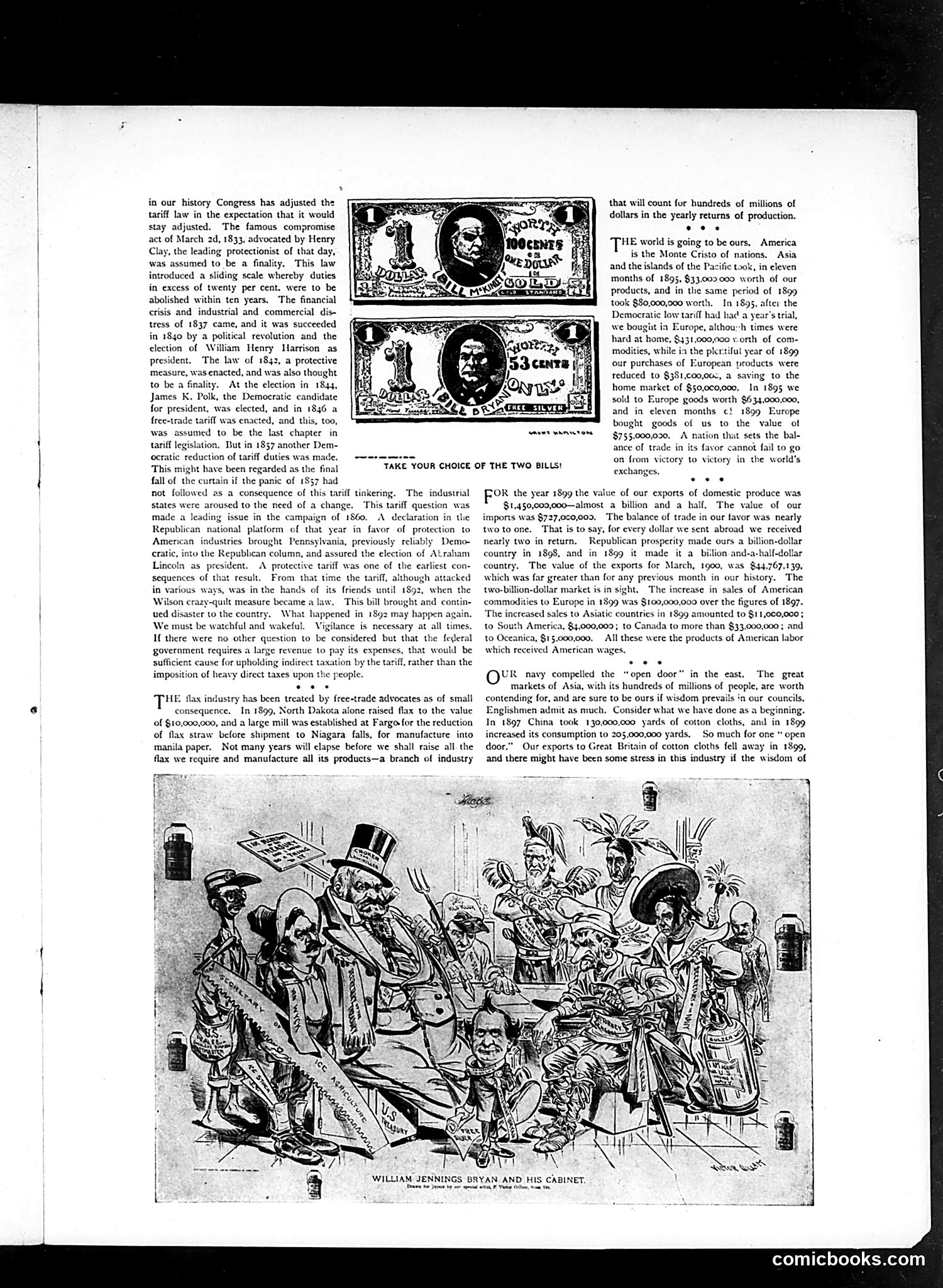
This page argues for **protective tariffs** against free-trade advocates, particularly targeting **William Jennings Bryan**, the Democratic presidential candidate shown caricatured at the bottom with his "Cabinet." The text celebrates America's trade dominance under Republican tariff policies—exports to Asia jumped from $33 million (1895) to $80 million (1899), while a protective tariff allegedly grew exports to $1.45 billion by 1899. The article criticizes the 1892 Wilson tariff (Democratic, low-tariff) as disastrous, contrasting it with Republican "prosperity." The cartoon depicts Bryan surrounded by grotesque, exaggerated international figures—caricatures representing foreign nations or interests—suggesting that Bryan's free-trade position serves foreign, not American, interests. The imagery implies that electing Bryan would surrender American economic advantage. The two currency images at top appear to contrast American strength with alternatives. **Context for modern readers:** This reflects the 1890s-1900 tariff debate between protectionists (Republicans) and free-traders (Democrats), with economic nationalism framed as patriotic prosperity.
📄 Transcribed text from this page (OCR, searchable)
Machine-transcribed from the original scan — historical spelling and the odd misread are preserved.
in our history Congress has adjusted the tariff law in the expectation that it would stay adjusted. The famous compromise act of March 2d, 1833, advocated by Henry Clay, the leading protectionist of that day, as assumed to be a finality, This law introduced a sliding scale whereby duties in excess of twenty per cent. were to be abolished within ten years. The financial crisis and industrial and commercial dis- that will count fur hundreds of millions of dollars in the yearly returns of production. eee THE world is going to be ours, America is the Monte Cristo of nations. Asia and the islands of the Pacific took, in eleven months of 1895, $33,002.00 worth of our products, and in the same period of 1899 took $80,000,000 worth. In 1895, after the tress of 1837 came, and it was succeeded in 1840 by a political revolution and the election of William Henry Harrison as president. The law of 1852, a protective measure, was enacted, and was also thought to be a finality. At the election in 1844, James K. Polk, the Democratic candidate for president, was clected, and in 1846 a free-trade tariff was enacted, and this, too, was assumed to be the last chapter in tariff legislation, But in 1857 another Dem- ocratic reduction of tariff duties was made. This might have been regarded as the final fall of the curtain if the panic of 1857 had not followed 2s a consequence of this tariff tinkeri states were aroused to the need of a change. made a leadi The industrial This tariff question was ue in the campaign of 1860. A declaration in the ional platform of that year ia favor of protection to Wwania, previously reliably Demo- d assured the election of ALraham A protective tariff was one of the earliest con- result, From that time the tariff, although attacked in various ways, was inthe hands of its friends until 1892, when the Wilson crazy-quilt measure became a law. This bill brought and contin- ued disaster to the country. What happened in 1892 may happen a We must be watchful and wakeful. Vigilance is nec Lincoln as president. sequences of th that the federal expenses, that would be HE: flax industry has been treated by free-trade advocates as of small consequence. In 1899, North D: ised flax to the value of $10,000,000, and a large mill was established at Fargo-for the reduction of flax straw before shipment to Niagara falls, for manufacture into manila paper. Not many years will elapse before we shall raise all: the flax we require and manufacture all its products—a branch of industry | is TAKE YOUR CHOICE OF THE TWO BILLS! WILLIAM JENNINGS BRYAN AND HIS CABINET. Democratic low tariff had had a year’s trial, we bougit ia Europe, althou-h times were hard at home, $431,000,000 v.orth of com- modities, while ia the plentiful year of 1899 our purchases of European products were reduced to $3S1,coo,occ, a saving to the home market of $50,000,000. In 1895 we sold to Europe goods worth $6 34,000,000, and in eleven months c! 1899 pe bought goods of us to the value of steer wansren — §755,000,030. A nation that sets the bal- ance of trade in its favor cannot fail to go on {rom victory to victory in the world’s exchanges. FOR the year 1899 the value of our exports of domestic produce was $1.450,000,000—almost a billion and a half. The value of our imports was $727,0¢0,002. The balance of trade in our tavor was nearly two to one. That is to say, for every dollar we sent abroad we received nearly two in return, Republican prosperity made ours a billion-dollar country in 1898, and in 1899 it made it a billion -dollar country. The value of the exports for March, 1900, was $44,767.139, which was far greater than for any previous month in our history. The two-billion-dollar market is in sight. The increase in sales of American commodities to Europe in 1899 was $100,000,000 over the figures of 1897. ‘The increased sales to Asiatic countries in 1899 amounted to $11,060,000 ; to South America, $4,000,009; to Canada to more than $33,000,000 ; and to Oceanica, $15,000,000. All these were the products of American labor which received American wages. QUE navy compelled the “open door” in the east. The great markets of Asia, with its hundreds of millions of people, are worth contending for, and are sure to be ours if wisdom prevails in our councils. Englishmen admit as much. Consider what we have done as a beginning. In 1897 China took 130,000,000 yards of cotton cloths, and in 1899 increased its consumption to 203,000,000 yards. So much for one * open door.” Our exports to Great Britain of cotton cloths fell away in 1899, and there might have been some stress in this industry if the wisdom of comicbooks.com