
Judge, 1900 · page 7 of 22
Judge — 1900 — page 7: what you’re looking at
What you’re looking at
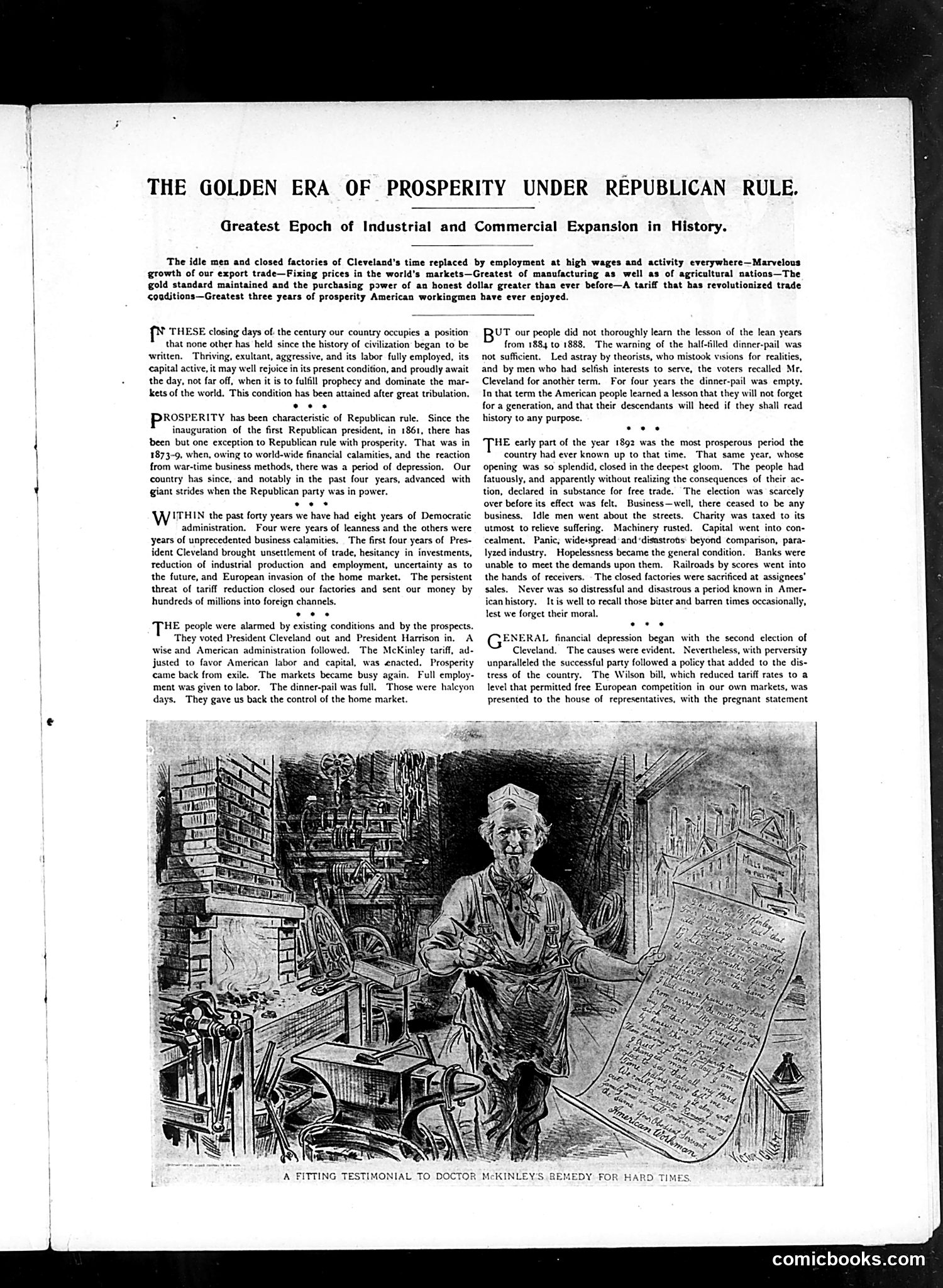
This is Republican Party campaign propaganda from Judge magazine, likely from 1896 or shortly after. The text praises Republican economic policy, particularly McKinley's protective tariff, while blaming Democratic administrations—especially Cleveland's—for economic hardship. The central illustration depicts a working man amid industrial machinery and ledgers, captioned as "A Fitting Testimonial to Doctor McKinley's Remedy for Hard Times." This is pro-McKinley political advertising disguised as editorial content. The satire targets Democratic free-trade policies. The repeated phrase "dinner-pail was full/empty" was contemporary political shorthand for worker prosperity. Republicans claim their tariff protects American labor and factories, while Democratic rule brought unemployment and suffering. The article blames Cleveland's 1892-1896 term for economic depression, crediting McKinley's 1897 tariff with restoration of prosperity—a common Republican talking point, though historical economists debate whether tariffs or other factors drove the recovery. This represents partisan media advocacy common in the Gilded Age.
📄 Transcribed text from this page (OCR, searchable)
Machine-transcribed from the original scan — historical spelling and the odd misread are preserved.
THE GOLDEN ERA OF PROSPERITY UNDER REPUBLICAN RULE. Greatest Epoch of Industrial and Commercial Expansion in History. The idle men and closed factories of Cleveland's time replaced by employment at high wages and activity everywhere—Marvelous growth of our export trade—Fixing prices in the world’s markets—Greatest of manufacturing as well as of agricultural nations—The gold standard maintained and the purchasing power of an honest dollar greater than ever before—A tariff that has revolutionized trade coaditions—Greatest three years of prosperity American workingmen have ever enjoyed. rT ‘THESE closing days of. the century our country occupies a position that none other has held since the history of civilization’ began to be written. Thriving, exultant, aggressive, and its labor fully employed, its capital active, it may well rejoice in its present condition, and proudly await the day, not far off, when it is to fulfill prophecy and dominate the mar- kets of the world. This condition has been attained after great tribulation. eee PROSPERITY has been characteristic of Republican rule. Since the inauguration of the first Republican president, in 1861, there has deen but one exception to Republican rule with prosperity. That was in 1873-9, when, owing to world-wide financial calamities, and the reaction from war-time business methods, there was a period of depression, Our country has since, and notably in the past four years, advanced with giant strides when the Republican party was in power. eee WITHIN the past forty years we have had eight years of Democratic administration. Four were years of leanness and the others were years of unprecedented business calamities. ‘The first four years of Pres ident Cleveland brought unsettlement of trade, hesitancy in investments, reduction of industrial production and employment, uncertainty as to the future, and European invasion of the home market, The persistent threat of tariff reduction closed our factories and sent our money by hundreds of millions into foreign channels. eee THE people were alarmed by existing conditions and by the prospects. They voted President Cleveland out and President Harrison in, A wise and American administration followed. The McKinley tariff, ad- justed to favor American labor and capital, was enacted. Prosperity came back from exile. The markets became busy again. Full employ- ment was given to labor. The dinner-pail was full. Those were halcyon days. They gave us back the control of the home market. BUT our people did not thoroughly learn the lesson of the lean years from 1884 to 1888, The warning of the half-filled dinner-pail was not sufficient. Led astray by theorists, who mistook visions for realities, and by men who had selfish interests to serve, the voters recalled Mr. Cleveland for another term. For four years the dinner-pail was empty. In that term the American people learned a lesson that they will not forget for a generation, and that their descendants will heed if they shall read history to any purpose. eae THE carly part of the year 1892 was the most prosperous period the country had ever known up to that time, That same year, whose opening was so splendid, closed in the deepest gloom. ‘The people had fatuously, and apparently without realizing the consequences of their ac- tion, declared in substance for free trade. The election was scarcely over before its effect was felt, Business—well, there ceased to be any business. Idle men went about the streets. Charity was taxed to its utmost to relieve suffering. Machinery rusted. Capital went into con- cealment. Panic, widespread and ‘disastrots beyond comparison, para- lyzed industry. Hopelessness became the general condition. Banks were unable to meet the demands upon them. Railroads by scores went into the hands of receivers. . The closed factories were sacrificed at assignees’ sales, Never was so distressful and disastrous a period known in Amer= ican history. It is well to recall those bitter and barren times occasionally, lest we forget their moral. G NERAL financial depression began with the second election of Cleveland. ‘The causes were evident. Nevertheless, with perversity unparalleled the successful party followed a policy that added to the dis- tress of the country. The Wilson bill, which reduced tariff rates to a level that permitted free European competition in our own markets, was presented to the house of representatives, with the pregnant statement A FITTING TESTIMONIAL TO DOCTOR McKINLEY'S REMEDY FOR HARD TI comicbooks.com