
Judge, 1900 · page 9 of 22
Judge — 1900 — page 9: what you’re looking at
What you’re looking at
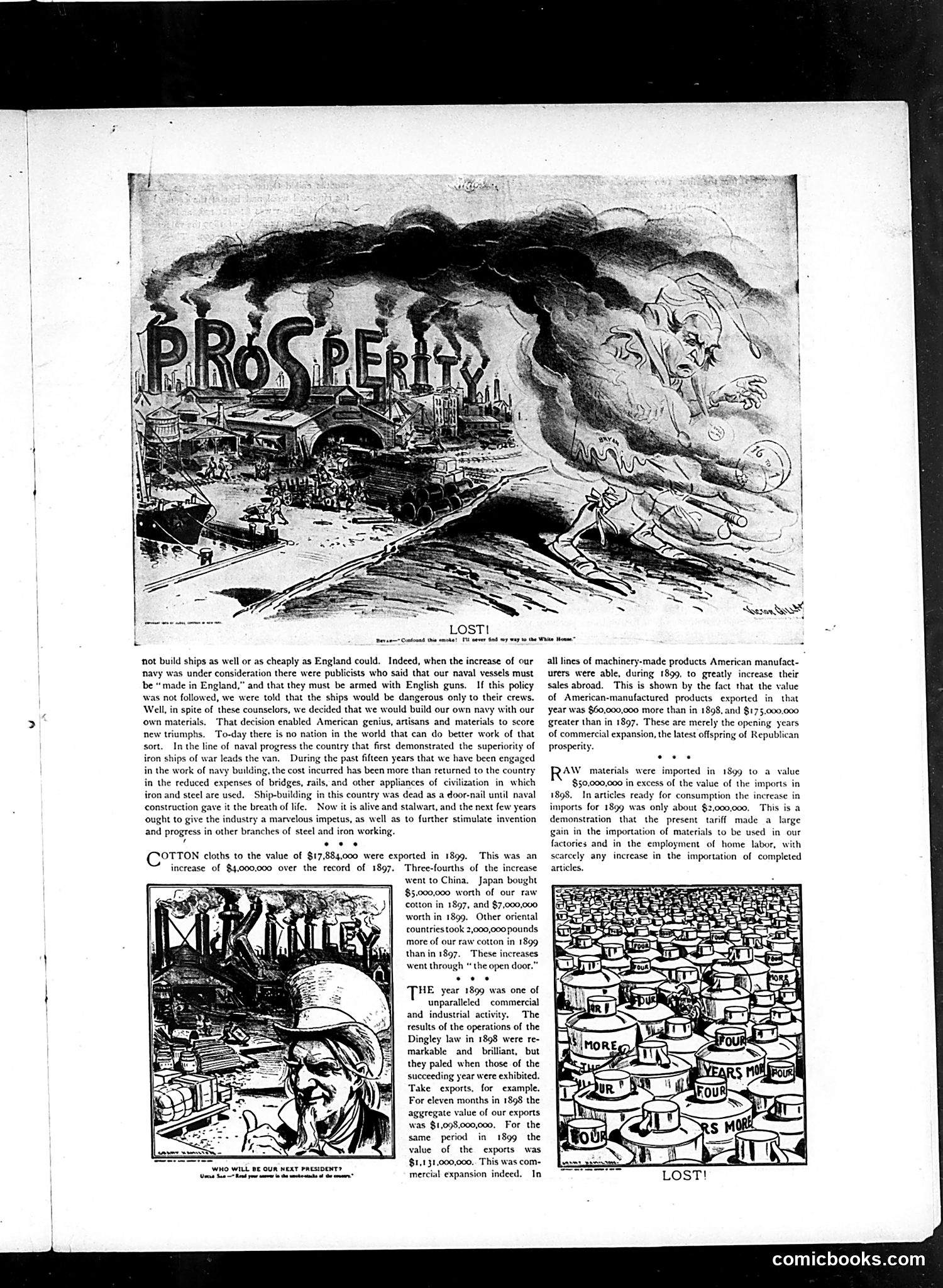
This page celebrates Republican economic policies, specifically the **Dingley Tariff of 1897**. The top cartoon depicts "Prosperity" as a cornucopia figure showering wealth upon an industrial American cityscape, contrasting with a drowning figure labeled "LOST!"—representing the opposing Democratic position. The text boasts of American naval shipbuilding superiority (countering critics who said American-made ships were inferior), cotton exports to China and Japan, and record export values in 1899 ($1.131 billion). The smaller illustrations show a prosperous McKinley-era worker and barrels of goods, emphasizing manufacturing success. The cartoons argue that protective tariffs enabled American industry to flourish domestically while still achieving massive exports—framing this as "Republican prosperity." The "LOST!" imagery suggests Democrats' alternative policies would have been economically ruinous. This is straightforward partisan advocacy celebrating incumbent Republican economic achievements.
📄 Transcribed text from this page (OCR, searchable)
Machine-transcribed from the original scan — historical spelling and the odd misread are preserved.
not build ships as well or as cheaply as England could. Indeed, when the increase of our navy was under consideration there were publicists who said that our naval vessels must be “made in England,” and that they must be armed with English guns. If 1 was not followed, we were told that the ships would be dangerous only to their crews. Well, in spite of these counselors, we decided that we would build our own navy with our own materials, That decision enabled American genius, artisans and materials to score new triumphs. To-day there is no nation in the world that can do better work of that sort. In the line of naval progress the country that first demonstrated the superiority of iron ships of war leads the van, During the past fifteen years that we have been engaged in the work of navy building, the cost incurred has been more than returned to the country in the reduced expenses of bridges, rails, and other appliances of civilization in which iron and steel are used. Ship-building in this country was dead as a door-nail until naval construction gave it the breath of life. Now it is alive and stalwart, and the next few years ought to give the industry a marvelous impetus, as well as to further stimulate invention and progress in other branches of steel and iron working. COTTON cloths to the value of $17,884,000 were exported in 1899. This was an increase of $4,000,000 over the record of 1897. Three-fourths of the incr went to China. Japan bot $5,000,000 worth of our raw cotton in 1897, and $7,000,000 worth in 1899. Other oriental countries took 2,000,000 pounds more of our raw cotton in 1899 than in 1897. These increases went through “the open door.” se HE. year 1899 was one of unparalleled commercial and industrial activity. The results of the operations of the Dingley law in 1898 were re- markable and brilliant, but they paled when those of the succeeding year were exhibited. Take exports, for example. For eleven months in 1898 the aggregate value of our exports was $1,098,000,000. For the same period in 1899 the value of the exports was $1,131,000,000.. This was com- mercial expansion indeed. In (WHO WILL BE OUR NEXT PRESIDENT? na ee" Rend yu sn te conto oo ea ® all lines of machinery-made products American manufact- urers were able, during 1899, to greatly increase their sales abroad. This is shown by the fact that the value of American-manufactured products exported in that year was $60,000,000 more than in 1898, and $175,000,000 greater than in 1897. These are merely the opening years of commercial expansion, the latest offspring of Republican prosperity. RAW materials were imported in 1899 t0 a value $50,000,000 in excess of the value of the imports in 1898. In articles ready for consumption the increase in imports for 1899 was only about $2,000,000. This is a demonstration that the present tariff made a la gain in the importation of materials to be used in our factories and in the employment of home labor, with scarcely any increase in the importation of completed articles. comicbooks.com