
Judge, 1900 · page 8 of 22
Judge — 1900 — page 8: what you’re looking at
What you’re looking at
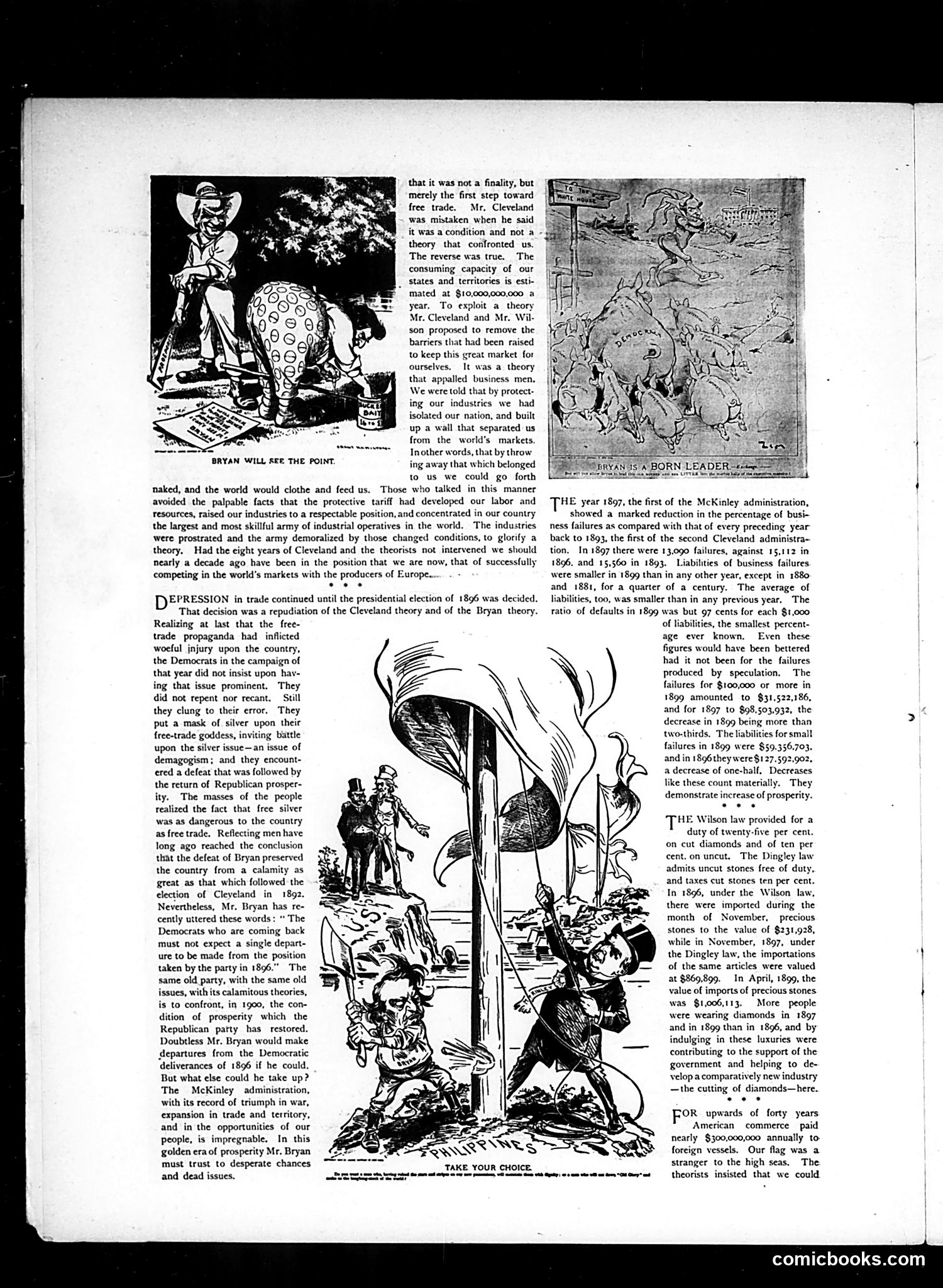
This page critiques the Cleveland and Bryan administrations' free-trade policies. The top-left cartoon, "Bryan Will See the Point," depicts William Jennings Bryan as naive—a figure being led by Lady Liberty toward economic ruin, suggesting his free-trade ideology blindly serves destructive ends. The text argues Cleveland and Bryan's removal of protective tariffs damaged American industry and caused business failures. The opposing cartoon, "Take Your Choice," presents two paths: one leads to prosperity (implicitly under McKinley's protectionist policies), the other to collapse. The right-side statistics support protectionism by showing improved business conditions after McKinley's 1897 election, citing reduced failure rates and smaller liabilities. The page essentially argues that protecting domestic industries—not free trade—built American prosperity and that Bryan's theory-driven approach was economically catastrophic.
📄 Transcribed text from this page (OCR, searchable)
Machine-transcribed from the original scan — historical spelling and the odd misread are preserved.
that it was not a finality, but merely the first step toward free trade. Mr. Cleveland was mistaken when he said it was a condition and not a theory that confronted us. The reverse was true. The consuming capacity of our _ States and territories is esti- mated at $10,000,000,000 a year. To exploit a theory Mr. Cleveland and Mr. Wil- son proposed to remove the barriers that had been raised to keep this great market for ourselves, It was a theory that appalled business men, We were told that by protect- ing our industries we had isolated our nation, and built up a wall that separated us from the world’s markets Inother words, that by throw ing away that which belonged to us we could go forth naked, and the world would clothe and feed us. Those who talked in this manner avoided the palpable facts that the protective tariff had developed our labor and THE year 1897, the first of the McKinley administration, Tesources, raised our industries to a respectable position, and concentrated in our country showed a marked reduction in the percentage of busi- the largest and most skillful army of industrial operatives in the world. The industries ness failures as compared with that of every preceding year were prostrated and the army demoralized by those changed conditions, to glorify a back to 1893, the first of the second Cleveland administra~ theory, Had the eight years of Cleveland and the theorists not intervened we should tion. In 1897 there were 13,090 failures, against 15,112 in nearly a decade ago have been in the position that we are now, that of successfully 1896, and 15,560 in 1893. Liabilities of business failures competing in the world’s markets with the producers of Europe... . - were smaller in 1899 than in any other year, except in 1880 see and 1881, for a quarter of a century. The average of EPRESSION in trade continued until the presidential election of 1896 was decided. liabilities, too, was smaller than in any previous year. The That decision was a repudiation of the Cleveland theory and of the Bryan theory. ratio of defaults in 1899 was but 97 cents for each $1,000 Realizing at last that the free- of liabilities, the smallest percent- trade propaganda had inflicted age ever known, Even these woeful injury upon the country, figures would have been bettered the Democrats in the campaign of had it not been for the failures that year did not insist upon hav- produced by speculation, The ing that issue prominent. They failures for $100,000 or more in did not repent nor recant. Still 1899 amounted to $31,522,186, they clung to their error. They and for 1897 to $98,503,932, the put a mask of silver upon their decrease in 1899 being more than free-trade goddess, inviting battle two-thirds, The liabilities for small upon the silver issue—an issue of failures in 1899 were $59.356.703. demagogism; and they encount- and in 1896 they were $127.592,902, ered a defeat that was followed by a decrease of one-half, Decreases the return of Republican prosper like these count materially. They ity. The masses of the people demonstrate increase of prosperity. realized the fact that free silver cee was as dangerous to the country THE Wilson law provided for a as free trade, Reflecting men have duty of twenty-five per cent. long ago reached the conclusion on cut diamonds and of ten per that the defeat of Bryan preserved cent. on uncut, The Dingley law the country from a calamity as admits uncut stones free of duty, great as that which followed the and taxes cut stones ten per cent. election of Cleyeland in 1892. In 1896, under the Wilson law, Nevertheless, Mr. Bryan has re- there were imported during the cently uttered these words: “ The month of November, precious Democrats who are coming back stones to the value of $231,928, must not expect a single depart- while in November, 1897, under ure to be made from the position the Dingley law, the importations taken by the party in 1896." The of the same articles were valued same old party, with the same old at $869,899. In April, 1899, the issues, with its calamitous theories, value of imports of precious stones is to confront, in 1900, the con was $1,006,113. More people dition of prosperity which the were wearing diamonds in 1897 Republican patty has restored. and in 1899 than in 1896, and by Doubtless Mr. Bryan would make indulging in these luxuries were departures from the Democratic contributing to the support of the deliverances of 1896 if he could. government and helping to de- But what else could he take up? velop a comparatively new industry The McKinley administration, —the cutting of diamonds—here. with its record of triumph in war, cee expansion in trade and territory, and in the opportunities of our people, is impregnable. In this nearly $30,000,000 annually to golden era of prosperity Mr. Bryan foreign vessels. Our flag was a must trust to desperate chances Pee COUN CHOICE: stranger to the high seas. The arid "dead lesoes: etrnreeeetee ee EO SE oe ermeeemenccneres — theorists insisted that we could mete BRYAN WILL SEE THE POINT. OR upwards of forty years American commerce paid comicbooks.com