
Judge, 1900 · page 14 of 22
Judge — 1900 — page 14: what you’re looking at
What you’re looking at
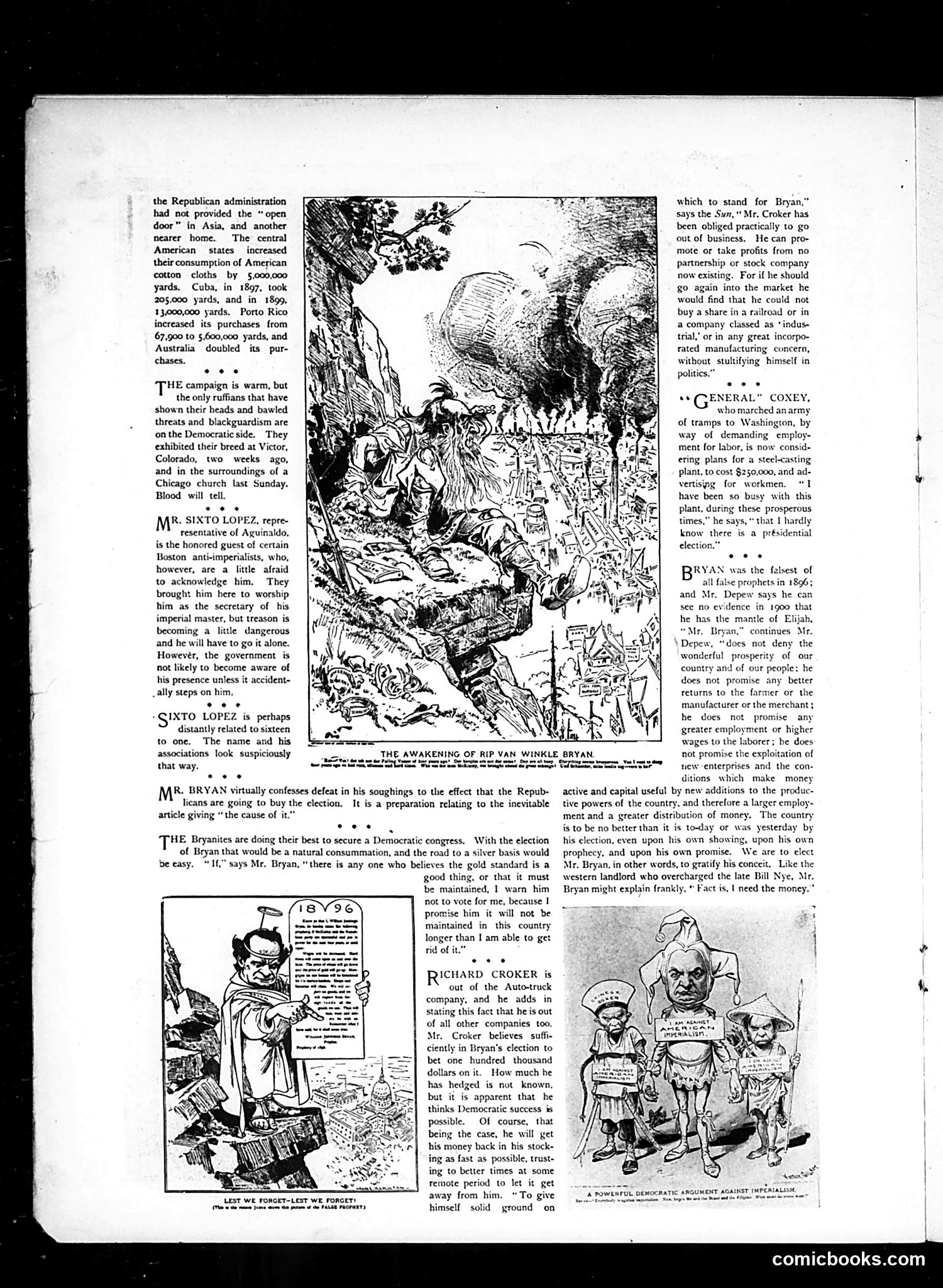
This 1900 page attacks William Jennings Bryan and Democratic candidates through multiple cartoons and commentary. **Main Figures:** - **Bryan** (referenced throughout): Democratic presidential candidate, depicted as "Rip Van Winkle"—sleeping through Republican prosperity - **Richard Croker**: Tammany Hall boss betting on Bryan while supposedly divesting from businesses - **General Coxey**: Former labor activist now running a steel plant, ignoring the election - **Sixto Lopez**: Filipino independence representative welcomed by Boston anti-imperialists (implicitly treasonous) **Key Political Points:** The satire argues Republicans have delivered economic success (increased cotton exports, prosperity) while Democrats resort to "blackguardism." Bryan's warnings about gold standards are mocked as outdated. Croker's large Bryan bet is portrayed as hypocritical—he claims to support Bryan yet remains entangled in capitalist ventures. The cartoons ridicule Democratic pessimism amid Republican prosperity.
📄 Transcribed text from this page (OCR, searchable)
Machine-transcribed from the original scan — historical spelling and the odd misread are preserved.
the Republican administration had not provided the “open door" in Asia, and another nearer home. The central American states increased their consumption of American cotton cloths by 5,000,000 yards, Cuba, in 1897, took 205,000 yards, and in 1899, 13,000,000 yards. Porto Rico increased its purchases from 67,900 to §,600,000 yards, and Australia doubled its pur- chases. eee ‘THE campaign is warm, but the only ruffians that have shown their heads and bawled threats and blackguardism are on the Democratic side. They exhibited their breed at Victor, Colorado, two weeks ago, and in the surroundings of a Chicago church last Sunday. Blood will tell. cee R. SIXTO LOPEZ, repre- resentative of Aguinaldo, is the honored guest of certain Boston anti-imperialists, who, however, are a little afraid to acknowledge him. They brought him here to worship him as the secretary of his imperial master, but treason is becoming a little dangerous and he will have to go it alone. However, the government is not likely to become aware of his presence unless it accident- ally steps on him. eee “GIXTO LOPEZ is perhaps distantly related to sixteen to one. The name and his associations look suspiciously that way. see article giving “the cause of it.” LEST WE FORCET-LEST WE FORCET! (rea me ons co ts pn PALA PRSPET) a Beaeeeres cee THE Bryanites are doing their best to secure a Democratic congress, With the election of Bryan that would be a natural consummation, and the road to a silver basis would be easy. “If,” says Mr. Bryan, “there is any one who believes the gold standard is a THE AWAKENING OF RIP VAN WINKLE BRYAN. sites RES go egos Sp mae R. BRYAN virtually confesses defeat in his soughings to the effect that the Repub- licans are going to buy the election. It is a preparation relating to the inevitable good thing, or that it must be maintained, 1 warn him not to vote for me, because | him it will not be intained in this country longer than I am able to get rid of it.” ICHARD CROKER is out of the Auto-truck company, and he adds in stating this fact that he is out of all other companies too. Mr. Croker believes suffi- ciently in Bryan's election to bet one hundred thousand dollars on it. How much he has hedged is not known, but it is apparent that he thinks Democratic success is possible. Of course, that being the case, he will get his money back in his stock- ing as fast as possible, trust- ing to better times at some remote period to let it get away from him. “To give himself solid ground on harlot which to stand for Bryan,” says the Sum,“ Mr. Croker has been obliged practically to go out of business. He can pro- mote or take profits from no partnership or stock company now existing. For if he should go again into the market he would find that he could not buy a share in a railroad or in a company classed as ‘indus trial,’ or in any great incorpo- rated manufacturing concern, without stultifying himself in politics.” +* GENERAL” COXEY, who marched anan of tramps to Washington, by way of demanding employ- ment for labor, is now con: ering plans for a steel-casting plant, to cost $250,000, and ad- vertising for workmen, “1 have been so busy with this plant, during these prosperous times,” he says,“ that I hardly know there is a présidential election.” BRYAN was the felsest of all false prophets in 1896; and Mr. Depew says he can see no evidence in 1900 that he has the mantle of Elijab. “Mr. Beyan,” continues Mr. \ Depew, “does not deny the wonderful ‘osperity of our country and of our people: he does not promise any better returns to the ner or the manufacturer or the merchant ; he does greater employ wages to the laborer; he does not promise the exploitation of new enterprises and the con- ditions which make money active and capital useful by new additions to the produc. tive powers of the country, and therefore a larger employ- ment and a greater distribution of money. The country is to be no better than it is today or was yesterday by his election. even upon his own showing, upon his own prophecy, and upon his own promise. We are to Mr. Bryan, in other words, to gratify his conceit. Like the western landlord who overcharged the late Bill Nye, Mr. Bryan might explain frankly, * Fact is, | need the money.” © any nt or higher TarEAACIsh. comicbooks.com