
A complete issue · 48 pages · 1900
Judge — December 22, 1900
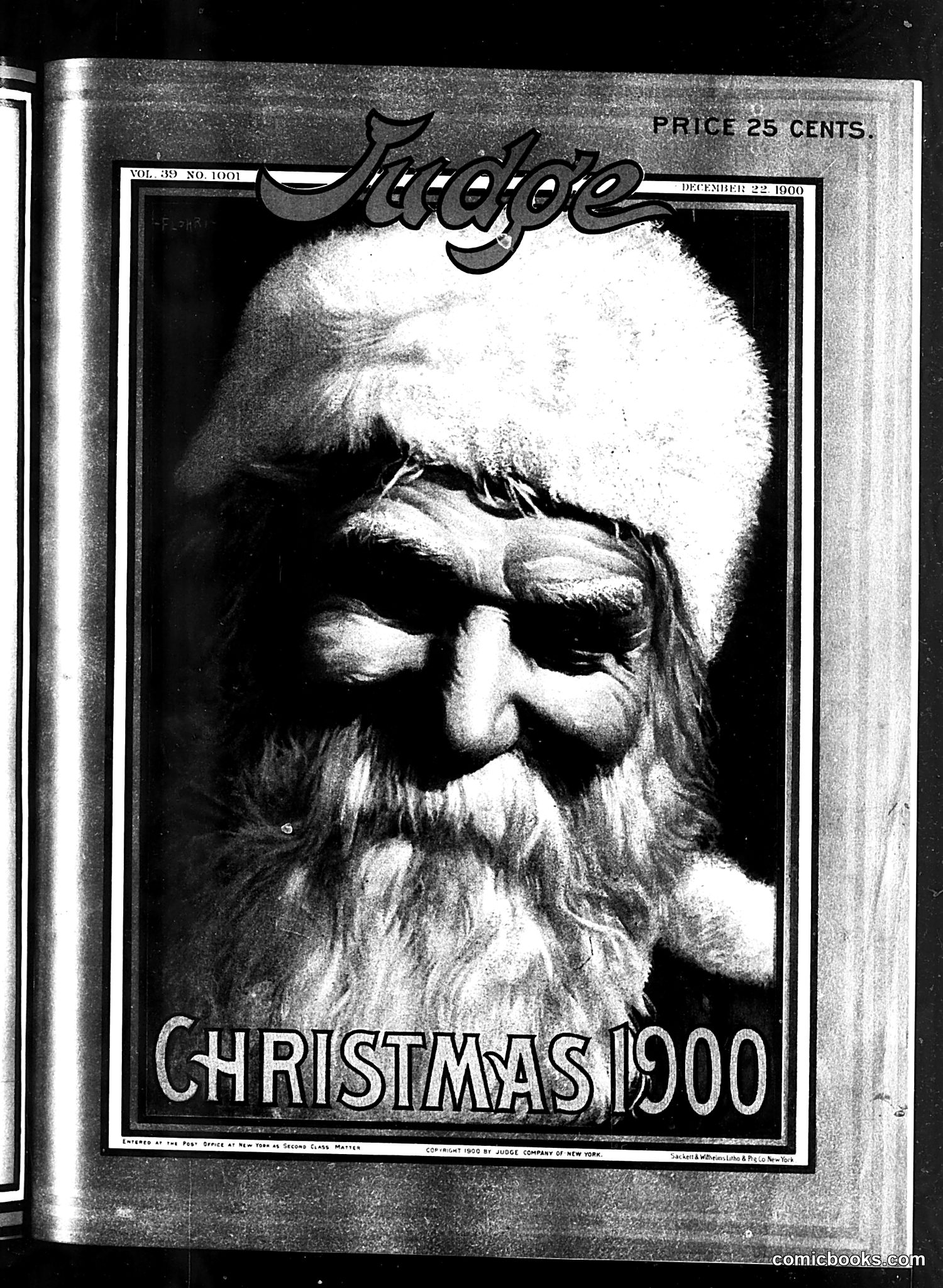
This is a **Christmas 1900 issue cover** (Vol. 39, No. 1001, December 22, 1900) featuring a portrait of **Santa Claus** with his characteristic long white beard, fur-trimmed coat, and sunglasses. The sunglasses are the notable satirical element—an unusual detail for a traditional Santa image. This likely represents a contemporary joke about modernity, technology, or perhaps a commentary on "modern times" at the turn of the century. The sunglasses may satirize changing customs or mock the commercialization of Christmas as the new century approached. The issue cost 25 cents and was published by the Judge Company of New York. Without additional OCR text visible, the specific satirical point remains somewhat unclear, though it appears to comment on Santa's adaptation to a new era.
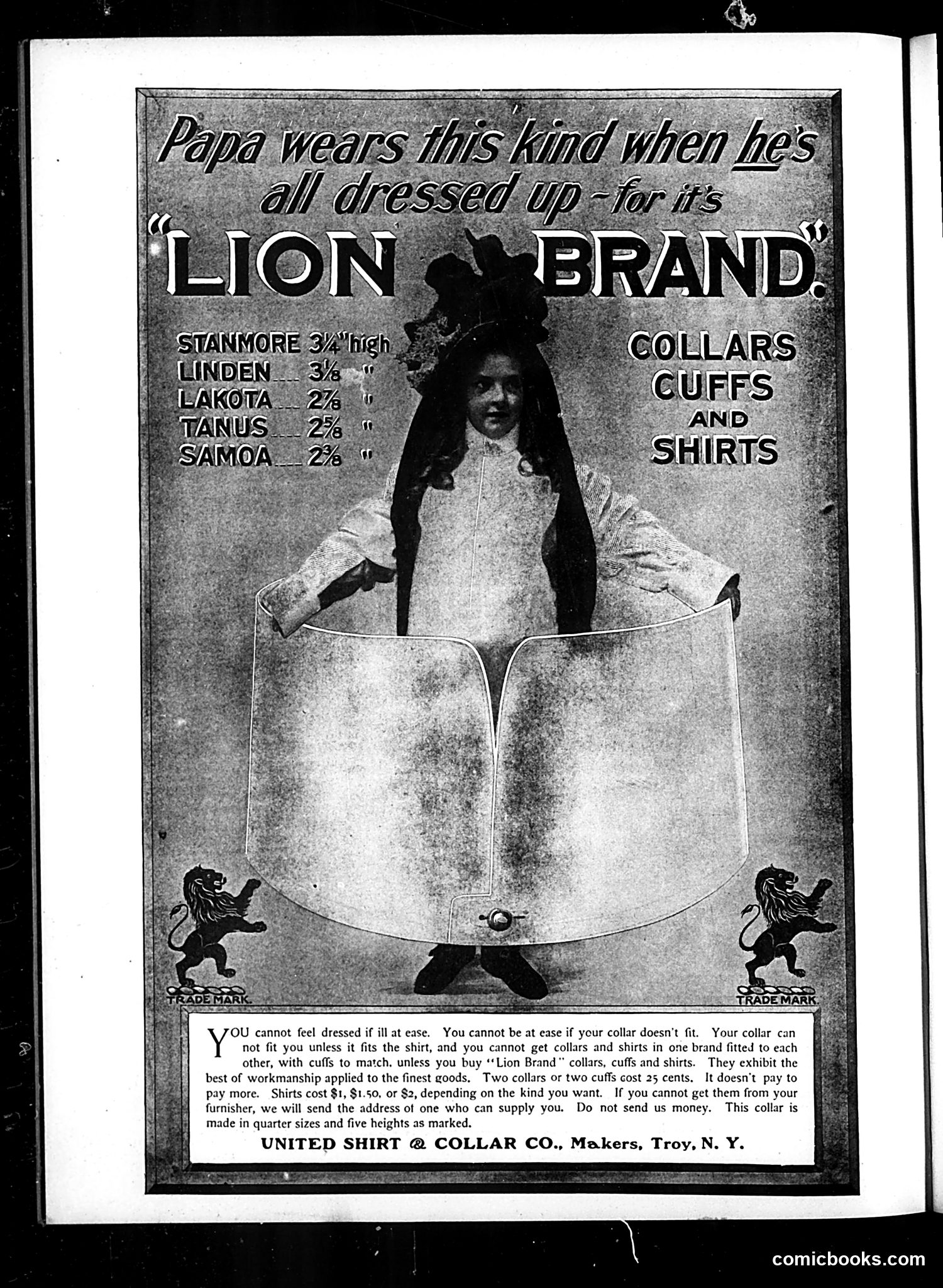
This is a **commercial advertisement**, not political satire. It promotes "Lion Brand" collars, cuffs, and shirts made by United Shirt & Collar Co. in Troy, New York. The ad uses a visual joke: a man emerges from an oversized collar like a "papa" getting dressed up. The humor plays on the idea that proper-fitting collars are essential to looking well-dressed—you "cannot feel dressed if it all ease" without the right collar. The ad lists various collar heights (Stanmore, Linden, Lakota, Tanus, Samoa) and emphasizes that Lion Brand offers coordinated collars, cuffs, and shirts at affordable prices ($1-$2 for shirts). This reflects early 1900s advertising strategy: using humor and visual exaggeration to promote practical menswear products in magazines like *Judge*.
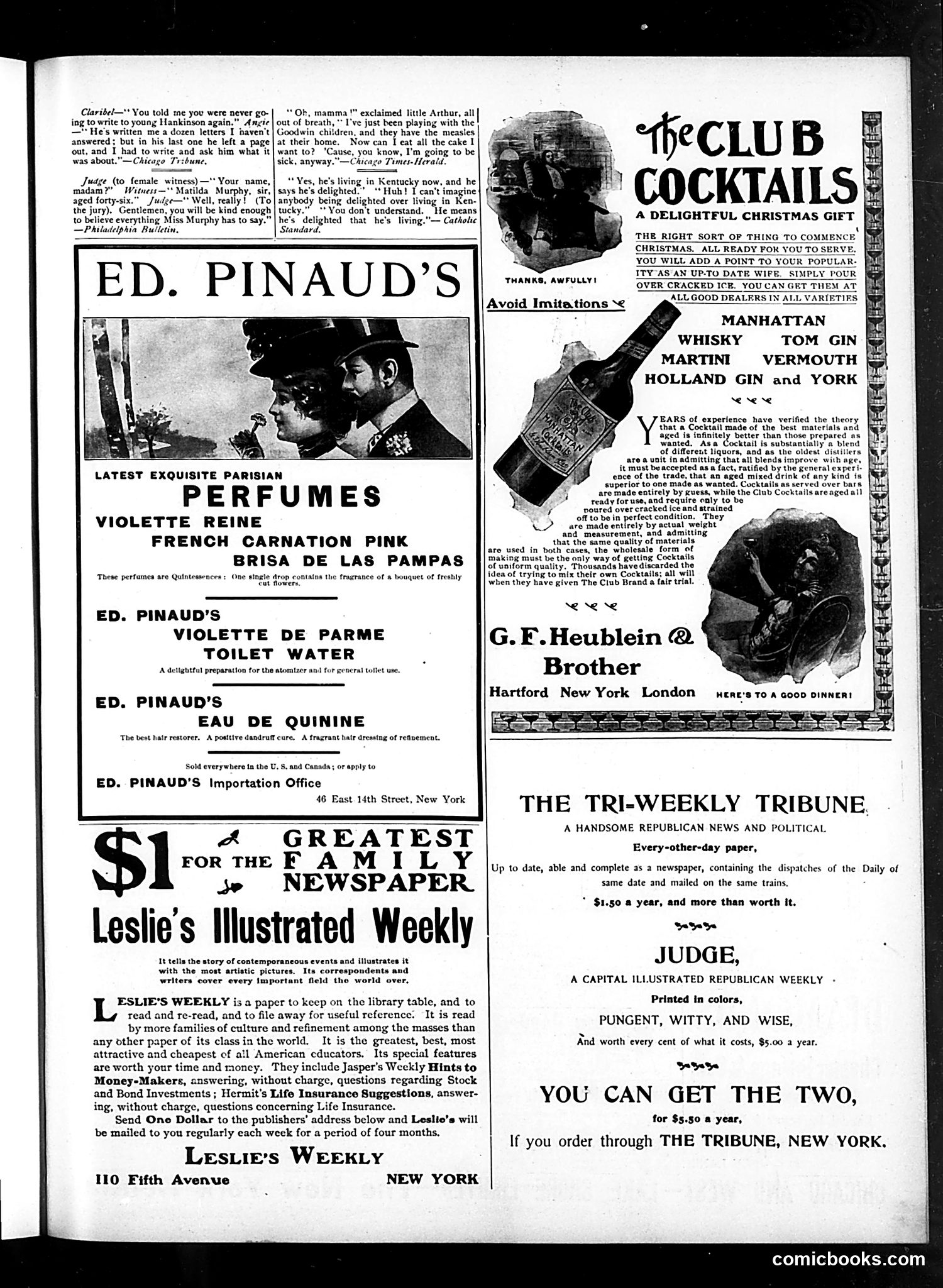
This page is primarily **advertising**, not political satire. It features: 1. **Ed. Pinaud's Perfumes & Toiletries** - A major advertisement for French beauty products (perfumes, toilet water, hair restorer) with an illustration of a mustachioed man in a top hat, likely representing the brand's Parisian sophistication. 2. **The Club Cocktails Advertisement** - Promotes pre-mixed cocktails (Manhattan, Tom Gin, Martini, etc.) as Christmas gifts, featuring two illustrated figures enjoying drinks. 3. **Leslie's Illustrated Weekly & Judge Magazine promotions** - Advertising competing publications. The page reflects early 20th-century consumer culture, emphasizing French luxury goods and modern convenience products (pre-made cocktails). No clear political satire or commentary is evident—this is straightforward commercial content typical of Judge's revenue model.
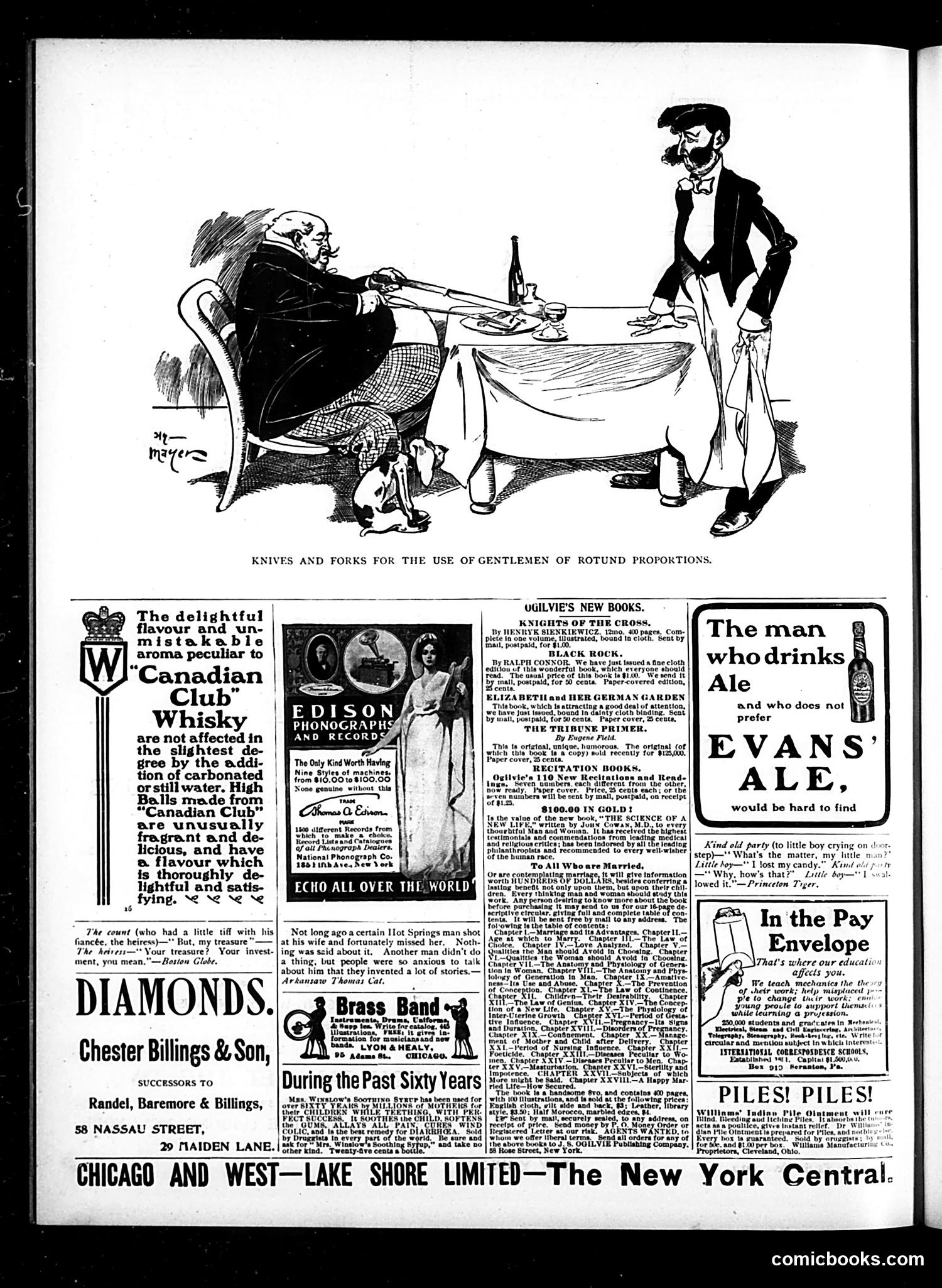
This cartoon satirizes wealthy, overweight men through dining etiquette humor. The illustration shows a portly gentleman seated at a table with an attentive server, with exaggerated utensils implied to suit his substantial girth. The caption plays on the absurdity of providing specialized dining implements for men of "rotund proportions"—essentially mocking obesity among the wealthy class. The joke reflects Judge magazine's satirical tradition of lampooning wealthy Americans, particularly the self-indulgent rich. The humor relies on physical caricature combined with mock-serious observation about luxury goods and class pretension. The surrounding advertisements (Canadian Club whisky, diamonds, Evans Ale) further underscore the magazine's focus on upscale consumption and the foibles of affluent readers, who were likely the magazine's primary audience.
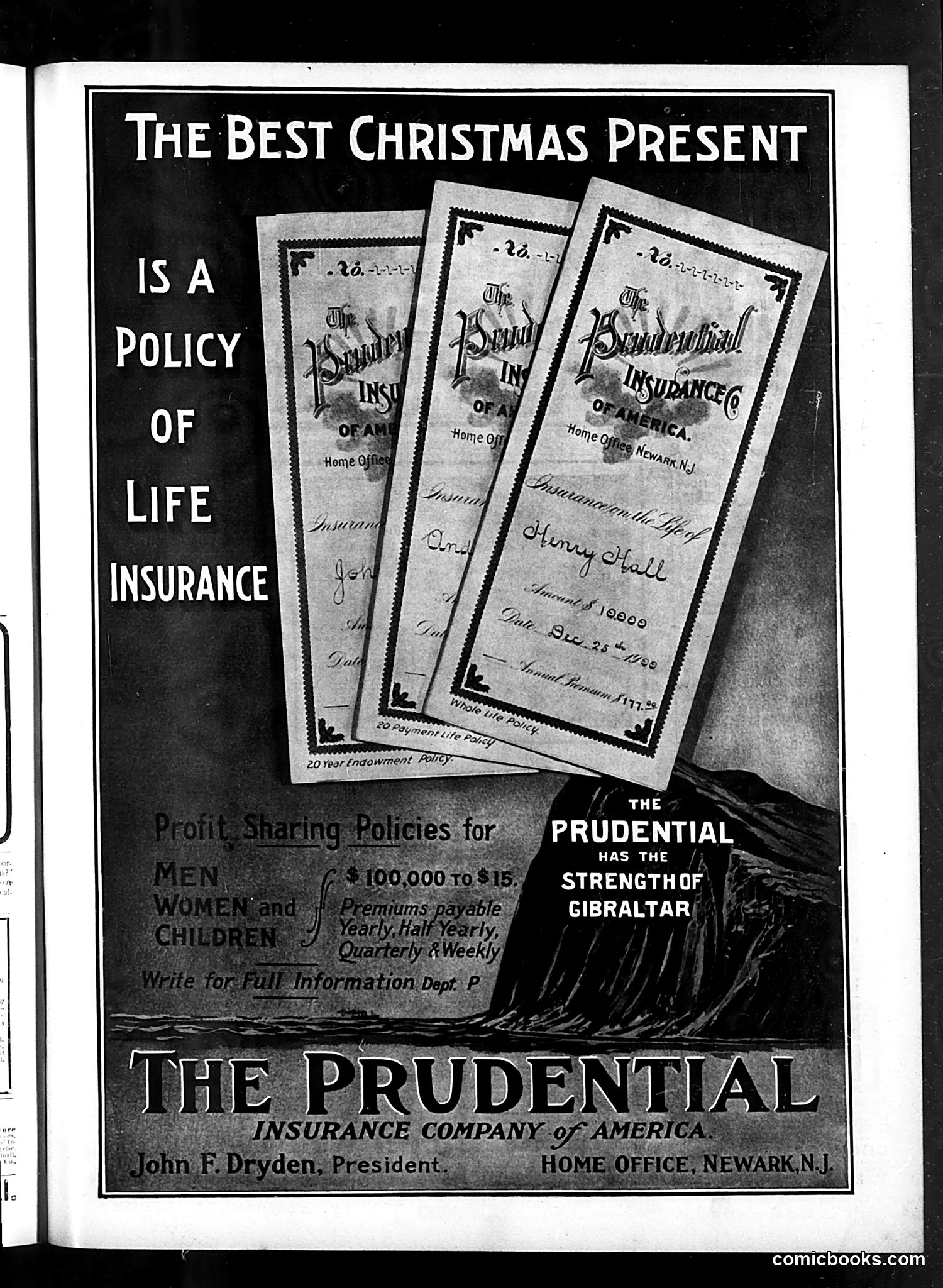
This is a **life insurance advertisement** rather than political satire. The Prudential Insurance Company of America presents life insurance policies as ideal Christmas gifts for families. The ad displays three sample insurance policy documents and promotes profit-sharing policies covering "$100,000 to $15" with flexible payment options (yearly, half-yearly, quarterly, weekly). It targets "Men, Women and Children" and invites readers to request full information. The tagline "The Prudential Has the Strength of Gibraltar" uses the famous Rock of Gibraltar as a metaphor for stability and security—a common advertising trope suggesting the company's reliability and permanence. The reference to "Christmas present" frames life insurance as thoughtful family protection, not merely financial product. This reflects early-20th-century attitudes toward insurance as a moral obligation ensuring dependents' welfare.
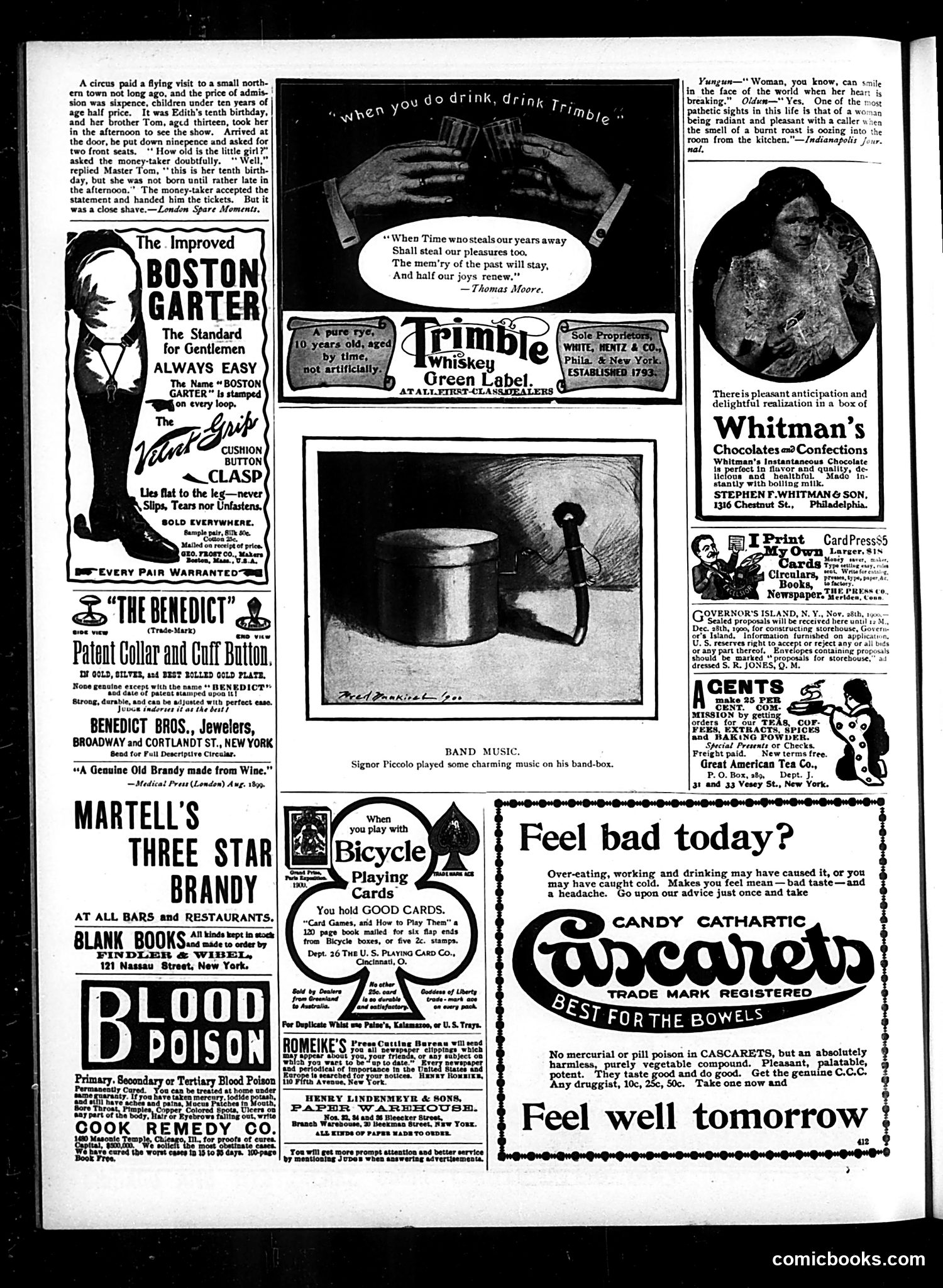
This page is primarily **advertisements** with minimal editorial content. The small story at top involves a boy cleverly getting his ten-year-old sister into a circus at half price by claiming she was "born late in the afternoon" of her birthday—a humorous anecdote about youthful deception. The ads reflect early 1900s consumer products: Trimble Whiskey (with period poetry), Boston Garters for men, Whitman's Chocolates, Benedict Bros. jewelry, Martell's Brandy, Cascarets (a laxative), and remedies for "blood poison" (likely syphilis treatment). A small illustration shows "Signor Piccolo" playing music on a band-box—apparently a novelty act or pun. The **Cascarets ad** is notable: it explicitly markets as an alternative to mercury treatments and "pill poisons," suggesting awareness of dangerous contemporary medical practices. Overall, this page demonstrates Judge's heavy reliance on patent medicine and luxury goods advertising rather than satirical content—typical of early 20th-century magazine economics.
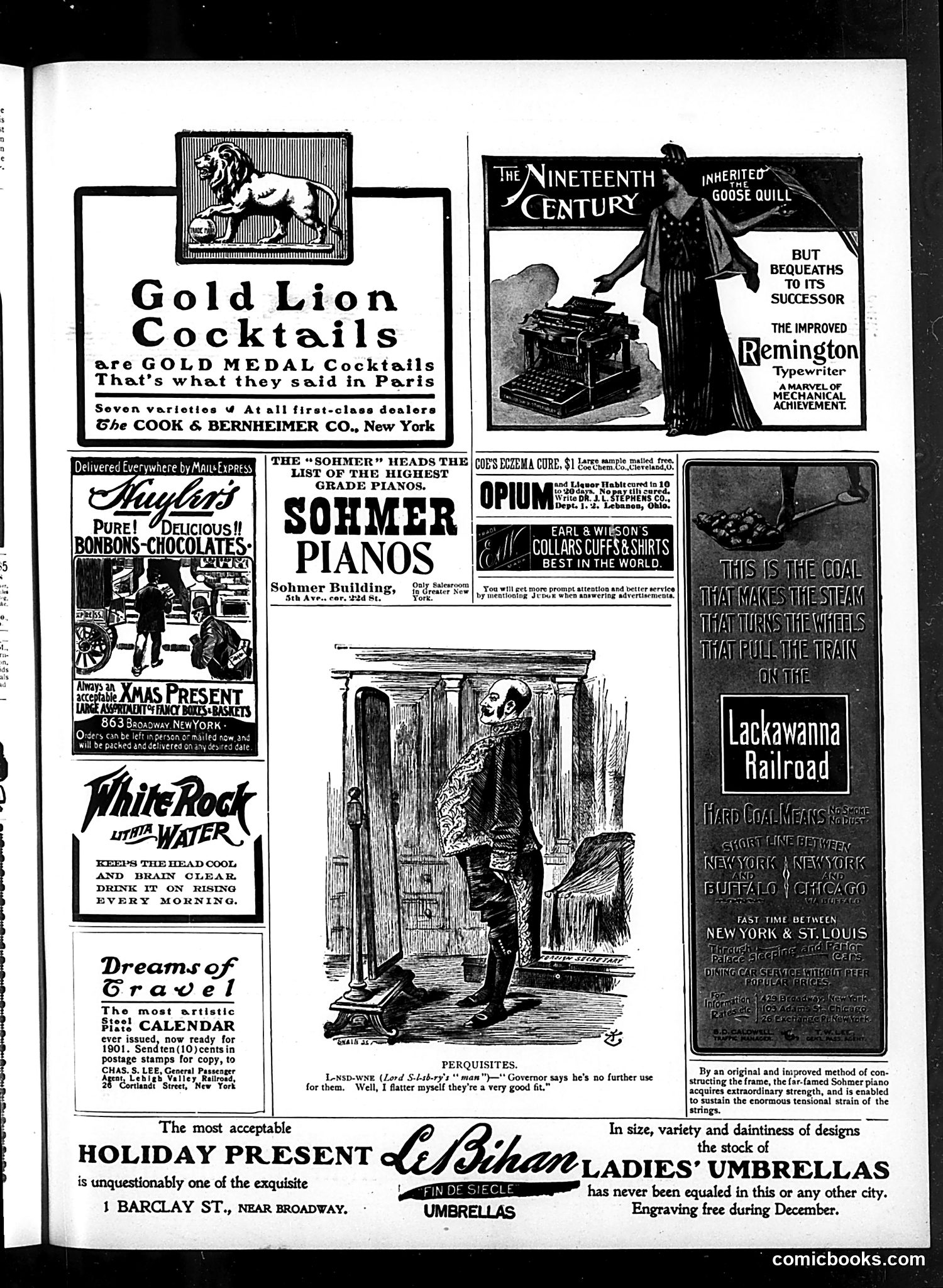
This page is predominantly **advertising rather than political satire**. It contains various commercial notices from early 1900s businesses: Sohmer Pianos, Gold Lion Cocktails, Remington Typewriters, and the Lackawanna Railroad among others. The one cartoon—a small central illustration labeled "Perquisites"—depicts a figure in formal dress stealing from what appears to be a classical building or institution. The caption jokes about ill-fitting items, suggesting petty theft of workplace perquisites (employee benefits or "borrowed" goods). This is mild social commentary on workplace theft rather than political satire. The page reflects Judge's mixed content model: serious advertising revenue alongside light satirical humor. The "Nineteenth Century Inherited Goose Quill" ad is tongue-in-cheek marketing, but the page lacks substantive political commentary typical of Judge's editorial cartoons.
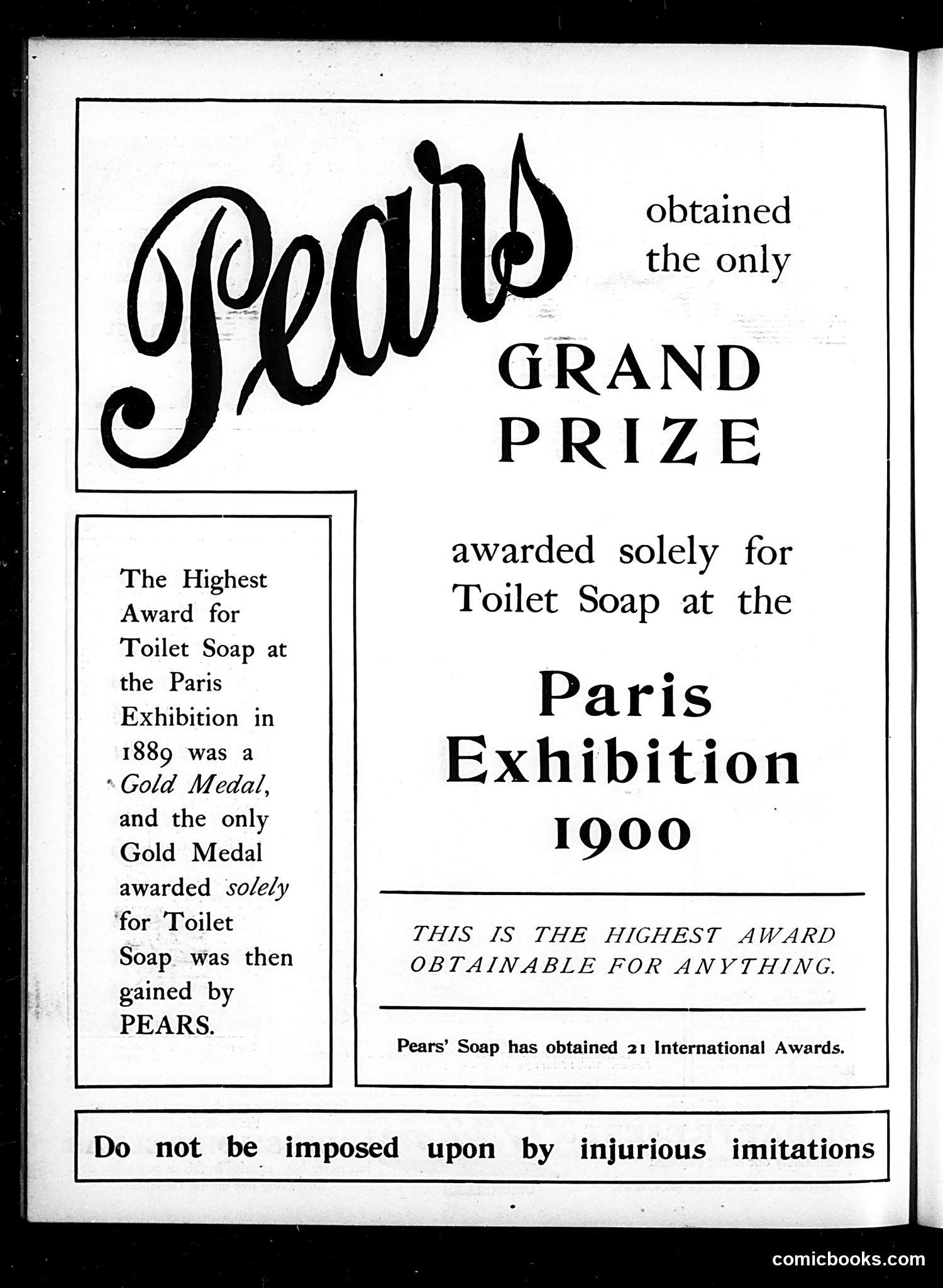
This is an advertisement, not satire. The page promotes Pears' Soap by emphasizing its prestigious awards. The text claims Pears obtained the only Grand Prize for toilet soap at the Paris Exhibition of 1900, described as "the highest award obtainable for anything." A sidebar notes that Pears previously won a Gold Medal—the sole Gold Medal awarded for toilet soap—at the 1889 Paris Exhibition. The ad boasts 21 total international awards. The final line warns consumers: "Do not be imposed upon by injurious imitations," suggesting competitors were capitalizing on Pears' reputation. This reflects genuine historical competition in late-19th-century soap marketing, where prizes and awards were heavily promoted to establish quality and trustworthiness to consumers.
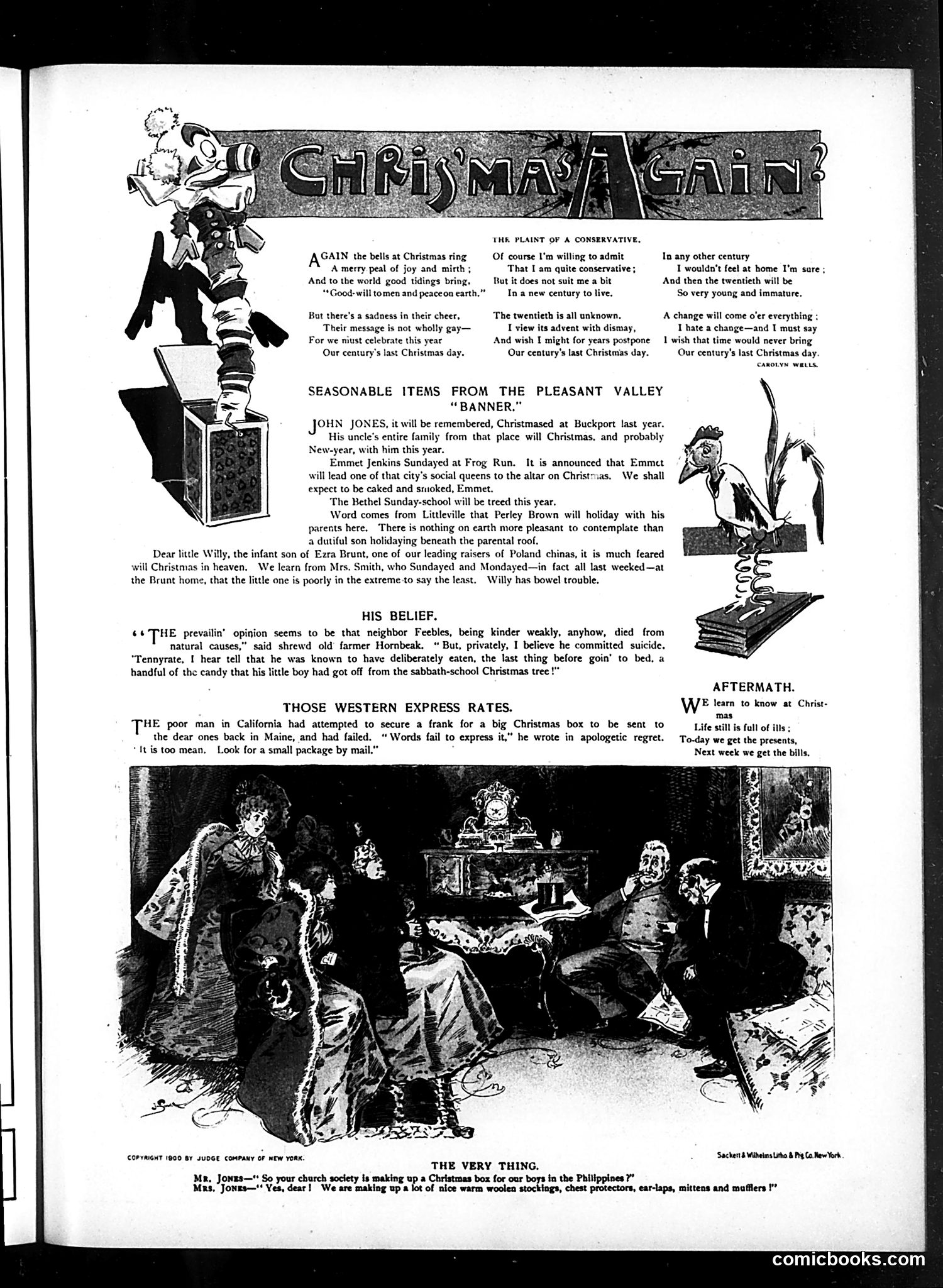
This page contains multiple Christmas-themed satirical pieces reflecting turn-of-the-century anxieties. **"The Plaint of a Conservative"** (top) mocks an elderly conservative lamenting the transition from the 1800s to the 1900s. The poem's speaker fears change and the "unknown" twentieth century—satirizing how older generations resist modernity. **"Seasonable Items"** presents faux-news briefs about local figures' holiday plans, including a darkly comic note about "dear little Willy" (an infant) feared to "Christmas in heaven" due to bowel trouble—mocking sentimental Victorian newspaper sentimentality. **"Those Western Express Rates"** jokes about prohibitive shipping costs preventing a California man from mailing a Christmas box east. **"The Very Thing"** (bottom cartoon) depicts church ladies preparing care packages of practical items (stockings, chest protectors) for American soldiers fighting in the Philippines—referencing the ongoing Philippine-American War (1899-1902). The satire suggests well-meaning but somewhat absurd charitable efforts. **"Aftermath"** humorously notes life's persistent hardships despite holiday cheer: "Next week we get the bills."
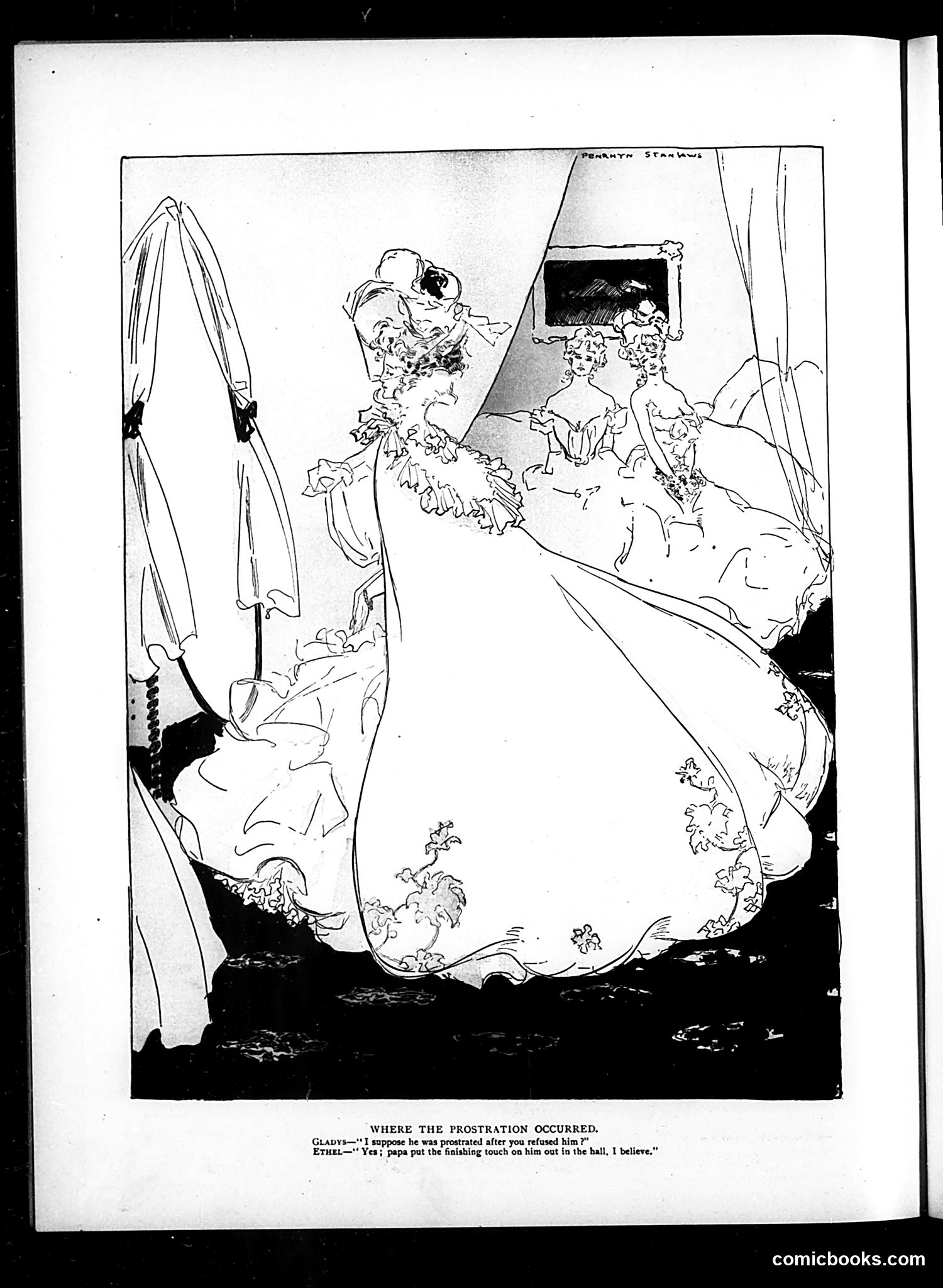
This cartoon depicts a domestic scene involving a marriage proposal rejection. Two women (labeled Gladys and Ethel) discuss a suitor's rejection and subsequent physical confrontation. The humor relies on the suggestion that Ethel's father physically assaulted the rejected suitor "out in the hall" as a form of paternal protection of his daughter's honor. The satire reflects late 19th/early 20th-century social attitudes: a father's violent response to an unwanted proposal was considered comedic rather than criminal. The term "prostration" plays on both emotional distress and literal physical defeat. The exaggerated illustration style, with the women in elaborate dress among draped furnishings, emphasizes the upper-class domestic setting where such incidents supposedly occurred.
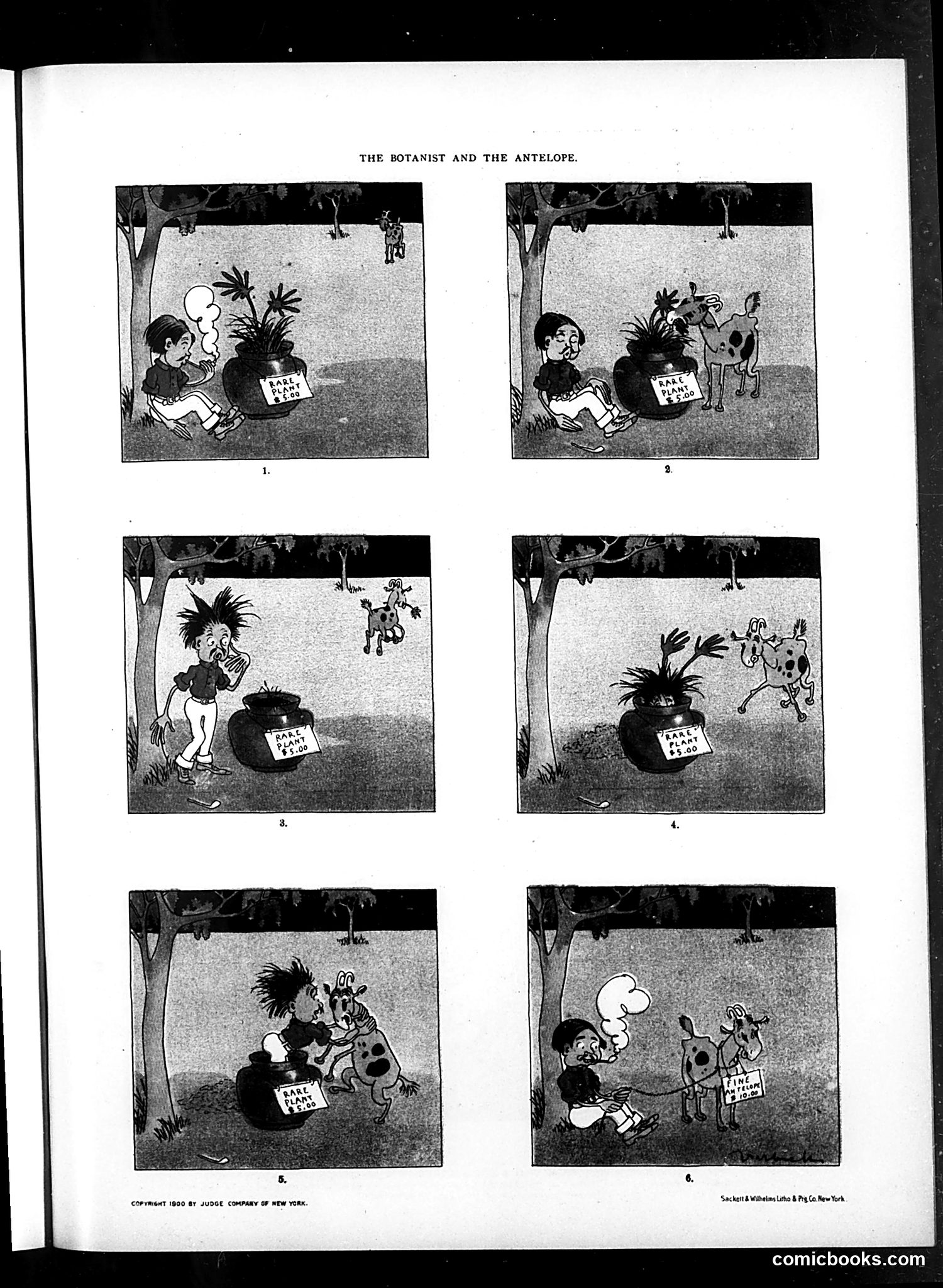
This six-panel comic strip depicts a child attempting to care for a potted plant labeled "RARE PLANT" while an antelope repeatedly interferes. The narrative shows the botanist's increasingly frantic efforts to protect the plant from the animal's destructive behavior—the antelope kicks it over, eats from it, and generally disrupts the gardening project across successive panels. The humor appears to rely on slapstick physical comedy: the contrast between the child's small, careful gestures and the antelope's chaotic disruption. The "rare plant" label suggests the joke may involve the incongruity of keeping exotic specimens in a backyard setting, complicated by an equally exotic animal visitor. Without additional context from Judge magazine's 1900 publication, the specific satirical target—if any—remains unclear.
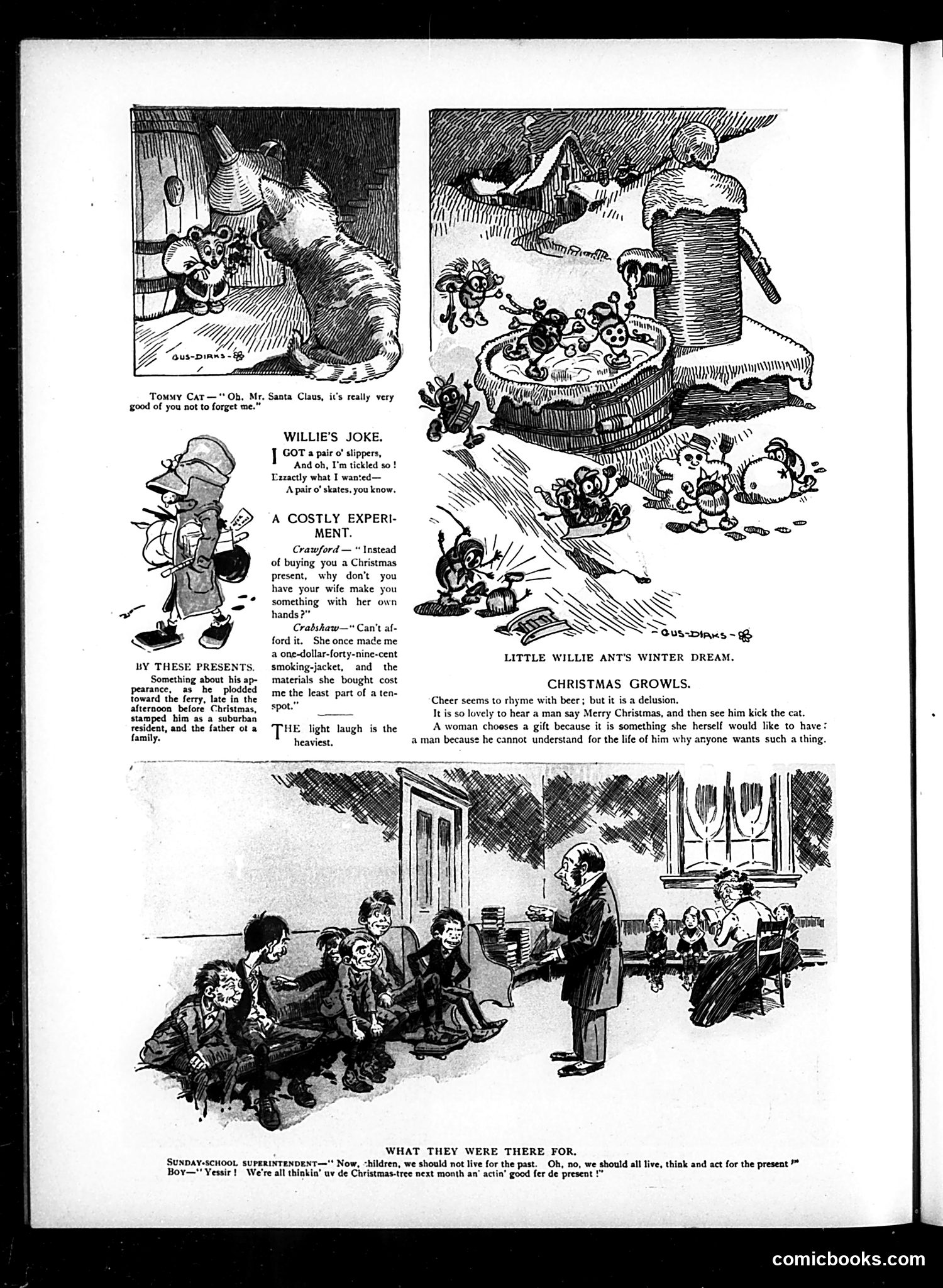
This page contains several Christmas-themed satirical pieces targeting domestic and social hypocrisy: **"Tommy Cat"** shows Santa ignoring a child for a cat—mocking the sentimental Christmas myth. **"Willie's Joke"** and **"Costly Experiment"** poke fun at gift-giving economics: Willie receives cheap skates he wanted, while Crabshaw's wife's homemade smoking jacket (marketed as heartfelt) actually costs him money—satirizing the gap between gift-giving sentiment and actual expense. **"Christmas Growls"** are cynical observations: people celebrate Christmas cheer while kicking cats; women gift what they want, men gift what women inexplicably desire. **"What They Were There For"** mocks Sunday school morality. The superintendent preaches living for the present, but the boy admits children only behave well now to earn the Christmas tree next month—exposing that childhood virtue is purely transactional, not genuine. The overall message: Christmas sentiment masks selfishness, expense, and manipulation in American family life.
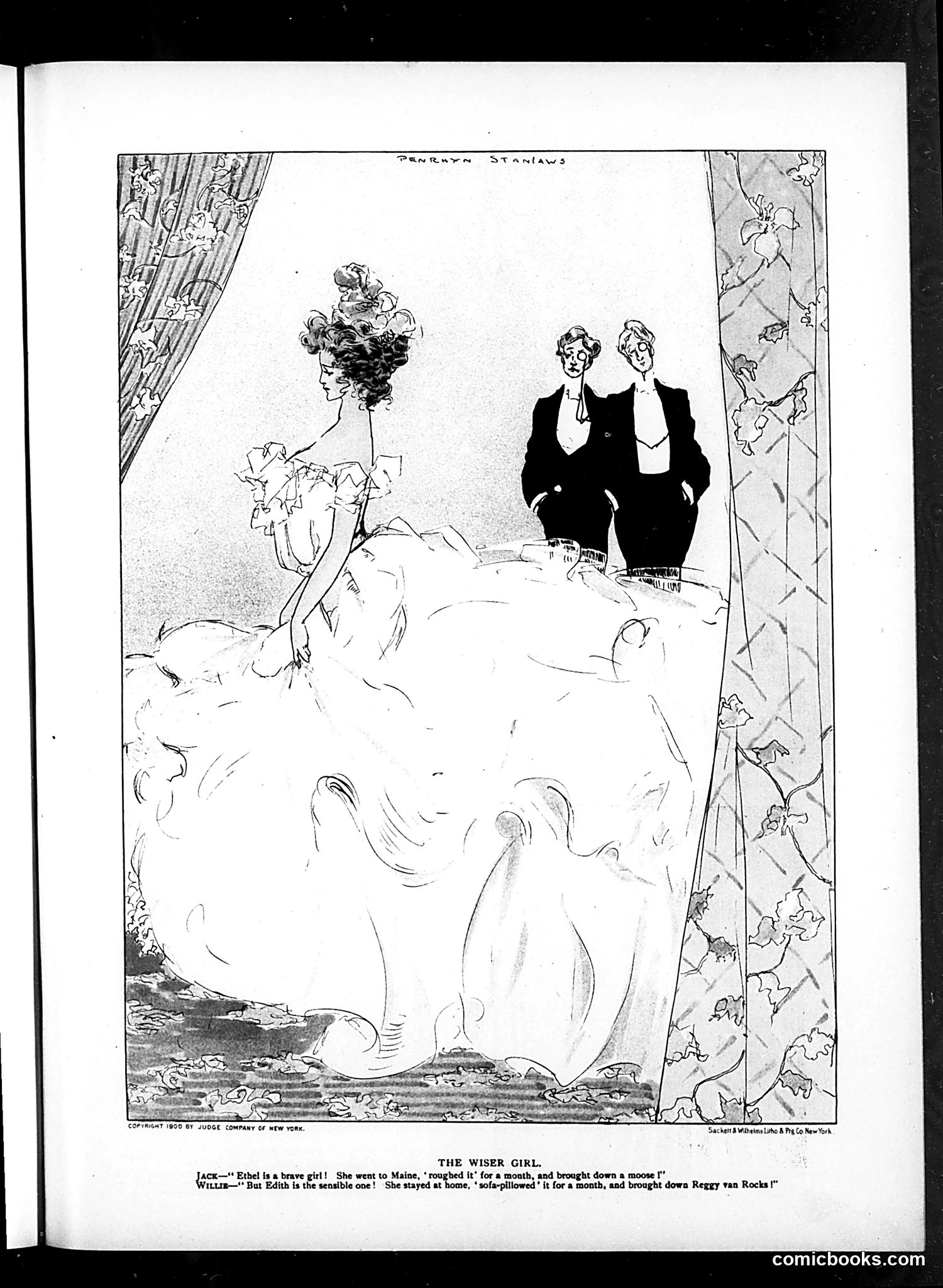
This cartoon satirizes competing attitudes toward female independence at the turn of the century. Two men discuss two girls: Ethel, who went to Maine for a month, "roughed it," and killed a moose—demonstrating adventurousness and self-sufficiency. Edith, meanwhile, stayed home among comfortable "sofa pillows" and secured an engagement to a wealthy man named Reggy van Rocks. The joke's title reveals the satire's target: despite progressive rhetoric celebrating female independence and outdoor adventure, the cartoon suggests that a woman's true "wisdom" lies in traditional marriage to a wealthy suitor. The contrast mocks both the new "New Woman" ideal (Ethel's hunting trip) and the enduring economic reality that women's security depended on advantageous marriage, not personal achievement.
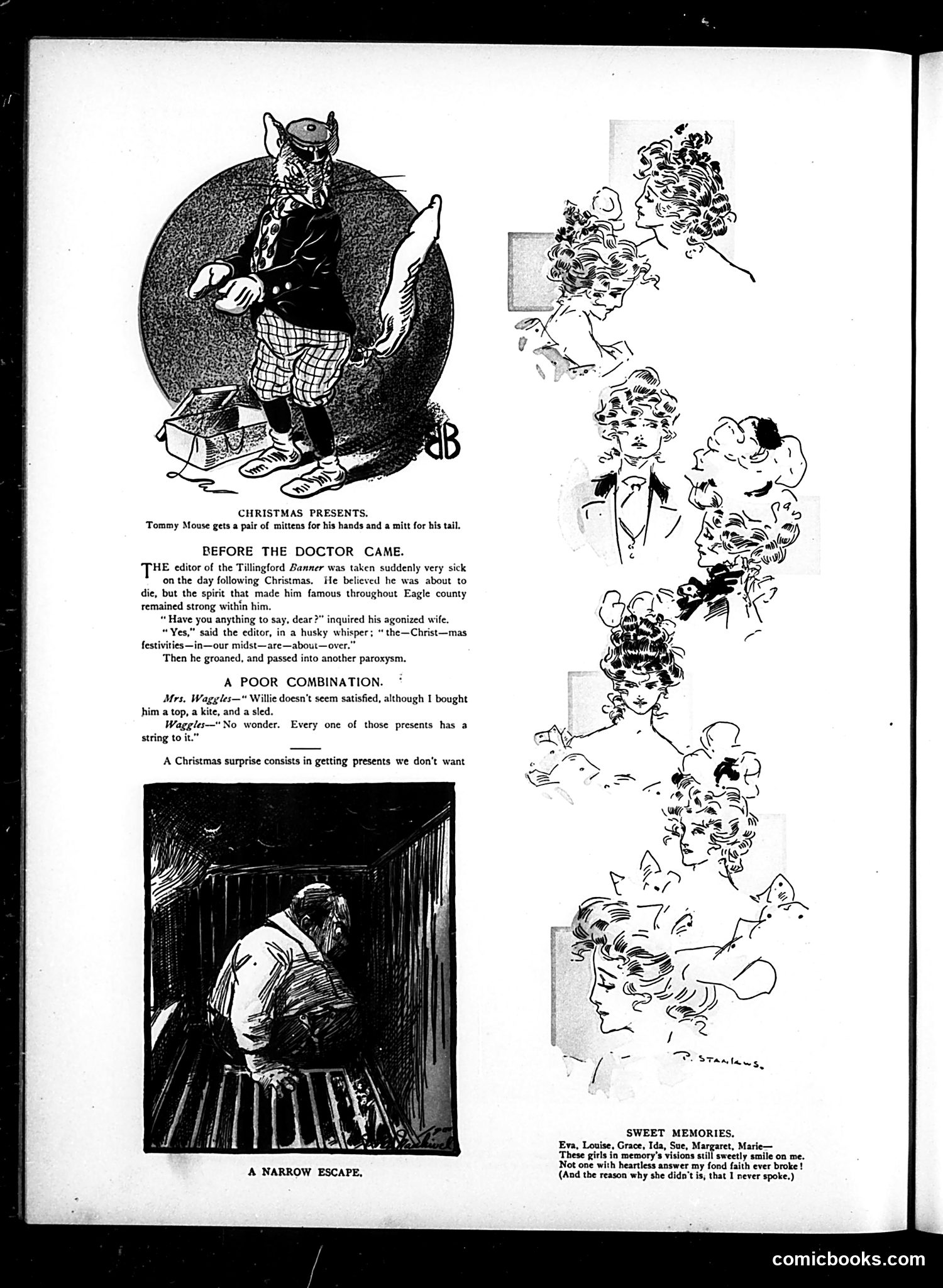
This is a humorous Christmas-themed page from *Judge*, featuring several short comedic bits rather than political cartoons: **"Tommy Mouse"** (top): A talking mouse character receives mittens and a "mitt for his tail"—a visual pun playing on the word "mitt." **"Before the Doctor Came"**: A dying newspaper editor's final concern isn't his mortality but that Christmas festivities are "about over"—satirizing journalistic obsession with current events and deadlines, even in extremis. **"A Poor Combination"**: A joke about children's gifts where toys with strings (kites, sleds) fail to satisfy because they require effort—mocking both parental gift-giving and children's preferences. **"A Narrow Escape"** and **"Sweet Memories"**: These sections present illustrations of women's faces with accompanying romantic commentary, likely satirizing sentimental Christmas cards or romantic nostalgia. The page blends domestic humor with light social satire typical of early 20th-century *Judge* magazine—amusing rather than politically pointed.
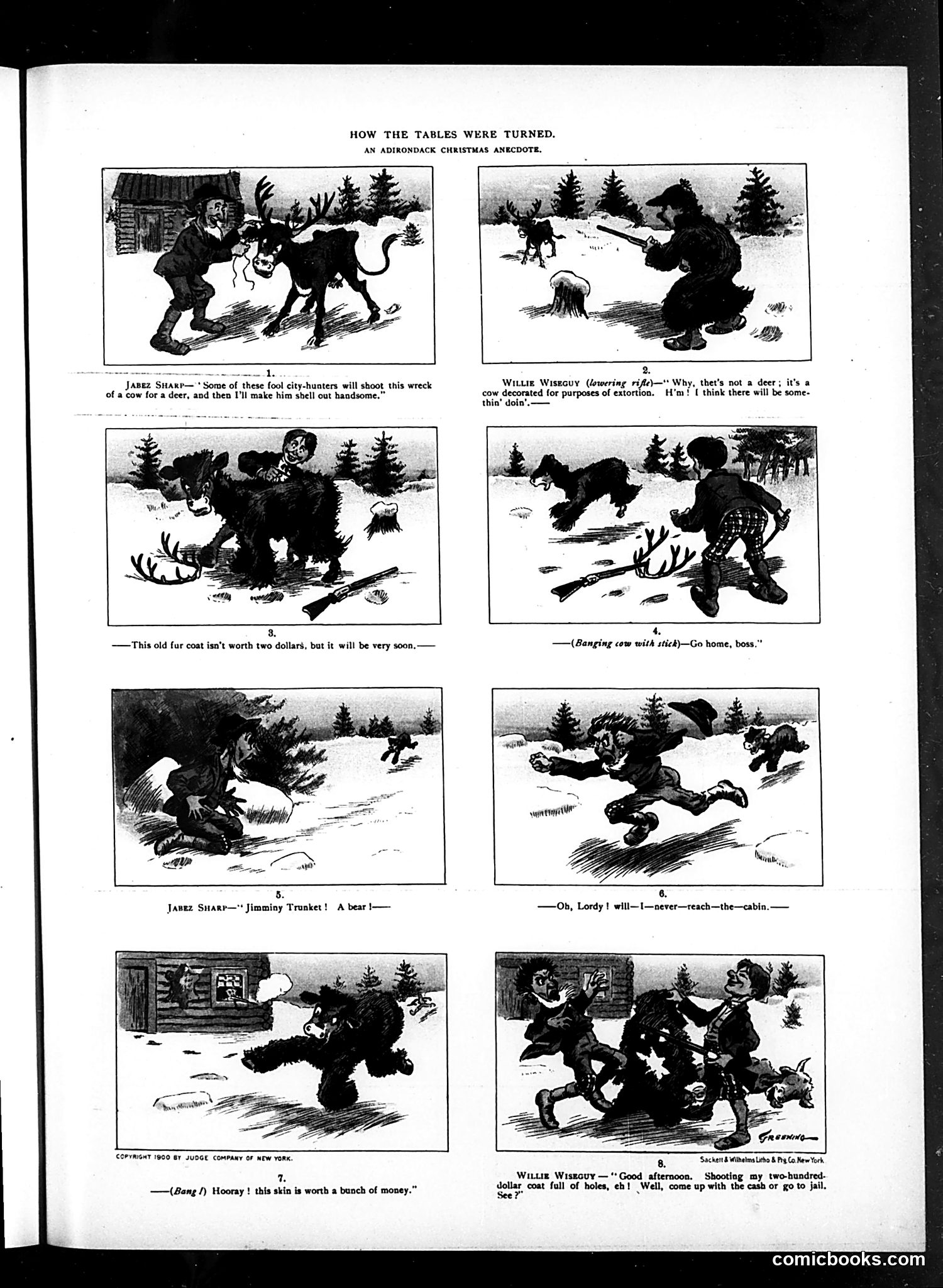
This eight-panel comic depicts a con game in the Adirondack Mountains. James Sharp, a local, schemes to trick wealthy "city-hunters" (urban sportsmen) into shooting an old cow, then extorting money from them for property damage. However, Willie Wiseacre, apparently a more cunning city visitor, turns the tables: he recognizes the deception, shoots Sharp's own cow anyway, then confronts Sharp with a rifle, demanding compensation or threatening arrest. The satire ridicules both rural con artists who prey on naive urban tourists AND the wealthy city hunters themselves—portrayed as foolish enough to fall for transparent schemes. The joke's irony is that the supposedly sophisticated urbanite outsmarts the rural schemer at his own game, reversing expected class hierarchies. It's a period piece mocking the collision between city and country cultures during the Gilded Age leisure class era.
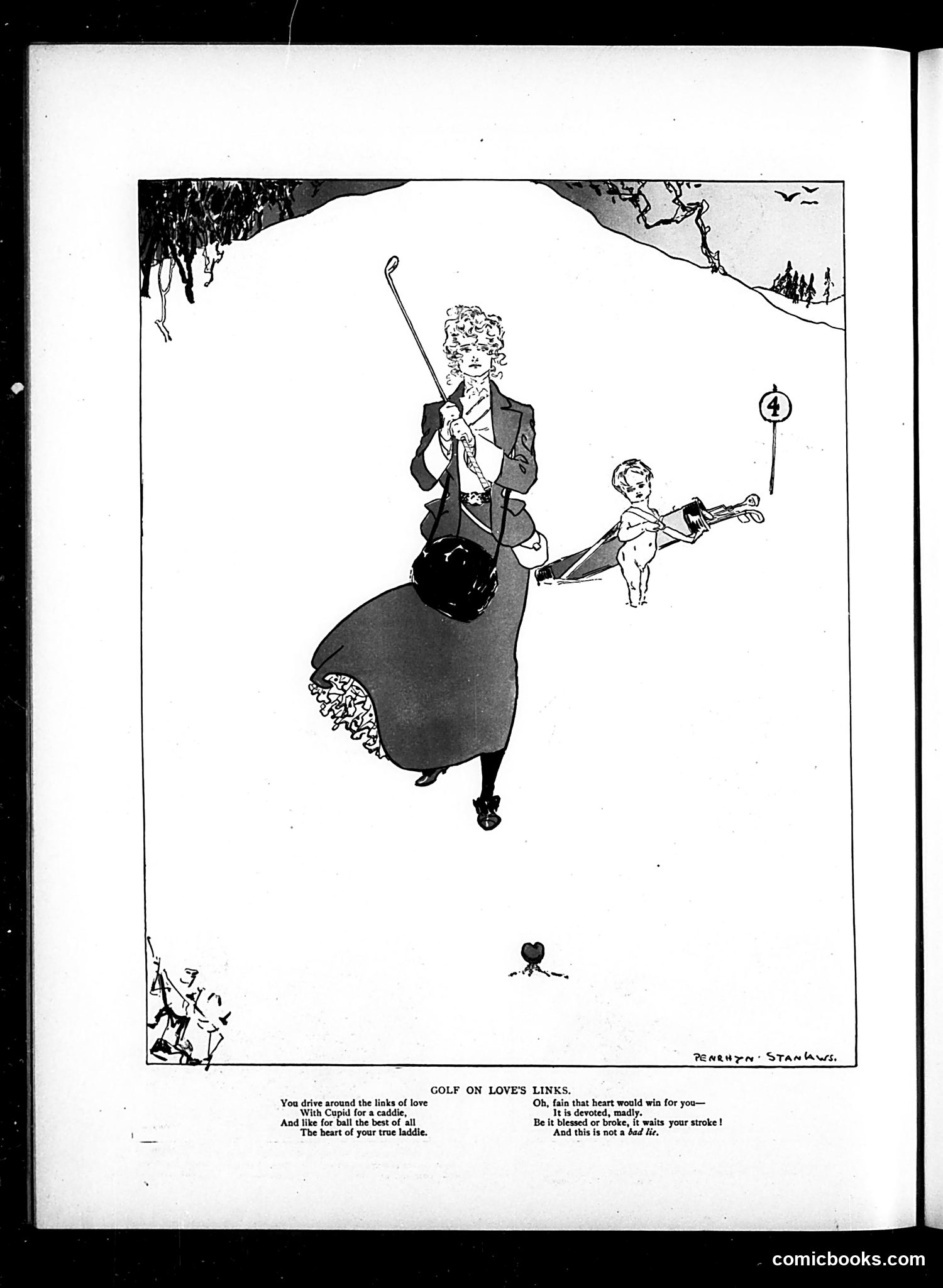
This illustration by Penrhyn Stanlaws satirizes romantic courtship through golf metaphors. A woman in early 20th-century dress swings a golf club while holding a small cherub (Cupid), with a tiny male figure on the string she's extending—depicted as if he's the "ball" in this game of love. The accompanying verse plays on golf terminology: "driving around the links of love," using Cupid as a "caddie" (golf assistant), and the heart as the "ball." The joke suggests that courtship is a manipulative game where women control men through romantic feelings, treating their suitors as playthings to be directed at will. This reflects early 1900s anxieties about female power and agency during changing gender roles.
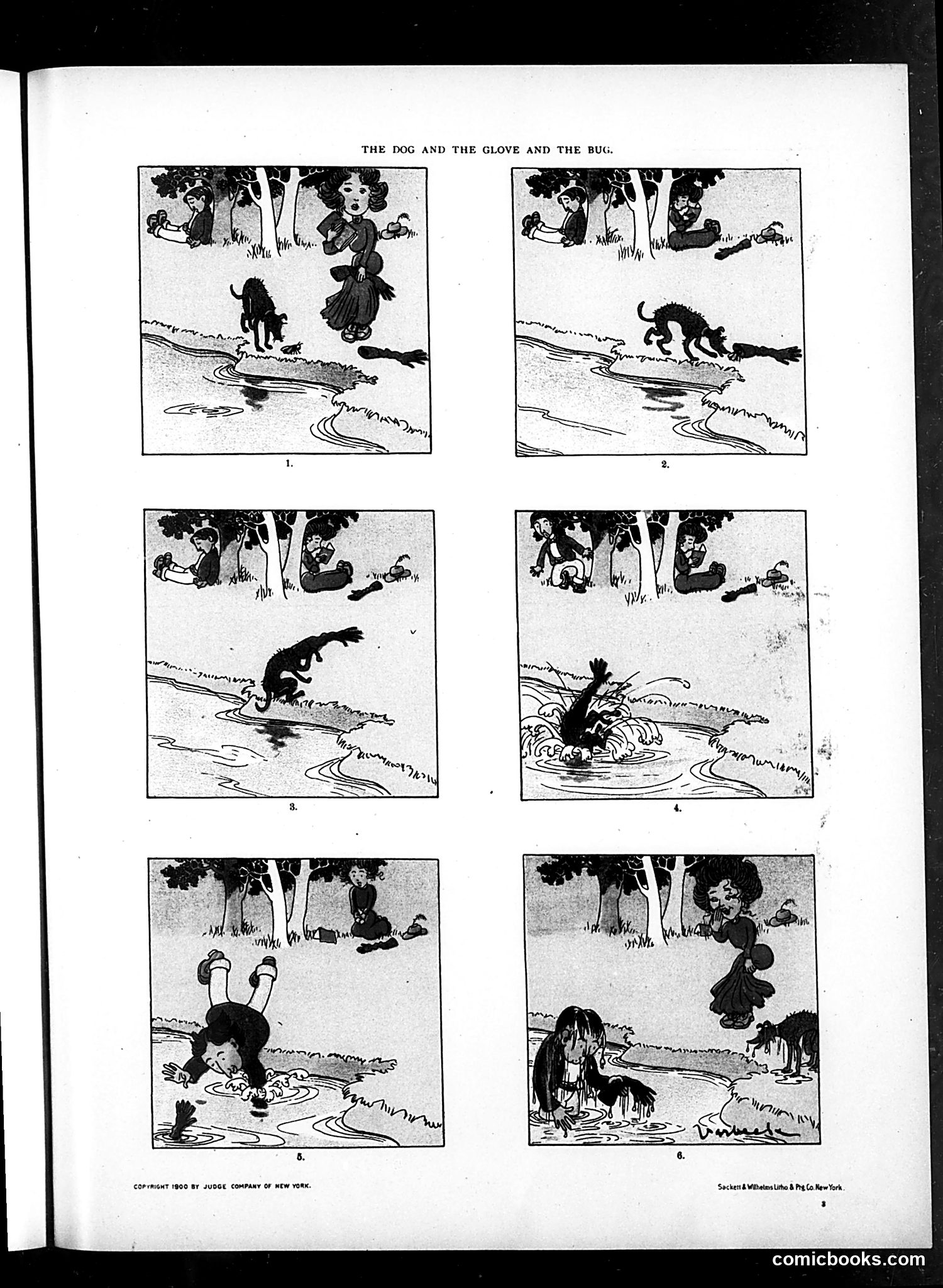
This is a six-panel sequential narrative from Judge magazine (1900) showing a slapstick story without dialogue. A woman in black sits by a pond while a dog appears to find or investigate something near the water's edge. The dog then jumps into the water, splashing dramatically. In the final panels, the woman reacts with apparent distress or surprise—suggesting the dog has either retrieved something unexpected or caused some comedic mishap. The humor appears to be visual/physical comedy typical of early 1900s Judge satire: a domestic scene disrupted by a dog's mischievous behavior. The title mentions a "glove" and "bug," suggesting these objects figure into the narrative, though their exact significance remains somewhat unclear from the images alone. The story exemplifies Judge's reliance on sight gags rather than political satire.
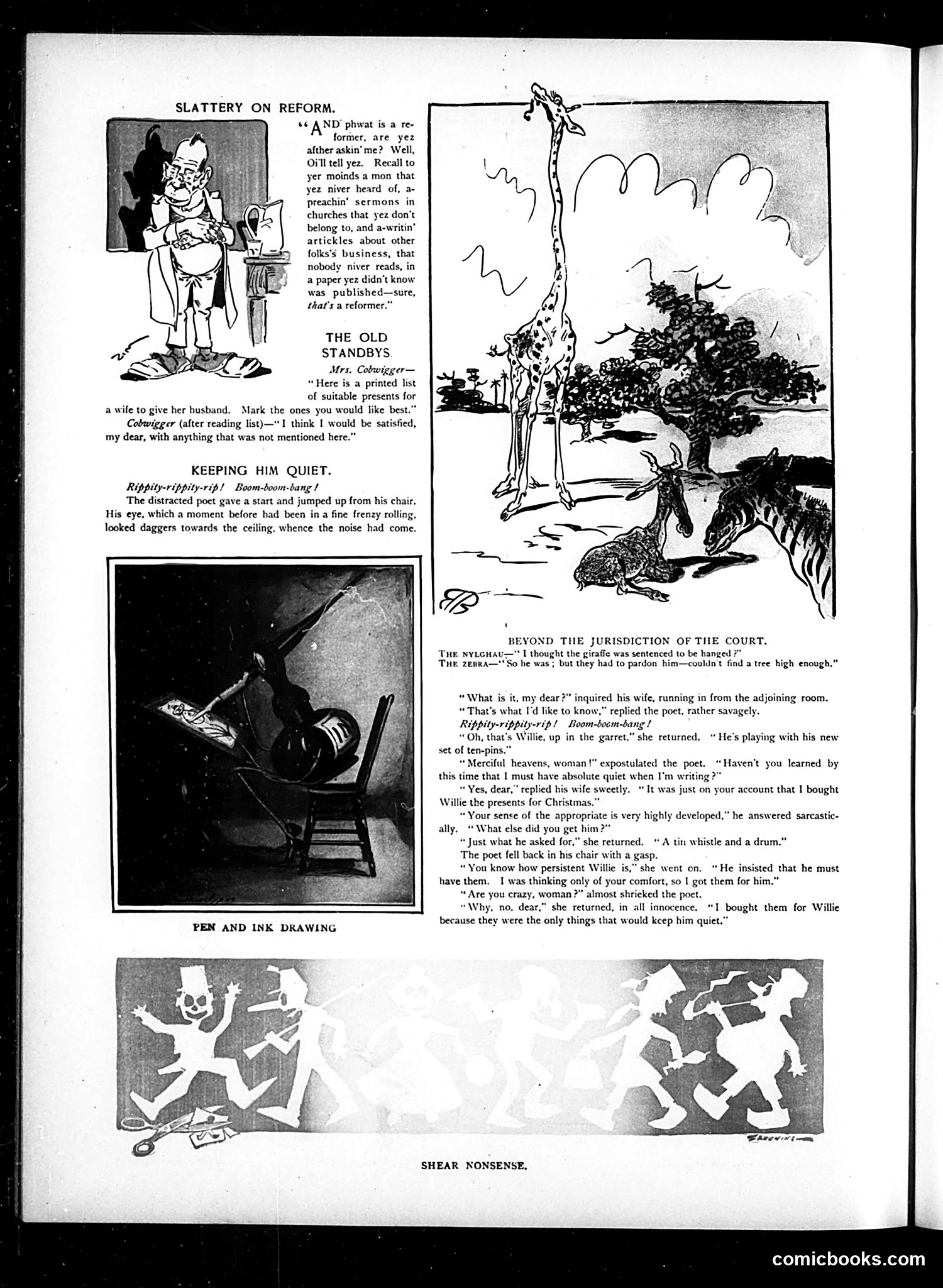
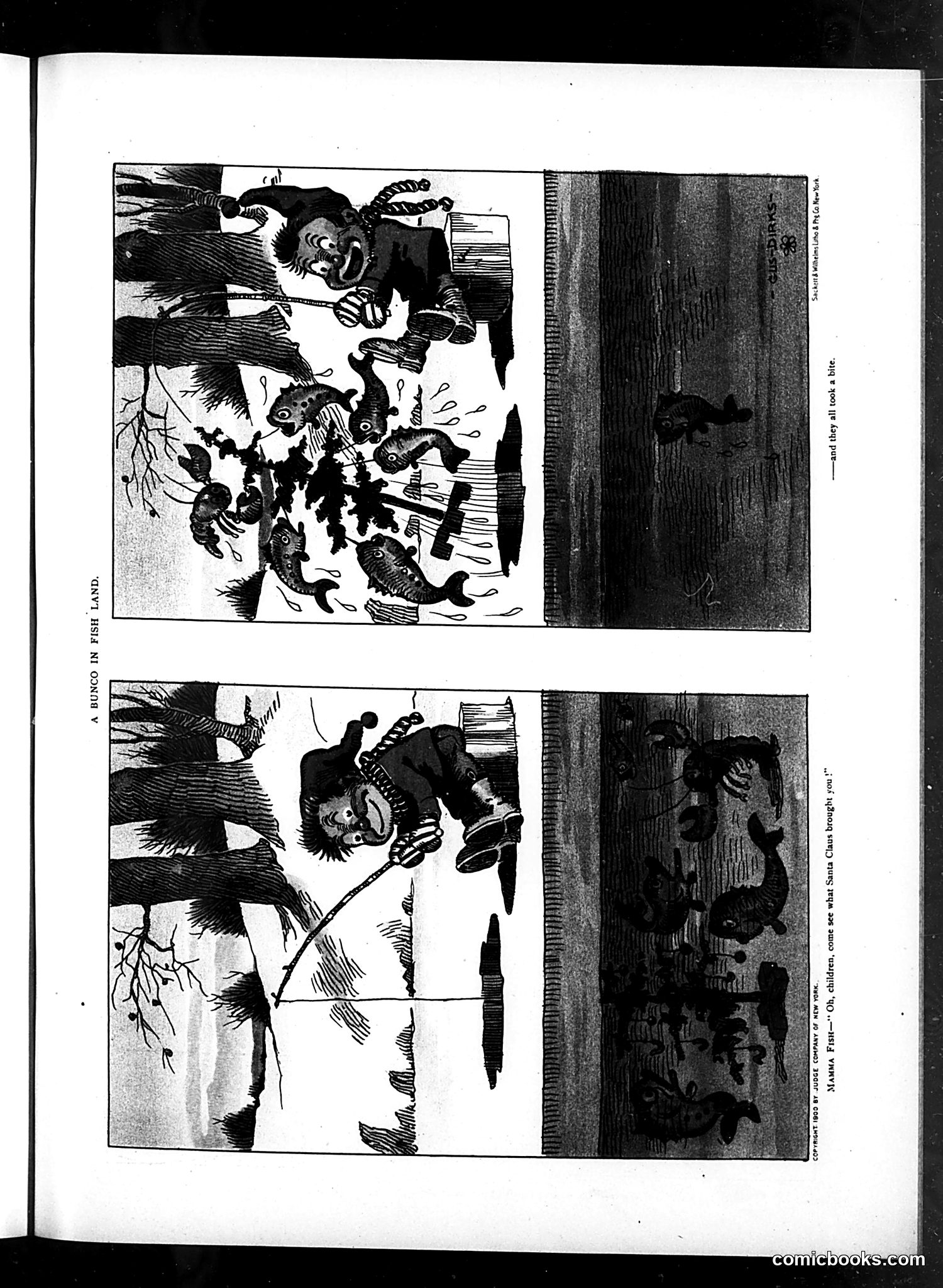
This page displays two sequential cartoon panels titled "A Burro in Irish Land" (text appears reversed/corrupted in OCR). The images show a donkey causing chaos among what appear to be Irish figures in a domestic setting. The satire likely targets Irish stereotypes common in late 19th/early 20th-century American humor—depicting Irish people as rough, chaotic, or incompetent. The burro (Mexican donkey) disrupting an Irish home may satirize immigration conflicts or cultural stereotypes of the era. The right panels show silhouettes, possibly representing shadow-play or theatrical representations of the same scene. Without clearer text, the specific political commentary remains unclear, though Judge magazine typically mocked ethnic groups, politicians, and social issues of its time.
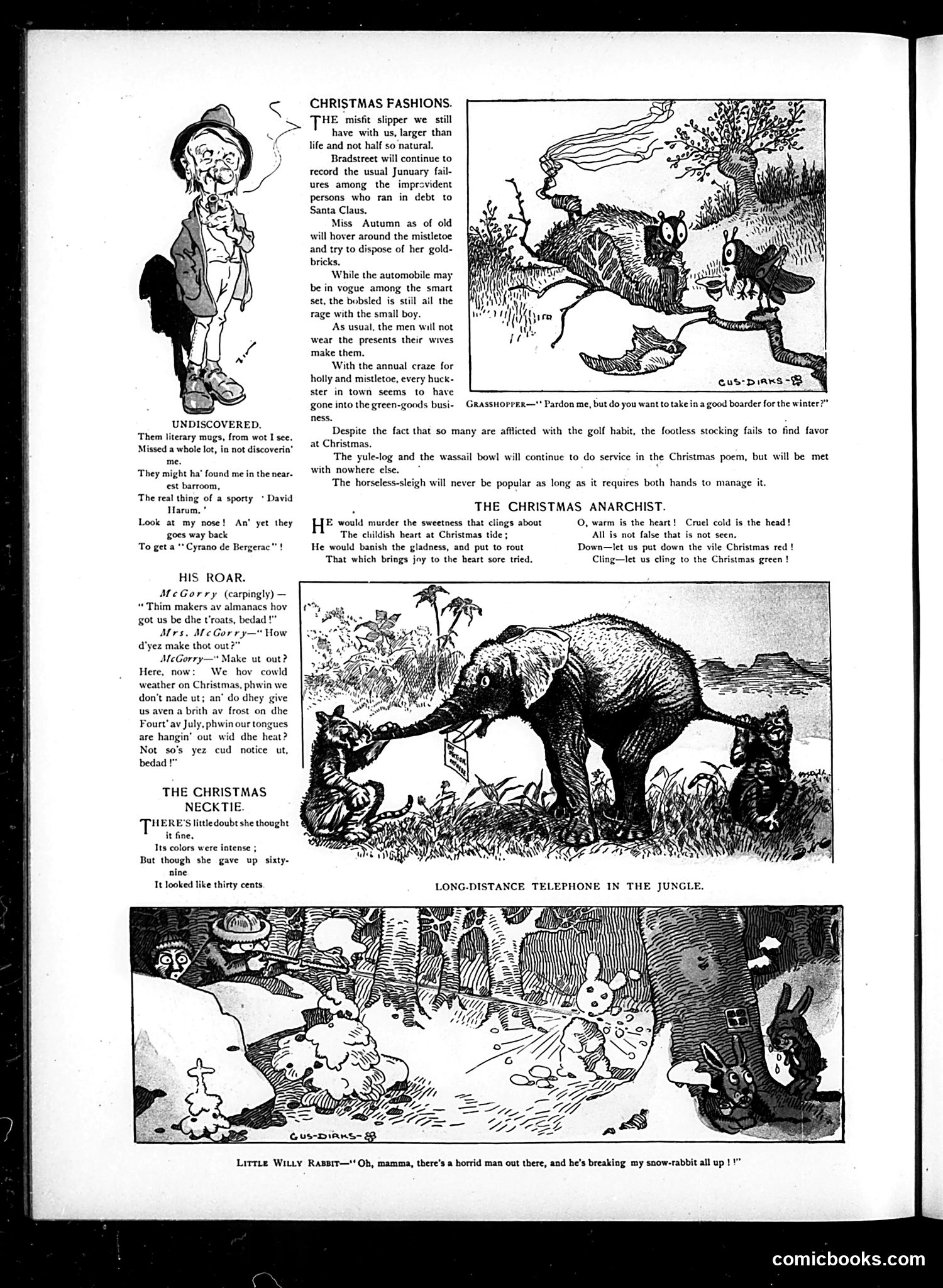
This page from *Judge* magazine contains Christmas-themed satirical commentary and cartoons mocking contemporary society (circa early 1900s). **"Undiscovered"**: A caricatured Irish immigrant complains that literary critics overlooked him despite his distinctive nose—likely mocking both pretentious literary circles and ethnic stereotyping. **"His Roar"**: McGorry (Irish dialect character) grumbles that almanac-makers got weather predictions wrong—giving frost on July 4th when unneeded, but cold on Christmas when unwanted. Social satire about incompetent "experts." **"Christmas Fashions"**: Mock editorial on holiday trends: people buying misfit slippers, automobiles replacing bobsleds for children, husbands rejecting homemade gifts, and merchants peddling cheap mistletoe and "green goods" (counterfeit merchandise). **"Christmas Anarchist"**: A reformer wants to eliminate Christmas sentimentality and "red" (capitalist) traditions for "green" (socialist/anarchist) alternatives—satirizing radical political movements threatening traditional values. The cartoons blend class commentary, ethnic humor, anti-socialist sentiment, and consumer culture critique typical of early-20th-century American satire.
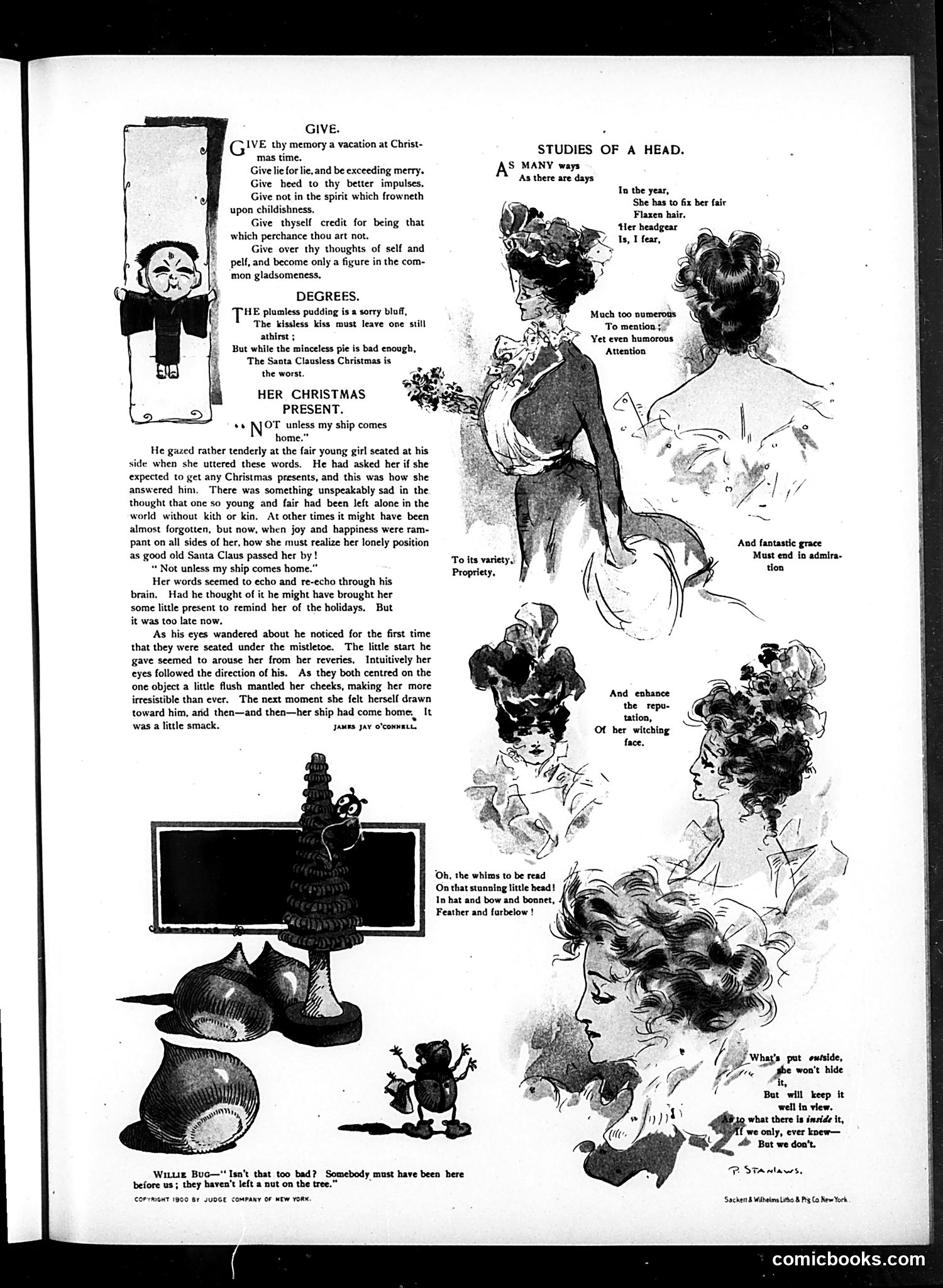
This page contains three satirical pieces from Judge (circa 1900): **"Give"** and **"Degrees"** are humorous mock-philosophical verses mocking sentimental Christmas platitudes and the disappointment of substandard holiday foods (fruitcake, mince pie without filling, Christmas pudding). **"Her Christmas Present"** is a romantic short story illustrating a sentimental trope: a poor orphan girl wishes aloud that Christmas gifts depend on her ship coming home. A gentleman notices they're standing under mistletoe and kisses her—her "ship has come home." The satire targets melodramatic sentimentality about poverty and romance. **"Studies of a Head"** uses multiple sketches to humorously catalog the elaborate hairstyles and headwear fashionable women must constantly adopt. The accompanying verse pokes fun at the vanity and impracticality of female fashion—particularly the complexity of hairstyles and elaborate bonnets and feathers that dominate women's appearance. The page reflects turn-of-century satirical humor targeting romantic excess, fashion obsession, and holiday commercialism.
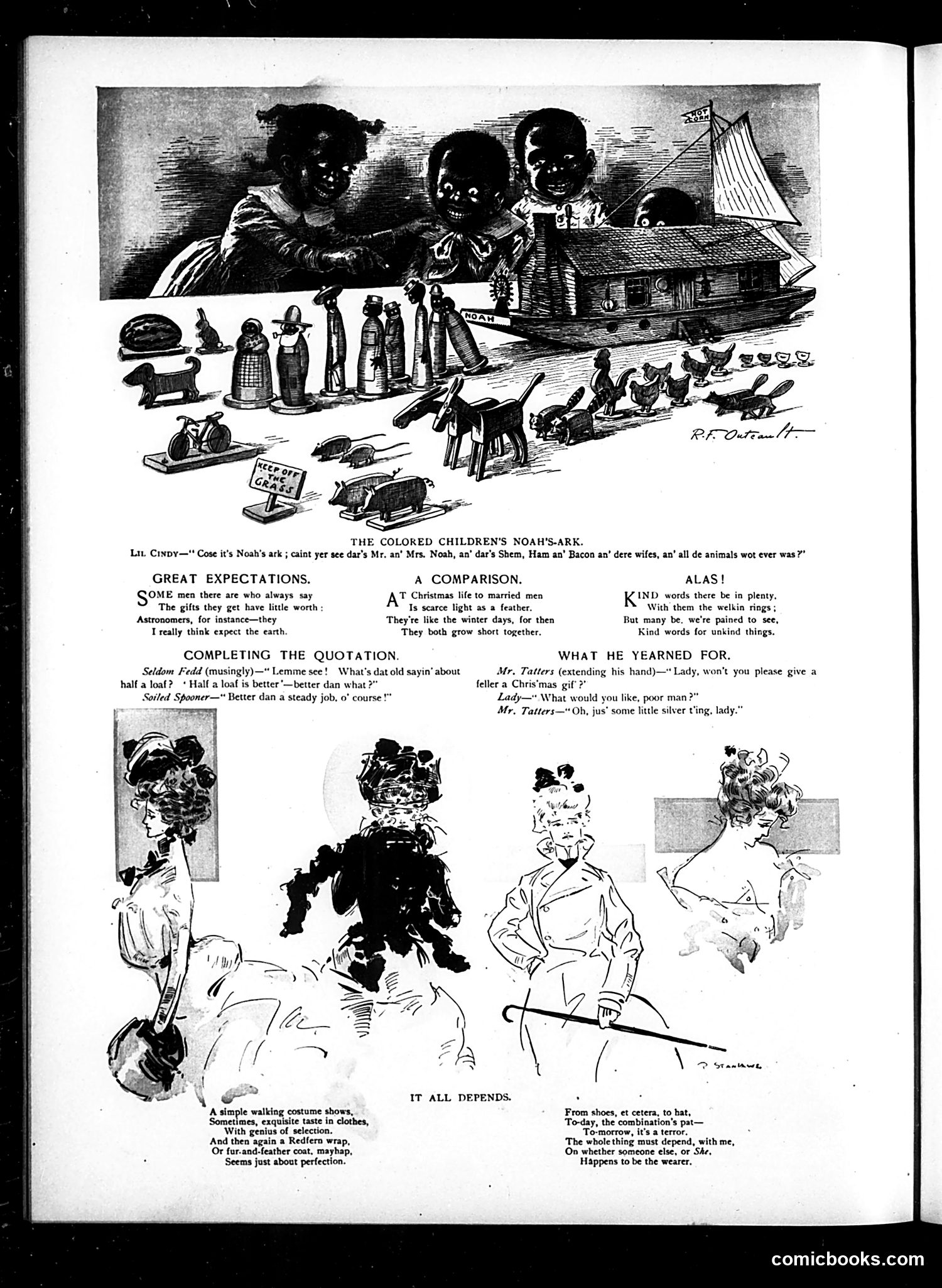
This page contains multiple satirical pieces typical of late 19th-century American humor: **Top cartoon**: "The Colored Children's Noah's Ark" depicts a Black child explaining a toy ark to another child, using dialect and mispronunciations ("Bacon" for "Shem"). The satire appears to mock both the child's speech patterns and, likely, contemporary racial attitudes through caricature. **Below**: Four separate humor pieces mock different social groups: - "Great Expectations" and "A Comparison" joke about marriage's disappointments and Christmas gift-giving - "Complimenting the Quotation" presents working-class men's dialogue, using dialect for comic effect - "It All Depends" satirizes women's fashion, suggesting female appearance depends entirely on who observes them The page exemplifies Judge's approach: using exaggerated dialect, physical caricature, and social stereotyping for humor. By modern standards, the racial caricature is strikingly offensive, though typical for the era's "respectable" publications.
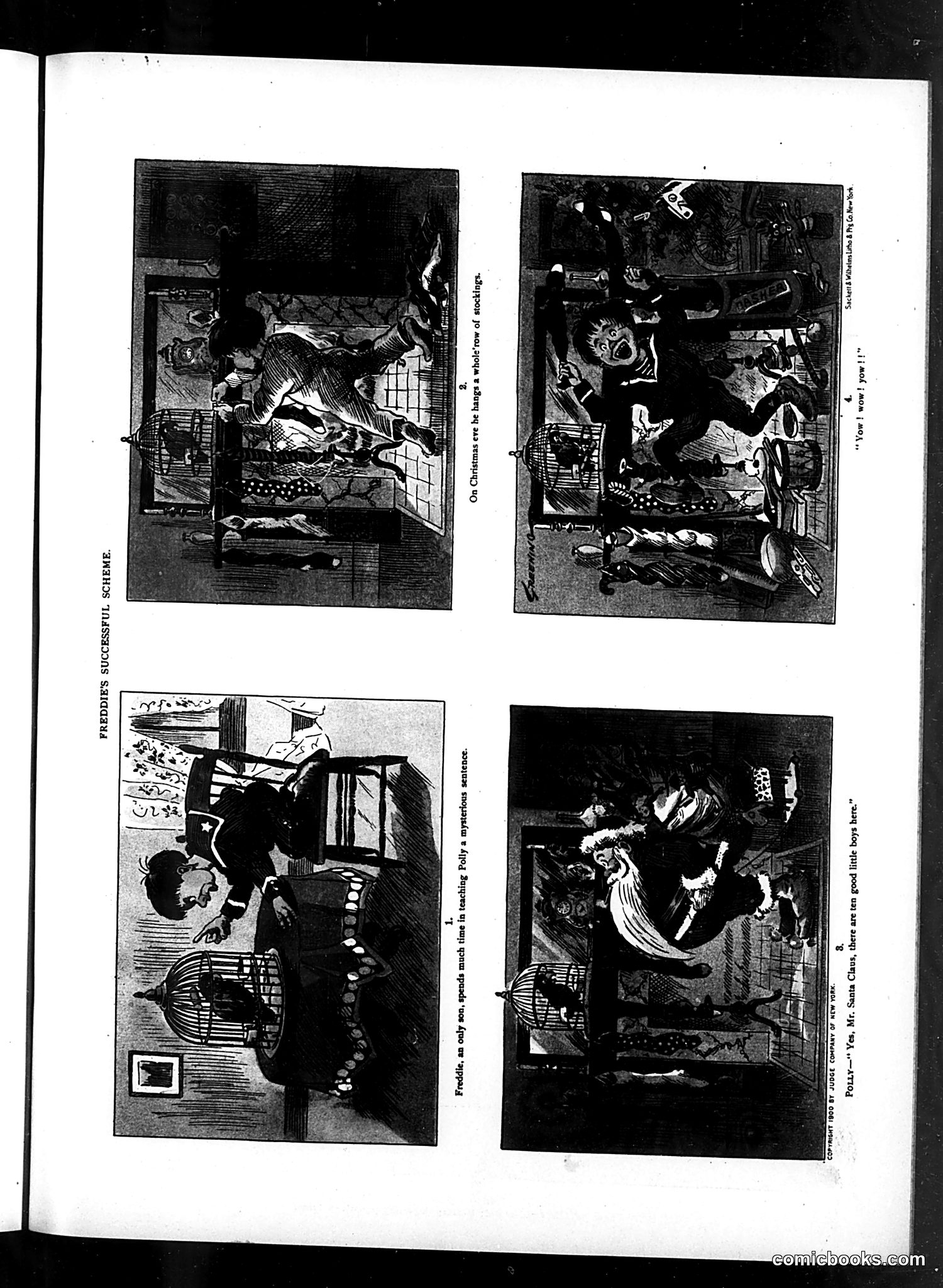
This page from *Judge* magazine displays four black and white cartoon panels labeled "FIDDLERS' BURLESQUE SCENES." The OCR text is largely illegible, making precise identification difficult. The images appear to be satirical theatrical or vaudeville sketches, featuring exaggerated character types in domestic or comedic situations. The heavy use of shadow and dramatic staging suggests they're parodying popular entertainment of the era—possibly minstrel shows, burlesque performances, or slapstick comedy acts. Without clearer text or visible captions, I cannot definitively identify specific political figures or social references. The "burlesque" designation suggests the cartoons mock theatrical conventions or perhaps contemporary performers, but the exact targets remain unclear from this reproduction. The page likely commented on popular culture rather than specific political events.
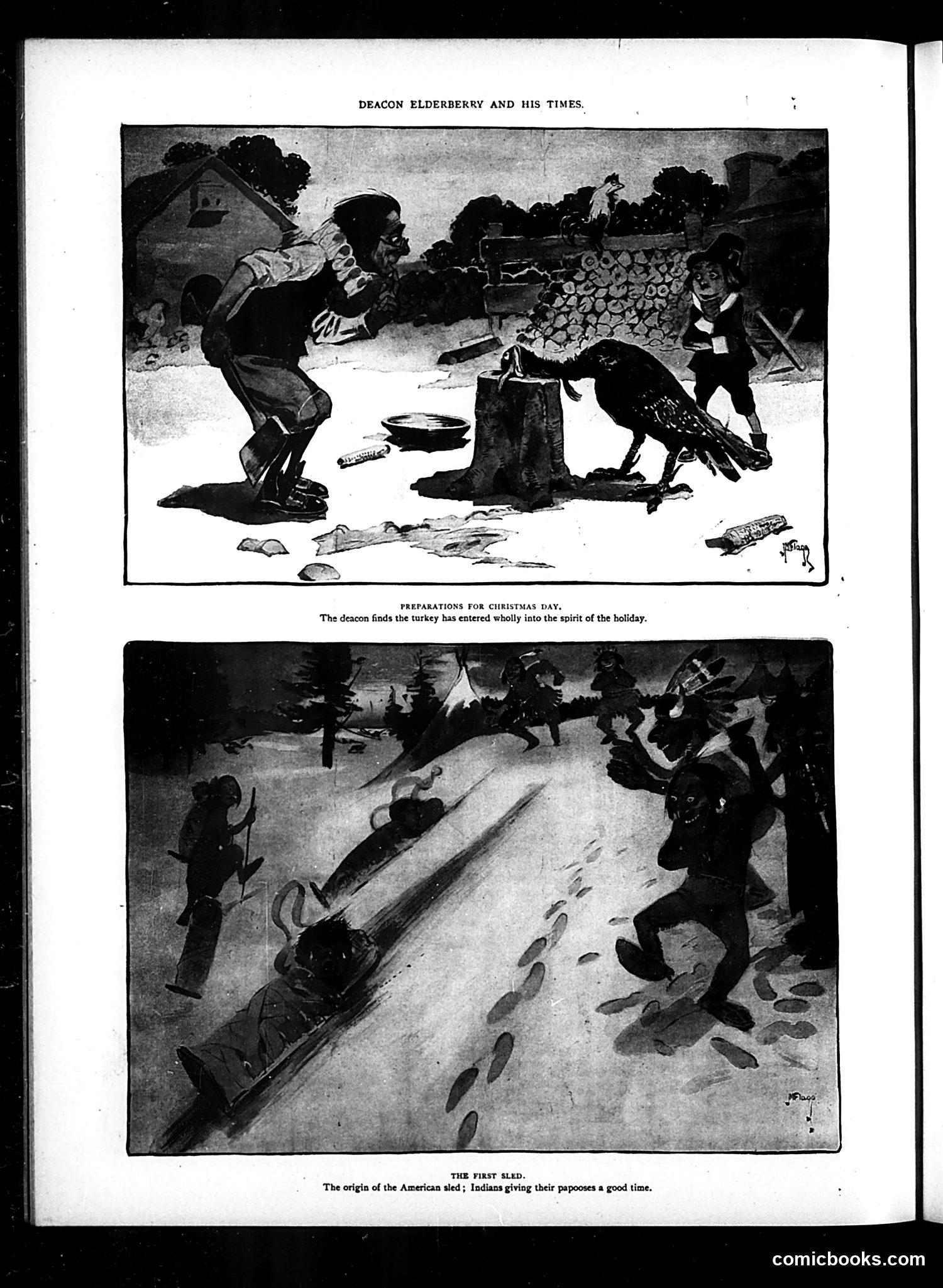
This is a two-panel comic strip featuring a recurring character, Deacon Elderberry. The top panel shows the deacon attempting to slaughter a turkey for Christmas dinner, but the bird has become wildly animated—"entered wholly into the spirit of the holiday"—creating chaotic slapstick comedy as it evades capture. The bottom panel appears to be a separate historical humor segment about sledding's origins, depicting Native Americans ("Indians") sending children down snowy slopes on logs, presented as the origin of American sleds. Both panels use exaggerated, comedic illustration typical of Judge's satirical style. The humor relies on physical comedy and period stereotypes rather than pointed social commentary.
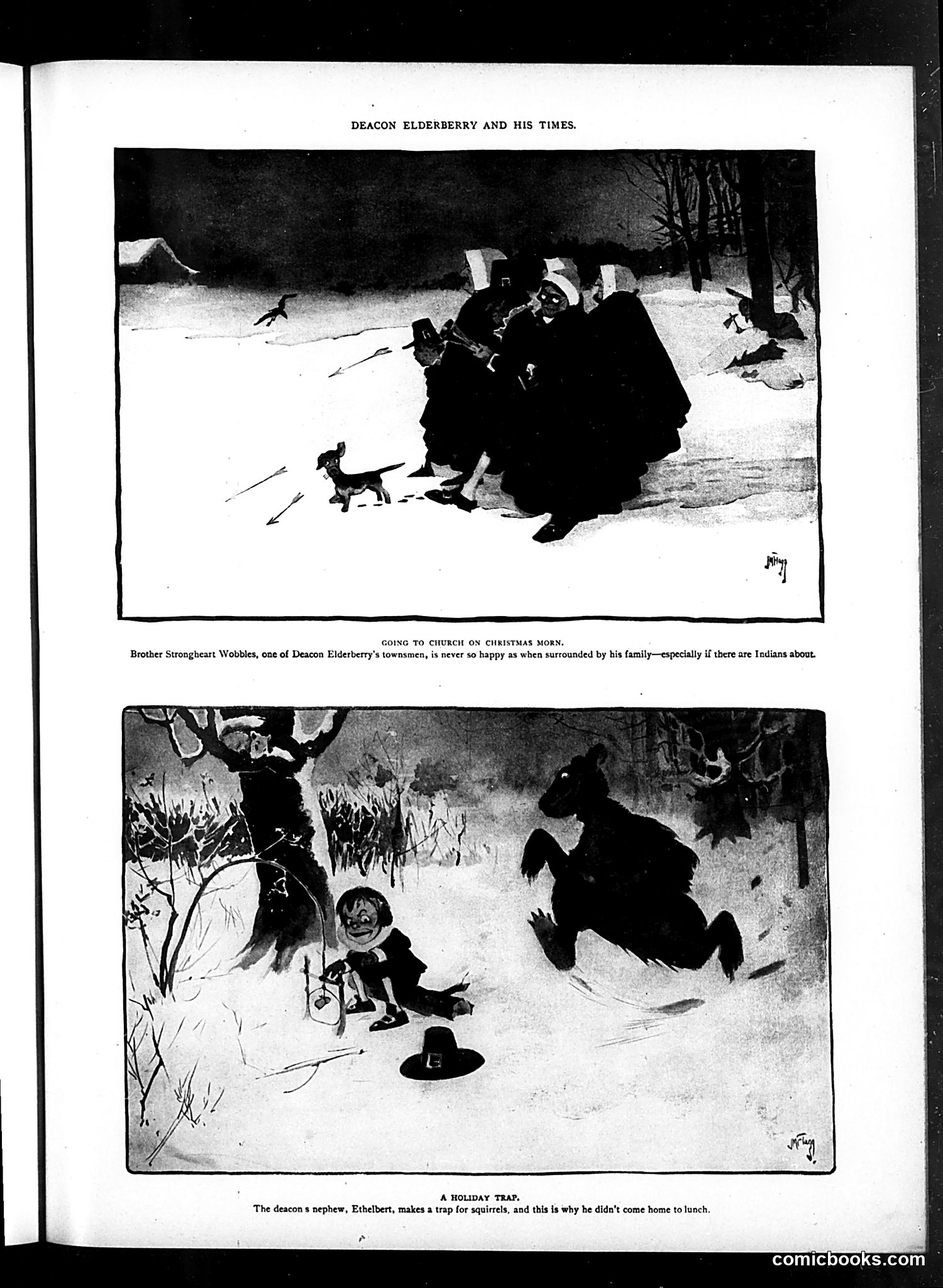
This page from *Judge* magazine presents two comic strips featuring recurring character "Deacon Elderberry and his times." **Top panel:** Shows townspeople heading to Christmas church services. The caption introduces "Brother Strongheart Wobbles," humorously suggesting he's happiest surrounded by family—"especially if there are Indians about." This likely satirizes frontier anxieties and racial prejudices of the era, using absurdist humor to mock both paranoia about Native Americans and masculine posturing. **Bottom panel:** Depicts the deacon's nephew Ethelbert with a squirrel trap in snowy woods. The joke is that he's become trapped himself, explaining his absence from lunch. The visual gag relies on simple slapstick irony—the trap-maker caught by circumstance. Both strips use gentle, folksy humor typical of early-20th-century American comic strips, with recurring characters allowing readers to follow ongoing narratives about small-town life.
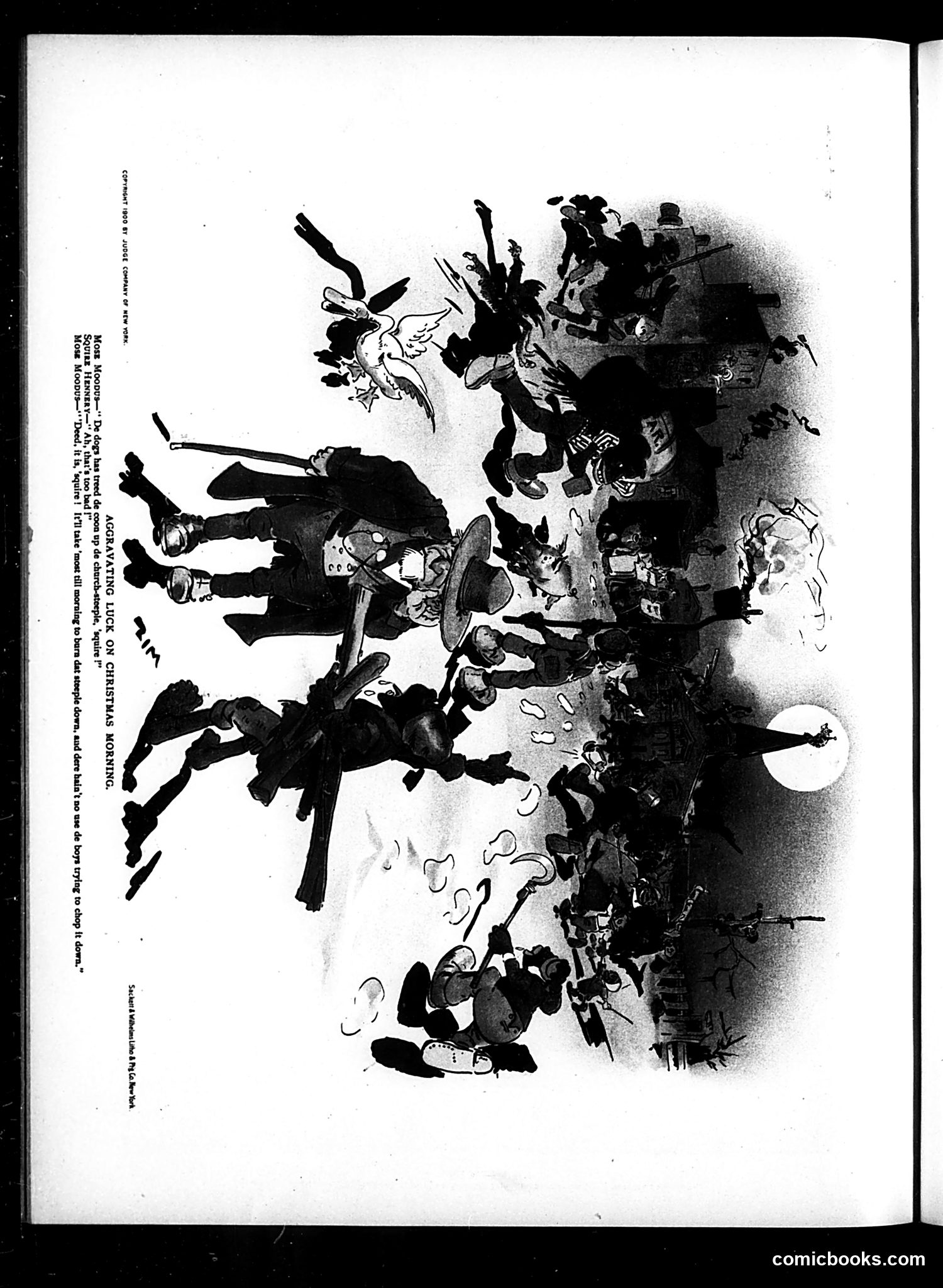
This Judge magazine cartoon depicts a racist scene using caricatured dialect and imagery. It shows two figures—labeled "Mose Moopus" and "Squire Henry"—discussing a raccoon treed in a church steeple on Christmas morning. The "joke" relies on degrading racial stereotypes: the exaggerated dialect ("De dogs," "'Deed") and the casual reference to burning down a church to retrieve game reflect deeply offensive caricatures of Black Americans common in 19th-century American humor. The satire appears to mock the frustration of hunting being thwarted by circumstance—the raccoon's inconvenient location making the kill difficult. However, the cartoon's entire comedic premise depends on dehumanizing racist stereotyping. This represents the type of explicitly racist content Judge regularly published, normalized in its era but completely unacceptable by modern standards.
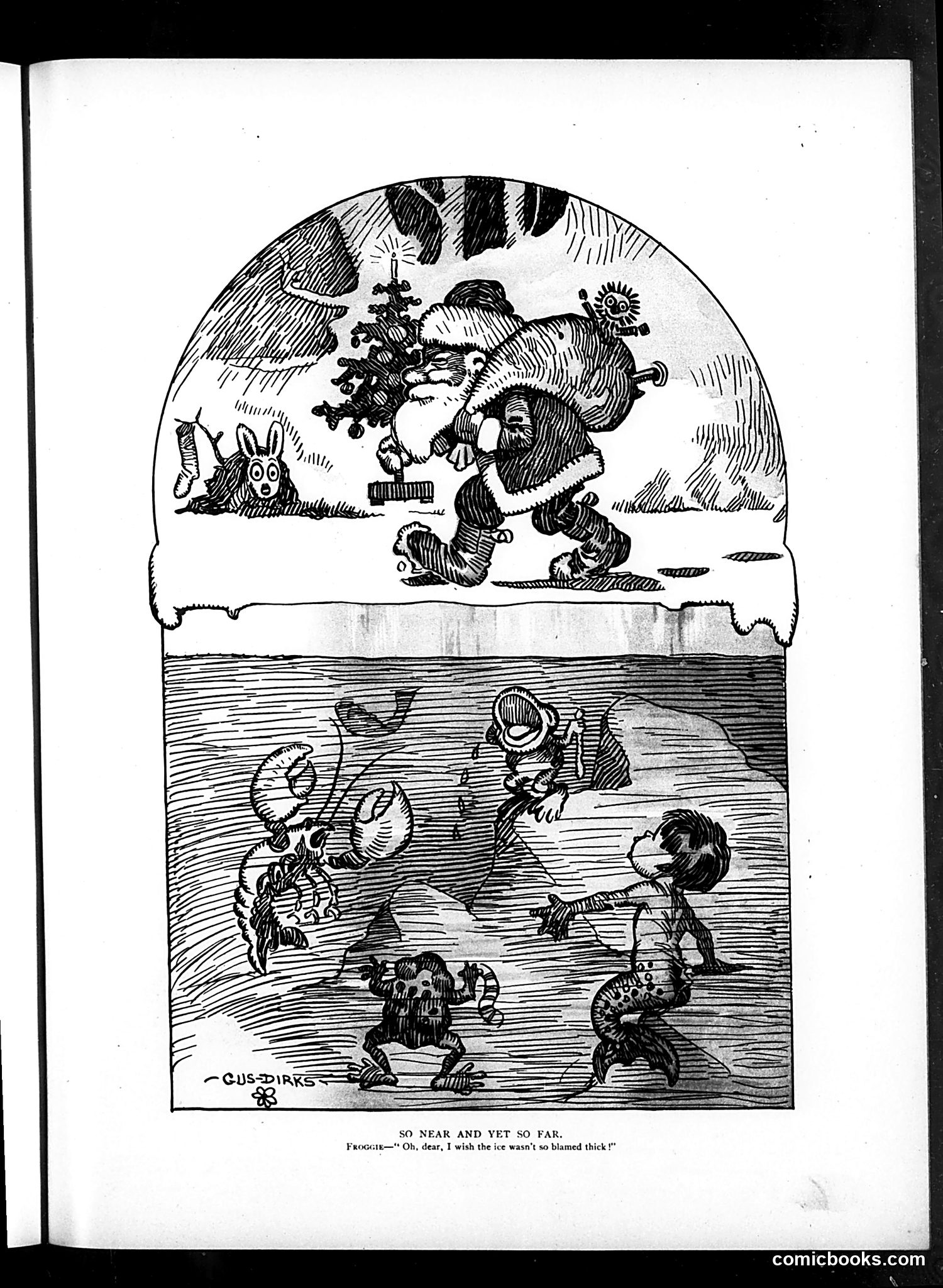
This Gus Dirks cartoon depicts two contrasting scenes divided by ice: above, figures enjoy winter activities in a snow-covered landscape; below, characters struggle underwater or beneath thick ice. The caption's complaint—"I wish the ice wasn't so blamed thick!"—suggests frustration with a barrier preventing access or progress. The title "So Near and Yet So Far" emphasizes this theme of proximity without achievement. Without additional context about Judge magazine's publication date or contemporary events, the specific political or social reference remains unclear. However, the cartoon likely satirizes a contemporary situation where desired goals or relief were tantalizingly close but rendered inaccessible by some obstacle—possibly an economic, political, or social barrier. The underwater figures may represent those struggling or disadvantaged, while those above represent relative comfort or freedom.
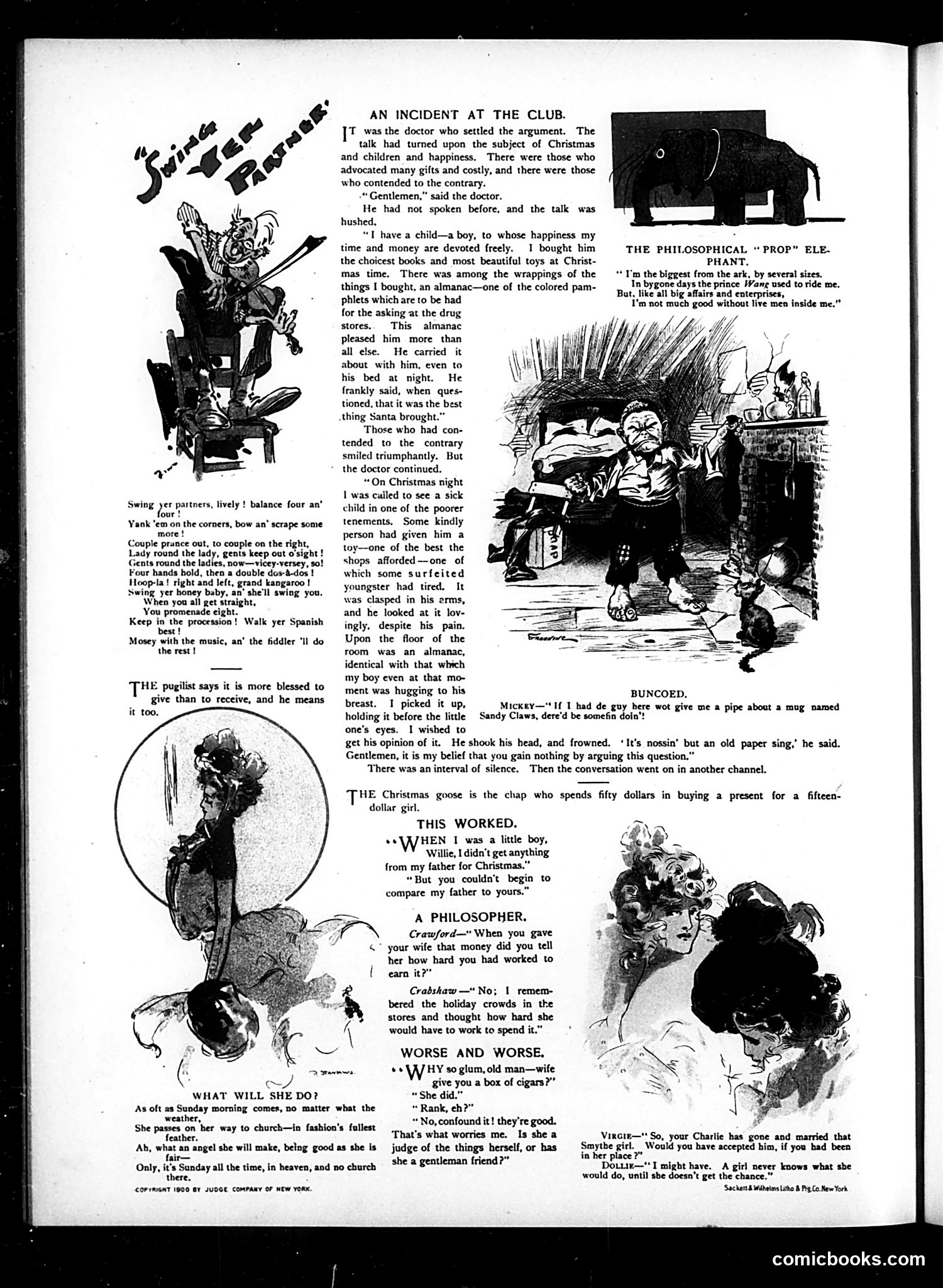
This is a *Judge* magazine page featuring multiple short satirical pieces about Christmas gift-giving and relationships. The main story concerns a doctor settling a debate about expensive versus modest Christmas gifts. His anecdote reveals the lesson: a poor sick child treasures a simple almanac (given as charity) as much as the doctor's wealthy son treasures his expensive one—suggesting that material wealth doesn't determine happiness. The smaller satirical vignettes mock different types: the "philosophical elephant" prop (a theatrical novelty claiming grandeur but needing "live men inside"); various social climbers and hypocrites; a man's feigned humility about his wife's spending; a disagreement over cigars quality. The cartoons and quips collectively target turn-of-the-century materialism and pretension—wealthy people obsessing over costly gifts while missing simpler truths about contentment. The humor relies on exposing contradictions between what people claim to value and their actual behavior.
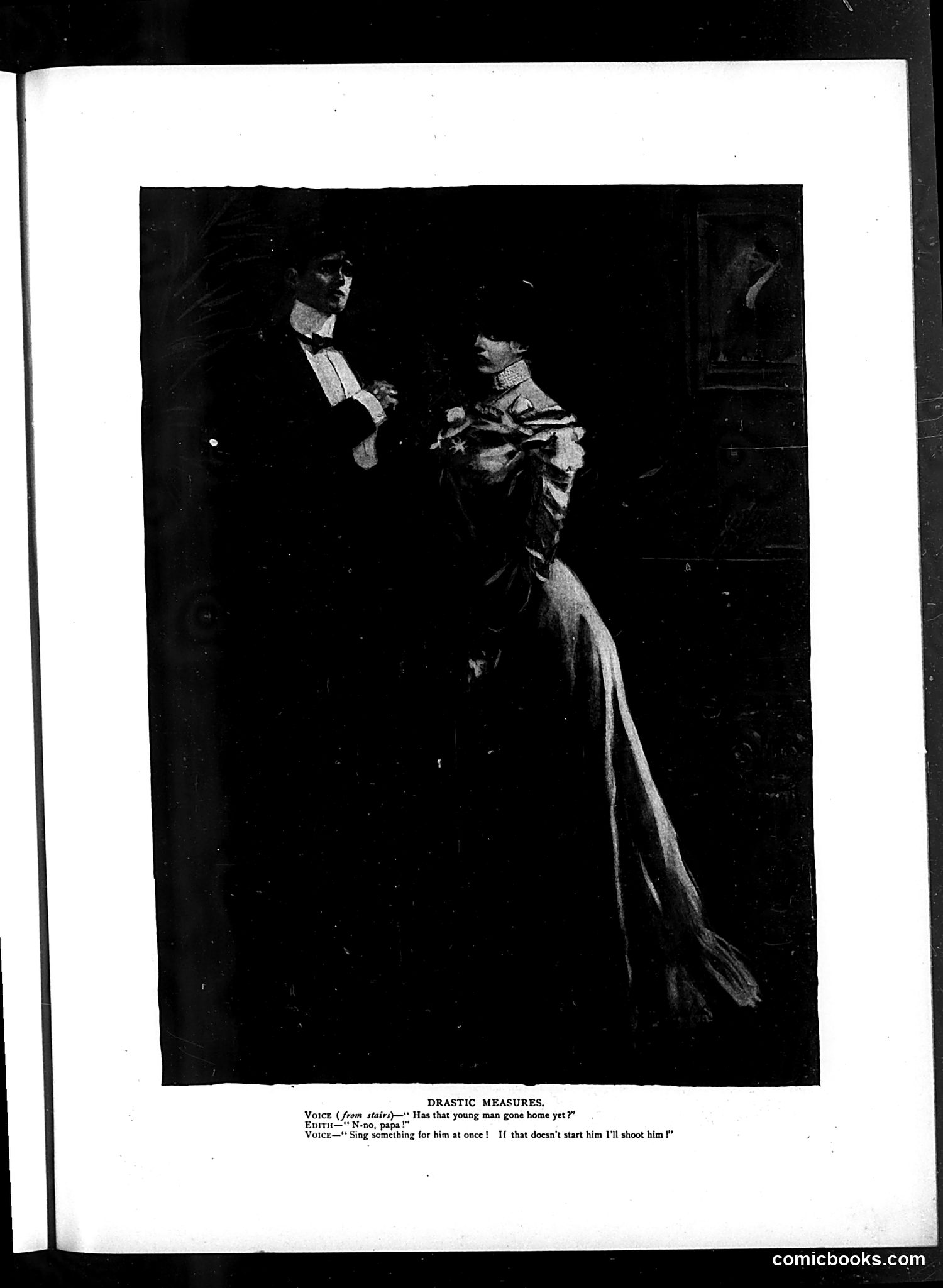
This domestic comedy cartoon depicts a father's exasperation with a lingering suitor. The scene shows a young woman in an elegant gown speaking with a man in formal attire while her father calls from upstairs, demanding she sing to drive the visitor away—threatening to shoot him if that fails. The humor relies on the period convention of tedious courtship visits and the father's protective (if jokingly violent) authority over his daughter's social interactions. The "drastic measures" reference suggests that even enlisting the woman's singing—presumably portrayed as unpleasant—may be insufficient to remove the persistent young man. It's satirizing both the awkwardness of Victorian/Edwardian courtship rituals and paternal anxiety about unwanted suitors lingering too long in the home.
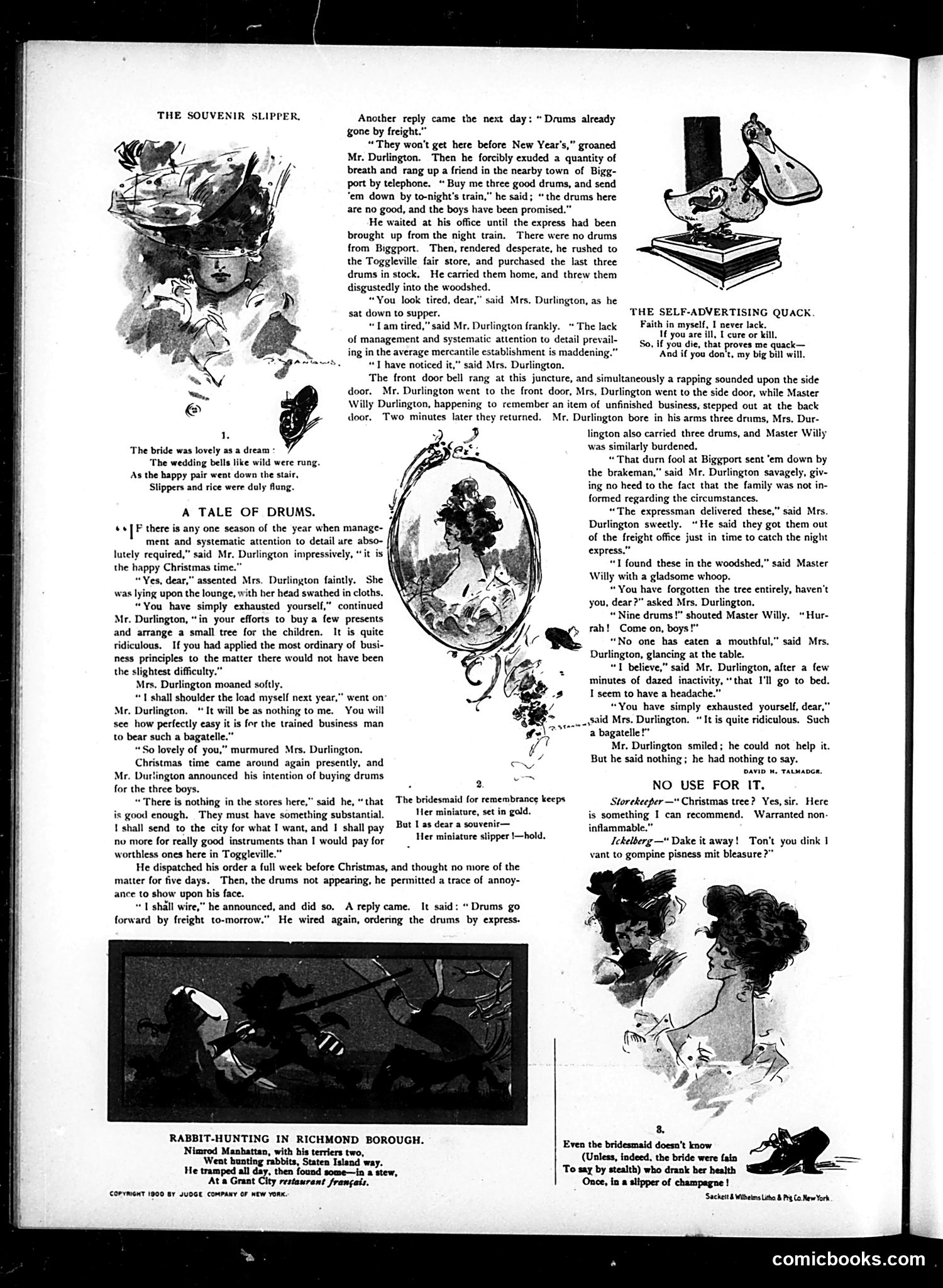
This page contains two separate humorous stories from Judge magazine (circa 1900, based on copyright notice). **"A Tale of Drums"** satirizes male overconfidence and poor planning. Mr. Durlington, a businessman who boasts about "systematic attention to detail," ironically botches Christmas preparations. Despite his smugness about business efficiency, he cannot secure drums for his children in time, forcing desperate last-minute scrambling. The joke: his wife's exhaustion goes unacknowledged while he takes credit for competence he lacks. The story mocks the era's self-important businessmen who preached efficiency while creating household chaos. **"The Self-Advertising Quack"** (right column) appears to be a brief satirical poem about fraudulent medical practitioners—common targets in Judge—who claimed cures worked regardless of outcomes. **"Rabbit-Hunting in Richmond Borough"** (bottom) is an illustration accompanying a humorous piece about urban hunting near New York City. The page primarily uses domestic comedy to lampoon male arrogance and the gap between professional pretension and actual competence.
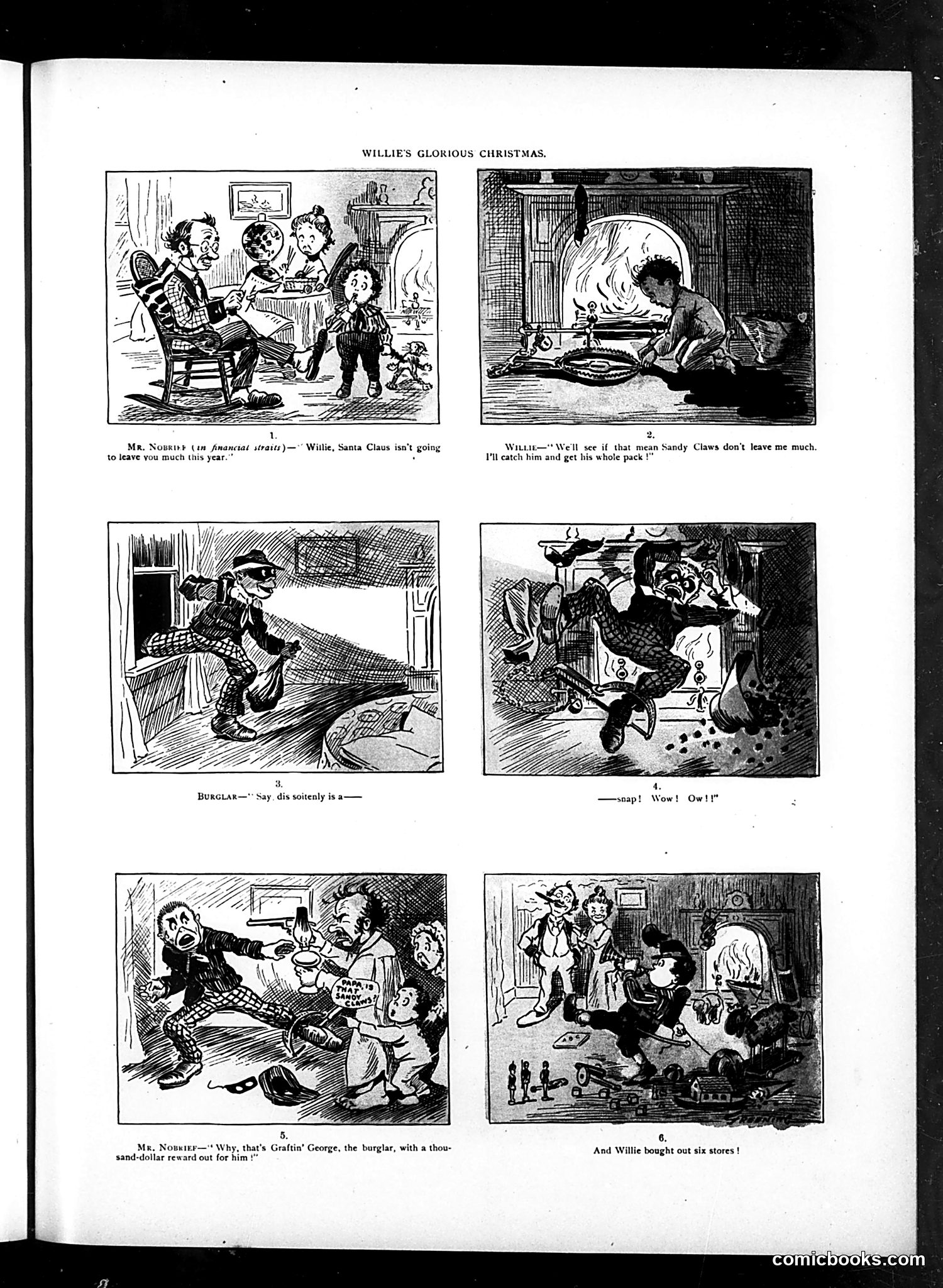
This comic strip follows a boy named Willie during Christmas, satirizing both childhood mischief and adult corruption. In panel 1, his father (Mr. Norbert, in financial trouble) warns Willie that Santa won't bring much. Willie responds by threatening to catch Santa and steal his entire pack—a child's literal interpretation of getting what he wants. The narrative escalates through Willie's increasingly disruptive Christmas adventures. Panel 5 reveals the joke's social commentary: when Willie encounters a burglar named "Graftin' George" (a reference to corrupt politicians or criminals involved in graft/bribery), he treats the dangerous criminal the same way he treated Santa—with the innocent aggression of a mischievous child. The satire suggests that in Gilded Age America, criminals and corrupt figures were so prevalent that a child couldn't distinguish them from harmless holiday figures. Willie's chaotic Christmas reflects broader societal disorder where crime and corruption had become normalized.
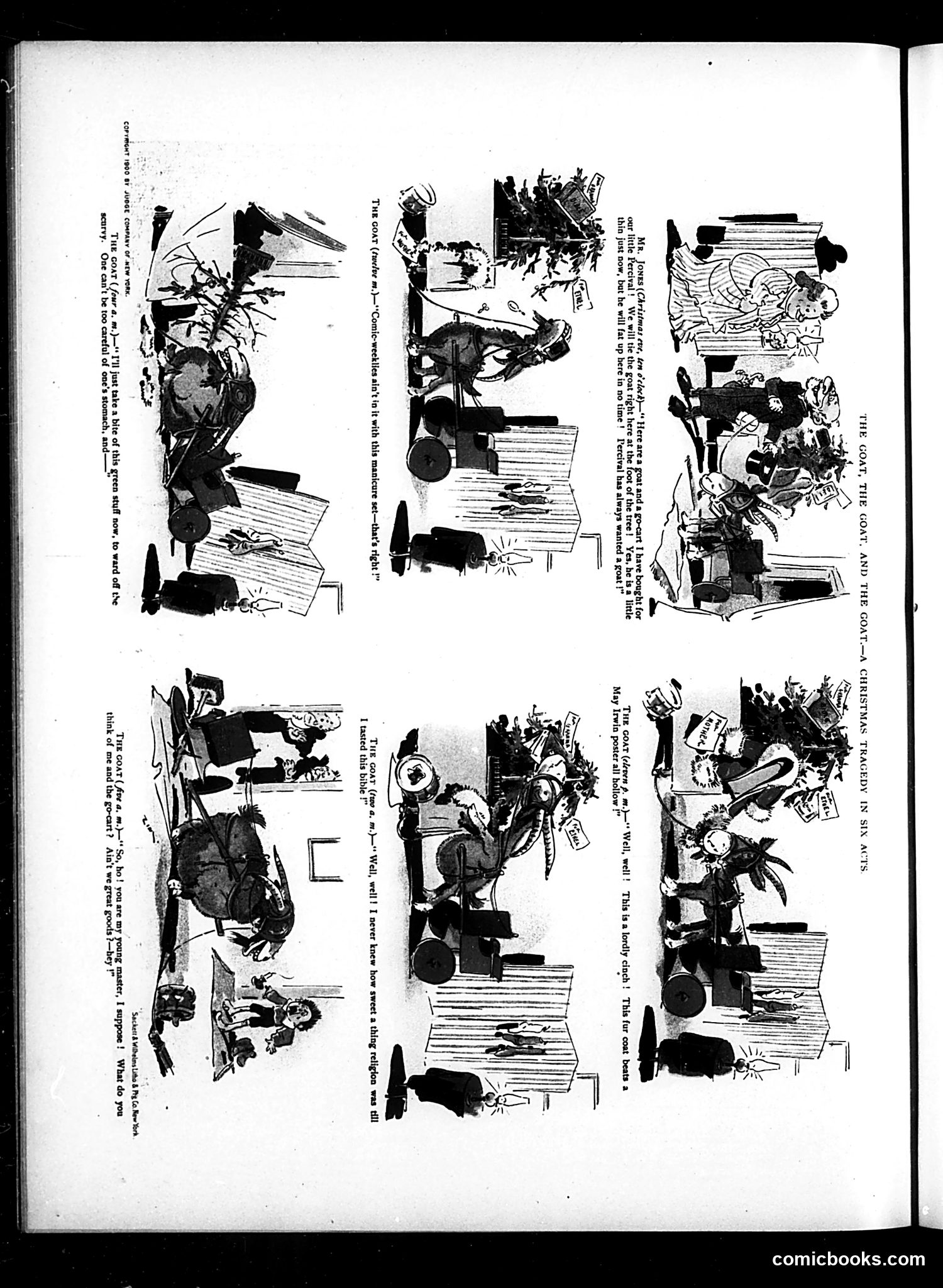
This page appears to contain a series of satirical cartoons depicting **anthropomorphized objects or concepts** (a coat and a Bible) in humorous situations, likely critiquing materialism and hypocrisy among the wealthy or society generally. The cartoons seem to mock the **veneration of luxury goods over genuine values**. The "coat" character boasts about superiority to entertainment (a "May Irwin poster"), while the "Bible" character sarcastically praises religion after being consumed—suggesting people treat sacred texts as objects of consumption rather than spiritual guidance. The fragmented text references "greed" and questions about "go-carts," implying social commentary on **materialistic excess and the replacement of authentic values with conspicuous consumption**. This reflects Judge magazine's typical satirical approach to gilded-age excess and moral hypocrisy among the wealthy classes. Without clearer OCR text or artist attribution visible, specifics remain uncertain, but the general target appears to be **class pretension and false piety**.
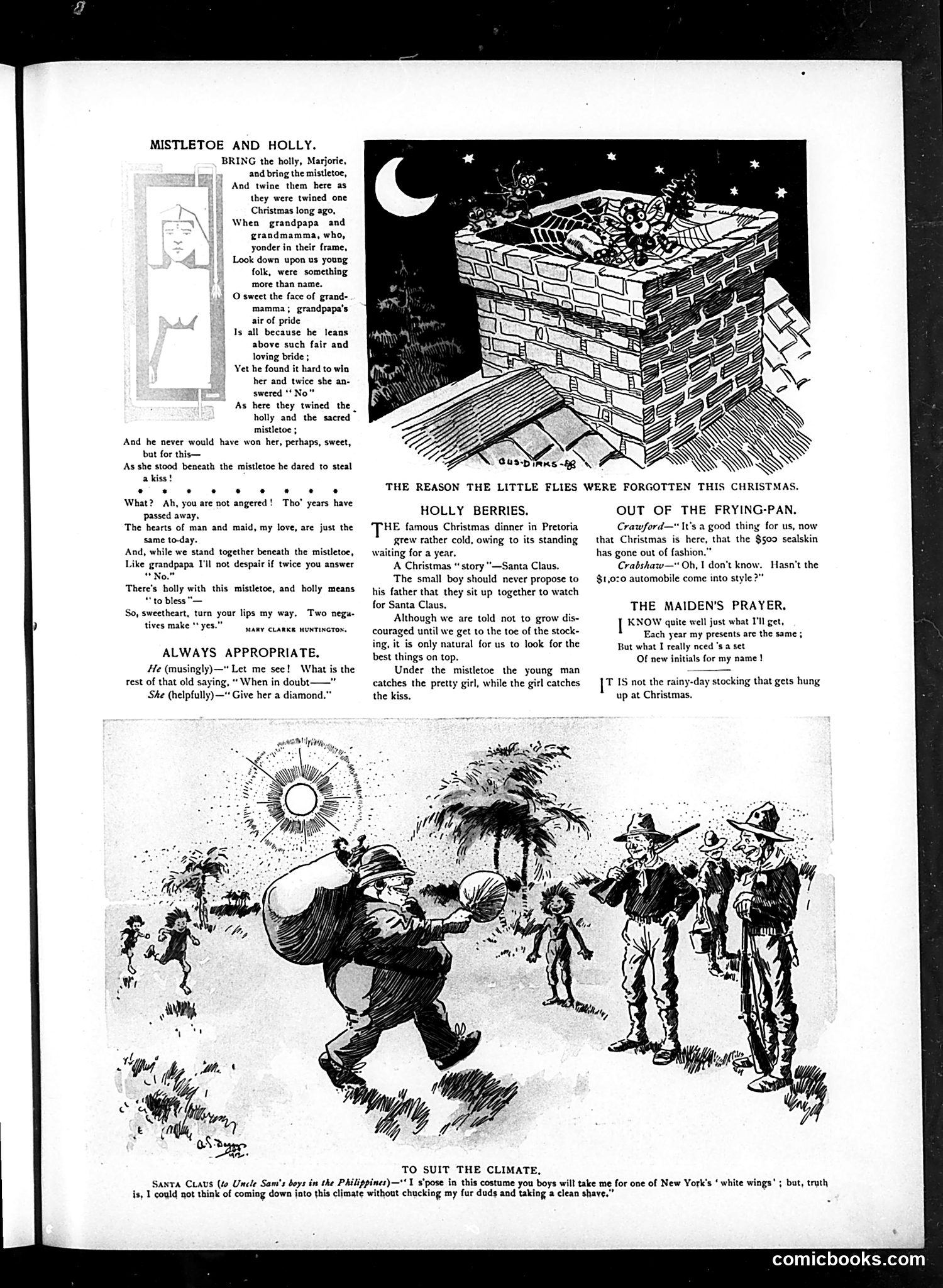
This is a Christmas-themed satirical page mixing poetry, short humor pieces, and illustrations typical of Judge magazine's format. **"Mistletoe and Holly"** is a sentimental poem about courtship traditions—a young man uses mistletoe to kiss his reluctant beloved, paralleling his grandfather's successful wooing. The satire is gentle, poking fun at romance and persistent male pursuit. **"Always Appropriate"** is a one-liner joke: when unsure what to give, a diamond is always the answer—mocking materialism in courtship. **"To Suit the Climate"** depicts Santa Claus in tropical Philippines dress, addressing American soldiers there. This references the Spanish-American War and U.S. presence in the Philippines (circa 1898-1902). The joke satirizes the absurdity of Santa's traditional arctic gear in a tropical climate—he's ditched his "fur duds" for practical clothing. **Other brief pieces** mock Christmas excess (expensive sealskin coats), the disappointment of predictable gifts, and the famous Christmas dinner in Pretoria (likely referencing the Boer War). The page reflects early 1900s American concerns: colonialism, materialism, and romantic customs.
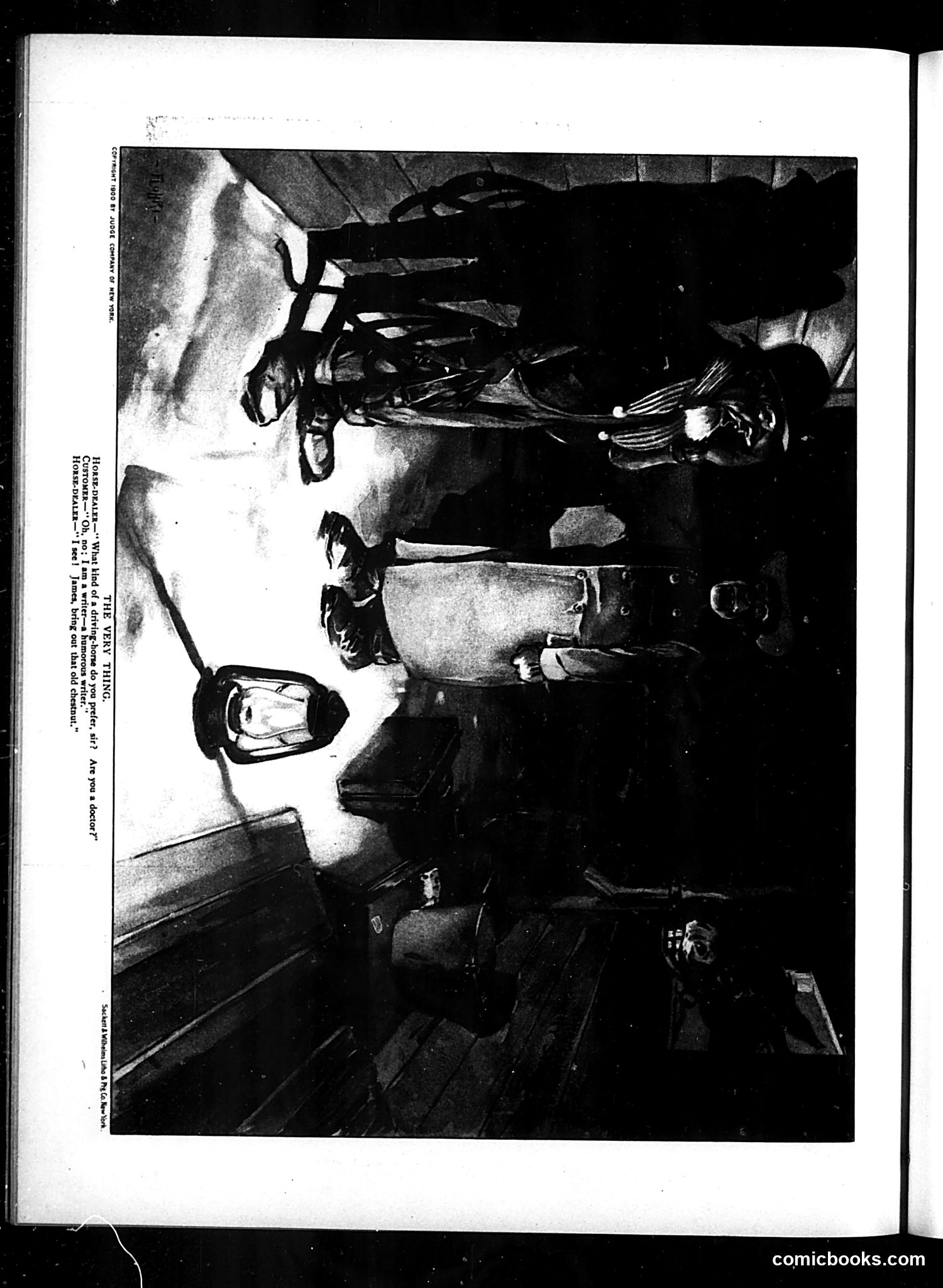
This appears to be a Victorian-era satirical cartoon from Judge magazine playing on the phrase "old chestnut"—a joke or story told repeatedly. A horse-dealer, responding to a customer who identifies himself as a "humorous writer," literally interprets the request for material by producing an actual old horse, calling it "that old chestnut." The satire mocks humorous writers of the period, suggesting their jokes are so worn-out and recycled that they're like a literally exhausted, decrepit horse. The humor relies on the visual pun of taking an idiomatic expression literally. It's commentary on the staleness of contemporary comedy writing—a common target of satirical magazines.
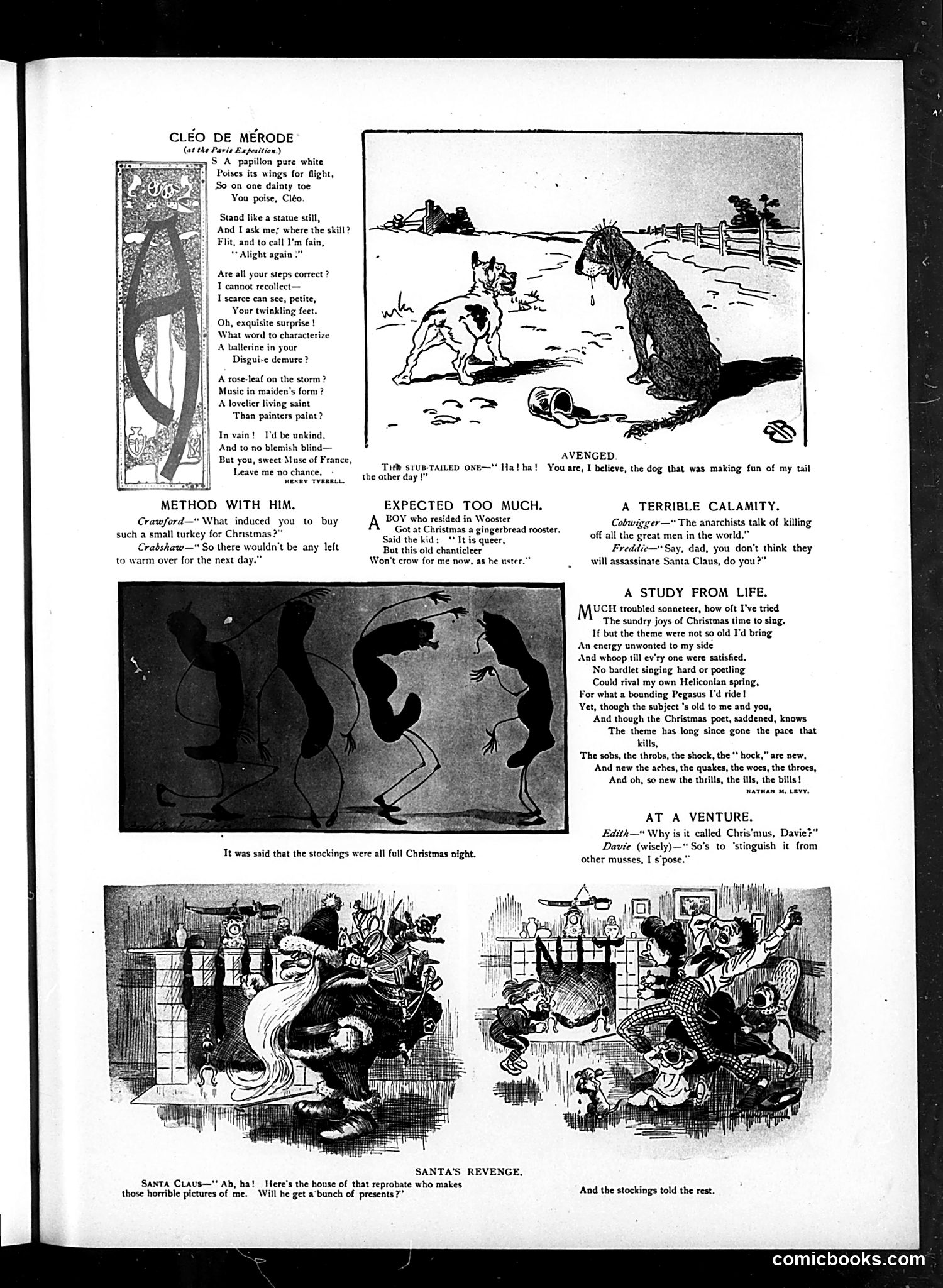
This Christmas-themed page from Judge magazine contains multiple satirical pieces: **"Cléo de Mérode"** is a poem praising a famous Parisian dancer performing at the Paris Exposition—likely the 1900 exposition. The ornate illustration and florid verse mock the pretentious admiration surrounding celebrity performers of the era. **The cartoon vignettes** satirize domestic Christmas anxieties: a man buying an undersized turkey to avoid leftovers; a boy discussing rooster meat; children joking about anarchists assassinating Santa Claus (reflecting contemporary anarchist fears in America). **"A Study from Life"** is a humorous poem about a struggling poet attempting Christmas verses, complaining the subject is worn out—yet finding new material in modern hardships: "aches," "quakes," "bills." **"Santa's Revenge"** depicts Santa punishing an illustrator who draws unflattering pictures of him—likely a self-referential joke about Judge's own satirical cartoonists. The page blends literary satire, domestic humor, and contemporary social anxieties (anarchism, economic strain) within a Christmas framework typical of Judge's sophisticated comedy.
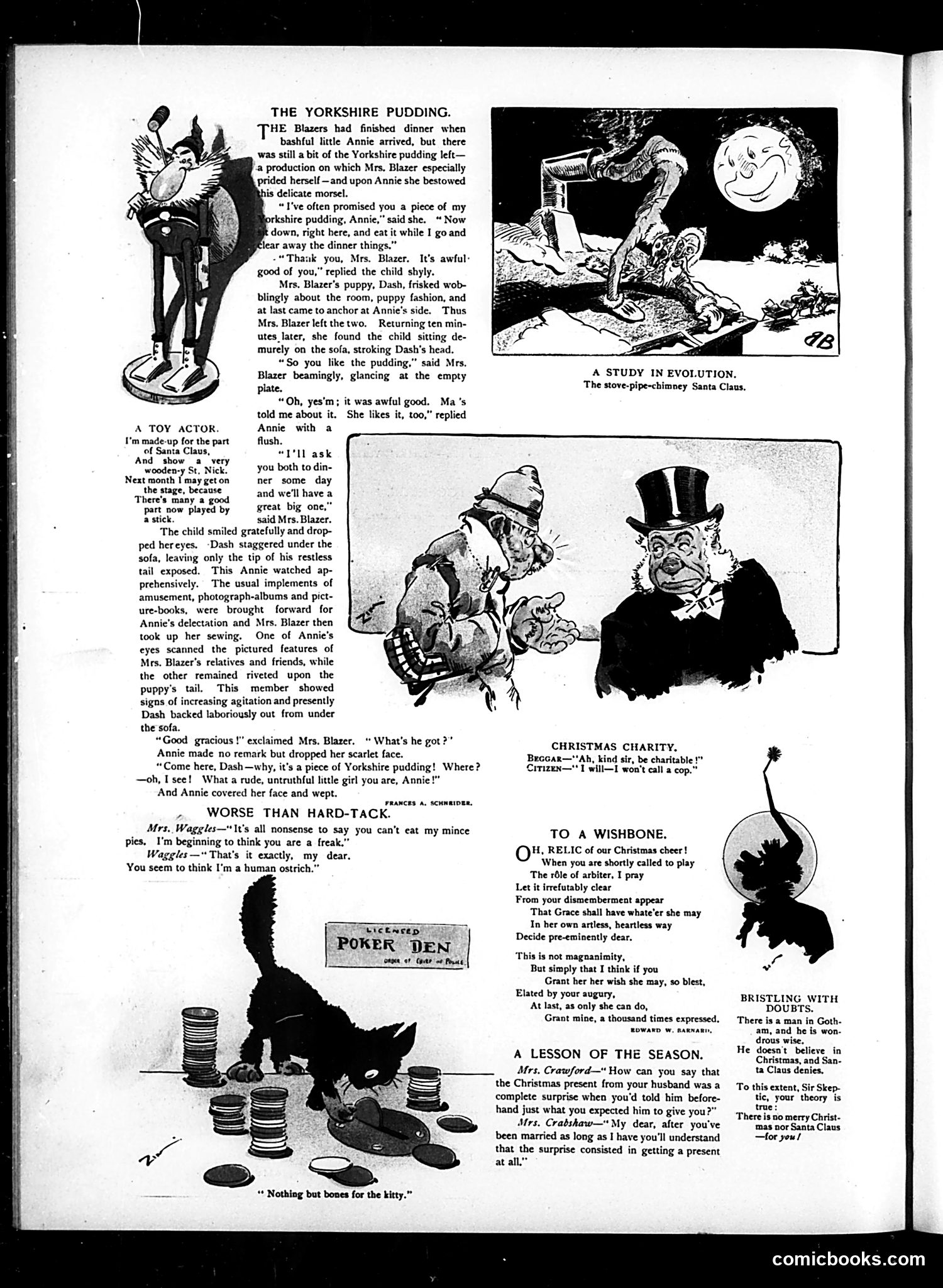
This page contains several humorous domestic vignettes typical of late 19th/early 20th-century American humor: **"The Yorkshire Pudding"** presents a moral tale: young Annie is given a pudding but secretly feeds it to the family dog (Dash), then lies about it. The story illustrates children's dishonesty and poor character—a common moralizing theme in period publications. **"A Toy Actor"** is a brief joke about wooden Santa Claus performances, likely mocking theatrical productions of the era. **Other sketches** address period social conventions: "Worse Than Hard-Tack" jokes about inedible cooking; "Christmas Charity" depicts condescending charity; "A Lesson of the Season" satirizes married couples' Christmas gift dynamics; "To a Wishbone" offers sentimental holiday verse. The illustrations use exaggerated caricature style typical of Judge's satirical approach. Overall, the page mixes gentle domestic humor with mild social criticism about class relations, marital life, and Victorian-era domestic expectations—nothing overtly political, but rather commentary on everyday middle-class American life.
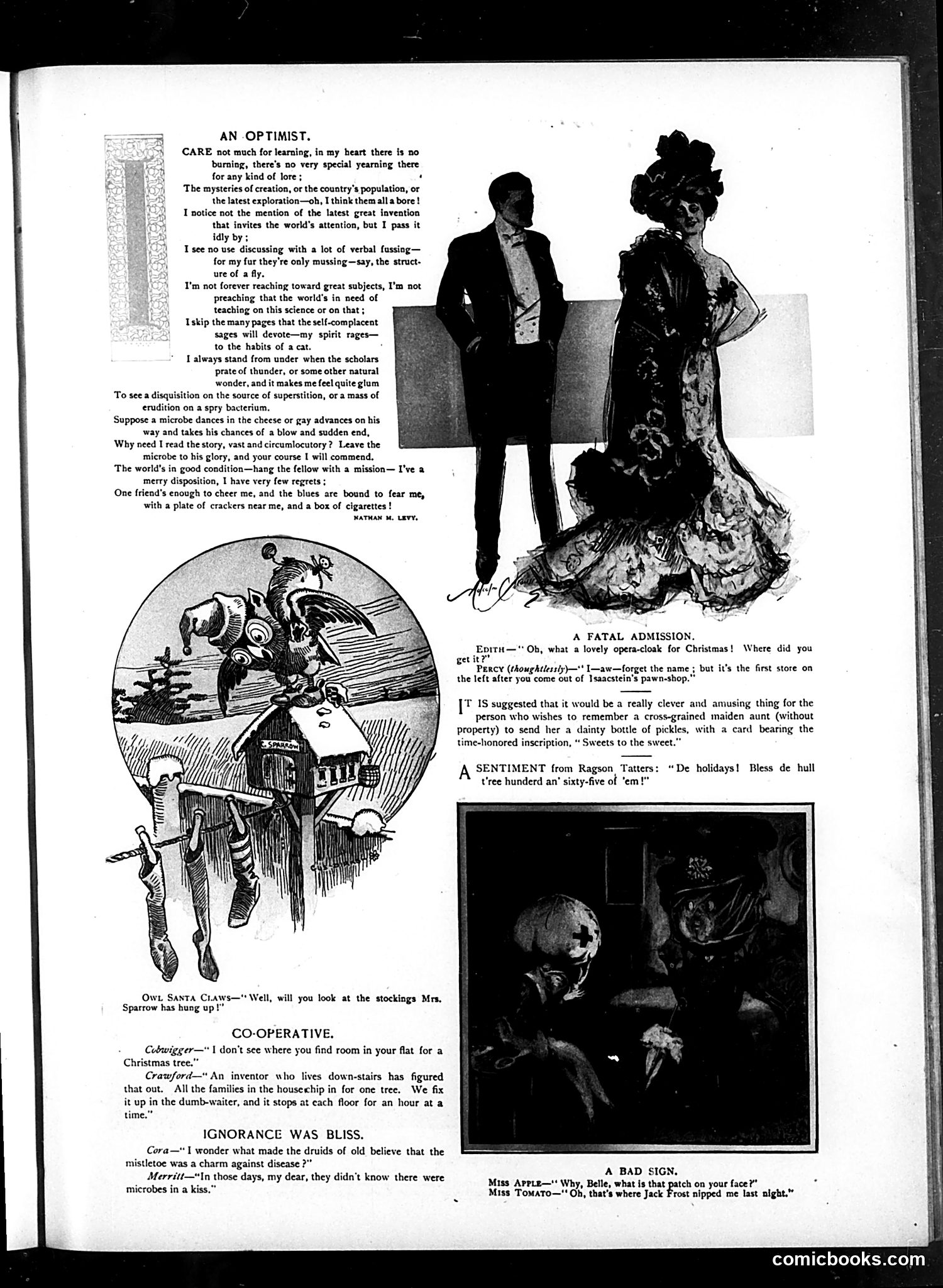
This page contains several satirical pieces typical of early 20th-century American humor: **"An Optimist"** is a poem celebrating willful ignorance—the speaker proudly dismisses learning, scientific discovery, and intellectual pursuits as boring. The satire targets anti-intellectual attitudes and complacency. **"A Fatal Admission"** jokes about pawn shops: a man admits he bought an opera-cloak from "the first store on the left after you come out of Isaacstein's pawn-shop"—revealing he bought second-hand goods, a social embarrassment. The Jewish name "Isaacstein" appears to be incidental to the pawn-shop reference. **"Co-operative"** depicts urban efficiency humor: apartment dwellers share a single Christmas tree, passing it through a dumb-waiter between floors. **"Ignorance Was Bliss"** makes a microbe joke: ancient druids didn't know kissing spread disease, contrasting pre-scientific and modern knowledge. The illustrations support these light domestic and social humor pieces rather than political satire.
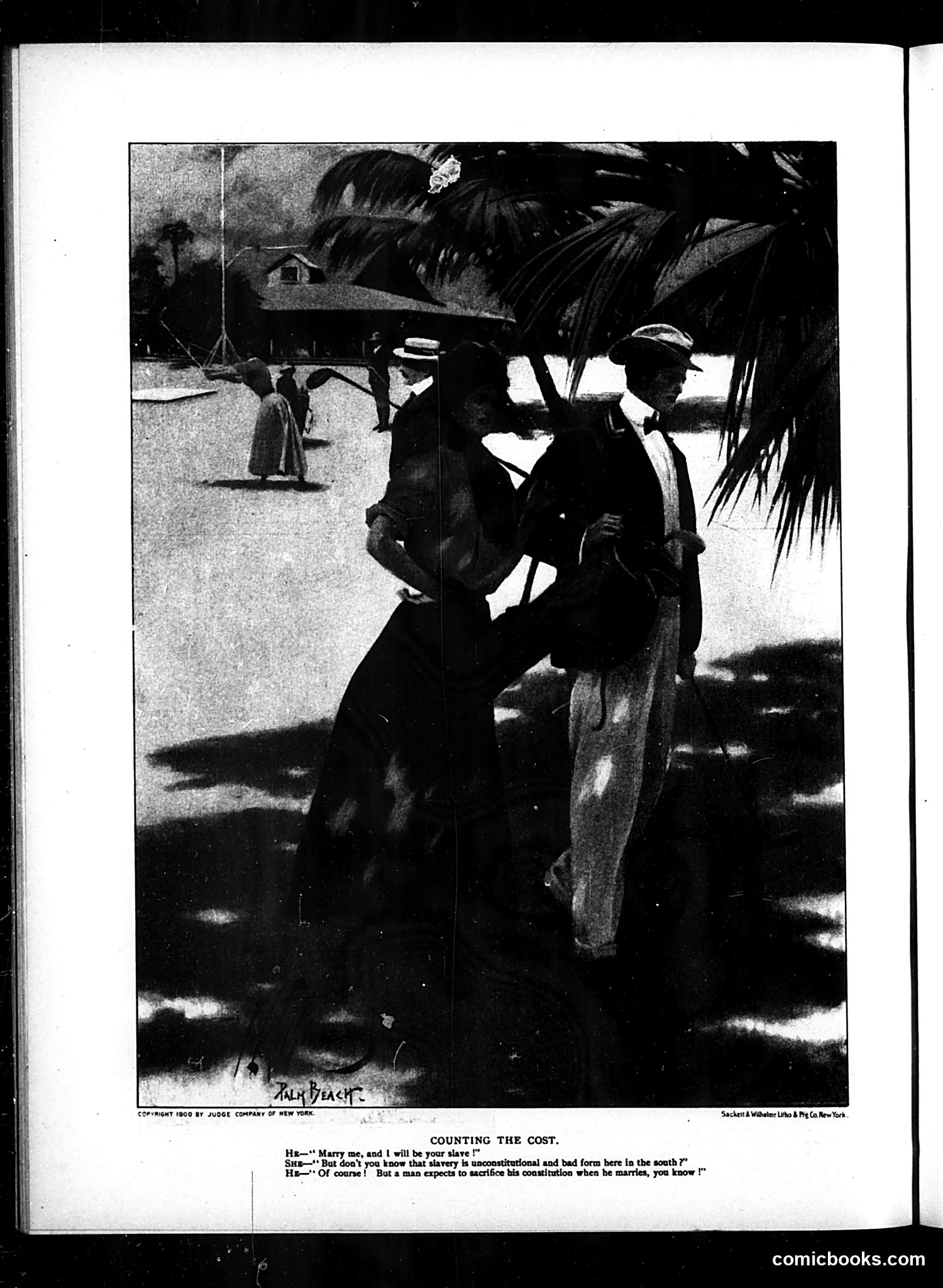
This 1900 cartoon satirizes marriage through the lens of slavery rhetoric. A man proposes to a woman, offering to be her "slave," but she objects that slavery is "unconstitutional and bad form...in the south" — referencing the post-Civil War South's complicated relationship with the abolished institution. The humor relies on a double meaning: the man responds that men are expected to "sacrifice his constitution when he marries," punning on constitutional law versus personal sacrifice. The satire targets marriage itself as an institution where men surrender their freedom and autonomy to wives. The cartoon reflects contemporary anxieties about gender roles and marriage dynamics among Judge's educated, middle-class readership. It uses slavery's legacy as a framework for joking about conjugal subjugation — a comparison that would strike modern readers as tone-deaf, though historically it was commonplace marital humor in this era.
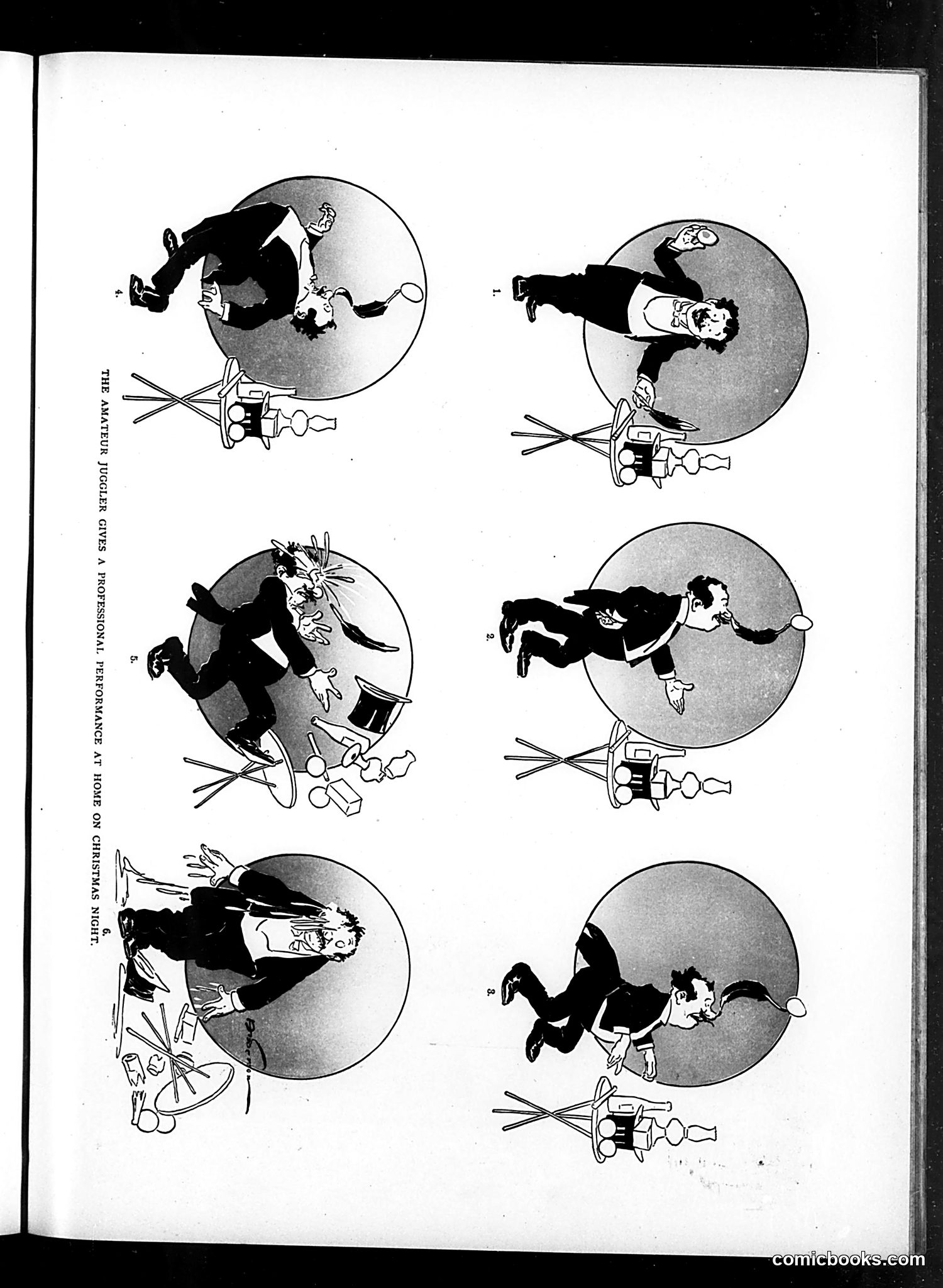
This is a comic strip showing six panels of a man attempting to juggle at home on Christmas night. The sequence depicts increasingly chaotic results as objects go flying in different directions—appearing to be household items, gifts, or decorations that scatter across the room with each failed attempt. The humor derives from the classic slapstick scenario of an amateur overestimating his abilities. The "professional performance" promised in the title is undercut by the obvious disaster unfolding in each panel. This appears to be gentle, domestic comedy typical of Judge magazine's style—poking fun at holiday mishaps and ordinary people attempting feats beyond their competence for entertainment purposes.
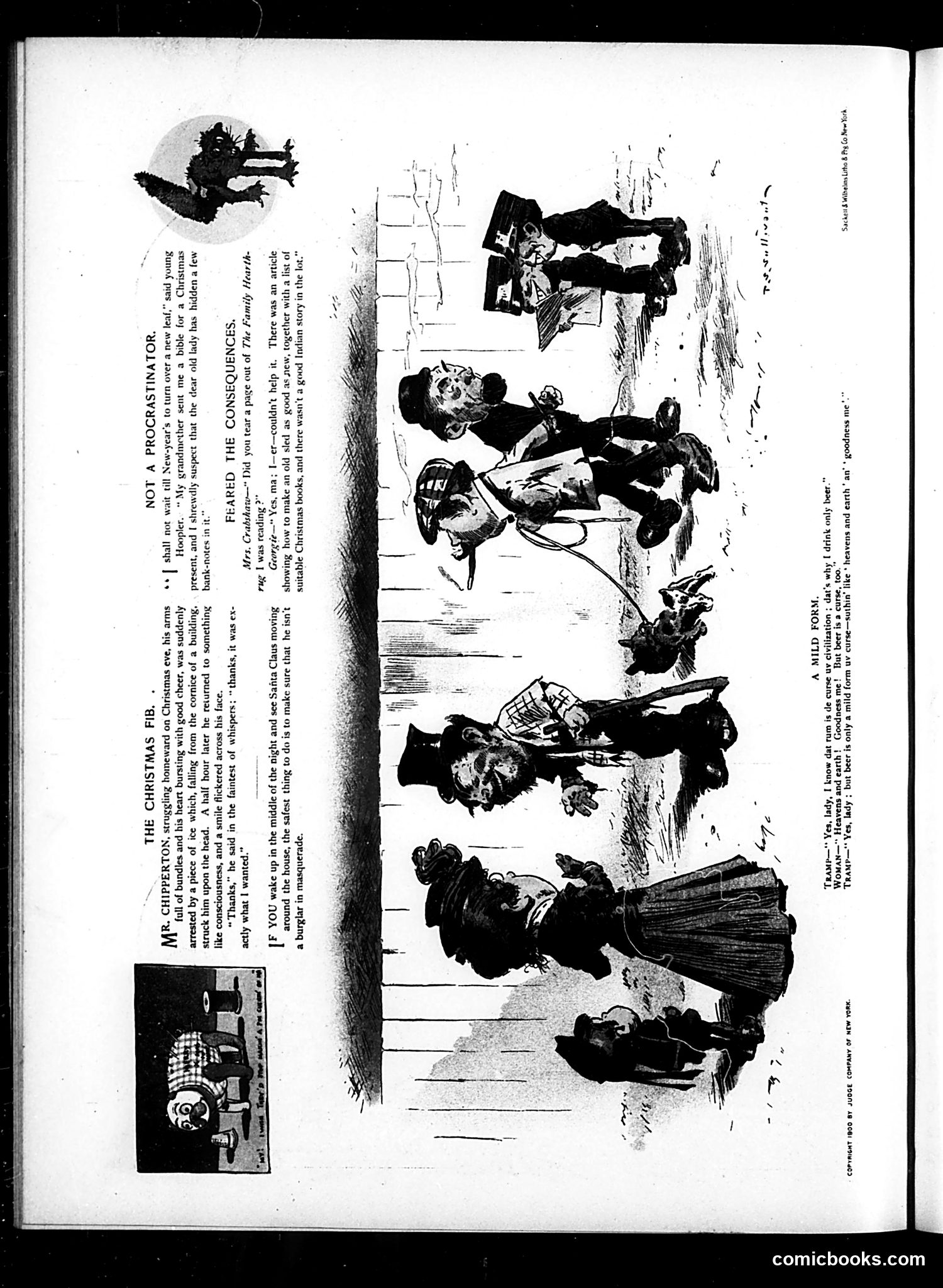
This page from *Judge* magazine contains "The Christmas Stocking" — a satirical illustration about American political and social figures of the era (likely early 1900s based on style). The cartoon depicts figures being stuffed into or emerging from a Christmas stocking, a visual metaphor for containing or criticizing prominent public figures. While the OCR text is heavily corrupted and largely illegible, the image shows what appear to be caricatured politicians or public personalities in various poses of discomfort or awkwardness. The satire likely critiques these individuals for behaviors, scandals, or political positions considered ridiculous or contemptible enough to belong in a "stocking" — suggesting they're being satirically "packaged" as unwelcome gifts or problems for the American public during the holiday season. Without clearer text or date information, specific identifications remain unclear, but the overall intent is typical *Judge* fare: mocking prominent figures through visual exaggeration and holiday-themed wordplay.
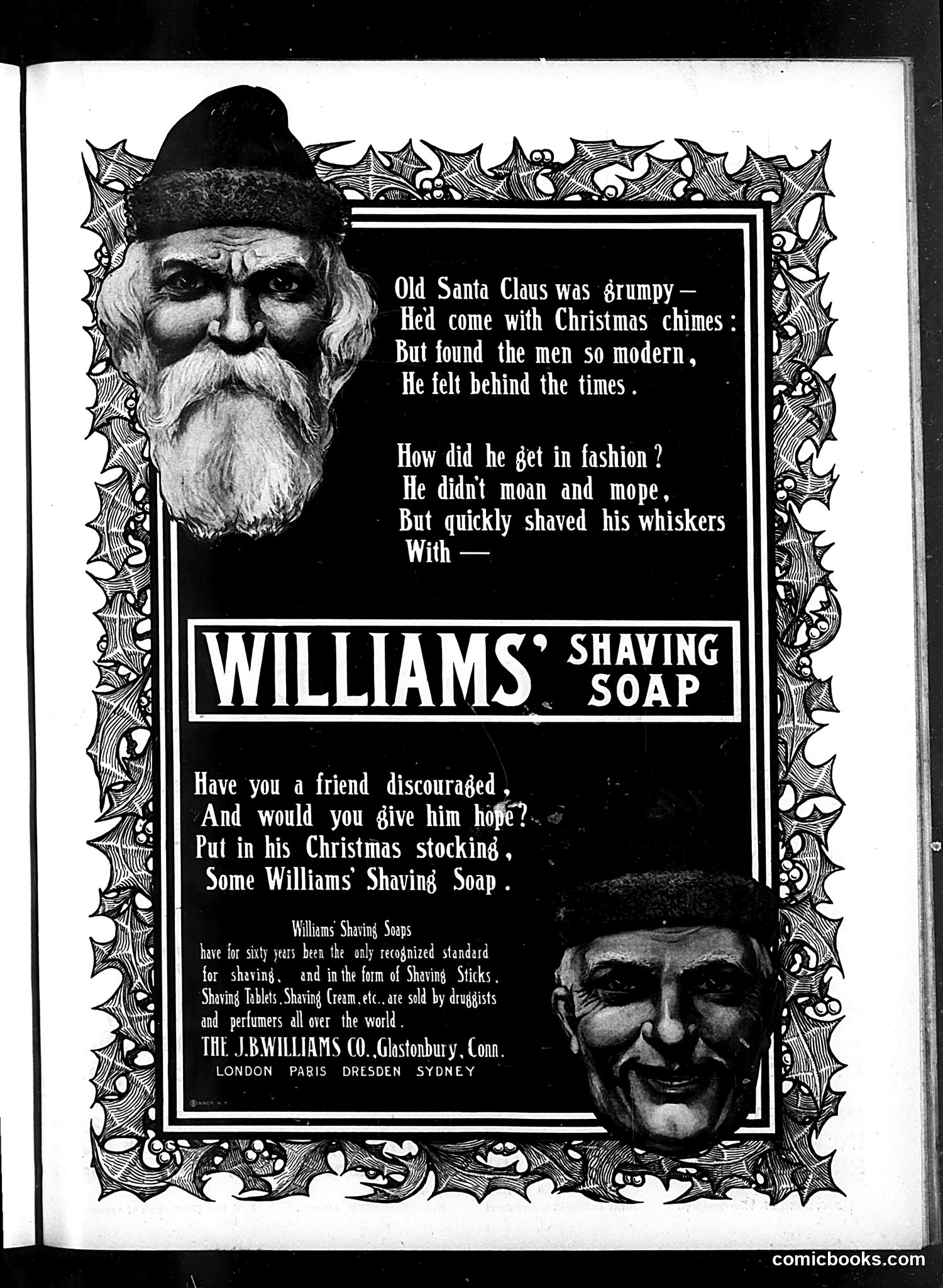
This is primarily a **product advertisement**, not political satire. It uses a humorous narrative about Santa Claus to market shaving soap. The joke: Old Santa Claus arrives with his traditional long beard and finds modern men clean-shaven. To stay fashionable and relevant, he shaves off his iconic whiskers using Williams' Shaving Soap. The ad then suggests giving the soap as a Christmas gift to discouraged friends—implying that grooming/a clean shave brings hope and modernization. The advertisement emphasizes that Williams has been "the only recognized standard for shaving" for sixty years and is available globally (London, Paris, Dresden, Sydney). The illustrations show Santa before and after shaving. This reflects early 20th-century advertising's use of humor and recognizable figures (Santa) to promote consumer products, alongside broader cultural shifts toward clean-shaven male appearance during this era.
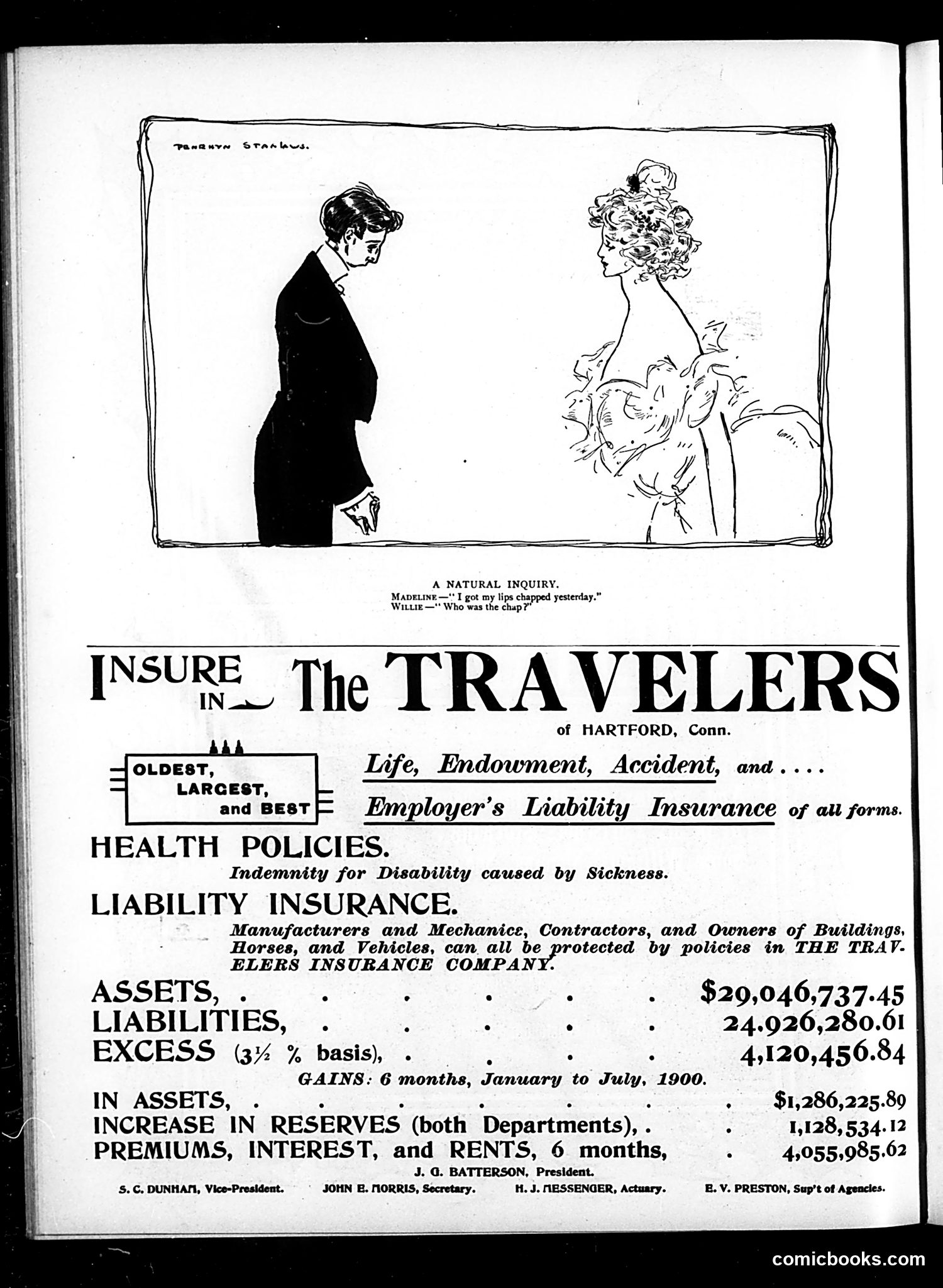
This page is primarily a Travelers Insurance Company advertisement for Hartford, Connecticut, occupying most of the space with financial data and policy offerings (life, health, liability, accident insurance). The small cartoon at the top titled "A Natural Inquiry" is the only satirical content. It shows a man in profile speaking to a woman, with dialogue: "I got my lips chapped yesterday" / "Who was the chap?" The joke exploits a pun: "chapped" (cracked, dry skin) sounds like "chap" (a fellow or man), creating a double-entendre where the woman humorously misinterprets the statement as referring to an affair or romantic encounter rather than a skin condition. It's mild flirtation humor typical of Judge magazine's light satirical fare, likely meant to add levity to what is otherwise a dense insurance advertisement.
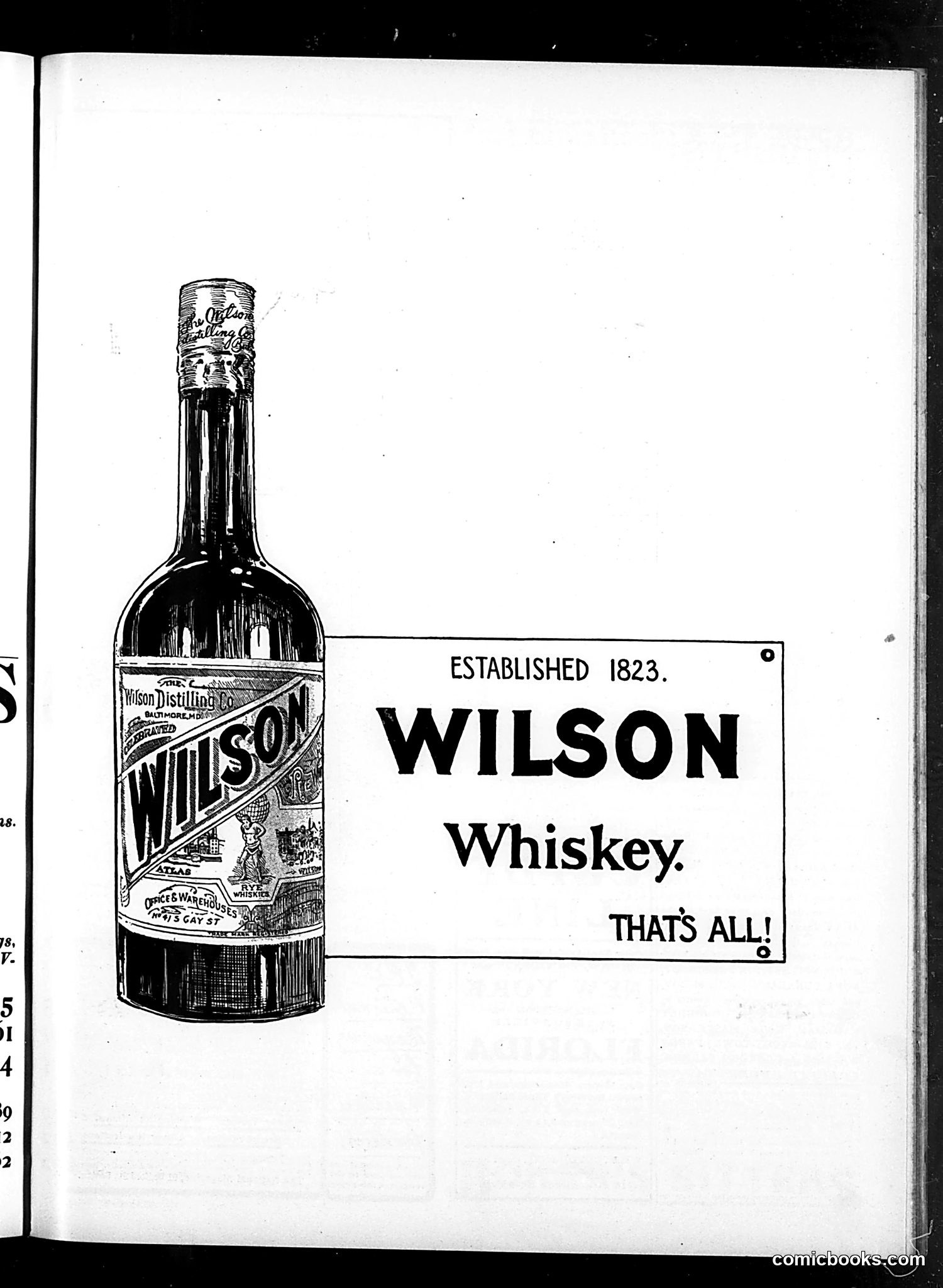
This page is primarily a **product advertisement** rather than satirical content. It promotes Wilson Whiskey, established in 1823, with a detailed illustration of a bottle labeled "Wilson Distilling Co." from Baltimore, Maryland. The tagline "THAT'S ALL!" suggests a straightforward marketing approach—the product speaks for itself without elaborate claims. The establishment date (1823) emphasizes the brand's longevity and presumed quality through tradition. There is **no apparent political satire or social commentary** on this page. It appears to be a standard commercial advertisement placed in *Judge* magazine, likely from the early 20th century. The page demonstrates how satirical publications of this era also carried paid advertising to support their business model.
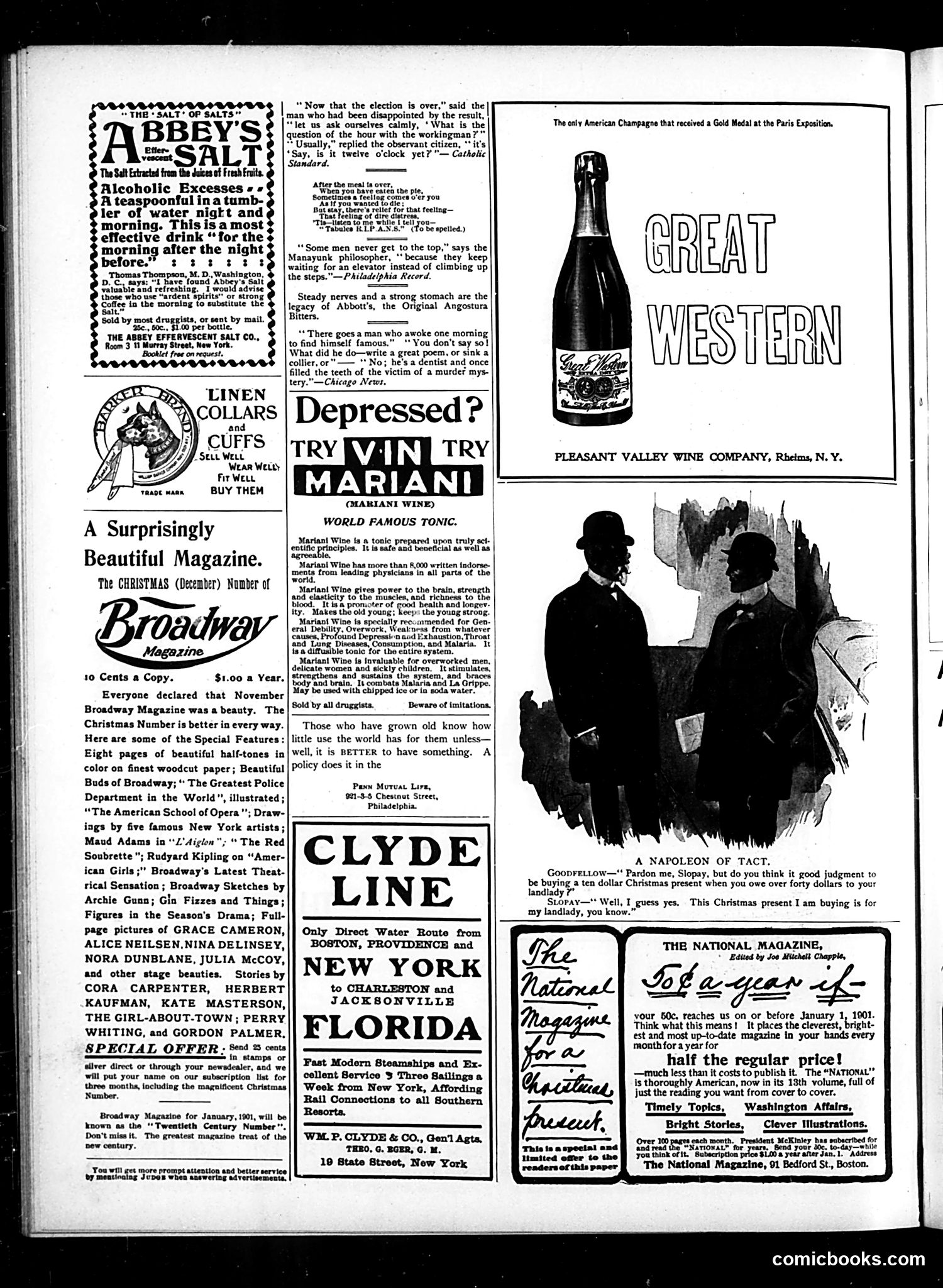
This page is primarily **advertising**, with minimal editorial content. The advertisements reflect turn-of-the-century remedies and products: **Key Content:** - **Abbey's Salt**: A hangover cure marketed as treatment for "alcoholic excesses" and the "morning after" - **Mariani Wine**: A "tonic" wine claiming medical endorsements and cure-all properties (likely containing cocaine, standard in patent medicines of that era) - **Linen Collars ad** and transportation services The brief satirical text snippets are period humor about elections, ambition, and daily life—unremarkable by modern standards. **Historical Context:** This represents the pre-FDA era when unregulated patent medicines made extravagant health claims without evidence. The "depressed?" prompt advertising wine as cure reflects attitudes toward mental health and substance use vastly different from today. The page demonstrates Judge's business model: satirical magazine supported primarily by lucrative advertisements rather than subscription revenue.
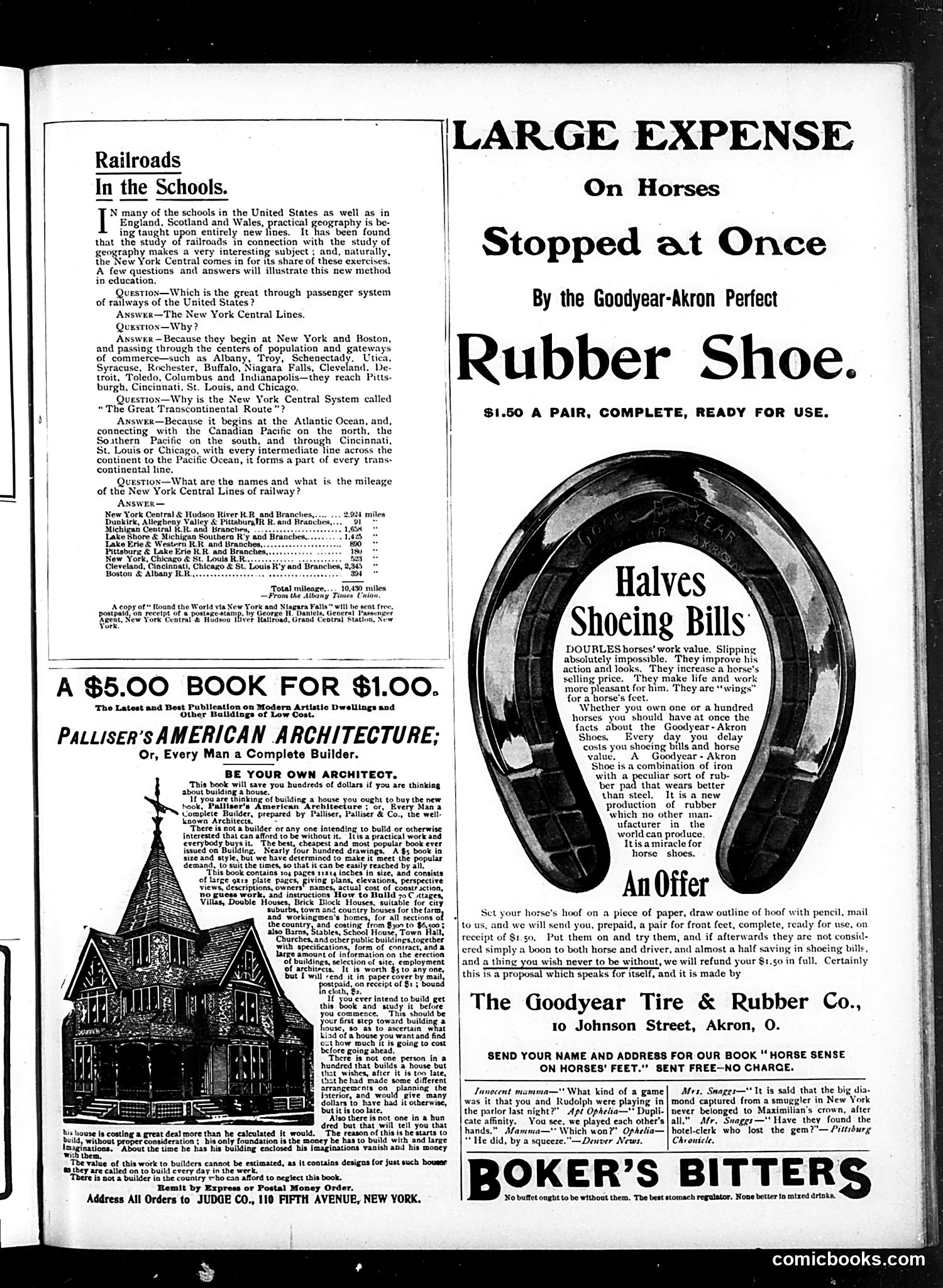
This page satirizes the era's aggressive railroad promotion by presenting a mock "geography lesson" treating the New York Central Railroad as educational content. The Q&A format parodies how schools presented commercial interests as neutral knowledge. The joke: instead of teaching students *actual* geography, the curriculum reduces to promotional material for the New York Central—its routes, mileage, and connections presented as if they were fundamental geographic facts. This reflects real Gilded Age concerns about corporate influence infiltrating public education and the blurring of advertising with instruction. The satire targets railroad monopolies' power to shape curricula and public perception. By framing it as a legitimate educational method, the article exposes how corporations used schools to build customer loyalty and cultural prestige—treating infrastructure promotion as objective fact. The remainder of the page contains advertisements (rubber shoes, architecture books), typical for *Judge* magazine's commercial content.
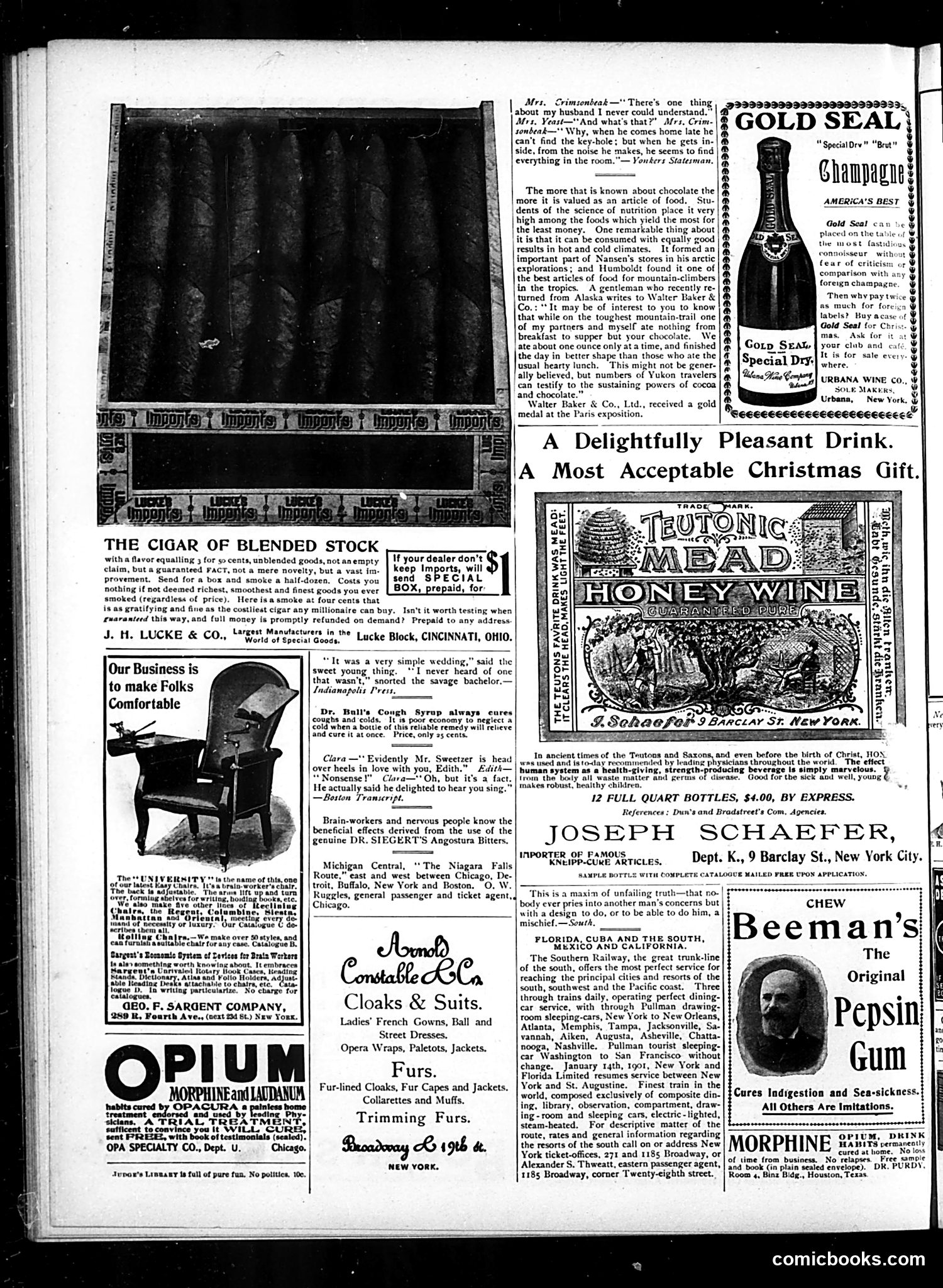
This page is primarily **advertising**, typical of Judge magazine's revenue model. The content includes: **Main Advertisement**: "The Cigar of Blended Stock" by J.H. Lucke & Co.—a Cincinnati cigar manufacturer claiming quality equivalent to expensive imports at four cents, with money-back guarantee. **Other Ads**: Products addressing common concerns of the era—furniture for office workers ("brain-workers"), opium/morphine addiction treatments, cough syrup, cloaks and furs, and beverages like Gold Seal Champagne and Beeman's Pepsin Gum. **Humor Content**: Small jokes interspersed, including one about a newlywed couple and another about a husband coming home drunk (unable to find the keyhole, yet somehow finding everything once inside). **Social Context**: The ads reflect late 19th/early 20th-century concerns: drug addiction was openly marketed as treatable, brain-worker fatigue was recognized as a problem, and alcohol consumption was normalized. There is **no political cartoon** on this page—it's a standard magazine issue page mixing editorial humor with commercial advertising.
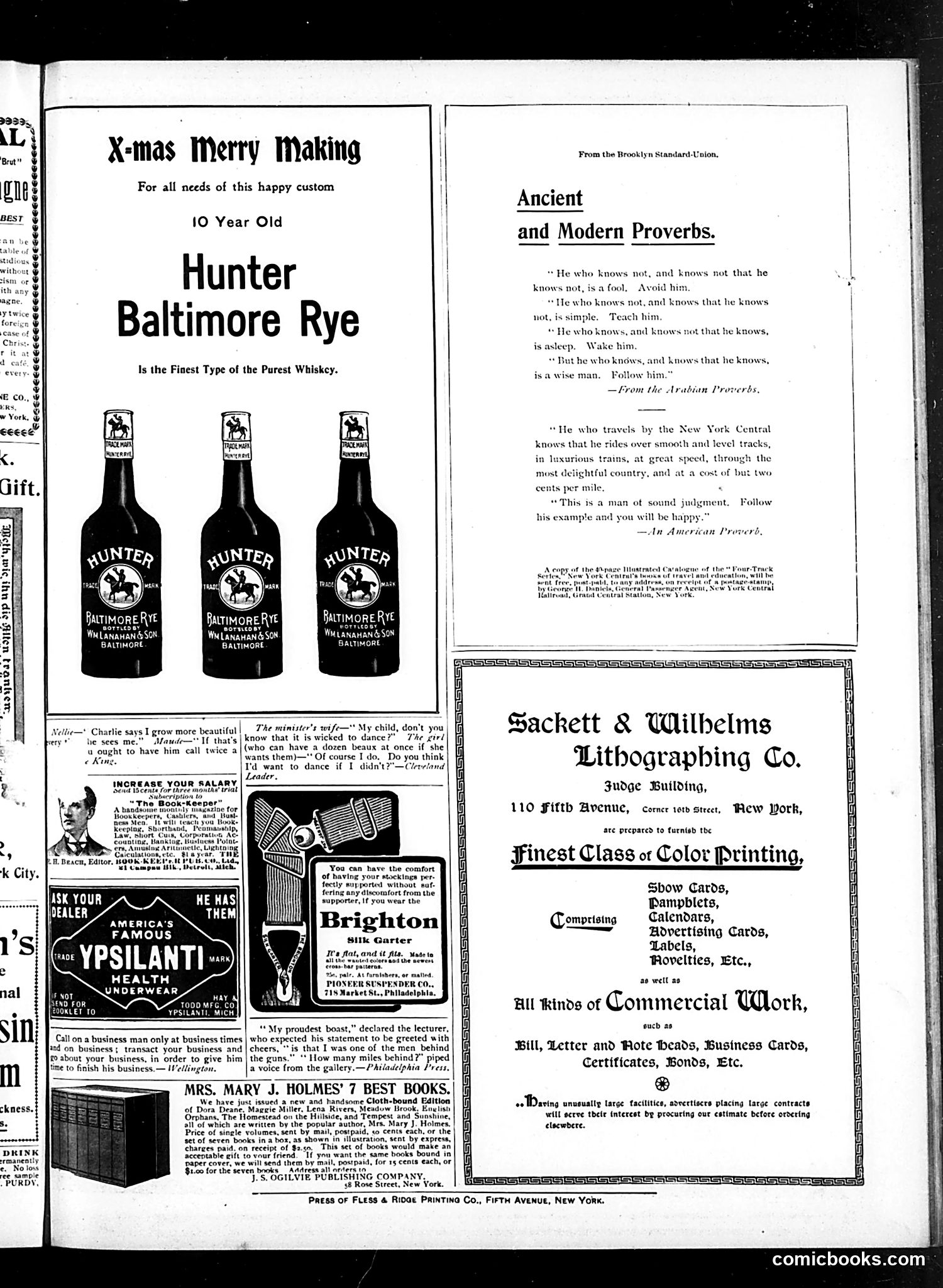
This page is primarily **advertising and filler content** rather than satirical political cartoons. The main elements are: **Major Advertisement:** Hunter Baltimore Rye whiskey dominates the left side, marketed as "the Finest Type of the Purest Whiskey" for Christmas gift-giving. **Small Comic Jokes:** Brief, mild humor pieces scattered throughout—including exchanges about dancing and dating that reflect early 1900s propriety concerns, and a lecturer's joke about being "behind the guns" (unclear context). **Proverbs Section:** A comparison of "Ancient and Modern Proverbs" that humorously positions the New York Central Railroad as exemplifying sound judgment—essentially an advertisement disguised as philosophy. **Service Advertisements:** Brighton Silk Garters, Ypsilanti Health Underwear, and Mrs. Mary J. Holmes book collections occupy remaining space. The page reflects Judge's dual nature as both satirical publication and advertising vehicle. No significant political satire or identifiable caricatures appear here; it's primarily commercial content with filler humor typical of the era.
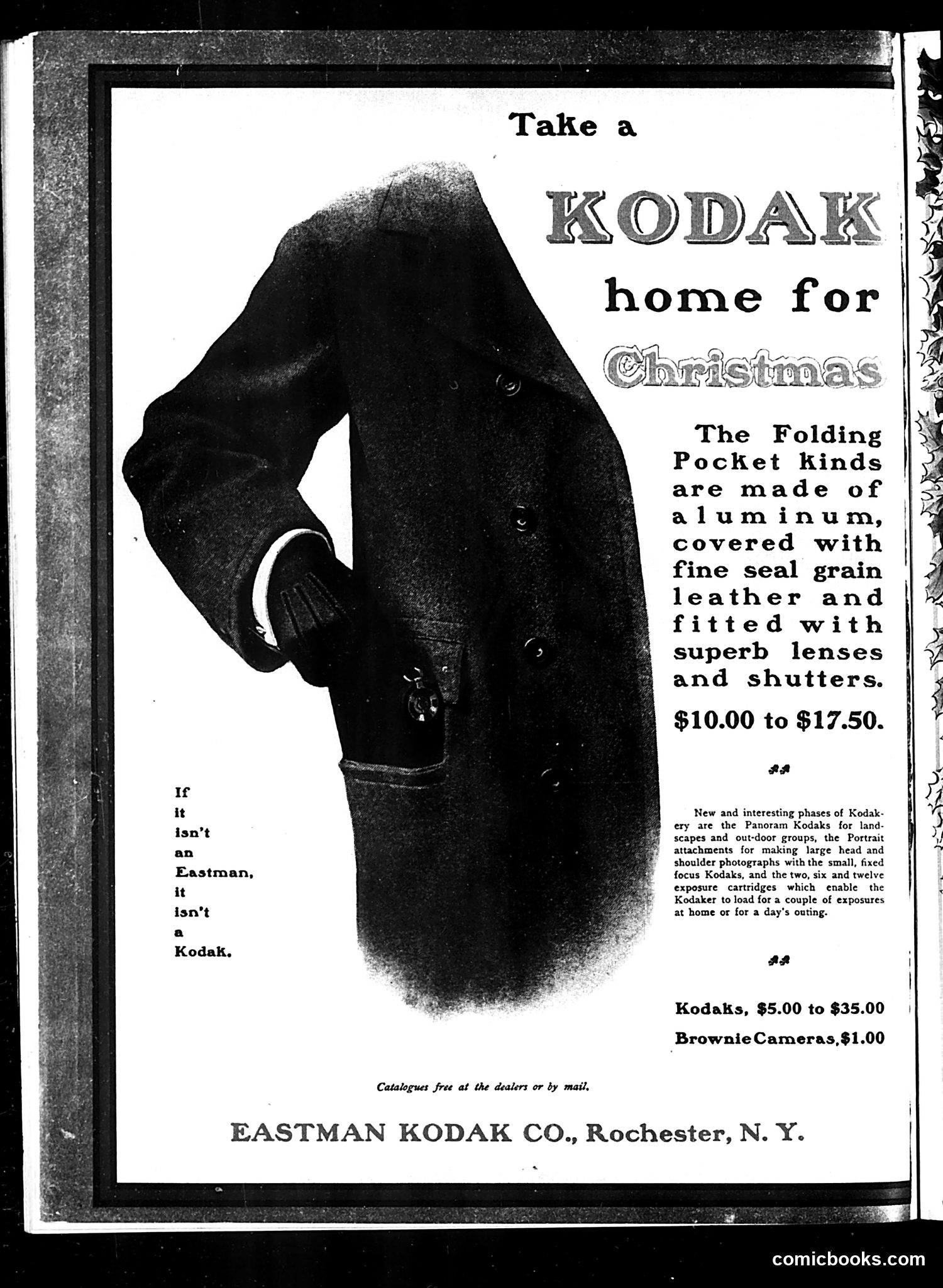
This is primarily **advertising**, not satire or political commentary. It's a Kodak camera advertisement from Judge magazine promoting folding pocket cameras as Christmas gifts. The small text on the left—"If it isn't an Eastman, it isn't a Kodak"—is a **brand slogan**, not a joke or satirical commentary. It's asserting Eastman Kodak's market dominance by claiming their cameras are the only "real" Kodaks. The image shows a hand holding a folding pocket camera. The ad highlights various Kodak models available at different price points ($1.00 to $35.00), emphasizing features like aluminum construction, leather covering, quality lenses, and interchangeable attachments. **For modern readers:** This reflects early 1900s consumer culture where Kodak was the dominant camera manufacturer, and companies used bold marketing claims to establish brand supremacy. The phrase "it isn't a Kodak" suggests competitors existed but were positioned as inferior alternatives.