
A complete issue · 22 pages · 1900
Judge — December 15, 1900
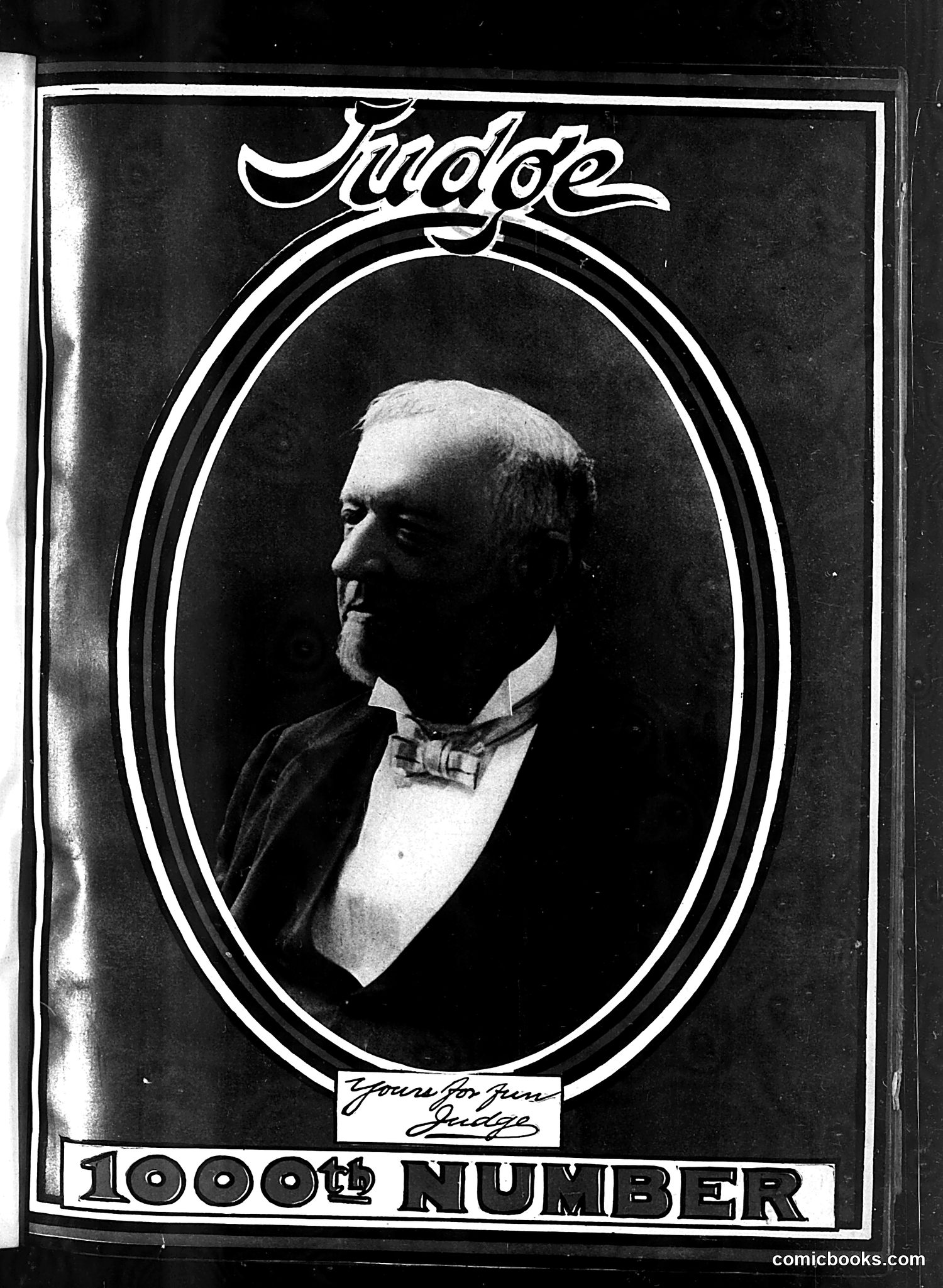
This appears to be a cover or feature page from *Judge* magazine celebrating the "1000th Number." The formal portrait shows a distinguished older gentleman in evening wear (tuxedo and bow tie), presented in an oval frame with decorative border—a classical style used for commemorative or honorific portraits. The inscription beneath reads "Yours for Judge" with a signature, suggesting this is either the magazine's founder/editor or a prominent figure associated with the publication being honored on this milestone issue. Without being able to read the signature clearly or having additional context about the specific issue date, I cannot definitively identify the individual or explain the precise satirical content, though the formal presentation suggests celebration rather than mockery.
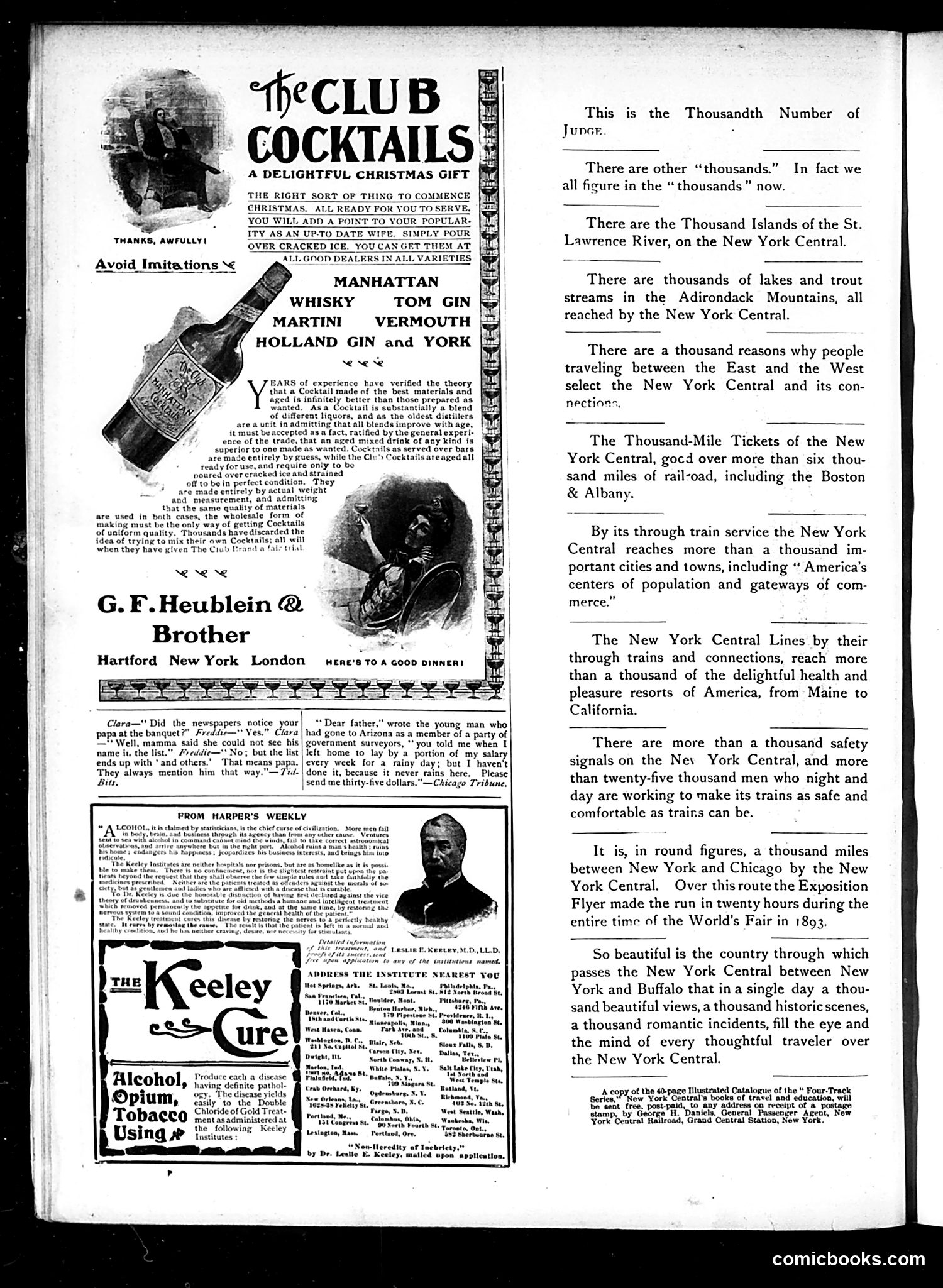
This page is primarily **advertising and promotional content** rather than satirical cartoons. The main features are: 1. **G.F. Hueblein & Brother ad** (left): Promotes cocktail recipes featuring their spirits, positioned as a "delightful Christmas gift." The accompanying illustration shows a bottle and figure, emphasizing quality ingredients and proper preparation. 2. **New York Central Railroad promotions** (right): Multiple paragraphs tout the railroad's routes, safety features, and scenic beauty between New York and Chicago, particularly highlighting connections to health resorts from Maine to California. 3. **The Keeley Cure advertisement** (bottom left): Promotes treatment for alcohol, opium, and tobacco addiction—ironic placement alongside the liquor ad above it. The page reflects early-1900s consumer culture and the railroad industry's marketing during the Gilded Age.
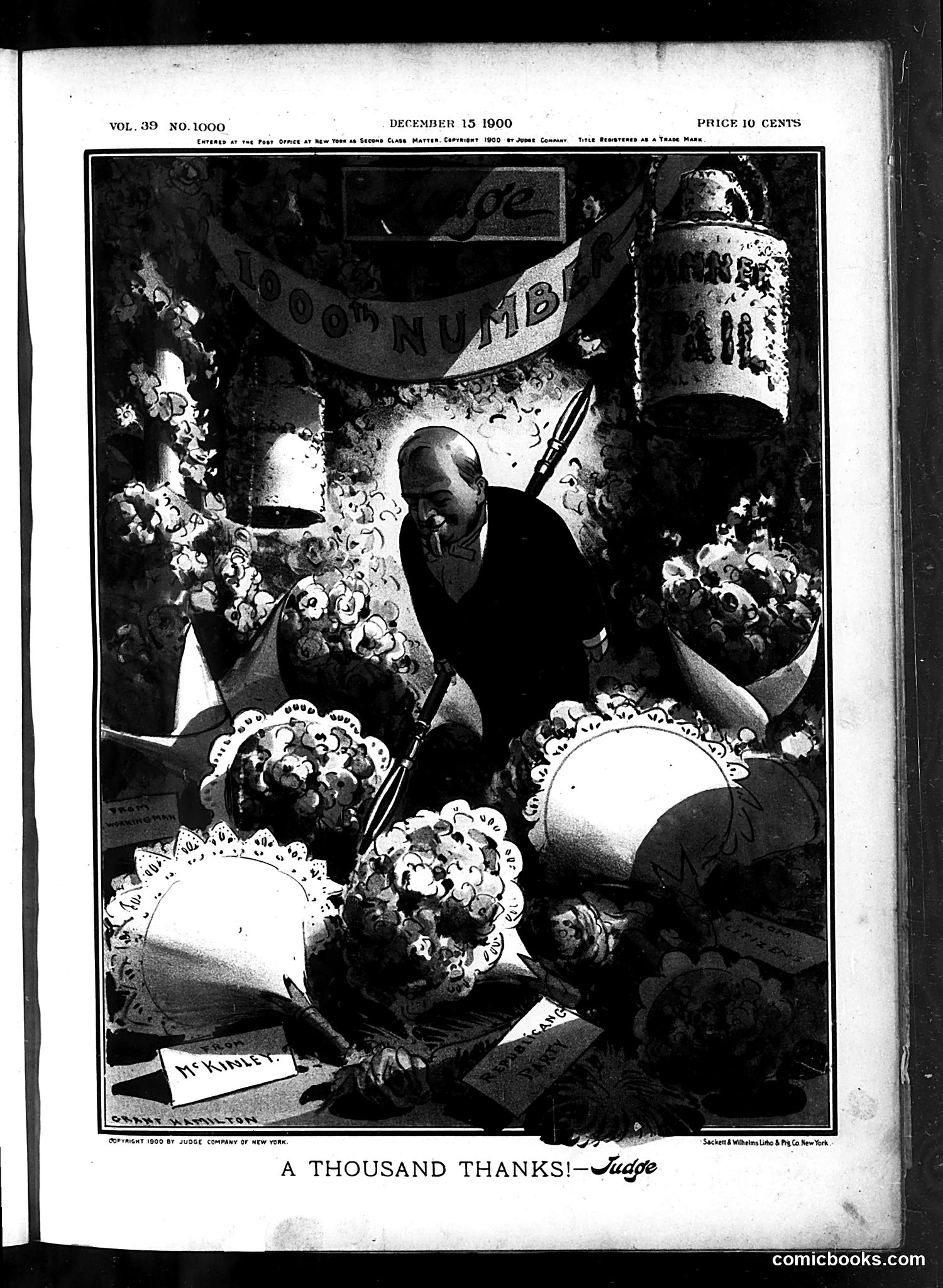
This Judge magazine cover from December 15, 1900 depicts a man in formal attire surrounded by elaborate floral arrangements and cornucopias. A banner reading "1,000,000" appears above, alongside what appears to be a judge's gavel or similar implement. The caption "A Thousand Thanks!—Judge" suggests this is a celebratory image, likely marking Judge magazine's circulation reaching one million copies—a significant achievement for a satirical publication at that time. The abundant harvest imagery (flowers, cornucopias) symbolizes abundance and success. The identity of the central figure remains unclear from the image alone, though he appears to be receiving thanks, possibly the magazine's editor or a prominent political figure the publication wished to acknowledge during this period.
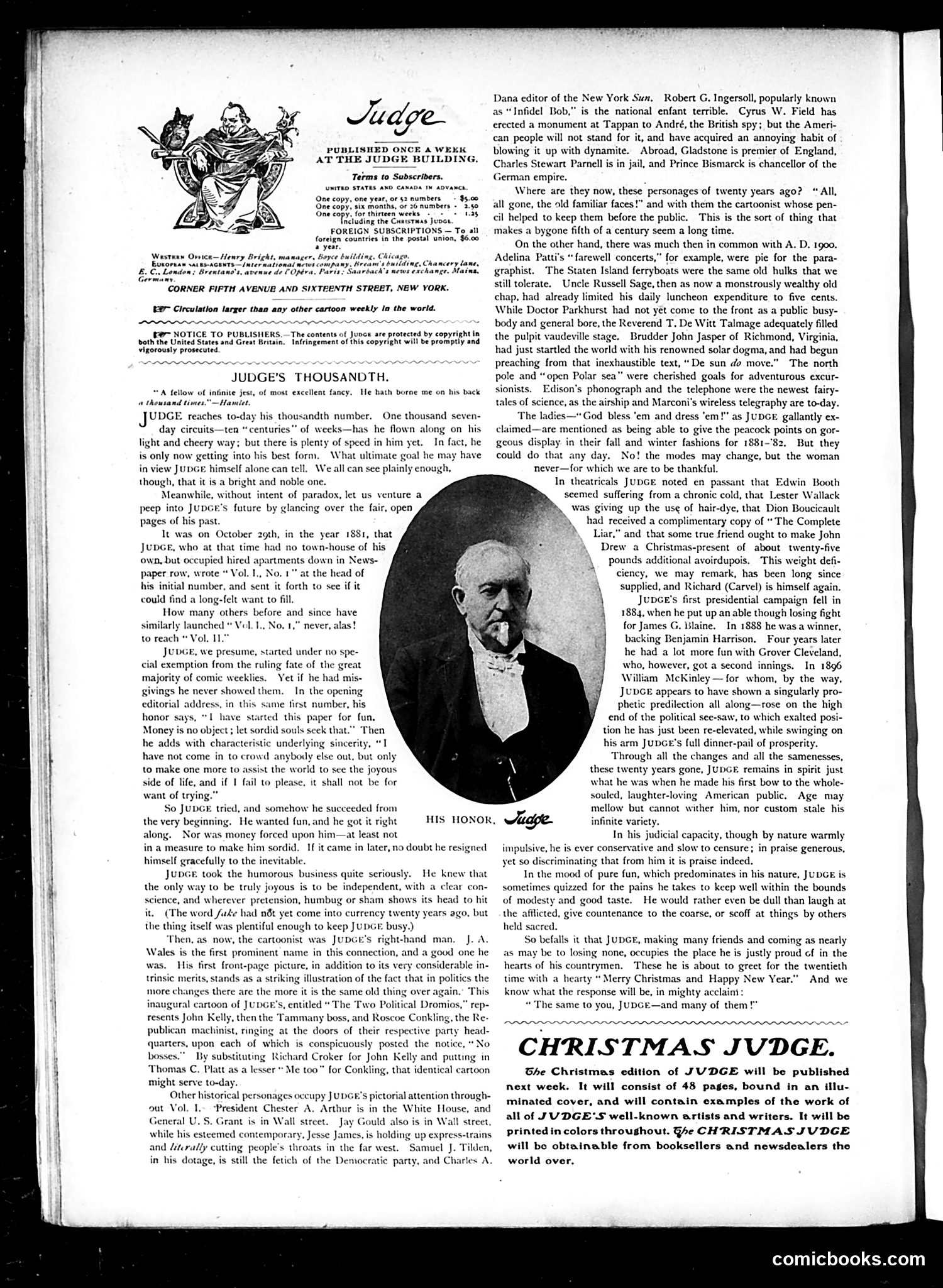
This page is primarily **editorial content about Judge magazine itself**, not political satire. The main article, "Judge's Thousandth," celebrates the magazine reaching its 1,000th issue (dated October 29, 1881). The text discusses Judge's history, founding principles, and notable contributors. It mentions contemporary figures like **Edwin Booth** (actor), **Benjamin Harrison** (political figure), and various editors and politicians, but in biographical/historical context rather than satirical commentary. The **portrait photograph** shows the magazine's founder or editor—likely Eugene Sandford Martin or another key figure—though the image quality makes identification difficult. The page concludes with an **advertisement for an upcoming Christmas Judge edition** with 48 pages and color illustrations. This is essentially a **house organ piece celebrating the magazine's milestone**, not satirical commentary on current events.
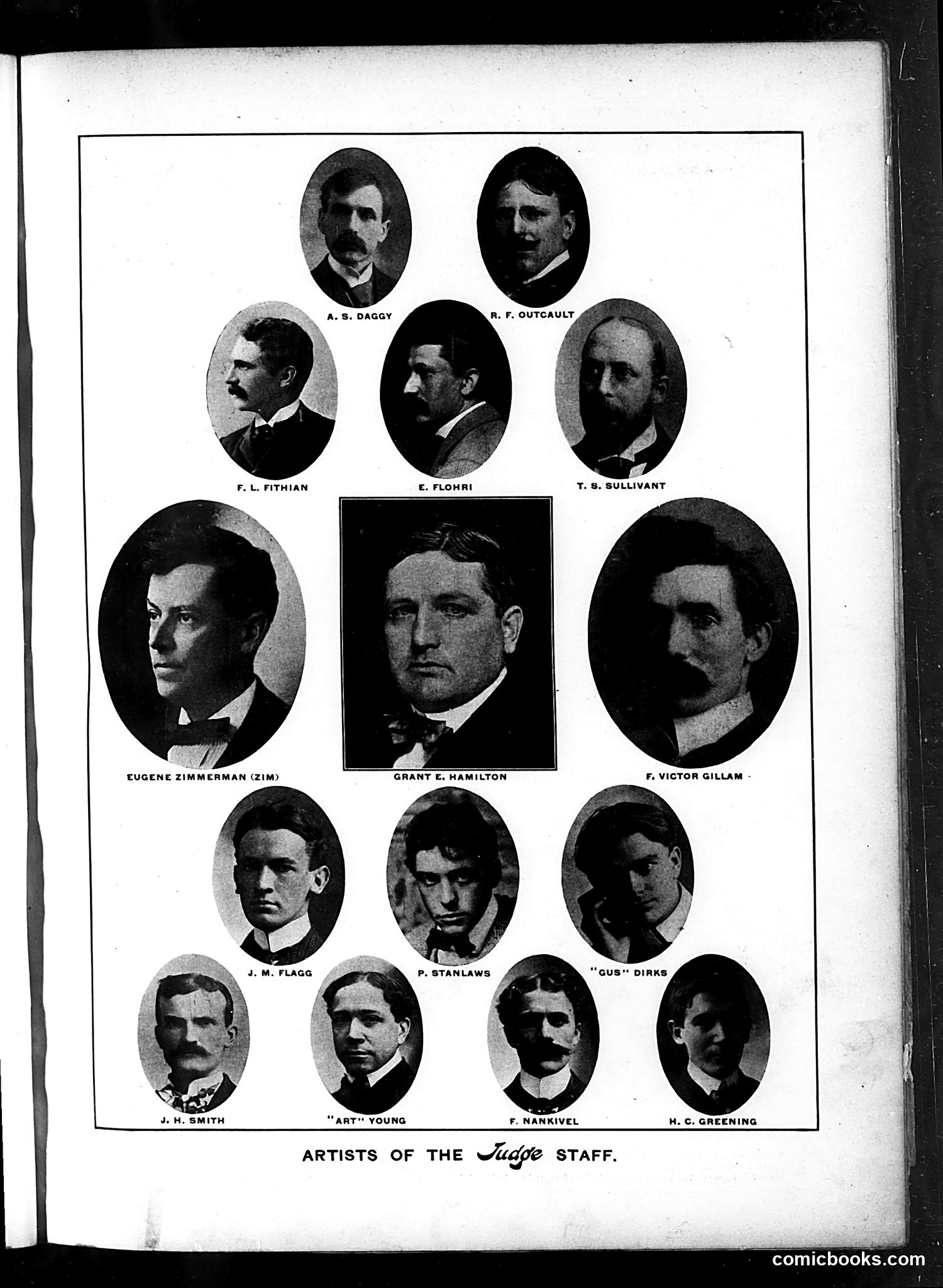
This page identifies the creative staff of *Judge*, a major American satirical magazine. The layout presents fifteen portrait photographs of artists and cartoonists who contributed to the publication, arranged in a decorative pattern around a central larger portrait (Grant E. Hamilton, likely the editor or most prominent contributor). The caption "ARTISTS OF THE *Judge* STAFF" celebrates the magazine's creative talent. These were professional illustrators and cartoonists whose work appeared regularly in *Judge*, which competed with *Puck* as a leading venue for political satire and humor commentary from the late 19th/early 20th century. This appears to be a self-promotional page showcasing the magazine's artistic credentials to readers and potential advertisers.
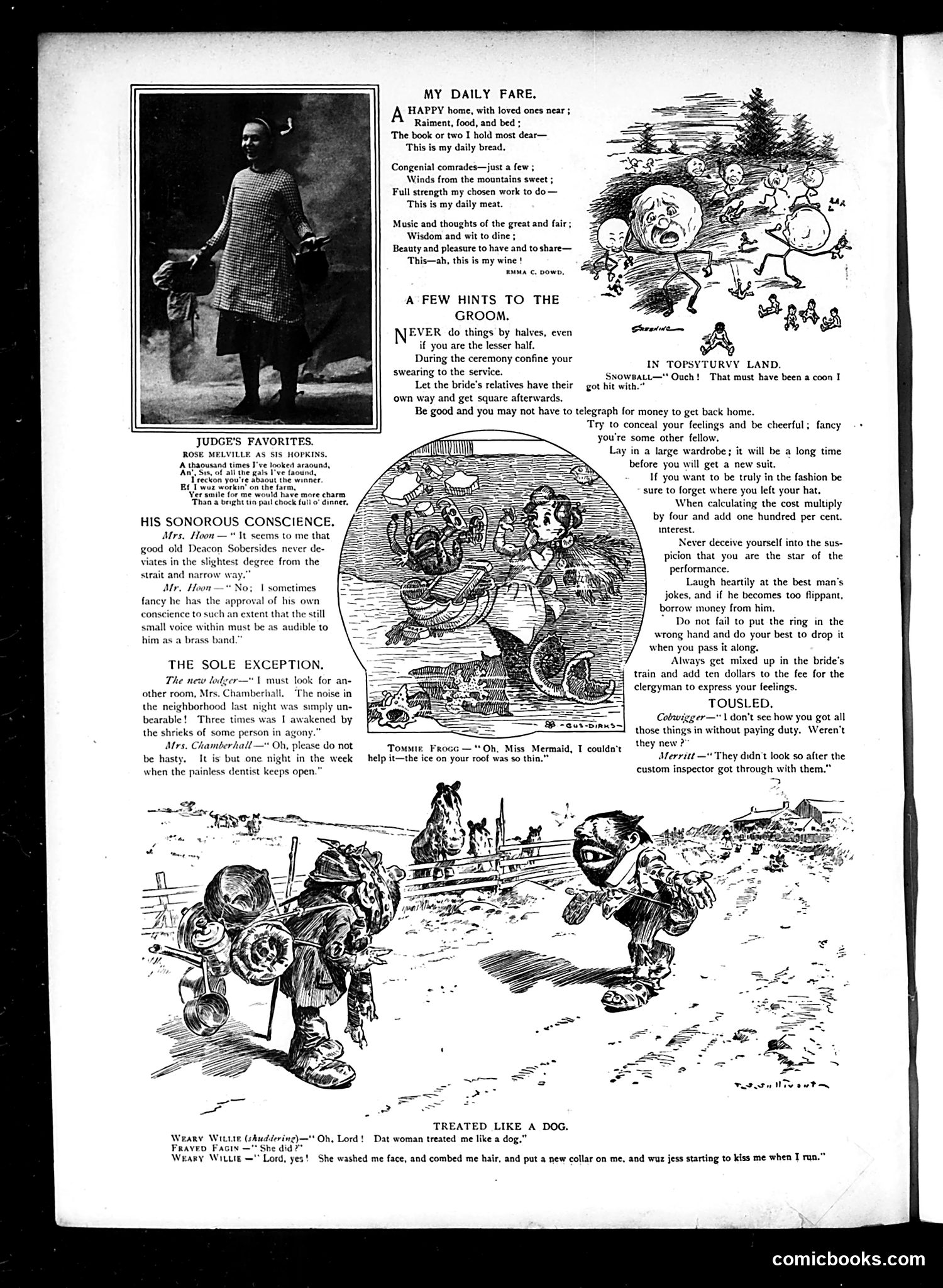
This is a humor and advice page from *Judge* magazine. The main content includes: **"A Few Hints to the Groom"**: Satirical wedding advice mocking grooms, suggesting they're subordinate to brides, financially ruined by marriage, and should expect to drop the ring and mess up the ceremony. **"His Sonorous Conscience"**: A joke about a man whose conscience is so loud it's like a brass band—mocking self-righteousness. **"The Sole Exception"**: A landlord's complaint about neighborhood noise is explained away because the local dentist practices painlessly at night, causing people to scream—dark humor about dental procedures. **"Treated Like a Dog"**: A racial caricature where a Black man ("Weary Willie") describes being treated well (washed, groomed, given a collar) as humiliating—the "joke" relies on dehumanizing comparison. The page satirizes marriage, social pretense, and dental quackery. The last cartoon reflects the period's deeply offensive racial attitudes.
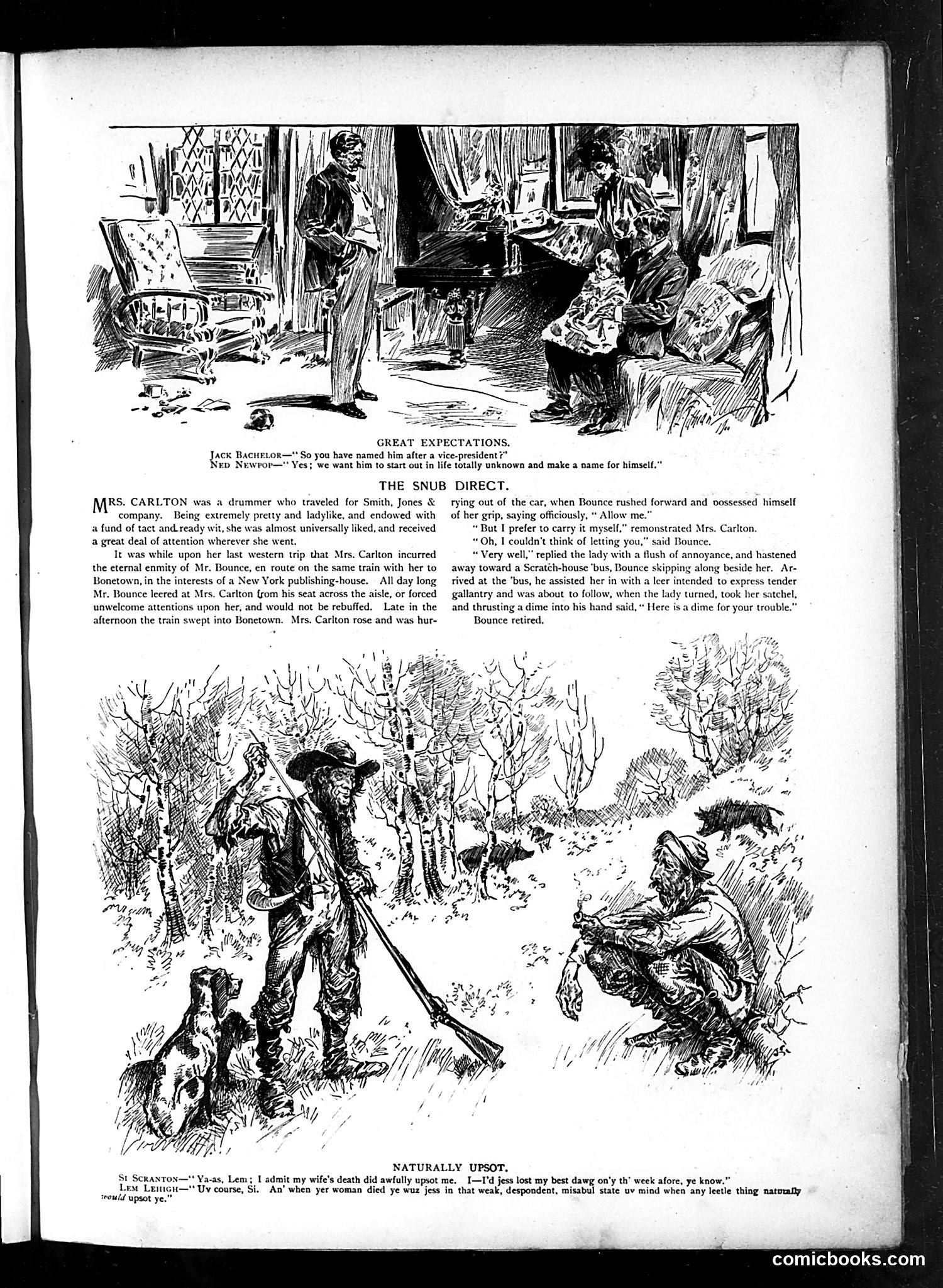
This page contains two unrelated stories from *Judge* magazine (dates unclear from the image). **"The Snub Direct"** satirizes a traveling saleswoman, Mrs. Carlton, who receives unwanted advances from Mr. Bounce, a business agent. When Bounce forcibly "helps" her with her luggage at their destination, she delivers a devastating social snub: she tips him a dime—the amount one gives a porter or servant—and leaves. The humor lies in her brilliant put-down: by treating his "gallant" assistance as paid service work, she strips away his pretense and publicly humiliates him. It's a sharp commentary on gender dynamics and class, showing how wit and social awareness can neutralize harassment. **"Naturally Upsot"** (below) depicts rural dialect humor between two working-class men discussing grief. One explains his emotional vulnerability when his wife died, having recently lost his dog. The joke relies on period rural stereotypes and vernacular speech patterns now considered dated. Both pieces reflect late 19th/early 20th-century satirical magazine conventions mixing social commentary with character humor.
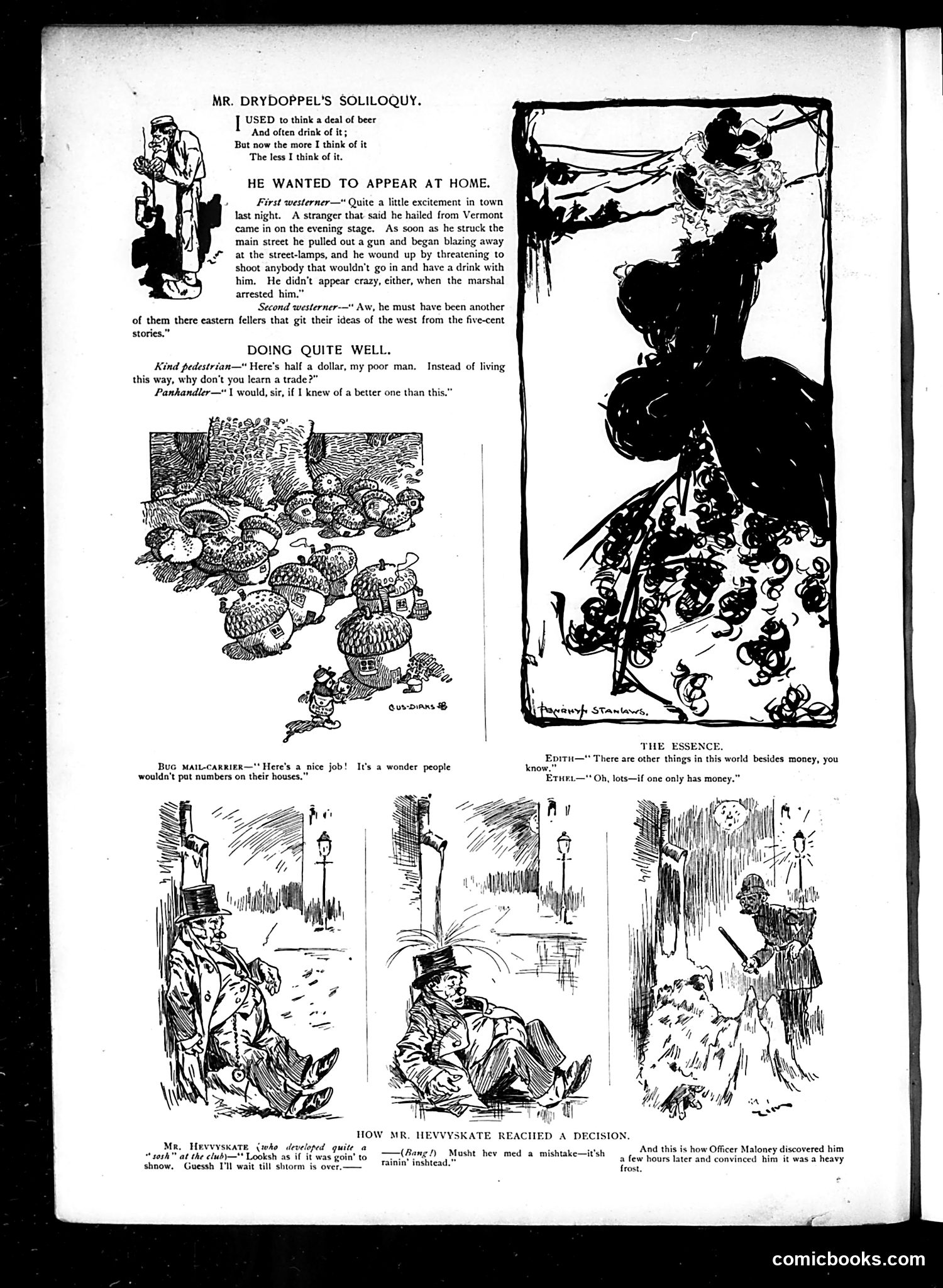
This page contains several comic vignettes satirizing American social types and behaviors circa early 1900s: **"Mr. Drydoppel's Soliloquy"**: A man recants his love of beer—typical temperance-era humor mocking changing attitudes toward alcohol. **"He Wanted to Appear at Home"**: Two Western characters discuss a Vermont visitor who fired guns in town and forced people to drink with him. The joke: Eastern dudes, influenced by cheap "five-cent stories" about Wild West lawlessness, mistakenly believe such behavior is authentically Western. **"Doing Quite Well"**: A pedestrian offers charity to a panhandler, suggesting honest work instead. The panhandler replies panhandling *is* his trade—satirizing both misguided charity and professional vagrants. **"How Mr. Heavyskate Reached a Decision"**: A drunk man, seeing snow, decides to wait at his club until the storm passes. Officer Maloney later finds him frozen to death—dark humor about the consequences of alcoholic poor judgment and indolence. The page generally mocks drunkenness, false Western romanticism, and social parasitism.
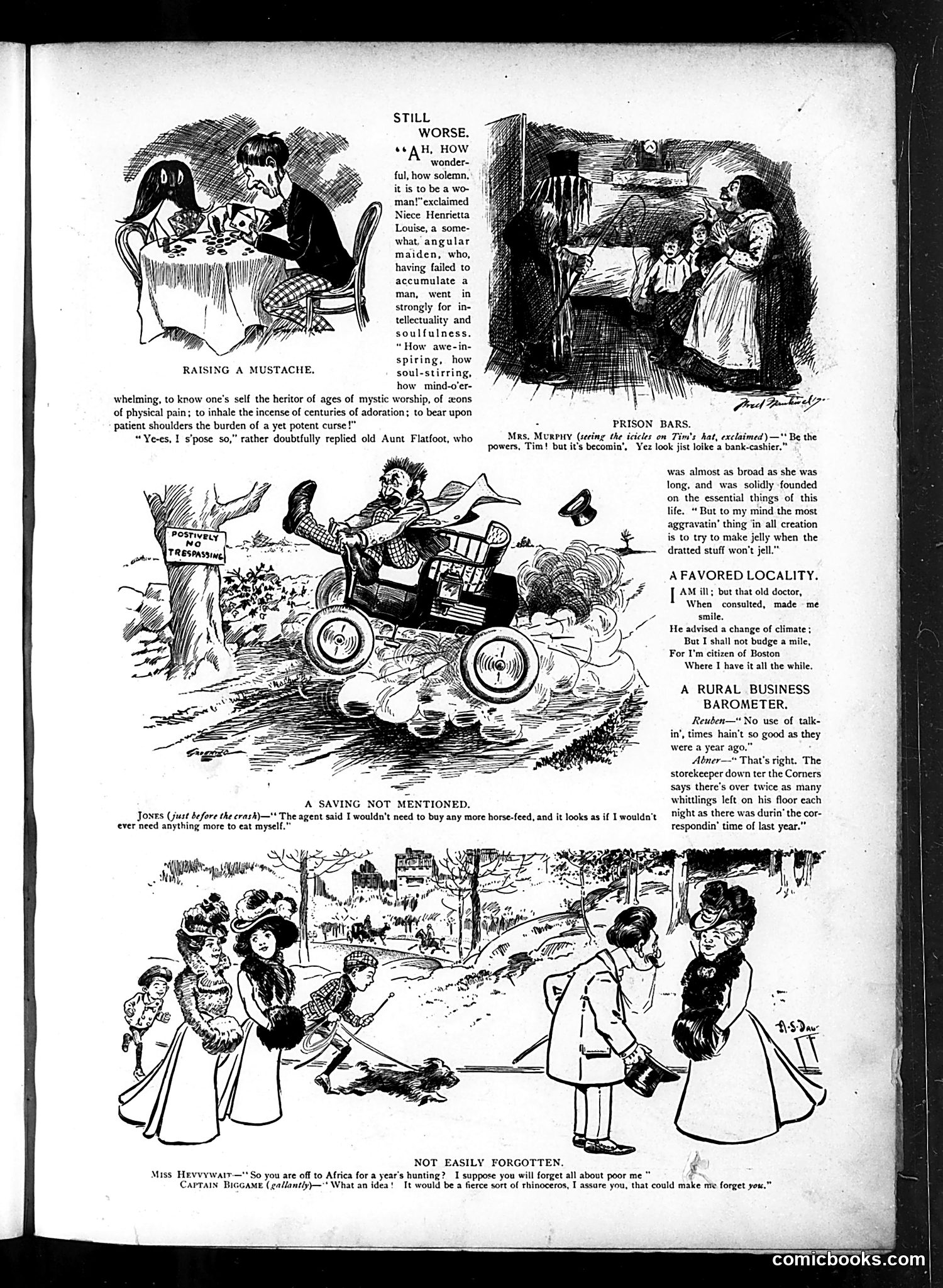
This page contains multiple unrelated satirical vignettes typical of Judge's format: **"Raising a Mustache"**: Contrasts an angular, intellectual young woman (Henrietta Louise) who romanticizes womanhood's "mystic" burdens with practical older Aunt Flatfoot, who finds real life's frustrations (like making jelly) more worthy of complaint. The satire mocks pretentious intellectualism versus common sense. **"Prison Bars"**: A brief domestic joke about Mrs. Murphy's observations on her husband Tim's appearance. **"A Favored Locality"**: Self-congratulatory Boston pride—a Bostonian refuses to leave despite illness, claiming Boston's climate is superior. **"Rural Business Barometer"**: Rural characters measure economic conditions by the quantity of wood shavings on a store floor—fewer whittlings indicate harder times, as farmers have less leisure. **"Not Easily Forgotten"**: A flirtatious exchange between Miss Heavyweight and Captain Biggame about his African hunting trip. The humor relies on period-specific social types, regional dialects, and domestic/social anxieties common to early 20th-century American audiences.
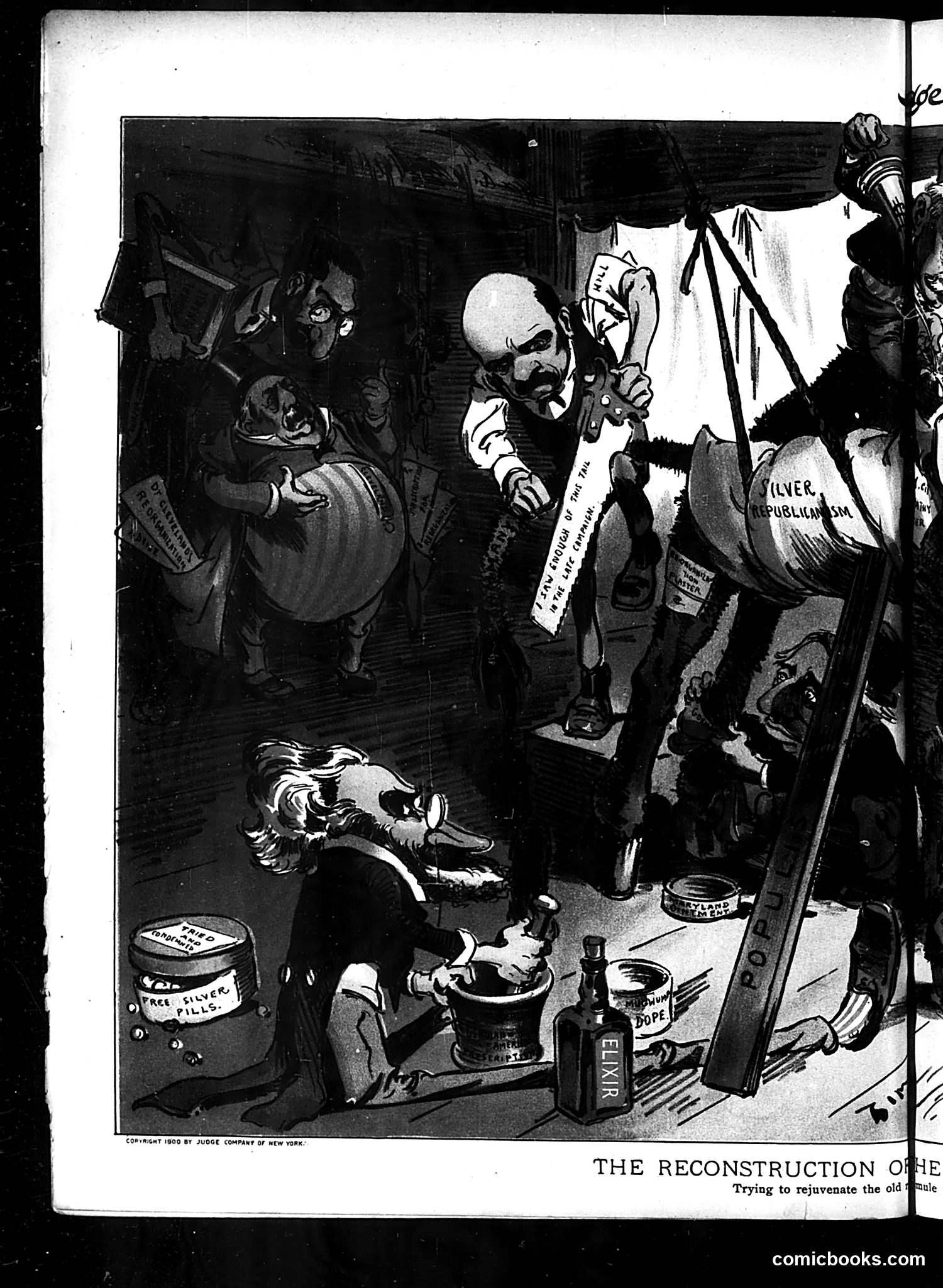
This Judge magazine cartoon satirizes efforts to revive the Republican Party during the Reconstruction era. The figures appear to be political doctors attempting to resuscitate a moribund "old male" (likely representing the Republican Party or Union itself). Visible labels include "Silver Republicanism" and references to "Dope," "Elixir," and "Silver Pills"—suggesting satirical treatments being applied. The scene depicts various political figures and remedies surrounding the prone figure, implying that Republican leadership was experimenting with different policy solutions (possibly silver monetary policy) to restore party vitality. The cartoon's tone is mockingly skeptical of these revival attempts, suggesting the treatments were ineffective or absurd panaceas rather than genuine solutions to political problems.
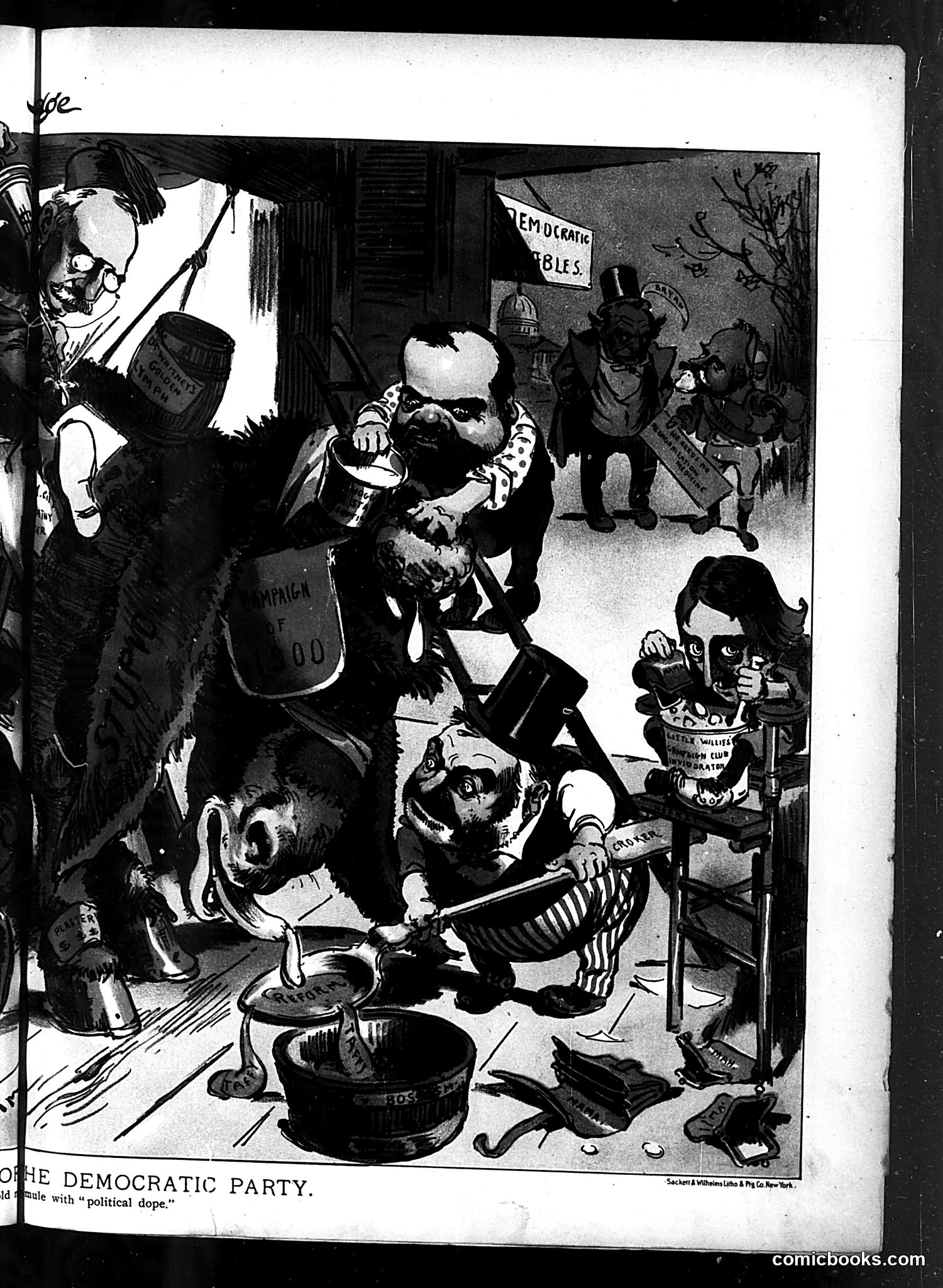
This political cartoon satirizes the Democratic Party as dysfunctional and drug-addled. The central caricatured figure appears to be a Democratic leader or personification of the party itself, depicted as intoxicated or incapacitated while holding a bottle labeled "political dope." Surrounding figures—likely representing party members or factions—engage in chaotic behavior around cauldrons and scattered items, suggesting internal disorder and corruption. The caption explicitly identifies this as commentary on the Democratic Party's problems, with the phrase "political dope" serving as the cartoon's key metaphor: the party is portrayed as addicted to destructive practices. The overall message suggests the Democrats were viewed by *Judge* magazine as incompetent, self-destructive, and unfit to govern. The publication date and specific historical context remain unclear from the visible text.
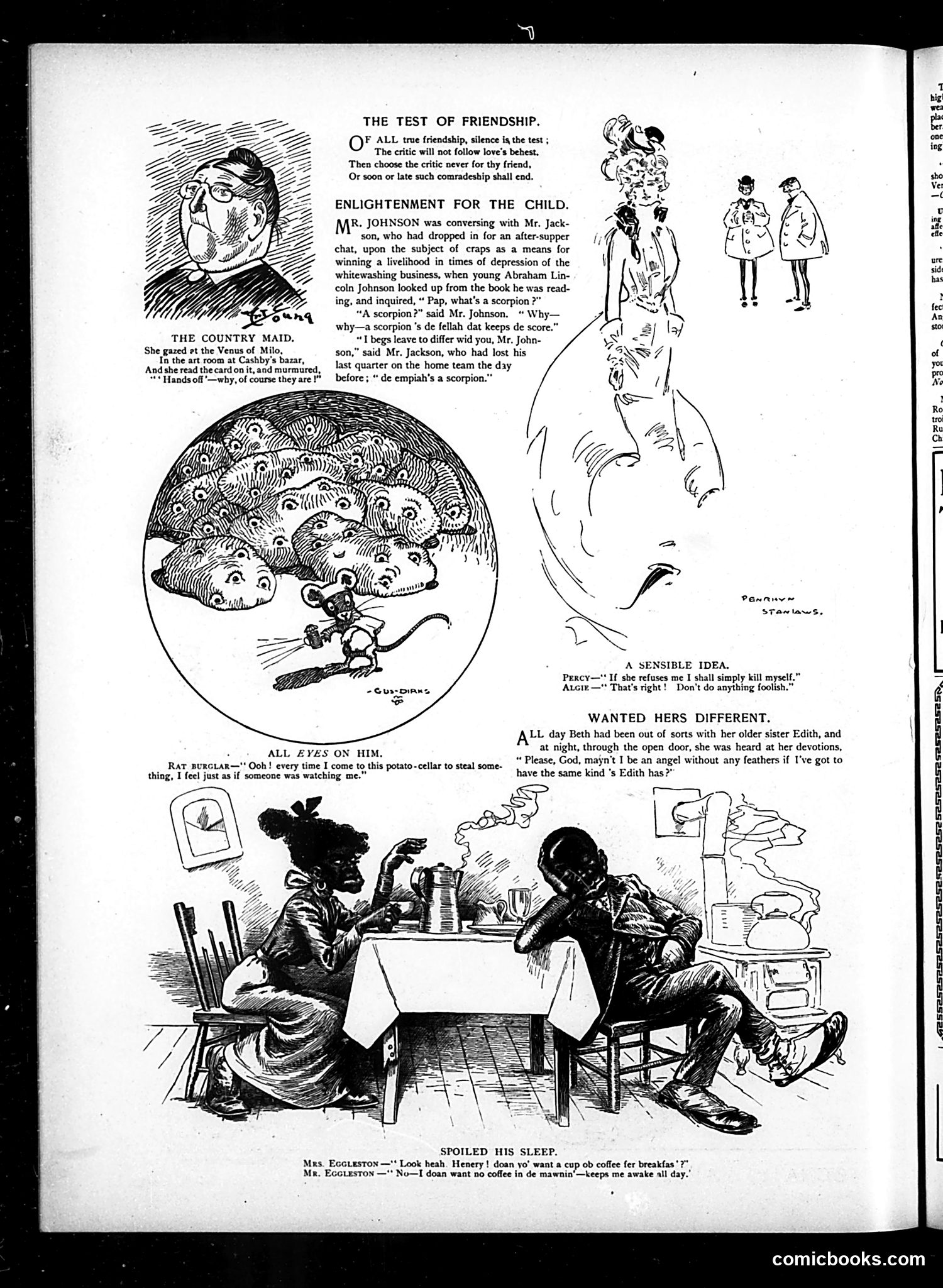
This early Judge page contains several humor pieces satirizing American life: **"Enlightenment for the Child"** mocks working-class dialect and ignorance. Mr. Johnson mishears "scorpion" (the baseball scoring keeper) as "de fellah dat keeps de score," while Mr. Jackson confidently misidentifies it as "de empiah's a scorpion"—likely a garbled reference to the Empire State or similar. The humor targets lower-class speech patterns and lack of education. **"The Country Maid"** uses a crude visual pun: a woman reads a playing card's instruction literally. **"A Sensible Idea"** satirizes melodramatic romantic suicide threats through absurdist reversal. **"Wanted Hers Different"** depicts sibling rivalry, with Beth envying her sister's angelic qualities. **"All Eyes on Him"** and **"Spoiled His Sleep"** offer brief comedic observations about theft and domestic life. The page reflects Judge's typical early-20th-century approach: gentle domestic humor, ethnic/class-based dialect comedy, and wordplay rather than sharp political satire.
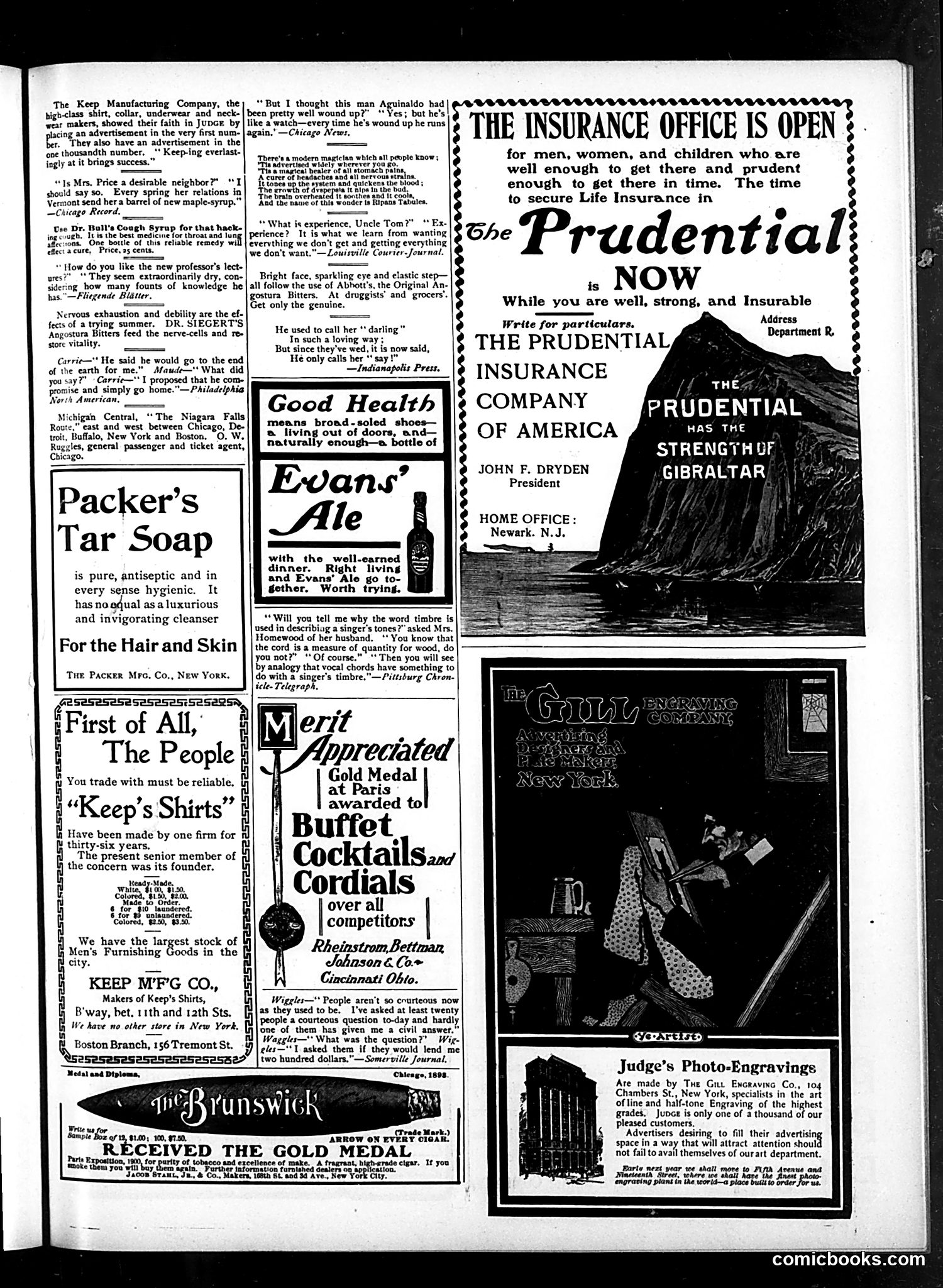
This is primarily an **advertising page** from Judge magazine, with scattered humorous quotes and anecdotes interspersed between ads. The only identifiable satirical content appears in a brief dialogue snippet: **The Political Reference:** A short exchange mentions "Aguinaldo" being "wound up," referencing **Emilio Aguinaldo**, leader of Filipino resistance during the Philippine-American War (1899-1902). The joke suggests America thought it had finished dealing with Aguinaldo but he remains problematic—a contemporary political jab at ongoing U.S. military entanglement in the Philippines. **Otherwise:** The page features advertisements for shirts (Keep's), soap, ale, bitters, and insurance—typical of Judge's revenue model. The scattered jokes address domestic life, courtship, and social etiquette rather than political satire. This appears to be a standard issue mixing advertising with light humor rather than a satirically-focused page.
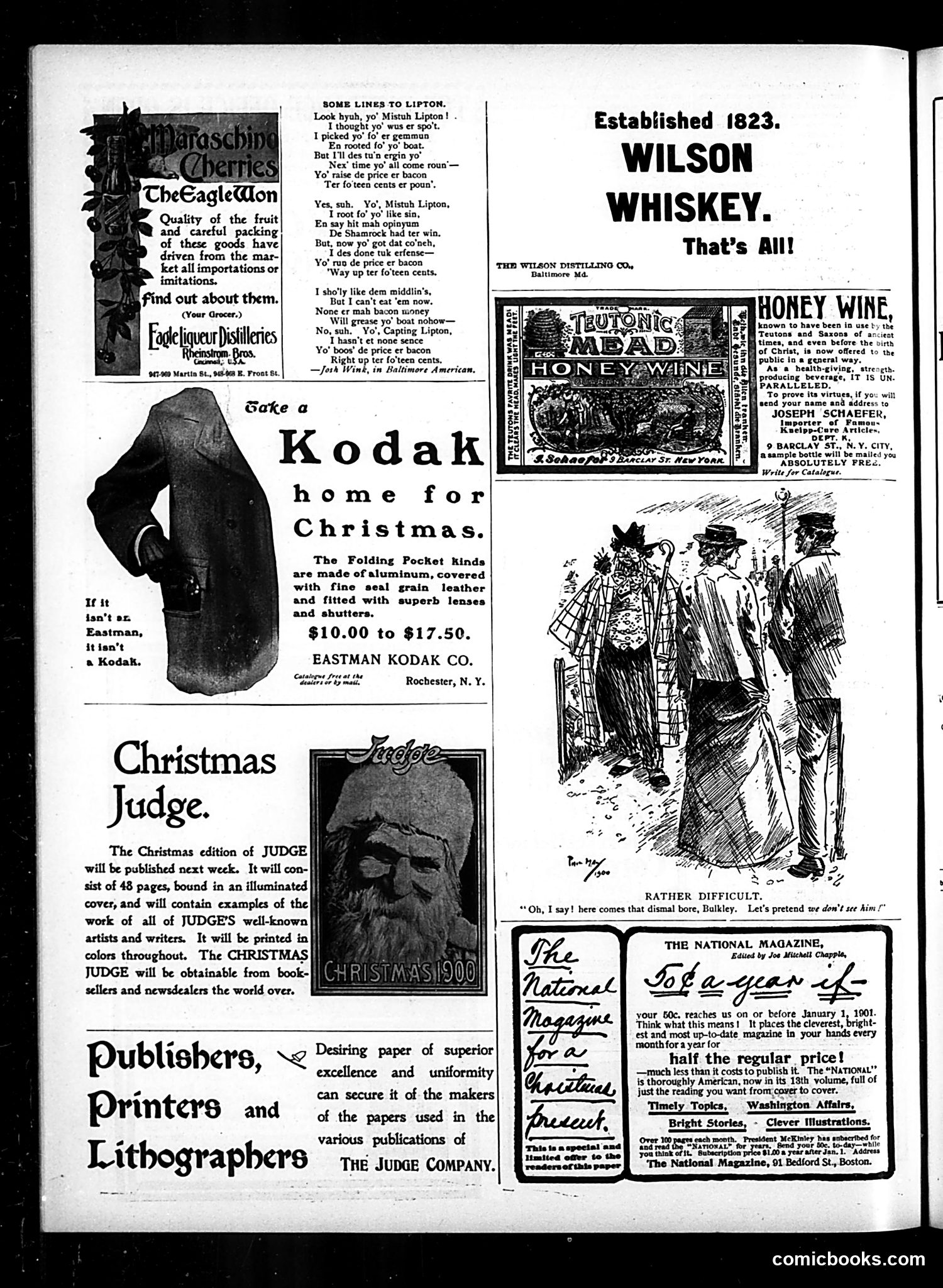
This page is primarily **advertisements and promotional content** rather than political satire. However, it contains one notable satirical poem: ## "Some Lines to Lipton" The poem mocks **Sir Thomas Lipton**, the Irish tea magnate and yacht-racing enthusiast. A Black narrator (written in dialect) expresses betrayal: he initially supported Lipton as a "sport" and rooted for his yacht *Shamrock* in races against American boats. However, after Lipton won, he raised bacon prices to fourteen cents per pound, making it unaffordable for working people. The satire criticizes wealthy industrialists who exploit ordinary consumers immediately after receiving public goodwill—Lipton went from folk hero to profiteer overnight. The remaining content consists of **turn-of-the-century product advertisements**: Eastman Kodak cameras, Wilson Whiskey, Lipton cherries, honey wine, and magazine subscriptions. There is also a small cartoon ("Rather Difficult") showing men avoiding an acquaintance, which requires no historical context.
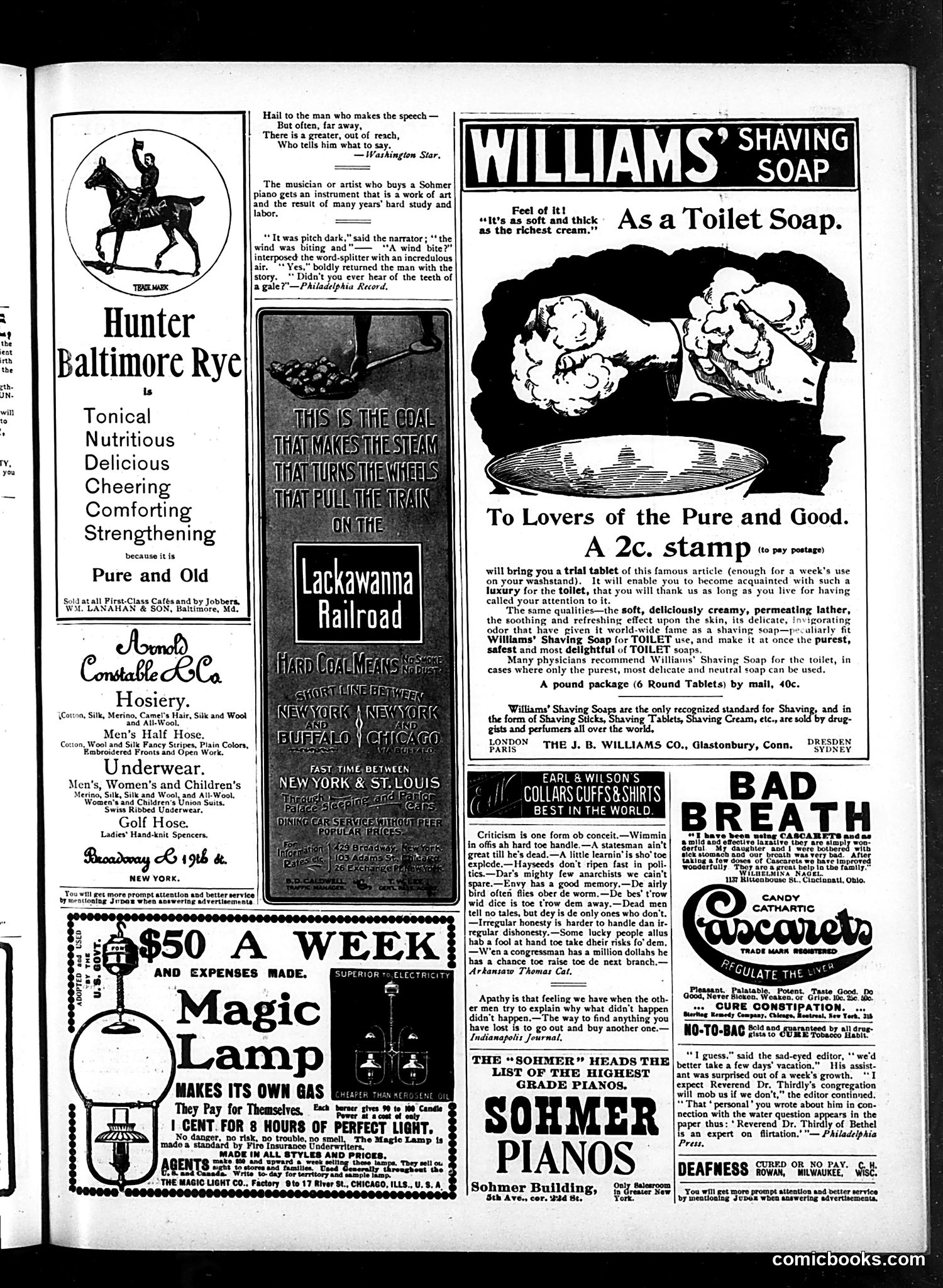
This is primarily an **advertising page** from Judge magazine, not a political cartoon. The page consists almost entirely of commercial advertisements for consumer products popular in the early 20th century: whiskey, hosiery, underwear, pianos, lamps, soap, and other goods. The only editorial content appears at the top—a brief quote from the *Washington Star* about speechmaking: "Hail to the man who makes the speech—But often, far away, / There is a greater, out of reach, / Who tells him what to say." This is a mild jab at **ghostwriters and speechwriters**, suggesting the real power behind public speakers goes unrecognized. Below that are two short humorous anecdotes about language and word-splitting, typical of Judge's light comedic filler. The rest is advertising, with Williams' Shaving Soap given prominent placement. The page reflects late-19th/early-20th-century consumer culture and advertising practices.
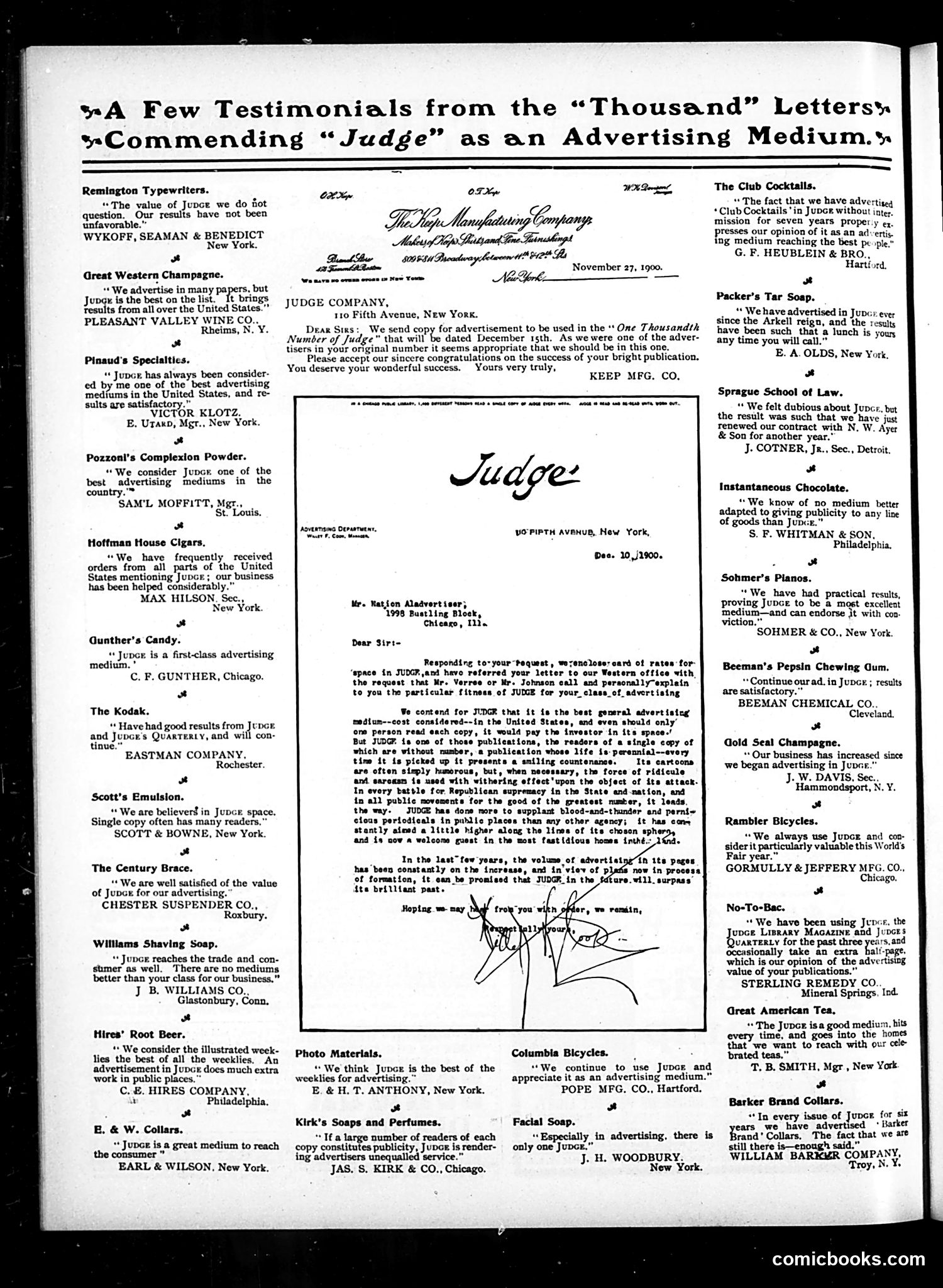
This is primarily a **testimonials and advertising page** from *Judge* magazine (dated November 27, 1900), celebrating the publication's upcoming 1,000th issue. It contains no political cartoon or satire to analyze. The page features endorsements from major American companies—Remington Typewriters, Kodak, Hoffman House Cigars, Hires' Root Beer, and others—praising *Judge* as an effective advertising medium. These testimonials claim the magazine reaches both trade professionals and consumers effectively. The letter from Keep Manufacturing Company (center) emphasizes *Judge's* role in Republican politics and social campaigns, noting it uses "ridicule and sarcasm with withering effect" against opponents and has promoted better publications in public spaces. **For modern readers:** This demonstrates *Judge's* status as a prestigious, influential weekly magazine where major brands invested advertising dollars, and confirms its identity as explicitly Republican-aligned advocacy journalism, not neutral satire.
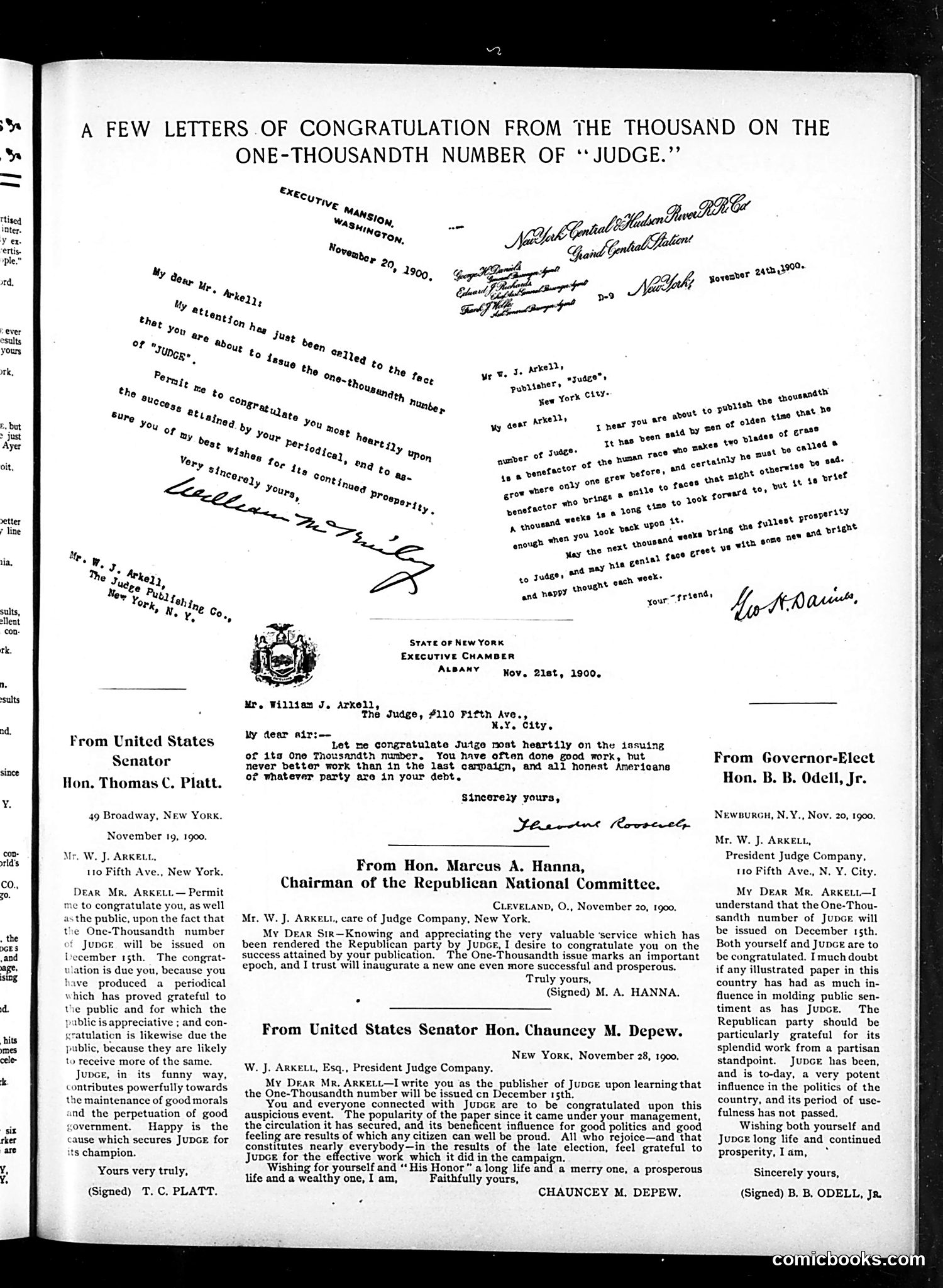
This page consists entirely of congratulatory letters sent to William J. Arkell, publisher of *Judge* magazine, marking its 1,000th issue in December 1900. The letters come from prominent Republican political figures: U.S. Senator Thomas C. Platt, New York Governor Theodore Roosevelt, Republican National Committee Chairman Marcus A. Hanna, U.S. Senator Chauncey M. Depew, and Governor-Elect B.B. Odell Jr. The shared theme across these letters is notable: each explicitly praises *Judge* for its role supporting the Republican Party and influencing recent elections (evidently the 1900 presidential election). Rather than treating *Judge* as a neutral satirical publication, these politicians openly credit it as a political instrument that advanced Republican interests and "good politics." This reveals that early 1900s satirical magazines like *Judge* operated as openly partisan organs, unlike modern satirical publications that claim independence.
This is primarily a **title/advertisement page**, not a cartoon. It advertises Judge magazine's "Colored Pages" section and credits two printing companies responsible for producing them. The page identifies: - **Sackett & Wilhelms Lithographing and Printing Company** (Fifth Avenue and Sixteenth Street, New York) as the fifteen-year supplier of Judge's colored pages - **Charles Eneu Johnson & Co.** (Rose Street, New York) as the ink supplier The boxed text boasts that Judge is "only one of a 'thousand'" satisfied customers, emphasizing the printing company's capability to handle diverse, high-quality work. For modern readers: This reflects the technical complexity of color lithography in the pre-offset printing era. Judge relied on specialized vendors for quality reproduction. The advertisements showcase industrial pride in craftsmanship—a selling point when quality printing was a significant technical achievement and business asset.
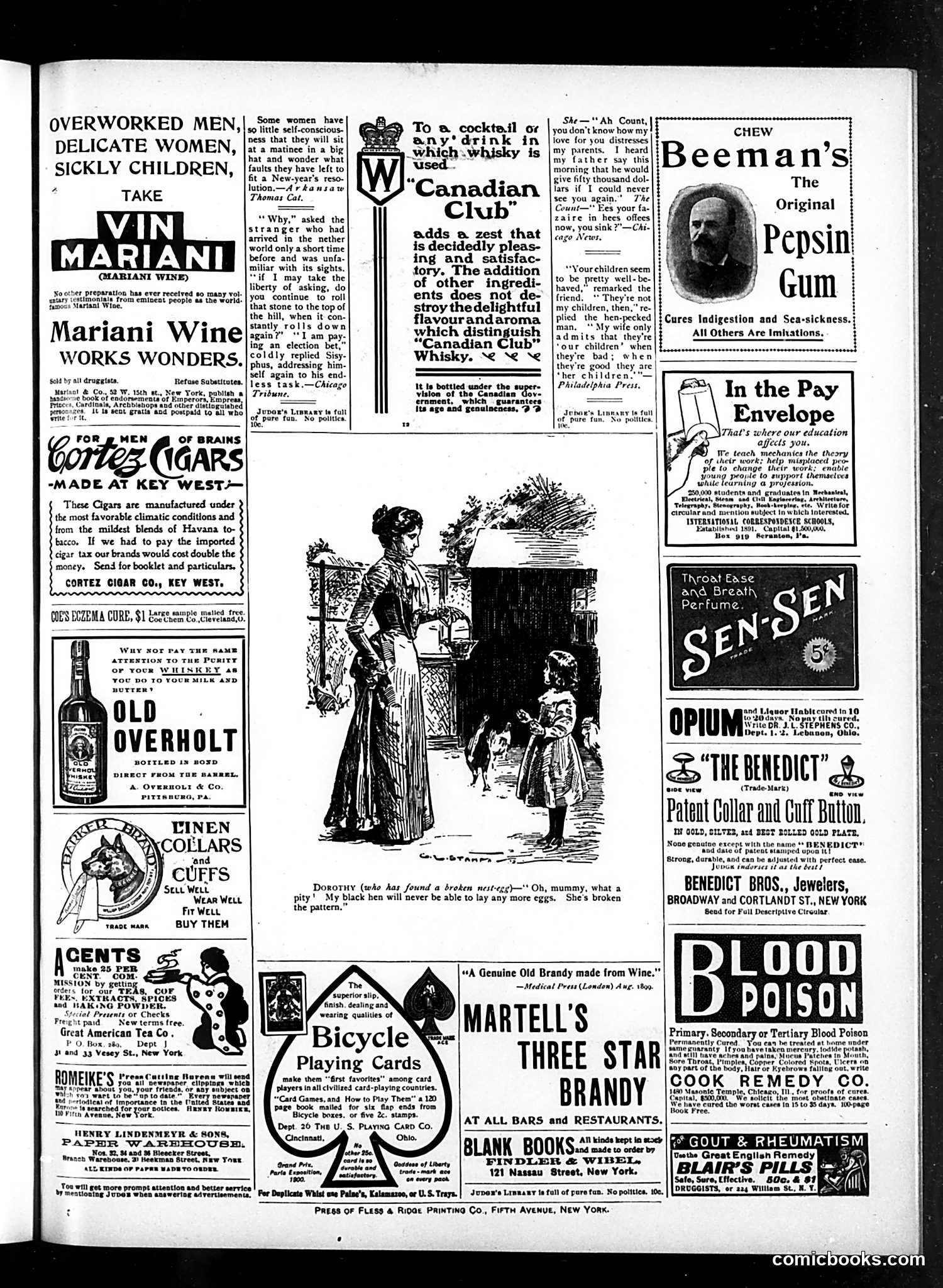
This page is primarily **advertising**, typical of early 20th-century American magazines. The dominant content consists of patent medicine and consumer product ads rather than political satire. The one visible **cartoon** depicts Dorothy with a broken eggshell, lamenting to her mother that her black hen can no longer lay eggs because "she's broken the pattern"—a gentle domestic joke about the hen's broken nest. The advertisements reveal period attitudes: **Mariani Wine** claims to cure various ailments; **Beeman's Pepsin Gum** promises digestive relief; **blood poison remedies** advertise "cures"; **Cortez Cigars** boast of avoiding import taxes; and various patent medicines (Opium-based treatments, "Gout & Rheumatism" pills) were openly marketed. These ads reflect the **pre-FDA era** when unregulated medical claims were standard. The page demonstrates how Judge mixed light humor with commerce, targeting affluent male readers through liquor, cigars, and dubious health products presented as solutions to contemporary ailments.
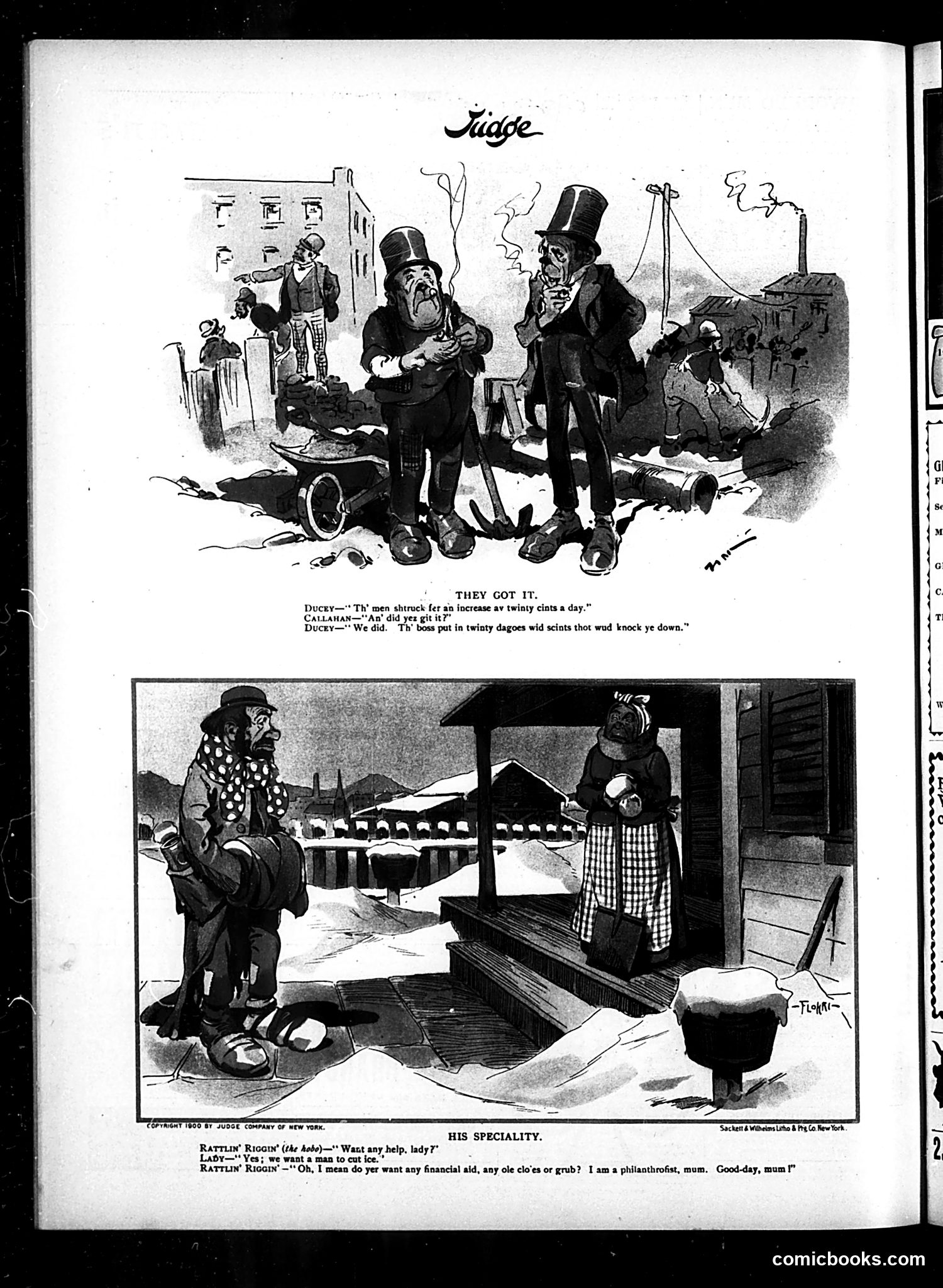
**Top cartoon ("They Got It"):** Two Irish workers (identified by dialect) celebrate winning a wage increase, but the joke is bitter—their boss replaced them with cheaper "dago" (derogatory term for Italian) laborers willing to work for less. The satire mocks both labor's pyrrhic victory and employers' exploitation of immigrant workers as strikebreakers. **Bottom cartoon ("His Specialty"):** A hobo ("Rairin' Brone") offers help to a woman needing ice-cutting work, but when she accepts, he pivots to offering charity (clothes, food, money) instead. The joke satirizes performative philanthropy—the hobo's real "specialty" is charity-seeking, not labor. Both cartoons reflect Gilded Age tensions: immigrant labor undercutting wages, class mobility anxieties, and the gap between charitable pretense and actual economic desperation.
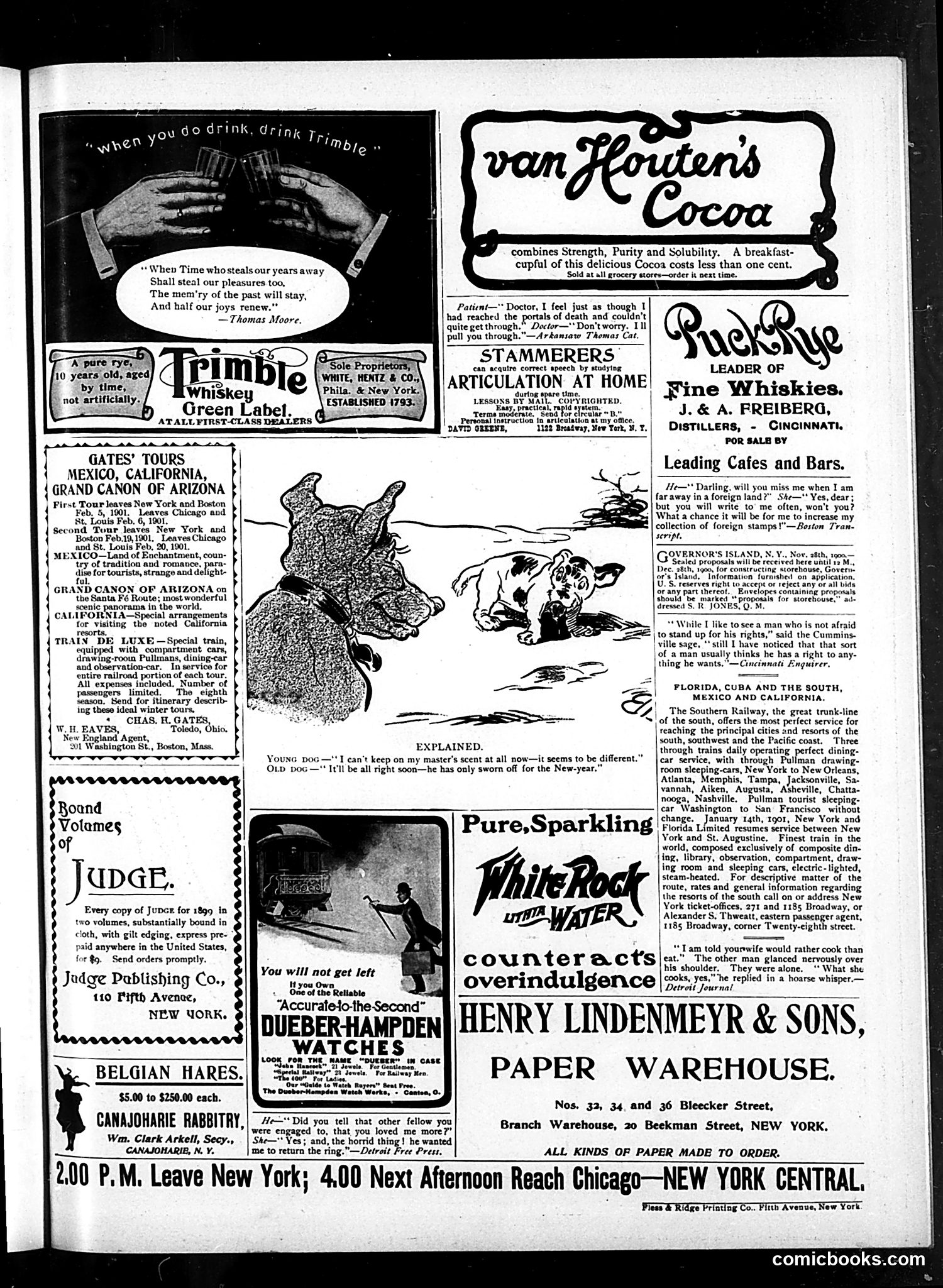
This page is primarily **advertisements and filler content** rather than political satire. The main cartoon shows a young dog unable to track its master's scent because the master has "sworn off for the New-year"—a joke about New Year's resolutions to quit drinking. **Key elements:** - **Thomas Moore quote** at top about memory and pleasure reflects the era's sentimental tone - **Trimble Whiskey ad** emphasizes "not artificially" aged stock (1793 establishment) - **Van Houten's Cocoa** and **White Rock Water** ads promote health/purity products - **Travel ads** (Gates' Tours, railroads) target wealthy readers - **Stammering correction services, Belgian hares, Judge back-volume collections** reflect 1900s consumer culture The dog cartoon's humor relies on readers understanding alcohol use was common enough that "swearing off" was a predictable, temporary New Year's phenomenon—a mild social observation rather than sharp political satire. This appears to be an issue from late 1900 or early 1901.
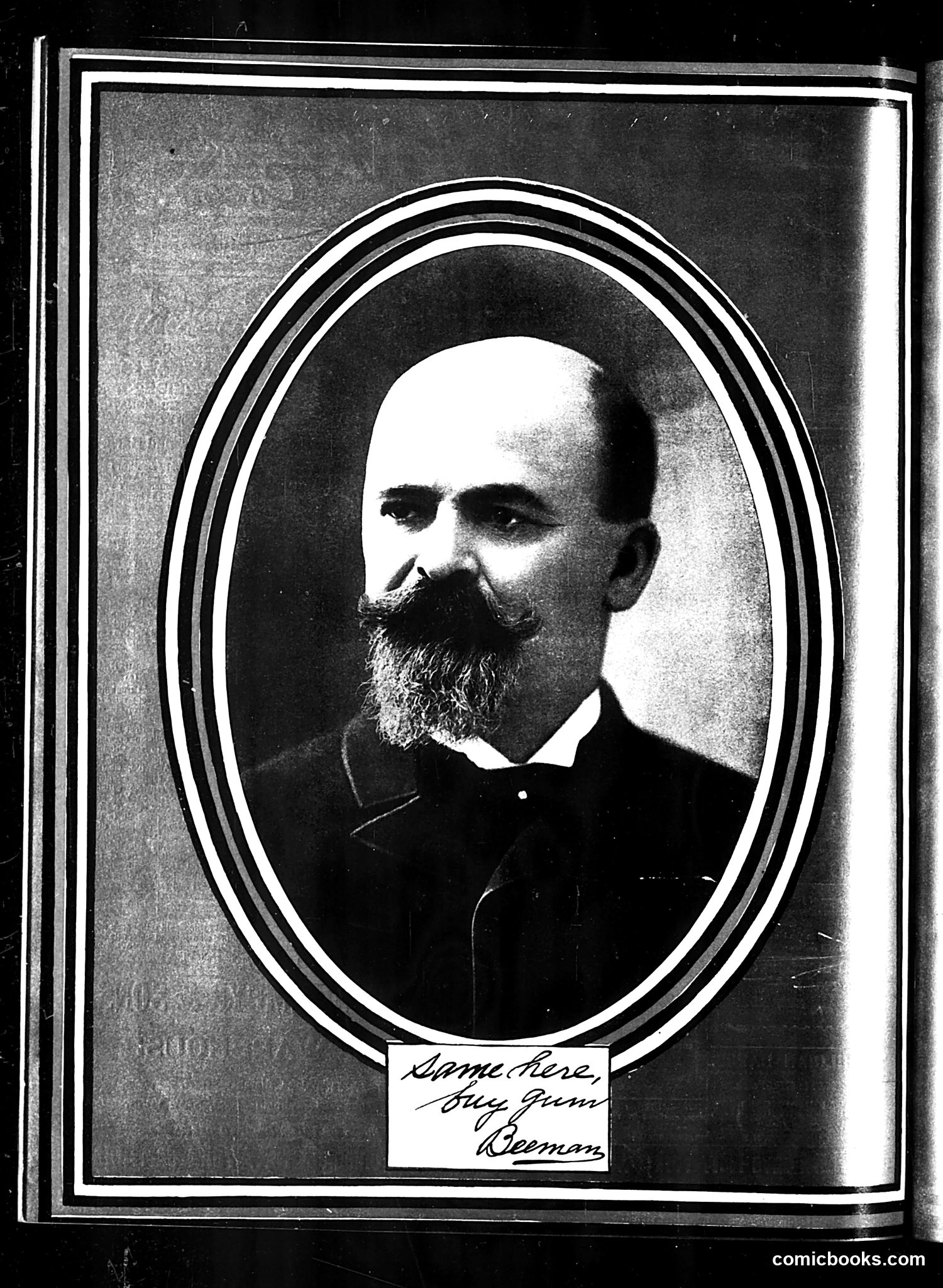
This appears to be a portrait page from *Judge* magazine featuring a formal oval-framed photograph of a bearded man in late 19th-century formal dress. The handwritten caption reads "Somewhere, Buff Gunn Beeman" (or similar—the handwriting is unclear). Without additional context on the page, I cannot definitively identify who this person is or what satirical point the image makes. The formal portrait style and magazine placement suggest this may be a notable public figure of the era being featured, but the specific identity and any accompanying satirical commentary are not clearly legible in the image provided. If there were additional text or captions on the original page, those would clarify the intended satire or commentary.