
Judge, 1900-12-15 · page 4 of 22
Judge — December 15, 1900 — page 4: what you’re looking at
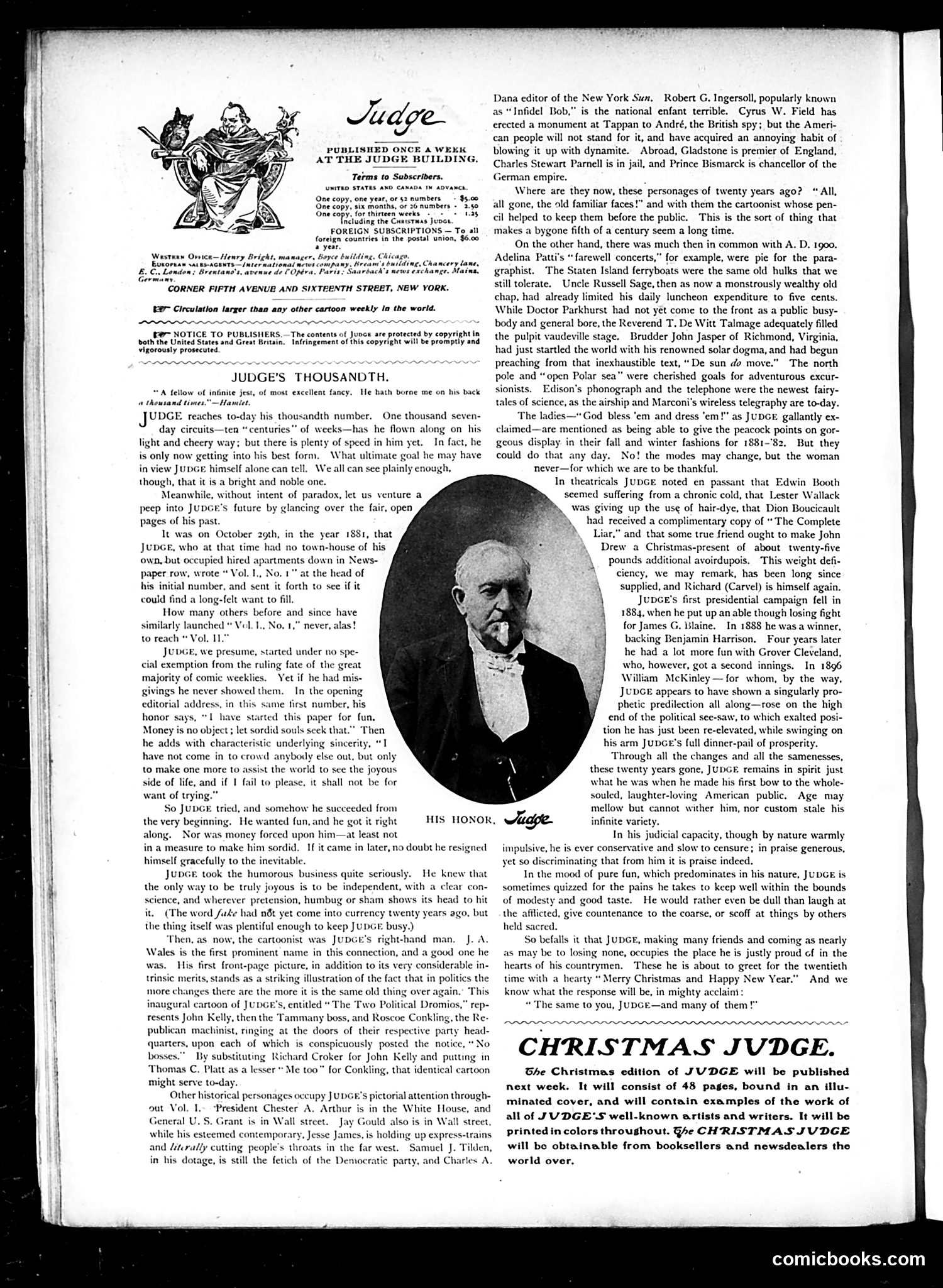
What you’re looking at
This page is primarily **editorial content about Judge magazine itself**, not political satire. The main article, "Judge's Thousandth," celebrates the magazine reaching its 1,000th issue (dated October 29, 1881). The text discusses Judge's history, founding principles, and notable contributors. It mentions contemporary figures like **Edwin Booth** (actor), **Benjamin Harrison** (political figure), and various editors and politicians, but in biographical/historical context rather than satirical commentary. The **portrait photograph** shows the magazine's founder or editor—likely Eugene Sandford Martin or another key figure—though the image quality makes identification difficult. The page concludes with an **advertisement for an upcoming Christmas Judge edition** with 48 pages and color illustrations. This is essentially a **house organ piece celebrating the magazine's milestone**, not satirical commentary on current events.
📄 Transcribed text from this page (OCR, searchable)
Machine-transcribed from the original scan — historical spelling and the odd misread are preserved.
PUBLISHED ONCE a WEKK AT THE JUDGE BUILDID Terms to Subscribers. UuITED STATES AMO CANADA De ADVAMCA. One copy, one year, of $2 numbers ~ $5.00 One copy, six months, or 36 numbers = 2.50 One copy, for thirteen weeks === 135 facluding the Custstaas Juocs. FOREIGN SUBSCRIPTIONS — To all foreign countries in the postal union, $6.00 ayer Wastxan Orrice—Henry Bright, manager, Boyce building. Chicago. Eutorsan sa ater cor company, Bream's butiding, Chancery lane, fede C Opéra. Paris: Saarback's news exchange, Maine, CORNER FIFTH AVENUE AND SIXTEENTH STREET, NEW YORK. [2 Circulation larger than any other cartoon weekly ia the world. Fe7 NOTICE TO PUBLISHERS. both the United States and Great Britain. vigorously prosecuted. ‘The contents of Juoce are protected by copyright in Infringement of this copyright will be promptly and JUDGE'S THOUSANDTH, thousand times.” Hamlet UDGE reaches to-day his thousandth number, One thousand seven- day circuits—ten “centuries” of weeks—has he flown along on his light and cheery way; but there is plenty of speed in him yet. only now getting into his best form. Ww JUDGE himself alone can tell. W. though, that it is a bright and noble one. Meanwhile, without intent of paradox, let us venture a peep into JUDGE'S future by glancing over the fair, open pages of his past. It was on October 29th, in the year 1881, that JUDGE, who at that time had no town-house of his own, but occupied hired apartments down in News- paper row, wrote “Vol. 1., No, 1" at the head of his initial number, and sent it forth to see if it could find a long-felt want to fill. How many others before and since have similarly launched * Vol. 1., No. 1," never, alas! to reach “Vol, 11.” JUDGE, we presume, started under no spe- cial exemption from the ruling fate of the great majority of comic weeklies. Yet if he had mis- givings he never showed them. In the opening editorial address, in this same first number, his honor says, “I have started this paper for fun. Money is no object ; let sordid souls seek that.” ‘Then he adds with characteristic underlying sincerity, “1 have not come in to crowd anybody else out, but only to make one more to assist the world to see the joyous side of life, and if I fail to please, it shall not be for want of trying.” So JubGE tried, \d somehow he succeeded from the very beginning. He wanted fun, and he got it right along. Nor was money forced upon him—at least not in a measure to make him sordid. If it came in later, no doubt he resigned himself gracefully to the inevitable. Jun He knew that the only way to be truly joyous is to be independent, with a clear con science, and wherever pretension, humbug or sham shows its head to hit (The word fake had ndt yet come into currency twenty years ago, but the thing itself was plentiful enough to keep JUDGE busy.) ‘Then, as now, the cartoonist was JUDGE'S right-hand man, J. A. in this connection, and a good one he as. His tirst front-page picture, in addition to its very considerable in- trinsic merits, stands as a striking illustration of the fact that in politics the more changes there are the more it is the same old thing over again.” This inaugural cartoon of JUDGE'S, entitled “The Two Political Dromios,” rep- resents John Kelly, then the Tammany boss, and Roscoe Conkling, the Re- publican machinist, ringing at the doors of their respective party head- quarters, upon each of which is conspicuously posted the notice, “No bosses.” By substituting Richard Croker for John Kelly and putting in ‘Thomas C. Platt as a lesser“ Me too” for Conkling, that identical cartoon might serve to-day. Other historical personages occupy JUDGE'S pictorial attention through- out Vol. 1. “President Chester A. Arthur is in the White House, and General U.S. Grant is in Wall s\ Jay Gould also is in Wall street while his esteemed contemporary, Jesse James, is holding up express-trains and Zitrally cutting people's throats in the far west. Samuel J. Tilden, in his dotage, is still the fetich of the Democratic party, and Charles A. He hath borne me on his back In fact, he What ultimate goal he may have all can see plainly enough, ook the humorous business quite seriously. Wales is the first prominent name et. HIS HONOR, Dana editor of the New York Sun, Robert G. Ingersoll, popularly known as “Infidel Bob,” is the national enfant terrible. Cyrus W. Field has erected a monument at Tappan to André, the British spy; but the Ameri- can people will not stand for it, and have acquired an annoying habit of blowing it up with dynamite. Abroad, Gladstone is premier of England, Charles Stewart Parnell is in jail, and Prince Bismarck is chancellor of the German empire. Where are they now, these personages of twenty years ago? “All, all gone, the ald familiar faces!” and with them the cartoonist whose pen- cil helped to keep them before the public. This is the sort of thing that makes a bygone fifth of a century seem a long time. On the other hand, there was much then in common with A. D. 1900. Adelina Patti's “farewell concerts,” for example, were pie for the para- graphist. The Staten Island ferryboats were the same old hulks that we still tolerate. Uncle Russell Sage, then as now a monstrously wealthy old chap, had already limited his daily luncheon expenditure to five cents. While Doctor Parkhurst had not yét come to the front as a public bus body and general bore, the Reverend T, De Witt Talmage adequately filled the pulpit vaudeville stage. Brudder John Jasper of Richmond, Virginia, had just startled the world with his renowned solar dogma, and had begun preaching from that inexhaustible text, “De sun do move.” The north pole and “open Polar sea” were cherished goals for adventurous excur- sionists. Edison's phonograph and the telephone were the newest fairy- tales of science, as the airship and Marconi’s wireless telegraphy are to-day. The ladies—" God bless ‘em and dress em!" as JUDGE gallantly ex- claimed—are mentioned as being able to give the peacock points on gor- geous display. in their fall and winter fashions for 1881-"82, But they could do that any day. No! the modes may change, but the woman never—for which we are to be thankful. In theatricals JUDGE noted en passant that Edwin Booth seemed suffering from a chronic cold, that Lester Wallack » was giving up the us¢ of hair-dye, that Dion Boucicault had received a complimentary copy of “The Complete Liar,” and that some true friend ought to make John Drew a Christmas-present of about twenty-five \ pounds additional avoirdupois. This weight defi- ‘ciency, we may remark, has been long since supplied, and Richard (Carvel) is himself again. Jupce's first presidential campaign fell in 1884, when he put up an able though losing fight for James G. Blaine. In 1888 he was a winner, backing Benjamin Harrison, Four years later he had a lot more fun with Grover Cleveland, who, however, got a second innings. In 1896 William McKinley—for whom, by the way, JUDGE appears to have shown a singularly pro- phetic predilection all along—rose on the high end of the political see-saw, to which exalted posi- tion he has just been re-elevated, while swinging on his arm JUDGE'S full dinner-pail of prosperity. ‘Through all the changes and all the samenesses, these twenty years gone, JUDGE remains in spirit just what he was when he made his first bow to the whole- souled, laughter-loving American public. Age may mellow but cannot wither him, nor custom stale his infinite variety. In his judicial capacity, though by nature warmly he is ever conservative and slow to censure; in praise generous, inating that from him it is praise indeed. In the mood of pure fun, which predominates in his nature, JUDGE is sometimes quizzed for the pains he takes to keep well within the bounds of modesty and good taste. He would rather even be dull than laugh at the afilicted, give countenance to the coarse, or scoff at things by others held sacred, So befalls it that June wage impulsiv yet so disc making many friends and coming as nearly as may be to losing none, occupies the place he is justly proud of in the hearts of his countrymen. ‘These he is about to greet for the twentieth time with a hearty “ Merry Christmas and Happy New Year.” And we know what the response will be, in mighty acclaim: “The same to you, JUDGE—and many of them! CHRISTMAS JUDGE. Ghe Christmas edition of JUDGE will be published next week. It will consist of 48 pages, bound in an illu- minated cover, and will contain examples of the work of all of JUDGE‘S well-known artists and writers. It will be printed in colors throughout. Gre CHRISTMAS JUDGE will be obtainable from booksellers and newsdealers the world over, comicbooks.com