
A complete issue · 16 pages · 1899
Judge — February 4, 1899
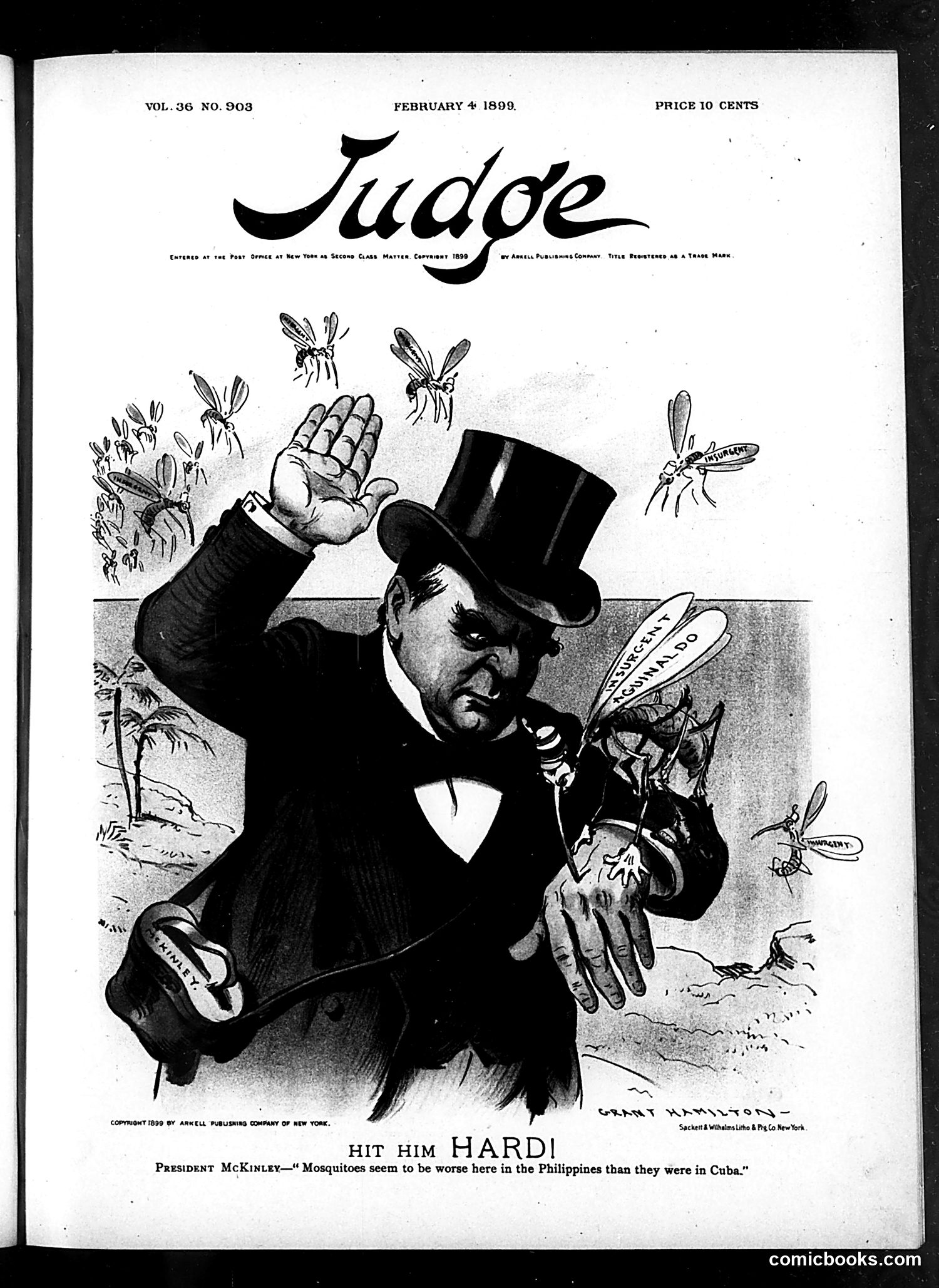
This political cartoon depicts President McKinley wielding a flyswatter against mosquitoes labeled with what appear to be references to the Philippines conflict. The caption reads: "Mosquitoes seem to be worse here in the Philippines than they were in Cuba." The satire compares the Philippine-American War (then ongoing) to pest control—suggesting McKinley faces persistent problems in the Philippines following America's recent victory in Cuba. The mosquitoes likely represent specific challenges: insurgent resistance, tropical disease, or diplomatic complications from the U.S. occupation. The cartoon critiques McKinley's foreign policy by trivializing serious military engagement as mere nuisance-swatting, implying the Philippines campaign is proving messier and more difficult than anticipated.
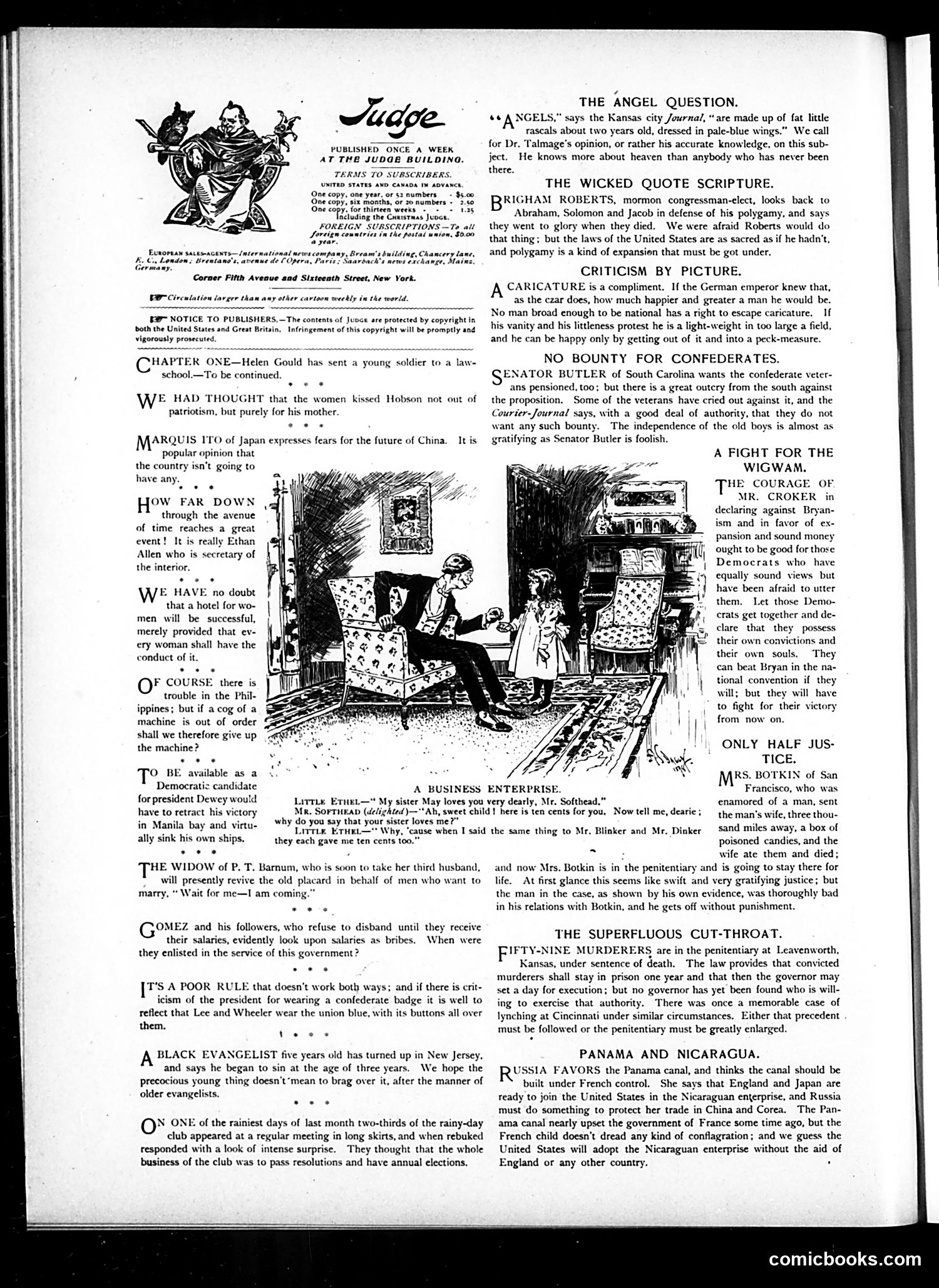
The main cartoon, titled "A Business Enterprise," depicts a conversation between a man and child about money. The text reveals social satire about child labor and exploitation: a father explains to his daughter that her mother loves money dearly, and when asked if she loves him, he cynically responds that she loves money more—it "costs less." The child then asks if she loves the father, and he admits the mother "gave him ten cents too." This satirizes late-19th/early-20th century anxieties about materialism destroying family bonds. The accompanying editorial text addresses various political issues including Confederate pension proposals and Democratic political courage, typical of Judge's partisan Republican commentary.
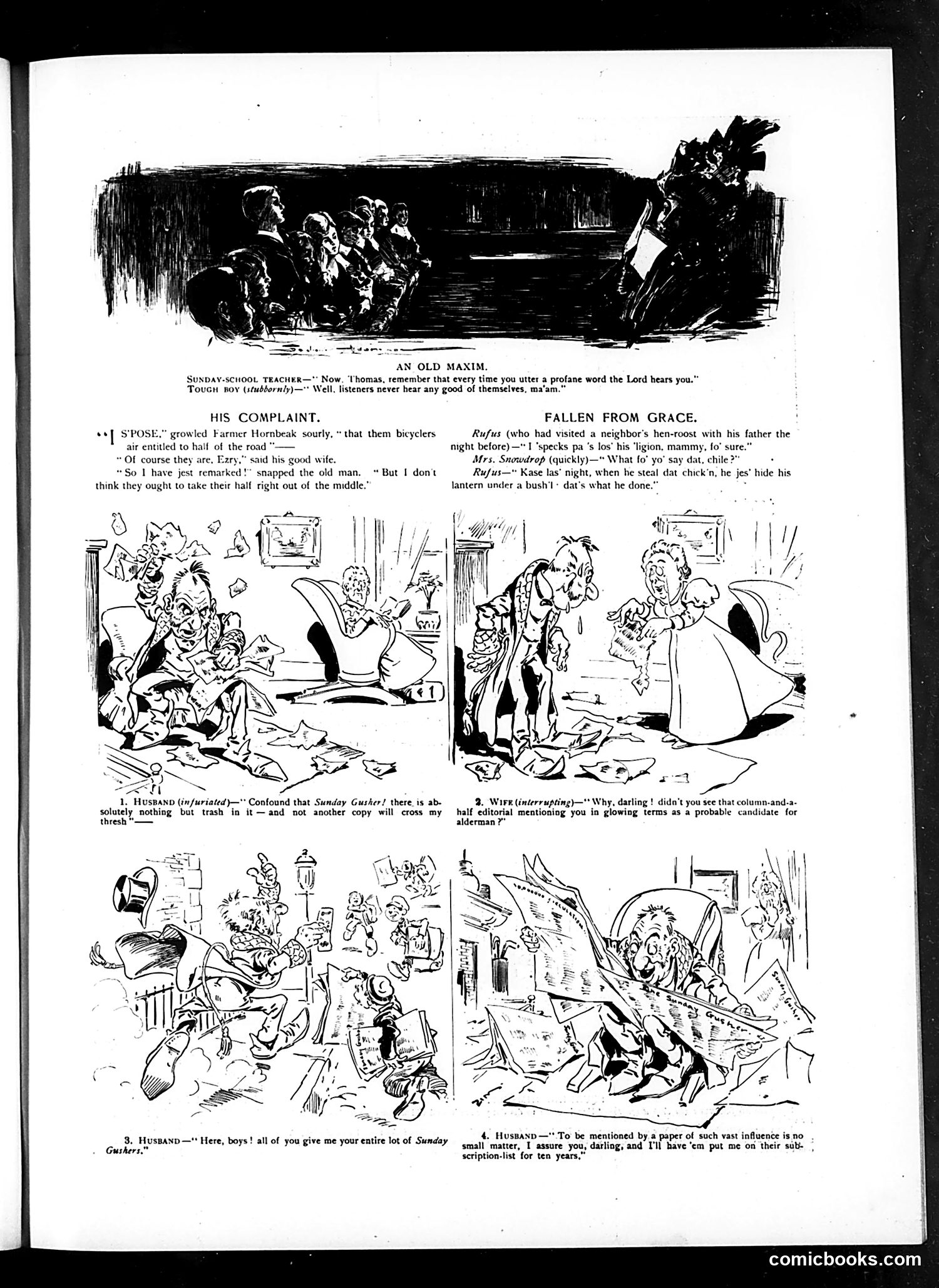
This page contains three separate satirical pieces: **"An Old Maxim"** (top): A Sunday school teacher instructs that "every time you utter a profane word the Lord hears you," while a boy responds that "listeners never hear any good of themselves." **"His Complaint"** and **"Fallen from Grace"**: These depict domestic disputes. In one, a husband complains about bicycles; in another, a wife interrupts her husband's evening, mentioning a newspaper's mention of him as a "probable candidate for alderman." **The four numbered cartoon panels** show domestic chaos—husbands and wives arguing over household disorder and newspaper coverage. The husband in panel 4 threatens to cancel his wife's subscription if a paper continues mentioning her. The satire targets domestic discord and the era's emerging concern with newspaper publicity affecting private life and political aspirations.
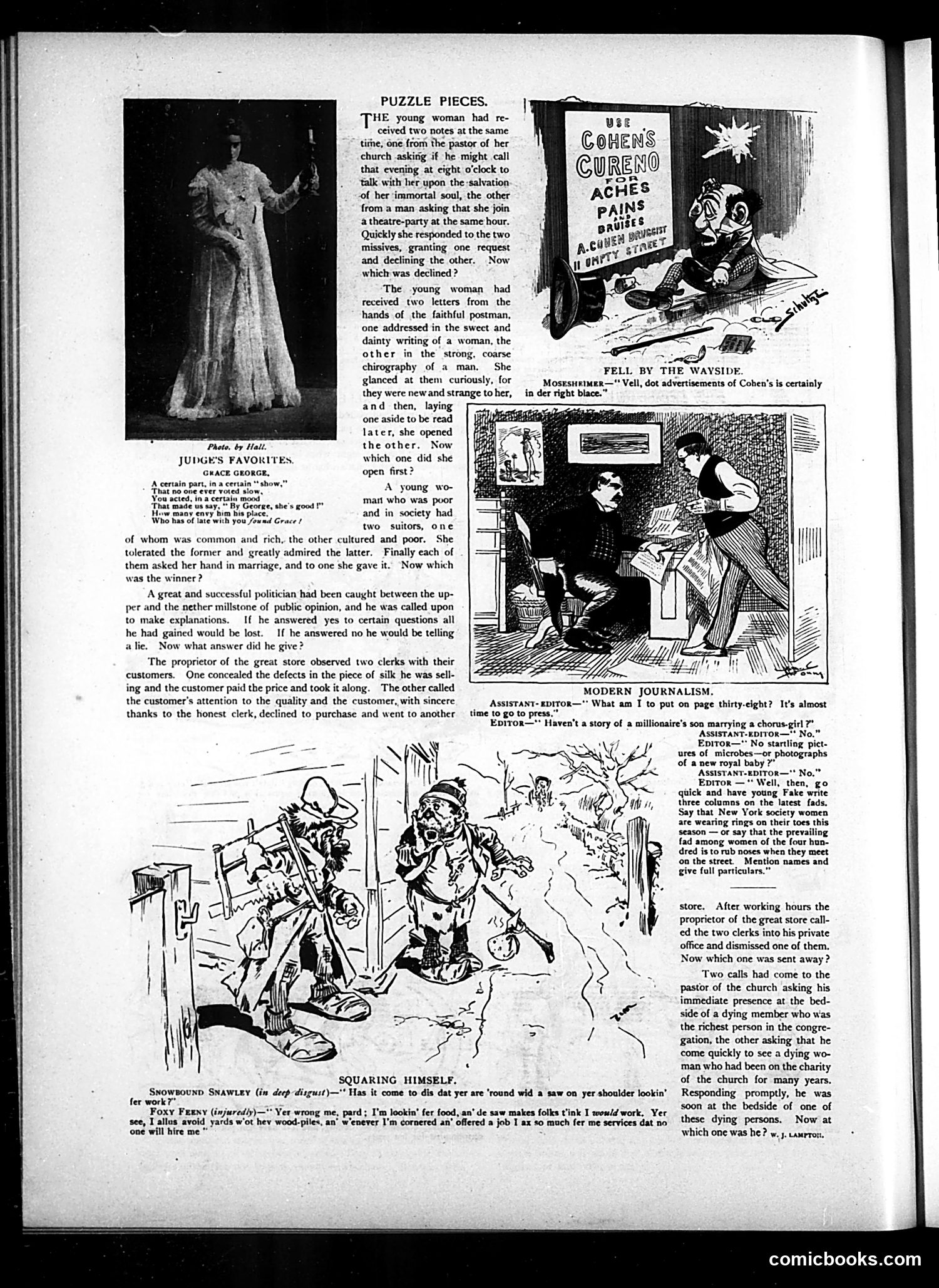
This page contains three distinct pieces of turn-of-the-century satire: **"Puzzle Pieces"** presents moral dilemmas as riddles—a young woman receiving conflicting advice about marriage and life choices, testing readers' ethical judgment. **"Fell by the Wayside"** advertises Cohen's Cureno, a patent medicine, satirizing dubious health product marketing common in the era. **"Modern Journalism"** mocks newspaper practices, showing an editor pressuring an assistant to fabricate sensational stories, including fabricating a "new royal baby" and manufacturing scandals. This critiques the yellow journalism sensationalism prevalent in that period. **"Squaring Himself"** depicts characters in apparent conflict, satirizing some social/political tension (details unclear from OCR). The cartoons collectively mock contemporary advertising fraud, journalistic ethics failures, and moral hypocrisy of the era.
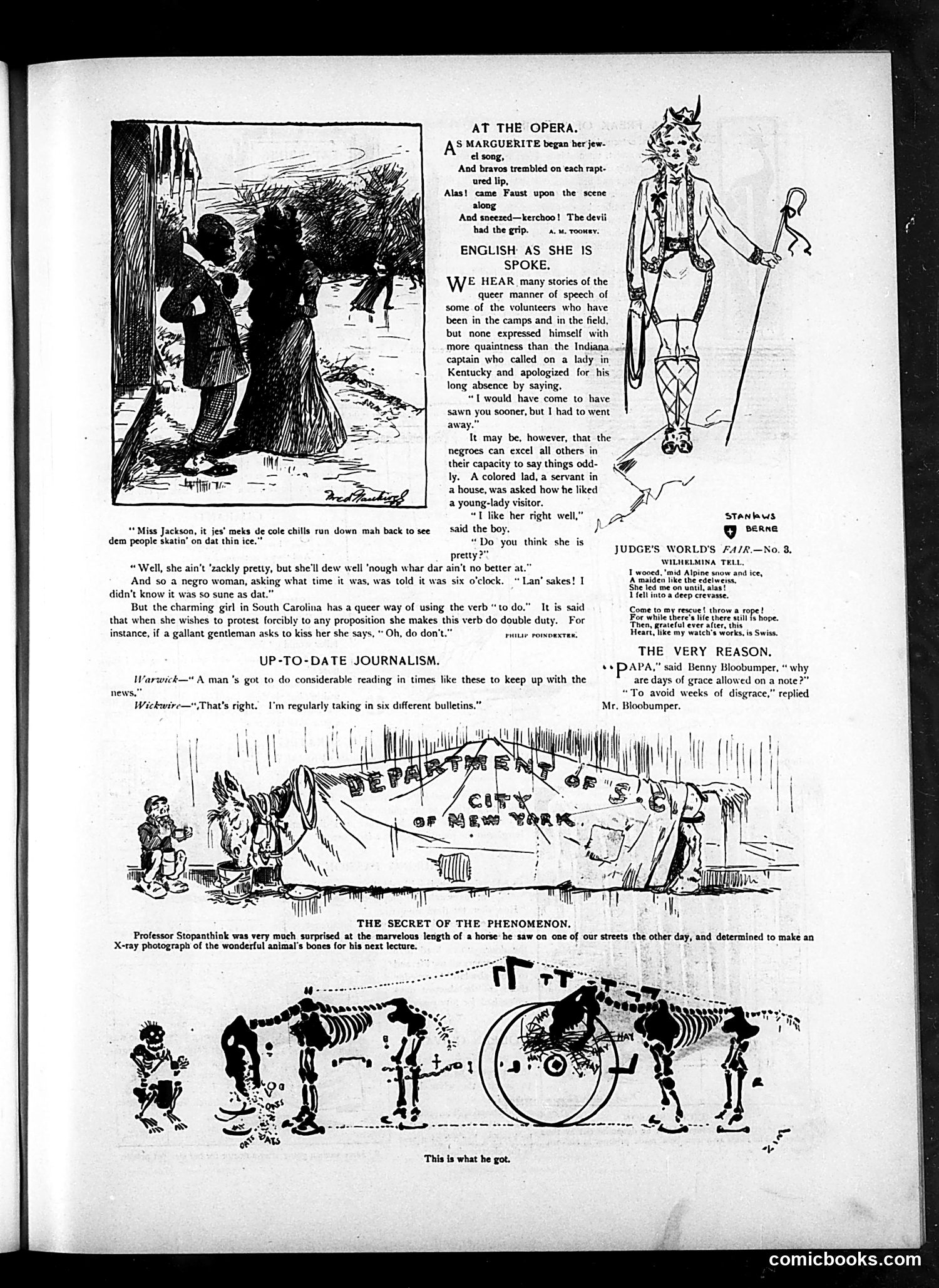
This page contains several satirical pieces reflecting early 20th-century American humor: **"At the Opera"** jokes that a sneeze (attributed to "the grip"—influenza) interrupts an opera performance, deflating its grandeur. **"English As She Is Spoke"** mocks dialectal speech of soldiers returning from camps and African American servants, presenting their grammatical errors as comic entertainment. Examples include malapropisms like "sawn you sooner" for "seen" and "do don't" as emphatic negation. This reflects period attitudes treating non-standard English as inherently humorous. **"Up-to-Date Journalism"** satirizes information overload, suggesting readers must consume multiple news bulletins constantly to stay informed. **"The Secret of the Phenomenon"** shows a professor X-raying a comically elongated horse, finding it stuffed with additional horse skeletons—visual absurdist humor about an impossibly long animal. The page exemplifies Judge's blend of social observation, linguistic humor, and visual gags targeting contemporary readers familiar with vaudeville, military references, and popular scientific curiosities.
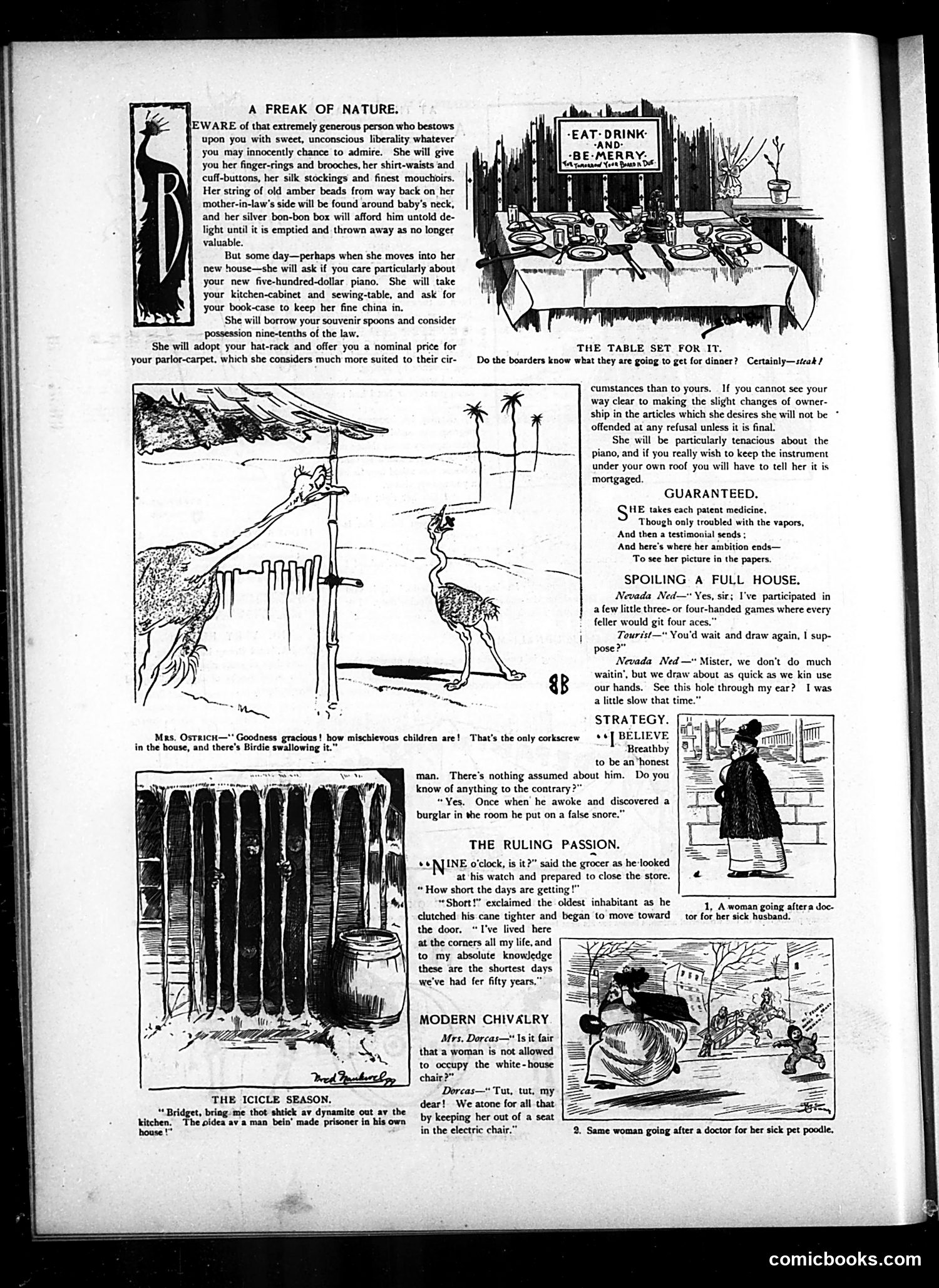
This page contains several disconnected satirical pieces typical of Judge's format: **"A Freak of Nature"** mocks the "generous" woman who showers gifts on others, then gradually claims their possessions as her own—particularly fixating on acquiring a friend's piano. The satire targets the social hypocrisy of upper-class women who disguise acquisitiveness as generosity. **"The Ruling Passion"** jokes about patent medicine users who take treatments for trivial ailments solely to get testimonials published in newspapers—satirizing both hypochondria and vanity. **"The Icicle Season"** is a mild domestic humor bit about children misusing household items. **"Modern Chivalry"** references the then-contemporary debate over women's rights, specifically women's suffrage and public participation. The joke about denying women the "white-house chair" (voting/political power) while allowing them the "electric chair" (execution) is dark commentary on gender inequality. **"Spoiling a Full House"** and related vignettes are brief joke-snippets about card games and domestic situations. The page reflects Progressive-era concerns: gender roles, women's rights, consumer culture, and social pretense.
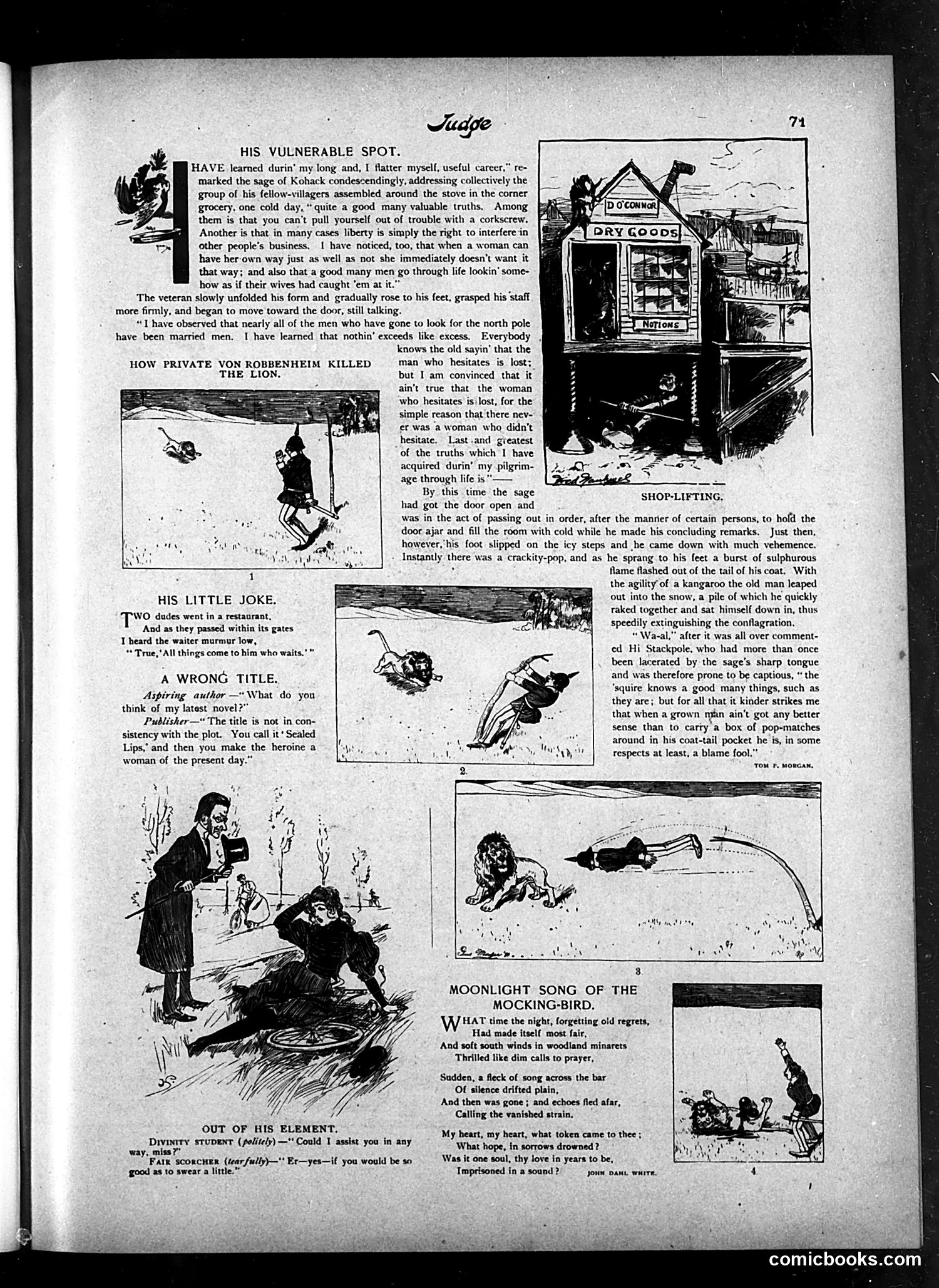
This page contains several humor pieces typical of early 20th-century American satire: **"His Vulnerable Spot"** presents a rustic sage (drawn by Tom Morgan) dispensing wisdom to villagers. The joke culminates when he slips on icy steps and pops-matches in his coat-tail ignite—undermining his pompous philosophizing with physical comedy. The humor mocks self-appointed village philosophers. **"How Private Von Robbenheim Killed the Lion"** and **"His Little Joke"** appear to be brief humorous anecdotes with accompanying illustrations, though details are unclear from the OCR. **"A Wrong Title"** is a literary joke: a publisher notes an author called their novel "Sealed Lips" while making the heroine a modern woman who presumably talks—a contradiction. The remaining pieces—"Moonlight Song of the Mocking-Bird," "Out of His Element," and shop-lifting illustrations—are lighter verse and comic sketches. Overall, this reflects Judge's blend of rural humor, literary satire, and slapstick common to Gilded Age American comedy magazines.
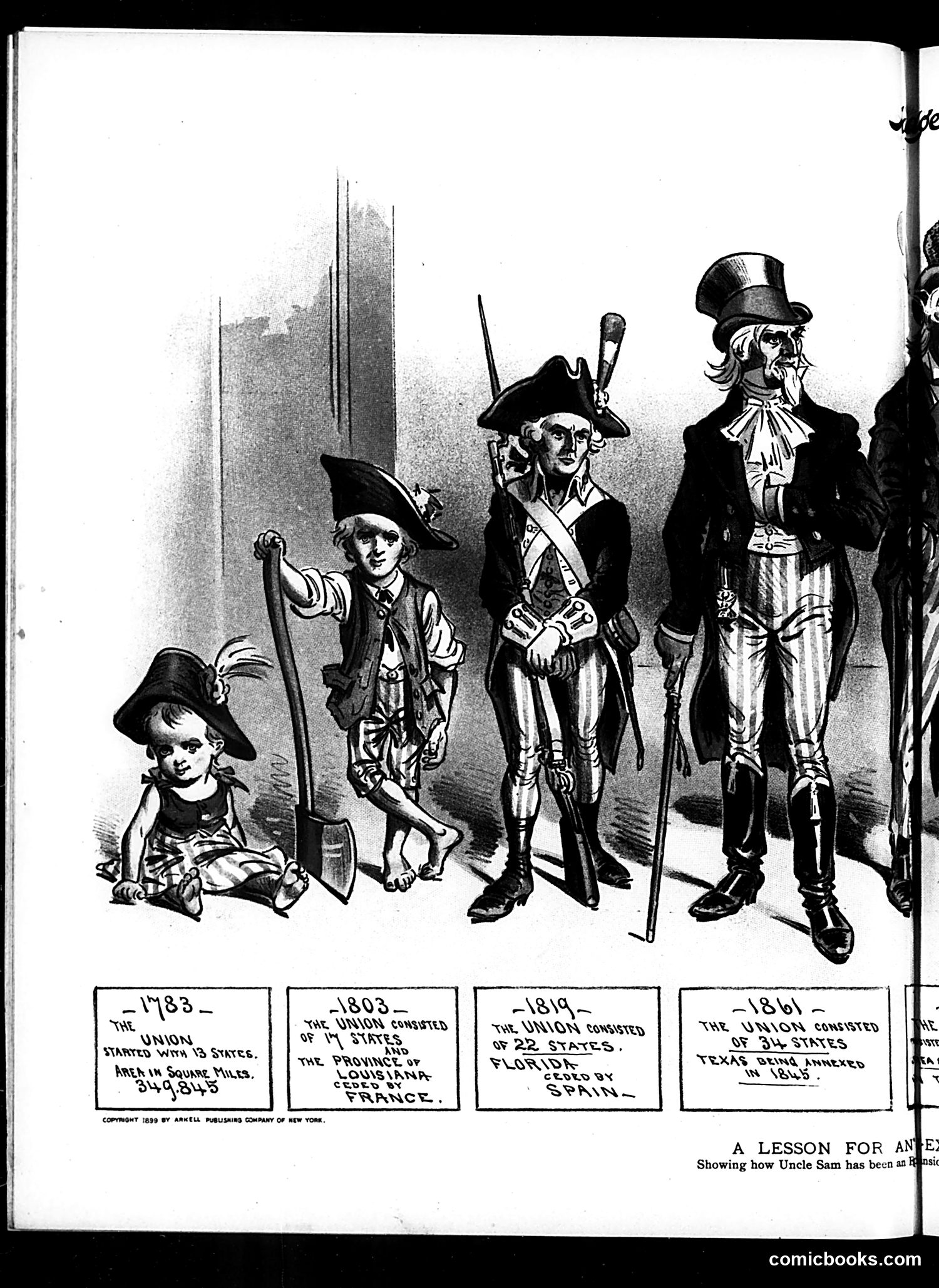
This 1899 Judge cartoon uses Uncle Sam's physical growth to satirize American territorial expansion. The figure grows progressively larger across four panels, each labeled with a historical date and acquisition: - **1783**: Original 13 states, small area - **1803**: Louisiana Purchase from France added - **1819**: Florida ceded by Spain - **1861**: Texas annexed, plus other states Uncle Sam transforms from an infant to a full-grown man as the nation expands westward. The title, "A Lesson for An[other nation]" (text cut off), appears to use this growth as either a warning or boast about American imperial ambitions—likely aimed at rival European powers. The cartoon reflects the imperialist zeitgeist of 1899, when the U.S. was actively acquiring overseas territories. The visual metaphor equates territorial growth with national maturation and strength, though the satire's exact target—celebrating or critiquing this expansion—remains somewhat ambiguous from the visible text.
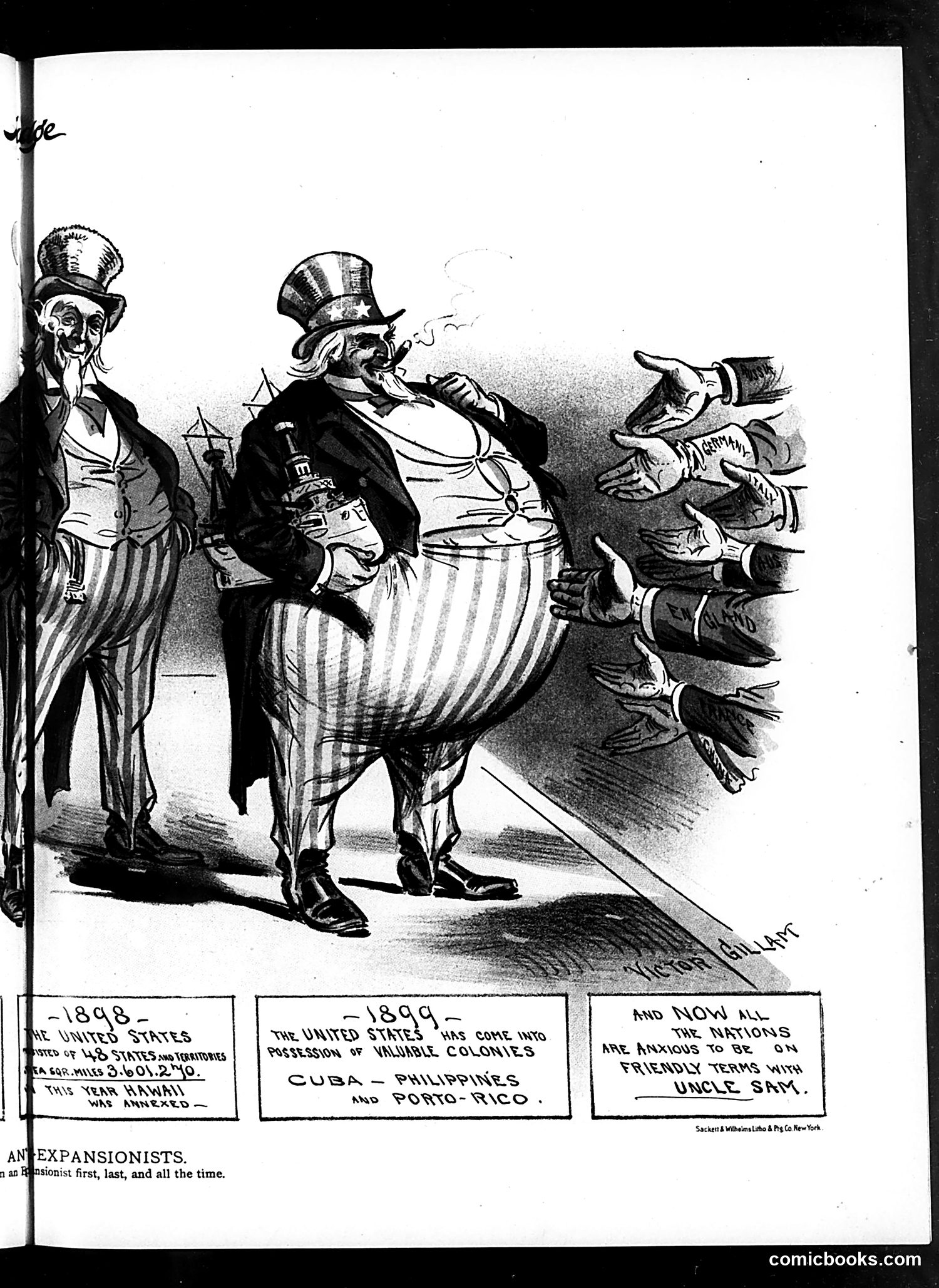
This 1898-1899 Judge cartoon satirizes American imperial expansion following the Spanish-American War. The central figure—a portly Uncle Sam in a top hat—represents American expansionist politicians. He's depicted smoking and boasting about newly acquired territories. The three caption panels chronicle America's territorial growth: 1898 shows the U.S. acquiring Hawaii; 1899 shows possession of Cuba, Philippines, and Puerto Rico; and the final panel notes that "all the nations are anxious to be on friendly terms with Uncle Sam." The cartoon mocks expansionists as greedy imperialists. The smaller figures on the right—appearing to be foreign diplomats or rival nations—react with apparent concern or deference to America's growing power. The satire criticizes both American imperial ambitions and the presumption that other nations would eagerly befriend an aggressively expansionist power.
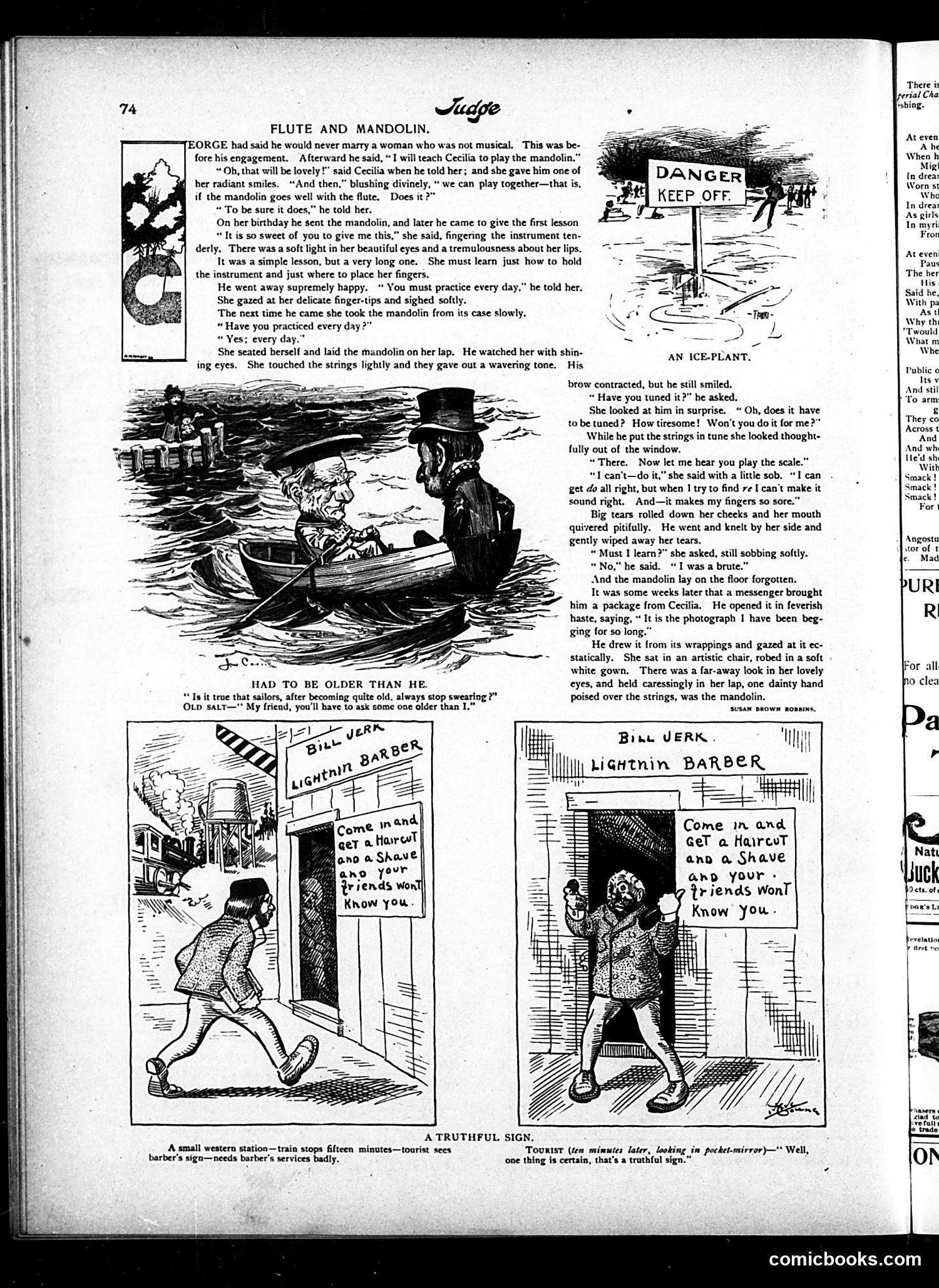
The main story depicts a romantic narrative where George insists his fiancée Cecilia learn mandolin to accompany his flute-playing. After giving her the instrument, he discovers she won't practice diligently and abandons the lessons when she becomes frustrated and tearful. Weeks later, he receives her photograph: she's posed artistically holding the mandolin, suggesting she's mastered it through independent effort rather than his tutelage. **The satire**: The story mocks masculine presumption—George's insistence on shaping his fiancée's interests and abilities. His condescending instruction fails where her own motivation succeeds, humbling his ego. The three cartoon vignettes below are unrelated gag comics: one shows a barber's sign promising a haircut; another reverses it as ironic commentary on poor work; the third features an "ice plant" warning sign (likely industrial humor). These pieces exemplify *Judge's* mix of sentimental short fiction and satirical comics targeting social conventions around courtship and gender roles.
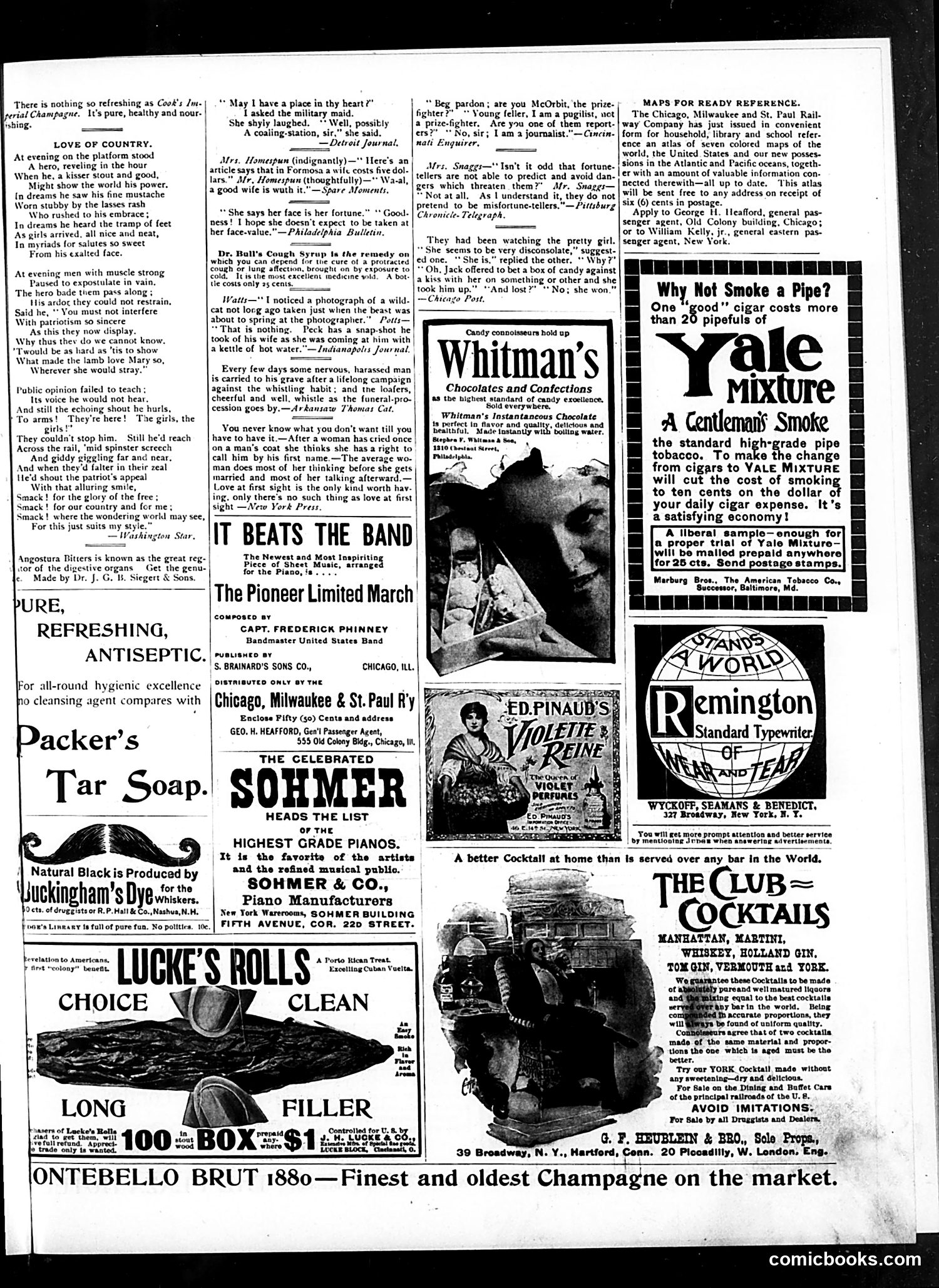
This page is primarily **advertising**, containing numerous product ads (champagne, soap, piano, typewriter, cigars, cocktails, etc.) mixed with short humorous text pieces typical of *Judge* magazine's satirical content. The main cartoon appears to be the poem "**Love of Country**" (left side), satirizing an overly enthusiastic patriot at a train platform who compulsively kisses women he encounters, justifying this behavior as patriotic fervor. The joke mocks excessive nationalism and his self-deluding rationalization of inappropriate conduct—he cannot be stopped because he claims his kissing serves the nation's glory. Other brief satirical items include jokes about: military romance ("coaling-station" instead of love), Formosan marriage costs, wives' monetary value, and the unstoppable nature of social habits (whistling, women's thinking patterns). These represent typical *Judge* fare: topical social commentary in mini-comic form, using exaggeration and irony to critique contemporary behavior and attitudes. The specific patriotic enthusiast appears generic rather than depicting an identifiable figure.
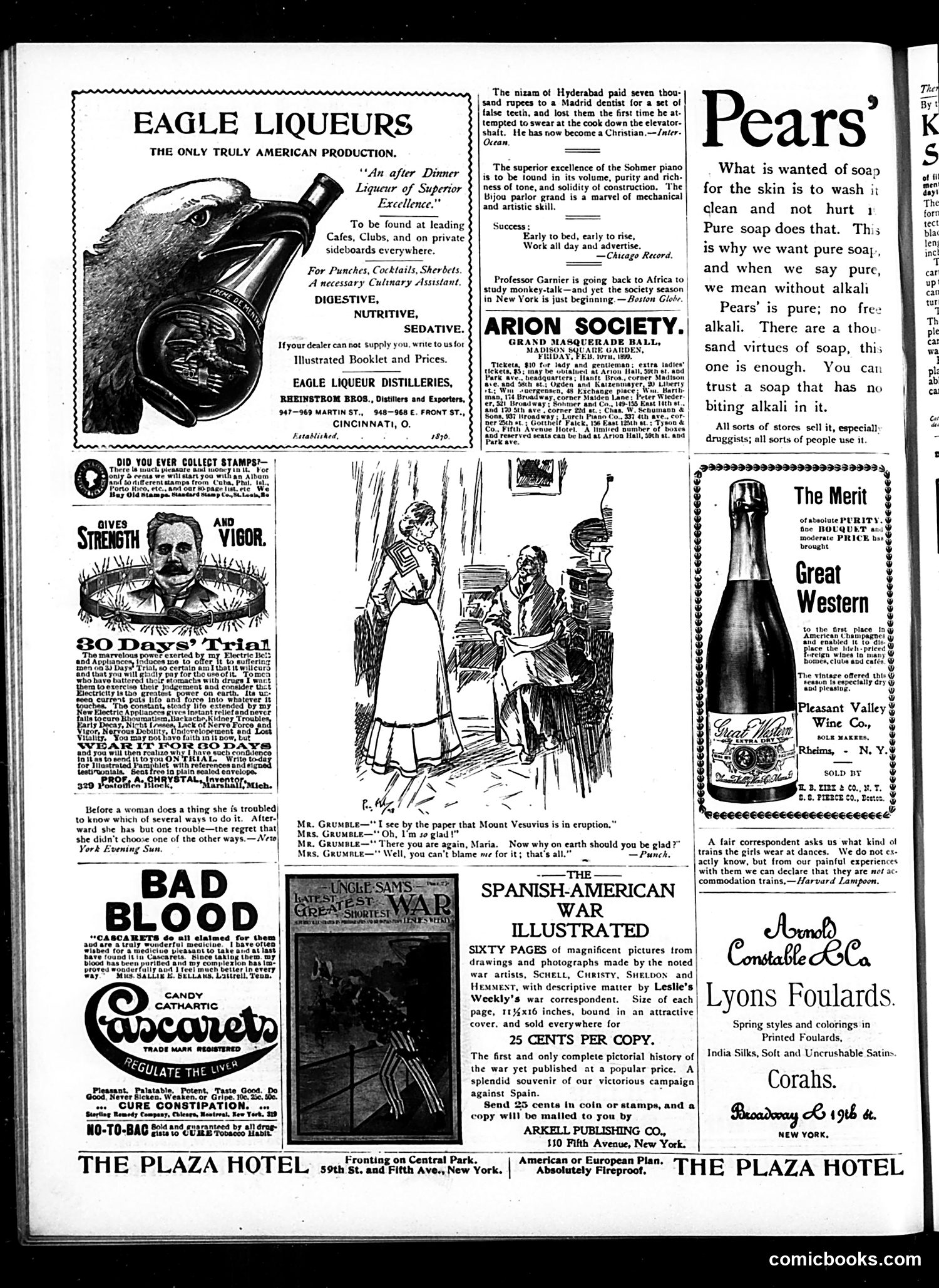
This page is primarily **advertising mixed with light humor** from Judge magazine, circa 1898-1900. **The main visual cartoon** shows a marital squabble: Mr. and Mrs. Grumble—she's reading a newspaper announcing Mount Vesuvius's eruption. When she admits she's "glad" about a volcanic disaster, he's appalled. Her punchline: "you can't blame me for it; that's all"—meaning she finds any excuse, even natural catastrophes, to express contrary opinions. The joke is **domestic annoyance**: wives as relentlessly disagreeable companions. **The page otherwise features advertisements** for liqueurs, soap, wine, and other products typical of the era, mixed with a humorous item about the Nizam of Hyderabad ordering false teeth from Madrid. There's also **an advertisement for "The Spanish-American War Illustrated,"** a 60-page pictorial history sold for 25 cents—reflecting the then-recent 1898 war's continuing public interest. The content reflects turn-of-century consumer culture and mild, genteel sexism in satirical magazines.
This page is primarily **advertising and filler content** for what appears to be a late 19th-century magazine. The main substantive content consists of brief **humorous anecdotes** rather than political cartoons: - A joke about newspapers printing "grip-germ" portraits (bacteria causing influenza-like illness) as a public health warning - A doctor's joke about curing a patient but not collecting payment - A comment on an Ohio clergyman-turned-barber, playing on the phrase "silenced" (expelled from preaching) - A marital joke about a wife's resemblance to her baby These are **mild social humor** typical of period magazines—no deep satire or political content. The remainder consists of **product advertisements** (Kodak cameras, sheet music, architecture books, shaving soap, barber supplies) and classified listings. There are **no identifiable political figures or caricatures** visible in the text or imagery described. This appears to be a standard advertising page interspersed with light comic filler rather than satirical editorial content.
This page is primarily **advertising and promotional content**, not editorial satire or political cartoons. It contains: 1. **Brief humor items** (top section): Short jokes in period dialect featuring African American characters discussing minor ailments, along with unrelated anecdotes about education and French language difficulties. These reflect early 20th-century publication conventions. 2. **Product advertisements**: The Boston Garter (men's hosiery), photographs, and magazine subscriptions dominate the page. 3. **Travel promotion**: Montreal in winter and the New York Central railroad. 4. **Art prints**: Leslie's Weekly offers war drawings by artists Christy and Schell. The page lacks sustained political commentary or significant caricature work. Rather, it exemplifies how Judge magazine filled space with light humor, consumer goods advertising, and travel promotions to subsidize publication costs. Modern readers would note the casual use of racial dialect humor, typical of the era but now considered offensive.
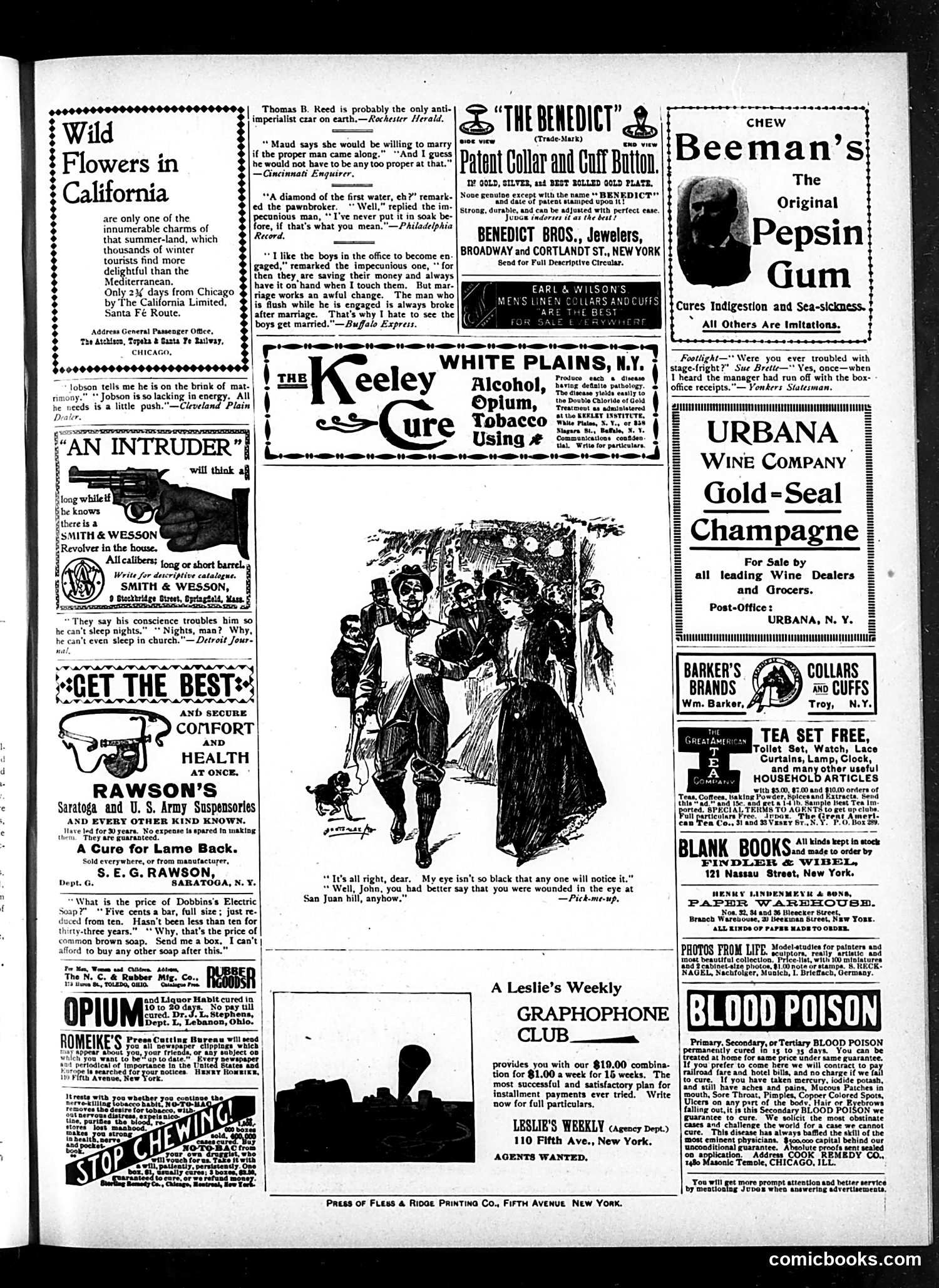
This page is primarily **advertising**, with one notable political reference and one humorous cartoon. **Political Reference:** The masthead quotes Thomas B. Reed as "probably the only anti-imperialist czar on earth." Reed was Speaker of the House; the joke equates his authoritarian control of Congress with being a "czar" while simultaneously noting his opposition to American imperialism—a topical reference likely to the Spanish-American War and Philippine annexation debates of that era. **Main Cartoon:** The central illustration depicts a couple on a street, with the woman saying "It's all right, dear. My eye isn't so black that any one will notice it." The man responds by suggesting he tell people he was "wounded in the eye at San Juan hill"—a famous battle from the Spanish-American War. The satire mocks how men might exaggerate or fabricate war service to explain injuries or justify their absence. **Rest of Page:** The remaining content consists entirely of patent medicines, food products, and household goods advertisements typical of the era—many making dubious health claims (opium products, "blood poison" cures, etc.).
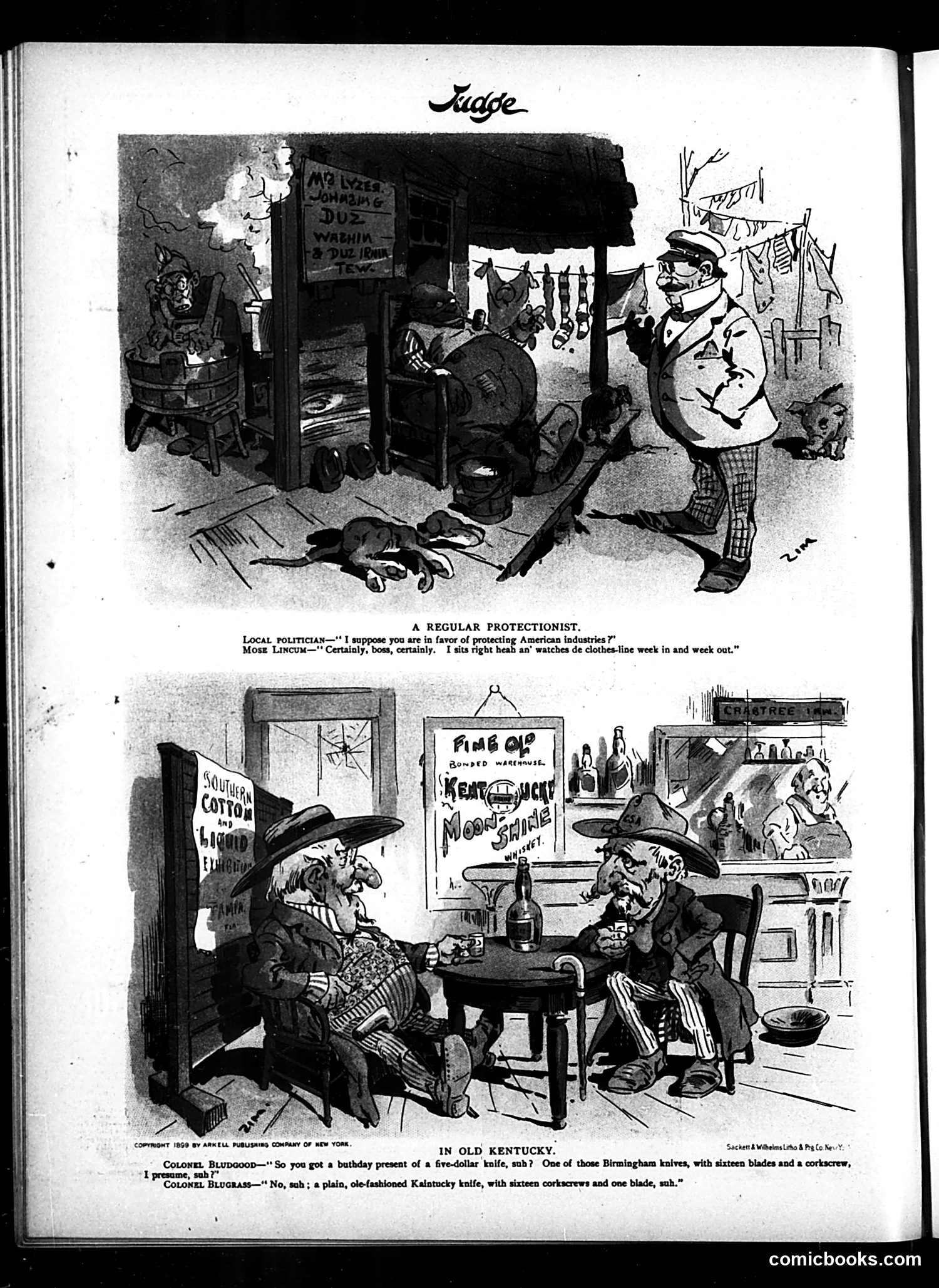
**"A Regular Protectionist"** (top): This satirizes a local politician's claim to support protecting American industries. "Mose Lincum" (a stereotyped African American character) interprets "protection" as literally watching clotheslines—a commentary on how politicians' pro-industry rhetoric means nothing to working people, particularly Black workers excluded from actual economic benefits. **"In Old Kentucky"** (bottom): Two Southern characters (depicted with exaggerated racist caricature) joke about a birthday knife gift. Colonel Bluegrass humorously inverts expectations: rather than a fancy multi-tool knife, he received a "plain" Kentucky knife with "sixteen corkscrews and one blade"—absurdly backwards. This satirizes Southern pretension and perhaps mocks nostalgic idealization of the antebellum South. Both cartoons employ racist visual stereotyping typical of 1899 Judge material, using caricature to demean their subjects while delivering political/social commentary about economic hypocrisy and regional vanity.