
Judge, 1899-02-04 · page 10 of 16
Judge — February 4, 1899 — page 10: what you’re looking at
What you’re looking at
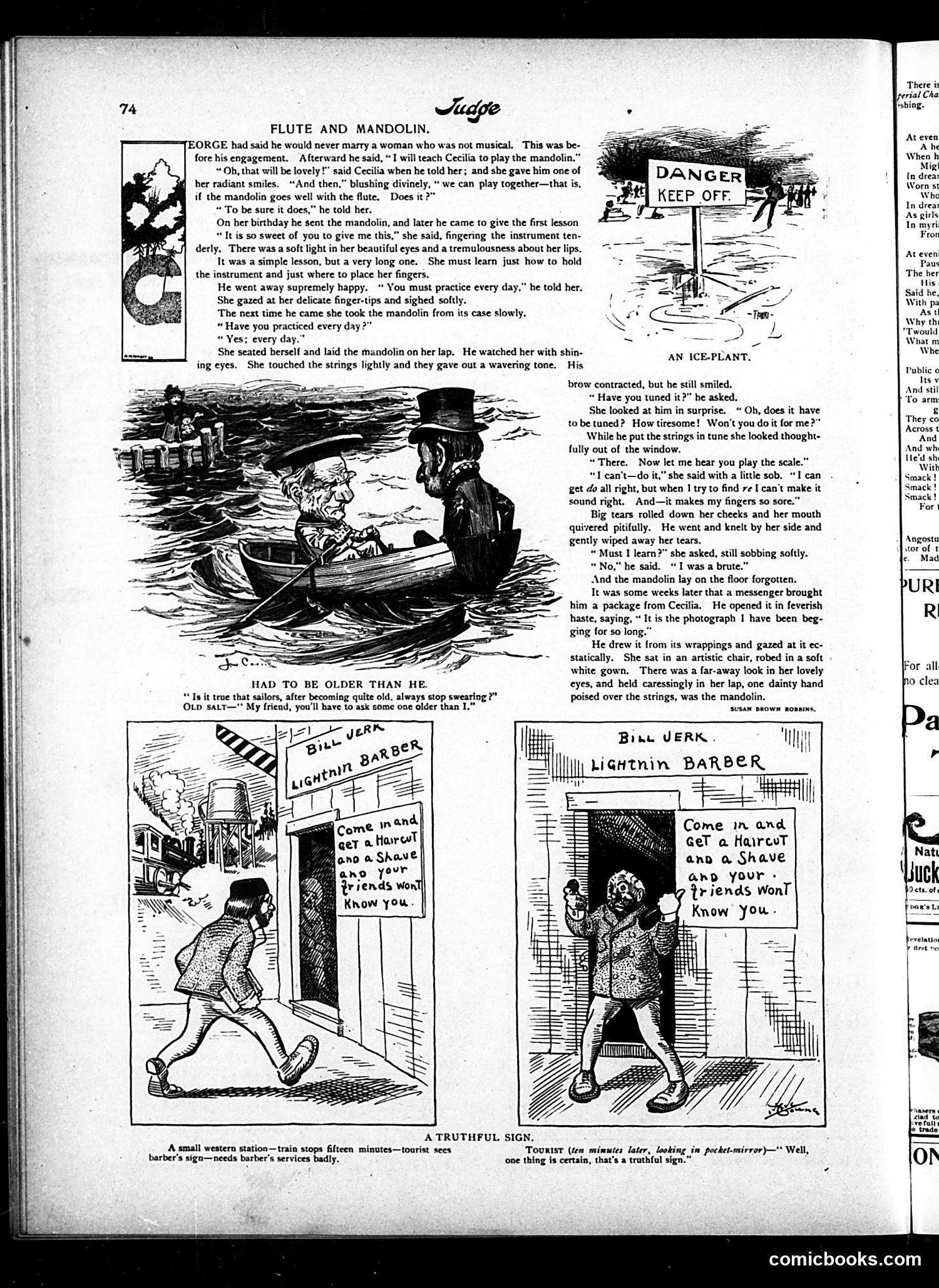
The main story depicts a romantic narrative where George insists his fiancée Cecilia learn mandolin to accompany his flute-playing. After giving her the instrument, he discovers she won't practice diligently and abandons the lessons when she becomes frustrated and tearful. Weeks later, he receives her photograph: she's posed artistically holding the mandolin, suggesting she's mastered it through independent effort rather than his tutelage. **The satire**: The story mocks masculine presumption—George's insistence on shaping his fiancée's interests and abilities. His condescending instruction fails where her own motivation succeeds, humbling his ego. The three cartoon vignettes below are unrelated gag comics: one shows a barber's sign promising a haircut; another reverses it as ironic commentary on poor work; the third features an "ice plant" warning sign (likely industrial humor). These pieces exemplify *Judge's* mix of sentimental short fiction and satirical comics targeting social conventions around courtship and gender roles.
📄 Transcribed text from this page (OCR, searchable)
Machine-transcribed from the original scan — historical spelling and the odd misread are preserved.
rial Cha : 14 Supe J, ishing. FLUTE AND MANDOLIN. Ret ORGE had said he would never marry a woman who was not musical. This was be- Cab fore his engagement. Afterward he said, “ I will teach Cecilia to play the mandolin.” When b “Ob, that will be lovely!" said Cecilia when he told her; and she gave him one of il « Mig her radiant smiles. “And then,” blushing divinely, “ we can play together—that is, Worn 3 if the mandolin goes well with the flute, Does it ?” Whe “ To be sure it does,” he told her. re oon On her birthday he sent the mandolin, and later he came to give the first lesson. Thora “ It is so sweet of you to give me this,” she said, fingering the instrument ten- Fron derly, ‘There was a soft light in her beautiful eyes and a tremulousness about her lips. mreved Tt was a simple lesson, but a very long one. She must learn just how to hold rife I the instrument and just where to place her fingers. ‘The her 1; He went away supremely happy. “ You must practice every day,” he told her. sae | She gazed at her delicate finger-tips and sighed softly. With ps The next time he came she took the mandolin from its case slowly. ASI “ Have you practiced every day?” bya «Yes; every day.” Wheto She seated herself and laid the mandolin on her lap. He watched her with shin- AN ICE PLANT, Whe Hy) ing eyes. She touched the strings lightly and they gave out a wavering tone. His Pablie ti brow contracted, but he still smiled. cata “ Have you tuned it?” he asked. 3 atti She looked at him in surprise.“ Ob, does it have g tobe tuned? How tiresome! Won't you do it for me?” Re While he put the strings in tune she looked thought- Aad fully out of the window. And wh “There. Now let me hear you play the scale.” neaan “I can't—do it,” she said with a little sob. “I can Smack! get do all right, but when I try to find re I can’t make it Smack! sound right. And—it makes my fingers so sore.” Smack! Big tears rolled down her cheeks and her mouth quivered pitifully. He went and knelt by her side and gently wiped away her tears. Angosta “ Must I learn?” she asked, still sobbing softly. stor a “No,” he said. “I was a brute.” And the mandolin lay on the floor forgotten. It was some weeks later that a messenger brought him a package from Cecilia. He opened it in feverish haste, saying, “ It is the photograph I have been beg- ging for so long.” He drew it from its wrappings and gazed at it ec- Wi statically. She sat in an artistic chair, robed in a soft _ \ white gown. ‘There was a far-away look in her lovely or all HAD TO BE OLDER THAN HE. eyes, and held caressingly in her lap, one dainty hand 0 clea “Is it true that sailors, after becoming quite old, always stop swearing 2” poised over the strings, was the mandolin. Otp satt—" My friend, you'll have to ask some one older than I.” SUSAN BROWN ROBBINS, | Biac UERK. “I il LiGHtnin BARBER , | Come in and i GeT a HarroeT i} ano a Shave { Nat | @np your - uch | tr iends wonT ete of | Know you. 7 i a i | A TRUTHFUL A small western station—train stops fifteen minutes—tourist sees barber's sign—needs barber's services badly. SIGN, Tourist (ten minutes later, looking in pocket-mirror)—'* Well, one thing is certain, that’s a truthful sign.’ comicbooks.com