
A complete issue · 16 pages · 1897
Judge — November 13, 1897
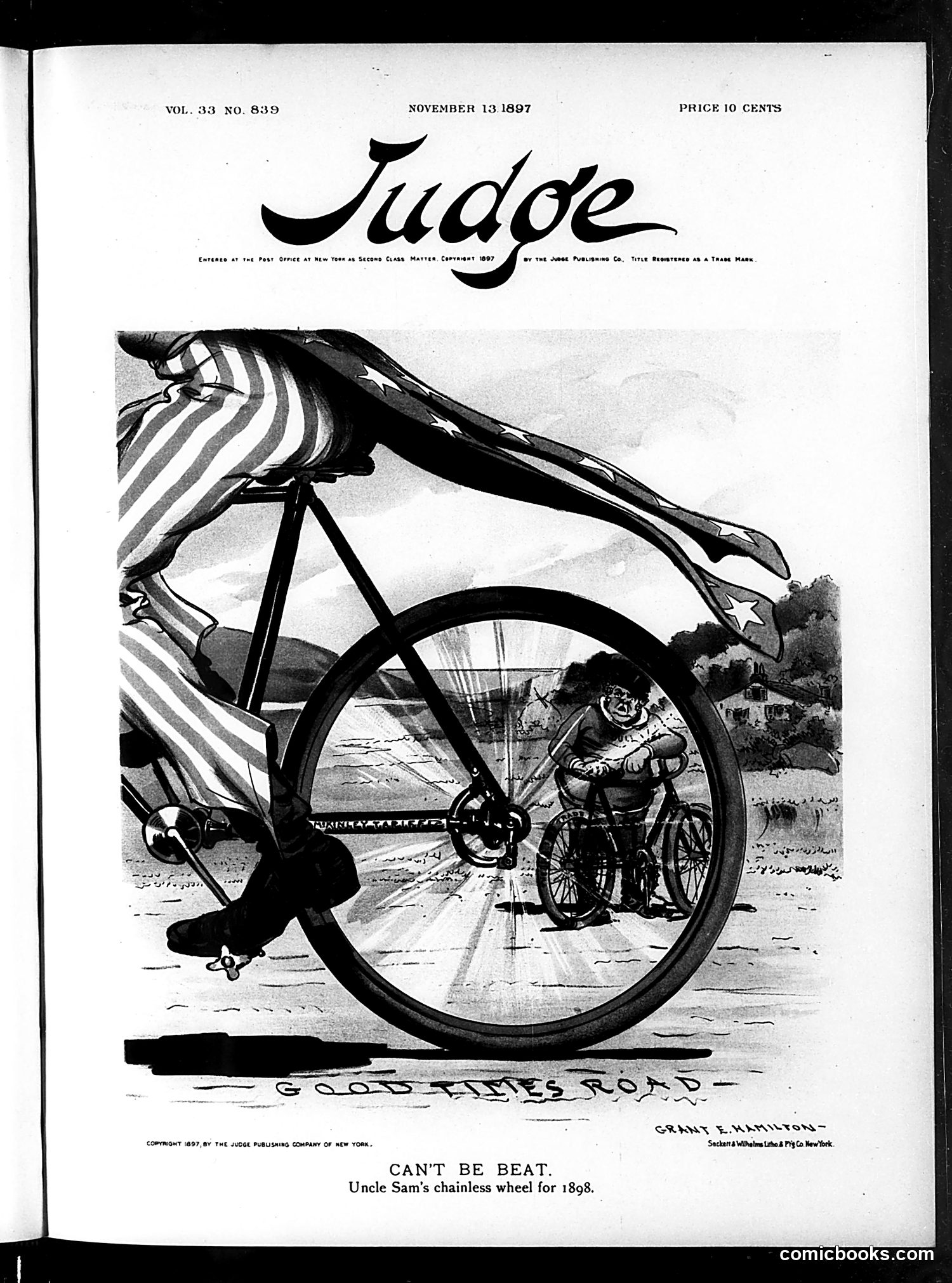
This cartoon satirizes American imperial ambitions in 1898. The massive bicycle wheel represents Uncle Sam (the U.S. government) riding a giant bicycle, with a tiny figure on a regular bicycle visible through the wheel's center—likely representing a rival nation or competitor. The "chainless wheel" references the then-new chainless bicycle technology. The satire suggests America's vastly superior power and reach compared to other nations. The striped pants and elongated leg emphasize Uncle Sam's exaggerated dominance. This appeared during the Spanish-American War (1898), when the U.S. expanded into Cuba, Puerto Rico, and the Philippines. The cartoon celebrates American technological and military supremacy as seemingly unstoppable and unbeatable.
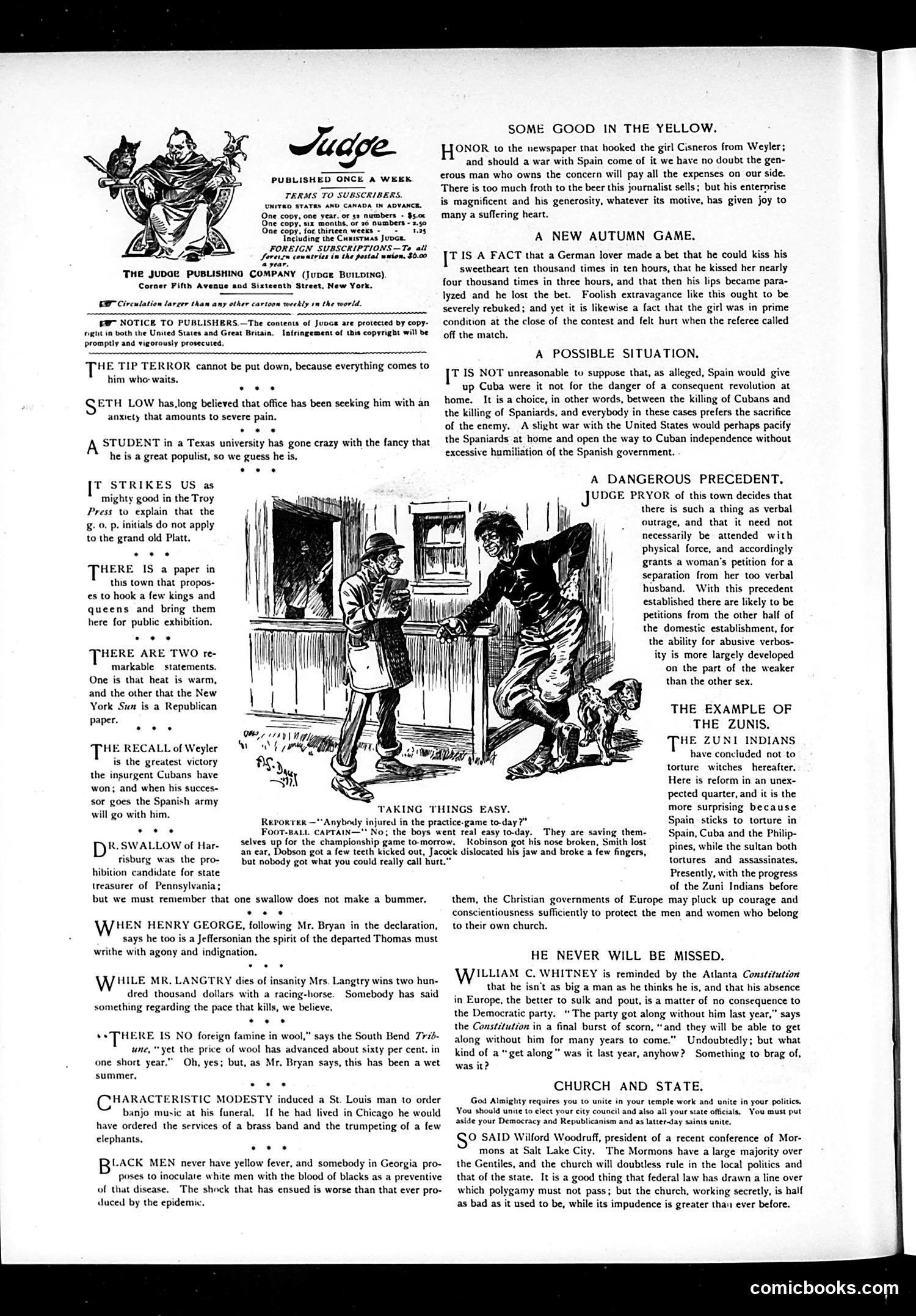
The main cartoon depicts a street scene with what appears to be a police officer or authority figure confronting civilians, including a woman and child. The caption "TAKING THINGS EASY" suggests commentary on law enforcement conduct or public order. The surrounding text references contemporary issues: Spanish-Cuban conflict, German romance/betting, Texas university popularity, and newspaper ethics regarding the Caneros from Weyler. References to "The Recall of Weyler" indicate this relates to Spanish colonial politics in Cuba. The page's satirical commentary targets various targets: governmental overreach, romantic excess, newspaper sensationalism, and what appears to be critique of Spanish imperial policies. However, without clearer identification of specific figures or exact publication date, precise political references remain partially unclear.
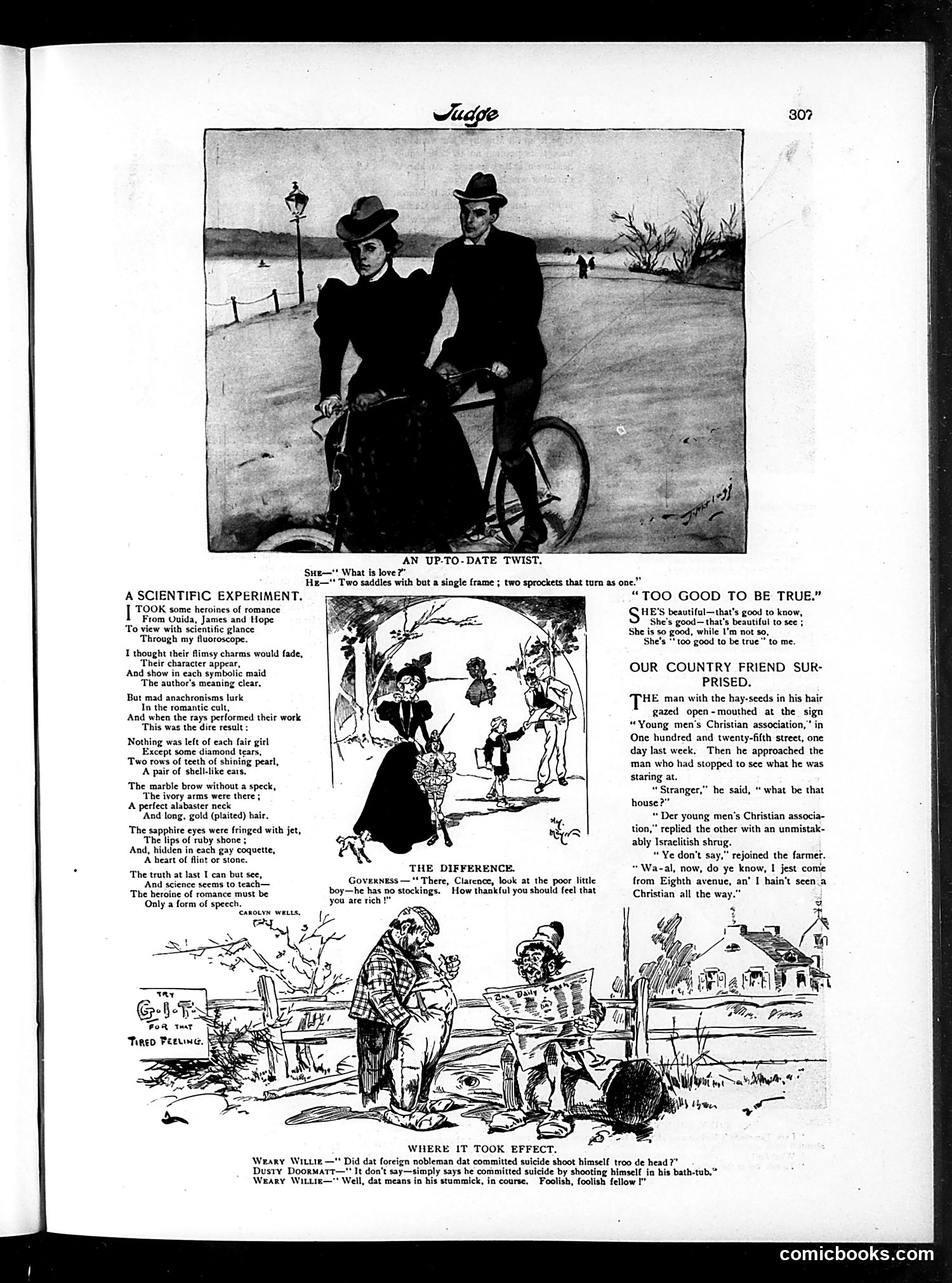
This page contains several satirical pieces typical of Judge's style: **"An Up-to-Date Twist"** (top): A cartoon showing two people on a tandem bicycle, playing on romantic conventions—likely mocking modern dating or relationship dynamics of the era. **"A Scientific Experiment"** and **"The Difference"**: Comic strips with accompanying verses and illustrations satirizing social pretensions and class distinctions, common Judge targets. **"Too Good to Be True"** and **"Our Country Friend Surprised"**: Short humorous stories depicting rural/urban cultural clashes—a recurring Judge theme—where unsophisticated country folk encounter city life or unusual situations. **"Where It Took Effect"**: A rural scene with working-class characters (Weary Willie, Dusty Doormat) in dialogue, using dialect humor typical of the period's working-class satire. The page represents Judge's mix of visual and textual humor targeting social hierarchies and modern manners.
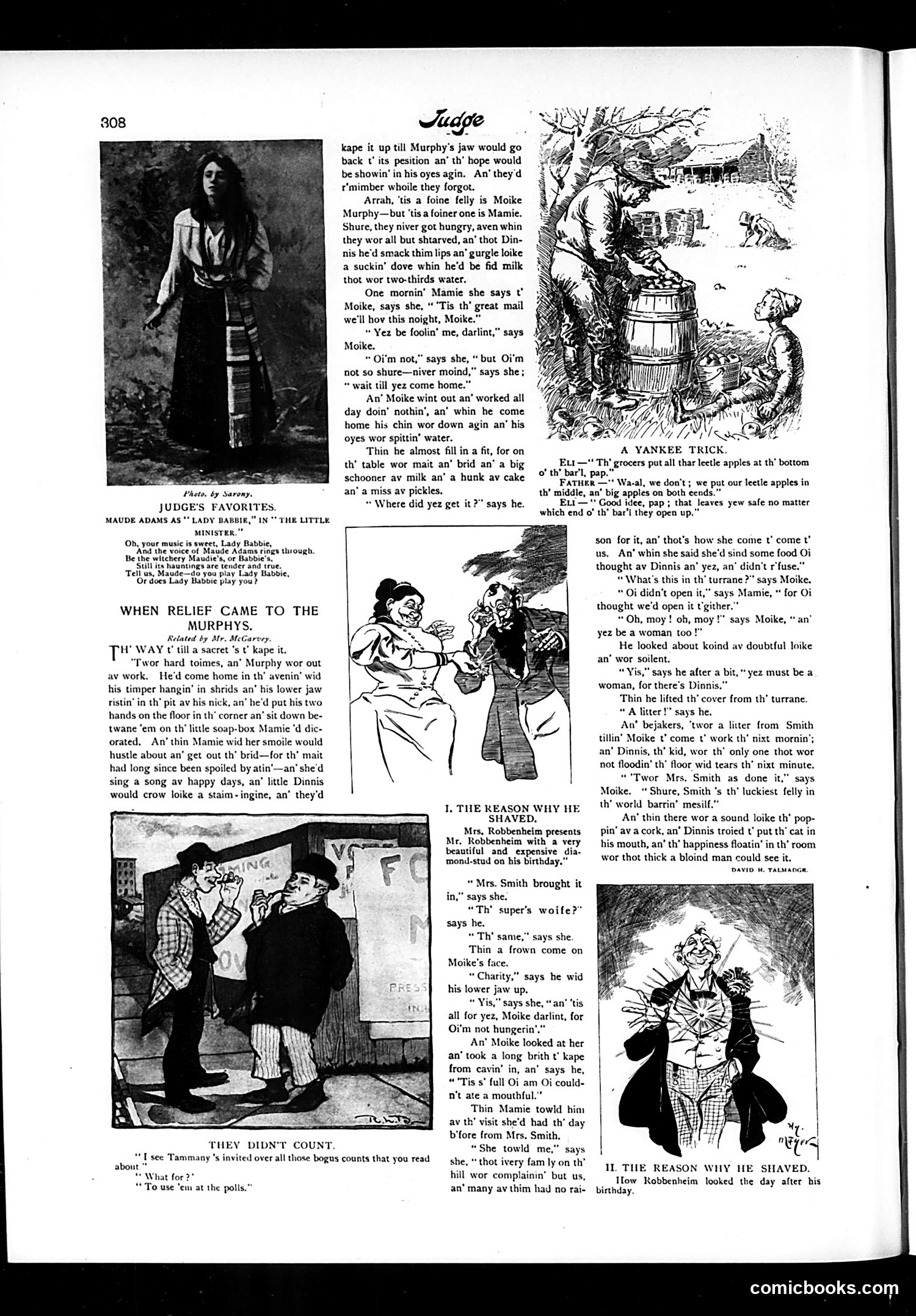
This page from *Judge* magazine contains three distinct satirical pieces: 1. **"Judge's Favorites"**: A celebrity tribute to actress Maude Adams in "The Little Minister," playfully questioning whether she plays the character or the character plays her—typical fan magazine fluff. 2. **"When Relief Came to the Murphys"**: An Irish-immigrant humor piece written in thick dialect. The satire targets poverty and charity: the Murphy family endures hunger while maintaining dignity, until a neighbor (Mrs. Smith) secretly provides food, allowing them to accept help without losing pride. The humor lies in the dialect and the tension between poverty and masculine pride. 3. **"They Didn't Count"** and **"The Reason Why He Shaved"**: Political cartoons referencing Tammany Hall corruption (the first) and domestic scenes (the second). 4. **"A Yankee Trick"**: A rural humor sketch about deceptive produce marketing—farmers placing small apples at the barrel's bottom, Yankees countering by putting them at both ends. The page reflects early-20th-century *Judge* sensibility: ethnic humor, political jabs at urban machines, and rural wit.
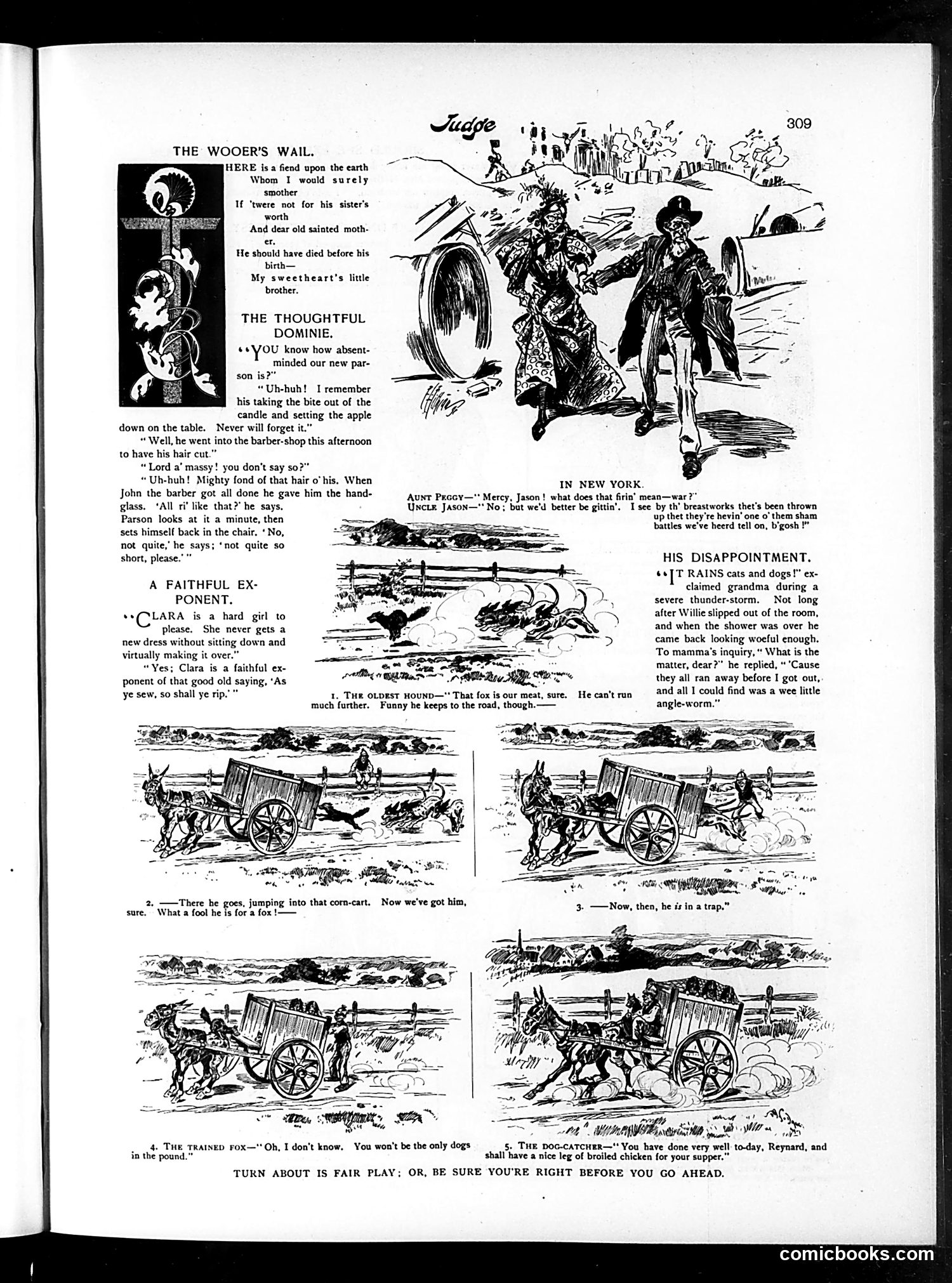
This page contains three distinct satirical pieces typical of Judge's humor: **"The Wooer's Wail"** mocks a suitor frustrated by his sweetheart's annoying younger brother—a relatable domestic complaint presented melodramatically. **"The Thoughtful Dominie"** ridicules an absent-minded clergyman (dominie = minister) who confuses objects, setting a candle instead of his head in the barber's chair—playing on the Victorian stereotype of scattered-brained clergy. **"His Disappointment"** features a child disappointed after a rainstorm, expecting to find animals but discovering only an earthworm—gentle humor about childhood expectations versus reality. **"Turn About is Fair Play"** is a four-panel fox-hunting narrative where the hunted fox outwits pursuing hounds and ends up in the dog-catcher's pound anyway, where he's fed better than the dogs—inverting expectations with dark irony about justice and comeuppance. The humor relies on domestic situations, character types, and ironic reversals typical of late-19th/early-20th-century American comic literature.
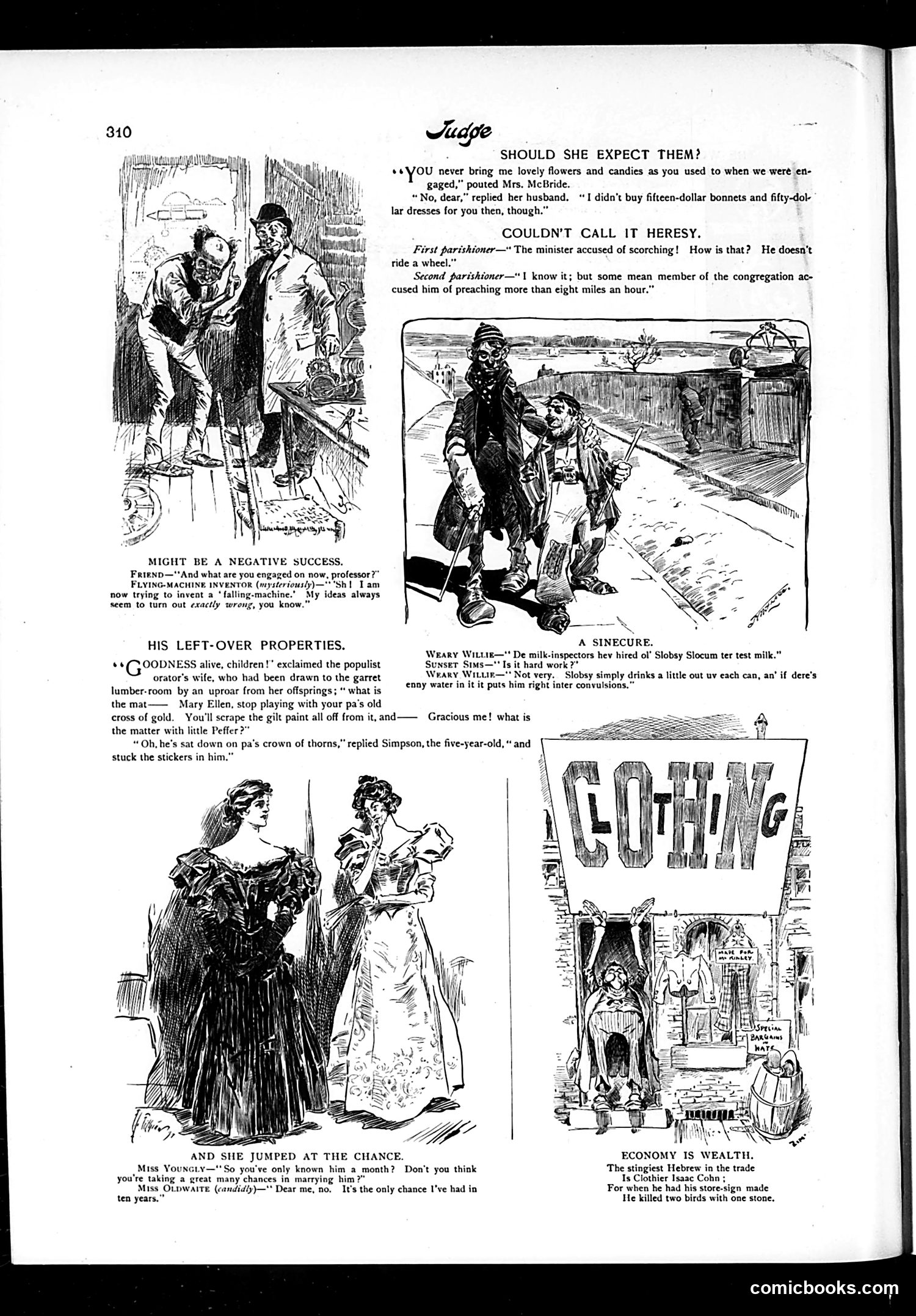
This page contains several short satirical jokes typical of late 19th-century humor: **"Should She Expect Them?"** mocks the transition from courtship to marriage—the husband's point being that expensive gifts (flowers, candy) were romantic gestures before marriage, but now he funds her expensive wardrobe instead. **"Couldn't Call It Heresy"** jokes about a minister accused of "scorching" (reckless speed)—a contemporary reference to the new bicycling craze. The humor: he's accused of preaching too fast (eight miles per hour), not actual dangerous cycling. **"Might Be a Negative Success"** satirizes an inventor's perpetual failure—he invents a "falling-machine" as a self-aware joke about his track record of disasters. **"His Left-Over Properties"** references populist politician William Jennings Bryan's famous "Cross of Gold" speech (1896), showing his children playing with symbolic political props. **"A Sinecure"** depicts a milk inspector so lazy he tastes milk to check for water—a joke about corrupt, do-nothing government positions. **"Economy is Wealth"** mocks Jewish merchant Isaac Cohn for being miserly with his store sign. The page reflects turn-of-century American political figures, technology anxieties, and period stereotypes.
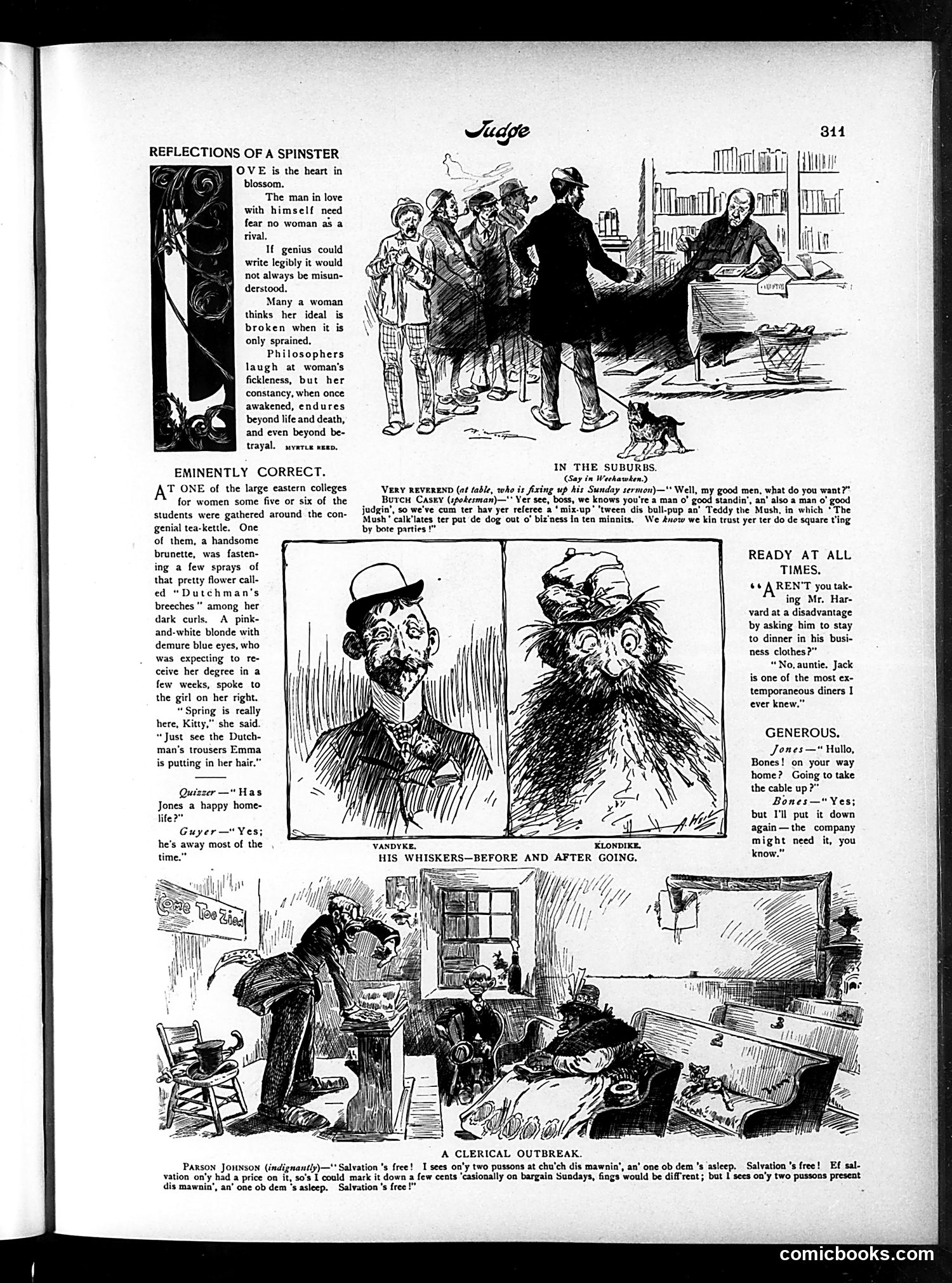
This page contains several satirical pieces targeting early 20th-century American social attitudes: **"Reflections of a Spinster"** offers cynical observations on romance and women's constancy, reflecting period anxieties about unmarried women. **"Eminently Correct"** mocks college women's education, suggesting intellectual women are ridiculous—a female student wears flowers in her hair while discussing serious matters. **"In the Suburbs"** depicts working-class men seeking a clergyman to referee a dogfight, satirizing both rural/working-class culture and clergy irrelevance. **"Ready at All Times"** and **"Generous"** are brief domestic humor pieces about misers and poor dinner guests. **"A Clerical Outbreak"** shows a Black pastor complaining about low church attendance, using heavy dialect. The satire targets both sparse congregations and, through caricature and dialect, reflects the magazine's racial stereotyping common to that era. The overall page exemplifies Judge's satirical approach: mocking women's ambitions, working-class behavior, and religious hypocrisy through sharp social commentary and offensive caricature.
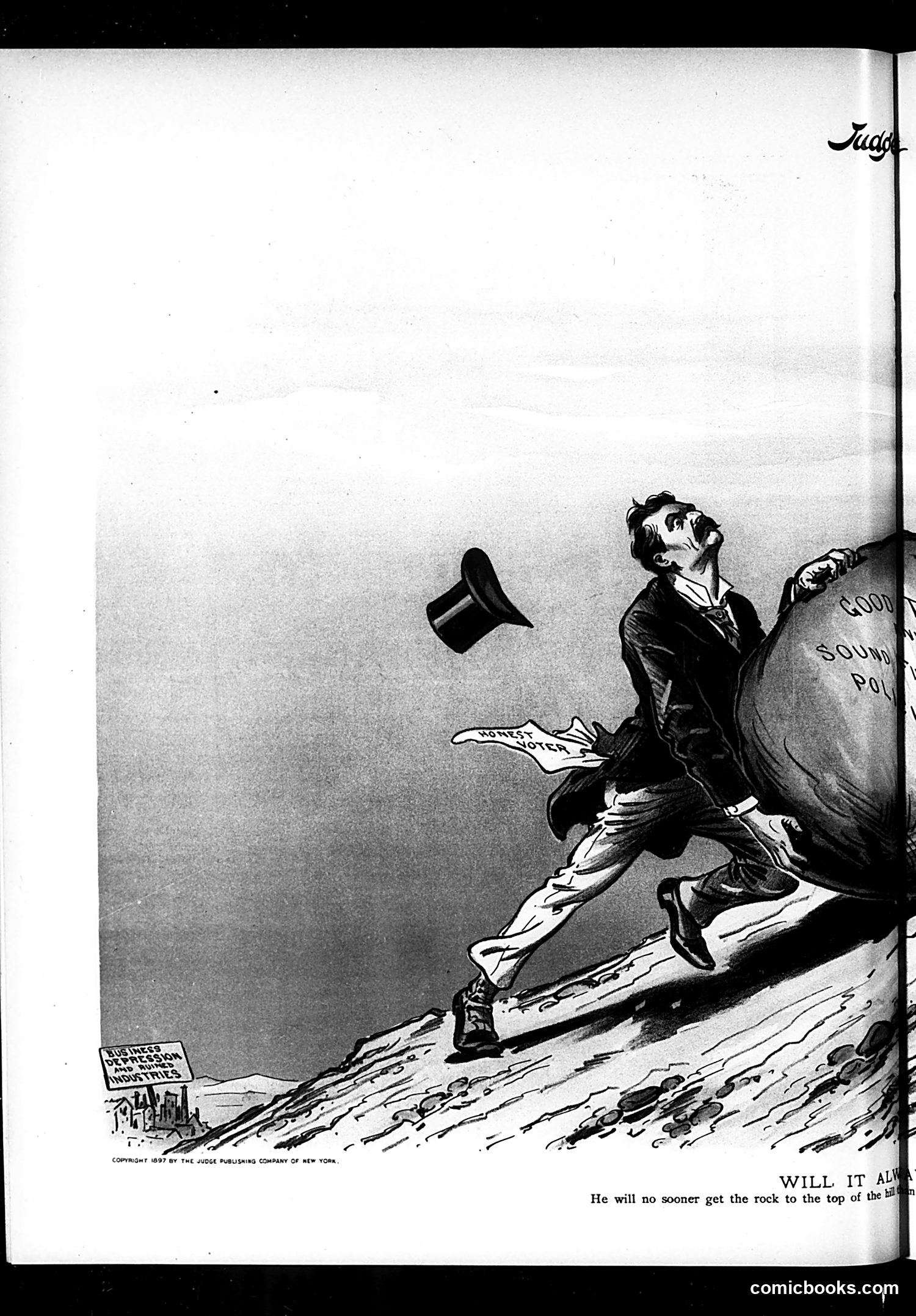
This 1897 *Judge* cartoon depicts a man in formal dress pushing an enormous boulder labeled "GOOD SOUND POLICY" up a steep hill. A top hat flies off his head, and he looks strained with effort. The caption reads "WILL IT ALWAYS" with the incomplete text "He will no sooner get the rock to the top of the..." This appears to reference the myth of Sisyphus—the eternal punishment of rolling a boulder uphill only to have it roll back down. The cartoon likely critiques a political figure or administration's policy efforts as futile and repetitive, suggesting that their initiatives will collapse despite exhausting effort. Without the complete text or date context, the specific policy referenced remains unclear, though the satirical point about failed governance is evident.
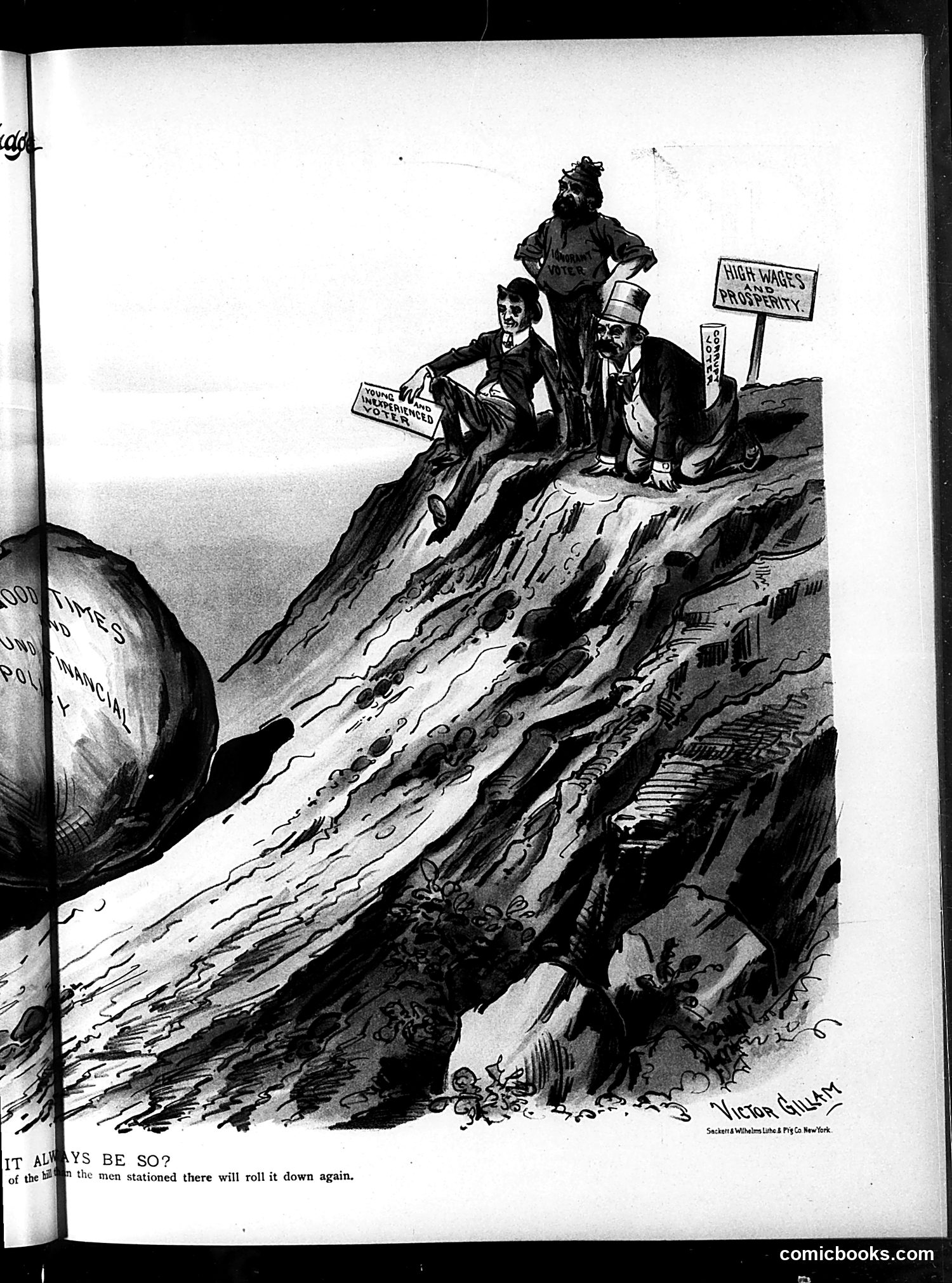
This Victor Gillam cartoon satirizes the cycle of labor unrest and management response. Three caricatured figures (likely representing capital/management) stand atop a steep hill labeled "HIGH WAGES PROSPERITY," watching a large boulder (labeled with text suggesting labor/wages) roll downward. The caption's cynicism—"IT ALWAYS BE SO? / of the men stationed there will roll it down again"—suggests the cartoon mocks the futility of worker efforts or the inevitability of economic decline despite temporary gains. The imagery critiques either: labor's inability to maintain wage increases, or management's deliberate efforts to reverse worker victories. Without a specific date visible, the exact historical context (Gilded Age labor disputes, Panic of 1893, or similar period unrest) remains unclear, though the theme reflects recurring American industrial-era conflicts between capital and labor.
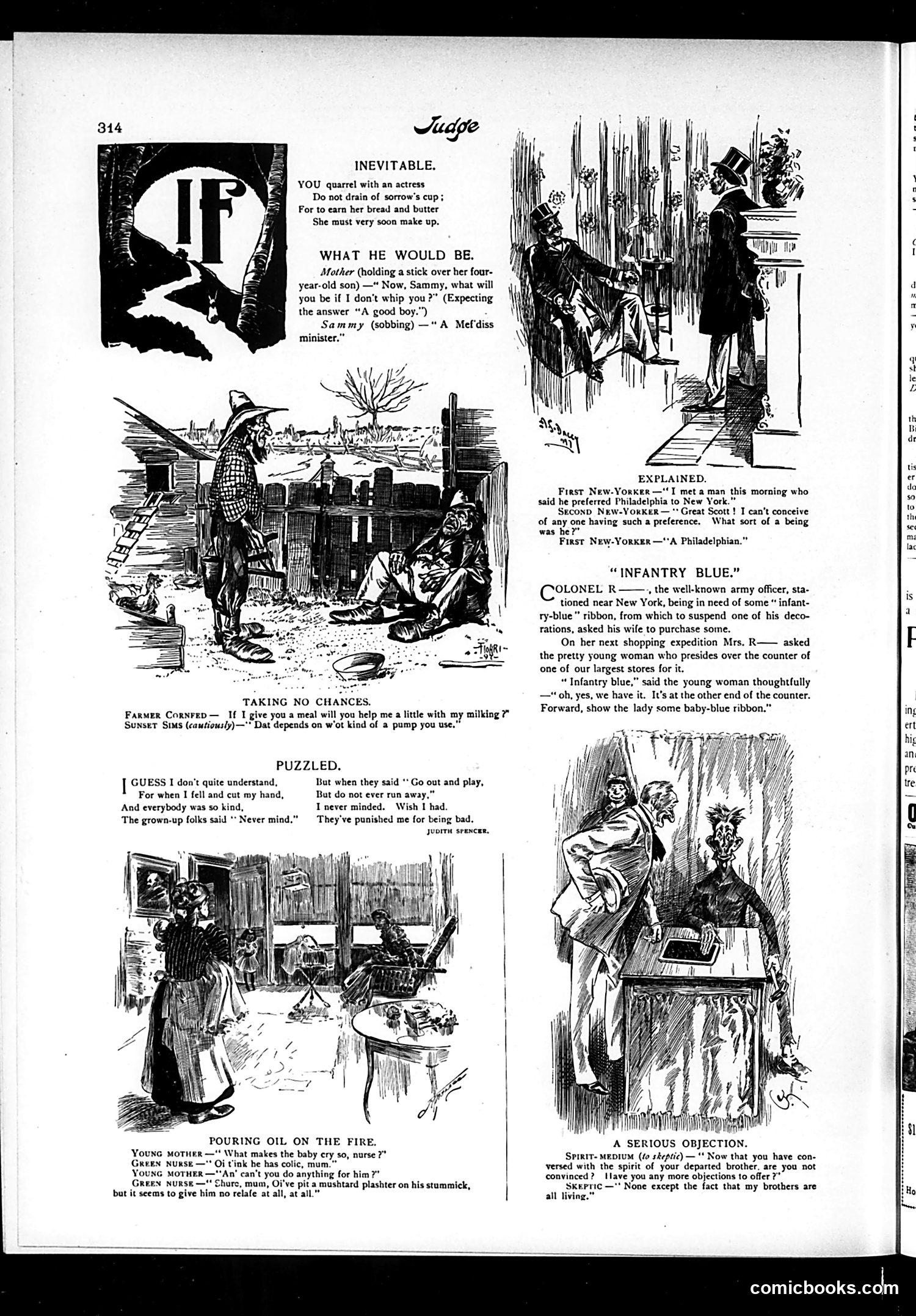
This page contains multiple brief satirical pieces targeting Victorian-era social pretensions and absurdities: **"Inevitable"** mocks actresses' professional necessity to reconcile with quarreling partners for their livelihoods. **"What He Would Be"** satirizes a child's aspiration to become a Methodist minister—implying it's an undesirable outcome equivalent to punishment, likely critiquing either religious hypocrisy or the profession's low regard. **New York vs. Philadelphia** jokes about provincial pride, with New Yorkers incredulous that anyone could prefer Philadelphia, treating such preference as evidence of fundamental human oddity. **"Infantry Blue"** plays on miscommunication: a shopkeeper mistakes military ribbon terminology for baby products, the humor deriving from conflated meanings. **"Taking No Chances"** depicts a cautious Black farmhand (Sunset Sims) negotiating meal payment by questioning the water pump's type—suggesting wariness about working conditions or compensation. **"Serious Objection"** mocks spiritualism: a skeptic attending a séance cannot be convinced by contacting his "departed brother" because his brothers are alive—exposing the medium's charlatan nature.
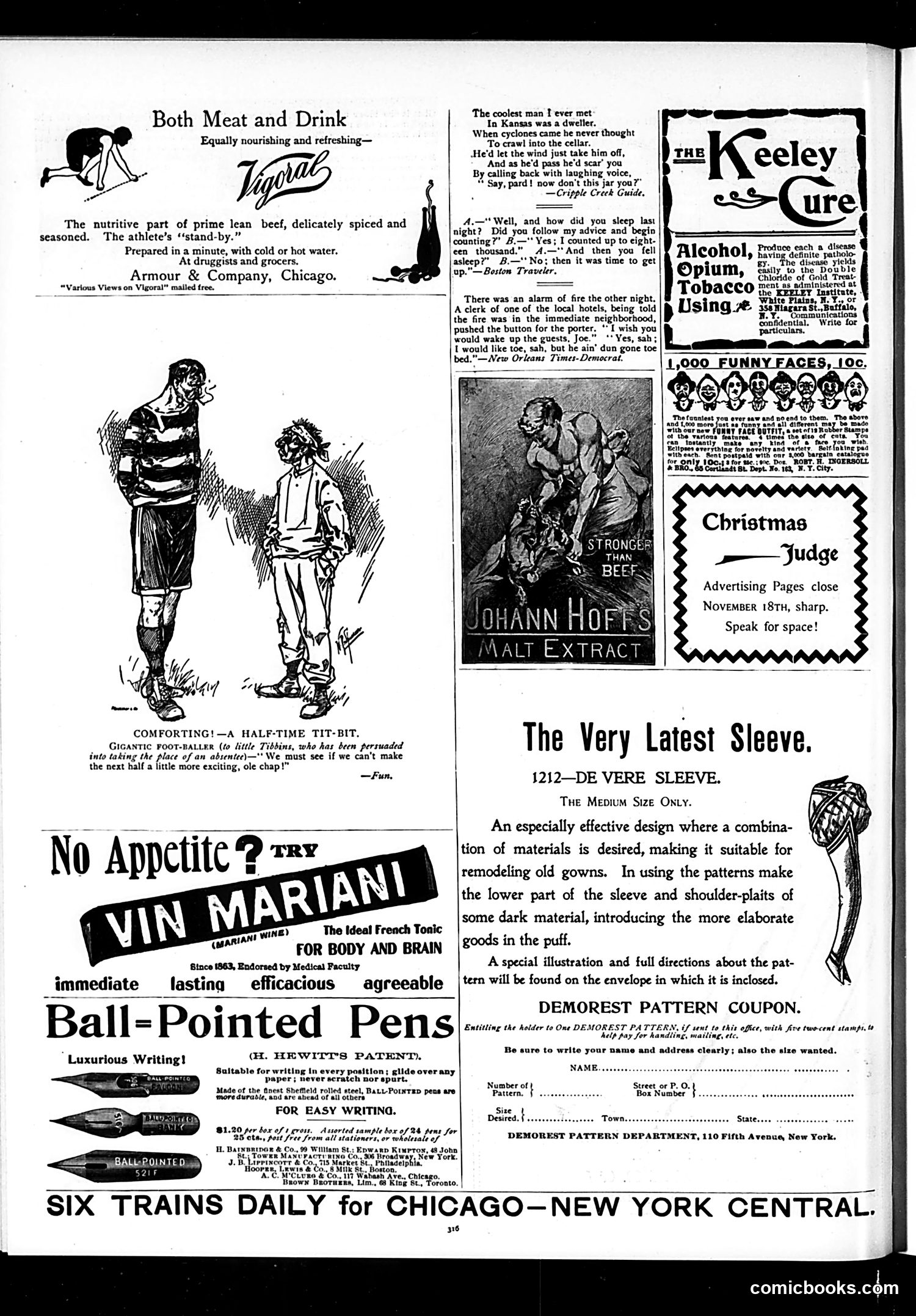
This page is primarily **advertising** interspersed with brief humorous anecdotes rather than political satire. The cartoons present light social humor: one depicts a large football player intimidating a small substitute, joking about making the second half "more exciting." Another shows a hotel porter unable to wake guests because they haven't gone to bed yet—commentary on late-night behavior. The small jokes mock everyday situations: a Kansas man's peculiar calm during cyclones, someone counting sheep to sleep (reaching 18,000), and a fire alarm at a hotel where the clerk notes guests are still awake. The bulk of the page consists of **product advertisements** typical of the era: Vigoral beef extract, Vin Mariani tonic wine, ball-pointed pens, and Demorest dress patterns. These ads, along with notices about Judge's advertising deadlines and train schedules, dominate the layout. The content reflects early 20th-century concerns (appetite tonics, patent medicines) and consumer goods marketed to Judge's middle-class readership.
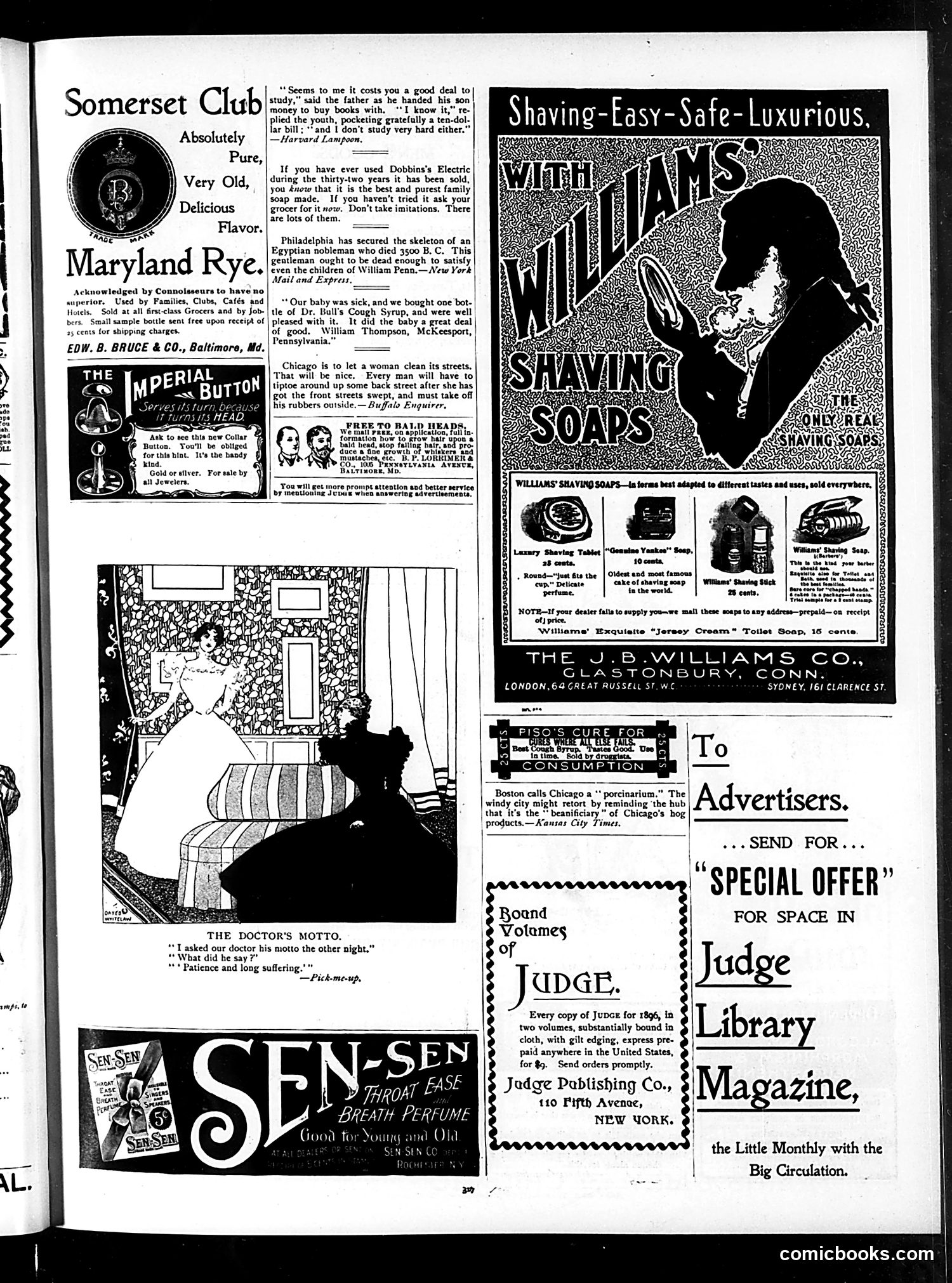
This page is primarily **advertising and promotional content** rather than political satire. It contains: **The Main Cartoon:** "The Doctor's Motto" shows a domestic scene where a doctor's philosophy is revealed as "Patience and long suffering"—a gentle joke about medical practice and waiting rooms. **Brief Political Humor:** Short satirical quips about Philadelphia acquiring an Egyptian skeleton (mocking Philadelphian pretensions), Chicago's street-cleaning program (joking that men will hide indoors), and a Boston-Chicago rivalry about pork products ("porcinarium" vs. "beanificiary"). **Dominant Content:** Multiple advertisements for alcohol (Maryland Rye whiskey), collar buttons, soaps, and other consumer goods—typical of Judge's revenue model. The page concludes with promotional offers for Judge's bound volumes and advertising space. **Context:** This reflects Judge's dual nature as both satirical magazine and advertising vehicle. The scattered jokes are mild social observation rather than cutting political commentary.
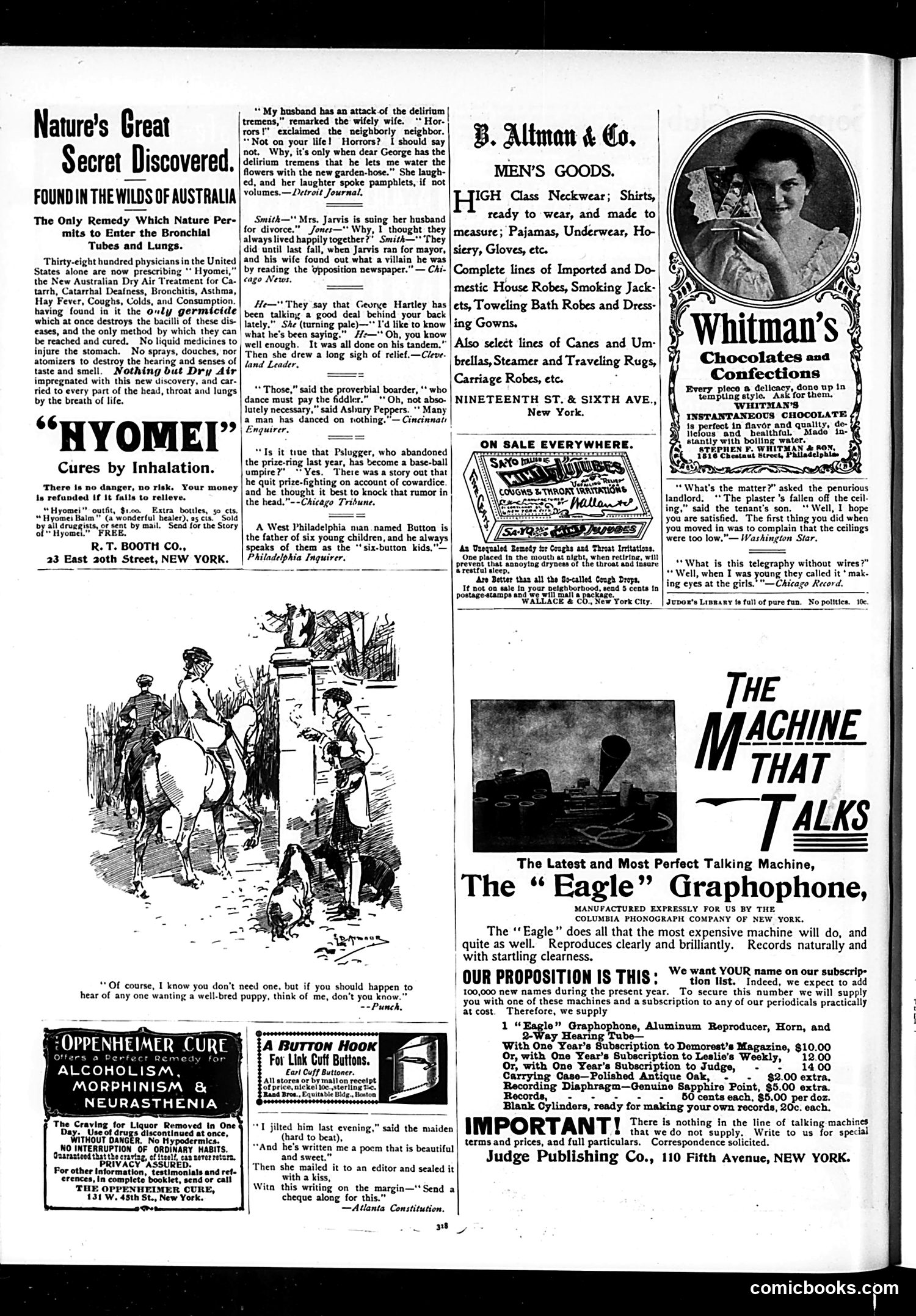
This page is primarily **advertising with scattered humor**, typical of early 1900s satirical magazines. The main content includes: **Advertisements:** - "Hyomei" (an Australian dry-air treatment for respiratory ailments) - Oppenheimer Cure for alcoholism and morphine addiction - B. Altman & Co. men's clothing - Whitman's Chocolates - The "Eagle" Graphophone (talking machine) - Judge Publishing Co. **Humor sections:** Small joke columns with dialogue snippets mocking contemporary domestic life—husbands with "delirium tremens," divorce gossip, tandem bicycles as private meeting spots, and boardinghouse complaints. These are generic, observational humor about marriage, social pretension, and urban life rather than political satire. **Visual:** A sketch shows people with horses and a dog in a rural/frontier setting, likely illustrating the "Nature's Great Secret" medical claim. The page reflects Judge's mixed commercial-editorial model: advertisements subsidized satirical content while both sold consumer products and social commentary to middle-class readers.
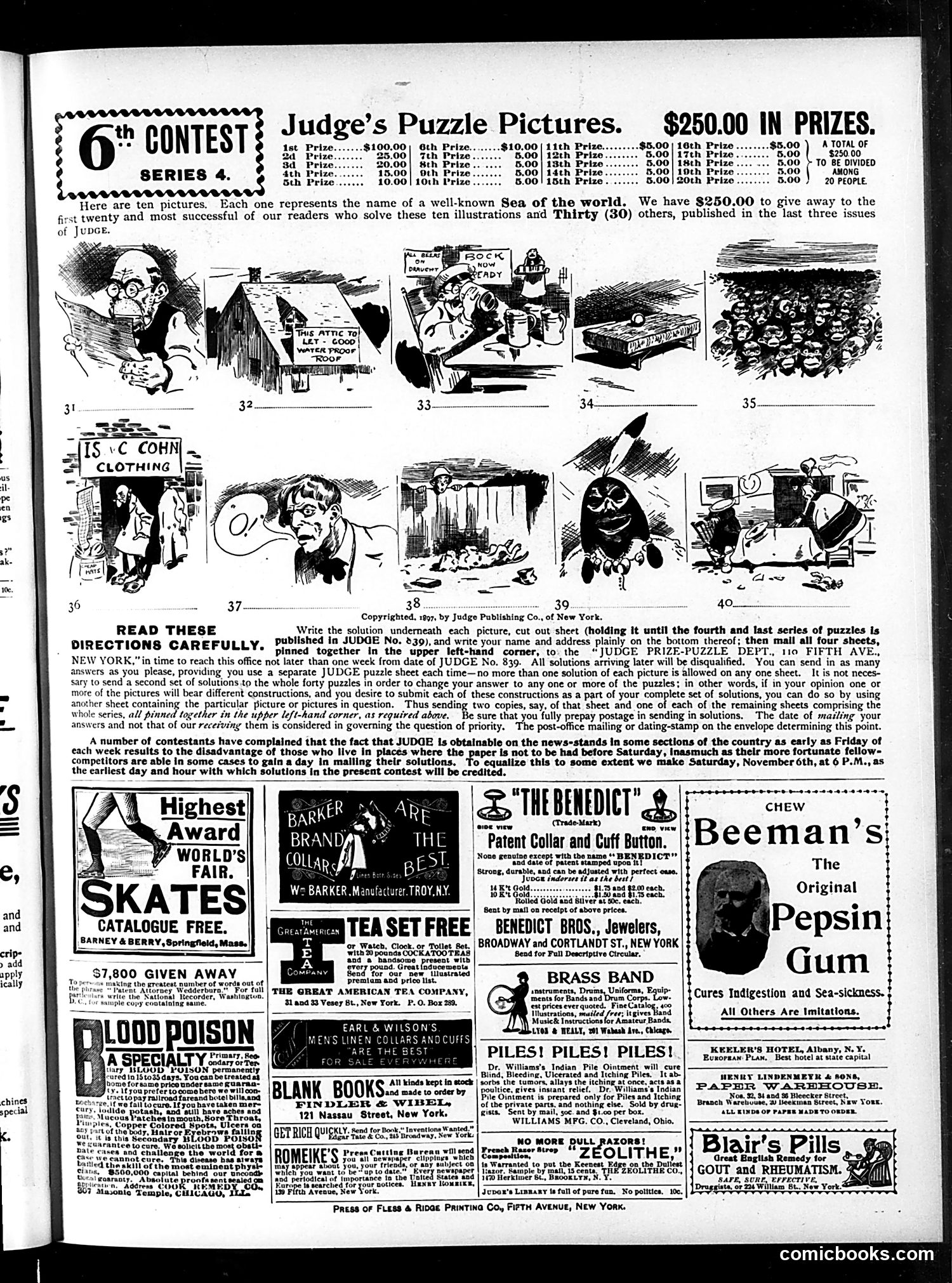
This page primarily showcases **Judge's Puzzle Contest Series 4**, offering $250 in prizes (1897). The contest challenges readers to identify ten "well-known Seas of the world" from cartoon illustrations. The ten sketches depict various seafaring or nautical scenes through visual puns—for instance, cartoon figures in comedic situations that suggest names like "Dead Sea," "Black Sea," or "Red Sea." The cartoon style is typical of 1890s satirical illustration: caricatured faces and exaggerated situations designed for quick visual recognition of geographical references. The puzzle format was standard entertainment in Judge magazine, appealing to readers seeking intellectual engagement and prize money. The remainder of the page contains **period advertisements** for products like blood tonics, tea sets, collar buttons, and patent medicines—reflecting the commercial culture of the era. These ads provide context about goods marketed to Judge's readership.
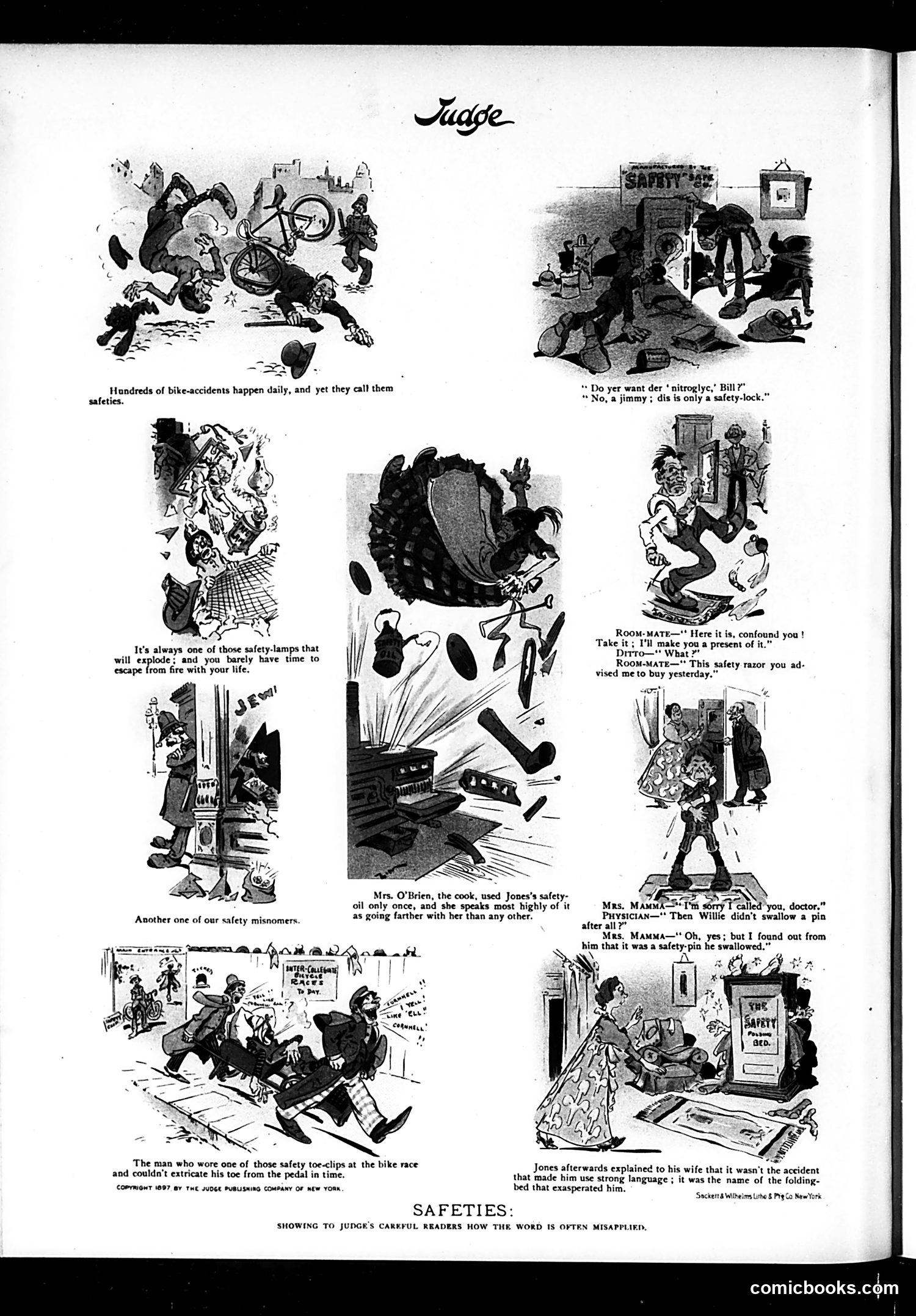
This page satirizes the ironic misuse of the word "safety" in late 19th/early 20th-century products and situations. Each cartoon illustrates something marketed or labeled as "safe" that actually causes harm or danger: - Bicycles called "safeties" despite causing daily accidents - A "safety-lock" that doesn't prevent theft - A "safety razor" that cuts the user - A child swallowing a "safety-pin" - "Safety toe-clips" that trap a cyclist's foot - A "safety lamp" that explosively fails - A "safety oil" that ignites dangerously The humor targets both manufacturers' deceptive marketing and consumers' gullibility in trusting products with reassuring names. The final caption explicitly states the magazine's intent: exposing how "the word is often misapplied." It's social commentary on consumer culture and false advertising through visual gags showing the gap between product names and actual outcomes.