
Judge, 1897-11-13 · page 5 of 16
Judge — November 13, 1897 — page 5: what you’re looking at
What you’re looking at
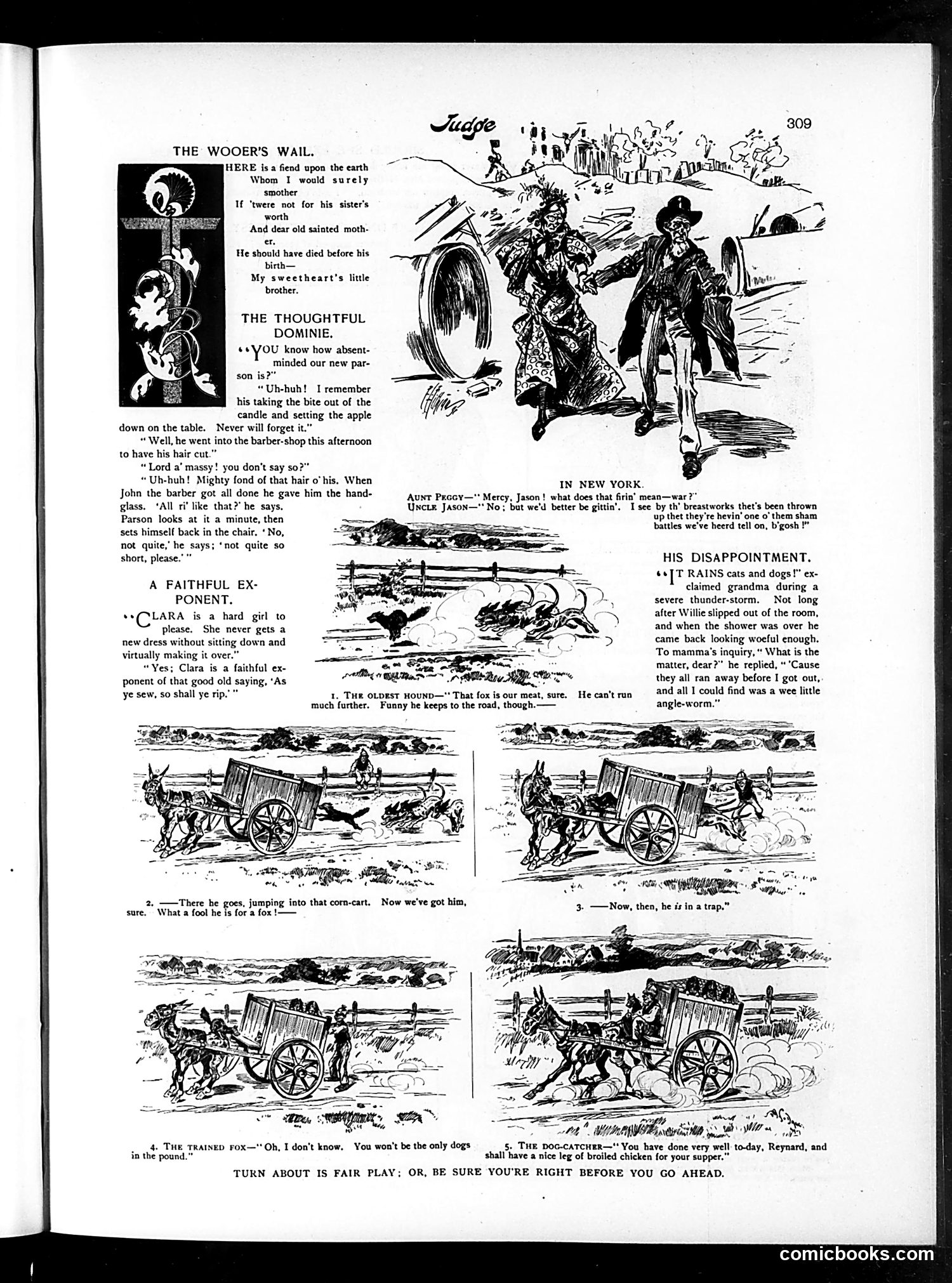
This page contains three distinct satirical pieces typical of Judge's humor: **"The Wooer's Wail"** mocks a suitor frustrated by his sweetheart's annoying younger brother—a relatable domestic complaint presented melodramatically. **"The Thoughtful Dominie"** ridicules an absent-minded clergyman (dominie = minister) who confuses objects, setting a candle instead of his head in the barber's chair—playing on the Victorian stereotype of scattered-brained clergy. **"His Disappointment"** features a child disappointed after a rainstorm, expecting to find animals but discovering only an earthworm—gentle humor about childhood expectations versus reality. **"Turn About is Fair Play"** is a four-panel fox-hunting narrative where the hunted fox outwits pursuing hounds and ends up in the dog-catcher's pound anyway, where he's fed better than the dogs—inverting expectations with dark irony about justice and comeuppance. The humor relies on domestic situations, character types, and ironic reversals typical of late-19th/early-20th-century American comic literature.
📄 Transcribed text from this page (OCR, searchable)
Machine-transcribed from the original scan — historical spelling and the odd misread are preserved.
THE WOOER'S WAIL. HERE isa fiend upon the earth Whom I would surely smother If ‘twere not for his sister's worth ‘And dear old sainted moth- er. He should have died before his birth— My sweethearts little brother. THE THOUGHTFUL DOMINIE, . syou know how absent- minded our new par- son is?” “Uh-huh! I remember his taking the bite out of the candle and setting the apple down on the table. Never will forget it.” “ Well, he went into the barber-shop this afternoon to have his hair cut.” "Lord a’ massy! you don’t say so?” “Uh-huh! Mighty fond of that hair o’ his. When IN NEW YORK John the barber got all done he gave him the hand- Aunt Pxccy—" Mercy, Jason! what does that firin’ mean—war?” glass. ‘All ri’ like that?" he says. Uncte Jason—‘* No; but we'd better be gittin’. Parson looks at it a minute, then sets himself back in the chair. ‘No, not quite,’ he says; ‘not quite so short, please.’ ” A FAITHFUL EX- PONENT. ssCLARA is a hard girl to please. She never gets a new dress without sitting down and virtually making it over.” “Yes; Clara is a faithful ex- T see by th’ breastworks thet's been thrown up thet they're hevin’ one o' them sham battles we've heerd tell on, b’gosh !” HIS DISAPPOINTMENT, se] T RAINS cats and dogs!” ex- claimed grandma during a severe thunder-storm. Not long after Willie slipped out of the room, and when the shower was over he came back looking woeful enough. To mamma's inquiry, " What is the matter, dear?” he replied, “Cause they all ran away before I got out, and all I could find was a wee little angle-worm.” Ee aoe A ACERS ADD SP OO 1, THR OLDEST HouND—"* That fox is our meat, sure, He can’t run much further. Funny he keeps to the road, though.— ponent of that good old saying, ‘As ye sew, so shall ye rip.’ " Zoo 2, ——There he goes, jumping into that corn-cart. Now we've got him, 3. —Now, then, he is fa a trap.” sure. What a fool he is for a fox !—— ee TT C9, ftp \ tn" wynetbresstn Sh lr OS 5. THE DOG-CATCHER—"* You have done very well to-day, Reynard, and shall have a nice leg of broiled chicken for your supper.” TURN ABOUT IS FAIR PLAY; OR, BE SURE YOU'RE RIGHT BEFORE YOU GO AHEAD. __ 4: THE TRAINED FOX—"*Oh, I don’t know. You won't be the only dogs in the pound.” comicbooks.com