
A complete issue · 16 pages · 1897
Judge — July 31, 1897
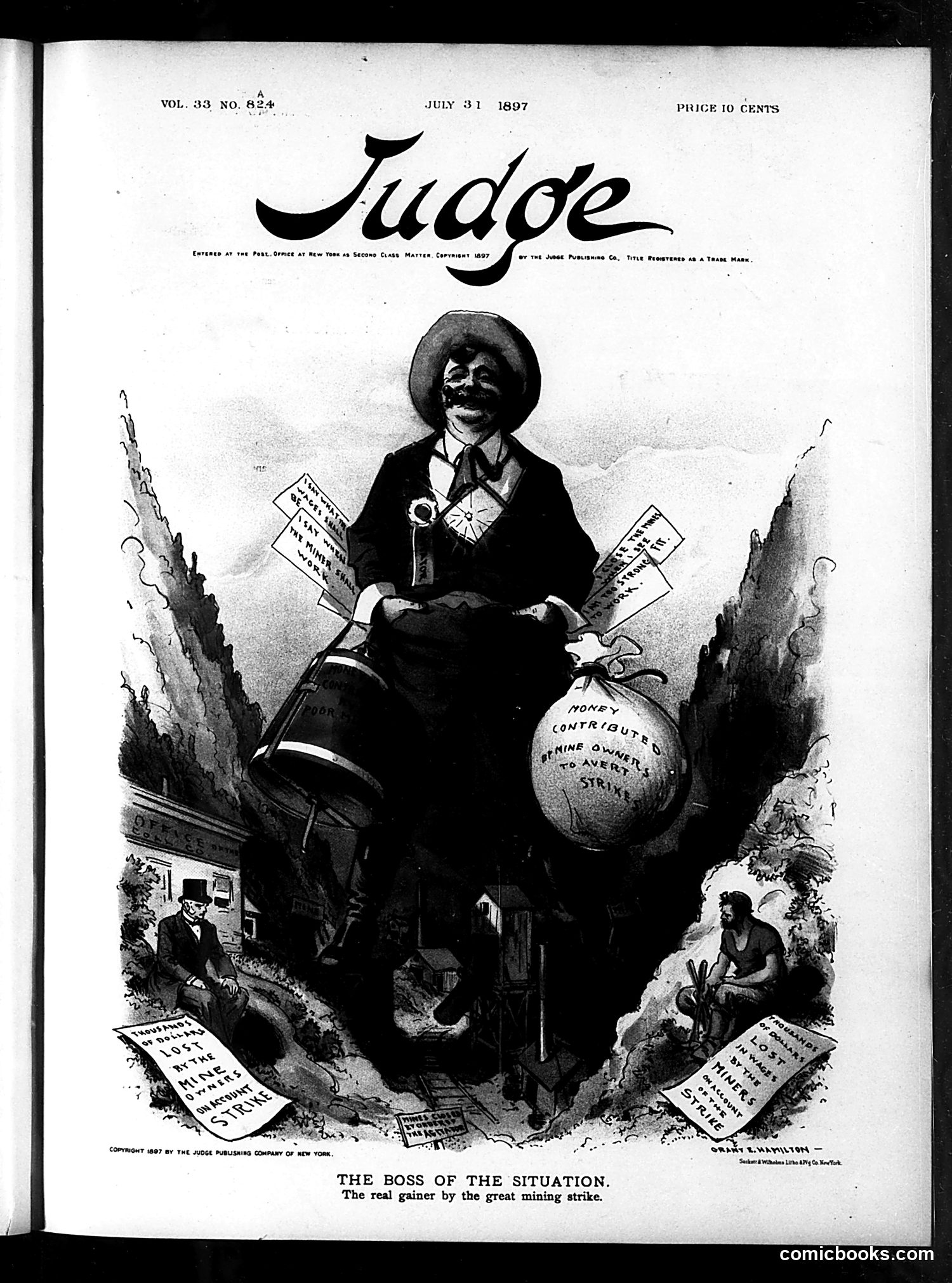
This July 31, 1897 *Judge* cartoon satirizes the impact of a major mining strike. A caricatured figure (likely representing labor agitators or strike leadership) sits astride two large barrels labeled "Money Contributed by Mine Owners" and "To Avert the Strike." The figure holds signs reading "Great Strike" while two smaller men—possibly representing mine owners and workers—sit dejectedly on opposite sides below. The satire suggests that strike organizers have become the real "boss," extracting money from mine owners under threat. The cartoon critiques how labor disputes enriched intermediaries rather than genuinely resolving worker grievances. The exaggerated caricature and smug expression emphasize the cartoonist's view that strike leadership exploited the situation for personal gain.
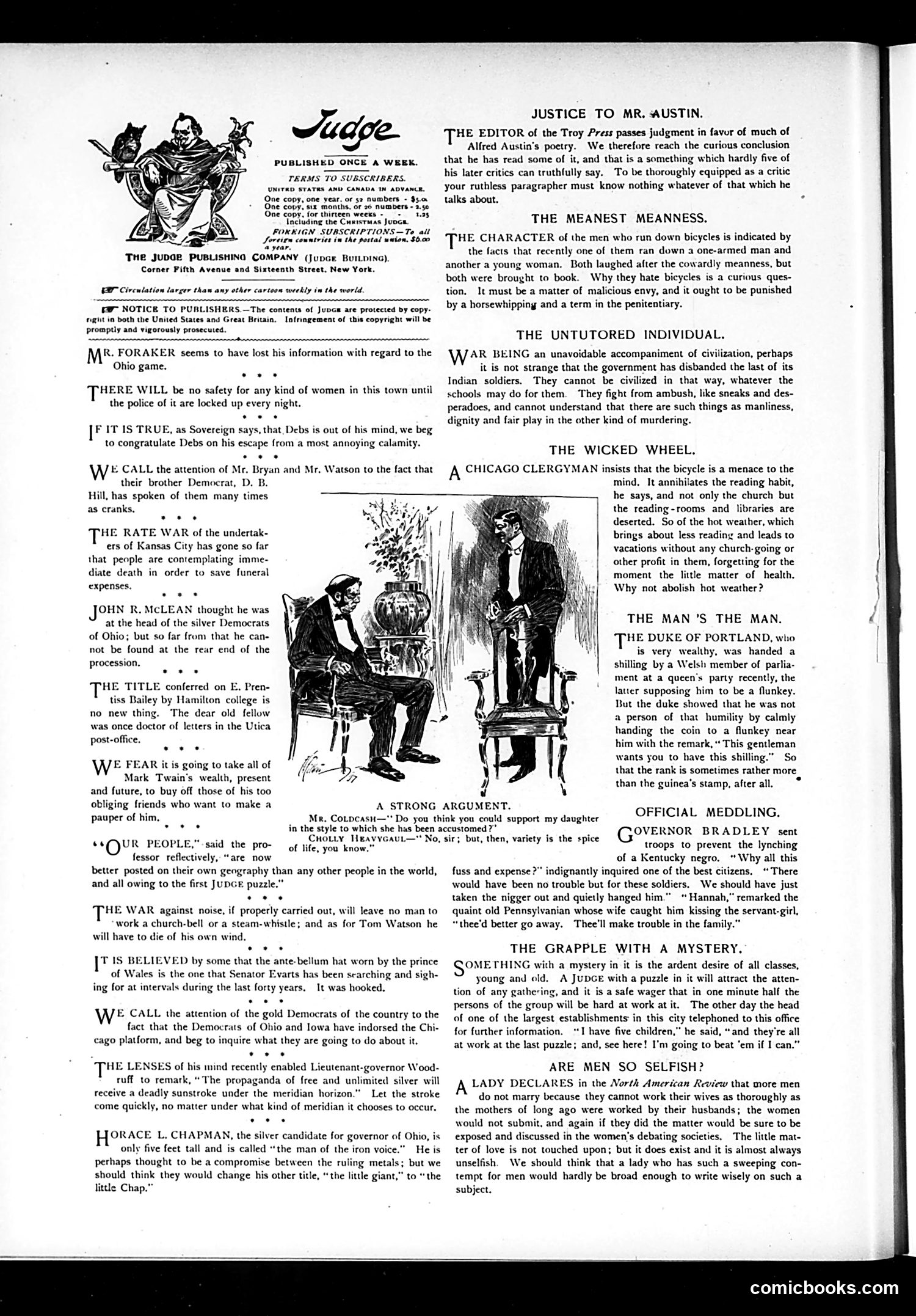
The page contains multiple short editorial commentaries typical of Judge's satirical format. The main cartoon, "A Strong Argument," depicts two figures in conversation—likely depicting a social debate about class distinctions or courtship. Other sections mock contemporary issues: bicycles as social menaces ("The Wicked Wheel"), concerns about women's safety in towns, labor disputes, and political figures like Mark Twain and various Ohio Democrats. The text criticizes bicycles for reducing reading habits, defends Indian soldiers against civilization rhetoric, and debates women's marital agency. Several items reference Democratic politicians, though specific identities aren't clearly labeled. Without publication date visible, the bicycle-focused criticism and Democratic references suggest early-to-mid 1890s content, when bicycles were newly controversial and debates about women's independence were culturally prominent.
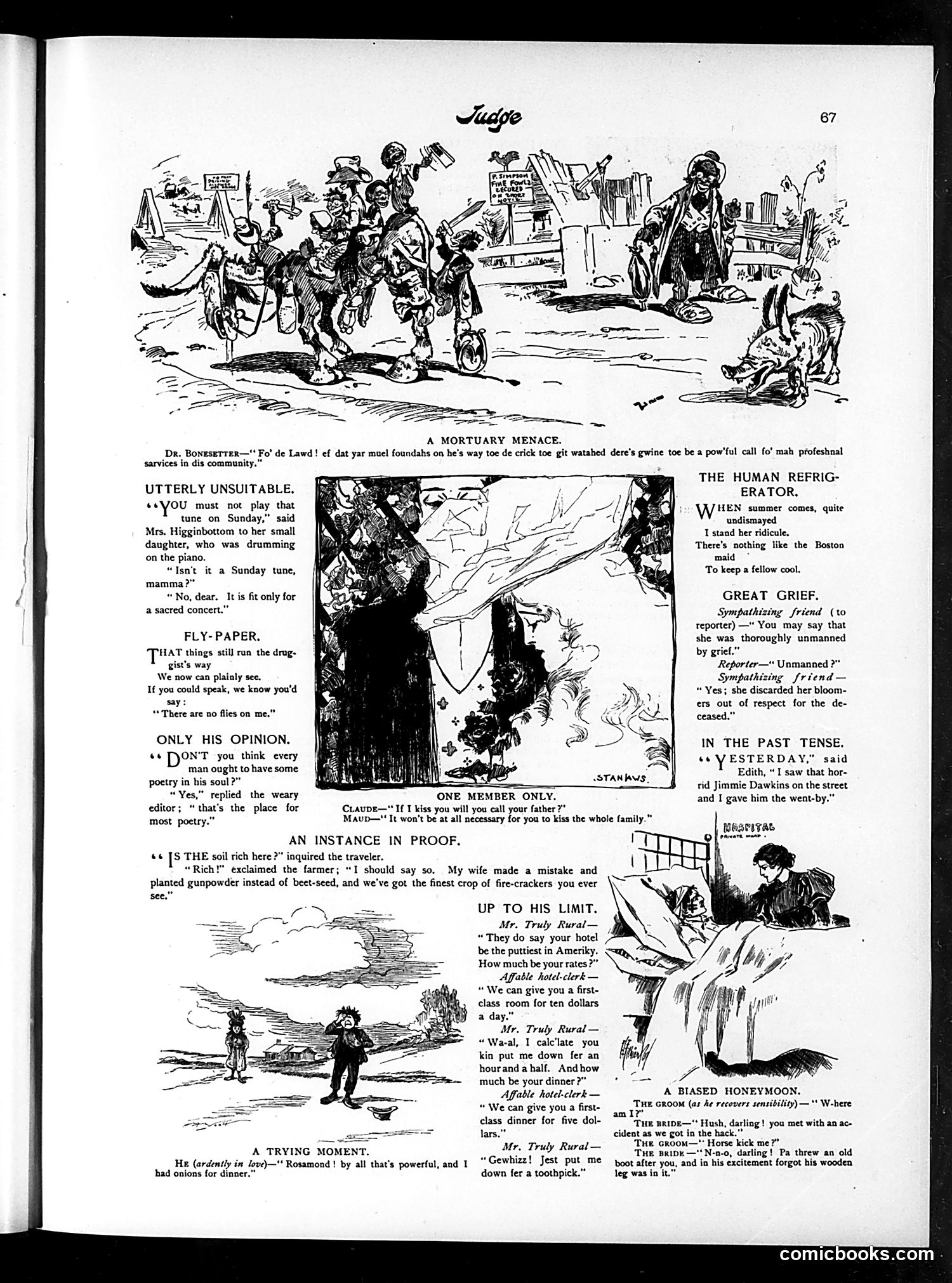
This page contains several unrelated short satirical pieces and jokes typical of Judge's format: **"A Mortuary Menace"** (top): A sketch mocking Dr. Bonesetter's Irish dialect and dubious medical practices—likely targeting quack doctors or specific medical charlatans of the era. **The remaining sections** ("Utterly Unsuitable," "Fly-Paper," "Only His Opinion," etc.) are brief humorous anecdotes about everyday social situations: inappropriate Sunday piano music, flies, poetry, soil fertility, hotel rates, and honeymoon mishaps. **"One Member Only"** features a domestic joke about kissing the family. These are general-audience humor pieces rather than political satire—they mock common social pretensions, bad manners, and marital/domestic awkwardness typical of Judge's satirical approach to middle-class American life.
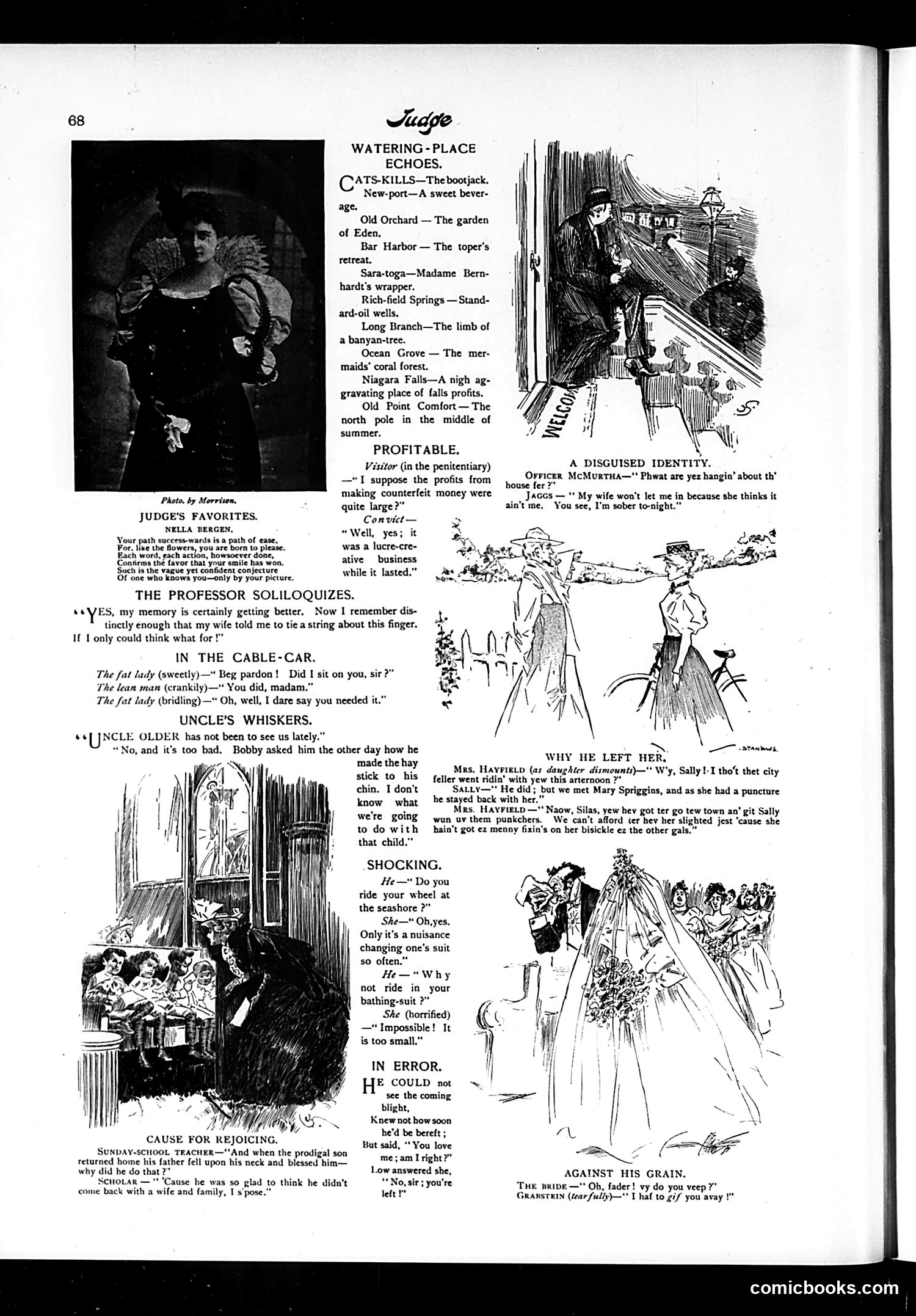
This page contains multiple satirical sketches and jokes typical of late-19th-century American humor. The main content includes: **"Watering-Place Echoes"**: Witty descriptions of famous vacation resorts with pointed social commentary—Saratoga references actress Sarah Bernhardt's elaborate wardrobe; Richfield Springs mocks Standard Oil's dominance; Niagara Falls jokes about profit-taking. **Various short comedic dialogues** satirizing domestic life, class pretension, and gender relations: a convict's profitable counterfeiting business, a wife preventing her sober husband from entering their home (implying he's usually drunk), and a professor unable to remember why his wife told him to tie a string around his finger. **"Why He Left Her"**: A scene depicting a young woman's bicycle ride creating social scandal—her friend Mary Spriggins had a puncture and the girl's family cannot afford equivalent bicycle accessories, causing embarrassment. The humor relies on period-specific social anxieties about propriety, class status, and emerging technologies like bicycles. The content reflects Victorian-era concerns about female independence and conspicuous consumption.
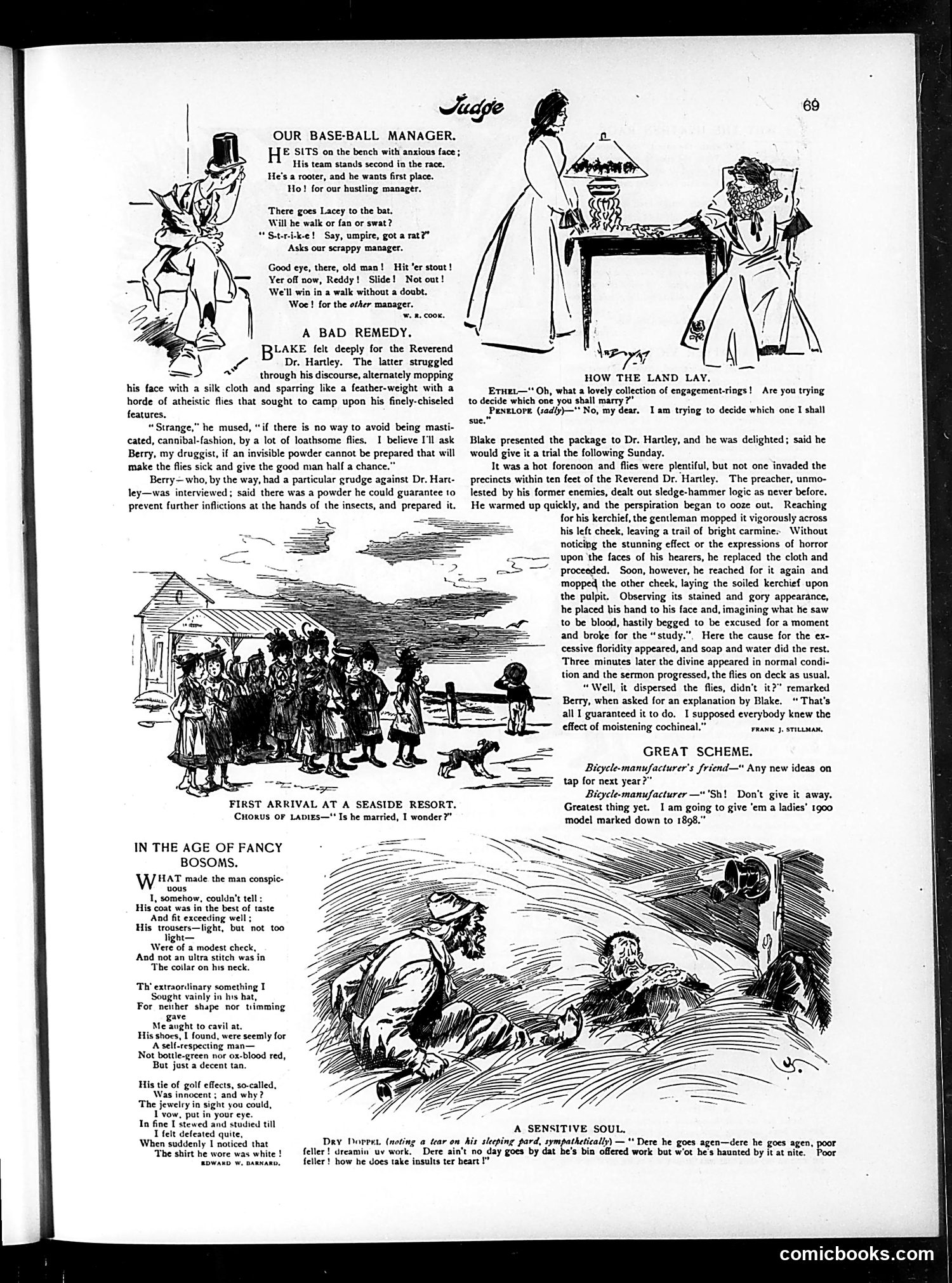
This page from *Judge* (a late-19th/early-20th-century American satirical magazine) contains several independent humorous pieces: **"Our Base-Ball Manager"** mocks an anxious team manager obsessing over winning, capturing the intense competitiveness of baseball culture. **"A Bad Remedy"** satirizes a druggist's revenge scheme: asked to create powder to repel flies from a preacher's pulpit, he instead provides cochineal (red dye), making the reverend appear bloodied when he perspires, horrifying his congregation—a practical joke exploiting professional malice. **"How the Land Lay"** jokes about a woman choosing among suitors by their engagement rings, highlighting matrimonial anxieties. **"Great Scheme"** mocks bicycle manufacturers' misleading marketing—selling old 1898 models rebranded as new "1900 models" to consumers. **"In the Age of Fancy Bosoms"** (incomplete on page) appears to satirize exaggerated Victorian fashion, specifically women's dress silhouettes. The cartoons target contemporary concerns: sports enthusiasm, commercial dishonesty, romantic complications, and fashion absurdities.
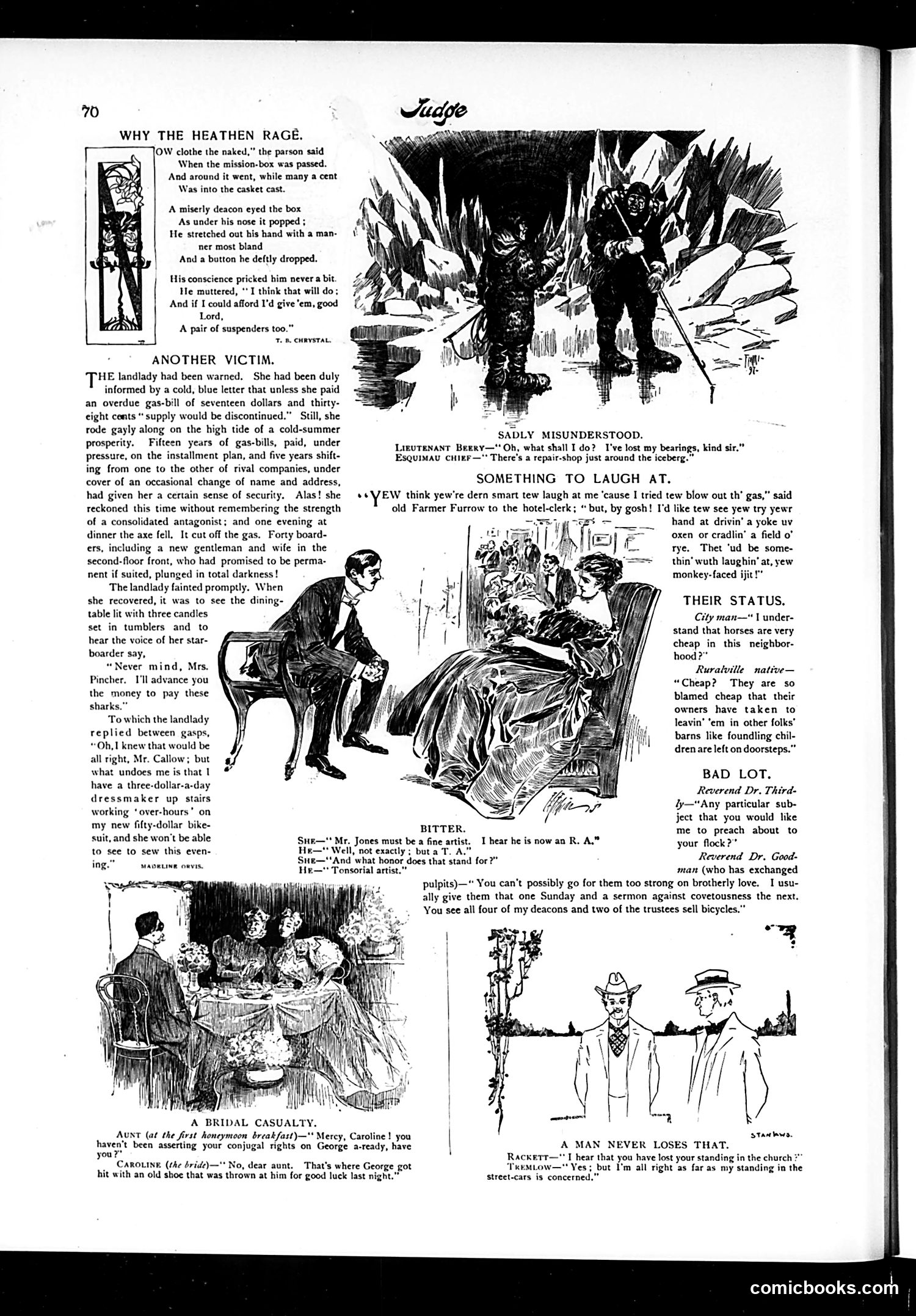
This page contains several satirical cartoons mocking hypocrisy and social pretense in late 19th/early 20th-century America. **"Why the Heathen Rage"** ridicules stingy donors: a deacon donates a button instead of money to a mission box, yet claims he'd give more if he could afford it—satirizing false piety among the wealthy. **"Another Victim"** shows a landlady whose gas is shut off for unpaid bills. Despite facing darkness, she laments that her dressmaker can't work on her expensive "fifty-dollar bike-suit"—mocking those living beyond their means. **"Bridal Casualty"** jokes about a new bride's black eye from a wedding shoe-throwing tradition. **"Something to Laugh At"** depicts a farmer defending his failed attempt to blow out gas (not understanding the technology), attacking urban sophistication. The remaining vignettes satirize rural versus urban attitudes, deacon hypocrisy about selling bicycles while preaching against covetousness, and human nature's inconsistencies. The humor targets moral pretense across social classes.
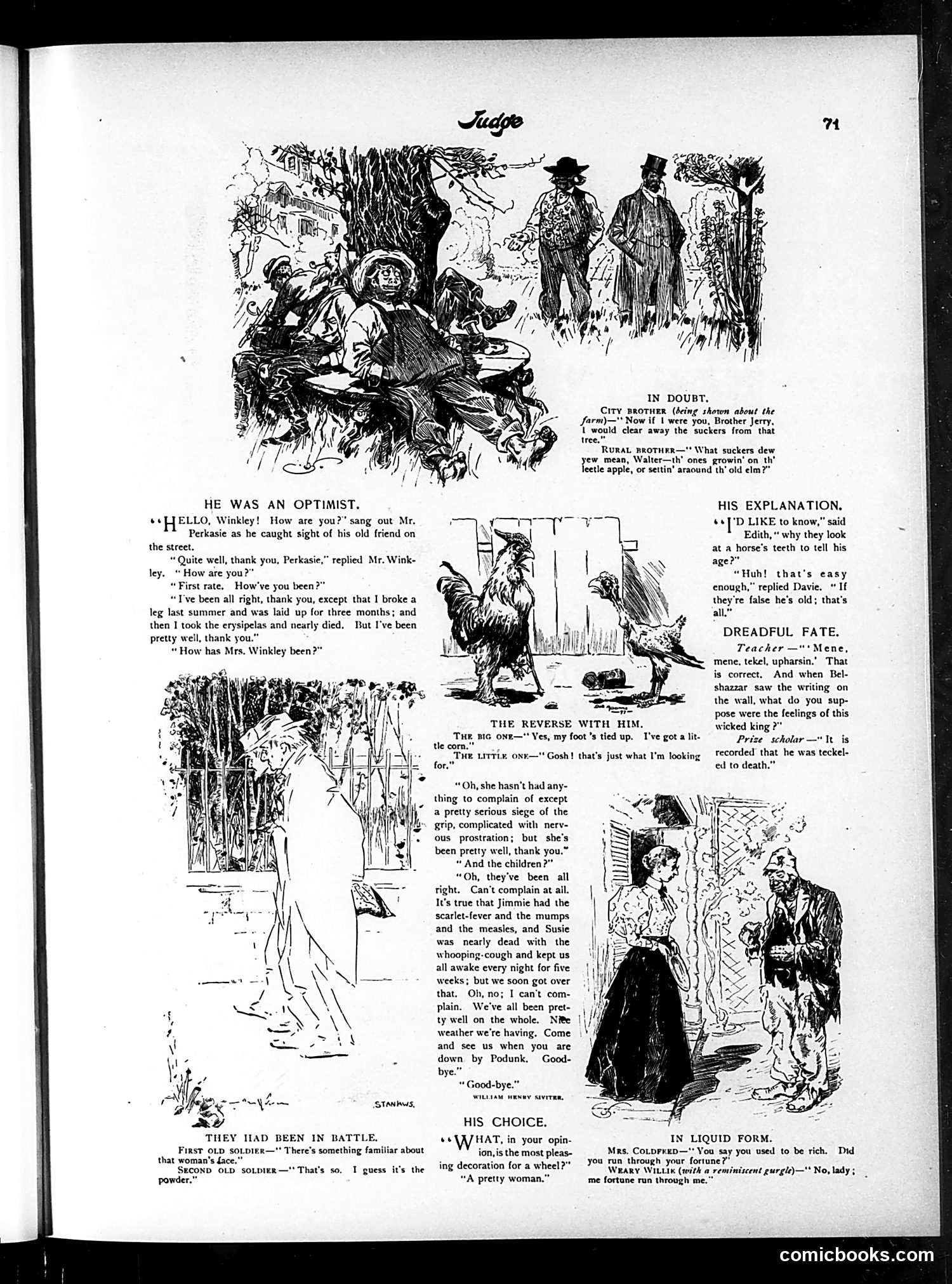
This page contains multiple brief satirical vignettes typical of Judge's humor: **"He Was an Optimist"** mocks a man whose recitation of disasters (broken leg, erysipelas, family illnesses) contradicts his claim of being "pretty well." The joke plays on oblivious optimism masking genuine hardship. **"They Had Been in Battle"** appears to reference Civil War veterans recognizing a woman by her face, with a joke about "powder"—likely cosmetic rather than gunpowder. **"The Reverse with Him"** shows a dialogue between roosters about a tied foot and corn—simple barnyard humor. **"In Doubt"** depicts rural/urban miscommunication about "suckers" (tree growth versus lollipops). **"His Choice"** is a flirtation gag about decorating bicycle wheels with "a pretty woman." **"His Explanation"** uses a pun on "teckel" (from the Biblical "mene mene tekel upharsin") for dark humor about execution. **"In Liquid Form"** jokes about a poor man who drank away his fortune. The page demonstrates Judge's signature style: brief, punchy jokes exploiting wordplay, rural-urban contrasts, and social observation rather than focused political satire.
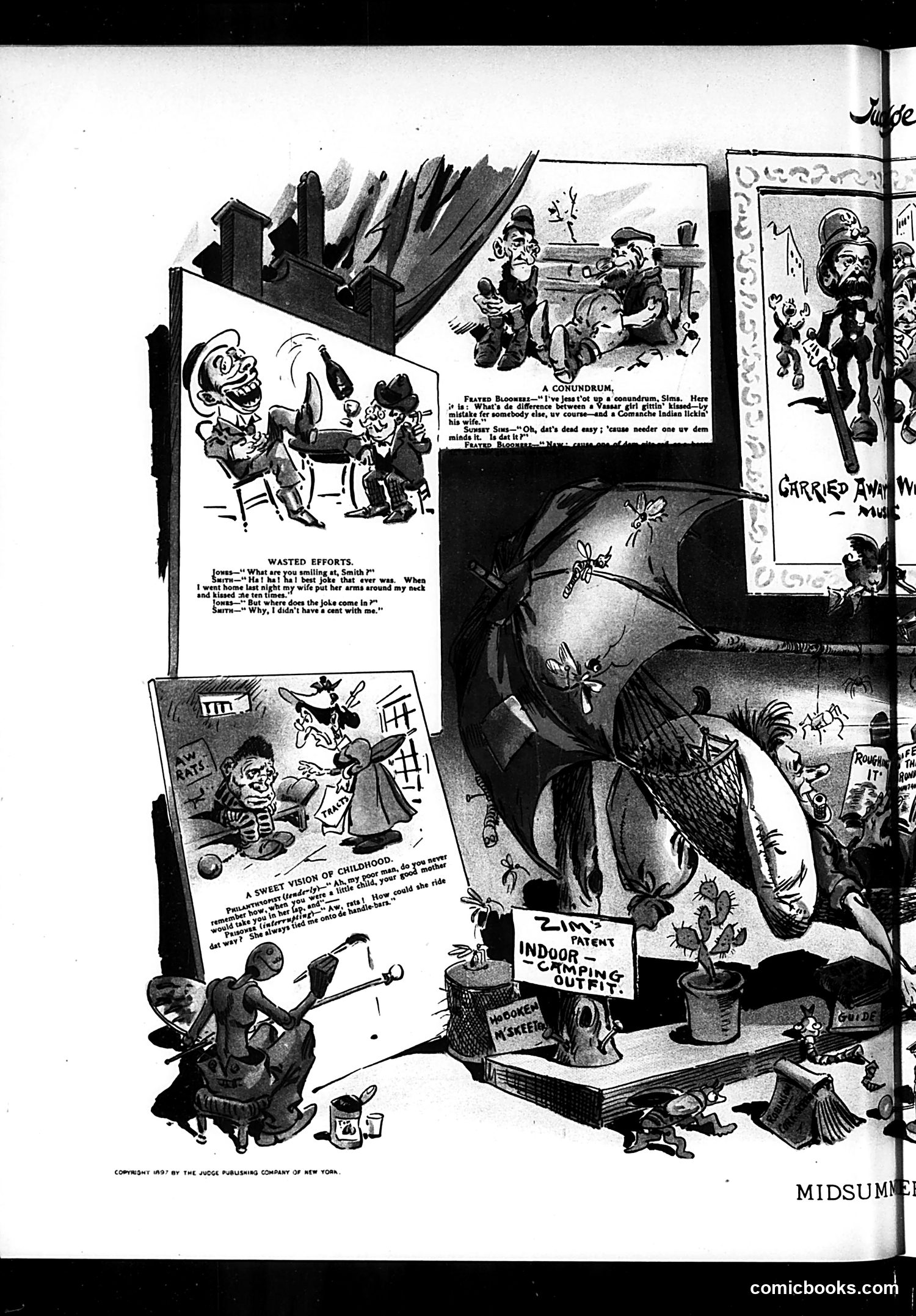
This page contains three separate humorous vignettes satirizing early 20th-century American social attitudes: **"Wasted Efforts"**: A joke about a working-class man (Smith) whose wife showed affection despite his being broke—the humor relies on the era's assumption that a man's worth was tied to his financial status. **"A Conundrum"**: Features caricatured African American and Native American figures (using period racist dialect spellings). The "joke" involves conflating a Vassar college girl being kissed with a Comanche Indian and a Black man, with the punchline that "neither one" minds—this represents the offensive racial humor common to early 20th-century satire magazines. **"A Sweet Vision of Childhood"** (partially visible): Appears to mock parenting or childhood behavior. These cartoons reflect Judge's satirical approach to class, race, and gender dynamics of the era, though the racial caricatures are deeply offensive by modern standards.
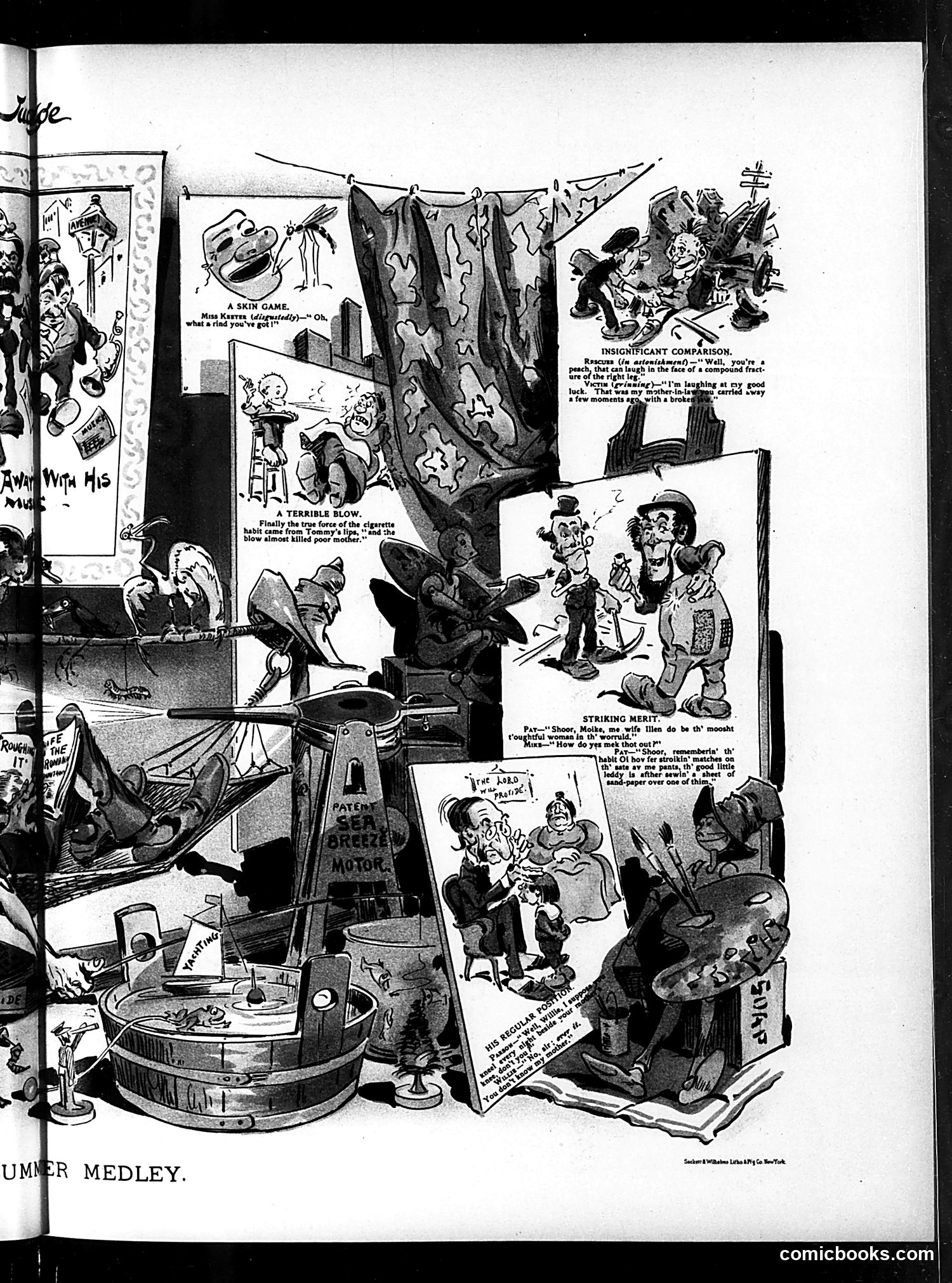
This page presents three separate satirical sketches, typical of Judge's "medley" format mixing social commentary with humor. **"A Skin Game"** appears to mock theatrical or performance deception—likely referencing actresses or performers misrepresenting themselves (the OCR suggests "Miss Kenree" or similar). **"A Terrible Blow"** depicts domestic violence played for laughs, with a character named Tommy striking someone, reflecting the era's troubling casual treatment of such subjects in humor. **"Striking Merit"** features Irish immigrant dialect humor (characteristic of early 1900s American satire), with a character praising his wife's fighting ability—again using violence as comedic material. The page collectively satirizes theatrical fraud, domestic brutality, and ethnic stereotypes common to Judge's sensibility. These sketches would be considered offensive today for trivializing violence and relying on demeaning dialect humor targeting Irish immigrants.
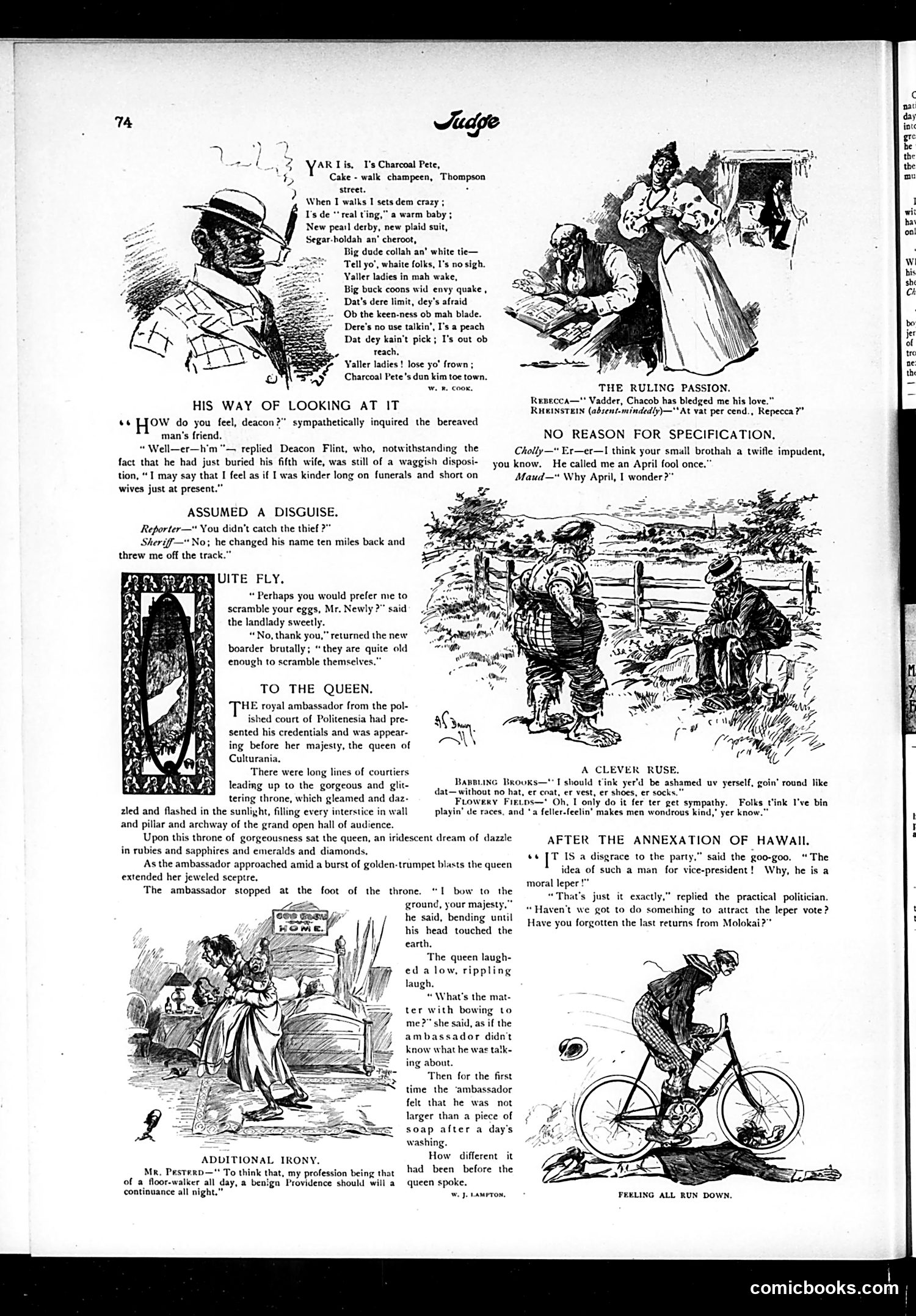
This page contains multiple satirical vignettes typical of Judge's humor circa early 1900s: **"Charcoal Pete"** presents a racist caricature of a Black man boasting about his flashy appearance and appeal to women. The dialect and stereotyping reflect the magazine's reliance on crude racial humor common to the era. **"His Way of Looking at It"** is a dark joke about a deacon repeatedly burying wives, suggesting serial loss or dark humor about mortality. **"To the Queen"** satirizes diplomatic protocol—an ambassador's elaborate bow is undercut when the queen's casual comment makes him feel insignificant, mocking both courtly etiquette and the ambassador's pretension. **"The Ruling Passion"** mocks Jewish stereotypes regarding money, with a father responding to his daughter's declaration of love by asking the interest rate. **"After the Annexation of Hawaii"** references the 1898 U.S. annexation, satirizing politicians who cynically seek the "leper vote" from Molokai (known for its leper colony) to win elections—mocking both political opportunism and disability. The humor relies heavily on ethnic and racial caricature typical of Judge's satirical approach.
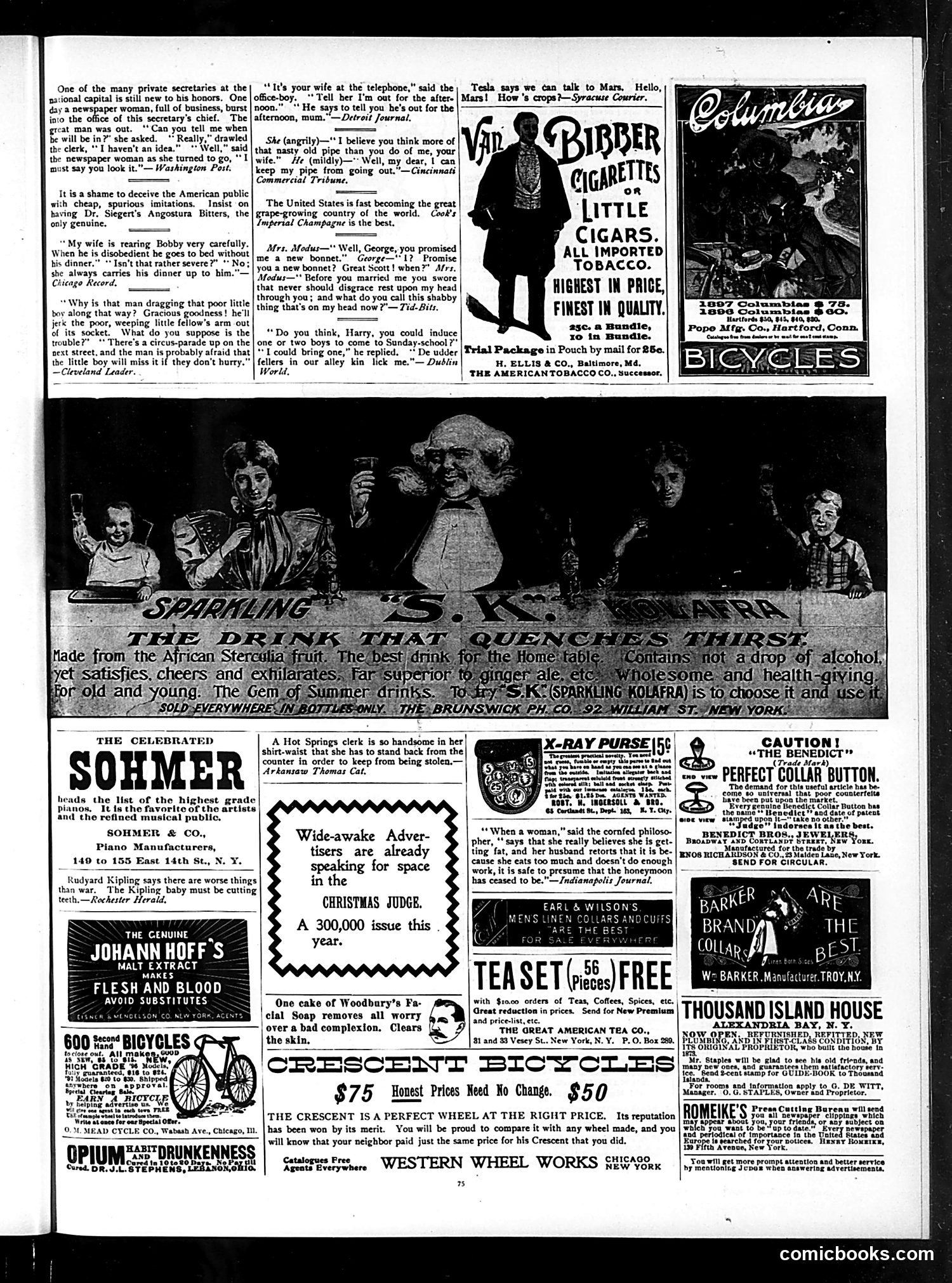
This page is primarily **advertising**, with small joke snippets interspersed. The main cartoon appears to be a large illustrated advertisement for "Sparkling S.K. Kola" (a soft drink), showing exaggerated caricatured figures drinking the beverage. The scattered jokes reflect turn-of-the-century office and domestic humor: - A secretary's incompetence - A wife complaining her shabby hat disgraces her (marital disappointment joke) - A husband valuing his pipe over his wife - A boy avoiding Sunday school because local boys will "lick" him These jokes satirize **modern inconveniences of urban life** (telephone miscommunication), **marital discord** (husbands' indifference, broken promises), and **childhood mischief**. The advertisements promote patent medicines, bicycles, pianos, and cosmetics—typical period products. One ad humorously notes a Hot Springs clerk's shirt-waist is so attractive people might steal it. The page captures **Edwardian-era anxieties**: changing gender roles, advertising's rise, and urbanization's social friction.
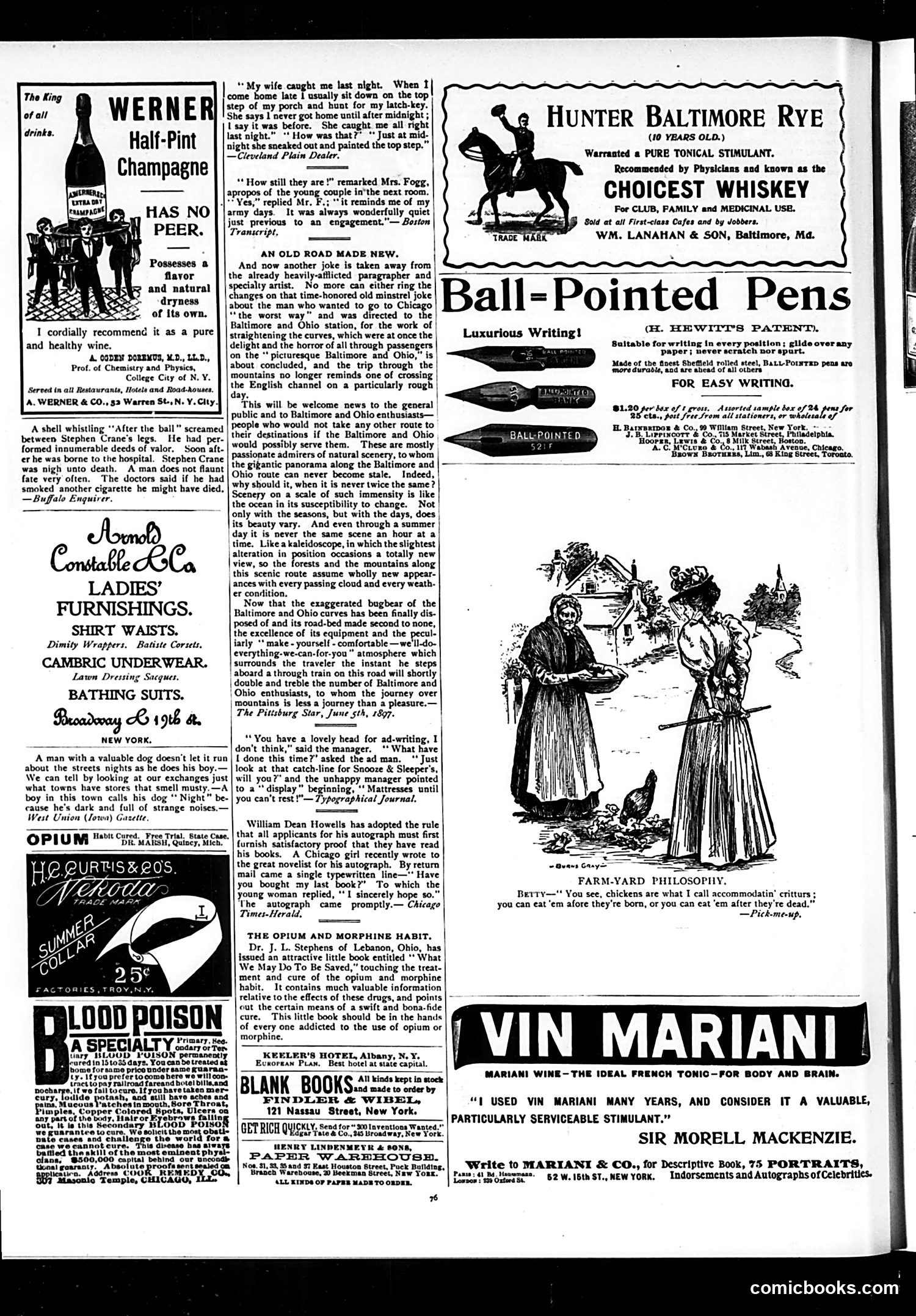
This page is **primarily advertising**, not political satire. It contains multiple product advertisements interspersed with brief humor columns typical of Judge magazine's format. The advertisements promote various products: Werner's champagne (endorsed by a professor), Hunter Baltimore Rye whiskey, Ball-Pointed Pens, Arnold Constable ladies' furnishings, Hepburn's Cocoa, and Vin Mariani wine (endorsed by "Sir Morell Mackenzie"). The brief humorous items are **social jokes** rather than political cartoons—anecdotes about domestic life, courtship, and small-town observations. For example, one jokes about a wife painting porch steps to catch her husband coming home late; another plays on the Baltimore and Ohio railroad's famously curved route. The page includes a longer article praising improvements to the B&O railroad's curves, making travel more comfortable. **No political figures or satire are present.** This appears to be a typical late-19th/early-20th-century magazine page mixing advertising with light humor columns.
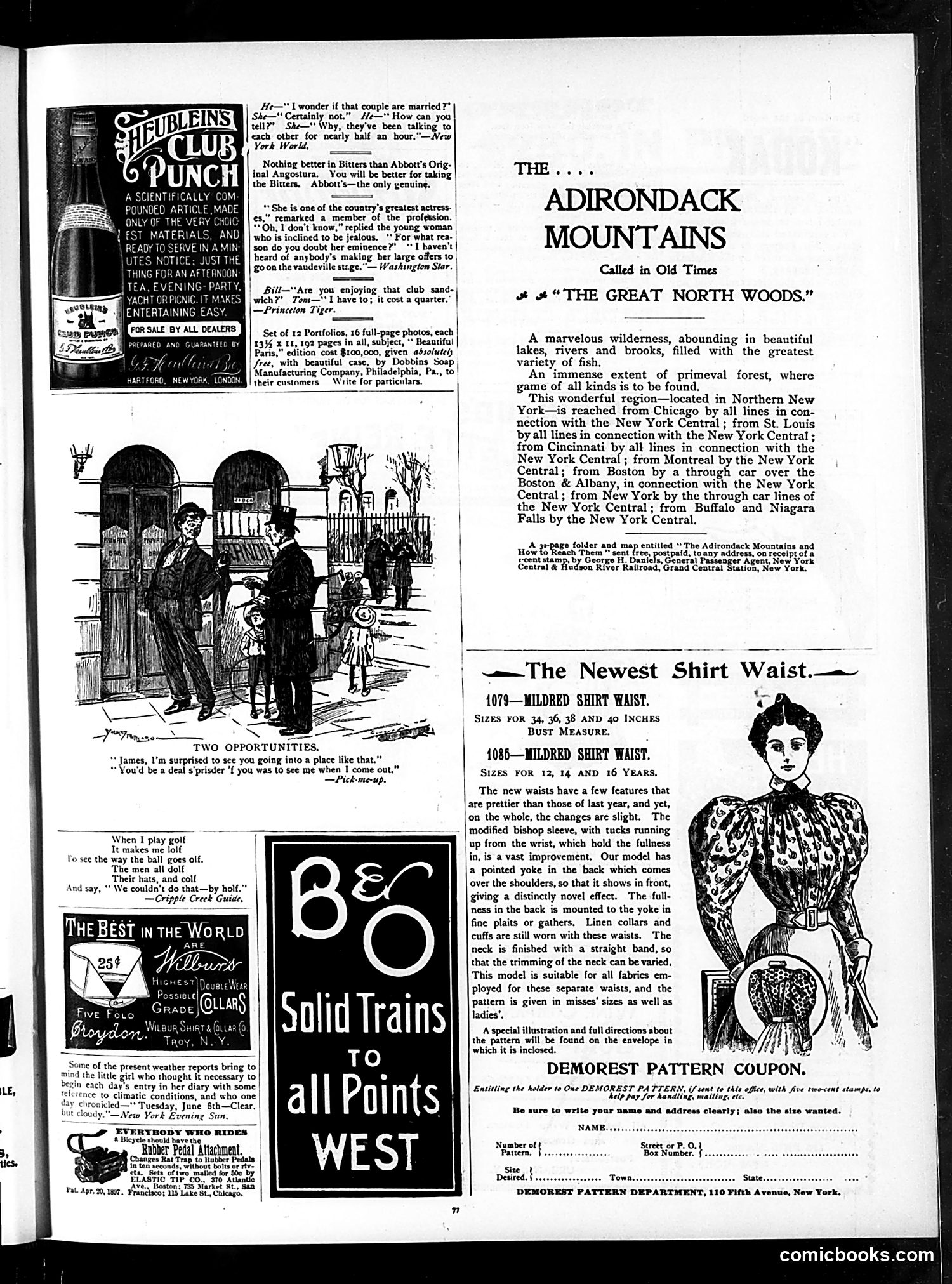
This page is primarily **advertising and travel promotion** rather than political satire. The main cartoon, titled "Two Opportunities," shows a man speaking to a woman and child outside what appears to be a tavern or club. The dialogue satirizes social class: the man suggests the woman enter such an establishment, implying impropriety—"You'd be a deal a finer [woman] if you was to see me when I come out." The page otherwise features ads for **Higgbleins Club Punch** (an alcoholic beverage), **Williams' Best in the World** whiskey, **B&O Solid Trains to all Points West**, and **Demorest Pattern Coupon** for shirt waists. The satire here mocks working-class aspirations and gender propriety of the era, but the page functions primarily as a commercial vehicle rather than editorial commentary.
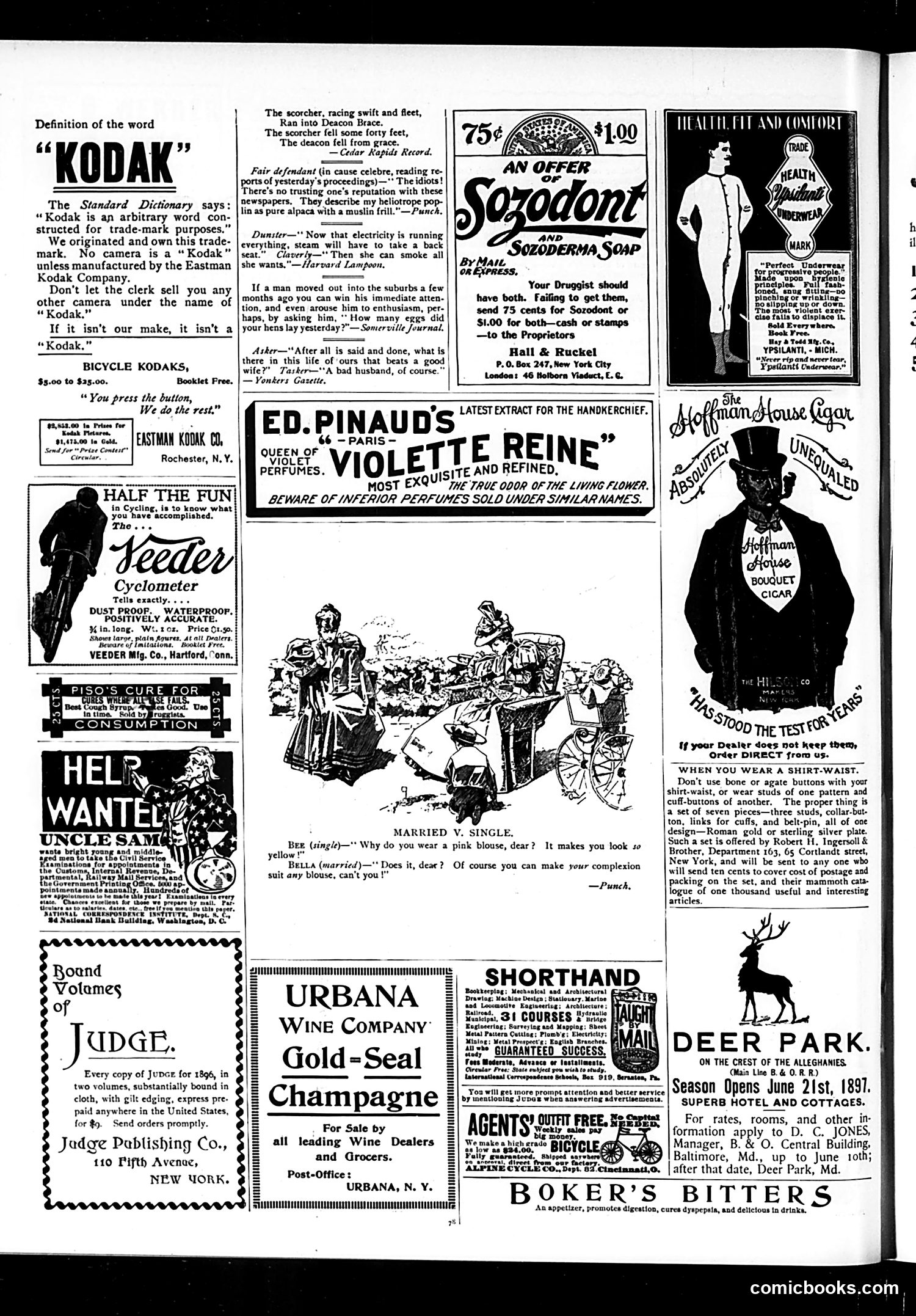
This page from Judge magazine is primarily advertising, with one notable satirical cartoon. The main cartoon is titled "MARRIED V. SINGLE," depicting a dialogue between two women. A single woman (Bee) asks a married woman (Bella) why she wears a pink blouse, suggesting it makes her look younger. Bella responds that of course she can wear a pink blouse—implying that as a married woman, she no longer needs to maintain her appearance to attract a husband. The satire mocks the social expectation that unmarried women must prioritize physical appearance and youth to secure a husband, while married women are presumed to have "succeeded" and can therefore neglect their looks. It's a commentary on women's limited social value being tied to marital status and marriageability. The remainder of the page contains period product advertisements for items like Kodak cameras, bicycle cyclometers, perfume, wine, and shorthand courses—typical of late-1890s magazine advertising.
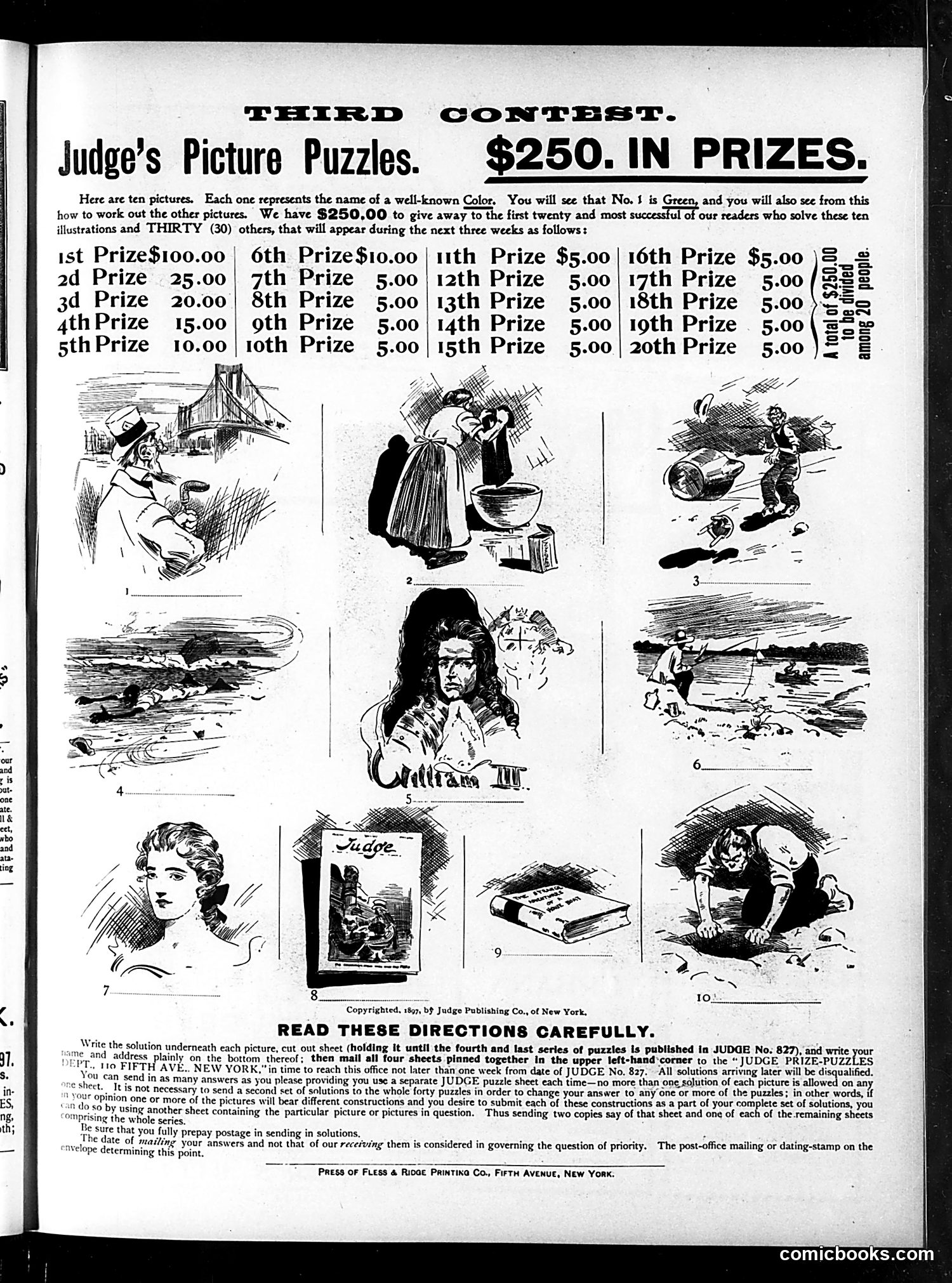
This page advertises a **rebus puzzle contest**—a popular form of word-picture game where illustrated images represent color names. Picture #1 shows a man in green clothing (representing "Green"). Readers must identify what colors pictures #2-10 represent through visual puns and clever illustrations. The contest offered $250 in prizes distributed among twenty winners, with the top prize worth $100. Judge would publish forty puzzles total over three weeks, with solutions due by mail one week after the final installment (Judge No. 827). **Context for modern readers:** This reflects late-19th-century American parlor entertainment—rebus puzzles were sophisticated amusements for literate audiences. The contest encouraged reader engagement and helped build magazine circulation, a common publishing strategy of the era.
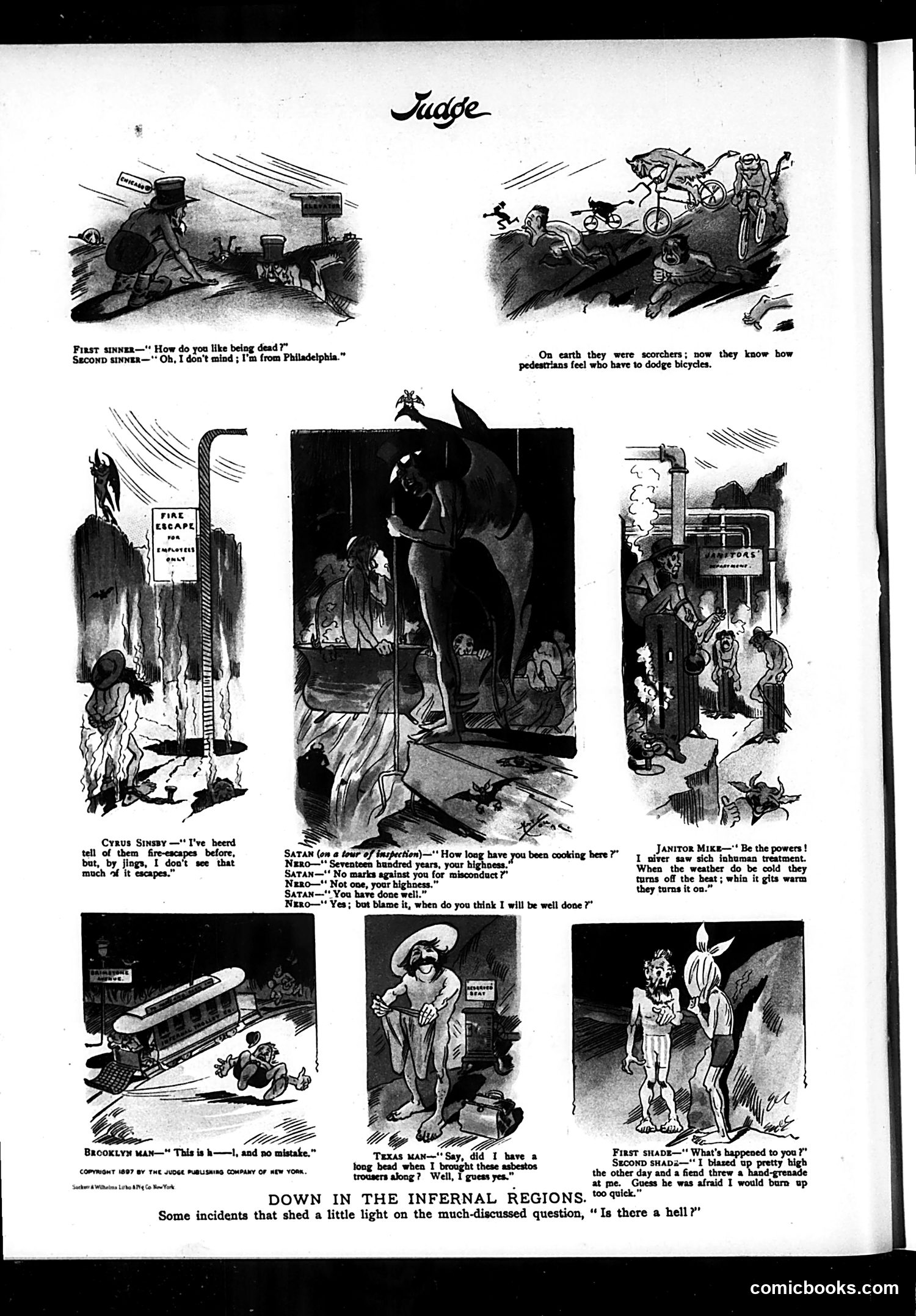
This 1897 *Judge* cartoon series titled "Down in the Infernal Regions" uses Hell as a satirical setting to mock various American regional stereotypes and contemporary social types. The humor revolves around the premise that different groups—Philadelphians, "scorchers" (reckless bicyclists), a Brooklyn man, a Texas man, and a janitor—experience Hell according to their earthly nature. A Philadelphian claims indifference to damnation; bicycle riders (who apparently caused pedestrian hazards) now dodge vehicles; regional types suffer punishments fitting their character flaws. The satire reflects 1890s anxieties about rapid urbanization, transportation dangers (bicycles were new and controversial), and regional American identity. The cartoon implicitly asks whether certain behaviors warrant damnation, using Hell as a comedic mirror to judge contemporary society's vices. The overall message: *Judge* magazine used infernal imagery to critique American social problems and regional stereotypes with darkly comic irony.