
A complete issue · 16 pages · 1897
Judge — January 9, 1897
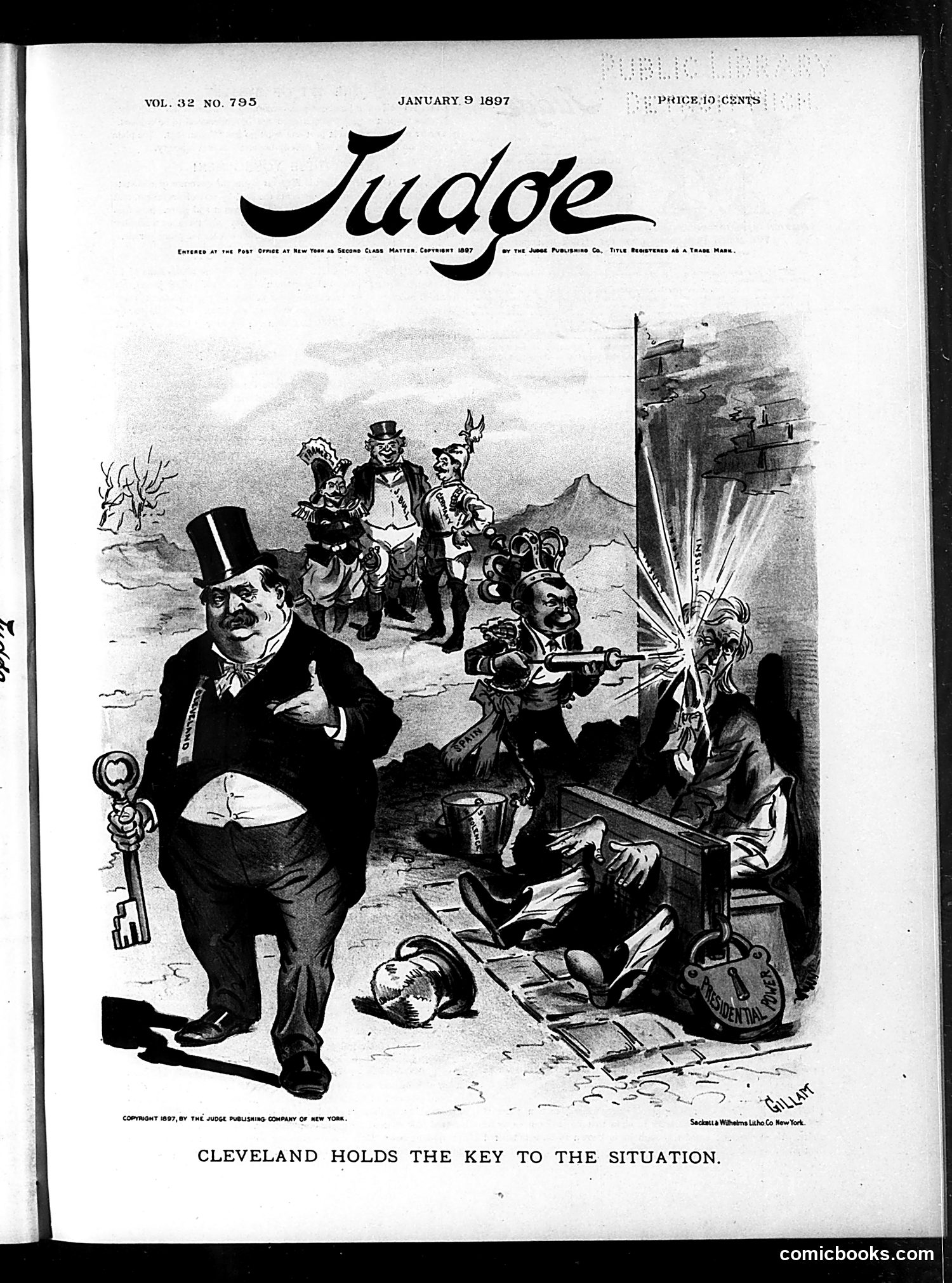
**Cartoon Title:** "Cleveland Holds the Key to the Situation" This political cartoon depicts President Grover Cleveland (the large figure in the foreground with the prominent mustache, holding a large key) as controlling a chaotic diplomatic situation. In the background, several caricatured figures appear to represent foreign powers or political factions engaged in conflict or dispute. The implication is that Cleveland possesses the authority to resolve an international crisis through his decisions. The "key" is a visual metaphor for presidential power and decision-making authority. The cartoon likely comments on Cleveland's second term (1893-1897) and suggests his administration held leverage over a contemporary foreign policy dispute, though the specific conflict is unclear without additional historical context about January 1897 events.
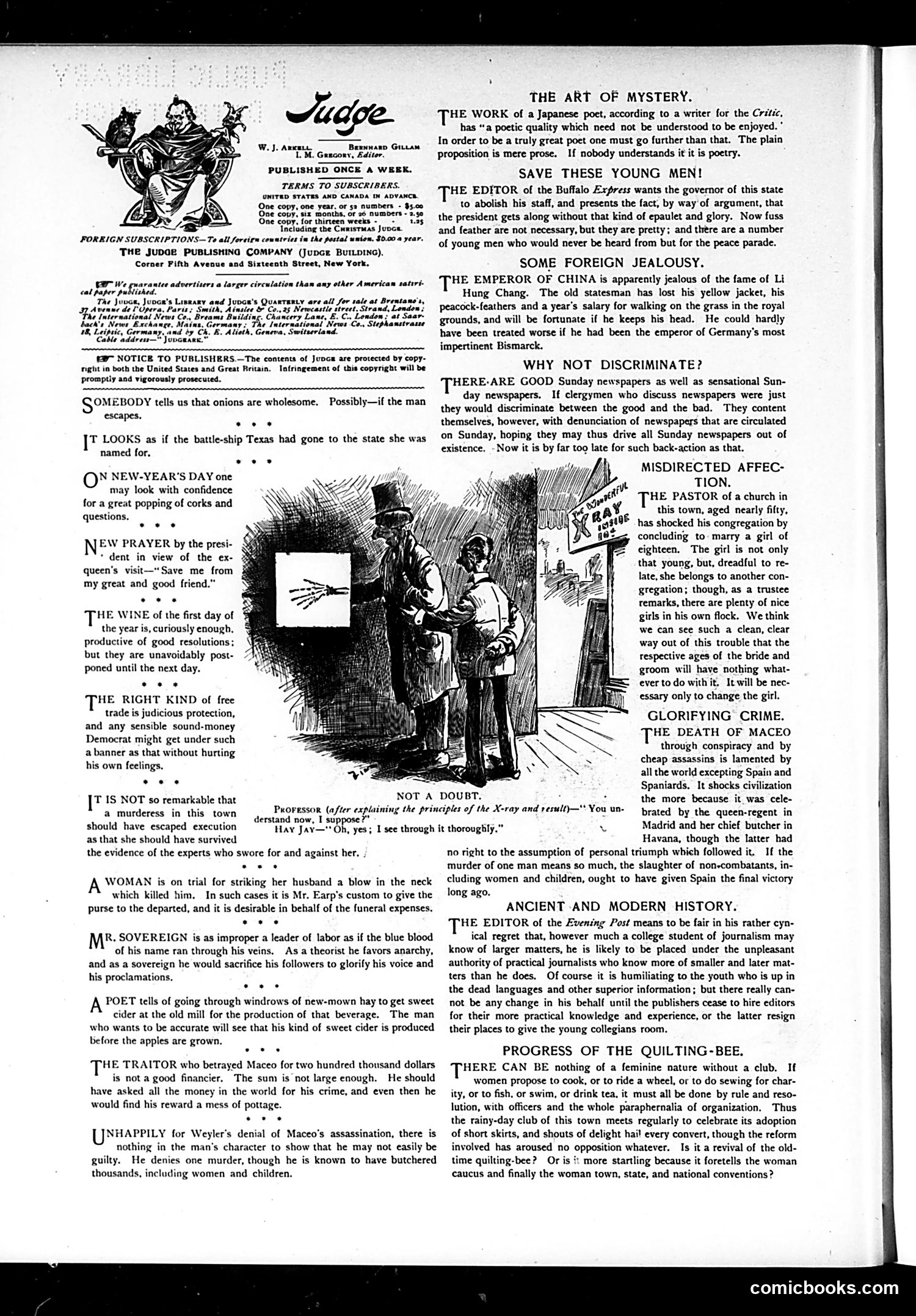
The main cartoon titled "NOT A DOUBT" depicts two men in conversation outside what appears to be a church or institutional building. The caption reads: "Professor (elucidating the principles of Dr. Keyes and creed)—'You understand now, I suppose?' / Pupil—'Yes sir; oh yes; I see through it thoroughly.'" This appears to satirize academic or religious instruction, likely mocking either a professor's explanation of pseudoscientific principles (possibly phrenology or similar discredited theories popular in the era) or theological doctrine. The humor lies in the "pupil" claiming comprehension while the context suggests the subject matter is deliberately obscure or nonsensical—"seeing through it" becomes a double meaning about transparency versus intellectual emptiness. The specific reference to "Dr. Keyes" remains unclear without additional context.
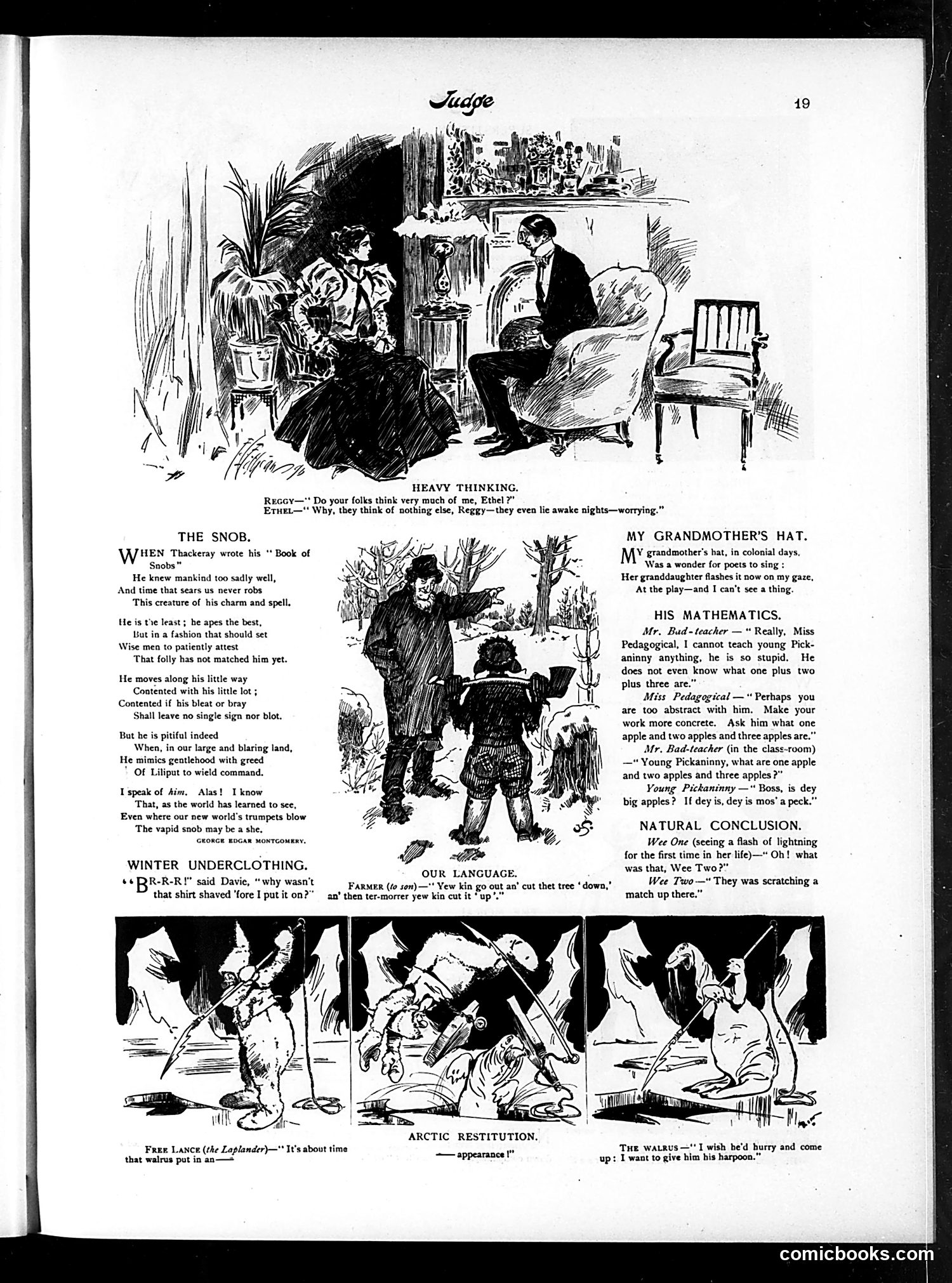
This page contains several humorous sketches and poems targeting social situations rather than specific political figures: **"Heavy Thinking"** depicts a domestic scene where a woman worries her husband thinks poorly of her, while he's actually preoccupied with business concerns—satirizing the gap between spouses' assumptions. **"The Snob"** is a poem mocking snobbish behavior and pretension among the wealthy classes. **Other pieces** include humor about teaching mathematics, grandmother's hats as fashion, and winter underclothing complaints. **"Arctic Restitution"** shows a walrus being returned, apparently satirizing some kind of practical joke or restoration scenario. The content appears primarily *social satire* rather than political commentary—poking fun at everyday class anxieties, gender dynamics, and human foibles typical of Judge's genteel humor.
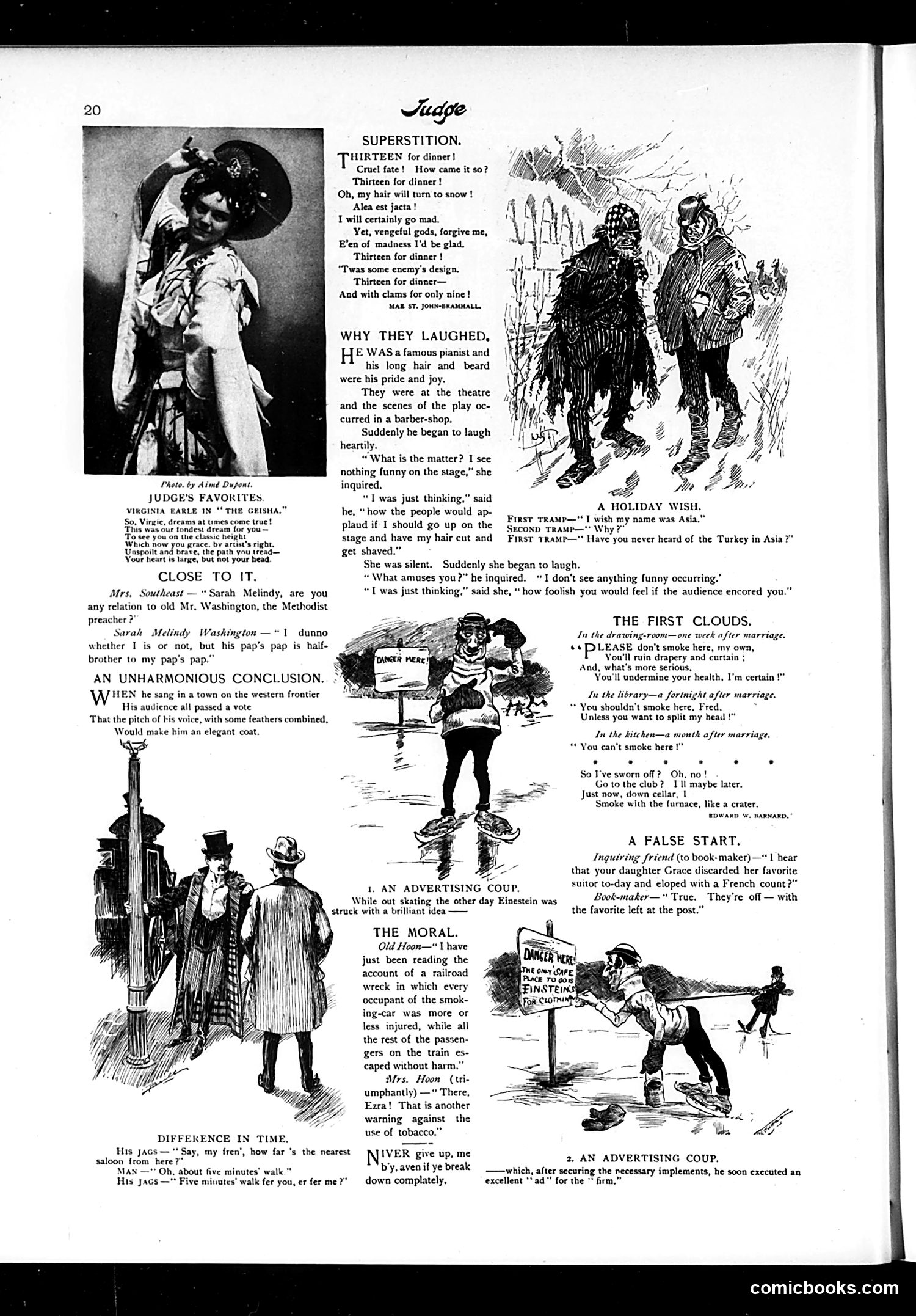
This page from *Judge* (a late 19th/early 20th-century satirical magazine) contains multiple brief humorous pieces typical of the publication's format. **Notable content includes:** - **"Superstition"**: Mocks dinner anxiety about having 13 guests, a common superstition of the era - **"Why They Laughed"**: A pianist with signature long hair finds a barber-shop stage scene funny, imagining audience reaction if he were shorn—his wife finds his vanity absurd - **"The First Clouds"**: Depicts marriage deterioration through smoking restrictions—a husband progresses from drawing-room to library to basement as his wife's objections escalate - **"An Advertising Coup"**: Einstein (contemporary figure) gets a skating idea, with two panels showing creative advertisements using his name - Various other brief jokes about preacher genealogy, voice pitch, and horse-racing The page's satire targets Victorian sensibilities (superstition, vanity), marital dynamics, and contemporary figures. The artwork uses period-appropriate pen-and-ink illustration style characteristic of 1900s American humor magazines.
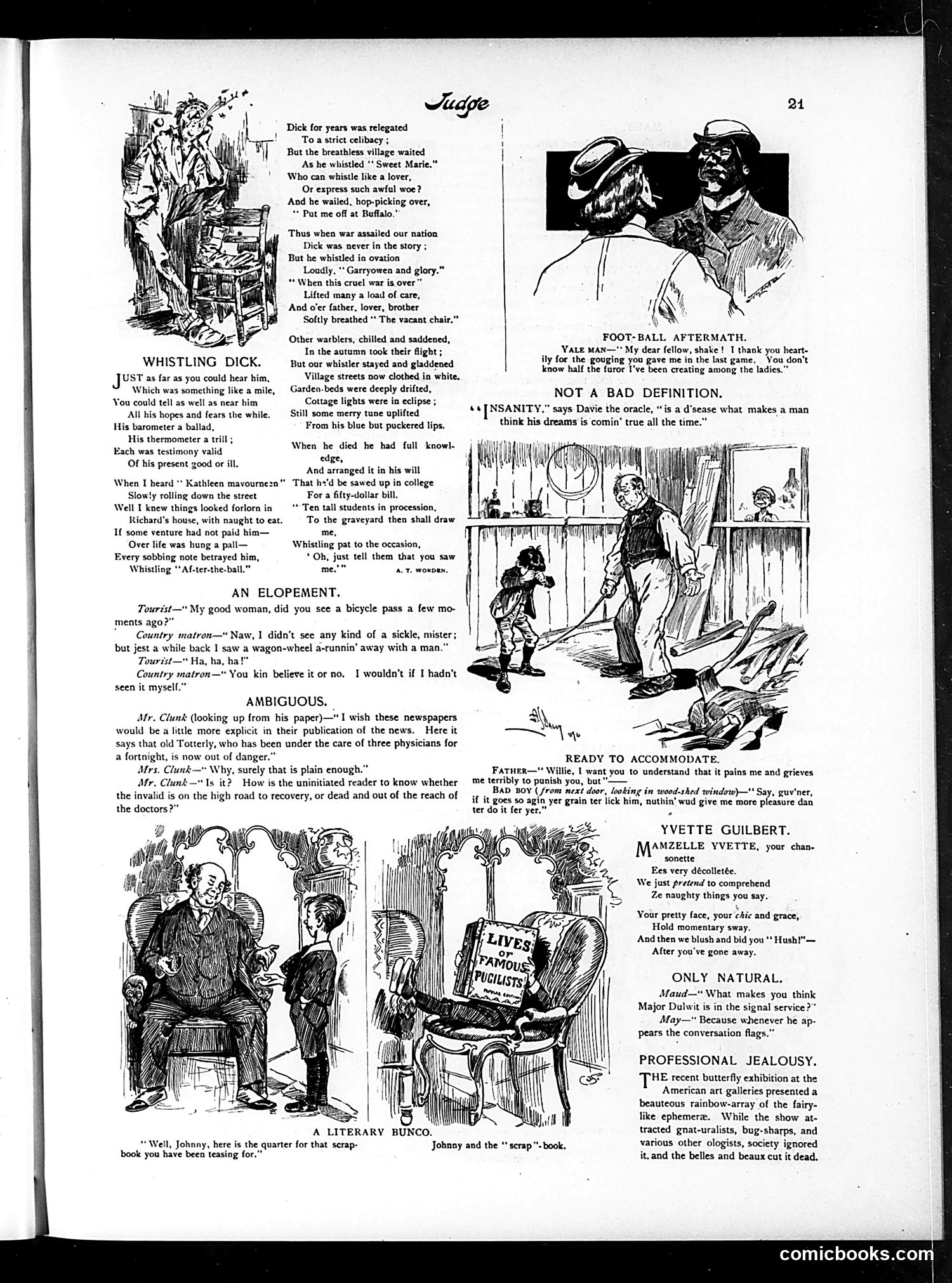
This page from *Judge* contains multiple short satirical pieces reflecting late 19th-century American humor: **"Whistling Dick"** is a sentimental poem about a working-class man whose whistled songs reveal his emotional state through life's hardships—poverty, unrequited love, and the Civil War. The satire lies in the final twist: his will requests his body be dissected for medical students while they whistle him to his grave. **"An Elopement"** plays on rural dialect humor: a tourist misunderstands a country woman's description of a bicycle as a "wagon-wheel," mistaking an elopement for something mechanical. **"Ambiguous"** satirizes newspaper reporting's vagueness—a man "out of danger" could mean either recovering or dead. **"Football Aftermath"** references college football brutality (common complaint of the era), where a Yale player thanks his opponent for violent "gouging" because it impressed the ladies. The remaining pieces are brief comic sketches on dreams, parental discipline, a French chanteuse's provocative performances, and military signal corps wordplay. The humor relies on puns, dialect, physical comedy, and social observation typical of *Judge*'s satirical style.
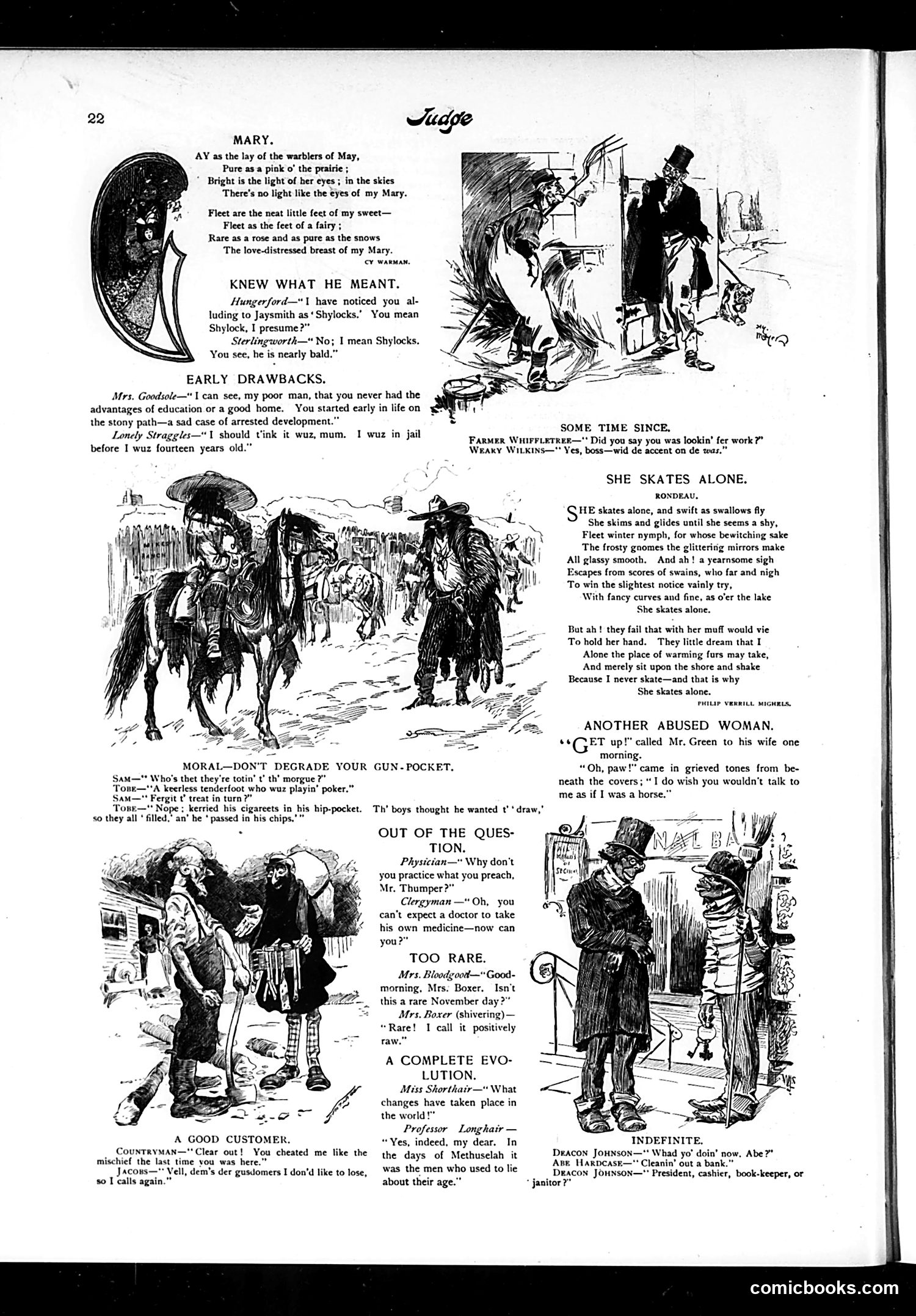
This page contains multiple brief satirical sketches typical of Judge's humor: **"Knew What He Meant"** jokes about a bald man being called "Shylocks" (plural of the Shakespearean moneylender stereotype, here a pun on his baldness). **"Early Drawbacks"** presents class commentary—a wealthy woman patronizes a poor man about his "arrested development," while he reveals he was jailed as a teenager. **"Moral—Don't Degrade Your Gun-Pocket"** uses Western frontier slang to warn against storing cigarettes in gun holsters; a careless tenderfoot did so during poker, and his cigarettes "filled" and "passed in his chips" (died). **"Out of the Question"** mocks clerical hypocrisy: a physician asks why the clergyman doesn't practice his own preaching; the clergyman deflects that doctors don't take their own medicine. Other sketches mock romantic pretension, seasonal confusion, gender role expectations, and class stereotypes. The tone is cynical, focusing on human folly, dishonesty, and hypocrisy across social strata.
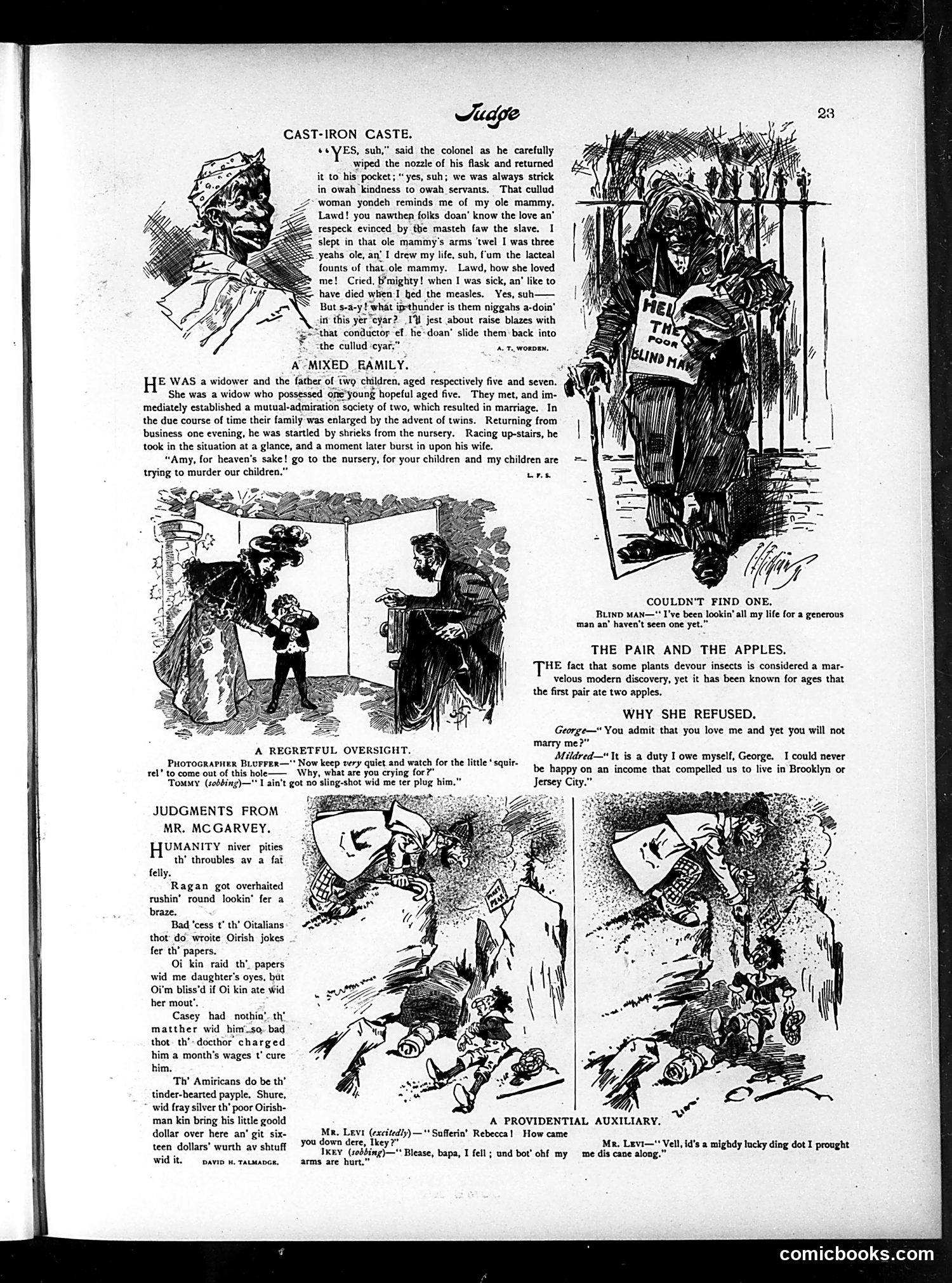
This page contains several satirical pieces typical of late 19th/early 20th-century American humor: **"Cast-Iron Caste"** mocks Southern nostalgia for slavery through a colonel's sentimentalized monologue about his former enslaved caretaker, contradicted by his immediate rage at Black passengers sharing a railroad car. The satire exposes the hypocrisy of romanticizing slavery while maintaining rigid racial segregation. **"A Mixed Family"** jokes about blended families' conflicts by having a remarried man complain that "your children and my children are trying to murder our children"—the twins from the new union. **"Why She Refused"** presents a woman rejecting marriage because economic hardship in Brooklyn or Jersey City would make her unhappy—satirizing class anxiety and material expectations in courtship. The **Irish dialect pieces** by "Mr. McGarvey" offer ethnic humor common to the era, with stereotypical Irish expressions about poverty and foolishness. **Minor cartoons** address universal themes: generosity, class differences, and domestic mishaps. The overall tone reflects Judge's satirical approach to social contradictions and class tensions.
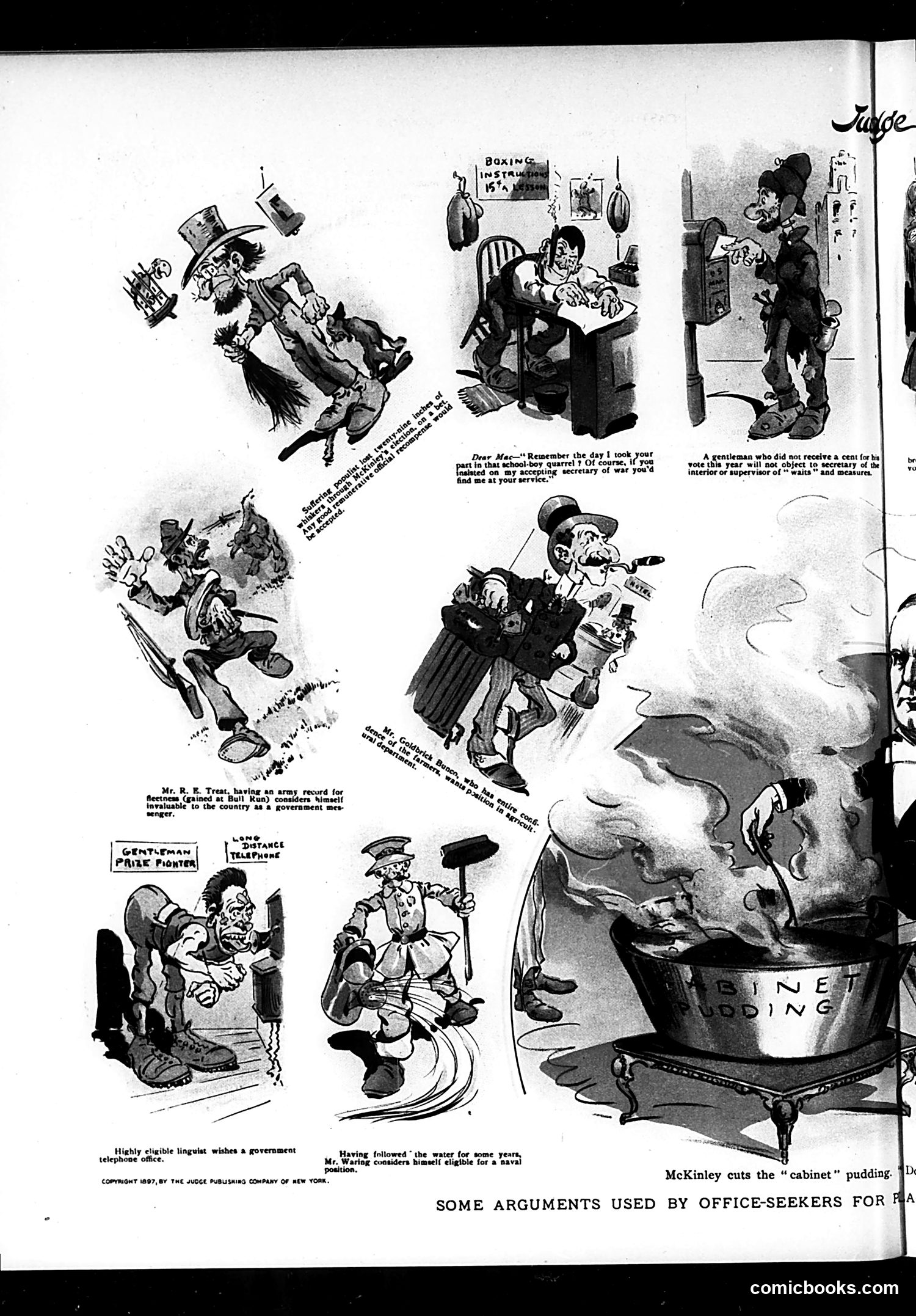
This 1897 Judge magazine page satirizes the flood of job applicants seeking government positions under President William McKinley after his election. Each cartoon ridicules absurd or irrelevant "qualifications" office-seekers offered: - A man citing a childhood schoolyard fight as basis for Secretary of War - Someone with a Bull Run (Civil War) record claiming messenger credentials - A linguist wanting a telephone office job - A man with water-following experience seeking a naval position - A figure labeled "Gentleman Prize Fighter" offering unspecified services The large "cabinet pudding" image on the right shows McKinley dividing spoils, suggesting government positions were distributed like patronage rather than merit. The satire targets the Gilded Age spoils system—the practice of awarding government jobs as political favors regardless of actual qualification, a widespread complaint during this era of reform movements.
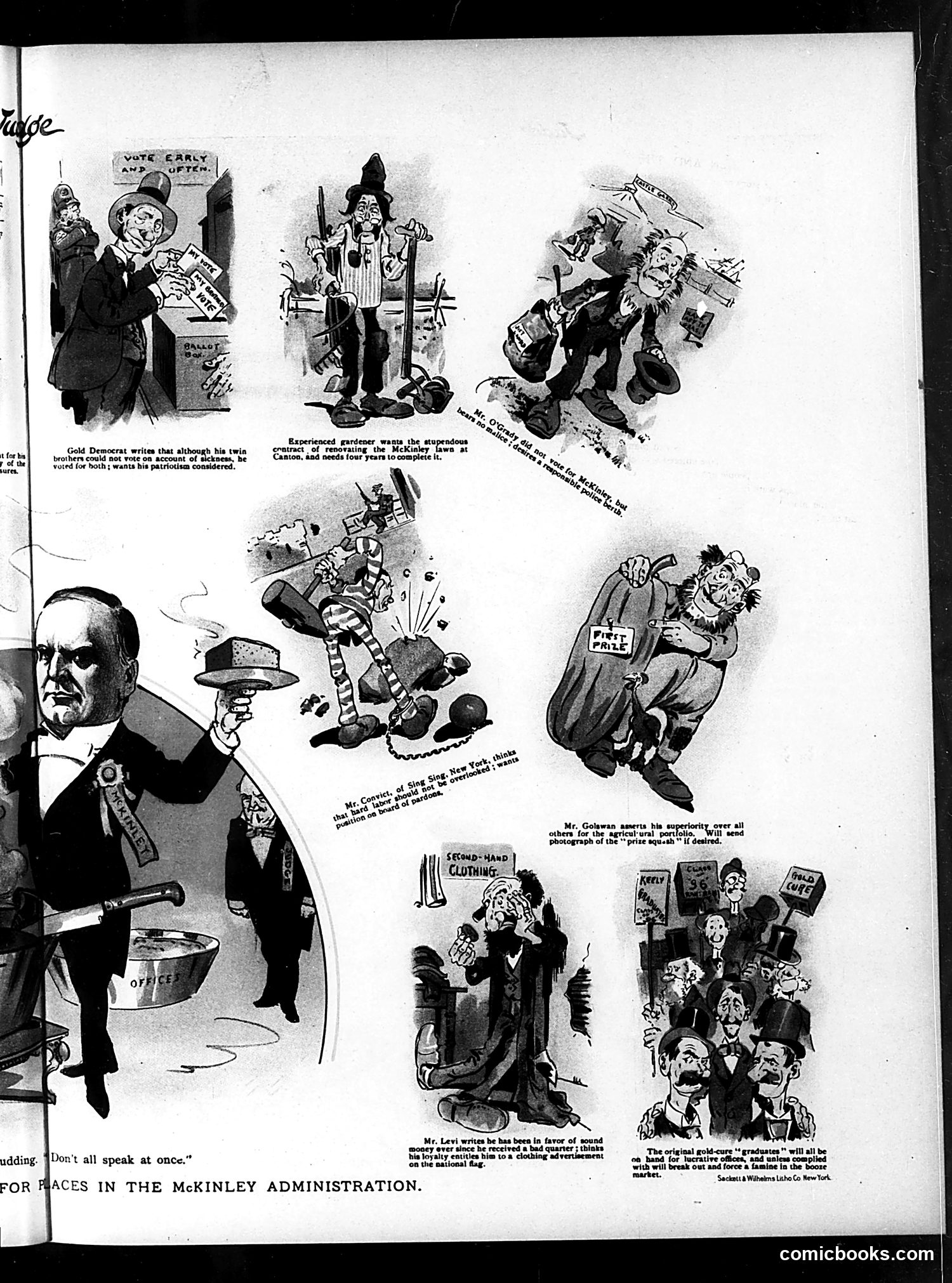
This page satirizes corruption in President McKinley's administration through multiple cartoons depicting various officials seeking positions or defending questionable actions. **Key targets include:** - A "Gold Democrat" claiming credit for voting twice (likely referencing electoral fraud or family nepotism) - An official defending renovations to the Canton residence (McKinley's home) requiring four years and substantial funds - "Mr. Coleman" promoting agricultural port interests with a "prize squash" photograph (suggesting self-promotion or inflated accomplishments) - "Mr. Levi" defending past positions on budget matters and the national flag (likely a political flip-flopper) The bottom caption, "Don't all speak at once," suggests multiple office-seekers competing for McKinley administration positions. **Overall message:** The cartoons mock the McKinley administration as riddled with self-serving officials, fraudulent claims, wasteful spending, and political opportunism—a scathing critique of Gilded Age corruption and patronage politics.
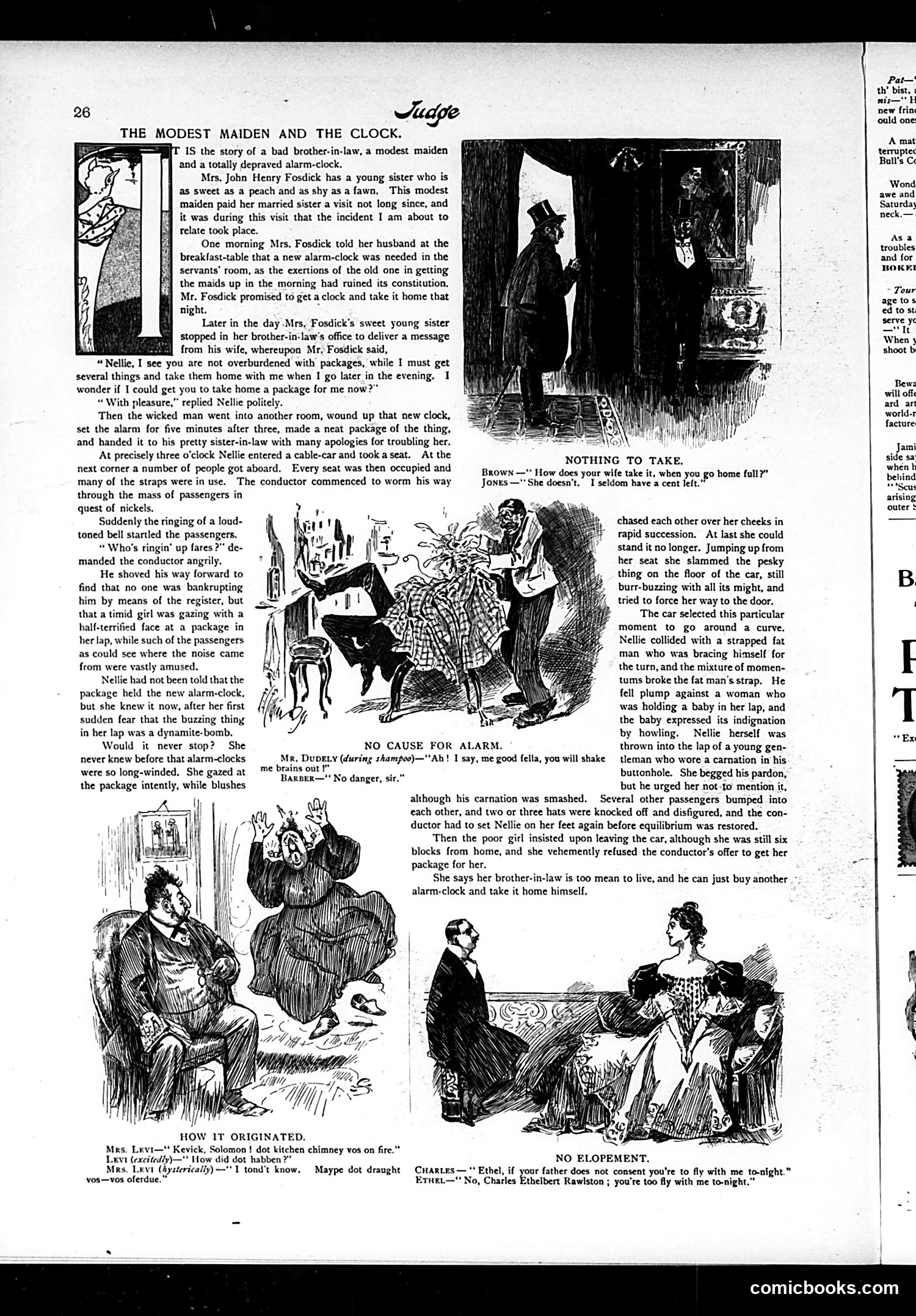
This is a humorous story illustrated with multiple cartoons about a prank gone wrong. A brother-in-law, Mr. Fosdick, asks his shy sister-in-law "Nellie" to carry home an alarm clock without telling her what's in the package. When the clock goes off on a crowded cable car at 3 o'clock, Nellie panics—briefly fearing it's a dynamite bomb. Her terrified reaction causes chaos: she jumps up, crashes into a fat man whose strap breaks, who then collides with a woman holding a baby, creating a domino effect of comic mayhem. The page includes additional unrelated cartoon jokes about domestic and romantic situations. The satire mocks both the thoughtless prank and the "modest maiden" stereotype—Nellie's exaggerated fearfulness and embarrassment over the innocent incident.
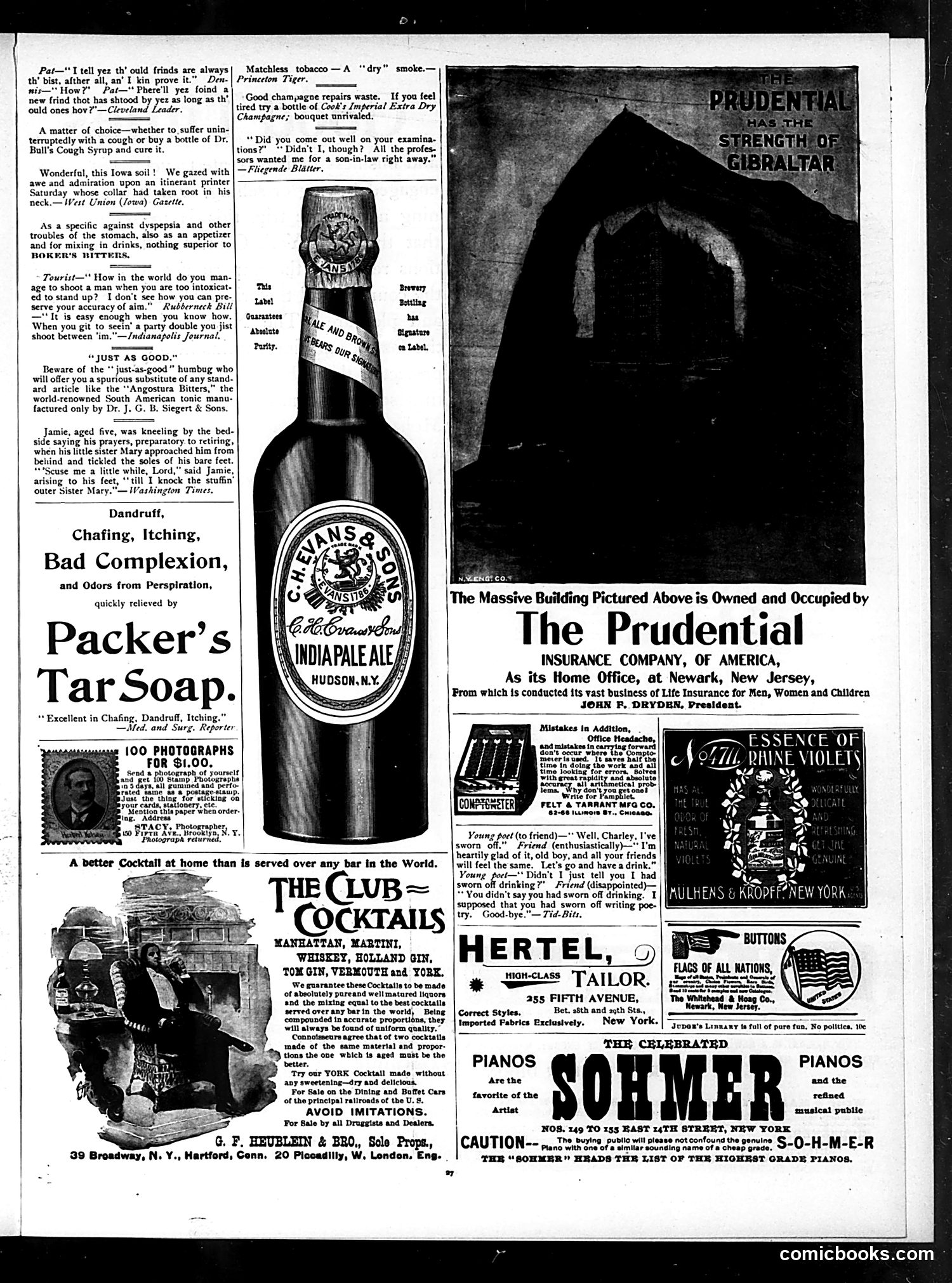
This is primarily a **advertising page** with several small comic anecdotes interspersed. The dominant content is commercial rather than satirical. The brief comics are ethnic/dialect humor typical of early 20th-century publications: - "Pat" and "Dennis" exchange uses Irish-accented dialect ("th' oald frinds," "shtood") - A "Rubberneck Bill" joke plays on frontier-style drunkenness and shooting accuracy - A child's prayer scene uses innocent humor about sibling mischief The major feature is a large advertisement for **The Prudential Insurance Company**, showing their Newark, New Jersey headquarters building. This represents the company's corporate prestige and stability—a key marketing strategy for life insurance at the era. Smaller ads promote patent medicines (Packer's Tar Soap for skin conditions), alcoholic beverages (cocktails, champagne, bitters), and luxury goods (pianos, tailoring). The "essence of brute force" ad appears to be for a men's product. The page reflects the magazine's business model: combining light humor with lucrative advertising from major corporations and consumer products.
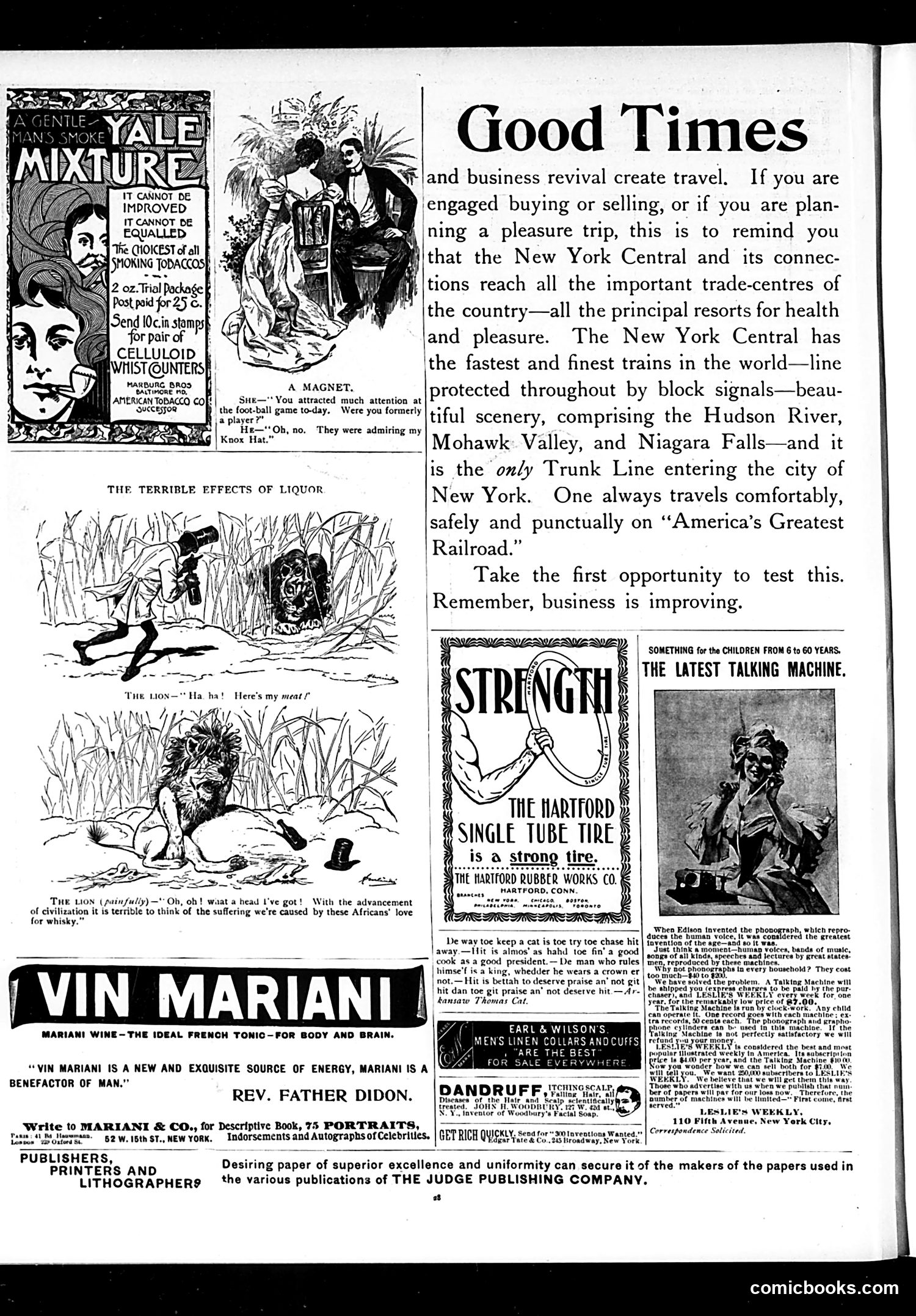
**The Lion Cartoon:** This satirical cartoon depicts a lion lamenting civilization's effects. The lion represents African wildlife, while the joke critiques European/American attitudes: colonizers view Africans as causing their own suffering through alcohol consumption ("these Africans' love for whisky"), rather than recognizing colonialism itself as the source of harm. It's a commentary on racist justifications for imperialism—blaming the colonized for problems caused by colonization. **Advertisements:** The page is dominated by period product ads (Vin Mariani wine tonic, Hartford tires, talking machines, dandruff treatment), with a New York Central Railroad travel advertisement promoting business and leisure opportunities. The cartoon's irony exposes how Western powers rationalized colonial exploitation by attributing societal problems to the colonized peoples' supposed moral failings rather than to imperial domination itself.
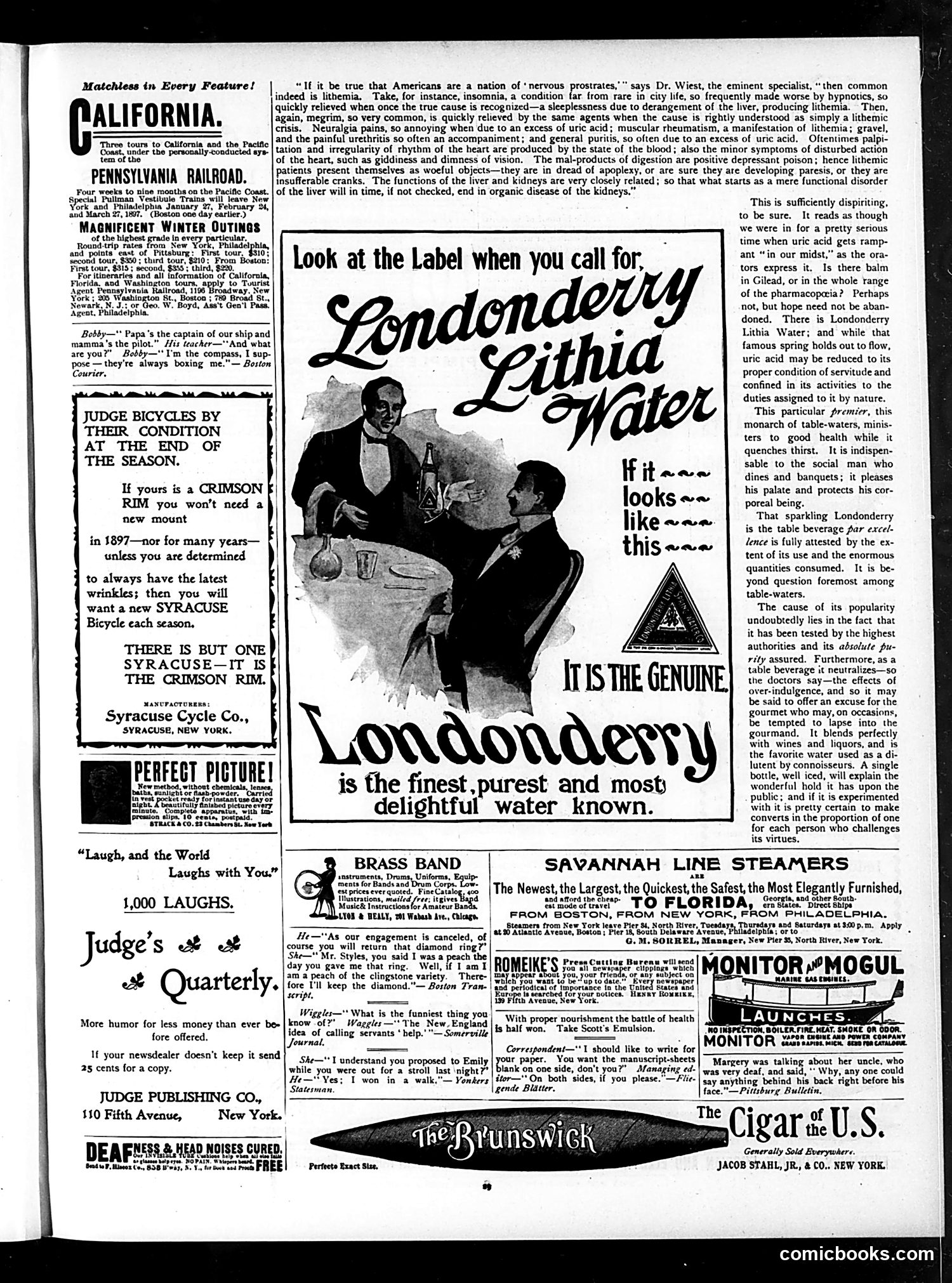
This is primarily an advertising page from an 1897 issue of *Judge* magazine, featuring travel promotions, bicycles, and patent medicines. The main visual content is a large advertisement for "Londonderry Lithia Water," depicting two well-dressed men dining. The accompanying text, attributed to "Dr. Wiest," presents pseudo-medical claims that Americans suffer from "lithemia" (excess uric acid) causing nervousness, insomnia, and various ailments—all supposedly curable by drinking this spring water. **The satire:** The medical language is overwrought and absurd by modern standards. The "doctor's" diagnosis conflates unrelated symptoms into a single condition treatable by bottled water, exemplifying late-19th-century patent medicine fraud. *Judge's* inclusion suggests ironic mockery of such dubious health claims marketed to anxious upper-class consumers. The page also advertises Pennsylvania Railroad California tours, Syracuse bicycles (the "Crimson Rim"), and *Judge's* quarterly magazine itself—representing the commercial landscape of 1890s American publishing.
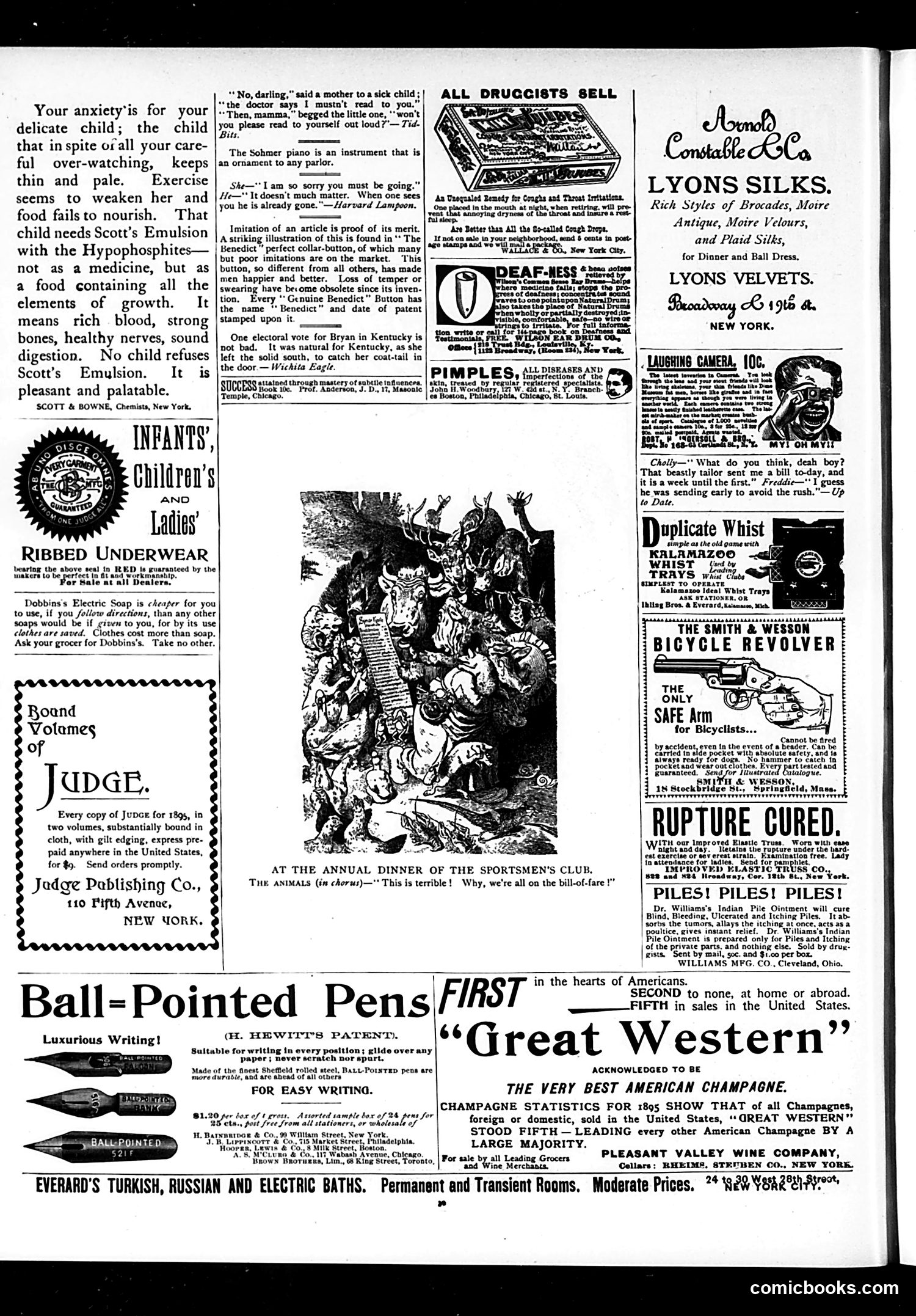
This page is primarily **advertising**, typical of late-19th-century magazines. However, it contains two satirical cartoons: **Main cartoon ("At the Annual Dinner of the Sportsmen's Club"):** Depicts animals at a dinner table realizing with horror that they themselves are on the menu ("bill-of-fare"). This is a dark joke about hunters' dinners, where game animals were served—the satire being animals' perspective on their own fate. **Social humor vignettes** include a joke about a sick child wanting her mother to read aloud (playing on Victorian concerns about children's health), and "Cholly" complaining about receiving his tailor's bill too early in the week—mocking the leisure-class anxiety about bills interrupting their week. The rest of the page consists of period advertisements for Scott's Emulsion (nutritional supplement for weak children), pens, silks, medical treatments (deafness, rupture), and firearms—products typical of 1890s America. No specific political figures or major events are referenced.
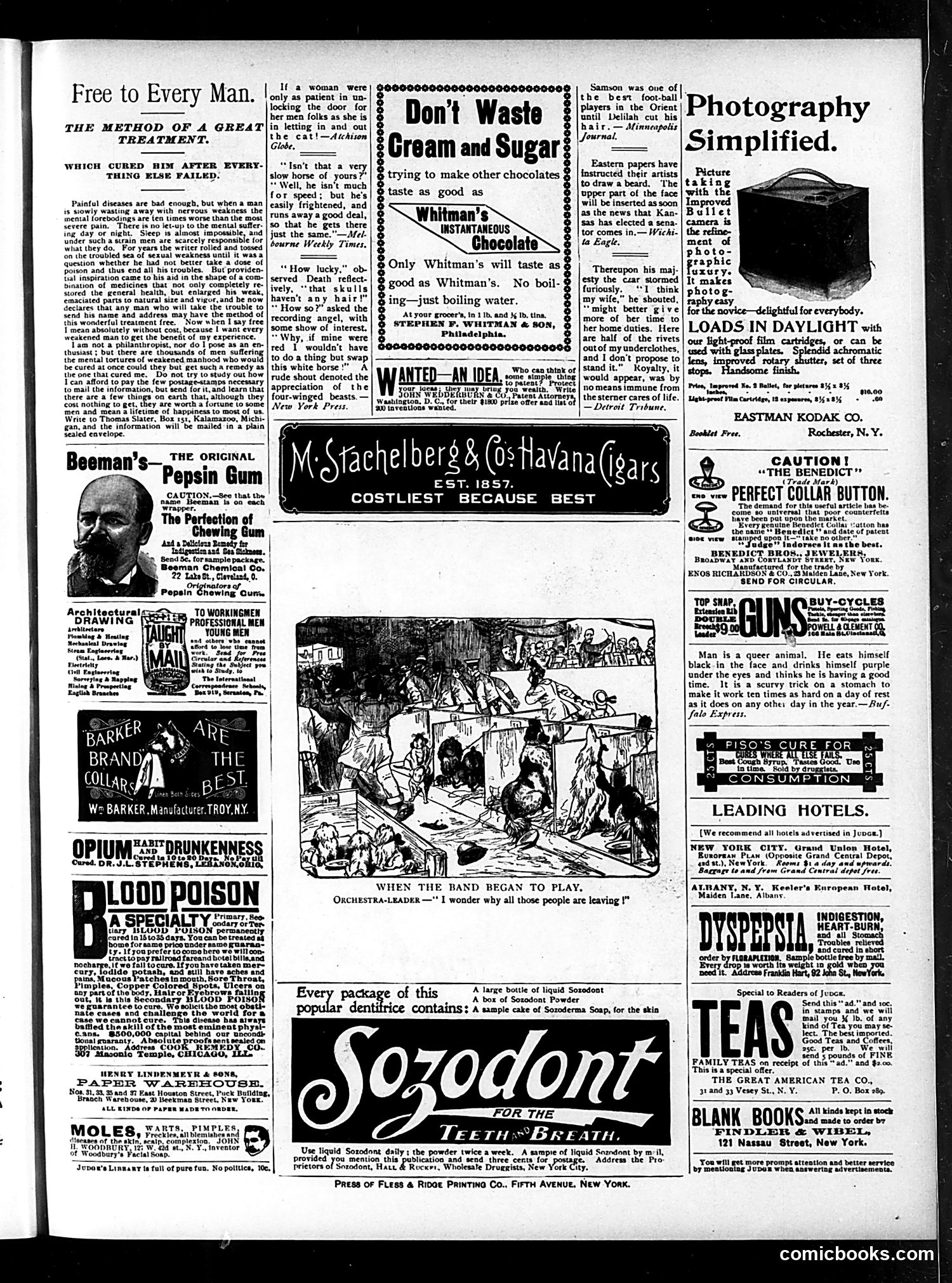
This page is **primarily advertising** for patent medicines and commercial products typical of early 20th-century American publications. The content reflects the era's unregulated health claims. Notable elements include: **Patent Medicine Ads**: Multiple advertisements for dubious treatments—sexual weakness remedies, opium/drunkenness cures, and blood poison treatments—all promising miraculous results. These exploited vulnerable men with exaggerated claims. **The Single Cartoon**: The bottom illustration captioned "When the Band Began to Play" shows an orchestra conductor with the joke "I wonder why all those people are leaving!" This is a simple, non-political humor piece mocking bad musicians. **Commercial Ads**: Legitimate products like Sozodont toothpaste, Whitman's chocolates, and Kodak cameras share space with dubious remedies. The page reveals how **Judge subsidized itself through advertising**, including the exploitative patent medicine industry that preyed on insecurity and illness—practices that would later be regulated by the FDA.
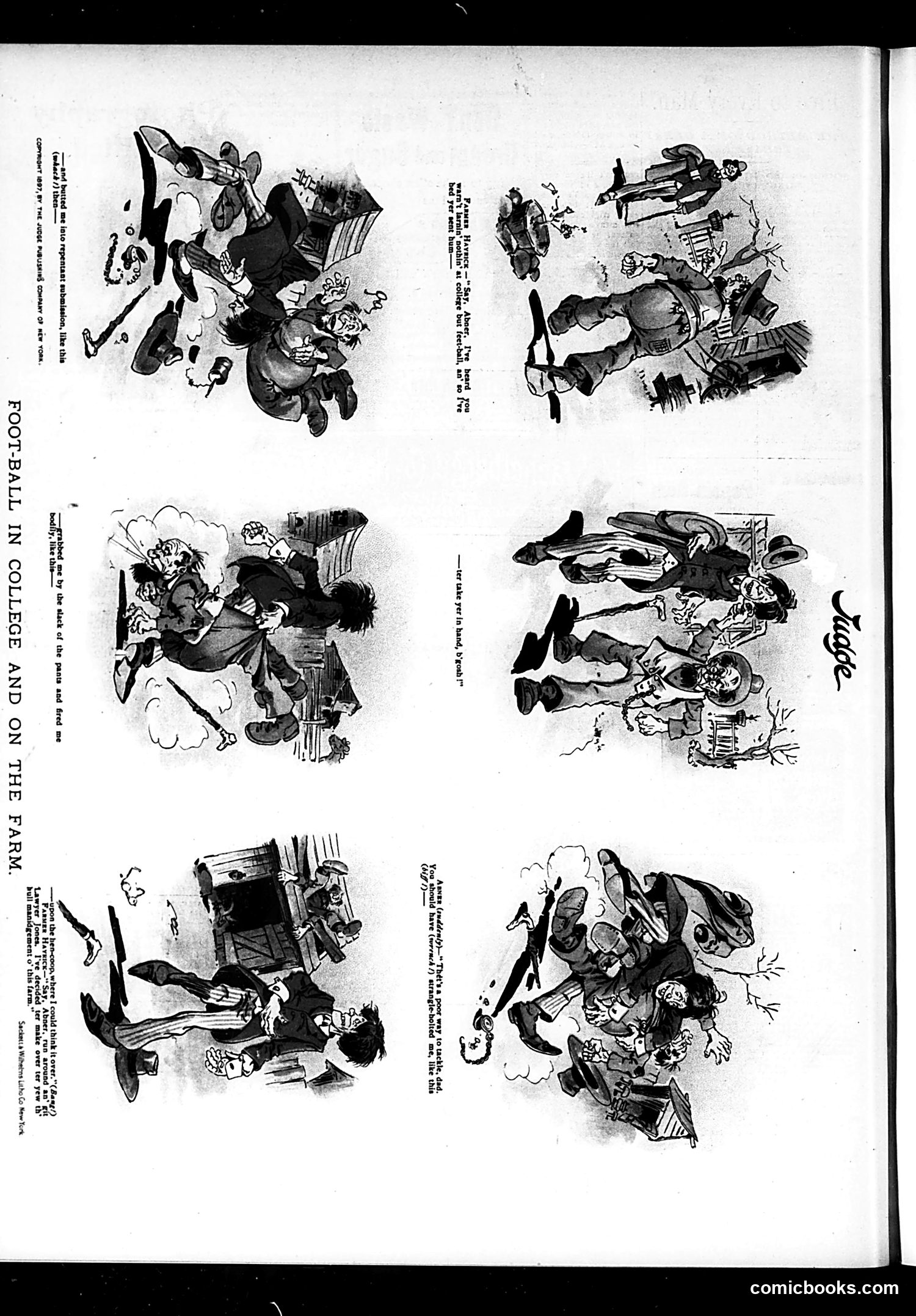
This satirical page contrasts college football's violent physicality with farm labor. The cartoon depicts a father confronting his son, who he's heard learned only football at college—not academics. The son responds by demonstrating football "tackles" and techniques on his bewildered father, treating him like an opponent. The satire mocks two things: (1) college football's brutality and dominance over actual education, and (2) the absurdity of applying football violence to everyday farm management. The joke suggests that if football is all college teaches, at least the boy can put those lessons toward practical farm work. This reflects late-19th-century anxiety about college football's increasingly dangerous nature and concern that it distracted students from serious study—a recurring criticism in *Judge* magazine during this era.