
A complete issue · 16 pages · 1896
Judge — November 14, 1896
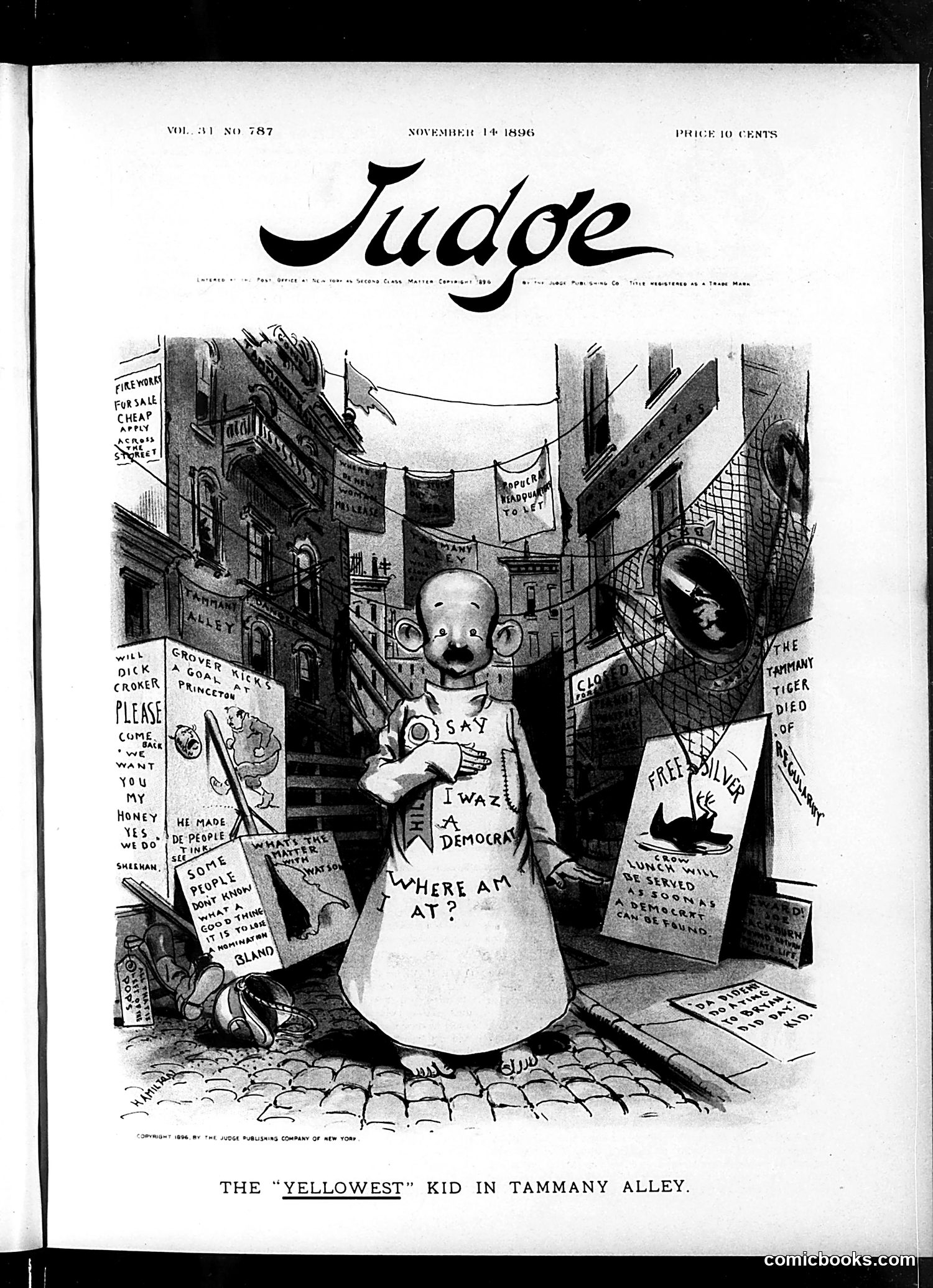
This 1896 Judge cartoon satirizes **Tammany Hall**, New York City's Democratic political machine, depicted as a confused, ghost-like figure in an urban alley surrounded by conflicting signs and messages. The central figure represents Tammany Hall itself, asking "WHERE AM I AT?" and claiming "I WAS A DEMOCRAT"—suggesting the organization has lost its political identity or direction. The surrounding signs reference various scandals and controversies, including references to Sherman (likely William Tecumseh Sherman or political figures of that era) and various criminal/ethical failures. The title's reference to "yellowest" likely evokes both the "Yellow Journalism" of the 1890s and accusations of cowardice, suggesting Tammany Hall's moral compromises and corruption had become indefensible.
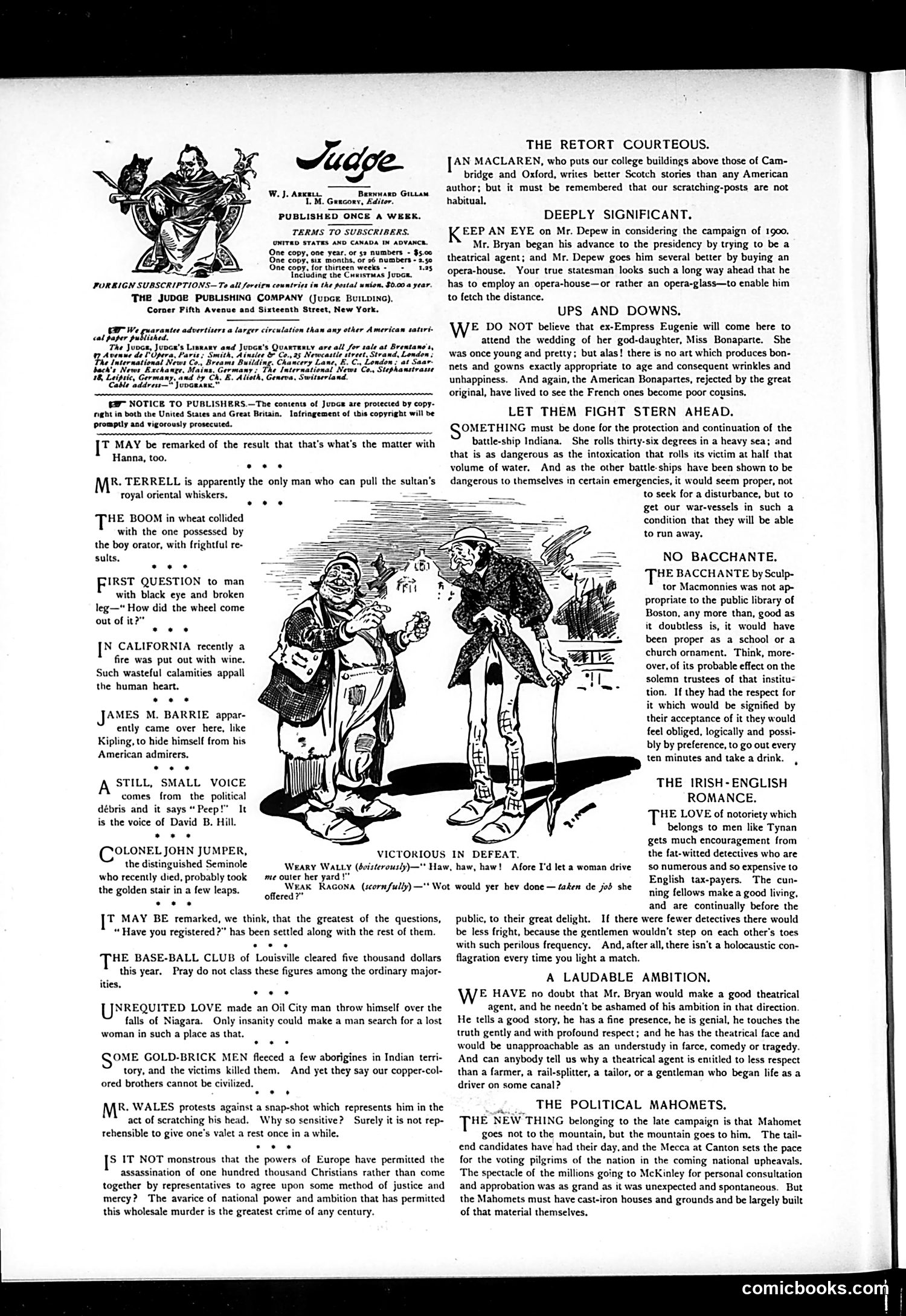
This page contains several brief satirical commentary pieces rather than a single cartoon. The main illustration shows two figures in what appears to be a comedic interaction labeled "VICTORIOUS IN DEFEAT." The text pieces mock contemporary figures and events: Colonel John Jumper's death, the Louisville BASE-BALL CLUB, an oil magnate's failed love pursuit, American detectives pursuing cases in London, and Mr. Wales's sensitivity. One section criticizes "The Political Mahomet," suggesting Mahomet (likely a political figure) gains power through mountain-level politics rather than earning it directly—a commentary on backroom political maneuvering. Most commentary focuses on absurd human behavior and social pretension rather than specific identifiable political figures. The satirical tone targets general hypocrisy, ambition, and foolishness across American society.
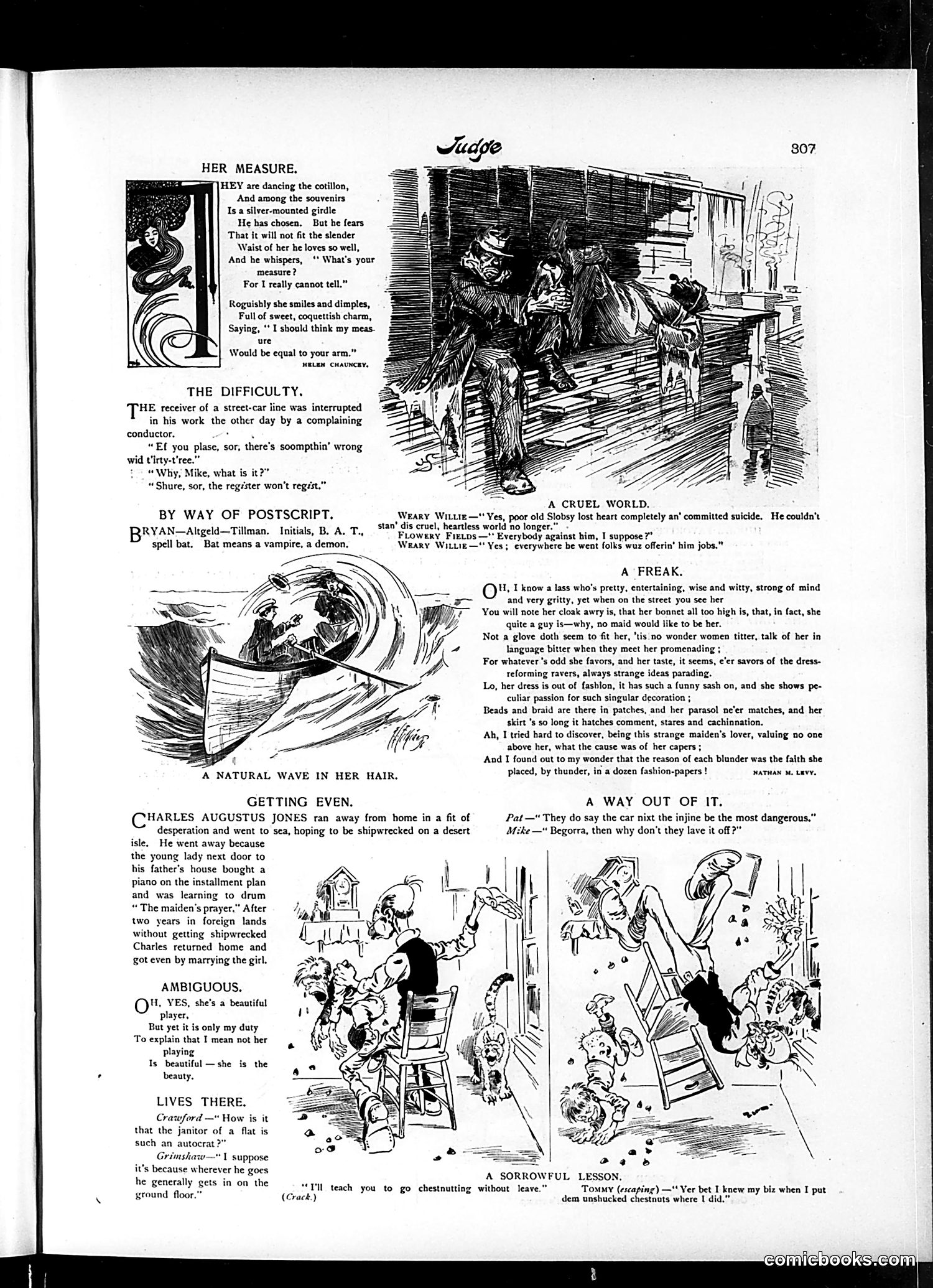
This page contains several unrelated humorous sketches and verses typical of Judge's format. The cartoons depict domestic comedies rather than political content: **"A Cruel World"** shows shabby figures discussing Shelby's suicide, contrasting sympathy with callous indifference about lost jobs. **"A Freak"** is a character sketch about an oddly dressed woman with strange fashion sense—her mismatched accessories and bizarre taste puzzle the narrator. **"Getting Even"** depicts Charles Augustus Jones learning piano, then deliberately playing badly to annoy his father (who bought the instrument). **"A Way Out of It"** and **"A Sorrowful Lesson"** show domestic chaos—the first involving a cat causing mayhem, the second a woman teaching someone to chestnuts without leaving a mess. These are social satires of everyday middle-class life, not political commentary. No specific historical figures appear identifiable.
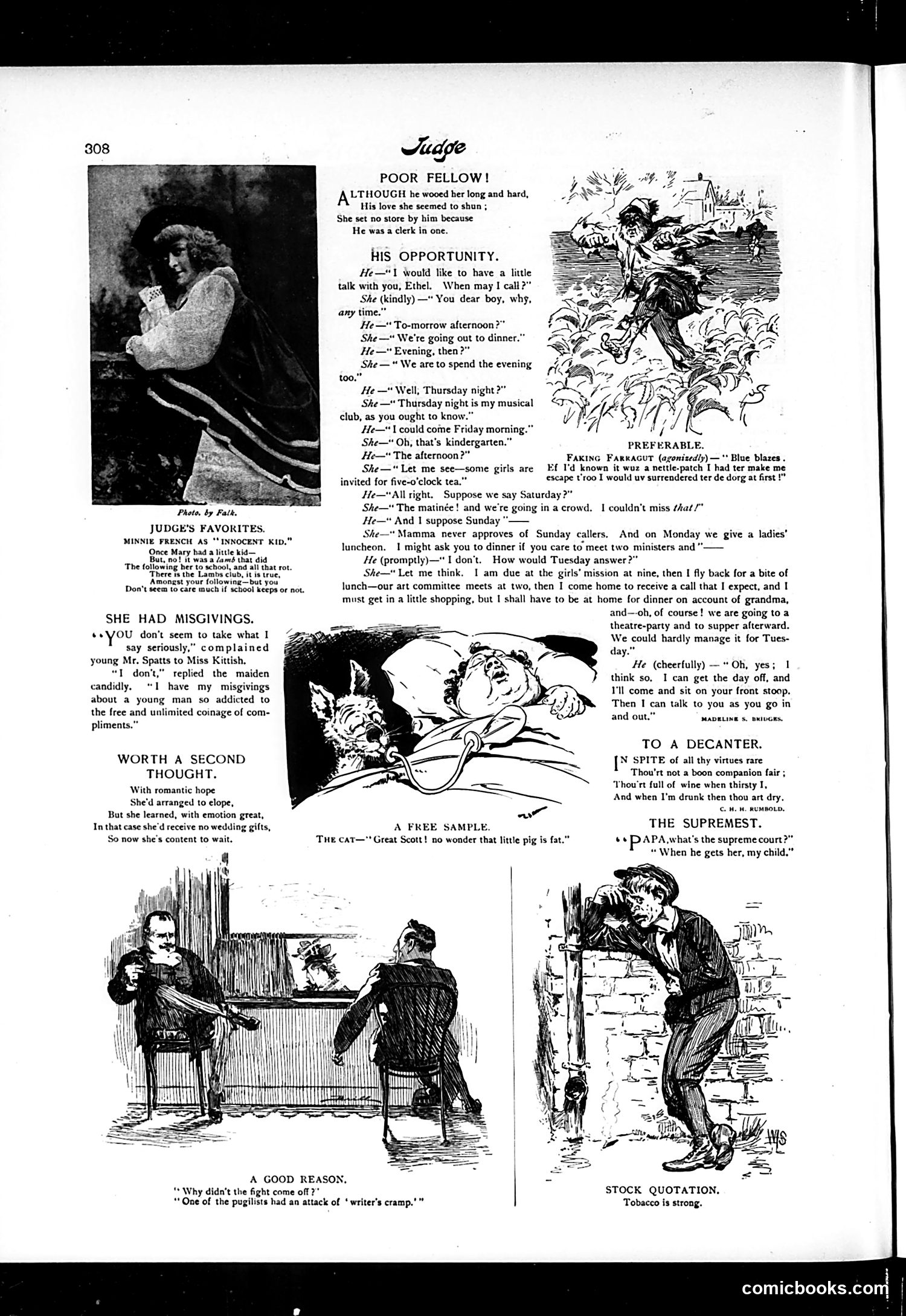
This page from **Judge** (a late 19th/early 20th-century American satirical magazine) contains several humorous sketches about courtship and daily life. **Major content:** The centerpiece, "His Opportunity," satirizes a young clerk's futile attempts to court a woman named Ethel. She consistently rebuffs his calls by claiming prior engagements—dinners, musical clubs, kindergarten, shopping, theater parties. The joke targets both the clerk's low social status ("a clerk in one") and the woman's impossibly packed social calendar, mocking both class anxiety and the busy leisure activities of prosperous women. "Faking Farragut" depicts a confused figure who mistook a nettle patch for something else—unclear without more context, though it parodies overblown newspaper accounts. Minor pieces mock romantic misgivings about wedding gifts, a boxer's "writer's cramp" excuse, and domestic gender dynamics ("The Supremest"). **Overall tone:** Light social comedy aimed at urban, middle-class readers, poking fun at courtship rituals, social climbing, and gender relations of the era.
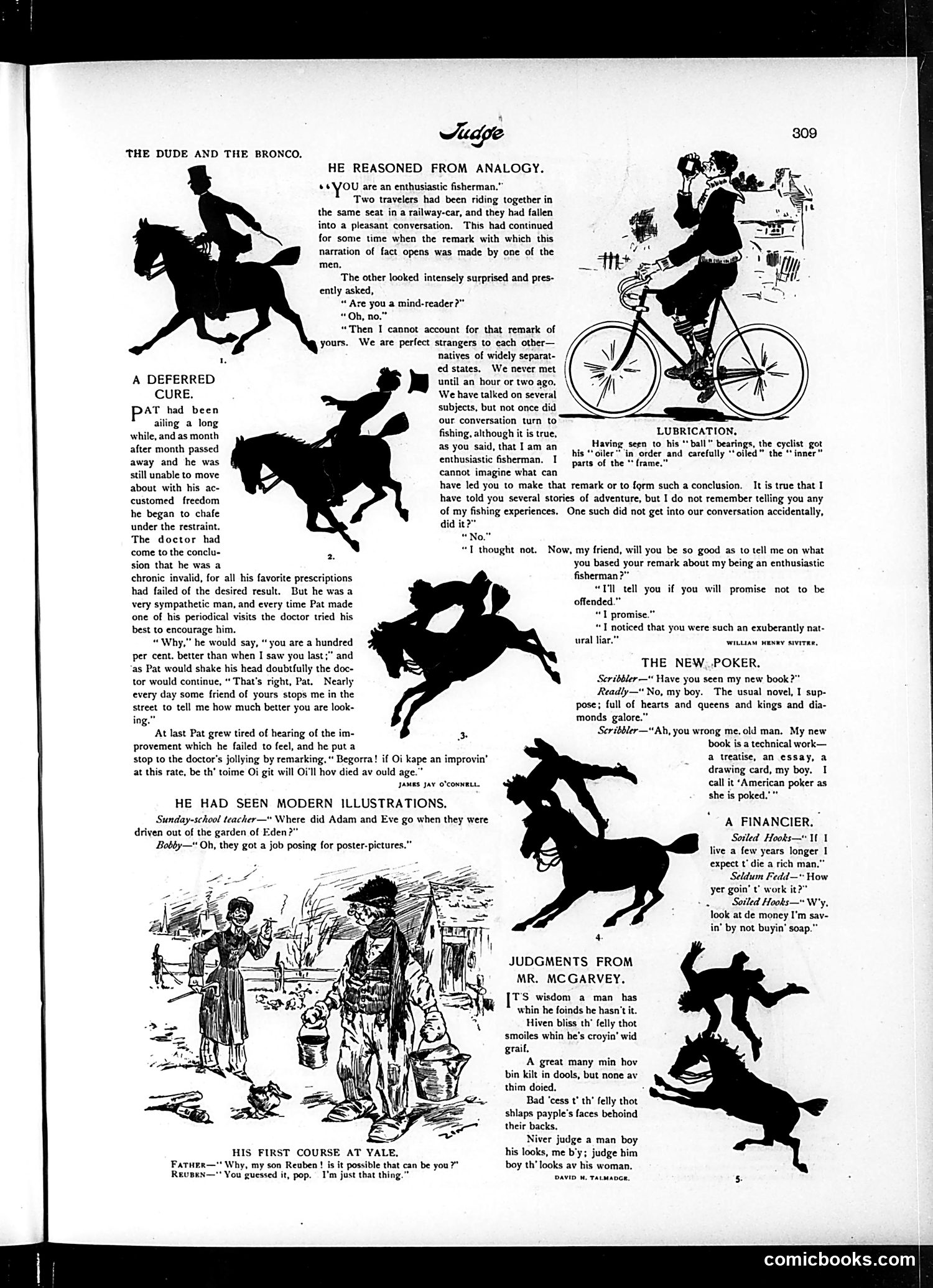
This page contains several short humor pieces typical of Judge's satirical style: **"The Dude and the Bronco"** depicts a wealthy, sedentary man ("dude") learning to ride wild horses as physical therapy—satirizing the then-fashionable notion that rough Western activities could cure urban ailments. **"He Reasoned from Analogy"** is a joke about a train passenger deducing another's fishing hobby through observation, leading to the punchline that the man is simply "an exuberantly natural liar"—poking fun at pseudo-intellectual deduction. **"The New Poker"** jokes that a modern book about "American poker as she is poked" is actually literary criticism (a pun on "poked" versus "poked at"). **"A Financier"** presents a humorous working-class character planning to become rich by avoiding soap purchases—satirizing absurd economic logic. **"Judgments from Mr. McGarvey"** offers Irish-dialect folk wisdom, a common Judge feature mocking immigrant speech patterns while presenting supposedly profound observations. The silhouettes of bucking horses illustrate the cowboy theme. The page is entertainment-focused rather than political.
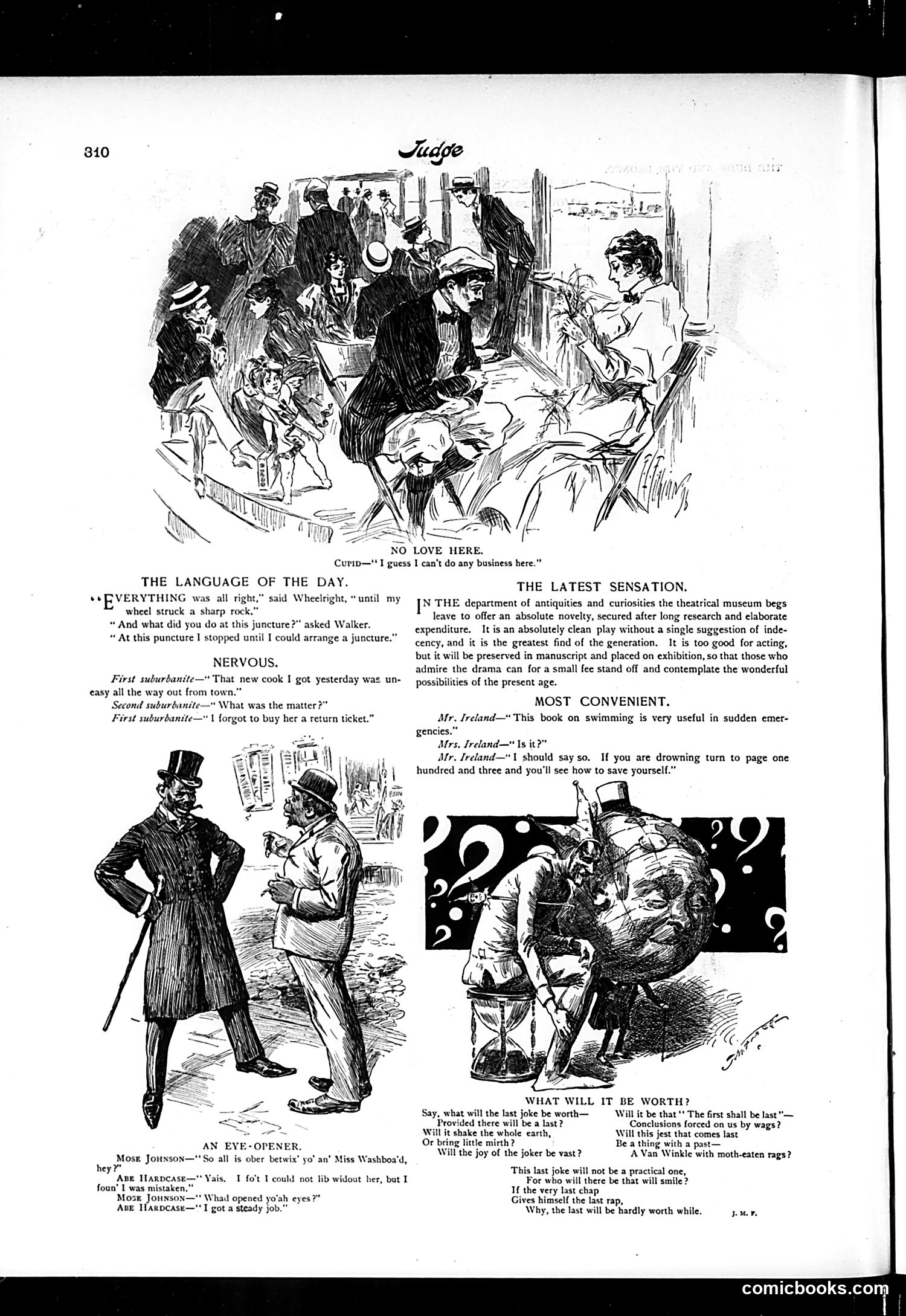
This page contains multiple brief satirical sketches typical of Judge magazine's humor style. **"No Love Here"** mocks romantic disappointment—a figure (Cupid) can't conduct business, suggesting love has abandoned the scene. **"The Language of the Day"** satirizes pretentious wordplay: a man describing a wheel accident uses "puncture/juncture" puns, ridiculing affected speech patterns. **"Nervous"** jokes about class anxiety: an employer suspects his new cook will flee because he forgot to buy her a return ticket—suggesting working-class servants couldn't be trusted to stay. **"An Eye-Opener"** uses racist dialect humor (typical of the era) about a Black man who abandons his girlfriend after getting steady employment, implying upward mobility changes loyalties. **"The Latest Sensation"** satirizes theatrical pretension: a "clean play" is so boring it's better preserved unperformed than acted. **"Most Convenient"** offers dry humor about a swimming book's impracticality. **"What Will It Be Worth?"** ends with philosophical verse questioning whether the final joke matters if no one survives to appreciate it. The overall tone reflects Judge's focus on social observation, class commentary, and wordplay humor.
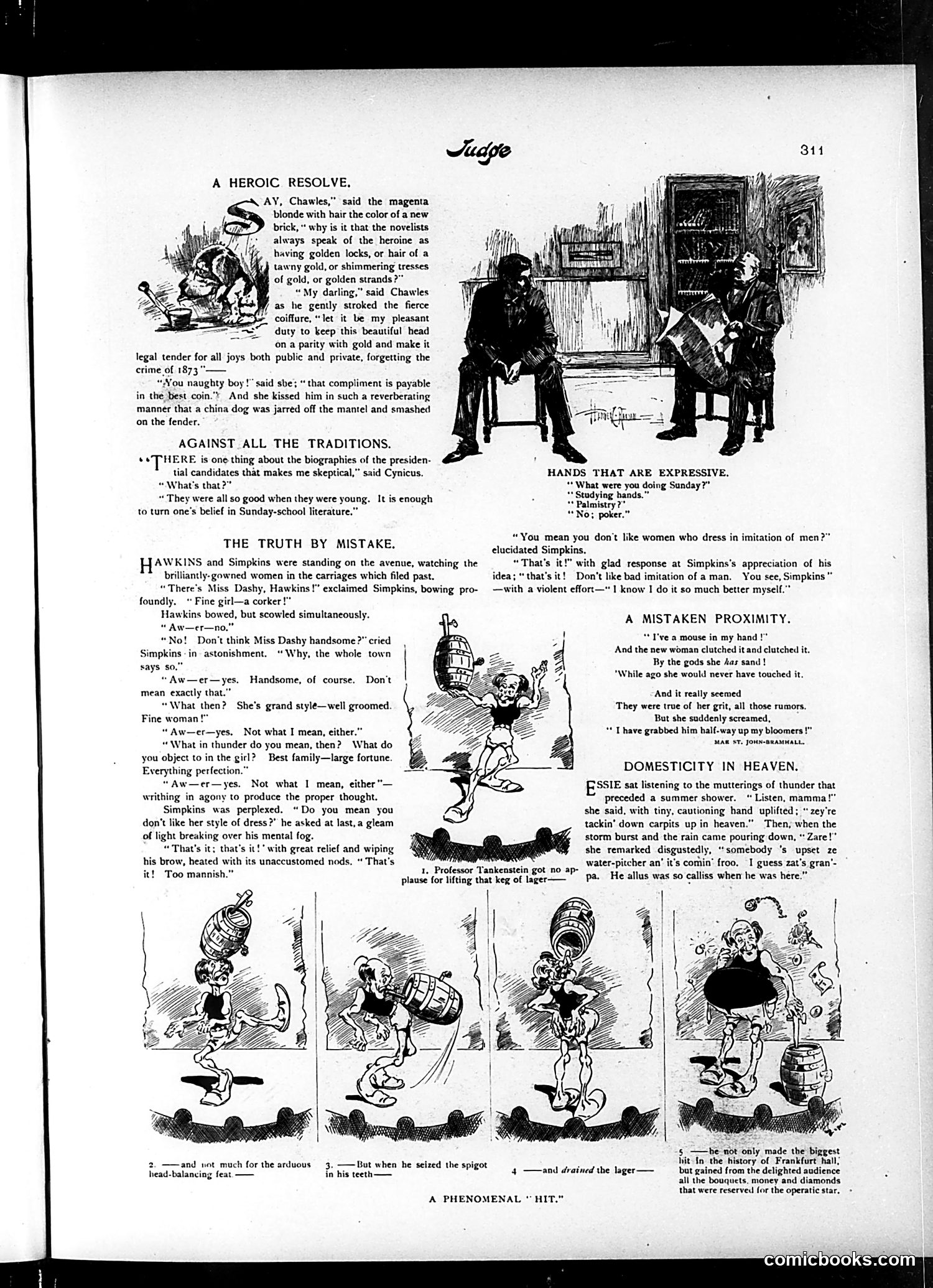
This page from Judge (a satirical weekly) contains several unrelated humor pieces typical of the era: **"A Heroic Resolve"** mocks a romantic couple's clichéd dialogue about golden hair—the woman has notably red/brick-colored hair, making the boyfriend's flowery compliments absurd flattery. **"The Truth by Mistake"** satirizes masculine fashion trends. Hawkins disapproves of women dressing in "mannish" style—apparently a contemporary concern about women adopting men's clothing conventions. **"Against All Traditions"** critiques how young women, contrary to Sunday-school morality teachings, aren't virtuous. **"A Phenomenal Hit"** depicts a strongman (Professor Tankenstein) performing feats, with a caption joke about a woman accidentally grabbing a mouse in her bloomers—playing on 1890s anxieties about "New Woman" independence and impropriety. **"Domesticity in Heaven"** presents a child mishearing thunder as carpentry work in heaven—gentle domestic humor. The page reflects late-19th-century anxieties about changing gender roles and women's fashion modernization.
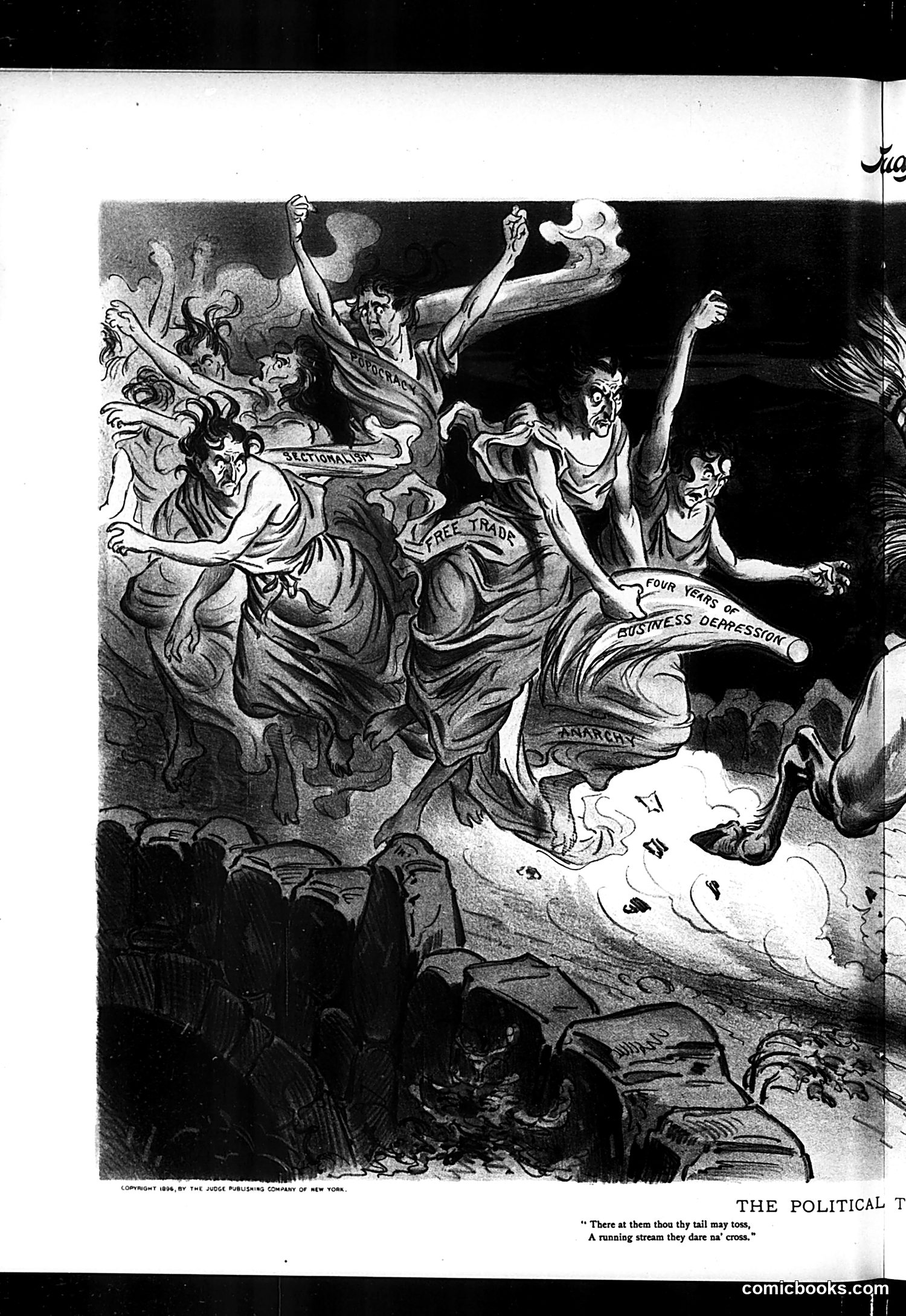
This Judge magazine cartoon depicts a chaotic allegorical scene showing political and economic forces as demons or devils confronting obstacles. The visible labels include "SECTIONALISM," "FREE TRADE," and "FOUR YEARS OF BUSINESS DEPRESSION," suggesting the cartoon addresses late 19th-century American political divisions and economic hardship. The demons appear trapped or blocked by a stream, referenced in the Scottish verse quotation below. This likely represents protective barriers against destructive political forces—sectionalism (North-South divisions) and trade policy disputes were major 1890s political battlegrounds. The "business depression" reference suggests this dates to the severe economic downturn of 1893-1897. The satire mocks how these political antagonisms flourished during hard economic times, presenting them as malevolent forces the nation must resist crossing back into mainstream policy.
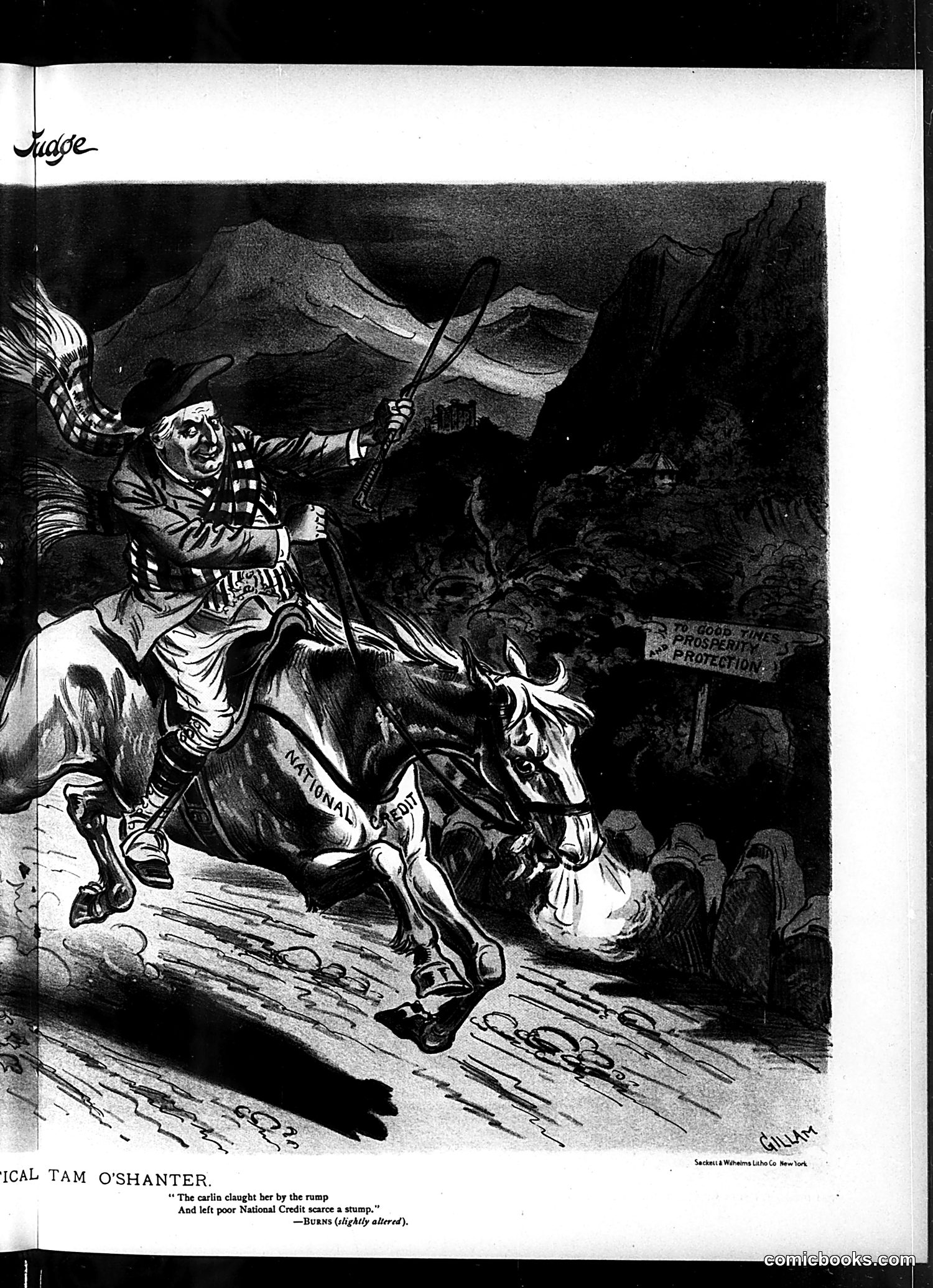
This cartoon satirizes Irish-American political corruption, likely from the late 19th century. The figure riding the horse labeled "National Credit" appears to be an Irish politician or ward boss (suggested by the "Tam O'Shanter" Scottish cap and Irish associations). The cartoon alludes to Robert Burns' poem about a witch attacking a man's horse. The satire suggests that Irish political machines were recklessly depleting the nation's financial credit and stability through corrupt practices. The "carlin" (old woman/witch) represents corruption or mismanagement. The quote's alteration—substituting "National Credit" for the original text—makes explicit that political corruption was literally destroying the country's financial foundation. This reflects late-19th-century Anglo-American anxieties about immigrant political power and fiscal responsibility.
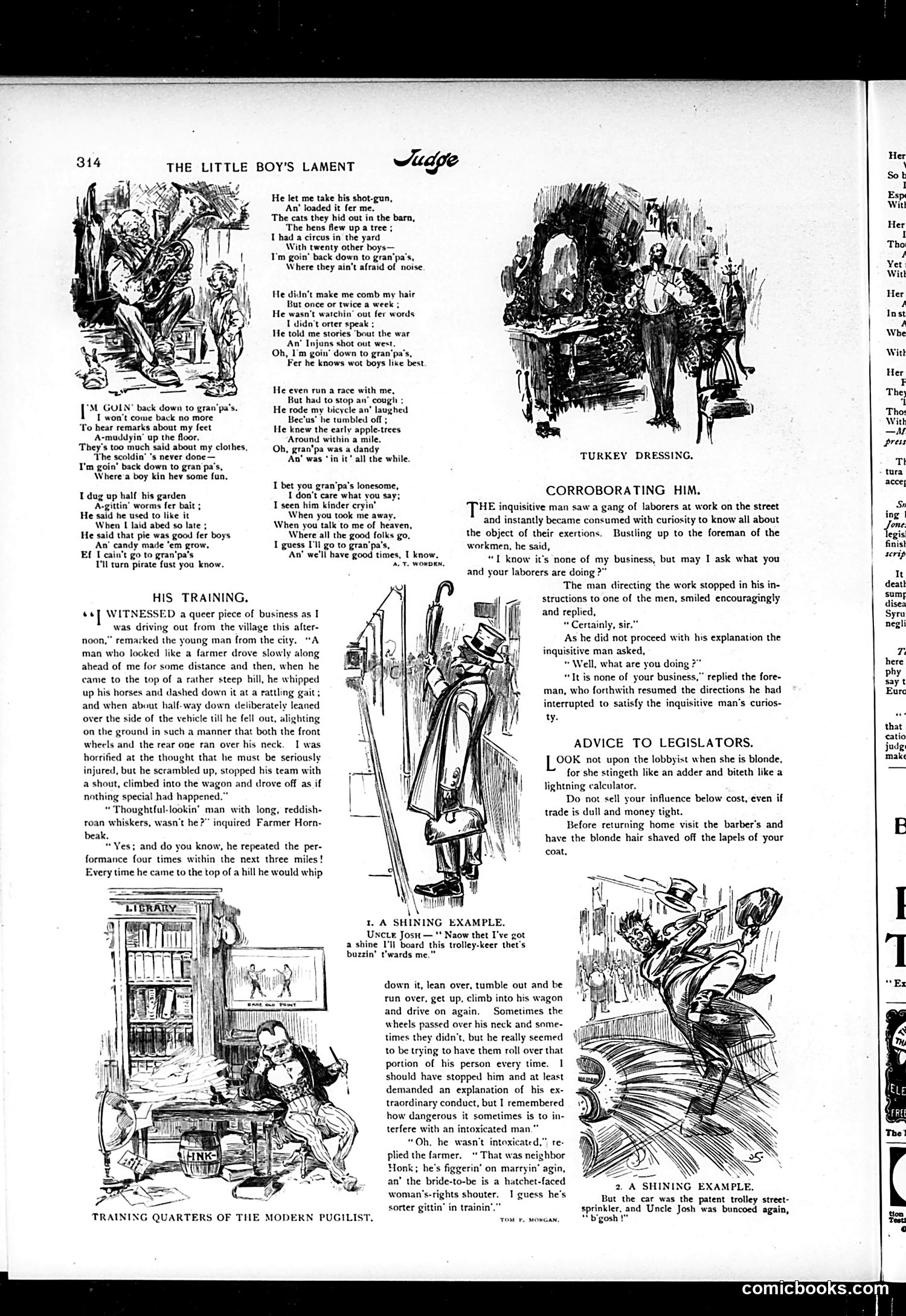
This page contains several satirical pieces typical of late 19th-century American humor: **"The Little Boy's Lament"** (poem with illustrations): A nostalgic contrast between strict urban parenting and permissive rural grandfather-care. The boy prefers his grandfather's indulgence—allowing guns, bicycles, stories about Indian wars, and freedom from grooming demands—over his parents' discipline. The satire critiques rigid Victorian child-rearing by romanticizing a more relaxed alternative. **"His Training"** and related cartoons: Mock the "modern pugilist" (boxer) and his training methods, satirizing emerging sports culture and the absurdity of athletic regimens. **"Corroborating Him"** and **"Advice to Legislators"**: Brief satirical vignettes poking fun at various social types—the nosy questioner, the suicidal farmer (apparently drunk), and lobbyists. The overall tone is gentle mockery of contemporary American social practices, parenting styles, and character types, using exaggeration and irony typical of Judge's editorial humor.
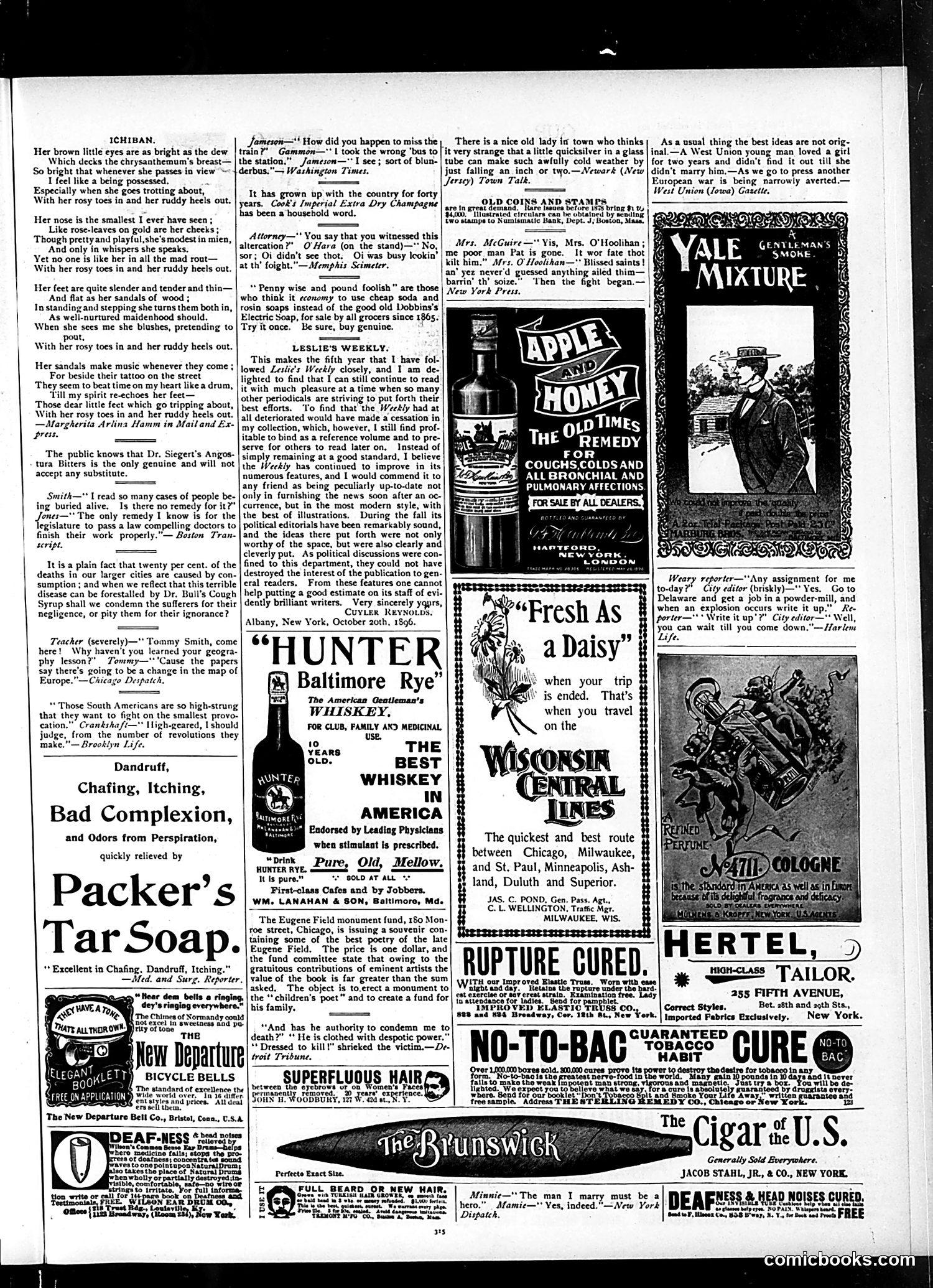
This page is primarily **advertising and light humor** rather than political satire. The content consists of: **Main Elements:** - A romantic poem "Ichiban" about a Japanese woman with stereotypical descriptions ("rosy toes," "modest mien") - Multiple product advertisements (Packer's Tar Soap, Hunter Rye Whiskey, Yale Mixture tobacco, Hertel Tailor) - Brief jokes about mundane topics: avoiding trains, buying soap, South American temperament **Social Context:** The page reflects **1890s attitudes toward Japan and Asian stereotypes**—the poem exoticizes Japanese femininity in ways modern readers would recognize as orientalist. The jokes are apolitical, concerning domestic life and commerce rather than governmental issues. **No significant political cartoon is visible.** This appears to be a typical Judge issue: mixing genteel poetry, advertising, and mild domestic humor typical of that era's satirical magazines. The "satire" is gentle wordplay rather than sharp political commentary.
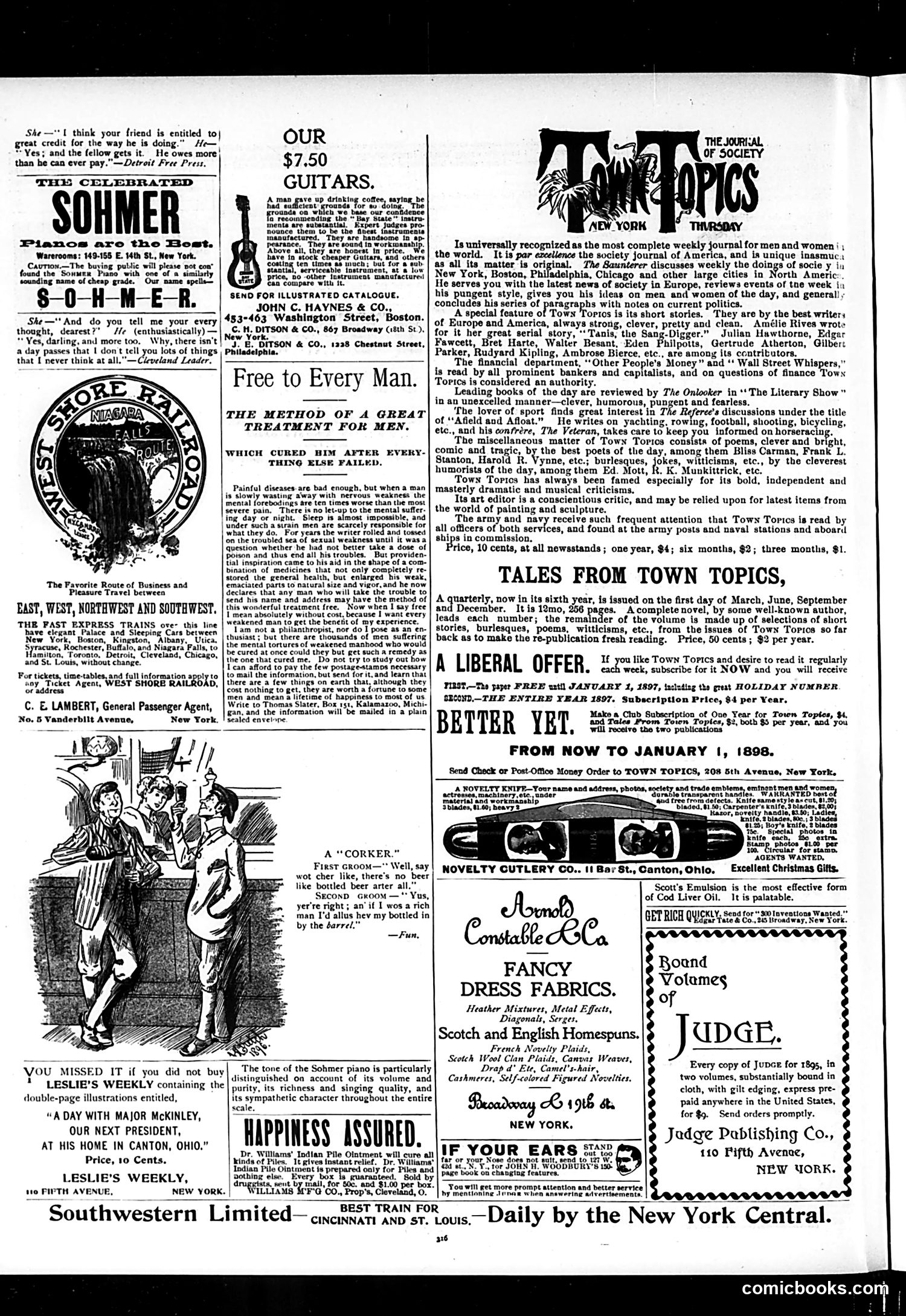
This page is primarily **advertising and promotional content** rather than political satire. The main cartoon—labeled "A 'Corker'"—depicts two groomsmen discussing beer after a wedding, with the joke being a mild pun about bottled beer being superior ("corker" meaning excellent). The humor is purely social/domestic rather than political. The page features advertisements for pianos, guitars, trains, medical treatments, and other consumer goods typical of 1890s magazines. There is one brief dialogue cartoon at top showing a couple joking about honesty in relationships—again, domestic humor without political content. **Town Topics**, advertised prominently, was Judge's companion society gossip publication for the wealthy elite. The historical significance here is **commercial rather than satirical**—this reflects how 1890s magazines funded themselves through extensive advertising while maintaining editorial content.
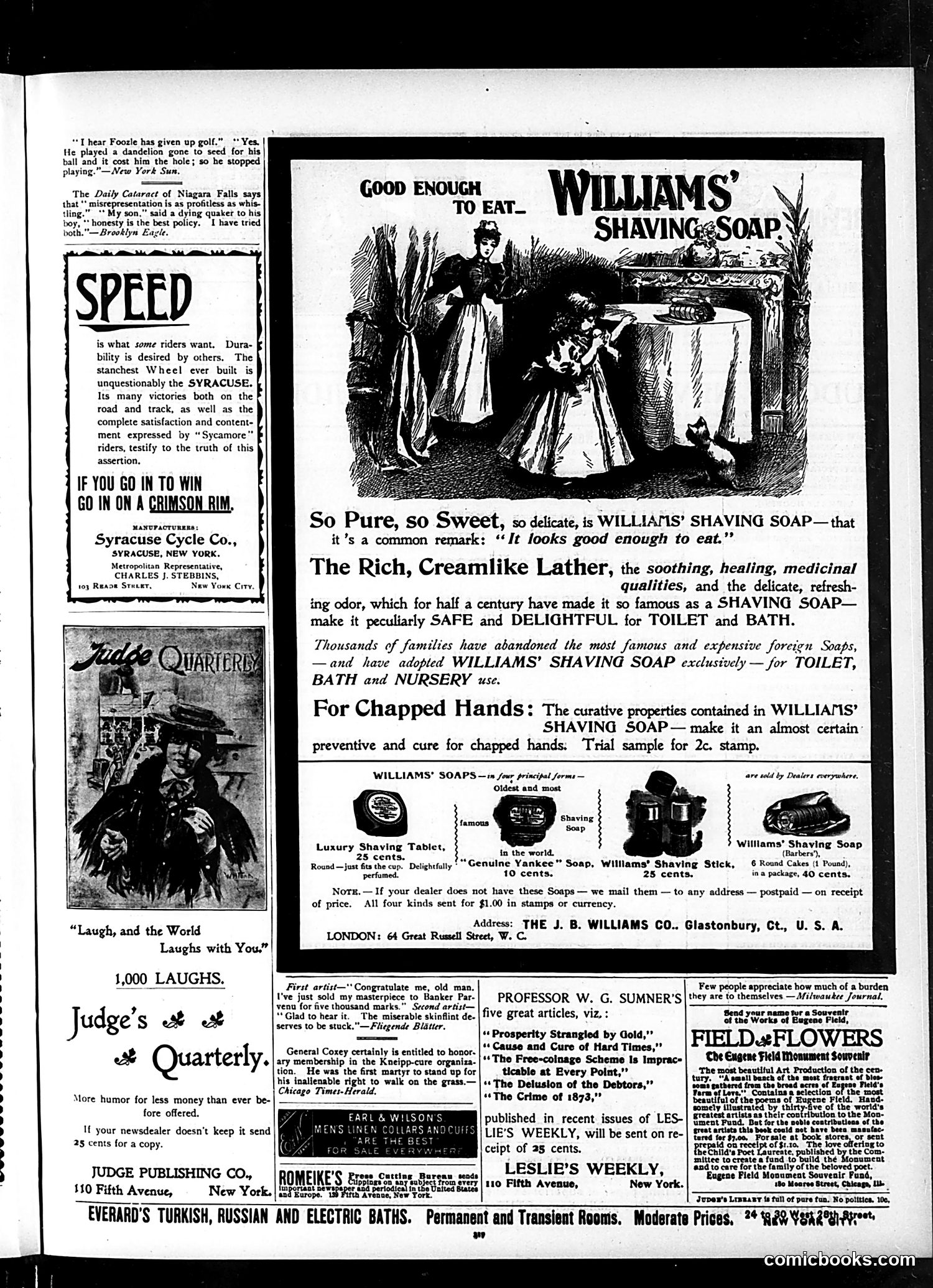
This page from Judge magazine is primarily **advertising and filler content**, not political satire. The major content includes: **Advertisements:** - Williams' Shaving Soap (dominant, center-right): Marketed as so pure "it looks good enough to eat," emphasizing safety for toiletries and chapped hands - Syracuse Cycle Co.: Bicycle advertisement emphasizing durability and racing victories - Judge's Quarterly: Magazine subscription promotion - Leslie's Weekly: Promoting Professor W.G. Sumner's articles on monetary policy (gold standard debates) - Field's Flowers: Eugene Field poetry souvenir **Humor items** (left side): Brief jokes from various newspapers, including one about a golfer using a dandelion seed as a golf ball, and a reference to General Coxey's rights to walk on grass—likely referencing Coxey's Army (1894), a labor protest movement. The page reflects late-19th-century consumer culture and monetary debates, but contains minimal political cartoon content.
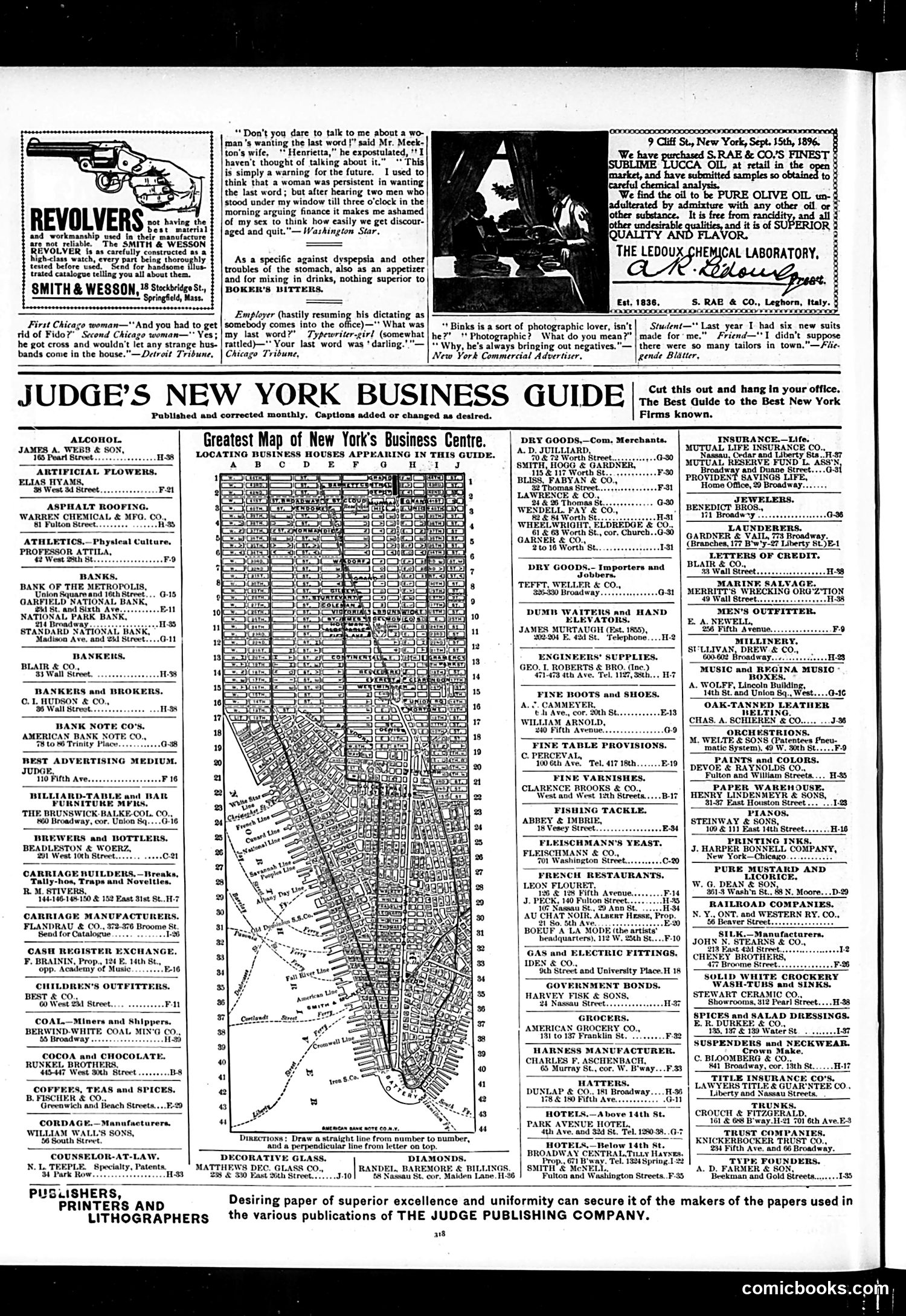
This is primarily a **business directory and advertising page** from Judge magazine (September 15, 1896), not a political cartoon page. The page features: 1. **A street map** of Manhattan's business center with numbered locations corresponding to listed businesses 2. **Multiple brief humorous anecdotes** in the margins, typical of Judge's satirical style: - A dialogue about women wanting "the last word" in arguments - A joke about a Chicago woman getting rid of her dog because it wouldn't let strangers (specifically "strange husbands") in the house—implying infidelity - Wordplay about a "photographic lover" who brings out "negatives" - A student claiming six new suits from tailors 3. **Extensive business listings** (banks, manufacturers, services) with addresses and grid references The humor is mild domestic satire reflecting late-Victorian attitudes about women, marriage, and propriety. This appears to be a **hybrid advertising/editorial page** rather than a dedicated cartoon section.
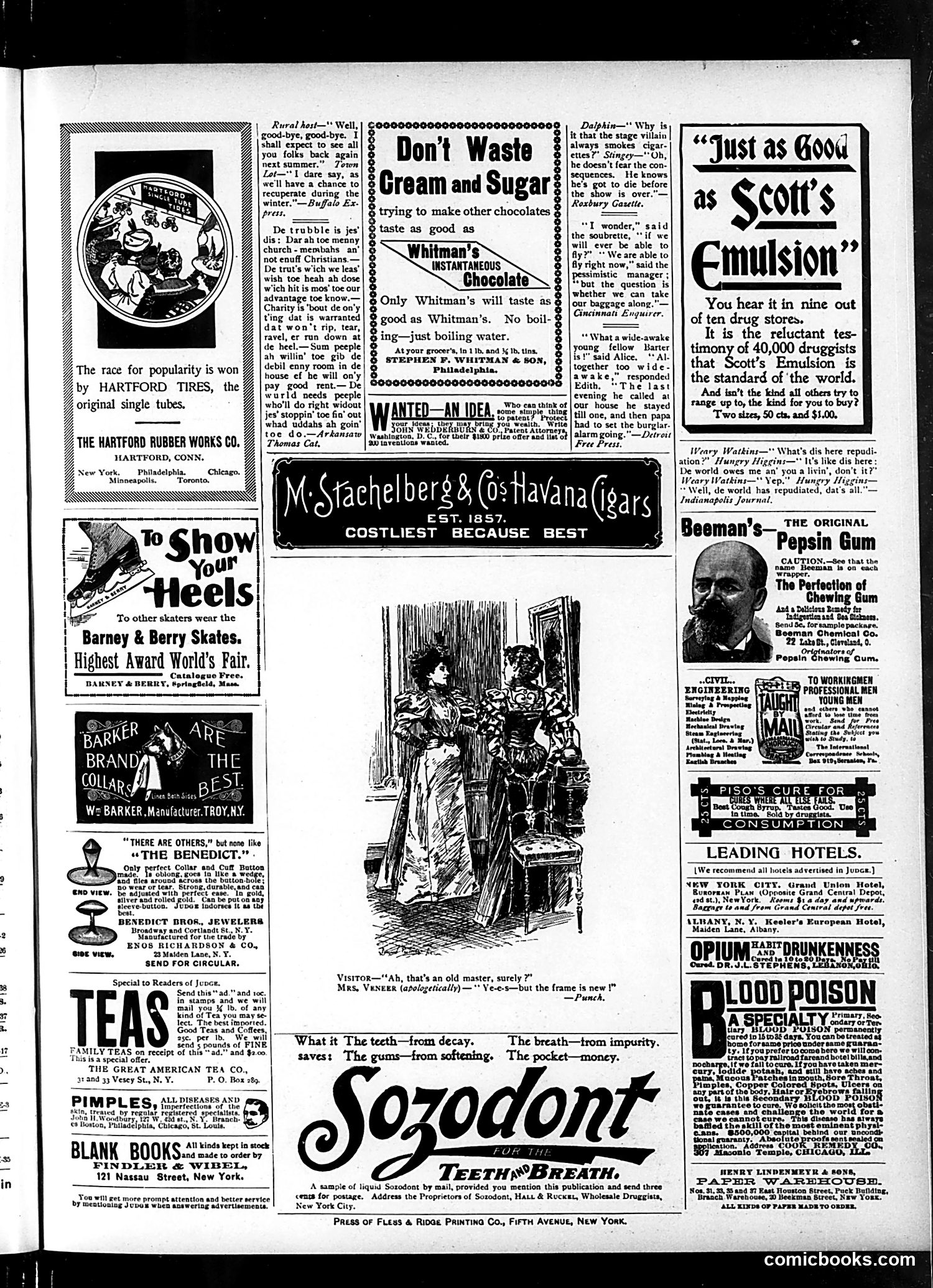
This page is primarily **advertising**, typical of Judge magazine's revenue model. The main content includes: **The Central Cartoon**: Shows a Victorian-era woman with two children viewing what appears to be a painting. The caption references "an old master" with a frame—likely satirizing wealthy Americans who bought European art without understanding authenticity, a common Gilded Age anxiety. **Surrounding Advertisements**: Products include Sozodont toothpaste, Scott's Emulsion (cod liver oil), Whitman's chocolates, and various patent medicines. These ads reflect late 19th/early 20th-century consumer culture. **Scattered Humor Snippets**: Brief jokes about church hypocrisy, stage villains, and romantic mishaps—typical period humor emphasizing morality and social propriety. **No Clear Political Satire**: Unlike typical Judge content, this page lacks overt political cartoons or social commentary. It's essentially a revenue-focused advertising section with light filler humor, representative of how magazines monetized through product endorsements during this era.
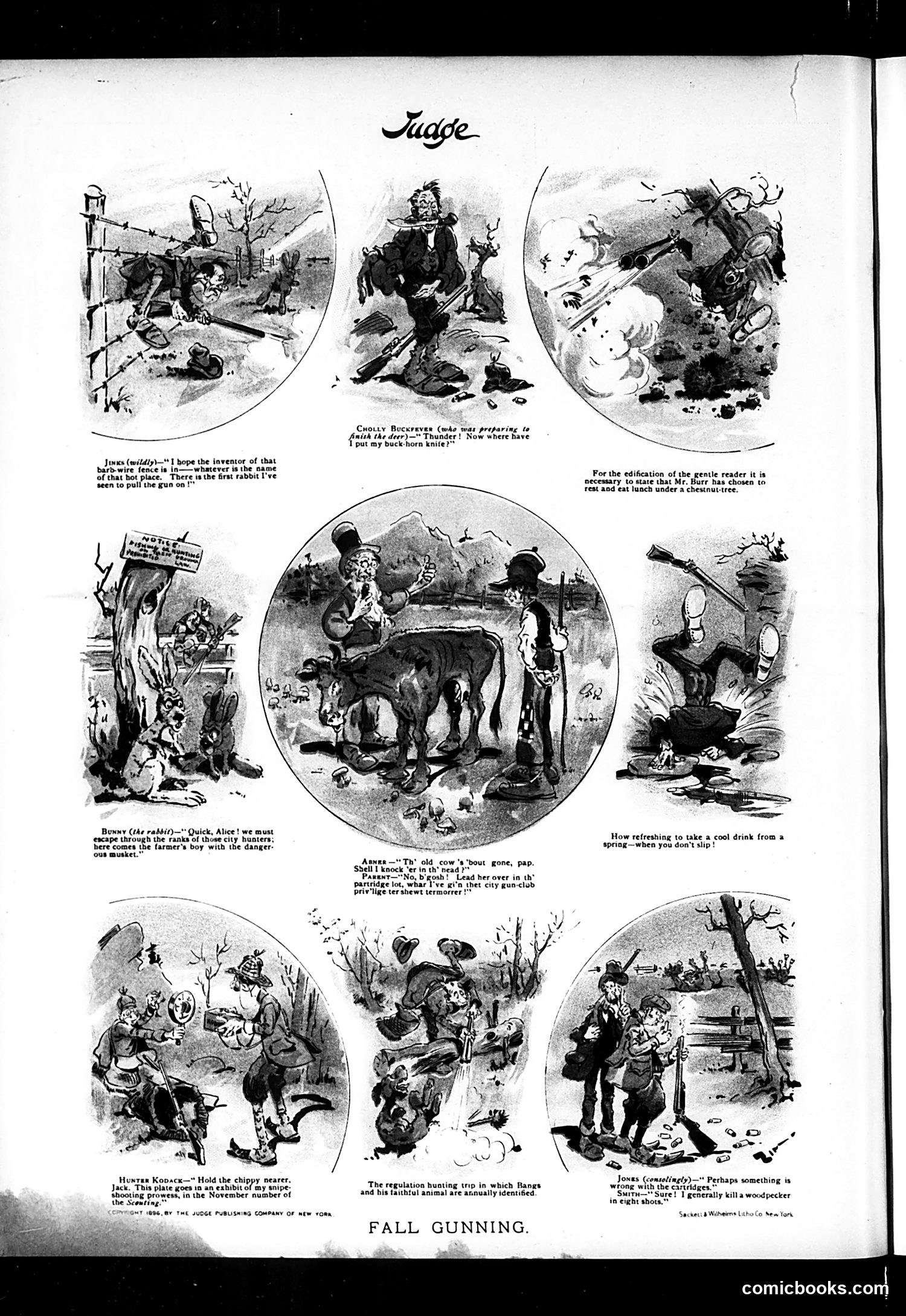
This page satirizes American hunting culture through multiple vignettes featuring bumbling sportsmen. The humor targets city dwellers and wealthy hunters who venture into the countryside during fall season, portraying them as incompetent and accident-prone. Key scenarios mock: - Urban hunters' dangerous ignorance (accidentally shooting each other, losing equipment) - Pretentious sport hunters obsessed with documenting kills for bragging rights - The collision between city folk and rural farmers/boys, who possess actual hunting skill - Slapstick mishaps: slipping at springs, lost knife blades, mysterious gun malfunctions The cartoons suggest that hunting attracts overeager amateurs more interested in masculine display than competence. References to "Mr. Burr" and "Bangs" appear to reference real contemporary hunting figures, though specific identities are unclear. The overall message: autumn hunting season brings comic chaos when unprepared city dwellers flood the countryside.