
A complete issue · 16 pages · 1896
Judge — August 22, 1896
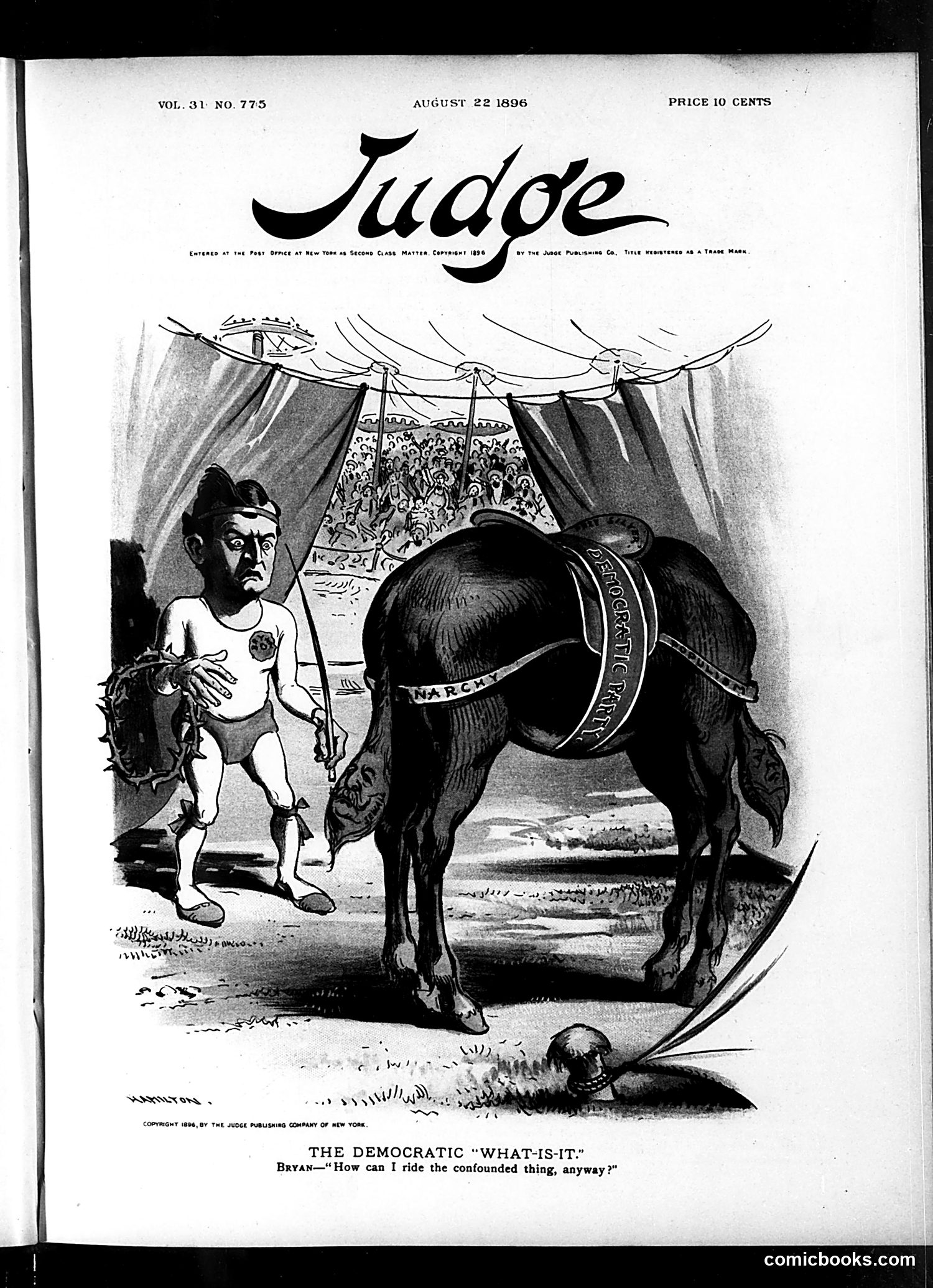
This cartoon satirizes William Jennings Bryan's 1896 presidential campaign. The figure labeled "Bryan" appears as a confused child attempting to ride a donkey labeled "ANARCHY" and "THE POPULIST" — representing the Democratic Party platform that Bryan championed. The caption reads: "How can I ride the confounded thing, anyway?" — mocking Bryan's ability to control or manage the radical, unpredictable forces he's aligned with. The circus tent behind suggests a chaotic spectacle, while the thorny object Bryan holds symbolizes the difficult political thorns of his populist agenda. The Republicans' message: Bryan's Democratic coalition is uncontrollable and dangerous, combining anarchist and populist elements incompatible with stable governance.
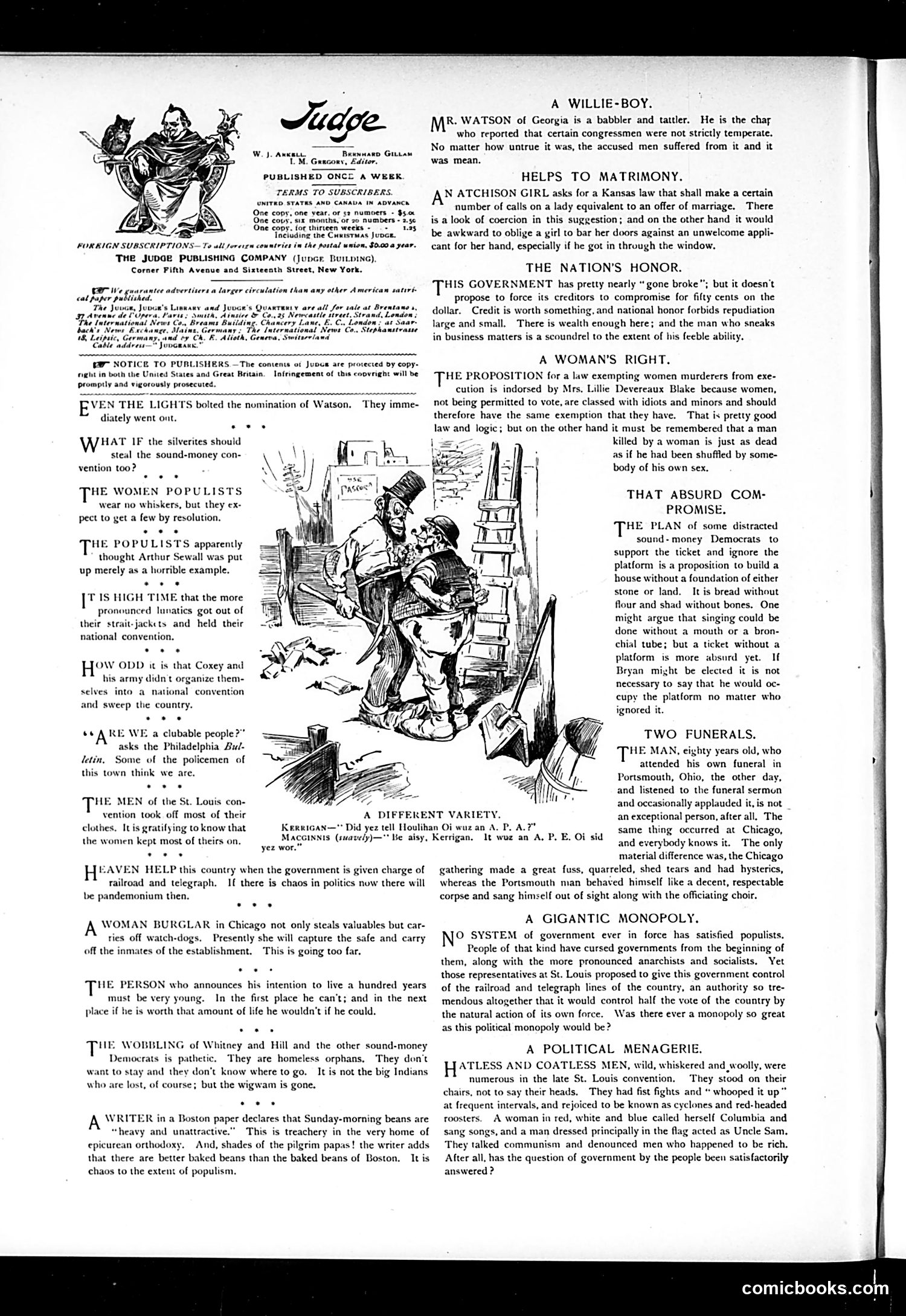
This cartoon depicts what appears to be a domestic dispute or altercation, with a man and woman in period dress engaged in physical conflict in a home interior. The accompanying dialogue—"Did ye tell Henahan O'i wore an A. P. A.?" and a response about wearing "A. P. O. old yez woe"—references the **American Protective Association**, a nativist, anti-Catholic organization active in the 1890s. The satire mocks Irish-American identity politics of the era, suggesting that disputes over membership in such organizations led to real-world conflict within immigrant communities. Judge uses this domestic scene to ridicule both the A.P.A.'s divisive rhetoric and Irish-American participation in nativist movements, implying such allegiances created social chaos and domestic discord.
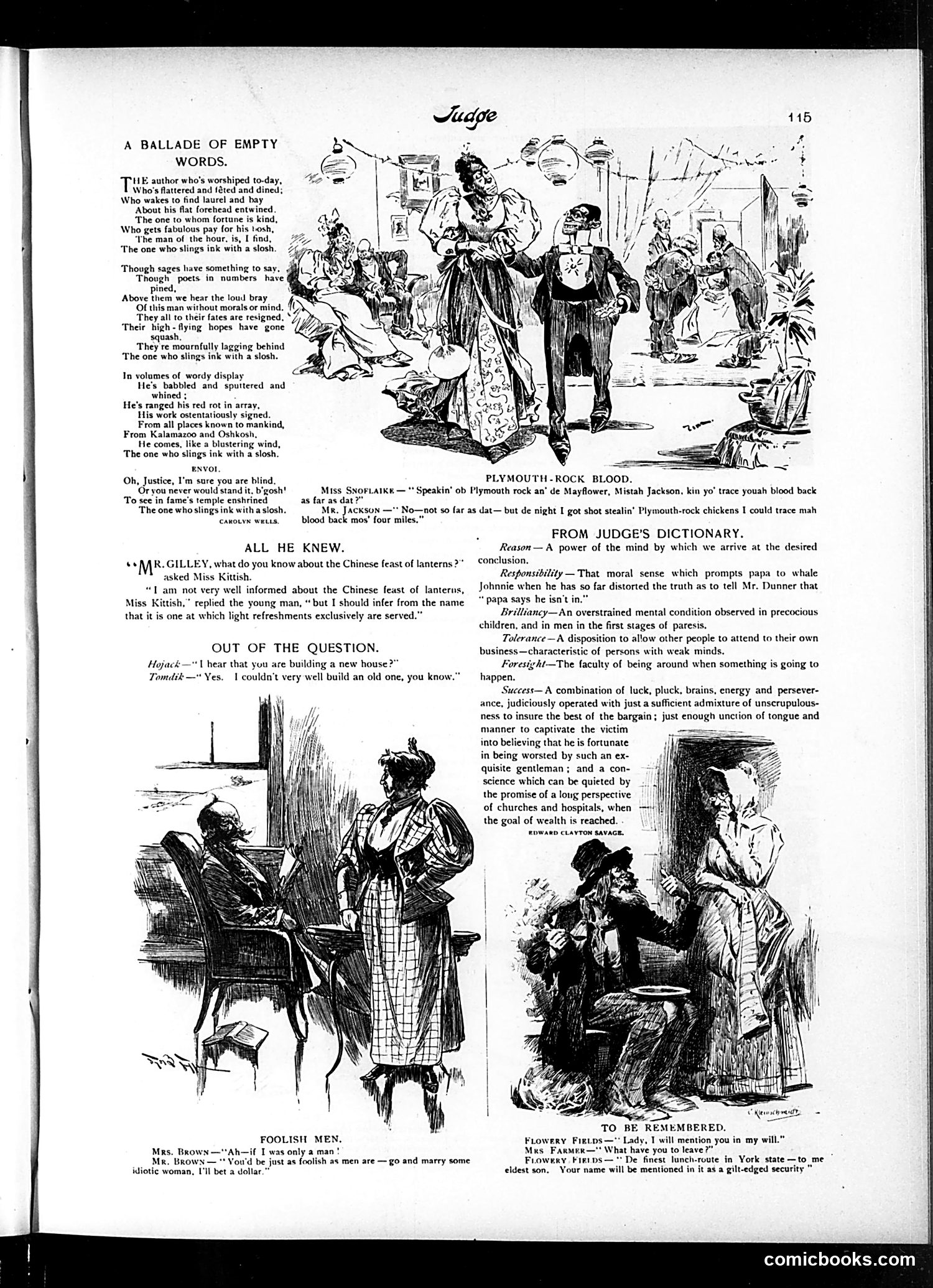
This Judge magazine page contains several satirical sketches and literary pieces mocking contemporary figures and social types. **"Plymouth-Rock Blood"** ridicules pretentious New Englanders claiming descent from the Mayflower, with characters using exaggerated dialects to demonstrate their supposed superiority while behaving foolishly. **"All He Knew"** satirizes Mr. Gilley's superficial knowledge—he confuses a Chinese feast of lanterns with Miss Ketchup, suggesting pretentious ignorance about culture. **"Out of the Question"** mocks someone's absurd claim about building a new house without financial means. **"Foolish Men"** depicts Mrs. Brown lamenting that men won't marry sensible women, only foolish ones. The page targets Victorian-era pretension, class affectation, and gender stereotypes through humor and caricature typical of 1890s American satirical magazines.
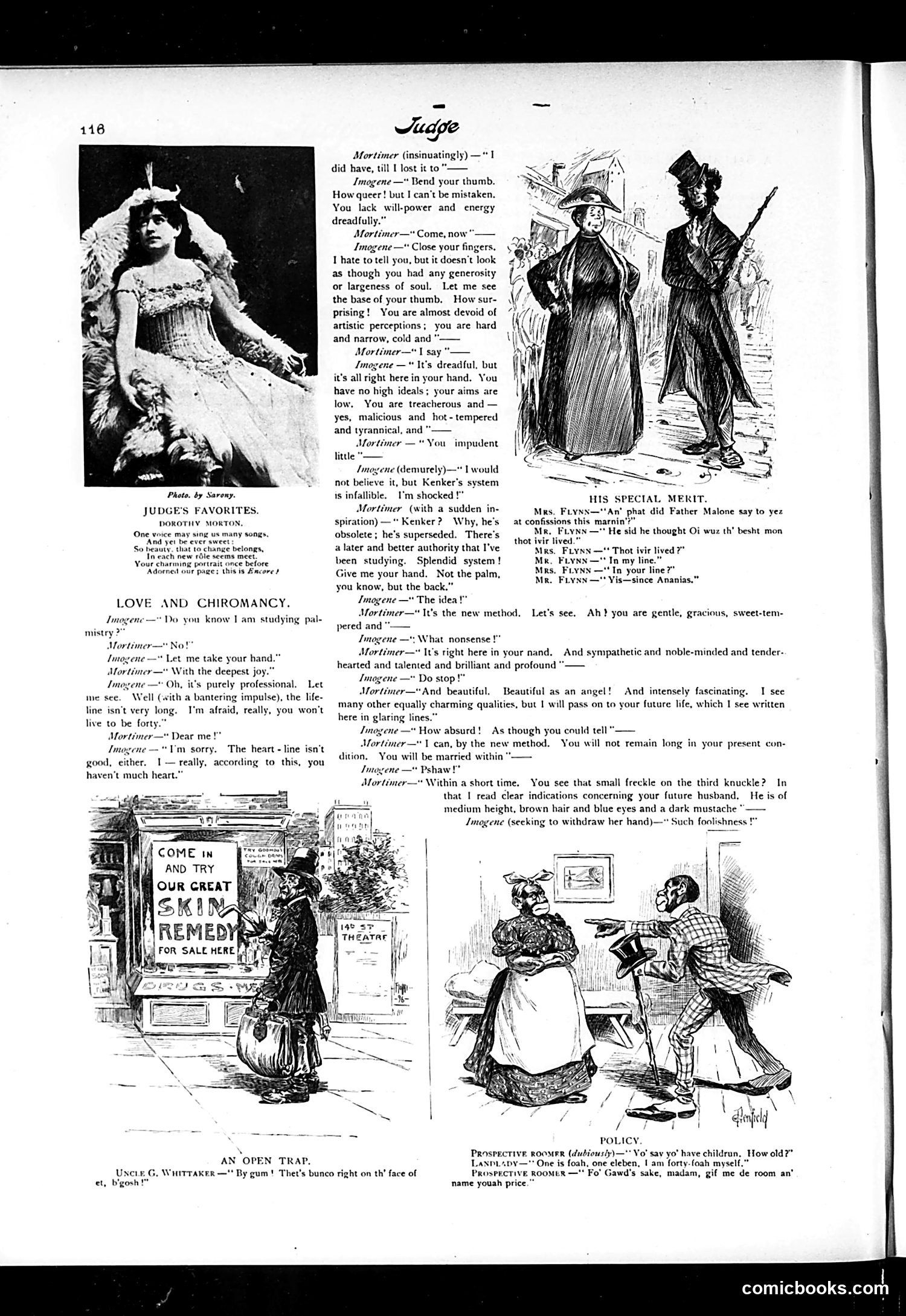
This page contains several satirical sketches typical of late 19th-century American humor: **"Love and Chiromancy"** (main dialogue): A young man (Mortimer) uses palmistry as a pickup line. He initially insults a woman (Imogene) by reading her palm—claiming she lacks generosity, artistic sense, and virtue. When she objects, he suddenly reverses course, praising her beauty and sensitivity, claiming he was using a "new method." The satire mocks men's manipulative flattery and the pseudoscience of palm-reading used for romantic advantage. **"His Special Merit"** (top right): An Irish dialogue joking that a priest praised someone as "the best man that ever lived"—in their specific occupation (implying moral mediocrity but professional competence). **"Policy"** (bottom): A landlady with multiple children seeks renters; a prospective tenant, horrified at her age and number of offspring, agrees to any price to escape. **"An Open Trap"** (left): A street scene of urban deception (likely advertising fraud). The humor targets romantic deception, pseudoscience, and social hypocrisy.
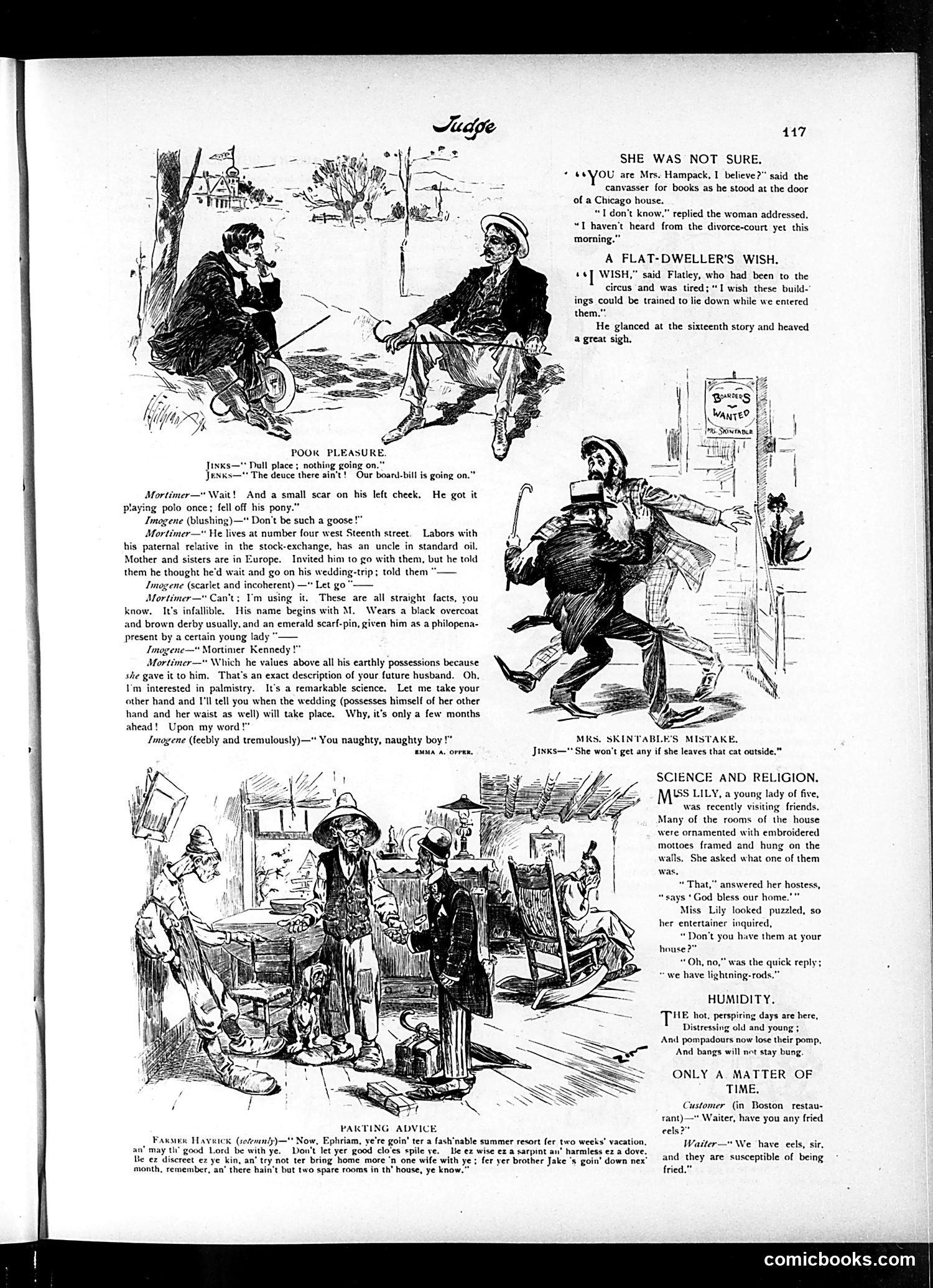
This page contains several brief satirical pieces typical of late 19th/early 20th-century American humor: **"Poor Pleasure"** depicts a young man (Mortimer Kennedy) using supposed "palmistry" skills to court a woman (Imogene) by reciting detailed facts about himself while holding her hands—clearly a transparent pickup artist routine. **"Parting Advice"** shows a rural father giving conventional (if slightly humorous) send-off advice to his son heading to a summer resort. **"She Was Not Sure"** jokes about a Chicago woman uncertain whether she's still married, awaiting divorce-court news—reflecting period anxieties about divorce. **"A Flat-Dweller's Wish"** is simple physical humor about city apartment life: a tired circus-goer wishes buildings could lie down so he wouldn't climb stairs. **"Science and Religion"** contrasts a child's practical American pragmatism with old-fashioned religious mottos—the girl's family has "lightning-rods" rather than pious wall hangings. The remaining items are brief gags about humidity, eels, and cats. The page is primarily light domestic and courtship humor with gentle social observation.
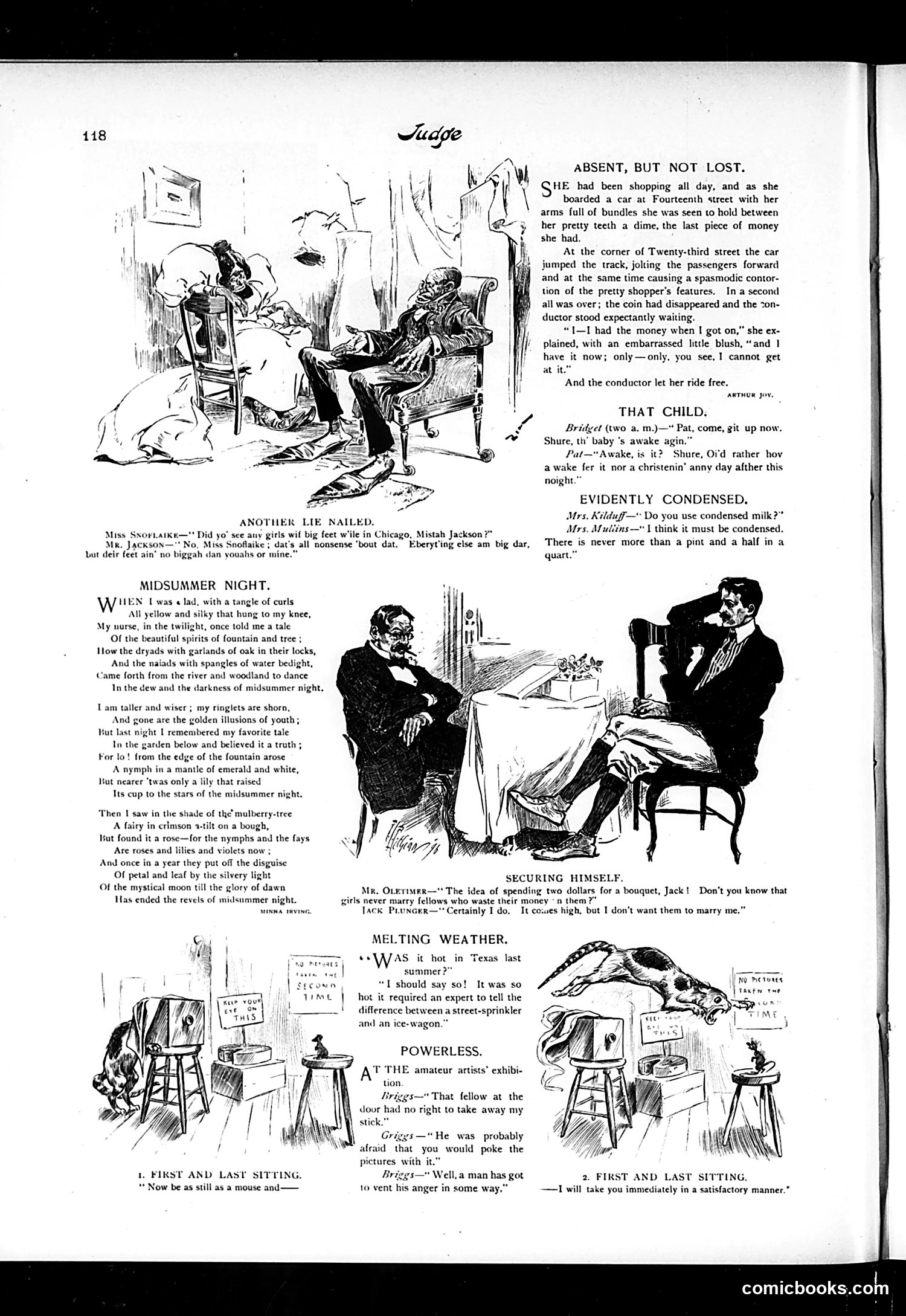
This page from *Judge* contains multiple brief satirical sketches typical of the magazine's format: **"Absent, But Not Lost"** mocks a woman who swallowed her last dime during a streetcar accident, then couldn't retrieve it—the conductor lets her ride free out of sympathy. The satire targets both female vanity (shopping all day) and the absurdity of the situation. **"Another Lie Nailed"** uses racist dialect humor common to the era, with a Black character denying that Chicago women have large feet, sarcastically attributing all other "big" things to the city. **"Midsummer Night"** is sentimental poetry about childhood imagination versus adult reality—discovering garden "fairies" are merely flowers. **Other sketches** include Irish domestic humor ("That Child"), observations on condensed milk measurements, and commentary on amateur artists and courtship rituals. The page exemplifies *Judge*'s mix of social observation, domestic humor, and period prejudices, reflecting early 20th-century American comedy sensibilities.
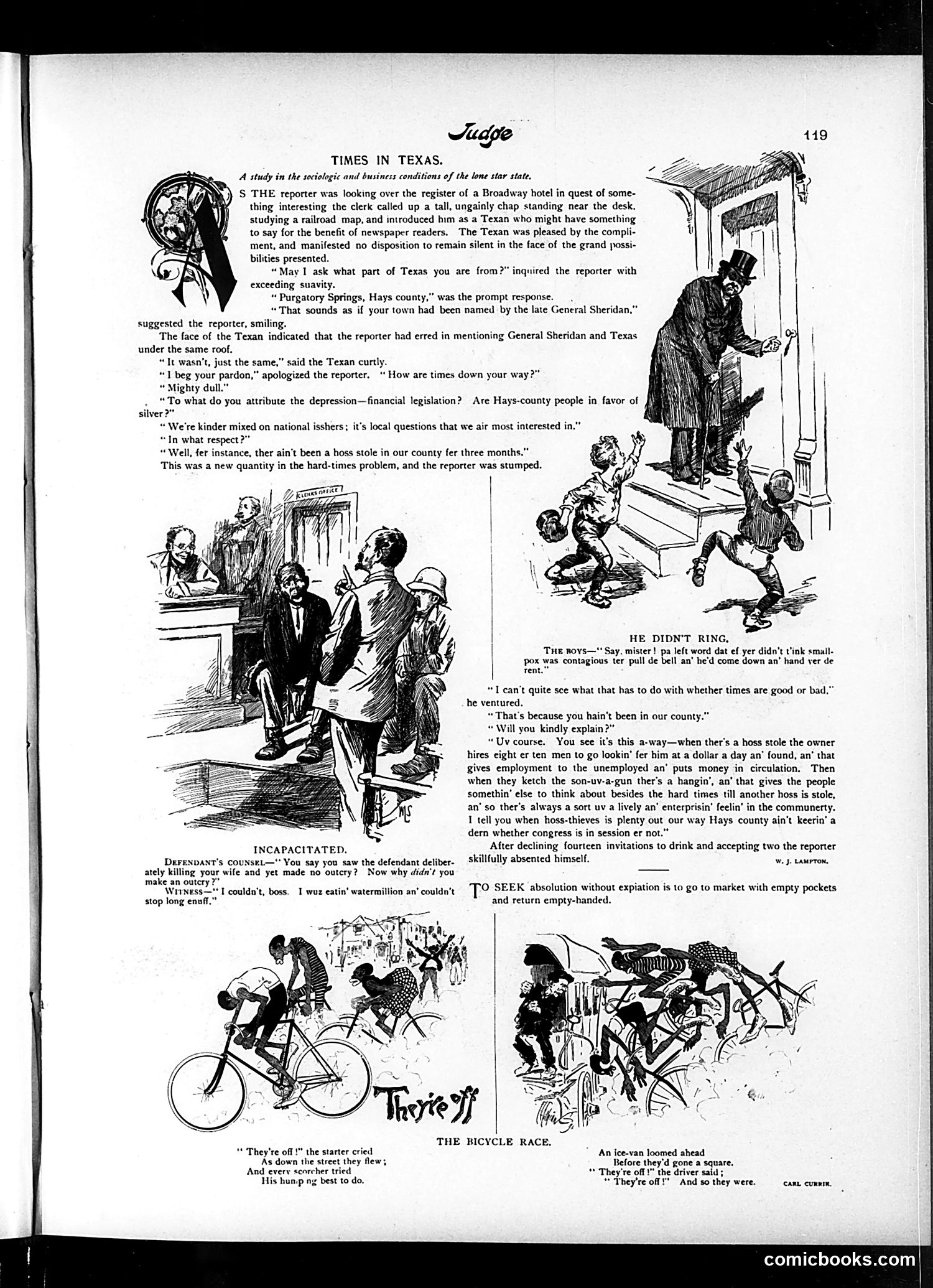
This page satirizes rural Texas attitudes toward economic hardship during what appears to be the 1890s depression era. A Broadway reporter interviews a Texan from "Purgatory Springs" seeking commentary on financial conditions. The joke: the Texan measures local prosperity not by national economic indicators (silver vs. gold legislation) but by *horse thefts*. Fewer stolen horses means economic depression because theft-related activities—hiring searchers, conducting hangings—stimulate local employment and provide entertaining distraction from hard times. The satire mocks both the reporter's urban, sophisticated economic assumptions and rural Texas's backwards priorities and violent social customs. Supporting cartoons ("He Didn't Ring," "The Bicycle Race") employ similar deadpan humor about unexpected consequences and misunderstandings. The General Sheridan reference alludes to his reported contempt for Texas during Reconstruction.
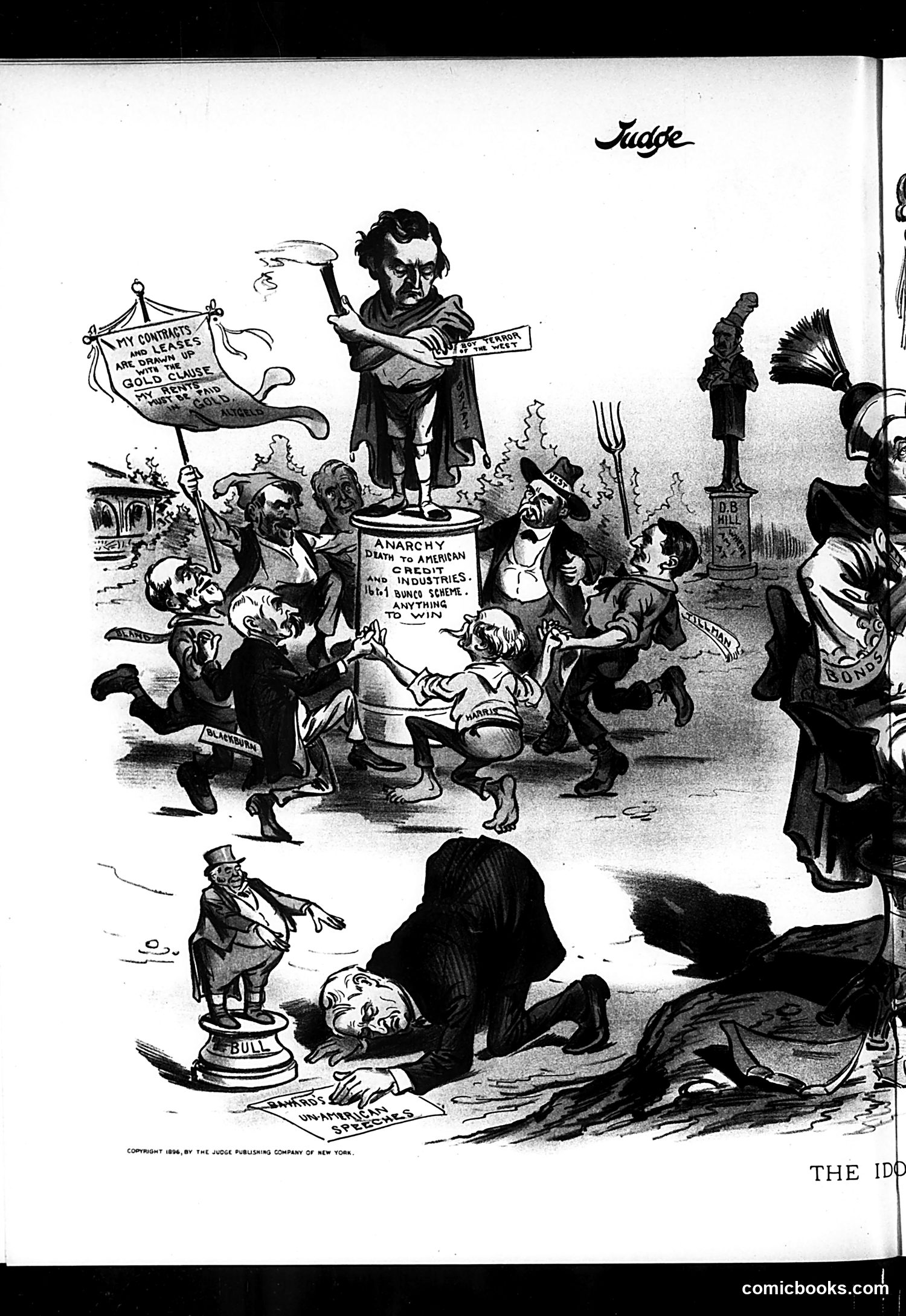
This 1896 Judge cartoon depicts "Anarchy" as a central demonic figure standing on a pedestal, surrounded by caricatured anarchists and radical figures dancing or worshipping below. The pedestal lists anarchism's supposed goals: undermining American credit, destroying industries, and promoting violent schemes. The cartoon satirizes late-19th-century American anxieties about anarchism and radical political movements. The demons and grotesque figures represent how mainstream society viewed anarchists—as dangerous, irrational threats to capitalism and industrial society. A figure labeled "Bull" appears at bottom left, likely representing police response to anarchist agitation. This reflects the historical period following violent anarchist bombings and assassinations in America and Europe (1890s), when anarchism was widely portrayed as an existential threat requiring strong suppression.
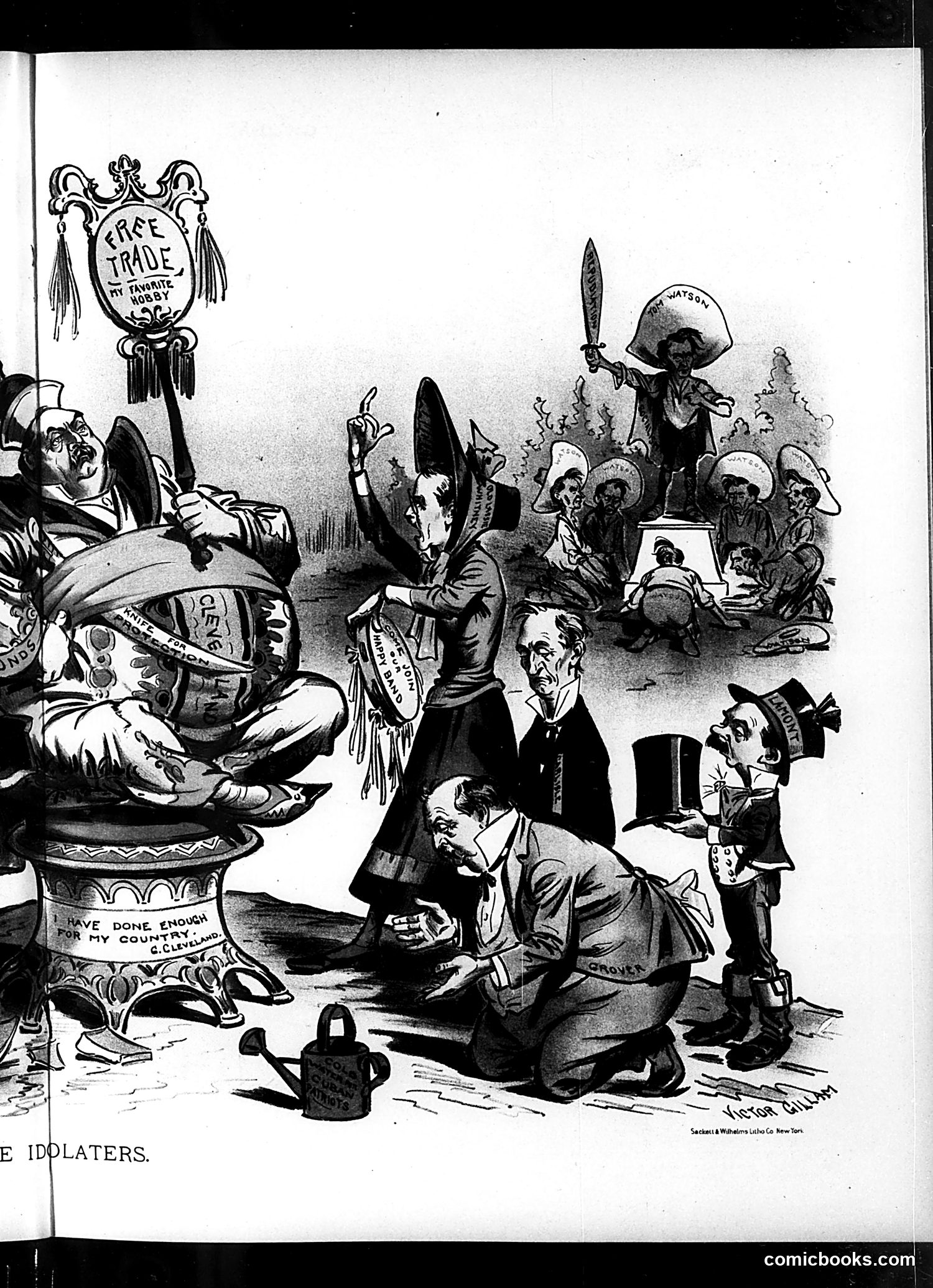
This satirical cartoon depicts figures worshipping at an altar labeled "Free Trade—My Favorite Hobby." The central scene shows men in formal dress bowing before an ornate pedestal, while indigenous figures and armed warriors surround them, appearing to represent colonial or imperial subjects. The satire critiques free-trade advocates (the "idolaters") as blindly devoted to commercial ideology. The imagery suggests that free trade policies, particularly regarding colonial territories, involved exploitation masked by economic rhetoric. The contrast between the formally dressed Western businessmen and the armed, subjugated figures emphasizes how free-trade doctrine served imperial expansion and resource extraction. The banner reading "I've Done Enough For My Country" (partially visible) reinforces the ironic message: advocates claimed moral superiority while pursuing exploitative policies. This reflects late-19th-century American debates over trade protectionism versus free trade during imperial expansion.
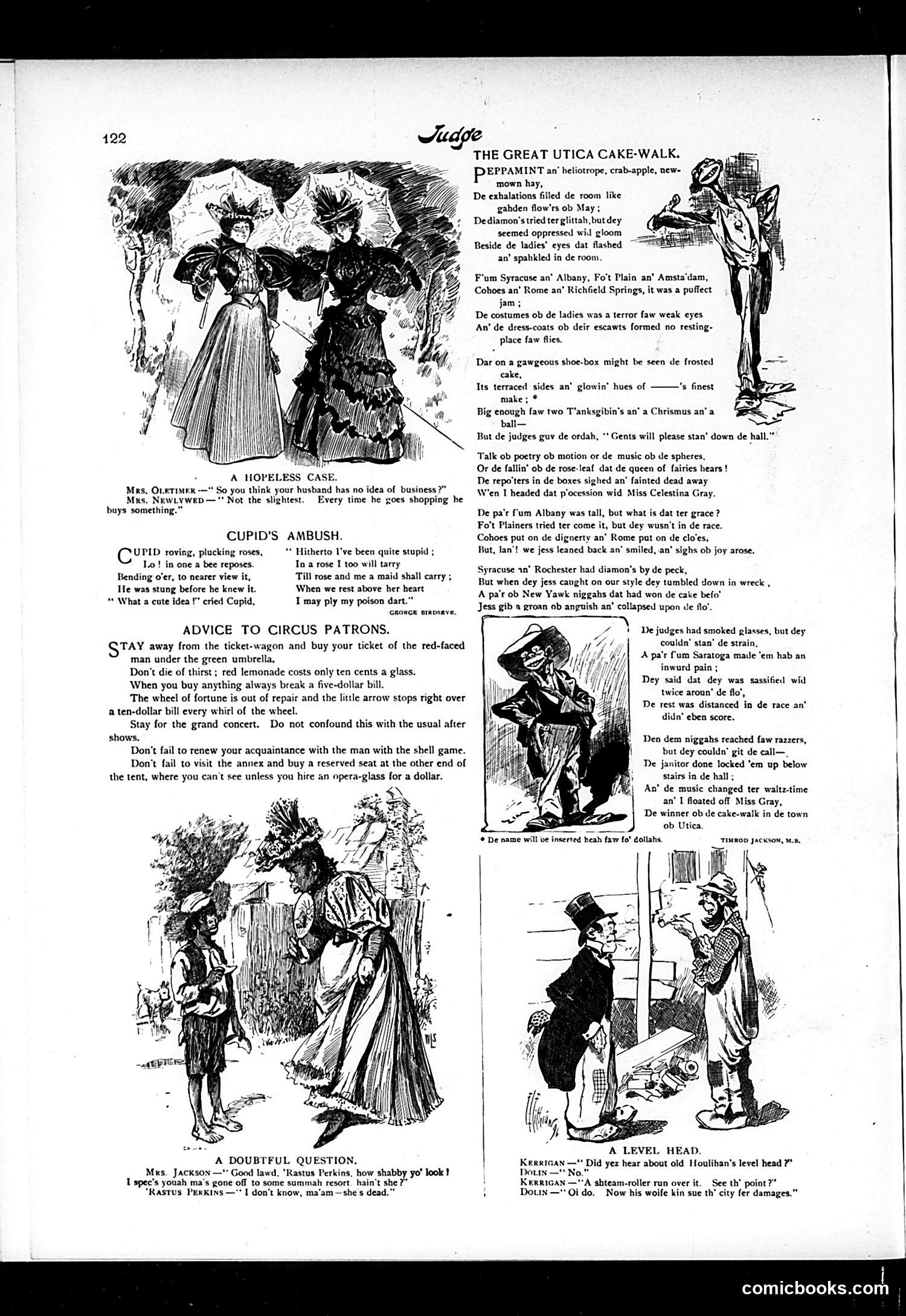
This Judge magazine page contains multiple pieces of period humor, most troublingly including **"The Great Utica Cake-Walk,"** a racist dialect poem mocking African Americans through exaggerated phonetic speech ("niggahs," "faw," "ob"). The cake-walk—originally a Black dance—is presented here as spectacle for white audiences' entertainment and ridicule. The other content includes: - **"A Hopeless Case"**: A domestic humor joke about a husband who can't shop without buying unnecessary items - **"Cupid's Ambush"**: A sentimental poem about Cupid discovering deception via a bee in a rose - **"Advice to Circus Patrons"**: Satirical "tips" exposing circus scams (rigged games, overpriced lemonade, obstructed views) - **"A Doubtful Question"** and **"A Level Head"**: Brief dialect jokes with African American characters presented as ignorant or dim-witted The page reflects Judge's satirical approach to social commentary, though its humor relies heavily on racial caricature and stereotype—standard for this era but deeply offensive by modern standards.
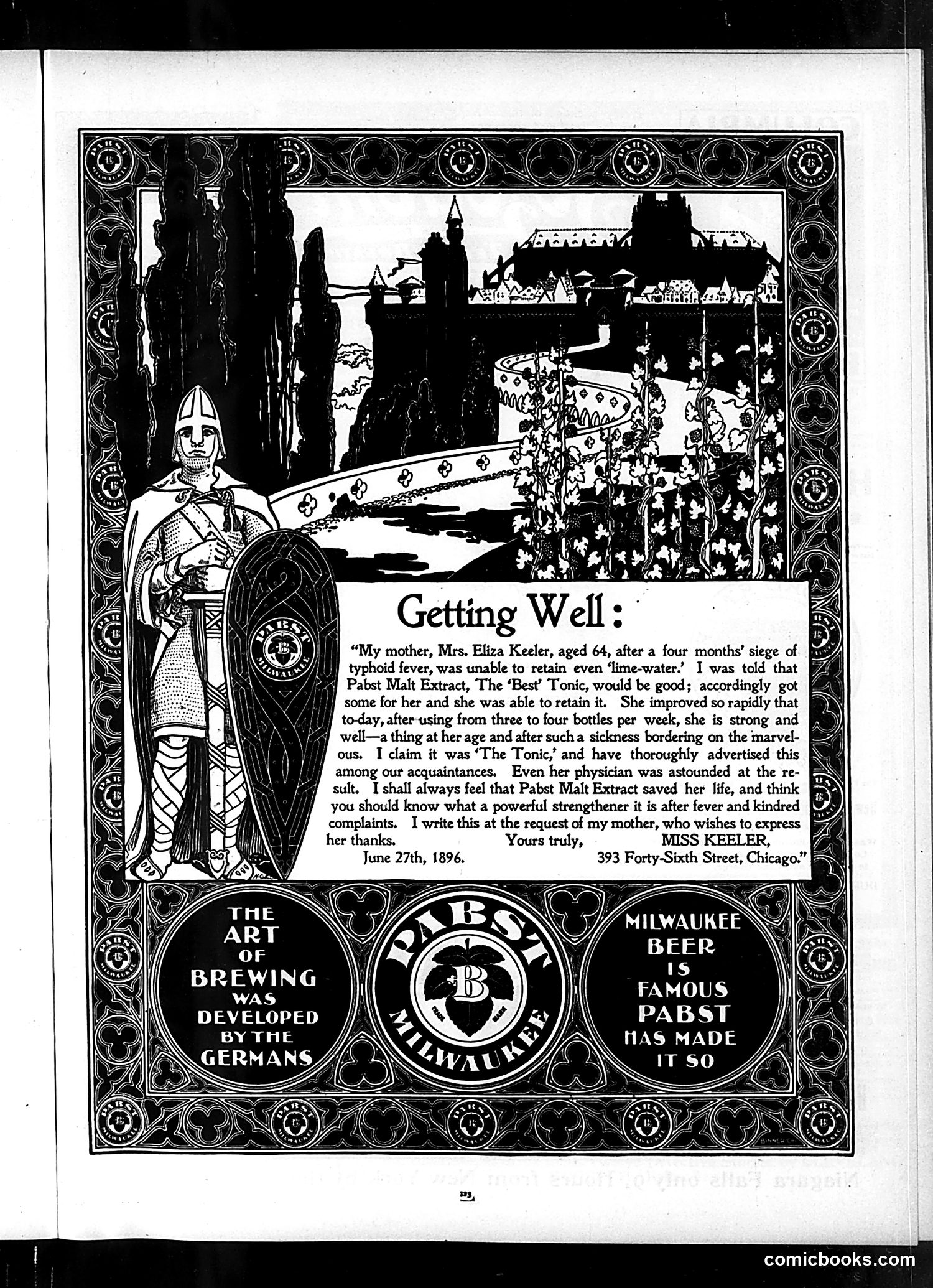
This is a **patent medicine advertisement**, not satire. It appears in Judge magazine circa 1896 and promotes Pabst Malt Extract as a health tonic. The page features a testimonial letter from Miss Keeler describing how the product allegedly saved her elderly mother's life during typhoid fever recovery. The mother reportedly couldn't retain food or water but tolerated the malt extract, leading to rapid improvement. The decorative medieval border and armored knight figure are designed to suggest strength, tradition, and trustworthiness—common marketing tactics of the era. **What modern readers should know:** This represents the "patent medicine" boom of the 1890s, when unregulated tonics made extravagant health claims without scientific evidence. The FDA didn't exist yet; such testimonials were common advertising. While Pabst was a legitimate brewery, malt extract had no proven medicinal powers. This exemplifies why the 1906 Pure Food and Drug Act eventually became necessary.
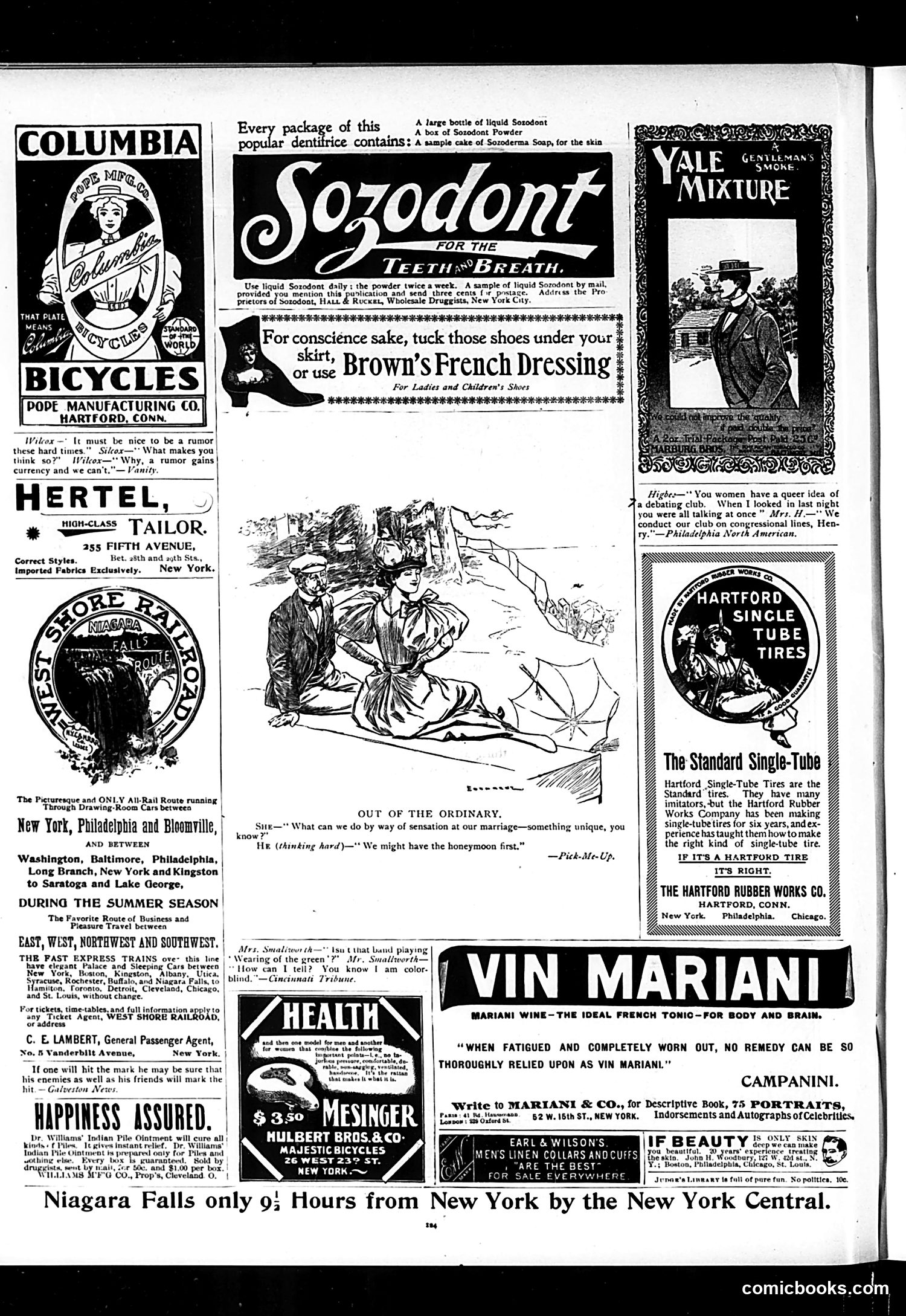
This is primarily an **advertising page** from Judge magazine, not a political cartoon. The page features numerous product advertisements typical of late 19th/early 20th century American magazines, including dentifrice (Sozodont), bicycles, railroads, wine tonics, and clothing. The few **humorous items** present are brief jokes rather than political satire: - A joke about rumors spreading during economic hardship - A couple's quip about having their honeymoon "first" at their wedding - A congressional debate comparison (women talking simultaneously at a club meeting) - A color-blindness joke about identifying a musical piece These are lightweight, domestic humor pieces with no apparent political commentary or caricature of public figures. The page reflects Judge's mixed format of satirical magazine content alongside commercial advertising—a standard revenue model for period publications. The content is accessible to modern readers without requiring historical context beyond understanding that these were everyday consumer products and genteel domestic situations of the era.
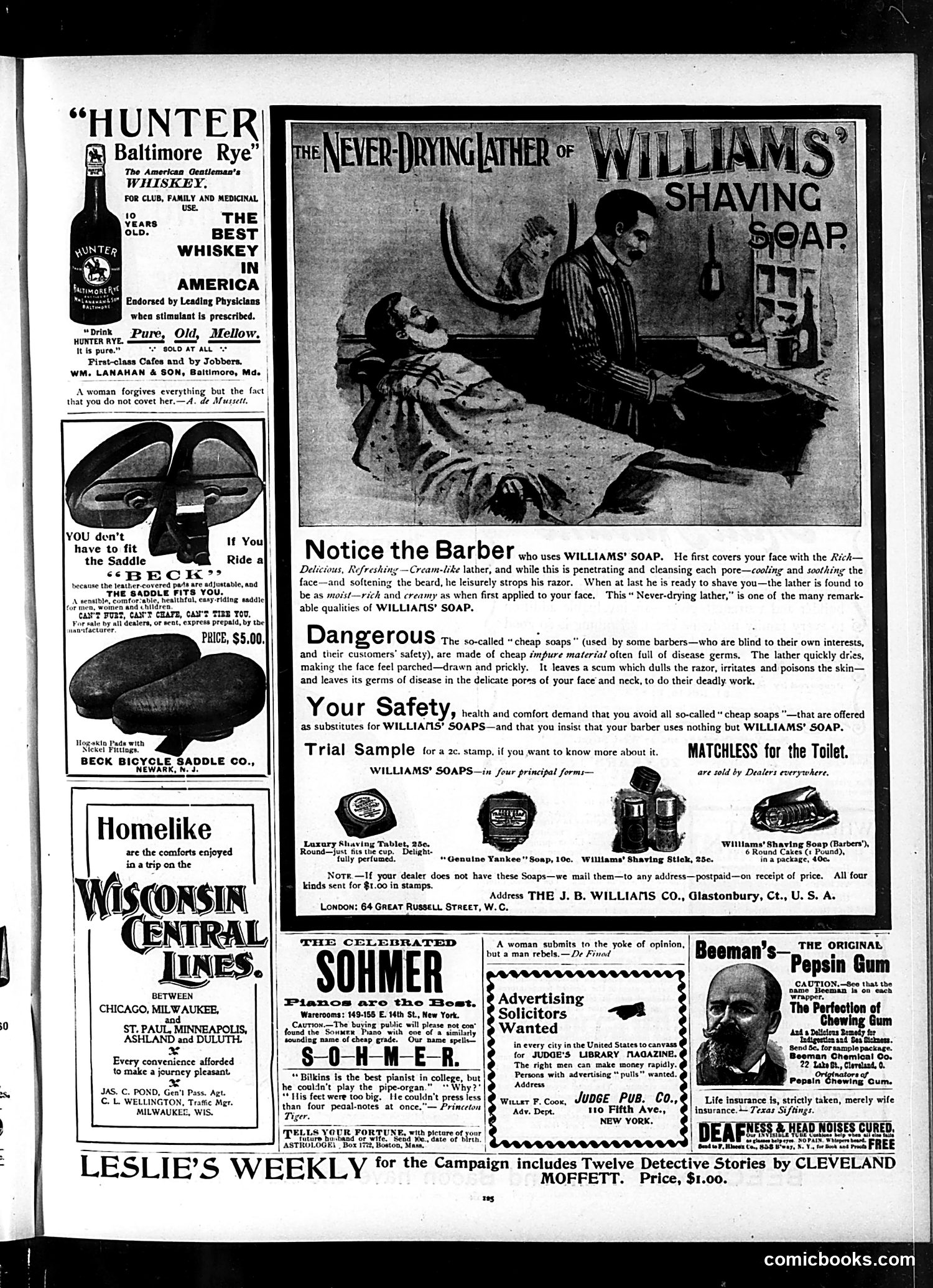
This page is primarily **advertising**—not political satire. It contains multiple commercial advertisements typical of early-20th-century magazines, including: **Major ads:** - Hunter Baltimore Rye whiskey (endorsed by physicians) - Beck Bicycle Saddle (adjustable leather pads) - Williams' Shaving Soap (extensive ad showing a barber's technique) - Wisconsin Central Lines railroad - Sohmer Pianos - Leslie's Weekly (detective stories by Cleveland Moffett) **Minor content:** - Small humorous items (the "Bilkins" joke about piano vs. organ playing) - Personal ads (astrology, advertising solicitors wanted) - Beeman's Gum and deafness cure ads The Williams' Soap ad is the most substantial content, emphasizing that quality soap (versus "cheap" alternatives) prevents disease and skin irritation—a health claim reflecting period concerns about hygiene and product purity. No political cartoons or satire appear on this page.
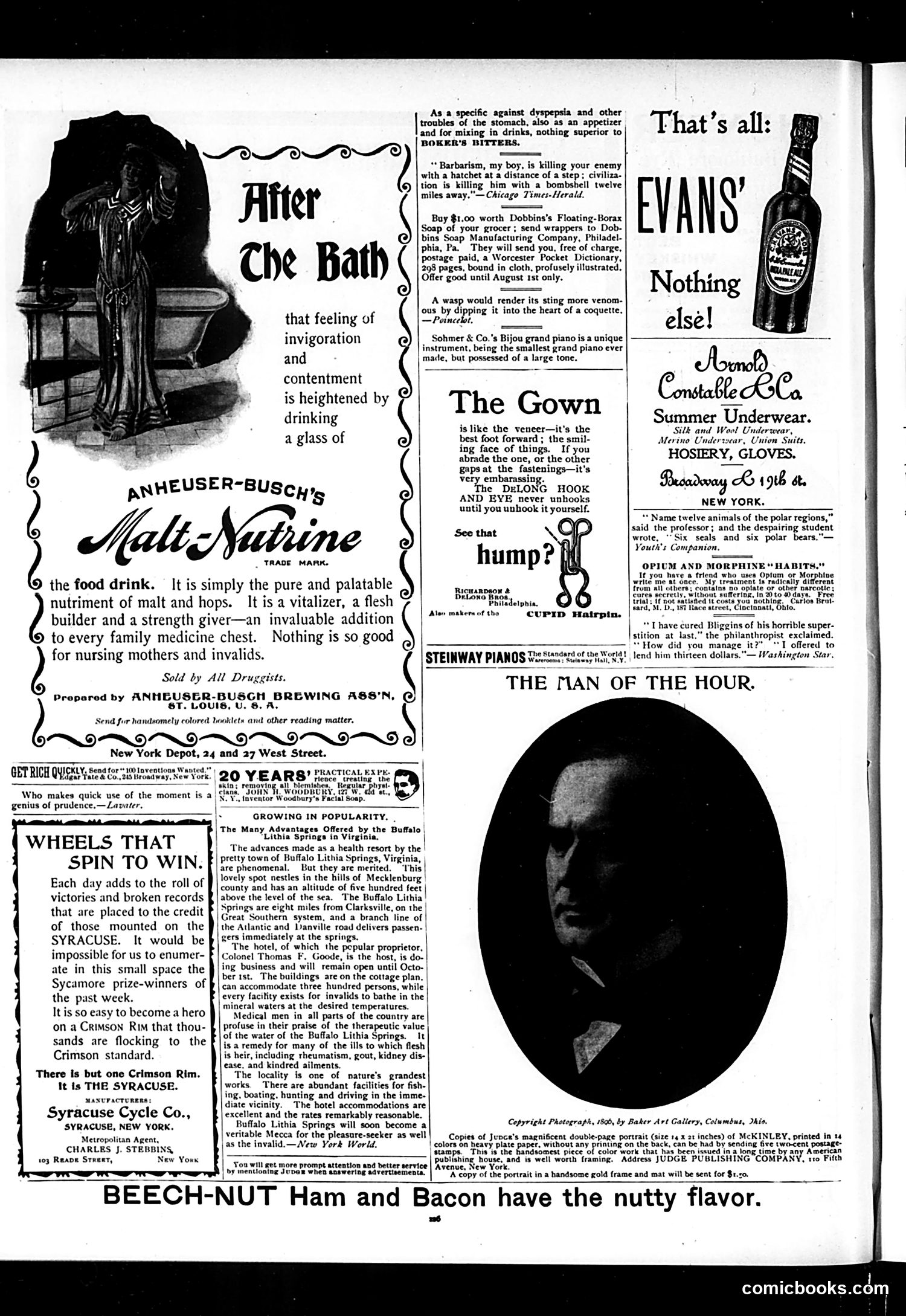
This page is primarily **advertisements and filler content**, not political satire. It contains: **Main advertisements:** - Anheuser-Busch's Malt Nutrine (food drink for nursing mothers) - Evans' beverages - Syracuse bicycles ("Wheels That Spin to Win") - Steinway Pianos - Various patent medicines and household products **The one cartoon element** is "The Man of the Hour" (bottom), a large portrait photograph labeled as depicting someone, though the OCR text doesn't clearly identify who. The caption mentions a copyright by Baker Art Gallery, Columbus, Ohio. **Social context:** The ads reflect early 1900s consumer culture—malt drinks marketed for health, patent medicines, pianos as status symbols, and bicycles as modern transportation. The scattered quotations and brief jokes about medicine, manners, and superstition are typical Judge filler material rather than pointed political commentary. This appears to be a typical interior magazine page where advertisements subsidized editorial content.
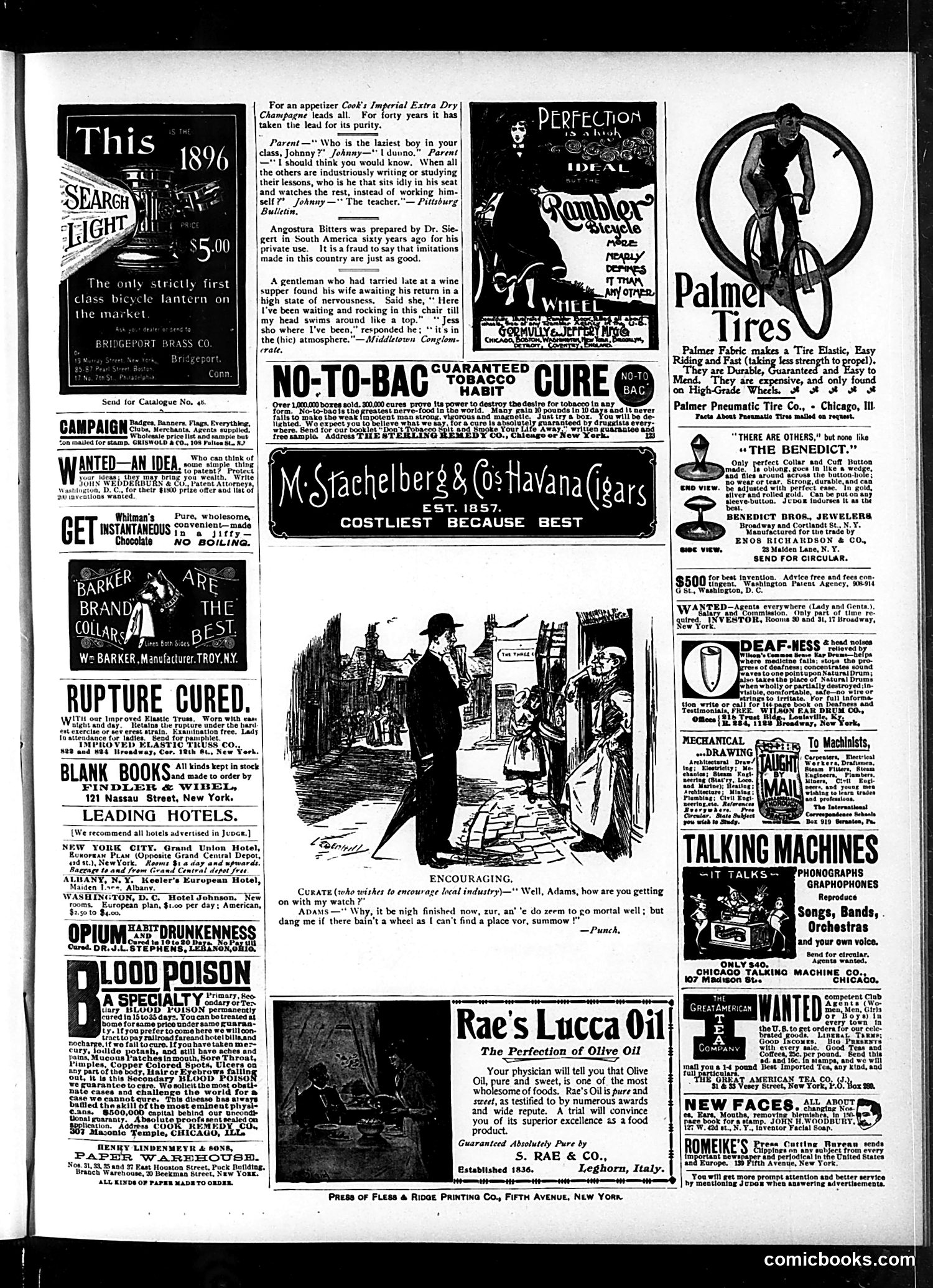
This page is primarily **advertising**, with one small cartoon and several humorous anecdotes. The main cartoon, titled "ENCOURAGING," depicts a clergyman (curate) asking a local tradesman named Adams about his watch repair. The joke plays on the curate's well-intentioned but patronizing attempt to "encourage local industry"—he assumes Adams is a watchmaker. Adams's response (cut off in the OCR) likely reveals he's not, deflating the curate's charitable assumption. The surrounding content consists of period product advertisements (champagne, cigars, bicycle tires, tobacco cure, hotels) and brief jokes about lazy students, intoxicated husbands, and similar domestic humor typical of 1890s satirical magazines. The page reflects Judge's mixed model: satirical commentary alongside commercial advertising supporting publication costs.
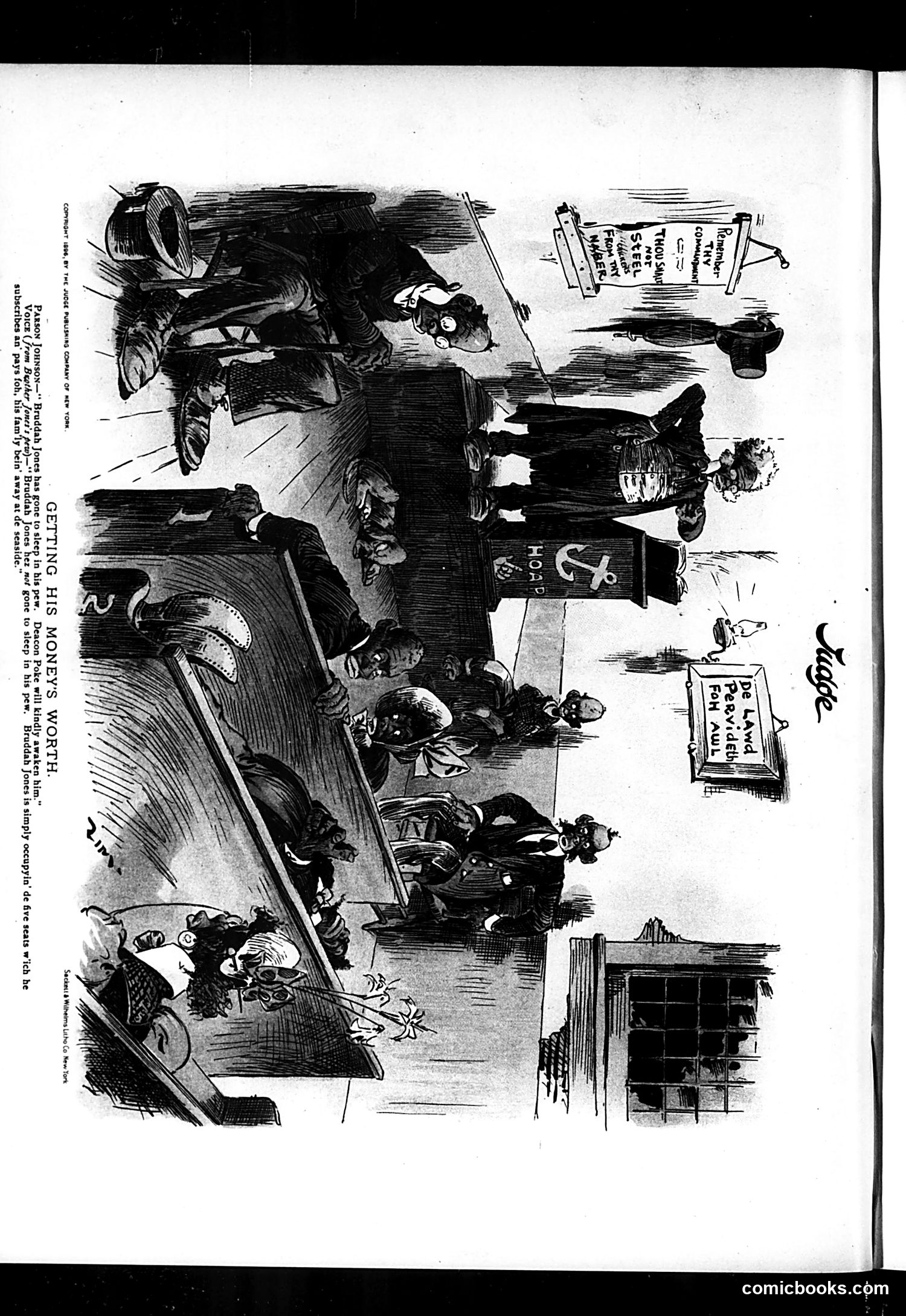
This Judge cartoon satirizes a parishioner's literal interpretation of church pew ownership. The scene depicts a Black church where Parson Johnson asks Deacon Poke to wake "Brother Jones," who appears to be sprawled across multiple seats during service. However, Jones defends himself by noting he *pays* for five pews—and since his family is away at the seaside, he's simply using all the seats he subscribes to. The humor relies on the contrast between the church's expectation of respectful behavior and Jones's working-class logic: he's paid for the space, so he's entitled to occupy it however he wishes. The dialect-heavy dialogue was typical of late-19th-century American humor targeting African American characters, reflecting period prejudices. The cartoon appears to mock both Jones's undignified behavior and the commercial transaction underlying church membership.