
A complete issue · 16 pages · 1896
Judge — August 15, 1896
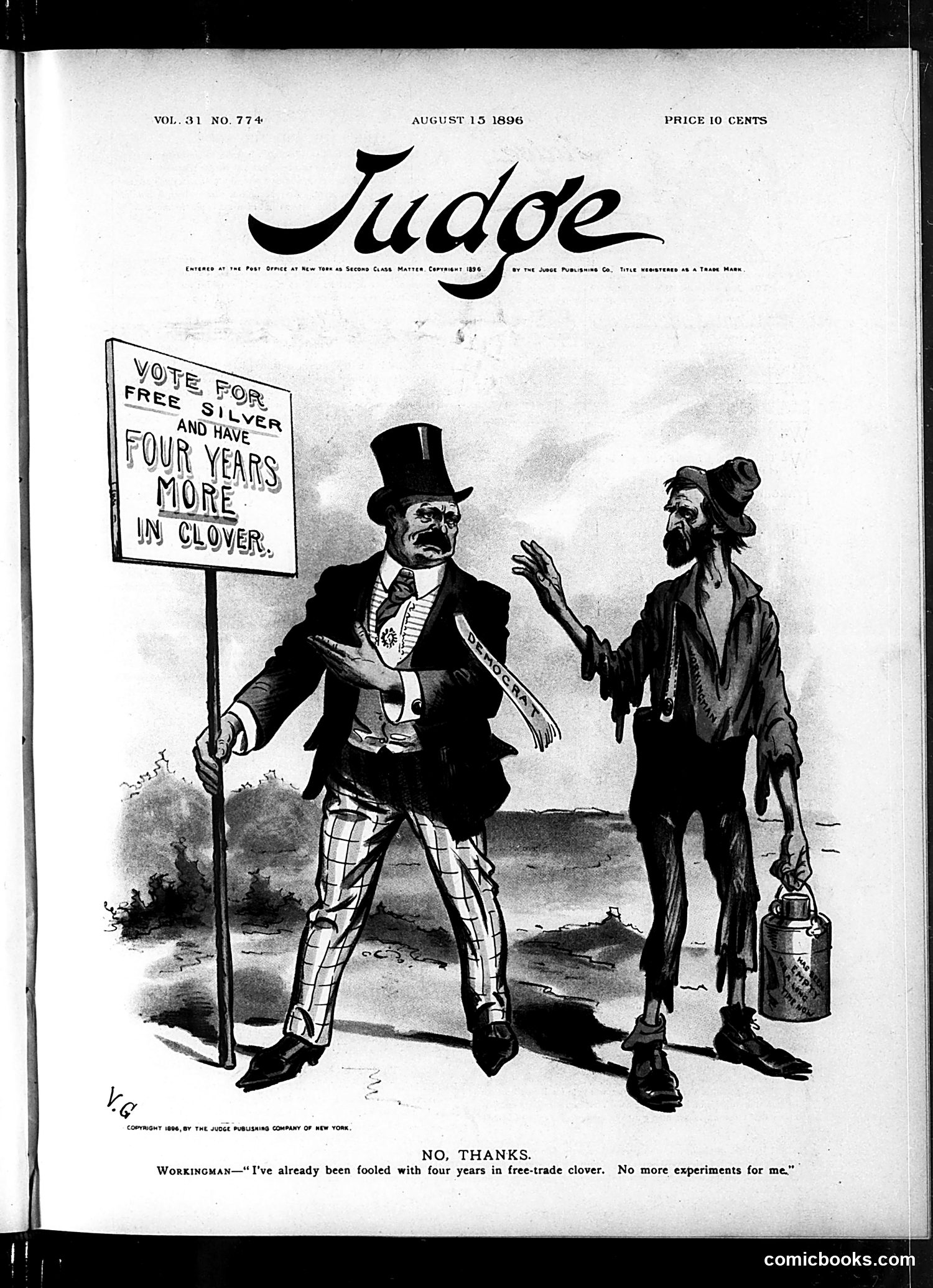
This cartoon satirizes the 1896 presidential election's free-silver debate. The well-dressed figure on the left (likely representing Republican/establishment interests) holds a sign promoting "free silver" while promising "four years more in clover." The ragged workingman on the right rejects this offer, declaring he's "already been fooled with four years in free-trade clover. No more experiments for me." The satire mocks the free-silver movement as a failed economic policy. The cartoon suggests working-class voters had suffered under previous free-trade policies and now distrust similar promises. The contrasting dress emphasizes the gap between wealthy promoters of free silver and ordinary laborers who bore its consequences, making it an anti-free-silver argument during the contentious 1896 campaign.
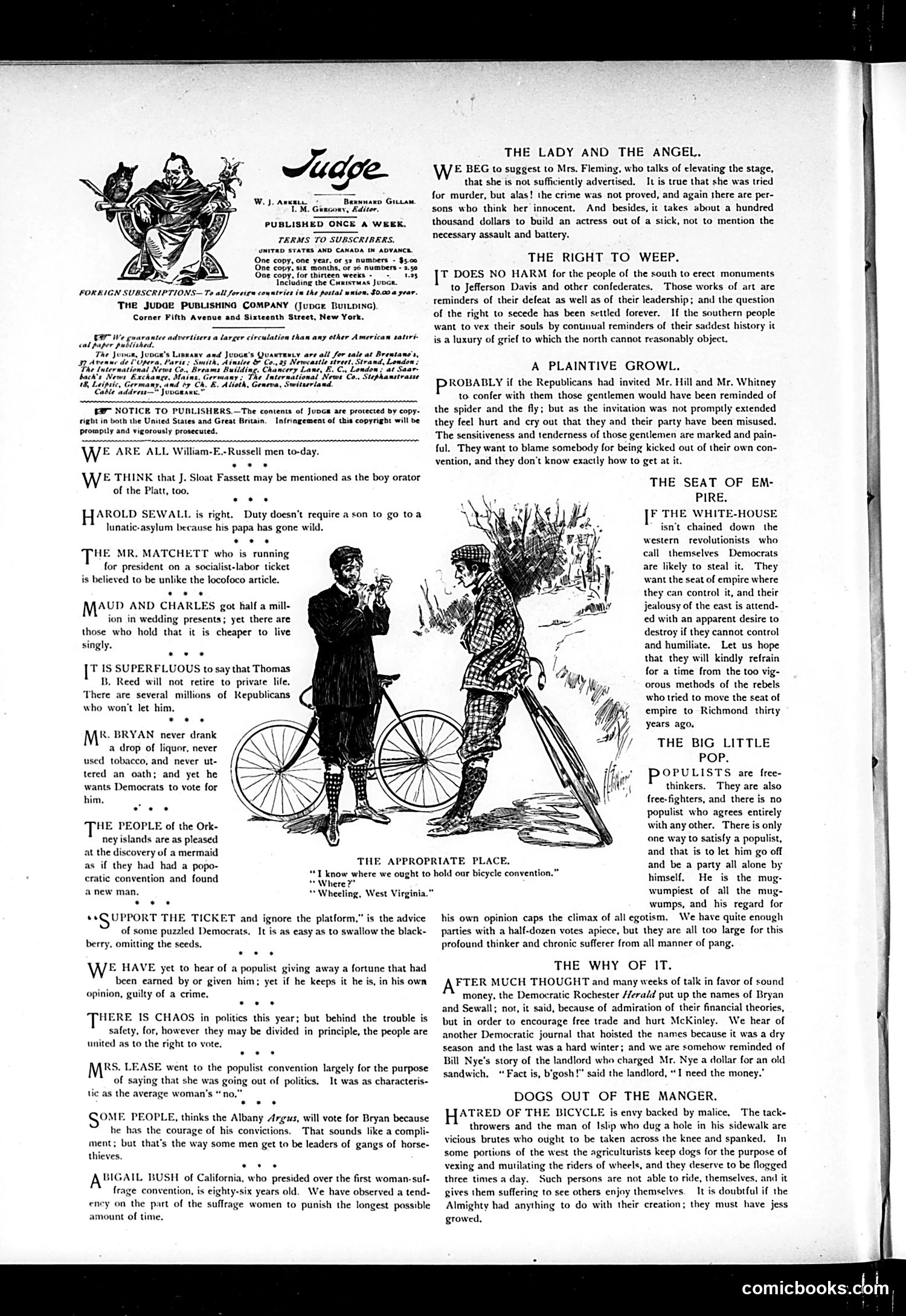
The main cartoon titled "THE APPROPRIATE PLACE" depicts two men with a bicycle, discussing where to hold "our bicycle convention." One responds: "I know where we ought to hold our bicycle convention" — "Where?" — "In West Virginia." This appears to be political satire referencing Democratic Party politics, likely from the early 1900s. The reference to West Virginia suggests commentary on state politics or a specific Democratic convention location debate. The bicycle convention serves as a thin disguise for actual political organizing. The surrounding text contains brief satirical comments on contemporary figures and issues—William-Russell men, J. Shoat Fassett, Harold Sewall, and various political positions. Without clearer historical context about the specific election cycle or Democratic controversy referenced, the precise political targets remain unclear, though the overall tone mocks Democratic political maneuvering and personalities.
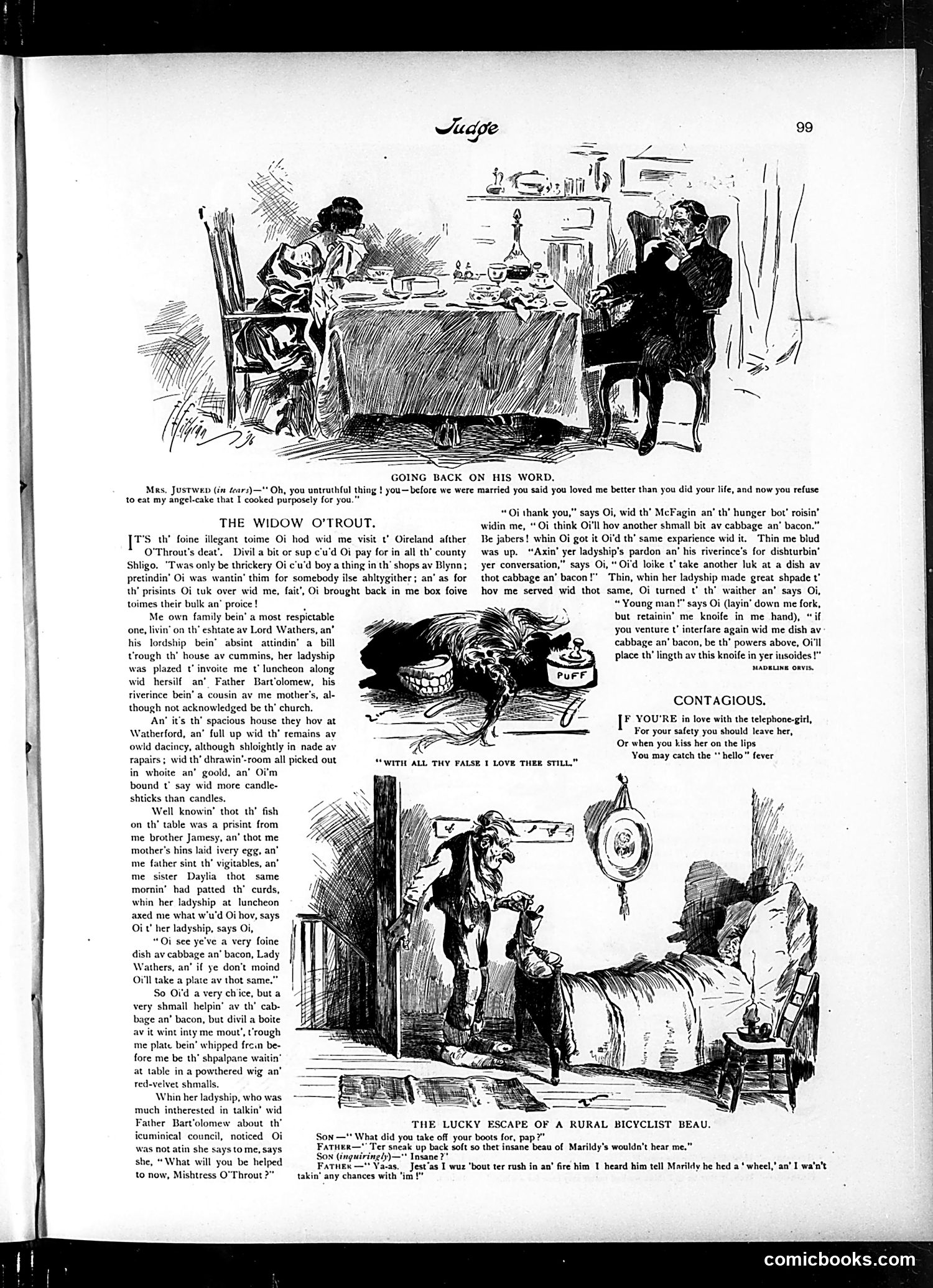
This page contains three satirical pieces: 1. **"Going Back on His Word"** (top): A domestic dispute scene where a woman confronts a man about breaking a promise made before marriage—he claimed to love her more than his previous life, but now refuses to eat her cooking. The satire mocks men who make romantic pledges they don't keep. 2. **"The Widow O'Trout"** (left column): A lengthy humorous narrative about an Irish widow's romantic history and domestic disputes, including references to cabbage and bacon. It's primarily comedic character writing rather than political satire. 3. **"The Lucky Escape of a Rural Bicyclist Beau"** (bottom): A illustrated anecdote about a young man escaping an embarrassing situation involving borrowed boots, satirizing rural courtship mishaps. These pieces target domestic life and social customs rather than politics.
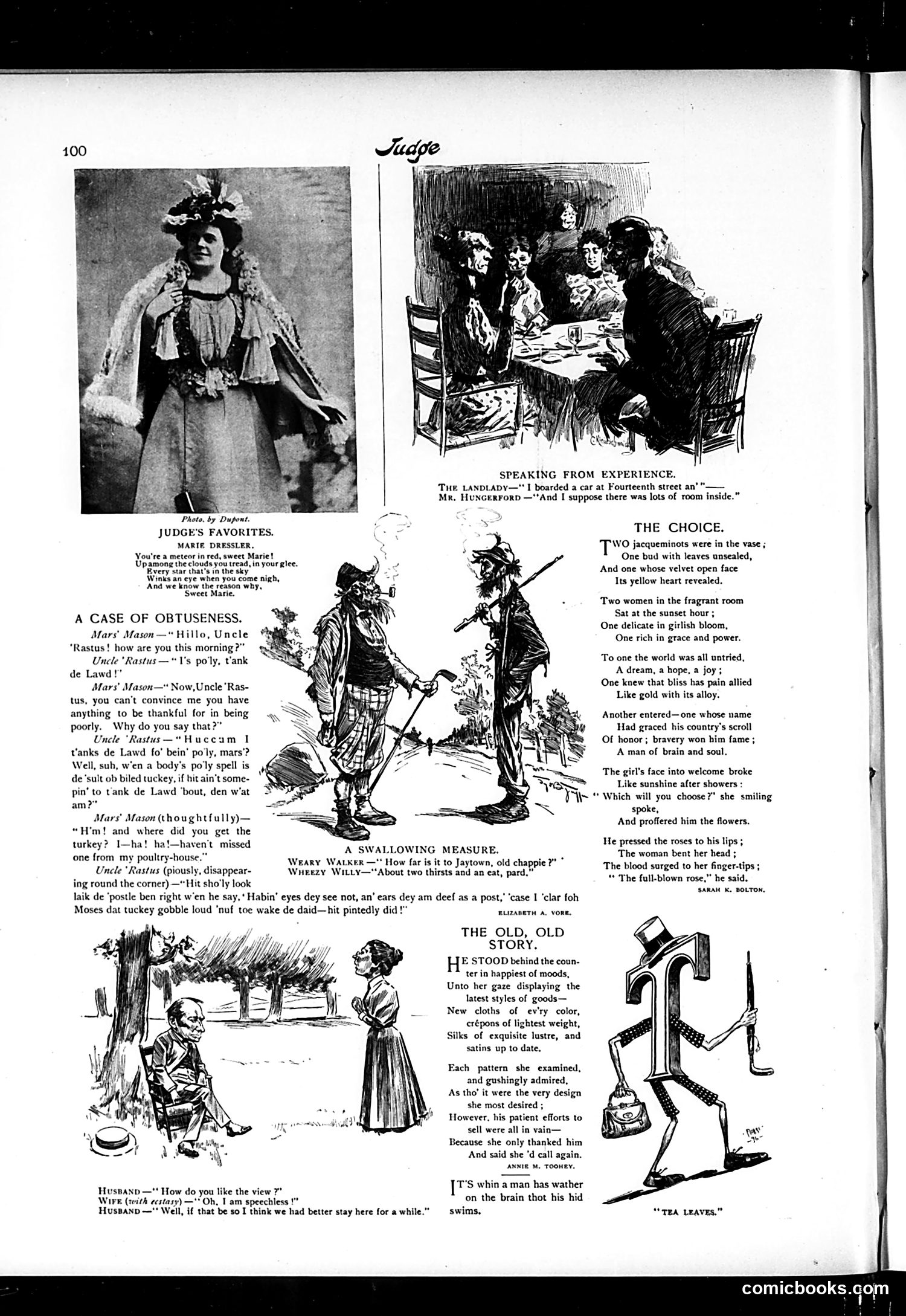
This page from *Judge* contains several satirical pieces typical of turn-of-the-century American humor: **"Judge's Favorites"** features Marie Dressler, a popular actress of the era, in celebratory verse. **"A Case of Obtuseness"** is a dialect-humor piece depicting an exchange between a white man ("Mars' Mason") and an enslaved or formerly enslaved Black man ("Uncle Rastus"). The joke relies on racial stereotypes common to the period: the humor derives from the Black character's supposed logical confusion and suspected turkey theft. This represents offensive period humor that traded on minstrelsy conventions. **Other pieces** include light domestic humor ("A Swallowing Measure," "The Old, Old Story") about shopping and marriage—typical genteel magazine fare. **"The Choice"** is sentimental poetry about a woman offering flowers to a man who chooses the mature "full-blown rose" over the younger woman's preference. The page reflects *Judge*'s mix of celebrity coverage, racial caricature (standard for the era), and sentimental romantic narratives aimed at middle-class readers.
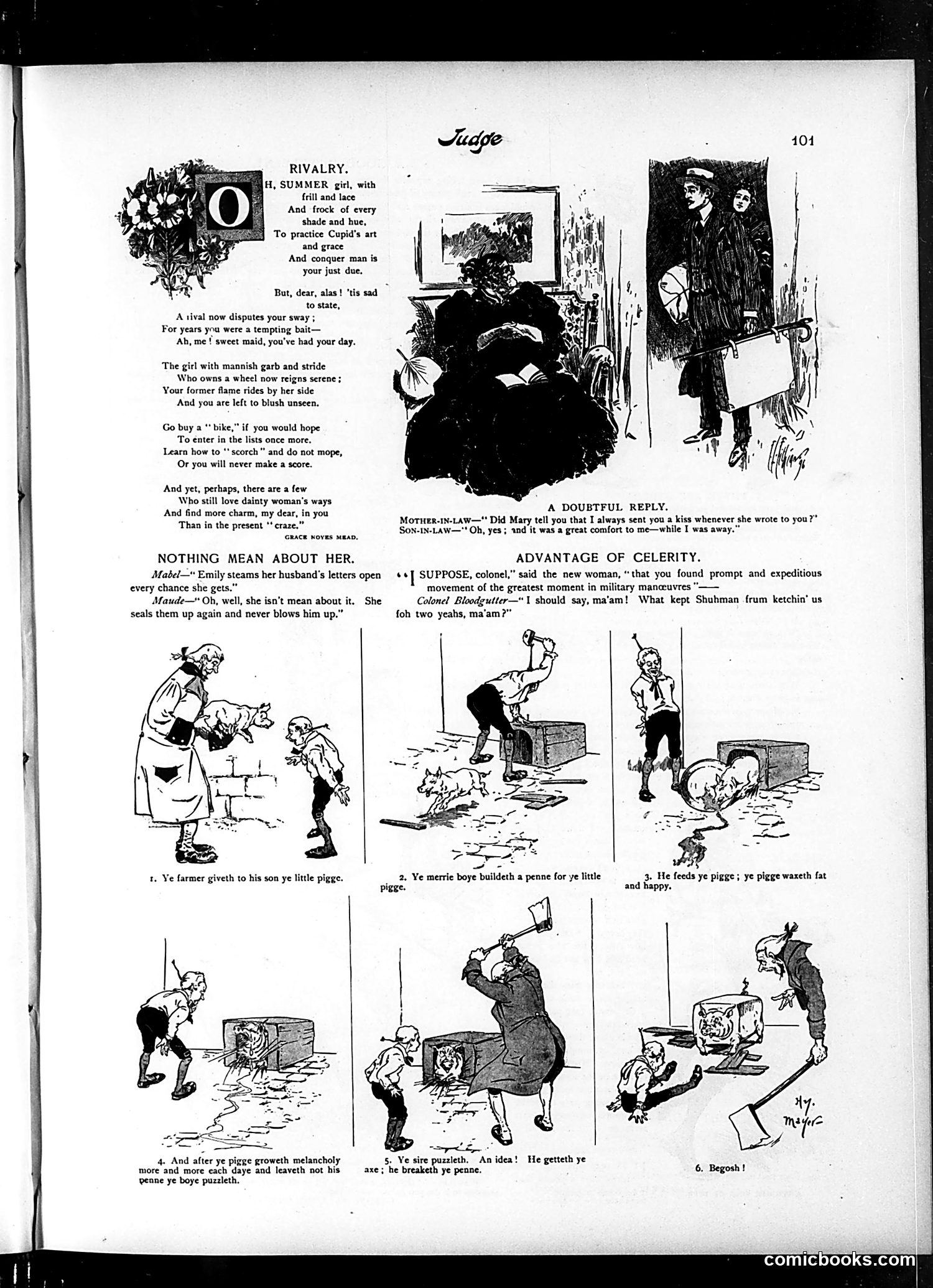
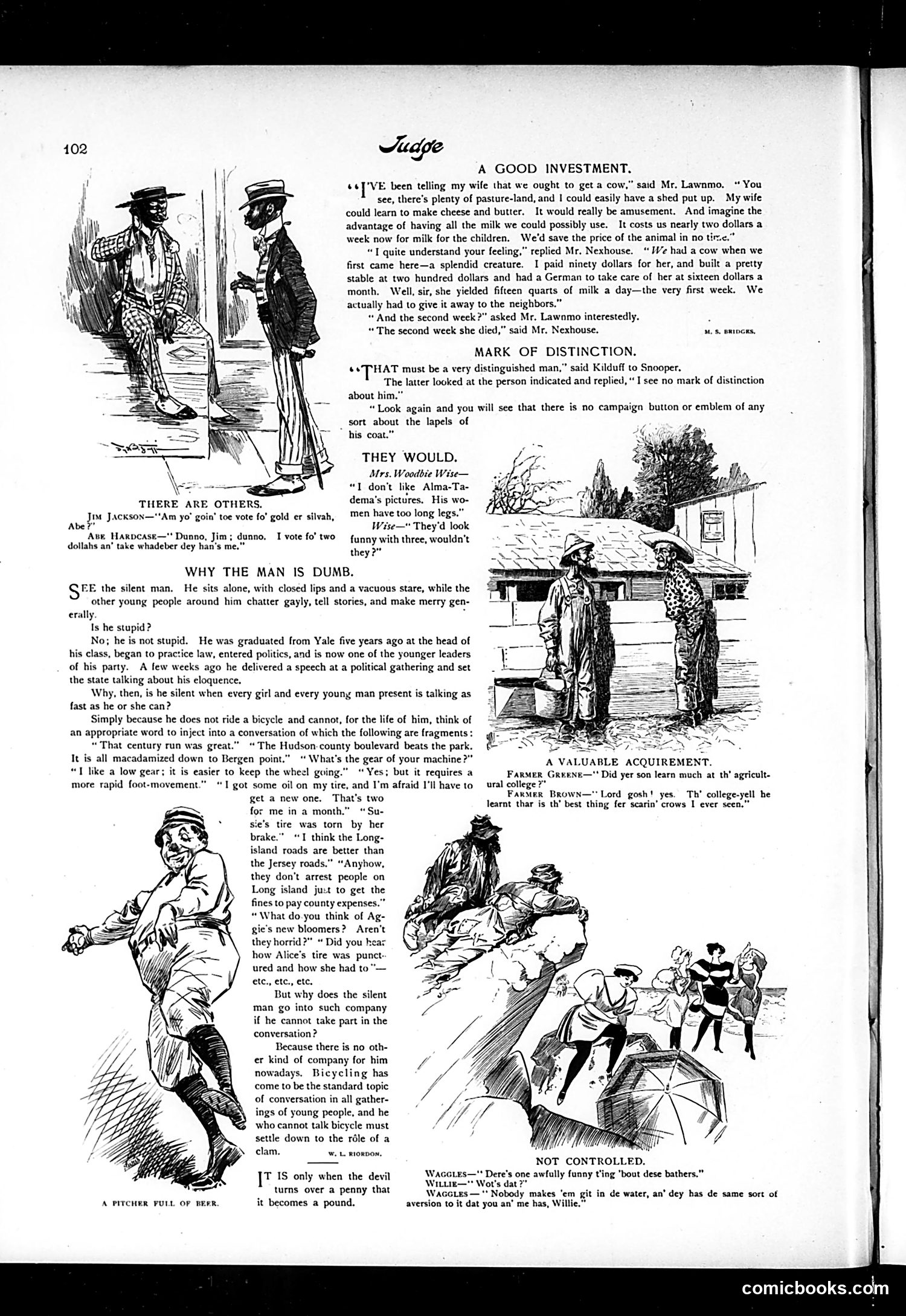
This page from Judge satirizes the fads and social conventions of 1890s America, primarily targeting the bicycle craze sweeping through young society. **Main Content:** The centerpiece, "Why the Man Is Dumb," mocks a Yale-educated lawyer and political leader who remains silent in social gatherings because he cannot discuss bicycles—the obsessive topic dominating young people's conversations. The satire critiques how bicycle terminology (gears, tires, bloomers, roads) has become the *only* acceptable social currency, rendering an intelligent man socially paralyzed. **Supporting Jokes:** "A Good Investment" humorously illustrates rural naiveté about dairy farming—a man's cow dies after one productive week, negating his investment. "Mark of Distinction" jokes that someone is distinguished *only* by lacking campaign political buttons/emblems. Minor pieces mock art criticism (Alma-Tadema's female figures) and political fence-sitting on the currency question (gold vs. silver). **Context:** This reflects 1890s anxiety about how consumer culture and fads were reshaping social life and what counted as acceptable conversation among the educated classes.
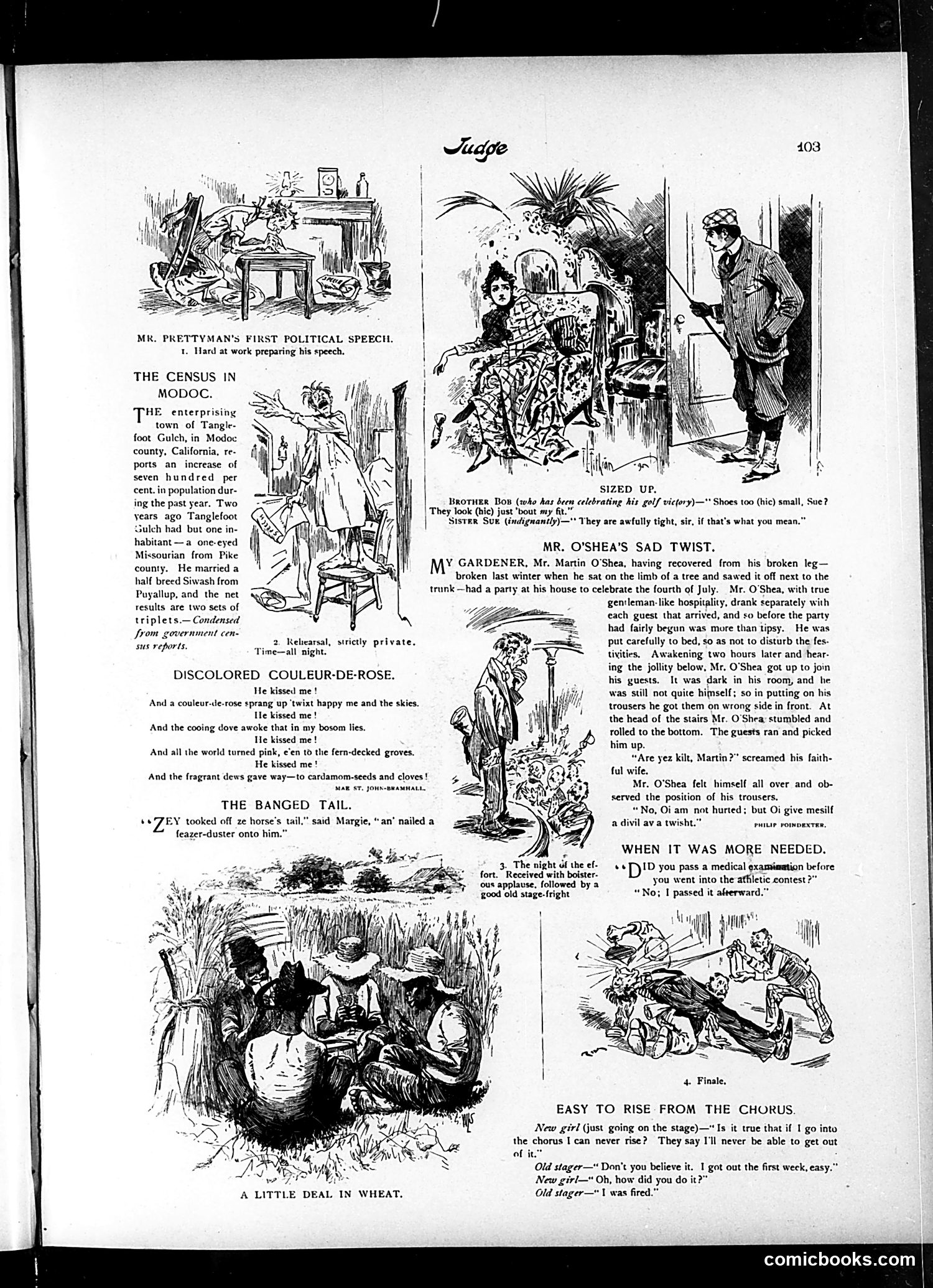
This page contains several humorous sketches typical of late-19th-century American satire: **"Mr. Prettyman's First Political Speech"** mocks amateur politicians nervously preparing speeches, showing the contrast between private practice and public performance anxiety. **"The Census in Modoc"** satirizes inflated population reports from frontier towns, suggesting the one inhabitant of Tanglefoot Gulch somehow produced two sets of triplets, implying absurdly exaggerated census claims. **"Mr. O'Shea's Sad Twist"** is an Irish-dialect humor piece about a gardener who, drunk after hosting a Fourth of July party, puts his trousers on backward and tumbles downstairs—the "twist" being both physical comedy and a pun. Other sketches mock romantic poetry ("Discolored Couleur-de-Rose"), theatrical struggles, and social pretension. The page reflects Judge's characteristic blend of political/social commentary with slapstick humor and dialect comedy—common entertainment for educated middle-class readers of the era, though the Irish stereotyping reflects period prejudices.
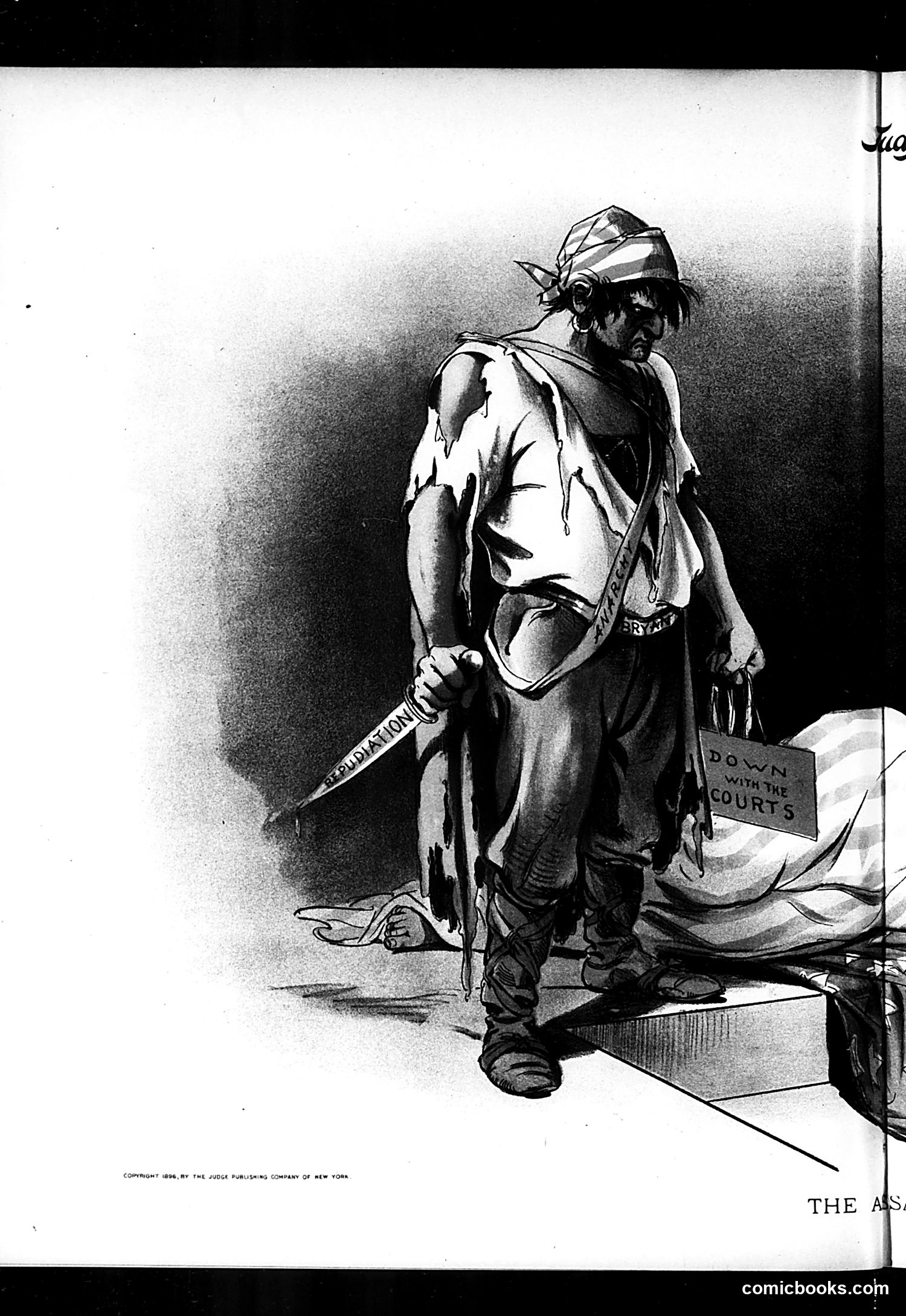
This 1896 *Judge* magazine cartoon depicts a disheveled figure holding a sword labeled "SEDITION" while wearing a blindfold and tattered clothing. A visible placard reads "DOWN WITH THE COURTS" — suggesting the figure represents radical elements opposing the judicial system. The cartoon appears to satirize anarchist or revolutionary movements that threatened American institutions in the 1890s, a period marked by labor unrest, bombings, and anti-government violence. The blindfold suggests these radicals act without reason or understanding, while the worn appearance emphasizes their marginalization. The sword labeled "sedition" directly references seditious conspiracy — the legal charge against those attacking government authority. The overall message warns against lawlessness and attacks on established legal institutions, positioning such movements as destructive and irrational.
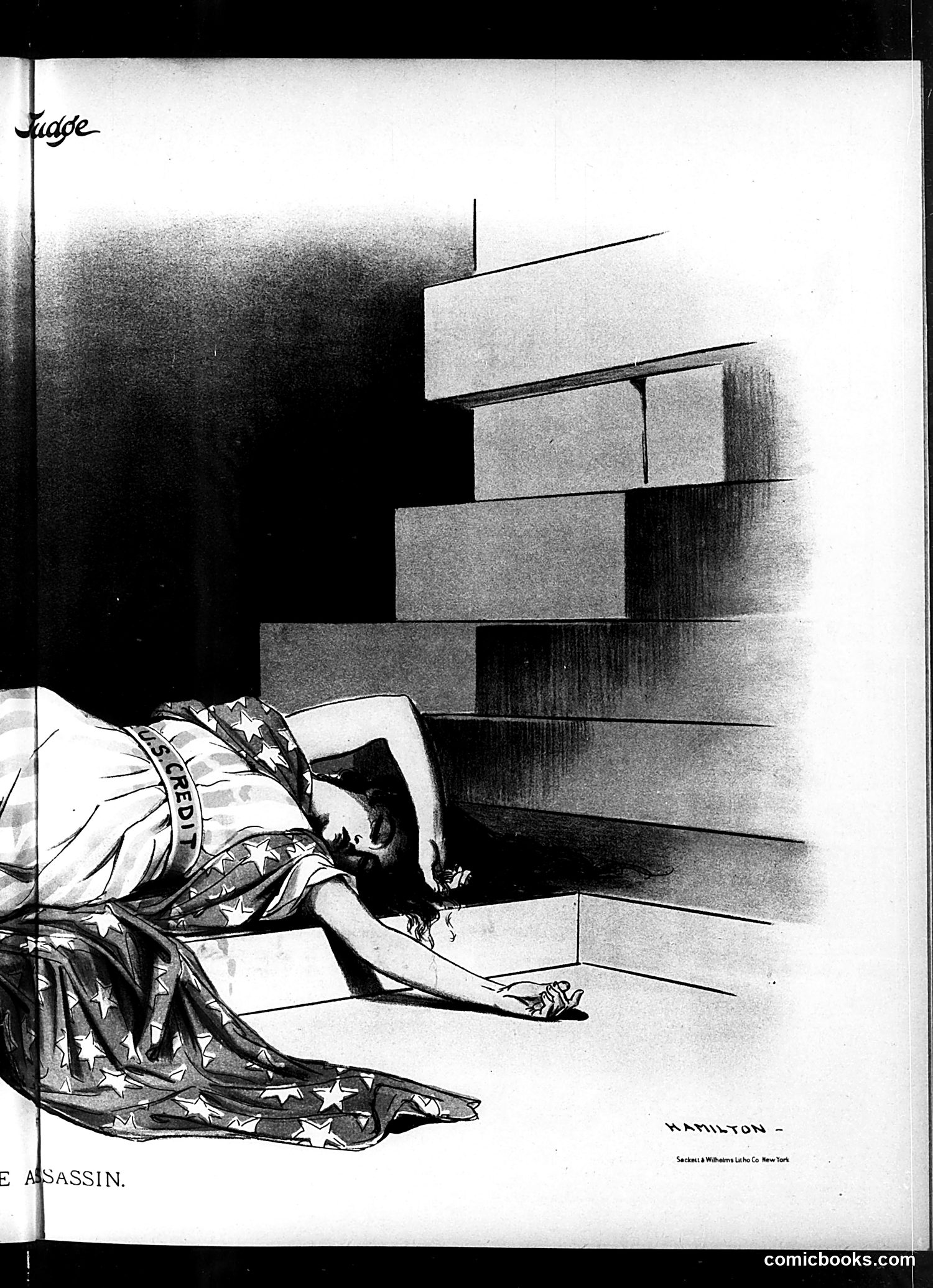
This political cartoon by Hamilton depicts a figure draped in an American flag lying dead or collapsed on steps, labeled "THE ASSASSIN" (visible at left edge). The stepped structure behind suggests institutional architecture—possibly Congress or a government building. The cartoon appears to criticize political assassination or violence against American democratic institutions. The body wearing stars and stripes, combined with the ominous shadowed backdrop, suggests the death of American ideals or democracy itself caused by some "assassin." Without a visible date or more specific text, the exact historical event referenced is unclear, though Judge magazine frequently addressed political violence and threats to democratic governance during its publication era. The work serves as anti-violence political commentary.
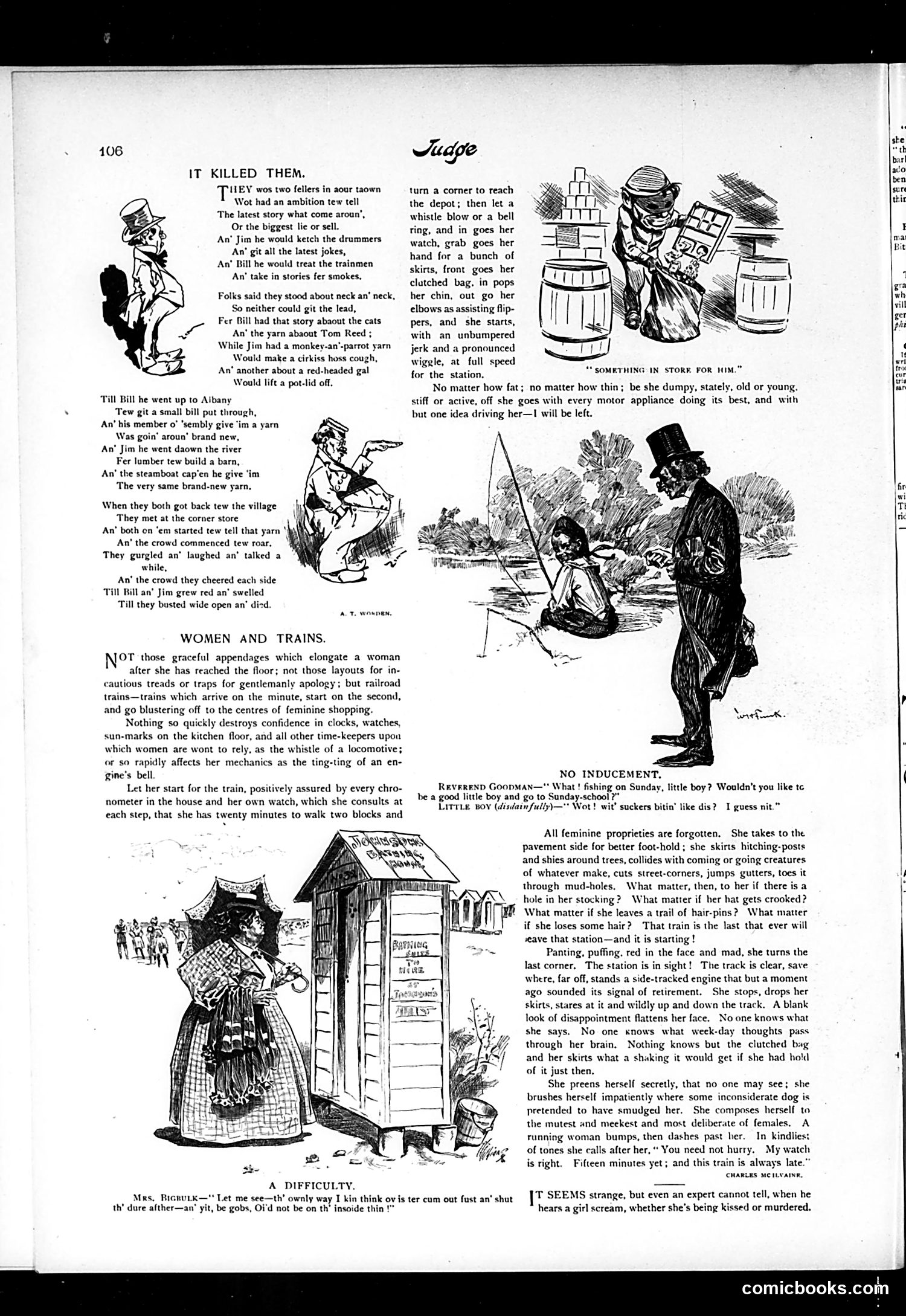
This page contains two unrelated pieces of social satire: **"It Killed Them"** (top): A humorous poem about two small-town men competing to tell the best stories and jokes. The joke culminates when both travel separately, hear the identical "new" story from different sources (Albany legislator and riverboat captain), return home and attempt to tell it simultaneously to an audience—the absurdity of both claiming originality while telling the same tale causes them to literally laugh themselves to death. **"Women and Trains"** (bottom): Social commentary mocking women's frantic behavior when rushing to catch trains. The satire suggests that the urgency of rail schedules destroys women's normally careful demeanor—they abandon propriety, abandon concern for their appearance, and transform into chaotic figures driven solely by fear of missing departure. The brief anecdote about a boy choosing fishing over Sunday school adds a secondary jab at religious instruction versus natural impulse. Both pieces reflect late-19th-century attitudes: mockery of village gossip culture and gentle ridicule of women's perceived vanity and anxiousness.
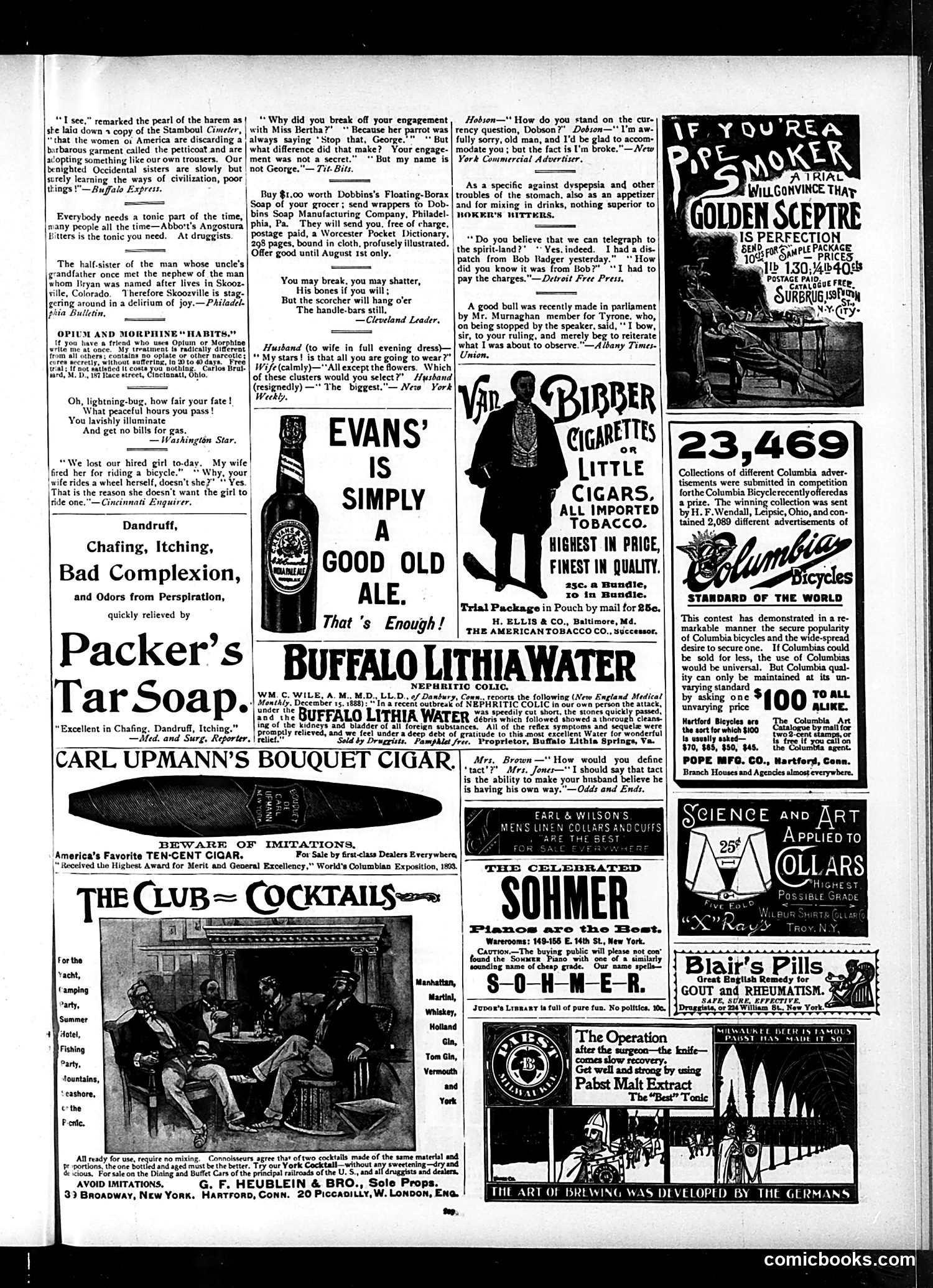
This page is primarily **advertising with several short humorous jokes** typical of Judge magazine's satirical approach. The opening joke mocks **Western attitudes toward women's dress reform**. A harem woman (representing "the Orient") smugly observes that American women are finally abandoning petticoats for trousers—suggesting the West is belatedly adopting Eastern practicality. The satire targets both Western women's fashion conservatism and the colonial-era condescension toward "uncivilized" Eastern cultures. The remaining printed jokes are brief, scattered anecdotes poking fun at relationships, bicycles, spiritualism, and parliamentary blunders—standard period humor with no deeper political significance. **Most of the page is filled with period advertisements** for patent medicines (Packer's Tar Soap, Bitters, Buffalo Lithia Water), cigars, pianos, bicycles, and pills—products making dubious health claims typical of the era before FDA regulations. The visual elements include a drinking scene and various brand logos, but contain no meaningful political cartoons or caricatures worthy of historical analysis.
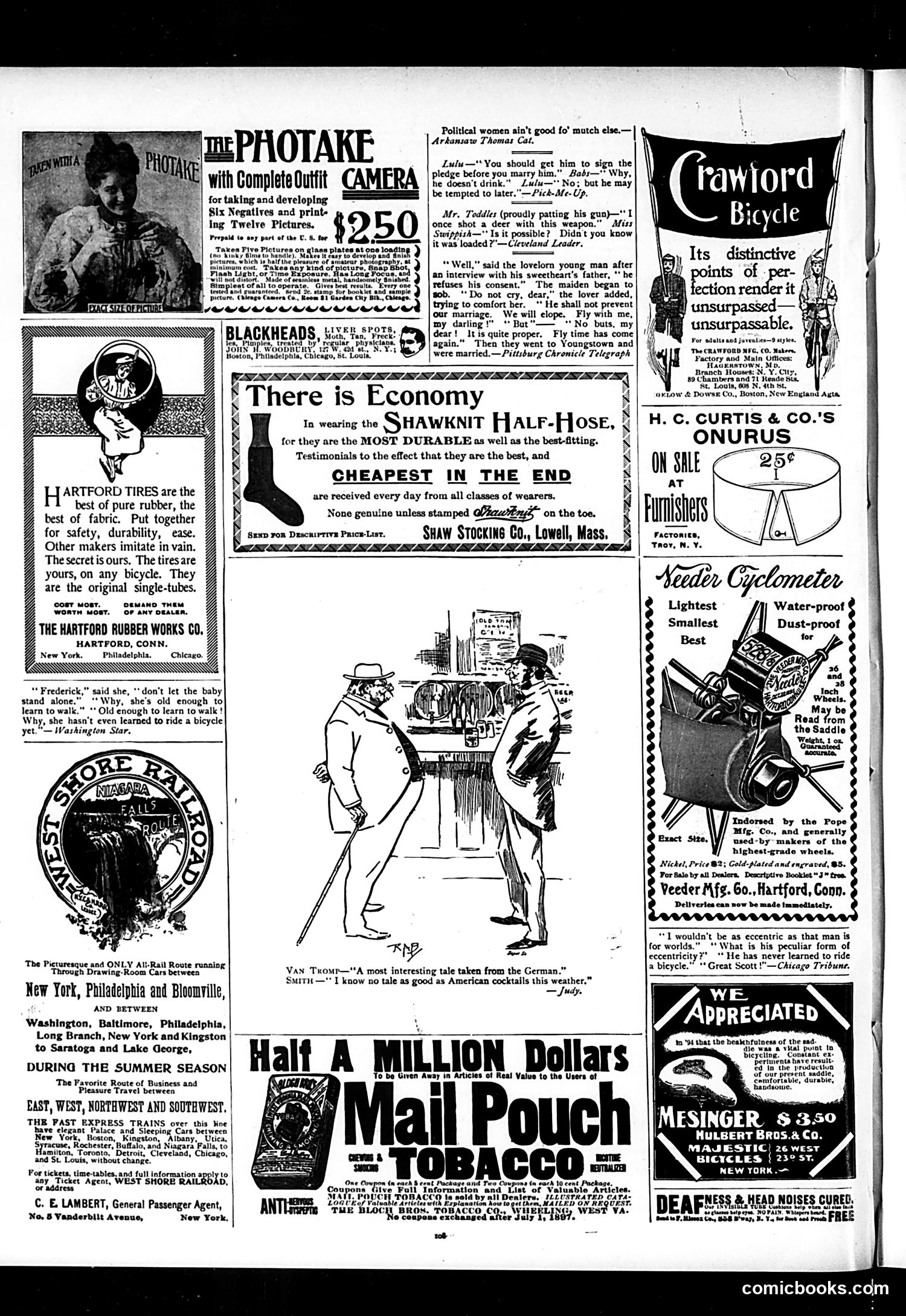
This page is primarily **advertising**, not political cartoons. However, it includes several brief humorous anecdotes typical of Judge's satirical style: **The jokes present gender and social stereotypes common to the era:** 1. **"Political women ain't good fo' mutch else"** — A derogatory quip dismissing women in politics, reflecting early-20th-century skepticism about female political participation. 2. **Marriage/courtship jokes** — Multiple anecdotes mock romantic relationships, including one where a young woman's father refuses consent to marriage, and the couple elope to Youngstown anyway—satirizing parental authority and elopement conventions. 3. **Child-rearing humor** — A joke about a baby learning to walk and ride a bicycle plays on absurd parental expectations. The page is dominated by product advertisements (cameras, bicycles, tires, tobacco, railroads) typical of Judge's revenue model. The brief satirical content reflects period attitudes toward women, courtship, and family life rather than addressing specific political events or figures.
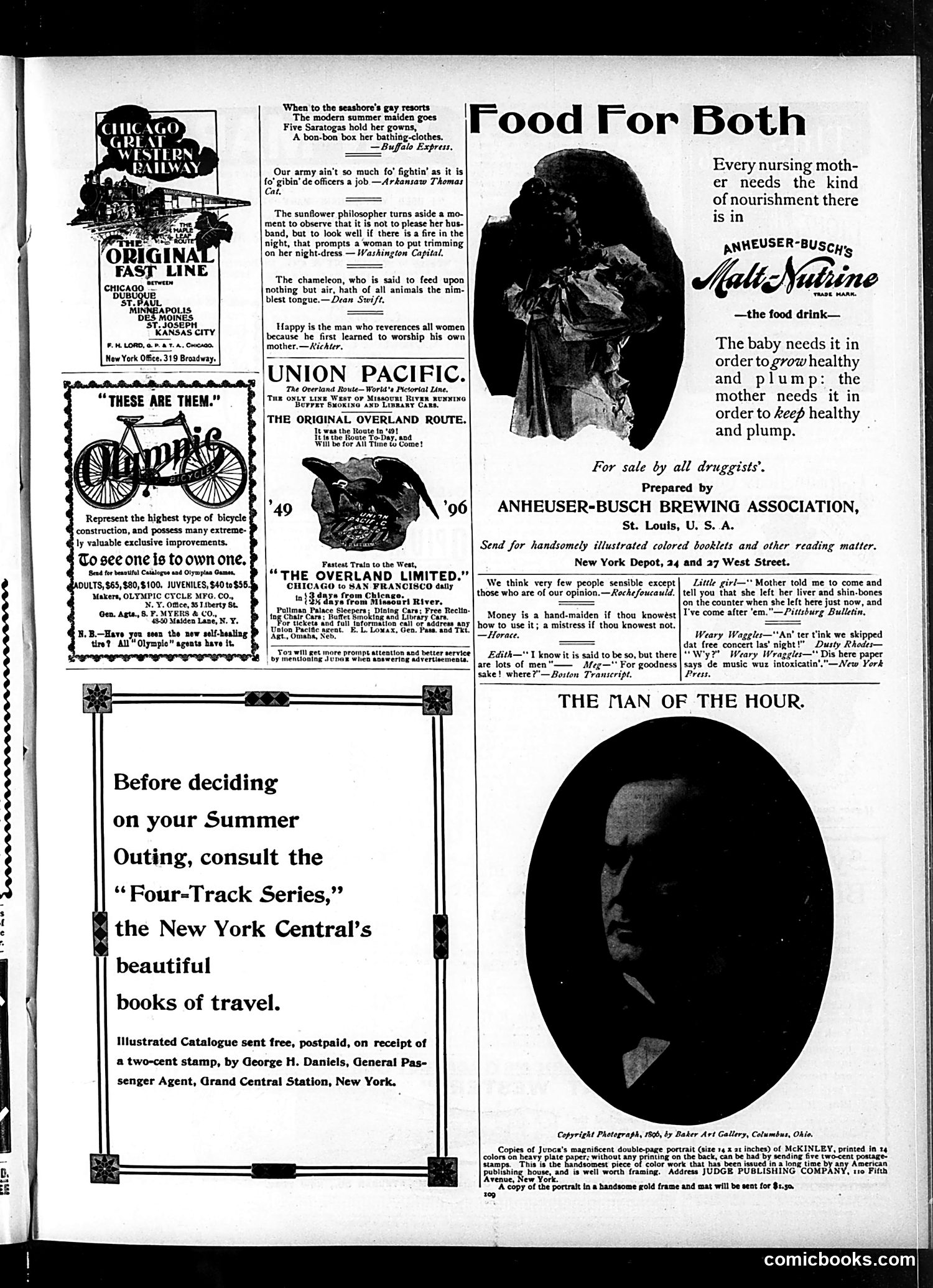
This page is primarily **advertising** with scattered satirical quotes typical of Judge magazine's format. The main content consists of: 1. **Product advertisements**: Chicago Great Western Railway, Olympic bicycles, Union Pacific Railroad, Anheuser-Busch's Malt Nutrine (a nutritional drink for nursing mothers and infants), and New York Central travel guides. 2. **Satirical quotes** from various fictional sources (Buffalo Express, Arkansaw Thomas Cat, Dean Swift) offering social commentary on contemporary life—women's fashion extravagance, military bureaucracy, and women's vanity. 3. **"The Man of the Hour"** portrait section (lower right)—appears to be a regular Judge feature celebrating a notable contemporary figure, though the specific identity is unclear from visible text. The page reflects early 1900s concerns: gender roles, military efficiency, and railroad travel as markers of modernity. The Malt Nutrine ad particularly exemplifies period attitudes toward motherhood and infant nutrition through commercial products.
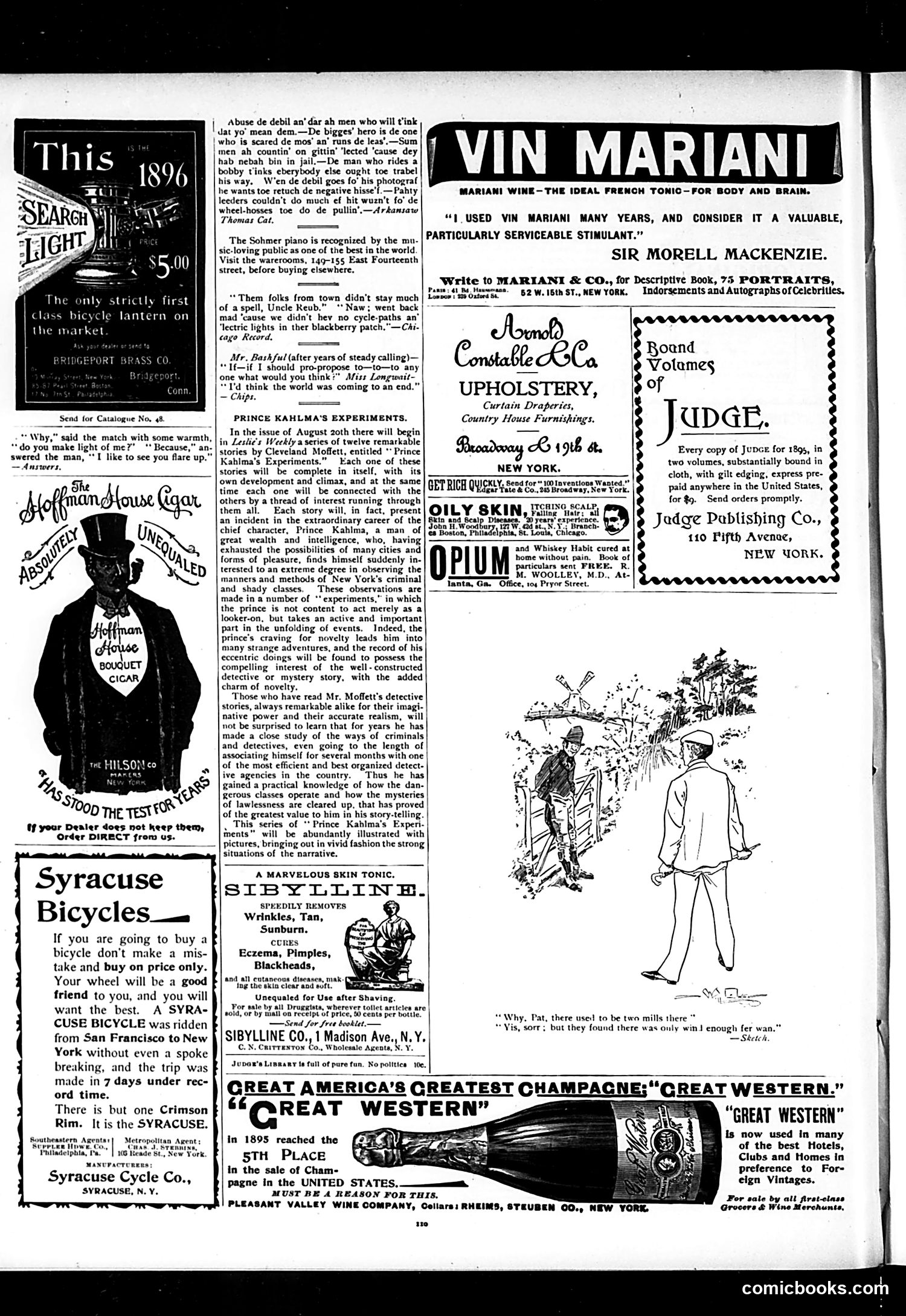
This page is primarily **advertising-driven**, with minimal editorial content. The small cartoon visible shows a humorous exchange between a match and a man—the match complains the man makes light of it, and he replies he enjoys seeing it "flare up." This is a simple **pun-based joke** typical of the era, playing on "light" and "flare." The page features advertisements for bicycles (Syracuse brand), cigars (Hoffman House), pianos (Sohmer), and various patent medicines including "Vin Mariani" (a cocaine-containing wine tonic endorsed by Sir Morell Mackenzie) and treatments for "oily skin" and alcohol addiction. These ads reflect **turn-of-century consumer culture and dubious medical claims** now recognized as dangerous. A preview announces Cleveland Moffett's serialized detective stories about "Prince Kahlma's Experiments" coming in Leslie's Weekly, targeting Judge's affluent readership interested in mystery fiction.
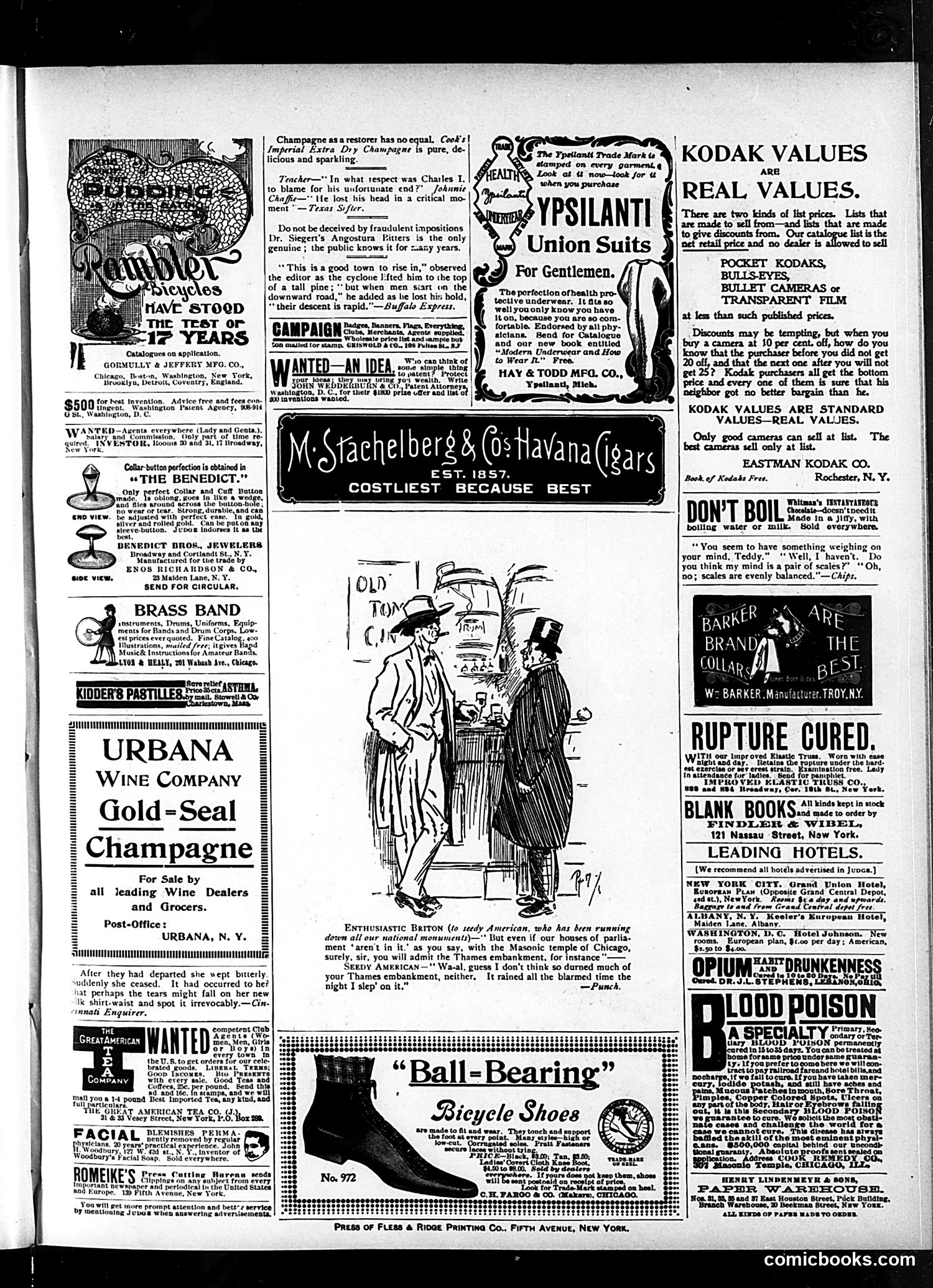
This page is primarily **advertisements and filler content**, typical of Judge magazine's revenue model, with one central cartoon. The **main cartoon** depicts an "Enthusiastic Briton" and a "Seedy American" in conversation. The satire mocks American boosterism and exceptionalism: the American has been bragging that Chicago's Masonic Temple surpasses British monuments (Parliament, the Thames Embankment). When challenged to admit the Thames embankment's grandeur, the American dismissively claims he wouldn't know—he slept on it during rain. The joke targets American travel-braggadocio and willful cultural ignorance: the character is so committed to American superiority that he refuses to acknowledge British achievements, even while admitting his own experience was unpleasant. The "Seedy" descriptor undercuts his credibility, suggesting a charlatan rather than legitimate critic. This reflects Judge's genteel satire of Gilded Age American cultural pretension.
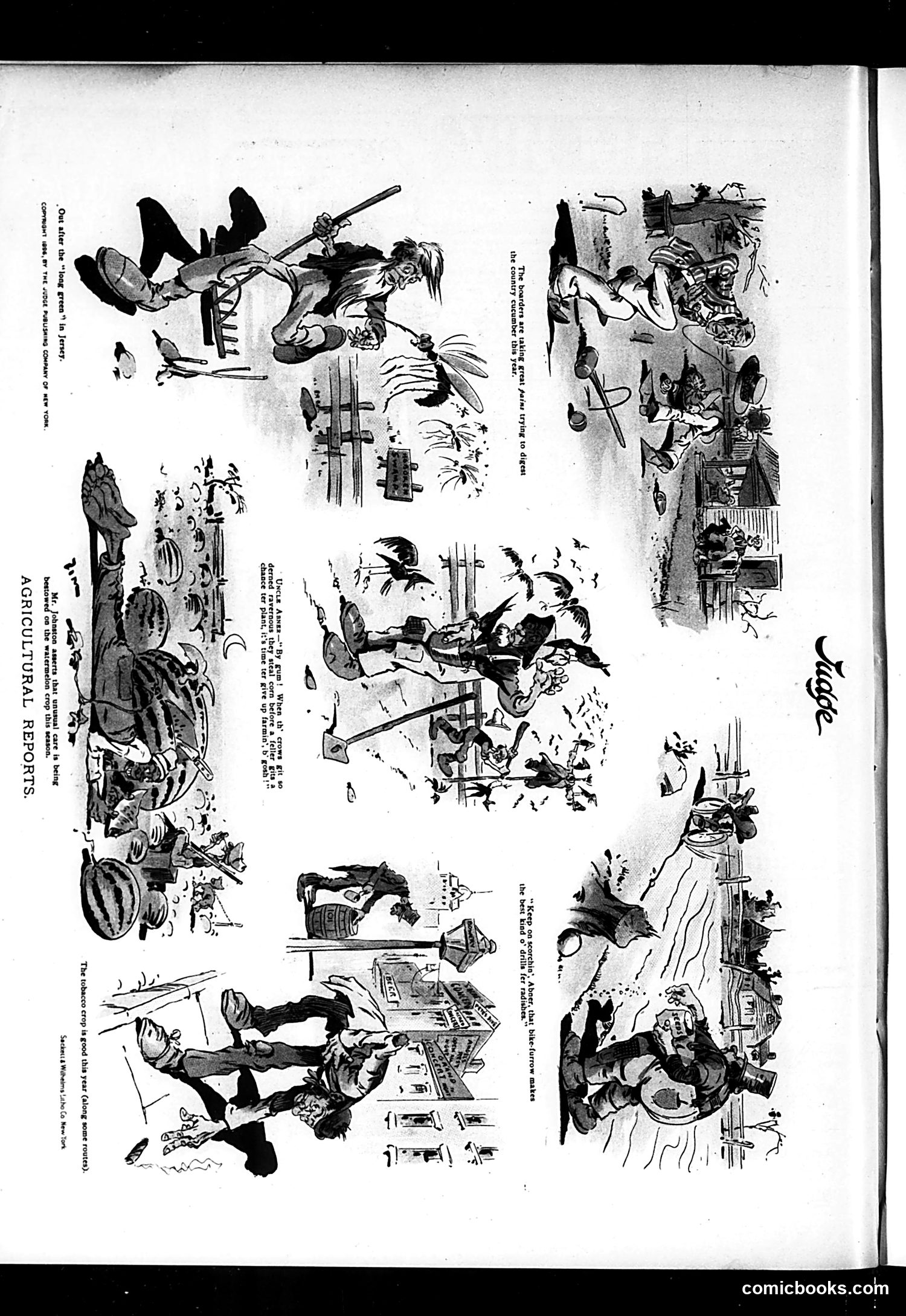
This page presents satirical "Agricultural Reports" mocking rural American farming life, likely from the early-to-mid 20th century. The cartoons depict exaggerated farm scenarios with comedic mishaps: farmers struggling with equipment, crops failing, and agricultural labor going absurdly wrong. The humor targets rustic incompetence and rural stereotypes—boarders causing crop damage, farmers pursuing money ("long green") in Jersey, tobacco crops mysteriously succeeding "along some routes" (suggesting selective or dubious success). References to crows destroying corn and failed planting methods mock both farmer intelligence and agricultural reality. The title "Agricultural Reports" ironically frames obvious failures as official data, satirizing the gap between idealized rural life and actual farming struggles. The satire appeals to urban Judge readers by depicting farmers as bumbling and comedically inept.