
A complete issue · 18 pages · 1896
Judge — April 25, 1896
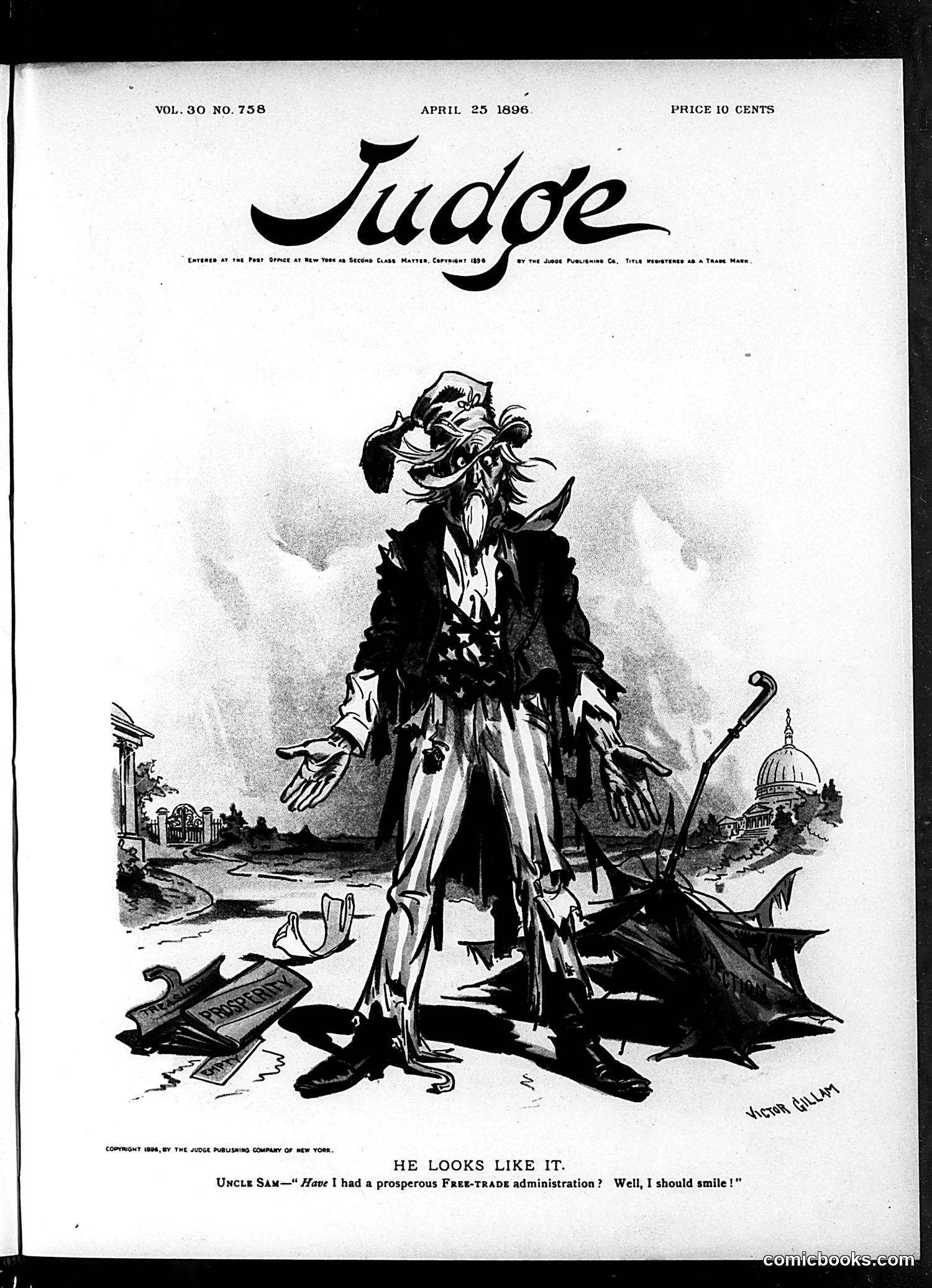
This political cartoon by Victor Gillam depicts Uncle Sam as a ragged, disheveled vagrant—torn clothes, tattered umbrella, surrounded by discarded items. The caption quotes Uncle Sam saying, "Have I had a prosperous Free-trade administration? Well, I should smile!" The satire is ironic: Uncle Sam's appearance suggests economic hardship and poverty, contradicting any claim of prosperity. This criticizes the McKinley administration's predecessor (likely Cleveland's second term, ending in 1896), attacking the Democrats' free-trade policies. The cartoonist argues that free trade has impoverished America, making Uncle Sam look literally broke despite rhetorical claims of success. The sarcastic caption underscores the gap between political messaging and visible economic reality.
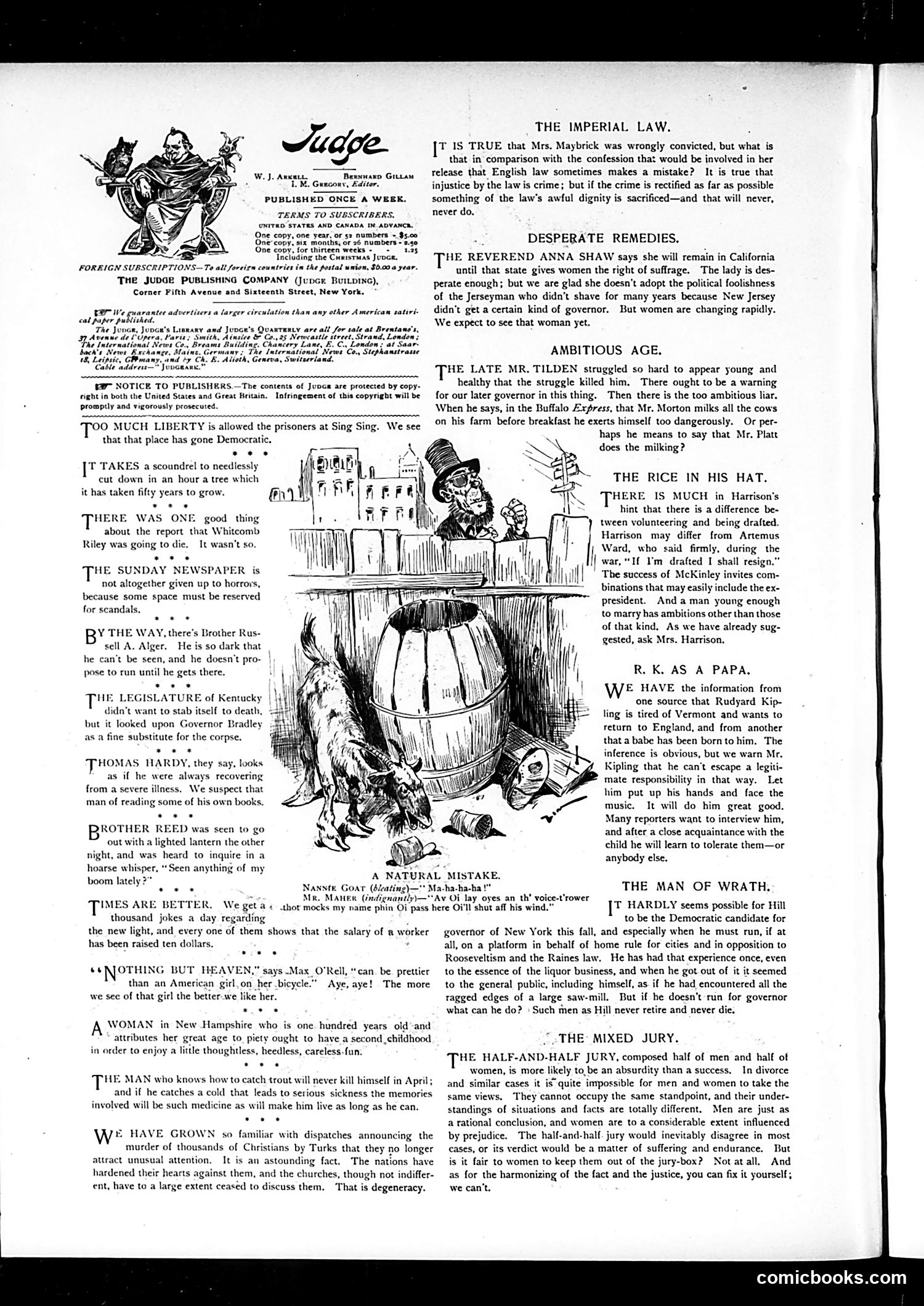
The central cartoon titled "A Natural Mistake" depicts a goat wearing a hat, with the caption suggesting confusion between bleating and human speech. The accompanying text identifies "Ma" Maines (unmarked) and references voice-power and a politician's comments. The page consists primarily of editorial commentary and social satire rather than political cartoons. Items mock: - Mrs. Maybrick's wrongful conviction and legal injustice - Reverend Anna Shaw's suffrage activism in California - The late Mr. Tilden's youthful appearance aspirations - Political ambitions of various figures - Mixed-gender juries' ineffectiveness - Benjamin Harrison's political vulnerabilities The satire targets late 19th-century American social issues: women's rights activism, judicial corruption, political posturing, and gender dynamics in civic institutions. Specific individuals referenced are unclear without additional context.
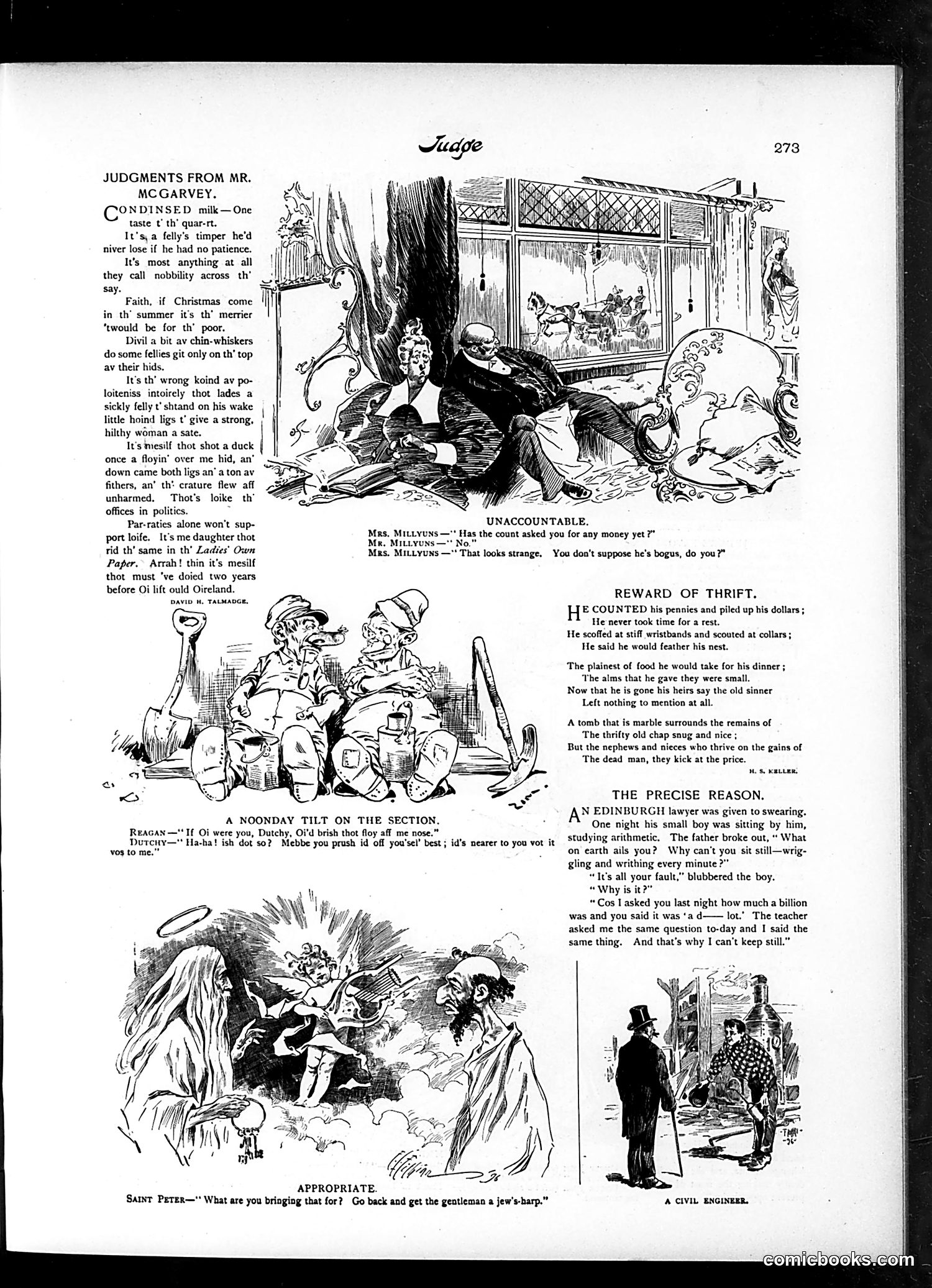
This page contains several satirical pieces typical of Judge's humor: **"Unaccountable"** shows a woman (Mrs. Millyuns) asking her husband about missing money, suggesting financial irresponsibility or marital discord over household accounts. **"A Noonday Tilt on the Section"** depicts working-class men in comic dispute, likely satirizing labor disputes or working-class conflicts of the era. **"Reward of Thrift"** is a poem mocking a miserly man who hoarded pennies but gained nothing in life—social commentary on excessive frugality. **"The Precise Reason"** features an Edinburgh lawyer and schoolboy discussing why the boy can't keep still, suggesting class differences in discipline and education. **"Appropriate"** shows Saint Peter with figures in heaven, a religious joke about appropriate heavenly accessories. The page emphasizes domestic, class, and moral humor typical of early 20th-century American satire.
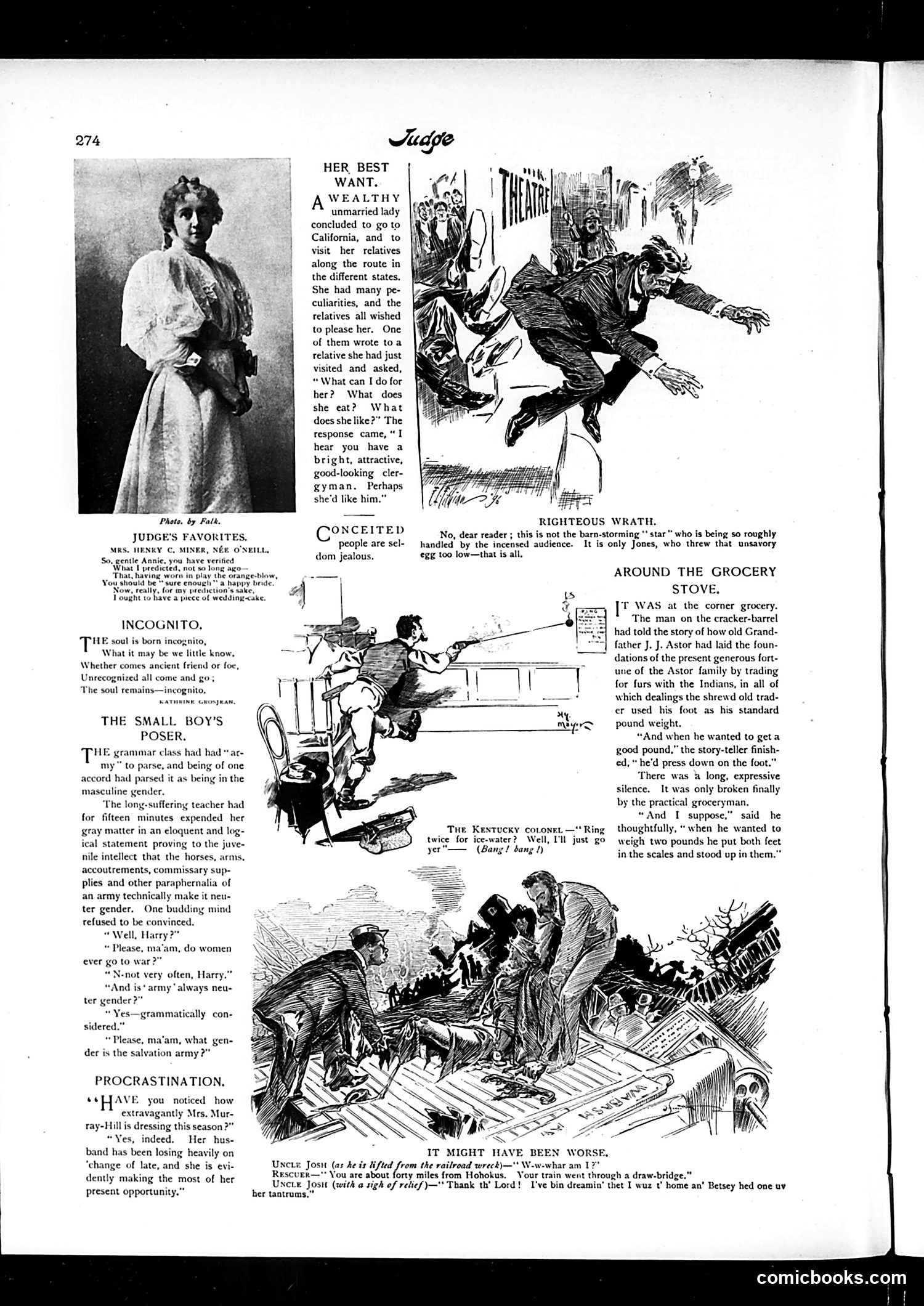
This page contains several unrelated satirical pieces typical of Judge's humor: **"Her Best Want"**: A wealthy woman traveling to California asks relatives what she'd enjoy. The response suggests an attractive clergyman—implying her real desire is romantic companionship, not material goods. **"Righteous Wrath"**: A crude theatrical performance is being disrupted by an angry audience member being physically ejected—satirizing both bad actors and violent audience reactions to poor entertainment. **"Around the Grocery Stove"**: A tall tale about J.J. Astor using his foot as a pound weight for fur trading is extended by a grocer's deadpan joke: if one foot equals one pound, two feet must equal two pounds. It's absurdist humor playing on literal logic. **Other pieces**: Brief jokes about grammar (a student questioning whether the "salvation army" is feminine), procrastination, and a train wreck survivor. The overall tone reflects Judge's mix of social satire, puns, and everyday character humor typical of early 20th-century American magazines.
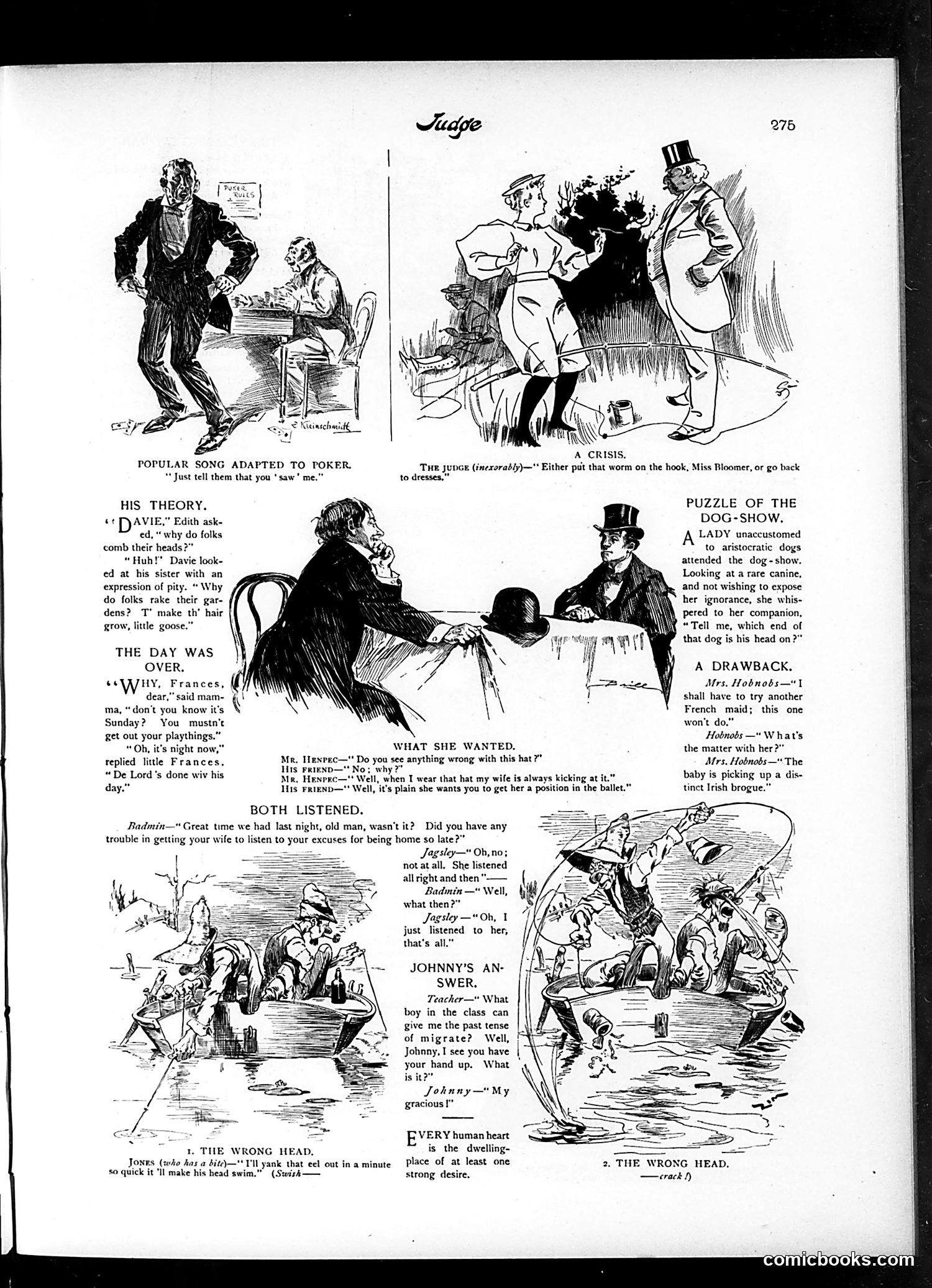
This page contains multiple short humorous pieces satirizing late 19th/early 20th-century American social conventions: **"A Crisis"** mocks the "New Woman" movement—the judge demands the woman either fish properly or abandon her unconventional pursuits ("go back to dresses"), suggesting women's expanding social roles were seen as ridiculous affectations. **"Puzzle of the Dog-Show"** ridicules nouveau-riche pretension: an upper-class-aspirant woman attends an exclusive dog show but lacks knowledge to navigate high society, exposing her social climbing. **"A Drawback"** satirizes wealthy households' reliance on European servants, with an Irish maid's accent and performance proving inadequate to aristocratic standards. Other pieces joke about childhood logic, marital dynamics, and classroom humor. The cartoons consistently target social climbers, gender role challenges, and the tensions between old money and new wealth—reflecting Gilded Age anxieties about American class mobility and "proper" behavior.
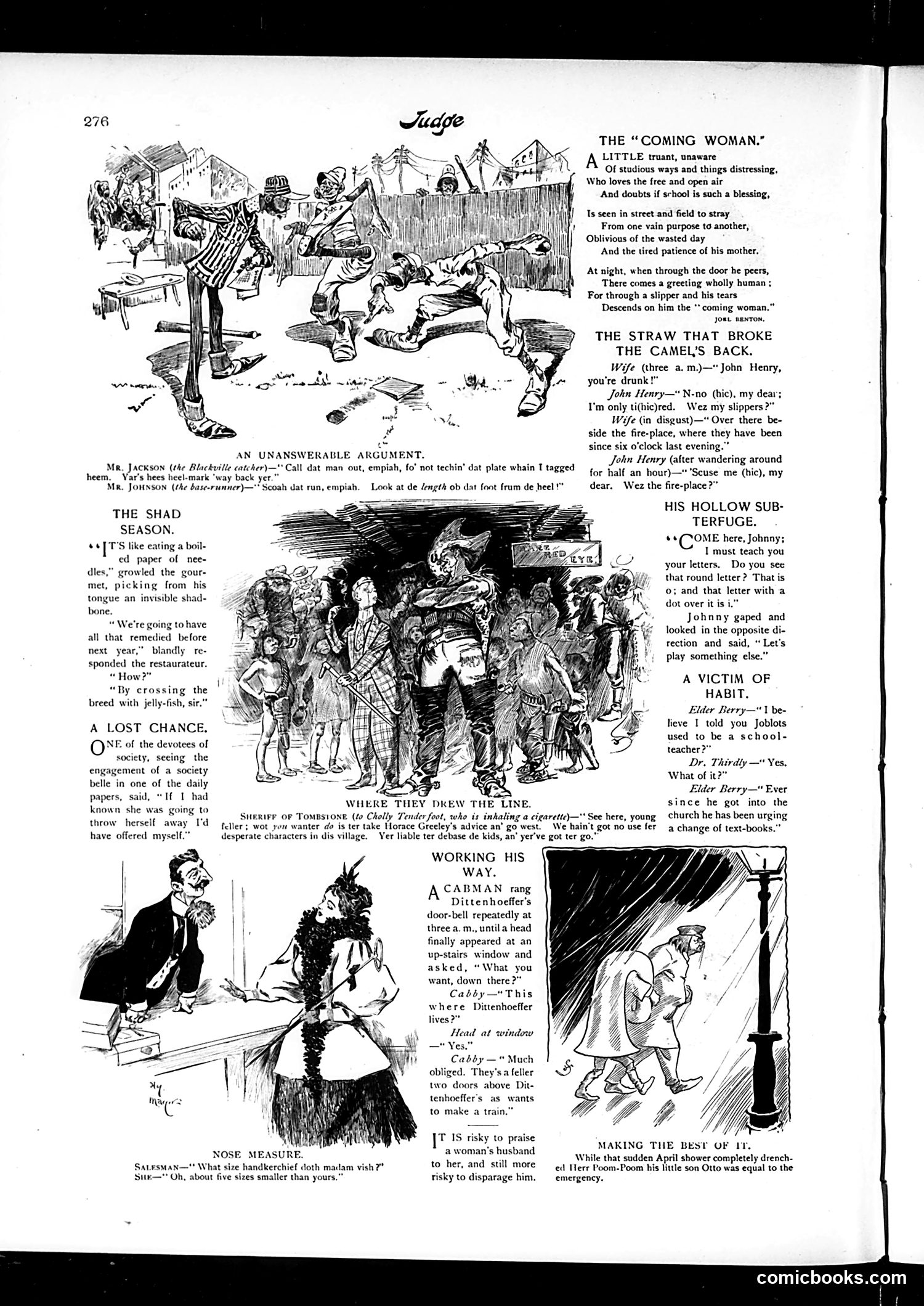
This page contains multiple brief humorous sketches typical of late 19th-century American satire: **"The Straw That Broke the Camel's Back"** depicts a drunk husband (John Henry) stumbling home at 3 a.m., unable to find his slippers despite his wife's clear directions. The joke: his inebriation makes simple tasks impossible—the "final straw" of marital frustration. **"The Coming Woman"** satirizes corporal punishment, showing a truant boy receiving a beating from his mother with a slipper when he returns home late. The ironic title suggests this represents women's expanding social roles (the "coming woman"). **Other sketches** include variations on domestic comedy: a society girl "throwing herself away" in engagement, shad-fishing humor, and a carman ringing the wrong apartment at 3 a.m. The **baseball dialogue** uses heavy dialect humor common to the era, mocking working-class speech patterns. The overall tone reflects Judge's brand of genteel satire targeting domestic life, alcohol abuse, and social pretension rather than serious political commentary.
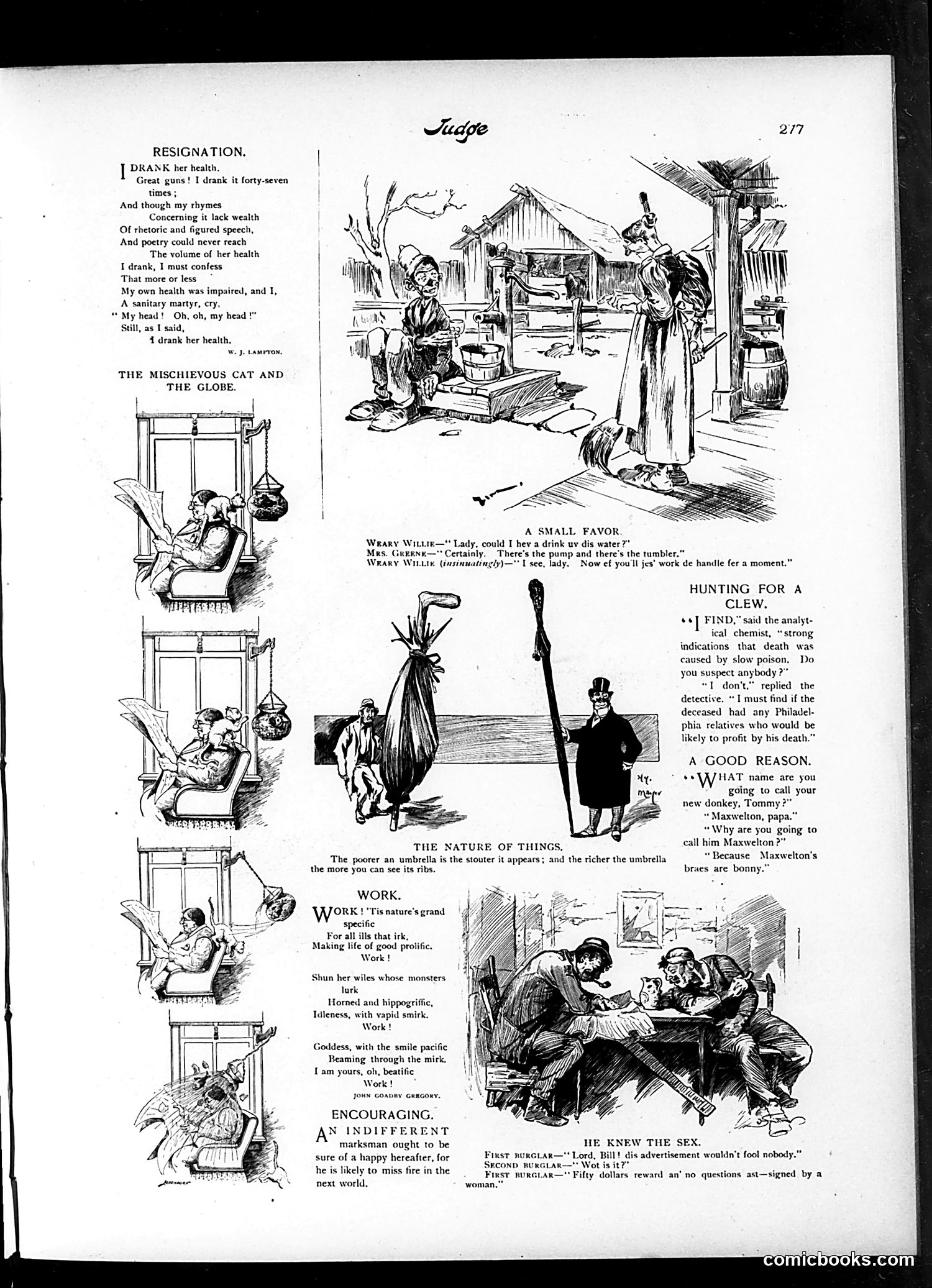
This page contains several unrelated satirical pieces typical of Judge's format: **"Resignation"** mocks excessive toasting customs—a speaker claims to have drunk someone's health 47 times, rendering his own health ruined, illustrating the absurdity of the era's elaborate social drinking rituals. **"Weary Willie" cartoon** shows a vagrant attempting to manipulate a woman into pumping water for him, exploiting politeness. It satirizes both panhandling and the class dynamics of the period. **"Hunting for a Clew"** jokes darkly about murder investigation, suggesting a detective would immediately suspect Philadelphia relatives (likely implying they're financially motivated), playing on period stereotypes about regional greed. **"A Good Reason"** is a simple child's joke about naming a donkey "Maxwelton" after a song lyric. **"He Knew the Sex"** presents burglars discussing a reward notice—the humor relies on the sexist premise that only a woman would post a reward without demanding answers, stereotyping women as sentimental or naive about criminal matters. The page also includes humorous aphorisms about work, umbrellas, and marksmanship.
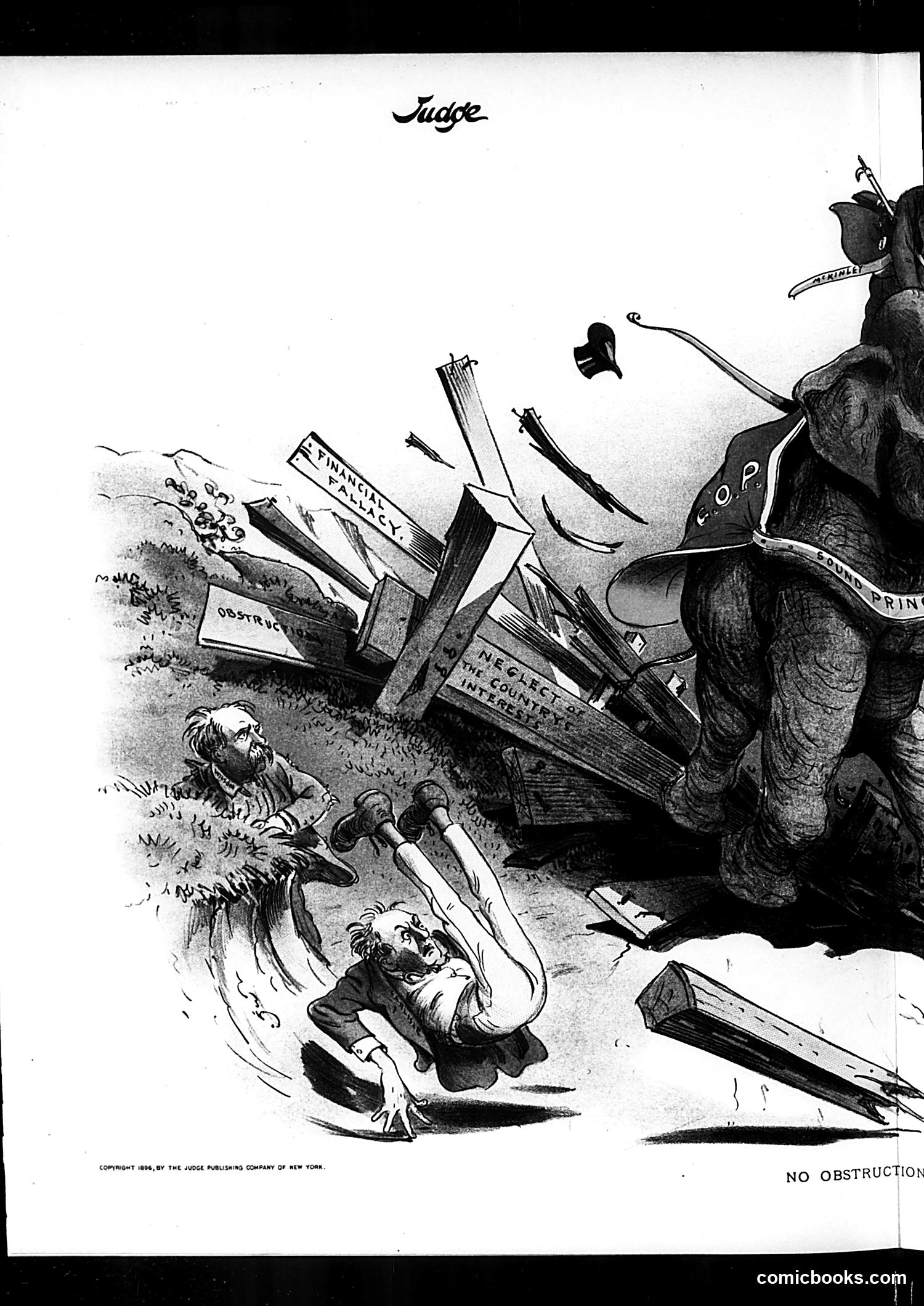
This political cartoon depicts an elephant (the Republican Party symbol) trampling two human figures in the grass while destroying various labeled obstacles and barriers. The visible labels include "OBSTRUCTION," "FINANCIAL PANIC," and what appears to be "NEGLECT" and "IN-COMPETENCY." The satire critiques Republican power by showing the elephant crushing those beneath it while removing impediments to its path. The title "NO OBSTRUCTION" appears ironic—suggesting the Republicans face no barriers to their agenda, though they're destroying legitimate concerns (financial panic, governmental failures) in the process. The copyright date of 1896 places this during William McKinley's presidency, likely commenting on Republican dominance and their dismissal of Democratic opposition or economic/governance criticisms.
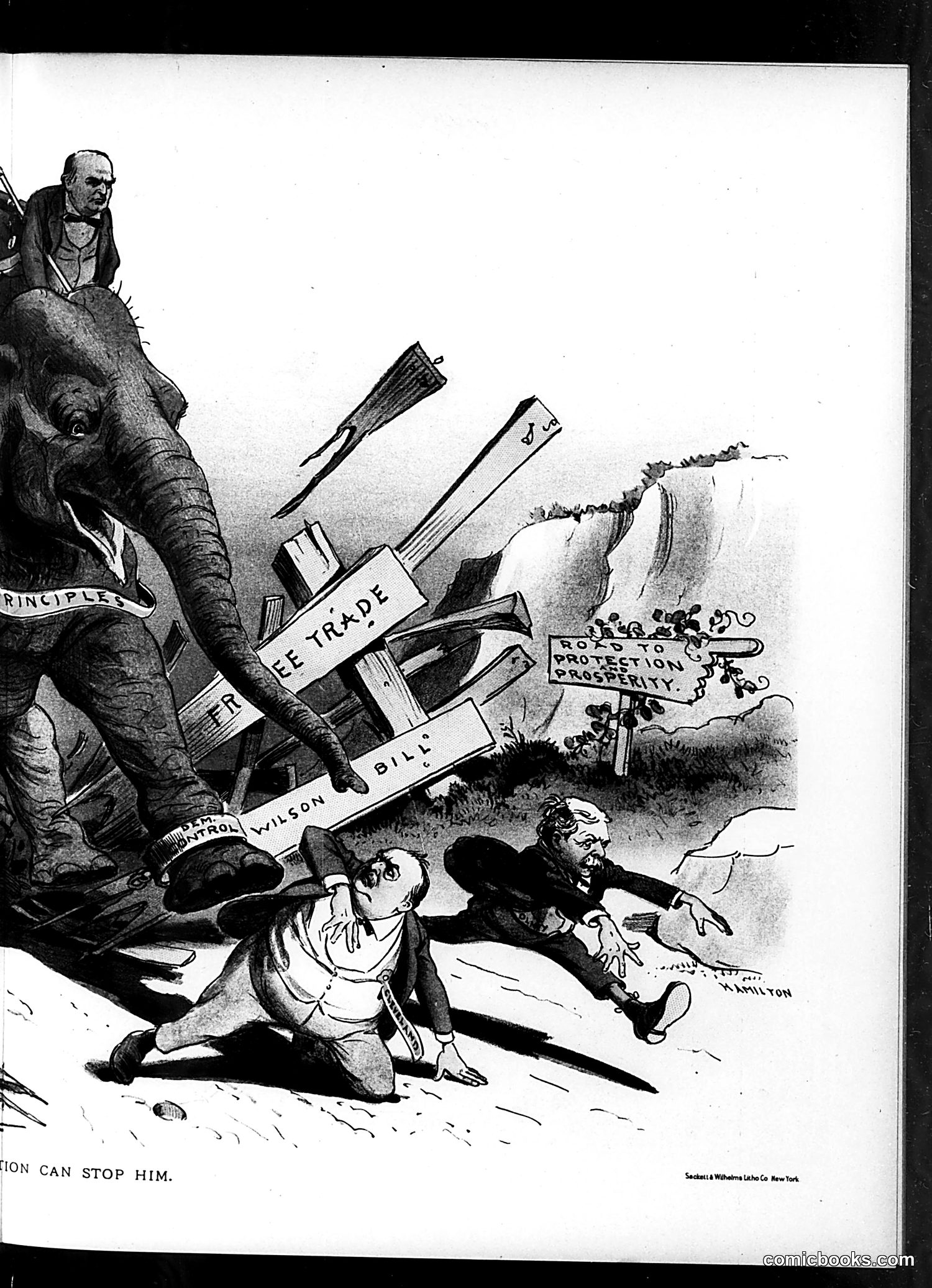
This satirical cartoon depicts an elephant (the Republican Party symbol) labeled "PRINCIPLES" being ridden by a man (likely President Wilson, given the context of Judge magazine's era). The elephant is trampling documents labeled "FREE TRADE," "BILL," and "ROAD TO PROTECTION & PROSPERITY," while two smaller figures (appearing to be Democrats or political opponents) scramble to escape beneath its feet. The cartoon criticizes Wilson for abandoning Republican economic principles, particularly regarding tariffs and free trade policy. The phrase "ONLY WILSON CAN STOP HIM" (partially visible) suggests mockery of claims about Wilson's control or leadership. The satire suggests Wilson is recklessly destroying established Republican economic doctrines through his policies, with opposition figures powerless to prevent the damage.
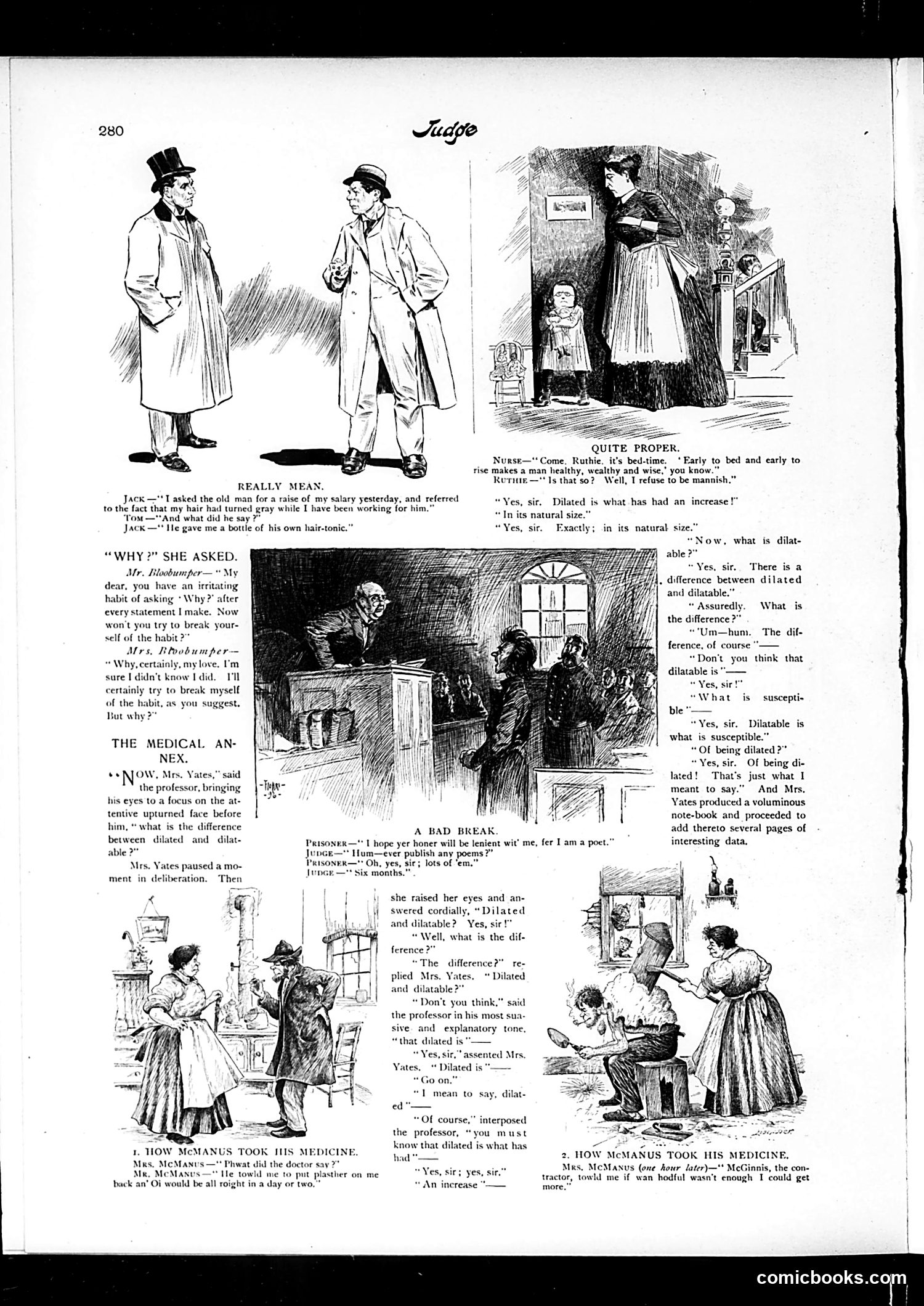
This page contains four separate humorous sketches satirizing different social situations: **"Really Mean"**: A man asks his employer for a raise, noting his hair turned gray in service. The boss responds by giving him hair-tonic—a dismissive, insulting non-answer that mocks penny-pinching employers. **"Why? She Asked"**: A wife habitually asks "why?" after every statement. Her husband requests she break this annoying habit—she immediately asks "why?"—illustrating the irony through her own behavior. **"The Medical Annex"**: A professor quizzes Mrs. Yates on the difference between "dilated" and "dilatable." She repeatedly gives circular, meaningless answers ("dilated is dilated"). The professor accepts her non-definitions as profound wisdom, satirizing academic pretension and circular reasoning masquerading as expertise. **"A Bad Break"**: A prisoner claims to be a poet seeking leniency; when asked if he's published, he says yes—"six months ago," implying he's been imprisoned since. The judge's implied skepticism mocks both criminal excuses and dubious artistic credentials. The overall theme: human folly and evasion in everyday life.
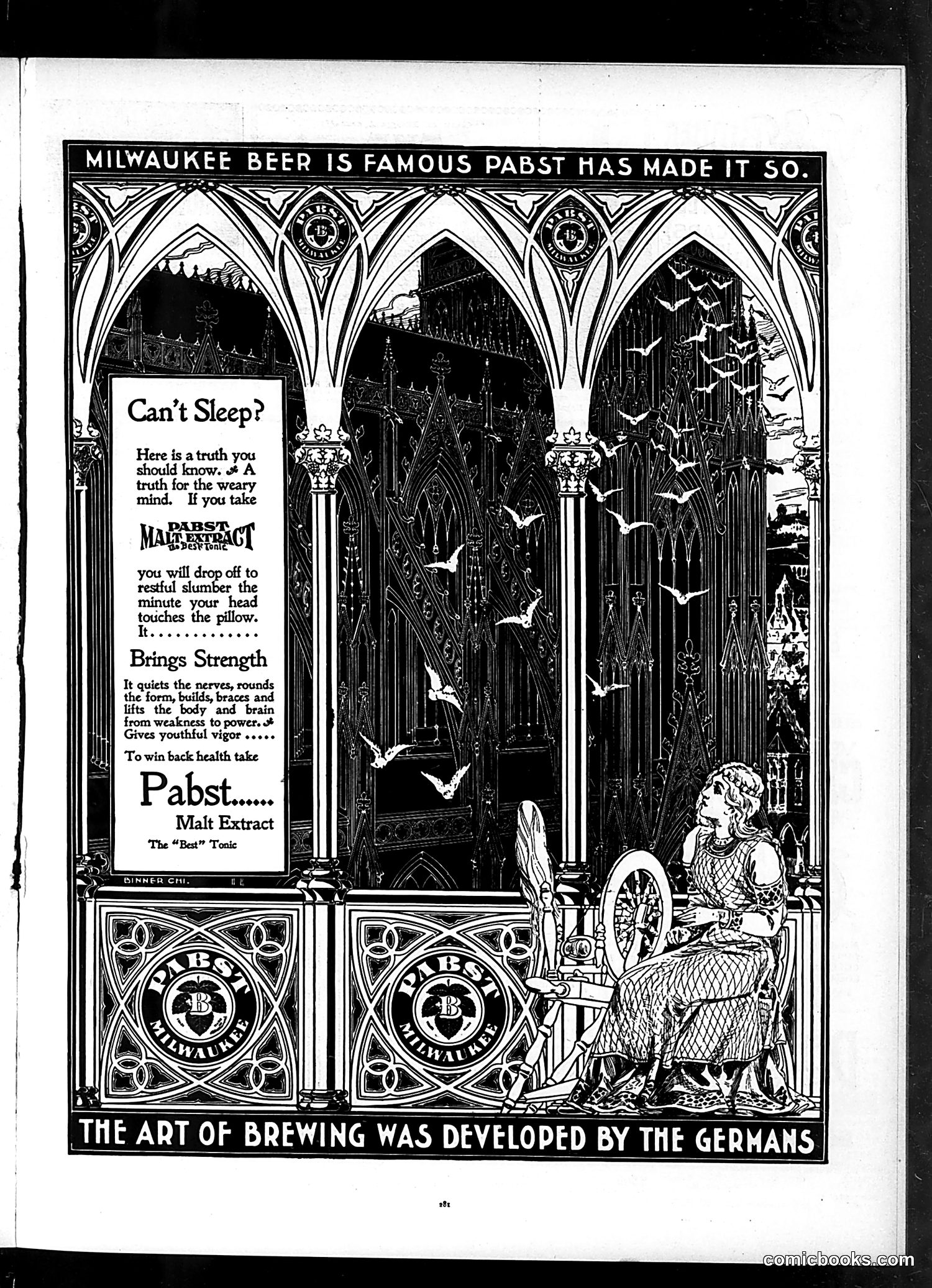
This is a Pabst Malt Extract advertisement, not satire. It promotes the product as a sleep aid and health tonic for the "weary mind." The ad claims that consuming Pabst Malt Extract will induce "restful slumber" and "brings strength" by quieting nerves and providing "youthful vigor." The gothic illustration depicts a woman in a cathedral-like setting, likely evoking European brewing traditions—the text notes "the art of brewing was developed by the Germans." This aesthetic lends gravitas and Old World authenticity to the product. Modern readers should note this reflects early 20th-century patent medicine marketing, when alcohol-based tonics made dubious health claims without FDA regulation. The product exploited common anxieties about insomnia and weakness while leveraging nostalgia for German brewing expertise.
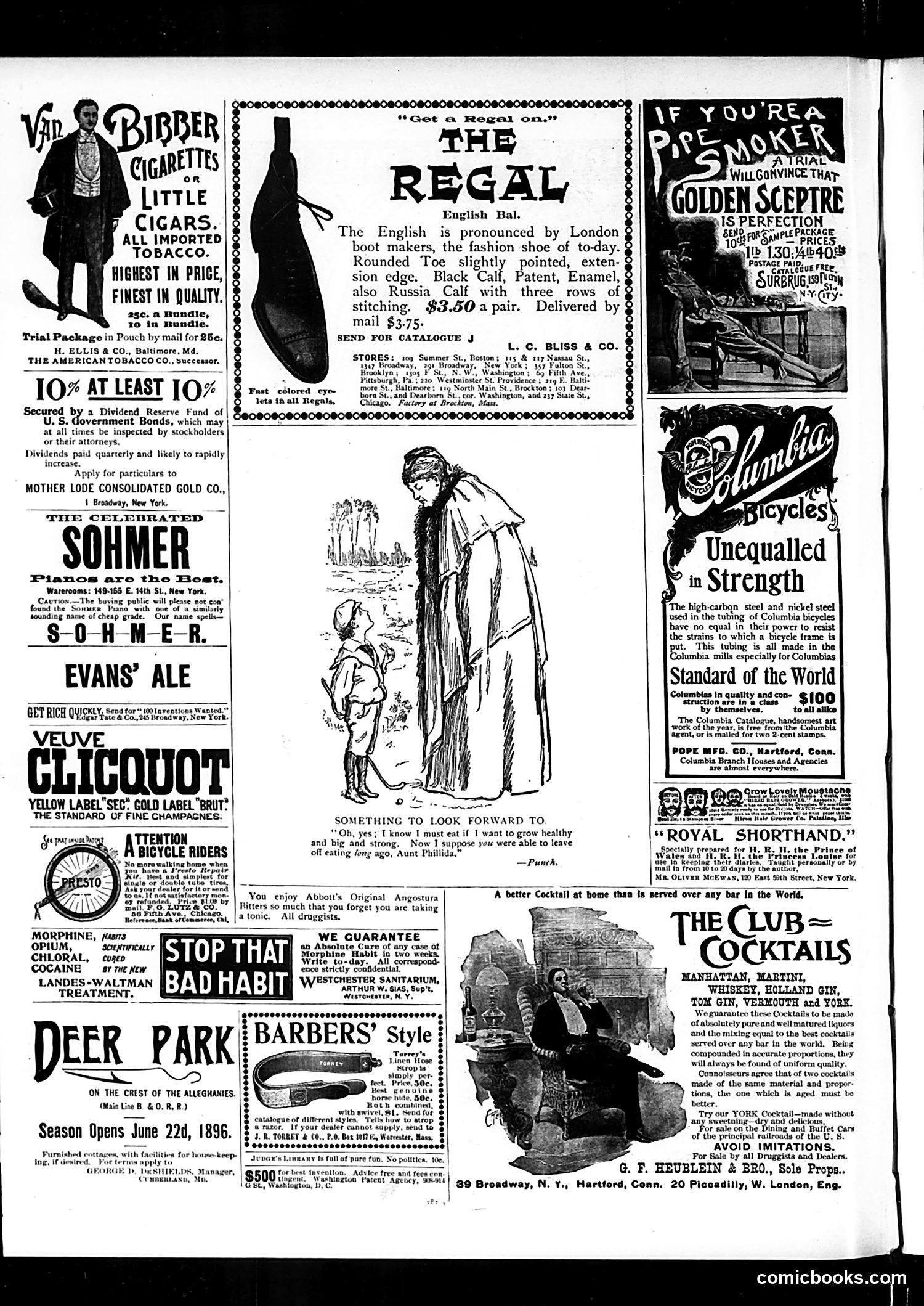
This is primarily an **advertising page** from Judge magazine (circa 1896, based on the Deer Park resort opening date). Rather than containing political cartoons, it showcases period product advertisements. The page illustrates late-19th-century consumer culture and social attitudes: **Notable advertisements include:** - Van Bibber cigarettes and cigars (luxury imported tobacco) - The Regal shoe (fashionable English design) - Sohmer pianos - Evans' Ale and Veuve Clicquot champagne - Columbia bicycles - Medical "treatments" for morphine, opium, and cocaine addiction (reflecting period drug epidemics) - Barbers' razors - The Club cocktails **Social context:** The ads reveal anxieties about substance abuse (addiction treatments prominent), class aspirations (imported goods emphasized), technological progress (bicycles), and leisure culture (resort advertising). The single illustrated feature—"Something to Look Forward To" from *Punch*—shows a child and adult discussing eating habits, likely commenting on nutrition or childhood obesity, though specifics are unclear.
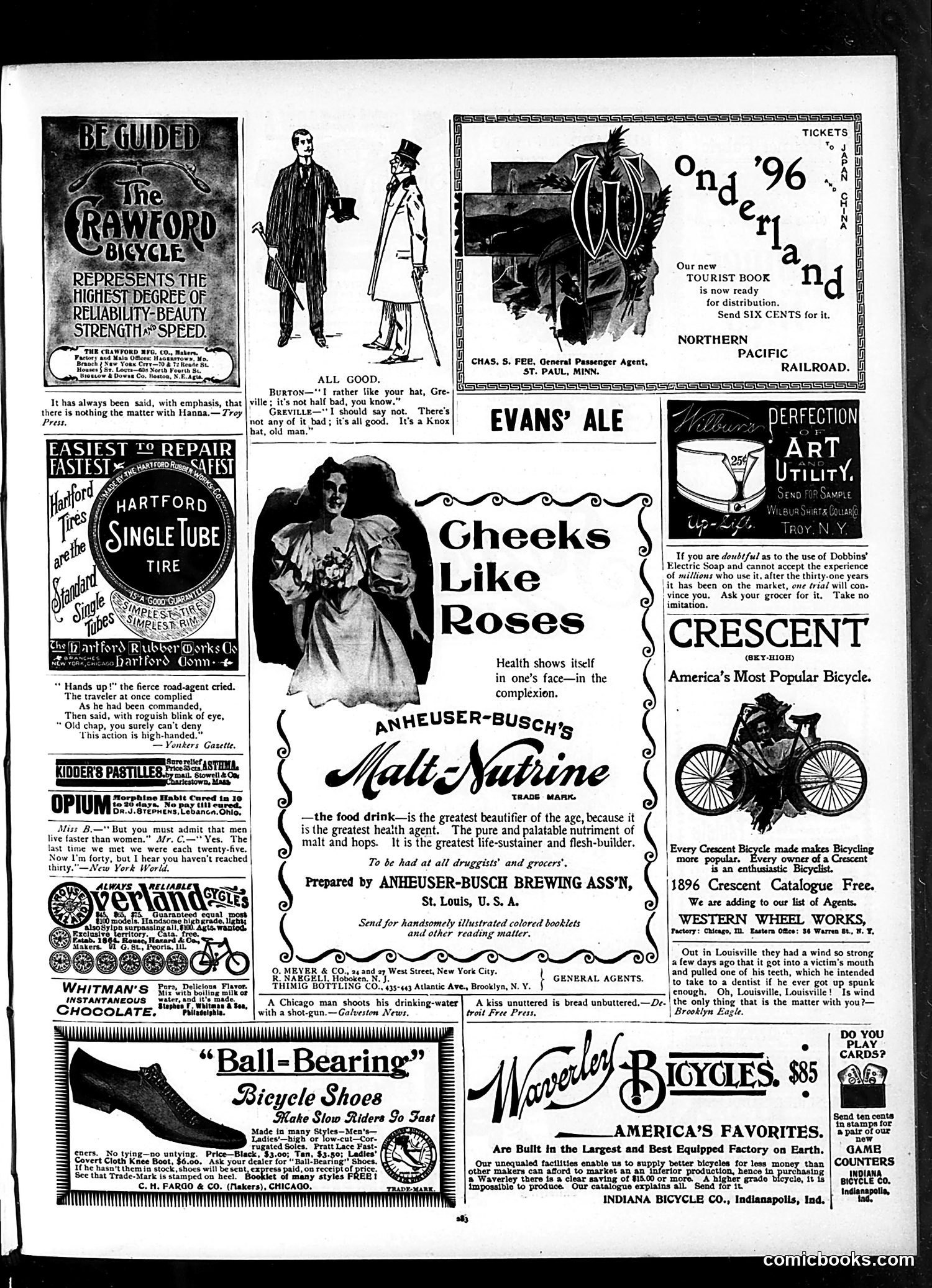
This is primarily an **advertising page** from Judge magazine, circa 1896. The page contains mostly commercial advertisements with minimal satirical content. The only clear editorial humor appears in the scattered **brief jokes** throughout: - A quip about a man named **Hanna** and his hat (likely referencing Mark Hanna, McKinley's campaign manager, though the exact satire is unclear) - A dialogue joke about men living faster than women - A tall-tale about a Chicago man shooting his drinking water - A wind joke about Louisville pulling out someone's tooth The **bulk of the page** advertises bicycles (Crescent, Waverley, Indiana), beverages (Anheuser-Busch's Malt-Nutrine), bicycle shoes, tires, and patent medicines—typical of 1890s American magazines. The product claims are earnest, not satirical. The Northern Pacific Railroad and tourist book advertisement appears at the top. Overall, this is a **commercial/advertising issue** rather than a satirically-focused editorial page.
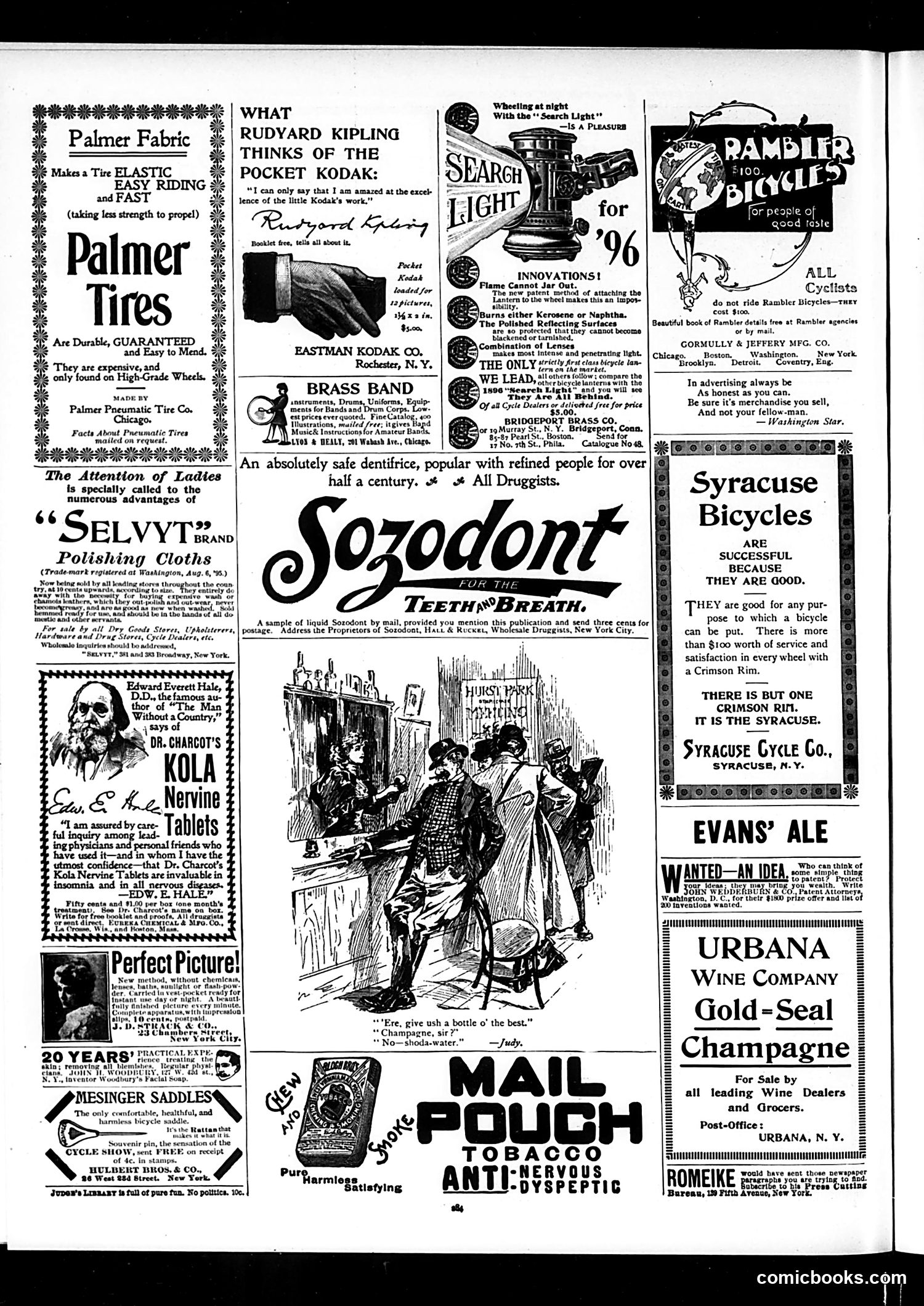
This page is primarily **advertising**, not satirical content. The main cartoon—a small illustration labeled "Judy" at center—depicts a humorous bar scene: a patron requests "a bottle o' the best," the bartender offers "Champagne, sir?" and the patron replies "No—soda-water." The joke relies on **class commentary**: despite appearing wealthy enough to afford champagne, the customer prefers plain soda water—either suggesting temperance values, practical frugality, or mockery of pretension. The rest of the page contains period product advertisements (Palmer Tires, Eastman Kodak, Sozodont toothpaste, bicycles, ale, champagne, nerve tonics) typical of early 1900s magazines. Notably, these ads reveal contemporary consumer culture: bicycles as luxury goods, photography equipment, and dubious patent medicines like "Kola Nervine Tablets." The page demonstrates how **advertising subsidized magazines** while also reflecting the era's commercial values and health misconceptions.
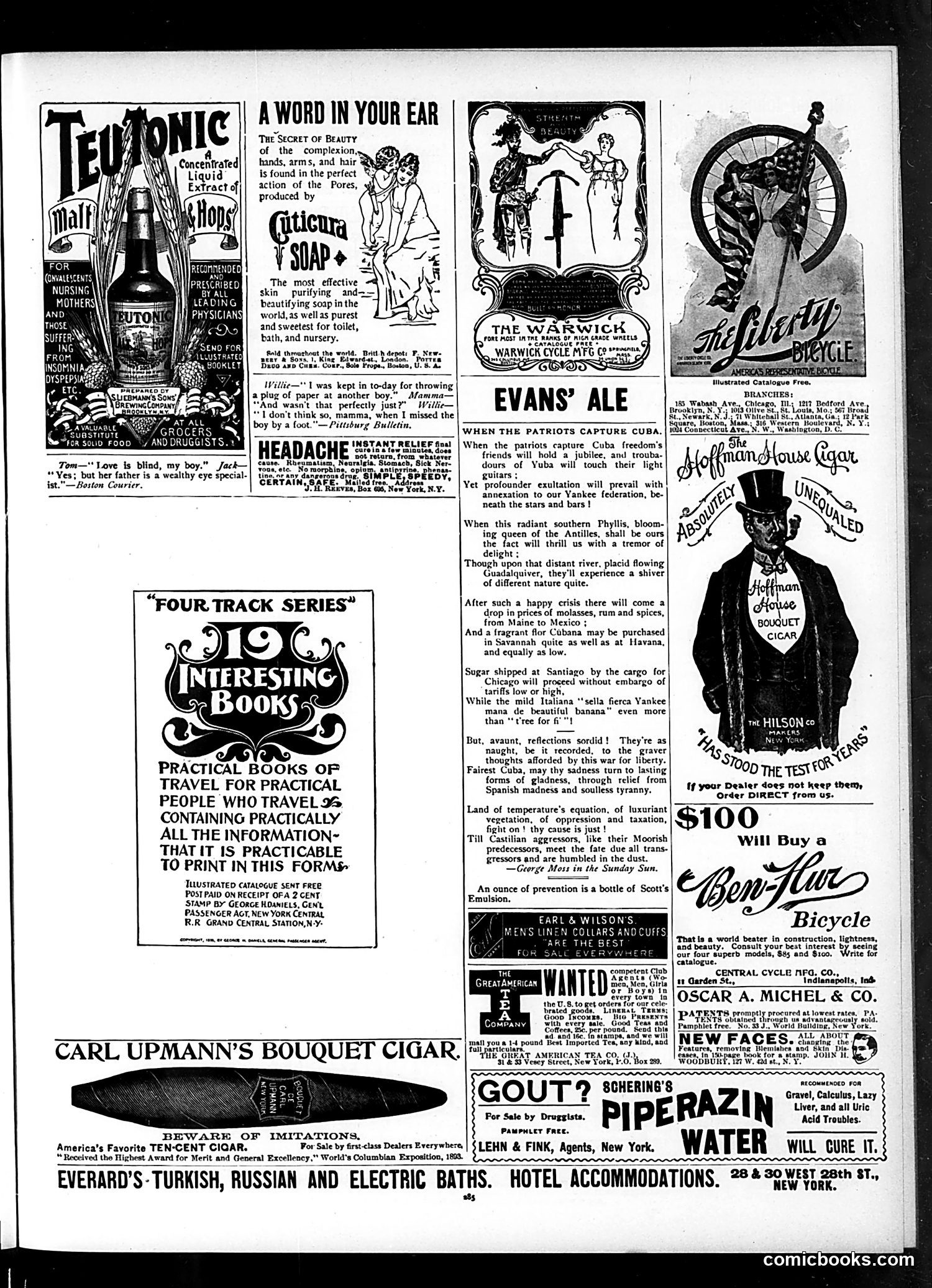
This is primarily an **advertising page** from Judge magazine, with one notable satirical poem about Cuba. The main satirical content is **"When the Patriots Capture Cuba,"** a poem that mocks American jingoism during the Spanish-American War (appears to be 1898, given references). The poem presents Cuba's liberation in grandiose patriotic terms—"freedom's friends will hold a jubilee"—but then undercuts this with mercenary concerns: price drops on sugar, molasses, and rum; cheaper cigars in American cities; removal of trade tariffs. The final lines attempt to recover lofty rhetoric about liberty, but the satire is clear: American "patriots" are primarily motivated by commercial advantage, not Cuban freedom. The poem appears to critique American expansionism dressed in liberation rhetoric—a common Judge theme during the 1890s. The rest of the page consists of period advertisements: beauty products, cigars, bicycles, travel books, and patent medicines—typical Judge advertising content with no apparent satirical intent beyond the standard exaggeration of product claims.
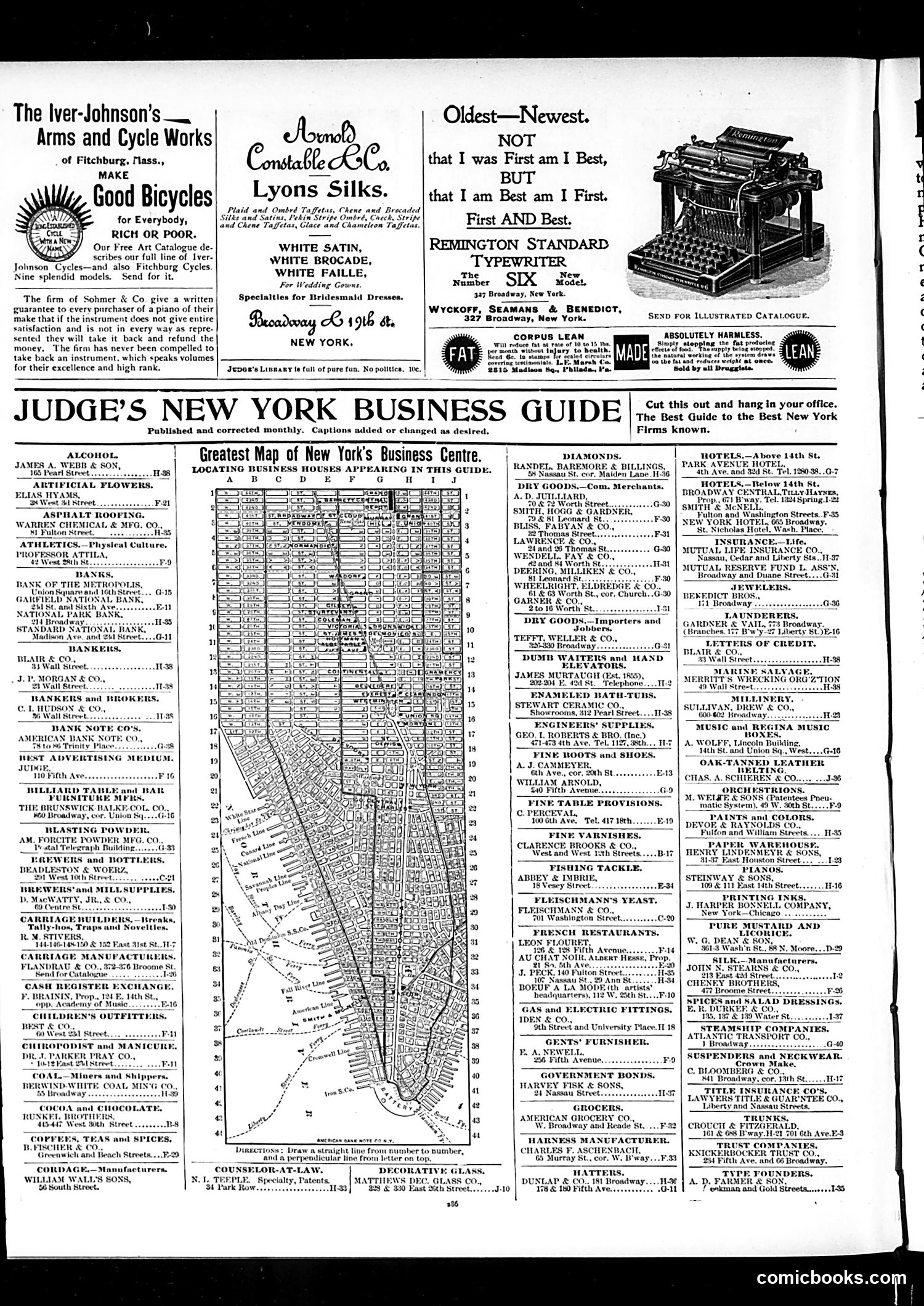
This page is primarily a **business directory and advertising supplement**, not a satirical cartoon feature. It contains: **Content:** Judge's New York Business Guide—a classified business directory with a detailed map of Manhattan's commercial center and hundreds of listed firms (banks, hotels, manufacturers, jewelers, etc.). The page includes advertisements for products like bicycles, pianos, typewriters, silk, and weight-loss remedies. **No Political Satire:** Unlike Judge's typical content, this page lacks cartoons or satirical commentary. It's a practical commercial reference tool. **Historical Interest:** The ads reveal period products and concerns—safety bicycles, manual typewriters, patent medicines claiming to reduce weight "by stopping fat production." The businesses mapped reflect turn-of-the-century Manhattan's commercial geography and mercantile culture. This appears to be a service feature rather than Judge's satirical editorial content.
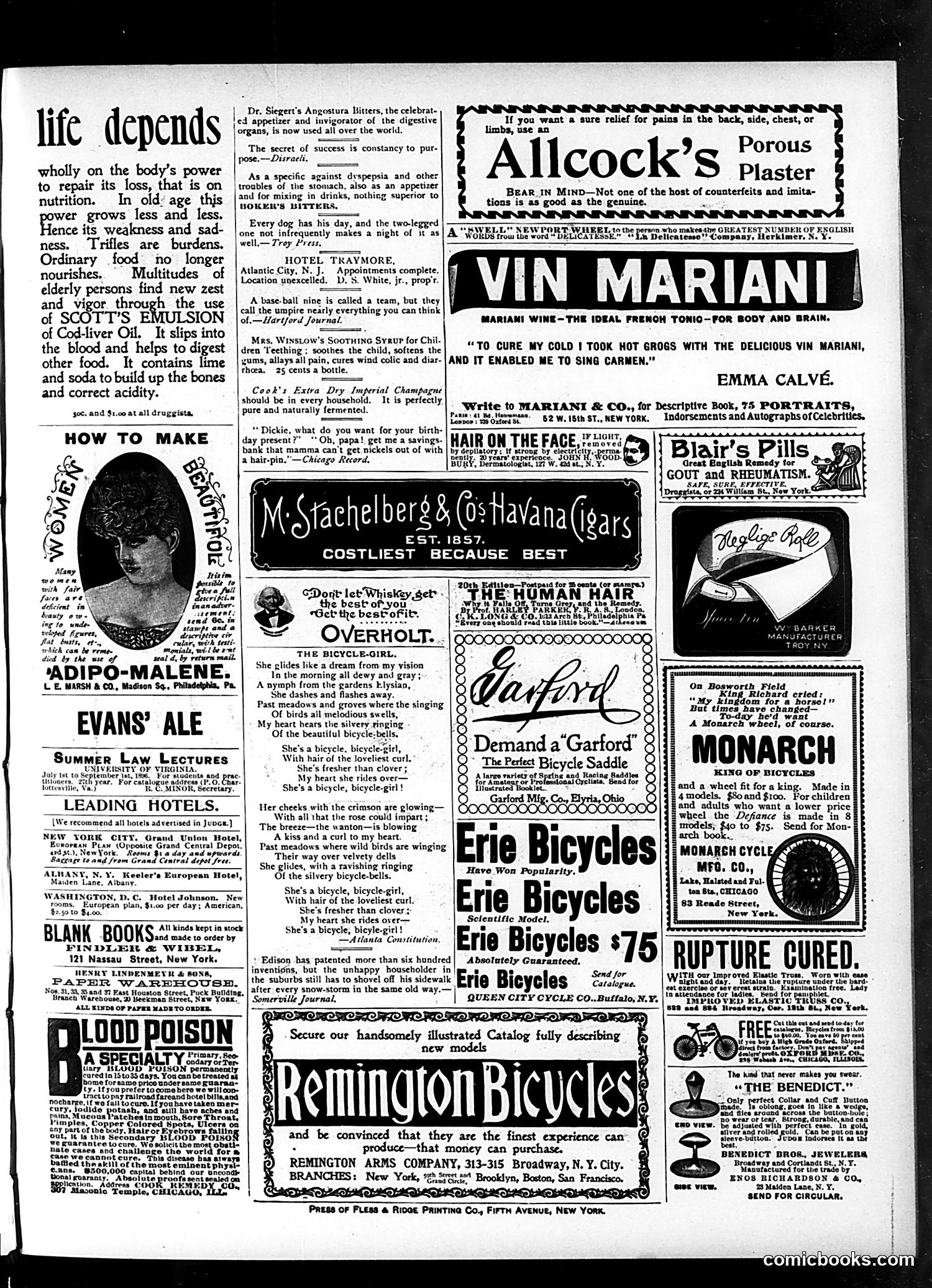
This page is primarily **advertising**, typical of Judge magazine's revenue model. The content includes: **Main advertisements:** - Health/medicinal products (Scott's Emulsion cod liver oil, various bitters and tonics) - Vin Mariani (a cocaine-wine tonic, endorsed by opera singer Emma Calvé) - Patent medicines (Blair's Pills, Allcock's Plaster) - Bicycles (Erie, Remington, Garford models) - Cigars (M. Stachelberg & Co.) **The only cartoon element** is "The Bicycle-Girl"—a romantic poem/illustration about a young woman on a bicycle, reflecting the 1890s cycling craze and the "New Woman" phenomenon. The bicycle symbolized female independence and mobility, causing social anxiety among conservatives. **Historical context for modern readers:** The cocaine-containing Vin Mariani was legal and openly advertised as a health tonic. Patent medicines made extravagant health claims without regulation. The bicycle-girl represents both the era's technological optimism and anxieties about changing gender roles.
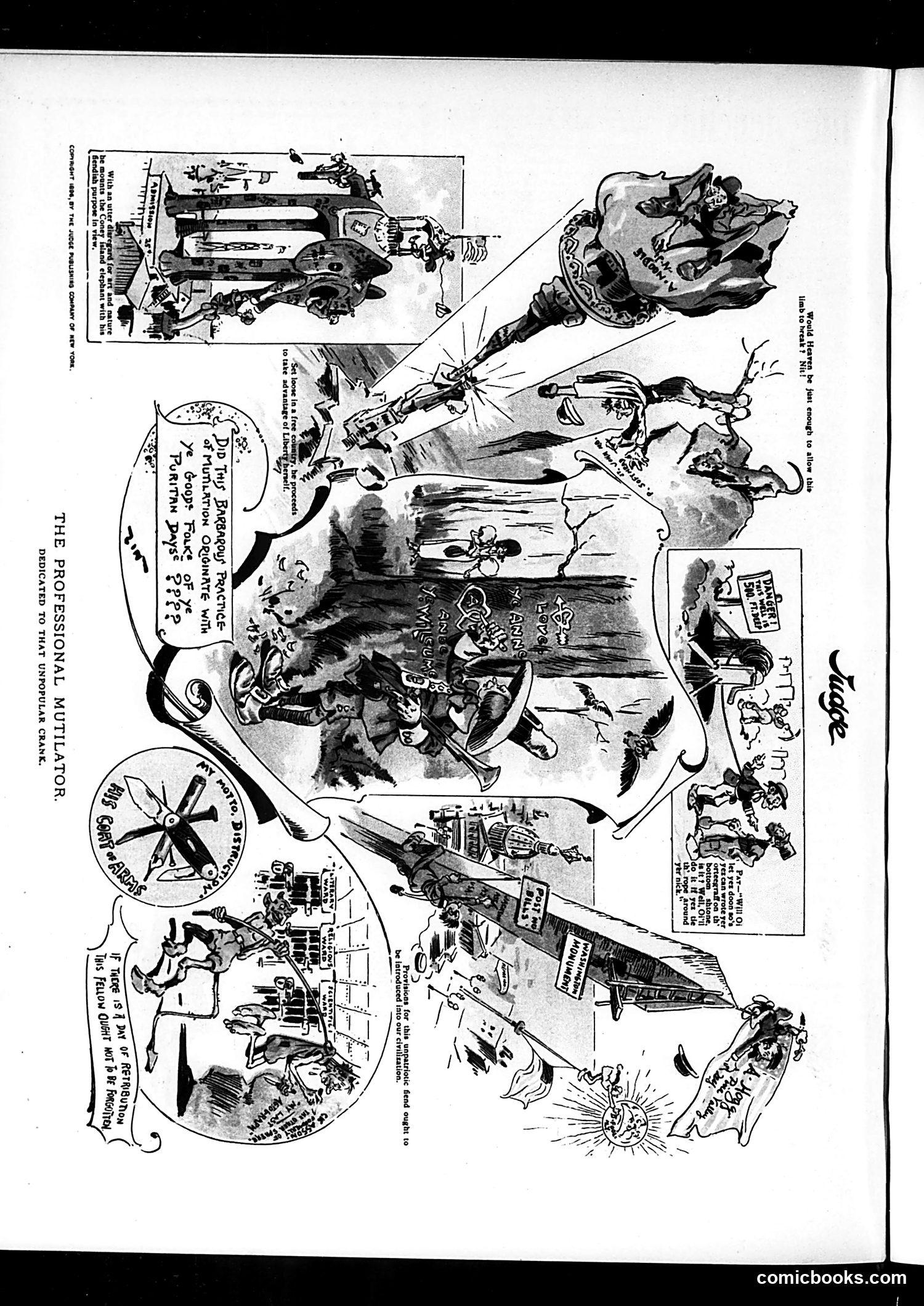
This Judge cartoon satirizes what appears to be a contemporaneous practice of deliberately maiming or mutilating animals or people for profit or exhibition. The title references "that unpopular crank," though the specific figure isn't clearly identifiable from this image alone. The OCR'd text suggests the cartoon compares this practice to historical barbarism—invoking Puritan-era punishments and practices in Nepal—to emphasize how primitive and inhumane the behavior is. The central figure appears to be someone who deliberately injures others "with utter disregard for art and nature," presumably for display or spectacle purposes. The satire condemns both the perpetrator and society's tolerance of such cruelty. Without clearer context about the specific 1896 incident or individual targeted, the exact target remains somewhat unclear, but the cartoon's message is unambiguous: Judge deemed this form of exploitation barbarous and worthy of public ridicule.