
A complete issue · 16 pages · 1895
Judge — June 8, 1895
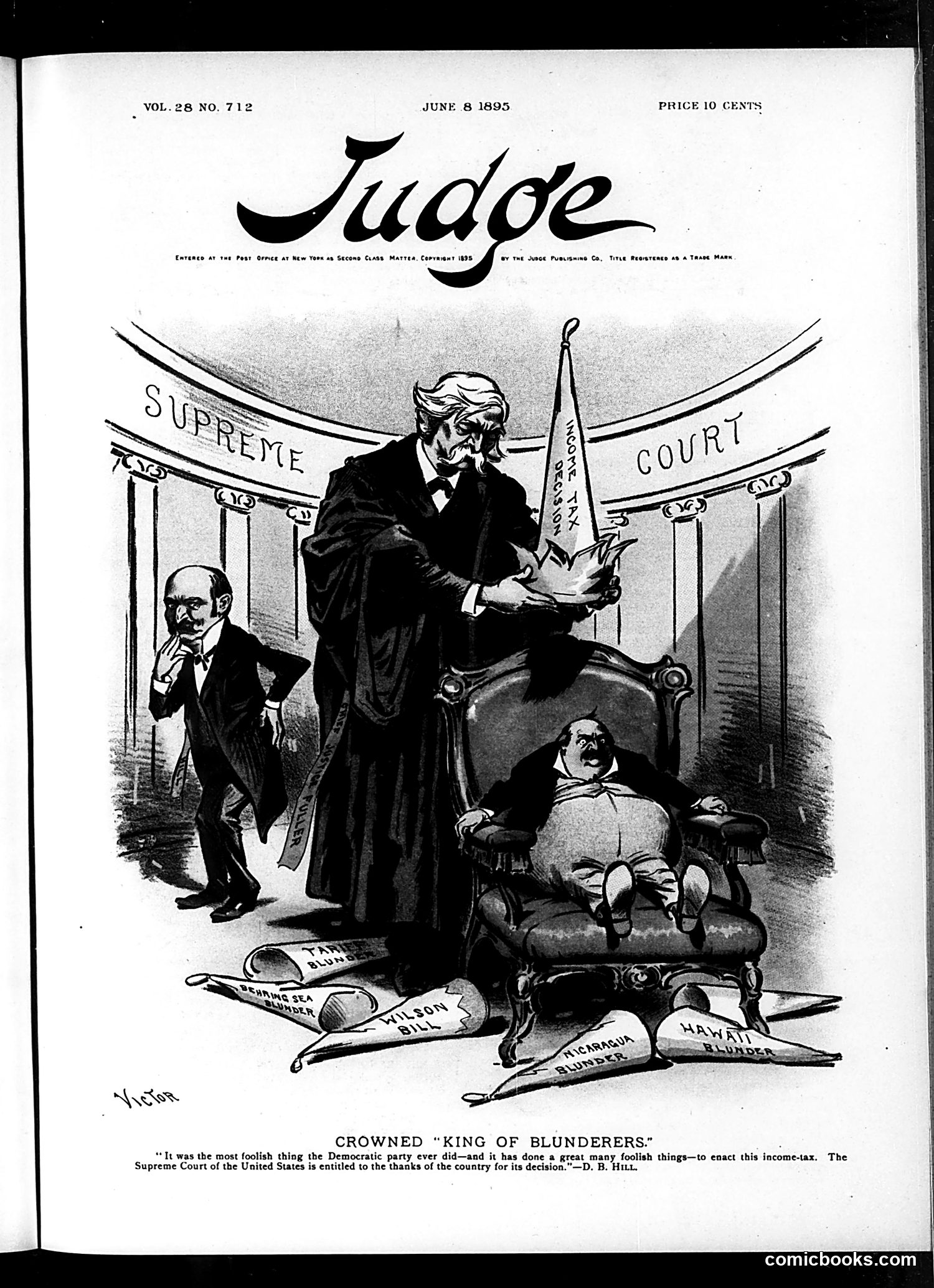
This 1895 *Judge* cartoon satirizes the Democratic Party's income tax legislation. A demonic figure (representing the Supreme Court) sits enthroned in the "Supreme Court," holding a sword labeled with various taxes (Selling Sea Island, Wilson Bill, Haiti Blunderer, and others). Two men flank him—likely Democratic politicians—appearing distressed. The caption attributes the quote to D.B. Hill, a prominent New York Democrat, calling the income tax "the most foolish thing the Democratic party ever did." The cartoon suggests the Supreme Court has struck down this tax policy, and mocks Democrats for their legislative failure. The caricatured devil-judge represents judicial authority humiliating Democratic ambitions, with the scattered tax labels symbolizing defeated tax initiatives.
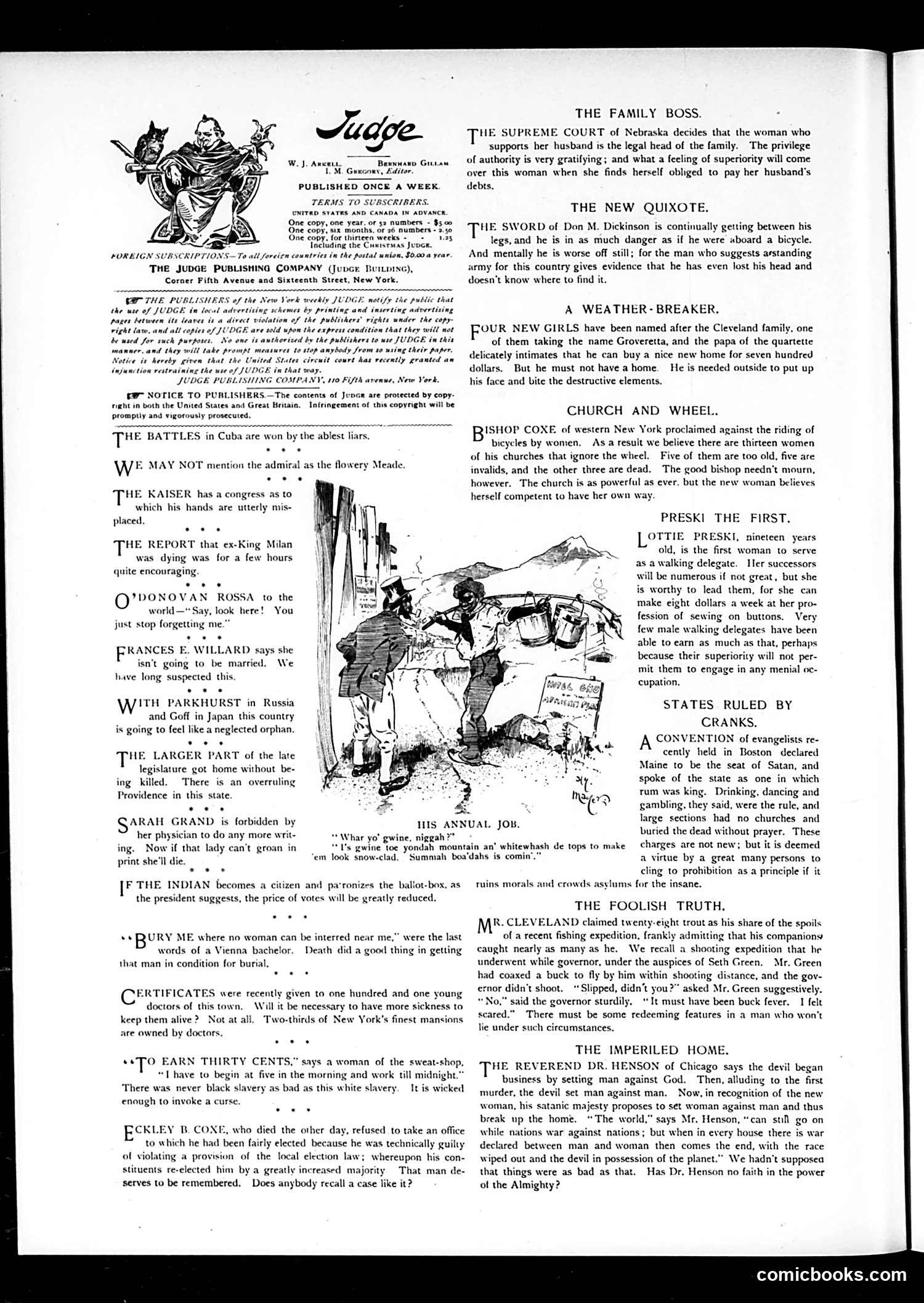
This satirical cartoon depicts a man (likely a politician or government official) performing degrading labor—apparently shoveling manure or waste—labeled as his "annual job." The accompanying caption mocks his claim that he's "giving the yondah mountain an' whitewash de tops to make it look snow-coated. Shammah boss'dals is comin'." The satire appears to target political corruption or incompetence: a public official performs performative, menial work while claiming respectability. The broken dialect suggests mockery of either the official himself or those he serves. The cartoon critiques the gap between politicians' self-presentation and their actual usefulness—they engage in meaningless labor while accepting public positions. Without clearer identification of the specific figure, the exact political target remains uncertain, though the message condemns fraudulent or ineffectual governance.
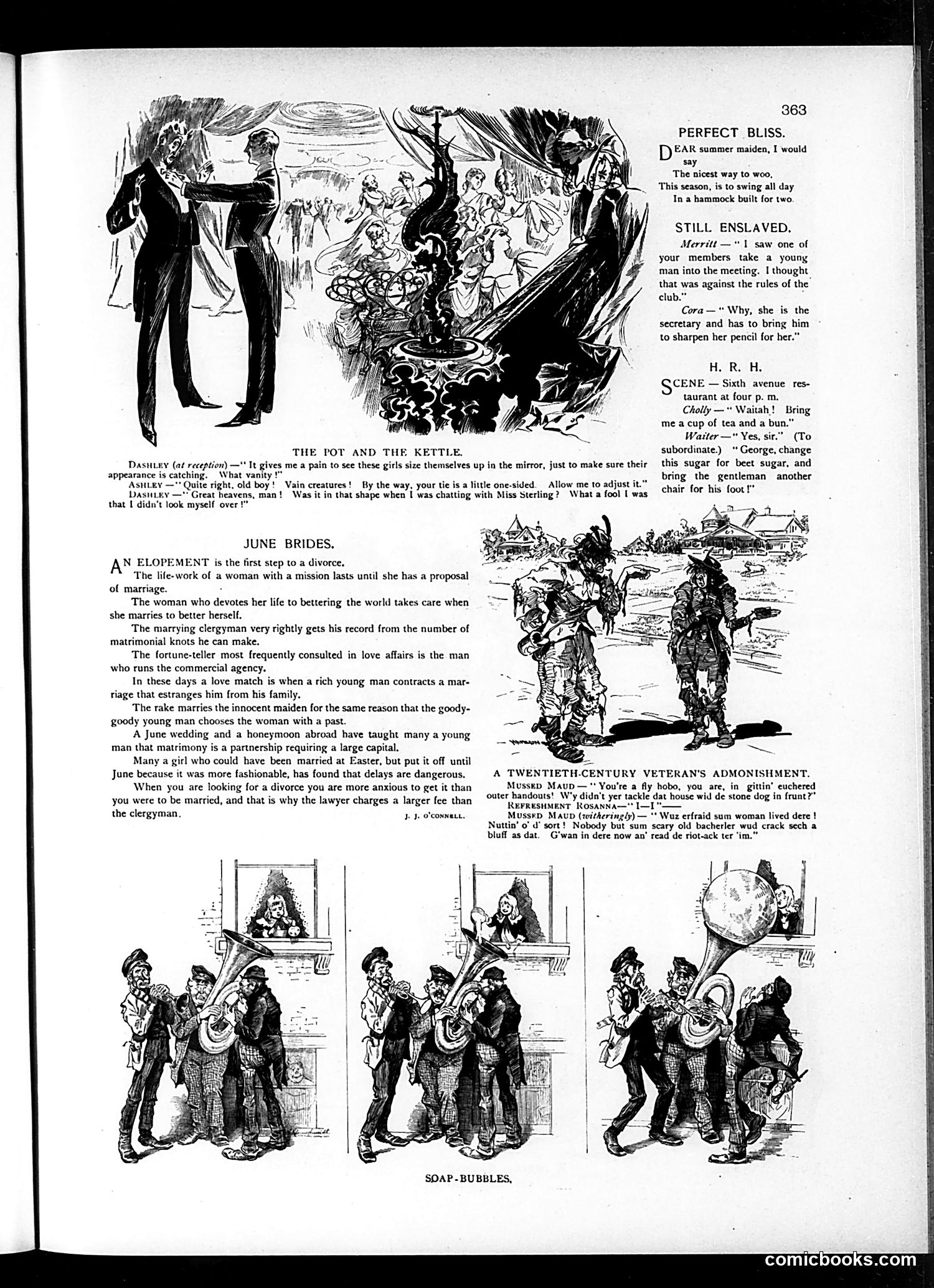
This page contains three satirical pieces: **"The Pot and the Kettle"** mocks club members for hypocrisy—specifically about bringing young men to meetings while enforcing rules against it. The sketch satirizes double standards among the organization's leadership. **"June Brides"** is a social commentary on marriage, divorce, and legal fees. Written by J.J. O'Connell, it argues that women marry to improve themselves, but June weddings are dangerous because divorce is easier and more desirable than marriage itself—satirizing both the legal system's complexity and contemporary attitudes toward matrimony. **"Soap-Bubbles"** appears to be a three-panel visual gag about street musicians or performers, likely mocking their temporary success or fleeting fortunes—the metaphor of bubbles suggesting insubstantial gain. All reflect typical Gilded Age social anxieties about institutions, marriage, and class.
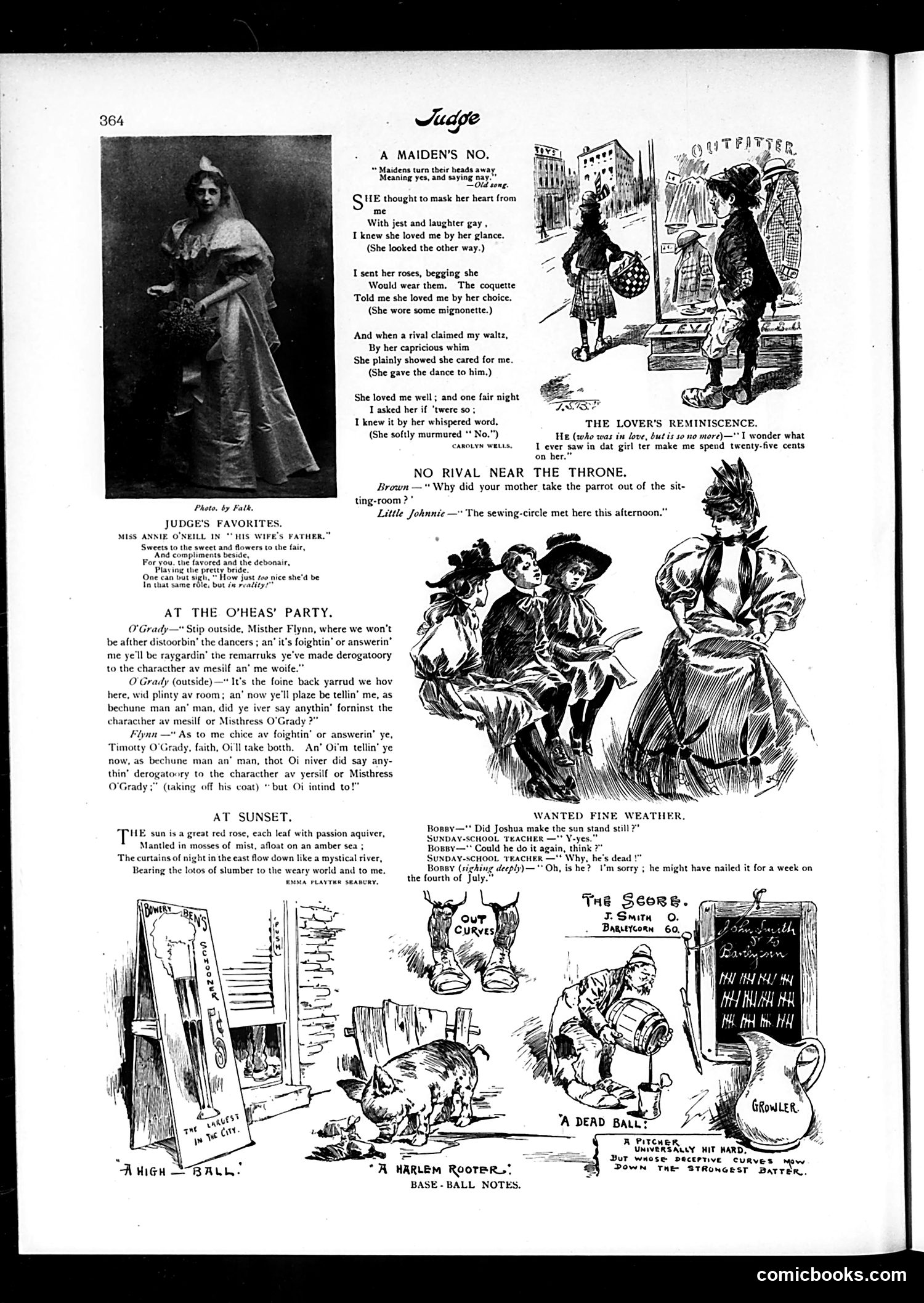
This page from Judge magazine (undated but appears late 19th century) contains several separate humor pieces: **"A Maiden's No"** satirizes romantic misinterpretation—a lover convinces himself that a woman's rejections and avoidances actually prove her love, culminating in her saying "No" to his proposal, which he interprets as affection. The joke mocks male delusion in courtship. **"The Lover's Reminiscence"** shows a jilted lover questioning why he spent money on a woman who rejected him—satire on romantic foolishness and wasted expense. **"At the O'Heas' Party"** uses Irish dialect humor (typical of the era) where two Irishmen discuss fighting over slanders, employing exaggerated brogue. **"At Sunset"** is sentimental romantic poetry, likely included for contrast/mockery. The baseball section at bottom uses visual puns about playing technique. Overall, the page emphasizes satire on romance, courtship misunderstandings, and gender dynamics—common Judge themes mocking Victorian-era social pretense and male foolishness in matters of love.
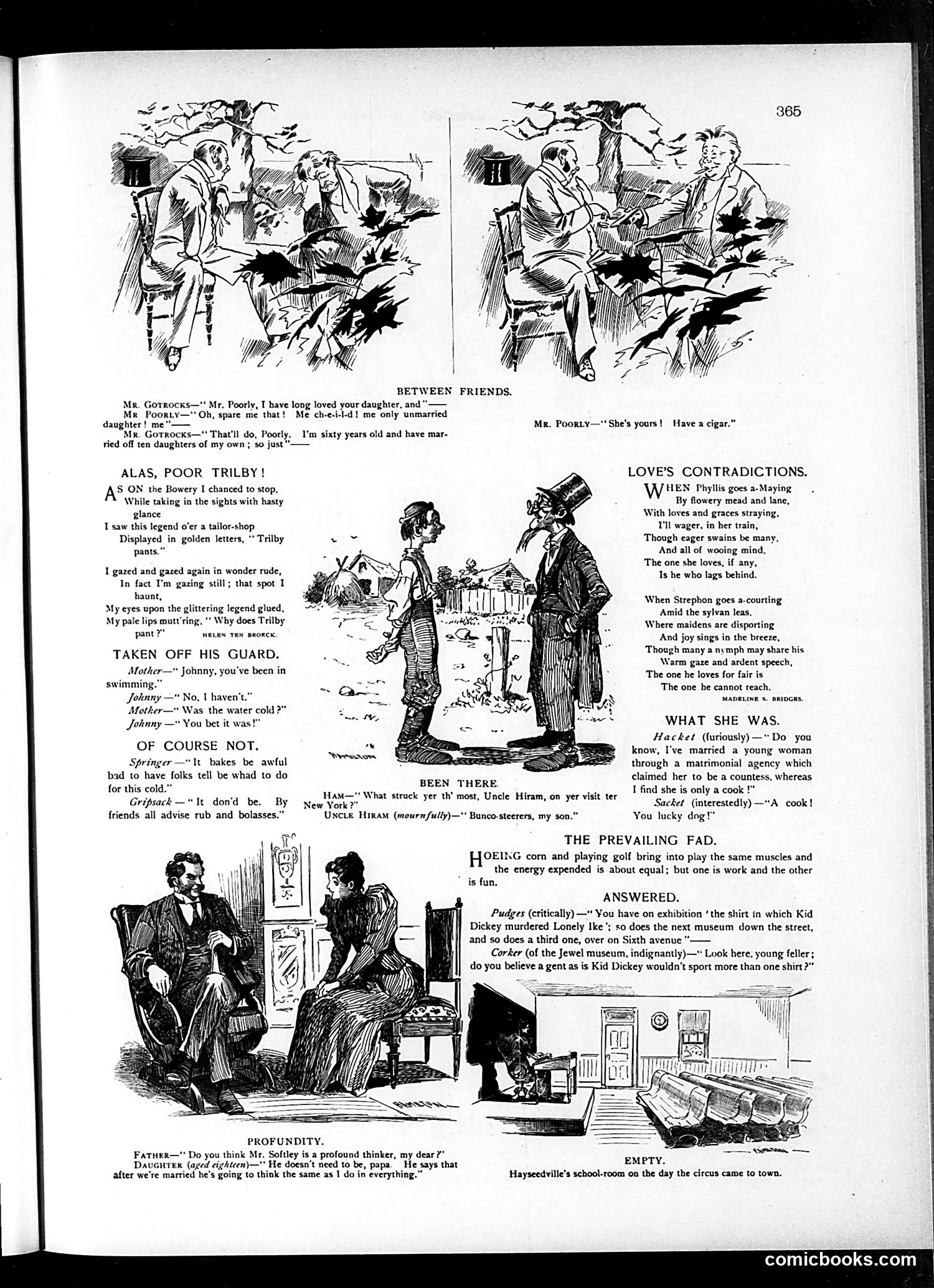
This page contains multiple short humorous pieces typical of late 19th-century American satire: **"Between Friends"** mocks pretentious suitors—Mr. Gorrocks attempts a romantic proposal to Mr. Poorly about his daughter, only to be deflated when Poorly reveals he's already married off ten daughters himself. **"Alas, Poor Trilby"** references the "Trilby" pants craze (likely from the popular play *Trilby*), satirizing the absurdity of a tailor shop's golden sign advertising "Trilby pants" on the Bowery. **"Love's Contradictions"** presents a poetic observation: in romance, the unattainable person is always most desired—whether Phyllis pursuing the man who "lags behind" or Strephon wanting the maiden he "cannot reach." **"What She Was"** jokes about matrimonial agencies: a man discovers his "countess" bride is actually a cook, but another man envies him—suggesting a cook is actually preferable. Other sketches humorously contrast work versus leisure, and comment on marriage dynamics and human nature. The cartoons use simple domestic scenarios to deliver social commentary on courtship, class pretense, and gender relations.
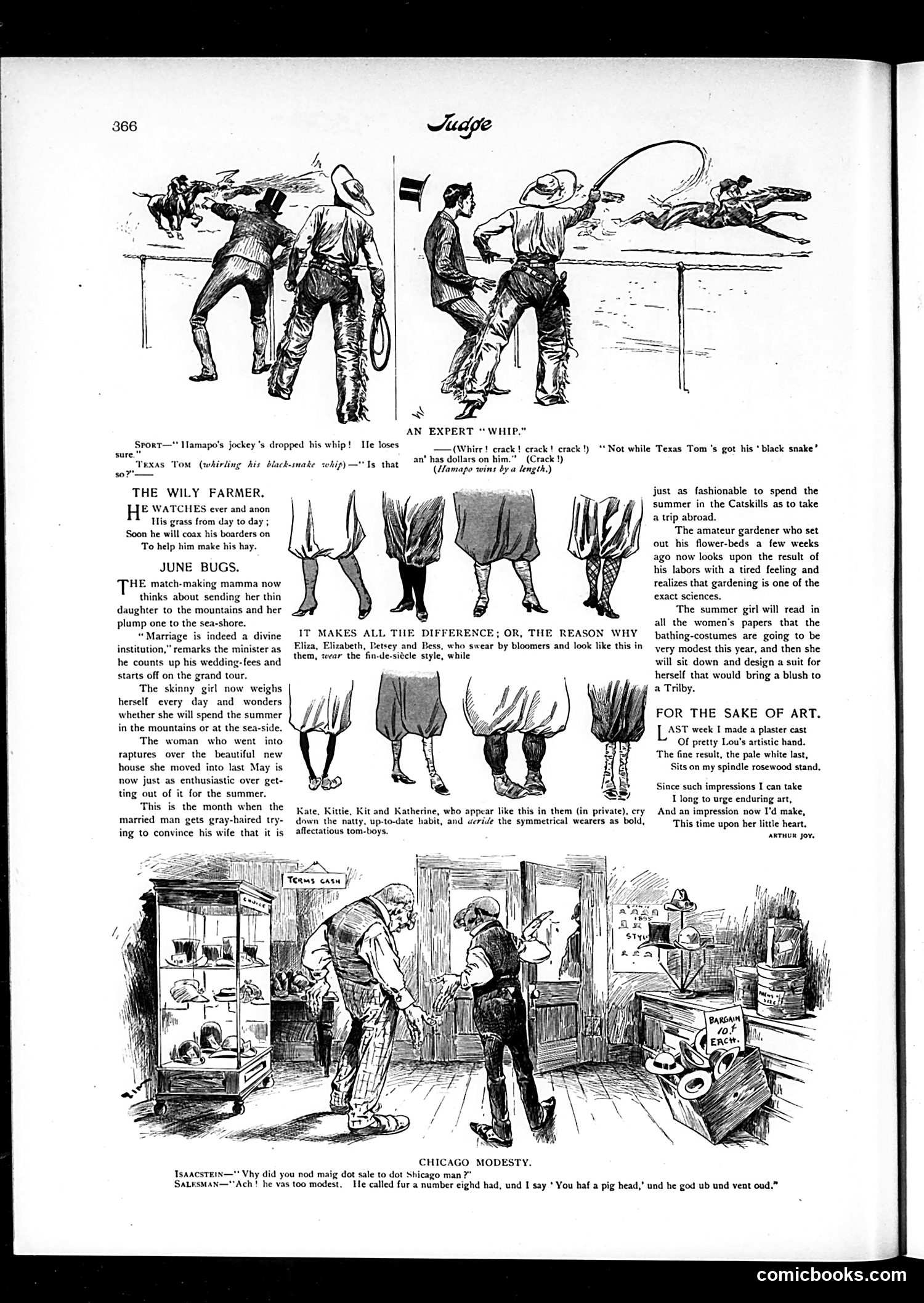
This satirical page from Judge (circa 1890s-1900s based on references) contains several disconnected humor pieces typical of the era: **Top cartoons**: Mock a horse race where "Texas Tom" uses his whip skillfully, contrasting with an inept jockey who dropped his. **"The Wily Farmer"**: A brief joke about farmers manipulating their boarders into helping with hay. **"It Makes All The Difference"**: Satirizes women wearing bloomers (then-scandalous divided skirts). The illustration contrasts how bloomers look on fashionable society women versus how ridiculous they appear on ordinary women—mocking both the fashion and those who adopt it without elegance. **"For the Sake of Art"**: A poem about an artist making a plaster cast of a woman's hand. **"Chicago Modesty"**: A dialect joke where a German salesman insults a Chicago customer by calling him "pig head," and the customer leaves offended—the humor playing on regional stereotypes about Midwestern rudeness and Germanic accents. The page reflects period obsessions with fashion, class distinctions, and ethnic humor.
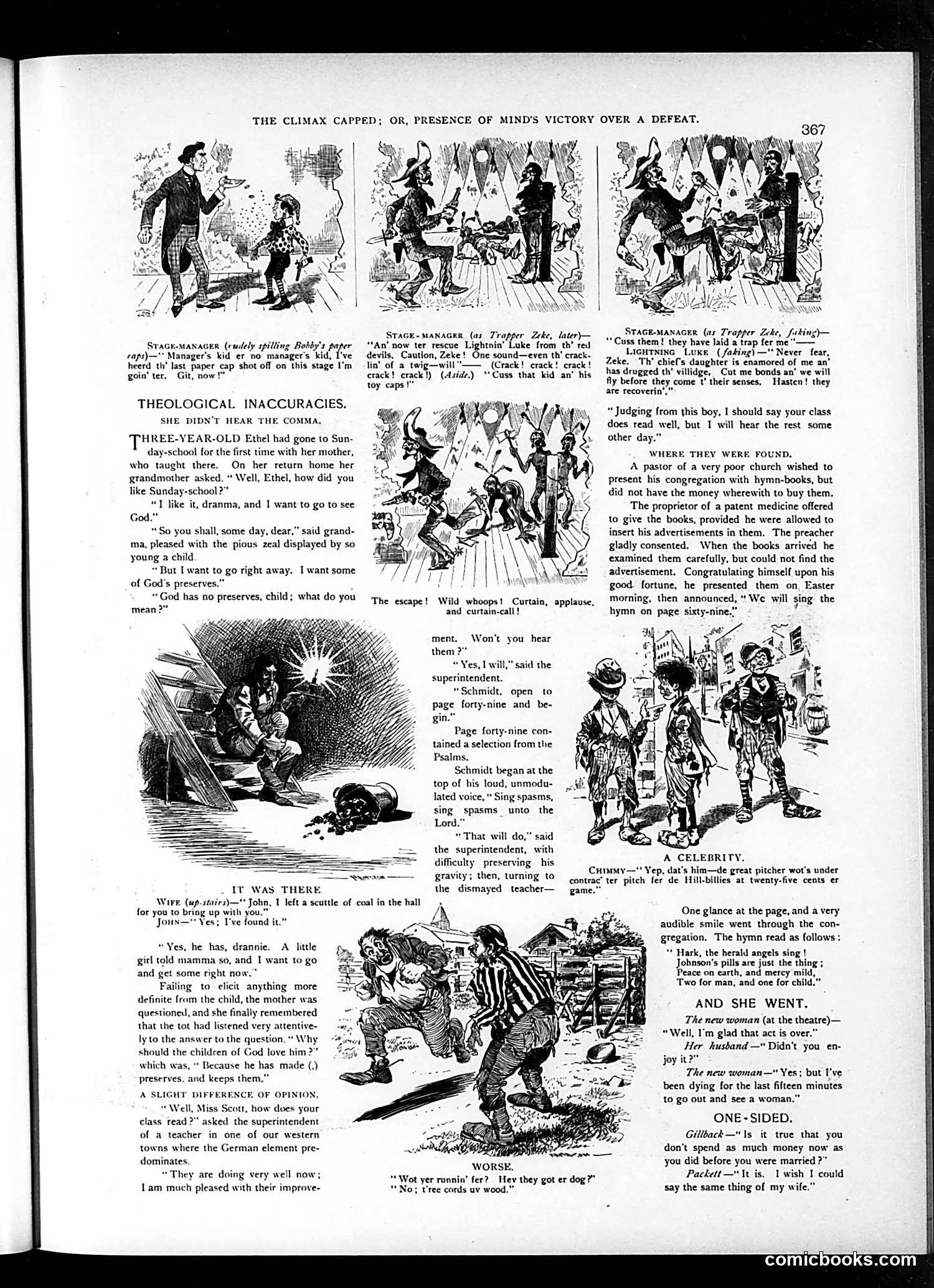
This page contains several unrelated humorous anecdotes typical of late-19th-century satirical magazines, rather than unified political commentary. **"Theological Inaccuracies"** features two misunderstandings by children mishearing religious instruction. A three-year-old confuses "God's preserves" (a comma missing in "preserve us") with jam; another child reads "sing spasms unto the Lord" instead of "Psalms." **"Where They Were Found"** satirizes commercialism in churches: a poor pastor accepts hymnals sponsored by a patent medicine company, only to discover advertisements embedded in hymn 69—which reads as a medicine ad disguised as a hymn ("Johnson's pills are just the thing"). **Theater sketches** depict stage managers and melodramatic rescue scenes, likely parodies of overwrought theatrical conventions. **Other brief jokes** include marital quips and miscommunications—standard fare for the period's humor magazines. The page reflects turn-of-the-century American concerns: commercialization of religion, theatrical excess, and gender roles ("the new woman").
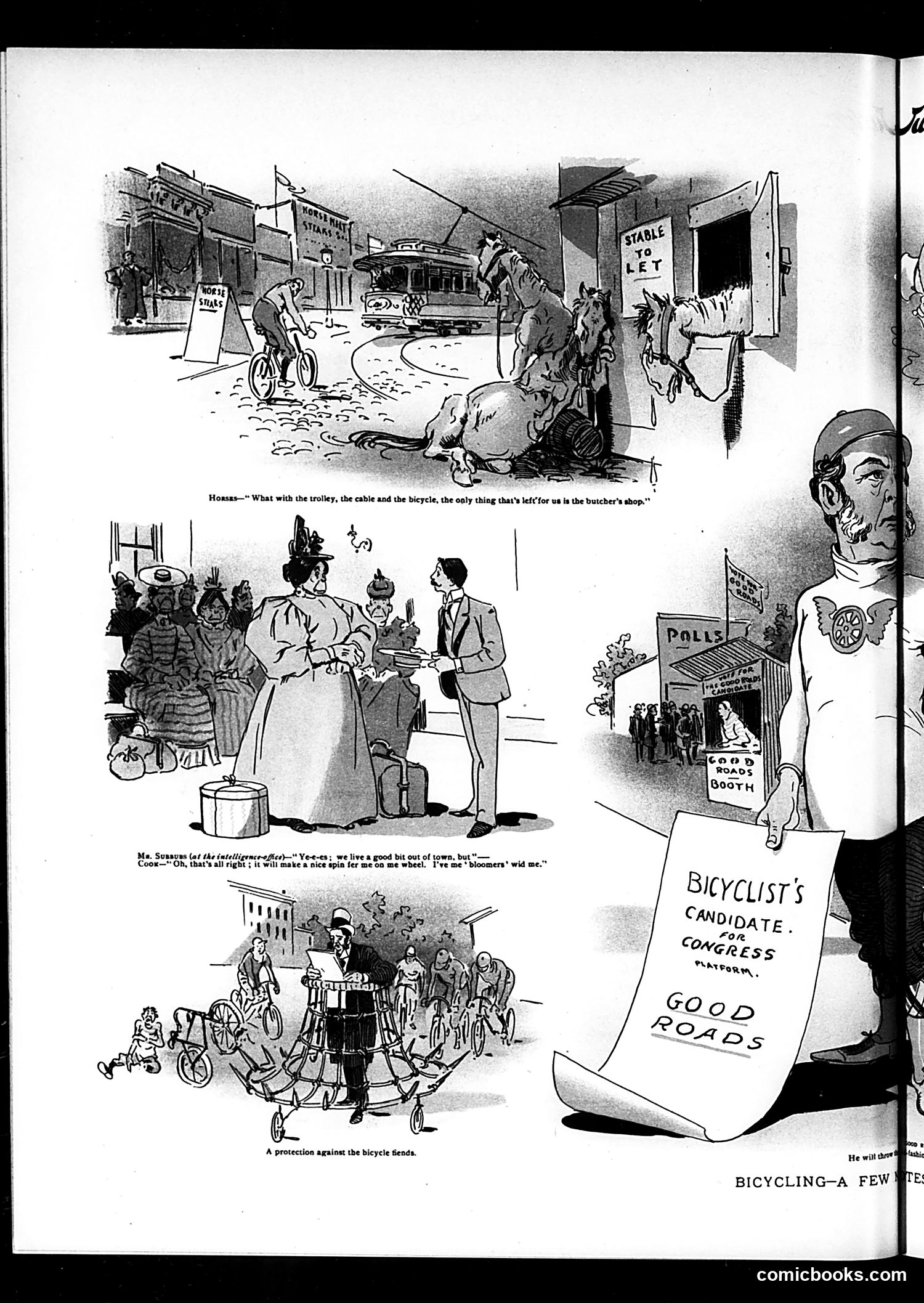
This page satirizes the early bicycle craze and its social implications, likely from the 1890s. The top cartoon shows a horse lying injured outside a stable, with the joke that vehicles (trolley, cable car, bicycle) now threaten the butcher's shop more than horses do—suggesting bicycles' disruptive impact on traditional transportation and commerce. The middle cartoon depicts a woman in bloomers (scandalous split pants worn for cycling) discussing road conditions with a man. The humor mocks both the impracticality of early cycling infrastructure and the controversy surrounding women wearing bloomers—then considered immodest. The bottom cartoon shows cyclists advocating for "Good Roads," illustrated as a political candidate supported by bicycle enthusiasts. This references the actual "Good Roads Movement," where cyclists lobbied for improved infrastructure, making their advocacy a subject of mockery in this satirical magazine.
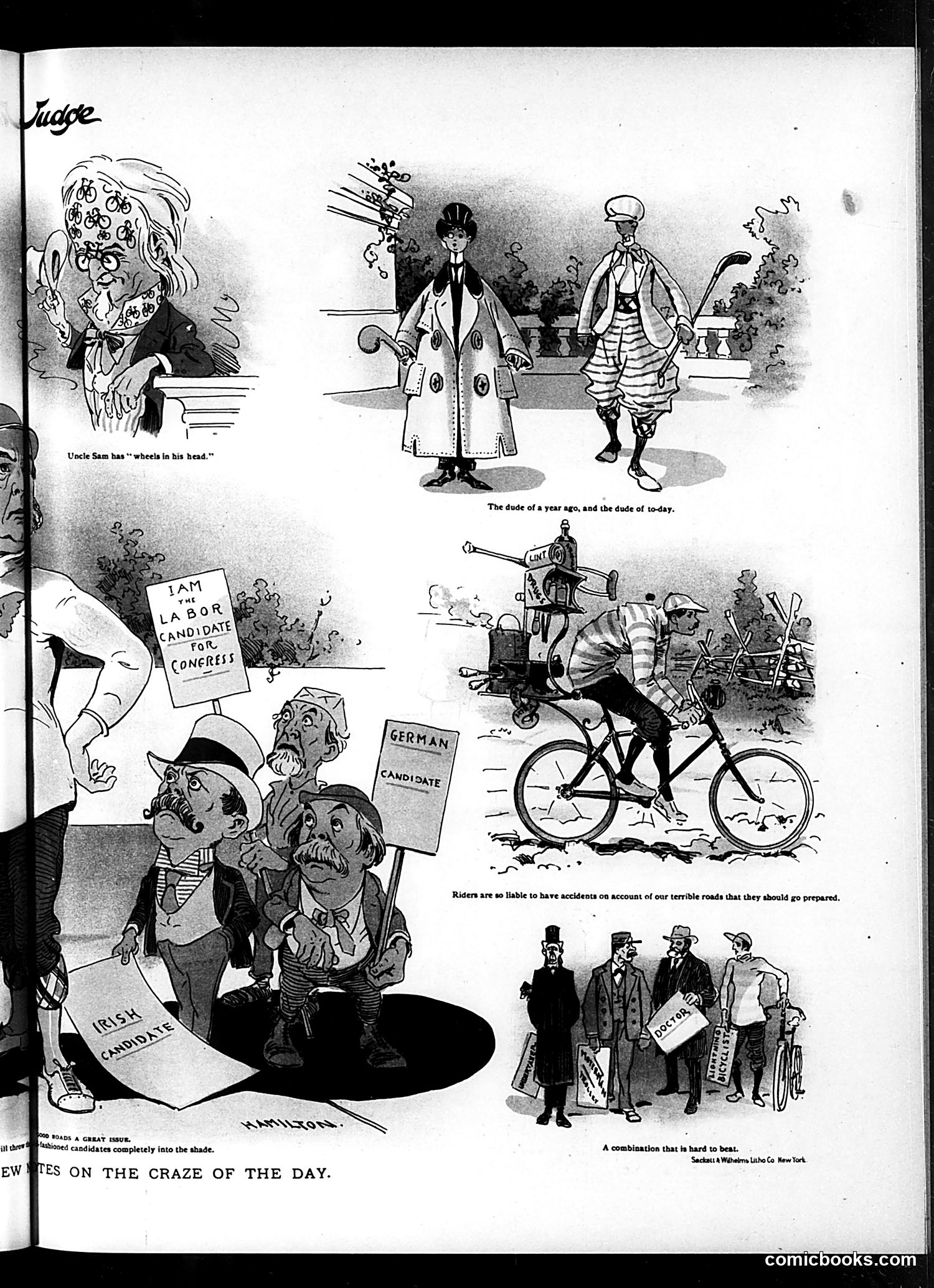
This page satirizes early-1900s political candidates competing against fashionable trends. The top section contrasts a "dude of a year ago" with today's fashionable gentleman, mocking how style changes rapidly. The lower cartoons show various political candidates—including an "Irish Candidate" and "German Candidate"—struggling for attention against bicycling craze and road safety concerns. One panel depicts cyclists navigating terrible roads, captioned "Riders are as liable to have accidents on account of our terrible roads that they should go prepared." The satire suggests that while politicians campaign, the public is distracted by trivial fashion fads and recreational activities. The "combination that is hard to beat" refers to how bicycling enthusiasm overshadows political discourse—a commentary on what voters actually care about versus serious political issues.
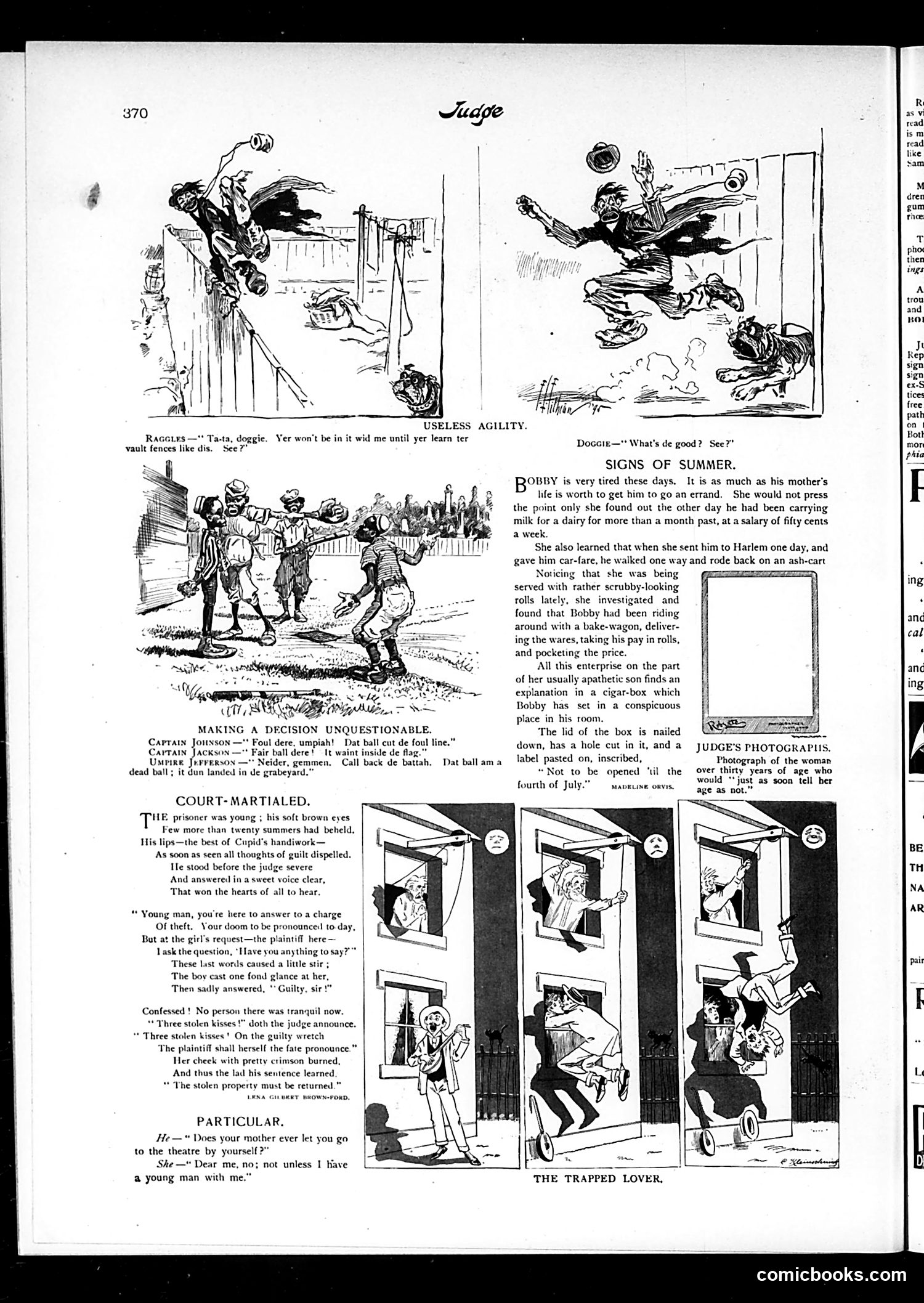
This page contains several satirical comic strips typical of late 19th/early 20th-century American humor: **"Useless Agility"** mocks a dog's inability to apply fancy tricks to practical problems—the raccoon can vault fences, but this doesn't help the dog catch it. **"Signs of Summer"** depicts a lazy boy (Bobby) who suddenly becomes industrious only when motivated by money—he works for dairies, bake-wagons, and ash-carts. His mother discovers he's saving toward something in a mysterious cigar-box labeled "Not to be opened 'til the fourth of July," likely containing a photograph of a woman. The satire targets youthful laziness overcome only by romantic incentive. **"Court-Martialed"** presents a humorous "trial" where a young man admits to stealing "three kisses" from a girl. The judge sentences him to return the kisses, which the blushing plaintiff must administer—a sentimental Victorian joke about romance masquerading as crime. **"The Trapped Lover"** (bottom) shows a comedic sequence of a man trapped in increasingly awkward situations, likely depicting romantic entanglement. All employ gentle, family-friendly humor targeting courtship, youthful behavior, and romance.
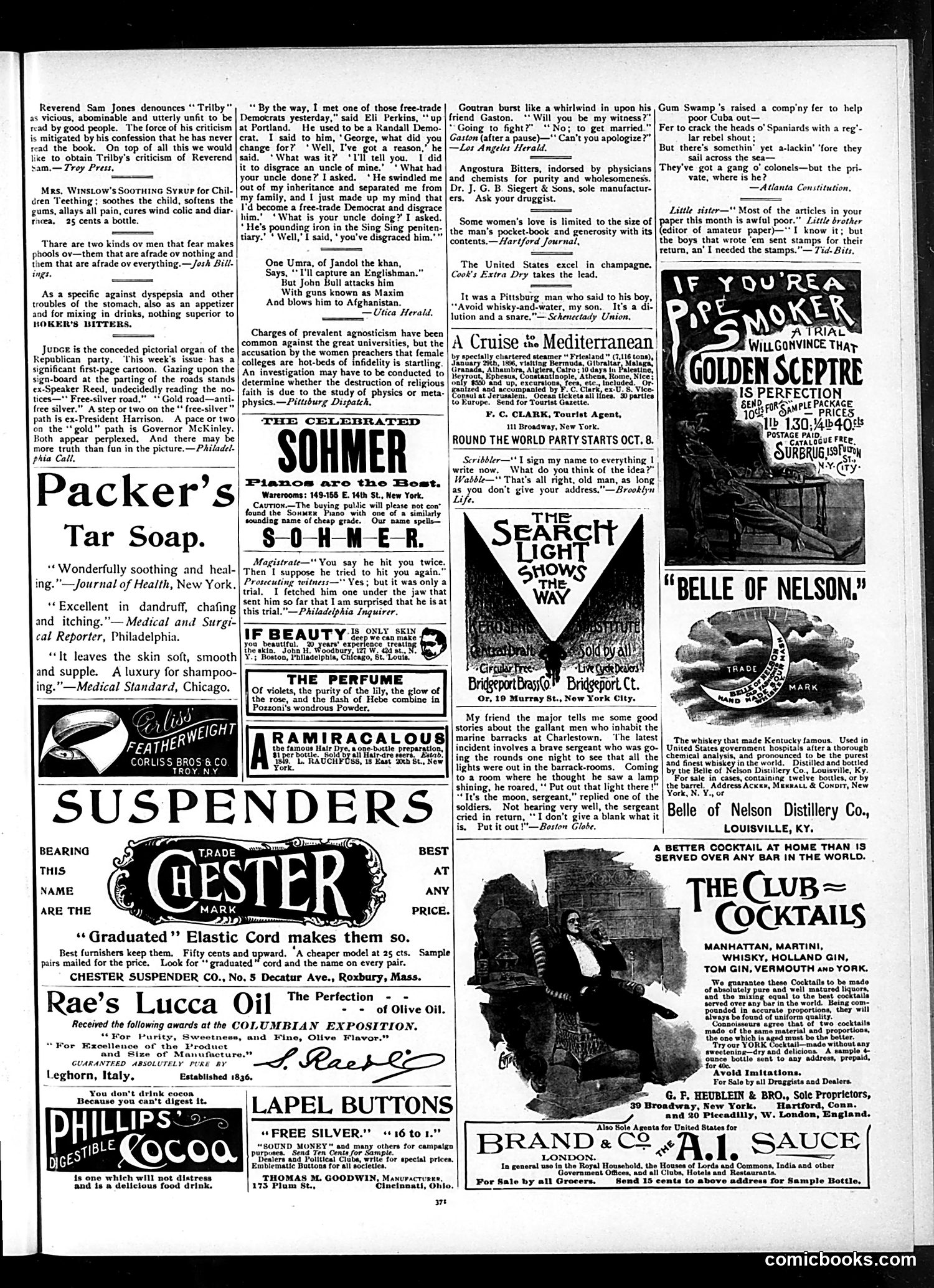
This is primarily an **advertising page** with scattered editorial content typical of Judge magazine's format. The main notable content includes: 1. **A brief political cartoon reference**: The page mentions Judge's "significant first-page cartoon" depicting ex-Speaker Reed at a crossroads, undecided between the "free-silver road" and "gold road—anti-free silver," with ex-President Harrison and Governor McKinley also shown as perplexed. This reflects the **1896 presidential era's monetary policy debate**—a major Republican Party split over currency standards. 2. **Editorial snippets**: These include a joke about Reverend Sam Jones criticizing the novel *Trilby* without reading it, and humor about a man becoming a free-trade Democrat to disgrace his imprisoned uncle. 3. **The rest is vintage advertisements** for products like Sohmer pianos, Packer's Tar Soap, Chester Suspenders, cocoa, and beauty powders—typical of Judge's revenue model. The page captures Judge's dual nature: Republican-leaning political satire mixed with commercial advertisements targeting middle-class readers of the 1890s.
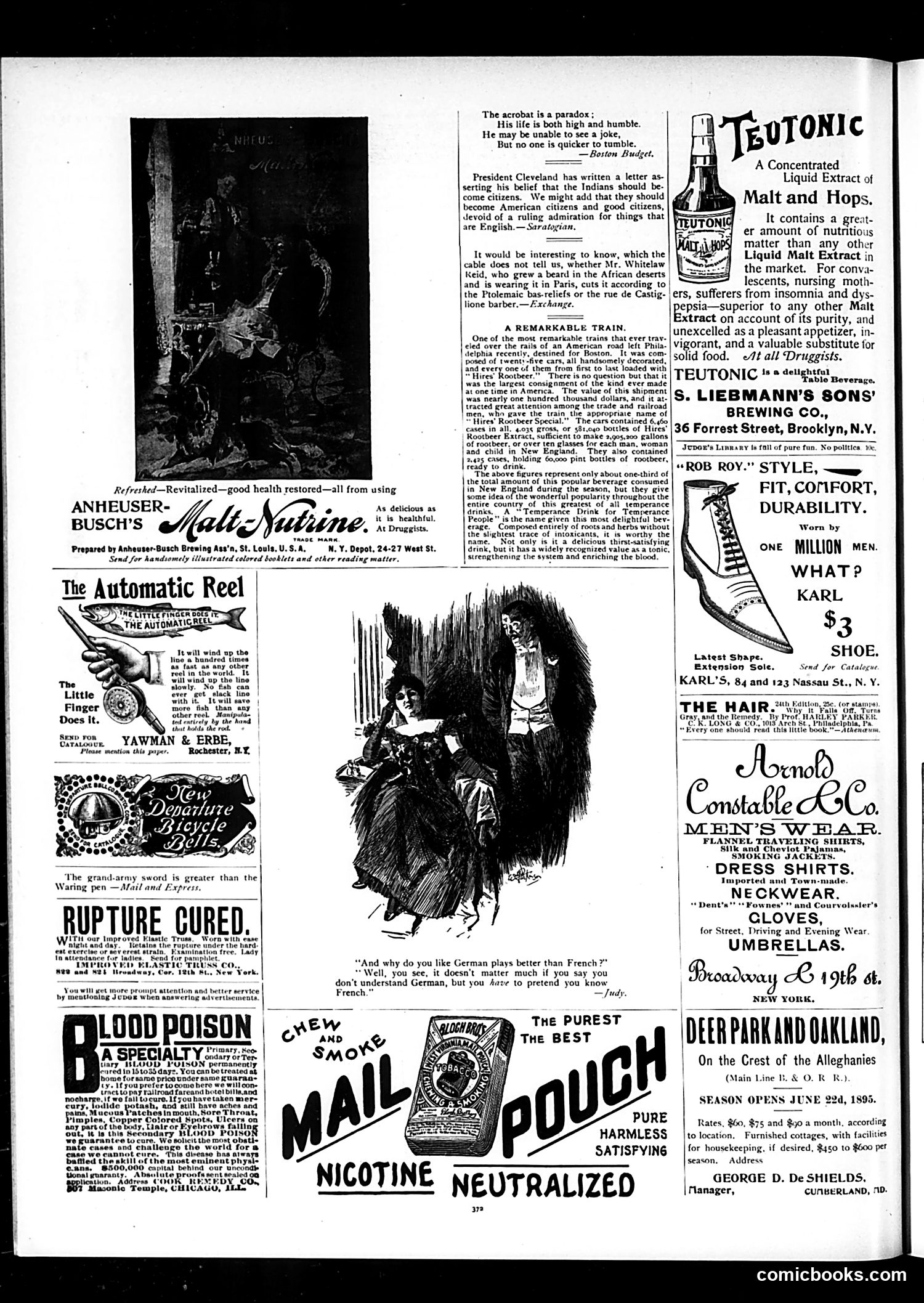
This page is primarily **advertisements** interspersed with brief humorous observations typical of Judge's satirical style. The central cartoon depicts a woman in elaborate dress being supported by what appears to be a man in dark clothing, illustrating a joke about German versus French plays—a dig at pretentious theatergoers who claimed not to understand German but felt obligated to pretend knowledge of French culture. The page is dominated by product ads: Anheuser-Busch's malt extract, Hires' Rootbeer (featuring a remarkable promotional train carrying 381,040 bottles), Teutonic malt extract, and various other goods. A notable feature is coverage of a "Hires' Rootbeer Special"—an actual freight train shipment that received press attention. The brief text snippets mock contemporary figures (President Cleveland's Indian policy) and social pretensions. Overall, this represents Judge's typical mix of **advertising revenue and light social satire** from the 1890s era.
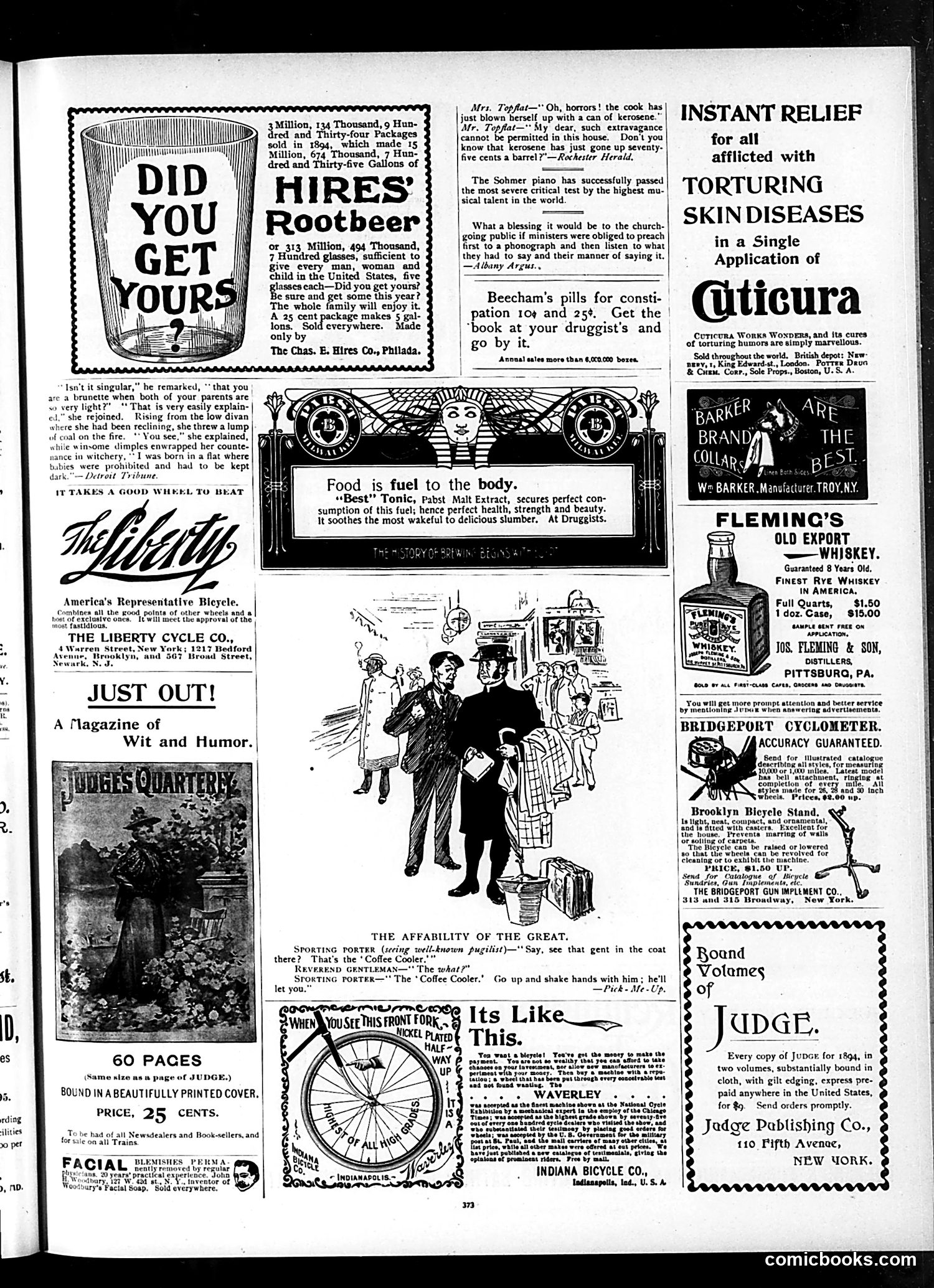
This page is primarily **advertisements and filler content** rather than political cartoons with satirical messaging. The notable editorial items include: **"The Affability of the Great"** — A brief joke about a "well-known pugilist" called the "Coffee Cooler" whom a reverend gentleman is encouraged to greet. The humor appears to play on class contrast: a clergyman meeting a working-class boxer, with implications about the boxer's modest status or behavior. **A joke about a burnt cook** — A wife reports the cook injured herself with kerosene; the husband's response focuses on the rising price of kerosene rather than concern for the employee, satirizing upper-class penny-pinching and callousness toward servants. **A joke about phonographs and sermons** — Suggests ministers should test their speeches on phonographs first, implying clergy deliver tedious or poorly-crafted sermons. The rest is advertising for bicycles, rootbeer, whiskey, pills, and skin treatments — typical of Judge's revenue model. The page lacks the pointed political satire one might expect from a major satirical publication of this era.
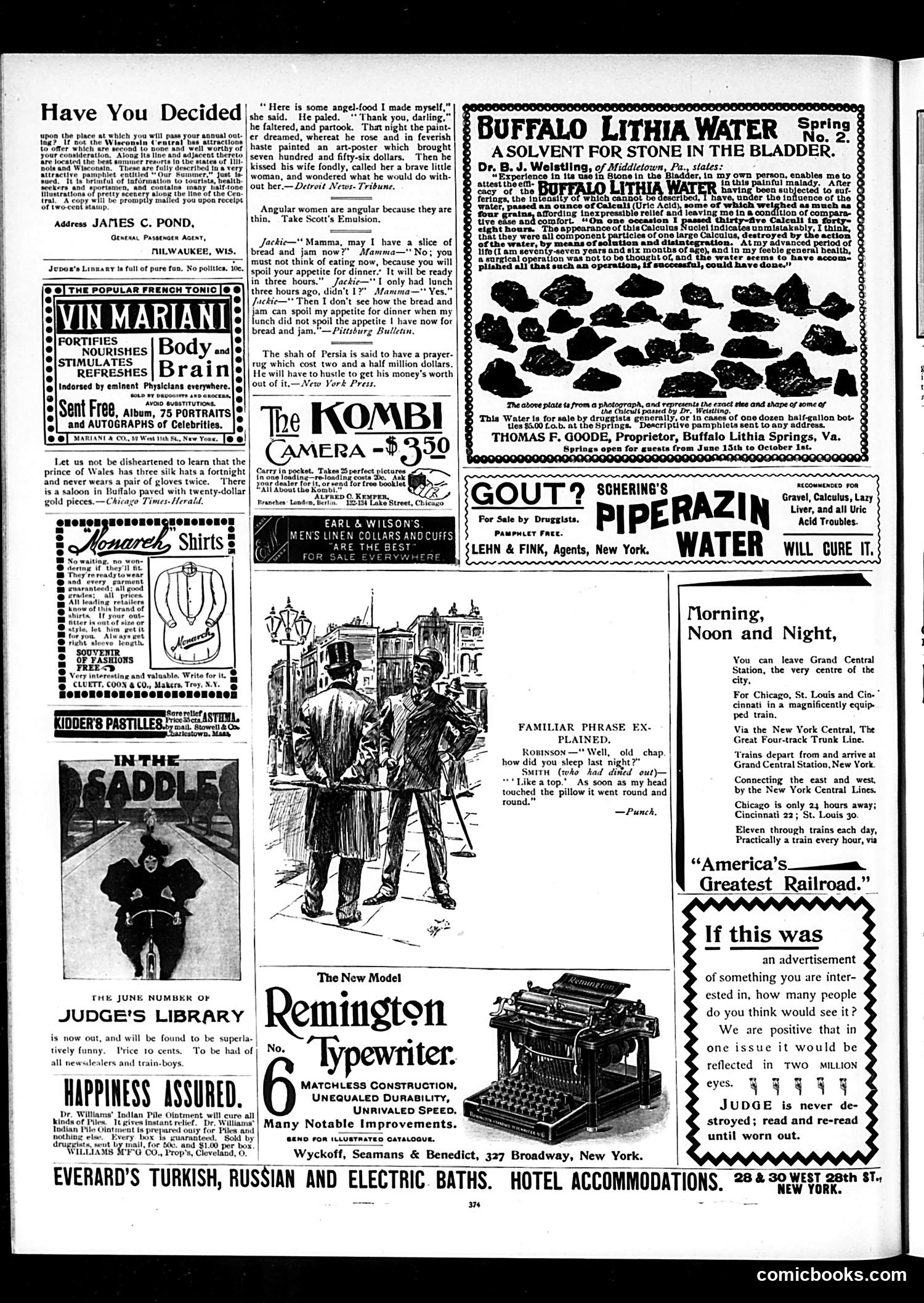
This page is primarily **advertisements and light humor content**, typical of Judge magazine's format. The main cartoon shows a domestic scene with the caption "Familiar Phrase Explained." A husband and wife interact in what appears to be a city setting—the husband asks "how did you sleep last night?" and the wife responds "I felt as if I had died"—a common 1890s expression meaning she slept very well. The joke is literal wordplay on the phrase. The page is otherwise filled with **patent medicine ads** (Buffalo Lithia Water for bladder stones, Piperazin for gout) and consumer product advertisements (Kombi cameras, Remington typewriters, Earl & Wilson collars), reflecting the era's unregulated medical advertising market. **Context**: Judge was a satirical weekly mixing political commentary with lifestyle humor and ads. These advertisements represent now-discredited "cure-all" medicines marketed to the wealthy, typical of the Gilded Age.
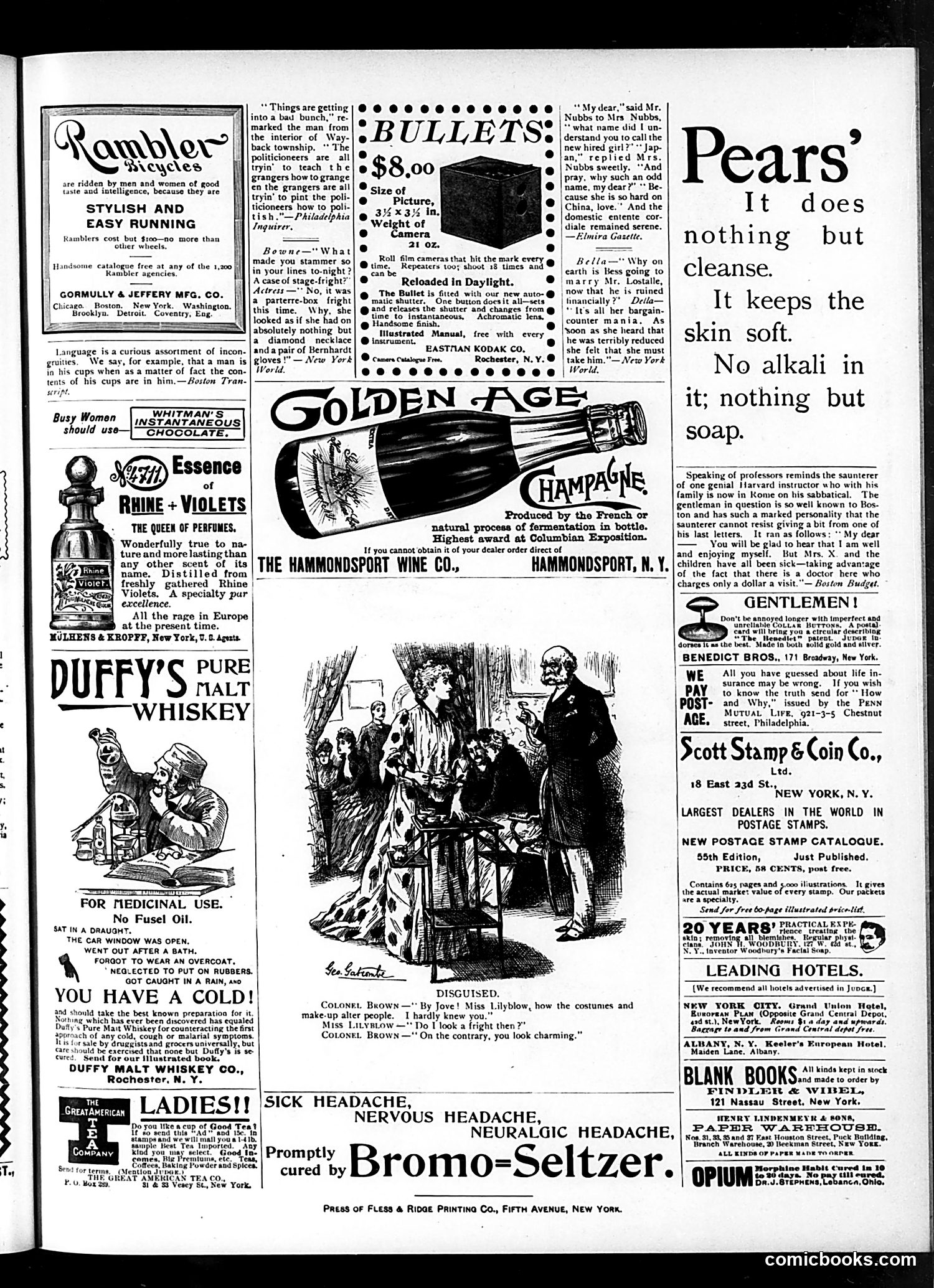
This page is primarily **advertising**, not satire or political commentary. The dominant content comprises paid advertisements for consumer products (bicycles, cameras, whiskey, perfume, headache remedies, hotels, etc.) interspersed with small editorial snippets. The only cartoon visible depicts a formal social scene labeled "DISGUISED," where a woman in elaborate costume addresses a man, saying she "hardly knew you" because of her costume. The man responds positively about her appearance. This is mild domestic humor about masquerade balls or fancy dress—unremarkable social satire without political content. The page's brief editorial jokes concern mundane topics: politicians behaving poorly, a woman hiring a Japanese servant, a gentleman's romantic troubles. These are lighthearted observations on everyday life rather than substantive political commentary. **Conclusion:** This is a typical Judge magazine page from the early 1900s, dominated by commercial advertising with minimal satirical content of historical significance.
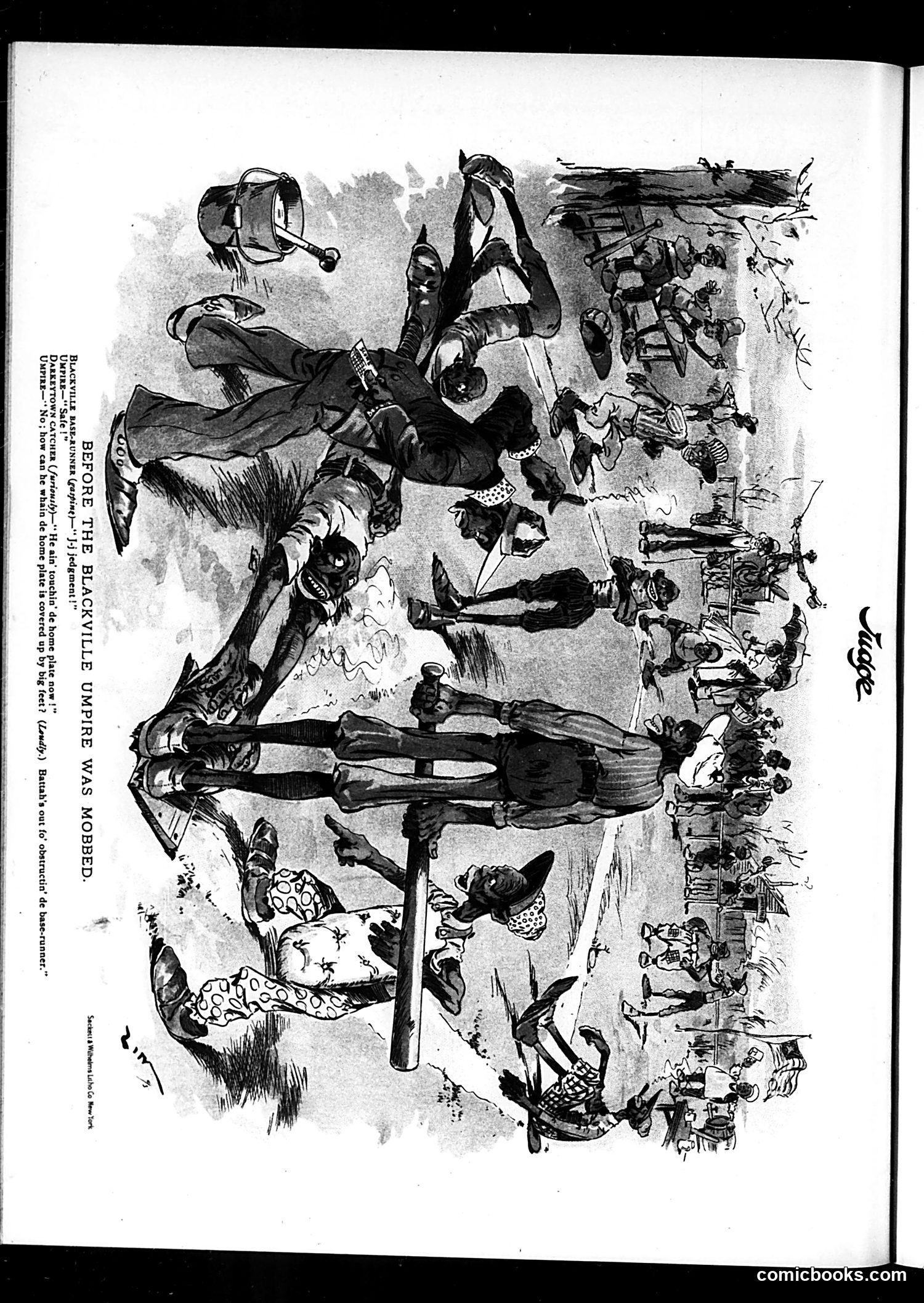
This is a racist baseball cartoon from *Judge* magazine featuring caricatured Black players in a deliberately dehumanizing scenario labeled "Blackville." The humor relies on crude stereotypes: the umpire's decision is absurd (ruling the batter out for "obstructing" the base-runner by standing on home plate), but the real joke targets Black athleticism and intelligence through mocking dialect ("ain'," "de"). The cartoon's title suggests violence will follow—the umpire will be "mobbed"—treating potential mob violence as comedic inevitability. This reflects historical anti-Black violence normalized in period satire. The artwork depicts exaggerated physical features typical of era racist imagery. Without visible attribution or date, the specific historical moment is unclear, but the content exemplifies how mainstream American humor magazines of the late 19th/early 20th century weaponized caricature against Black people through sports, a newly integrated competitive arena.