
Judge, 1895-06-08 · page 3 of 16
Judge — June 8, 1895 — page 3: what you’re looking at
What you’re looking at
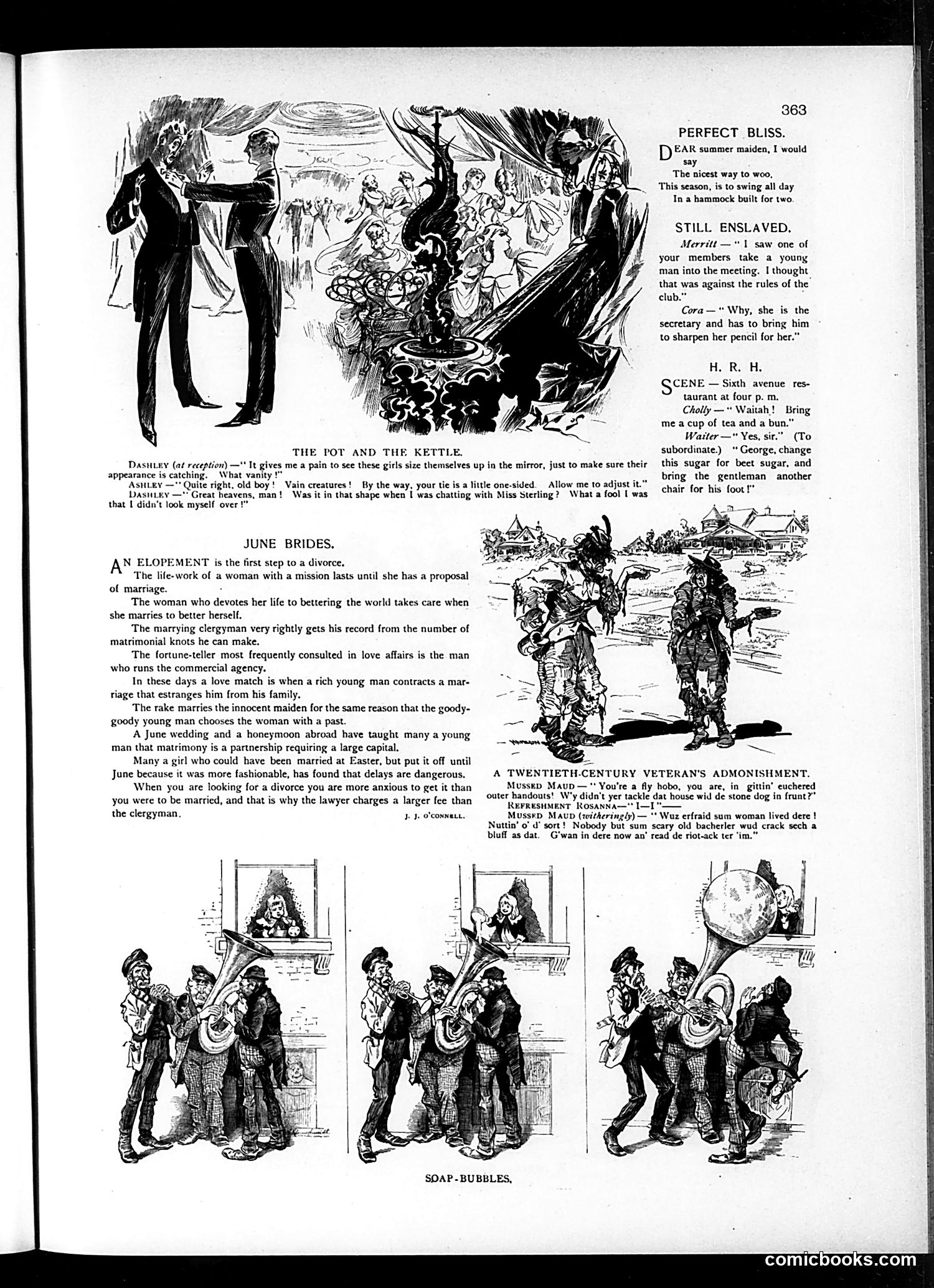
This page contains three satirical pieces: **"The Pot and the Kettle"** mocks club members for hypocrisy—specifically about bringing young men to meetings while enforcing rules against it. The sketch satirizes double standards among the organization's leadership. **"June Brides"** is a social commentary on marriage, divorce, and legal fees. Written by J.J. O'Connell, it argues that women marry to improve themselves, but June weddings are dangerous because divorce is easier and more desirable than marriage itself—satirizing both the legal system's complexity and contemporary attitudes toward matrimony. **"Soap-Bubbles"** appears to be a three-panel visual gag about street musicians or performers, likely mocking their temporary success or fleeting fortunes—the metaphor of bubbles suggesting insubstantial gain. All reflect typical Gilded Age social anxieties about institutions, marriage, and class.
📄 Transcribed text from this page (OCR, searchable)
Machine-transcribed from the original scan — historical spelling and the odd misread are preserved.
363 PERFECT BLISS. DEAR summer maiden, I would say The nicest way to woo, This season, is to swing all day In a hammock built for two STILL ENSLAVED, Merritt —" \ saw one of your members take a young man into the meeting. I thought that was against the rules of the club.” Cora —" Why, she is the secretary and has to bring him to sharpen her pencil for her.” H.R. H. CENE — Sixth avenue res- taurant at four p. m. Cholly —“ Waitah! Bring me a cup of tea and a bun.” Waiter —" Yes, sit." (To THE POT AND THE KETTLE. subordinate.) “ George, change ives me a pain to see these girls size themselves up in the mirror, just to make sure their this sugar for beet sugar, and appearance is catching. What vanit i _ bring the gentleman another ASHLEY —"* Quite right, old boy! Vain creatures! By the way, your tie is a little one-sided. Allow me to adjust it. Dasiitey —" Great heavens, man! Was it in that shape when i was chatting with Miss Sterling? What a fool {was Chait for his (oot! that I didn’t look myself over!" Dasiity (at reception) —"* Tt JUNE BRIDES, AN ELOPEMENT is the first step to a divorce. The life-work of a woman with a mission lasts until she has a proposal of marriage. . The woman who devotes her life to bettering the world takes care when she marries to better herself. The marrying clergyman very rightly gets his record from the number of matrimonial knots he can make. The fortune-teller most frequently consulted in love affairs is the man who runs the commercial agency. In these days a love match is when a rich young man contracts a mar- riage that estranges him from his family. The rake marries the innocent maiden for the same reason that the goody- goody young man chooses the woman with a past. A June wedding and a honeymoon abroad have taught many a young man that matrimony is a partnership requiring a large capital. Many a girl who could have been married at Easter, but put it off until June because it was more fashionable, has found that delays are dangerous. A TWENTIETH-CENTURY VETERAN'S ADMONISHMENT. When you are looking for a divorce you are more anxious to get it than Mosse Maup — “You're a fly hobo, you are, in gittin’ euchered you were to be married, and that is why the lawyer charges a larger fee than Met Pandouts! Wry didn't yer tackle dat house wid de stone dog in frunt? the clergyman, 5 o'connan. Mussep Maun (:vi¢heringly) — “* Wuz erfraid sum woman lived dere ! Nuttin’ o’ d’ sort! Nobody but sum scary old bacherler wud crack sech a bluff as dat. G'wan in dere now an’ read de riot-ack ter ‘im.”. SOAP-BUBBLES, comicbooks.com