
A complete issue · 16 pages · 1895
Judge — February 23, 1895
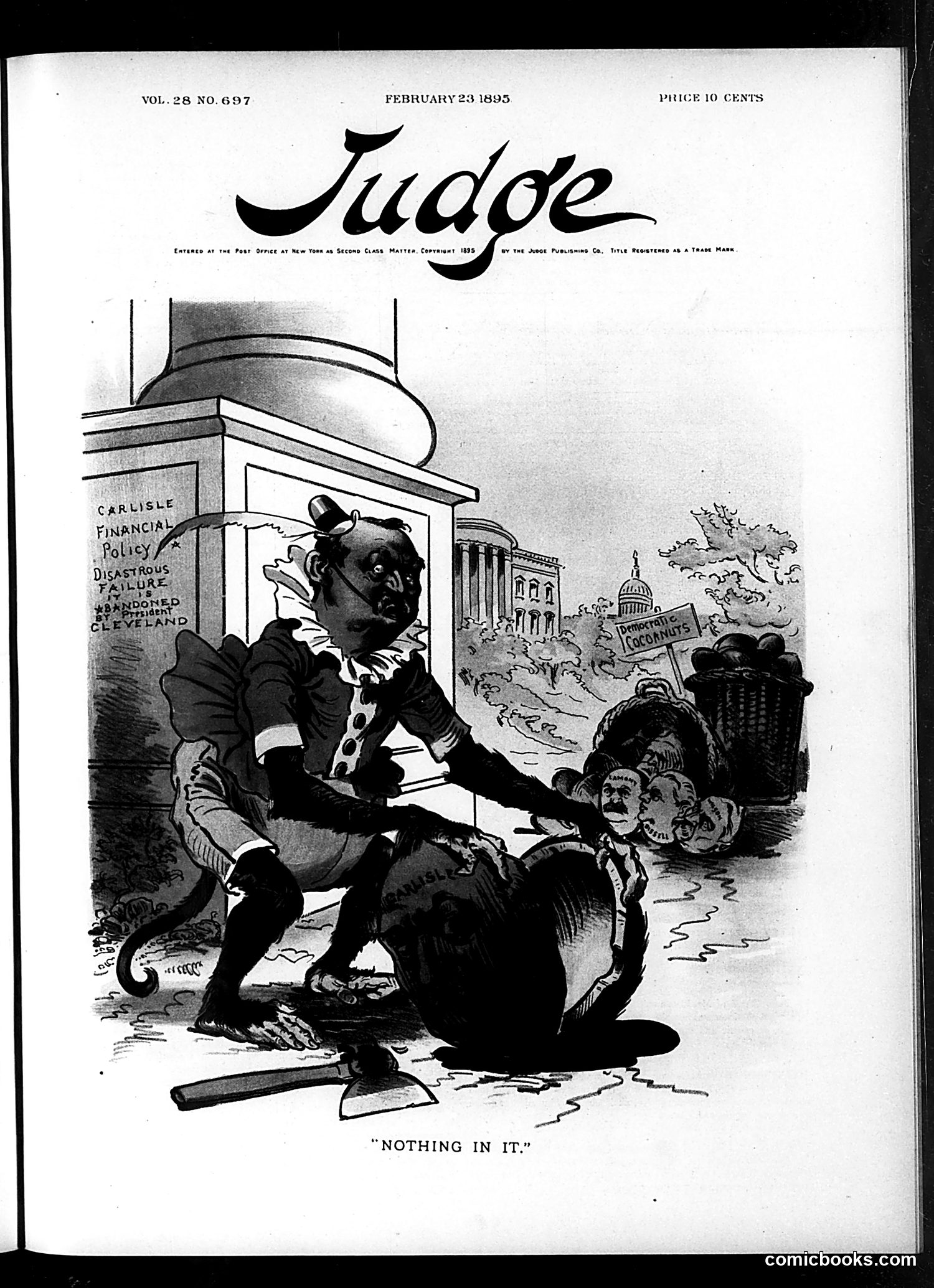
This political cartoon satirizes what appears to be the Cleveland administration's financial crisis or policy failure. A donkey (symbol of the Democratic Party) sits examining an empty treasure chest labeled "Democratic Economies," finding it bare. The donkey wears formal attire and a ruffled collar, suggesting pretense masking emptiness. In the background, the Capitol building and a sign reading "Democratic Economics" are visible, emphasizing the political target. Papers scattered on the ground suggest discarded or failed policies. The title "Nothing In It" mocks Democratic economic promises or performance—suggesting the party's financial policies or treasury are hollow. This likely references specific 1890s economic troubles under President Cleveland, whose administration faced the Panic of 1893.
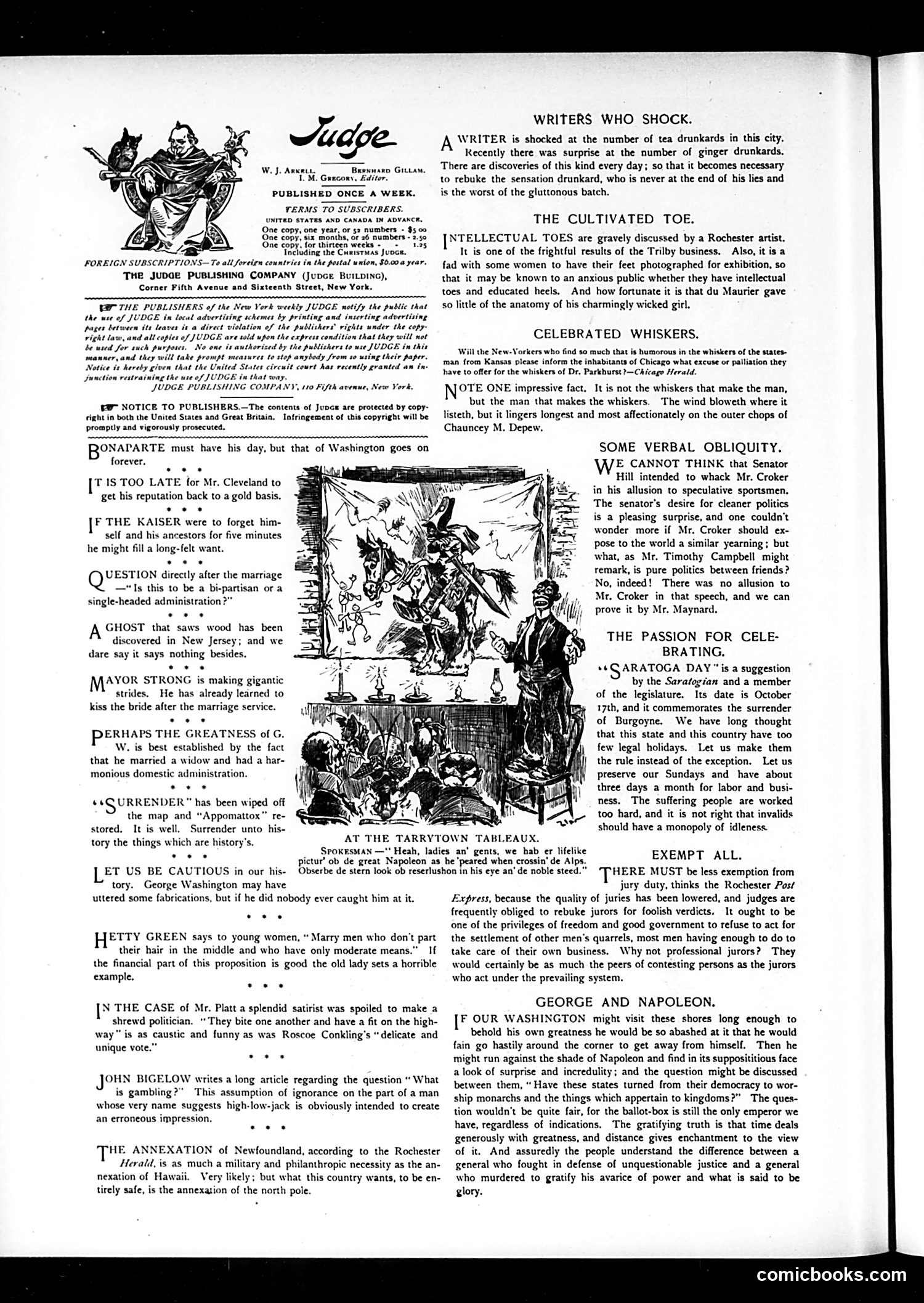
The central cartoon depicts a chaotic domestic scene titled "Spokesman" with figures engaged in heated argument. The caption references someone being "peered when crossin' de" and mentions "Osberbe's stern look ob resentabush." The surrounding text articles address contemporary social issues: "Writers Who Shock" criticizes tea drunkenness; "The Cultivated Toe" mocks intellectual pretension about feet; "Celebrated Whiskers" jokes about facial hair; and "Some Verbal Obliquity" discusses Senator Hill's political allusions. The cartoon's crude domestic violence depiction was typical of Judge's satirical approach to marital discord—a recurring theme in Gilded Age humor. The specific figures and dialogue are unclear from the OCR, but the overall thrust satirizes working-class domestic turbulence and linguistic peculiarities of the era.
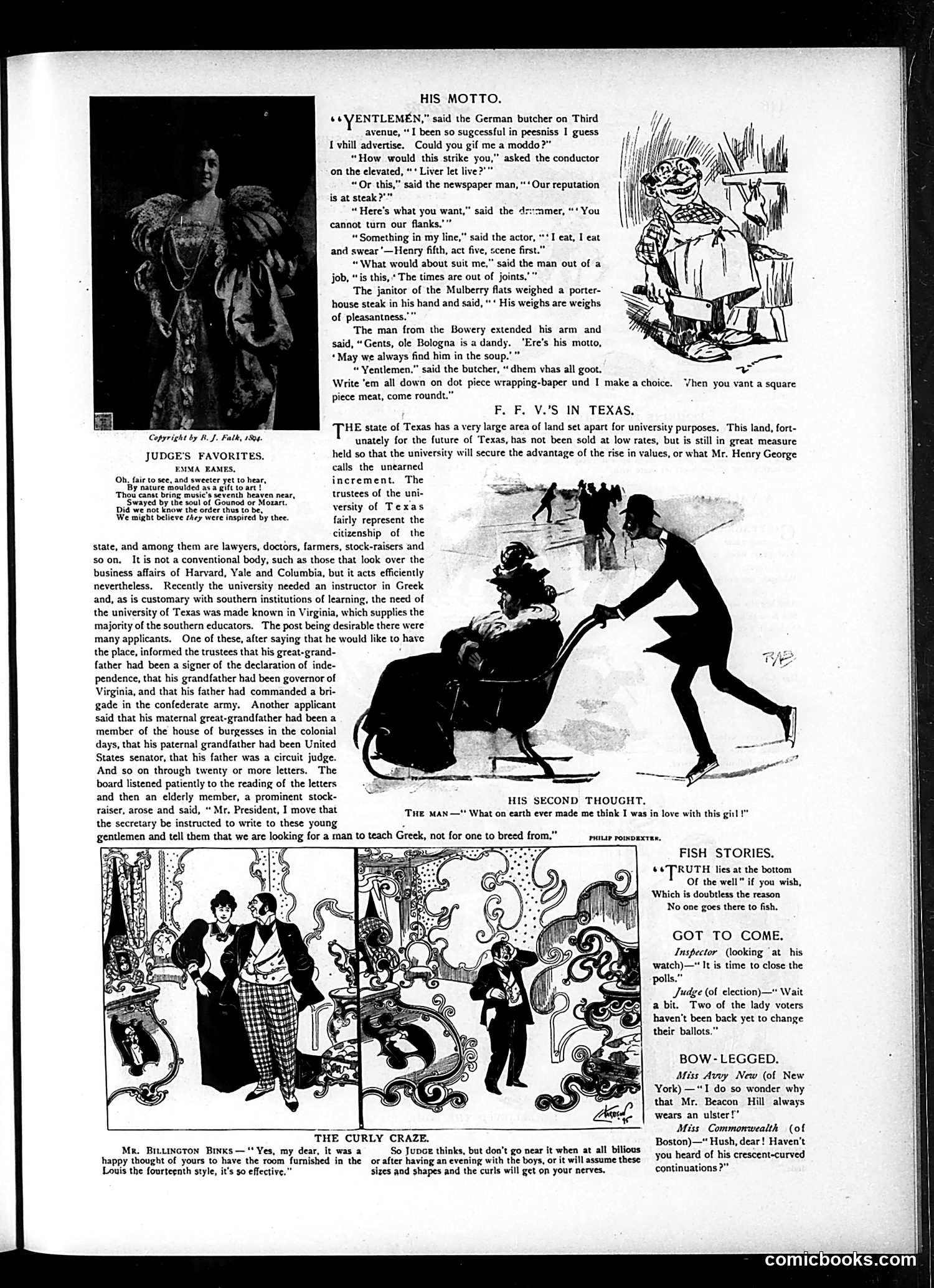
This page contains several unrelated humorous pieces typical of early 20th-century Judge magazine: **"His Motto"** (top): A satirical dialogue among New York professionals (butcher, conductor, actor, newspaper man, janitor, Bowery man) debating what makes for success. The "Bowery man" concludes Bologna sausage is "dandy" and its motto is "May we always find him in the soup"—mocking lower-class food preferences and aspirations. **"F.F.V.'s in Texas"**: Discusses University of Texas land holdings and prominent applicants claiming distinguished ancestry (F.F.V. = "First Families of Virginia"). It satirizes class pretension among applicants citing ancestral credentials. **Lower cartoons and brief jokes** appear to be standard period humor about courtship, elections, and social observations. The page reflects Judge's focus on class-based satire and contemporary American society circa early 1900s.
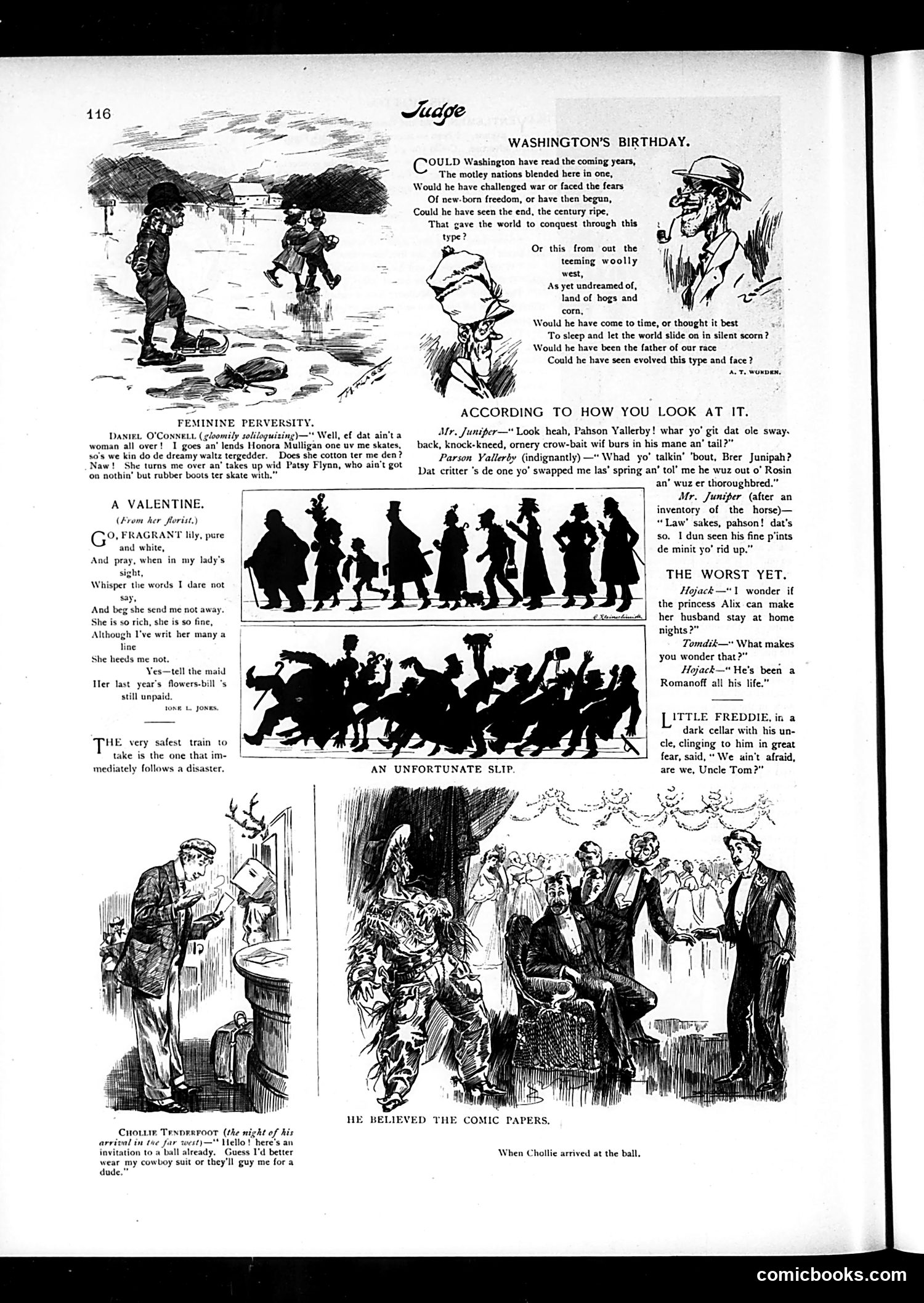
This page contains several satirical pieces typical of late 19th-century American humor: **"Washington's Birthday"** presents a caustic poem questioning whether George Washington would approve of the nation he founded, given its current state—specifically critiquing what appears to be immigration ("motley nations blended here") and the rough character of western settlers ("teeming woolly west"). The accompanying caricatures mock these perceived inferior types. **"According to How You Look At It"** uses dialect humor between two Black characters disputing a horse's value—each claiming the other misrepresented it. This reflects period minstrelsy conventions. **"A Valentine"** is a sentimental poem from flowers to a lady. **"The Worst Yet"** jokes about Princess Alix (likely Alexandra, Tsarina of Russia) unable to control her husband—contemporary gossip presented as humor. **"An Unfortunate Slip"** and related sketches offer society-page comedy about social embarrassments and mistaken identities. The overall tone reflects Judge's typical blend of political commentary, ethnic stereotyping, and upper-class social satire.
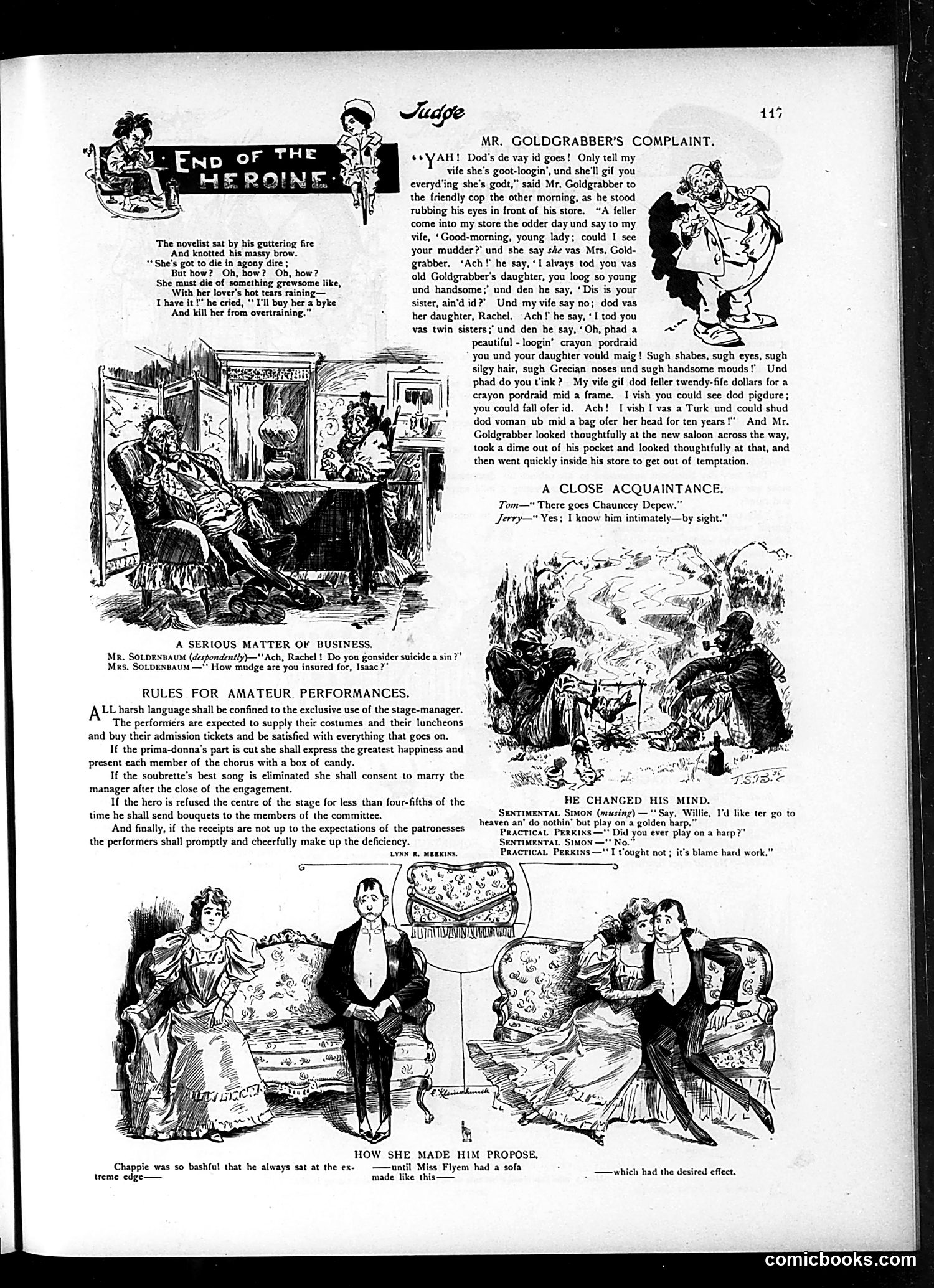
This Judge magazine page (page 147) contains several satirical pieces reflecting early 20th-century American humor and attitudes: **"Mr. Goldgrabber's Complaint"** features a Jewish merchant (indicated by dialect spelling and the name) complaining to a police officer about a con artist who flattered his wife into buying an expensive crayon portrait. The satire mocks both the gullible wife and the Jewish businessman stereotype—portraying him as penny-pinching yet prone to domestic frustration. The dialect humor was typical of period ethnic caricature. **"Rules for Amateur Performances"** satirizes theatrical ego and financial desperation, poking fun at demanding performers and struggling theater groups. The smaller jokes ("A Close Acquaintance," "He Changed His Mind," "How She Made Him Propose") use typical period comedy about social awkwardness, bashfulness, and courtship dynamics. The overall tone reflects turn-of-the-century American magazine humor: stereotyped ethnic characters, gender assumptions, and observational comedy about middle-class life.
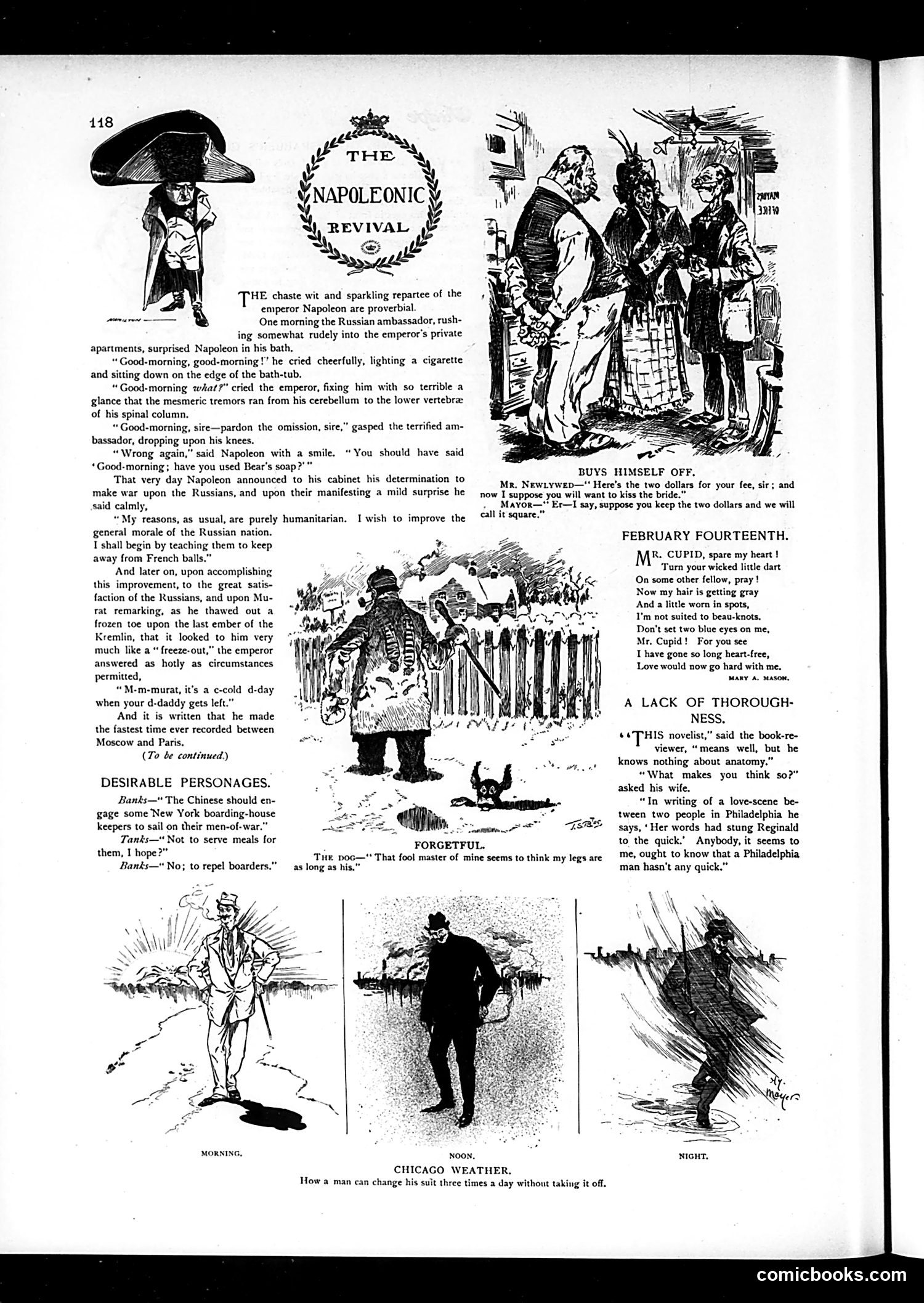
This page satirizes Napoleon through an absurdist anecdote about his legendary wit and temperament. The story depicts Napoleon bathing when a Russian ambassador enters. Napoleon takes offense at the ambassador's casual greeting, escalating his irritation until declaring war on Russia—allegedly for "humanitarian" reasons of improving Russian manners by keeping them from French balls. The satire mocks both Napoleon's reputation for sharp wit and his unpredictable authoritarianism: a trivial social breach becomes justification for military conquest. The phrase "freeze-out" referring to Napoleon's retreat from Moscow adds dark humor about the disastrous Russian campaign. The accompanying illustrations and lesser items (the Chicago weather joke, Valentine's Day verse, and book reviewer's quip about Philadelphia "lacking quick") are typical Judge magazine filler—light social comedy unrelated to the main story.
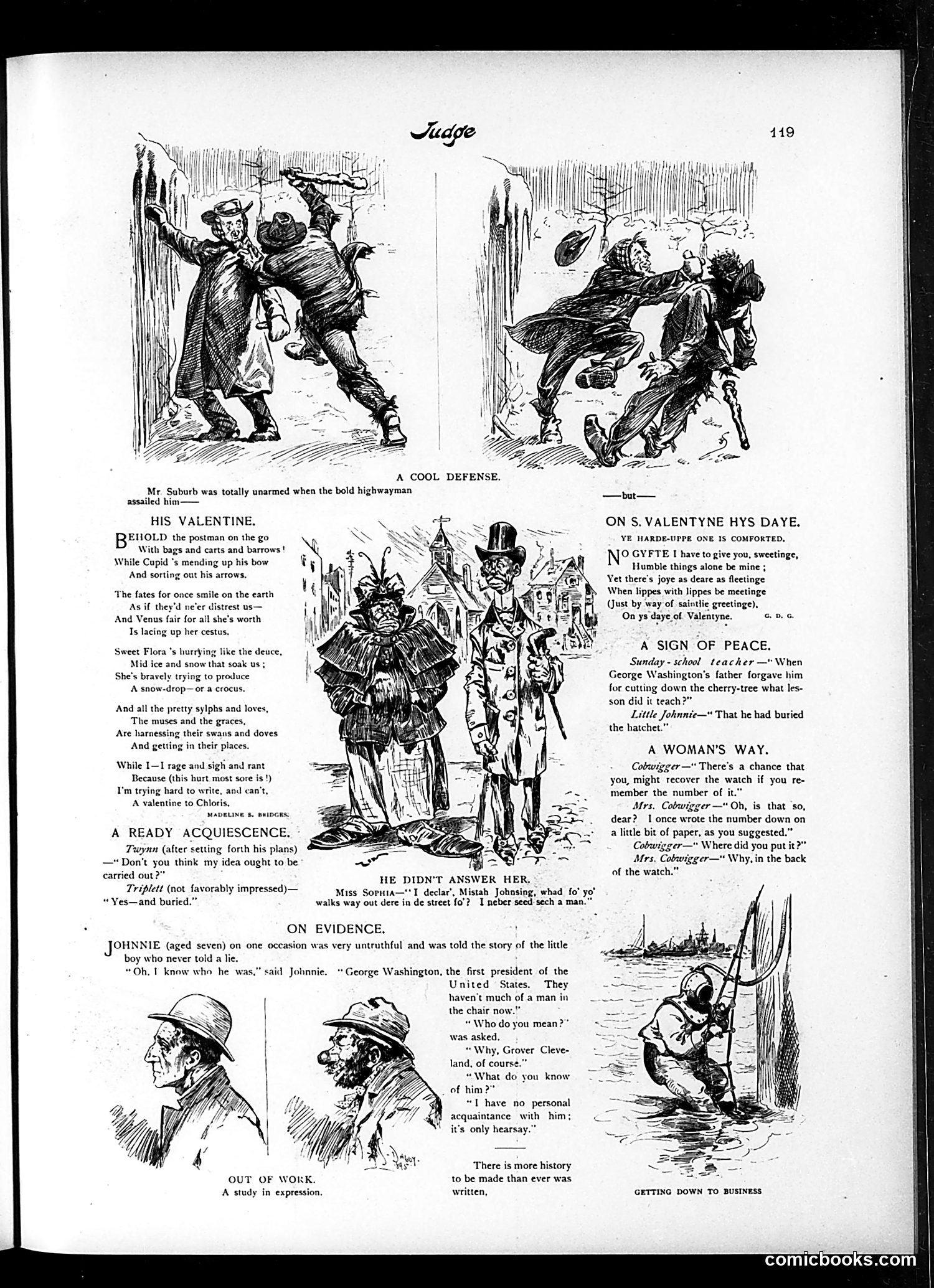
This page from Judge contains multiple satirical sketches typical of late-19th-century American humor: **Valentine's Day Poems & Sketches**: Several romantic and humorous verses celebrate St. Valentine's Day, including a frustrated poet unable to compose a valentine and a modest lover offering only kisses as a gift. **Political Satire ("ON EVIDENCE")**: A child named Johnnie, told the story of honest George Washington, dismissively compares the current president—**Grover Cleveland**—unfavorably to Washington. The joke satirizes Cleveland's character or competence, suggesting he lacks Washington's integrity. This appears critical of Cleveland's presidency. **Social Humor**: Other sketches mock everyday situations—a woman losing a watch but writing its number inside the watch itself (female illogic); a man defending himself against a highwayman; a Sunday school lesson about the cherry-tree legend. **"Out of Work" Sketch**: Two profile studies illustrate unemployment or dejection. The page emphasizes Judge's typical formula: light romantic verse mixed with political jabs and middle-class social satire.
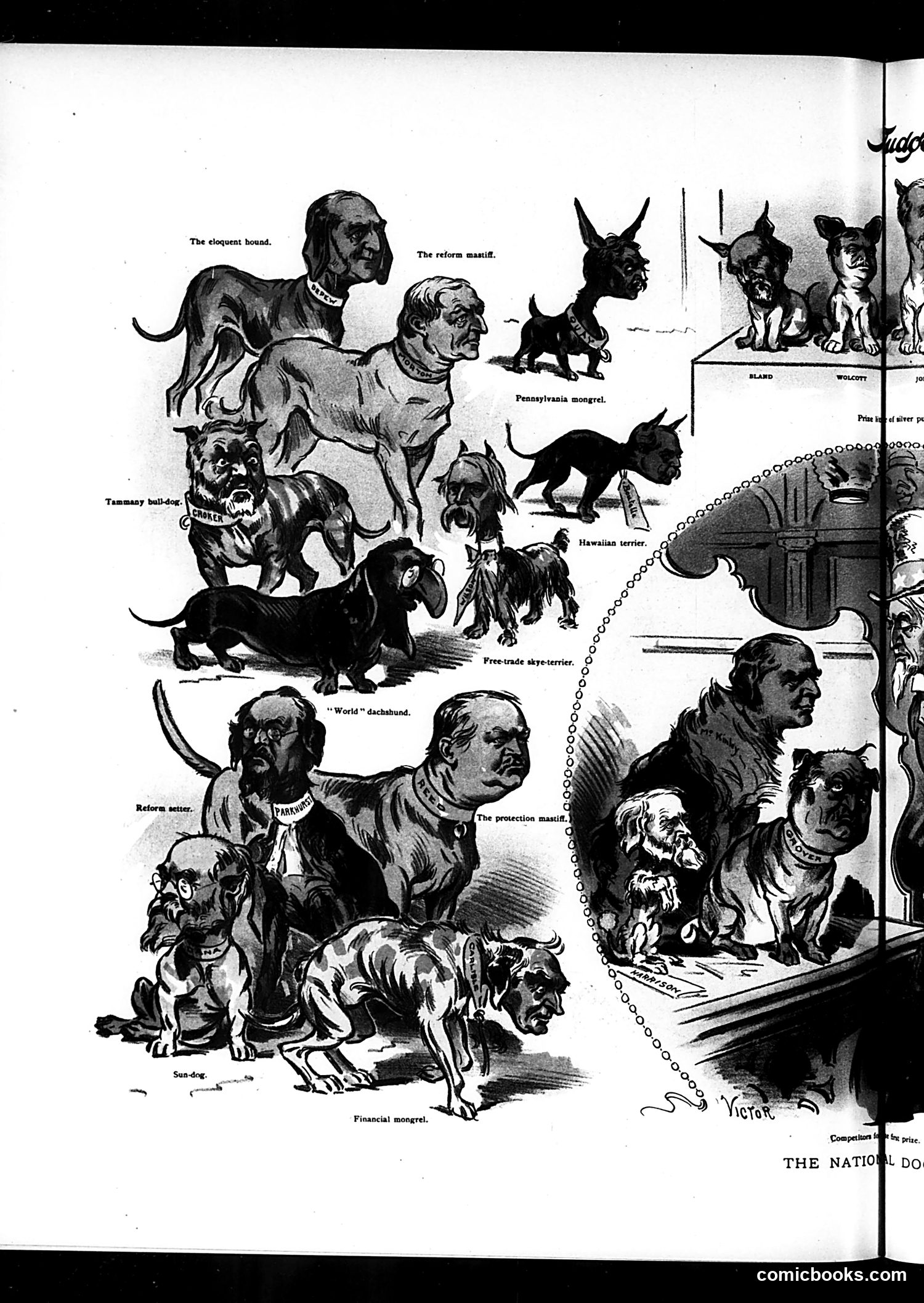
This page from *Judge* magazine uses dog caricatures to satirize political figures and issues of its era. The labeled mongrels represent different political positions or groups: "The eloquent hound," "The reform manisft," "Pennsylvania mongrel," "Hawaiian terrier," "Free-trade eye-terrier," "World" dachshund," "Reform setter," "The protection masif," and "Financial mongrel" appear among the pack. This is a classic technique of 19th-century American political cartooning—using animal metaphors to mock politicians and their competing ideologies. The dogs likely represent debates over tariffs (protection versus free trade), electoral reform, Hawaiian annexation, and financial policy. The chaotic arrangement suggests the disarray of American politics during this period. Without the magazine's date, specific identifications remain unclear, but the satirical method is unmistakable.
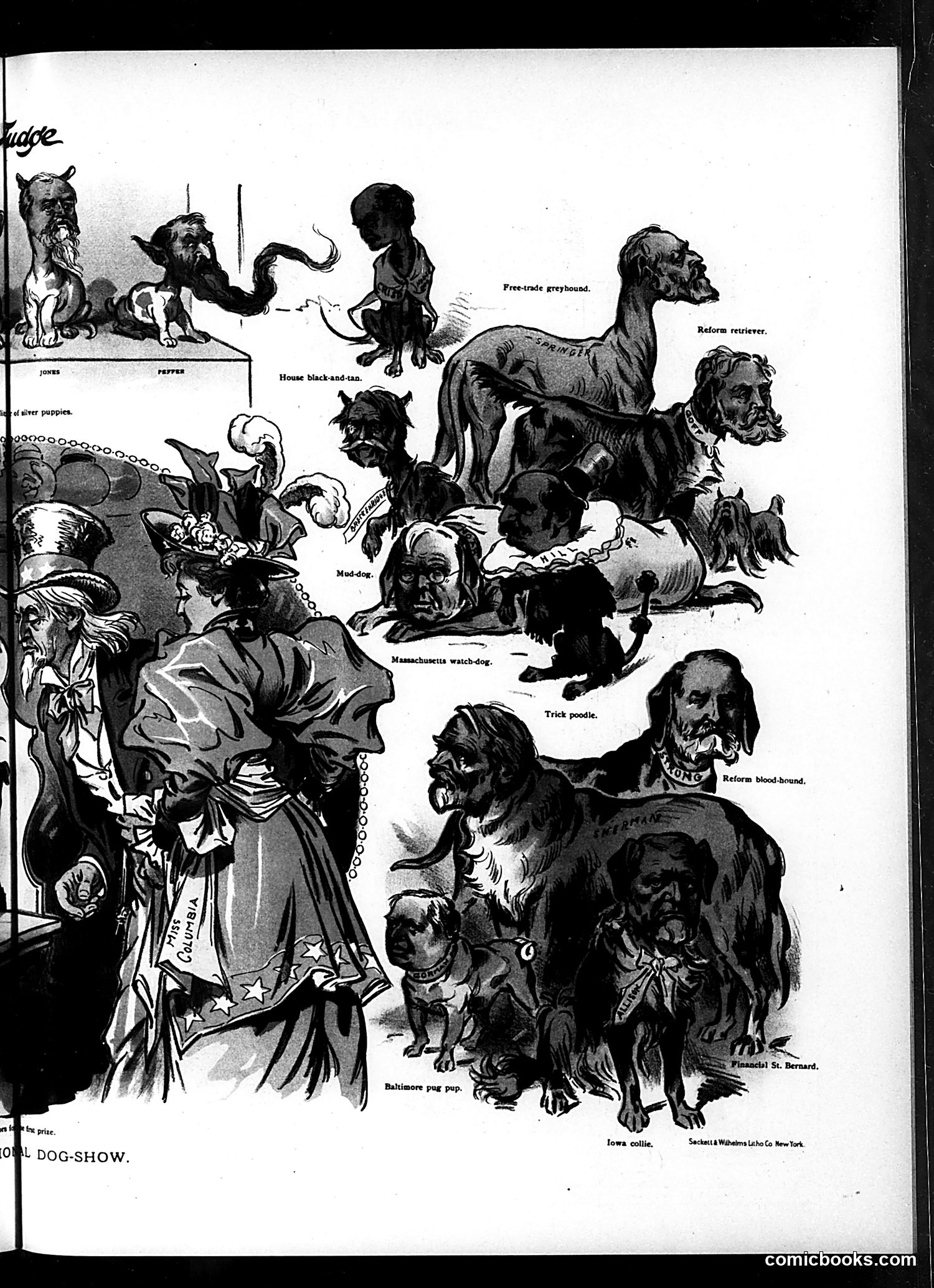
This is a satirical comparison of dog breeds to American political figures and positions, using a dog show as its metaphor. The left side shows Lady Liberty holding various dogs labeled with political identities ("Jones," "Pepper"). The right side displays additional dogs representing different political stances and regions: a "Free-trade greyhound," "Massachusetts watch-dog," "Reform retriever," "Trick poodle," "Reform blood-hound," "Baltimore pug pup," and "Iowa collie." The satire suggests that American politicians and their positions are interchangeable, undisciplined, and ultimately comparable to dogs competing for favor. The variety of breeds and labels implies fragmentation within American politics, likely reflecting late 19th-century debates over tariffs, regional interests, and reform movements. The cartoon criticizes the chaos and self-interested jockeying within the political system.
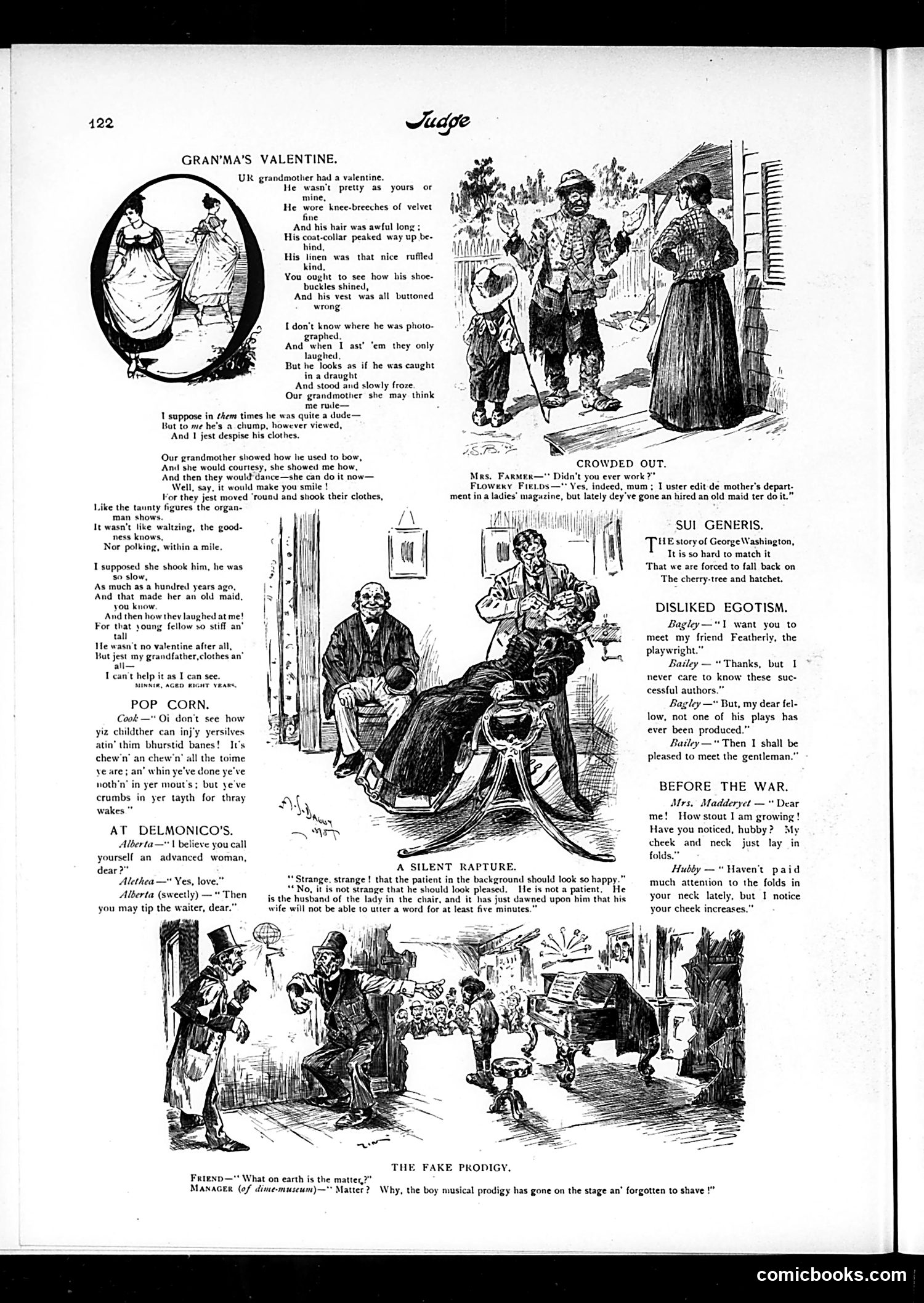
This page contains several short humorous pieces typical of late-19th-century American satire: **"Gran'ma's Valentine"** mocks old-fashioned courtship styles through a child's perspective, finding her grandmother's suitor comically dressed in outdated formal wear with knee-breeches and elaborate buckles—describing him as stiff and frozen-looking rather than romantic. **"Pop Corn"** satirizes working-class Irish immigrant speech (indicated by phonetic dialect writing) and parental bewilderment at children's snacking habits. **"At Delmonico's"** (a famous NYC restaurant) jokes about "advanced women" claiming independence while still expecting men to pay. **"A Silent Rapture"** depicts a dentist's patient husband delighted that his wife cannot talk while in the chair—a common marital joke about talkative spouses. **"The Fake Prodigy"** mocks museum attractions, where a child "musical prodigy" is exposed as a fraud who forgot to maintain his youthful appearance. The cartoons use class commentary, immigrant stereotypes, and domestic humor typical of Judge's satirical approach to American life.
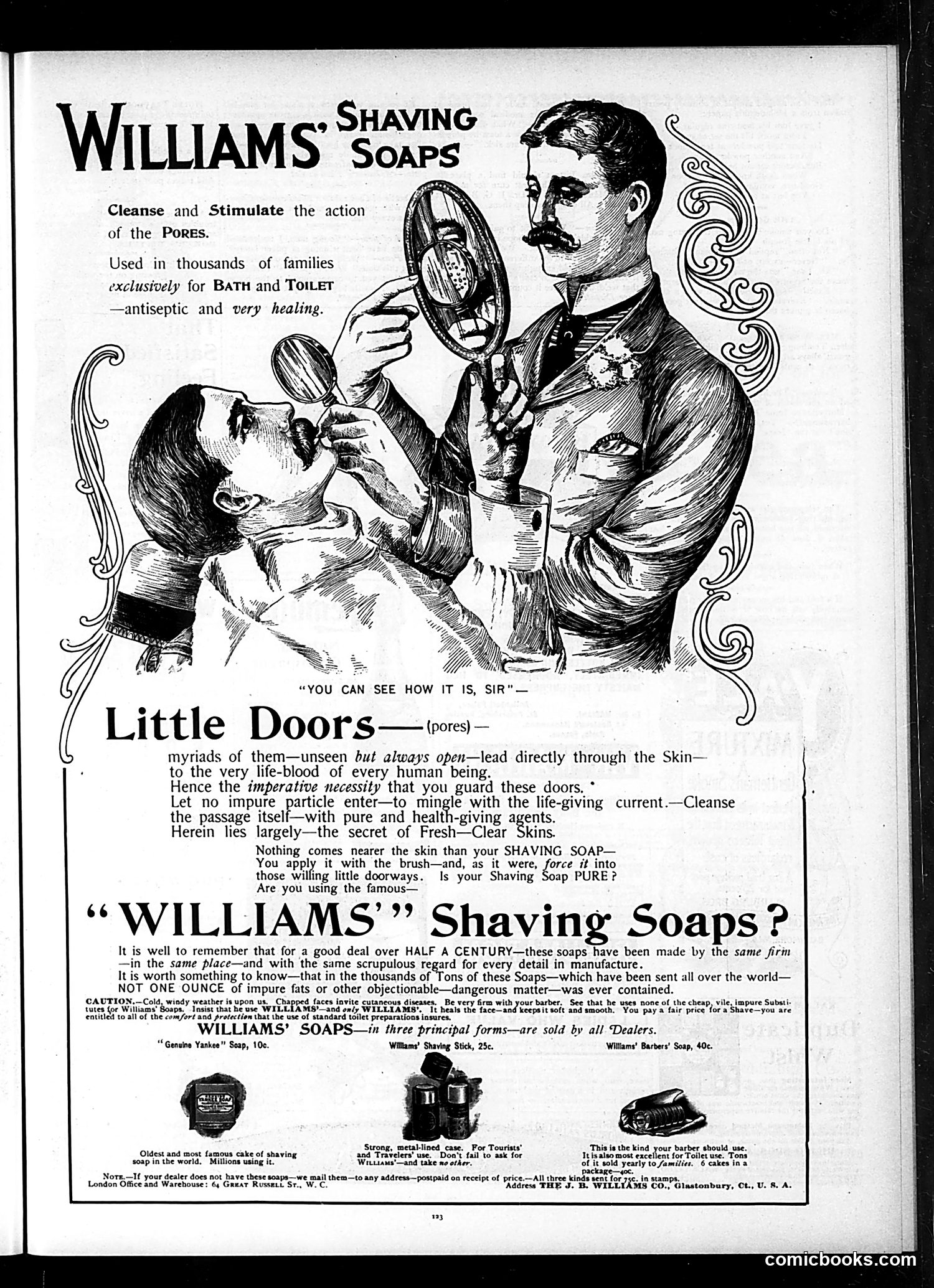
This is a **full-page advertisement**, not satire or political content. It promotes Williams' Shaving Soaps using pseudo-scientific health claims popular in early 20th-century advertising. The illustration shows a barber demonstrating the product to a customer using a mirror. The ad's central conceit—explained through the "Little Doors" metaphor—presents pores as vulnerable openings requiring protection from "impure" substances. This reflected contemporary anxieties about hygiene and contamination. Key marketing claims include: the product's 50+ year manufacturing history, purity guarantees ("NOT ONE OUNCE of impure fats"), and warnings against cheaper substitutes. The ad emphasizes barbers should use only Williams' soap to prevent "cutaneous diseases." The three product variants (Genuine Yankee Soap, Shaving Stick, Barbers' Soap) are displayed with prices and availability information. This represents typical turn-of-the-century advertising blending health concerns with commercial promotion.
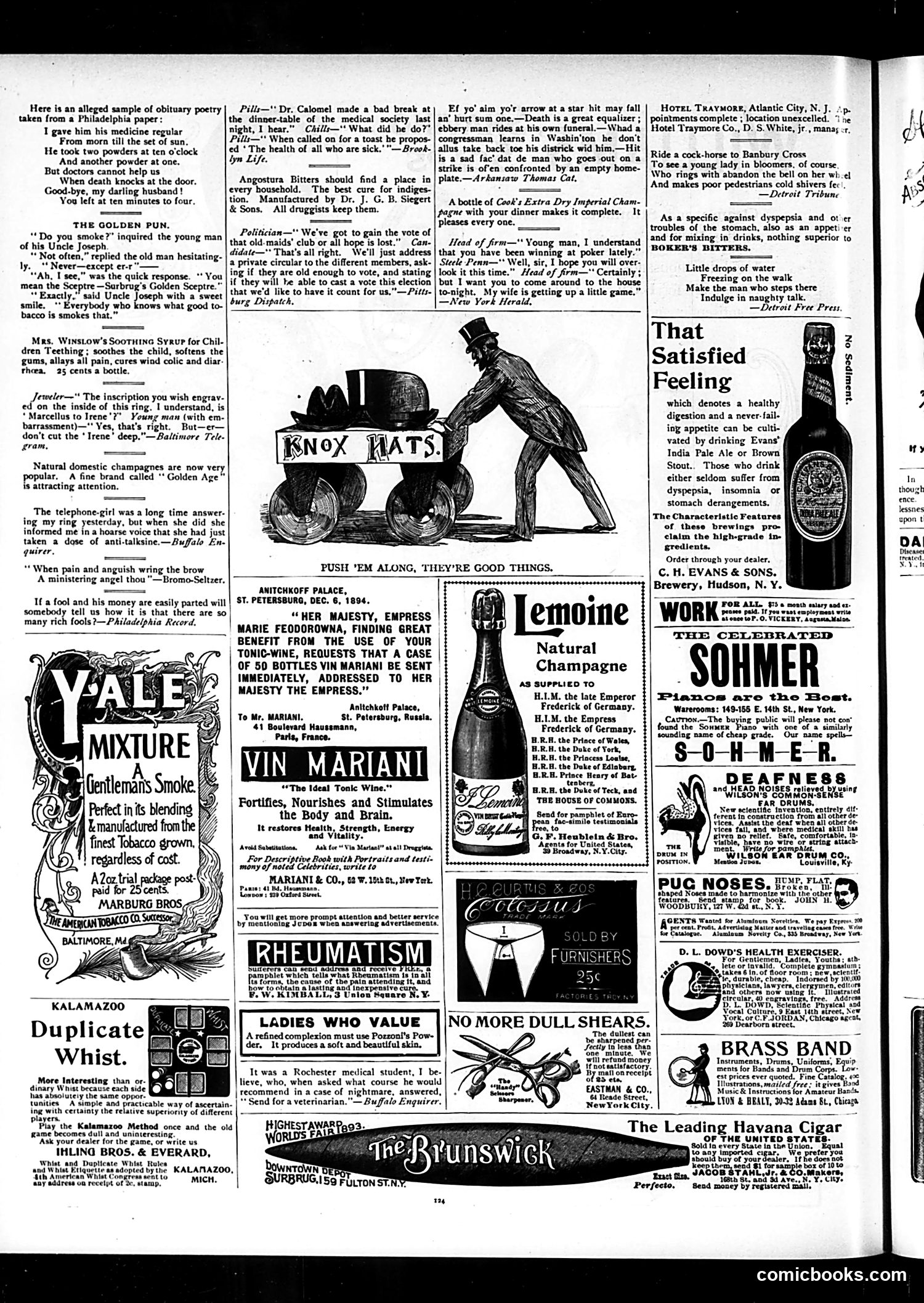
This page is primarily **advertising with interspersed humor items**, typical of Judge magazine's format. The cartoons and jokes are minor; the page is dominated by product advertisements. The main visual cartoon shows a man in a top hat labeled "KNOX HATS" with the caption "PUSH 'EM ALONG, THEY'RE GOOD THINGS"—a straightforward product endorsement with no political content. The text items are brief satirical jokes about contemporary life: - A pun about cigars ("Sceptre") - A jeweler's misunderstanding about ring inscriptions - A telephone operator's complaint about "anti-talksine" - A joke about fools and money The advertisements reflect turn-of-century consumer products: champagne, tonic wine, patent medicines, and tobacco. One notable ad for "Lemoine Natural Champagne" emphasizes it's "AS SUPPLIED TO H.M. the Emperor Frederick of Germany." **No significant political satire or caricature appears on this page.** It's representative of how Judge mixed light humor with commercial advertisements to fund publication.
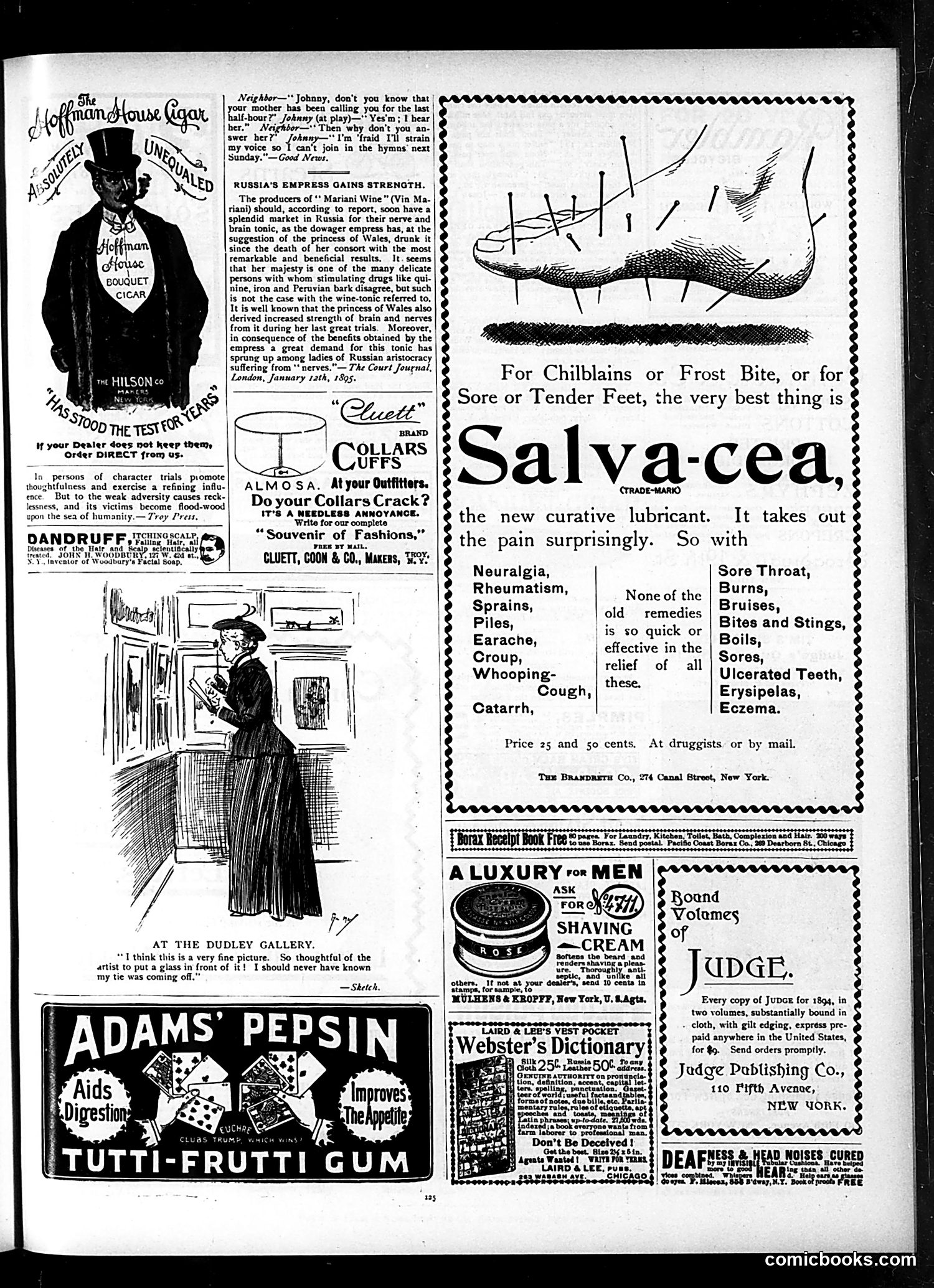
This page is primarily **advertising**, with a small cartoon and brief humorous anecdotes mixed in. The main cartoon, "At the Dudley Gallery," depicts a woman viewing artwork, with the joke that she's grateful the painting has glass in front because it prevented her from noticing her tie was coming undone—a gentle satire on vanity and inattention at art galleries. The brief text items are light humor: one about a boy avoiding his mother's call to preserve his voice for church hymns; another promoting "Mariani Wine" as a tonic the Russian Empress allegedly used, referencing the Princess of Wales. The rest consists of period advertisements for products like Salva-cea (a medicinal lubricant), Cluett collars, Adams' Pepsin gum, and other patent medicines and goods typical of 1890s marketing. These ads reflect the era's enthusiasm for proprietary remedies and commercial products, often making broad health claims that would be illegal today.
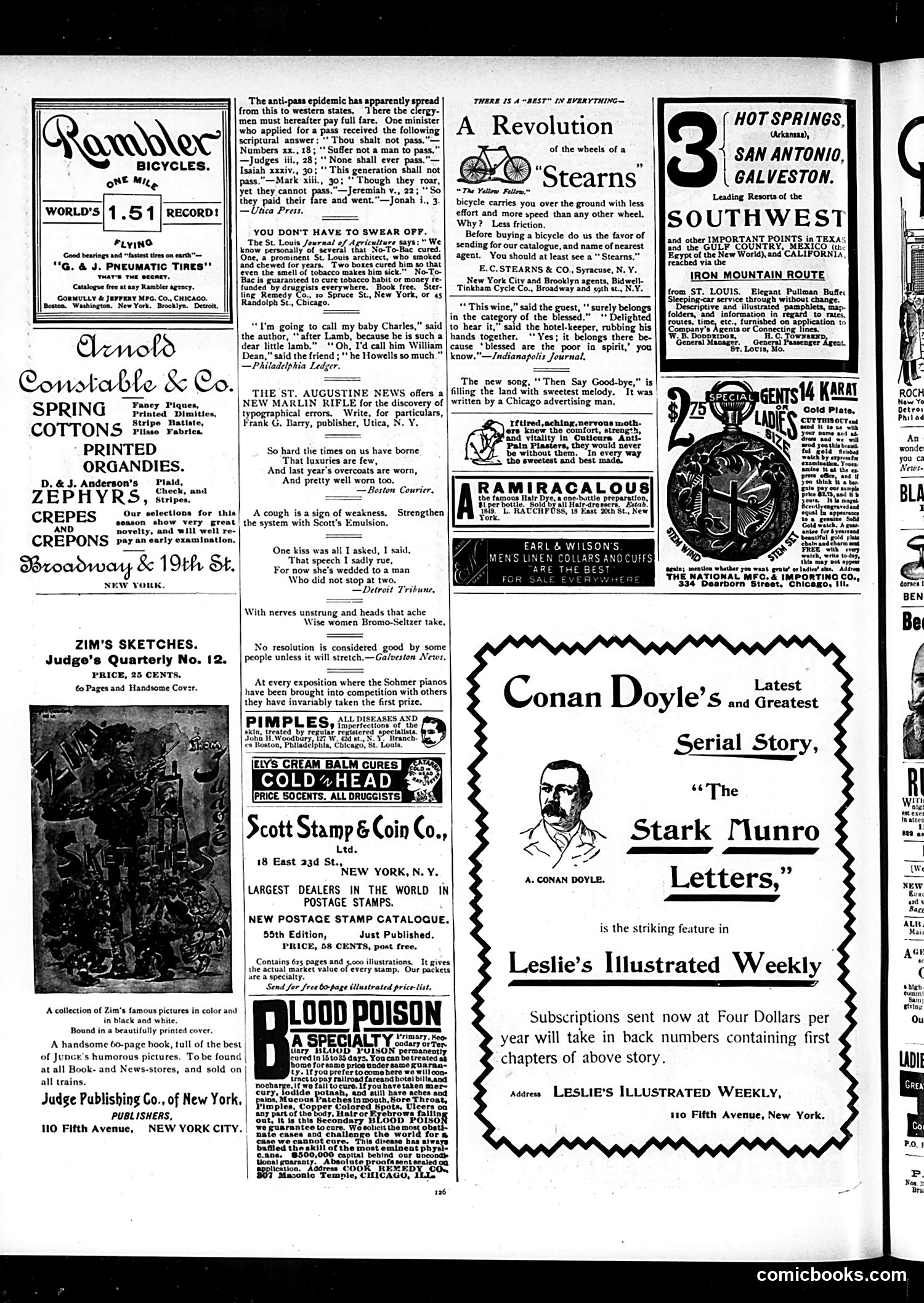
This page is primarily **advertising**, with limited satirical content. The main items are: **Satirical Items:** - Brief humorous quotes mocking social conventions (ministers refusing "passes," naming children after authors, tobacco cessation) - A joke about resolutions that "stretch" - Wordplay on calling a baby "Charles Lamb" (the writer) because he's a "dear little lamb" **Notable Advertisement:** A prominent box advertises **Conan Doyle's "The Stark Munro Letters"** serial story in *Leslie's Illustrated Weekly*—this is a historical reference to the actual serialization of Doyle's semi-autobiographical novel (1895). **Other Ads:** Rambler bicycles, spring fabrics, stamps/coins, tobacco cessation products, and blood poison treatments—typical late-19th-century magazine advertising. The page lacks substantive political cartooning or caricature. It represents *Judge* functioning primarily as a vehicle for consumer advertising with scattered light humor rather than sharp satire.
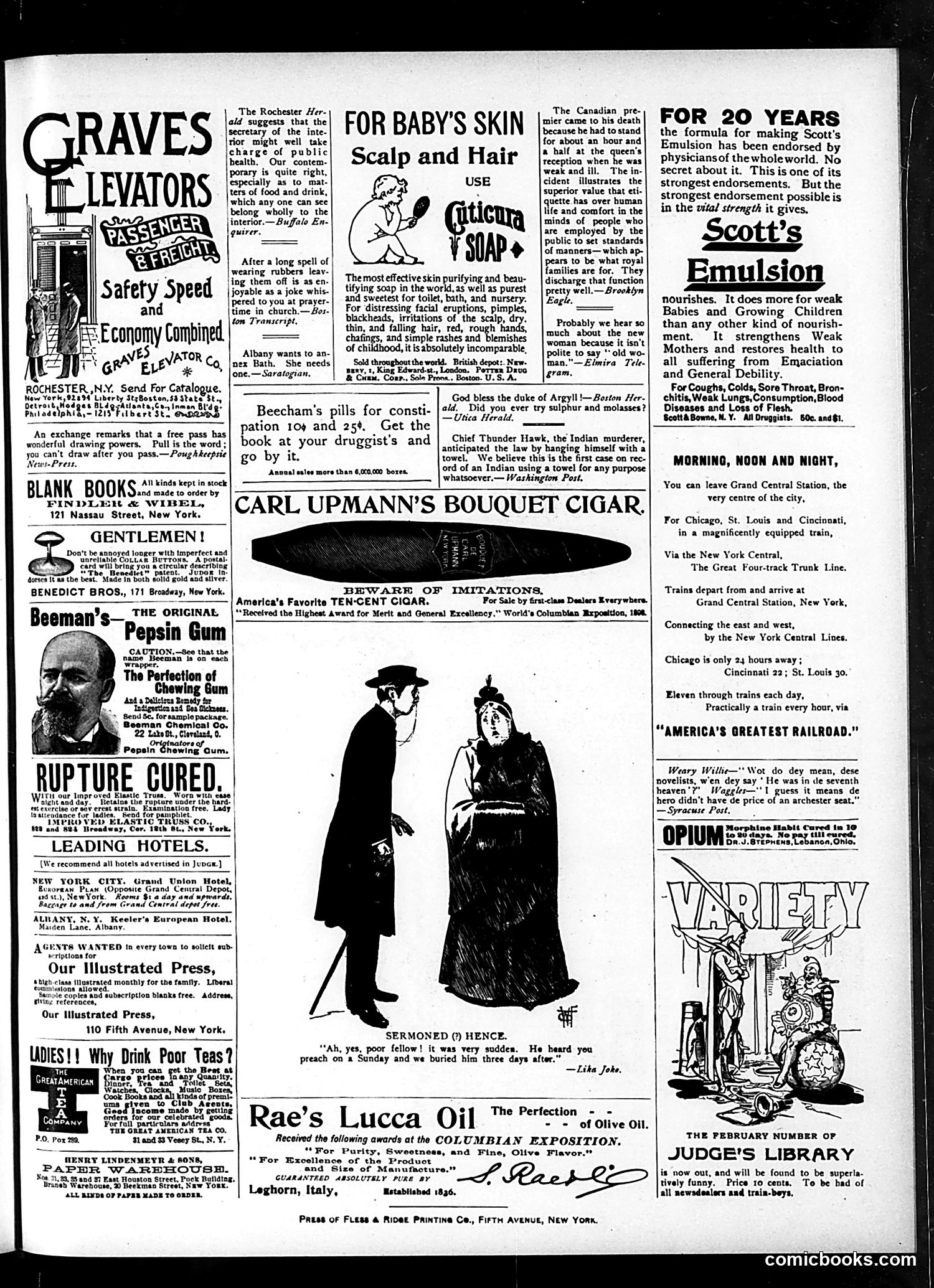
This page is primarily **advertising and miscellaneous content** rather than a coherent satirical cartoon. However, it contains several short, unsigned editorial quips typical of Judge's humor: **Key satirical content:** 1. **"Rubbers" joke**: Removing rubber boots after prolonged wear is compared to hearing a whispered joke during church prayer—both are unexpected reliefs. 2. **"New woman" quip**: The frequency of discussing the "new woman" (a contemporary term for feminists/independent women) reflects social discomfort; people avoid the older term "old woman" out of politeness. 3. **Canadian Premier anecdote**: Criticizes rigid royal etiquette, suggesting that formal standing requirements contributed to a politician's death—satirizing how upper-class institutions prioritize ceremony over human welfare. **Visual content:** One cartoon shows two figures in conversation, captioned "TRIMMED (?) HENCE," though the joke remains unclear without additional context. The page is otherwise dominated by **advertisements** for patent medicines, hotels, chewing gum, and other period products—standard Judge filler.
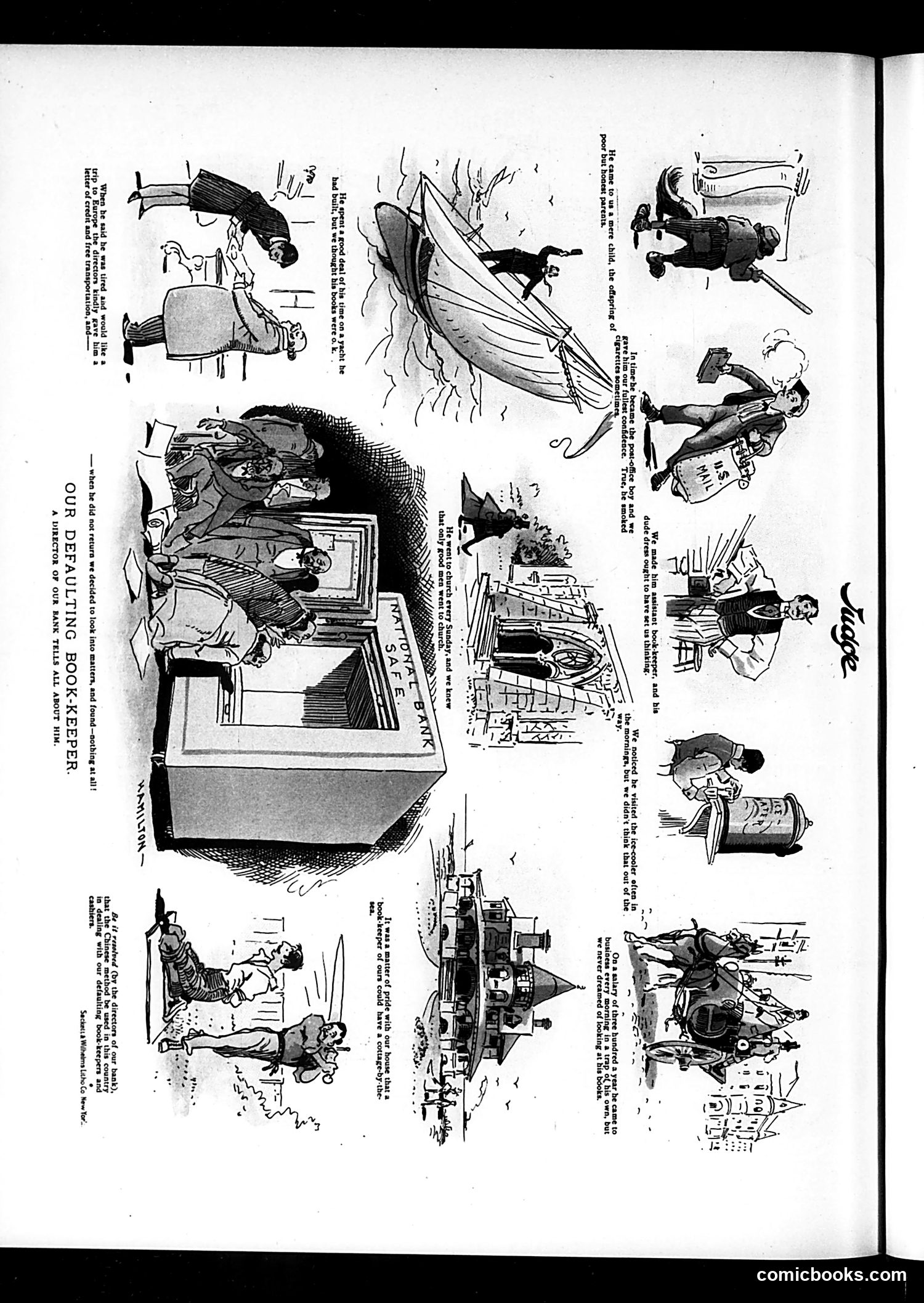
This satirical multi-panel comic illustrates how a bank's directors were duped by an embezzling employee. The narrative, told by a bank director, reveals their embarrassing naïveté: they hired a well-dressed "dude" as assistant book-keeper on modest salary ($300/year), yet he somehow afforded his own carriage, a seaside cottage, and frequent trips to the ice-cooler (likely concealing drinking). The directors convinced themselves he was respectable because he attended church and came from "poor but honest parents." When he disappeared, they finally examined his books—finding nothing (he'd stolen everything). The satire targets the directors' gullibility and willful blindness, their class assumptions that church attendance and genteel appearance signified honesty, and their criminal negligence in not auditing accounts. It's a cautionary tale about banking incompetence and misplaced trust.