
A complete issue · 16 pages · 1895
Judge — February 9, 1895
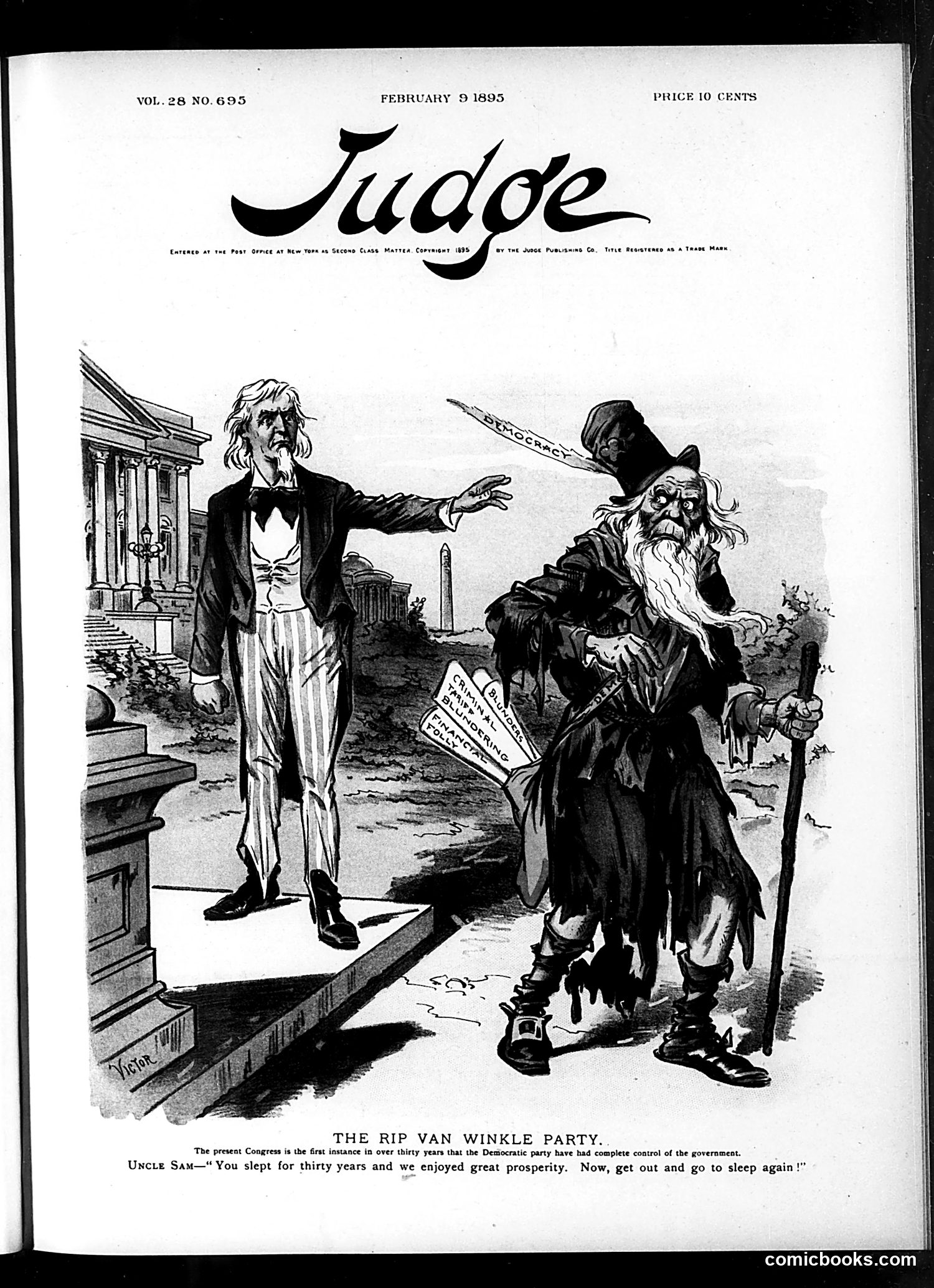
This cartoon satirizes the Democratic Party in 1895. "Uncle Sam" (the well-dressed figure on left, representing America) confronts a disheveled old man labeled "Democracy" wearing a hat marked "DEMOCRACY," carrying a document about "CRIME, CORRUPTION, FREE TRADE, HARD TIMES." The satire references the legend of Rip Van Winkle, who slept for decades. The caption states: "You slept for thirty years and we enjoyed great prosperity. Now, get out and go to sleep again!" This mocks Democrats for having been out of power for 30 years while Republicans governed, implying Democratic policies caused the problems listed on the document. The cartoon suggests Democrats should remain politically dormant rather than regain control.
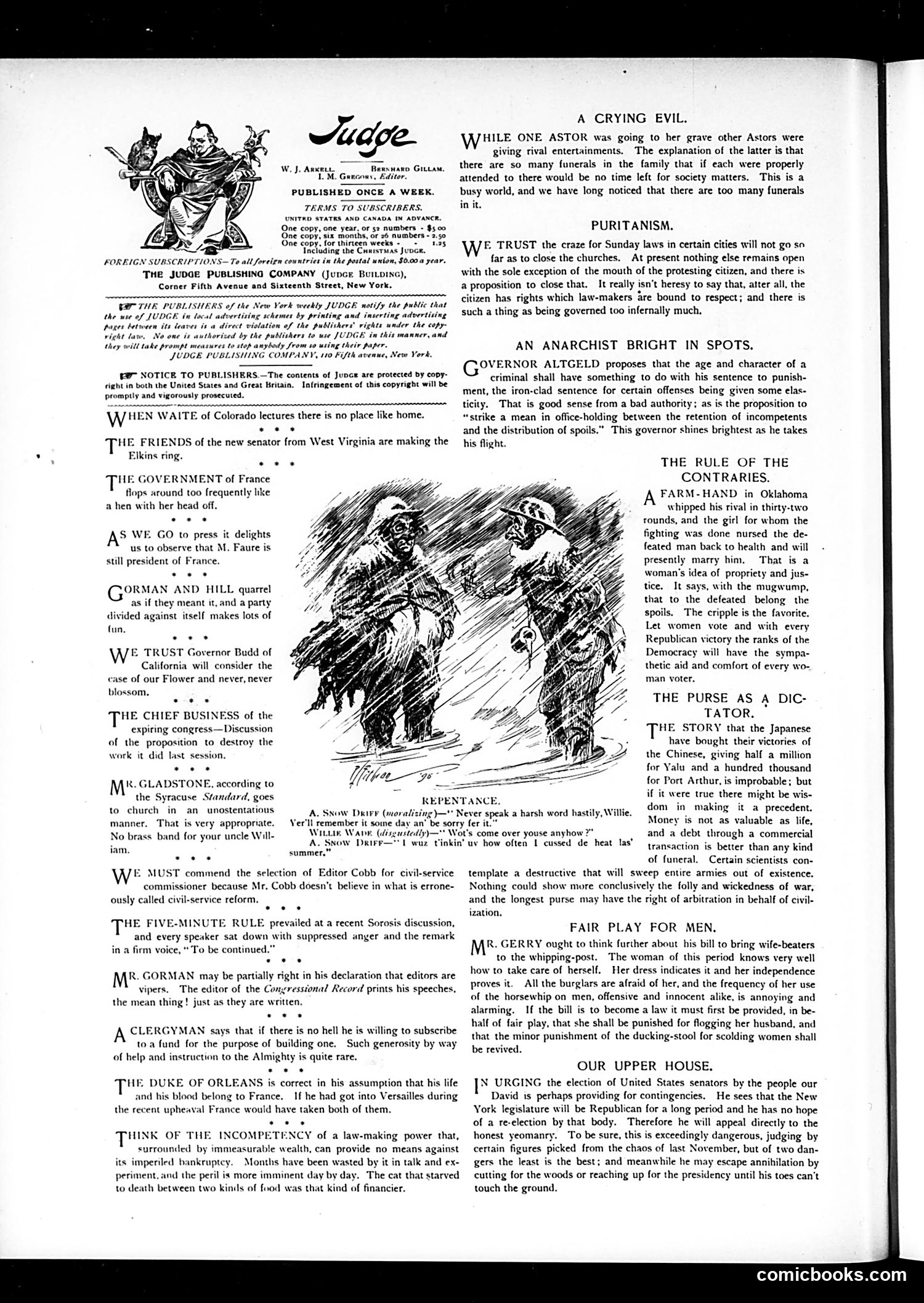
The main cartoon titled "REPENTANCE" depicts two figures in a winter scene—one appears to be escaping or fleeing while another pursues. The caption references Willie Collier (a contemporary actor) saying "Never speak a harsh word hastily, Willie" and mentions someone cursing "de beat las' summer." The surrounding editorial snippets are brief satirical comments on contemporary political figures and issues, including references to Governor Altgeld, Governor Budd of California, Editor Cobb's civil-service reform, and debates over presidential succession. However, **without more historical context identifying the specific individuals being caricatured or the exact events referenced**, I cannot reliably explain the precise political meaning or identify all figures depicted. The page appears to be from Judge's typical format of short political commentary and visual satire, but the specific targets and jokes require clearer identification of the historical moment.
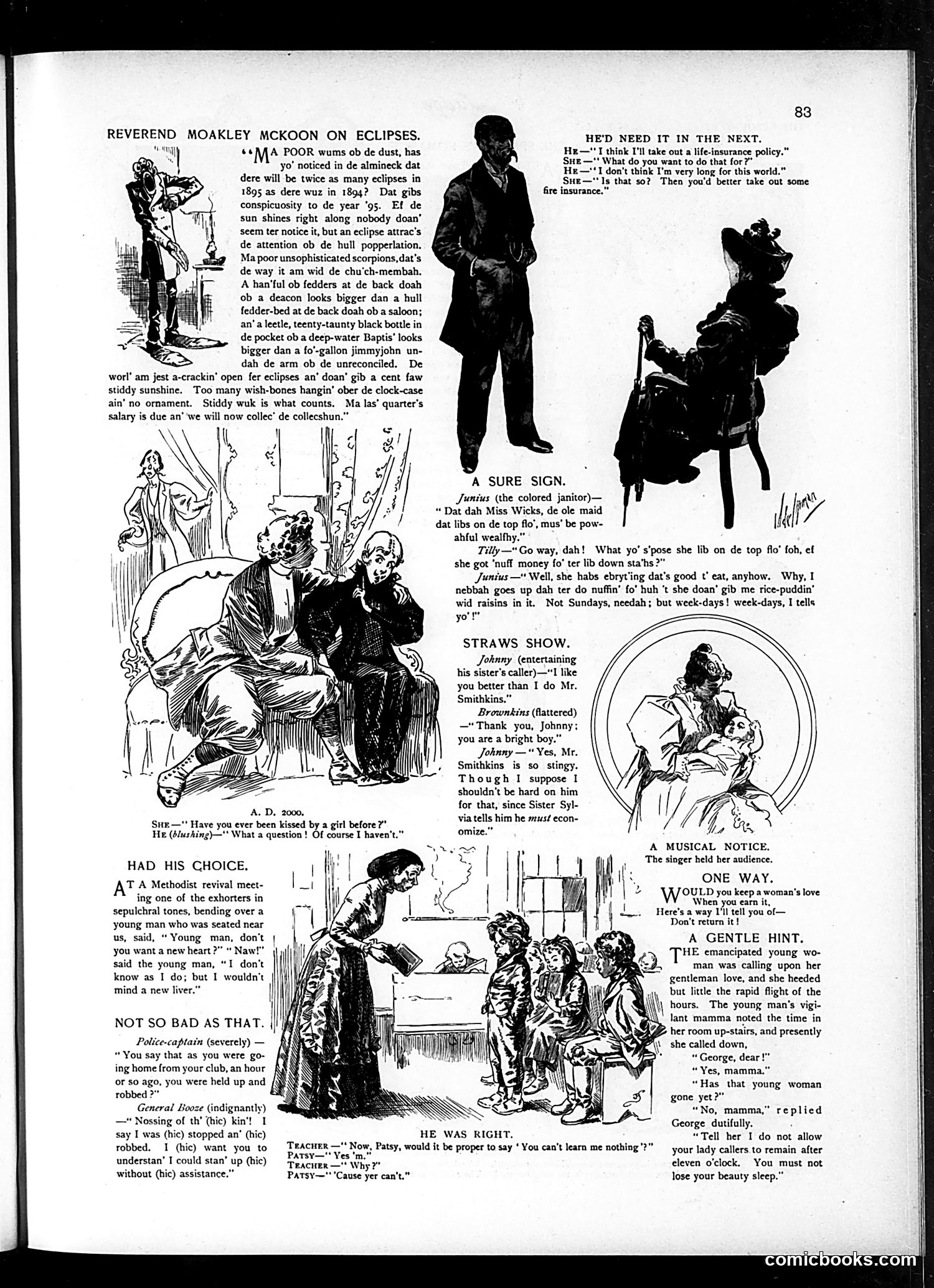
This page contains multiple comic sketches and humorous anecdotes rather than political cartoons. The sketches depict social comedy scenes: **"A Sure Sign"** shows a janitor and maid discussing wealth and domestic service—satirizing class dynamics and servant gossip. **"Straws Show"** presents dialogue between siblings about a Mr. Smithkins, poking fun at social pretension and family judgment of acquaintances. **"Had His Choice"** depicts a Methodist revival meeting where a young man refuses a "new heart," mocking religious conversion rhetoric. **"Not So Bad As That"** presents a police-captain interrogation about robbery, using dialect humor common to period comedy. The remaining sketches ("He Was Right," "A Gentle Hint," "One Way," "A Musical Notice") are brief domestic or romantic comedies with contemporary social observations rather than political satire. This appears to be humor focused on class, courtship, and everyday American life rather than political commentary.
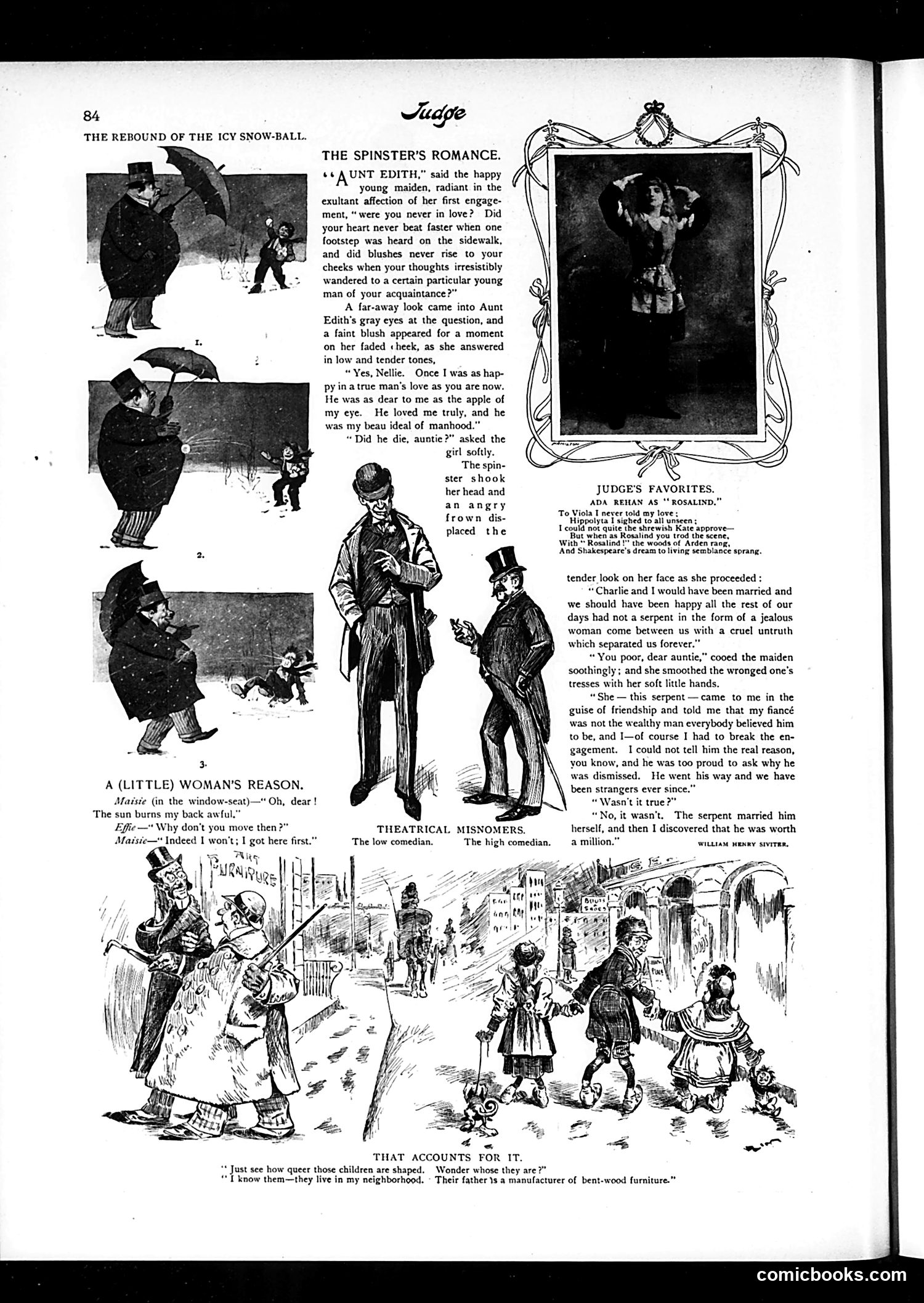
This page contains several satirical pieces typical of Judge magazine's humor: **"The Spinster's Romance"** tells of Aunt Edith, whose fiancé Charlie was separated from her by a jealous woman who falsely claimed he was poor. The twist: that woman married him and he turned out to be wealthy anyway. The satire mocks romantic melodrama and the irony of women's gossip backfiring. **"A (Little) Woman's Reason"** jokes about a child refusing to move from a sunny spot simply because "I got here first"—poking fun at childish stubbornness and possessiveness. **"Theatrical Misnomers"** contrasts "the low comedian" (working-class humor) with "the high comedian" (upper-class wit). **"That Accounts for It"** shows oddly-shaped children, explained by their father manufacturing bent-wood furniture—a pun on heredity and profession. The page's humor relies on Victorian-era social conventions, romantic melodrama, class distinctions, and wordplay typical of late-19th/early-20th century American satire.
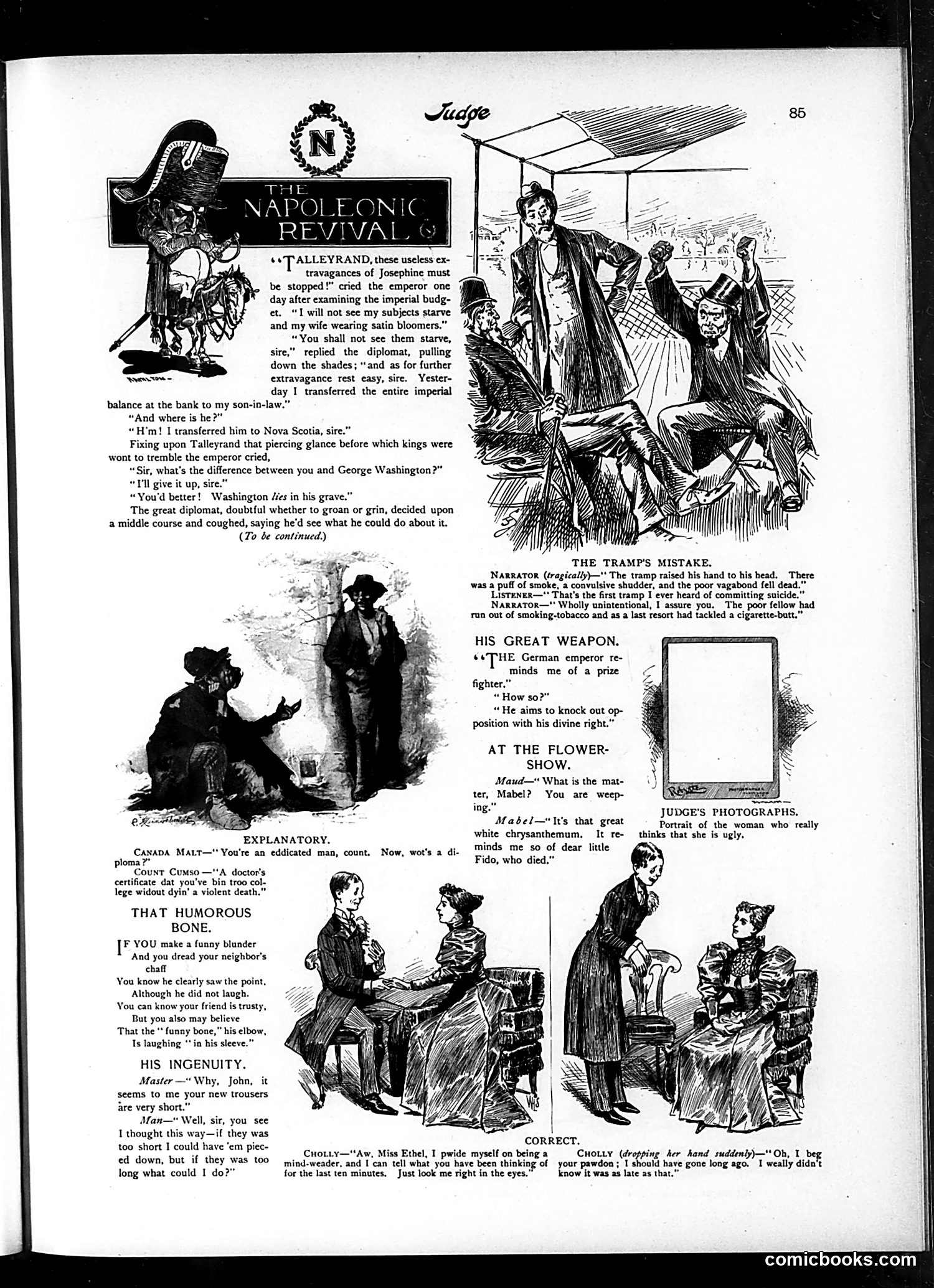
This satirical piece compares a contemporary diplomat (Talleyrand) to Napoleon, mocking diplomatic corruption. When the "emperor" complains about his wife Josephine's extravagant spending, Talleyrand admits he's embezzled the imperial treasury to his son-in-law and exiled him to Nova Scotia. The punchline contrasts the corrupt diplomat unfavorably with George Washington—who "lies in his grave" (implying honesty and integrity), while Talleyrand remains alive and scheming. The humor targets late-19th-century political corruption and self-dealing, using historical comparison to critique contemporary governmental dishonesty. The page also contains unrelated brief comedic sketches about education, practicality, and social awkwardness. The satire suggests American readers would have recognized Talleyrand as history's archetypal cunning diplomat, making him an apt vehicle for mocking current political malfeasance.
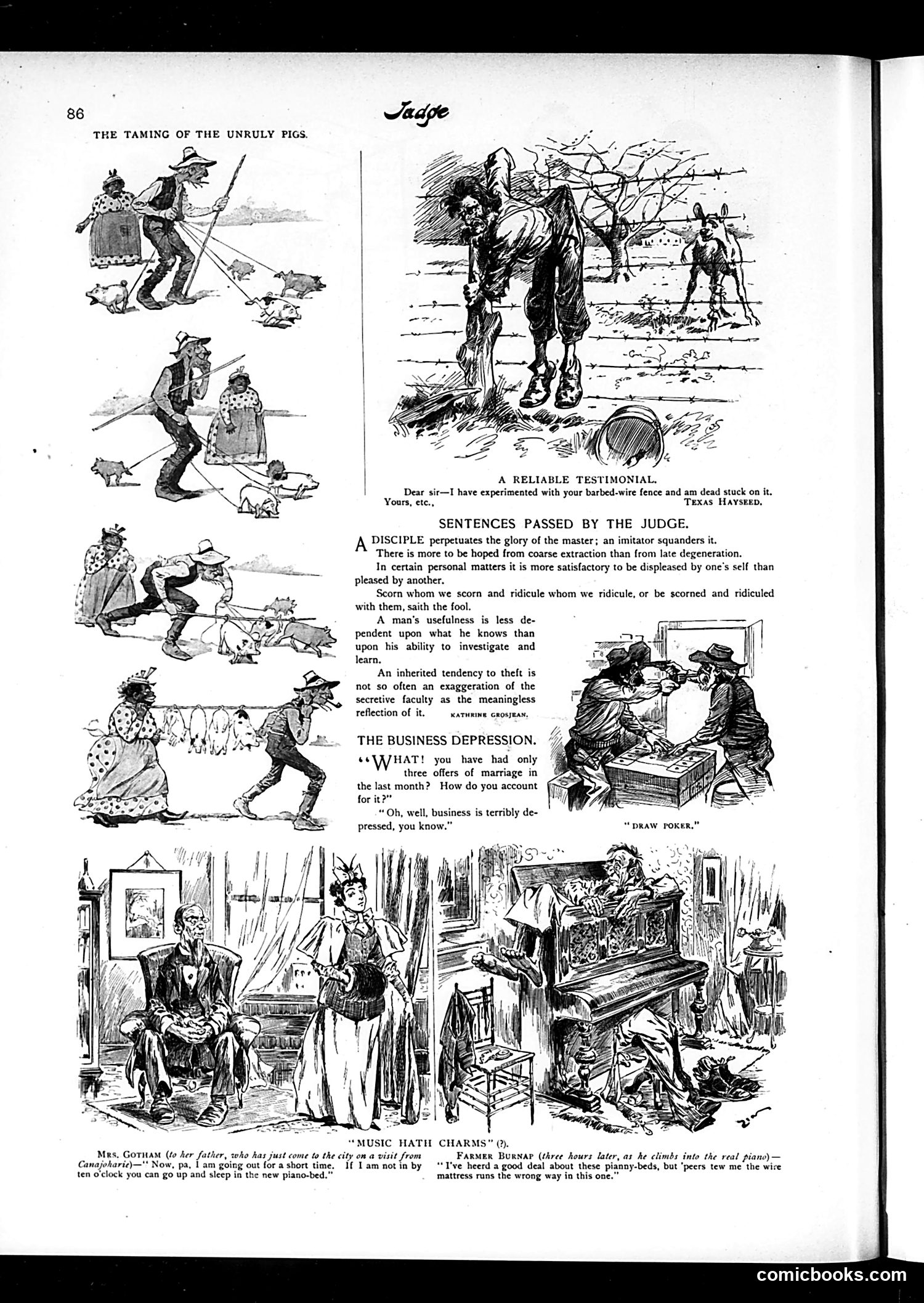
This page from Judge (a late 19th/early 20th-century American satirical magazine) contains several distinct pieces: **"The Taming of the Unruly Pigs"** (left): A series of cartoon vignettes showing a woman (in elaborate dress, suggesting wealth or status) struggling to control misbehaving pigs. The satire likely mocks difficulty managing unruly situations or people—possibly commenting on social control or feminine frustration with disorder. **"A Reliable Testimonial"**: A mock endorsement praising barbed-wire fencing from "Texas Hayskep," likely satirizing both frontier culture and advertising hyperbole of the era. **"Sentences Passed by the Judge"**: Philosophical aphorisms, a recurring Judge feature offering satirical wisdom. **"The Business Depression"**: A brief joke about marriage proposals declining due to economic hardship—social commentary on how economic downturns affect courtship. **"Music Hath Charms"**: Two scenes mocking a new novelty—the "piano-bed" (a bed that folds into a piano or vice versa). A farmer visiting the city is skeptical of this impractical invention, satirizing both urban fads and rural common sense.
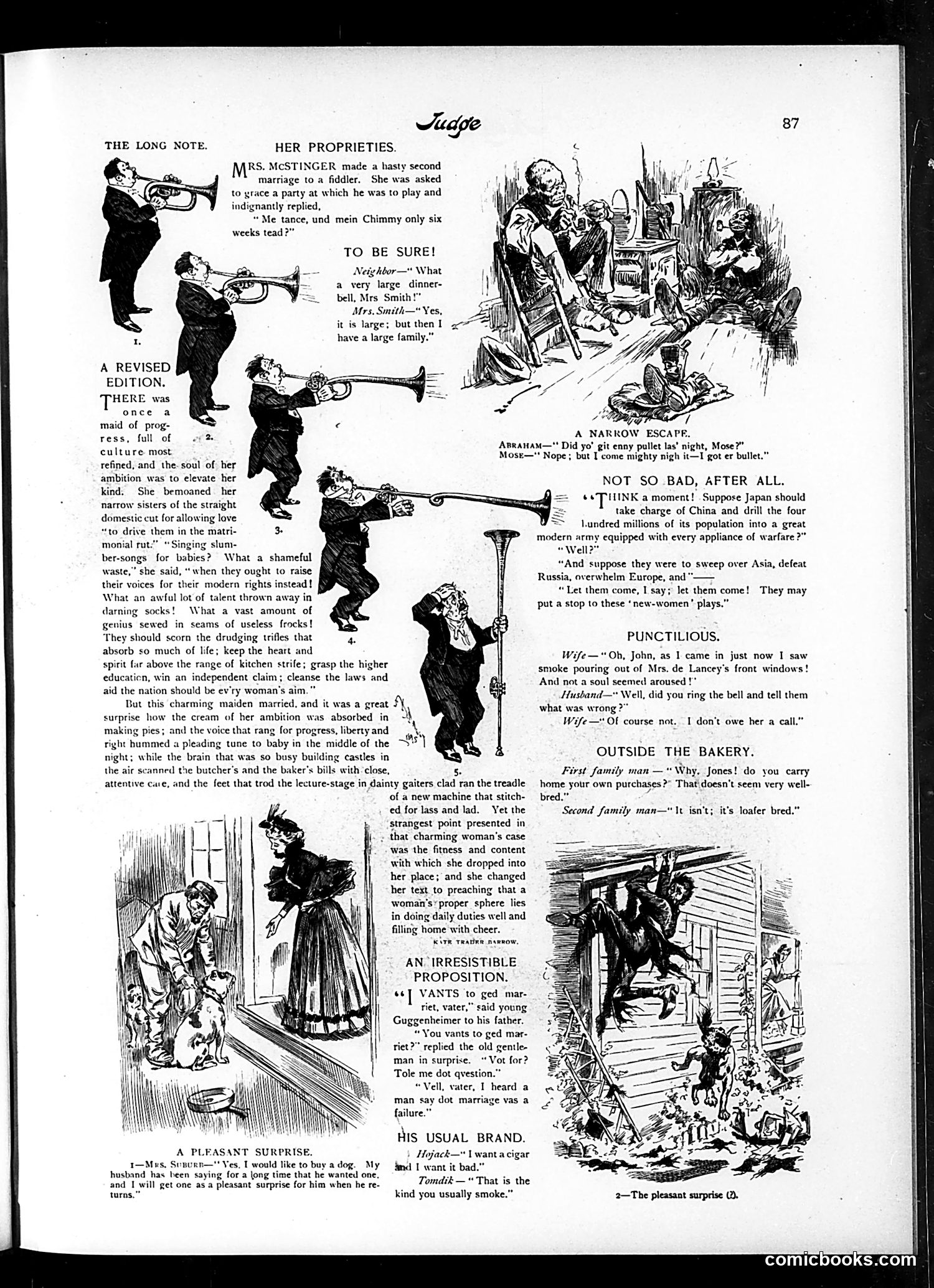
This page contains several satirical vignettes mocking late-19th/early-20th-century social conventions: **"The Long Note"** ridicules a German-accented fiddler's wife who refuses social obligations, suggesting immigrant pretension. **"A Revised Edition"** is the page's main satire: a progressive "New Woman" advocates for female independence, education, and rights—then abandons all principles upon marriage, contentedly making pies and managing household budgets. This mocks the hypocrisy of feminist rhetoric that evaporates when women marry, suggesting women's "true nature" is domestic. **Other brief comedic sketches** include wordplay about large dinner bells, marital proposals, and social etiquette violations (a woman not "calling" on a neighbor after seeing her house smoking). **"Not So Bad, After All"** sarcastically suggests even a Japanese military conquest of Asia would be preferable to enduring contemporary "new-women" theatrical plays—mocking both militarism and women's liberation movements simultaneously. The overall tone reflects conservative anxiety about changing gender roles and women's independence movements of the era.
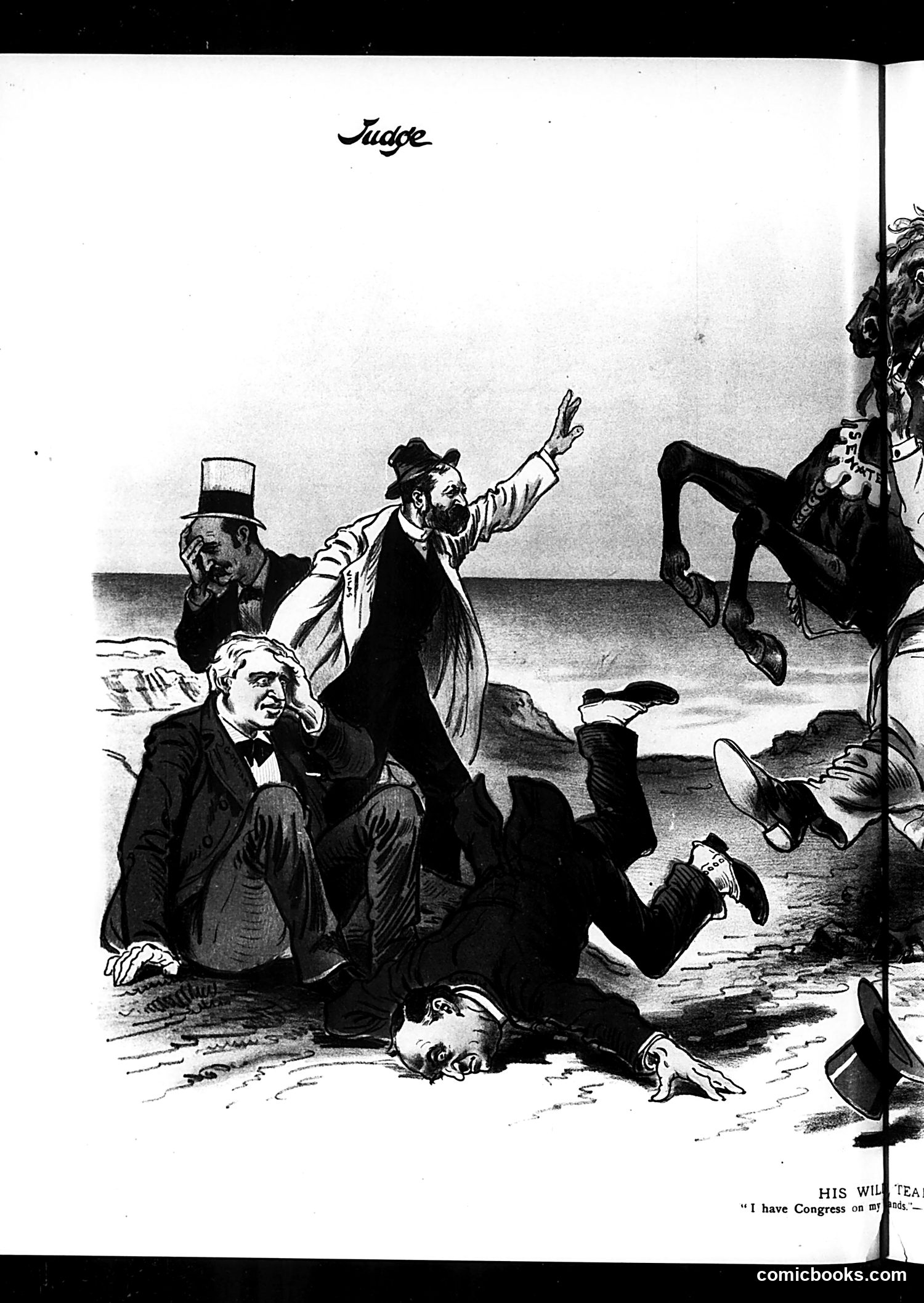
This Judge cartoon satirizes a political figure (likely a president or executive) who claims to "have Congress on my hands"—meaning Congress is burdensome or problematic for him. The scene depicts chaos: figures tumble and sprawl across the ground in disarray, suggesting Congress is uncontrollable or creates disorder. The seated figure in the foreground appears distressed, while another gestures dramatically above. The composition emphasizes pandemonium and loss of control. The satire mocks the speaker's complaint about managing Congress, implying either that he's incompetent at leadership or that Congress itself is inherently chaotic and difficult to govern. The visual disorder reinforces the rhetorical claim—he literally "has Congress on his hands" as a messy, unmanageable problem.
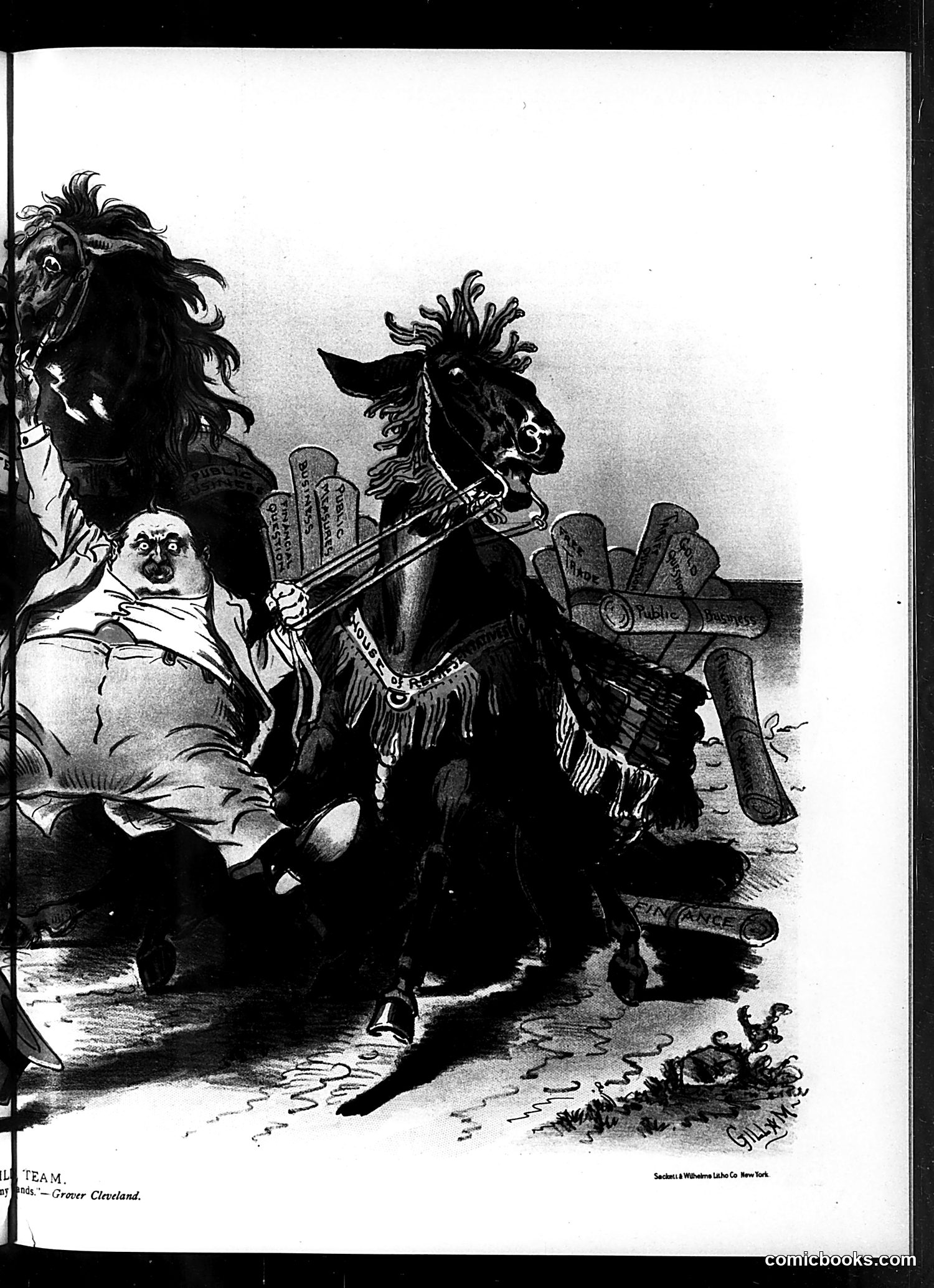
This **Judge** magazine cartoon satirizes **Grover Cleveland** (identified in the OCR text). The image depicts Cleveland as a disheveled, monkey-faced figure struggling to control an unruly horse labeled with military regalia and decorations. The horse appears to represent either the military establishment or aggressive foreign policy that Cleveland cannot manage. The logs scattered in the background likely reference resource disputes or construction/infrastructure conflicts. The cartoon's message appears to critique Cleveland's handling of military or foreign affairs—suggesting his administration is incompetent or overwhelmed by forces beyond its control. The exaggerated, dehumanizing caricature of Cleveland (with ape-like features) was typical of 19th-century political satire, reflecting the harsh visual rhetoric common in **Judge** magazine's commentary on political figures.
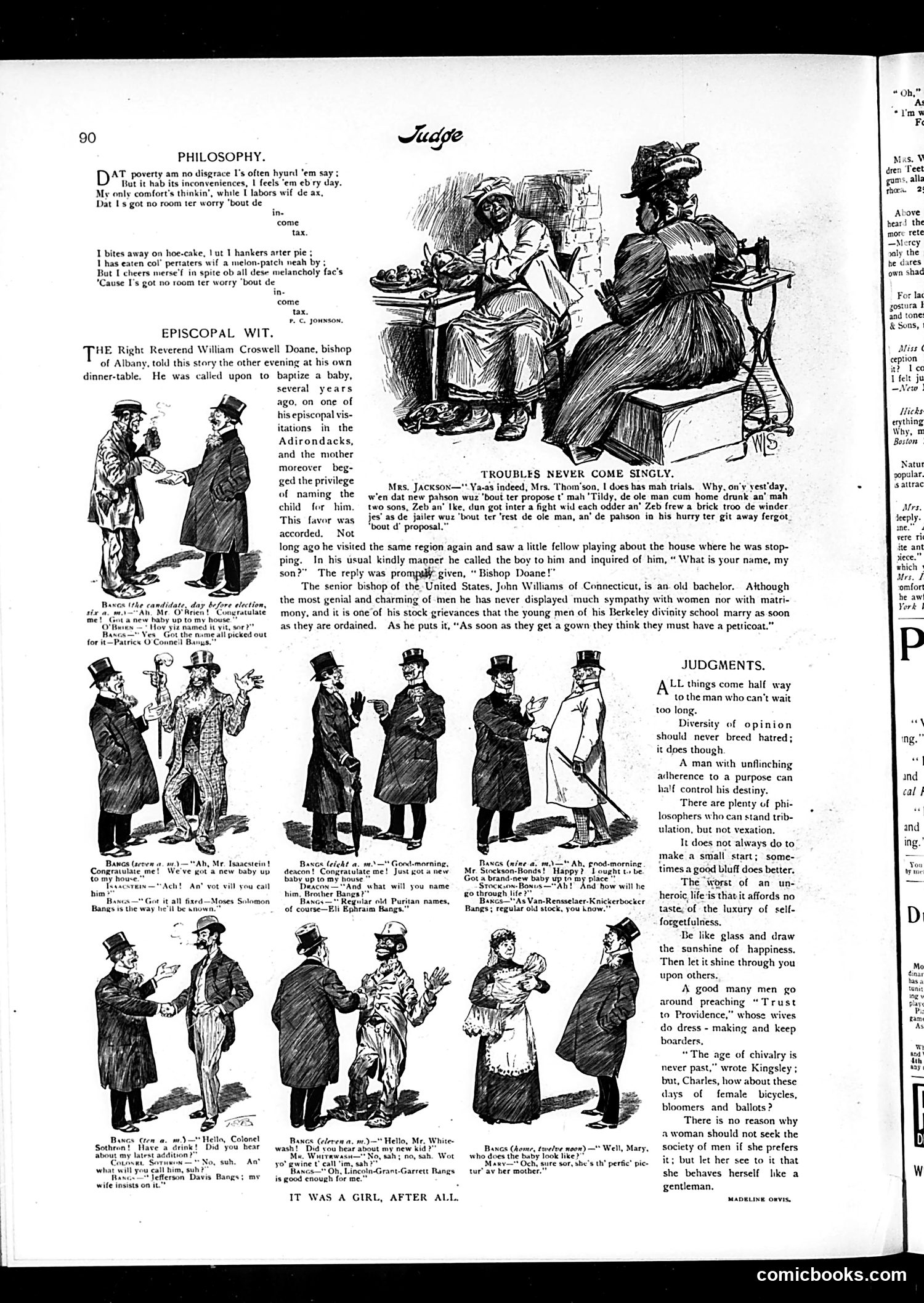
This page from the satirical magazine *Judge* contains three separate pieces of humor: **"Philosophy"** presents a stereotyped enslaved or impoverished Black speaker consoling himself about poverty because he has "no room ter worry 'bout de income tax"—the joke being he's so poor he owes no taxes. This reflects period racial caricature and humor at the expense of Black Americans. **"Episcopal Wit"** mocks clergy naming practices through anecdotes about Bishop Doane. Various characters (Bangs, O'Brien, etc.) name babies after politicians and religious figures in increasingly ridiculous ways—"Patrice O'Connell Bangs," "Eli Ephraim Bangs," "John-Grant-Garrett Bangs." The satire targets clergymen's pretentious or excessive patriotic/religious naming conventions. **"Judgments"** is a philosophical column offering conventional wisdom about patience, purpose, and morality—entirely separate from the cartoons above. The page illustrates *Judge*'s mix of racial caricature, gentle institutional satire, and moral platitudes typical of 1880s-90s American humor magazines.
This page is **primarily advertisements** with minimal editorial cartoon content. The visible satirical pieces are brief: 1. **Opening anecdote**: A clam lamenting it "never advertises" — commentary on the era's growing belief that business success required advertising. 2. **Brief social jabs**: Scattered one-liners mocking vanity (a pretty girl losing charm upon realizing her beauty), Irish laborers' speech patterns, and matrimonial prospects — typical period humor stereotyping immigrants and gender relations. 3. **Dominant content**: Product advertisements (Sohmer pianos, Vin Mariani, Phillips Cocoa, Packer's Tar Soap) reflecting late 19th/early 20th-century consumer culture. The page reflects **Judge's** dual purpose: satirizing American society while generating revenue through advertising. The humor is gentle, class-conscious, and relies on ethnic stereotyping typical of the era. No specific political figures or major events are clearly referenced here.
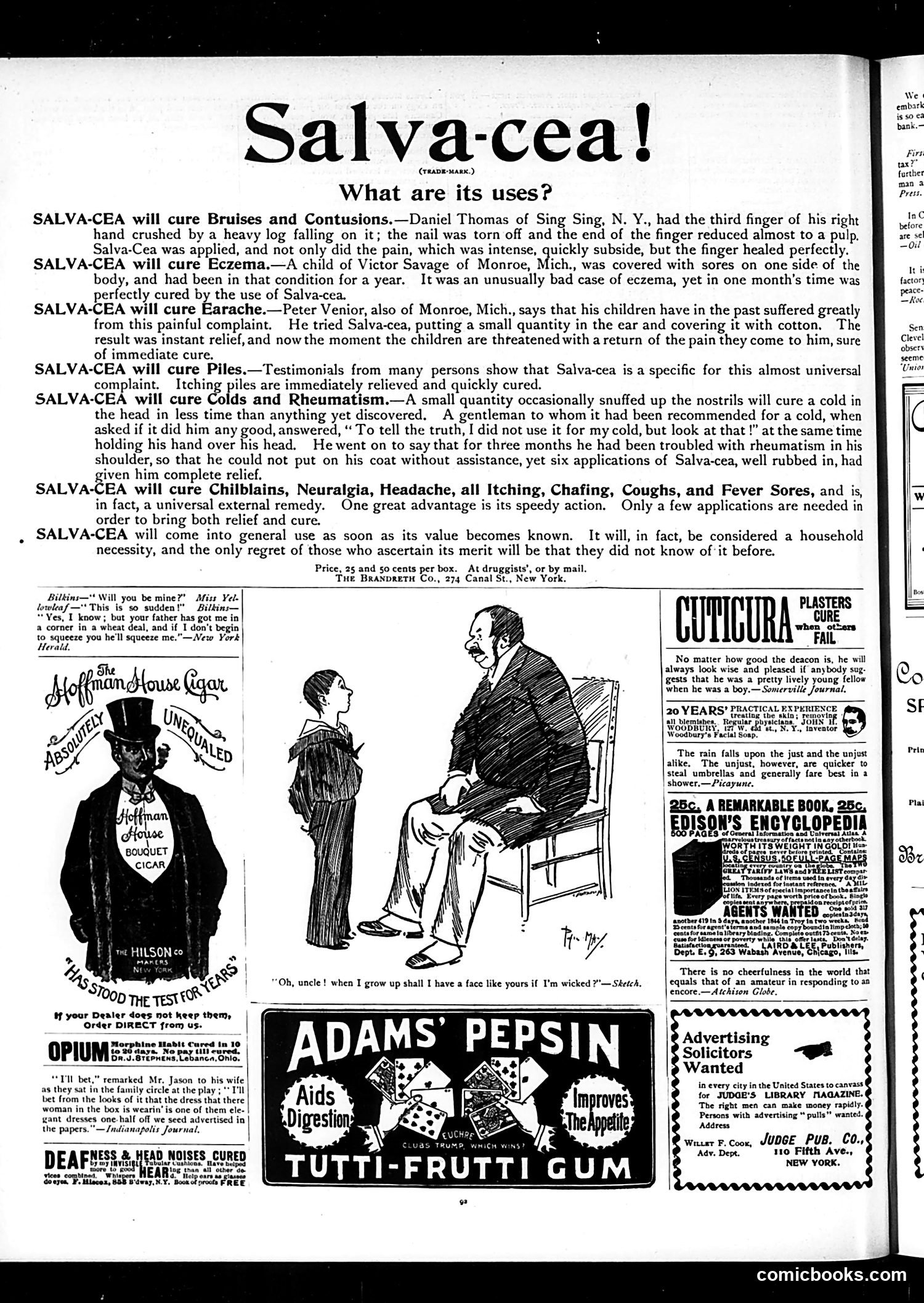
This page is primarily **advertising and filler content** rather than political satire. The dominant feature is a lengthy advertisement for "Salva-Cea," a patent medicine claiming to cure bruises, eczema, earache, piles, colds, rheumatism, and numerous other ailments—typical of the era's dubious medical products. The page includes several small comic vignettes and jokes: 1. **"Oh, uncle! when I grow up shall I have a face like yours if I'm wicked?"** — A humor sketch mocking an unattractive man's appearance. 2. **Bilkins and Miss Yellowleaf dialogue** — A brief comedic exchange about a marriage proposal motivated by financial/business pressure rather than romance. 3. Various advertisements for other products (cigars, encyclopedias, deafness cures). The satirical content is minimal and generic—poking fun at human nature rather than addressing specific political events. This reflects Judge's mixed format of advertisements and light humor typical of late 19th/early 20th-century magazines.
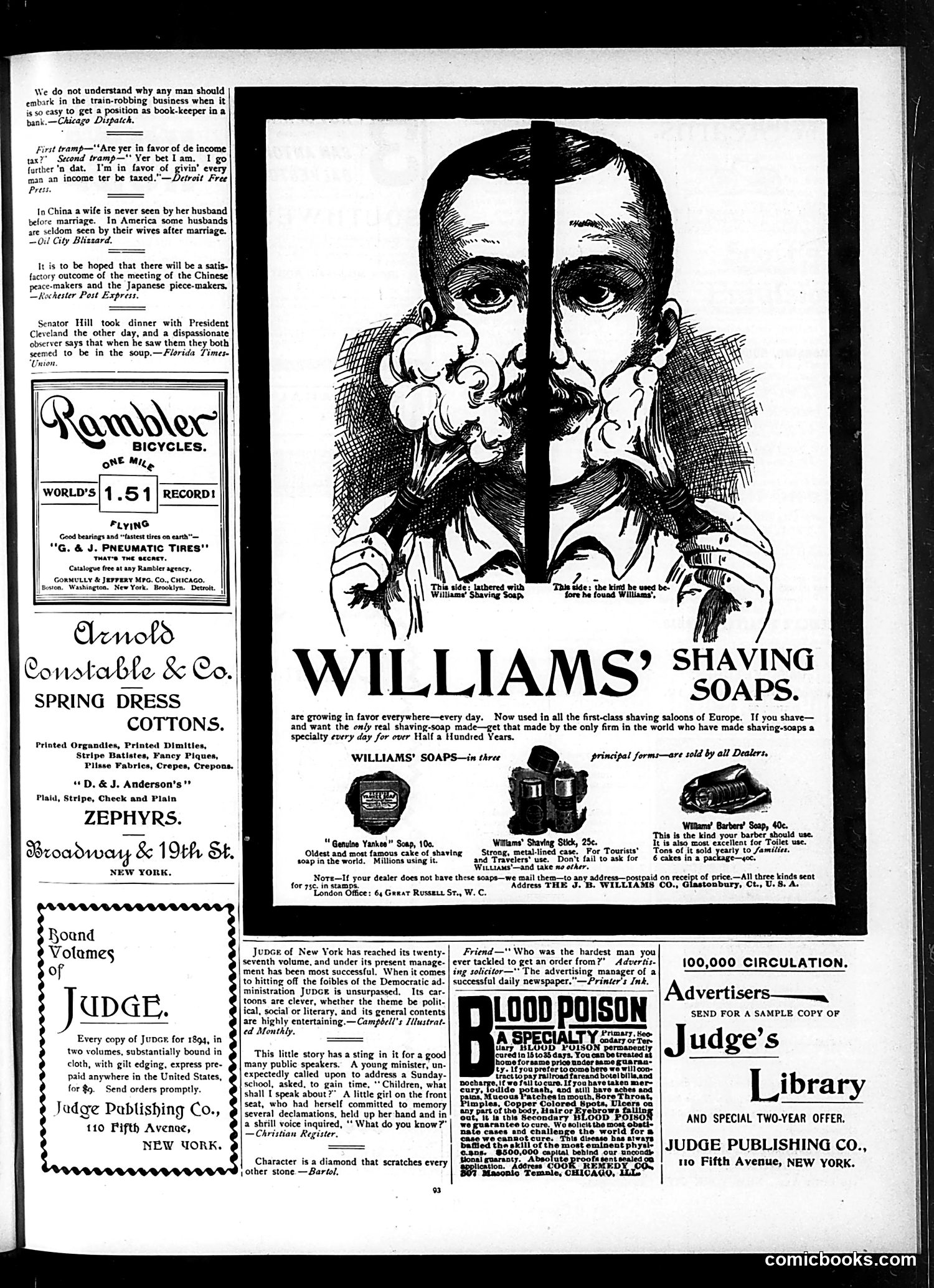
The main illustration is a **double-faced caricature advertisement** for Williams' Shaving Soaps, one of the page's commercial features. The two mirrored faces—labeled as appearing in William Sheering Soap advertisements—show men with exaggerated features lathering their faces. The advertisement emphasizes that Williams' soaps are "the only firm in the world" making shaving soaps as a specialty "for over Half a Hundred Years," positioning it as an established, trustworthy product "now used in all the first-class shaving saloons of Europe." The page is primarily **advertising-driven**: it includes ads for Rambler bicycles, Constable & Co. cottons, Judge Publishing bound volumes, and Judge's Library subscription offer. The satirical quotations on the left—jokes about train robbers becoming bank bookkeepers, tramps debating income tax, and marital observations—are brief filler content typical of Judge magazine's style. These are disconnected one-liners rather than a cohesive political cartoon or commentary.
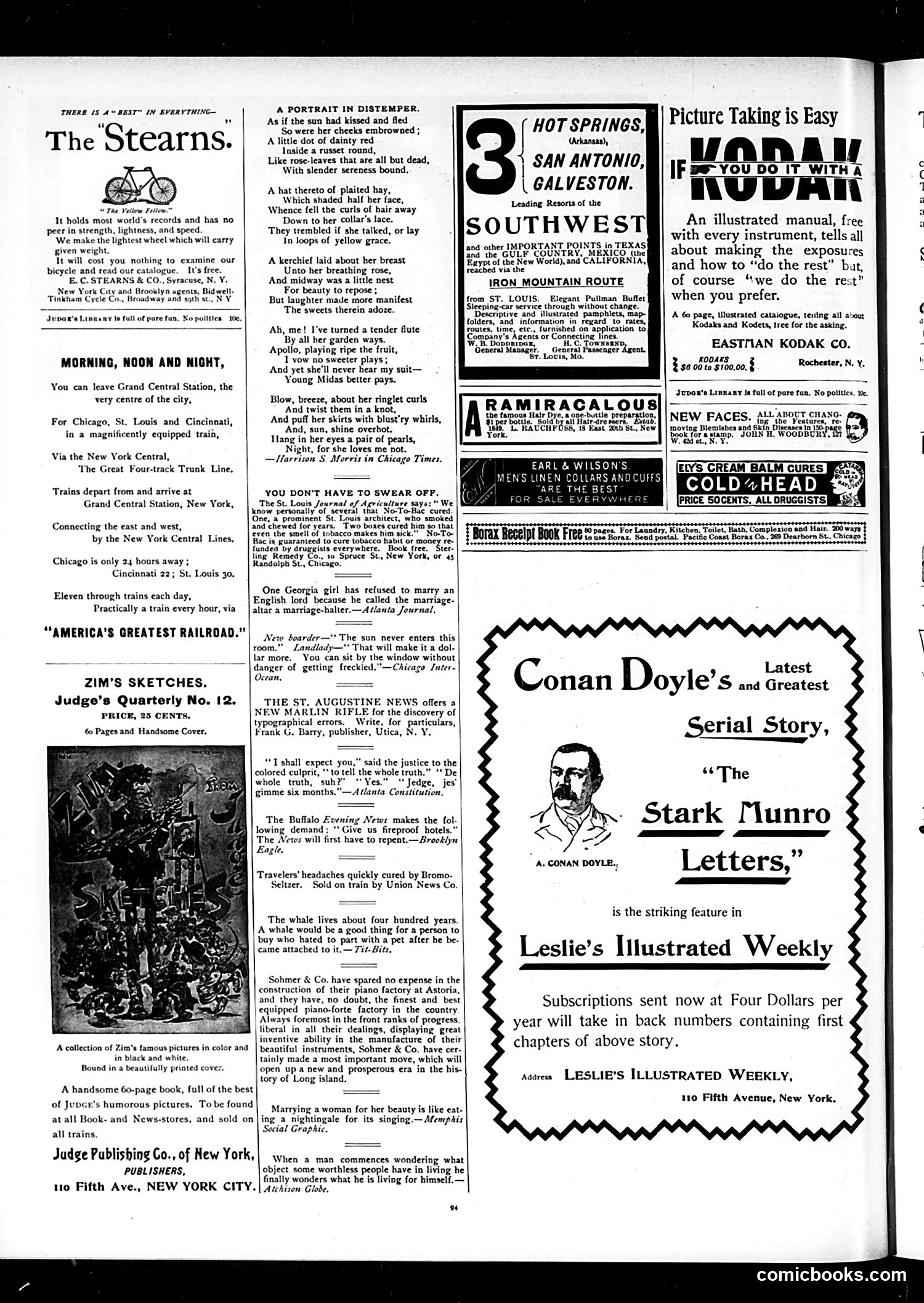
This page from *Judge* magazine is primarily **advertising and literary content** rather than political satire. The main visual element is **Zim's Sketches** — an advertisement for a 60-page collection of humorous pictures, bound as "Judge's Quarterly No. 12." The actual cartoon/sketch shown appears to be a dense, detailed illustration typical of early 1900s magazine humor, though its specific subject is difficult to discern at this resolution. The page also features: - **Product advertisements** (Stearns bicycles, New York Central Railroad, Kodak cameras, Eastman products) - **A romantic poem** titled "A Portrait in Distemper" - **A serial story promotion** for Conan Doyle's "The Stark Munro Letters" in *Leslie's Illustrated Weekly* - **Various small satirical items** with brief quips about contemporary life Rather than targeting specific political figures or events, this appears to be a typical issue mixing humor, advertising, and serialized fiction — the standard format of *Judge* magazine in this era (early 1900s).
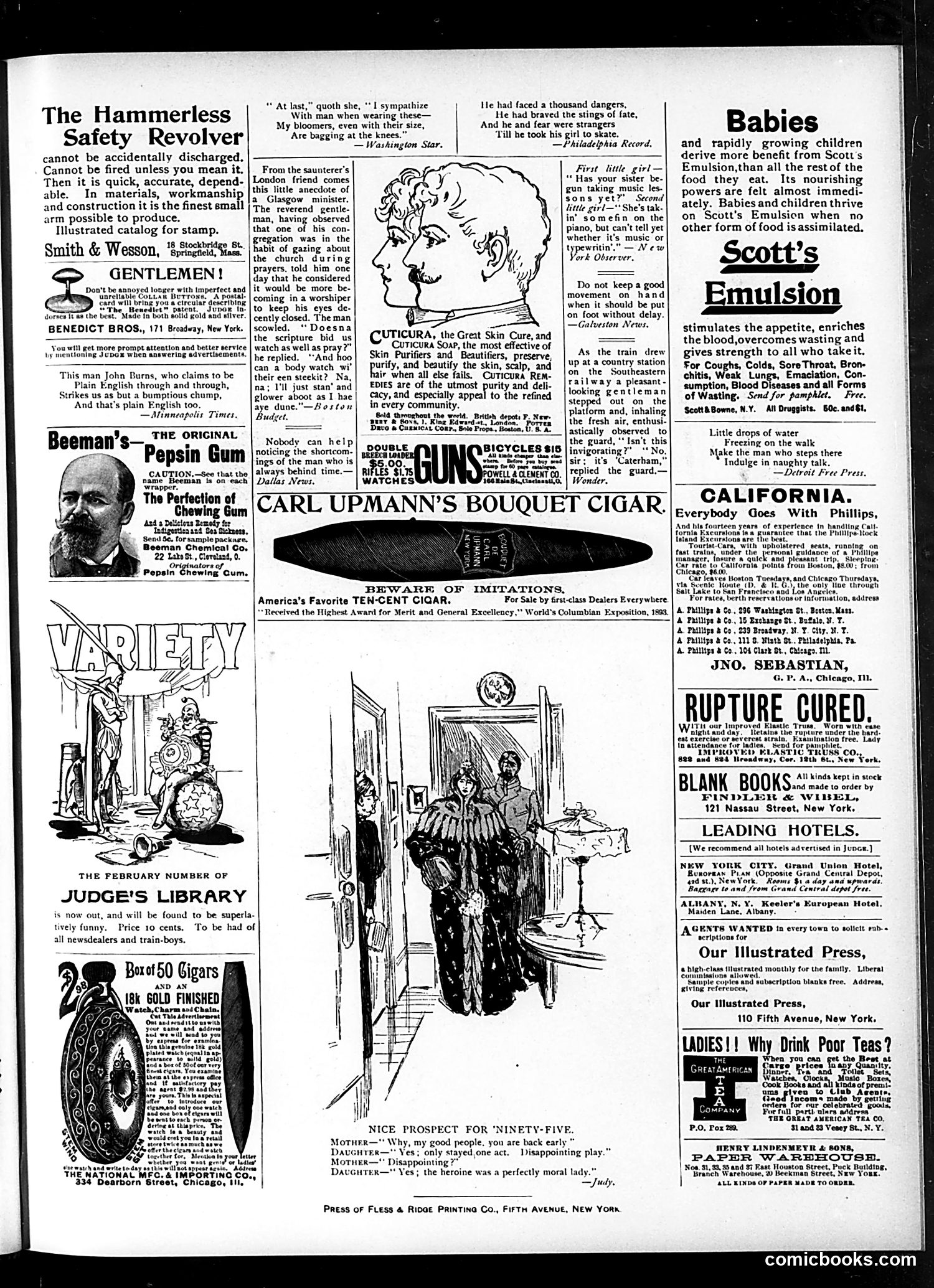
This appears to be primarily an **advertising page** rather than political satire. The majority of the content comprises product advertisements (revolvers, cigars, soap, chewing gum, hotels) interspersed with short humorous anecdotes and jokes, typical of Judge magazine's format. The cartoons and text snippets present are **social humor** rather than political commentary: - A joke about bloomers (women's loose pants) sagging at the knees - An anecdote mocking a Scottish minister's literal interpretation of scripture - A quip about a man being late all the time - A joke about a young girl mistaking piano practice for typewriter noise - A pun about "Catetham" railway station sounding like "inhale-ating" These represent **everyday social observations**—fashion complaints, religious hypocrisy, punctuality, and children's misunderstandings—typical of turn-of-the-century humor. There is **no apparent political satire** on this particular page.
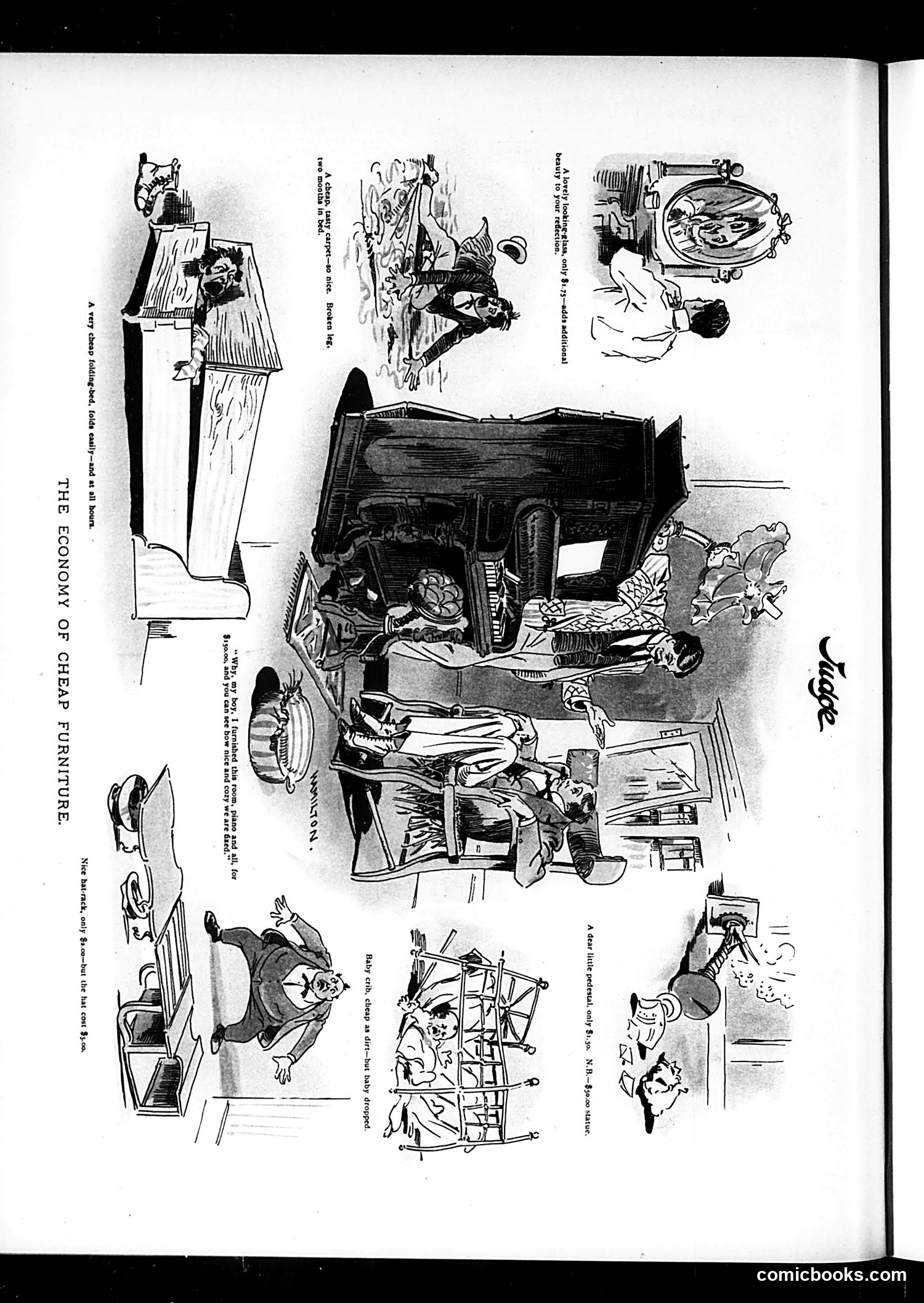
This Judge page satirizes affordable furniture marketing and consumer culture. The central illustration depicts a shabby, collapsing piece of furniture—likely a cabinet or dresser—literally falling apart as a woman examines it, surrounded by scattered components and debris. The surrounding vignettes show various consumers discovering defects: broken wheels, unstable construction, and poor craftsmanship. The satire targets manufacturers and retailers advertising "cheap" furniture while concealing its inferior quality. The price listings in the OCR text (references to "$5," "$6") suggest these were budget options marketed to working and middle-class buyers who couldn't afford quality pieces. Judge's joke: bargain-basement furniture quickly becomes worthless—a timeless consumer complaint about "you get what you pay for," critiquing both false advertising and consumer gullibility.