
Judge, 1895-02-09 · page 4 of 16
Judge — February 9, 1895 — page 4: what you’re looking at
What you’re looking at
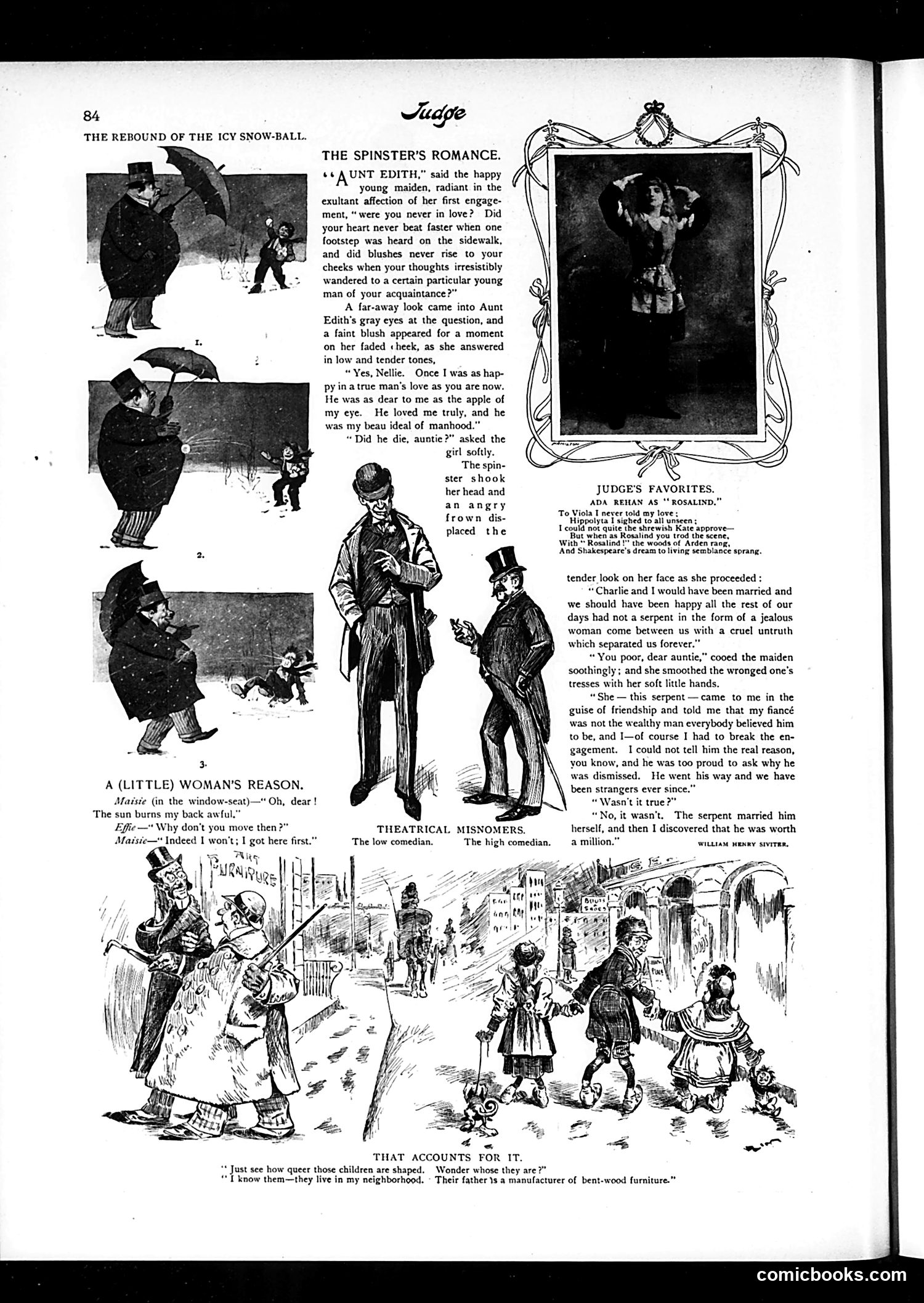
This page contains several satirical pieces typical of Judge magazine's humor: **"The Spinster's Romance"** tells of Aunt Edith, whose fiancé Charlie was separated from her by a jealous woman who falsely claimed he was poor. The twist: that woman married him and he turned out to be wealthy anyway. The satire mocks romantic melodrama and the irony of women's gossip backfiring. **"A (Little) Woman's Reason"** jokes about a child refusing to move from a sunny spot simply because "I got here first"—poking fun at childish stubbornness and possessiveness. **"Theatrical Misnomers"** contrasts "the low comedian" (working-class humor) with "the high comedian" (upper-class wit). **"That Accounts for It"** shows oddly-shaped children, explained by their father manufacturing bent-wood furniture—a pun on heredity and profession. The page's humor relies on Victorian-era social conventions, romantic melodrama, class distinctions, and wordplay typical of late-19th/early-20th century American satire.
📄 Transcribed text from this page (OCR, searchable)
Machine-transcribed from the original scan — historical spelling and the odd misread are preserved.
84 uae THE REBOUND OF THE ICY SNOW-BALL. THE SPINSTER’S ROMANCE. «66 A UNT EDITH,” said the happy young maiden, radiant in the exultant affection of her first engage- ment, “were you never in love? Did your heart never beat faster when one footstep was heard on the sidewalk, and did blushes never rise to your cheeks when your thoughts irresistibly wandered to a certain particular young man of your acquaintance?” A far-away look came into Aunt Edith’s gray eyes at the question, and a faint blush appeared for a moment on her faded cheek, as she answered in low and tender tones, “Yes, Nellie. Once I was as hap- py ina true man’s love as you are now. He was as dear to me as the apple of my eye. He loved me truly, and he was my beau ideal of manhood.” “Did he die, auntie?” asked the girl softly. The spin- ster shook her head and JUDGE'S FAVORITES. an angry revi pee nea as, “*ROSALIND.” nea ‘0 Viola T never told my love; frown dis- Hippolyta I sighed to all unseen; placed the T could not quite the shrewish Kate approve— With ® Rosalind !" the woods of Arden rang, And Shakespeare's dream to living semblance sprang. tender look on her face as she proceeded ; “Charlie and I would have been married and we should have been happy all the rest of our days had not a serpent in the form of a jealous woman come between us with a cruel untruth which separated us foreve “You poor, dear auntie,” cooed the maiden soothingly ; and she smoothed the wronged one’s tresses with her soft little hands. “She — this serpent —came to me in the guise of friendship and told me that my fiancé was not the wealthy man everybody believed him to be, and I—of course I had to break the en- gagement. I could not tell him the real reason, you know, and he was too proud to ask why he was dismissed. He went his way and we have been strangers ever since.” “Wasn't it true?” “No, it wasn’t. The serpent married him THEATRICAL MISNOMERS. herself, and then I discovered that he was worth ‘The low comedian. ‘The high comedian. a million.” A (LITTLE) WOMAN’S REASON. Maisie (in the window-seat)— Oh, dear ! The sun burns my back awf Effie —* Why don't you move then ?” Maisie—* Indeed 1 won't; I got here first.” WILLIAM HENRY SIVITRR, Ties 3 j URN Pugs \ f See ann tay MY aa THAT ACCOUNTS FOR IT. “* Just see how queer those children are shaped. Wonder whose they are?” “T know them—they live in my neighborhood. Their father 1s a manufacturer of bent-wood furniture.” comicbooks.com