
A complete issue · 20 pages · 1894
Judge — December 1, 1894
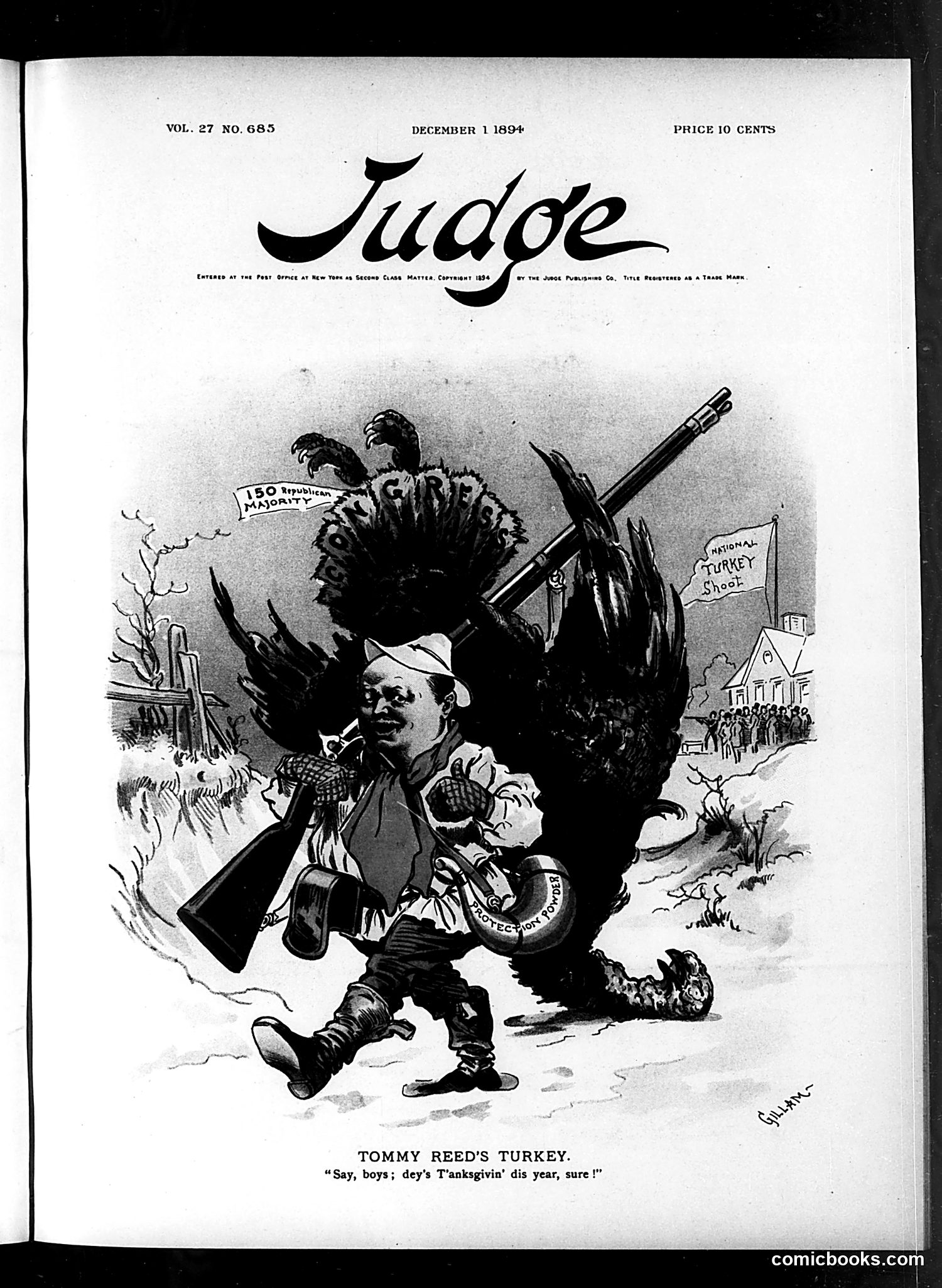
This political cartoon from Judge magazine (December 1, 1894) depicts a caricatured figure labeled "Tommy Reed" presenting a grotesque turkey as a Thanksgiving offering. The turkey appears diseased or monstrous, emerging from what's labeled a "150 Republican Majority" banner. The satire targets Thomas B. Reed, the Republican Speaker of the House, whose party held a significant majority. The "turkey" likely represents the Republican legislative agenda or legislative accomplishments that Reed is proudly presenting for the holiday season—though the cartoon suggests these accomplishments are worthless or repugnant rather than something to celebrate. The caption's dialect humor ("Tankasgivin'") reinforces the satirical tone, mocking Reed's presentation of failed or unpopular Republican initiatives.
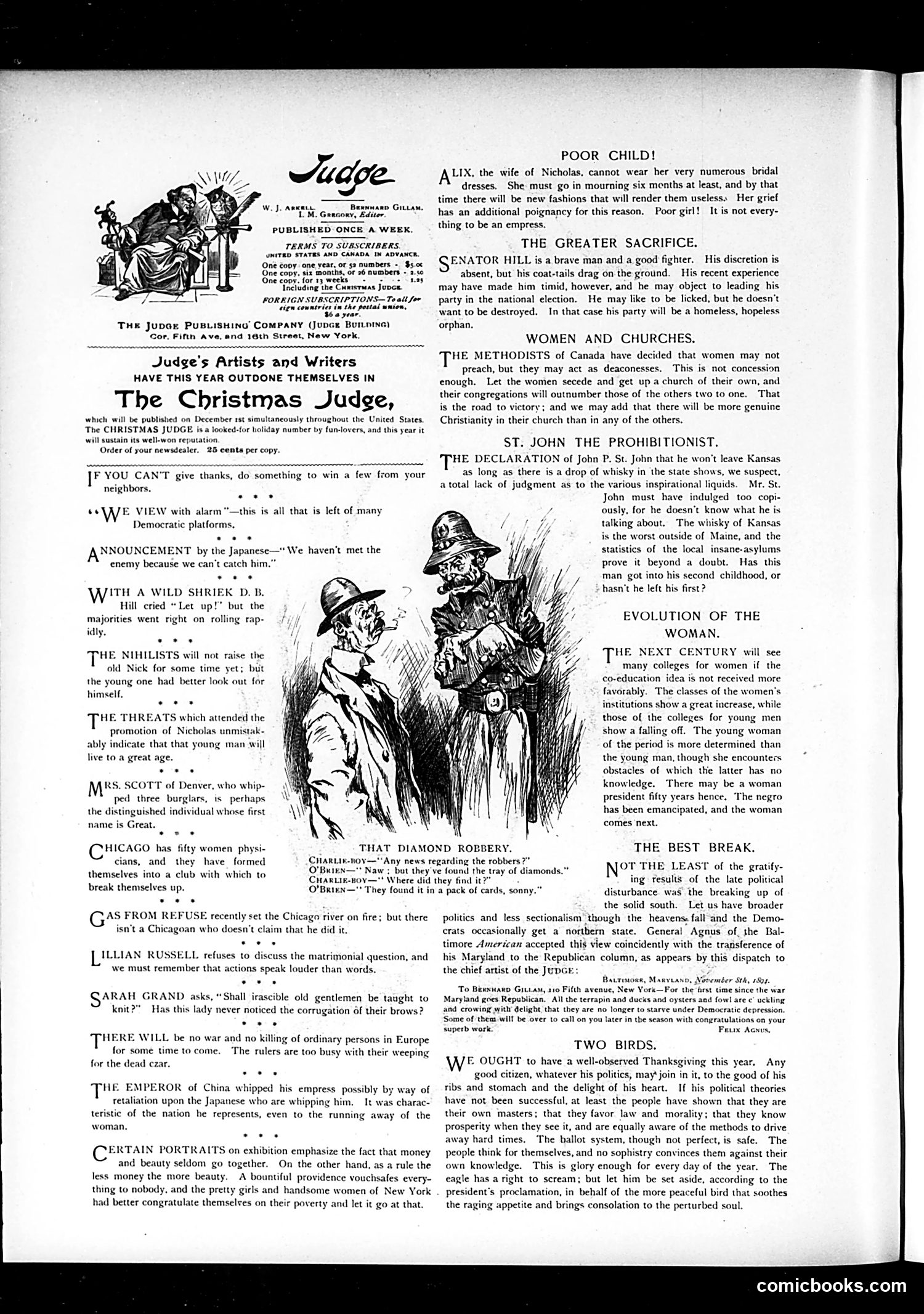
The cartoon depicts two policemen discussing a recent robbery. One officer says "Any news regarding the robbers?" while the other responds "Naw, but they've found the tray of diamonds" and "Where did they find it?" with the reply "In a pawnshop, sonny." The satire mocks Chicago police incompetence—they've recovered stolen diamonds but apparently failed to catch the actual thieves. The joke relies on the absurdity that criminals quickly pawned their haul, yet police couldn't trace them through this obvious transaction. This reflects contemporary concerns about organized crime in Chicago during the early 20th century and public skepticism about law enforcement's effectiveness. The "sonny" condescension suggests the younger officer's naive faith in police work contrasts sharply with the cynical reality of bungled investigations.
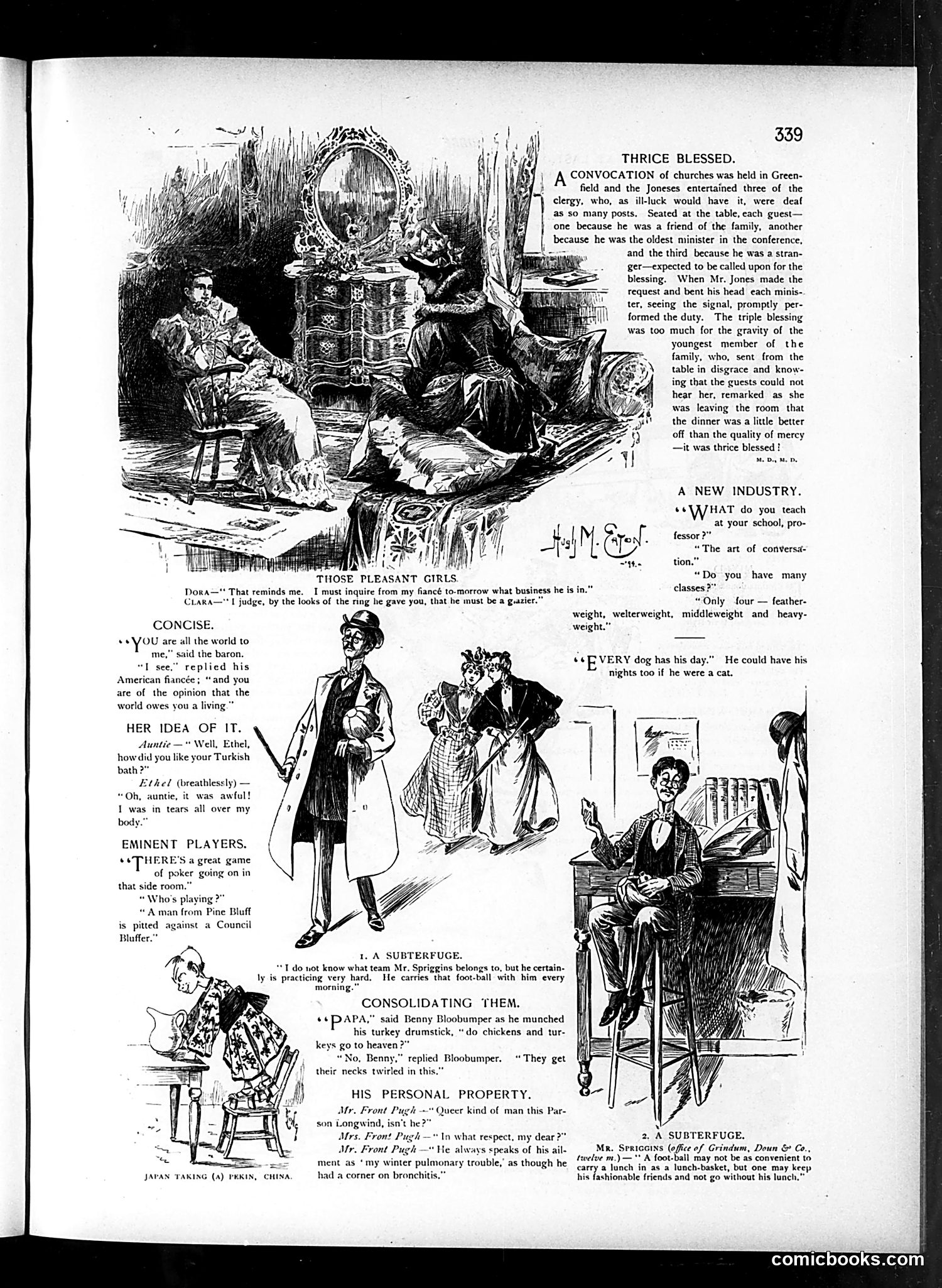
This page contains multiple unrelated satirical sketches typical of Judge magazine's format: **"Thrice Blessed"** (top): A social commentary on clergy attendance at dinner parties. The joke mocks the practice of inviting multiple ministers to appear pious, with the youngest guest embarrassed by the excessive "blessing" of the meal. **"A New Industry"** and other sketches below explore everyday absurdities: a professor explaining boxing weight classes, observations about dogs' daily lives, and various social pretensions. **"Her Idea of It"** and "Eminent Players"** mock romantic misunderstandings and theatrical pretension respectively. The sketches share Judge's characteristic style: satirizing middle-class social conventions, professional vanity, and generational attitudes through brief, punchy dialogue and exaggerated character drawings. Without specific historical context for individual references, the humor relies on recognizable social types rather than particular political figures or events.
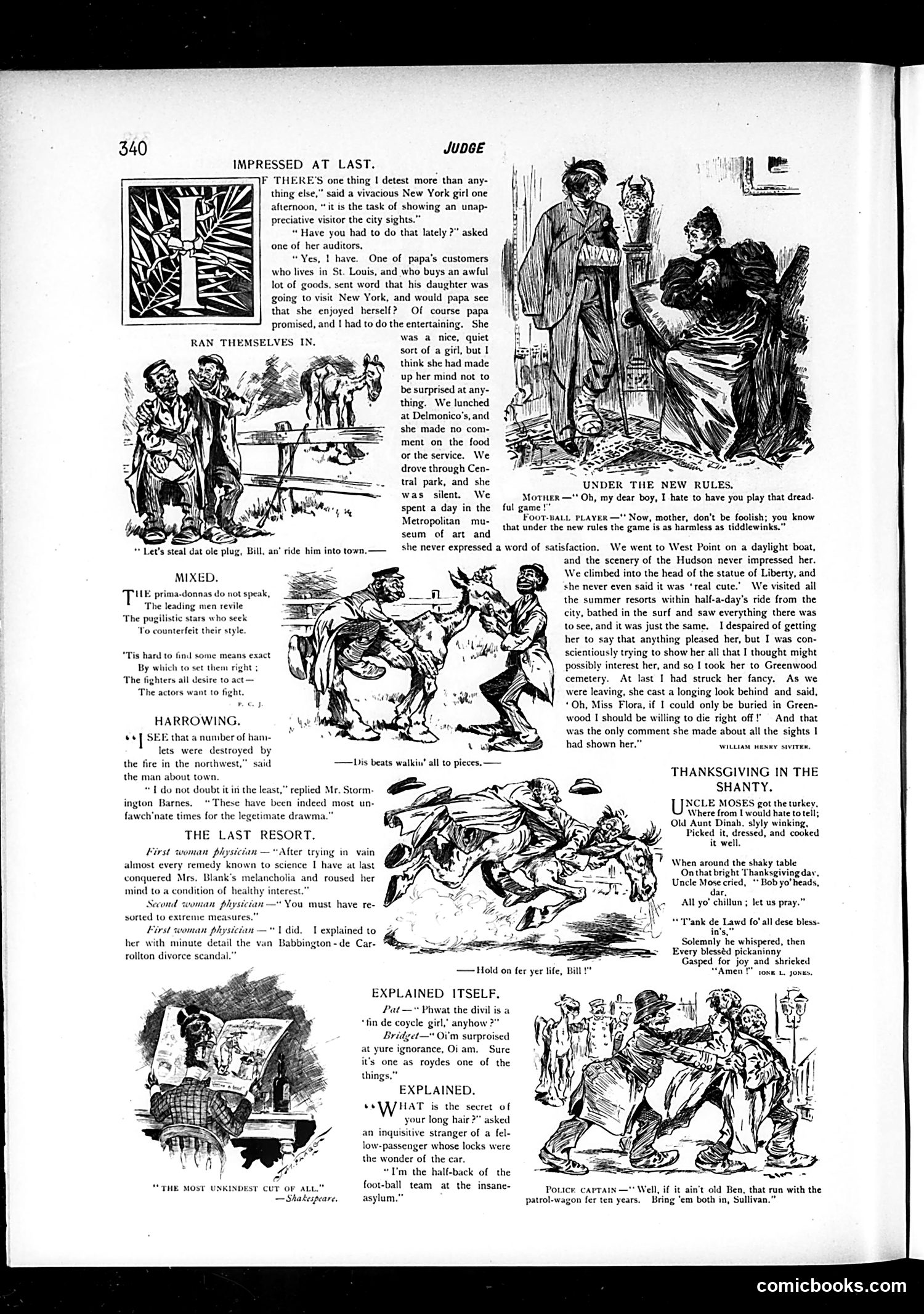
This page contains several satirical sketches typical of late 19th/early 20th-century American humor: **"Impressed at Last"** mocks the difficulty of impressing blasé New Yorkers. A girl from St. Louis remains unmoved by all major NYC attractions—fine dining, Central Park, the Metropolitan Museum, the Statue of Liberty—until visiting Greenwood Cemetery, where she expresses enthusiasm about being buried there. The joke satirizes both provincial visitors and jaded urbanites. **Other sketches** include wordplay about actors wanting to fight and fighters wanting to act ("Mixed"), a physician curing melancholia through gossip about scandals, Irish dialect humor, and football safety ("Under the New Rules"—mocking protective regulations as making the sport harmless as children's games). **"Thanksgiving in the Shanty"** appears to reference African American vernacular humor, with "Uncle Moses" and "Aunt Dinah" characters. The page represents Judge's characteristic blend of social satire, ethnic humor (now considered offensive), and commentary on contemporary urban life and leisure activities.
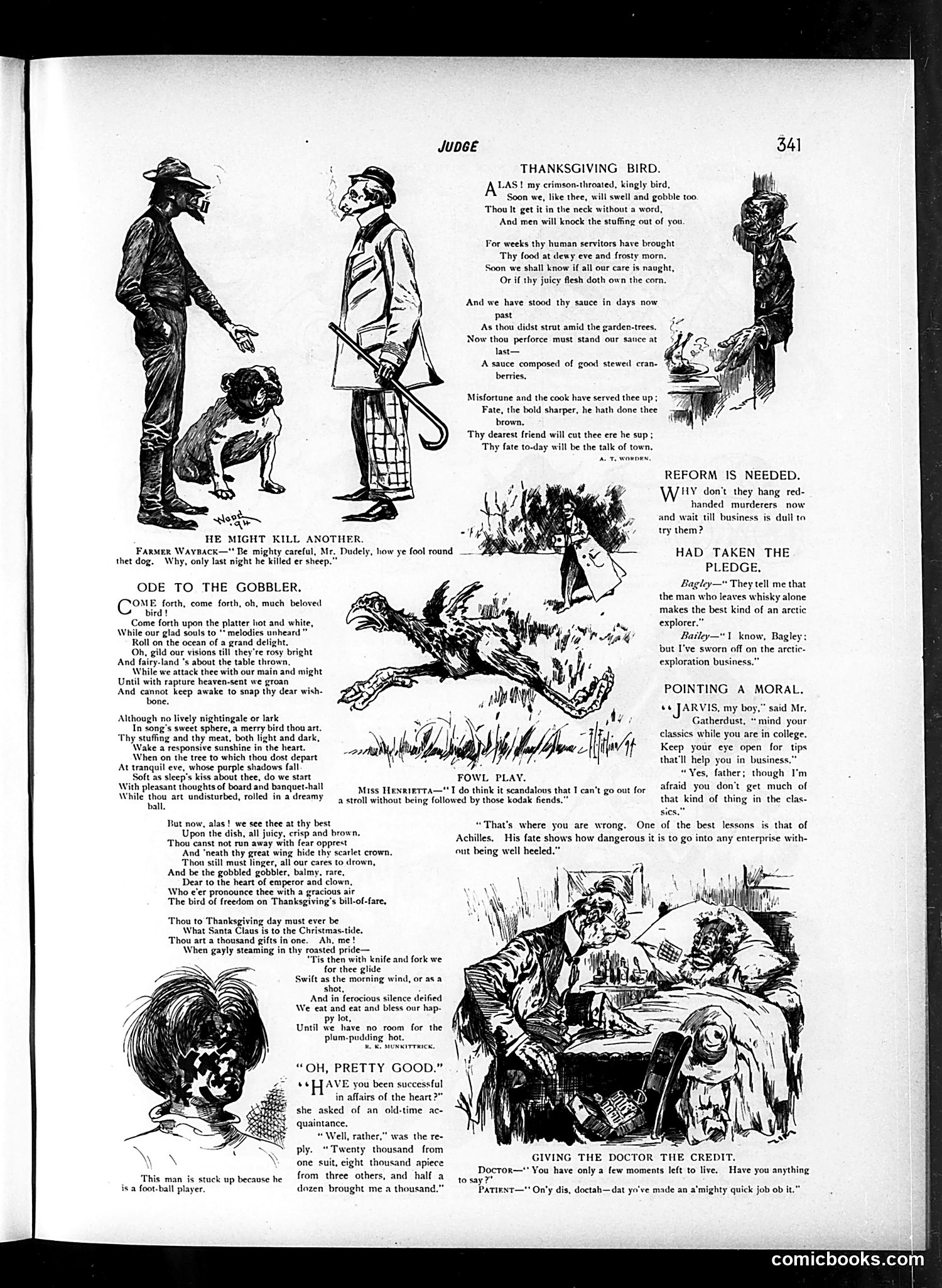
This is a humorous *Thanksgiving-themed* page from Judge magazine (appears early 20th century). The main content mocks the fate of the holiday turkey through satirical poetry and cartoons. **The Satire:** Multiple poems ("Thanksgiving Bird," "Ode to the Gobbler") ironically praise the turkey as a majestic creature while describing its inevitable slaughter and consumption. The jokes work by contrasting the bird's dignity with its comical doom—addressing it as a "crimson-throated, kingly bird" moments before discussing how it will be "stuffed" and served. **The Side Cartoons** address separate social issues: one criticizes delayed justice for murderers; another mocks a man bragging about romantic conquests (the "affairs of the heart" punchline reveals he means lawsuits, not romance). **Overall Point:** Standard Judge fare—gentle satire mixing holiday observance with social commentary and wordplay, relying on Victorian-style sentimental irony that modern readers might find heavy-handed.
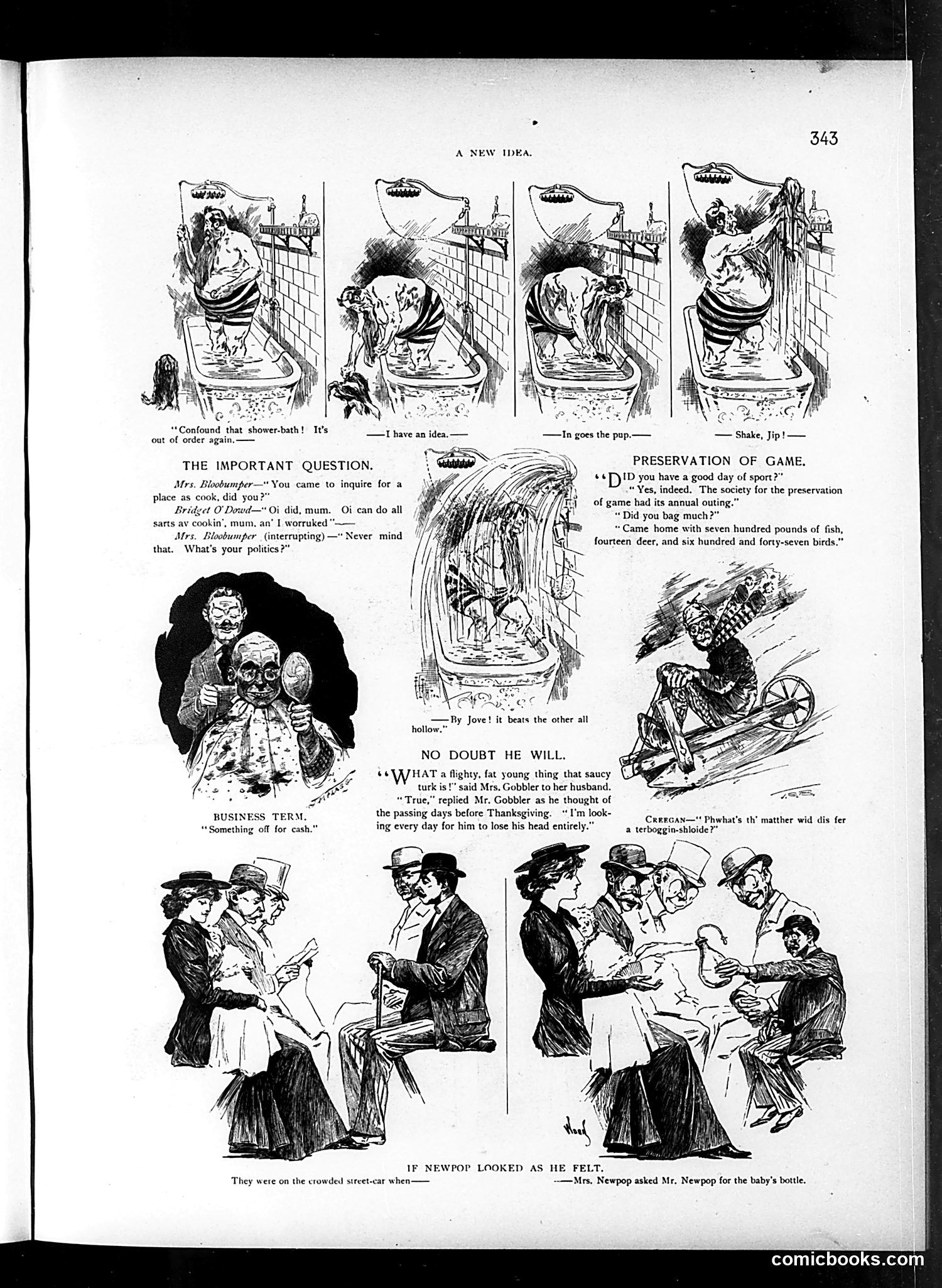
This page contains multiple unrelated satirical sketches typical of Judge magazine's format: **"A New Idea"** shows a man frustrated with a broken shower-bath, ordering his dog to shake itself dry—a simple domestic humor joke. **"The Important Question"** satirizes Irish domestic servants (Bridget O'Dowd) through ethnic stereotype humor common to the era, depicting her as incompetent at cooking despite claiming broad skills. **"Preservation of Game"** mocks excessive hunting/fishing boasting, with a character claiming absurdly large catches (700 pounds of fish, hundreds of birds). **"Business Term"** and **"No Doubt He Will"** are brief domestic comedy sketches about marriage and holiday preparations. **"If Newpop Looked As He Felt"** jokes about a husband's discomfort asking his wife for the baby's bottle on public transportation—playing on embarrassment about masculine roles. The page reflects late-19th/early-20th-century humor: ethnic caricature, domestic comedy, hunting culture, and gender-role anxieties. The satirical targets are primarily personal/social rather than political.
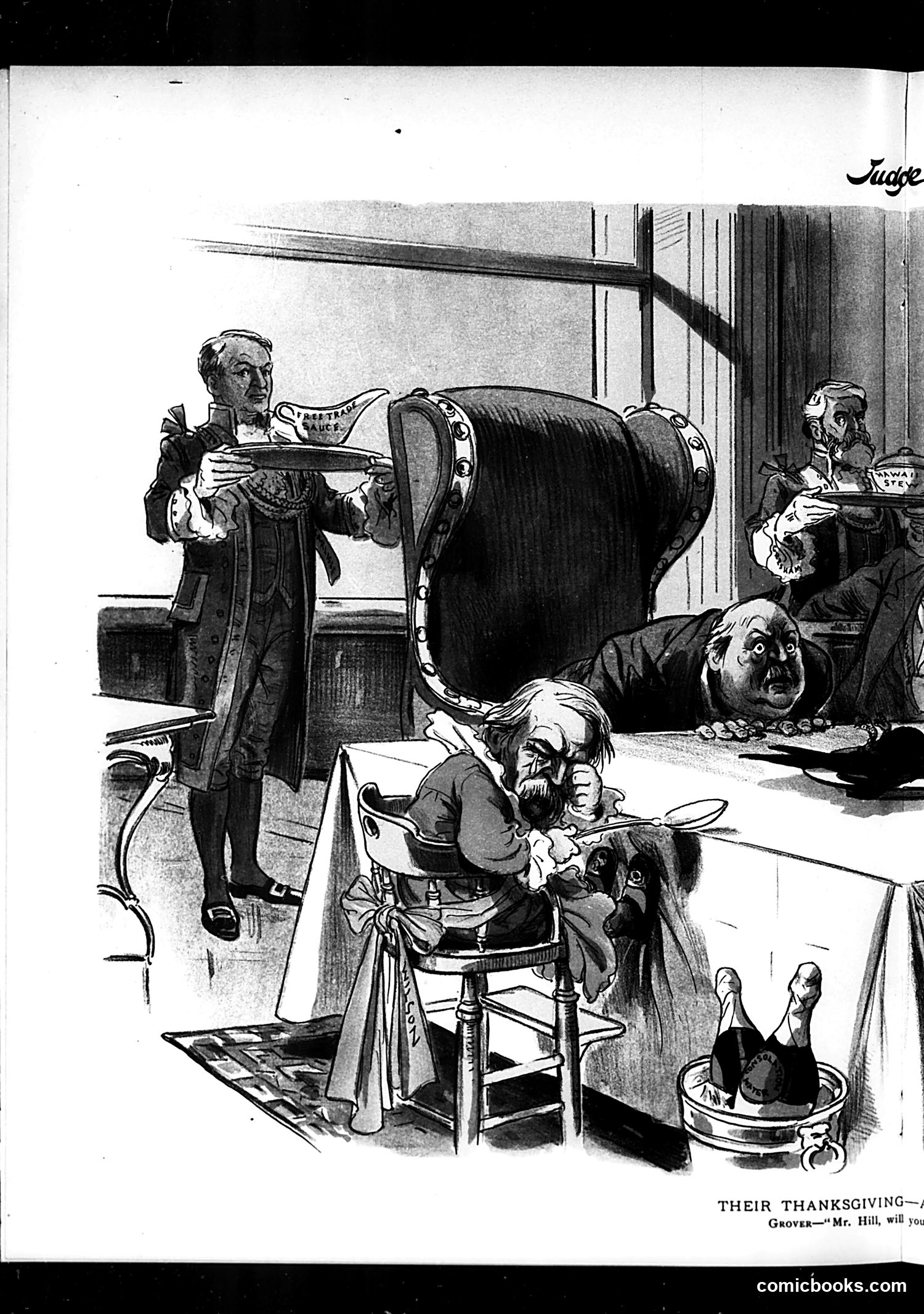
This **Judge** magazine cartoon satirizes a Thanksgiving dinner scene with political figures. The title "Their Thanksgiving" appears to reference President **Grover Cleveland** (identifiable by the address to "Mr. Hill"), likely **David B. Hill**, a contemporary political figure. The central image shows a large barrel or container—possibly representing a political issue or scandal—being served as the main course to assembled diners. The exaggerated expressions and caricatured faces suggest mockery of political figures' hypocrisy or moral compromise. The cartoon's satire hinges on the notion that these politicians are metaphorically "consuming" or benefiting from something distasteful, yet presenting it as a celebratory feast. Without the publication date, the specific political controversy remains unclear, but the dinner setting ironically juxtaposes Thanksgiving's association with gratitude and abundance against political corruption or malfeasance.
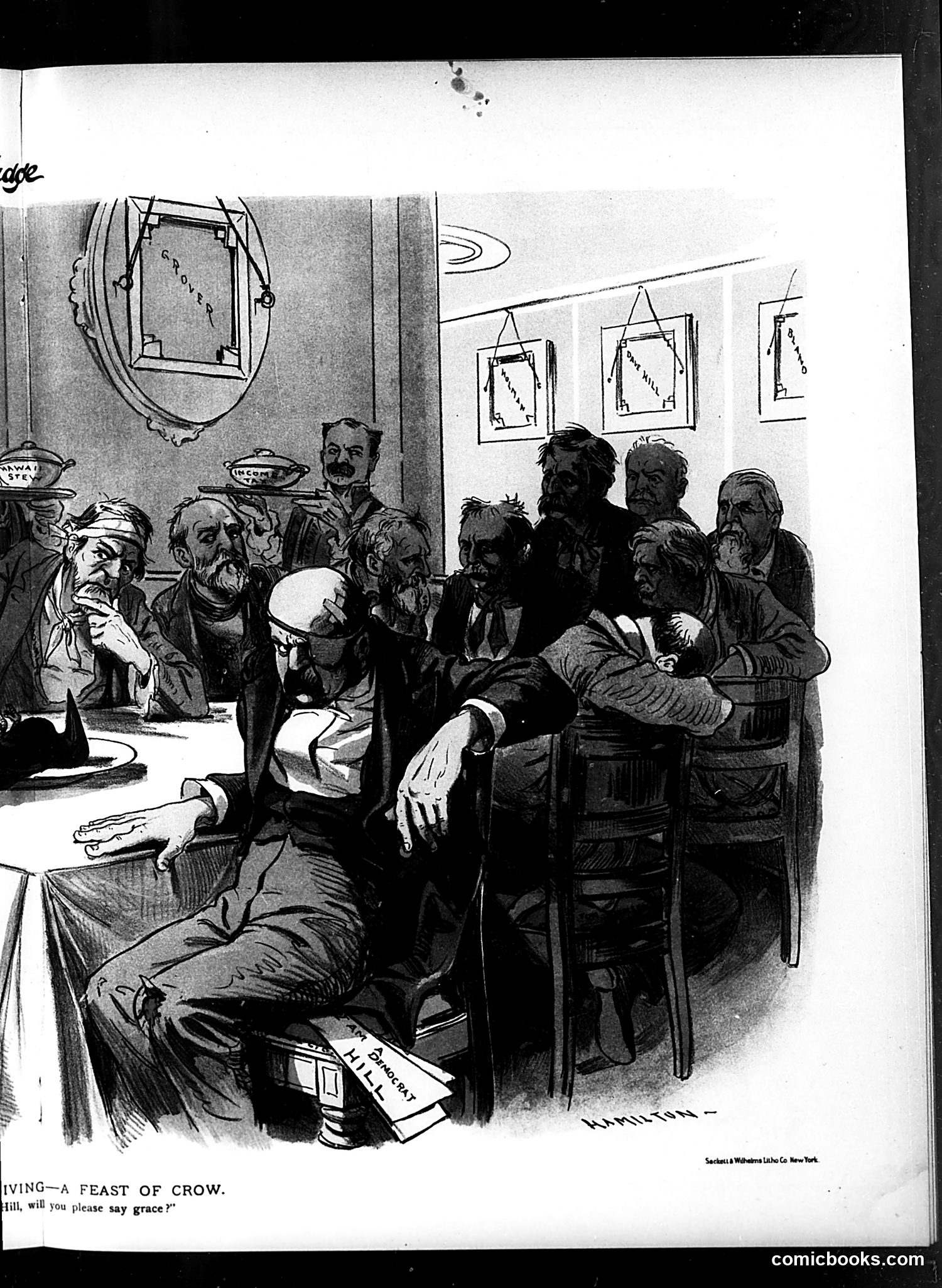
This political cartoon depicts a dinner scene titled "A Feast of Crow" — a satirical reference to the phrase "eating crow," meaning to accept humiliation or admit defeat. The image shows a group of men gathered around a table with what appears to be a document labeled "TRUST" visible. The cartoon satirizes political or business figures forced to accept an unwelcome outcome or policy reversal, depicted metaphorically as an unpalatable meal they must consume together. The specific identities of the figures remain unclear without additional context, but the composition suggests prominent political or industrial leaders of the Judge magazine era being compelled to accept a collective loss or compromise. The "grace" caption adds bitter irony—suggesting these figures must formally acknowledge what they're forced to accept. The exact historical reference is uncertain without dating information.
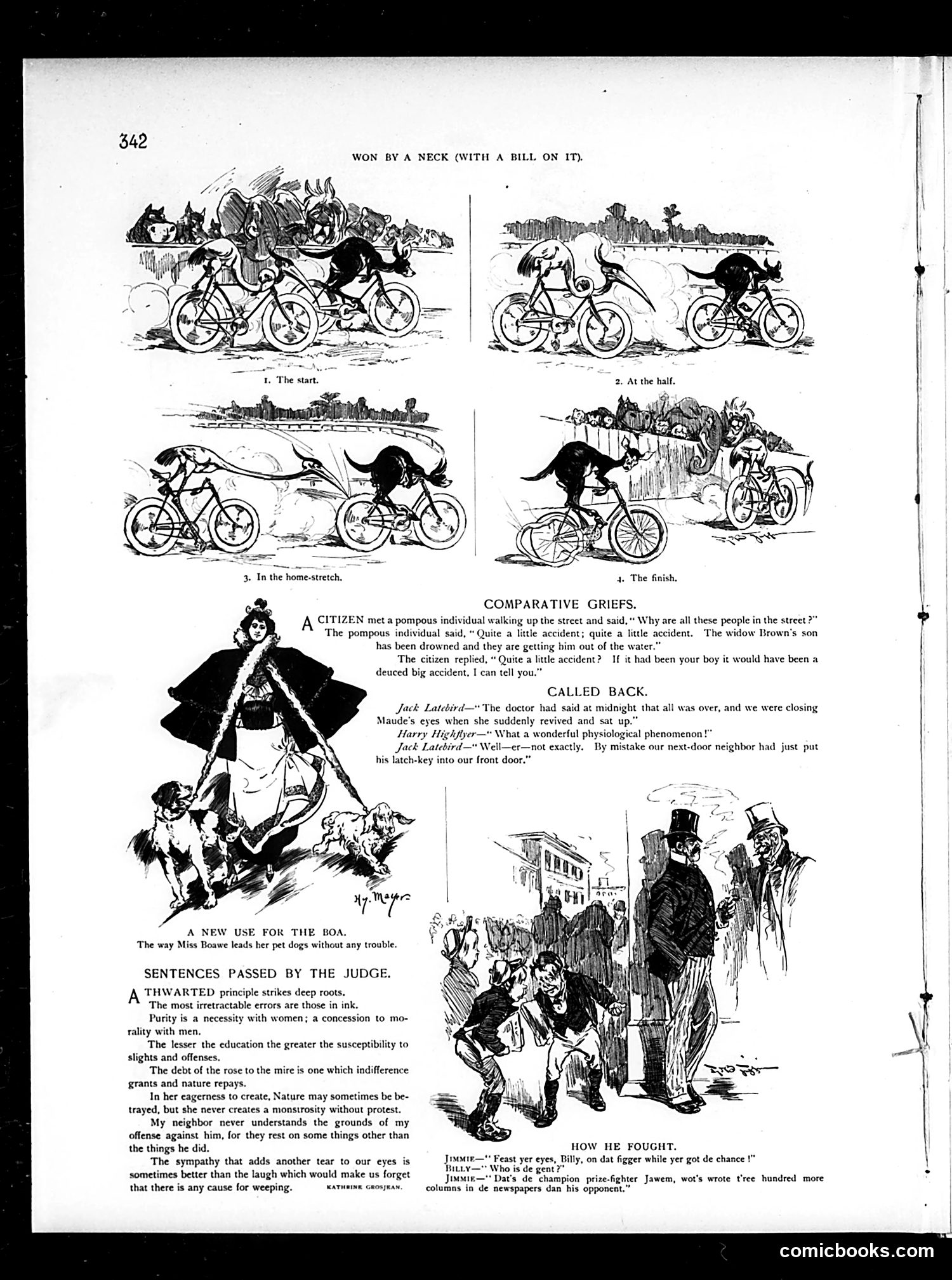
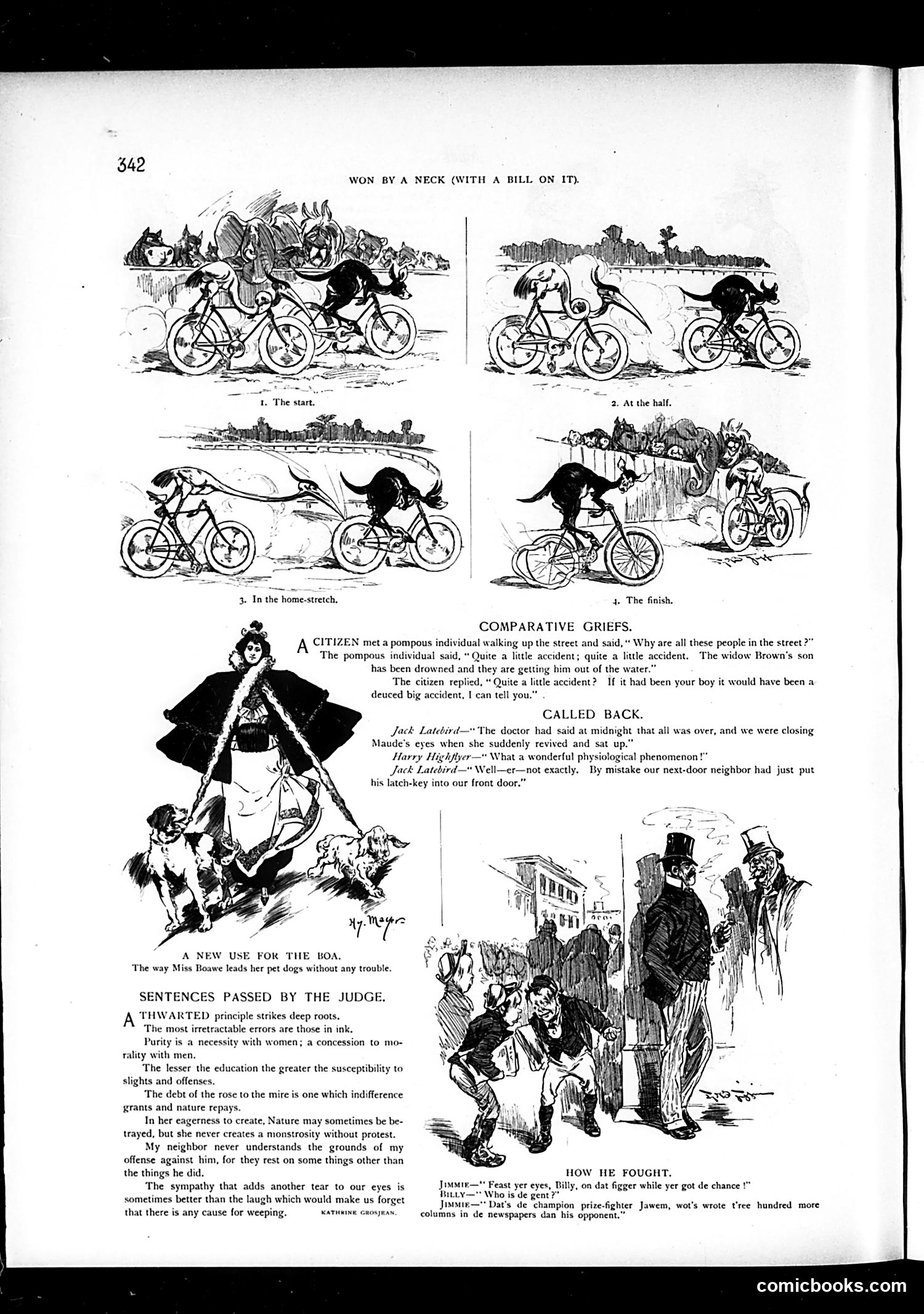
**"Won by a Neck (With a Bill on It)"** depicts a bicycle race where one competitor appears to be winning by extending their neck—a visual pun on "winning by a neck" while literally using a bill (beak/neck) as an advantage. The satire mocks absurd competitive tactics or possibly unfair advantages in races. **"Comparative Griefs"** contrasts a pompous man's dismissive attitude toward a widow's drowned son as merely "quite a little accident" with the citizen's pointed observation that he'd call it catastrophic if it were *his* child. This mocks hypocrisy and class insensitivity—the wealthy man's callousness toward others' suffering. **"Called Back"** is a humorous domestic mix-up: a woman apparently dying suddenly revives, but only because a neighbor mistakenly used his latch-key at their door, not due to medical miracle. The remaining items—aphorisms from "The Judge," a fashion note about using a boa constrictor as a leash, and a prizefighter joke—are lighter filler content typical of Judge's satirical miscellany.
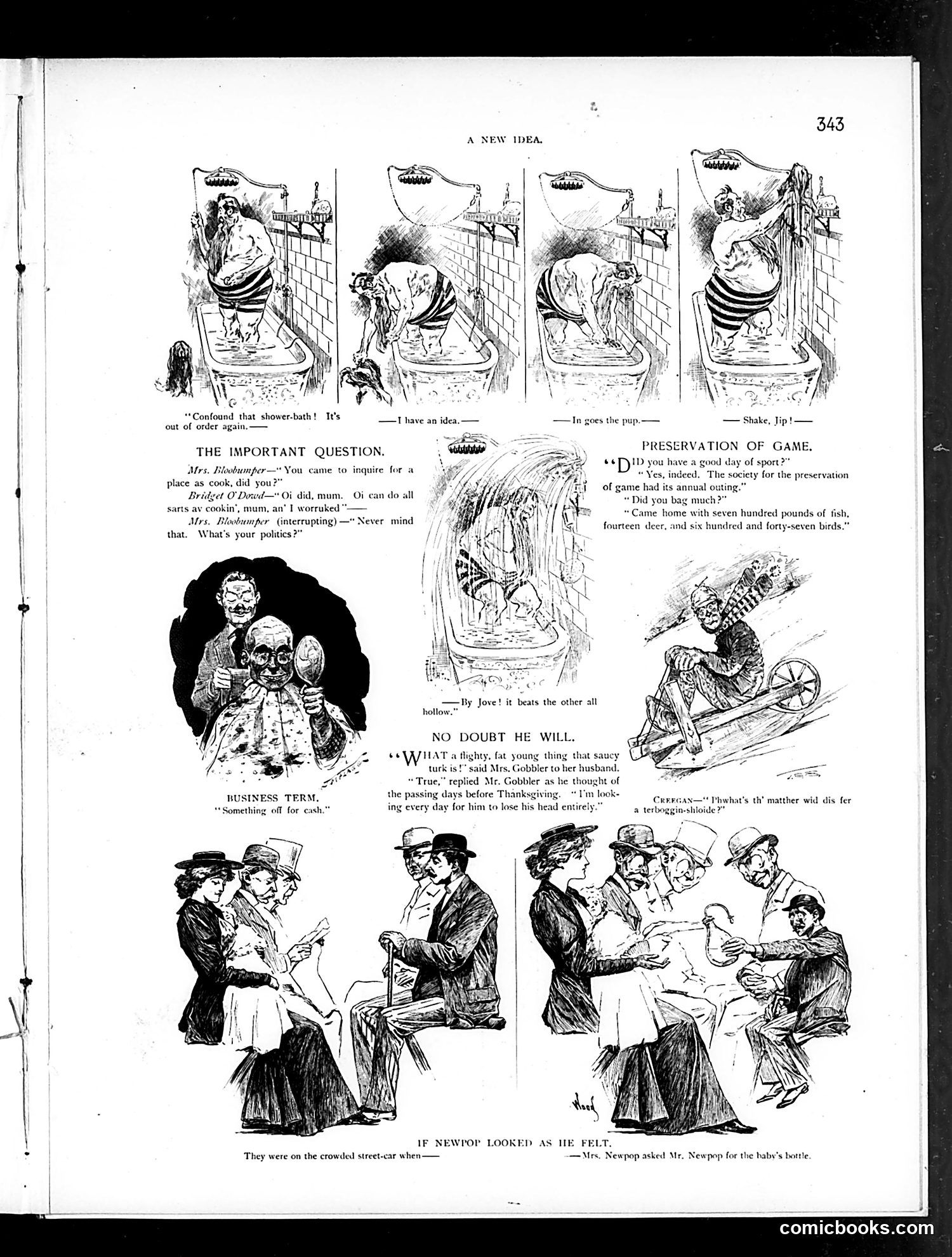
This page contains several satirical vignettes: **"A New Idea"** (top): A comedic sequence where a man uses his dog in a bathtub as a makeshift shower-bath replacement—visual humor about domestic inconvenience. **"The Important Question"**: An Irish maid (Bridget O'Dowd) is interviewed for a cook position. The employer asks standard questions about cooking skills, but crucially interrupts to ask "What's your politics?"—satirizing how 19th-century employers (particularly wealthy urbanites) screened servants for political reliability, viewing domestic help with suspicion regarding their social views. **"Preservation of Game"**: Mocks a hunting society's absurdly inflated kill counts (700 pounds of fish, 14 deer, 647 birds)—satire on either exaggeration or overhunting practices. **"No Doubt He Will"**: A husband awaits Thanksgiving, hoping his turkey will "lose his head entirely"—obvious holiday dinner joke. **"If Newpop Looked as He Felt"**: A husband reluctantly fetches a baby bottle on a crowded streetcar, depicting domestic obligation versus male discomfort. The page targets class pretensions, servant anxiety, and domestic gender roles.
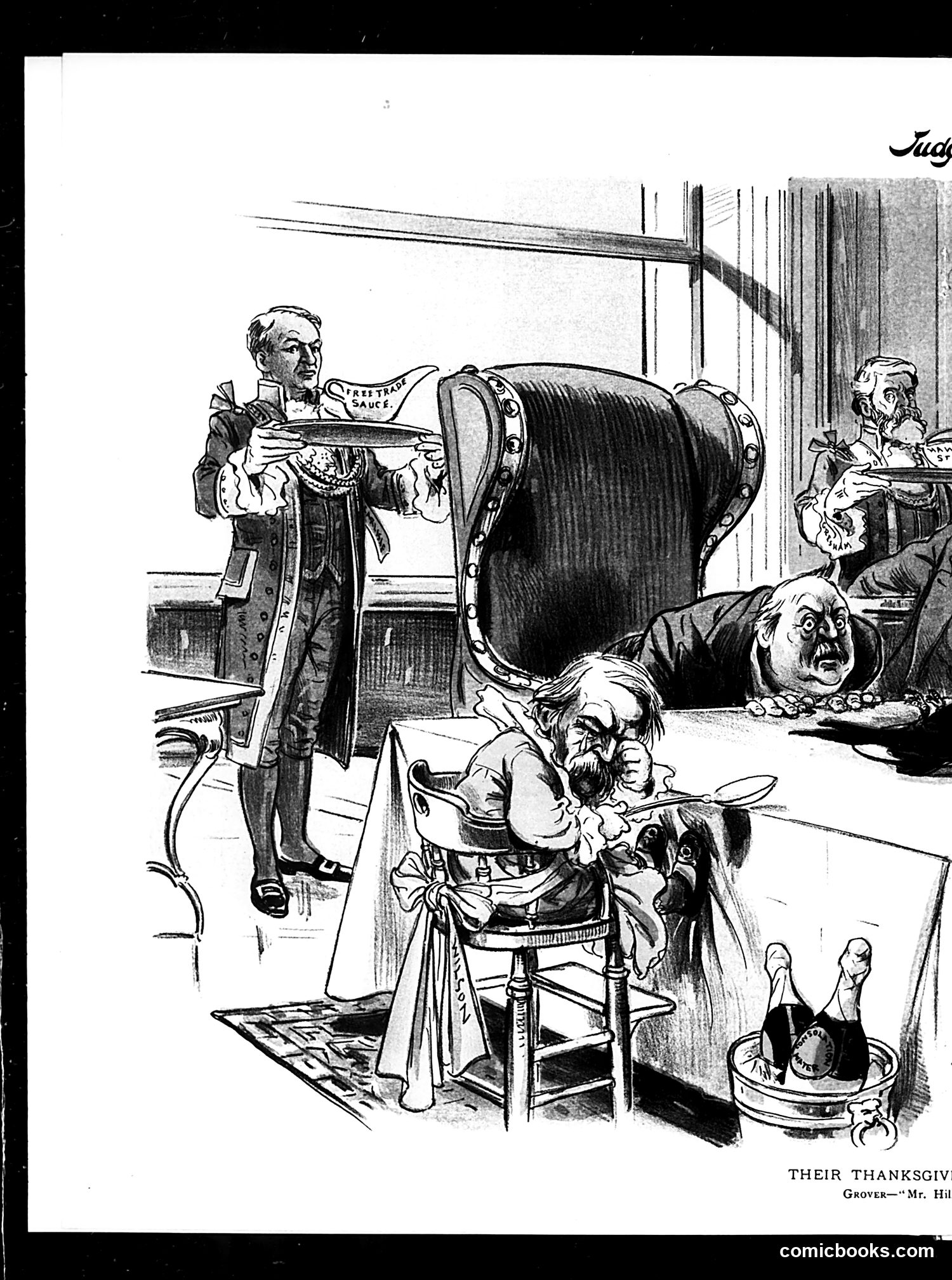
This appears to be a political cartoon from *Judge* magazine's "Their Thanksgiving" series. The visible text references "Grover" and "Mr. Hil[l]," likely alluding to President Grover Cleveland and a contemporary political figure. The cartoon depicts a formal dinner scene where a well-dressed man (presumably representing Cleveland or another political figure) operates a large cannon or similar device aimed at dining figures. The scene suggests satirical commentary on political conflict or "attack" during the Thanksgiving season—ironically juxtaposing the holiday of gratitude with political warfare. The caricatured faces and formal attire of the other diners suggest these represent specific political rivals or opponents. Without the complete caption or date, the exact historical context remains unclear, but the satire targets political antagonism masquerading under holiday civility.
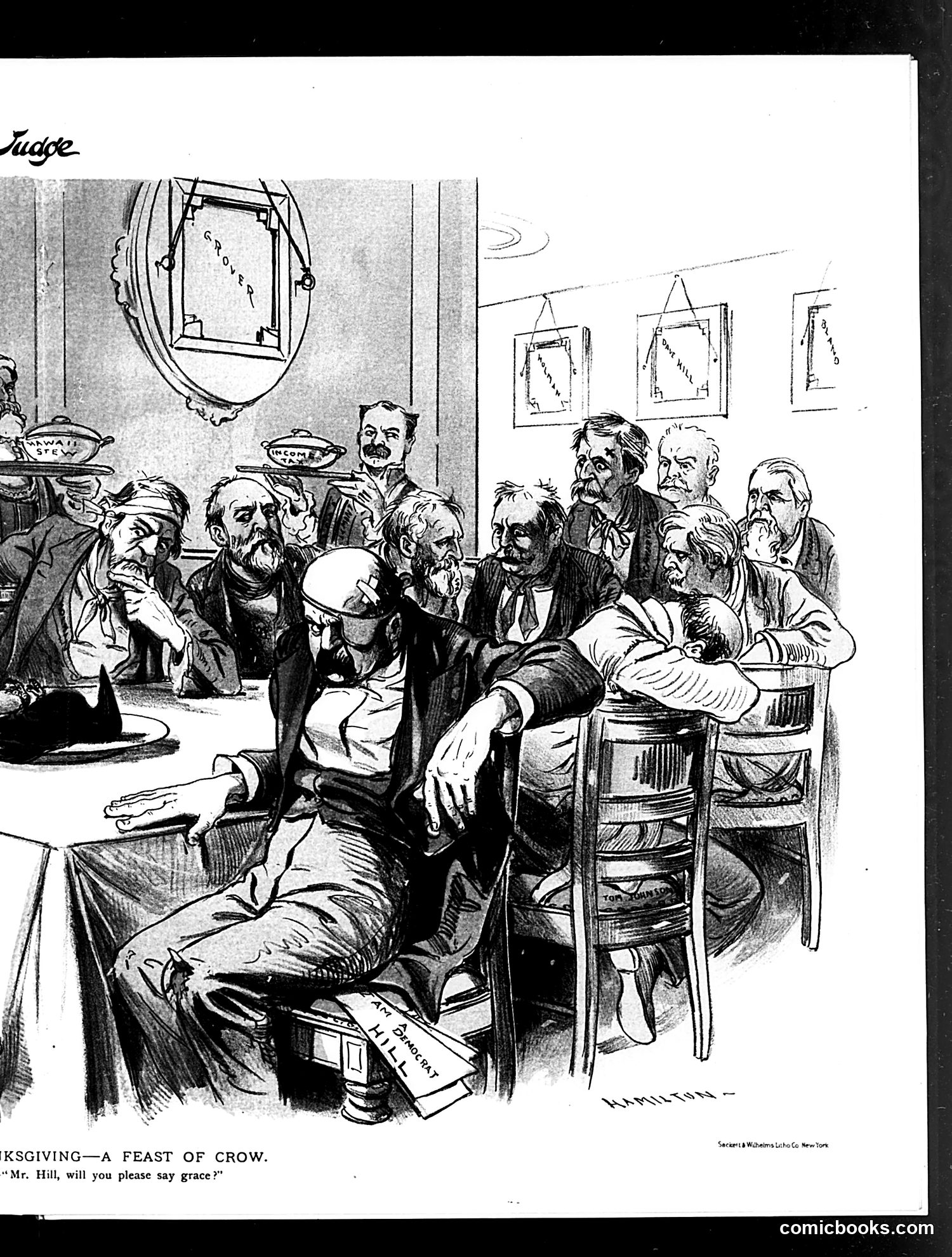
This political cartoon depicts a group of men seated around a table being asked by "Mr. Hill" to say grace before eating. The title "A Feast of Crow" is a idiom meaning to suffer humiliation or accept defeat. The cartoon appears to satirize a political situation where a faction or group is forced into an unwanted compromise or loss. The men's expressions suggest reluctance and displeasure at the meal before them. Without clearer identification of who "Mr. Hill" is or the specific political context, the exact historical reference remains unclear, though it likely concerns a notable 1890s-early 1900s political controversy or legislative defeat that forced certain politicians to accept an unfavorable outcome, presented here through the metaphor of an unpalatable Thanksgiving dinner.
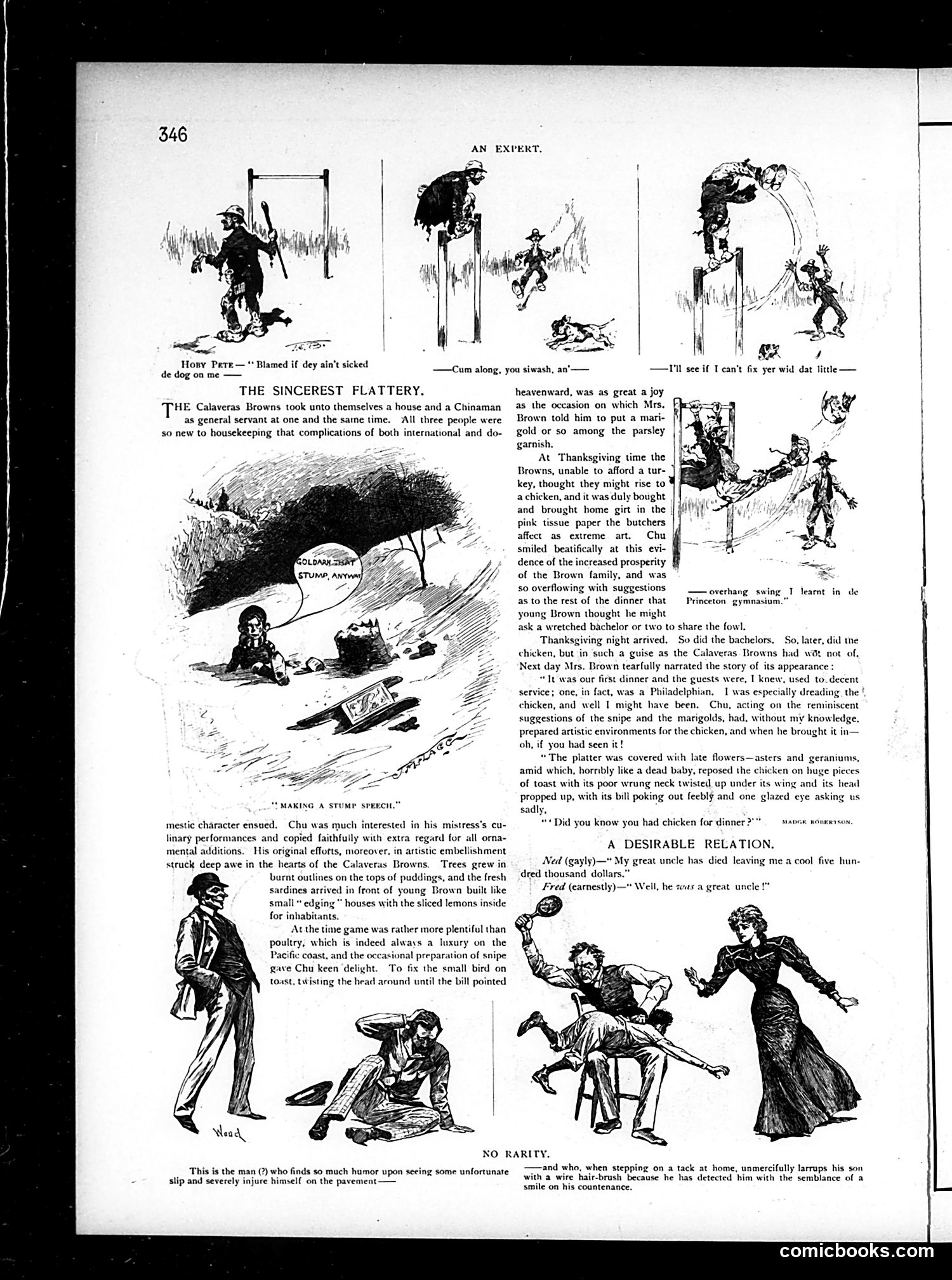
This page contains multiple unrelated comic vignettes satirizing American social behaviors and class anxieties of the period. **"The Sincerest Flattery"** depicts the Calavaras Browns, a nouveau-riche family, employing a Chinese servant named Chu. The humor derives from Chu's literal mimicry of his mistress's culinary "artistic" pretensions—he decorates a chicken with flowers and arranges it like a dead infant on toast, faithfully copying her earlier instruction to garnish with marigolds. The satire targets both the Browns' pretentious aspirations and the period's xenophobic stereotyping of Chinese immigrants as comically literal-minded. **"A Desirable Relation"** mocks hypocrisy: a man celebrates inheriting wealth from an uncle while the other man, earnestly praising the uncle, clearly only values him dead. **"No Rarity"** criticizes adult double standards—finding humor in others' accidents while brutally punishing their own children for smiling at similar mishaps. These sketches collectively lampoon American bourgeois pretension, greed, and moral inconsistency.
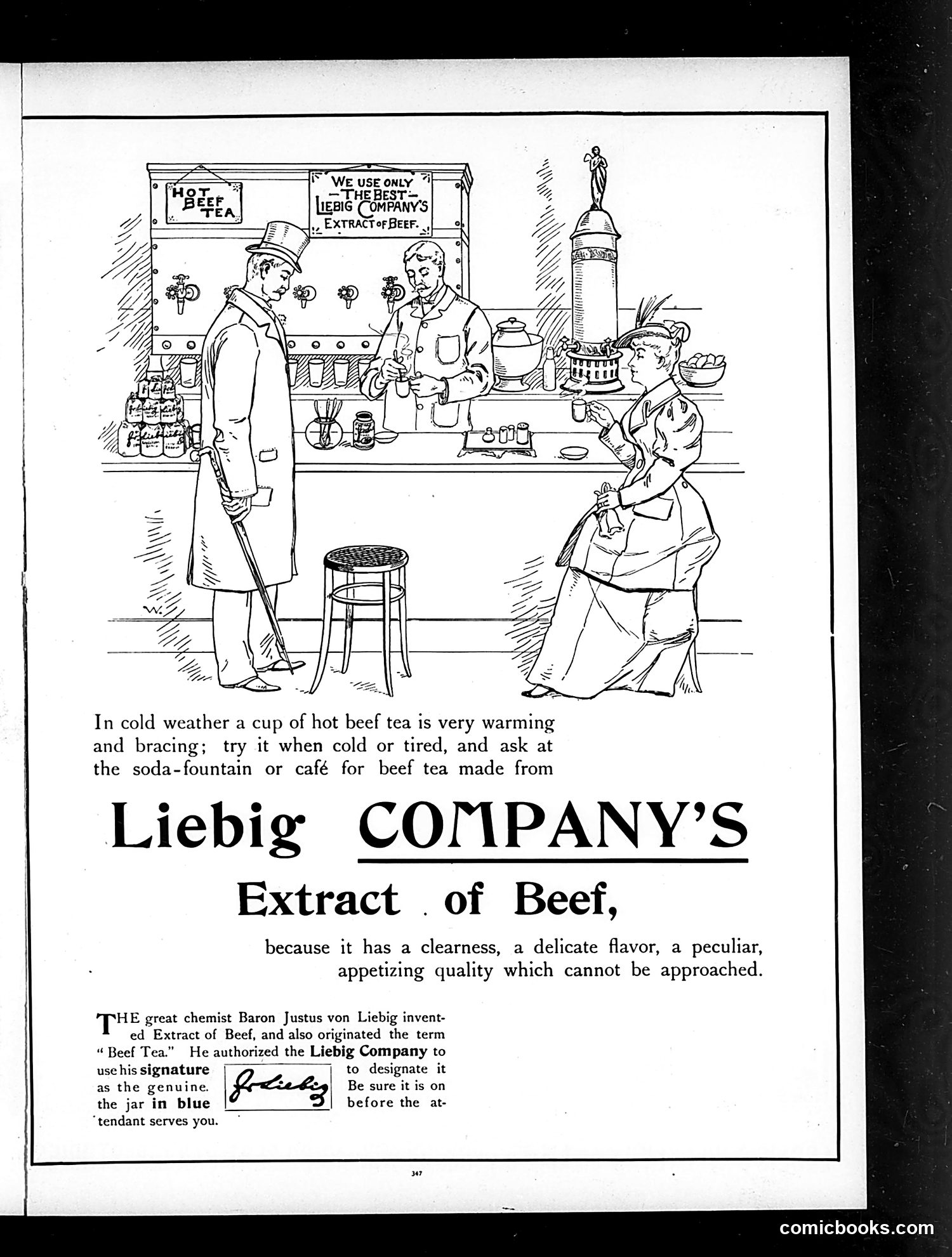
This is primarily a **product advertisement**, not satire. It promotes Liebig Company's Extract of Beef, a concentrated meat product used to make "beef tea"—a hot beverage popular in the late 19th/early 20th century. The illustration shows a soda fountain or café scene where a well-dressed man purchases beef tea. The ad emphasizes that the product comes from **Baron Justus von Liebig**, a real German chemist who invented the extraction process, lending scientific credibility. The company claims consumers should verify authenticity by checking for Liebig's signature on the jar's blue label. For modern readers: this represents a time when concentrated meat extracts were marketed as nutritious restoratives for cold weather and fatigue—positioned similarly to how sports drinks or energy supplements are marketed today. The scientific attribution and signature authentication reflect early branding strategies.
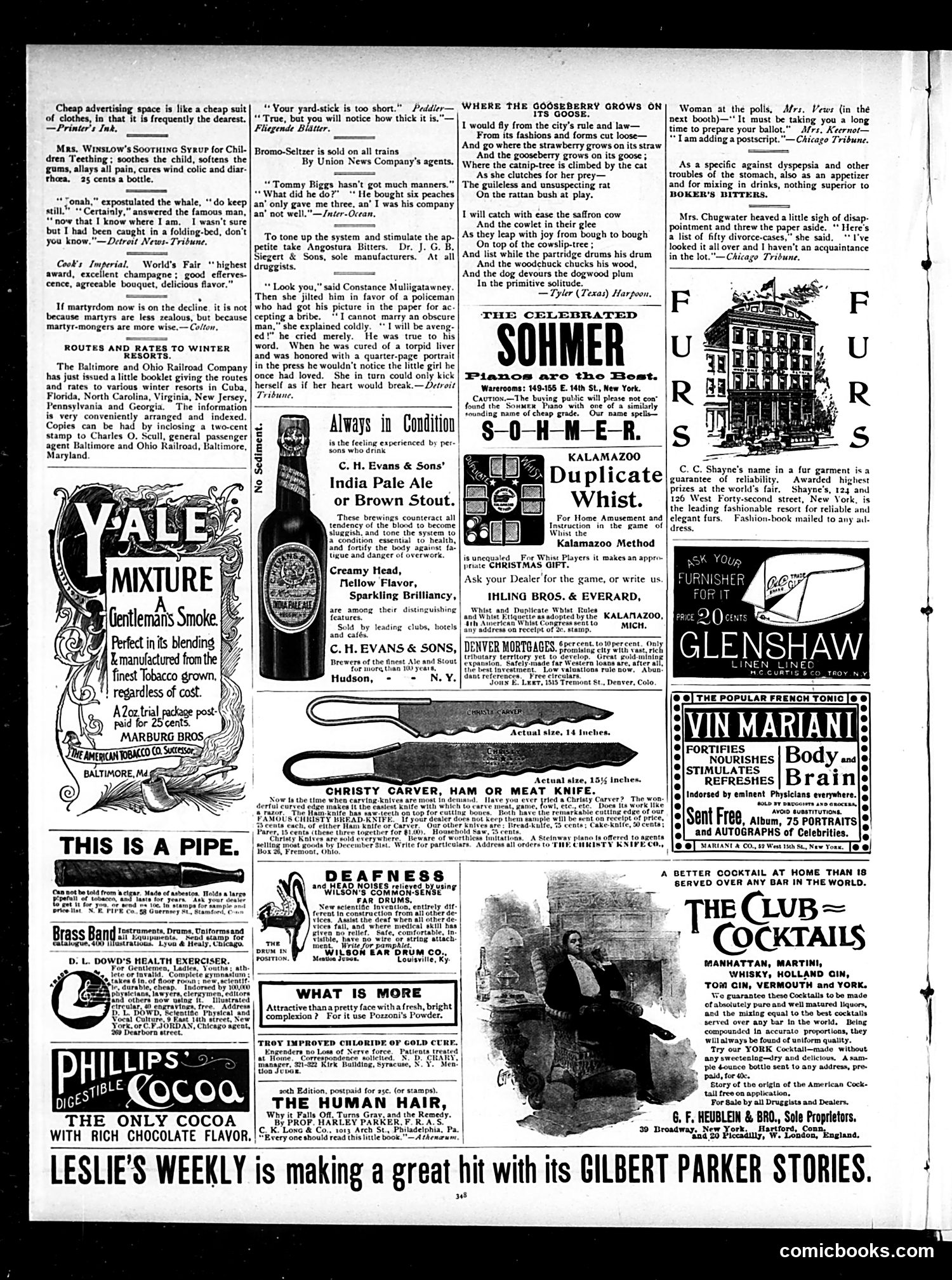
This is primarily an **advertising page** from Judge magazine, with minimal editorial content. The few satirical items are brief, disconnected quips typical of the era: **The cartoons/jokes:** - A folding-bed mishap (comparing being caught in one to being swallowed by a whale) - A peddler defending a short yardstick by claiming it's "thick" - A child's complaint about unfair peach distribution - A love-triangle revenge story about a man achieving newspaper recognition **The advertisements** dominate, promoting patent medicines (Bromo-Seltzer, Angostura Bitters), alcohol (Evans & Sons beer, Cook's champagne), and consumer goods typical of the late 19th/early 20th century. **Context for modern readers:** These were common Judge pages—light humor mixed with ads for products now seen as dubious (tonics claiming to cure "torpid livers"). The satirical content is gentle social observation rather than political commentary. The page reflects an era when magazine advertising subsidized publication and humor was often *ad-adjacent* rather than editorial-driven.
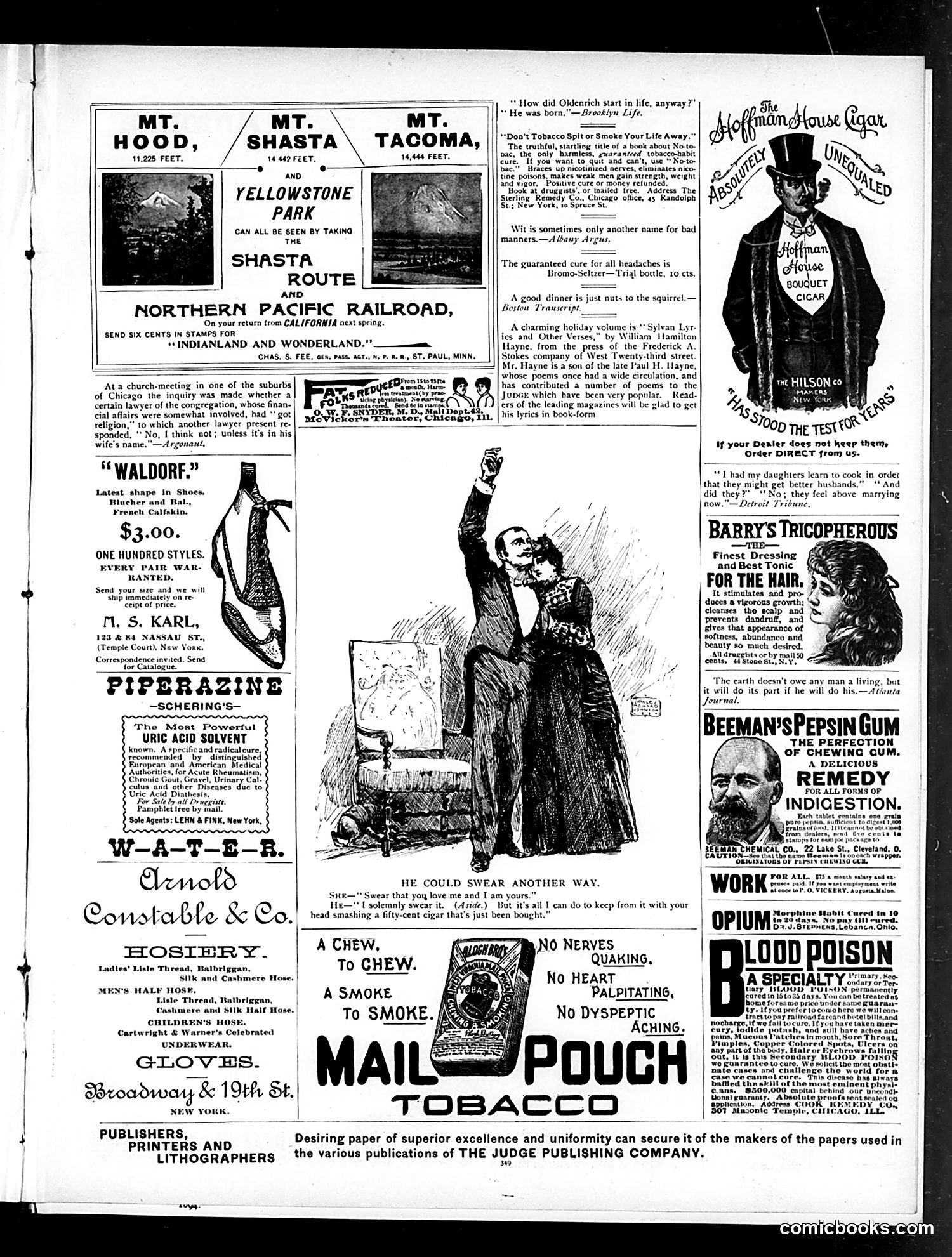
This page is primarily **advertising**, typical of late-19th-century magazines. However, it contains two notable satirical cartoons: ## Main Cartoon: "HE COULD SWEAR ANOTHER WAY" A dialogue joke about marriage and financial hardship. A man refuses to swear his love because he's angry about his wife making him buy an expensive fifty-cent cigar—satirizing the domestic friction between marital romance and household finances during an era when such spending represented real sacrifice for middle-class families. ## Secondary Cartoon: Man with raised fist Unclear without caption, but appears related to labor or social discontent. ## Advertisements The page features period remedies (Bromo-Seltzer, Beeman's Pepsin Gum, Piperazine) marketed with exaggerated health claims typical of the era before FDA regulation. Notable are ads for "No-to-bac" (tobacco cessation) and treatments for opium addiction—reflecting genuine public health concerns of the time. The Shasta Route railroad advertisement promotes Western tourism, then a growing leisure activity for affluent Americans.
This page is primarily advertising with brief satirical commentary scattered throughout. The notable satirical elements include: **Pocahontas Joke**: References the historical figure telling her father not to kill all "John Smiths" because he'd starve—a play on the common name's prevalence. **Insurance Joke**: A peasant learns his burned farm-house claim would result in prison time, sardonically commenting on insurance fraud or claims disputes. **Dog Praise Joke**: Neighbors prefer a grocer who "praised his dog" over competitors, mocking superficial relationship-building in business. **Trolley-Car Joke**: Pittsburgh women have perpetually frightened expressions from street-car horns—commentary on the disruptive novelty of urban electric trolleys. **Wisdom Aphorisms**: Rural philosophy jokes about hypocrisy and human nature scattered through the page. Most of the content is legitimate product advertising—Turkish bath novelties, cut glass, pianos, cigars, and California excursions—typical of Judge's revenue model. The satire is light and conversational rather than politically pointed.
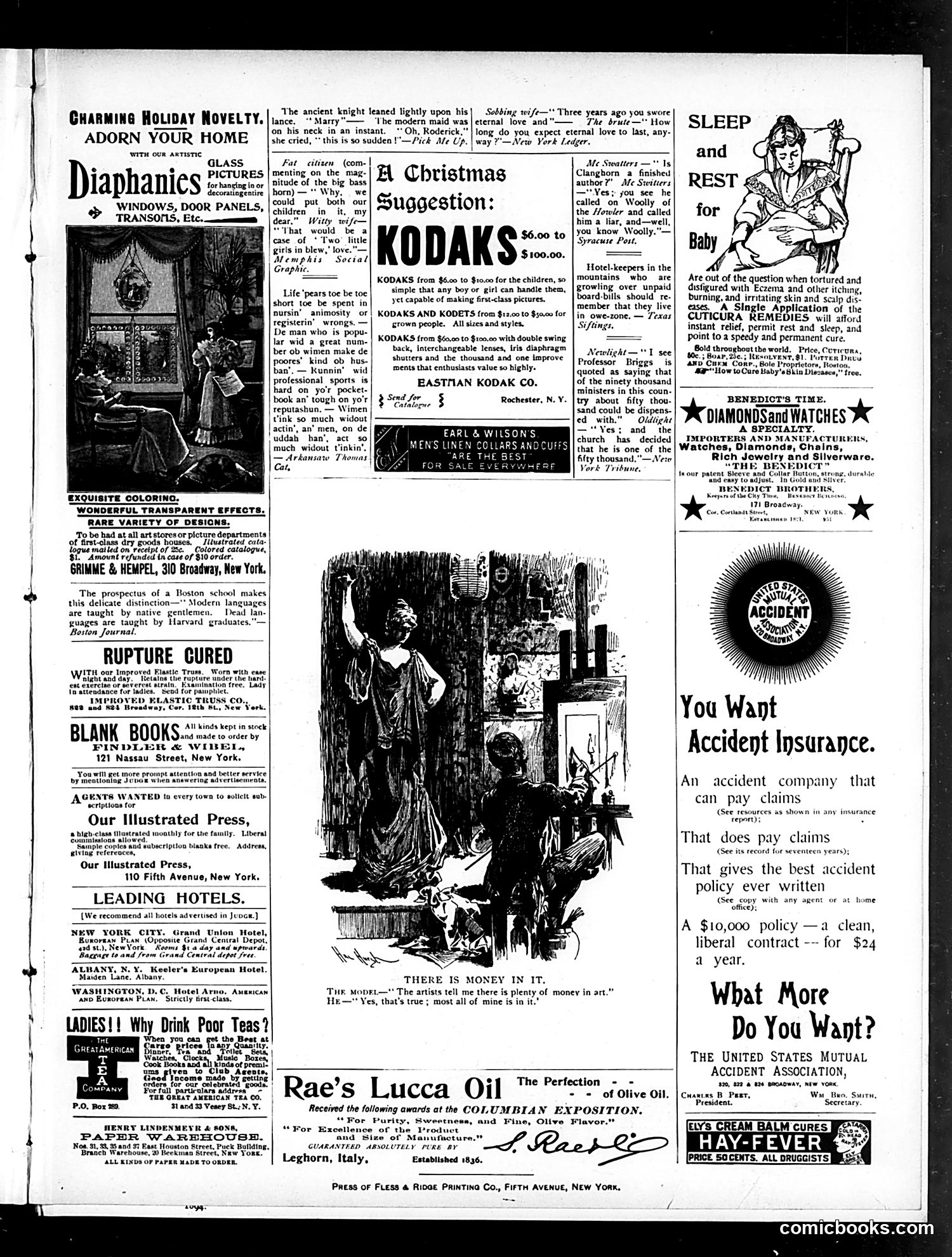
This page is primarily **advertising** with minimal editorial cartoon content. The dominant features are commercial advertisements for products like Diaphanies glass pictures, Kodak cameras (prominently featured as a "Christmas Suggestion"), blank books, hotels, and other goods typical of late 19th-century publications. The small cartoon/joke content visible includes brief humorous exchanges—such as a dialogue between a modern maid and "ancient knight" about eternal love, and a comment about artists having money "in" their work (a pun on financial investment). There's also a brief joke about an author named "Clanghorn" who became "finished" after calling someone a liar in print. The page reflects Judge's format: a satirical magazine that relied heavily on advertising revenue, mixing commercial content with scattered jokes and social commentary rather than featuring prominent political cartoons or sustained satire.
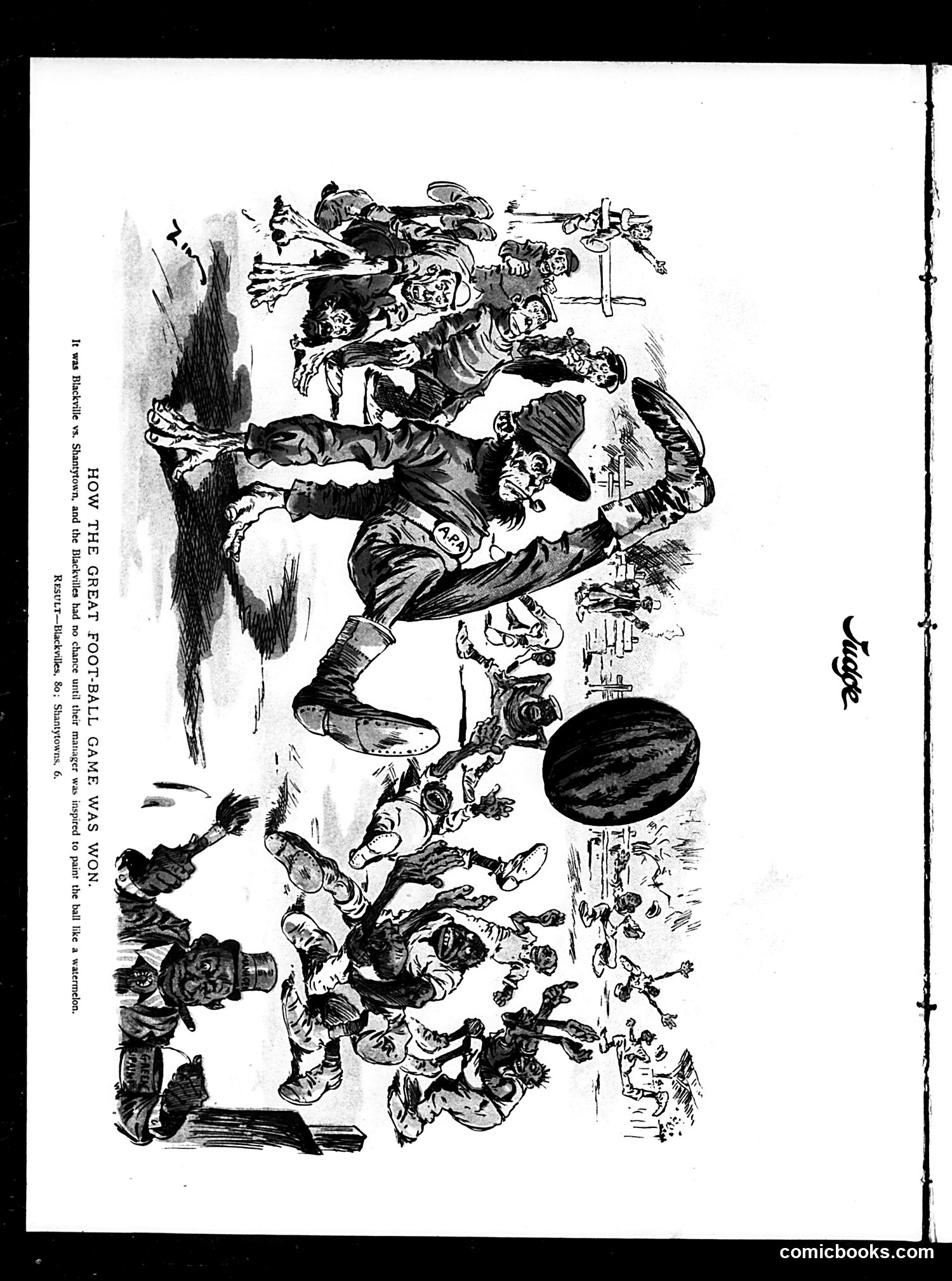
This is a racist caricature cartoon from Judge magazine mocking Black Americans. The satirical "joke" depicts a football game between "Blackville" and "Shantytown" where the Blackville team supposedly wins by an absurd margin (80-6) only after their manager paints the football to look like a watermelon—playing on a dehumanizing racial stereotype that associated Black people with watermelon consumption. The cartoon ridicules Black athletic ability while reinforcing demeaning stereotypes. The exaggerated caricatured faces of the players, the dialect in the caption, and the overall setup are characteristic of late 19th/early 20th-century American racist humor that Judge regularly published. The "humor" relies entirely on dehumanization and racial prejudice.