
A complete issue · 16 pages · 1894
Judge — February 10, 1894
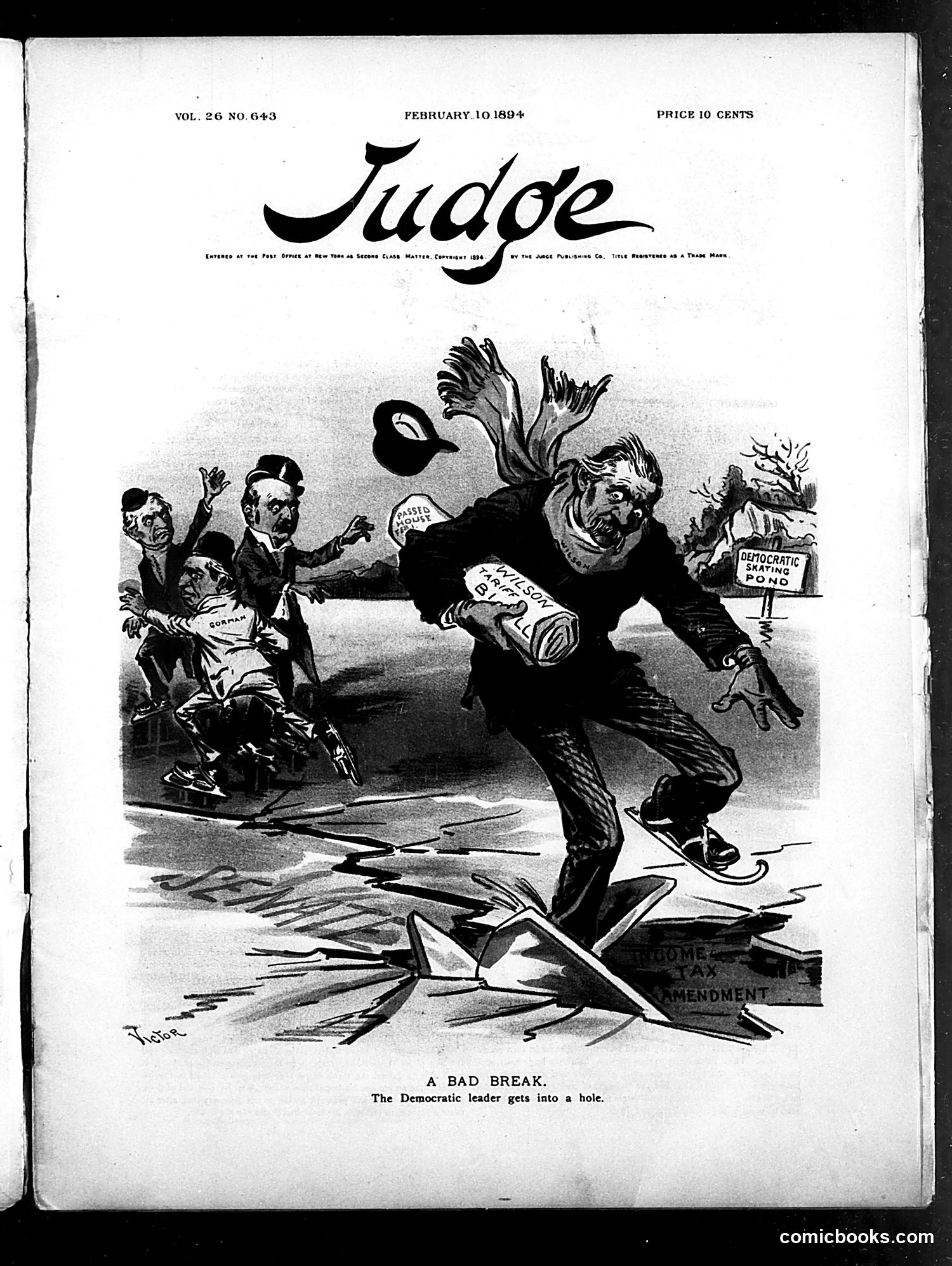
This February 1894 *Judge* cartoon satirizes Democratic Party leadership during an economic crisis. The central figure, depicted as a wild-haired man juggling a bottle labeled "Whiskey," appears to represent the Democratic leader stumbling into disaster. He's surrounded by smaller figures (likely other party members) gesturing in alarm on what resembles ice or unstable ground marked "Home Amendment." The scattered sticks beneath suggest the party is literally falling apart. The sign reading "Democratic Skating Pond" indicates the party has lost its footing during the severe economic panic of 1893. The cartoon criticizes Democratic mismanagement during this national financial crisis, portraying their leadership as reckless and incompetent.
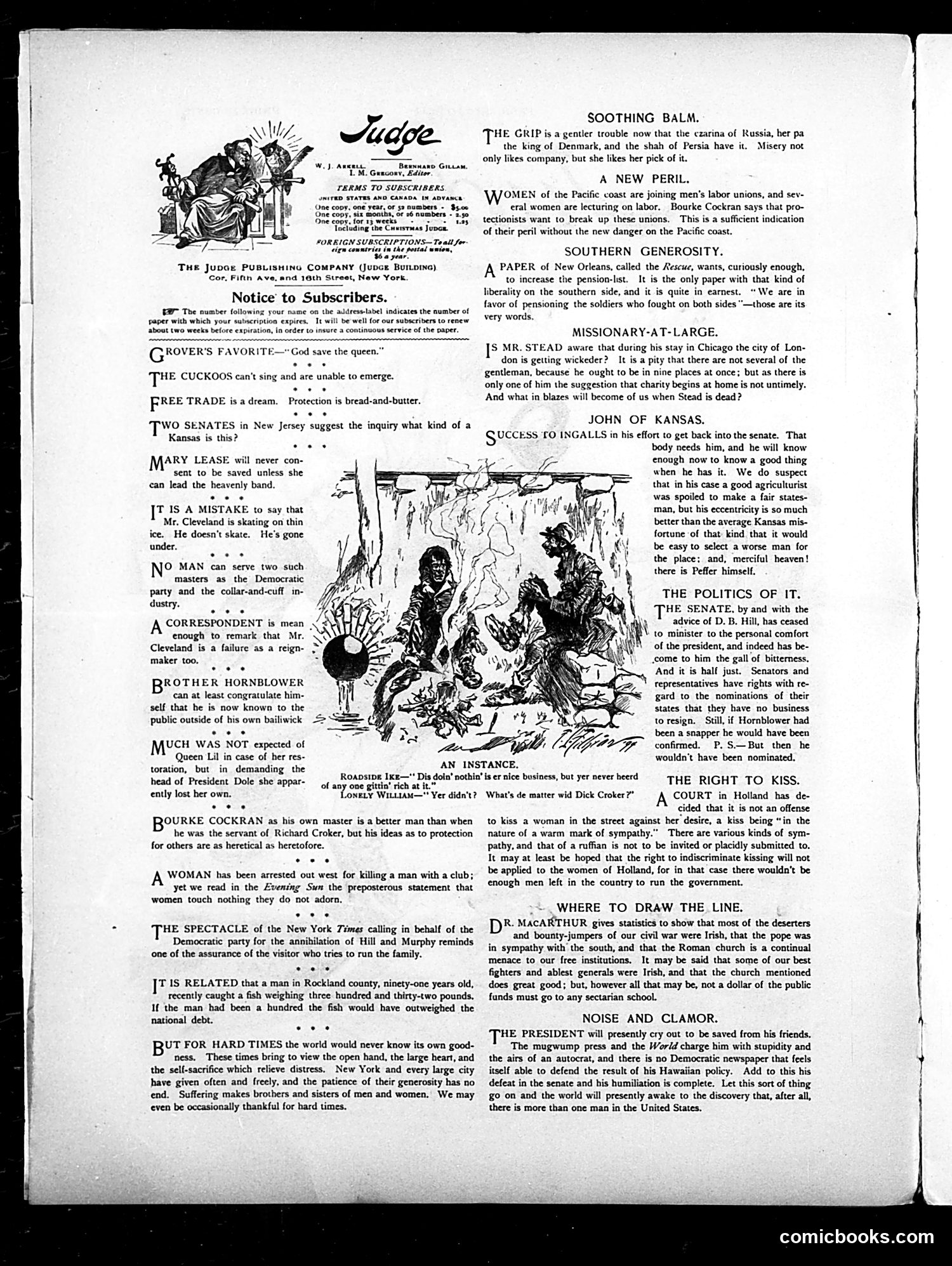
The main cartoon titled "AN INSTANCE" depicts two figures in what appears to be a cave or crude shelter, with one saying "Roadside Ice—'Dis doin' cookin' is a side business, but yet never heerd of any one gittin' rich at it.'" The response is "Yer didn't? What's de matter wid Dick Croker?" This references **Dick Croker**, the notorious Tammany Hall political boss, likely mocking his wealth accumulation through corrupt "side business" dealings. The cartoon satirizes how Croker became wealthy through political patronage and graft—suggesting even street vendors know such schemes don't typically enrich people, yet Croker mysteriously prospered. The surrounding text columns discuss various political and social commentary typical of Judge's satirical format, though specific events aren't clearly identifiable from this page alone.
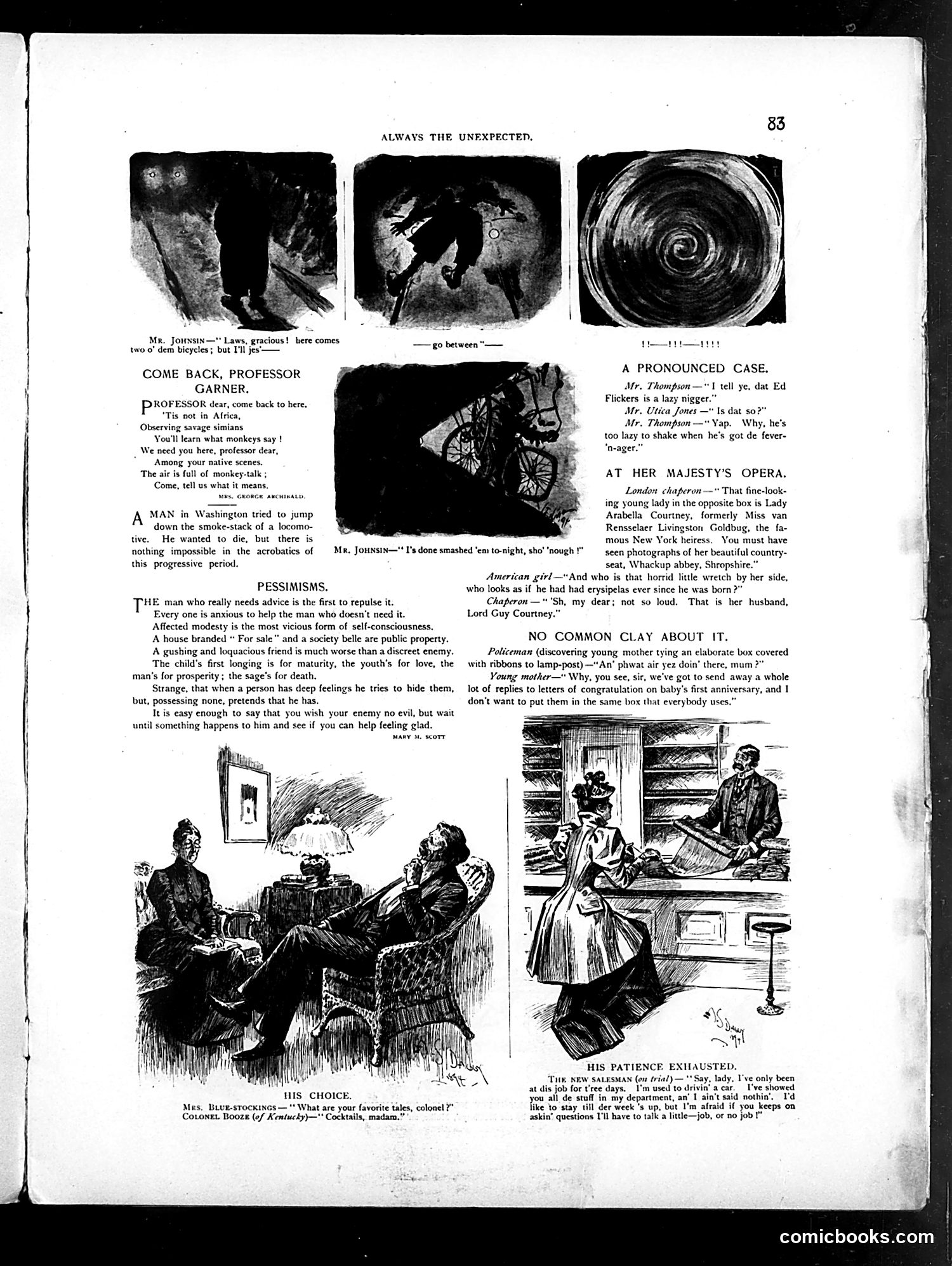
This page contains several satirical sketches and humorous anecdotes typical of Judge magazine's style. The main pieces include: **"Come Back, Professor"** - A poem mocking professorial absent-mindedness, suggesting a professor has wandered off and needs recalling. **"Pessimisms"** - A prose piece by Mary A. Scott critiquing false modesty and self-deprecation as social vices, arguing that excessive self-criticism is worse than honest pride. **"His Choice"** and **"His Patience Exhausted"** - Illustrated domestic comedy sketches showing marital or household dynamics, typical of period humor about relationships and domestic service. **"No Common Clay About It"** - Brief comic dialogue about a woman's pretensions. **"At Her Majesty's Opera"** - A society anecdote referencing aristocratic pretension. The page reflects early 20th-century middle-class anxieties about propriety, social status, and domestic life through gentle satire and humorous observations.
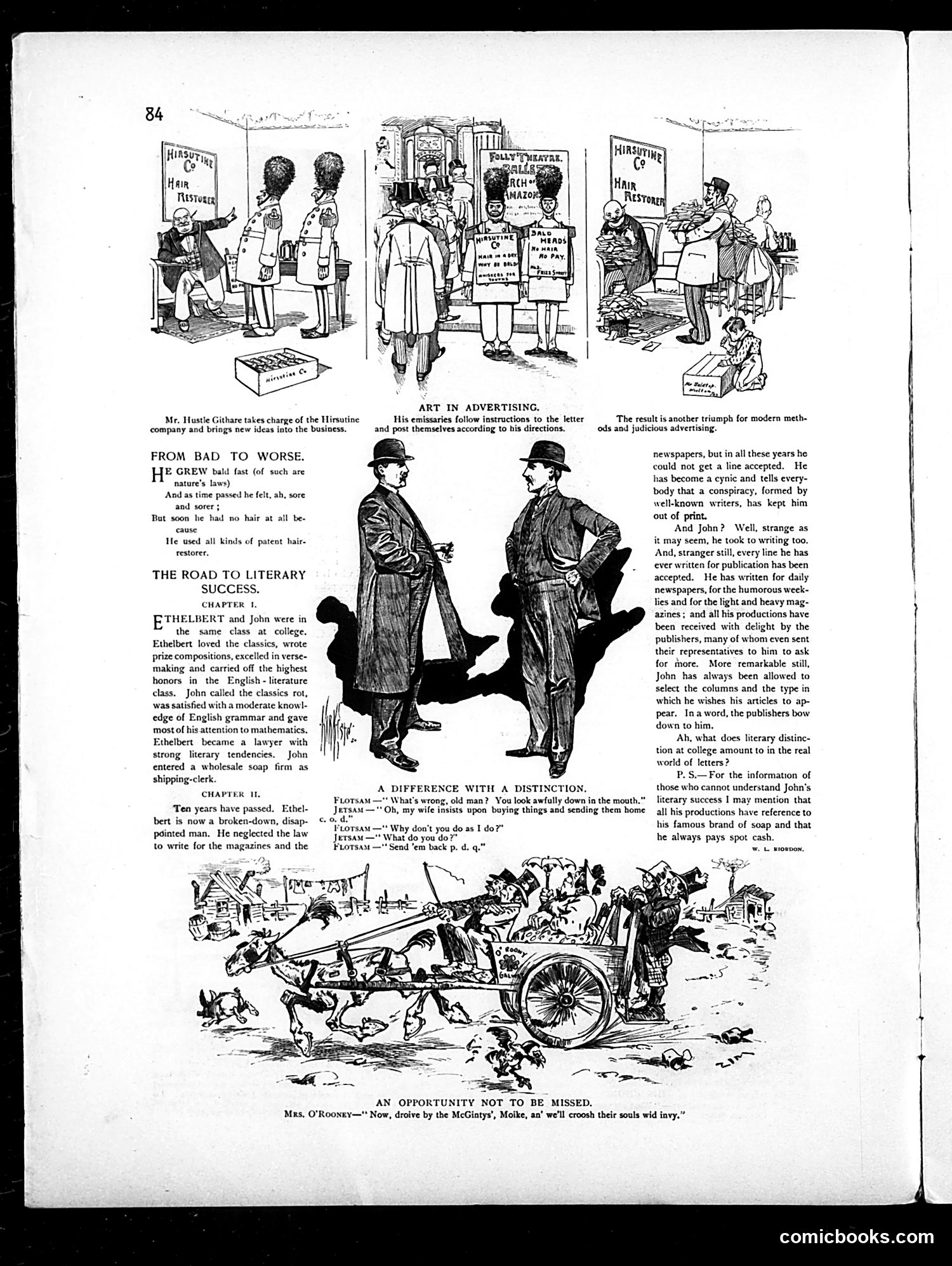
This page contains satirical commentary on American business and social aspiration circa early 1900s. **Top cartoons** mock patent medicine advertising and modern marketing tactics—specifically "Hirsutine Hair Restorer." The irony: a man uses hair-restoration products so aggressively he loses all his hair anyway. This satirizes the era's predatory patent medicine industry and gullible consumers. **"Road to Literary Success"** is the main satire: Ethelbert, a talented college writer who pursues serious literature, becomes a broke, bitter failure. John, an indifferent math student who enters soap manufacturing, becomes wildly successful as a writer—*because his articles advertise soap and he pays cash*. The joke skewers 1900s commercialism: literary merit means nothing; what publishers want is advertising revenue and reliable payment. John's "success" isn't talent but commercial utility. The P.S. punchline confirms this cynical reading. Minor cartoons mock Irish immigrants and mail-order purchasing culture—typical Judge fare targeting period anxieties.
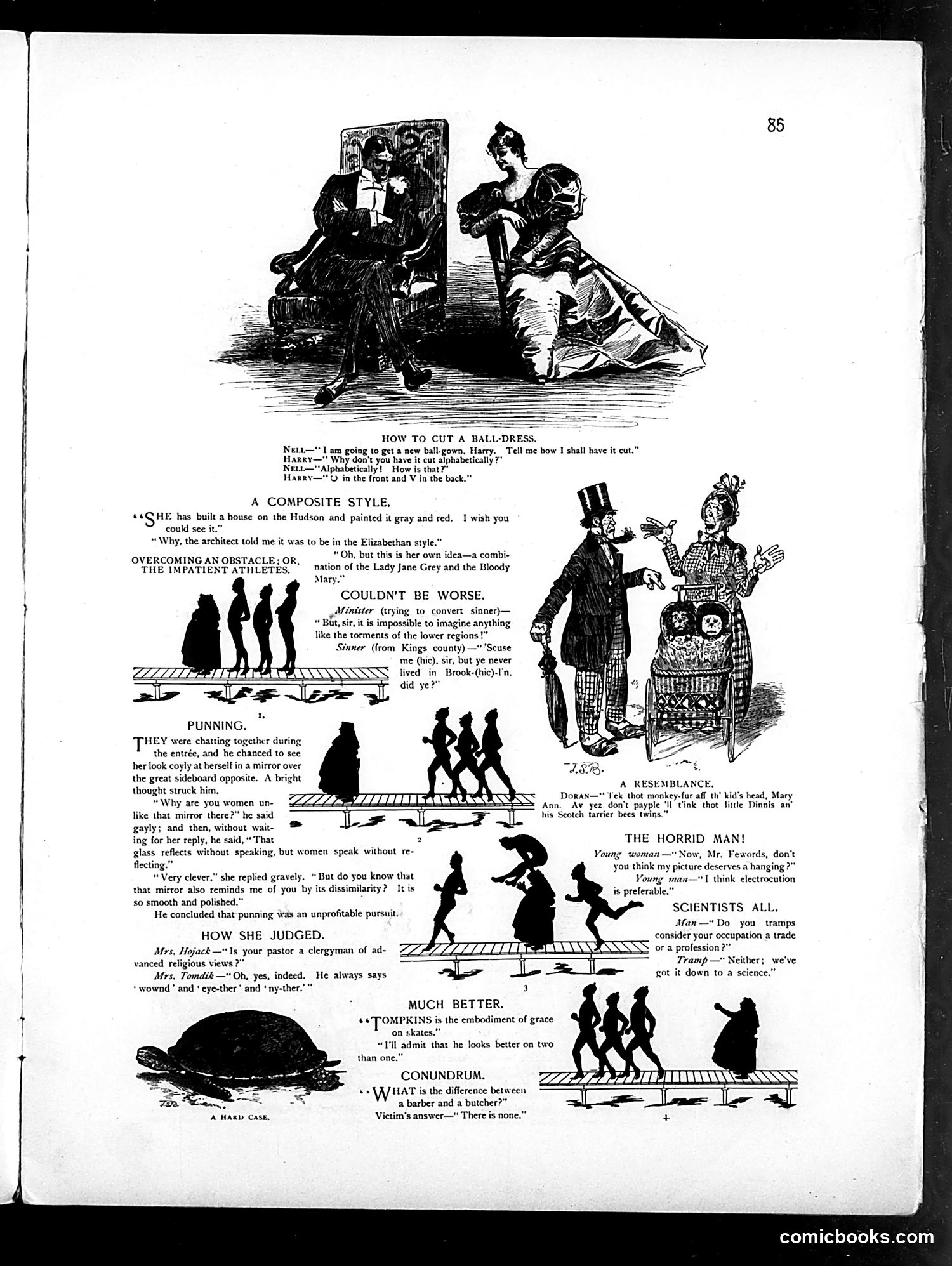
This page contains Victorian-era humor pieces typical of late 19th-century satirical magazines. The content includes: **"How to Cut a Ball-Dress"**: A play on words—suggesting a woman cut her dress with a "U" in front and "V" in back (implying indecent exposure), rather than alphabetically as the pun suggests. **"A Composite Style"**: Mocks pretentious architecture and society women who awkwardly combine historical styles (here, mixing "Lady Jane Grey" and "Bloody Mary" aesthetics). **"Punning" and "How She Judged"**: Standard wordplay humor about pronunciation and clerical speech patterns. **"The Horrid Man" and other brief jokes**: Social commentary on courtship etiquette and gender dynamics—the man making crude jokes about the woman's art and appearance. **"Punning Was an Unprofitable Pursuit"**: Shows a woman rejecting a suitor's mirror-based insult about women being reflections without thought—she compares him unfavorably to the mirror. The page primarily consists of domestic humor, romantic banter, and light social satire aimed at middle-class readers, with minimal political content.
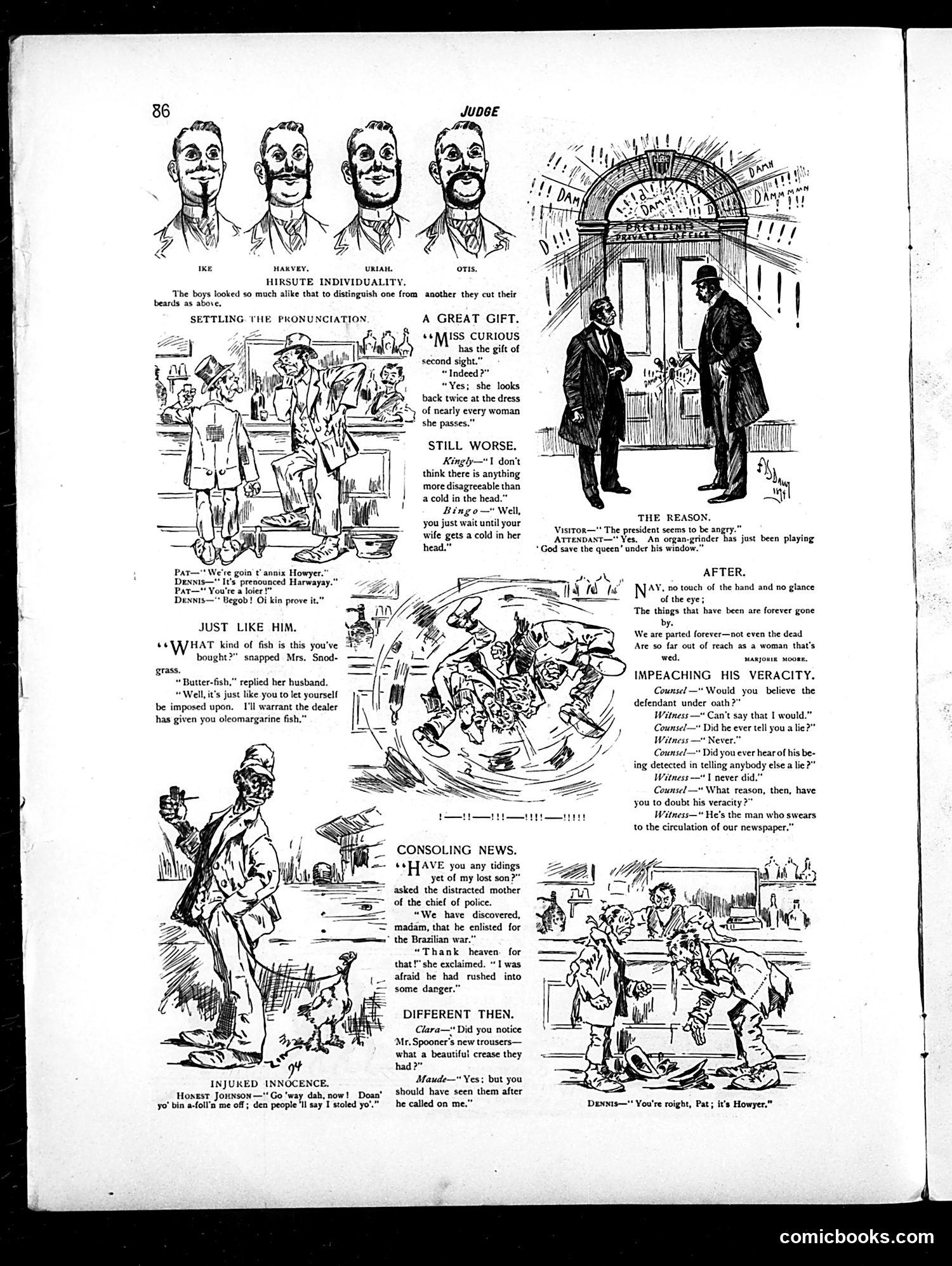
This page collects brief satirical humor pieces typical of Judge magazine's style: **"Hirsute Individuality"** mocks four similar-looking men distinguished only by their beards—poking fun at facial hair as identity marker. **"Settling the Pronunciation"** and other segments are light domestic comedies: a woman with "second sight" who merely stares at others' dresses; a husband's complaint about colds that backfires when his wife catches one; marital bickering about fish quality. **"The Reason"** depicts a president angered by street musicians—likely referencing late 19th/early 20th-century urban noise complaints. **"Impeaching His Veracity"** is a courtroom joke: a witness trusts a man's honesty except that he "swears to the circulation of our newspaper"—satirizing newspapers' inflated circulation claims, a common fraud of the era. The humor is genteel, domestic, and topical rather than deeply political—typical of Judge's middle-class readership.
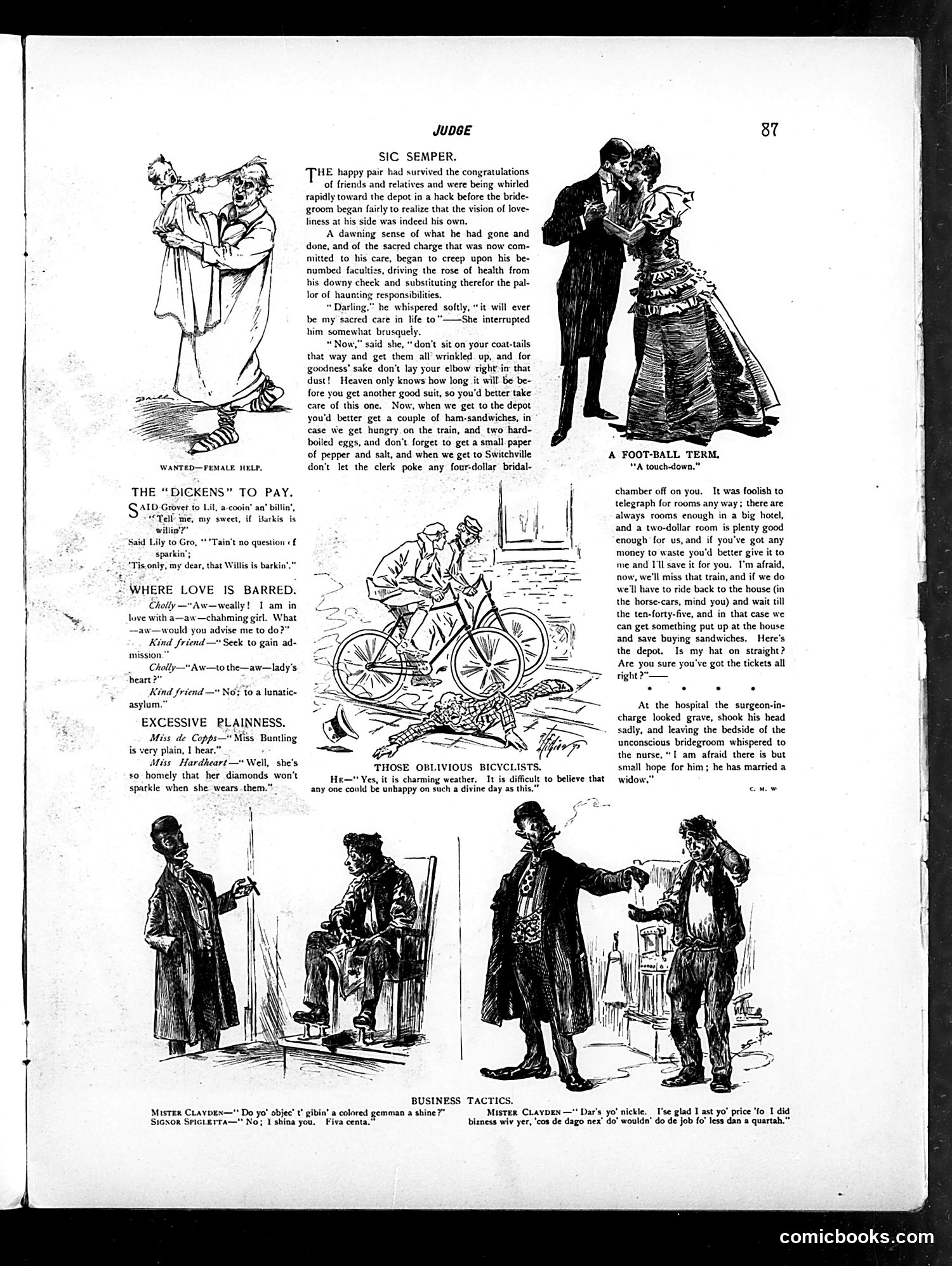
This page contains multiple short comedic pieces mocking Victorian social conventions. The main feature, "Sic Semper" (Thus Always), satirizes newlywed dynamics: a groom romanticizes marriage while his bride immediately reduces him to practical concerns—protecting his suit, economizing on food, and managing logistics. The humor lies in her swift deflation of his idealism through relentless nagging. Other sketches ridicule social anxieties: a man's hesitation about courting ("Seek admission to a lunatic asylum"), a wealthy woman so homely her diamonds won't sparkle, and oblivious bicyclists ignoring romance. The "Business Tactics" section uses dialect humor portraying African American characters negotiating labor rates—reflecting period racial stereotyping common in Judge magazine. The cartoons employ ink illustrations typical of 1890s-era satirical journalism, targeting middle-class pretension and gender dynamics.
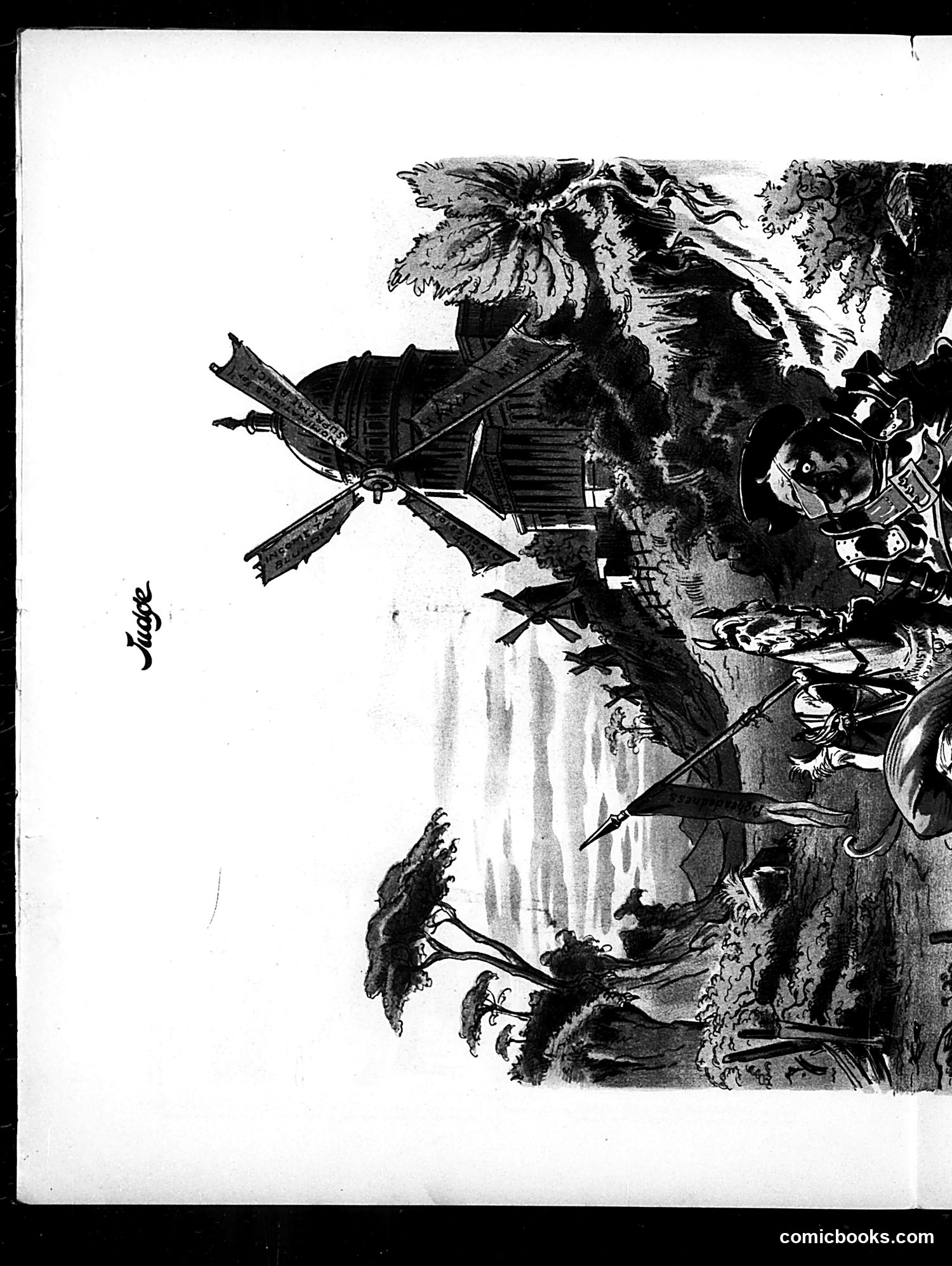
I can see this is a black and white engraving or illustration from *Judge* magazine, but the OCR text provided is largely garbled and unreadable—appearing to be only character encoding errors rather than actual article or caption text. The image itself shows what appears to be a Dutch or European windmill with figures in period dress, rendered in a detailed satirical style typical of *Judge*'s 19th-century engravings. However, without legible accompanying text or captions, I cannot definitively identify the specific political or social references, the figures depicted, or what satire or joke is intended. To properly explain this cartoon's meaning to a modern reader, I would need the actual OCR text transcription corrected.
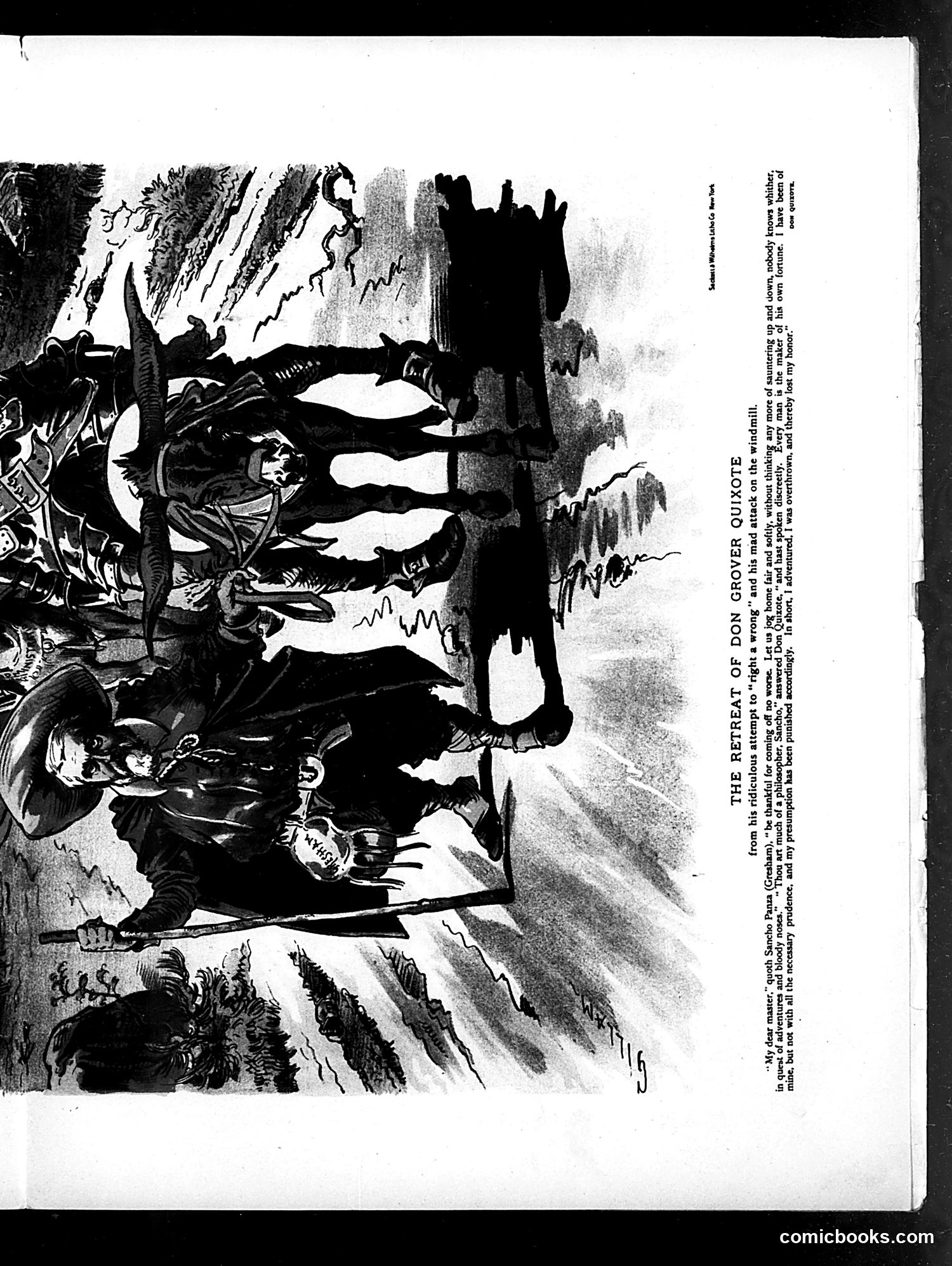
This appears to be a satirical cartoon from *Judge* magazine depicting a figure labeled "Don Grover" in retreat or defeat. The OCR text is heavily corrupted, making precise details difficult to confirm, but the visual shows a dramatic scene with multiple figures in what appears to be a chaotic or disorderly situation. Without clearer text or visible date information, I cannot definitively identify which "Grover" this references or the specific political context. It could relate to Grover Cleveland or another public figure from the Gilded Age when *Judge* was influential. The theatrical, exaggerated style is typical of political satire from that era, suggesting criticism of a politician's policies or conduct. **I cannot reliably explain the specific political reference without risking inaccuracy.** The corrupted OCR prevents identifying the precise satire or joke intended.
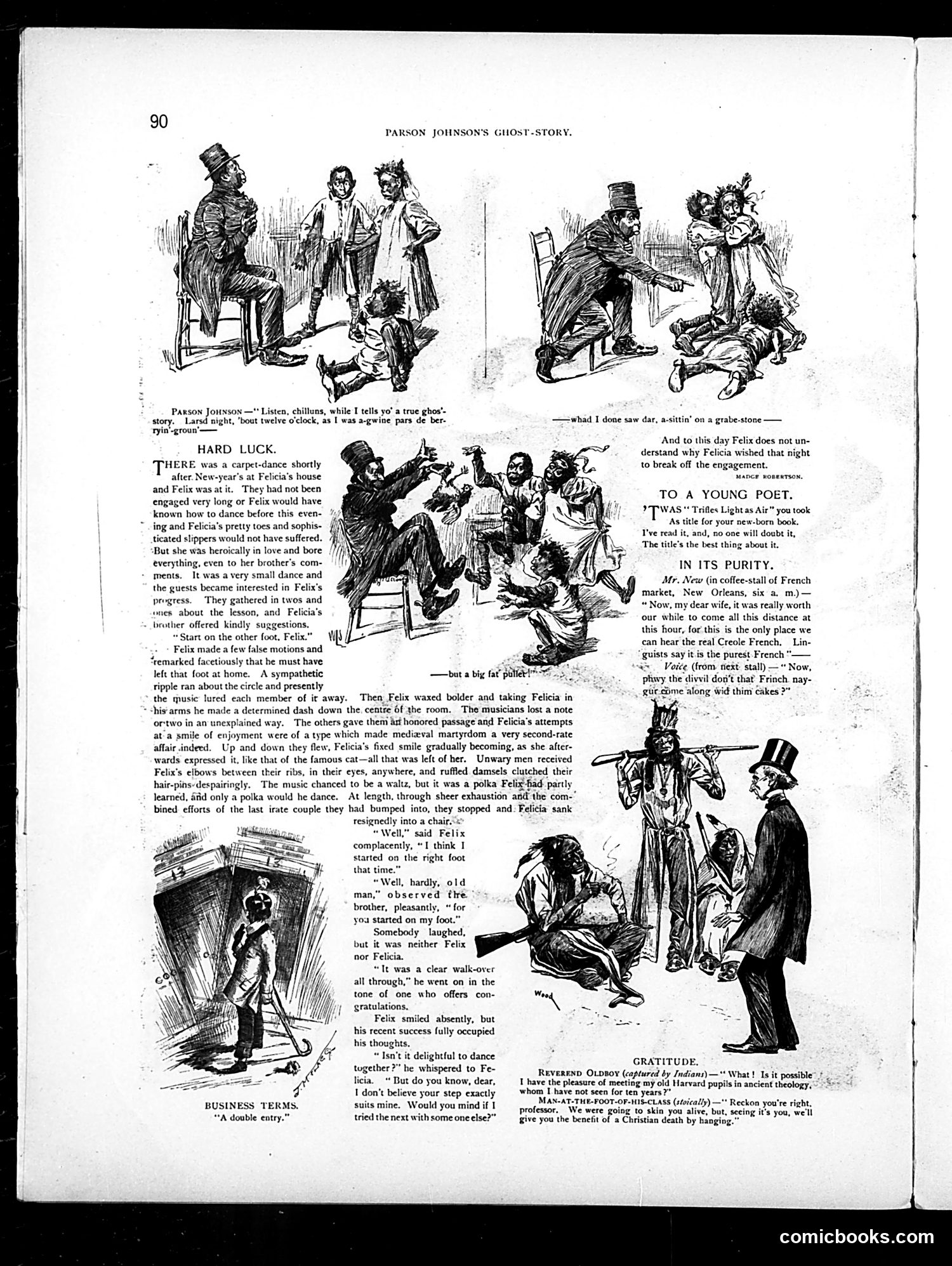
This page contains three separate satirical pieces: **"Hard Luck"** depicts a young man named Felix dancing poorly at a party. The humor lies in his obliviousness—he repeatedly steps on people (literally and figuratively) yet remains complacently self-satisfied, even suggesting to his fiancée Felicia that he dance with someone else because *her* step doesn't suit *his*. She breaks off the engagement, which he fails to understand. The satire mocks men who lack self-awareness and blame others for their failings. **"Business Terms"** is a brief joke about a "double entry"—a pun on accounting terminology applied to dancing mishaps. **"To a Young Poet"** mocks a pretentious poet whose book's title is better than its content. **"In Its Purity"** satirizes Americans abroad obsessing over "authentic" experiences, only to encounter crude reality (implied by the Creole speaker's rough dialect contradicting claims of purity). **"Gratitude"** shows a captured minister encountering former students—who were apparently planning to "skin him alive" but now show false respect. These are typical Judge magazine fare: gentle social satire targeting vanity, pretension, and human folly.
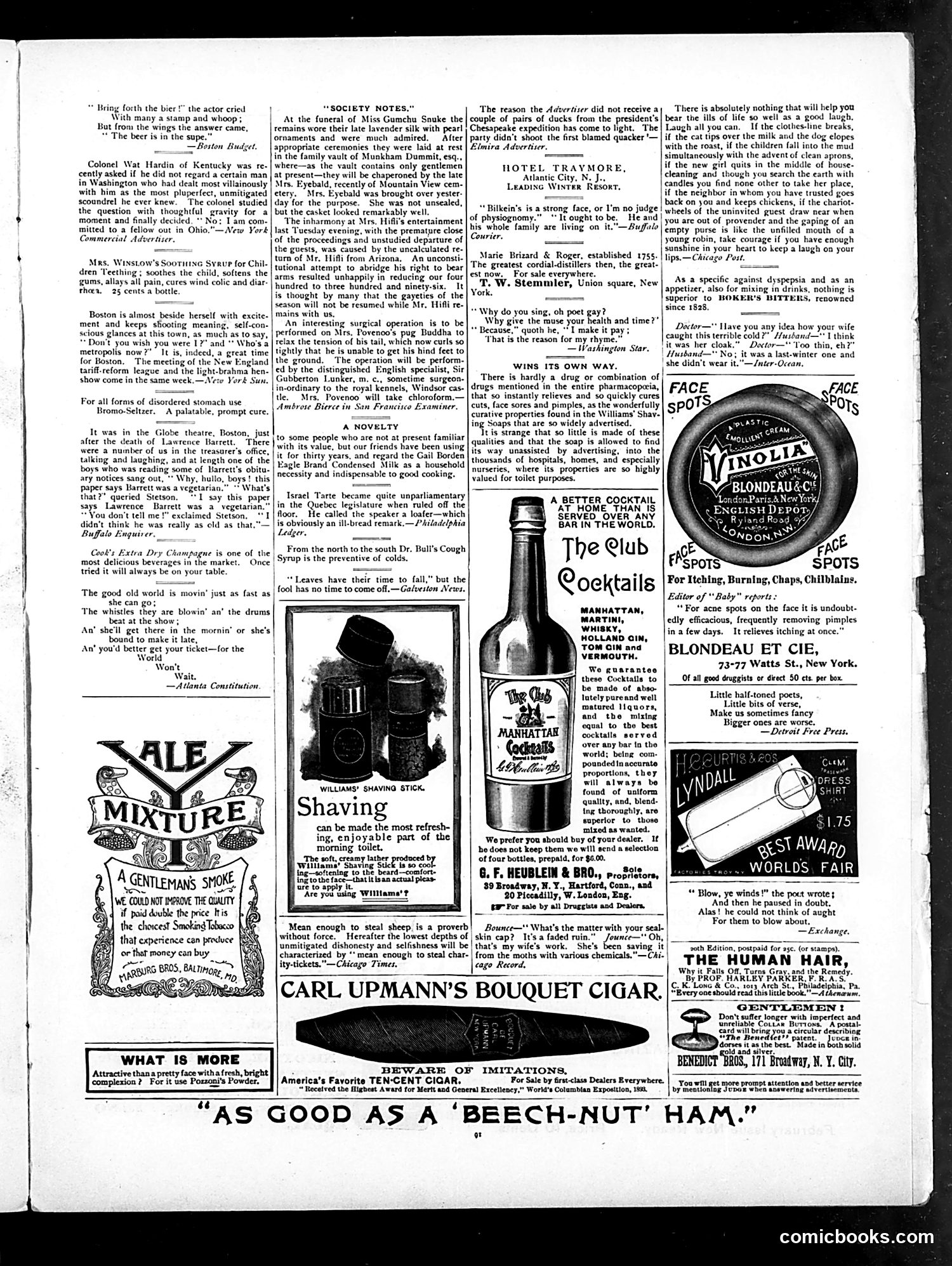
This page is primarily **advertising and humor columns**, not political satire. The content includes: **Humor columns** with jokes about: - An actor's malapropism ("beer" vs. "bier") - Colonel Hardin of Kentucky ranking scoundrels - Boston's excitement over a tariff-reform league meeting coinciding with a poultry show **"Society Notes" satire** mocking high society through absurdist humor: - Corpses attending their own funeral in fashionable dress - A violent domestic incident at a party (Mr. Hifli's return from Arizona causing a shooting that kills four guests) - Aristocratic concerns (surgical procedures on lap dogs) The satire targets **pretentious wealthy society** through deadpan descriptions of grotesque situations treated as mundane social events. There are no identifiable political figures—this is social, not political, mockery. **Extensive period advertising** dominates: cigars, liqueurs, toiletries, and patent medicines fill the remaining space, typical of Judge's revenue model.
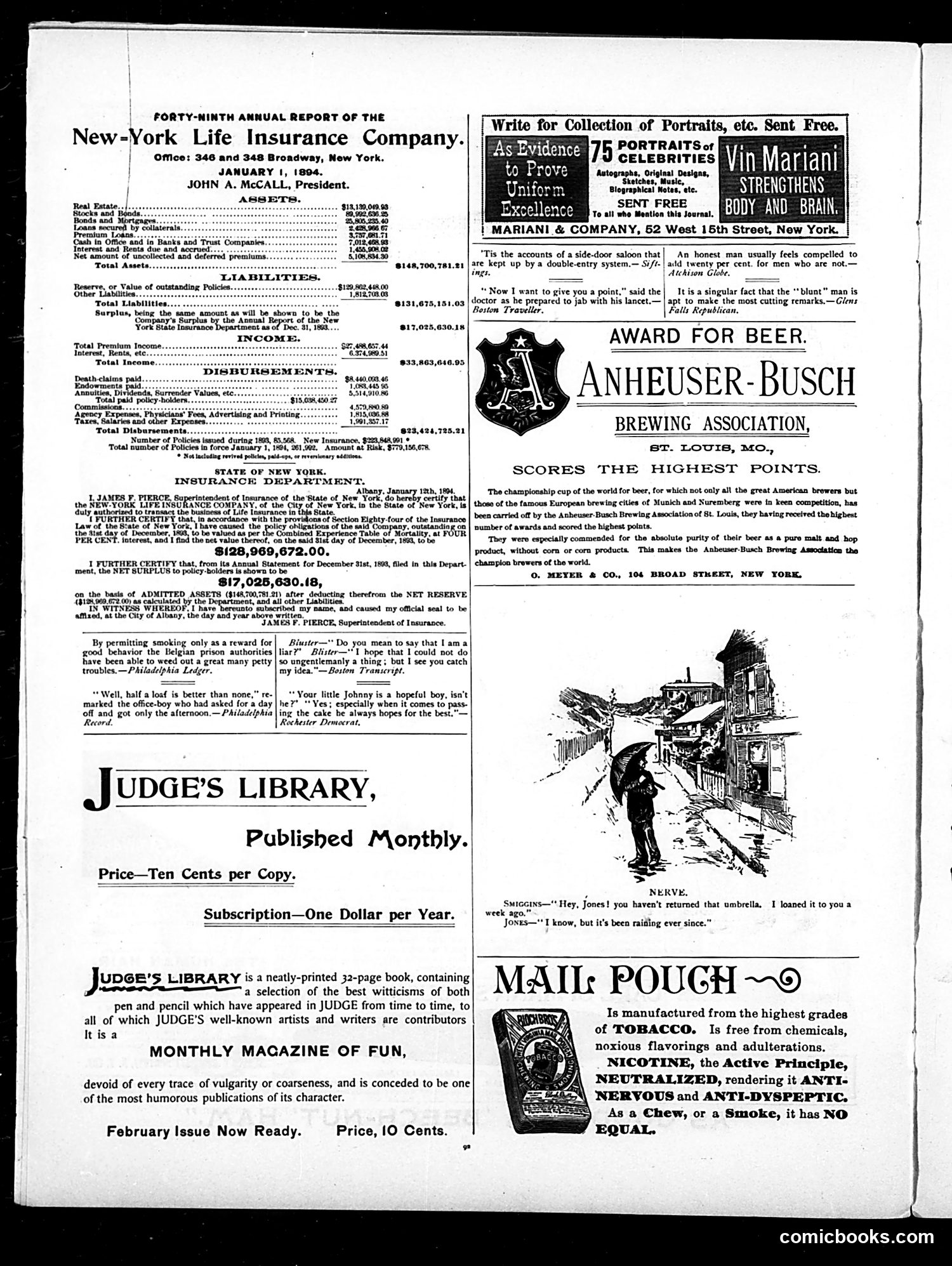
This page from Judge magazine (January 1, 1894) is primarily a **forty-ninth annual financial report** of the New-York Life Insurance Company, taking up roughly the top third in dense financial tables and official certification by the New York State Insurance Department superintendent. The remainder contains scattered **advertisements and jokes** typical of Judge's satirical humor. Visible are ads for Vin Mariani (a cocaine-infused wine marketed as strengthening body and brain), Anheuser-Busch beer, Mail Pouch chewing tobacco, and Judge's Library publication. The humor consists of brief, cynical quips about office workers, Belgian prison discipline, and dishonest dealings—representative of Judge's style of turn-of-the-century workplace and social commentary. A small cartoon shows a figure with an umbrella in rain, accompanying a joke about returned umbrellas. The overall effect captures how period magazines mixed serious institutional content with commercial ads and humor targeting middle-class readers.
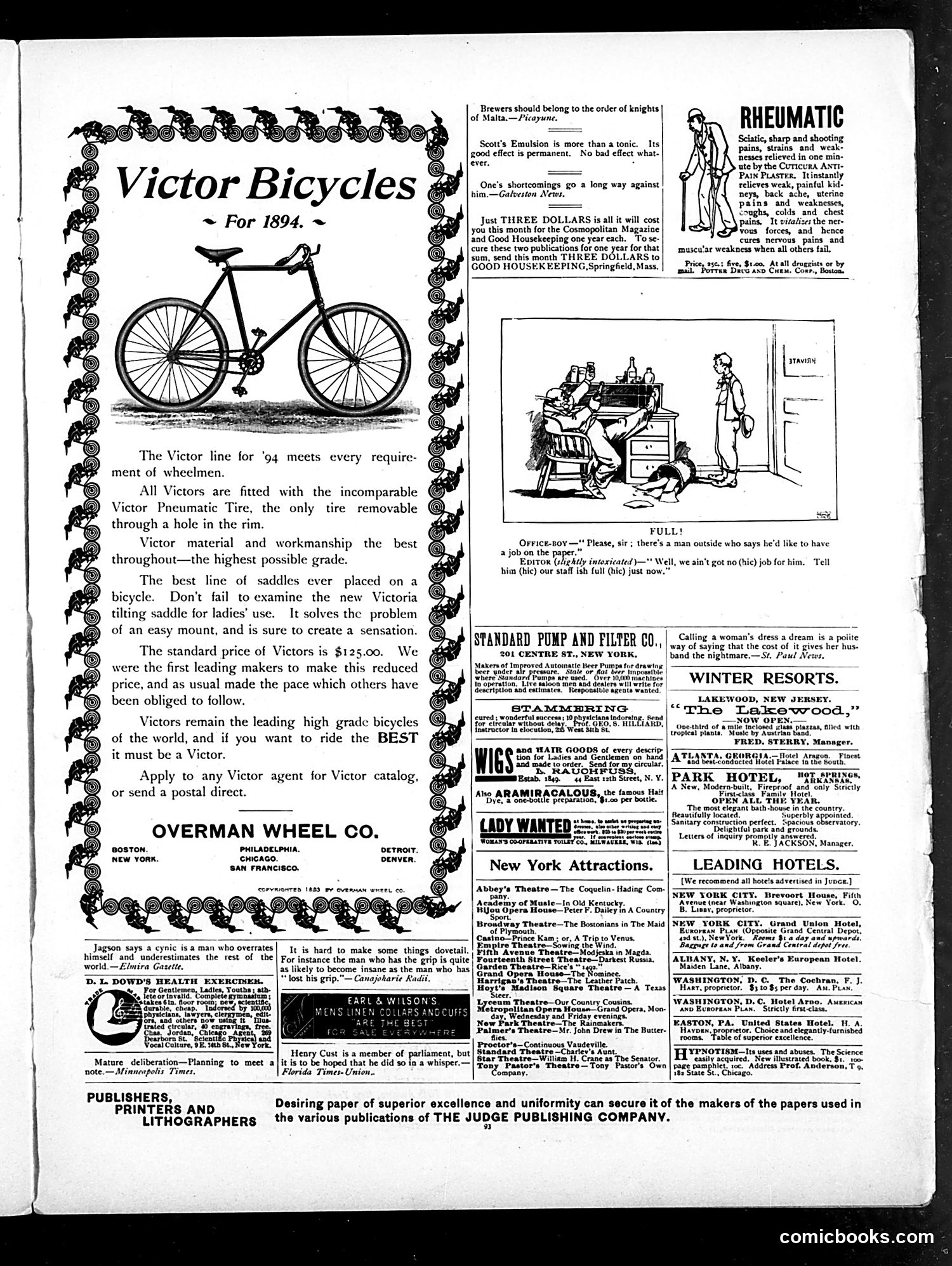
This page is primarily **advertising**, dominated by a large Victor Bicycles advertisement (left side). The bicycles were a major consumer craze in 1890s America—Victor was a leading brand marketed as the "best" at the premium price of $125. The small **cartoon** (center-right, titled "FULL!") depicts a social joke: a drunk office manager refuses a job applicant because the staff is already full of intoxicated men. The humor mocks workplace drinking culture and incompetence in the 1890s. The remaining content includes brief satirical **quotes** (e.g., "Calling a woman's dress a dream is a polite way of saying that the cost of it gives her husband the nightmare"), typical Judge filler, plus advertisements for hotels, theaters, medical products, and services. The page reflects 1890s consumer culture: bicycles as status symbols, workplace drinking as normalized, and the prevalence of patent medicine ads (Cuticura Anti-Pain Plaster, etc.).
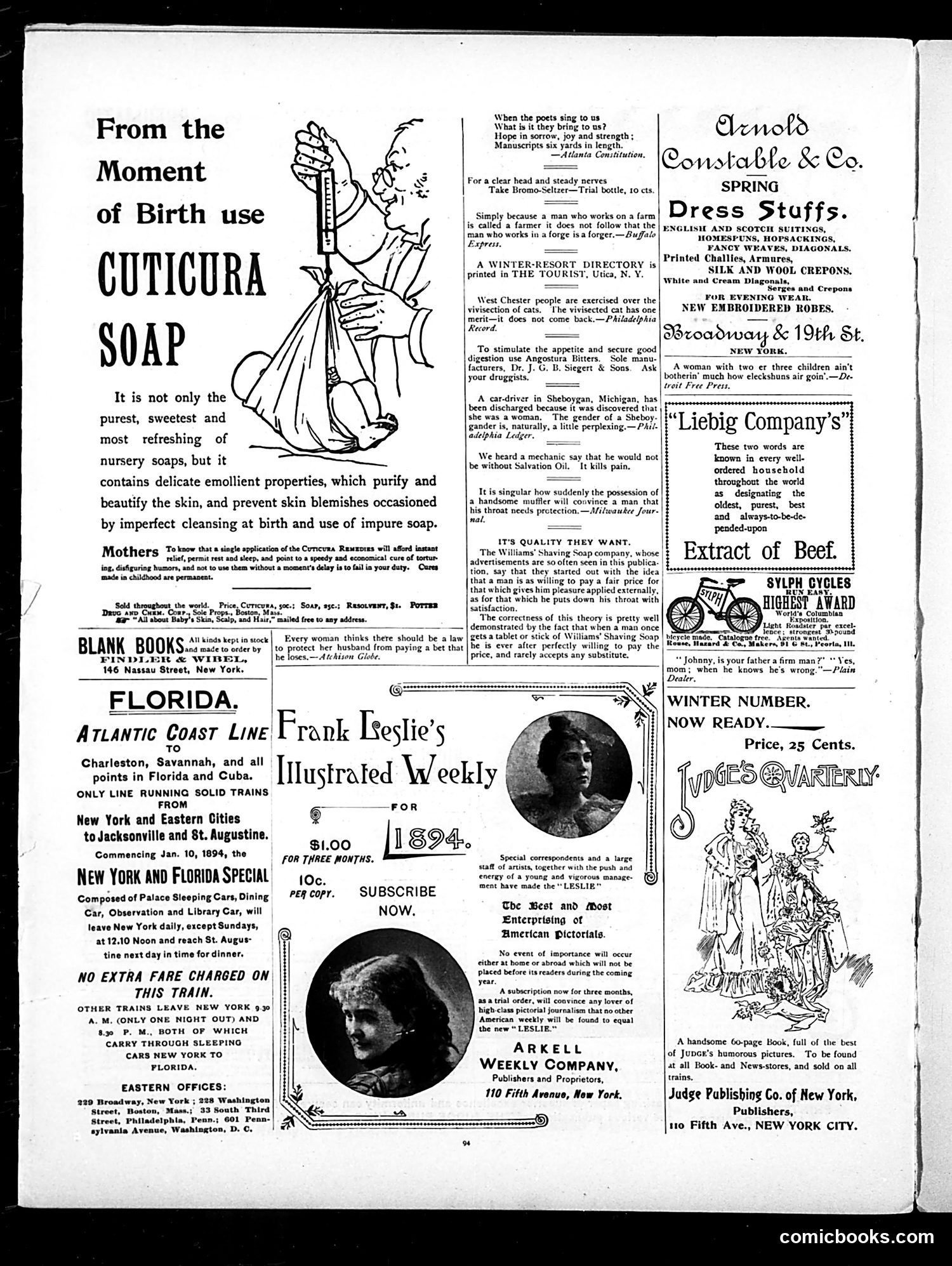
This is primarily an **advertising page** from Judge magazine (circa 1894, based on Frank Leslie's Illustrated Weekly reference). The page contains no political cartoons or satirical content—it's filled with period product advertisements and commercial notices. Notable elements include: - **Cuticura Soap** ad: emphasizes mother-infant hygiene, reflecting 1890s concerns about child health - **Blank Books** ad: a humorous snippet about a woman wanting to prevent her husband from betting - **Williams' Shaving Soap** advertisement: discusses consumer willingness to pay for quality grooming products - **Travel/Transportation ads**: Atlantic Coast Line railroad services to Florida - **Frank Leslie's Illustrated Weekly** subscription notice - Various other ads for dress goods, extract of beef, and bicycles The page reflects **turn-of-the-century consumer culture**: advertising emphasizes health, gentility, and modern convenience. The small editorial snippets scattered between ads offer light humor rather than political satire—typical filler content for magazine pages of this era.
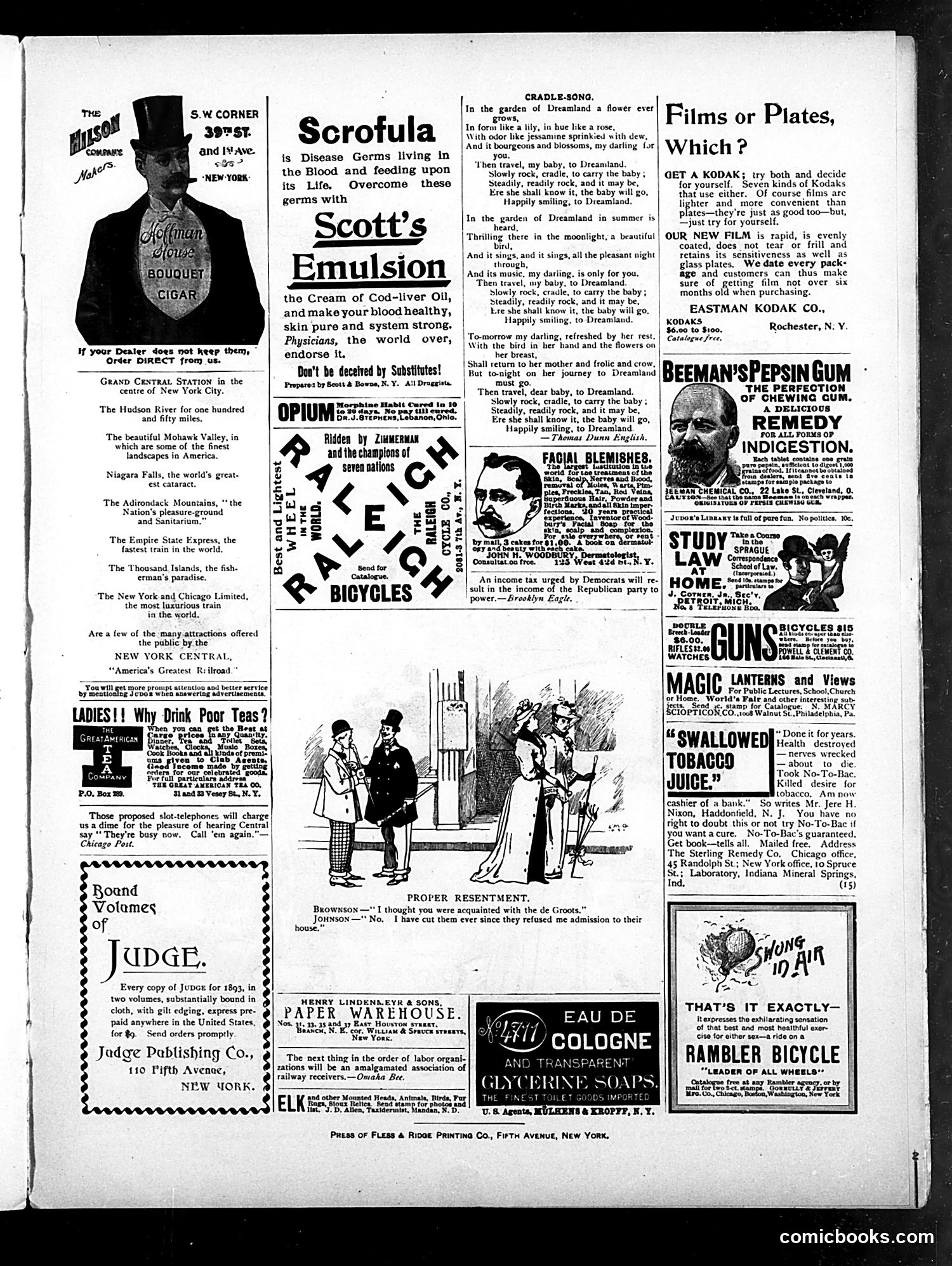
This page is primarily **advertising and product promotion**, typical of Judge magazine's commercial content. Key elements: **Advertisements include:** - Scott's Emulsion (cod-liver oil for treating scrofula, a real 19th-century disease) - Opium-based remedies (legal then, now shocking) - Raleigh Bicycles - Kodak cameras and film - Beeman's Pepsin Gum for indigestion - Various other products (guns, magic lanterns, soaps) **Editorial content:** - "Cradle-Song" poem about lulling a baby to sleep - Brief cartoon with caption "Proper Resentment" showing social interaction - Small political jab: Democrats' proposed income tax will reduce Republican party funds **Historical context for modern readers:** This reflects pre-FDA America when patent medicines openly contained narcotics, and advertising made extraordinary health claims. The page demonstrates how thoroughly commercialized Judge was, mixing satire with aggressive product marketing to affluent readers.
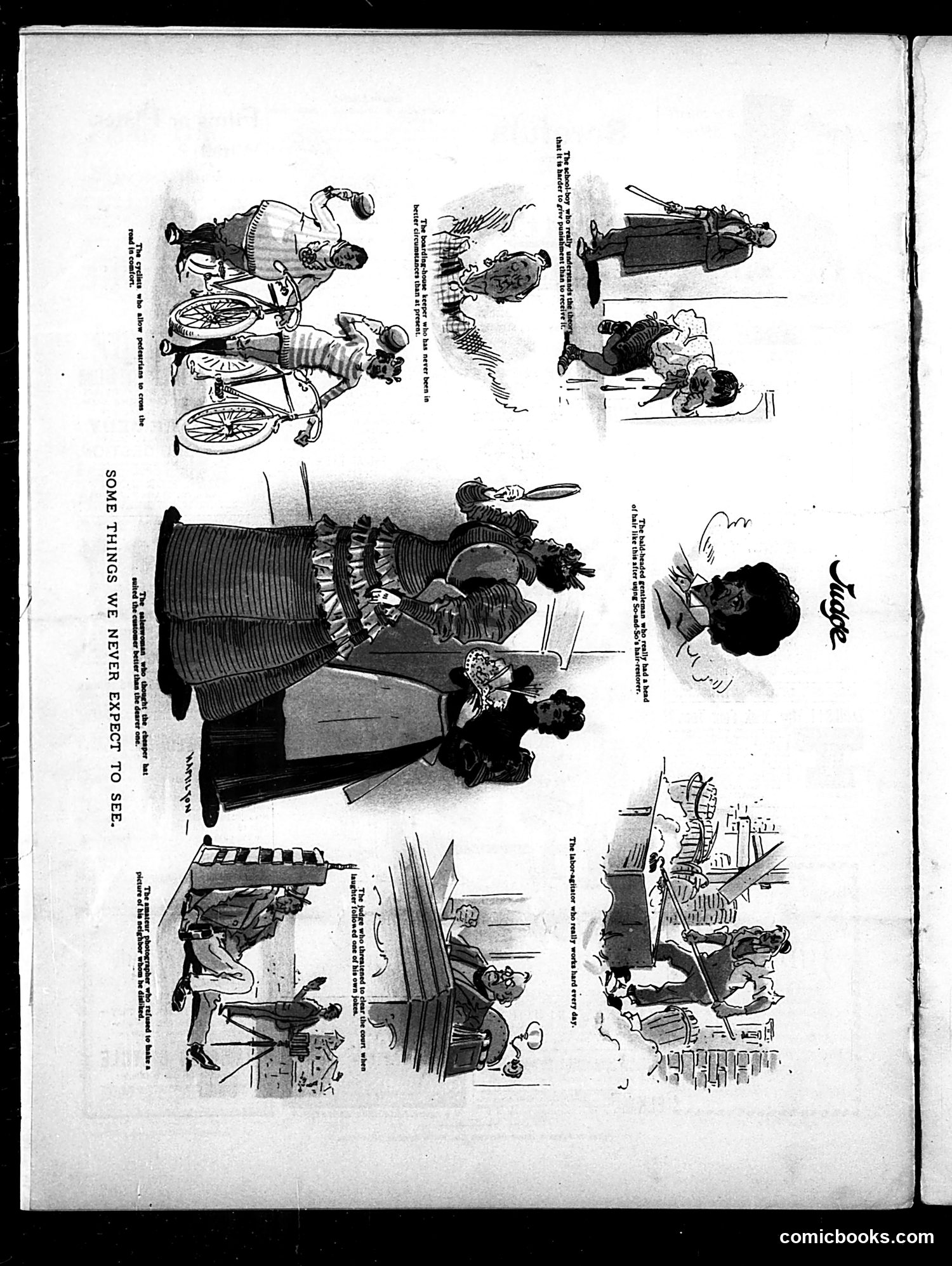
This is a satirical list-cartoon depicting impossible or highly unlikely scenarios, presented as social commentary through absurdist humor. The page shows six vignettes mocking various types of people: 1. **Bald man with hair** – satirizing dubious hair-restoration product claims 2. **Schoolboy accepting punishment** – suggesting children never truly learn obedience 3. **Boarding-house keeper content** – implying these proprietors are perpetually struggling financially 4. **Judge laughing at own jokes** – mocking judicial pomposity and self-awareness 5. **Cyclists yielding to pedestrians** – critiquing reckless cyclists who endanger the public 6. **Saleswoman recommending cheaper goods** – suggesting retail staff prioritize profit over customer honesty The humor relies on readers recognizing these social types and understanding that the scenarios are ironically "things we never expect to see"—implying these groups consistently behave oppositely. It's gentle social satire targeting consumer fraud, poor civic behavior, and professional dishonesty prevalent in the era.