
Judge, 1894-02-10 · page 4 of 16
Judge — February 10, 1894 — page 4: what you’re looking at
What you’re looking at
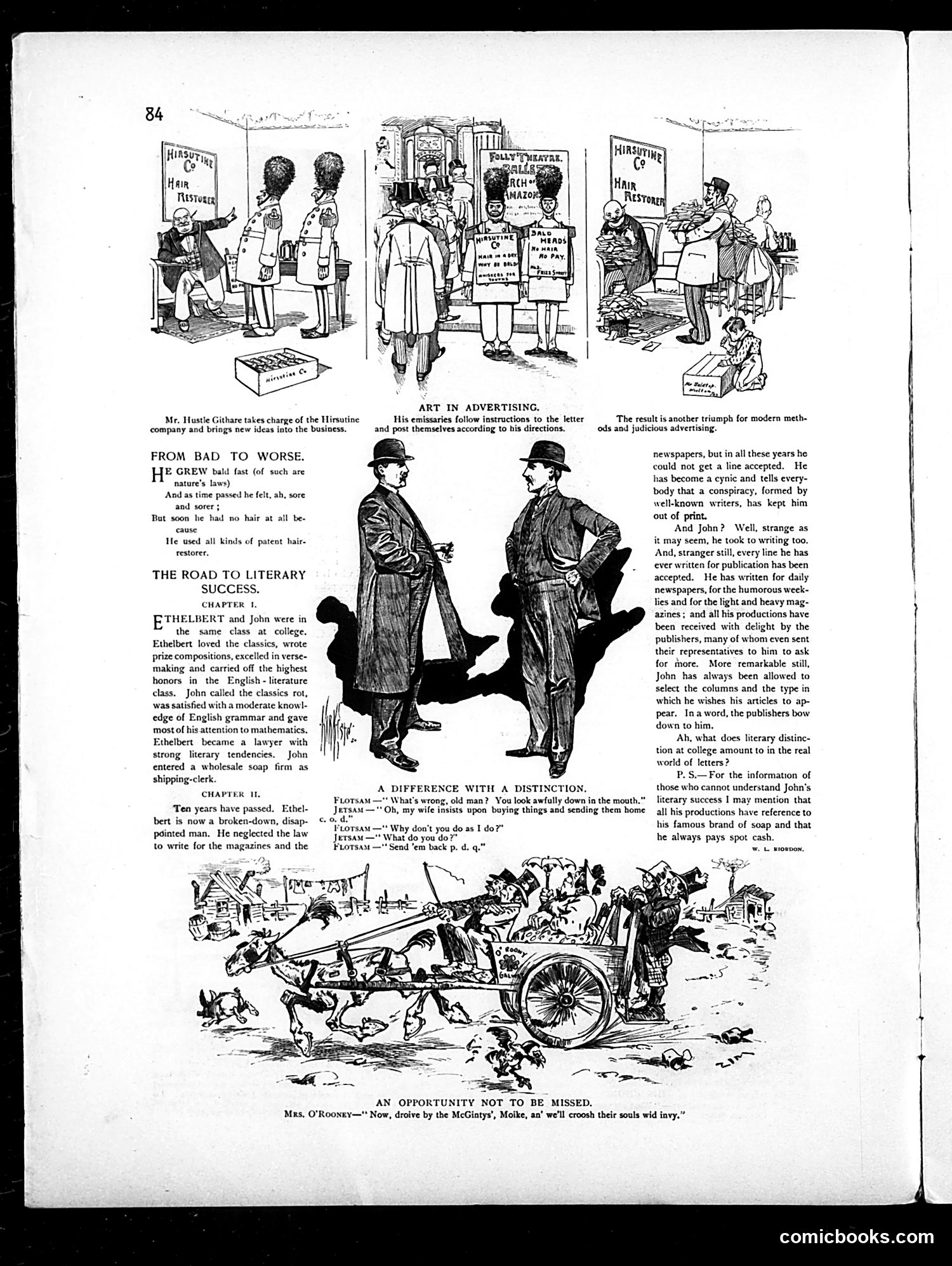
This page contains satirical commentary on American business and social aspiration circa early 1900s. **Top cartoons** mock patent medicine advertising and modern marketing tactics—specifically "Hirsutine Hair Restorer." The irony: a man uses hair-restoration products so aggressively he loses all his hair anyway. This satirizes the era's predatory patent medicine industry and gullible consumers. **"Road to Literary Success"** is the main satire: Ethelbert, a talented college writer who pursues serious literature, becomes a broke, bitter failure. John, an indifferent math student who enters soap manufacturing, becomes wildly successful as a writer—*because his articles advertise soap and he pays cash*. The joke skewers 1900s commercialism: literary merit means nothing; what publishers want is advertising revenue and reliable payment. John's "success" isn't talent but commercial utility. The P.S. punchline confirms this cynical reading. Minor cartoons mock Irish immigrants and mail-order purchasing culture—typical Judge fare targeting period anxieties.
📄 Transcribed text from this page (OCR, searchable)
Machine-transcribed from the original scan — historical spelling and the odd misread are preserved.
Mr. Hustle Githare takes charge of the Hirsutine company and brings new ideas into the business. FROM BAD TO WORSE. E GREW bald fast (of such are nature's laws) And as time passed he felt, ab, sore and sore Bat soon he had no hair at all be- cause He used all kinds of patent hair- restorer. THE ROAD TO LITERARY SUCCESS. CHAPTER 1. ETHELBERT and John were in the same class at college. Ethelbert loved the classics, wrote prize compositions, excelled in verse- making and carried off the highest honors in the English - literature class. John called the classics rot, was satisfied with a moderate knowl edge of English grammar and gave most of his attention to mathematics. Ethelbert became a lawyer with strong literary tendencies. John entered a wholesale soap firm as shipping-clerk. CHAPTER It, Ten years have passed, Ethel- bert is now a broken-down, disap- pointed man, He neglected the law to write for the magazines and the cs «0. 4. ART IN ADVERTISING. His emissaries follow instructions to the letter and post themselves according to his directions. A DIFFERENCE WITH A DISTINCTION, FLorsam —"' What's wrong, old man? You look awfully down in the mouth.” AM — FLorsast—" Why don’t you do as I do?” Jersa'—" What do you do?" Frorsast —“* Send ‘em back p. d. 4." Oh, my wife insists upon buying things and sending them home AN OPPORTUNITY NOT TO BE MISSED. Mrs. O'Rooxey—"* Now, droive by the McGintys’, Moike, an’ we'll croosh their souls wid invy.” ‘The result is another triumph for modern meth- ods and judicious advertising. newspapers, but in all these years he could not get a line accepted. He has become a cynic and tells every- body that a conspiracy, formed by well-known writers, has kept him out of print, And John? Well, strange as it may seem, he took to writing too. And, stranger still, every line he has ever written for publication has been accepted. He has written for daily newspapers, for the humorous week- lies and for the light and heavy mag- azines; and all his productions have been received with delight by the publishers, many of whom even sent their representatives to him to ask for more. More remarkable still, John has always been allowed to select the columns and the type in which he wishes his articles to ap- pear. Ina word, the publishers bow down to him, Ah, what does literary distine- tion at college amount to in the real world of letters? P. S.—For the information of those who cannot understand John’s literary success I may mention that all his productions have reference to his famous brand of soap and that he always pays spot cash. comicbooks.com