
A complete issue · 16 pages · 1894
Judge — January 20, 1894
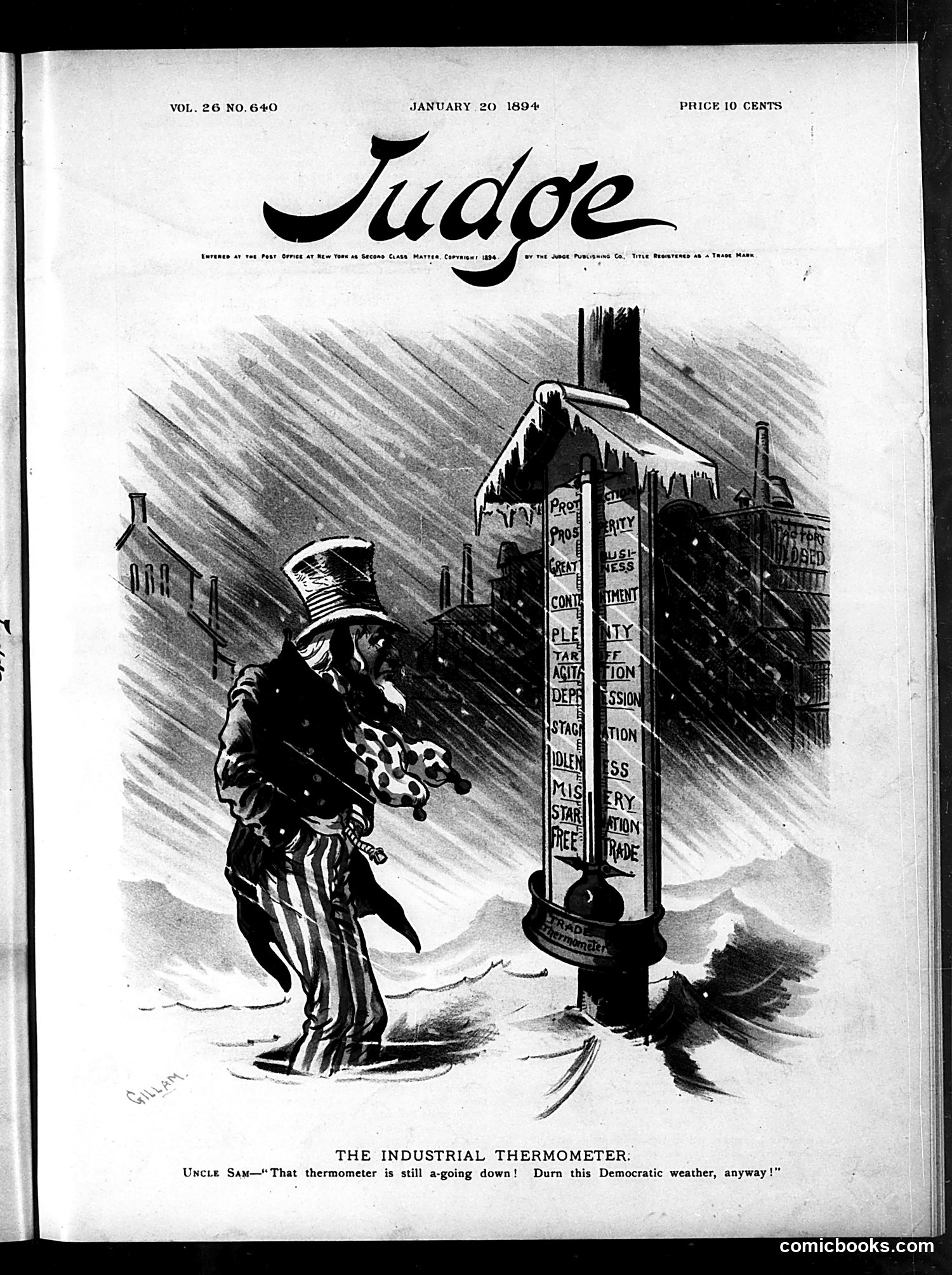
This political cartoon depicts **Uncle Sam** (identifiable by his characteristic top hat and striped pants) observing a large thermometer labeled with various economic and industrial terms: "Prosperity," "Business," "Confidence," "Trade," and others—all pointing downward. The caption reads: "That thermometer is still a-going down! Durn this Democratic weather, anyway!" The satire criticizes the **Democratic administration** (likely President Cleveland's) for economic decline during what appears to be the severe **Panic of 1893**. The "thermometer" metaphor represents industrial conditions and business confidence, which have plummeted. Uncle Sam blames the Democratic "weather"—meaning Democratic policies—for the economic cold snap devastating American industry and commerce.
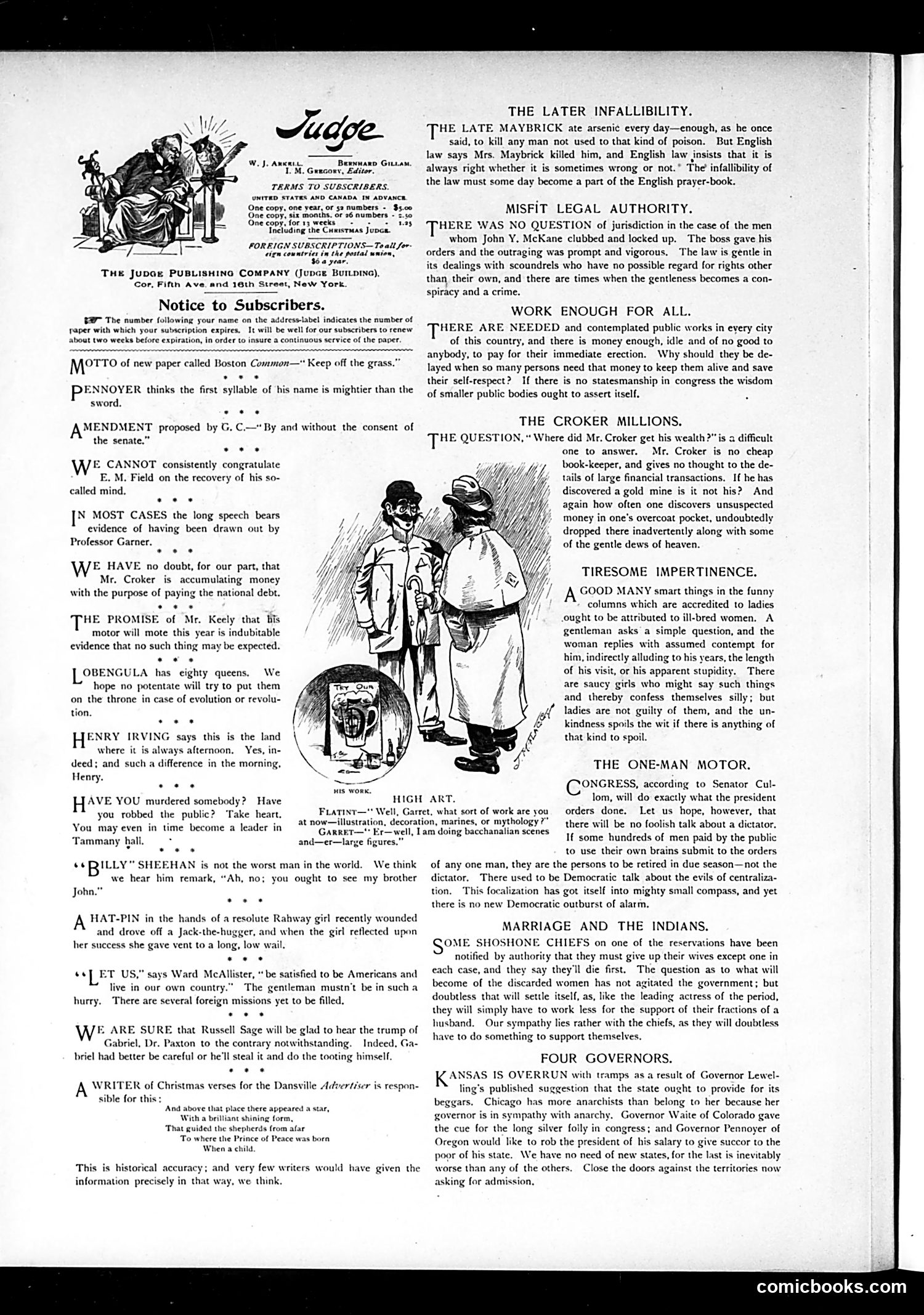
This page contains editorial commentary rather than cartoons. The sections critiquing "The Later Infallibility" and "Misfit Legal Authority" appear to reference a legal case involving John V. McKane, who is described as having "clubbed and kicked up" someone. The text suggests McKane abused his authority, with Judge defending the rule of law against his misconduct. The "Croker Millions" section satirizes Richard Croker, a Tammany Hall political boss, questioning how he accumulated wealth through "large financial transactions" and unexpectedly discovering money—implying corruption. "Four Governors" criticizes governors of Kansas, Chicago, and Oregon for being corrupt or sympathetic to anarchists and beggars, suggesting mismanagement and poor governance. The page reflects late-19th-century concerns about urban political corruption and judicial overreach.
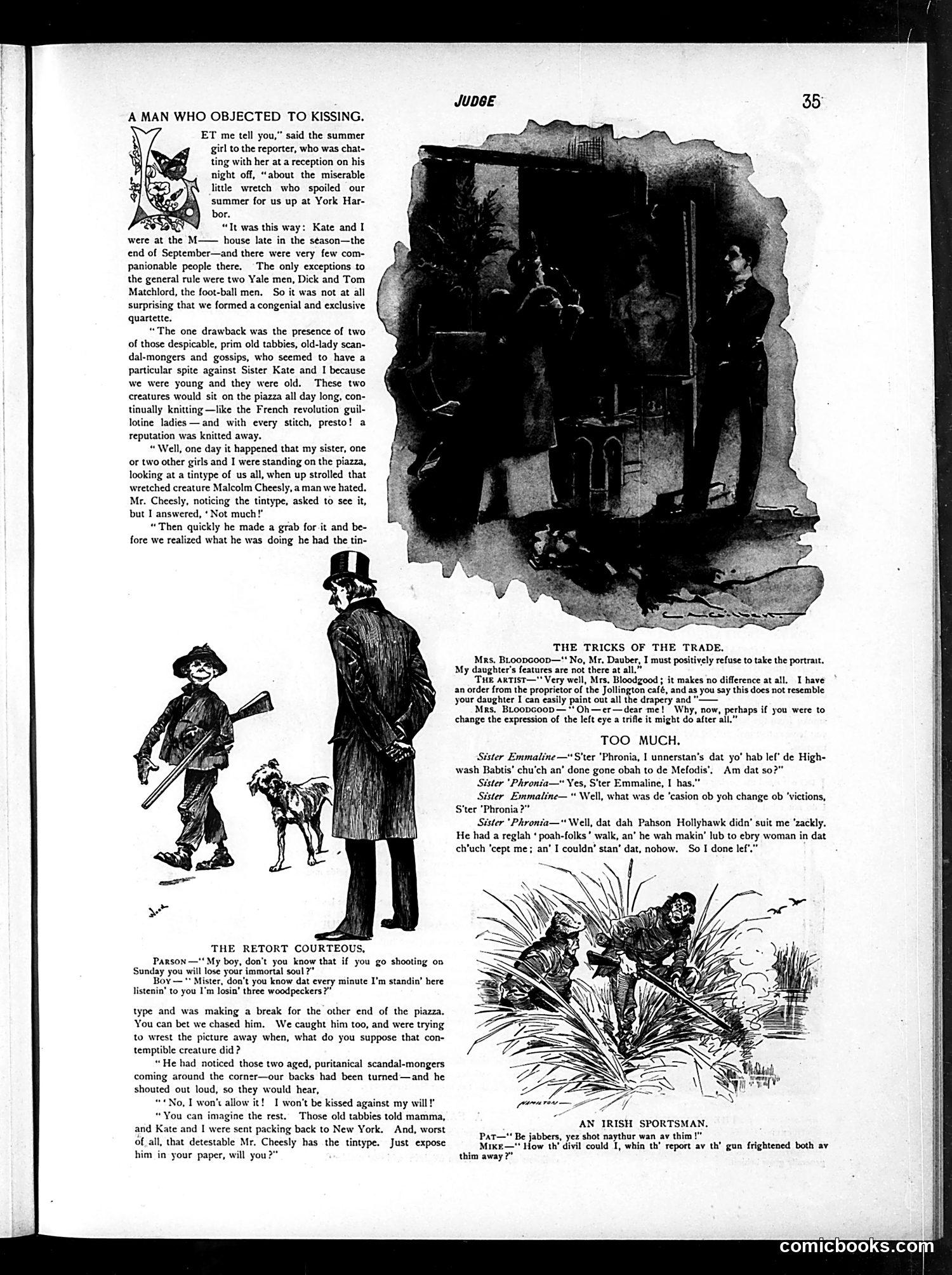
This page contains three separate humorous anecdotes with illustrations: 1. **"A Man Who Objected to Kissing"**: A story about an encounter at York Harbor where a man named Malcolm Chesely objected to being kissed by the narrator's sister. The joke hinges on his unexpected prudishness and his later embarrassment when caught attempting to kiss her. 2. **"The Tricks of the Trade"**: A brief exchange between Mrs. Bloodgood and Mr. Dasher about portrait photography, with wordplay about changing facial expressions. 3. **"Too Much"**: Dialect-heavy dialogue between sisters Emmeline and Phrenia about Parson Thironia and "Ster" (Sister) Phronia's romantic troubles, using exaggerated phonetic spelling for comic effect. 4. **"The Report Courteous"** and **"An Irish Sportsman"**: Brief joke exchanges about hunting and shooting. The humor relies on social observations, character types, and period dialect comedy rather than political satire.
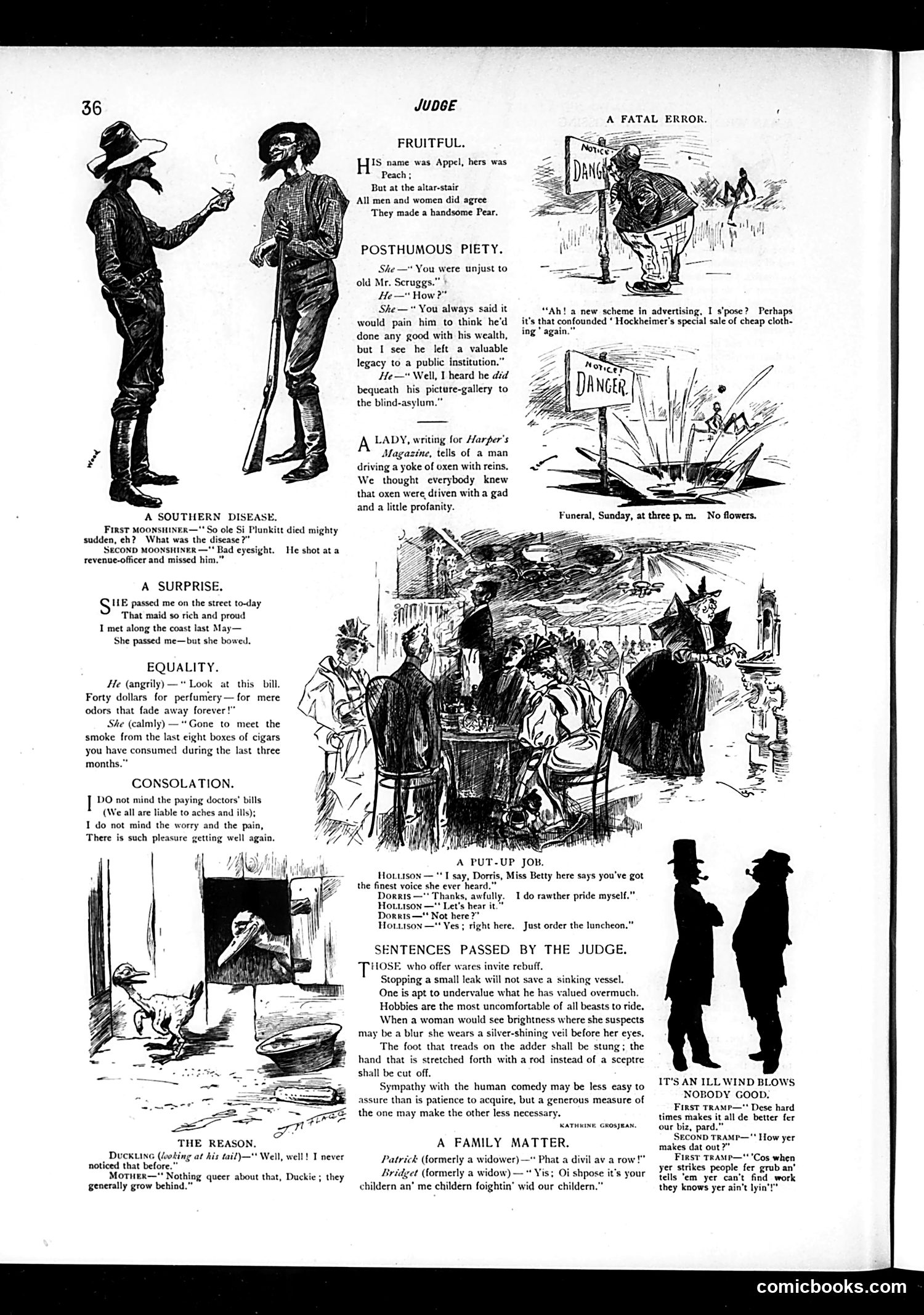
This page from the satirical magazine *Judge* contains multiple short humor pieces typical of late 19th/early 20th-century American comedy: **"Equality"** mocks gender double standards: a husband complains about his wife's perfume expenses while she points out his cigar smoking costs more—suggesting hypocrisy in marital finances. **"Posthumous Piety"** satirizes false respectability: a man claimed to despise charity during life, yet donated his art collection to a blind asylum after death—the irony being the donation is useless to its intended recipients. **"A Family Matter"** uses ethnic Irish dialect humor (common but now offensive) about blended families fighting among themselves. **Minor pieces** include wordplay ("Fruitful"—surnames Appel and Peach make a Pear), observations about social pretense, and tramp humor. The cartoons accompanying these jokes use exaggerated illustrations typical of the era's satirical style. The overall tone reflects Judge's irreverent approach to marriage, class, hypocrisy, and contemporary social behavior.
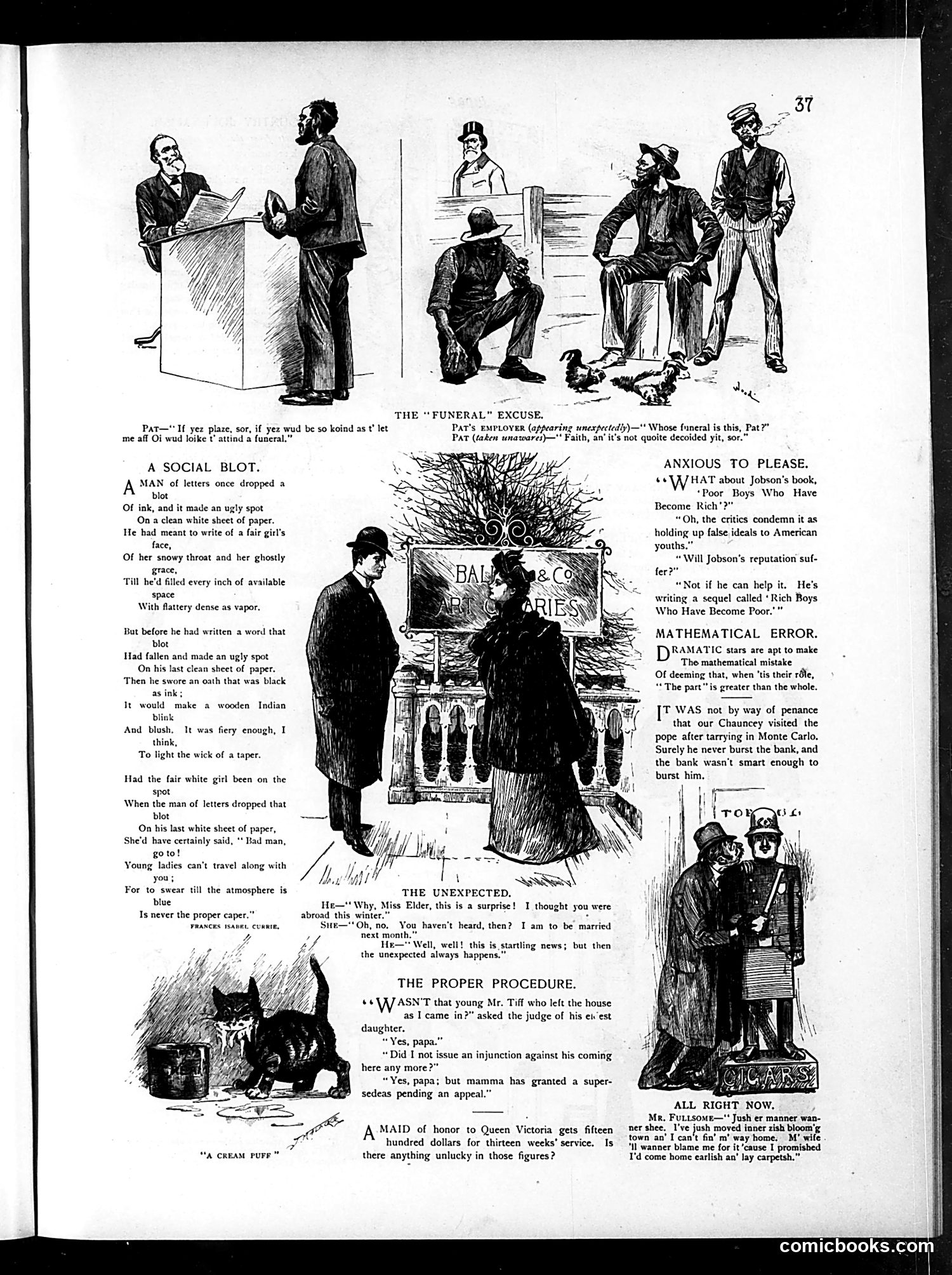
This page contains several satirical pieces mocking contemporary social foibles: **"The Funeral Excuse"** depicts an Irish servant (Pat, identified by dialect) claiming a funeral to skip work—a common excuse his employer catches him unprepared for, suggesting the excuse's transparency. **"A Social Blot"** is a moralistic poem about a man whose ink blot ruins his letter, then he curses so profanely a girl couldn't accompany him—the "blot" becomes metaphorical for moral failing. **Other brief satirical items** mock: - Literary pretension (Jobson's book) - Theatrical ego ("the part greater than the whole") - Legal absurdities (a mother issuing a "supersedeas" against a suitor) - Gambling culture (references to Monte Carlo and "bursting the bank") - Marital incompetence (the drunk husband unable to find home) The humor targets Victorian-era class anxieties, immigrant stereotypes, and middle-class aspirations through exaggeration and wordplay typical of *Judge* magazine's satirical approach.
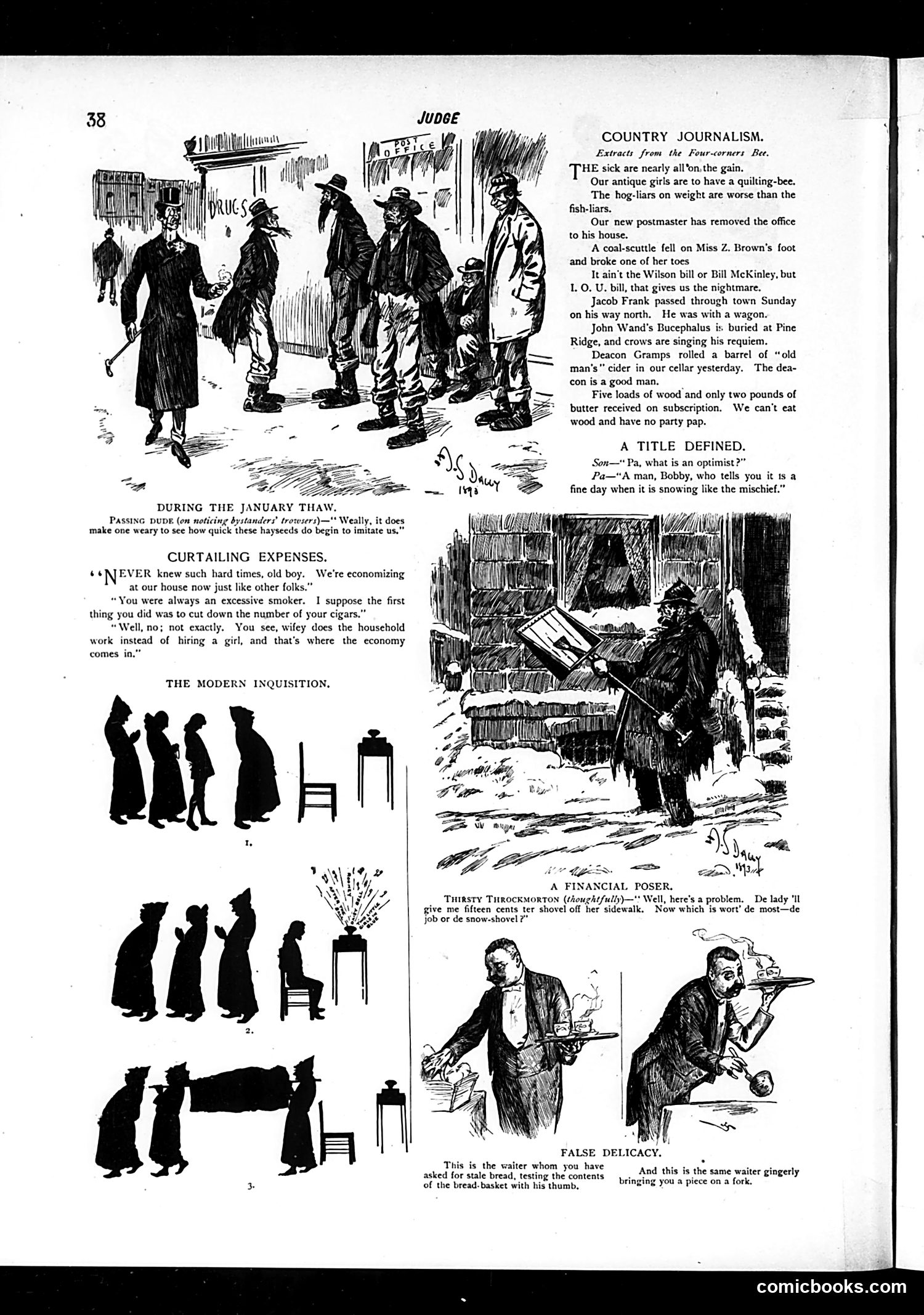
This page contains multiple satirical pieces targeting 1890s American social issues: **"During the January Thaw"** mocks urban dandies ("passing dude") who affect superiority over rural people ("hayseeds"), yet rural fashion quickly mimics city styles—undermining claims of class distinction. **"Curtailing Expenses"** jokes about economic recession (likely 1890s depression): a husband claims frugality by eliminating the hired housemaid, forcing his wife to do manual labor—presenting this as "economy" rather than admitting financial desperation. **"Country Journalism"** satirizes rural newspaper content as trivial gossip (broken toes, dead horses) mixed with cryptic references (unclear political bills), suggesting country papers prioritize local scandal over substantive news. **"The Modern Inquisition"** silhouettes show interrogation scenarios, though specific context is unclear from this excerpt. **"False Delicacy"** mocks waiter hygiene: they test bread freshness with unwashed thumbs, then pretend refinement serving it with fork—exposing class pretense masking unsanitary practices. The overall theme: exposing hypocrisy across social classes.
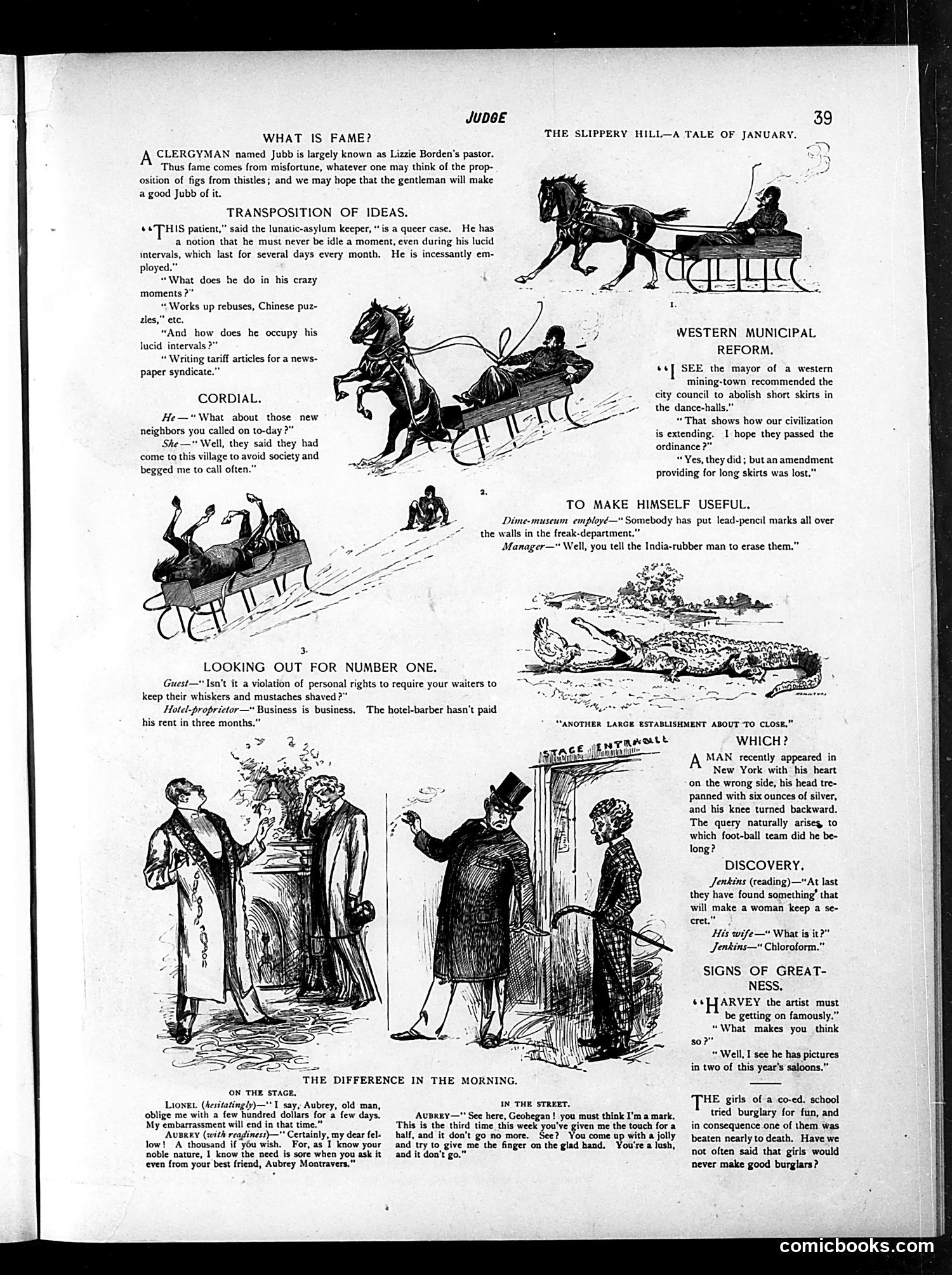
This page contains multiple short satirical pieces typical of late-19th-century American humor magazines: **"What Is Fame?"** jokes that Reverend Jubb gained prominence merely as Lizzie Borden's pastor—referencing the notorious 1892 murder case, satirizing how misfortune creates undeserved fame. **"Transposition of Ideas"** presents ironic contrast: an asylum patient works productively during madness but writes tariff articles during lucidity, mocking political journalism as inherently irrational. **"Western Municipal Reform"** satirizes municipal hypocrisy: a mining-town mayor champions abolishing short skirts in dance halls as "civilization," but the ordinance fails—suggesting progressive-era reformism lacks substance. **"Discovery"** presents a crude misogynistic joke about women and secrets, typical of period humor. Other pieces mock hotel proprietors, sports figures, and social pretension. The sledding illustrations ("Slippery Hill") appear decorative, accompanying winter-themed content. Overall, the page exemplifies Judge's satirical approach to American politics, morality, and social foibles.
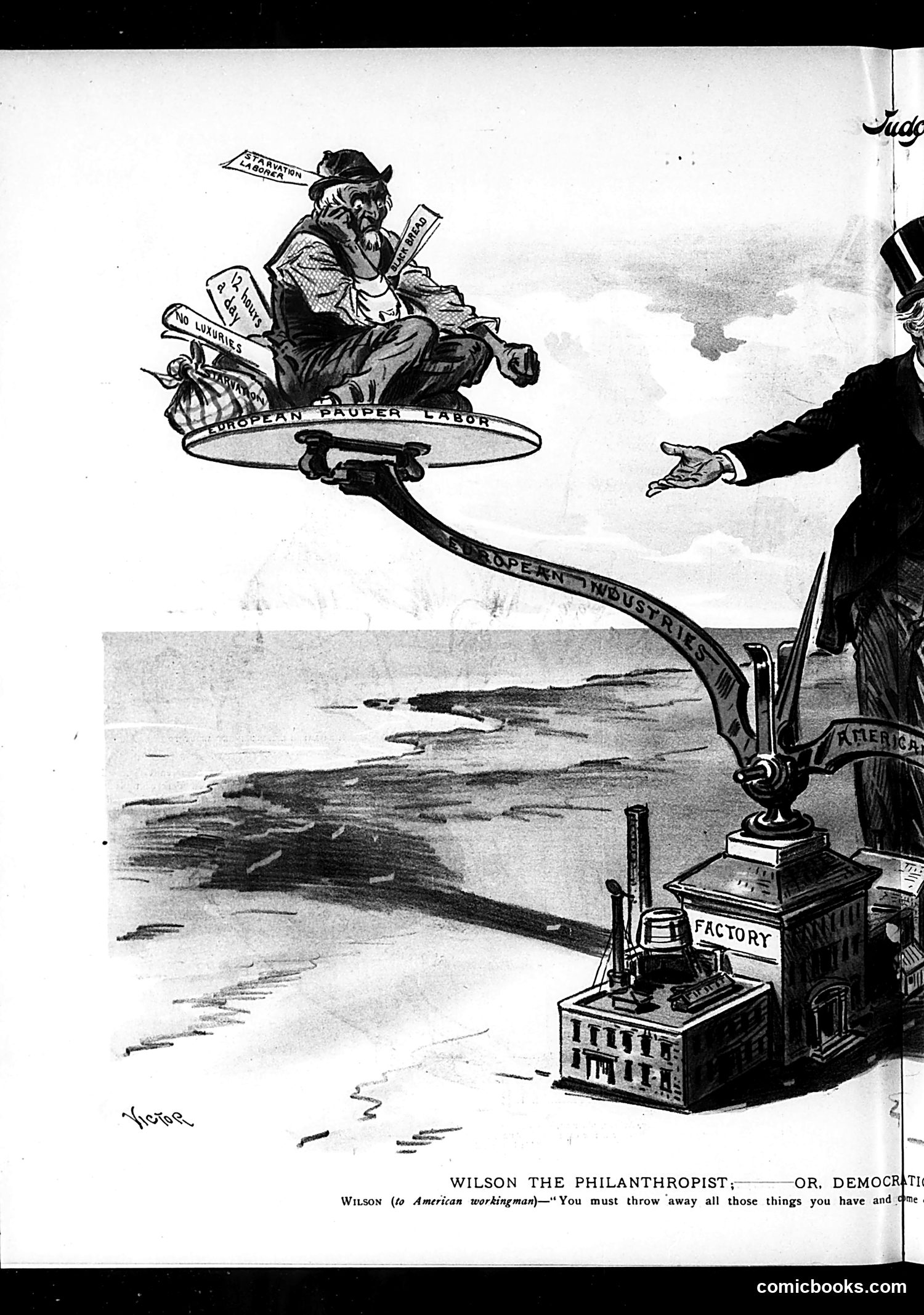
This Judge magazine cartoon satirizes President Wilson as a hypocritical "philanthropist." The caricatured Wilson figure, balanced precariously on a platform labeled "European Labor" and "Pauper Labor," is being manipulated by a figure representing American industry/capital (the factory owner on the right). The satire mocks Wilson's stated progressive ideals about workers' welfare while suggesting he actually serves industrial interests. The caption—"You must throw away all those things you have"—implies Wilson demands American workers sacrifice their living standards, supposedly for noble causes, while wealthy industrialists profit. The cartoon criticizes the disconnect between Wilson's philanthropic rhetoric and policies that allegedly benefited big business over working people, a common Democratic Party critique during this era.
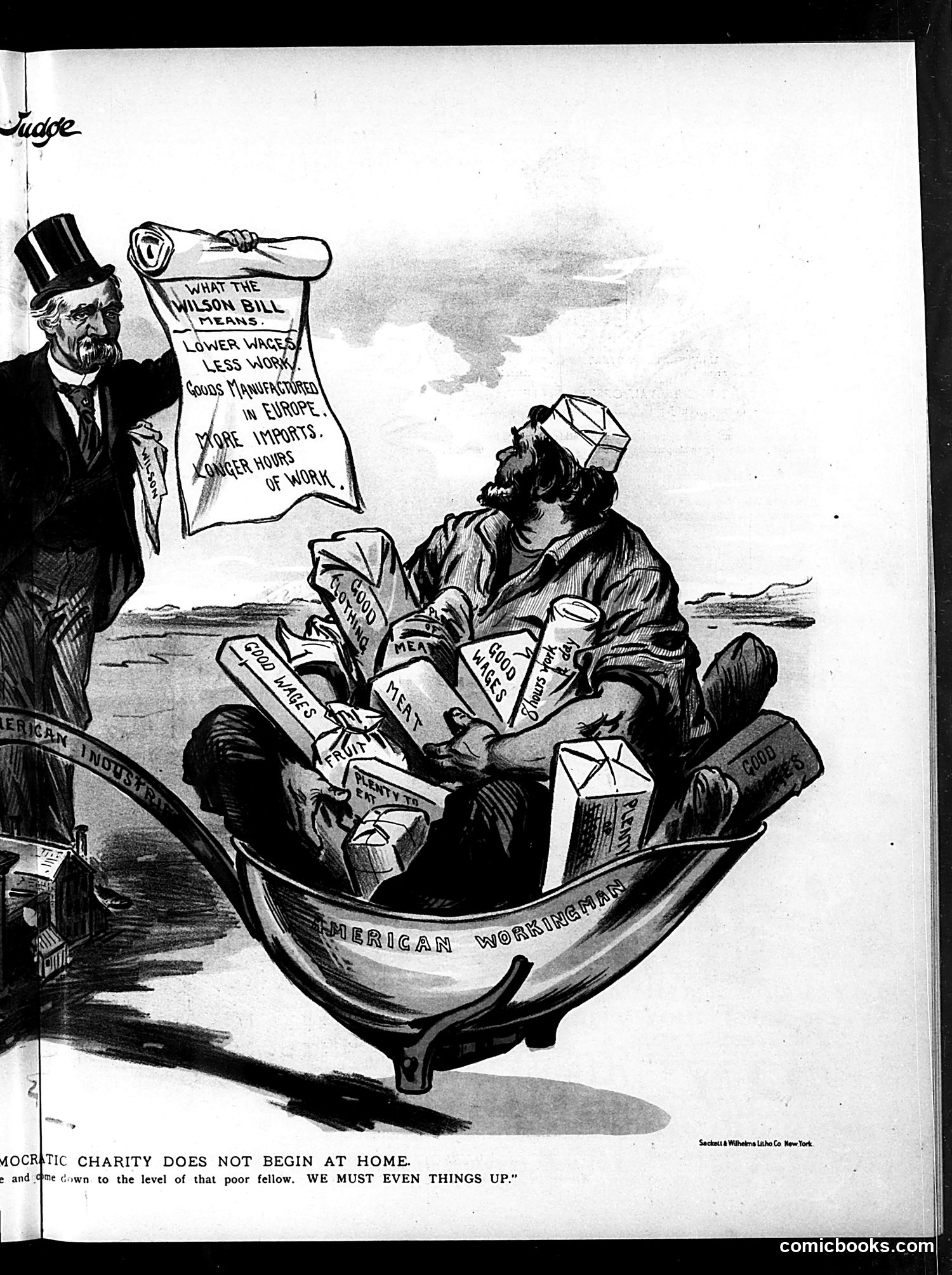
This cartoon criticizes the Wilson administration's tariff policy. A well-dressed aristocratic figure (representing wealthy interests) displays a scroll listing the Wilson Bill's supposed consequences: lower wages, less work, goods manufactured abroad, more imports, and longer working hours. Meanwhile, working-class Americans sit in a boat labeled "American Workingman," surrounded by food packages and goods, appearing impoverished despite abundance. The caption's incomplete text suggests irony about "evening things up"—the cartoon argues that Democratic policies claiming to help workers actually harm them through reduced wages and employment while benefiting foreign manufacturers. The satire attacks the contradiction between the administration's charitable rhetoric toward labor and the actual economic consequences of their tariff legislation.
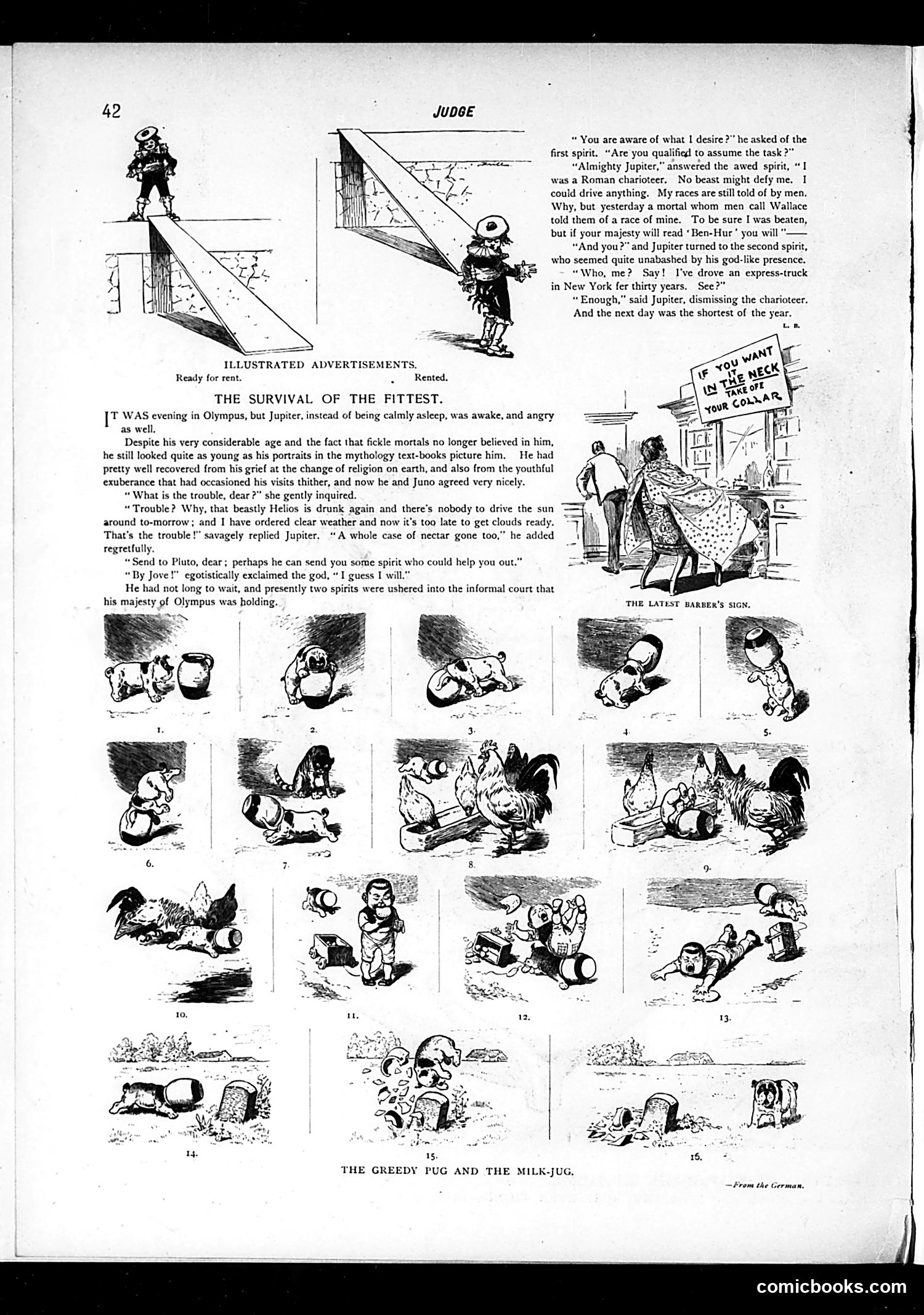
This story satirizes the decline of classical mythology in modern America. Jupiter, needing a charioteer to drive the sun, summons two spirits: an ancient Roman charioteer and a modern New York express-truck driver. The joke contrasts old and new: the Roman boasts of historical accomplishments ("Ben-Hur" references the famous novel), while the New York driver dismissively claims thirty years of mundane trucking experience. Jupiter dismisses the classical figure as obsolete and accepts the modern working man instead. The title "Survival of the Fittest" mocks evolution theory by suggesting modern mediocrity (a truck driver) outcompetes classical greatness (a legendary charioteer). The satire critiques American culture's dismissal of classical education and tradition in favor of modern practicality, however banal. The punchline—"the next day was the shortest of the year"—suggests the incompetent driver bungled the job.
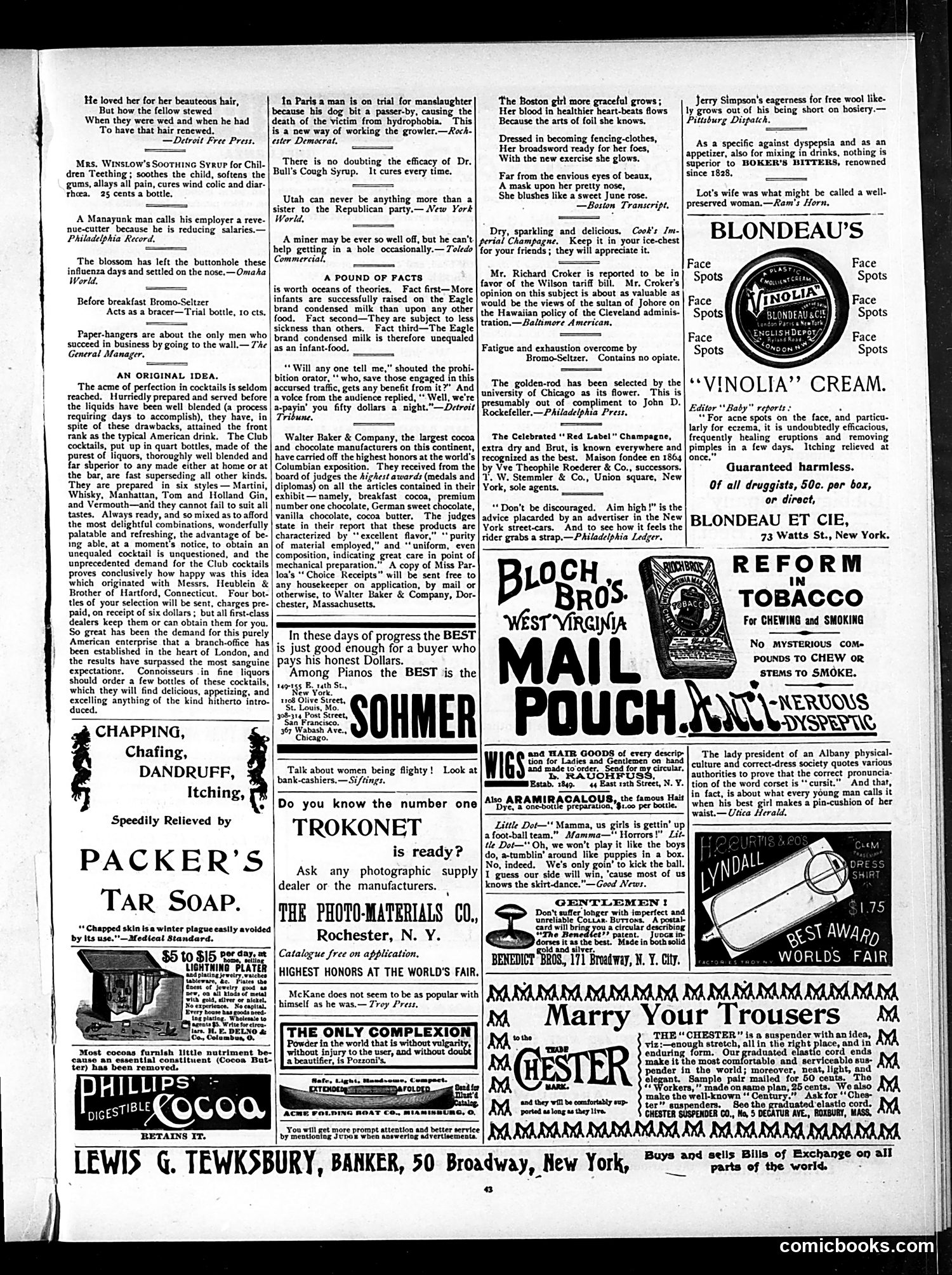
This is primarily a **advertisements and humor column page**, not a political cartoon. The page contains short satirical quips about contemporary life, interspersed with product advertisements. The humor relies on wordplay and social observation rather than visual satire. Notable examples: a man annoyed that his new wife's hair requires constant renewal; a prohibition speaker heckled by someone benefiting financially from the liquor trade; paper-hangers succeeding by "going to the wall" (a pun on bankruptcy). The page reflects **turn-of-the-century American consumer culture**, heavily advertising products like Bromo-Seltzer, Mrs. Winslow's Soothing Syrup, and Heublein cocktails. One quip mocks Utah's Republican politics; another references a French legal case involving a dog-bite death. The content suggests *Judge* blended lightweight social commentary with commercial promotion—typical for satirical magazines of this era that relied on advertising revenue. No specific political figures or major events are identifiable on this page.
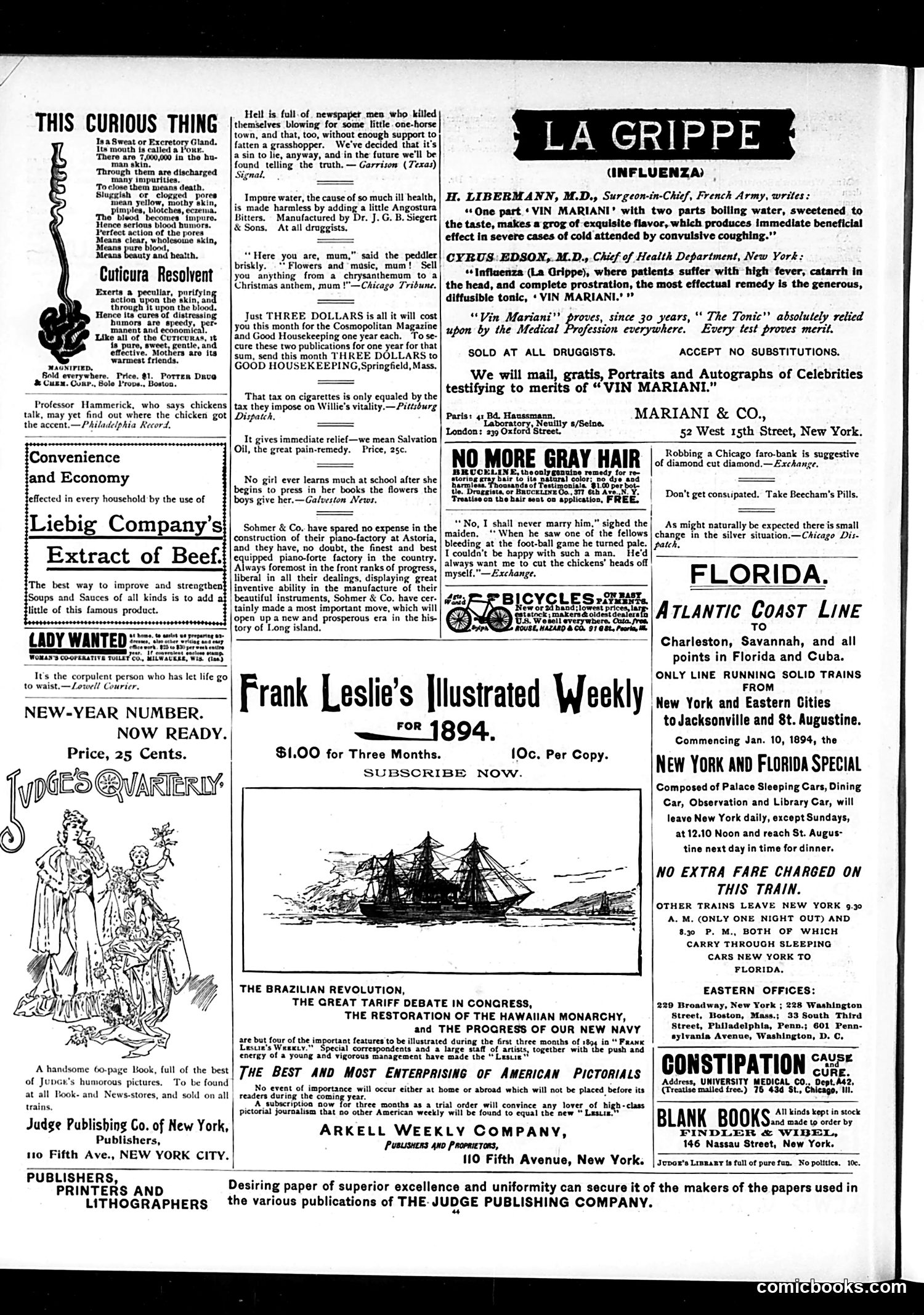
This is primarily an **advertising and miscellaneous content page** from Judge's 1894 New Year issue, not a political cartoon page. The notable content includes: **Medical Advertisements**: Multiple ads promote patent remedies for "La Grippe" (influenza), then a serious epidemic concern. Doctors endorse "Vin Mariani" and other tonics as treatments—reflecting 1890s medical practice where alcohol-based patent medicines were standard. **Satirical Quips**: Brief humor pieces mock contemporary life: a Texas newspaper editor renounces lying; a professor studies talking chickens; complaints about life-insurance schemes targeting newspaper writers; and observations about courtship and school. **Product Ads**: Cuticura skincare, Liebig's beef extract, piano manufacturers, and railroad services (Atlantic Coast Line to Florida). The page demonstrates how **Judge mixed satire with advertising**—the humor is gentle, topical observation rather than sharp political commentary. The predominance of patent medicine ads reflects widespread influenza concerns during this period and the era's unregulated pharmaceutical market.
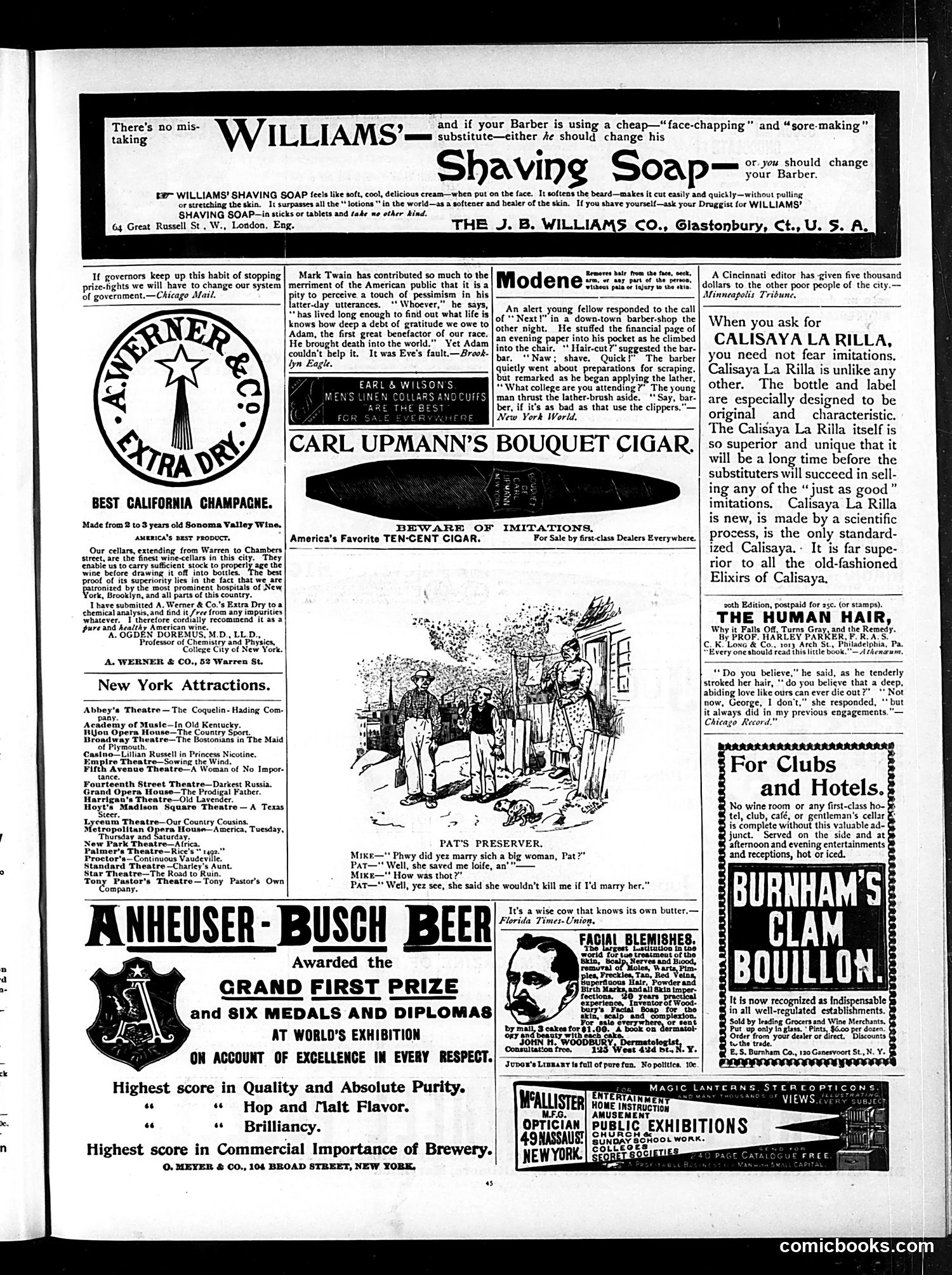
This page is primarily **advertising**, with minimal satirical cartoon content. The main advertisement is Williams' Shaving Soap, which dominates the upper portion with claims about superiority over cheap substitutes. The only clearly identifiable cartoon is "Pat's Preserver," a small dialogue-based joke at the bottom featuring what appears to be Irish characters (suggested by "Pat" and "yez"), though the joke text is partially cut off and unclear. There's also a brief text anecdote about **Mark Twain**, noting his recent pessimistic comments blaming Adam for introducing death to humanity. The passage gently mocks Twain's pessimism while crediting him as a major contributor to American public entertainment. The remainder comprises ads for champagne, cigars, hair removal products, and a listing of New York theaters—typical period advertising content. **No significant political satire or social commentary is evident** on this particular page.
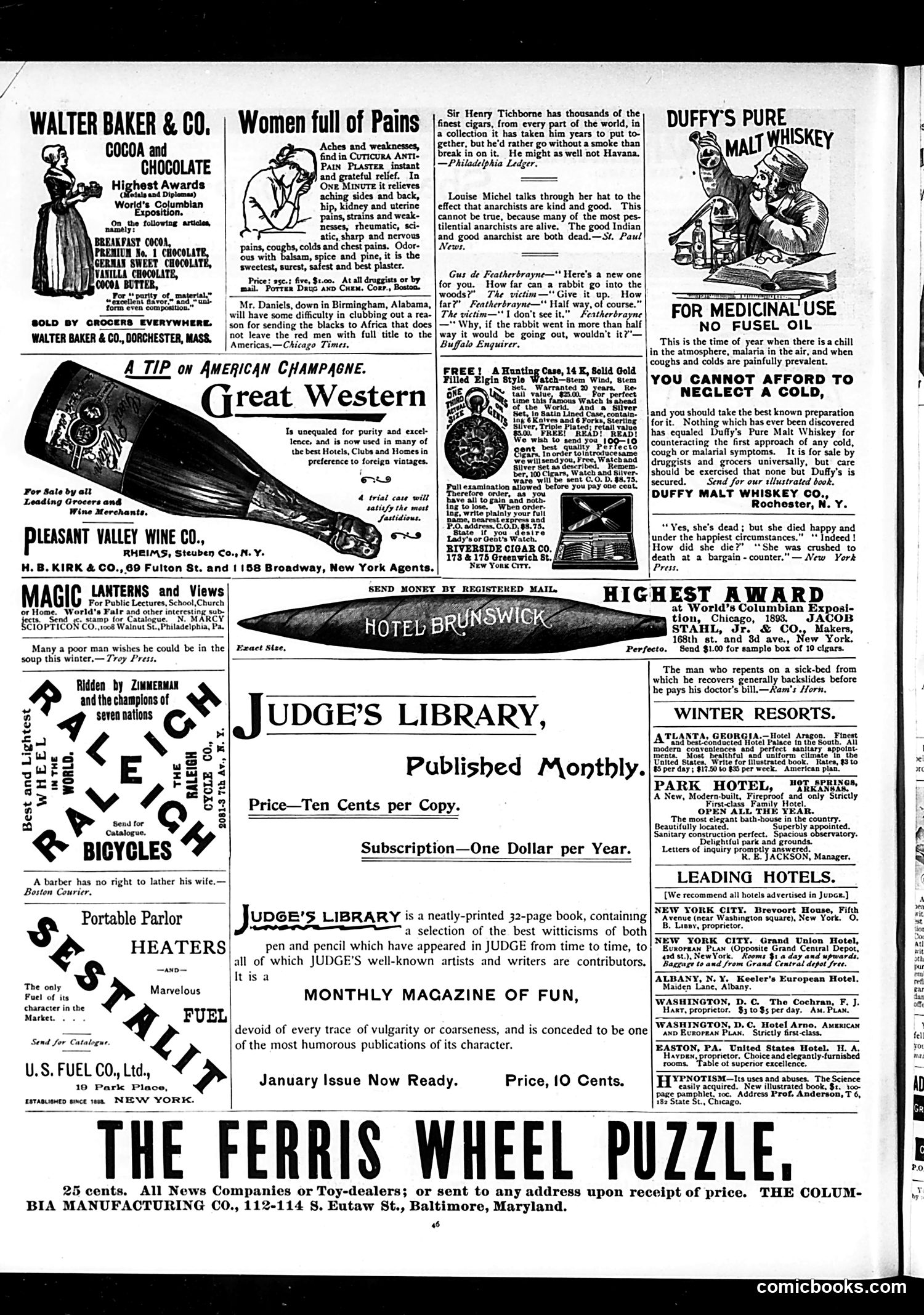
This is primarily an **advertising page** from Judge magazine, circa 1880s-1890s, with minimal editorial content. The few non-advertisement items are brief satirical snippets: 1. **The "Chicago Times" quote** about Mr. Daniels and colonization: This references a contemporary debate over sending African Americans ("blacks") to Africa, with the satirical point being that such logic would equally justify relocating Native Americans ("red men"), exposing the absurdity of the proposal. 2. **Louise Michel reference**: Michel was a famous French anarchist and Communard. The satire mocks her claims that anarchists are "kind and good"—the writer dismisses this as false since many anarchists remain alive (implying only dead anarchists are good). 3. **Various short joke items**: Brief humorous observations on topics like cigars, rabbits, and marriage. The page is dominated by period product advertisements (cocoa, wine, whiskey, bicycles, heaters) rather than substantive political cartoons or commentary.
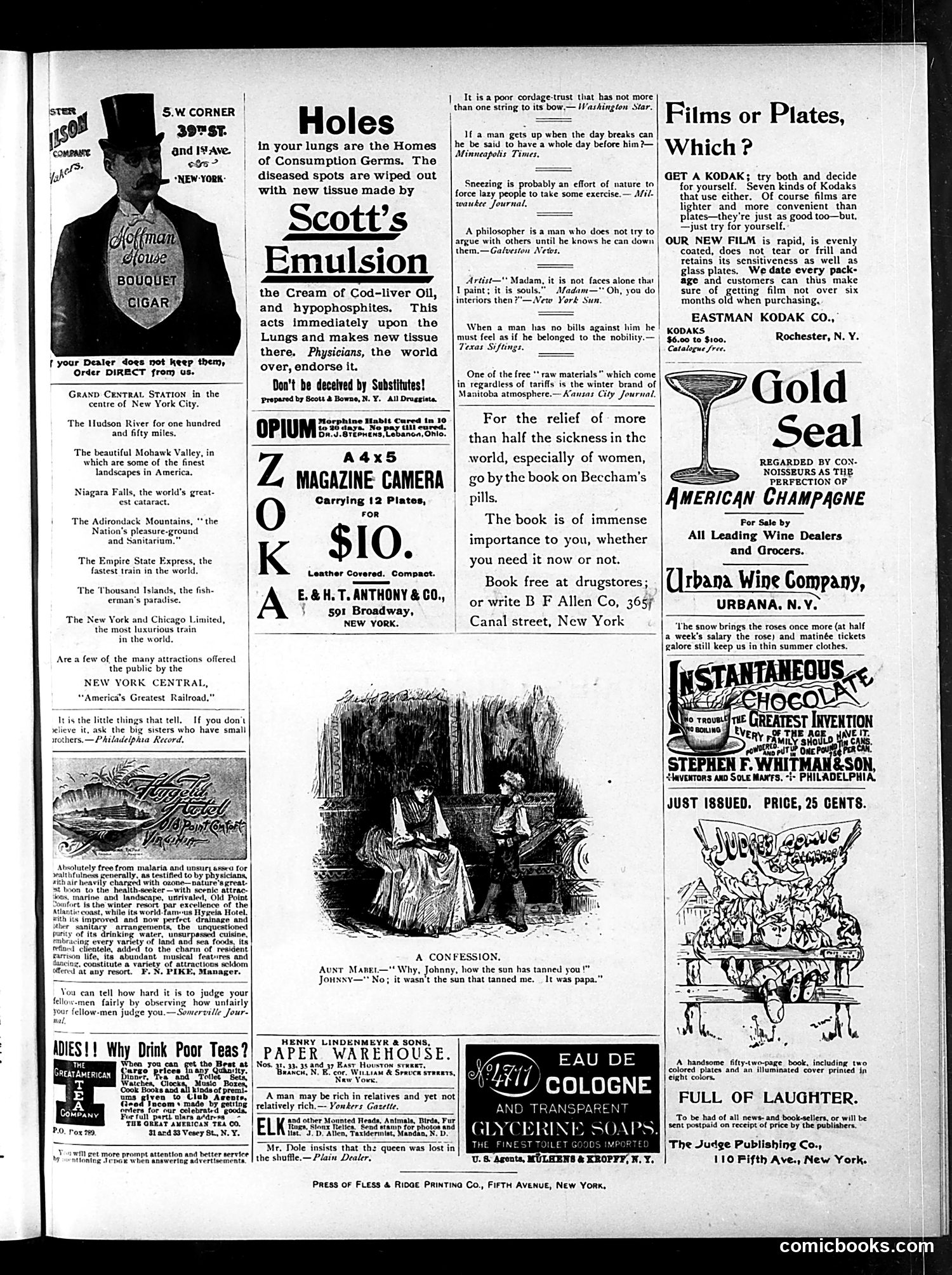
This page is primarily **advertising with minimal cartoon content**. The main visual element is a small domestic scene captioned "A Confession," showing a mother and child, where the boy claims his father (not the sun) gave him his tan—likely a joke about corporal punishment. The page consists largely of **turn-of-the-century product advertisements** for Scott's Emulsion (a tuberculosis remedy), cameras, champagne, chocolate, and various patent medicines. Several brief humorous quotations appear, touching on generic topics: trusts, daily schedules, philosophy, and tariffs. The **New York Central Railroad advertisement** promotes tourist attractions like Niagara Falls and the Adirondacks—typical period travel marketing. Most notably, **multiple ads promote dubious medical treatments**: opium addiction cures and consumption (tuberculosis) remedies. This reflects the era's unregulated patent medicine industry before FDA oversight. The page demonstrates how **satire magazines monetized through aggressive advertising** while maintaining lighter editorial content.
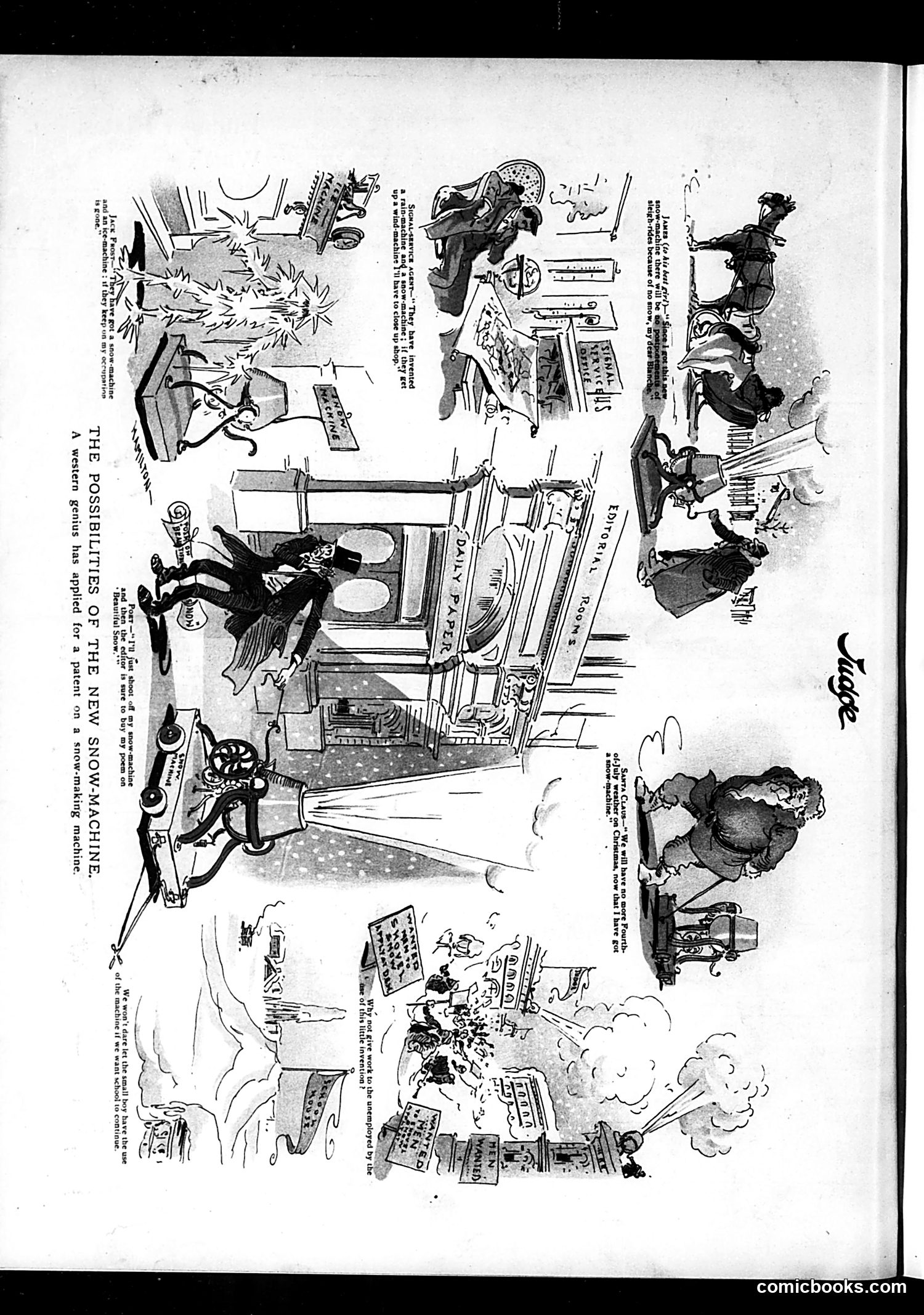
This Judge cartoon satirizes a recent invention: a mechanical snow-making device patented by "a western genius." The satire operates on multiple levels: **The main joke**: Santa Claus boasts he'll eliminate unseasonable warm weather on Christmas, while a "Stormy Weather Agent" (personifying natural weather patterns) fears automation will put him out of work—echoing contemporary anxieties about machines displacing human labor. **Secondary humor**: Various characters debate the machine's utility. A small boy wants to use it for mischief, while educators worry it will disrupt school schedules. Someone jokes about selling poems about "relief" (unemployment assistance), implying the invention creates joblessness. **Historical context**: This reflects late-19th/early-20th century American optimism about technological solutions to everyday problems, coupled with working-class concerns about mechanization replacing human work—a persistent tension of the Industrial Age.