
A complete issue · 16 pages · 1893
Judge — July 8, 1893
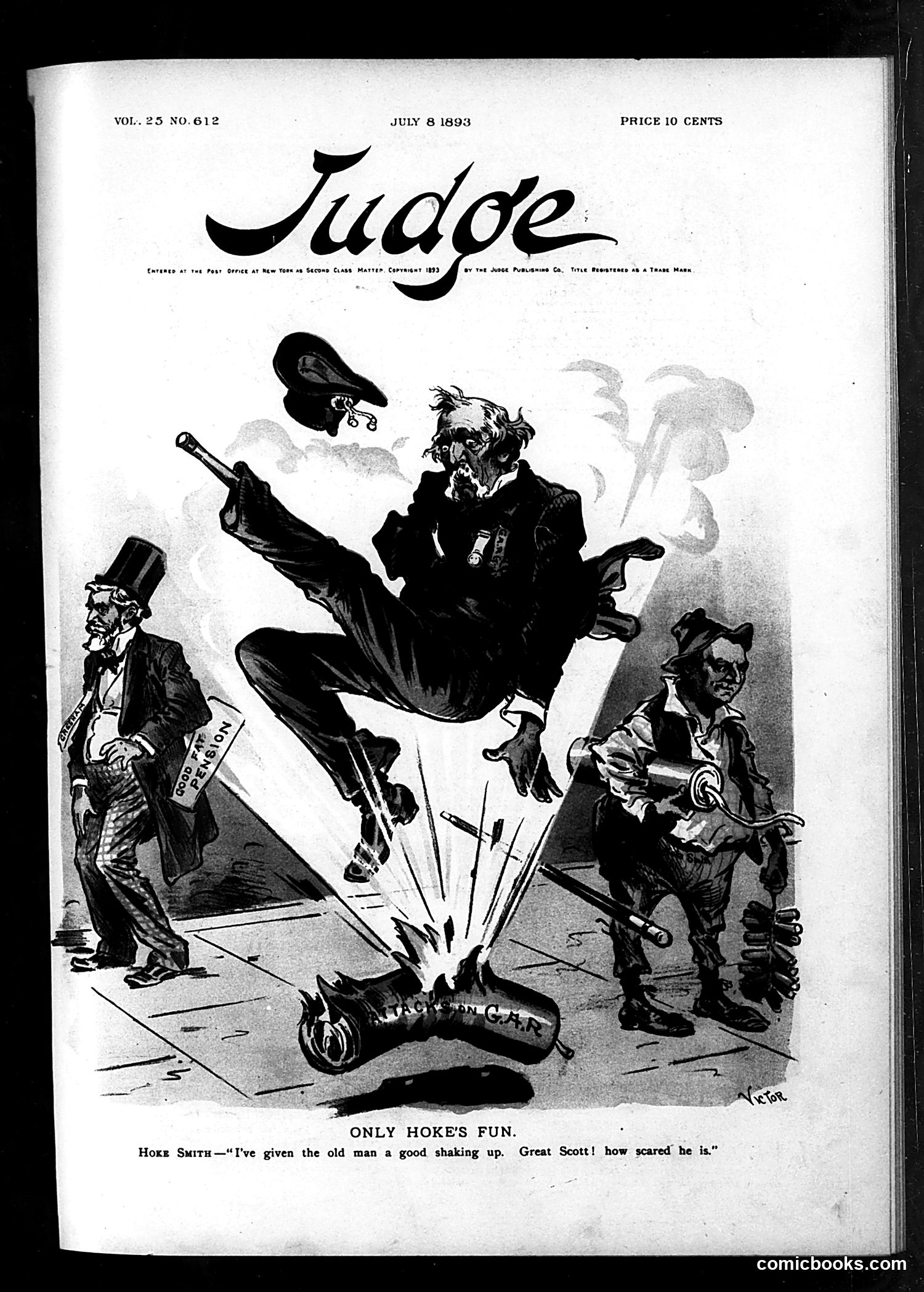
**"Only Hoke's Fun"** This political cartoon satirizes someone referred to as "Hoke Smith" (likely Secretary of the Interior under President Cleveland). The caption shows Smith boasting: "I've given the old man a good shaking up. Great Scott! how scared he is." The central figure—depicted as a grotesque, wild-haired man—is literally jumping in the air after stepping on what appears to be a firecracker labeled "HOKE'S ON" (a pun on his name). Two smaller figures flank him, appearing to be other political figures observing the chaos. The cartoon mocks Smith's self-importance, suggesting his actions cause more commotion than actual impact, and ridicules him for boasting about intimidating President Cleveland ("the old man").
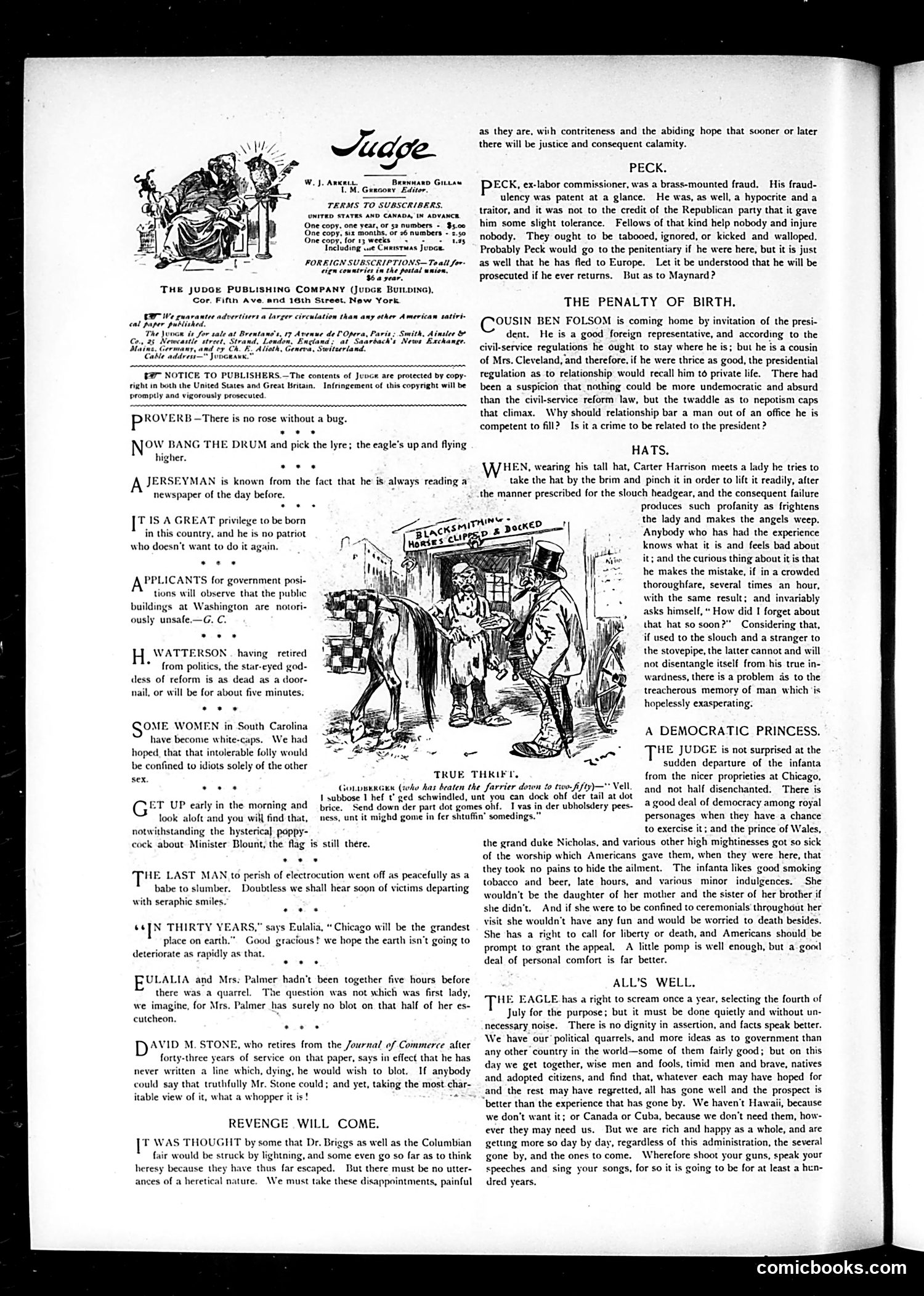
This page contains several brief satirical commentary sections rather than a single coherent cartoon. The visible cartoon depicts "True Thrift," showing what appears to be a street vendor or shopkeeper scene with period clothing. The text sections mock various political and social figures: "Peck," described as a "brass-mounted fraud" and labor commissioner who fled to Europe; commentary on "Cousin Ben Folsom's" return regarding civil-service regulations; and criticism of a lady's hat-wearing technique. Other sections reference Minister Blount, David M. Stone's retirement from the Journal of Commerce, and general political commentary about government positions and American institutions. Without clearer identification of specific historical figures and dates from the publication, precise political context remains unclear, though the satire targets government incompetence and hypocrisy.
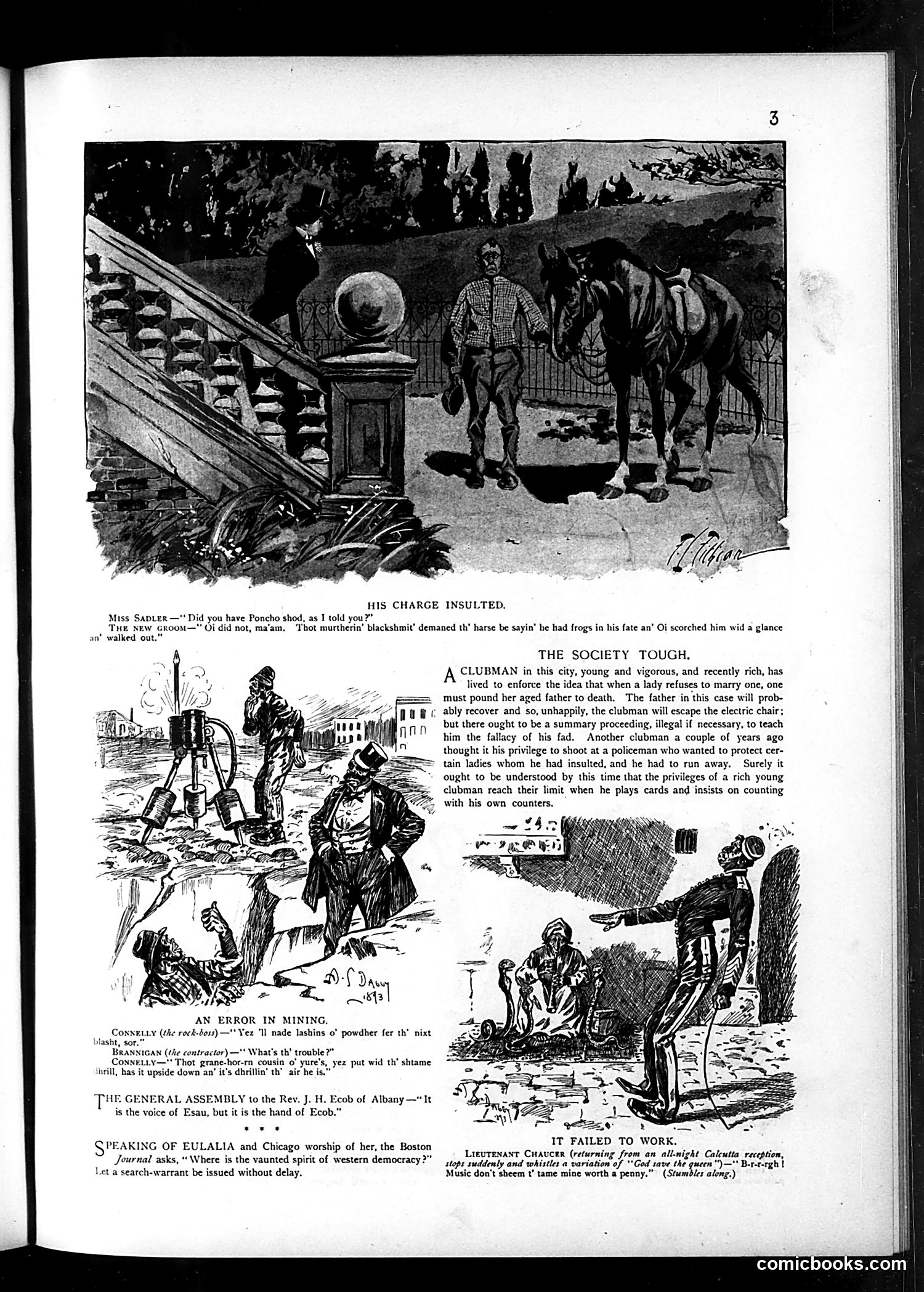
**"His Charge Insulted"** (top cartoon): A woman (Miss Sadler) confronts a man about a horse named Poncho. The dialogue suggests she's questioning whether he properly cared for the animal, with implied insults about his competence. **"The Society Tough"** (middle section): This satirizes wealthy young men who throw their financial privilege around recklessly. The text criticizes a clubman who behaves badly—refusing to pay debts, insulting women, and escaping consequences through wealth and connections. The satire targets his assumption that money insulates him from social and legal accountability. **"An Error in Mining"** and **"It Failed to Work"** (lower cartoons): These appear to be separate comic vignettes about mining mishaps and labor disputes, though context is unclear without fuller reading. The page overall mocks wealthy privilege and social hypocrisy.
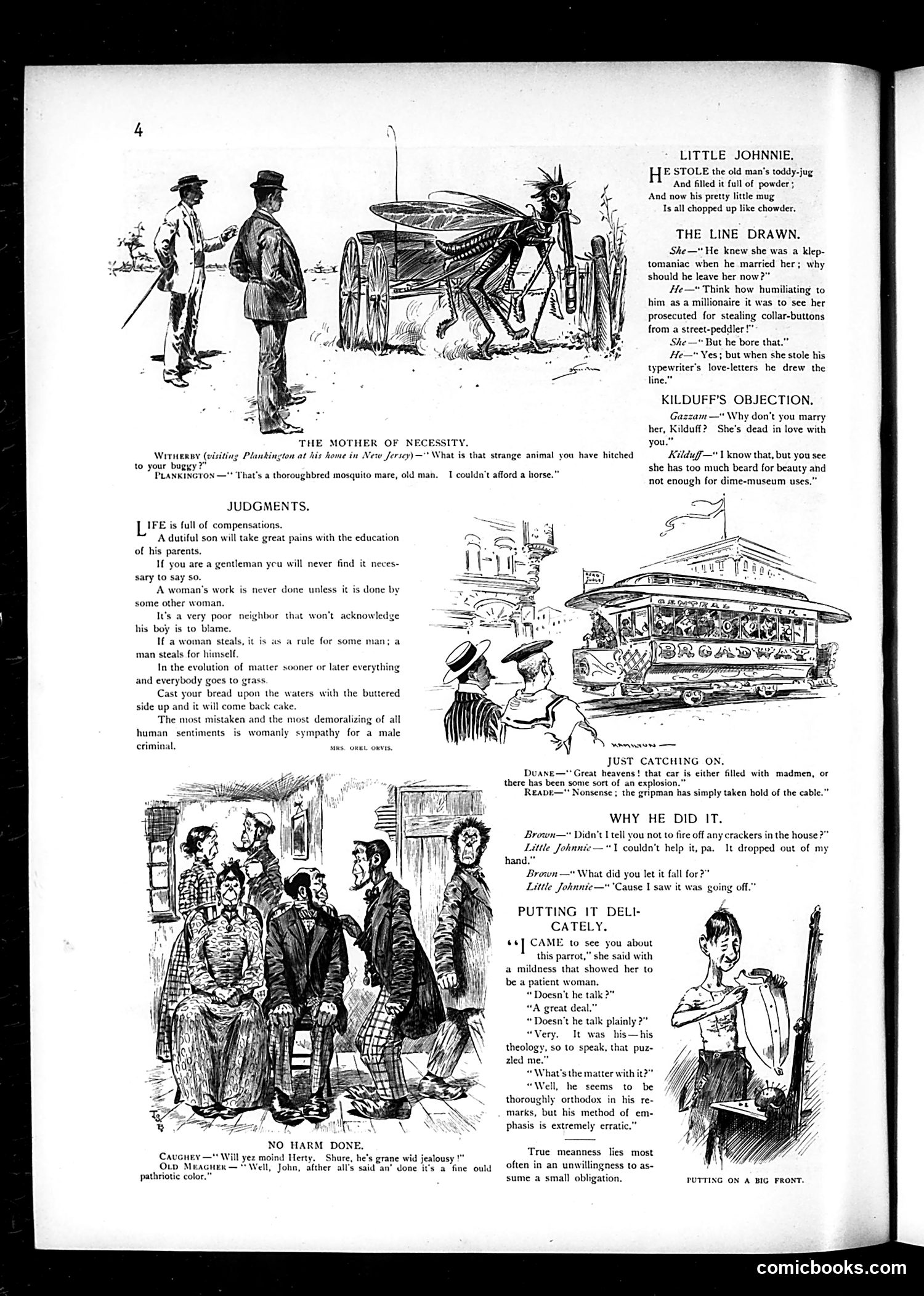
This page contains multiple satirical vignettes typical of late 19th-century American humor: **"Little Johnnie"** mocks the common literary trope of mischievous children causing domestic chaos—here, a boy fills his father's whiskey jug with powder, resulting in explosive consequences. The humor lies in exaggerated slapstick violence. **"The Line Drawn"** satirizes marital tolerance: a husband accepts his kleptomaniac wife stealing from street vendors, but draws the line when she steals his typewriter's love letters—a commentary on male vanity and selective morality. **"The Mother of Necessity"** jokes about New Jersey rural poverty: a visitor mistakes a giant mosquito for a horse, implying Jersey is so poor locals ride insects. **Various shorter pieces** ("Kilduff's Objection," "Why He Did It," "Putting It Delicately") use domestic and social situations for gentle humor about marriage, children's misbehavior, and etiquette. The overall tone is light social satire without partisan political content—typical Judge filler material aimed at middle-class readers.
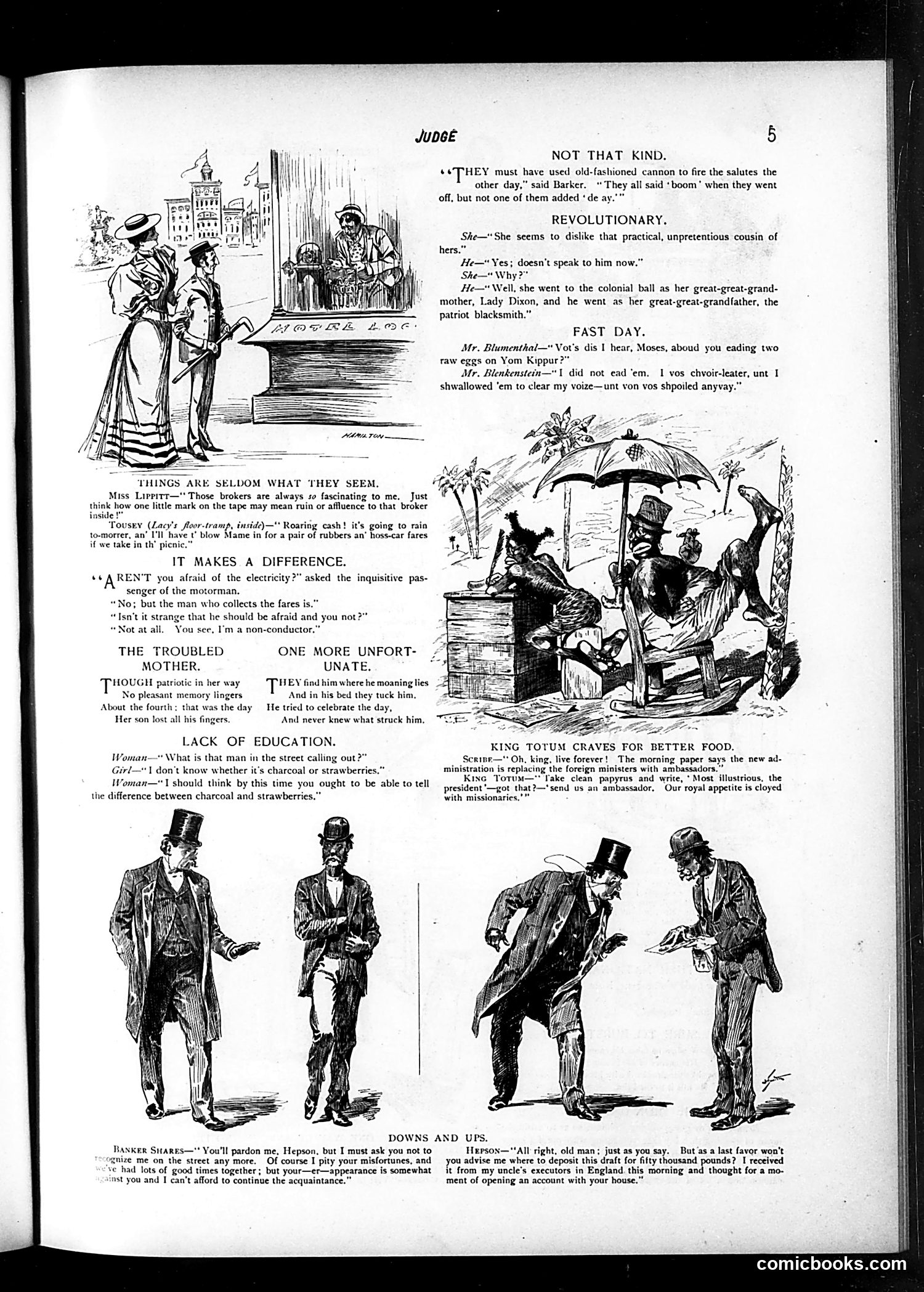
This page contains multiple short satirical sketches typical of Judge's humor: **"Revolutionary"**: Mocks pretentious genealogy-obsessing. A woman refuses to speak to her cousin because, despite both attending a colonial ball in ancestor costumes, his ancestor was merely a "patriot blacksmith" rather than a lady—social snobbery disguised as historical pride. **"Fast Day"**: Jewish-dialect humor (now considered offensive) about Yom Kippur observance. A man claims he swallowed raw eggs to clear his throat for the choir rather than eating them, thus technically observing the fast. **"King Totum Craves Better Food"**: Satirizes a foreign leader's trivial complaints. The "King" obsesses over whether America's new administration is sending "ambassadors" instead of "ministers," though the broader point seems to mock diplomatic minutiae. **"Downs and Ups"**: A banker snubs a formerly wealthy acquaintance fallen on hard times, then immediately asks where to deposit the man's inherited £50,000—exposing mercenary hypocrisy among the wealthy. The page reflects Judge's typical blend of social commentary, ethnic caricature, and class-based humor.
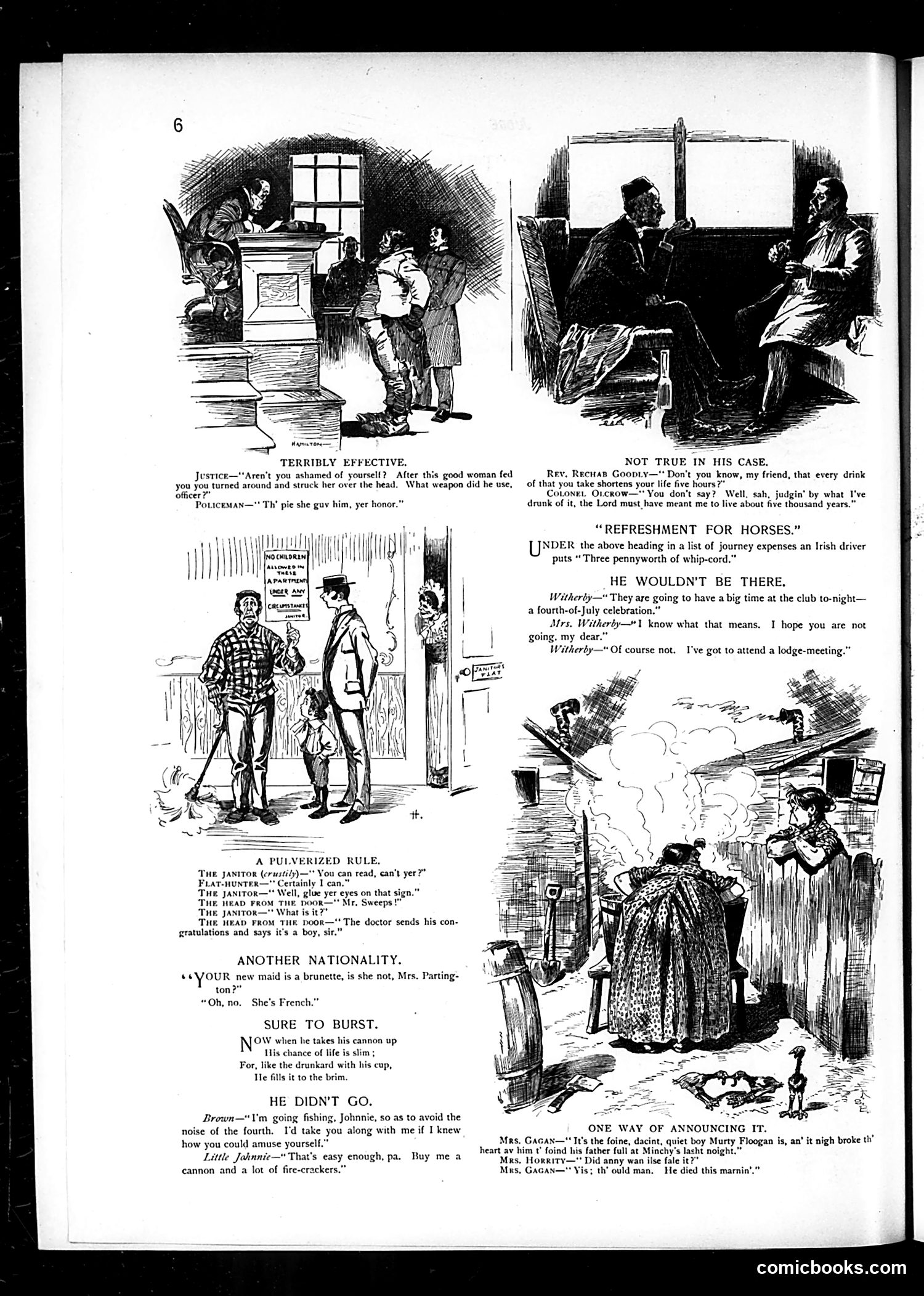
This page from Judge magazine (likely late 19th century, given stylistic references) contains several brief satirical sketches mocking human behavior and social types: **"Terribly Effective"** satirizes judicial leniency—a judge is shocked that a woman was struck with a pie, treating this absurdly as serious assault, while the policeman's deadpan delivery emphasizes the trivial weapon. **"Not True in His Case"** jokes about temperance messaging: a colonel claims drinking shortens life, but another man retorts he must have been meant to live thousands of years based on his consumption—mocking the temperance movement's moral arguments. **"Refreshment for Horses"** ridicules Irish stereotypes, suggesting an Irish driver disguises a whip as a business expense. **"He Wouldn't Be There"** depicts domestic life—a husband claims lodge attendance (possibly code for drinking) to avoid July Fourth celebration with his wife. Additional sketches contain wordplay and brief domestic humor typical of Judge's satirical style, poking fun at working-class life, Irish immigrants, and relationships.
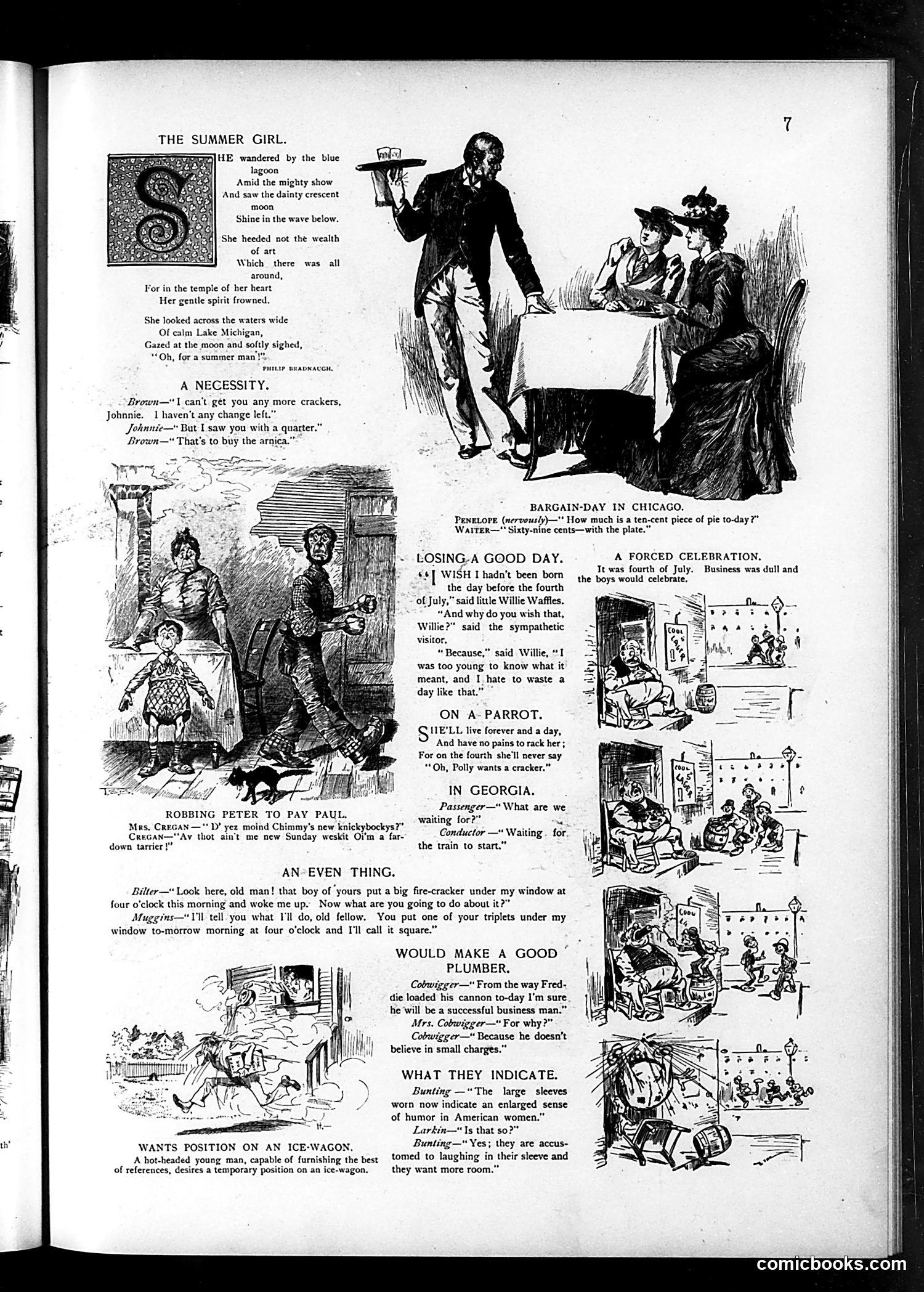
This page collects brief jokes and humorous observations typical of Judge's satirical style. "The Summer Girl" poem depicts a woman gazing at Lake Michigan, indifferent to art and beauty—she wants only a romantic male companion, mocking feminine superficiality and summer romance. The remaining items are short comedic sketches: "A Necessity" jokes about poverty (no change for crackers); "Bargain-Day in Chicago" mocks inflated prices disguised as sales; several pieces ridicule Fourth of July noise and celebration; "Would Make a Good Plumber" plays on cannon-loading and charging fees; and "What They Indicate" sarcastically suggests enlarged sleeve fashions reflect women's increased sense of humor. Overall, the page satirizes American consumer culture, holiday excess, gender stereotypes, and urban life—typical Judge fare targeting middle-class readers with gentle, domestic humor rather than sharp political commentary.
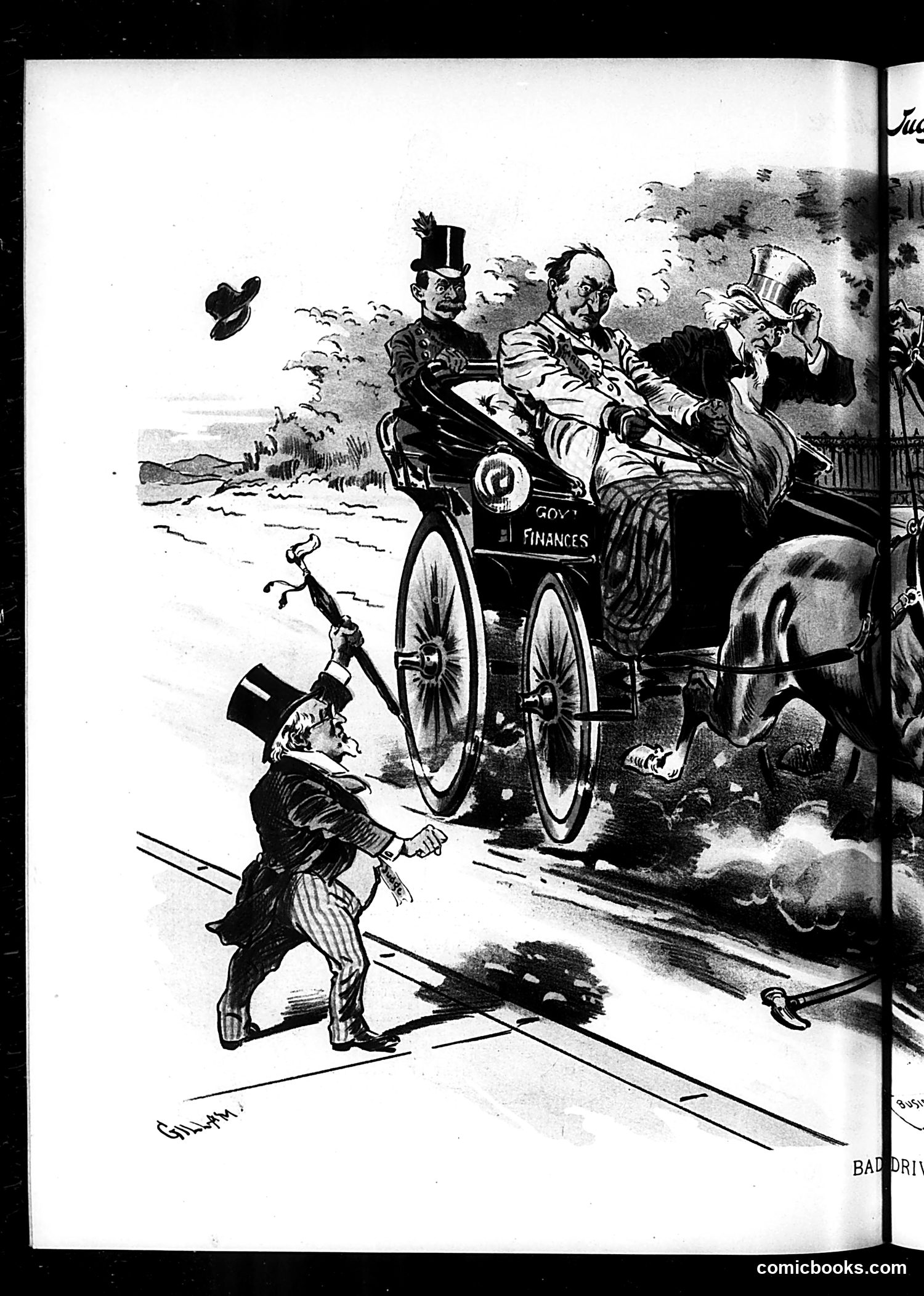
This appears to be a Gilded Age satirical cartoon depicting government financial mismanagement. A carriage labeled "GOVT FINANCES" is driven by officials in top hats, traveling precariously along railroad tracks. A figure in the foreground—appearing to be a common laborer or taxpayer in worn clothes—attempts to warn the drivers of danger ahead (a fallen hat and debris suggest impending disaster on the tracks). The satire critiques how government leaders recklessly manage public finances while ordinary citizens bear the consequences. The contrast between the well-dressed officials and the disheveled warning figure emphasizes how the working class suffers from elite financial mismanagement. The precarious position of the carriage suggests imminent economic catastrophe.
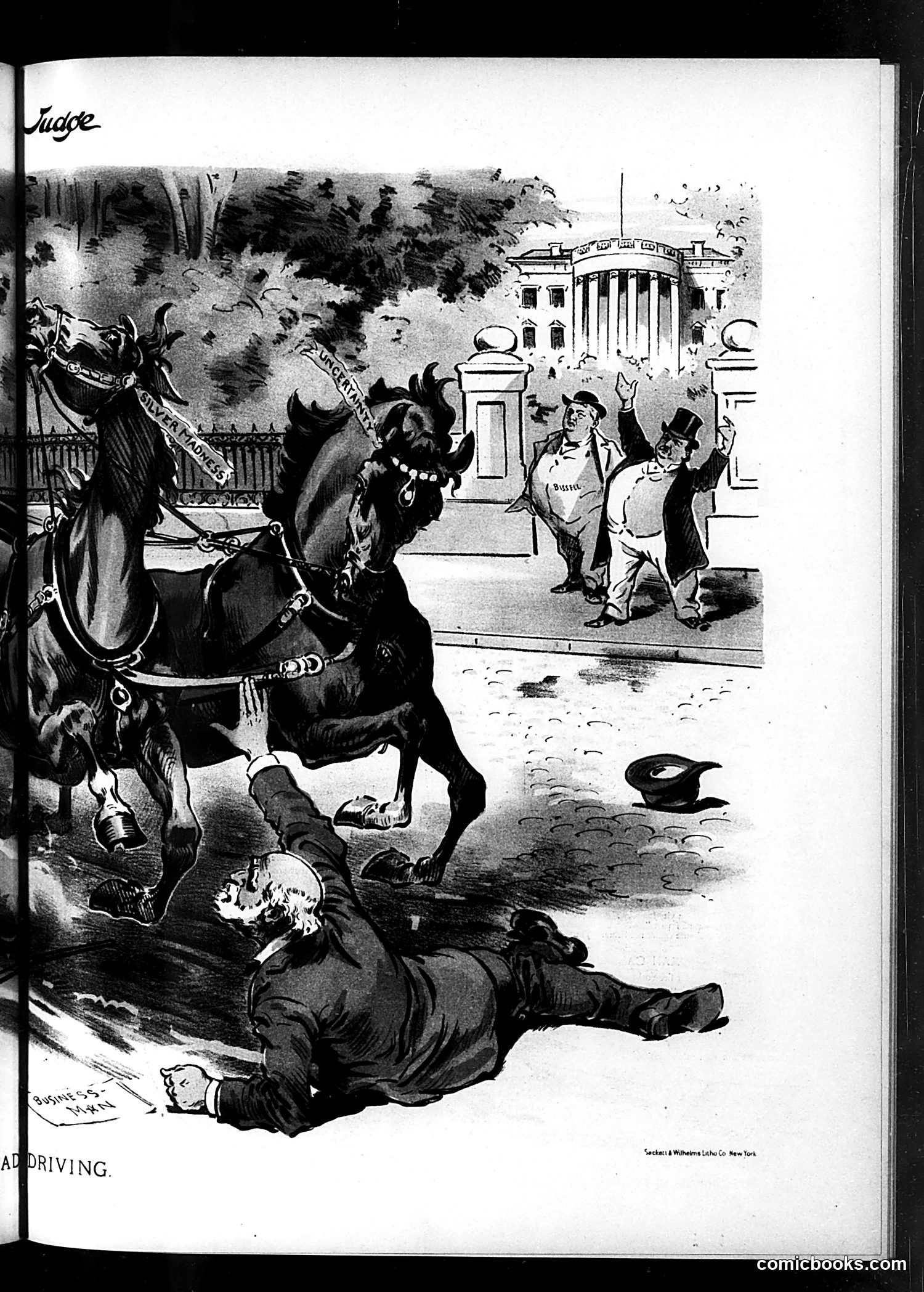
This cartoon satirizes reckless or dangerous political/social "driving" at the White House. A mounted horseman (likely representing a political figure or faction) gallops wildly through the grounds, having knocked down a pedestrian who lies sprawled on the pavement. Well-dressed observers on the White House steps appear alarmed or indifferent to the chaos. The title "Ad Driving" suggests criticism of careless leadership or policy—those "in the driver's seat" are operating without regard for consequences or public welfare. The victim on the ground represents ordinary citizens harmed by such recklessness. The composition emphasizes the contrast between the powerful rider's momentum and the powerless victim's vulnerability. Without dating information, the specific political target remains unclear, but the cartoon clearly critiques dangerous governance.
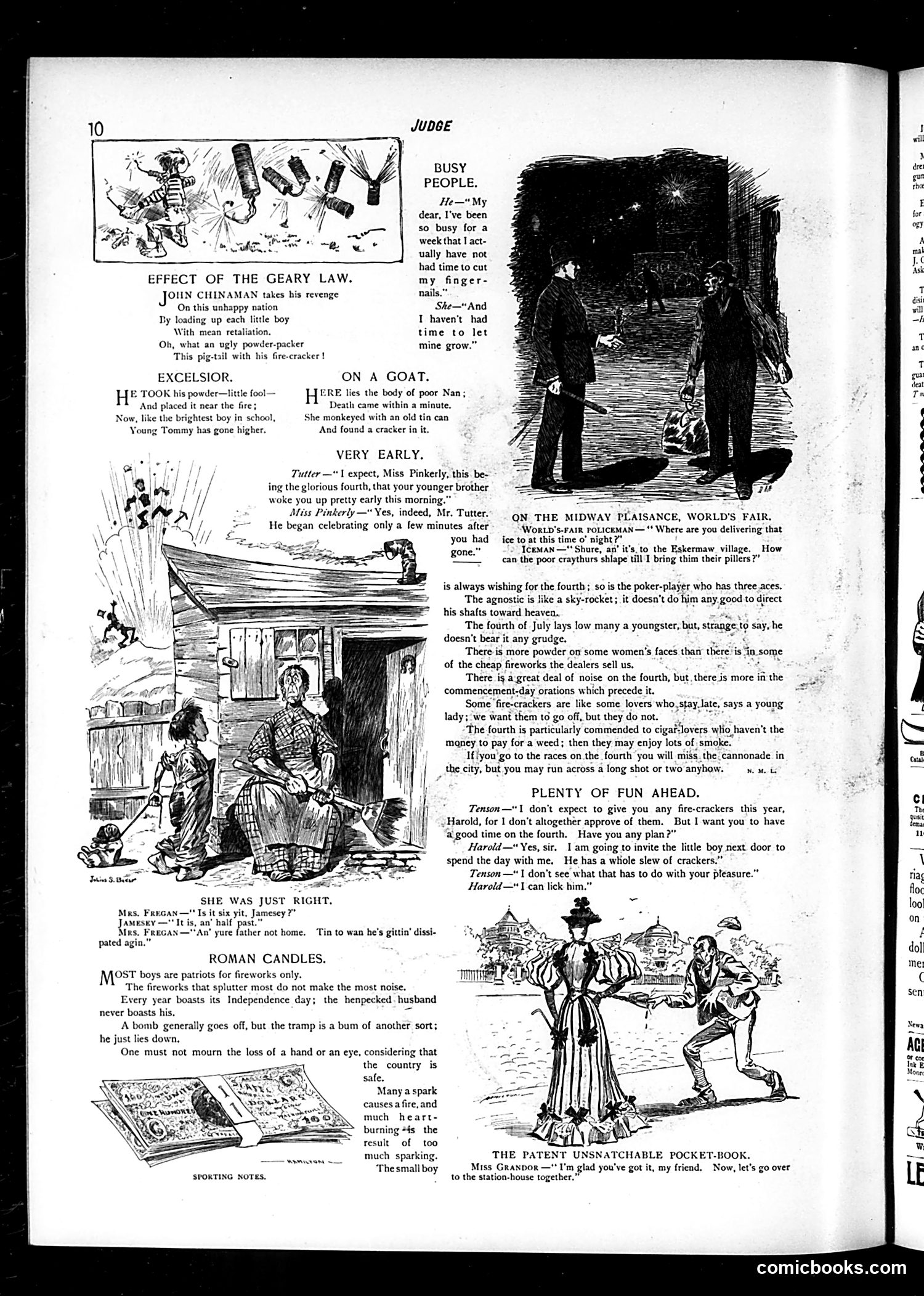
This page lampoons Fourth of July celebrations and their dangers, reflecting late-19th-century American concerns about fireworks safety. **"Effect of the Geary Law"** satirizes the Chinese Exclusion Act by depicting a Chinese boy retaliating with firecrackers—a dark joke about anti-Chinese sentiment and fireworks violence. **Multiple cartoons mock Fourth of July customs**: Young children injuring themselves with firecrackers (one dies from a "cracker in a tin can"), parents warning sons against fireworks while knowing they'll ignore warnings, and the inevitable injuries the holiday produces. **"Busy People"** presents a genteel couple too occupied to maintain hygiene—a commentary on modern overwork. **"Midway Plaisance, World's Fair"** references the 1893 Chicago World's Columbian Exposition, with an Irish ice-delivery worker humorously unable to sleep because of his noisy job, even at the fair's exotic Eskimo village exhibit. The page's recurring theme: Fourth of July celebrations, while patriotic, are reckless and produce predictable casualties—especially among children—yet Americans celebrate them annually anyway.
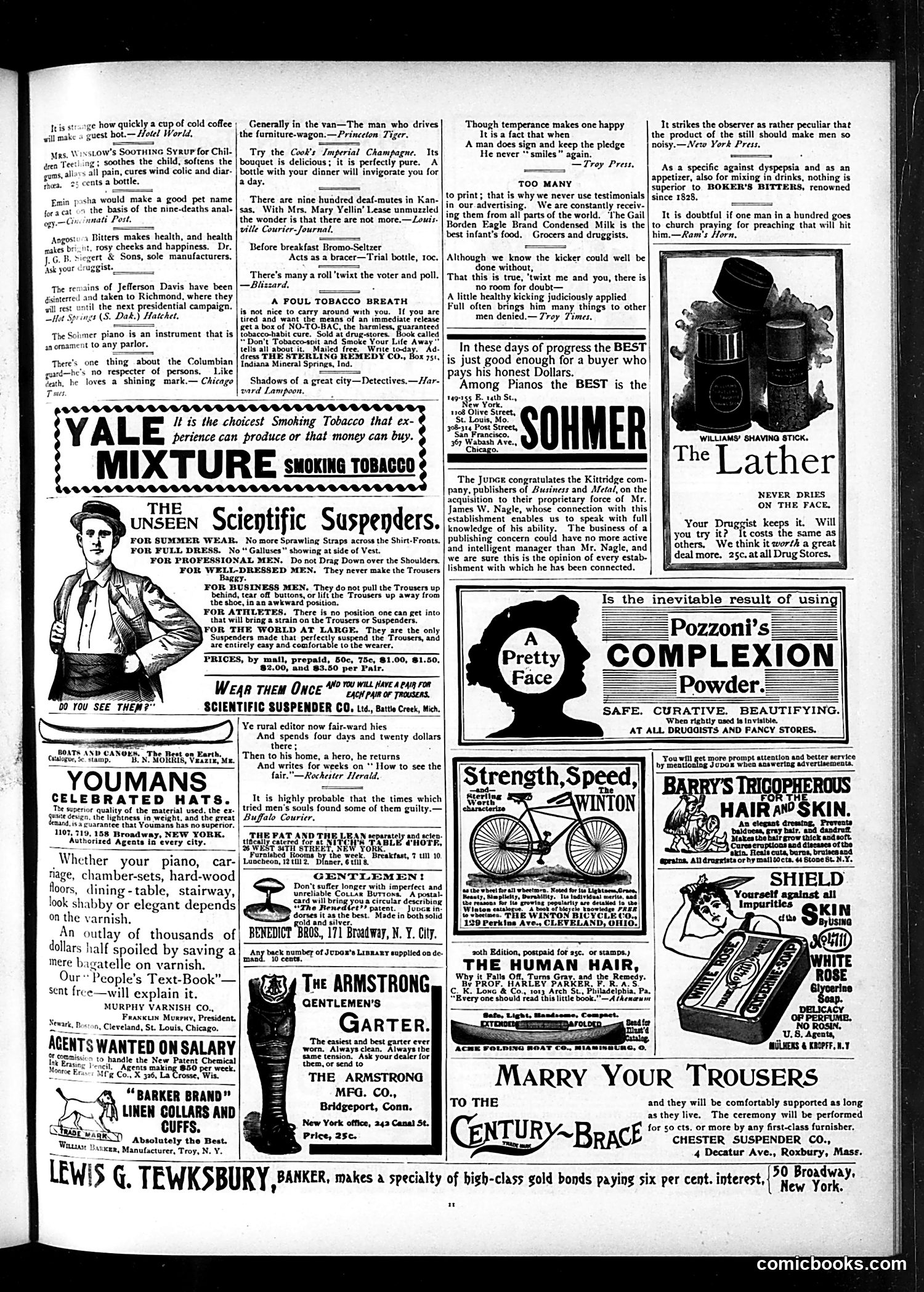
This page is predominantly **advertising** with brief satirical snippets interspersed. The main content consists of patent medicine ads, suspender advertisements, and hair/skin products typical of the 1890s era. The few cartoons/jokes are minor: - **"Scientific Suspenders"** features an illustration of a man demonstrating a new suspender design—a mundane product advertisement rather than political satire. - **Brief satirical quips** mock contemporary figures (Mary Yellin Lease, a Populist orator, is criticized as loud and unmuzzled) and general observations about rural editors wasting money at fairs. - **Pozzoni's Complexion Powder** and **Barry's Trigopherous Hair & Skin** ads dominate the right side—typical period beauty product marketing. The page lacks substantive political cartooning or social satire. It represents Judge's mixed format: part satirical commentary magazine, part classified advertising vehicle. Without dates or major political events referenced visibly, specific historical context remains unclear.
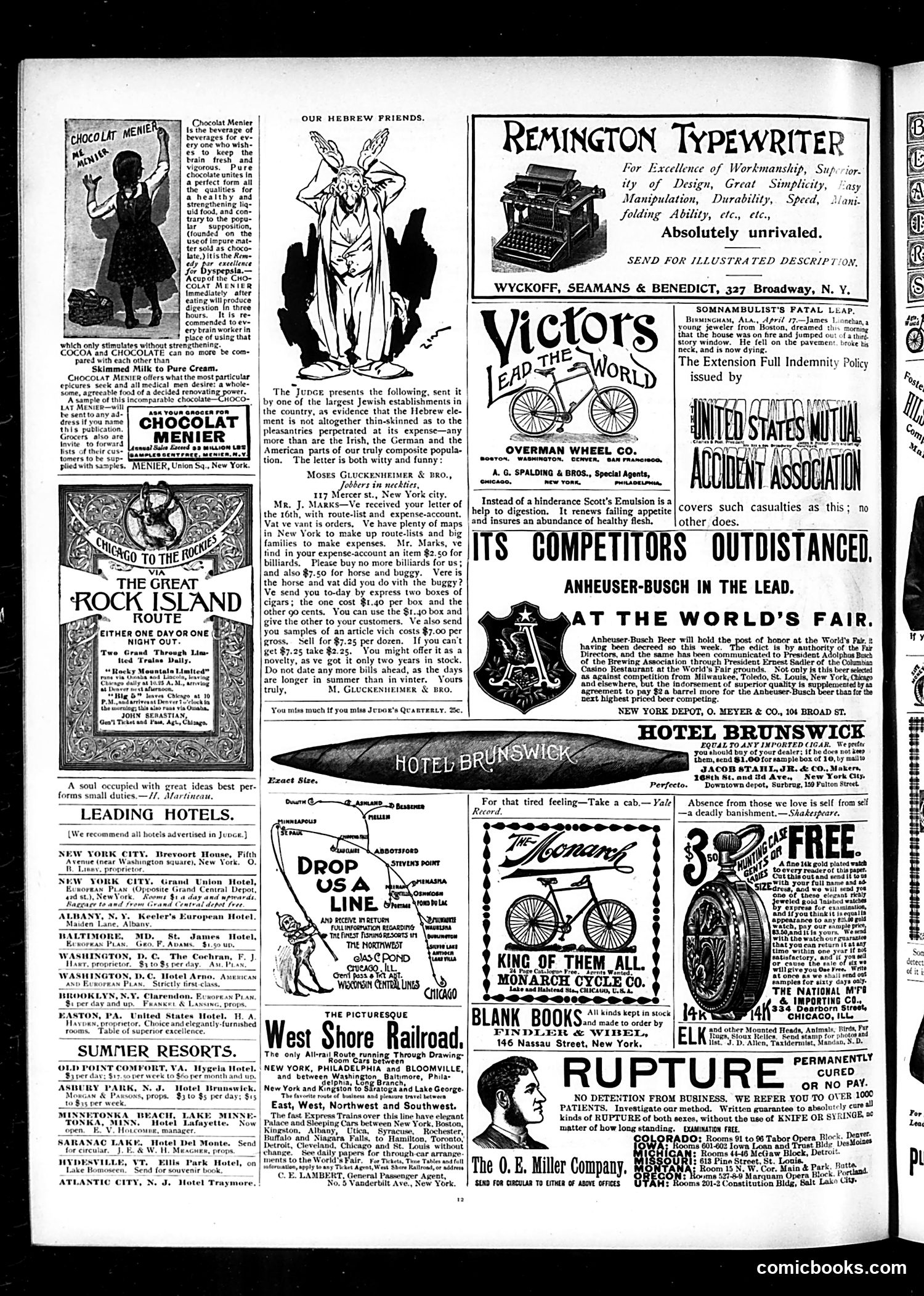
This is primarily a **page of advertisements and miscellaneous content** rather than political satire. The page includes: **"Our Hebrew Friends"** section: A humorous letter supposedly from a Jewish necktie firm ("Moses Gluckenheimer & Bro.") critiquing a salesman's expense report. The comedy relies on stereotypical Yiddish-accented English ("Vat ve vant is orders," "Vere is the horse"). This appears designed to show Jewish business owners as shrewd, practical, and capable of self-deprecating humor—presenting them as assimilated enough to laugh at themselves and be featured in Judge magazine. **The bulk of the page consists of period advertisements** for hotels, railroads, chocolate, typewriters, bicycles, and patent medicines—typical Judge revenue sources. The "Hebrew Friends" item suggests Judge's editors wanted to demonstrate that Jewish readers weren't offended by the magazine's humor, perhaps countering accusations of bigotry.
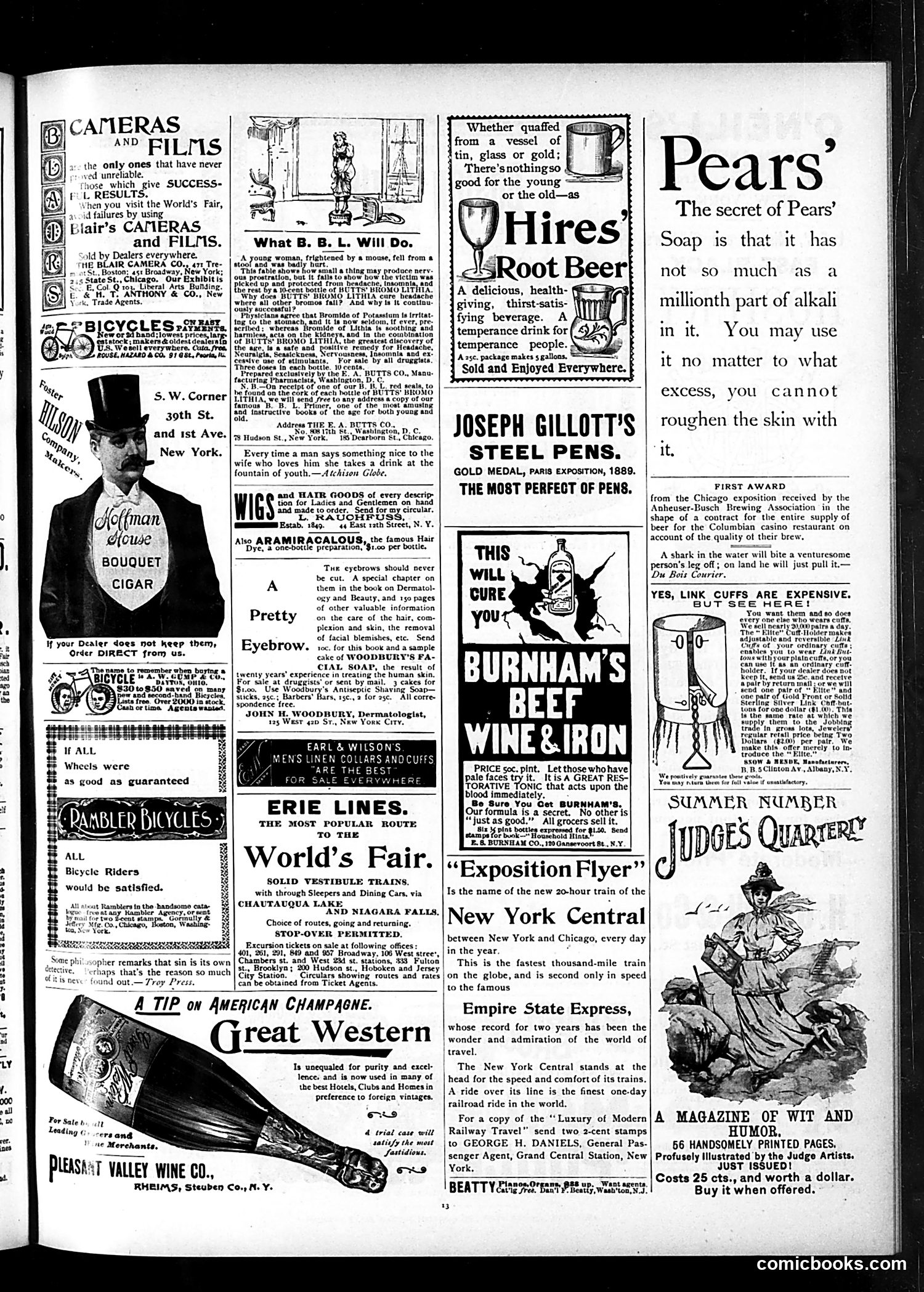
This page is primarily **advertisements** from what appears to be the 1890s, with minimal satirical content. The only substantive editorial piece is on the right side: a **Pears' Soap advertisement** promoting their product's gentleness ("cannot roughen the skin"), which won an award from the Anheuser-Busch Brewing Association. The bulk consists of period product ads: cameras, bicycles, cigars, hair treatments, steel pens, patent medicines (notably "Bromo Lithia" for headaches and "Burnham's Beef Wine & Iron"), and transportation promoting the Erie Railway to the World's Fair. One small item mentions a woman frightened by a mouse, used to advertise "Bromo Lithia," reflecting Victorian anxieties about women's "delicate nerves." The **Judge's Quarterly** masthead at bottom right advertises the magazine itself as "a magazine of wit and humor." **Notably absent**: specific political cartoons or identifiable caricatures of public figures. This appears to be a typical late-Victorian advertising-heavy magazine page.
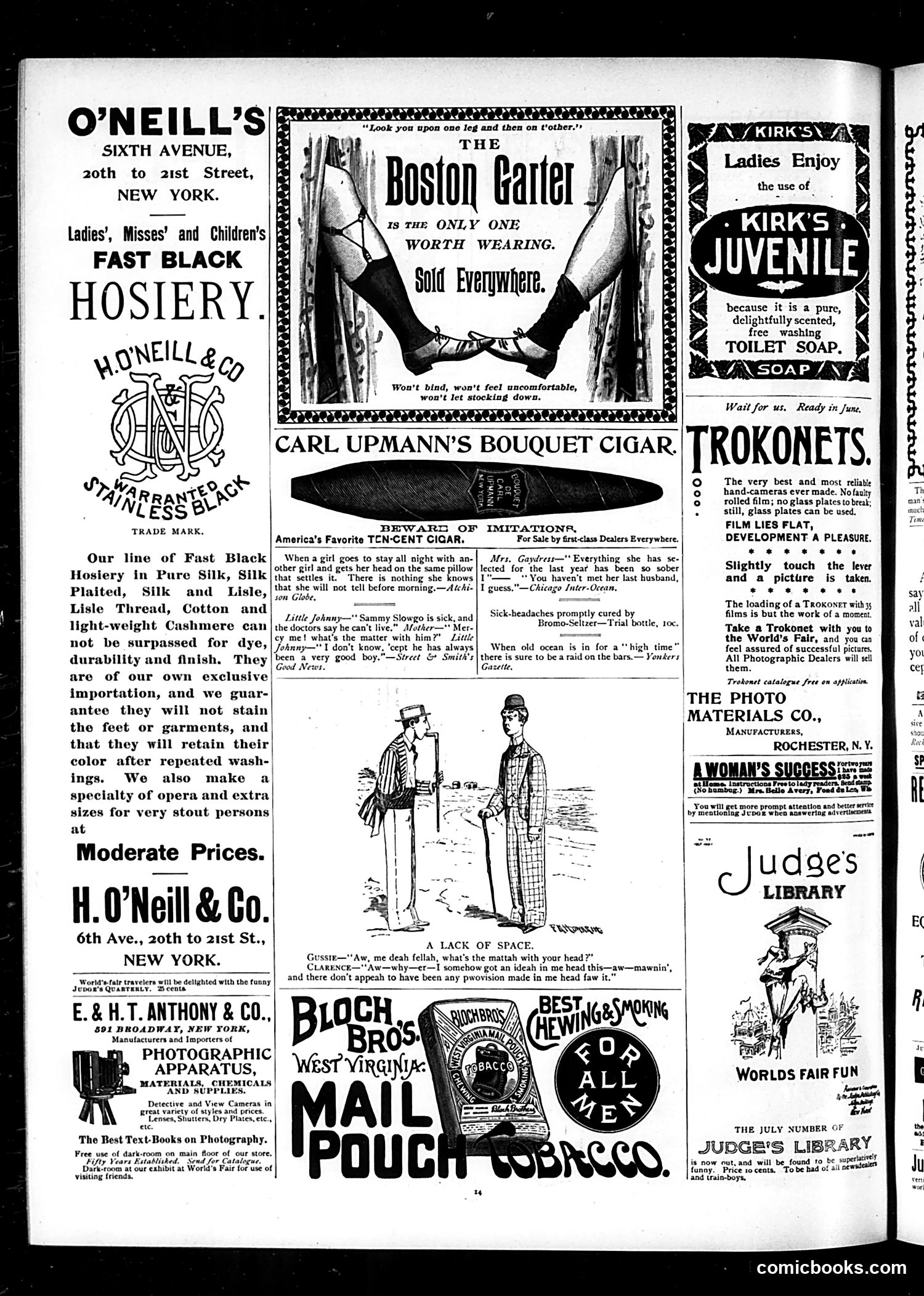
This is primarily an **advertising page** from Judge magazine, containing multiple product advertisements rather than satirical cartoons. The notable exception is a small cartoon captioned "A Lack of Space." ## The Cartoon The cartoon depicts two men in conversation, with one complaining that he had an idea in his head but there's "no provision made in me head faw it"—suggesting his head is too small or empty for ideas. This is a simple visual joke about intellectual capacity, using exaggerated upper-class accent transcription ("deah," "faw") for comedic effect, typical of Judge's humor style. ## The Advertisements The page features typical late-19th/early-20th century ads: hosiery, cigars, toilet soap, garters, photographic equipment, and cameras. These reflect period consumer goods and emerging technologies (photography cameras). The ads use common marketing language emphasizing quality, durability, and exclusivity—standard commercial rhetoric of the era. The page demonstrates how satirical magazines sustained themselves through substantial advertising revenue alongside their editorial content.
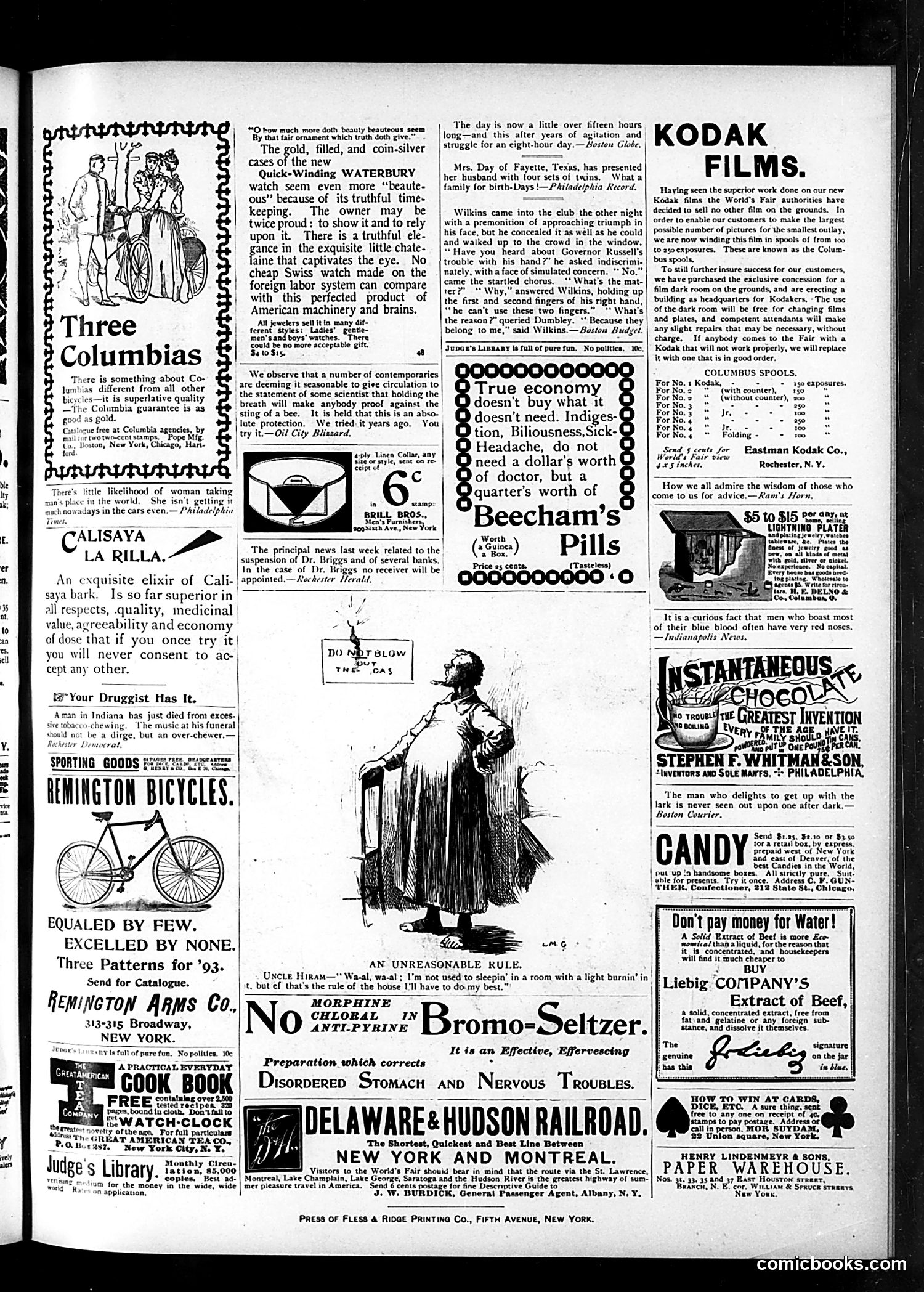
This page is primarily **advertising**, not political satire. The central cartoon, "An Unreasonable Rule," depicts Uncle Sam instructing a woman about household management—a commentary on gender roles and domestic authority rather than political satire. The cartoon's joke: Uncle Sam insists a woman manage her household "room with a light hand," but he himself won't follow this rule, instead demanding she obey his directives. It's a mild critique of male hypocrisy regarding authority and control in the domestic sphere. The surrounding content consists entirely of period product advertisements (Kodak films, bicycles, pills, chocolate) interspersed with short humorous editorial quips about contemporary life—tobacco deaths, eight-hour workdays, a woman with quadruplets. No specific political figures or events are satirized on this page. It represents typical Judge magazine filler: light social humor combined with commercial promotion.
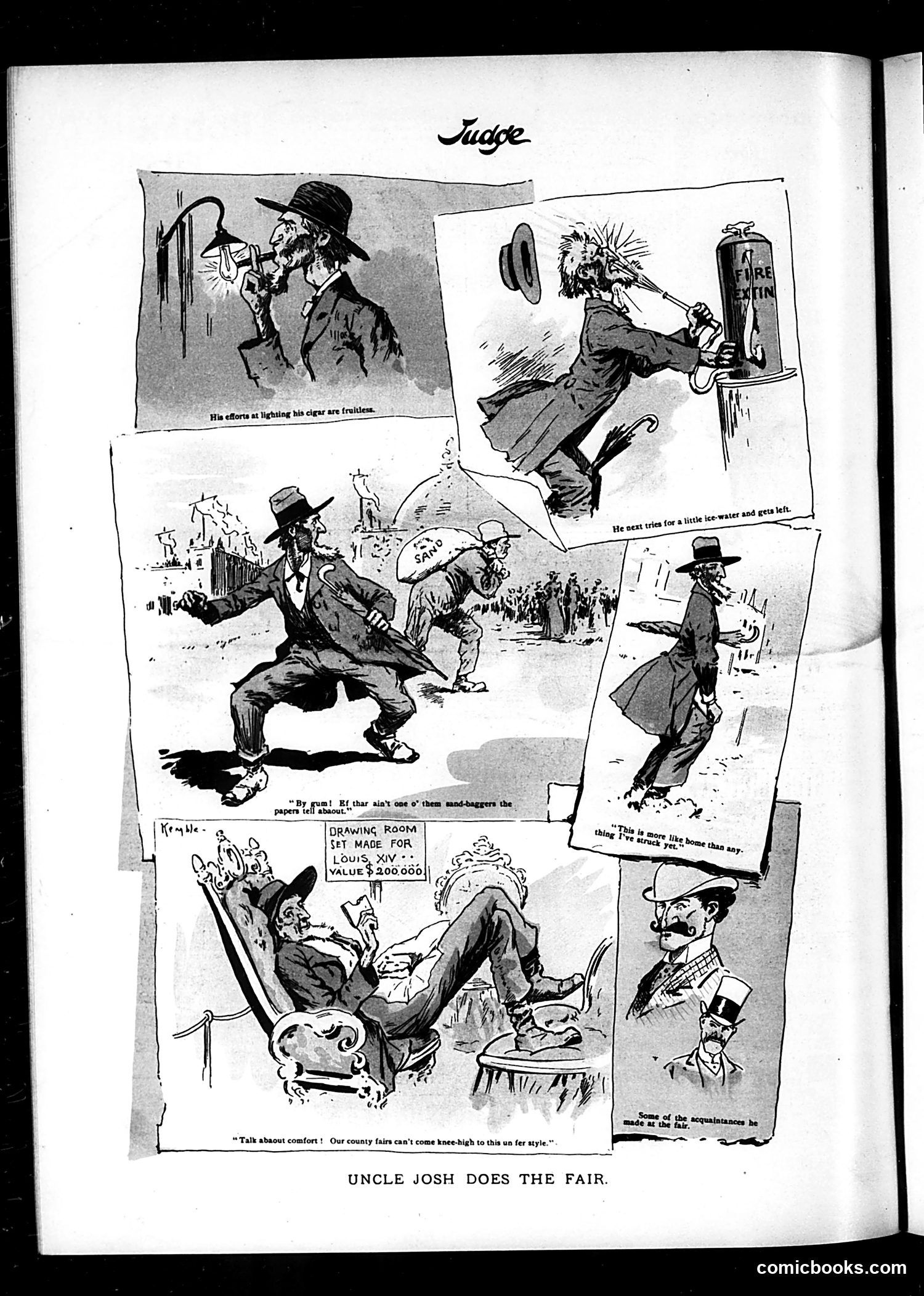
This is a rural-themed comic strip satirizing the contrast between rustic country life and urban sophistication. "Uncle Josh" appears to be a stereotypical yokel character attending what seems to be a major exposition or world's fair—likely the 1893 World's Columbian Exposition in Chicago, given the references to a luxurious "Drawing Room Set Made for Louis XIV" valued at $200,000. The humor derives from Josh's provincial amazement at the fair's opulence and modern attractions. His dialect ("By gum," "thar," "abaout") and repeated comparisons to humble county fairs underscore his working-class rural perspective encountering urban wealth and grandeur for the first time. The caricatured expressions and exaggerated poses emphasize the fish-out-of-water comedy. This reflects turn-of-the-century American anxiety and fascination regarding urbanization and class differences between rural and metropolitan America.