
Judge, 1893-07-08 · page 7 of 16
Judge — July 8, 1893 — page 7: what you’re looking at
What you’re looking at
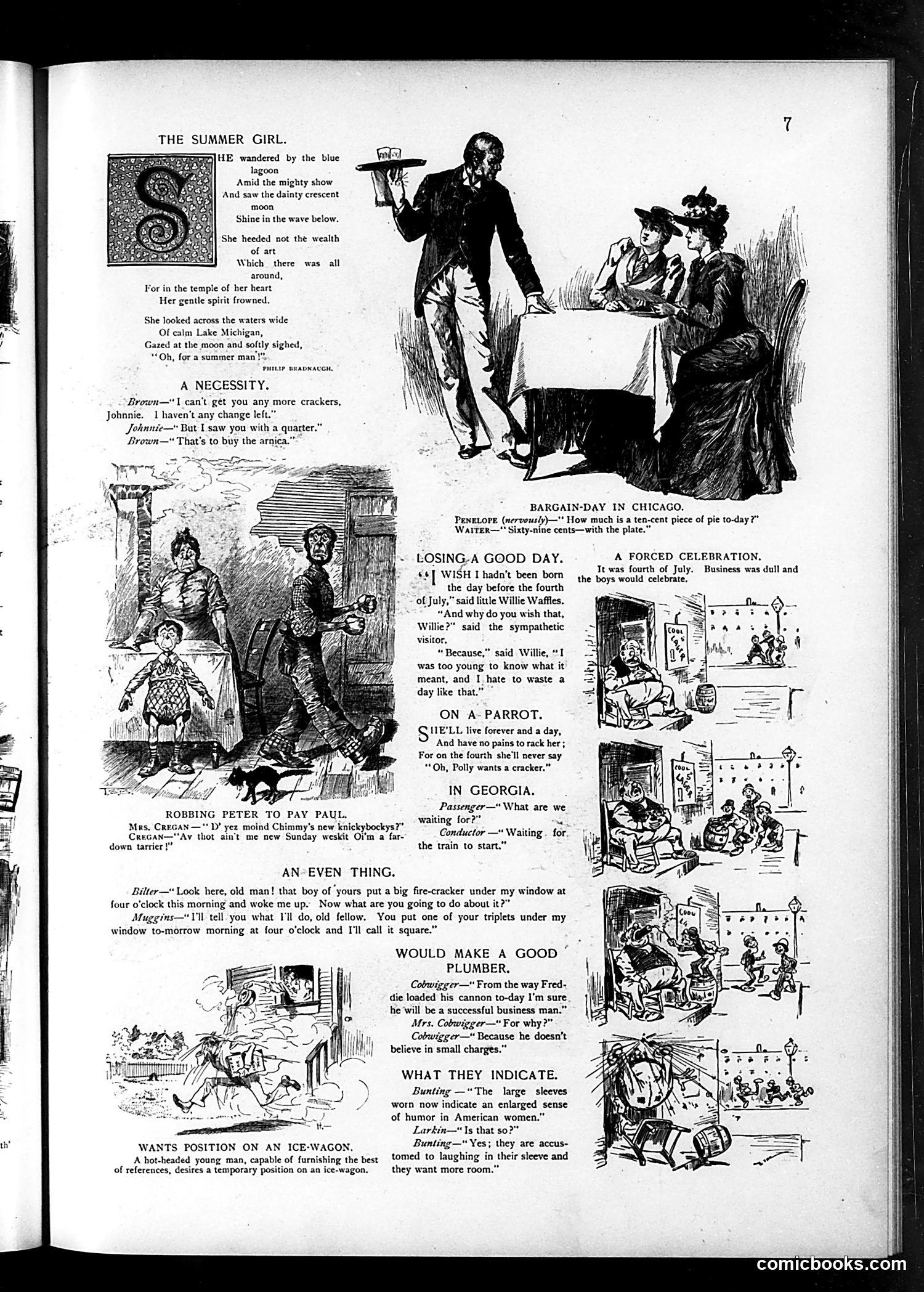
This page collects brief jokes and humorous observations typical of Judge's satirical style. "The Summer Girl" poem depicts a woman gazing at Lake Michigan, indifferent to art and beauty—she wants only a romantic male companion, mocking feminine superficiality and summer romance. The remaining items are short comedic sketches: "A Necessity" jokes about poverty (no change for crackers); "Bargain-Day in Chicago" mocks inflated prices disguised as sales; several pieces ridicule Fourth of July noise and celebration; "Would Make a Good Plumber" plays on cannon-loading and charging fees; and "What They Indicate" sarcastically suggests enlarged sleeve fashions reflect women's increased sense of humor. Overall, the page satirizes American consumer culture, holiday excess, gender stereotypes, and urban life—typical Judge fare targeting middle-class readers with gentle, domestic humor rather than sharp political commentary.
📄 Transcribed text from this page (OCR, searchable)
Machine-transcribed from the original scan — historical spelling and the odd misread are preserved.
THE SUMMER GIRL. HE wandered by the blue lagoon Amid the mighty show And saw the dainty crescent moon Shine in the wave below. She heeded not the wealth of art Which there was all around, For in the temple of her heart Her gentle spirit frowned. She looked across the waters wide Of calm Lake Michigan, Gazed at the moon and softly sighed, “Oh, for a summer man!" PHILIP BEADNALGH, A NECESSITY. Brown—"\ can't gét you any more crackers, Johnnie. I haven't any change left.” But I saw you with a quarter.” BARGAIN-DAY IN CHICAGO. PenEtore, (nervously)—* How much is a ten-cent piece of pie to-day?” WatTeR—" Sixty-nine cents—with the plate.”” LOSING-A GOOD DAY. A FORCED CELEBRATION. S$] WISH hadn't been born the boys wouid' celebrite’ usness was dell and the day before the fourth ‘of July,” said little Willie Waffles. “And why do you wish that, Willie?" said the sympathetic visitor. “Because,” said Willie, “I was too young to know what it meant, and I hate to waste a day like that.” ON A- PARROT. HE'LL live forever and a day, ‘And have no pains to rack her ; For on the fourth she'll never say “Oh, Polly wants a cracker.” he i) fe IN GEORGIA. ce Passenger—"What are we ROBBING PETER TO PAY PAUL. waiting for?” AN —"' Dt yez moind Chimmy's new knickybockys?” a v thot ain't me new Sunday weskit Oi'm a far- Conductor —* Waiting . for down tarrier !' the train to start.’ AN- EVEN THING. Bilter—* Look here, old man! that boy of yours put a big fire-cracker under my window at four o'clock this morning and woke me up- Now what are you going to do about it?” Muggins—‘V'll tell you what I'll do, old fellow. You put one of your triplets under my window to-morrow morning at four o'clock and I'll call it square.” WOULD MAKE A GOOD ° PLUMBER, Cobwigger— From the way Fred- die loaded his cannon to-day I'm sure he will be a successful business man.” Mrs. Cobwigger— For why?” Cobwigger— Because he doesn’t believe in small charges.” WHAT THEY INDICATE. Bunting —""The large sleeves worn now indicate an enlarged sense of humor in American women.” Larkin— 1s that so?” NTS POSITION ON AN ICE-WAGON. Bunting—“Yes; they are accus- A hot-headed young man, capable of furnishing the best tomed to laughing in their sleeve and of references, desires a temporary position on an ice-wagon. they want more room.” comicbooks.com