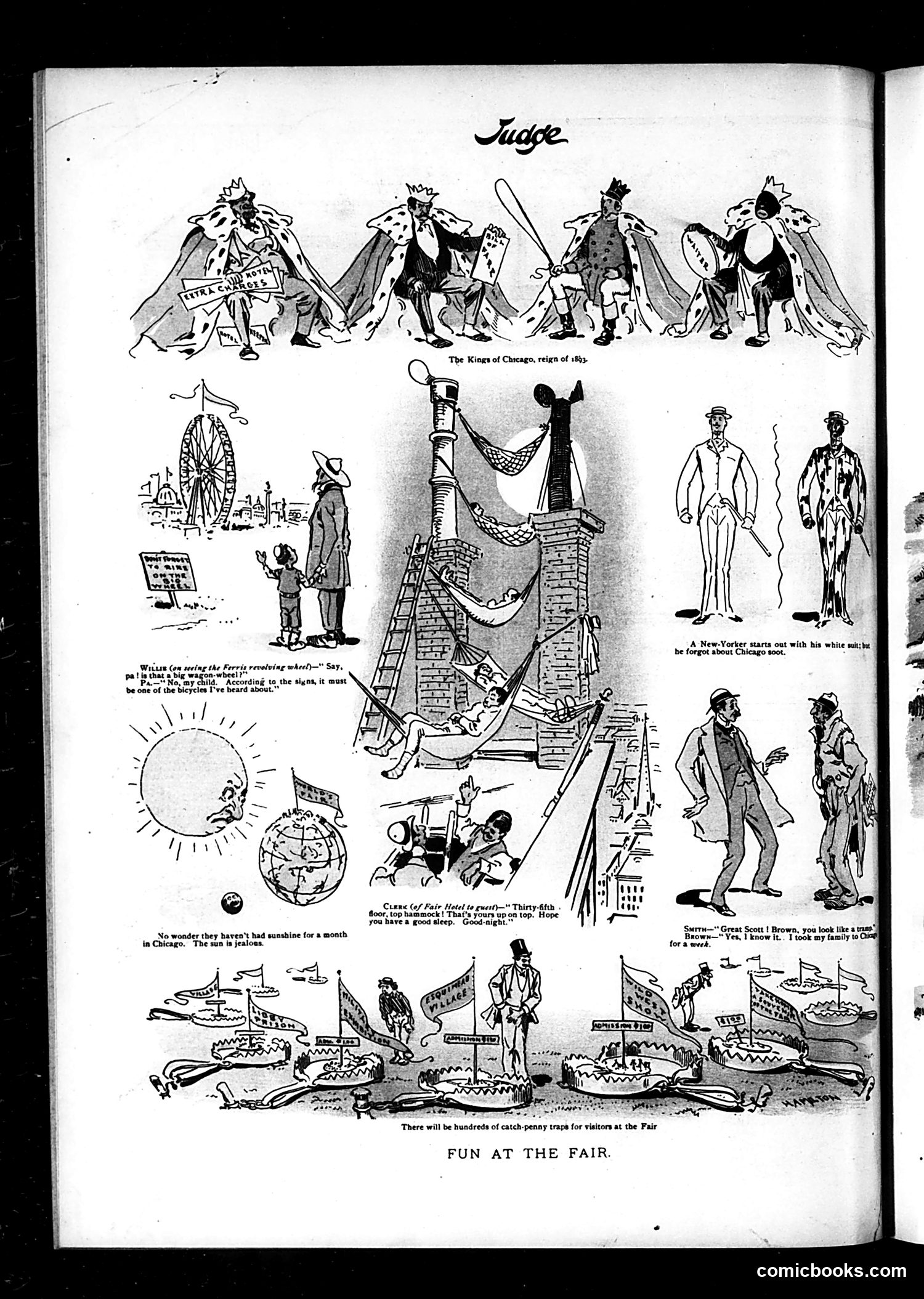
A complete issue · 16 pages · 1893
Judge — May 13, 1893
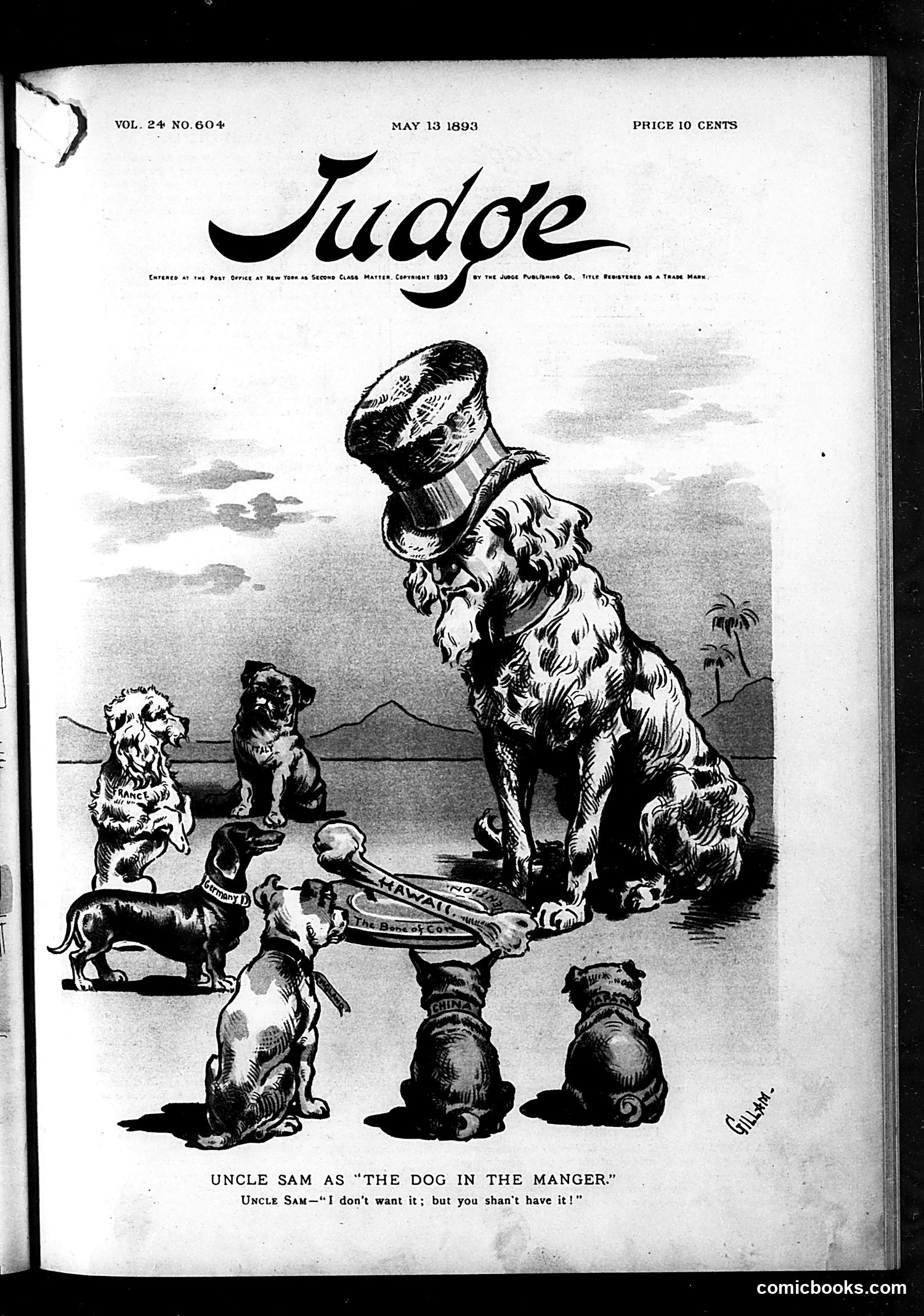
This political cartoon depicts **Uncle Sam as "The Dog in the Manger,"** referencing the Aesop's fable about a dog that prevented others from eating hay it wouldn't eat itself. The image shows Uncle Sam (identifiable by his characteristic top hat and beard) guarding a bone labeled what appears to be trade or economic resources, while various smaller dogs—likely representing other nations or competing interests—look on hungrily. The caption reads: "I don't want it; but you shan't have it!" This satirizes **American protectionist trade policies** of the 1890s, suggesting the U.S. was selfishly blocking access to resources or markets without benefiting itself. The cartoon critiques isolationist economic policies that denied others opportunity while providing no advantage to America.
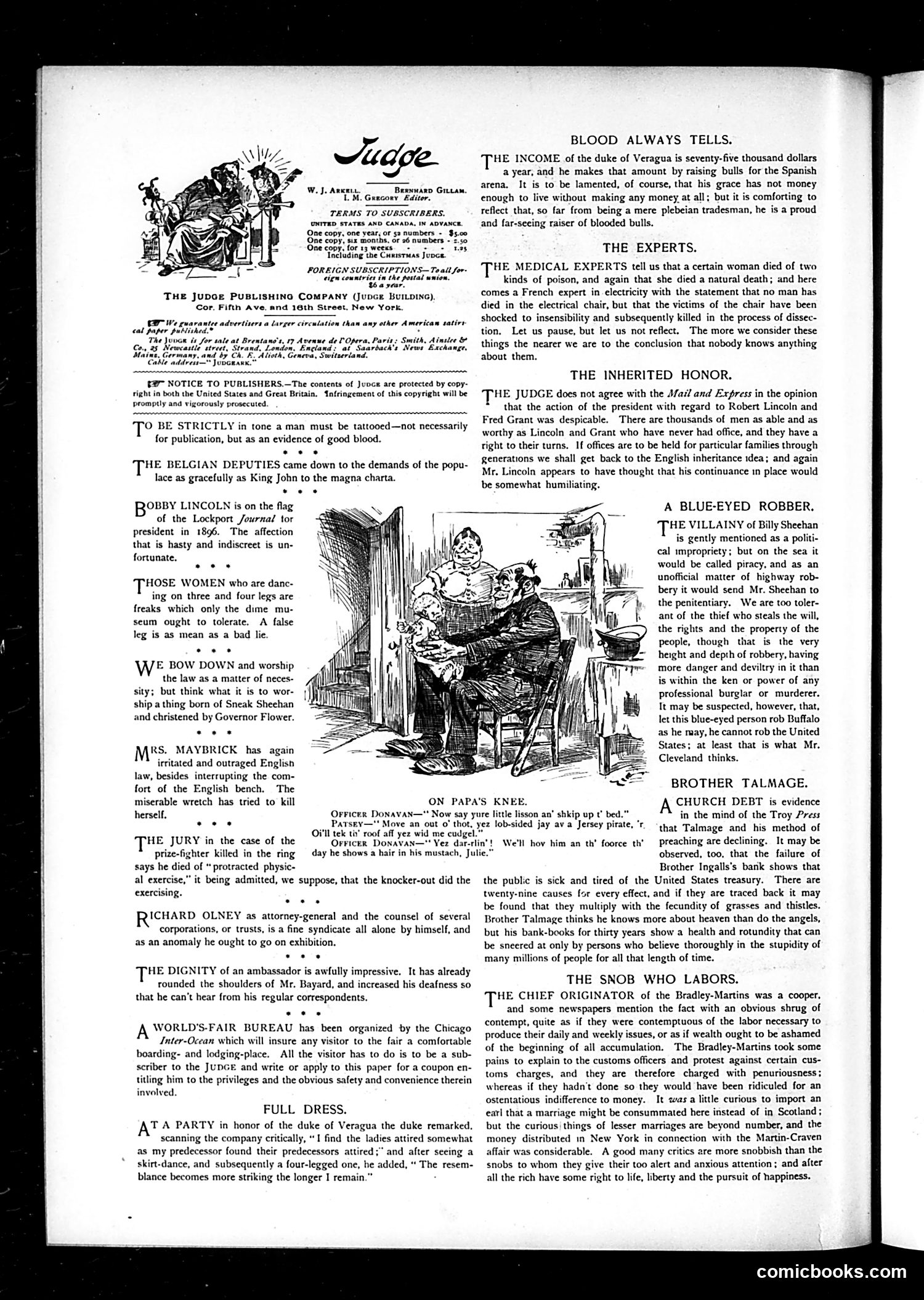
This page combines editorial commentary with satirical sections. The main cartoon "On Papa's Knee" depicts an officer speaking to a child, likely satirizing naval or military matters of the era. The editorial sections critique contemporary figures and issues: - "Blood Always Tells" appears to reference debates about inherited traits and breeding - "The Inherited Honor" disputes the *Mail and Express* newspaper's defense of Robert Lincoln's character, suggesting inherited status doesn't guarantee merit - "A Blue-Eyed Robber" discusses Billy Sheehan's criminal activities, debating whether his crimes constitute piracy or robbery - "Brother Talmage" critiques a church leader's financial management - "The Snob Who Labors" satirizes the Bradley-Martins' ostentatious wealth display during economic hardship The page reflects Gilded Age concerns about wealth inequality, hereditary privilege, and moral character.
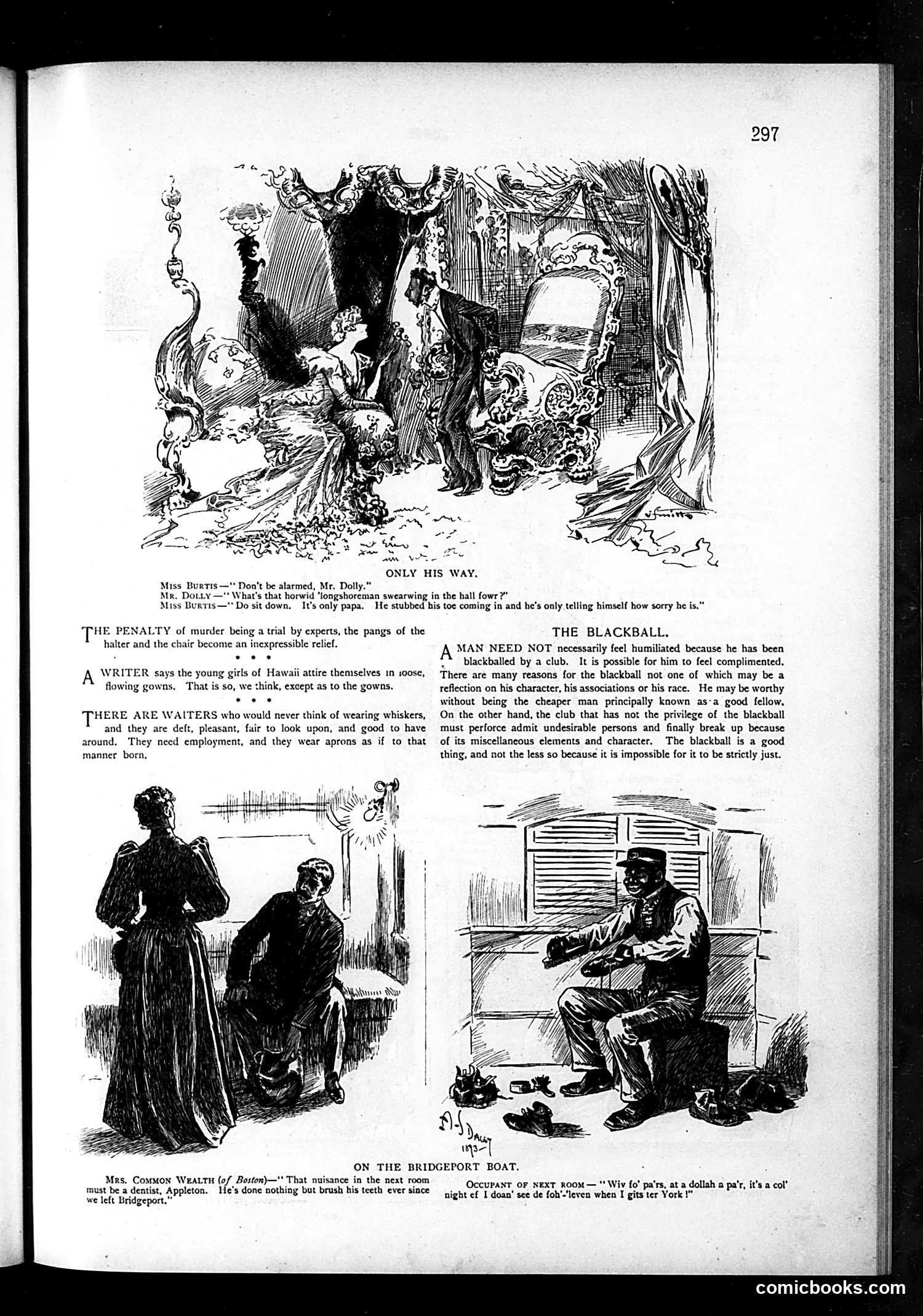
This page contains three separate satirical sketches from Judge magazine: 1. **"Only His Way"** (top): Shows a domestic scene where a man has apparently returned home late. The joke plays on marital conflict—the wife (Miss Dolly) questions a drunk man's excuses about his late arrival, with the punchline being his shameless admission that he only tells himself how sorry he is. 2. **"The Blackball"** (center): A serious editorial piece discussing social ostracism. It argues that being blackballed from society shouldn't humiliate a person of good character, and that such exclusion often reflects poorly on the organization doing the excluding rather than the excluded individual. 3. **"On the Bridgeport Boat"** (bottom): A brief comedic exchange between two working-class characters about paying fares. The page blends humor with social commentary typical of Judge's satirical approach.
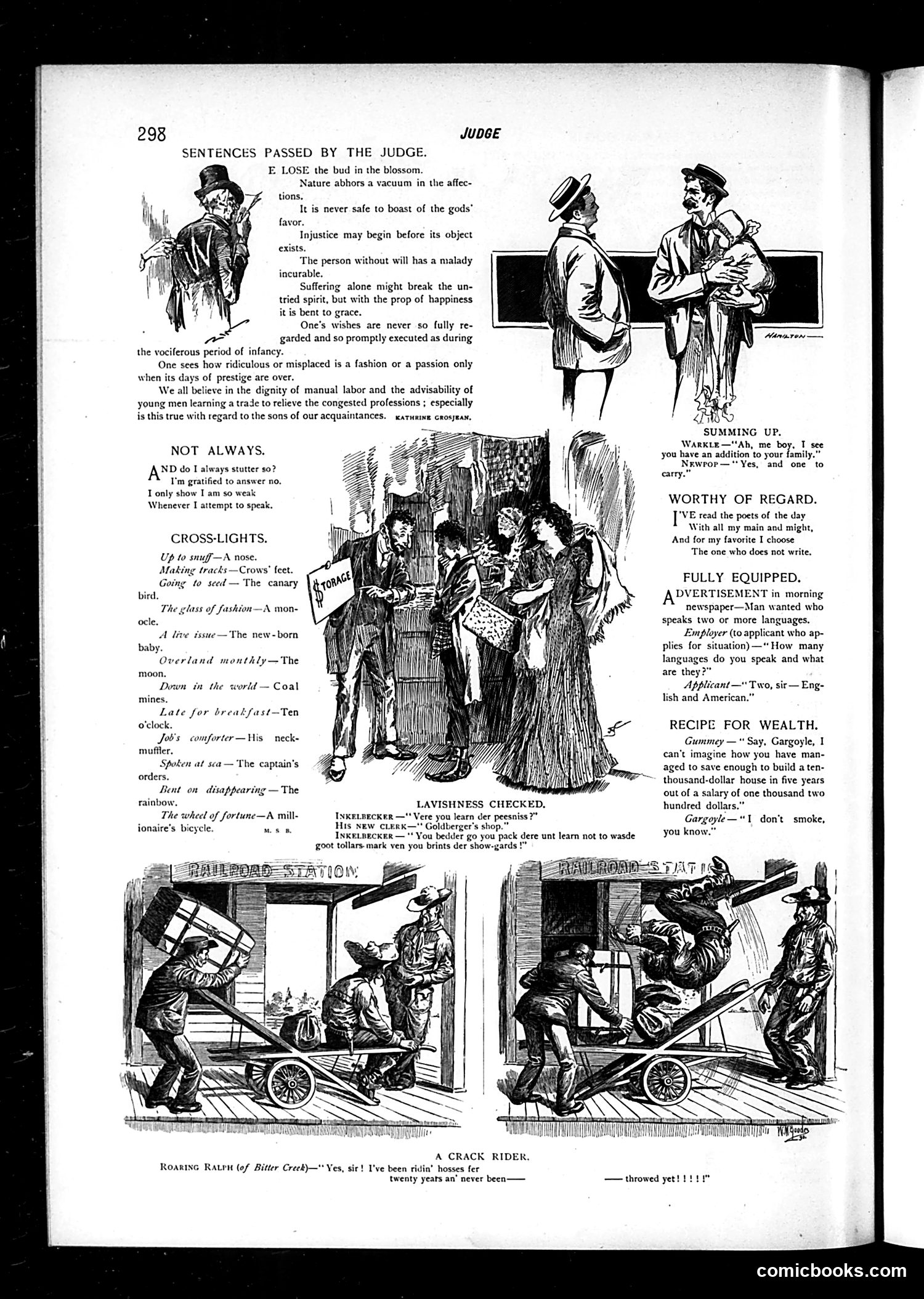
This page contains miscellaneous short jokes and satirical cartoons typical of Judge's format. **"Sentences Passed by the Judge"** are philosophical observations on human nature—witty aphorisms about wishes, willpower, and fashion trends. **"Cross-Lights"** is a wordplay feature playing on double meanings (e.g., "Up to snuff" = a nose, "Going to seed" = canary bird). **"A Crack Rider"** depicts a boastful horseman claiming twenty years' riding experience, then being immediately thrown—satirizing braggadocio. **"Fully Equipped"** mocks job advertisements requiring multilingual applicants; an applicant claims to speak "English and American"—joking that Americans treat their dialect as a separate language, reflecting period attitudes about American English versus British English. **"Recipe for Wealth"** suggests frugality and abstinence enable modest saving—implying working-class aspirations toward middle-class homeownership. The **German-accented dialogue** cartoons appear to mock immigrant shopkeepers, reflecting period ethnic stereotyping common in American satirical magazines.
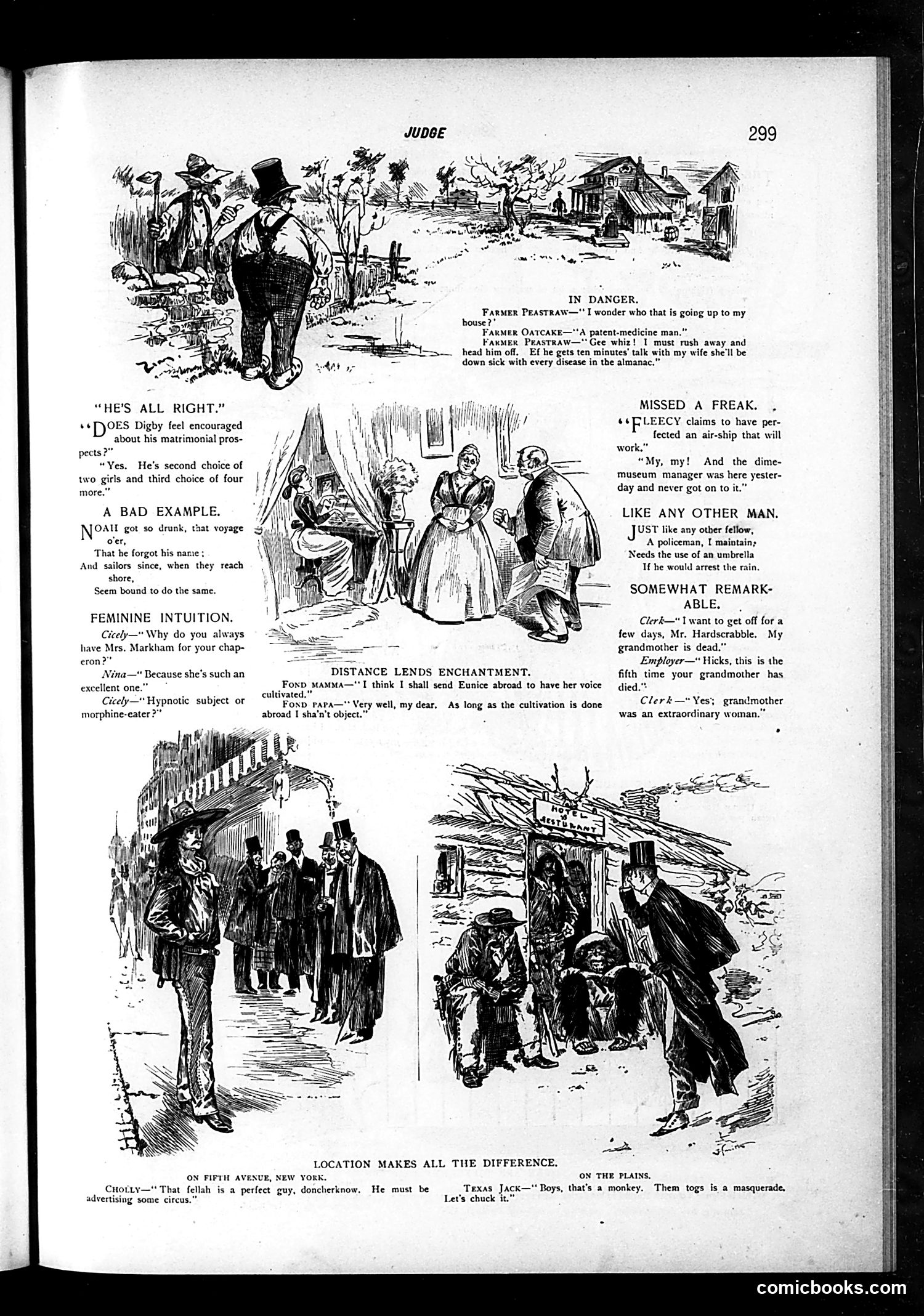
This page contains multiple brief satirical jokes typical of Judge magazine's humor style, targeting various social conventions and character types: **"He's All Right"** mocks dating prospects—a man being the third or fourth choice is presented as encouraging. **"A Bad Example"** uses a drunken sailor to satirize how behavior spreads through social imitation. **"Feminine Intuition"** jokes that women choose chaperones for advertising purposes rather than propriety. **"Distance Lends Enchantment"** satirizes parental hypocrisy—a father approves sending his daughter abroad for voice training only because it distances her from his observation. **"In Danger"** depicts farmers' fear of patent-medicine salesmen exploiting wives' gullibility. **"Missed a Freak"** mocks both failed inventions and dime museums' sensationalism. The bottom cartoons use location-based humor: identical behavior deemed acceptable on Fifth Avenue appears ridiculous on the Texas plains, satirizing class and regional pretension.
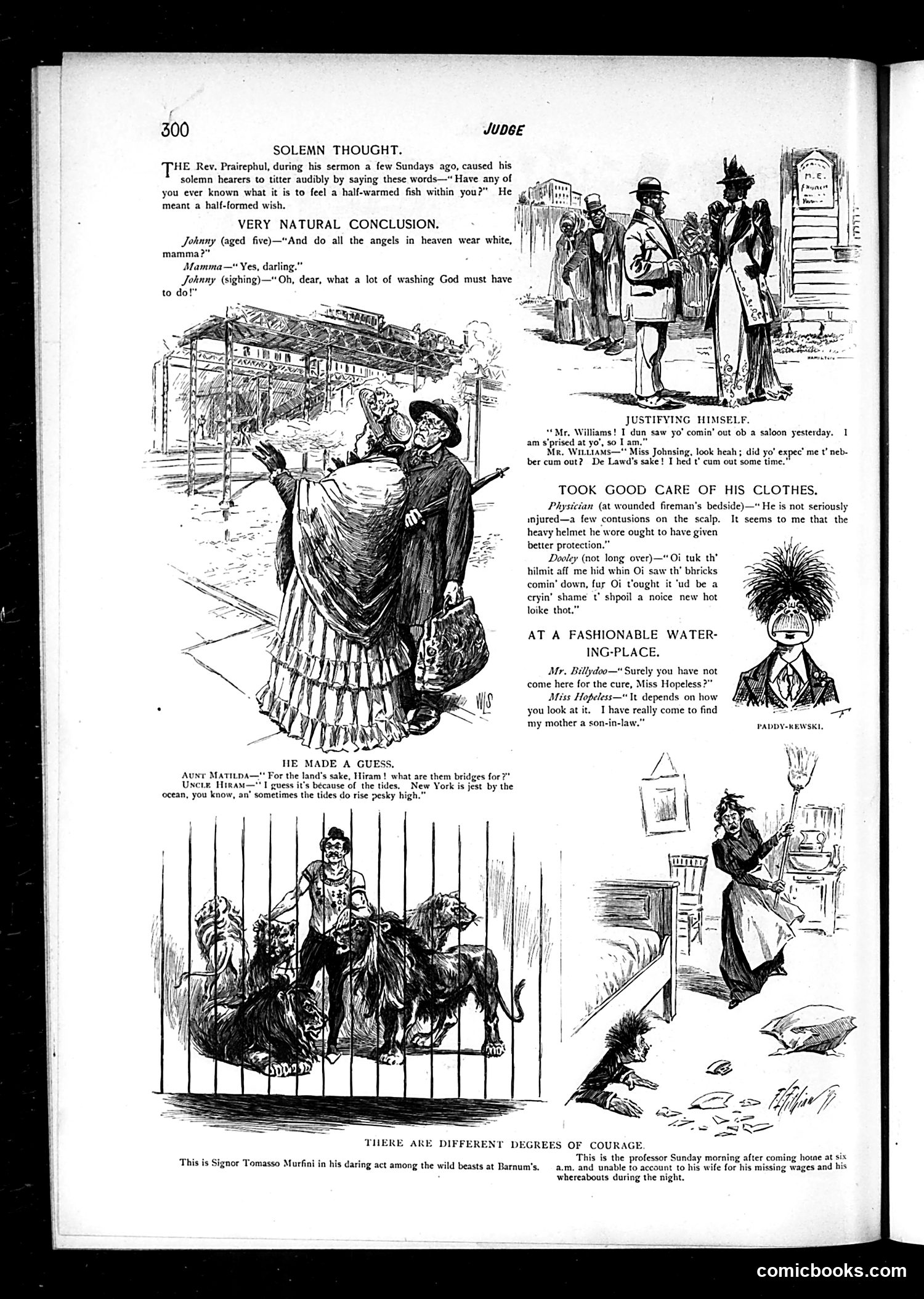
This page collects brief humorous sketches typical of late-19th century American satire: **"Solemn Thought"** and **"Very Natural Conclusion"**: Simple jokes about children's innocent logic—a boy reasons that God must do enormous laundry since all angels wear white. **"Justifying Himself"** and **"Took Good Care of His Clothes"**: Ethnic humor featuring dialectal speech (stereotyped African American and Irish accents). Characters defend questionable behavior through dubious logic—a man exiting a saloon, a fireman damaging his helmet. **"He Made a Guess"**: Rural American naïveté—a farmer incorrectly explains New York's bridges as tidal mechanisms. **"At a Fashionable Watering-Place"**: Social satire about marriage-hunting among the wealthy. **"There Are Different Degrees of Courage"**: Contrasts a circus performer with wild animals against a professor caught out all night—implying domestic confrontation is scarier than actual danger. The page uses period-typical ethnic caricature and class-based humor to mock various social types.
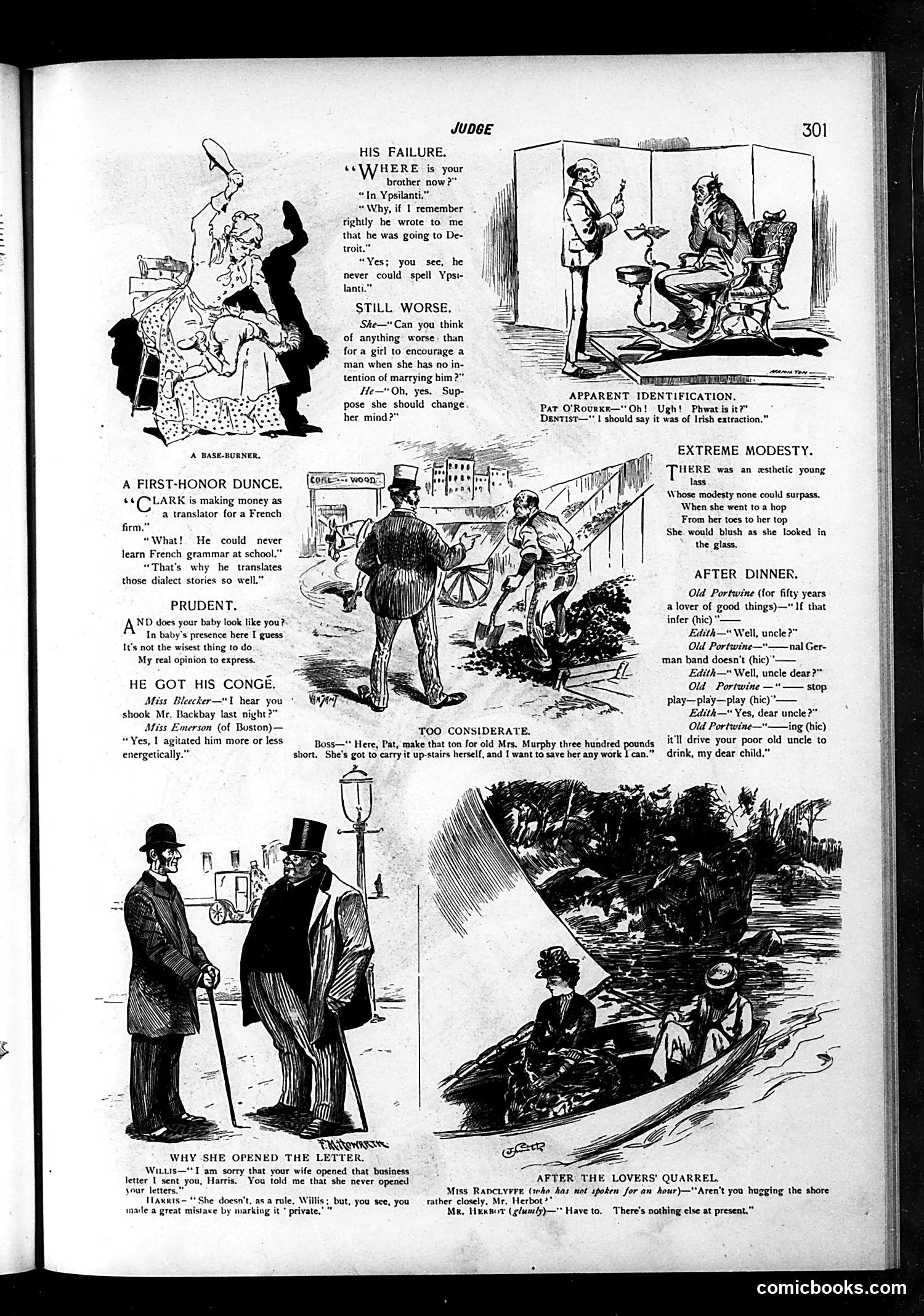
This page collects brief humorous vignettes mocking Victorian social conventions and character types: **"His Failure"** ridicules a man unable to spell "Ypsilanti," suggesting incompetence even in written correspondence—a serious flaw for gentlemen of the era. **"Apparent Identification"** contains ethnic humor: a dentist identifies a patient as Irish by examining his teeth, reflecting common 19th-century stereotyping. **"Extreme Modesty"** satirizes exaggerated feminine delicacy—a young woman so modest she blushes merely looking in a mirror. **"After Dinner"** depicts an elderly drunk uncle becoming increasingly incoherent, disrupting family gatherings through alcoholic rambling. **"Too Considerate"** ironically shows a boss asking an employee to reduce a package's weight so an elderly woman can carry it upstairs herself—false consideration masking exploitation. **"Why She Opened the Letter"** mocks marital dynamics: a wife violates her husband's privacy despite his trust. The cartoons collectively ridicule social pretension, ethnic stereotypes, and domestic hypocrisy typical of Judge's satirical approach.
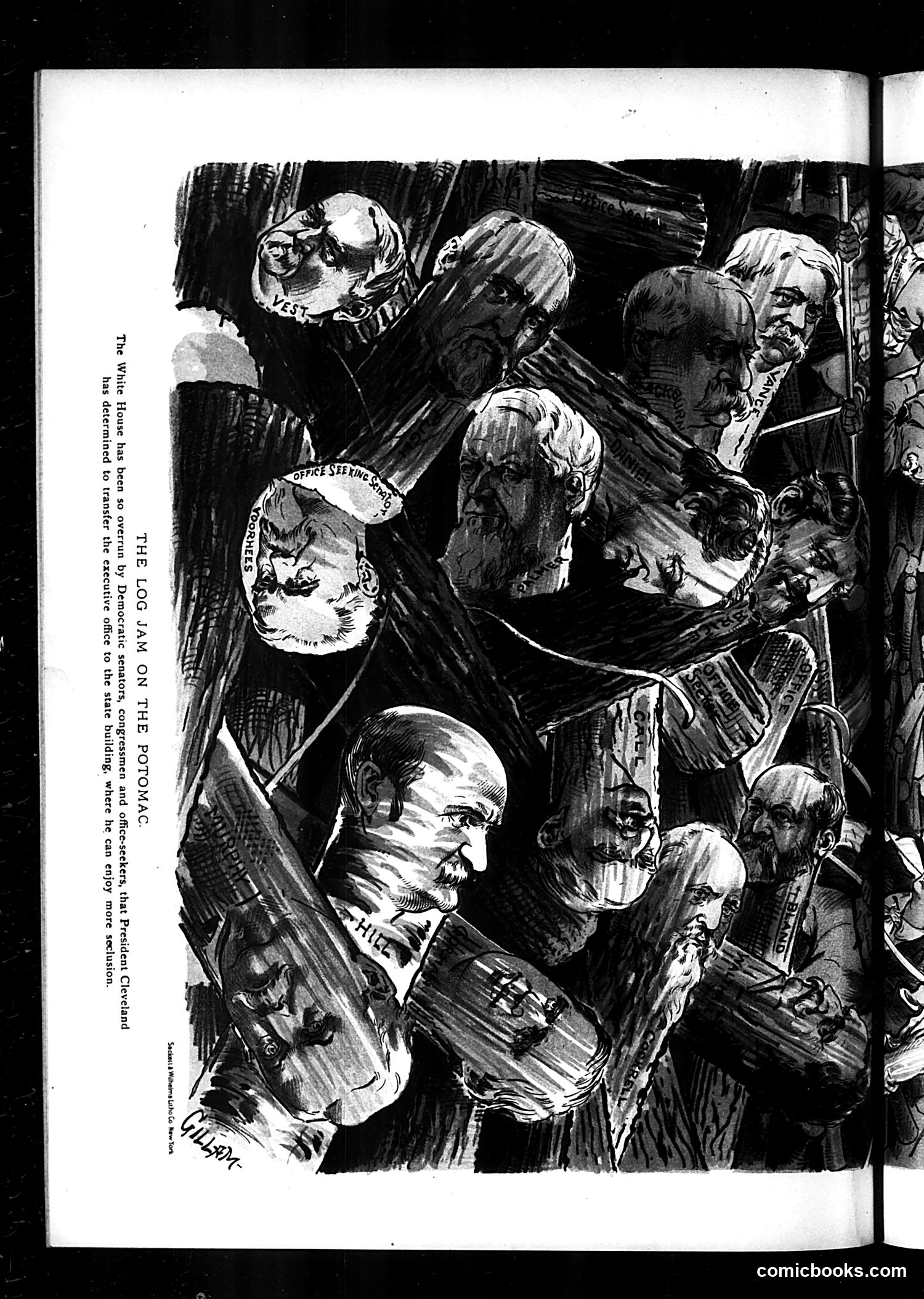
This political cartoon satirizes President Cleveland being overwhelmed by Democratic party members—senators, congressmen, and office-seekers—crowding the White House seeking favors and positions. The "log jam" metaphor depicts these officials as obstruction clogging the Potomac River (symbolizing government flow). The cartoon mocks the influx of patronage-hungry Democrats after Cleveland took office, suggesting the president is so besieged he must escape to a state building for peace. The densely packed, caricatured faces emphasize the chaotic mob mentality. This likely critiques the spoils system and Democratic pressure for political appointments during Cleveland's presidency (1885-1889 or 1893-1897), a recurring tension in American politics of that era.
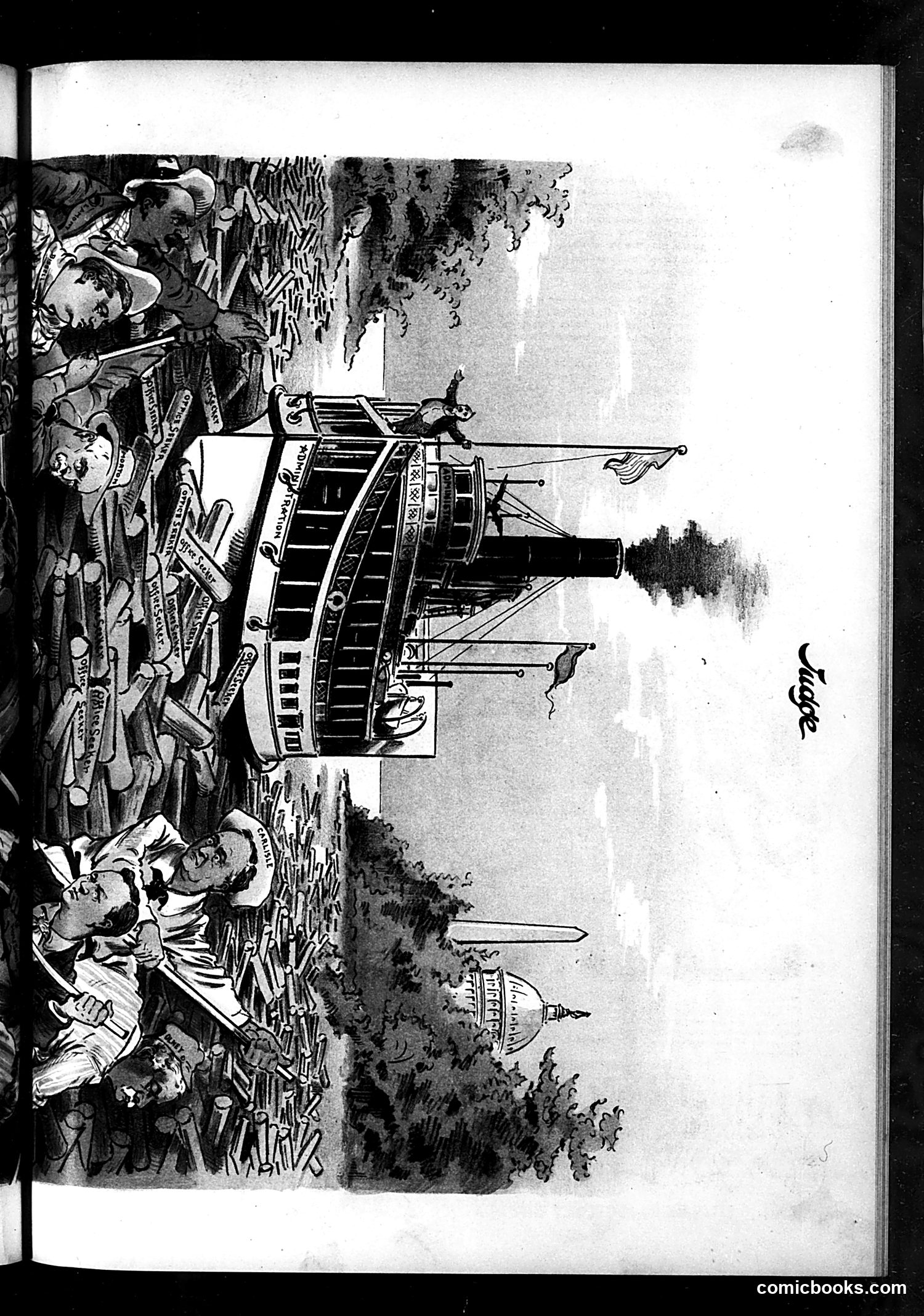
This page appears to be rotated 90 degrees in the scan. When oriented correctly, it shows a satirical illustration of what appears to be a grand building or structure (possibly a capitol or government building) with elaborate architectural details. On the left side, there are multiple caricatured figures in period dress, suggesting political or social commentary typical of Judge magazine's satirical style. The ornate building in the center is drawn with decorative elements and formal architectural features. However, the OCR text provided contains only formatting characters and no legible content, making it impossible to identify specific political figures, events, or the precise satirical point being made. Without readable text or clearer context, I cannot determine which historical moment or figures this cartoon targets.
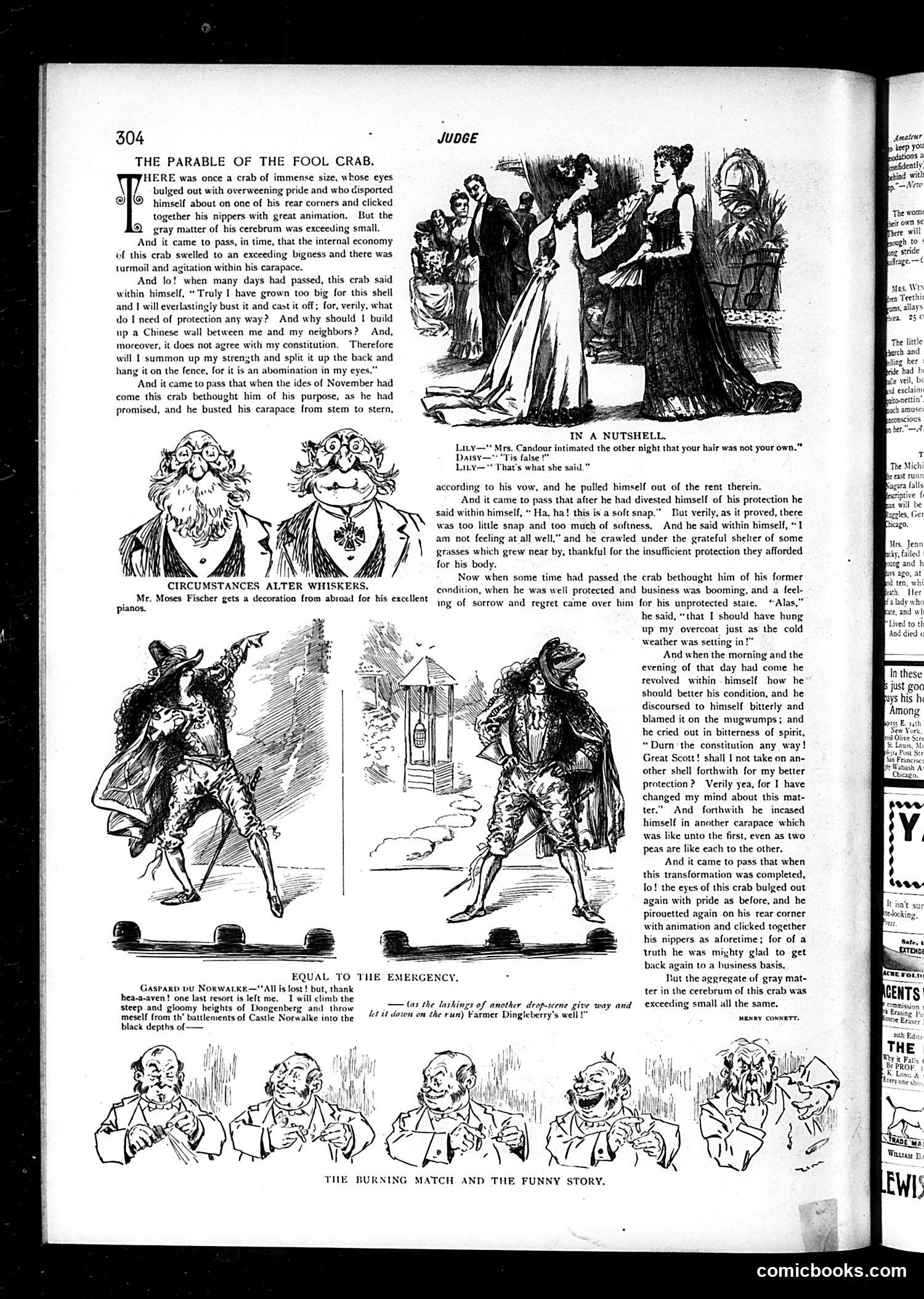
This is a political allegory about protectionism and tariffs. The crab represents a nation (likely the United States) that, driven by pride and poor judgment, abandons its protective tariff "shell" based on ideological arguments about free trade and anti-protectionist sentiment ("mugwumps" — a contemporary term for reform Republicans who opposed protective tariffs). Once unprotected, the crab suffers economic hardship ("not feeling at all well") and regrets its decision. It then hastily re-adopts protectionist measures, returning to its original state. The satire's point: despite reverting to protection, the underlying foolishness remains unchanged. The cartoon criticizes both free-trade ideology and the inconsistency of reversing course while learning nothing—a commentary on late 19th-century American tariff policy debates.
This page is primarily **advertising with brief satirical humor columns**, typical of Judge magazine's format. The satirical content includes short, disconnected jokes mocking: - **Women's suffrage**: A Kansas editor criticizes women voting, suggesting they lack qualifications - **Colonel Watterson** (Kentucky newspaper editor): Mocked for proposing taxes on sugar, coffee, and tea to fund schools—the joke being that in Kentucky, breakfast consists of cocktails instead, so taxing these items would be popular - **Dentist pricing**: A humorous exchange about dental costs - **Various domestic situations**: Jokes about maids, children, and household help The **advertisements** dominate the page, promoting products like Castoria (children's medicine), dental services, smoking tobacco (Yale Mixture), champagne, soap, suspenders, and complexion powder. The satirical tone is **light and domestic** rather than hard-hitting political commentary. The Watterson reference suggests the magazine engaged with contemporary debates about taxation and regional American differences, but presents these as gentle humor rather than serious critique.
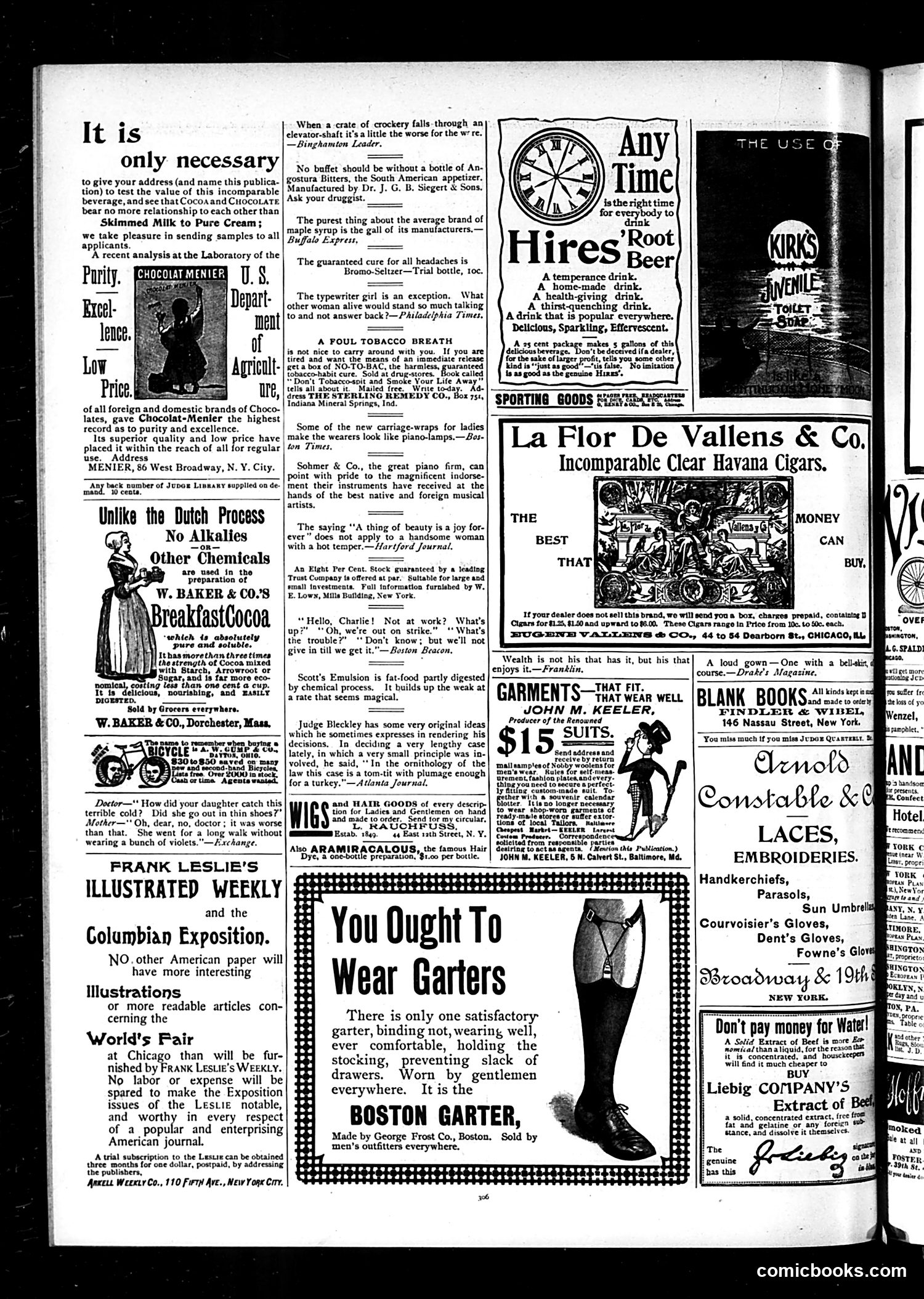
This page is primarily **advertisements and filler content**, typical of Judge magazine's format. The notable satirical elements are brief quips scattered among product ads: A **one-panel cartoon joke** mocks workplace labor disputes: workers on strike claim ignorance of their own grievance ("Don't know; but we'll not give in till we get it"), satirizing the perceived absurdity of labor strikes and worker organization. Another quip suggests **female typewriter operators are exceptional because they actually listen without talking back**—a sexist jab at women's volubility common in 1890s humor. The remaining content consists of period **advertisements** for chocolate, cocoa, cigars, cocoa remedies (anti-tobacco products), piano manufacturers, garments, and laces—reflecting late-19th-century consumer culture. The page's satire is mild and conventional, targeting labor activists and women rather than political figures or major events. There is **no identifiable political cartooning** here—the satirical content is secondary to commercial purposes.
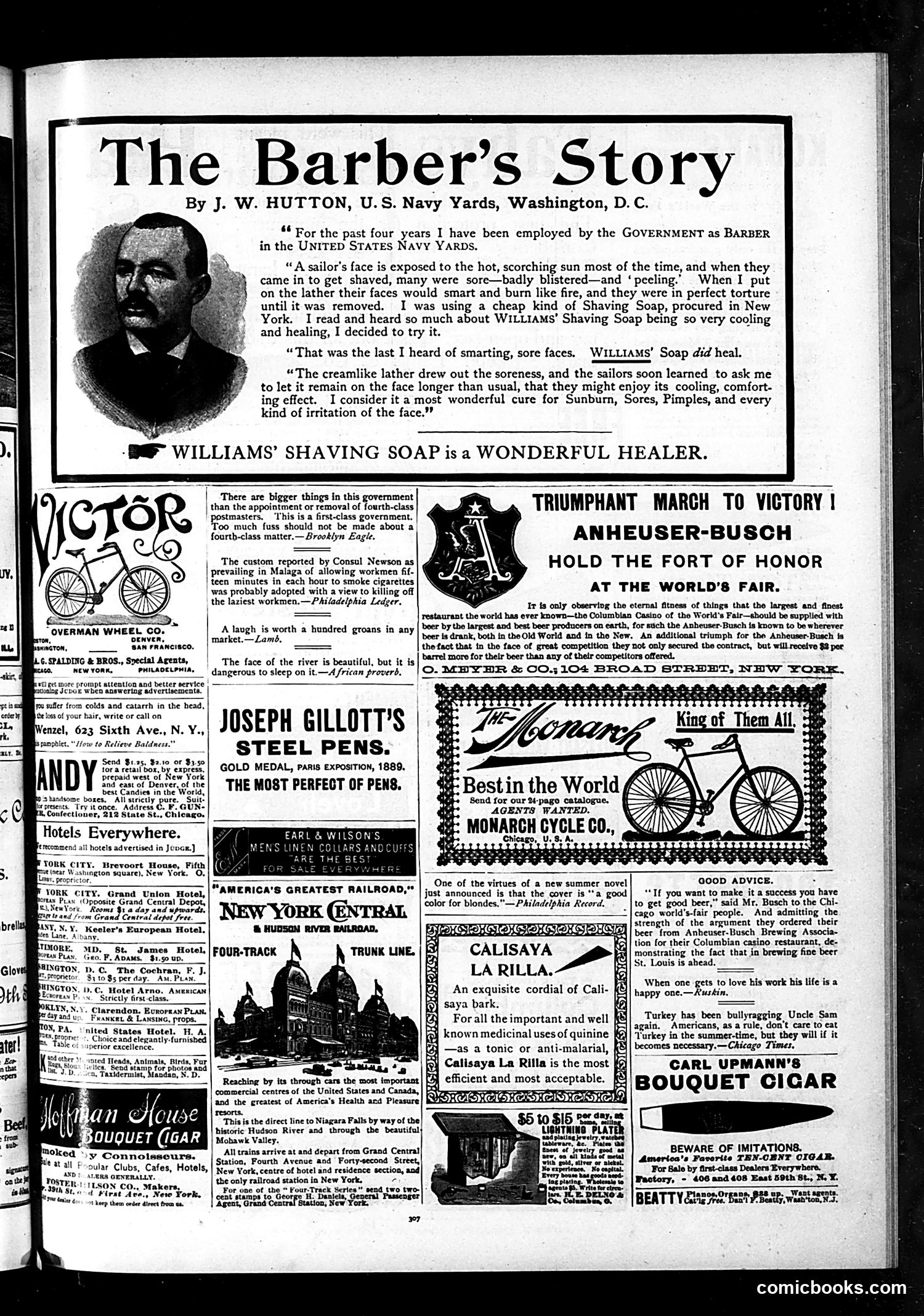
This page is primarily **advertising disguised as editorial content**. The lead article features a testimonial from a U.S. Navy barber praising Williams' Shaving Soap for healing sunburned sailors' faces. This is a **product endorsement** using government employment as credibility. The remainder consists of **classified and display advertisements** for various products: Victor bicycles, Joseph Gillott's steel pens, hotel listings, the New York Central Railroad, Anheuser-Busch beer (prominently featured twice), Monarch bicycles, Calisaya La Rilla medicinal cordial, and Carl Upmann cigars. The small text snippets scattered throughout are **brief satirical observations** typical of Judge magazine—mocking government appointments, Spanish work customs, and literary trends—but these are incidental to the page's primary function as an advertising vehicle. The Anheuser-Busch ads notably reference the 1893 World's Columbian Exposition, suggesting a contemporary date.
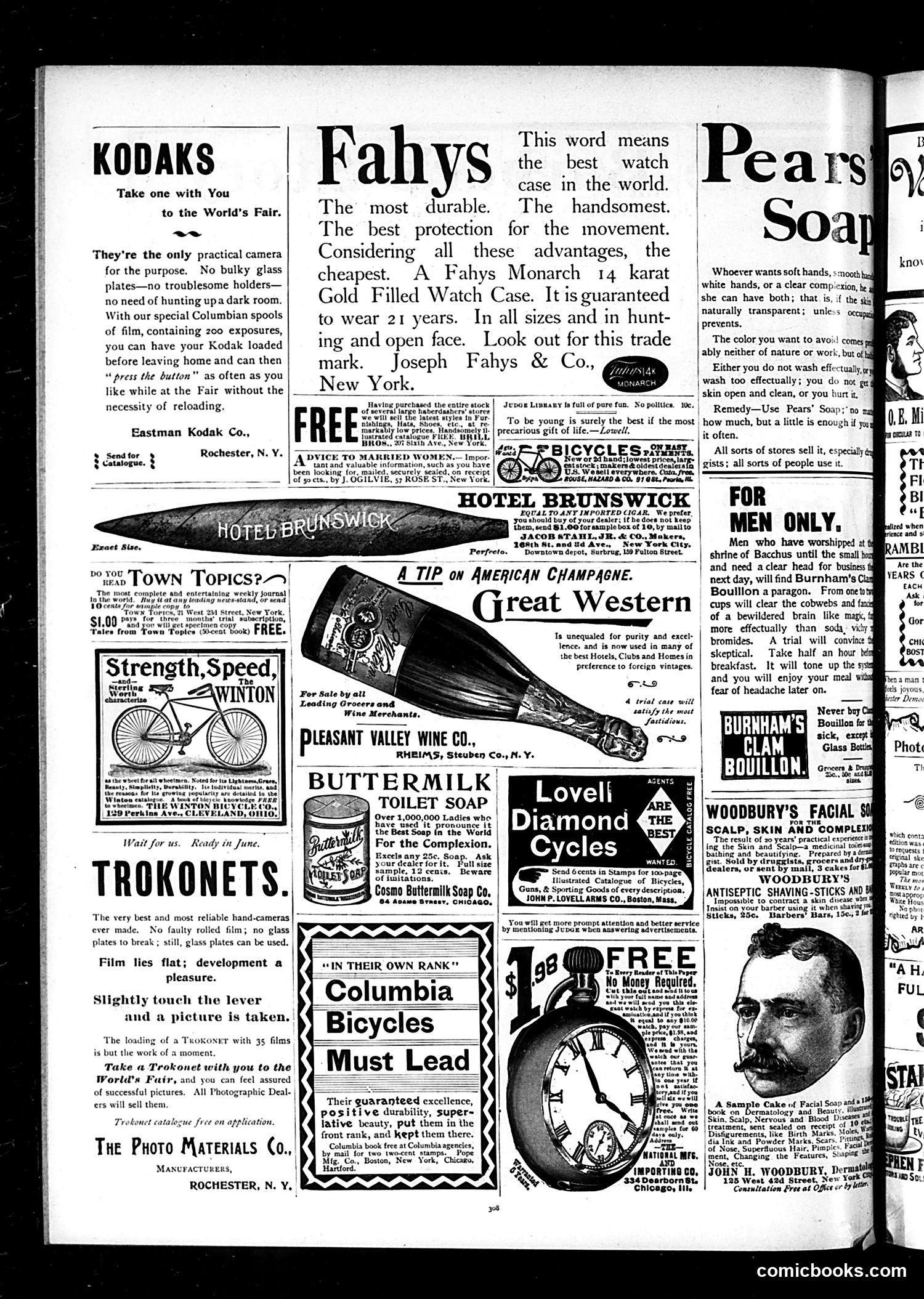
This is primarily an **advertising page** from Judge magazine, likely from the 1890s (references to "World's Fair" suggest the 1893 Chicago Columbian Exposition). The page contains **no political cartoons or satire**—it's a collection of product advertisements typical of the era: - **Photography equipment** (Kodaks, Trokonets) marketed for capturing the World's Fair - **Watches and jewelry** (Fahys watch cases) - **Bicycles** (Columbia, Lovell Diamond brands) - **Consumer goods** (soap, wine, cigars, champagne) - **Toiletries** (Buttermilk toilet soap for complexion) **Notable context for modern readers:** The ads emphasize *portability and convenience*—cameras without heavy glass plates, bicycles as practical transportation. The soap advertisement targets women's complexion care, reflecting period beauty standards. References to "imported" goods suggest American consumers valued European products. This page represents Judge's business model: satirical editorial content subsidized by extensive advertising, rather than editorial satire throughout.
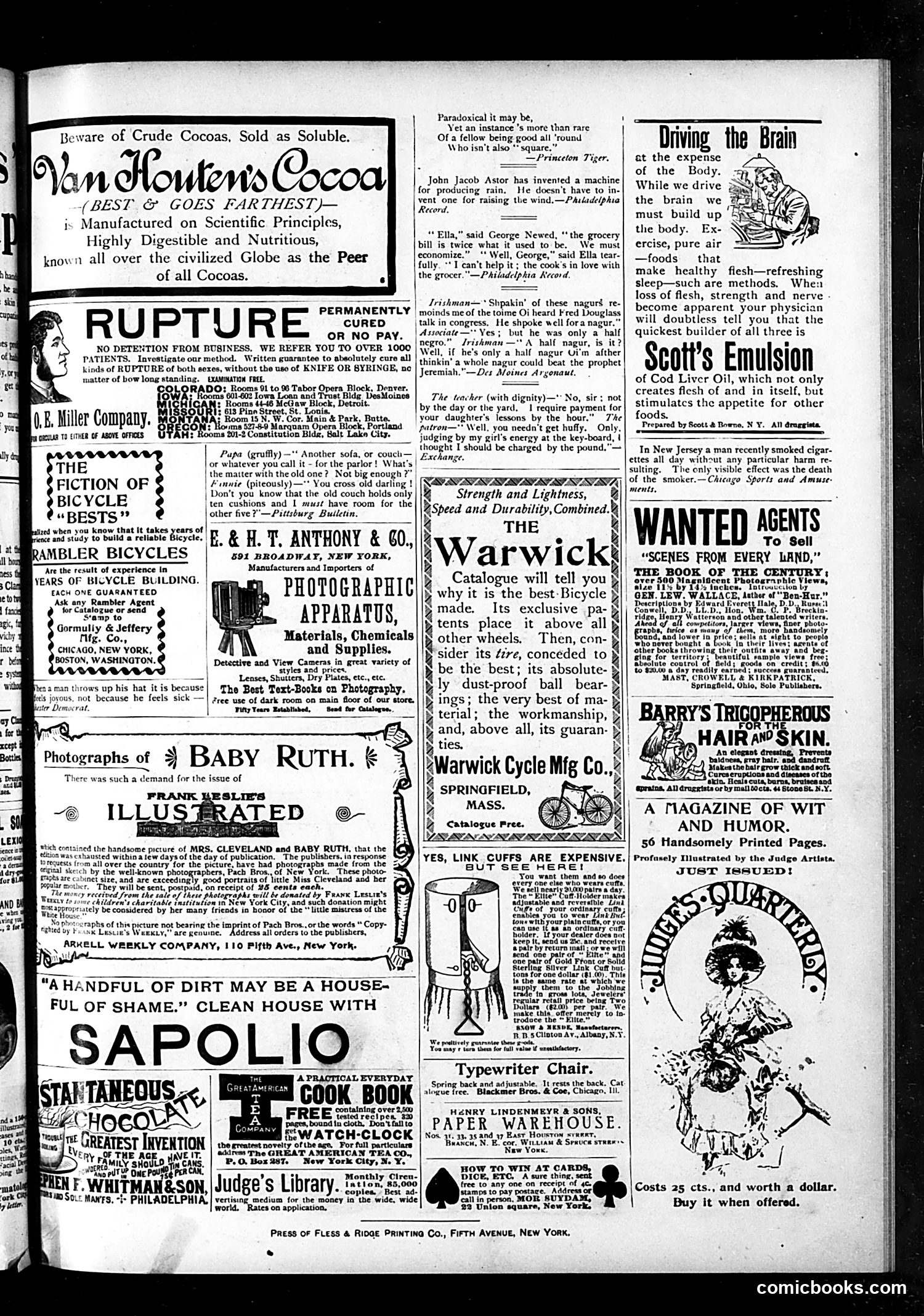
This is primarily an **advertising page** from Judge magazine, typical of late 19th-century publications. The page contains no significant political cartoons or satire—instead, it's dominated by commercial advertisements and product promotions. Notable content includes: **Advertisements:** Van Houten's Cocoa, rupture cure clinics, bicycles (Rambler, Warwick), photographic equipment, Scott's Emulsion (cod liver oil), and household products like Sapolio soap. **Minor humor content:** Two brief comic snippets—a domestic joke about a wife wanting more sofas ("Papa" and "Finnie"), and an aphorism about men throwing hats when jealous rather than sick. **Historical interest:** The "Baby Ruth" photograph promotion shows contemporary celebrity culture; the extensive medical advertisements (rupture cures, various tonics) reflect period medical practices now considered dubious. The page reflects Judge's business model: satirical content subsidized by advertising revenue.