
Judge, 1893-05-13 · page 4 of 16
Judge — May 13, 1893 — page 4: what you’re looking at
What you’re looking at
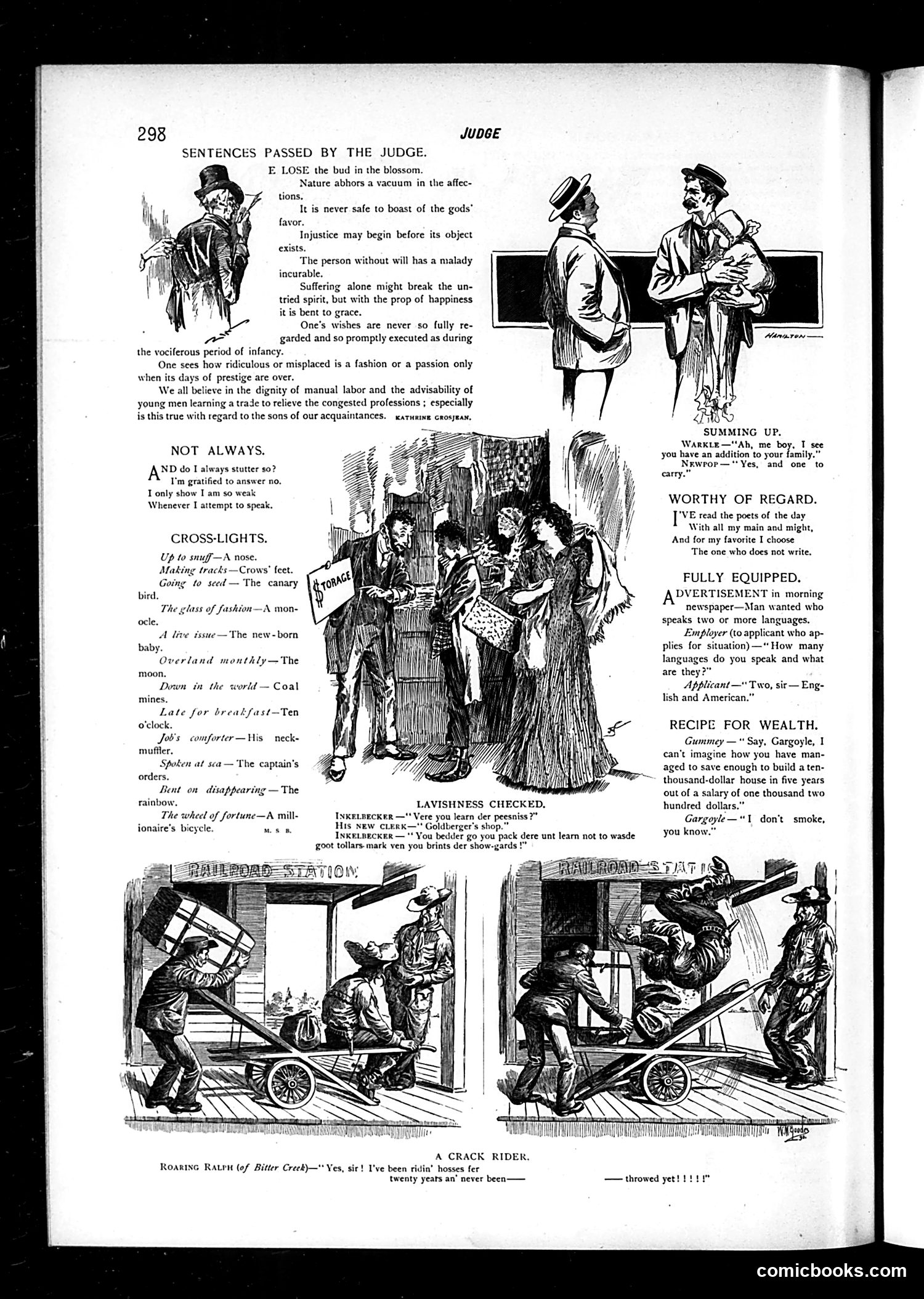
This page contains miscellaneous short jokes and satirical cartoons typical of Judge's format. **"Sentences Passed by the Judge"** are philosophical observations on human nature—witty aphorisms about wishes, willpower, and fashion trends. **"Cross-Lights"** is a wordplay feature playing on double meanings (e.g., "Up to snuff" = a nose, "Going to seed" = canary bird). **"A Crack Rider"** depicts a boastful horseman claiming twenty years' riding experience, then being immediately thrown—satirizing braggadocio. **"Fully Equipped"** mocks job advertisements requiring multilingual applicants; an applicant claims to speak "English and American"—joking that Americans treat their dialect as a separate language, reflecting period attitudes about American English versus British English. **"Recipe for Wealth"** suggests frugality and abstinence enable modest saving—implying working-class aspirations toward middle-class homeownership. The **German-accented dialogue** cartoons appear to mock immigrant shopkeepers, reflecting period ethnic stereotyping common in American satirical magazines.
📄 Transcribed text from this page (OCR, searchable)
Machine-transcribed from the original scan — historical spelling and the odd misread are preserved.
JUDGE SENTENCES PASSED BY THE JUDGE. E LOSE the bud in the blossom. Nature abhors a vacuum in the affec- tions, It is never safe to boast of the gods’ favor. Injustice may begin before its object exists. The person without will has a malady incurable. Suffering alone might break the un- tried spirit, but with the prop of happiness it is bent to grace. One’s wishes are never so fully re- garded and so promptly executed as during the vociferous period of infancy. One sees how ridiculous or misplaced is a fashion or a passion only when its days of prestige are over. We alll believe in the dignity of manual labor and the advisability of young men learning a trade to relieve the congested professions ; especially is this true with regard to the sons of our acquaintances. xarweine cRoyean. NOT ALWAYS. AND do L always stutter 0? I'm gratified to answer no. T only show I am so weak Whenever I attempt to speak. CROSS-LIGHTS. Up to snuff —A nose. Making tracks —Crows’ feet. Going to seed — The canary bird. The glass of fashion—& mon- ocle, Al live issue—The new-born baby. Overland monthly—The moon. Down in the world — Coal mines. Late for breakfast—Ten o'clock. Job's comforter—His neck- mufiler, Spoken at sca— The captain's orders. Bent on disappearing —The rainbow. The wheel of fortune—A mill- fe you learn der peesniss ?” ionaire’s bicycle. mom Goldberger’s shop.” goot tollars-mark ven you brints der show-gards A CRACK RIDER. Roarinc RAru (of Bitter Creek)—"* Yes, sit! I've been ridin’ hosses fer twenty years an’ never been — h, me boy, T see ‘to your family.” “Yes, and one to WORTHY OF REGARD. ['VE read the poets of the day With all my main and might, And for my favorite I choose The one who does not write. FULLY EQUIPPED. DVERTISEMENT in morning newspaper—Man wanted who speaks two or more languages. Employer (to applicant who ap- plies for situation) “How many languages do you speak and what are they?” Applicant —" Two, sir — Eng- lish and American.” RECIPE FOR WEALTH. Gummey —“ Say, Gargoyle, 1 can't imagine how you have man- aged to save enough to build a ten- thousand-dollar house in five years out of a salary of one thousand two hundred dollars.” Gargoyle—*1 don't smoke, ECKER— "* You bedder go you pack dere unt learn not to wasde you know.” — throwed yet! 1! 11" comicbooks.com