
A complete issue · 18 pages · 1893
Judge — April 1, 1893
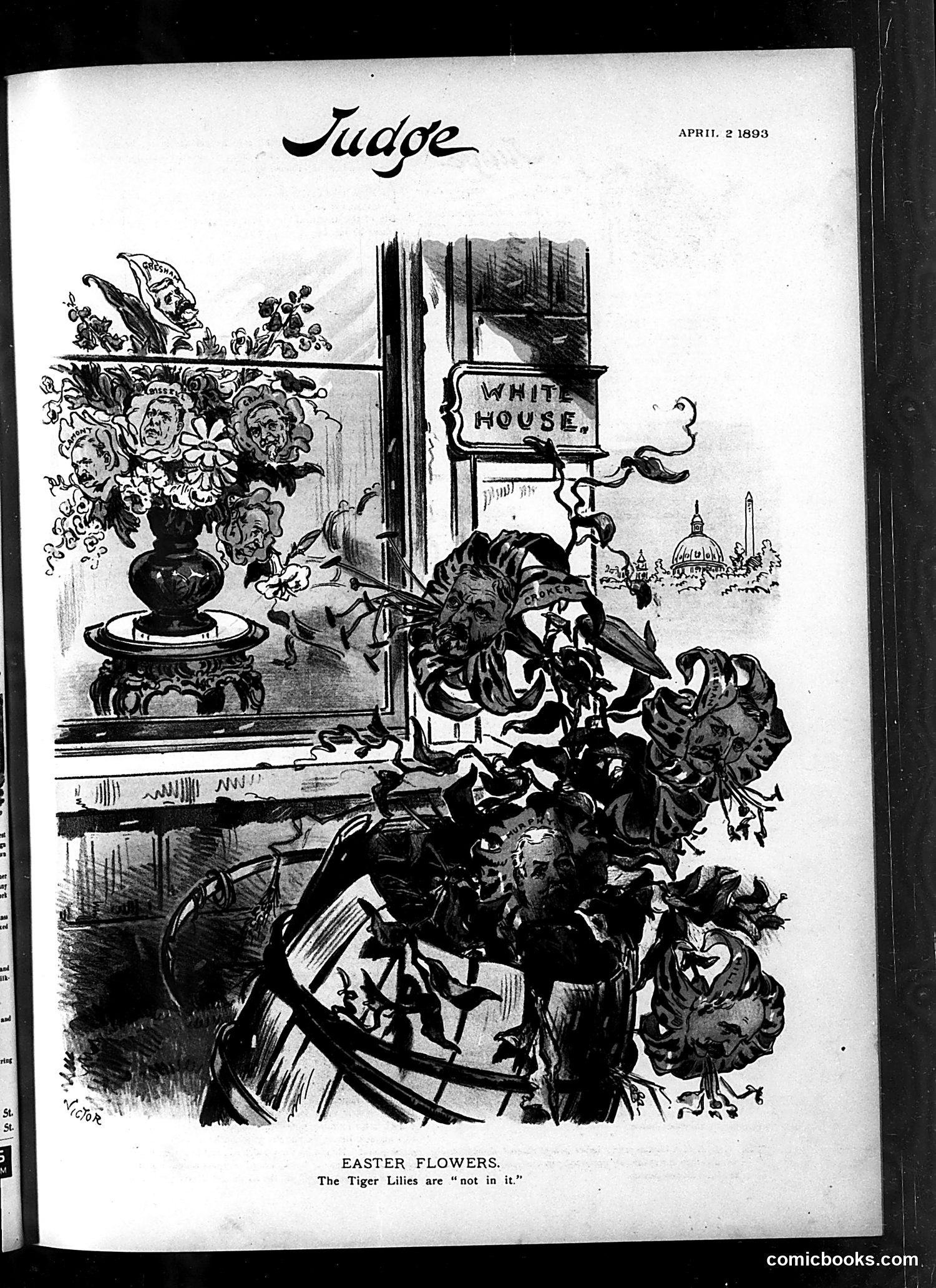
This political cartoon satirizes Easter flower displays at the White House during President Grover Cleveland's administration. The caption—"The Tiger Lilies are 'not in it'"—suggests that certain "tiger lilies" (likely representing specific political figures or factions) are being excluded or losing favor. The image shows elaborate Easter flowers being displayed at the White House entrance while various caricatured figures (appearing to represent politicians or political groups) are crowded outside, seemingly excluded or relegated to lower status. The satire appears to mock either political favoritism in White House social events or the exclusion of certain political actors from presidential circles during this period. The specific identities of the excluded figures remain unclear from the image alone.
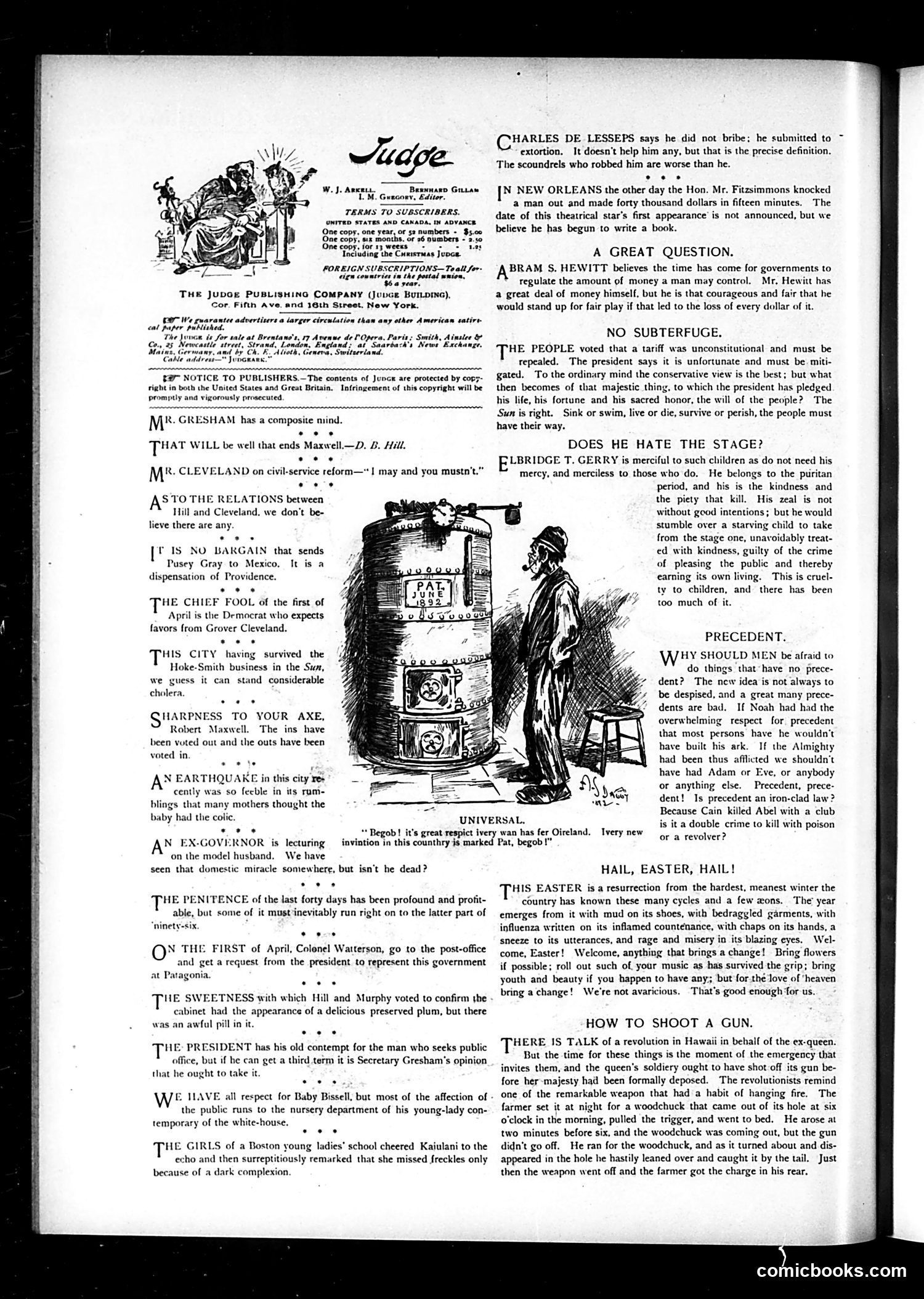
This page contains satirical commentary on contemporary political and social issues. The main cartoon depicts a figure examining a large cylindrical object labeled "JUNE 1903," likely representing a time capsule or historical record. The text columns include brief satirical quips about current events: criticism of government regulation of personal finances (Abram S. Hewitt), commentary on tariff policy and presidential power, and social critique regarding theatrical performers' treatment of children. A section titled "HOW TO SHOOT A GUN" describes a farmer's accidental discharge—likely satirizing either a recent incident or general incompetence with firearms among rural Americans. The page exemplifies Judge's style: pointed political commentary mixed with social observation, presented through both visual caricature and witty text fragments. Without specific date context, precise identification of some figures remains unclear.
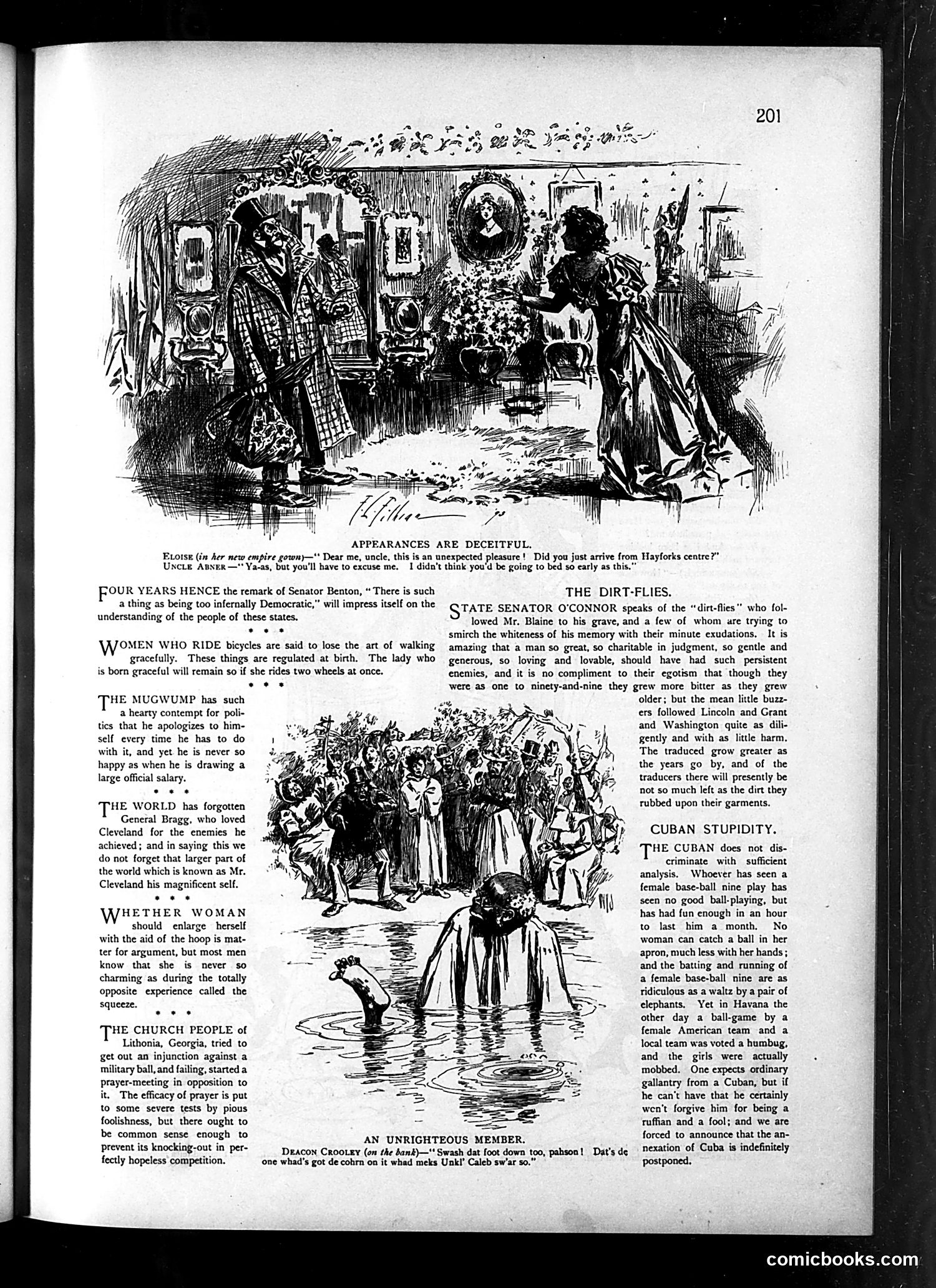
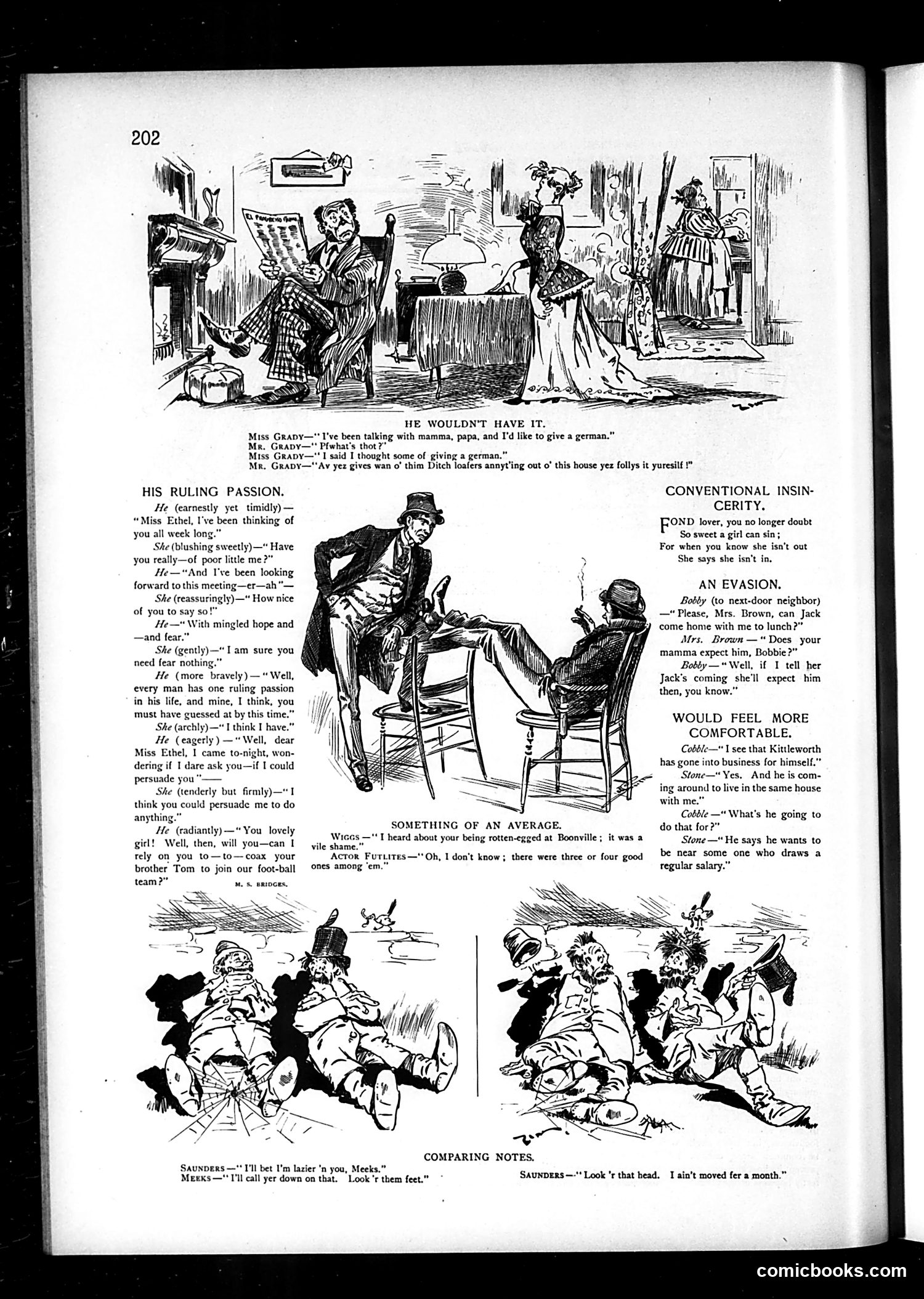
This page contains multiple short comic sketches mocking Victorian-era social pretenses and domestic life. **"He Wouldn't Have It"** satirizes Irish immigrant speech patterns (phonetic dialect) through Mr. Grady, who forbids his daughter from hosting a "german" (a fashionable social dance). The humor relies on class anxiety—the working-class father fears his daughter socializing with wealthy Germans. **"His Ruling Passion"** ironically depicts a young man's romantic confession that ultimately reveals his "ruling passion" is recruiting the woman's brother for his football team—mocking insincere courtship rhetoric. The remaining sketches—"Conventional Insincerity," "An Evasion," "Something of an Average," "Comparing Notes," and "Would Feel More Comfortable"—all target hypocrisy in polite society: dishonest expressions of feeling, evasive social excuses, competitive boasting, and financial anxiety among the aspiring middle class. The cartoons' crude humor trades on period-specific social codes that modern readers would find either quaint or offensive.
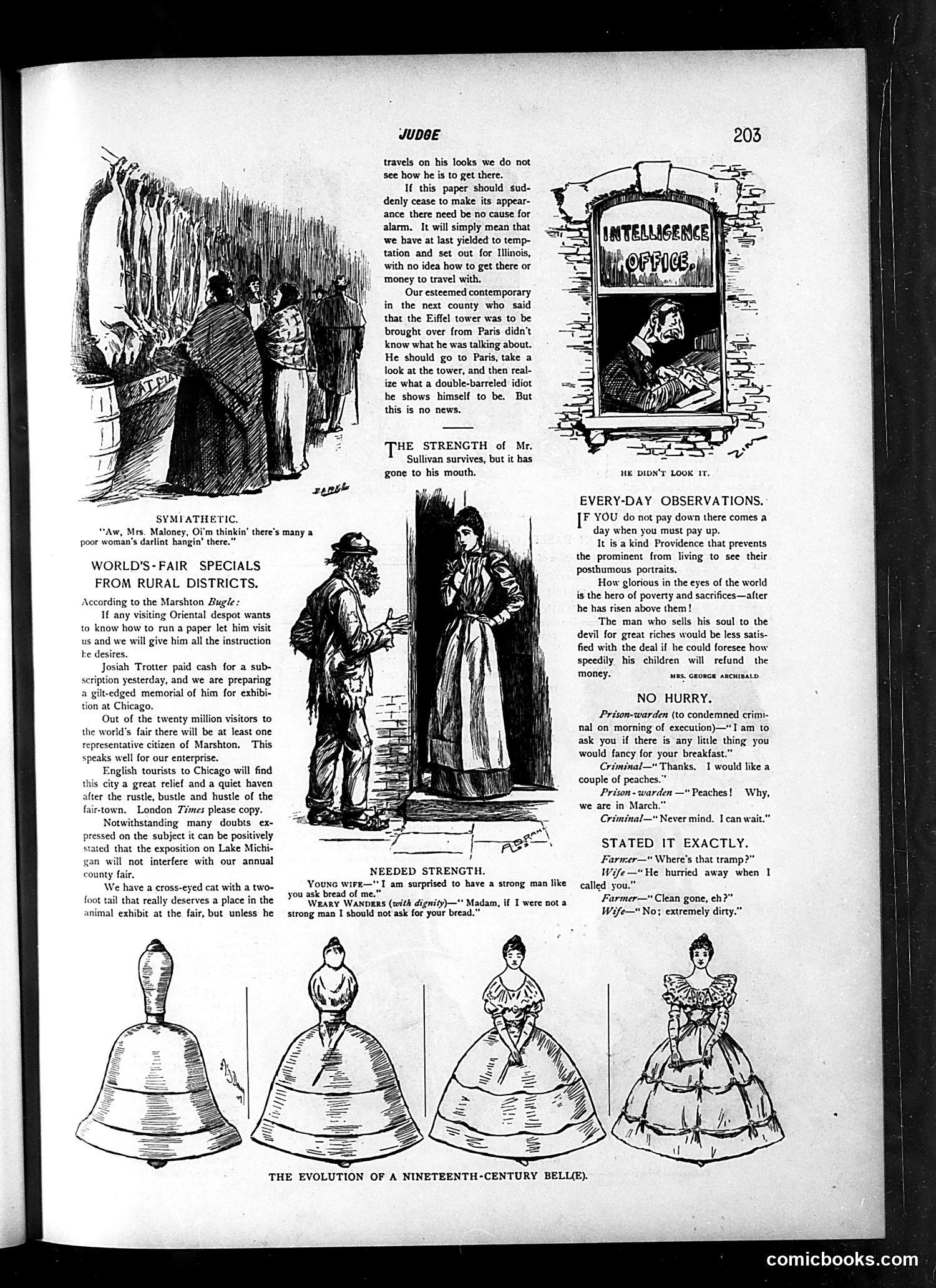
This page from Judge contains multiple satirical items mocking rural provincial attitudes and social pretension. The **"World's Fair Specials from Rural Districts"** section ridicules small-town papers' boastful coverage of the 1893 Chicago World's Columbian Exposition. The Marshton Bugle claims visitors and accomplishments of absurd insignificance (a cross-eyed cat, one local attending) warrant international attention. **"Sympathetic"** depicts working-class Irish immigrants, with the dialect humor typical of period satire. The **fashion evolution diagram** at bottom mocks how women's bell-shaped skirts grew increasingly elaborate—a commentary on vanity and impracticality of Victorian fashion trends. Various short jokes target **Irish working people** ("Weary Wanderer" asking for bread), **prison conditions**, and **social hypocrisy** (the wealthy ignoring posthumous consequences). The tone throughout is condescending toward rural, immigrant, and lower-class subjects while presenting itself as sophisticated social commentary.
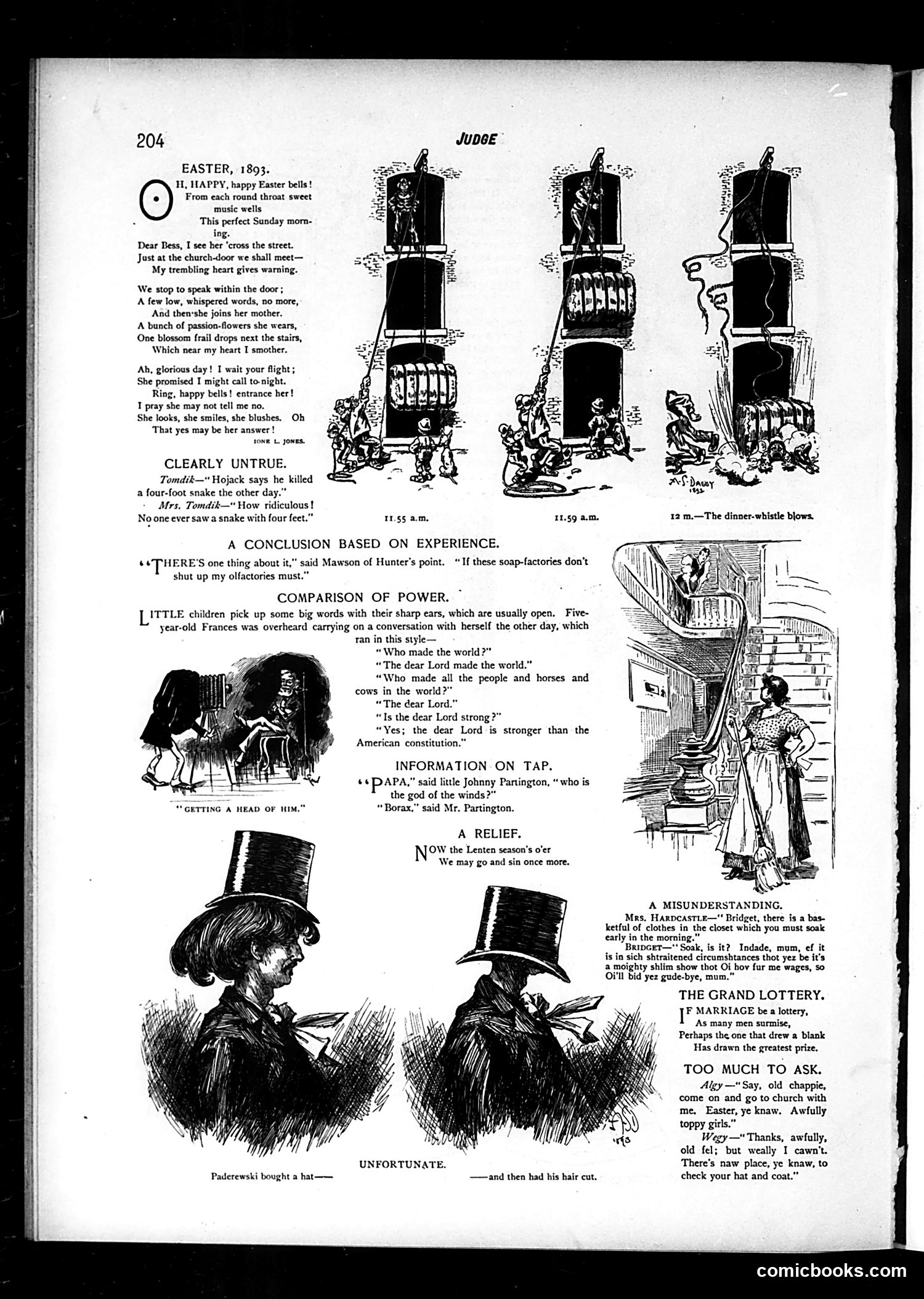
This Easter-themed page from Judge contains several short humorous pieces reflecting Victorian-era sensibilities: **"Easter, 1893"**: A sentimental poem about a young man's romantic anticipation meeting a woman at church on Easter Sunday—typical period courtship anxiety. **"Clearly Untrue"**: A joke mocking a husband's tall tale about killing a four-foot snake, with the wife's "logical" rebuttal that snakes don't have feet. **"Comparison of Power"**: A child's conversation comparing God's strength to the American Constitution—satire on how children misunderstand adult concepts. **"Information on Tap"**: A joke playing on the brand name "Borax" (a cleaning product) when a child asks about the god of winds—simple wordplay humor. **"Unfortunate" (bottom cartoon)**: Depicts pianist Paderewski buying a hat then getting a haircut—implying the hat purchase was pointless, likely mocking his vanity or appearance. The page also includes brief comic skits about servants misunderstanding instructions and marriage as a lottery. Overall, it's lightweight domestic and social humor typical of 1890s American satirical magazines.
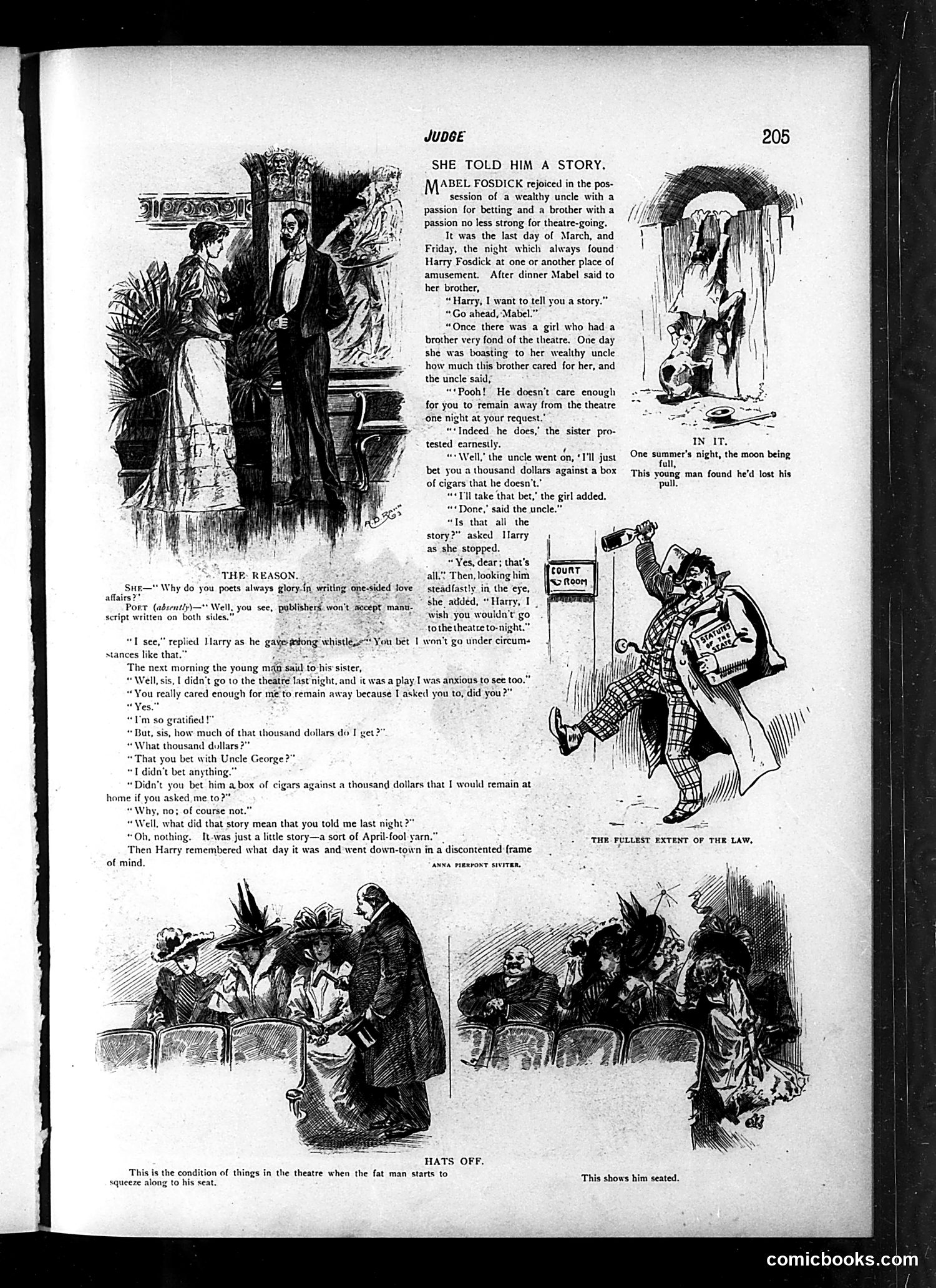
This page contains a humorous short story about sibling manipulation disguised as a moral lesson. Mabel tells her brother Harry an elaborate fictional anecdote about a girl who bets her uncle she can keep her theatre-loving brother home—implying Harry cares more for entertainment than for her. Harry, guilt-tripped, actually skips the theatre. But Mabel's "story" was fabricated; she never made any bet. Harry realizes he's been duped on April Fool's Day, having sacrificed a play he wanted to see based on a lie. The satire targets both theatrical obsession and sibling manipulation. The accompanying cartoons mock theatre etiquette—particularly the nuisance of overweight patrons squeezing into seats, disrupting other viewers ("The Fullest Extent of the Law" and "Hats Off"). The page also includes an unrelated joke about poets writing one-sided love poetry, and a brief editorial dialogue.
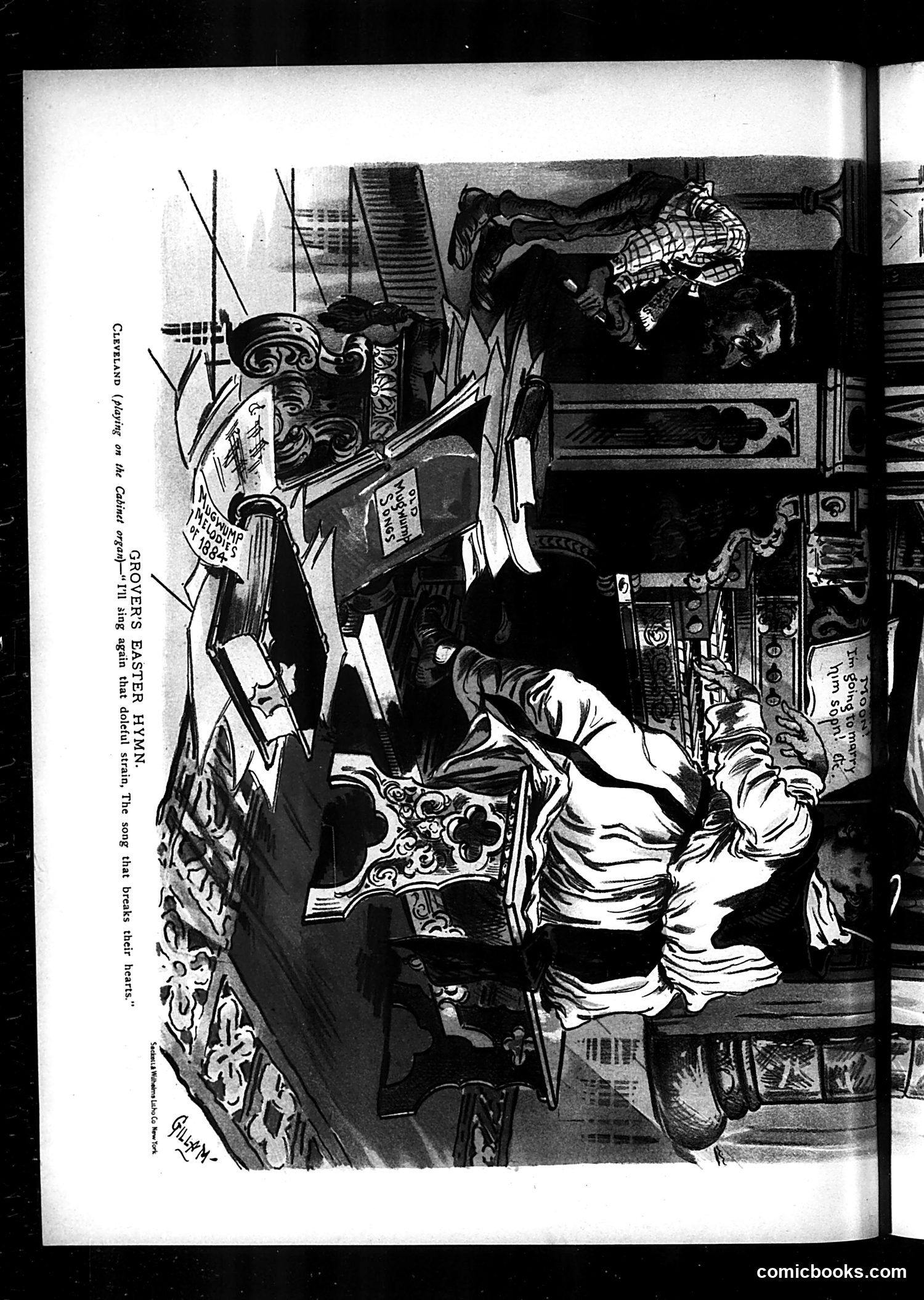
I can see this is a page from *Judge* magazine, but the OCR text is largely corrupted and unreadable, making it difficult to identify the specific cartoon(s) or their context with confidence. From the IMAGE alone, I can observe: - An interior scene with ornate period furnishings (decorative columns, elaborate furniture) - Multiple figures in what appears to be early-to-mid 20th century dress - One figure reclining or lounging prominently - The composition suggests a social or domestic satire However, **without legible text identifying the figures, the political context, or the magazine's date**, I cannot reliably explain what specific persons, events, or social commentary this cartoon addresses. The artistic style suggests early 20th century, but that alone is insufficient. To properly interpret this, I would need: the publication date, readable caption text, or additional context about which political or social figures were being satirized.
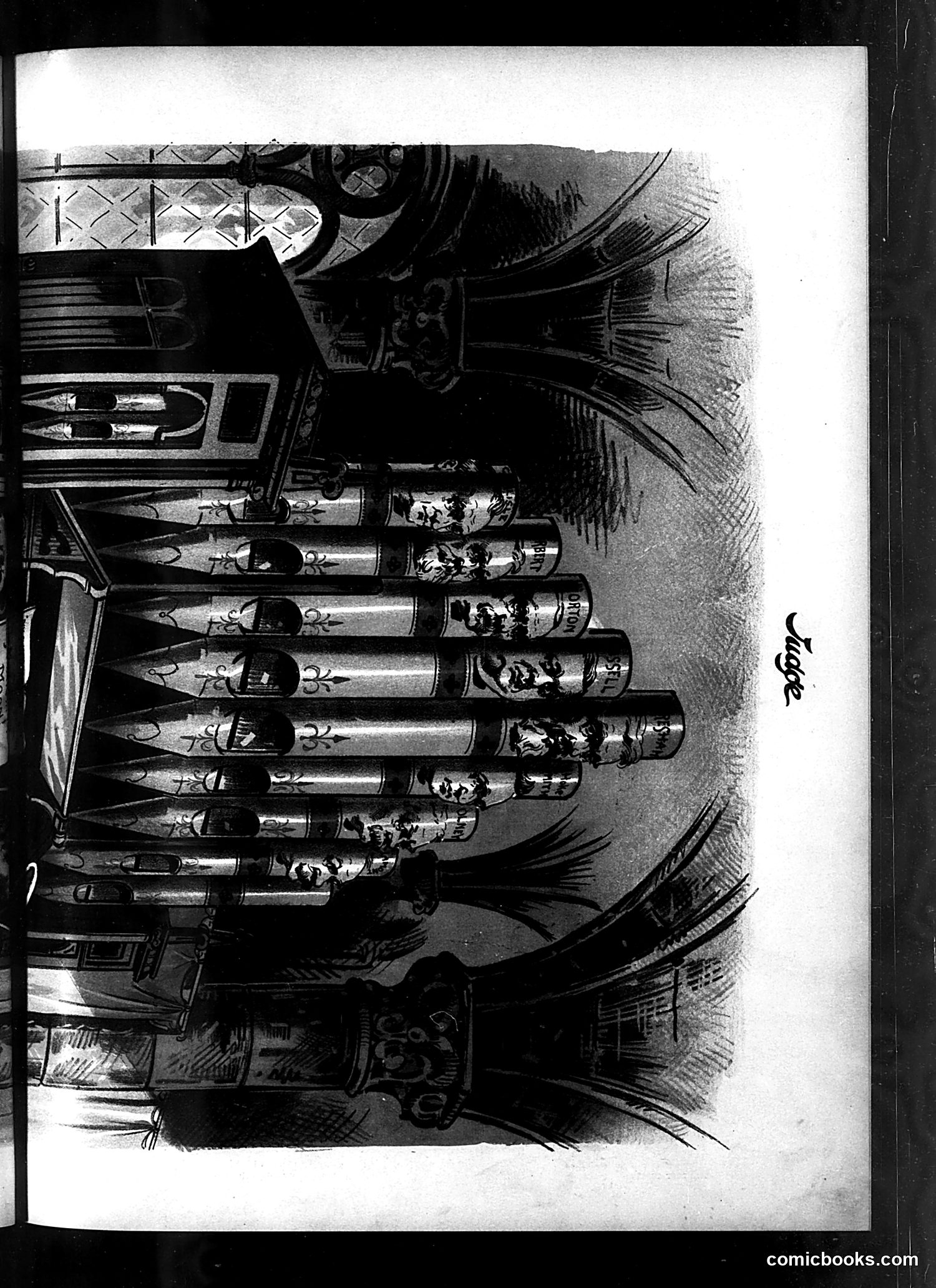
I can see this is a black and white illustration from Judge magazine, rotated 90 degrees, showing what appears to be a formal interior scene with decorative architectural elements and multiple cylindrical objects (possibly bottles or vessels) arranged in a line. However, the OCR text provided is largely illegible and contains only page markers and a website attribution. Without legible accompanying text, I cannot reliably identify the specific figures, historical references, or satirical intent of this cartoon. The image quality and rotation make detailed analysis uncertain. To provide an accurate explanation of the satire's meaning for a modern reader, I would need clearer text or additional context about the publication date and subject matter.
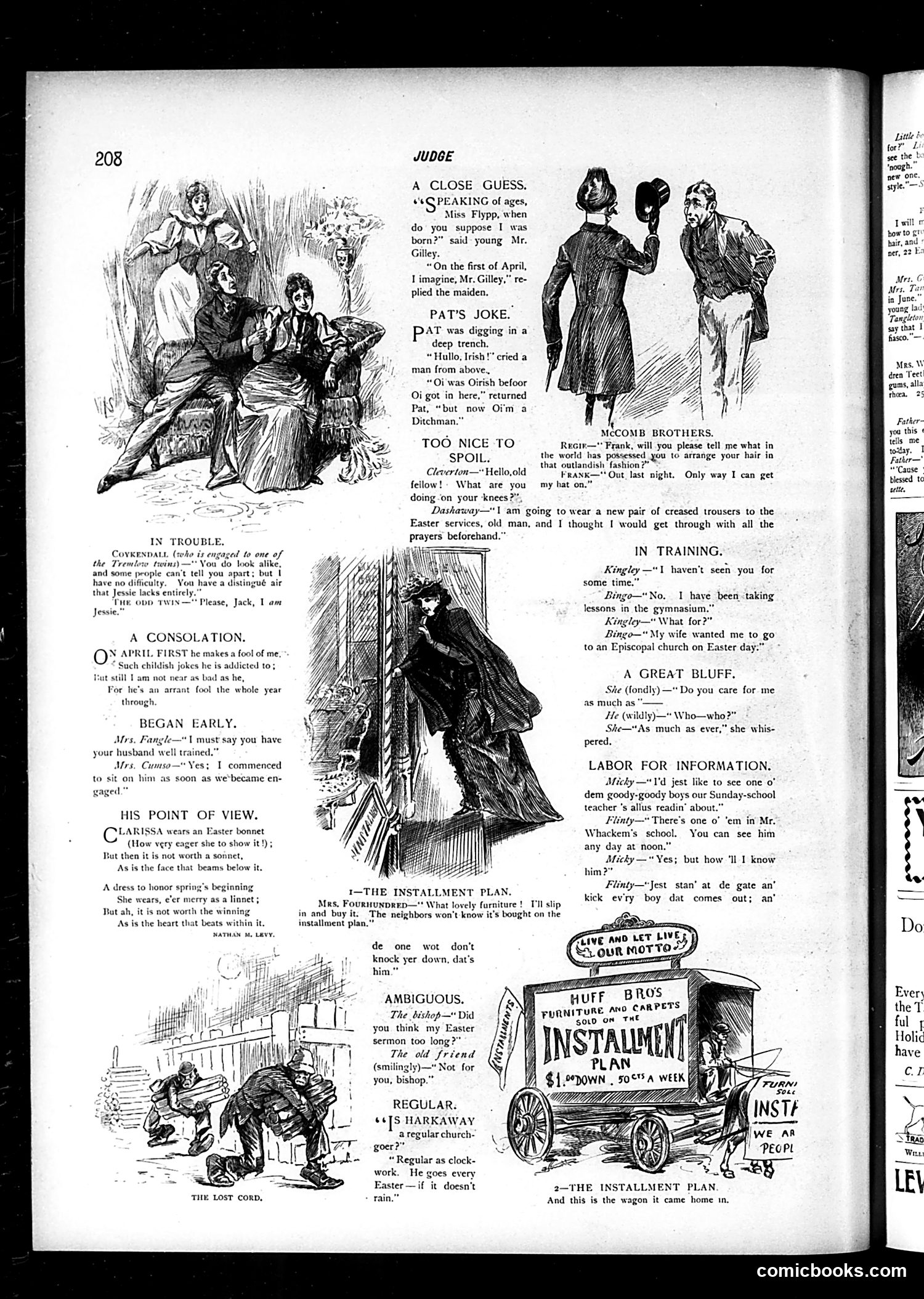
This page contains brief humorous anecdotes typical of Judge's satirical format, targeting various social situations and character types of the era. **Key content includes:** - **"A Close Guess"**: Young man asks a woman his age; she guesses "April first" (April Fools' Day), implying he's a fool. - **"Pat's Joke"**: An Irish laborer makes a pun—digging in a trench has made him a "Ditchman" rather than an Irishman, playing on ethnic stereotypes common to period humor. - **Social commentary sketches**: Various one-liners mock marital dynamics, religious hypocrisy (Easter observance), vanity, and class pretensions—particularly the "Installment Plan" advertisement satirizing working-class families purchasing furniture on credit while trying to impress neighbors. - **"Labor for Information"**: Immigrant or working-class children ("Micky," "Flinty") discussing Sunday school morality. The humor relies on contemporary social anxieties: immigration, marriage dynamics, religious practice, consumer debt, and class aspirations. The advertisements integrated throughout reinforce these themes.
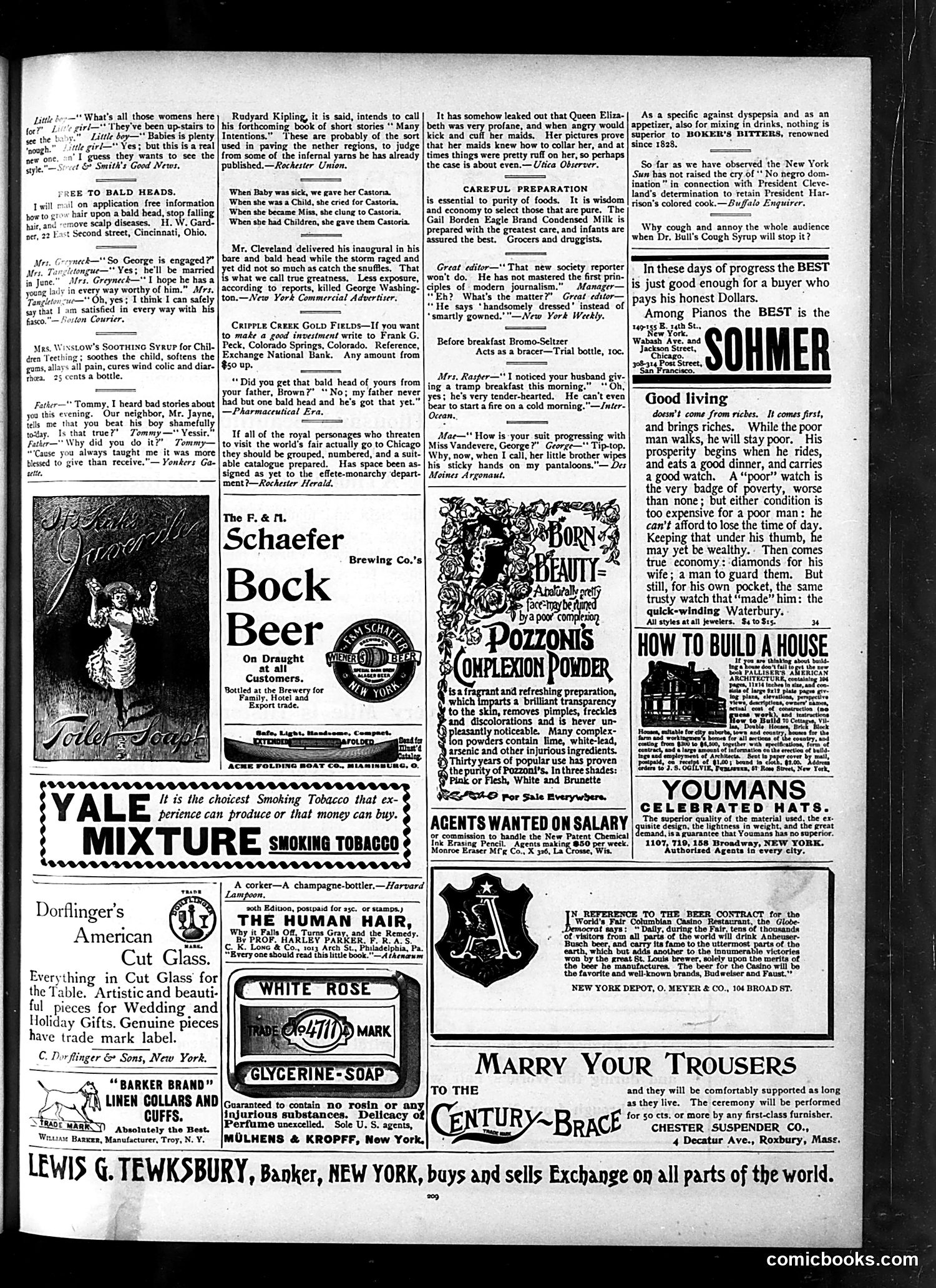
This page is primarily **advertising**, with minimal satirical content. The few brief jokes scattered among ads include: 1. **"Free to Bald Heads"** section: A pun-based joke playing on treatments for baldness and hair loss—common concerns in this era. 2. **Rudyard Kipling reference**: A short quip mocking Kipling's forthcoming book "Many Intentions," suggesting his stories are as poorly constructed as "paving stones for hell." 3. **Cleveland inauguration joke**: References President Cleveland delivering his inaugural address bareheaded in a storm, contrasting his "greatness" with George Washington's death (supposedly from exposure). This is topical 1890s political humor. 4. **Minor domestic jokes**: Brief anecdotes about fathers, children, and engagements occupy small text sections. The page is dominated by period product advertisements (beer, soap, cut glass, tobacco, hair treatments) with no significant political cartoons or sustained satirical commentary. It represents typical Judge magazine layout: scattered humor among commercial notices.
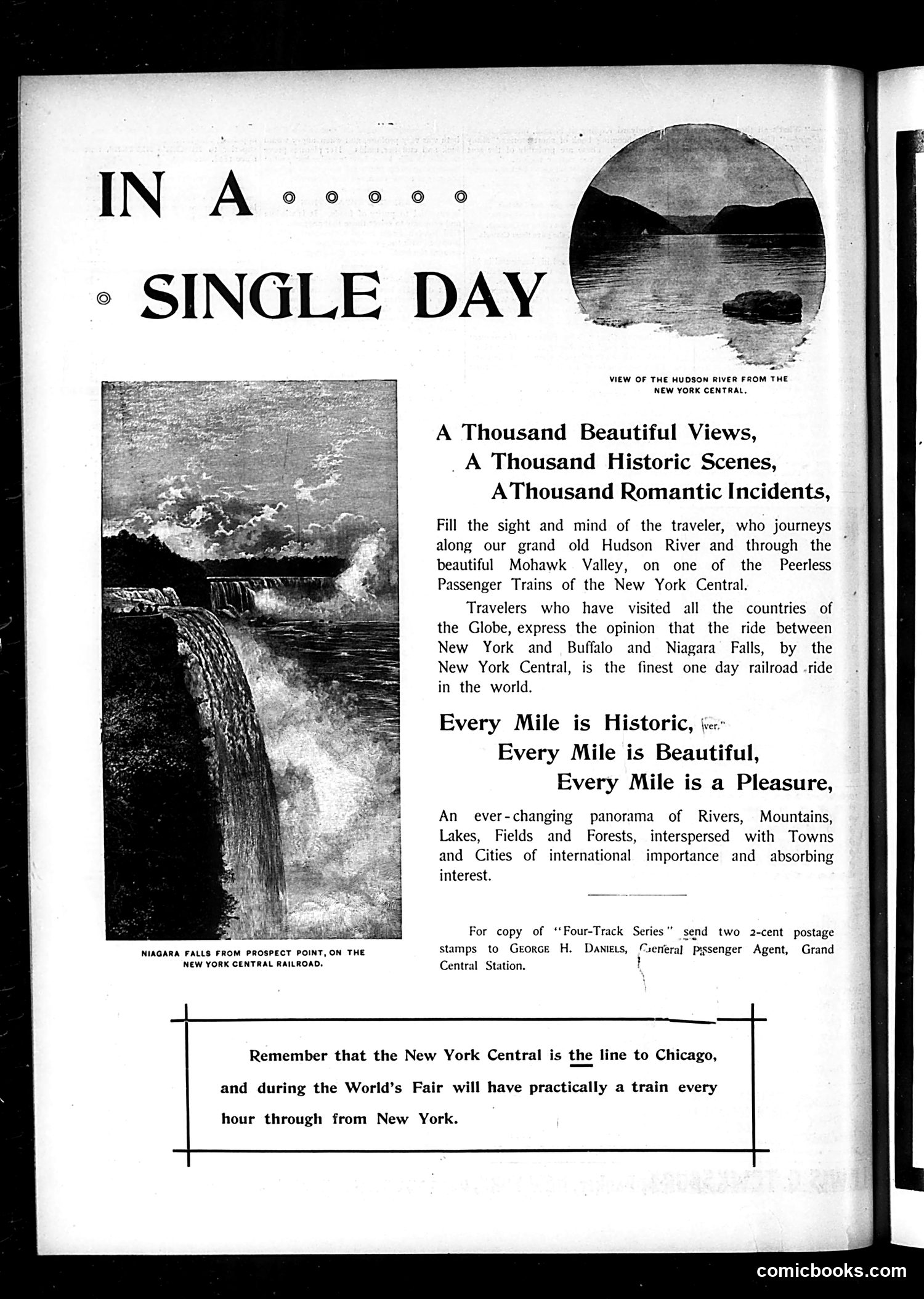
This is **not a cartoon or satire**—it's a straightforward advertisement for the New York Central Railroad, likely from around the 1893 World's Columbian Exposition (referenced in the boxed text at bottom). The page promotes passenger train travel between New York and Buffalo/Niagara Falls, emphasizing scenic beauty and historic significance along the Hudson River and Mohawk Valley routes. Two photographs illustrate the appeal: Niagara Falls and a Hudson River view. The "World's Fair" mention indicates this ad was timed to capitalize on increased travel during Chicago's 1893 fair, promising hourly service from New York. The repeated claims ("Every Mile is Historic, Beautiful, a Pleasure") use hyperbole typical of period advertising to make routine rail travel sound romantic and culturally enriching. This appears in *Judge* simply as paid advertising content, not satirical commentary.
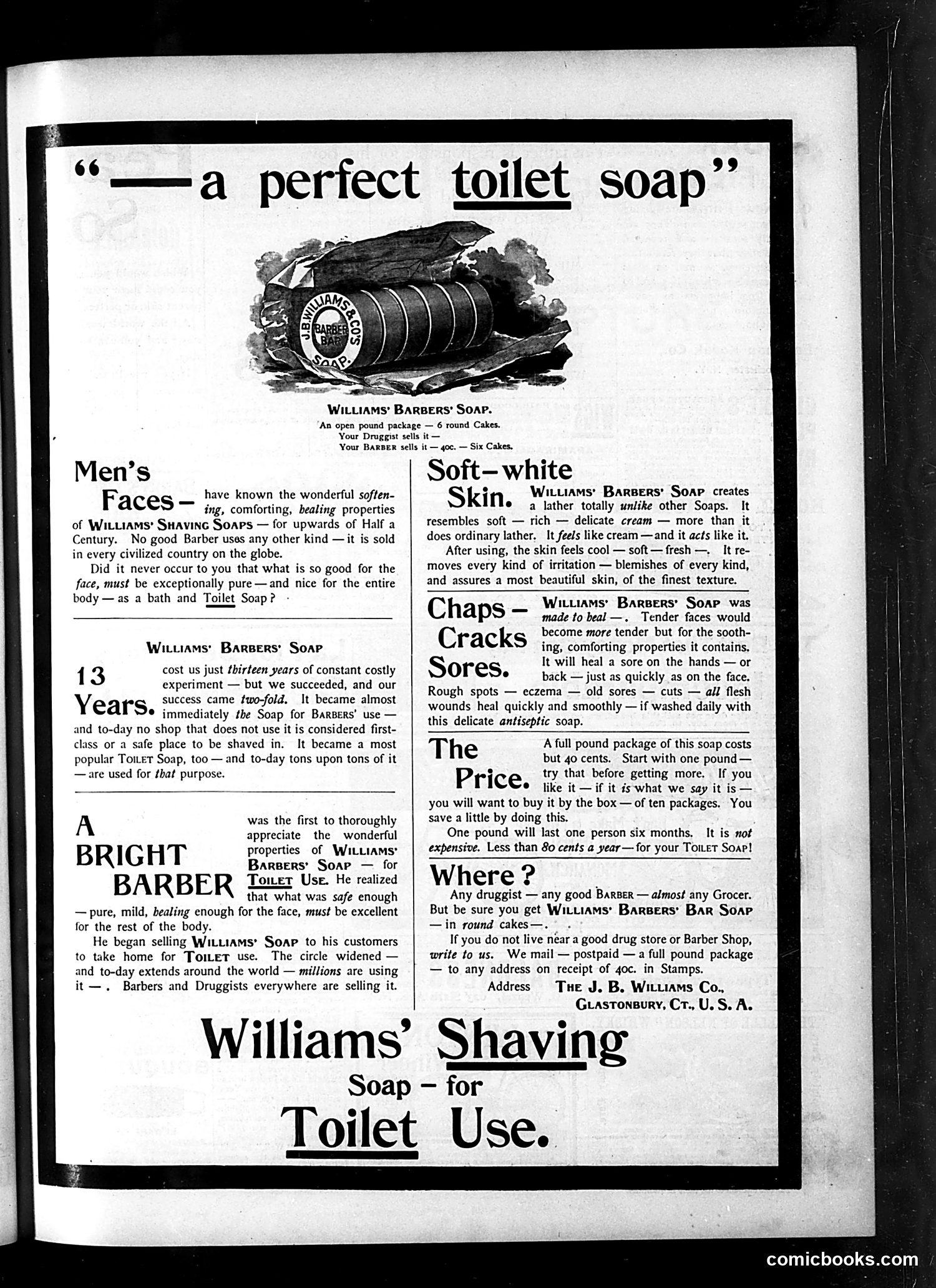
This page is **entirely a product advertisement**, not political satire or editorial cartoon content. It's a full-page ad for Williams' Barbers' Soap from The J.B. Williams Co. of Glastonbury, Connecticut. The ad uses a marketing narrative rather than humor or satire: it claims the soap was developed through "thirteen years" of experimentation and became popular first among barbers, then the general public. The text emphasizes the product's gentleness, healing properties, and suitability for both shaving and bathing. The only visual element is an illustration of a bar of soap wrapped with a barrel or package design at the top. **For a modern reader:** This represents early 20th-century advertising strategy—building brand credibility through origin stories and professional endorsement (barbers' approval) before mass marketing to consumers. The emphasis on "healing" and "antiseptic" properties reflects period concerns about skin irritation and infection. The price (40 cents per pound) and claims of affordability are sales tactics. There is no satire or political content to decode here.
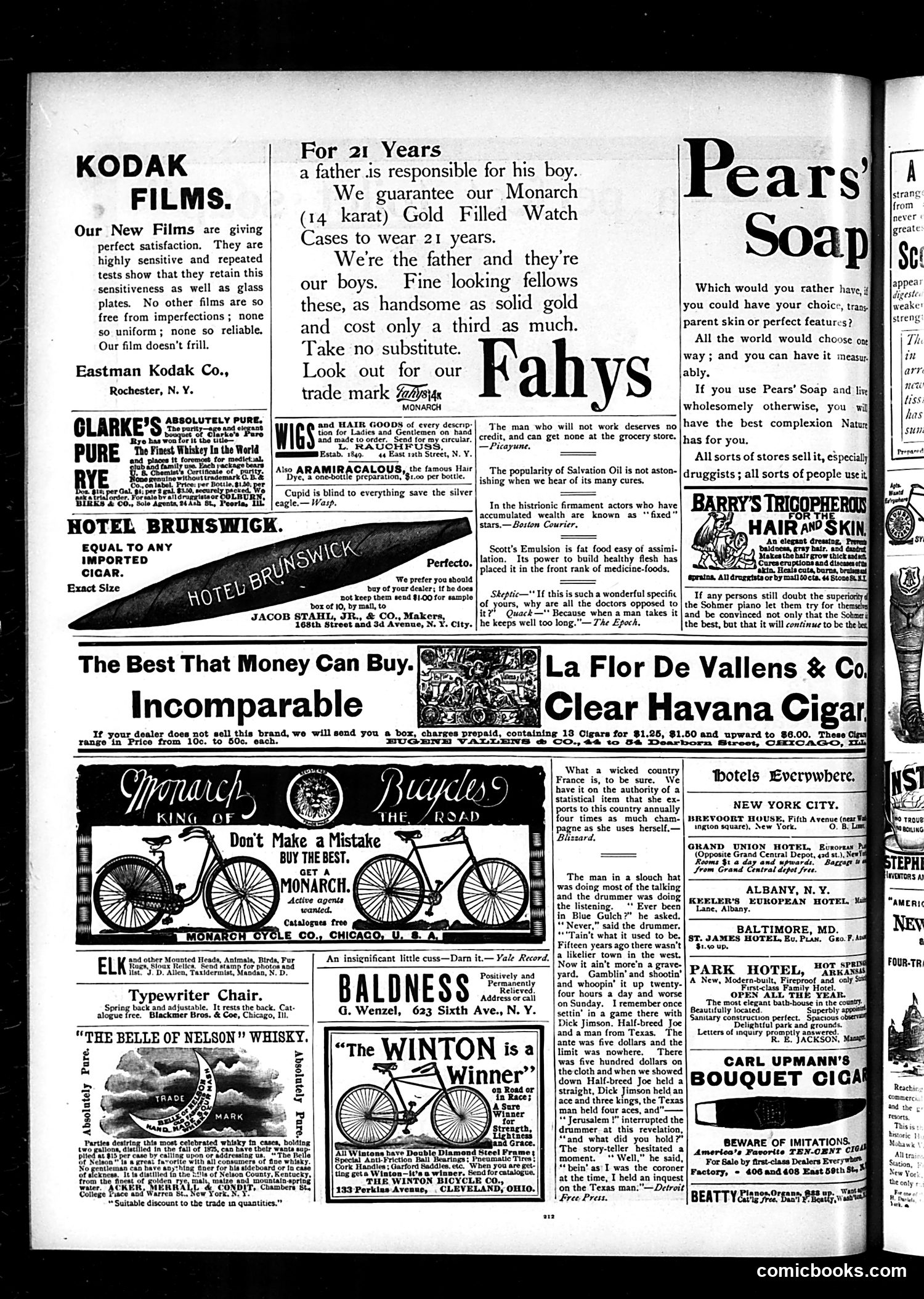
This page is primarily **advertising**, not political satire. It's a typical late-19th/early-20th-century magazine spread filled with product advertisements interspersed with brief humorous quips. The small cartoons/jokes scattered throughout are minor—mostly single-panel gags with light social commentary. For example, one depicts a conversation between "Septic" and a "Quack" doctor joking that the product works *too well*, keeping people healthy too long, which loses the doctor business. The advertisements themselves (Kodak film, Fahys watches, Pears' Soap, bicycles, cigars, hair products) use appeals common to the era: appeals to masculinity, class status, and pseudo-scientific health claims. The only potentially political element is a brief France reference about that country being "wicked," but the context is cut off and unclear. **Overall:** This is primarily a commercial page reflecting consumer culture and advertising practices of the period, not political or social satire.
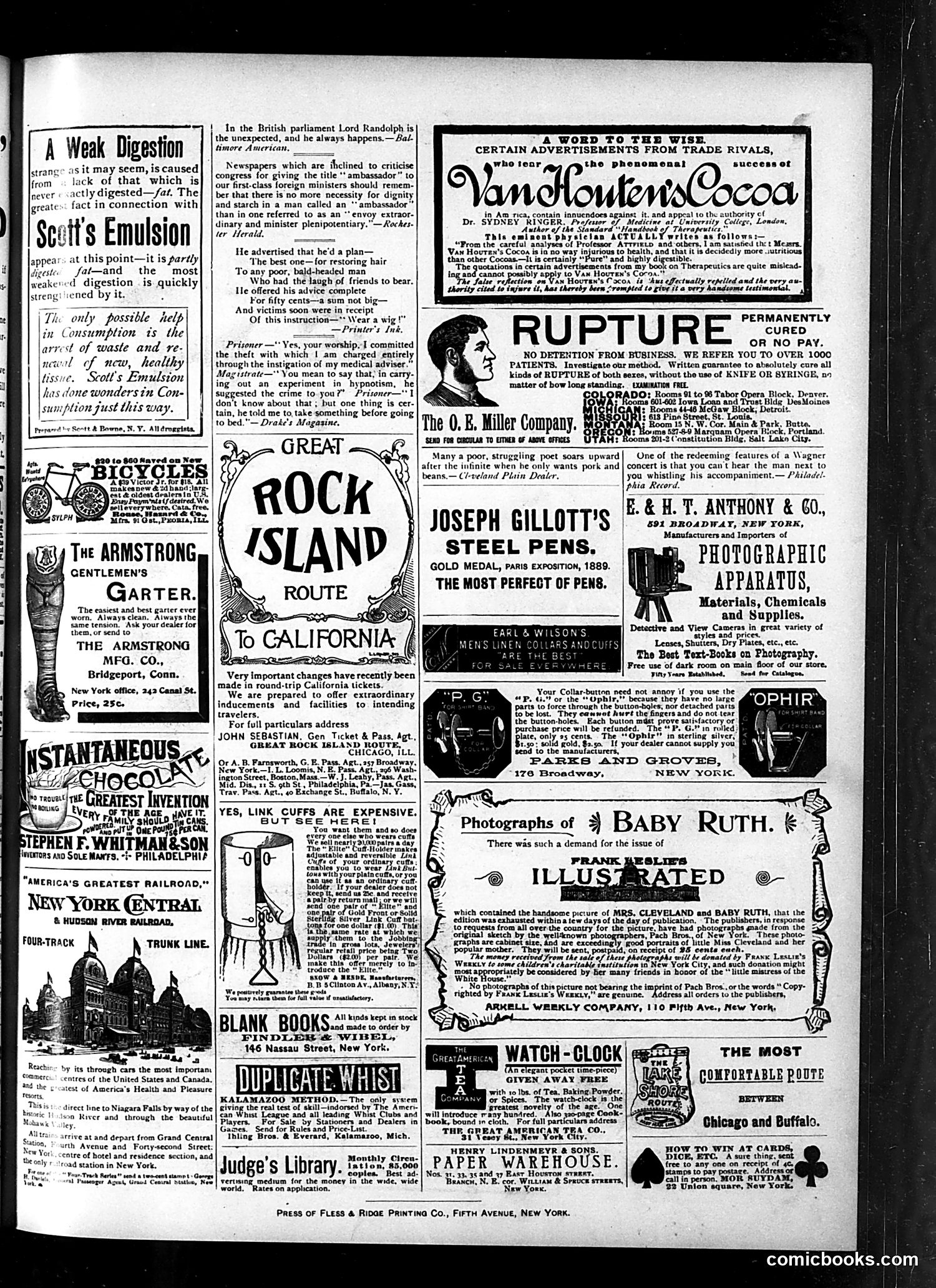
This page is primarily **advertisements and humorous filler content** rather than political cartoons. Judge magazine here showcases commercial ads (Scott's Emulsion digestive supplement, Armstrong garters, railroad routes, pens, cocoa) mixed with brief satirical jokes. The few jokes present are apolitical: - A bald man advertises a hair restoration "cure"—just wear a wig - A prisoner blames his crime on his doctor's hypnotic suggestion to "take something before bed" (a digestive aid joke) - A newspaper editorial quip about British politician Lord Randolph being "unexpected" There are **no identifiable political cartoons or caricatures** on this page. The content reflects turn-of-century American consumer culture and light humor typical of Judge's lighter material, designed mainly to fill space around paid advertisements. The satirical edge is minimal—mostly gentle wordplay rather than sharp political commentary.
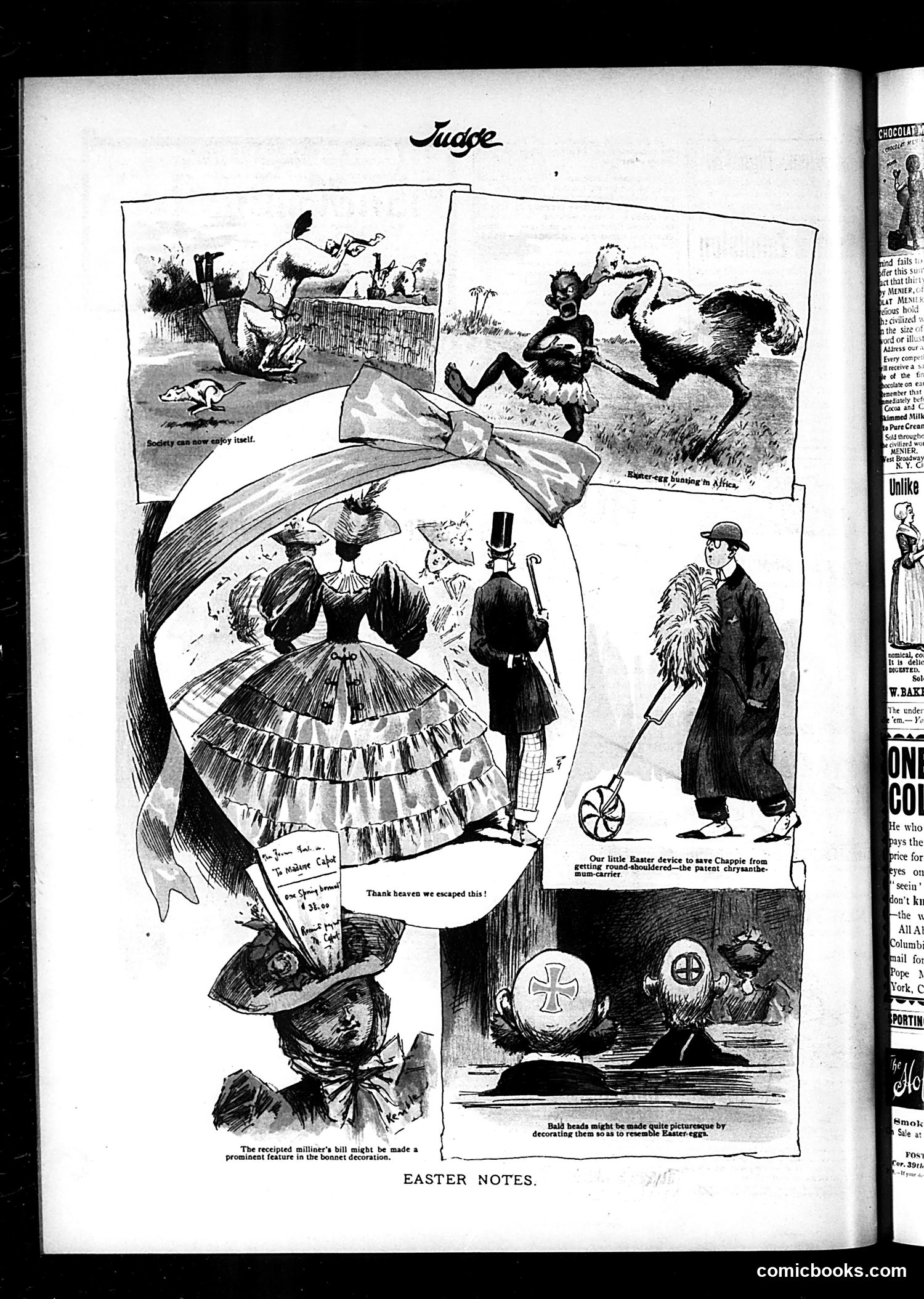
This Judge magazine page presents Easter-themed visual jokes. The cartoons mock Victorian-era fashion and social conventions: 1. **Top panels**: Satirize elaborate Easter fashions and activities—women in ornate dress, fashionable outings. 2. **"Chrysanthemum device"**: Mocks the impractical fashion advice to prevent slouching in children, suggesting absurd mechanical contraptions. 3. **Bald head decoration**: Jokes that men could disguise baldness by painting bald heads to resemble decorated Easter eggs. 4. **Milliner's bill**: Satirizes women's extravagant spending on Easter bonnets—a notorious expense—by suggesting the receipt itself become a bonnet decoration, humorously acknowledging the excessive cost. The satire targets consumerism, fashion excess, and the elaborate preparations surrounding Easter celebrations in early 20th-century America.
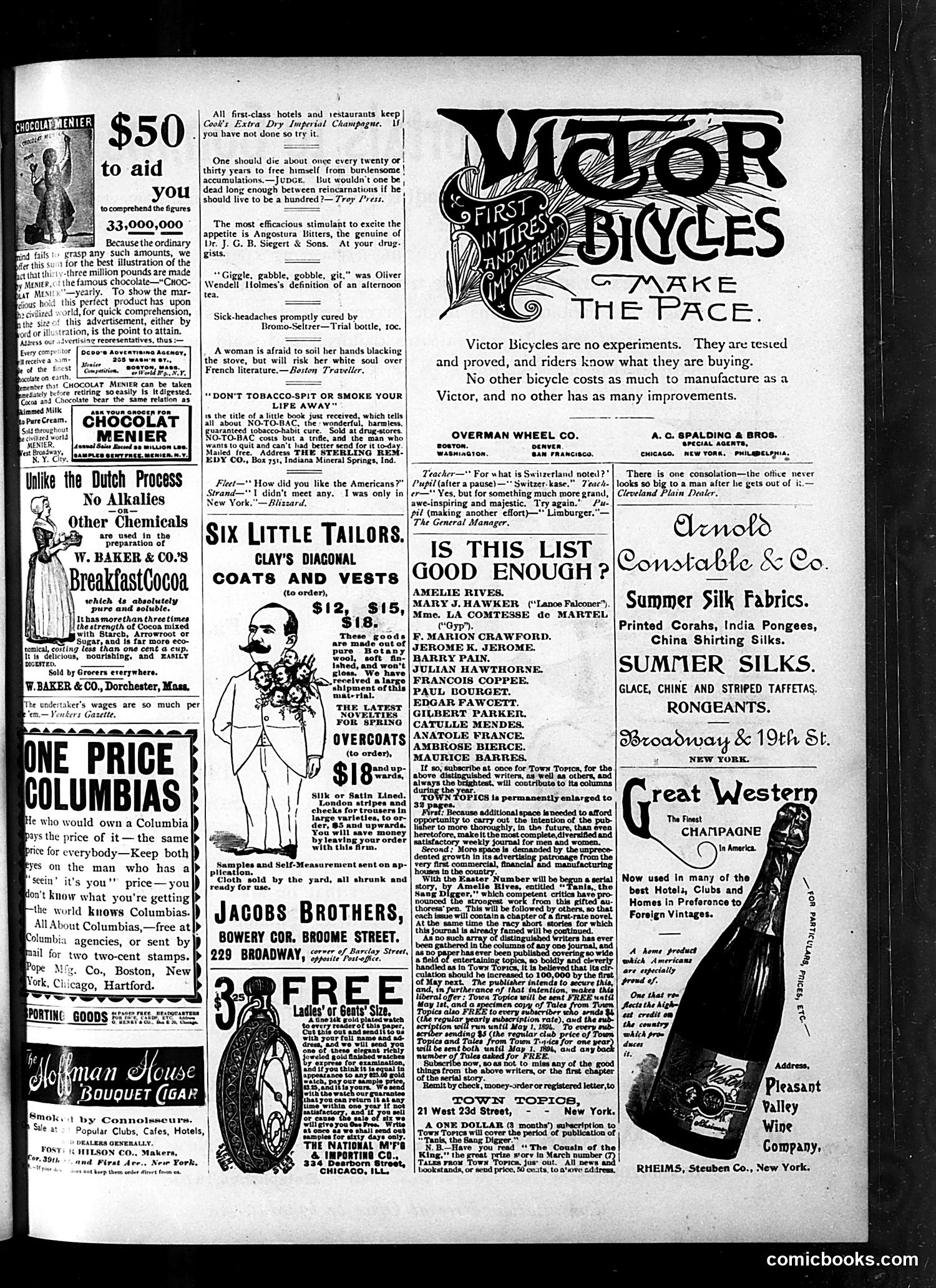
This page is primarily **advertising**, typical of late-19th-century American magazines. The editorial content consists of brief humorous quotes and quips—the magazine's satirical voice—interspersed among ads for products like chocolate, champagne, cigars, bicycles, and tailoring services. The jokes reflect period concerns: one mocks belief in reincarnation; another stereotypes Americans (a "Fleet" character claims he saw no Americans in New York, only "the Strand"—suggesting New York's immigrant character); a third jokes that women risk their morality reading French literature. There's also a jab at undertakers' wages and one comparing women's fear of soiling hands over moral compromise. The **Victor Bicycles** advertisement emphasizes reliability and innovation—bicycles were then revolutionary technology. Most other ads target middle-class male consumers (tailoring, cigars, patent medicines). No political cartoons appear on this page.
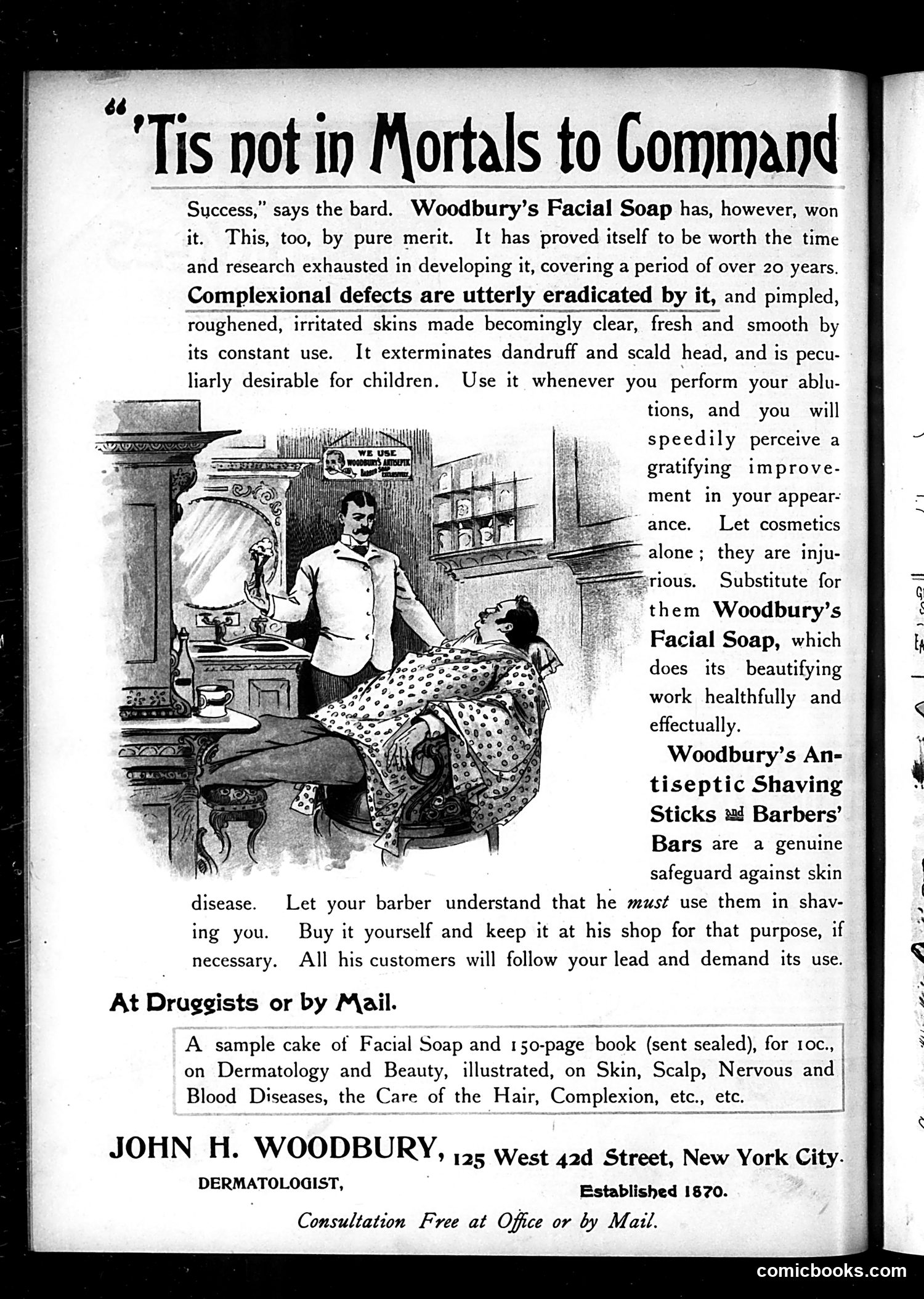
This is primarily a **product advertisement**, not satire or political commentary. It appears in *Judge* magazine as a paid advertisement for Woodbury's Facial Soap and related products. The illustration shows a barber shop scene: a woman in a chair receives treatment while a male barber works, suggesting the soap's universal appeal. The ad copy uses grandiose language ("'Tis not in Mortals to Command Success'") to claim the soap eliminates complexional defects, dandruff, and skin problems through "pure merit" developed over 20 years of research. The advertisement notably targets middle-class consumers with health-conscious messaging—positioning the soap as a scientific dermatological product rather than mere cosmetics (which are called "injurious"). It instructs readers to pressure their barbers to use these products, reflecting early 20th-century marketing strategy. The offer of a free sample and 150-page beauty book was a common promotional tactic of the era.