
Judge, 1893-04-01 · page 4 of 18
Judge — April 1, 1893 — page 4: what you’re looking at
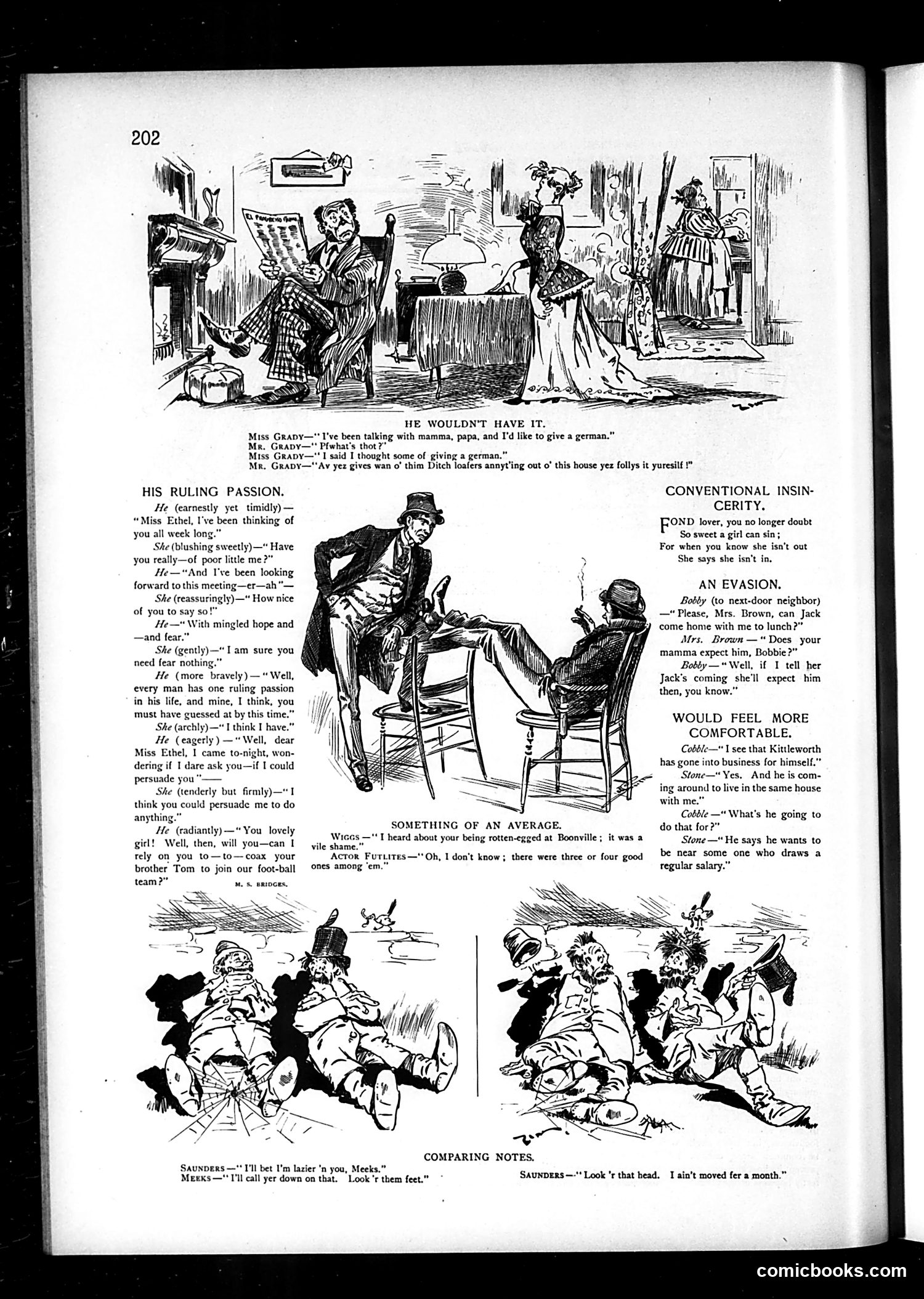
What you’re looking at
This page contains multiple short comic sketches mocking Victorian-era social pretenses and domestic life. **"He Wouldn't Have It"** satirizes Irish immigrant speech patterns (phonetic dialect) through Mr. Grady, who forbids his daughter from hosting a "german" (a fashionable social dance). The humor relies on class anxiety—the working-class father fears his daughter socializing with wealthy Germans. **"His Ruling Passion"** ironically depicts a young man's romantic confession that ultimately reveals his "ruling passion" is recruiting the woman's brother for his football team—mocking insincere courtship rhetoric. The remaining sketches—"Conventional Insincerity," "An Evasion," "Something of an Average," "Comparing Notes," and "Would Feel More Comfortable"—all target hypocrisy in polite society: dishonest expressions of feeling, evasive social excuses, competitive boasting, and financial anxiety among the aspiring middle class. The cartoons' crude humor trades on period-specific social codes that modern readers would find either quaint or offensive.
📄 Transcribed text from this page (OCR, searchable)
Machine-transcribed from the original scan — historical spelling and the odd misread are preserved.
Miss Grapy—'' I've been talking with mamma, papa, and I'd like to give a german.” Mr. Grapy—"* Pfwhat's thot?” Miss Grapy—''I said I thought some of giving a german.” Mr. Grapy—"Av yez gives wan o' thim Ditch loafers annyt'ing out o' this house yez follys it yuresilf !" HIS RULING PASSION. He (earnestly yet timidly) — “Miss Ethel, I've been thinking of you all week long.” She (blushing sweetly) —" Have you really—of poor little me He—“And I've been looking forward to this meeting—er—ah "— She (reassuringly)—" How nice of you to say so!” He—" With mingled hope and —and fear. She (gently) —" Lam sure you need fear nothing.” He (more bravely) — “Well, every man has one ruling passion in his life, and mine, I think, you must have guessed at by this time.” She (archly)—"'I think I have.” He (eagerly) —"Well, dear Miss Ethel, I came to-night, won- dering if I dare ask you—if I could persuade you ™. She (tenderly but firmly)—" 1 think you could persuade me to do anything.” He (radiantly)—“ You lovely girl! Well, then, will you—can I rely on you to—to—coax your brother Tom to join our foot-ball SAUNDERS Wiccs —*T heard about your being rotten-egged at Boonville; it was a vile shame.” Actor Futiites—"Oh, I don't know; there were three or four good ones among ‘em.” “I'll bet I'm lazier 'n you, Meeks.” HE WOULDN'T HAVE IT. SOMETHING OF AN AVERAGE. COMPARING NOTES, CONVENTIONAL INSIN- CERITY. OND lover, you no longer doubt So sweet a girl can sin; For when you know she isn’t out She says she isn't in, AN EVASION. Bobby (to next-door neighbor) —"Please, Mrs. Brown, can Jack come home with me to lunch ?” Mrs. Brown —* Does your mamma expect him, Bobbie?” Bobby —“Well, if I tell her Jack's coming she'll expect him then, you know.” WOULD FEEL MORE COMFORTABLE, Cobble—"1 see that Kittleworth has gone into business for himself.” Stone—“Yes, And he is com- ing around to live in the same house with me.” Cobble —" What's he going to do that for?” Stone —" He says he wants to be near some one who draws a regular salary.” Masxe-—''I'l call per down on thas "Losk’s theza tect.” SauNDERS—"* Look 'r that head. I ain't moved fer a month.” comicbooks.com