
A complete issue · 52 pages · 1891
Judge — December 5, 1891
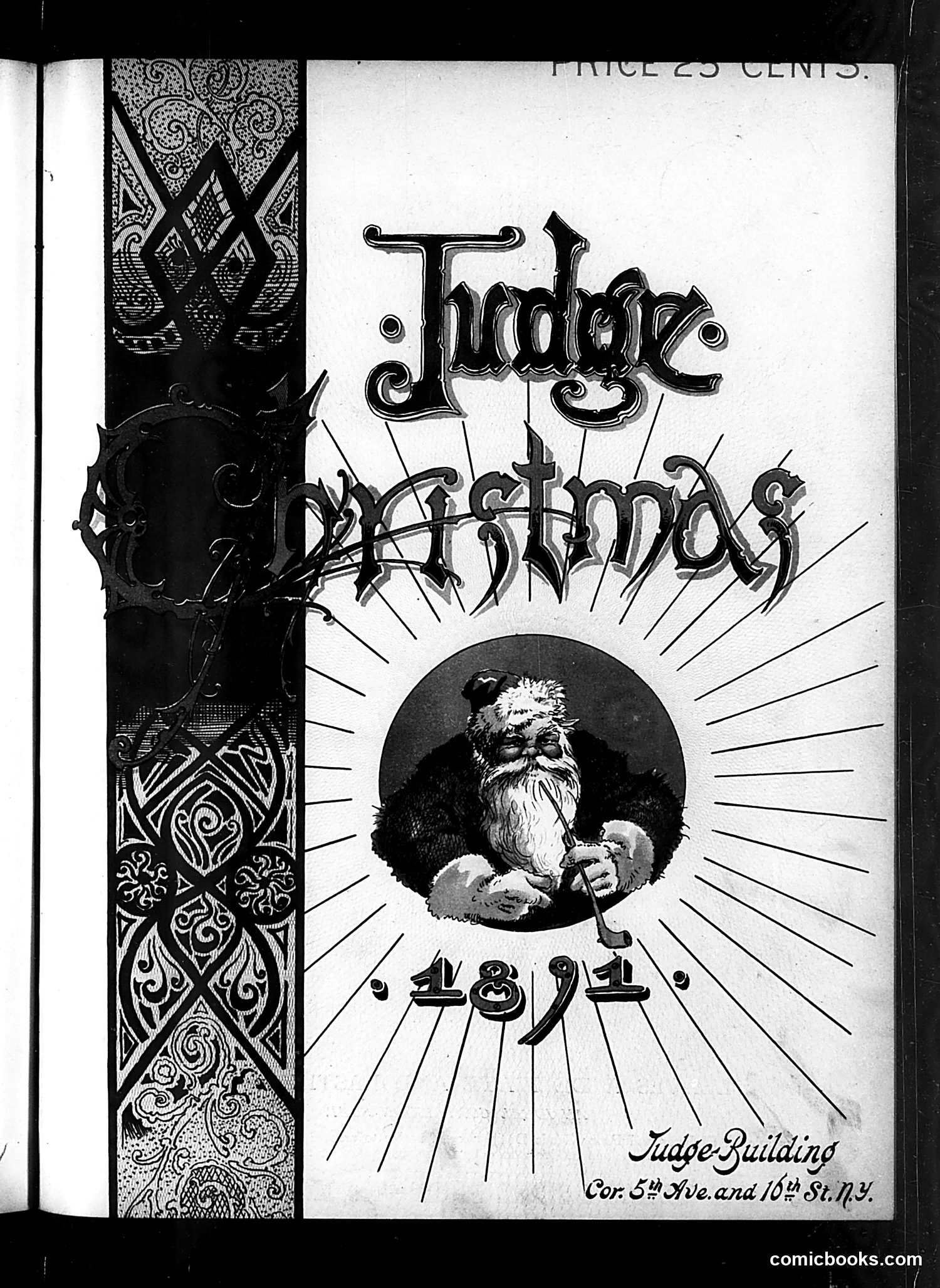
This is the cover of Judge magazine's 1894 almanac issue. The central image depicts Santa Claus (identifiable by his characteristic beard, fur-trimmed coat, and jolly demeanor) holding a golf club, surrounded by radiating lines suggesting importance or emphasis. The title reads "Judge Almanac" with "1894" displayed below. The satire likely reflects the late-19th-century craze for golf among wealthy Americans, suggesting that even Santa—traditionally associated with gift-giving and winter—has been caught up in this fashionable sporting obsession. By positioning Santa with golf equipment rather than toys or holiday items, the cartoonist mocks how thoroughly golf culture had penetrated American society, even displacing traditional holiday imagery. This represents social commentary on the era's class-driven leisure pursuits.
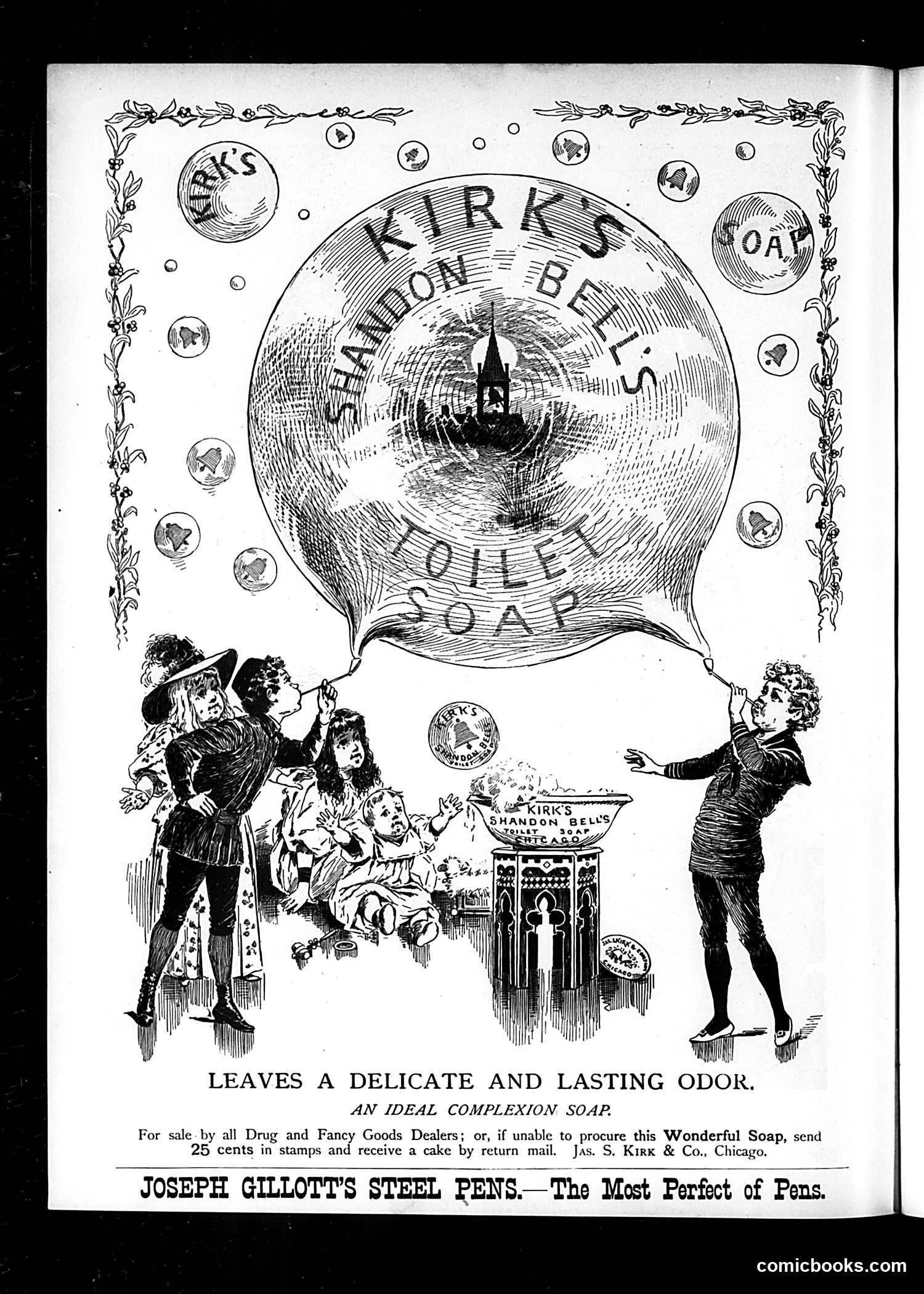
This page is primarily **advertising, not political satire**. The central image advertises Kirk's Harlone Bell Toilet Soap from Chicago, featuring an enormous soap bubble with a church steeple silhouette inside it. The satirical element is minimal: the bubble floats above Victorian-era figures (adults and children) who gaze upward in wonder, suggesting the product's ethereal, almost magical qualities. The caption claims it "leaves a delicate and lasting odor" and promises an "ideal complexion soap." The bottom contains an unrelated ad for Joseph Gillott's steel pens. This represents typical **19th-century magazine advertising**—using whimsical imagery and aspirational messaging to market consumer goods to middle-class readers rather than engaging political commentary.
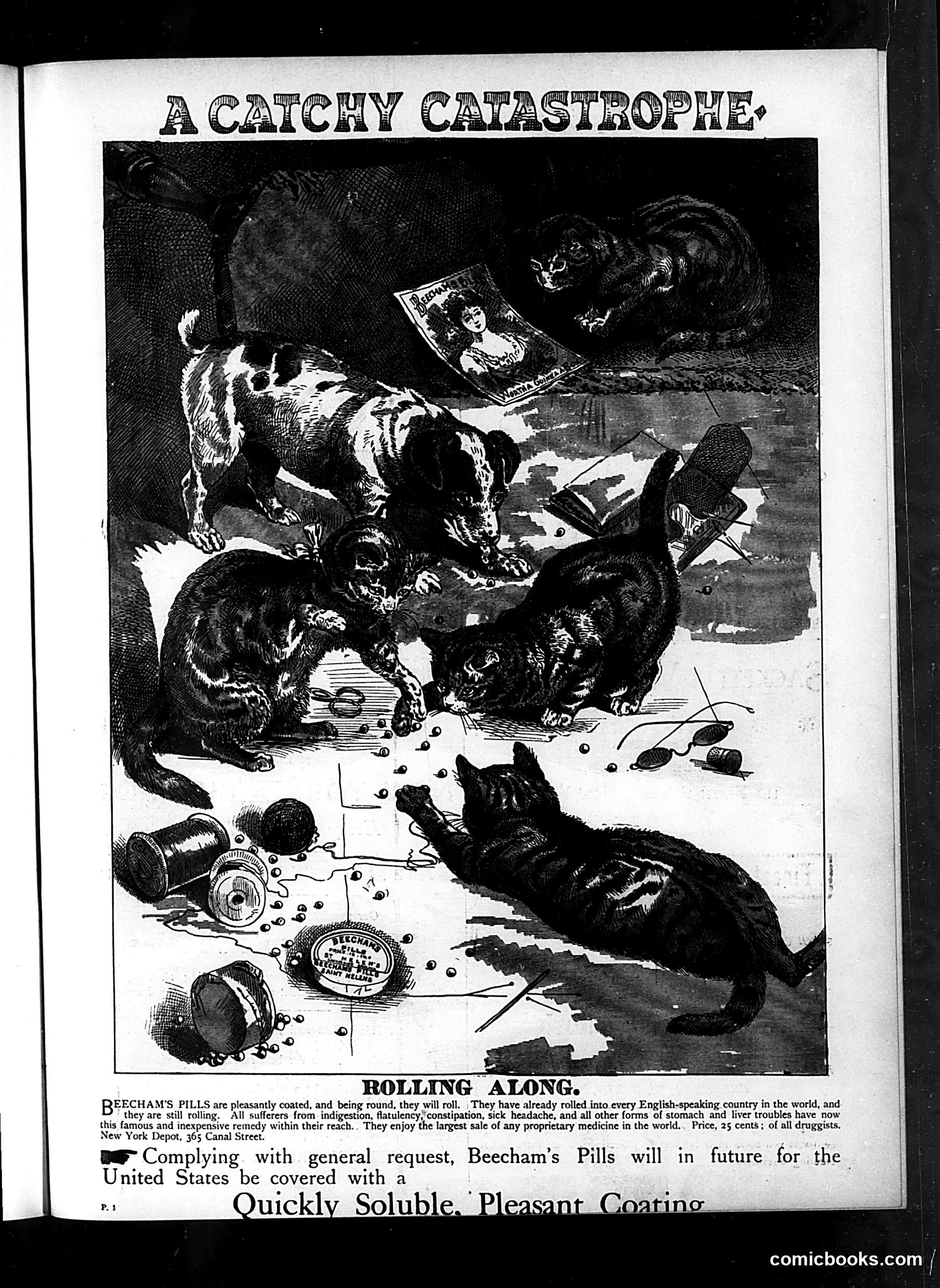
This is primarily a **Beecham's Pills advertisement** disguised as satirical content. The "catastrophe" is staged chaos: multiple cats have knocked over bottles of pills, spilled them across the floor, and scattered papers—one cat even appears to have knocked over an inkwell or similar container. The joke plays on the pill's marketing claim that they "roll" easily due to their round shape. Here, the rolling pills have literally rolled everywhere due to clumsy cats, creating humorous disorder. The text celebrates Beecham's Pills as a popular patent medicine for "indigestion, billiousness, constipation, sick headache, and all other forms of stomach and liver troubles." This reflects late-19th/early-20th-century advertising that used comic scenarios to promote patent medicines now considered dubious.
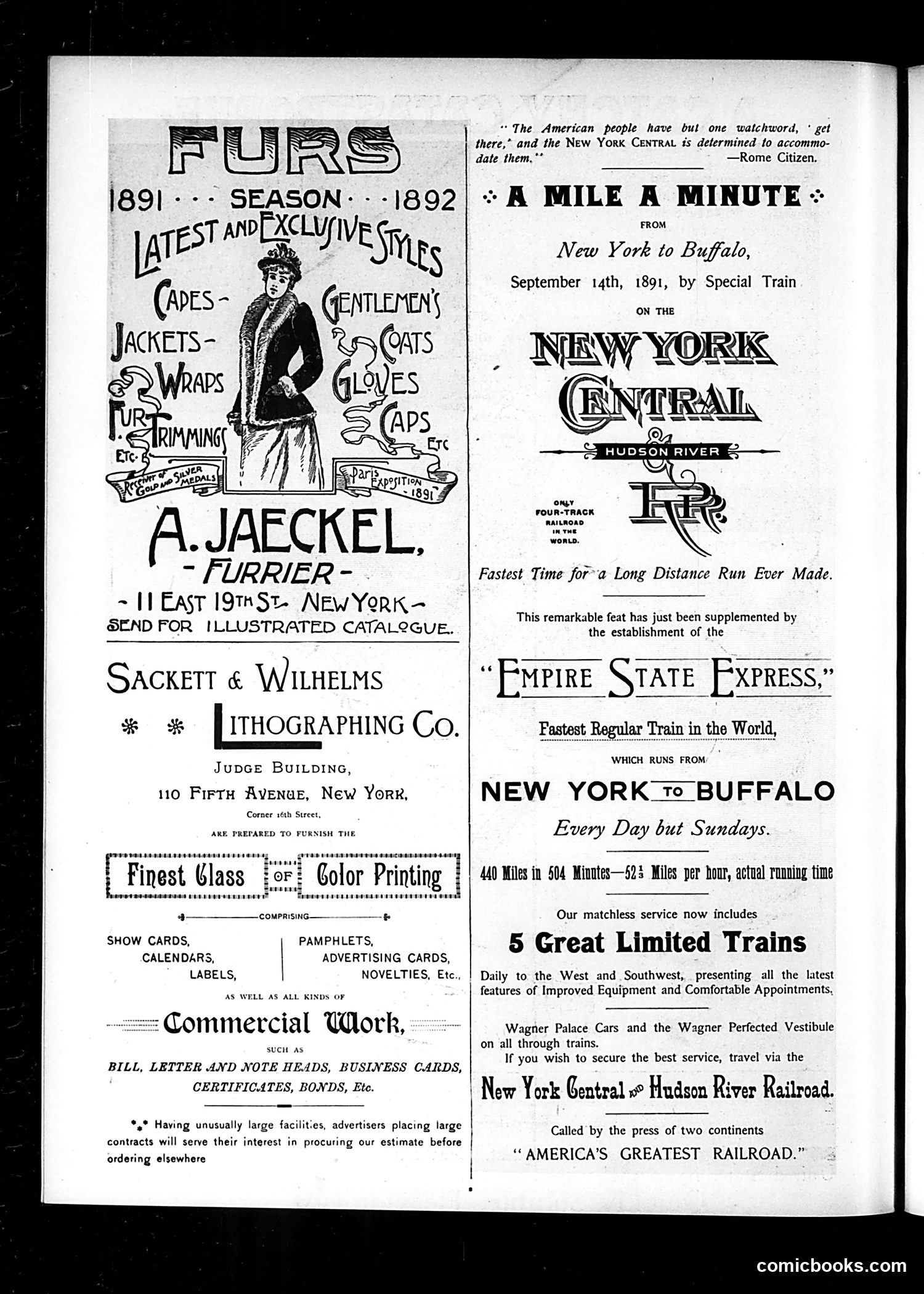
This page is primarily **advertising**, not satire or political commentary. It contains: **Left side:** Commercial ads for A. Jaeckel (furrier) and Sackett & Wilhelms (lithography company offering printing services). **Right side:** New York Central Railroad advertisement promoting the "Empire State Express," a new high-speed train service between New York and Buffalo. The ad claims a record 440 miles in 504 minutes (approximately 52.5 mph actual running time), which it presents as "Fastest Time for a Long Distance Run Ever Made." The only satirical element is the epigraph quoting "Rome Citizen," suggesting Americans' obsession with speed and haste—captured in their "watchword" to "get there"—which the railroad humorously claims to satisfy. This reflects the 1891 era's enthusiasm for technological progress and railroad competition. There are no identifiable political figures or caricatures; it's essentially a historical record of Gilded Age advertising and transportation marketing.
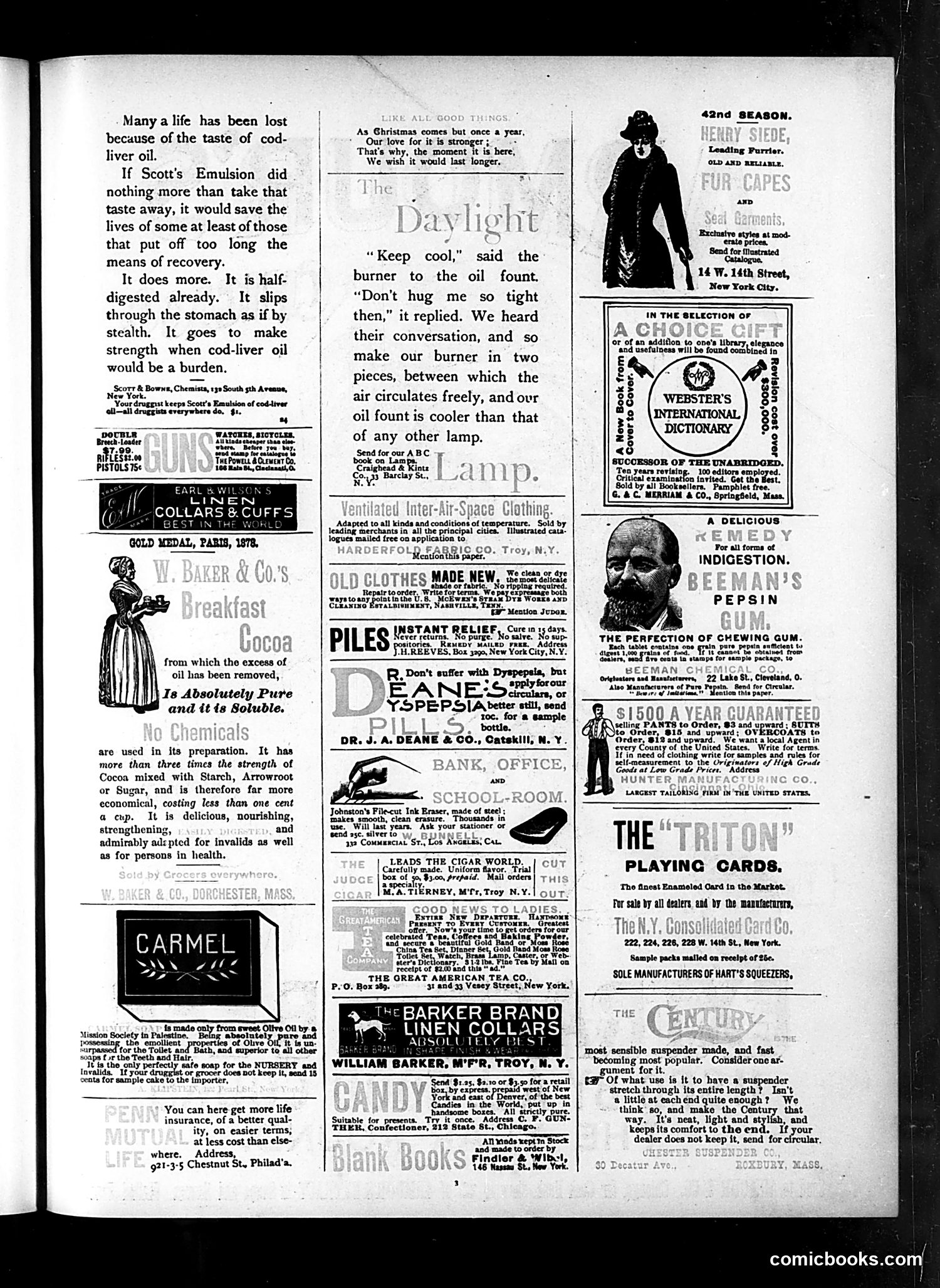
This is primarily a **advertising page** from Judge magazine's 42nd season, not a political cartoon. The page contains numerous patent medicine and consumer product advertisements typical of late 19th-century American publications. The only narrative content is a brief, **humorous dialogue** between an oil lamp's burner and oil fount (anthropomorphized as characters), where the burner tells the fount to "keep cool" and not "hug so tight." This is a gentle pun advertising a lamp design with improved ventilation that keeps oil cooler than competitors' models. The advertisements reflect period health concerns: Scott's Emulsion (cod-liver oil supplement), remedies for piles, dyspepsia, and indigestion. Products like W. Baker & Co.'s cocoa and Carmel soap promote themselves as healthful alternatives to inferior brands. **For modern readers:** This shows how advertising and editorial content mixed freely, and how patent medicines made extraordinary health claims without FDA regulation—a practice that would eventually be restricted.
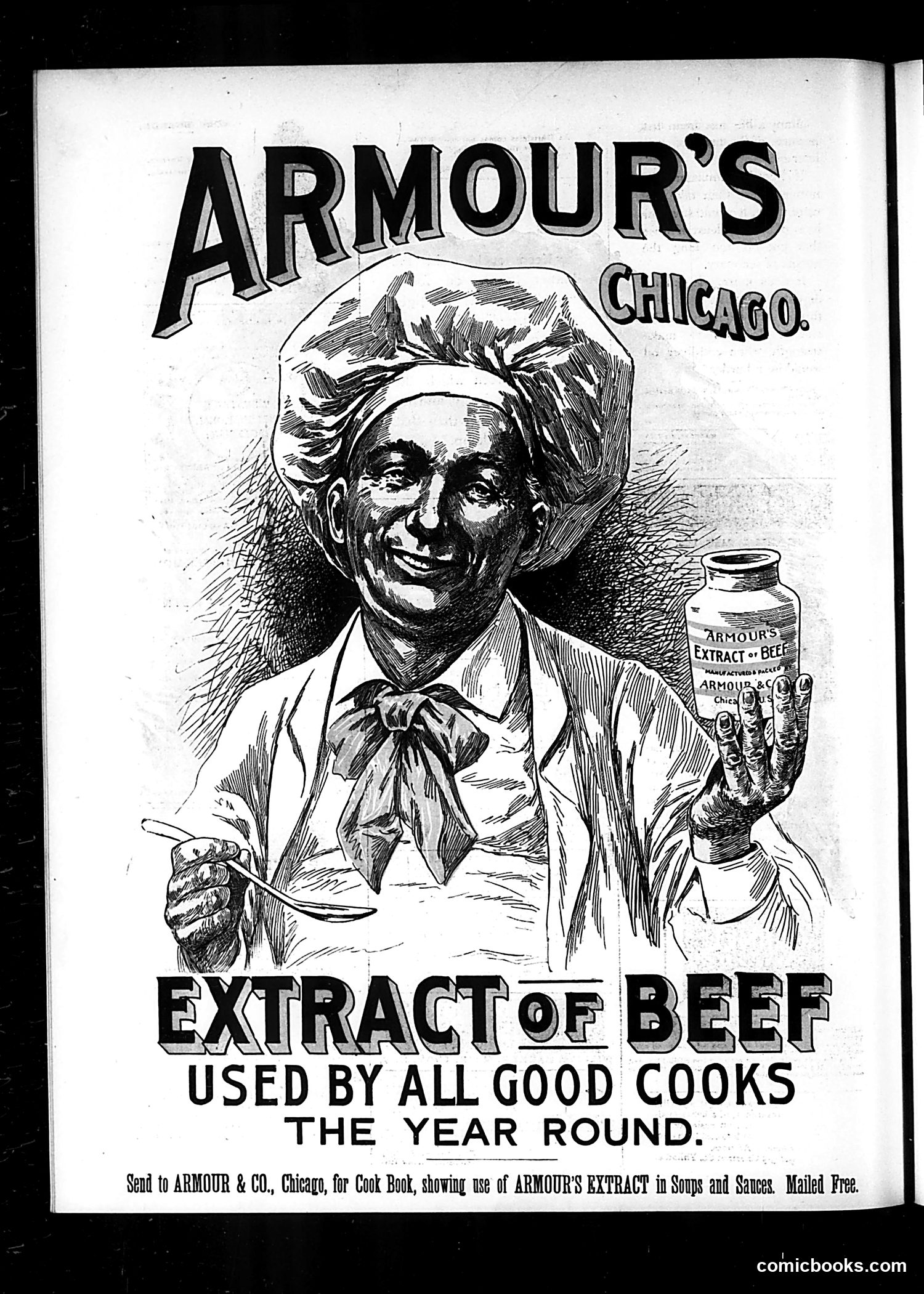
This is primarily a **product advertisement**, not political satire. It promotes Armour's Extract of Beef, a meat-based cooking ingredient made by Armour & Co. in Chicago. The image features a cheerful chef in traditional white hat and neckerchief, smiling while holding both a cooking utensil and a bottle of the extract. The figure appears to be a generic "good cook" character rather than a specific historical person or caricature. The marketing message emphasizes the product's universal appeal—"used by all good cooks the year round"—and includes a call-to-action offering a free cookbook showing how to use the extract in soups and sauces. While this appears in *Judge* (a satirical magazine), this particular page serves as straightforward advertising rather than social or political commentary.
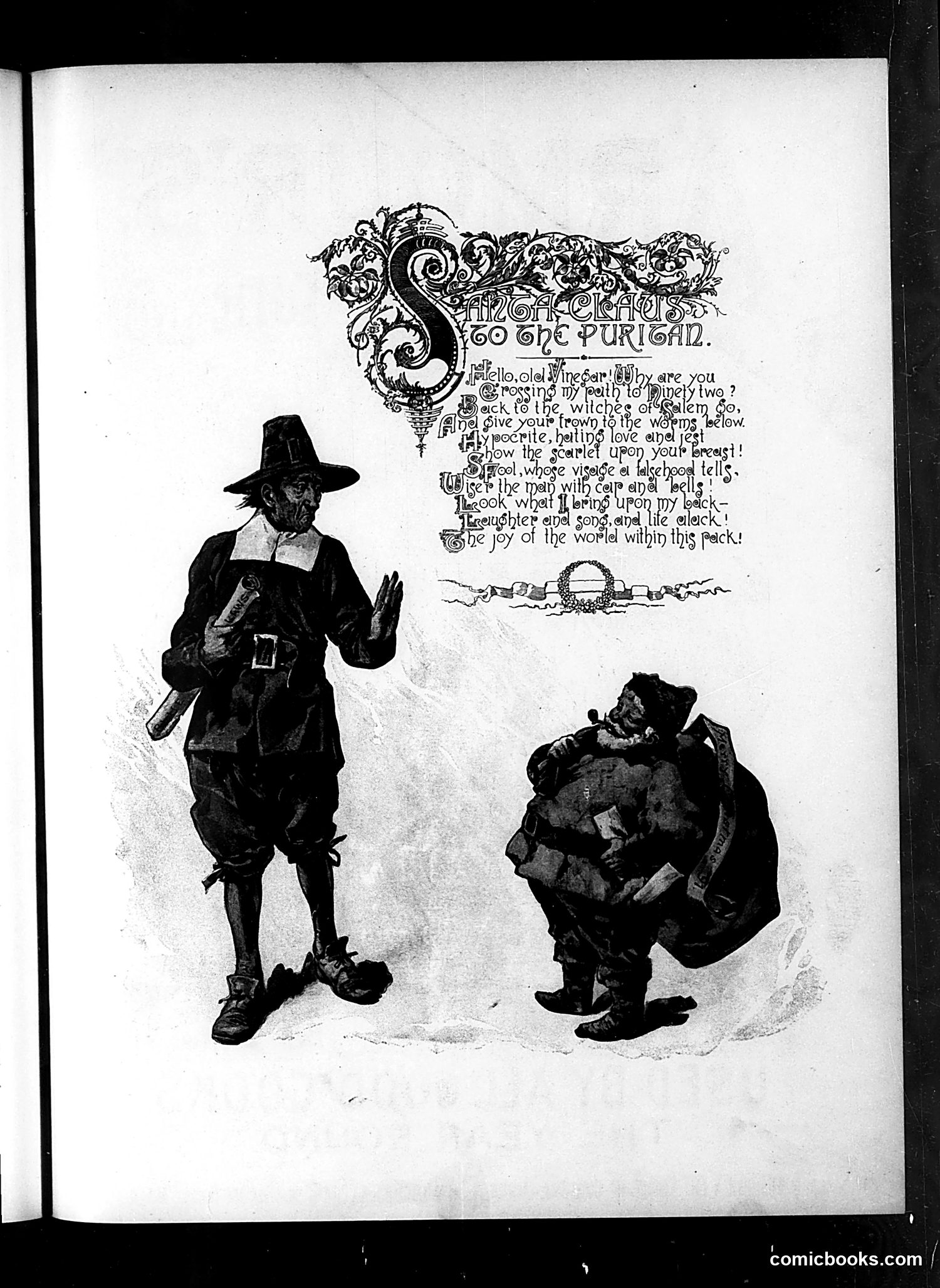
This page from *Judge* depicts "Sh'lock Shtus' Go on e Purlgan" (likely a Yiddish-inflected title suggesting a Jewish character or stereotype). The illustration shows two figures: a tall man in a hat and coat gesturing expressively, and a shorter, rotund man carrying a large pack. The ornate text above appears to be a theatrical or literary piece addressing the reader directly about choosing a "path to misery" and references to "Salem go," "worms," "scarlet," and "joy of the world within this pack." This appears to be **satirical commentary on Jewish immigrant characters**, using exaggerated caricature and dialect humor typical of late 19th/early 20th-century American satire. The "pack" likely references peddling or commercial enterprise. Without clearer OCR or dating, the specific political reference remains unclear, but the stereotypical depiction and Yiddish-inflected language suggest ethnic satire common to that era.
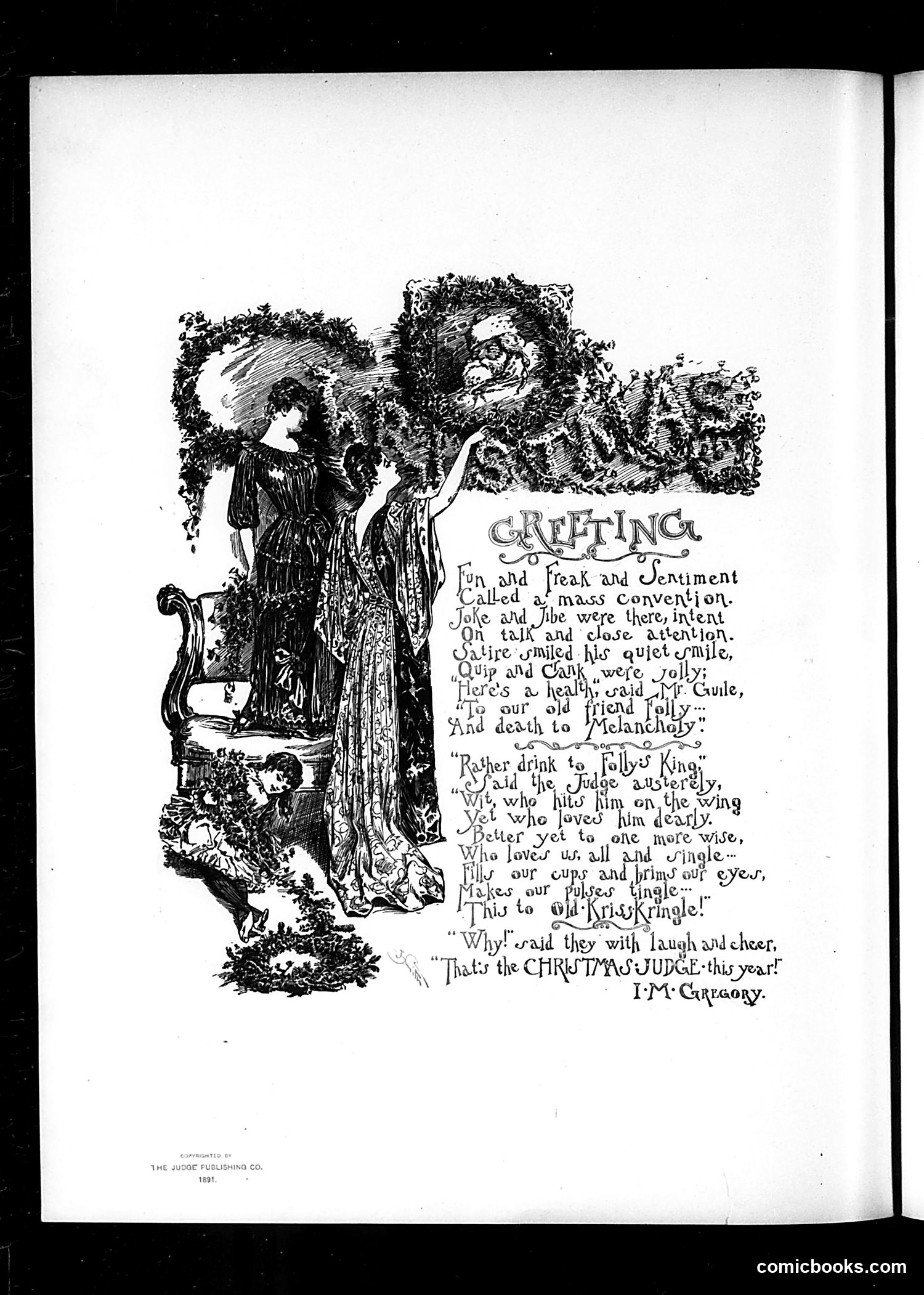
This is a festive illustrated poem celebrating Judge magazine's editorial philosophy and personified mascots. The image depicts allegorical figures representing the magazine's satirical tools: Joke, Jibe, Satire, Quip, and Cank (likely meaning "crank" or cantankerous commentary) gather in convivial celebration. The text presents these abstract concepts toasting "Folly" and "old Kris Kringle" (Santa), establishing Judge's role as a vehicle for witty social criticism during the holiday season. The final reveal—"That's the Christmas Judge this year!"—indicates this is the special holiday edition. The satire is gentle: the poem humorously positions Judge as a gathering place where humor, wit, and satirical commentary converge to skewer society's follies. The tone suggests Judge saw itself as a sophisticated, morally-engaged publication using laughter as a tool for social commentary, particularly fitting for a Christmas-season special issue.
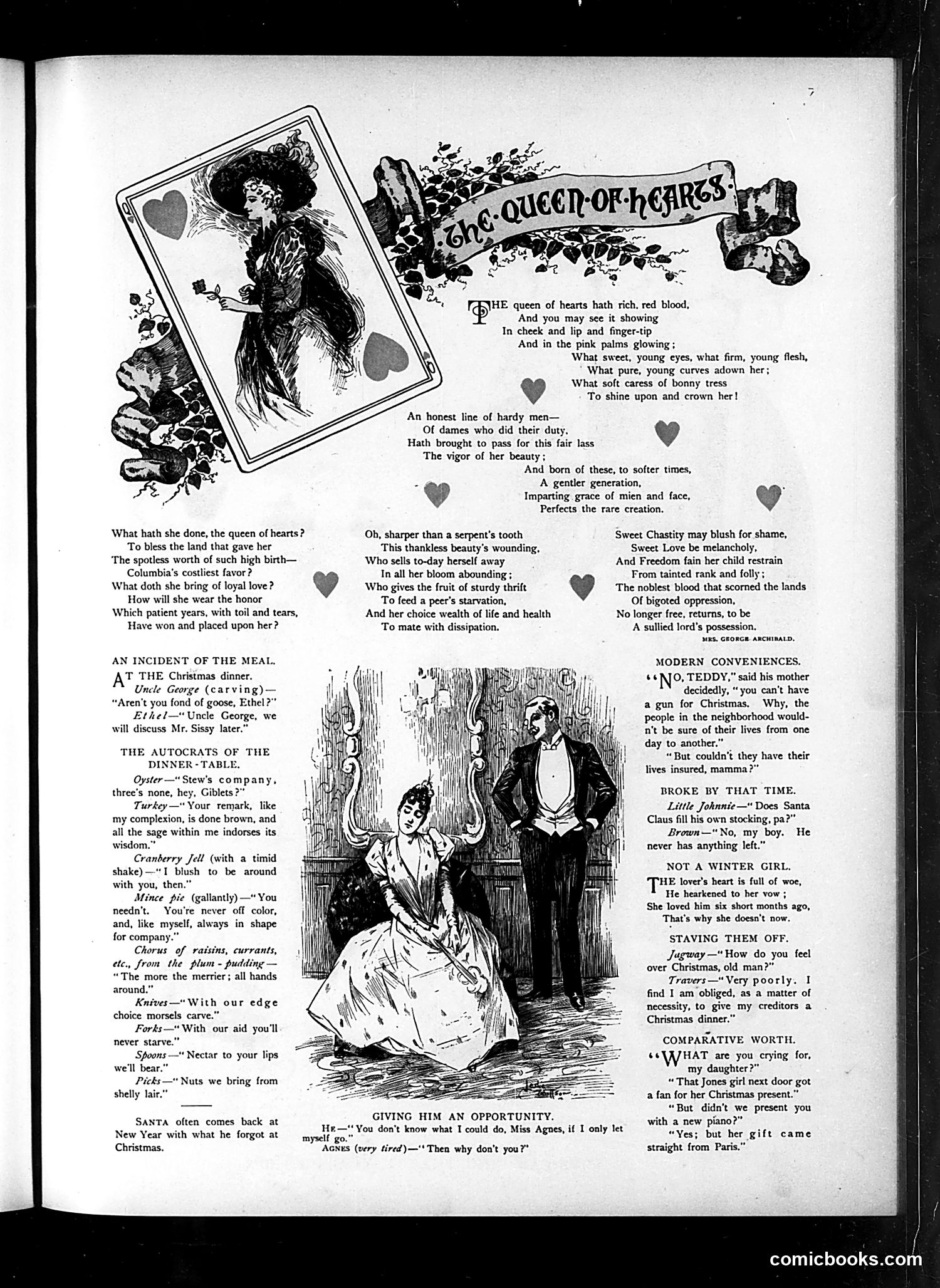
The upper portion features a poem accompanying an illustration of the "Queen of Hearts"—likely referencing American heiresses of the Gilded Age who married European nobility. The satire condemns women of noble American lineage who "sell themselves away" to foreign aristocrats, particularly impoverished European peers seeking wealthy brides. The poem praises American women's "vigorous beauty" inherited from "honest lines of hardy men" and "dames who did their duty," then bitterly questions what these women contribute to America in return. It sarcastically suggests they betray "Sweet Chastity," "Sweet Love," and "Freedom" by marrying for status rather than principle—particularly by joining "bigoted" European establishments that previously "scorned" American independence. This reflects genuine contemporary anxieties about wealthy American daughters marrying foreign titles, viewed as both a betrayal of American values and an embarrassing economic reversal where American gold purchased European prestige. The page's other humor pieces offer lighter holiday satire unrelated to this theme.
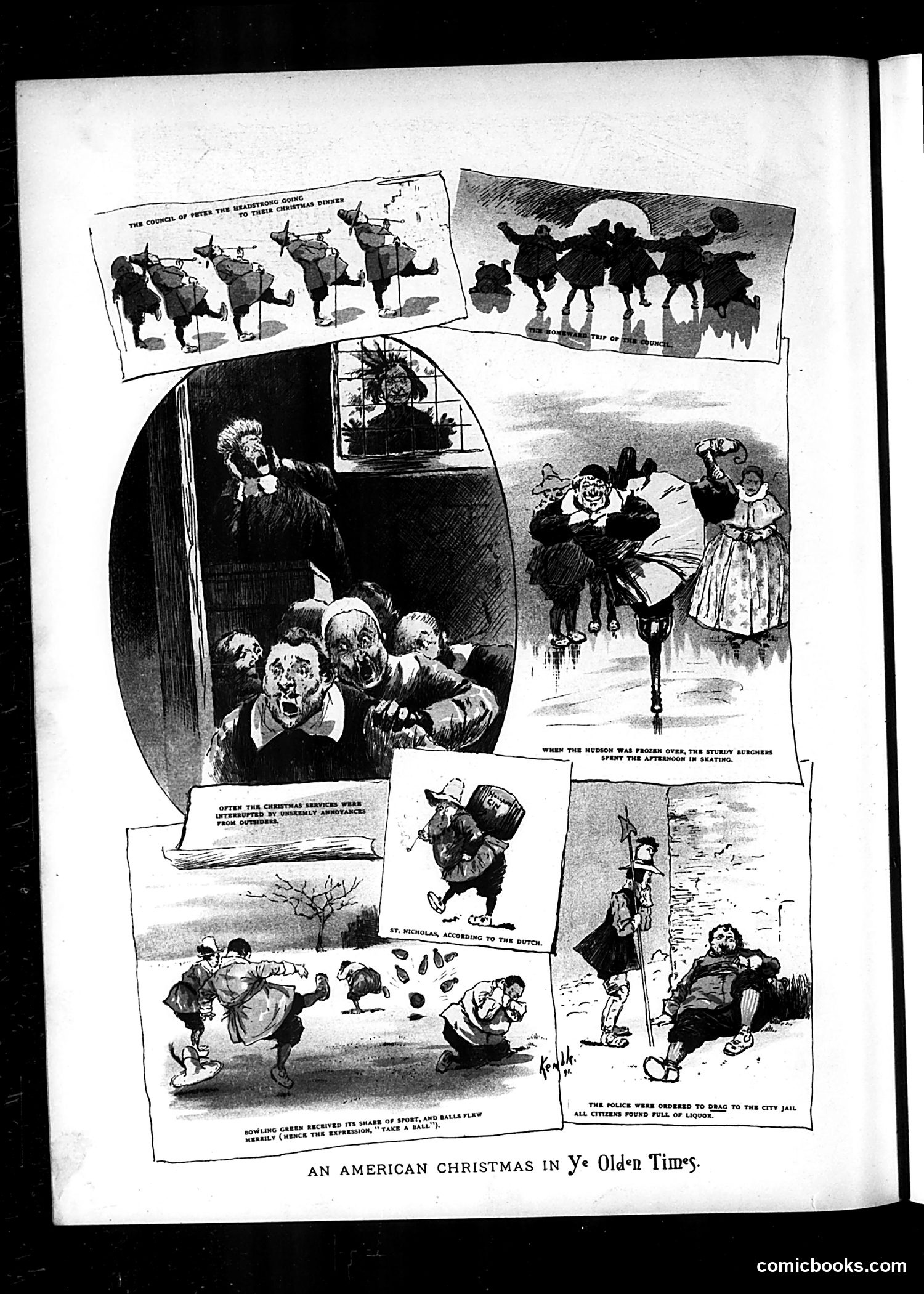
This Judge magazine page satirizes colonial-era American Christmas celebrations through exaggerated, chaotic scenes. The cartoon depicts rowdy, drunken behavior—skating on a frozen Hudson River, police dragging intoxicated citizens to jail, and general mayhem. The satire appears to contrast the *idealized* vision of "Ye Olden Times" (suggesting wholesome, quaint colonial America) with the *actual* reality: lawlessness, heavy drinking, and disorder. The title's nostalgic framing makes the crude behavior more pointed—the joke is that America's past wasn't the genteel, civilized period some romanticized it as. The various vignettes show arrests, drunkenness, and chaos, suggesting that excessive drinking and violence were hallmarks of early American Christmas traditions, not the respectable heritage some claimed.
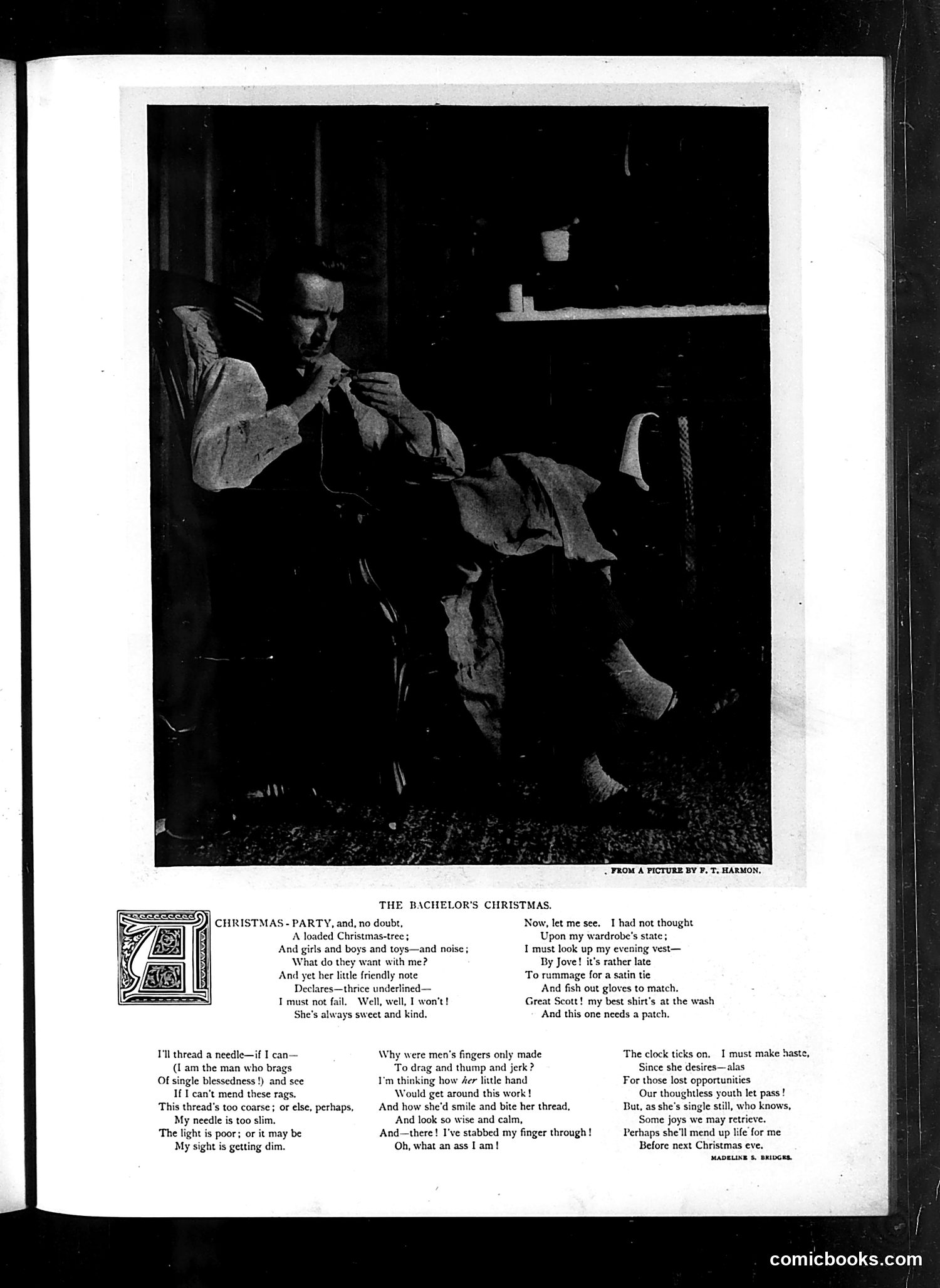
This is a sentimental illustrated poem rather than a political cartoon. It depicts a confirmed bachelor preparing for a Christmas party, shown in the photograph mending his own clothes with difficulty. The satire targets bachelor life: the man struggles with domestic tasks (threading needles, mending rags) that a woman would handle effortlessly. As he works, he nostalgically contemplates a woman he knows—"her little hand" would complete such work gracefully. The poem's irony is that this supposedly independent "man who brags / Of single blessedness" actually longs for female companionship. By poem's end, he hopes this Christmas gathering might lead to romance: "Perhaps she'll mend up life for me / Before next Christmas eve." The piece gently mocks bachelor pretensions while celebrating traditional domesticity and courtship—typical Judge magazine fare combining humor with conventional social values.
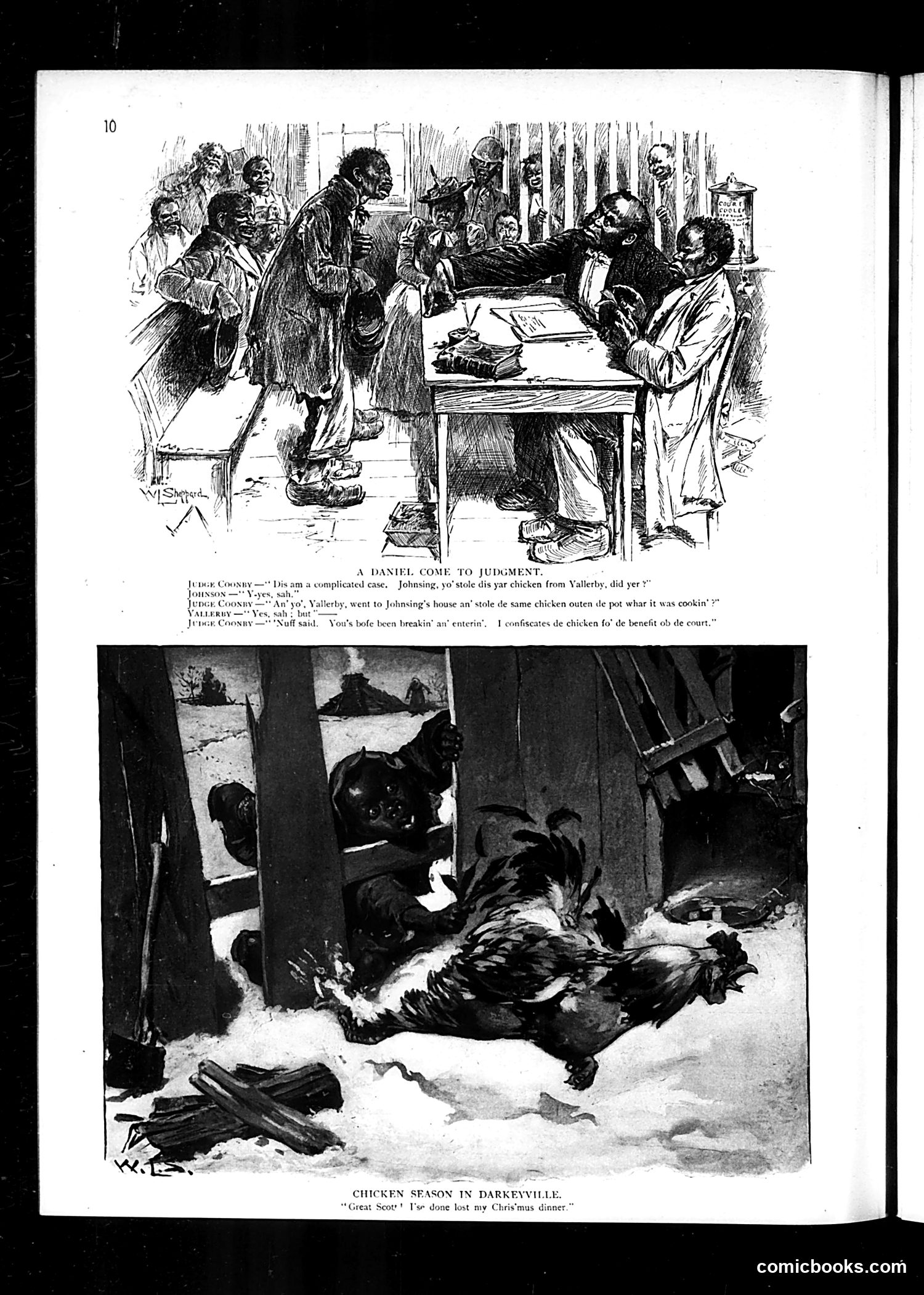
This page contains two cartoons satirizing African American characters and rural Southern life, using period racial stereotypes and dialect. **Top cartoon ("A Daniel Come to Judgment"):** A judge presides over a case where two Black defendants, "Johnsing" and "Yallerby," are accused of stealing a chicken from each other—each stole it from the other's house. The judge's solution is to confiscate the chicken "for the benefit of de court," implying judicial corruption and theft. The title references Shakespeare's *Merchant of Venice*, sarcastically comparing this absurd case to Solomon's wise judgment. **Bottom cartoon ("Chicken Season in Darkeyville"):** Shows a dead chicken in snow, captioned with a character lamenting losing his Christmas dinner. Both exploit racist caricature conventions common to late 19th/early 20th-century American humor, stereotyping Black Southerners as chicken-stealing and dialect-speaking. The satire targets both the characters and (in the top cartoon) corrupt judicial systems, though the racist framing undermines any social critique.
I can see this is a very faint pencil sketch or preliminary drawing on what appears to be a page from *Judge* magazine, but the image quality is too degraded for me to make out specific details with confidence. The sketch shows what might be multiple figures in some kind of scene, but I cannot clearly discern their features, identities, or the specific satirical content intended. Without being able to read legible details in either the image or accompanying text (only "comicbooks.com" is visible), I cannot reliably identify the political or social references, the figures depicted, or explain the cartoon's point to a modern reader. A clearer reproduction would be needed for accurate analysis.
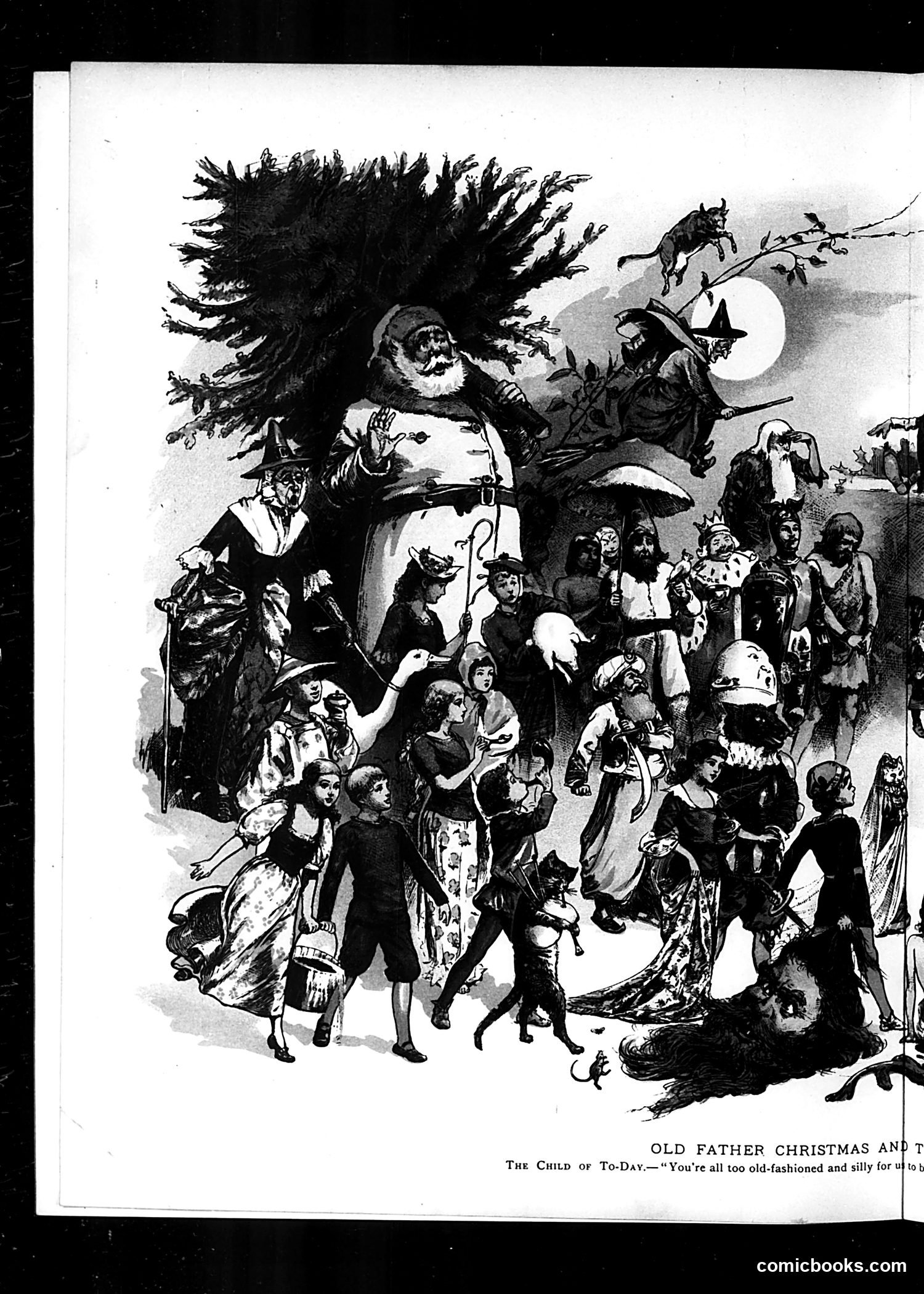
This satirical illustration depicts **Old Father Christmas** (the traditional, bearded personification of Christmas) confronting modern children. The caption's partial text suggests Christmas is telling children they find him "too old-fashioned and silly." The cartoon critiques **the modernization and commercialization of Christmas** in early 20th-century America. The traditional, folkloric figure of Father Christmas—associated with generosity and timeless values—clashes with contemporary children who reject his antiquated customs. The elaborate crowd scene surrounding him, rendered in Judge magazine's characteristic detailed style, likely represents competing modern Christmas practices or commercial interests. The satire suggests anxiety about how contemporary society was abandoning traditional Christmas customs in favor of newer, more secular or commercial celebrations.
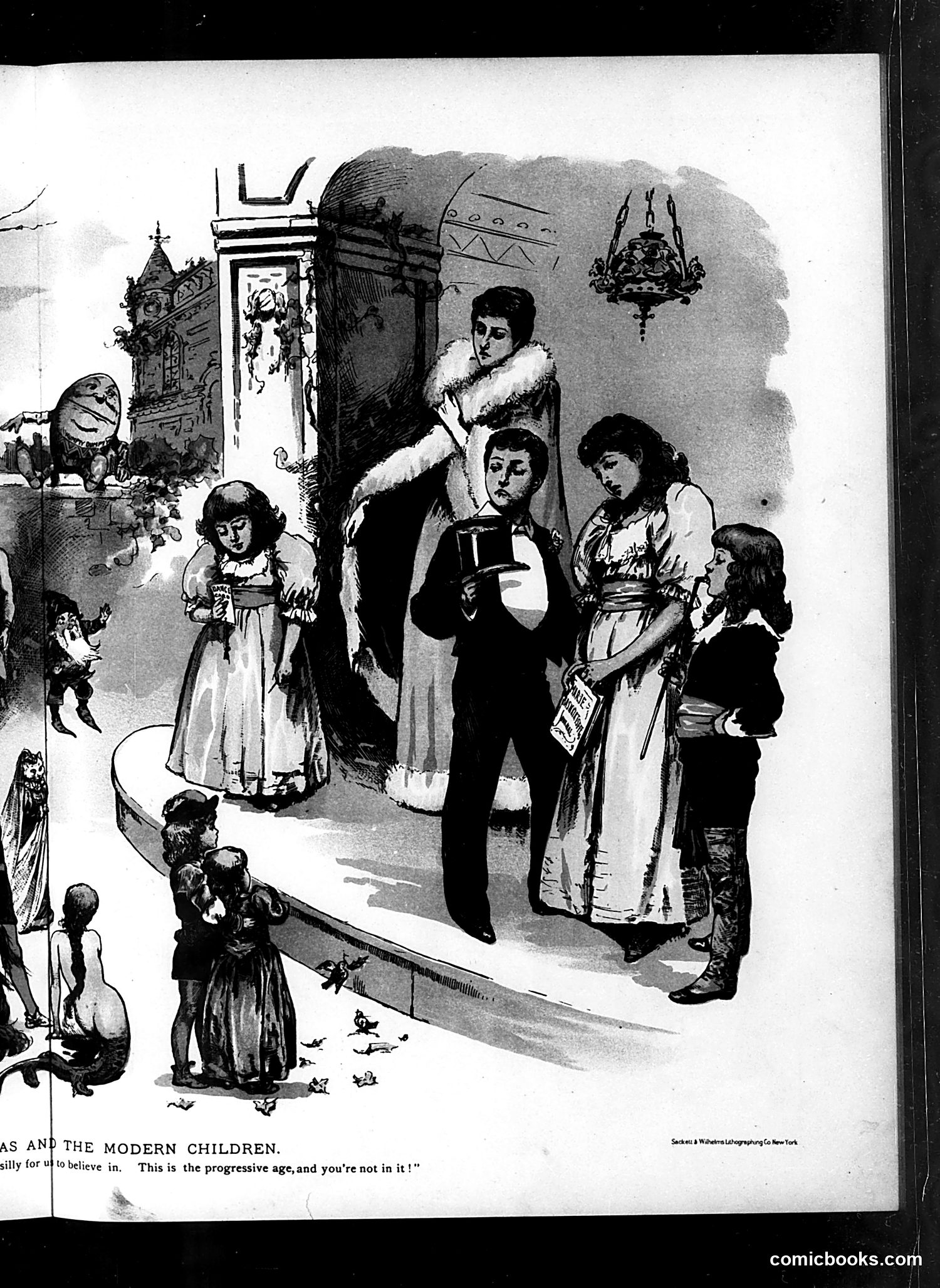
This satirical cartoon critiques the "Progressive age" by depicting fashionable, wealthy adults instructing children that belief in traditional values is outdated. The elegantly dressed woman with fur trim and the well-dressed man appear to represent progressive intellectuals or society figures dismissing conventional morality. The cartoon's humor lies in its ironic title: "The Modern Children" are being taught to abandon old-fashioned principles. The scattered, misbehaving children at the bottom—appearing undisciplined and chaotic—suggest the consequences of this progressive ideology. Judge magazine uses this to mock what it viewed as dangerous modernism undermining childhood innocence and traditional upbringing. The exact figures remain unclear, but the satire targets progressive attitudes of the era that critics felt corrupted young people.
I can see this is a page from *Judge* magazine, but the image is too faint and degraded for me to reliably identify specific cartoon content, figures, or caricatures. The page appears to contain illustrations and text, but the contrast is insufficient to read the OCR'd text clearly or to discern the visual details of any political or social satire depicted. To accurately explain what cartoons or content appear on this page—identifying figures, political references, and satirical intent—I would need a clearer image. Without being able to read the text or see the illustrations distinctly, I cannot responsibly assert specific meanings or references that modern readers would need explained.
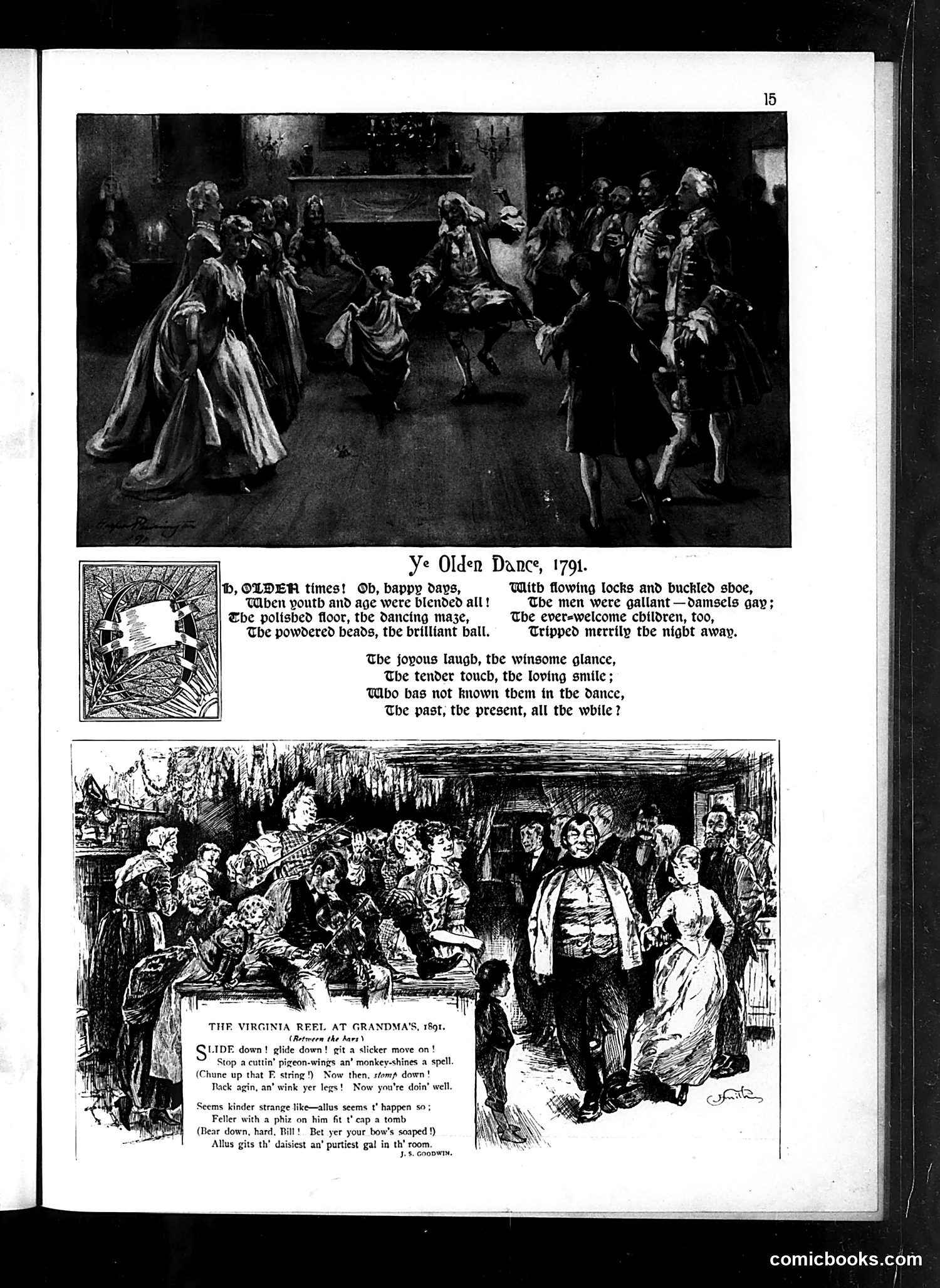
This page contrasts two dance scenes as social satire. The top illustration romanticizes an 18th-century formal ball—"polished floor," "powdered heads," "brilliant ball"—with accompanying verse nostalgically celebrating genteel courtship and propriety. The bottom illustration, captioned "The Virginia Reel at Grandma's, 1891," mockingly depicts a contemporary rural dance scene. The accompanying dialect verse (credited to J.S. Goodwin) humorously captures backwoods colloquialisms and rough behavior—dancers calling out instructions, references to "soaped" violin bows, and the boast that a physically attractive man "allus gits th' daisiest an' purtiest gal." The satire targets the gap between America's idealized past and crude present reality: 100 years of supposed civilization have produced not refinement but rustic vulgarity. The contrast between formal language/imagery above and vernacular dialect below emphasizes how far contemporary rural America has allegedly fallen from genteel standards.
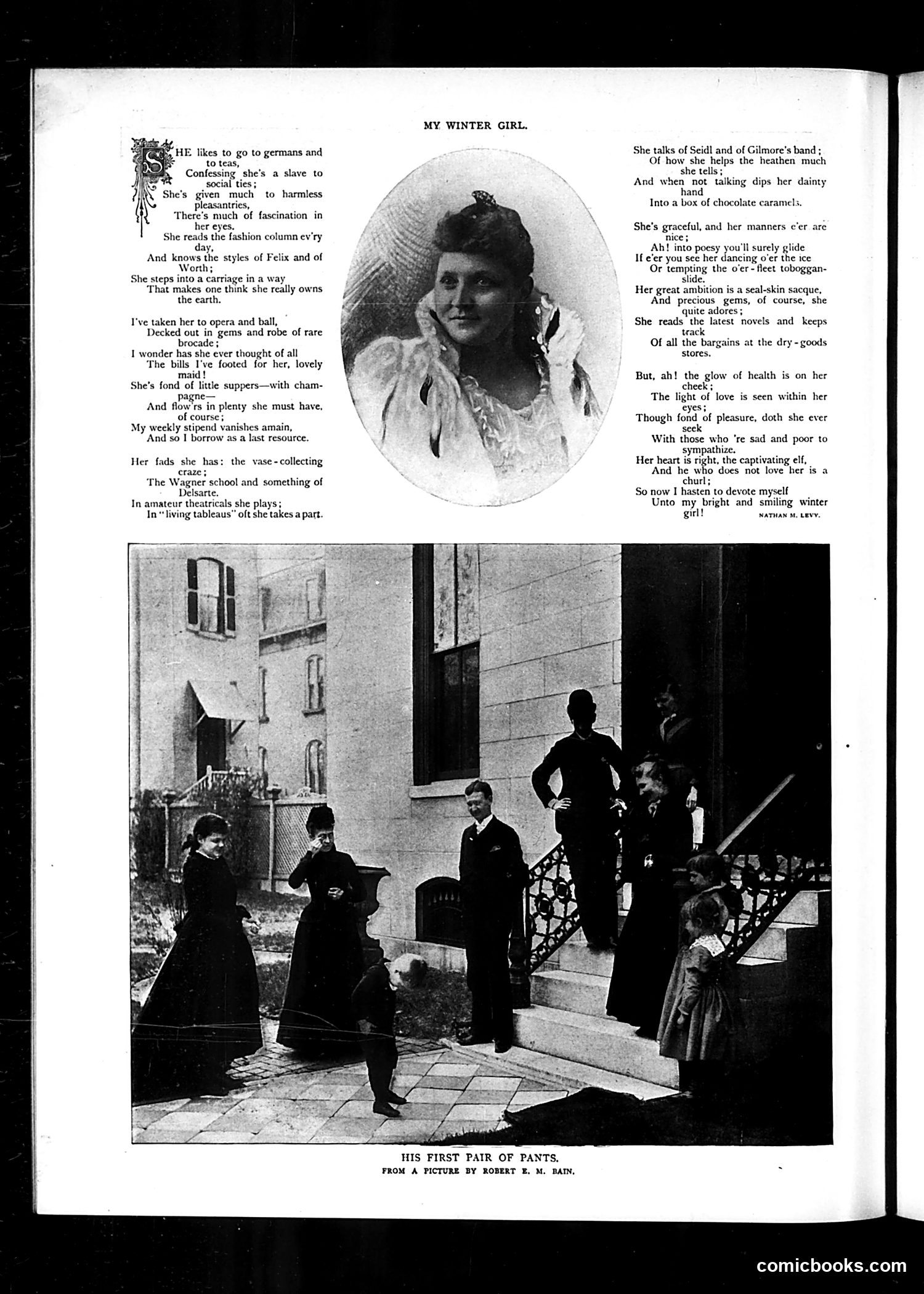
This page contains a humorous poem by Nathan M. Levy mocking the "winter girl" — a fashionable society woman of the era. The satire targets her shallow materialism and expensive tastes: she obsesses over high-end fashion designers (Felix, Worth), attends operas and balls, collects vases, and constantly demands champagne, flowers, and jewelry. The joke centers on the narrator's financial ruin funding her lifestyle. He complains his "weekly stipend vanishes," forcing him to "borrow as a last resource." Yet the poem concludes sentimentally, forgiving her because she's graceful, kind to the poor, and her "heart is right." The accompanying portrait and the unrelated photograph below ("His First Pair of Pants") suggest Judge's typical format mixing verse satire with illustrations. The piece mocks both wealthy women's consumerism and men's romantic helplessness against it — a common late-19th-century magazine theme.
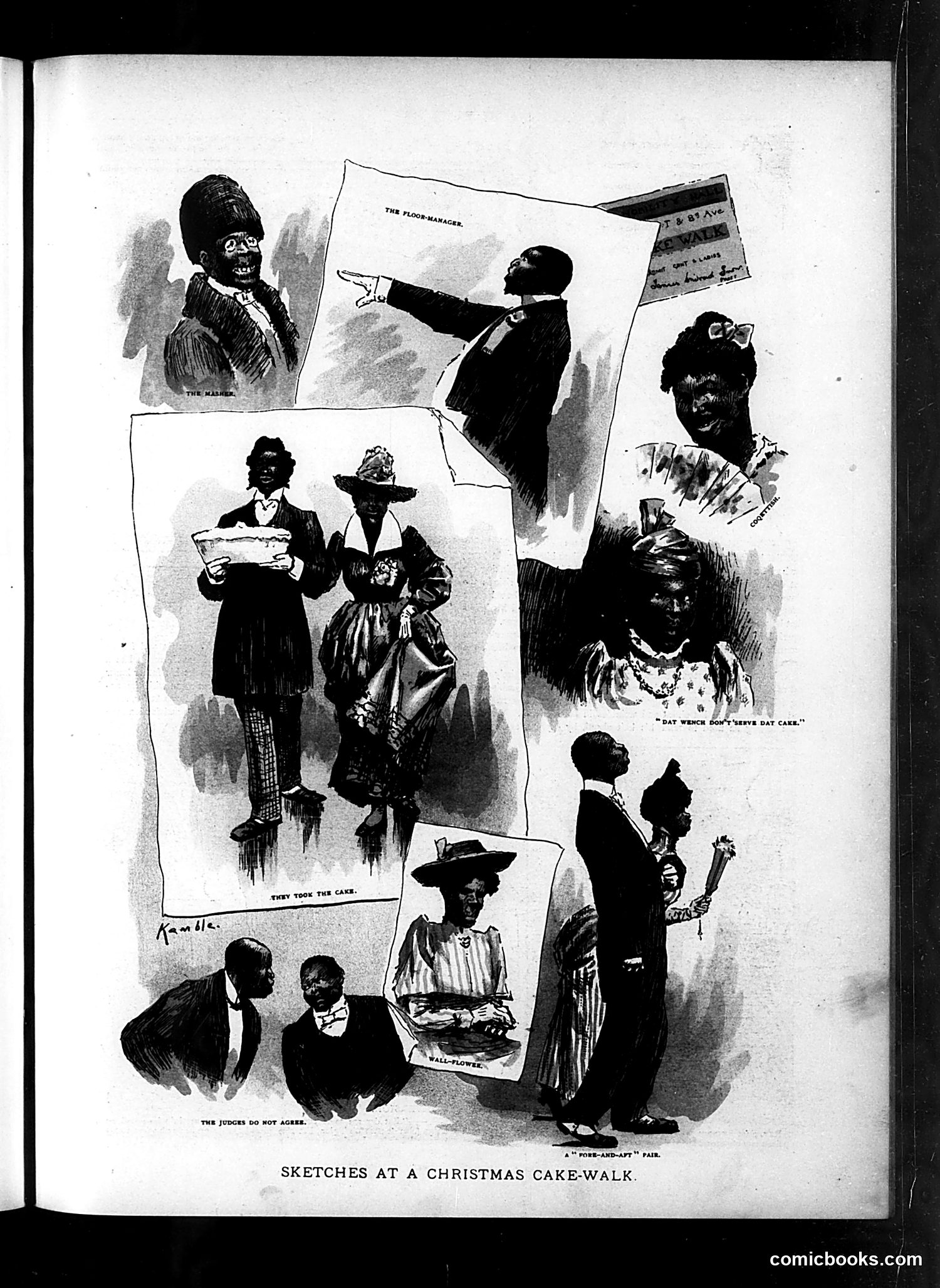
This page appears to be a series of satirical sketches from *Judge* magazine depicting a "cake-walk"—a popular entertainment form of the era featuring African American performers (though the crude caricatures suggest white performers in blackface). The sketches mock various aspects of the spectacle: "The Manager," "The Floor-Manager," participants "They Take the Cake," and judges who "Do Not Agree." Text fragments reference street locations (appearing to reference New York venues). The satire likely targets the cake-walk's popularity among white audiences and the absurdity of the spectacle itself. The exaggerated facial features and caricatured depictions reflect the deeply racist visual conventions standard in late 19th/early 20th-century American satirical magazines. The "judges disagreeing" sketch suggests mockery of the competition's legitimacy or judgment standards.
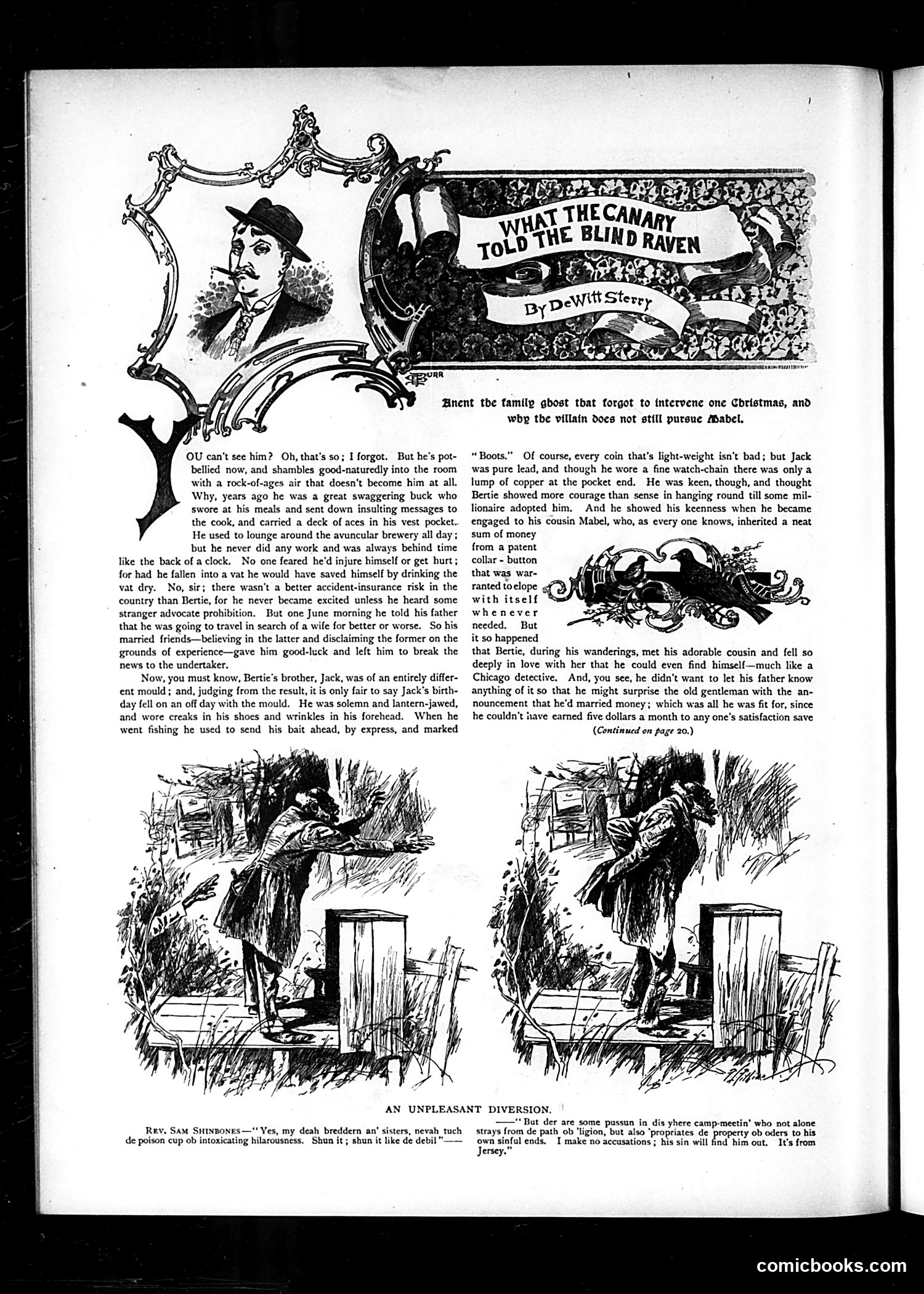
This is a serialized comic story (continued from earlier) about two contrasting brothers: the dissolute, charming Bertie and his serious, humorless brother Jack. Bertie is a lazy drunk who lives off his father's brewery fortune but paradoxically proves lucky in love, falling for their wealthy cousin Mabel during travels. Jack, though virtuous and industrious, is "pure lead"—a worthless dud despite outward respectability. The satire mocks class pretensions: Bertie's incompetence doesn't prevent success (he wins Mabel's inheritance), while Jack's moral superiority yields nothing. The "family ghost" reference and melodramatic setup suggest this was a serialized story playing on readers' investment in character outcomes. The bottom cartoon shows a revival preacher condemning "intoxicating hilarousness" while obliquely accusing congregants of theft—likely satirizing evangelical hypocrisy or the disconnect between moral preaching and actual vice in communities.
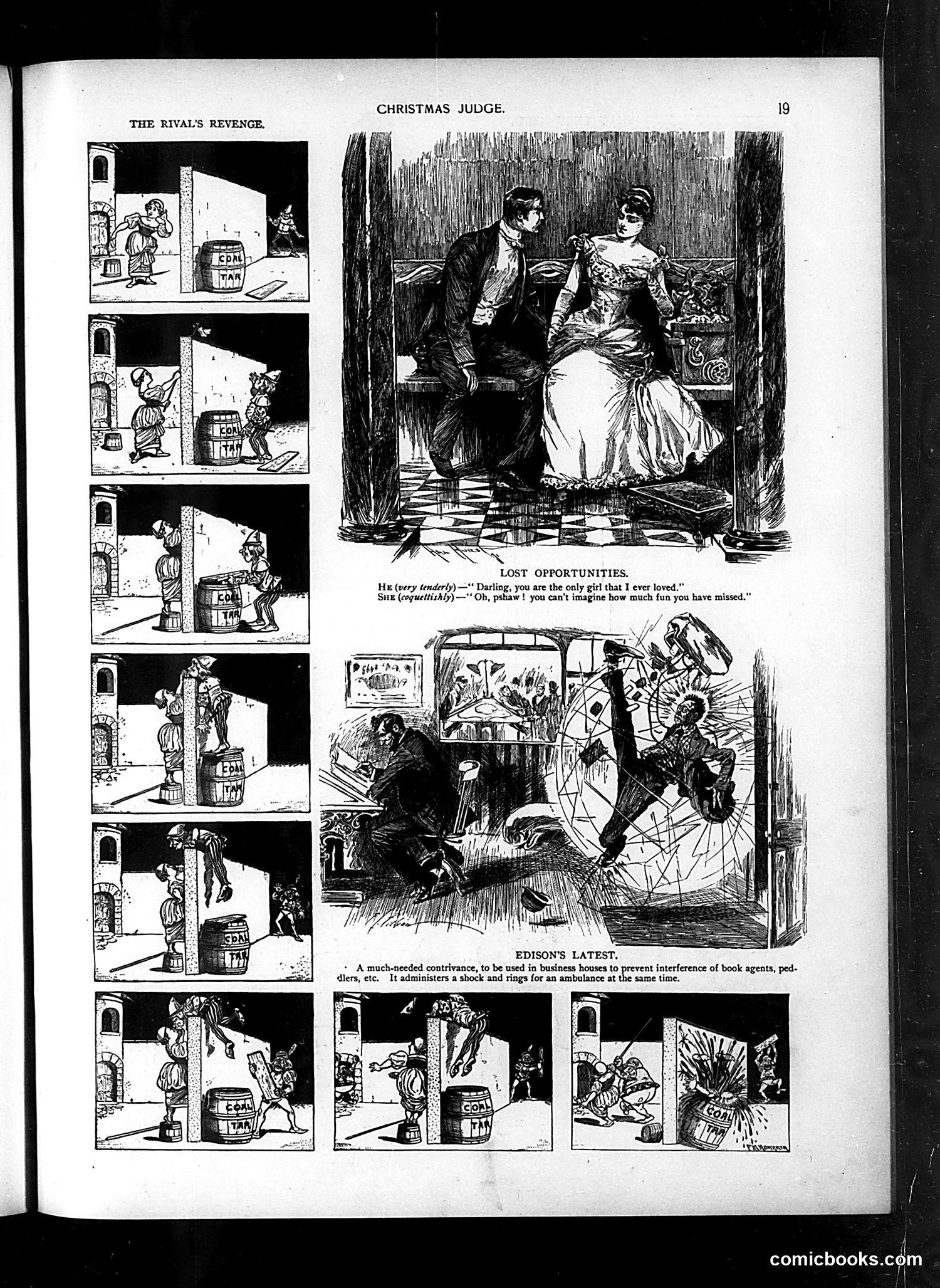
This page contains three separate satirical pieces: **"The Rival's Revenge"** (left comic strip): A sequential narrative showing a figure repeatedly attempting to enter a building through a door marked "COAL" or similar, escalating in comedic failure—a slapstick revenge plot. **"Lost Opportunities"** (top right): A romantic scene where a man declares exclusive love to a woman, who coquettishly suggests he's missed out on fun. The satire mocks both romantic sentimentality and female flirtatiousness—contemporary gender dynamics played for humor. **"Edison's Latest"** (center and bottom right): This satirizes Thomas Edison's inventive reputation by depicting a fictional "much-needed contrivance" designed to repel book agents and similar annoying visitors. It administers electric shocks and automatically summons an ambulance—exaggerating Edison's association with electrical innovation into absurd, violent comedy. The satire targets both Edison's prolific invention claims and the annoyance of aggressive sales tactics of the era. All three pieces use contemporary concerns (romance, unwanted solicitation) as vehicles for humor.
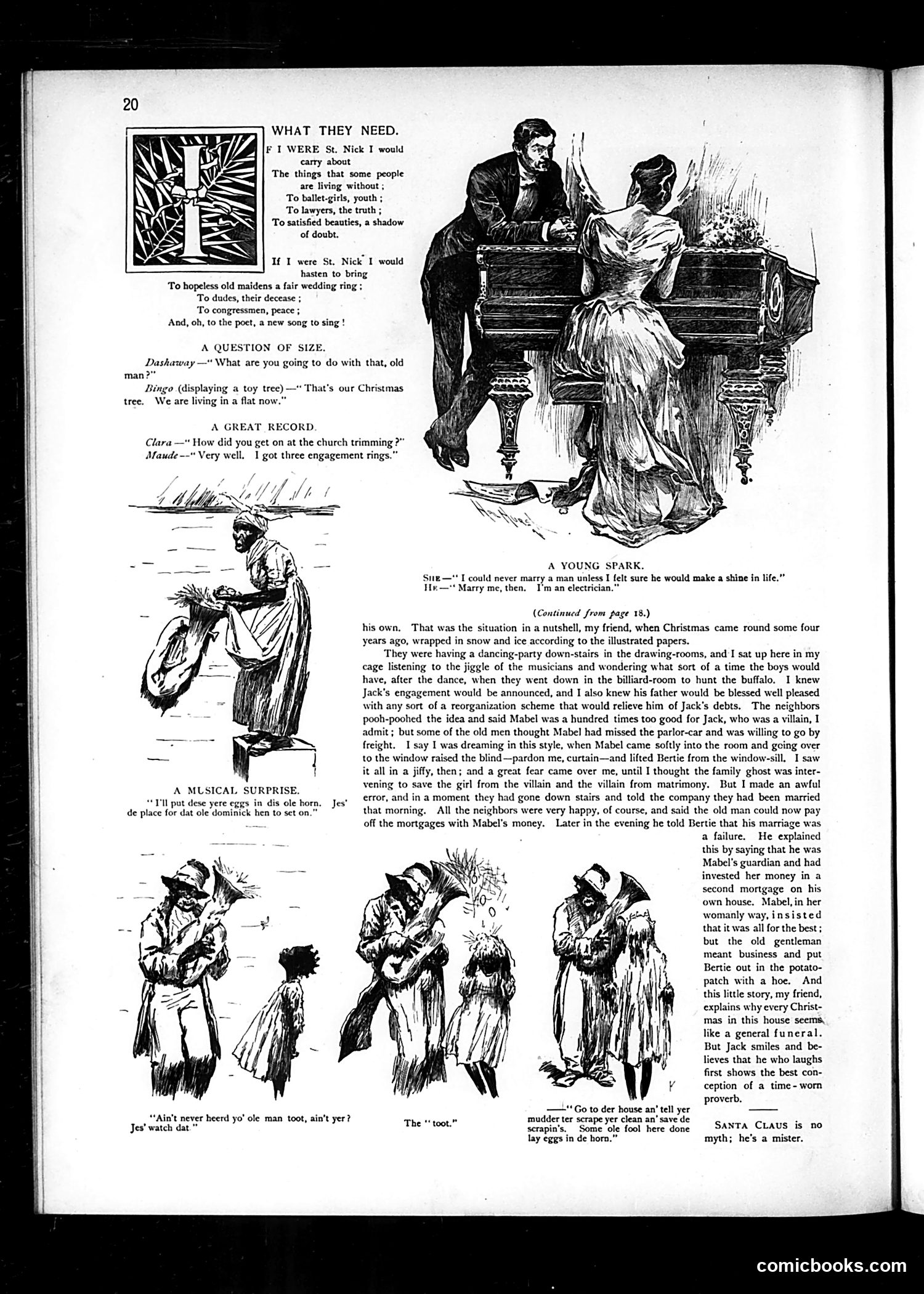
This page contains several brief satirical jokes and a longer narrative story, typical of Judge's format. The opening poem "What They Need" satirizes various social types by imagining what Santa should give them: ballet dancers need youth, lawyers need truth, congressmen need peace. The humor relies on suggesting these groups lack these basic qualities. The three short jokes below mock contemporary concerns: a man living in a cramped flat calling a toy tree "our Christmas tree"; a woman boasting of receiving three engagement rings at church; and wordplay about an electrician creating a "shine in life." The longer narrative describes a Christmas drama involving Jack, his father's debts, an engagement to the wealthy Mabel, and a revelation that Mabel's money was invested in the father's own mortgage—making the marriage financially useless. The story satirizes financial desperation among the upper classes and suggests marriage as transactional. The bottom illustrations appear unrelated comic vignettes involving working-class figures and dialect humor common to the era.
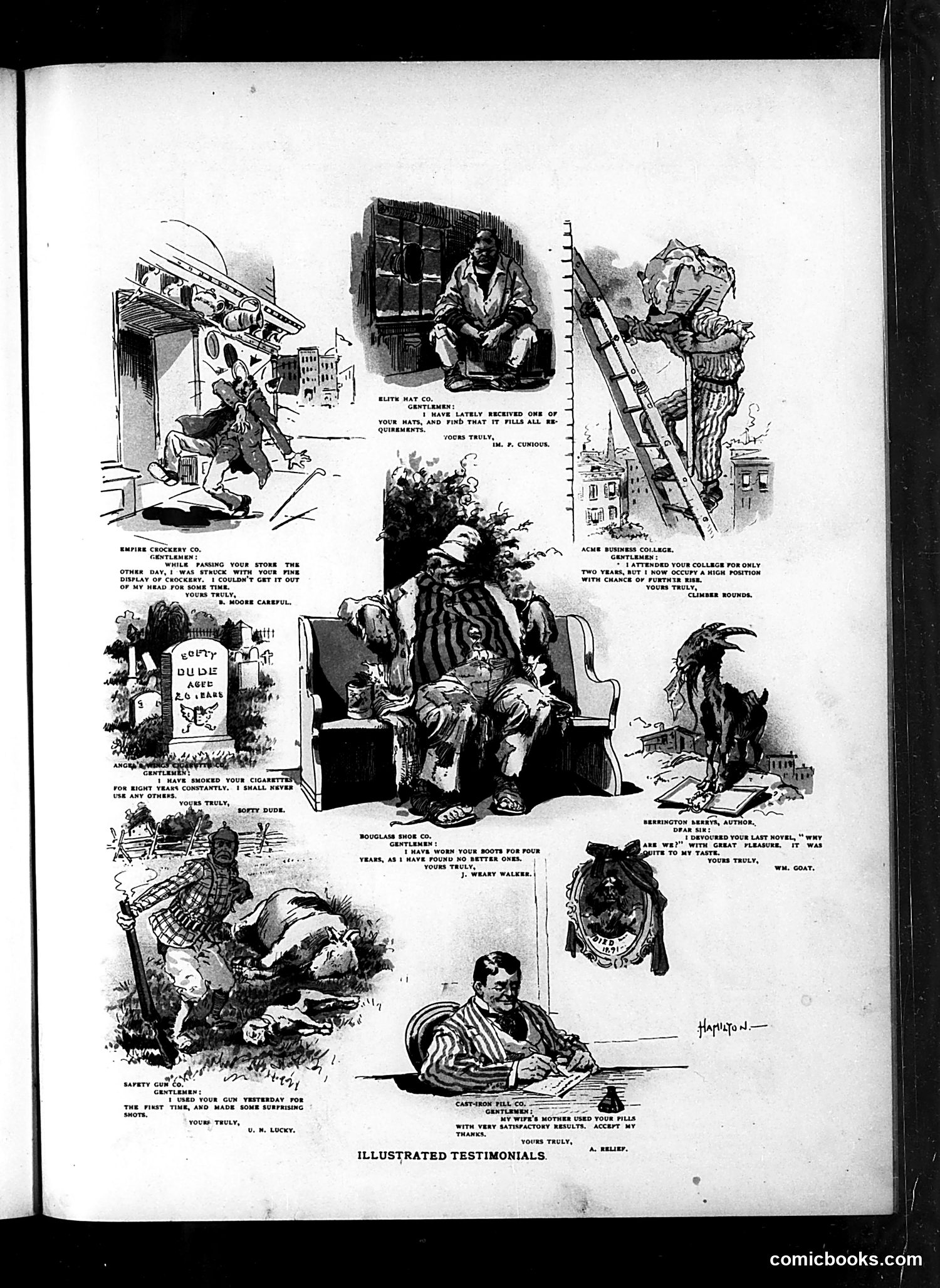
This page parodies fake advertising testimonials—a common marketing practice of the era. Each illustration shows a supposedly satisfied customer endorsing a product or service, with their praise printed below. The satire works by pairing absurd or contradictory testimonials with caricatured figures. For example, one man praises crockery he saw in a store window but "couldn't get out of my head"—implying obsession rather than quality. Another testimonial credits a gun with "surprising shots," while the Safety Gun ad shows someone apparently injured. The "Acme Business College" testimonial is particularly satirical: a student claims attending only two years led to a "high position with chance of further rise"—mocking the inflated promises of diploma mills and correspondence schools popular in this period. The overall point: Judge is ridiculing how companies use fake customer endorsements to make dubious or exaggerated claims sound legitimate, a deceptive advertising tactic that clearly annoyed the magazine's editors.
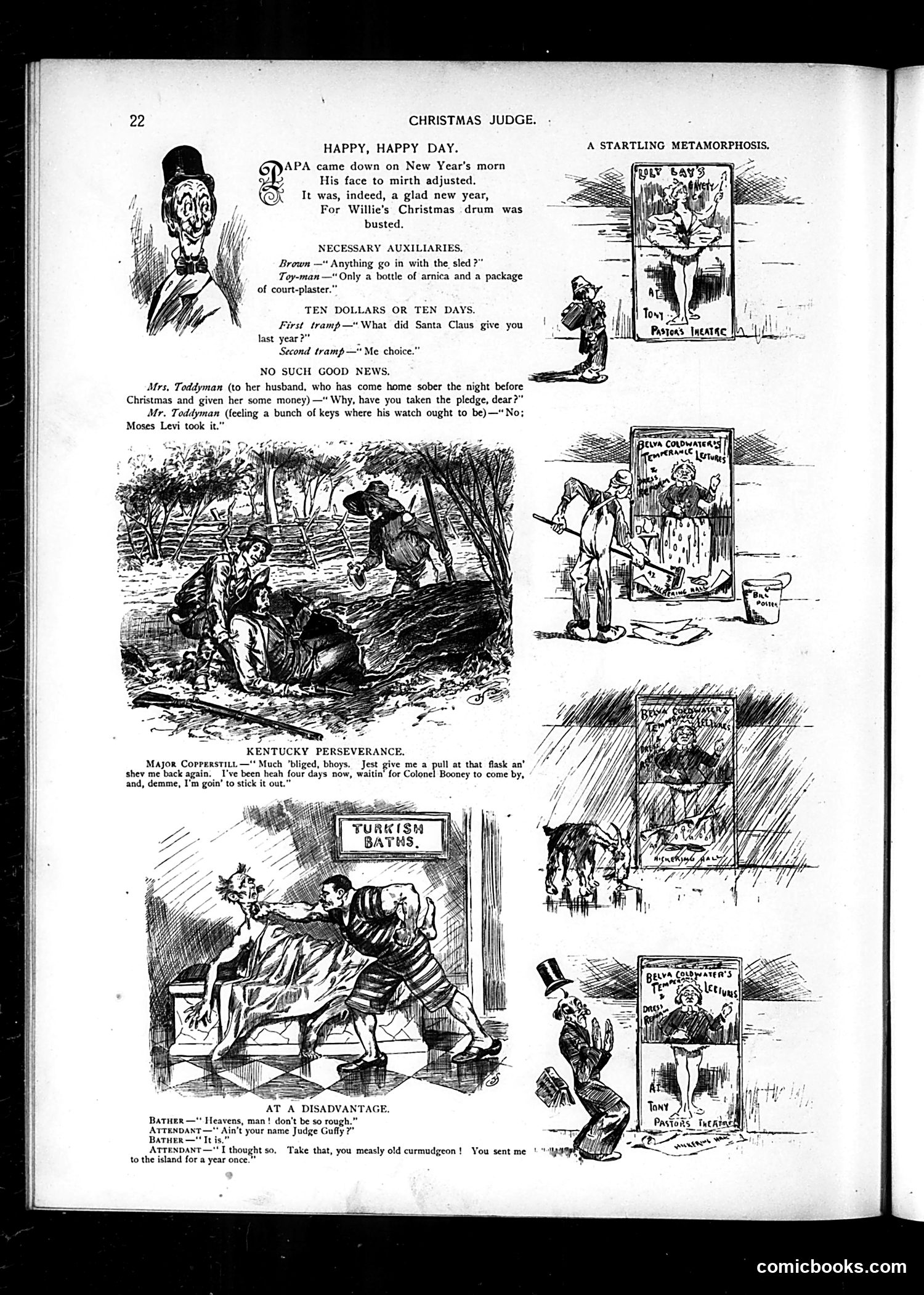
This Christmas-themed satirical page contains multiple short humor pieces typical of late 19th-century Judge magazine: **"Happy, Happy Day"** jokes about a child's drum being broken—a common trope about noisy toys driving parents mad. **"Necessary Auxiliaries"** mocks the injuries children sustain from sledding, with a toy seller suggesting arnica and court-plaster (bandages) as essential sled accessories. **"Ten Dollars or Ten Days"** presents homeless men discussing meager Christmas gifts, with dark humor about choosing jail time. **"No Such Good News"** satirizes a drunk husband returning sober with money—but he's pawned his watch to a pawnbroker (Moses Levi, a Jewish stereotype common in period satire). **"Kentucky Perseverance"** depicts a Major waiting four days for Colonel Booney, sustained only by whiskey—mocking Southern persistence and drinking culture. **"Turkish Baths/At a Disadvantage"** appears to reference bathing establishments and class-based mistreatment. The cartoons reflect period attitudes: drinking, gambling, ethnic stereotyping, and class humor.
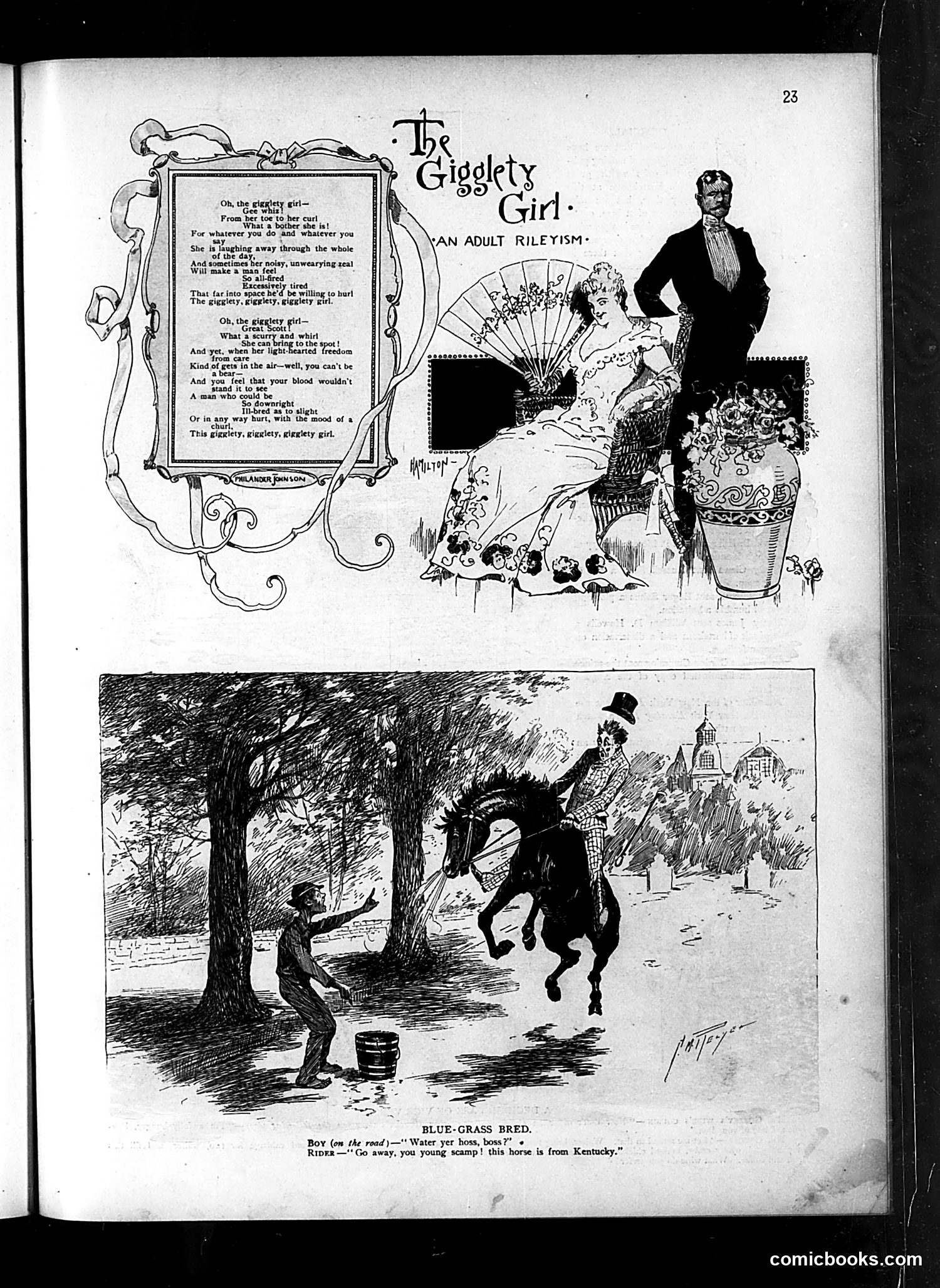
**Top Section:** A satirical poem mocking the "gigglety girl"—a young woman characterized by constant, infectious laughter and lighthearted frivolity. The verses present a contradictory male perspective: her giggling is simultaneously annoying (exhausting to men) and charming (impossible to resent). The accompanying illustration shows fashionable society figures, emphasizing the satirical tone about female behavior and social expectations. **Bottom Cartoon ("Blue-Grass Bred"):** A rural scene depicting class and regional satire. A poor boy offers to water a rider's horse; the rider harshly refuses, boasting that his horse is "from Kentucky"—implying superior breeding. The humor lies in the rider's snobbish pride over a horse's origin while treating a local child dismissively. This mocks American pretension about pedigree and status. Both pieces satirize contemporary social attitudes about gender, class, and regional identity.
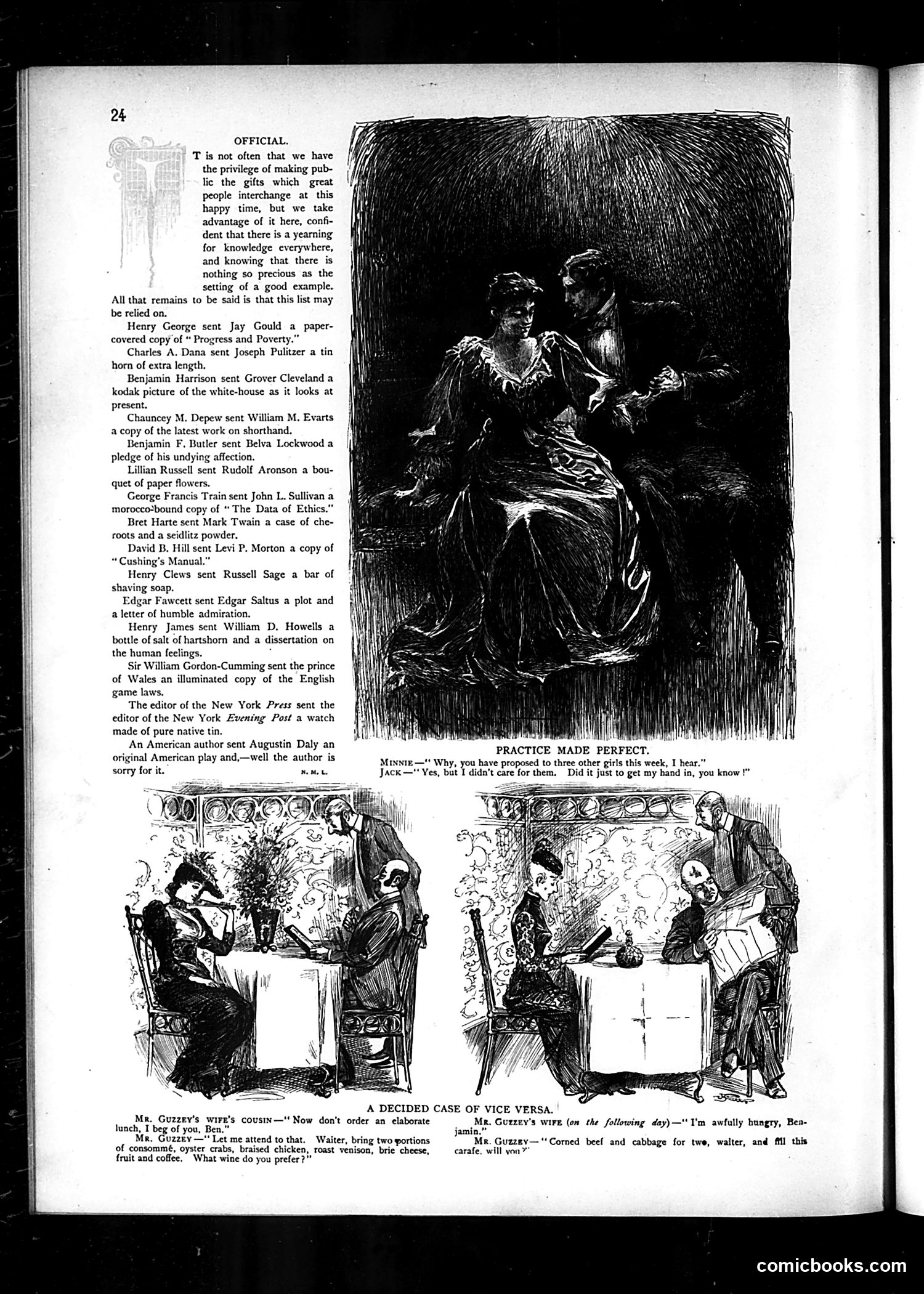
This page satirizes prominent late 19th-century figures through fake "gift exchanges." The top section lists humorous, mocking presents supposedly sent between famous politicians, businessmen, and cultural figures—like Henry George sending Jay Gould a copy of "Progress and Poverty" (implying Gould needs education on poverty) and Benjamin Harrison sending Grover Cleveland a photo of the White House (mocking Cleveland's defeat). The two cartoon strips below depict romantic/social comedy: "Practice Made Perfect" shows a man casually proposing to women as "practice," while "A Decided Case of Vice Versa" reverses gender roles—a woman orders an elaborate meal while her husband tries to control her spending, but the next day she demands expensive food from him anyway. The satire targets Gilded Age excess, hypocrisy among the wealthy and powerful, and evolving social expectations around gender and courtship.
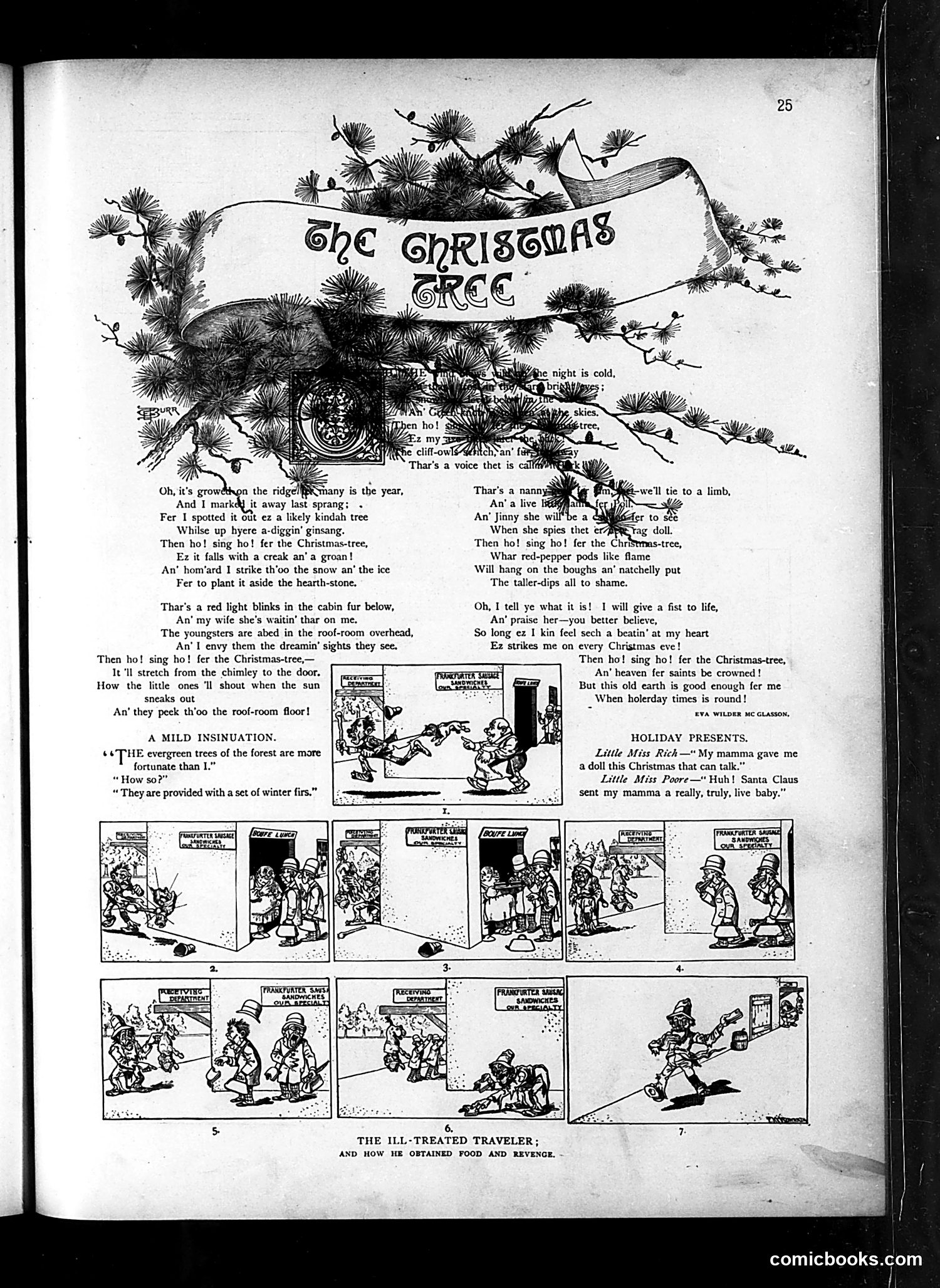
This page from *Judge* magazine features a sentimental ballad celebrating Christmas traditions among rural working-class Americans. The poem, attributed to Eva Wilder McClasson, romanticizes a poor family's Christmas—a man cuts a tree from the forest, treks home through snow, and anticipates his wife and children's joy at homemade decorations (red-pepper pods, paper dolls, etc.). The tone is nostalgic and celebrates humble contentment. Below are lighter satirical pieces: "A Mild Insinuation" is a pun joke about evergreen trees having "winter firs." "Holiday Presents" contrasts wealthy and poor children's gifts—one receives a talking doll, the other a "live baby" (implying an actual newborn sibling as a gift). The page footer references a comic strip about "The Ill-Treated Traveler." The content reflects Victorian-era sentimentality about rural poverty as noble and virtuous, mixed with genteel humor.
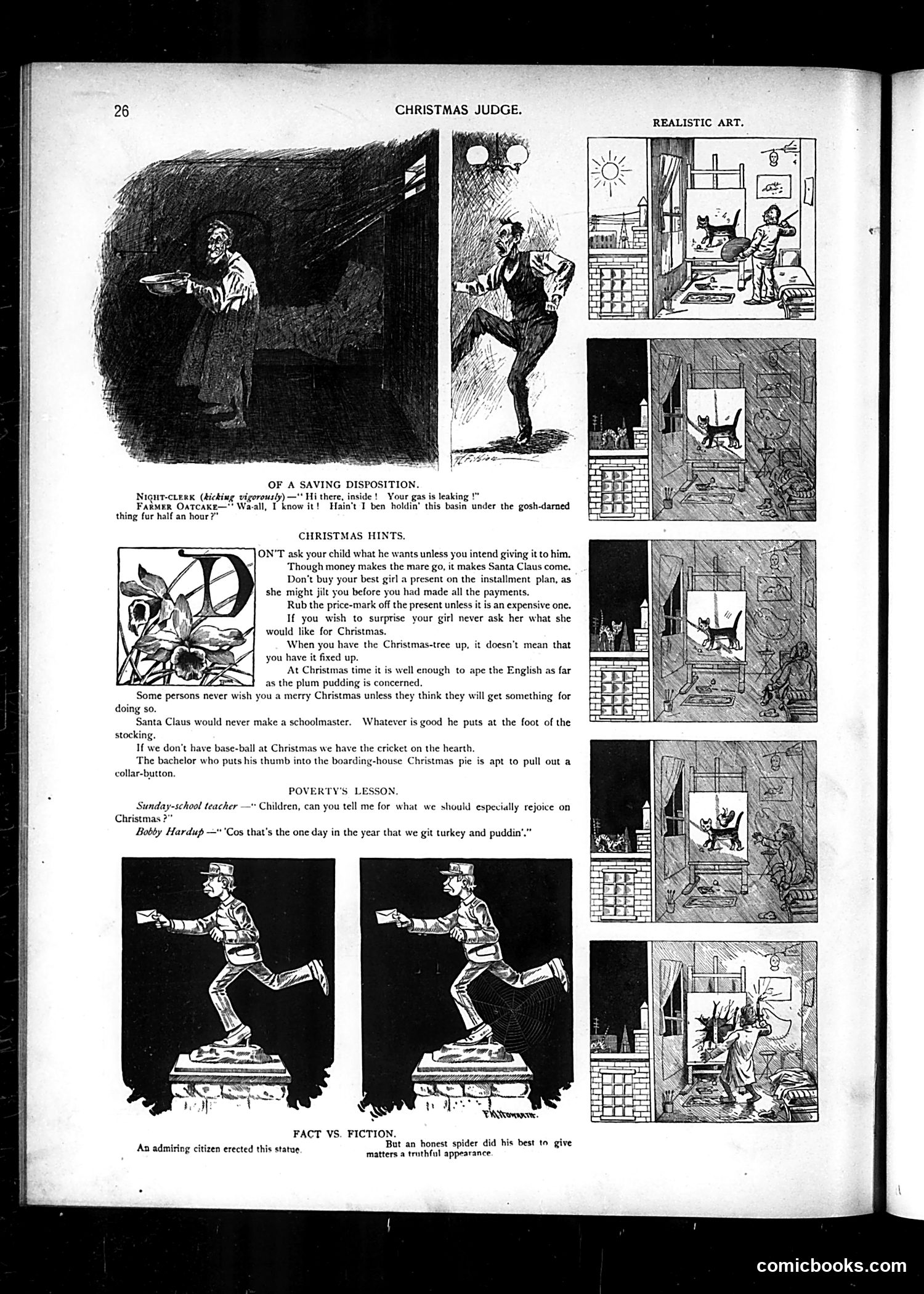
This Christmas-themed page from Judge satirizes American life and customs circa early 1900s: **"Of a Saving Disposition"**: A rural farmer holds a basin under a leaking gas pipe indoors, claiming he's been doing so for half an hour. The joke mocks penny-pinching frugality—the farmer won't call a repairman, instead wasting time with an ineffectual "fix." **"Christmas Hints"**: Practical satirical advice targeting middle-class behaviors—don't ask children what they want unless you'll buy it; avoid installment plans for gifts to sweethearts; hide price tags; and the jab at poor families: a child rejoices at Christmas primarily for turkey and pudding, not sentiment. **"Fact vs. Fiction"**: Two nearly identical images of a statue with caption noting an honest spider's web gives it truthfulness—dark humor about public monuments and appearances versus reality. **"Realistic Art"**: A series of simple domestic scenes showing everyday life. The page's overall tone ridicules working-class and rural American frugality, materialism, and hypocrisy around Christmas celebrations.
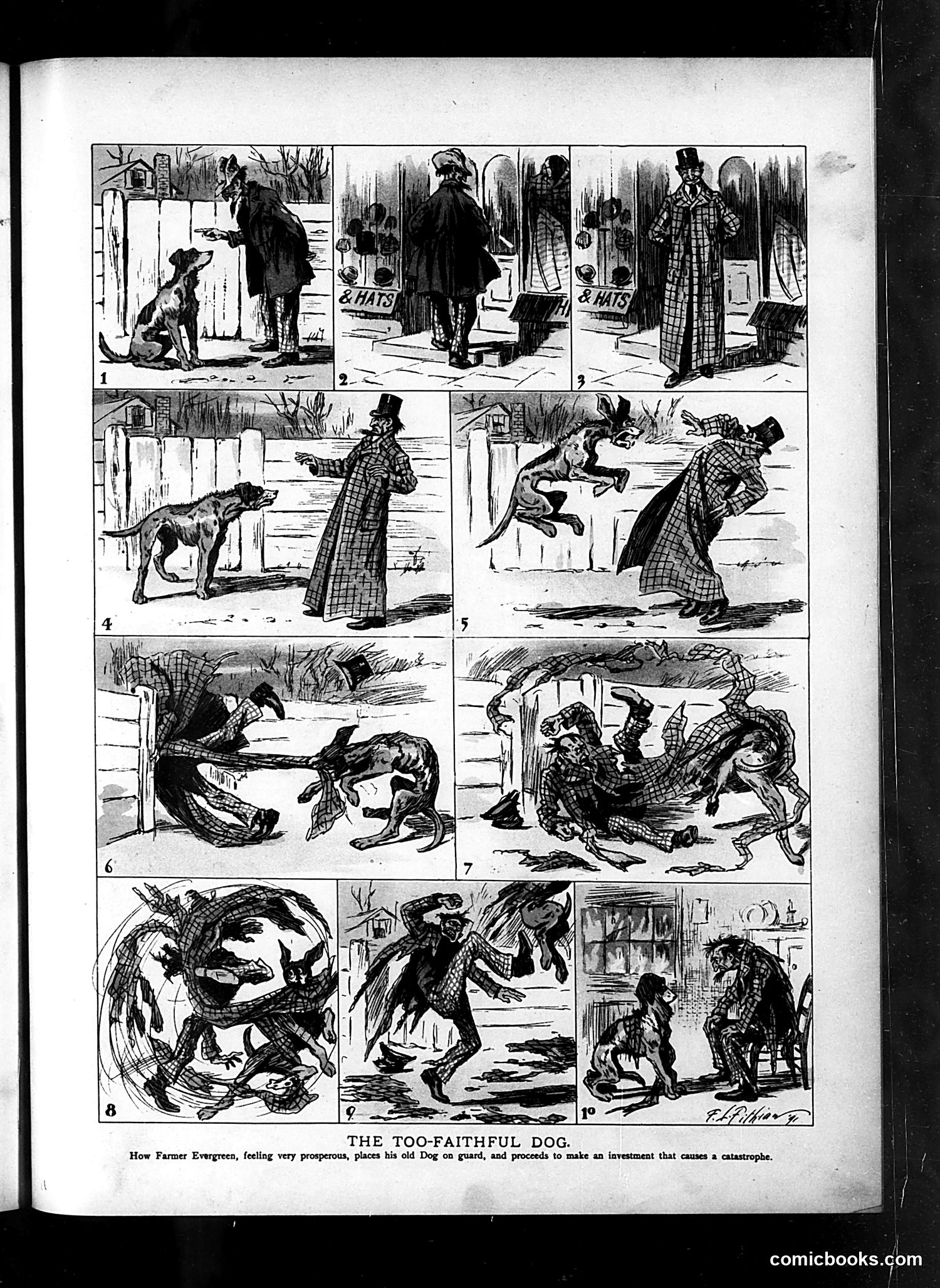
This is a satirical ten-panel narrative comic about "Farmer Evergreen," a prosperous farmer who leaves his old dog as a guard while he makes an unwise financial investment. The panels show the farmer departing (panels 1-3), the dog faithfully protecting the property (4-5), escalating chaos as the dog attacks intruders or threats (6-7), and the final catastrophe—apparently the investment fails and the farmer loses everything (8-10). The satire likely targets late-19th-century farmers who, flush with temporary prosperity, made speculative investments beyond their expertise while neglecting practical concerns. The dog's unwavering loyalty contrasts with the farmer's foolish financial decisions. The punchline suggests that blind faith in risky ventures, however prosperous one feels, leads to disaster.
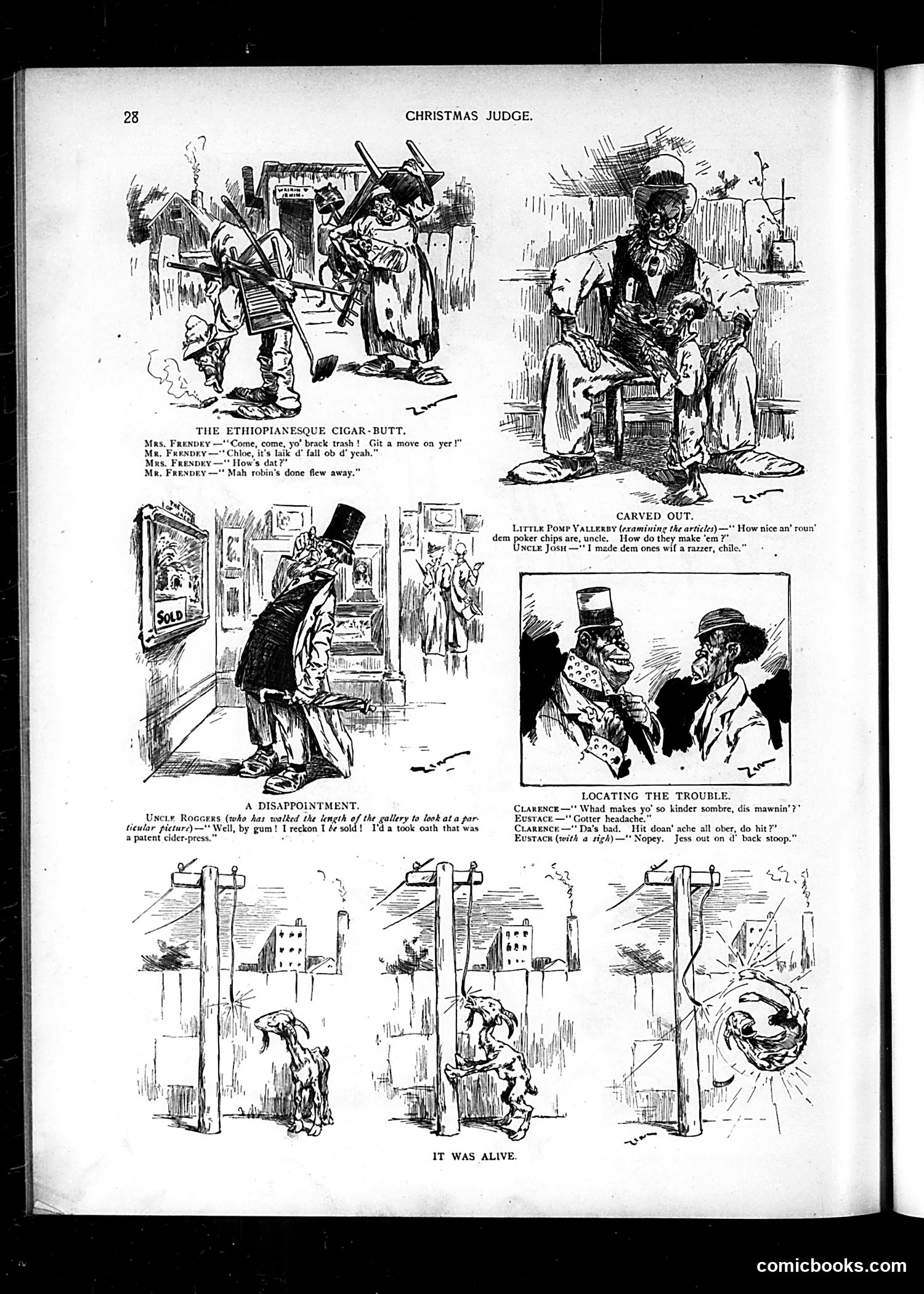
This page from *Judge* magazine contains several racist caricatures depicting African Americans with exaggerated dialect and stereotypical imagery typical of late 19th/early 20th-century American satire. **"The Ethiopianesque Cigar-Butt"** mocks Black speech patterns through dialect humor. **"A Disappointment"** shows Uncle Rogers examining what he mistakes for a patent cider-press (likely a gallows)—dark humor about lynching. **"Carved Out"** and **"Locating the Trouble"** continue the pattern of caricatured Black characters using heavy dialect. **"It Was Alive"** (the three-panel sequence) depicts a figure attempting to hang something from a noose that turns out to be alive—the punchline's exact meaning is unclear, but the gallows imagery reinforces the violent racial undertones throughout. The page demonstrates how *Judge*'s satire relied heavily on racist caricature and minstrelsy conventions as entertainment, reflecting the deeply racist attitudes embedded in American popular culture of that era.
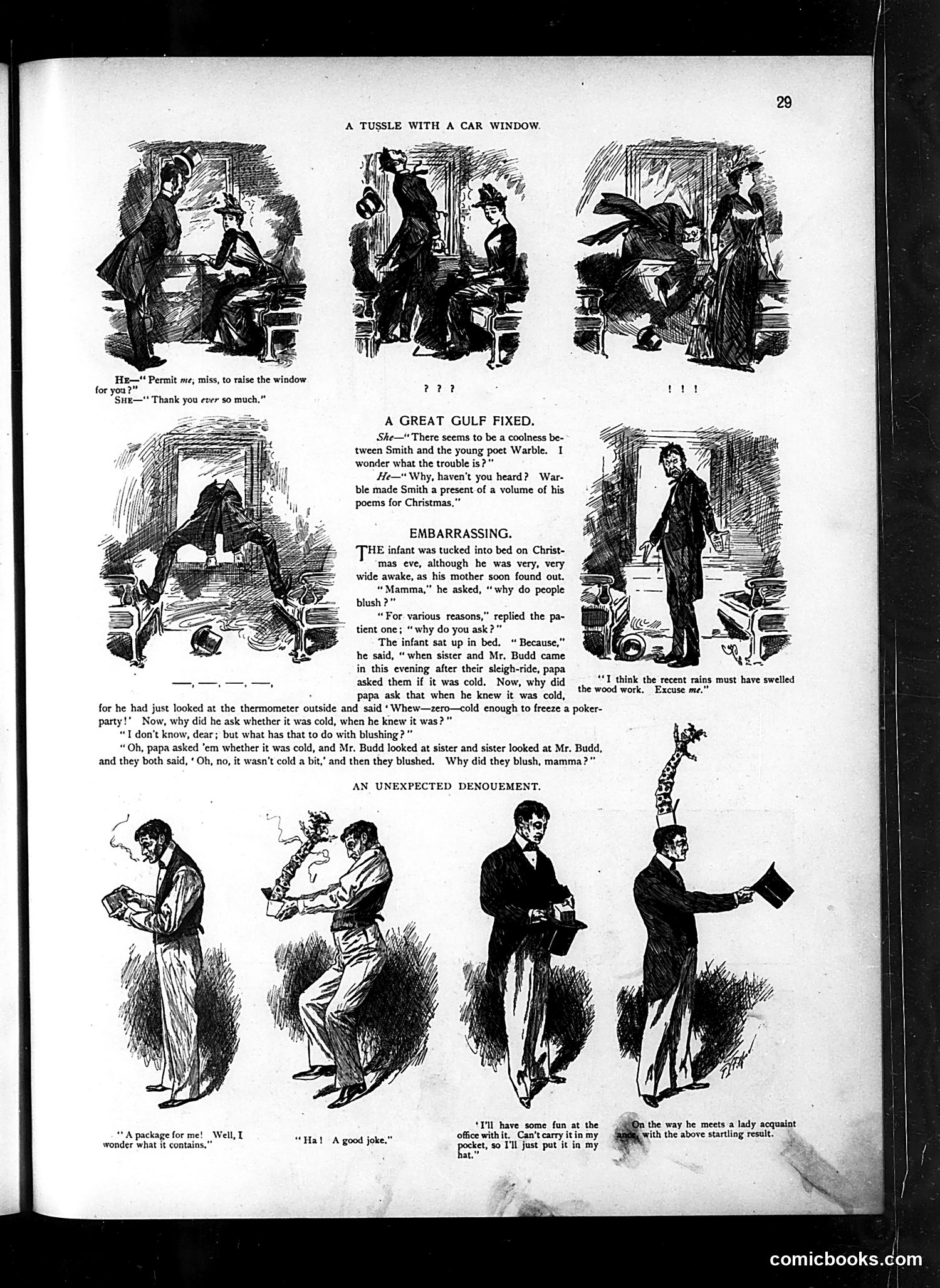
This page contains four separate humorous sketches satirizing Victorian social conventions and courtship customs: **"A Tussle with a Car Window"**: A gentleman offers to raise a car window for a lady, but a physical struggle ensues—satirizing the exaggerated chivalry and awkwardness of Victorian manners. **"A Great Gulf Fixed"**: A poet named Warble gifts his poetry collection to a man named Smith as a Christmas present, creating social distance between them—mocking both bad gift-giving and the pretension of amateur poets. **"Embarrassing"**: A child innocently exposes adult hypocrisy: his father asked guests if it was cold despite knowing it was freezing (from checking the thermometer), apparently to excuse why the guests (a young couple) were blushing—implying romantic closeness. The child's logical questioning of adult behavior reveals their implicit acknowledgment of courtship behavior. **"An Unexpected Denouement"**: A man receives a package and places it in his hat intending to play a prank, but encounters a lady—the package apparently contains something that startles her upon revelation. All satirize the gap between Victorian propriety and actual human behavior.
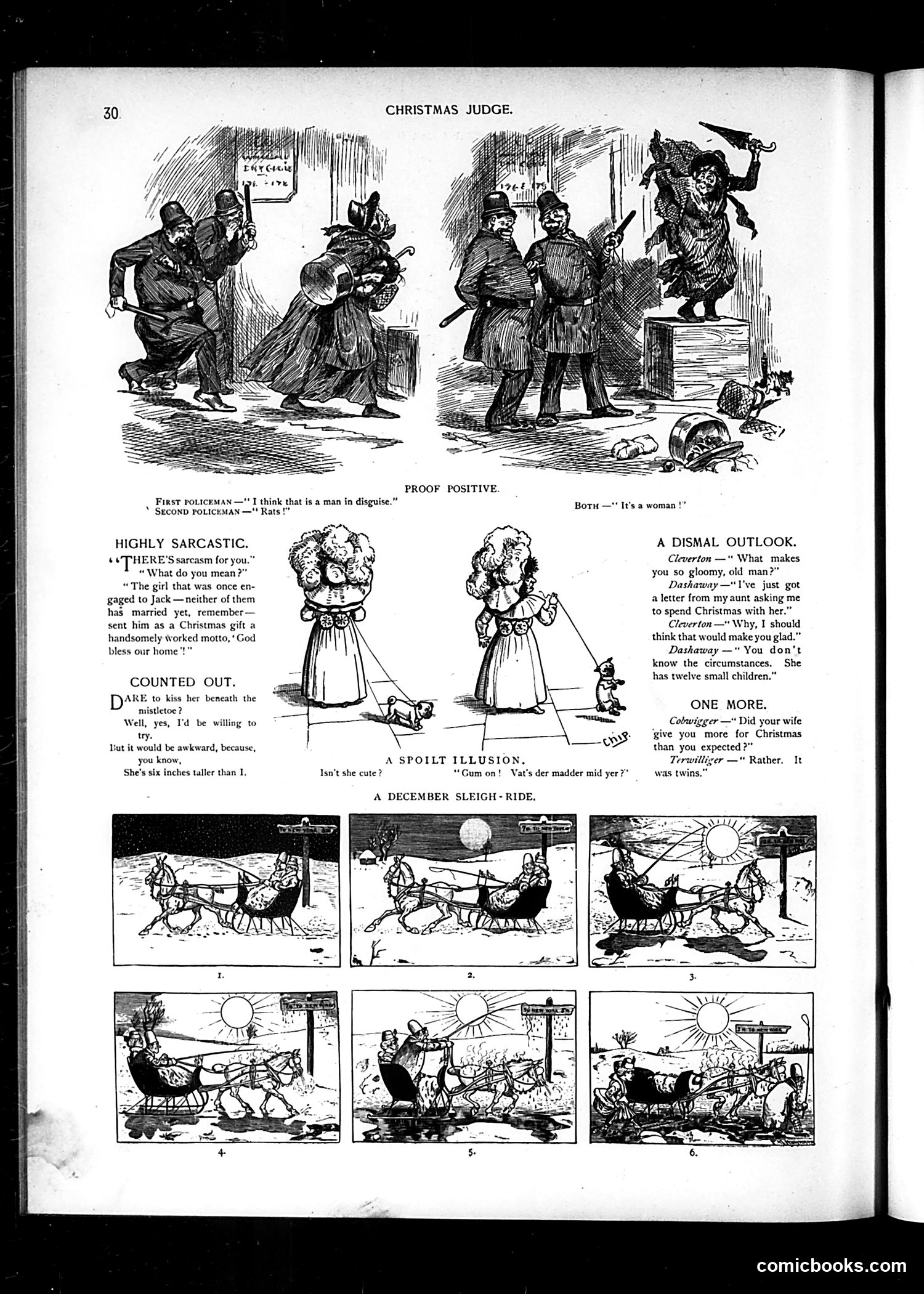
This page from *Judge* magazine contains six separate short comic sketches with Victorian-era humor typical of the late 1800s: **"Proof Positive"**: Police officers debate whether a disguised figure is male or female—the joke relies on physical appearance ambiguity. **"Highly Sarcastic"**: A woman gifts her former fiancé a "God bless our home" motto despite never marrying him—ironic given their broken engagement. **"Counted Out"**: A man hesitates to kiss a woman under mistletoe because she's taller than him—poking fun at masculine insecurity. **"A Spoilt Illusion"**: A German-accented character (suggested by dialect spelling) seems to experience disillusionment. **"A Dismal Outlook"**: An invitation to spend Christmas with an aunt sounds pleasant until revealed she has twelve children—satirizing unwanted family obligations. **"One More" / "A December Sleigh-Ride"**: The bottom sequence shows a sleigh ride narrative, with the final panel suggesting unexpected twins as a Christmas "gift." The humor throughout is domestic, genteel, and focuses on marriage, courtship, and family—standard Victorian satirical fare.
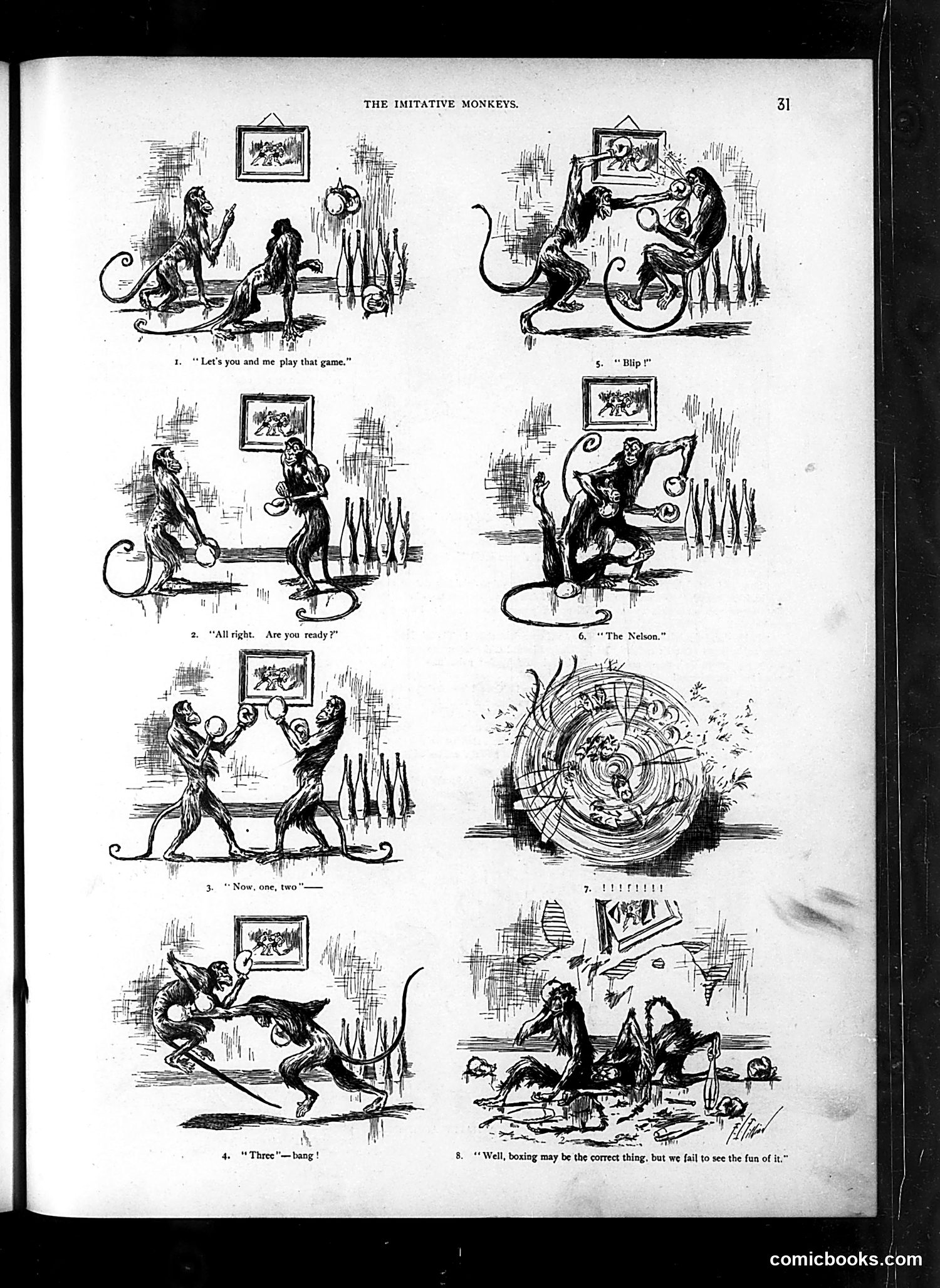
This is a sequential comic strip showing two monkeys mimicking human behavior and games. The monkeys progressively imitate humans playing parlor games—beginning with "Let's you and me play that game" and proceeding through various activities like card games ("All right. Are you ready?"), counting games, and acrobatic stunts, culminating in chaos and destruction. The final panel's caption—"Well, losing may be the correct thing, but we fail to see the fun of it"—reveals the satirical point: the monkeys can imitate human *forms* of behavior but miss the underlying *purpose* or enjoyment. The strip appears to mock either human pretension (showing how arbitrary social games are) or to satirize those who blindly imitate fashionable behaviors without understanding their meaning—a common theme in Gilded Age satire about social climbing and cultural mimicry.
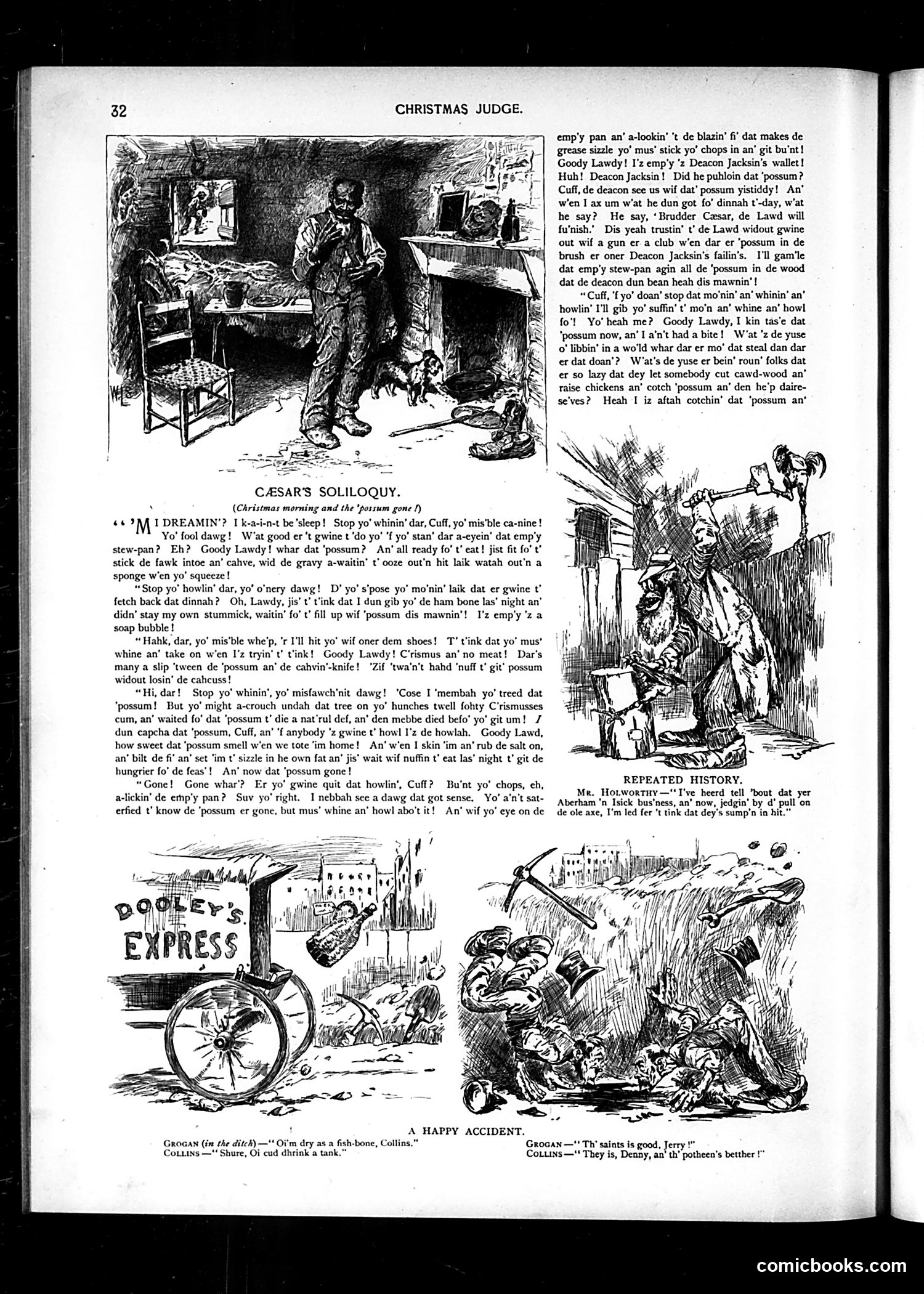
This page contains racist dialect humor typical of late 19th-century American publications. **"Caesar's Soliloquy"** depicts an enslaved or formerly enslaved Black man lamenting a missing possum—his anticipated Christmas dinner. The monologue, written entirely in exaggerated "plantation dialect," shows Caesar angrily berating his dog Cuff while fantasizing about cooking the possum. The joke culminates when he suspects Deacon Jackson (another Black character) stole it, contrasting Jackson's religious faith with Caesar's pragmatic hunting methods. **"A Happy Accident"** shows two Irish laborers (Grogan and Collins, identified by dialect and names) fallen in a ditch, making crude jokes about drinking and the Irish stereotype of alcohol consumption. **"Repeated History"** continues similar Irish-immigrant stereotyping, with characters discussing "Aberham 'n Isick" (unclear historical reference) while implying drunkenness via "potheen" (illicit whiskey). The page exemplifies Judge's reliance on ethnic and racial caricature as humor—content offensive by modern standards but commonplace in 19th-century American satire.
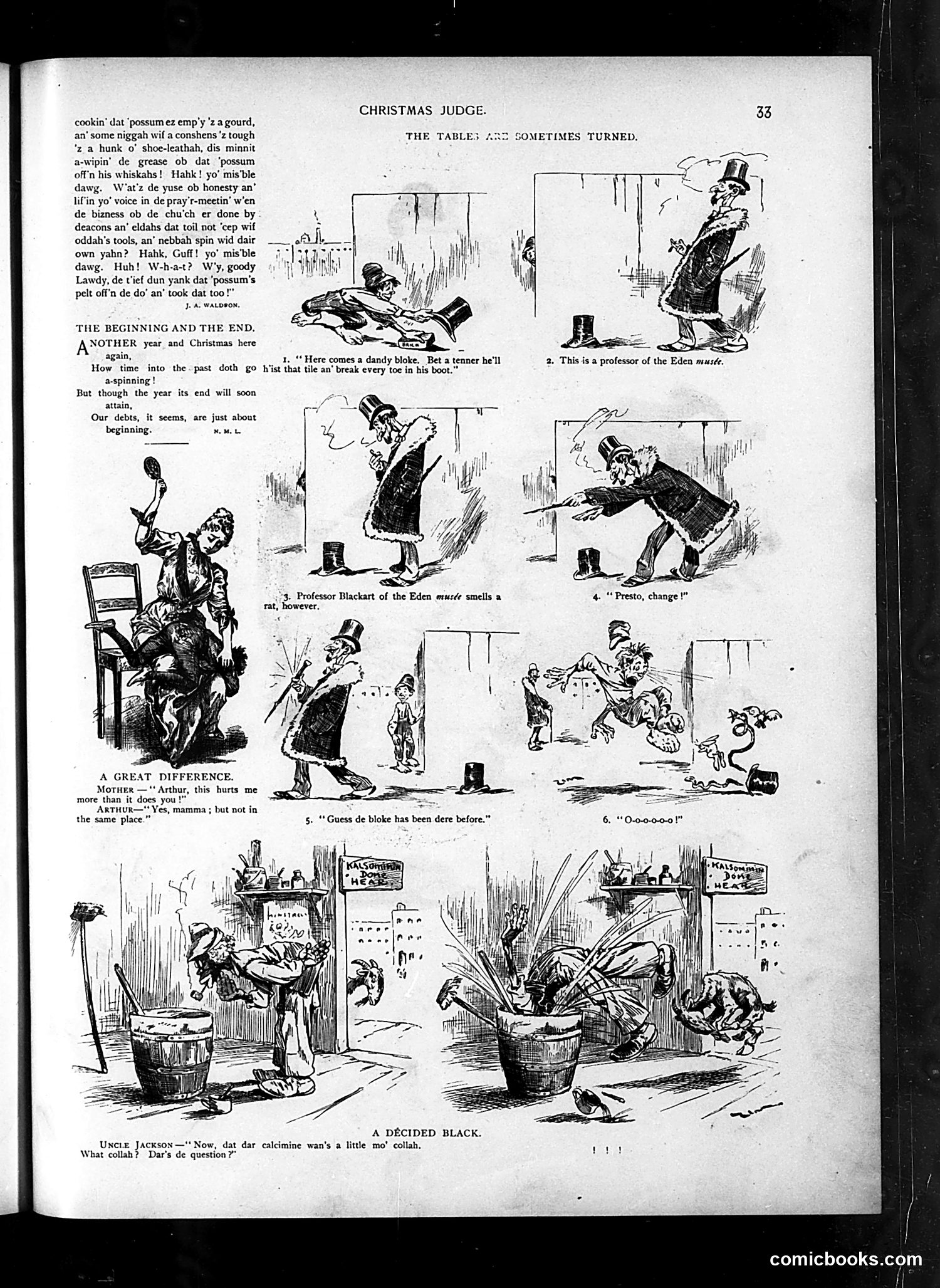
This Christmas-themed satirical page from Judge contains multiple cartoons with offensive racial stereotypes typical of late 19th/early 20th-century American humor. **"The Table; = Sometimes Turned"** series depicts a dandy in top hat repeatedly encountering misfortune—breaking his boot, smelling bad, getting robbed—illustrating the Victorian moral lesson that vanity and pretension lead to comeuppance. **"A Great Difference"** contrasts a mother's punishment of her son ("Arthur, this hurts me more than it does you!") with his cynical response that it hurts differently, satirizing sentimental parental discipline. **"A Decided Black"** shows Uncle Jackson asking about paint color in dialect-heavy speech, the humor deriving from the character's apparent confusion—a crude racial caricature common to the era. The opening text uses exaggerated dialect to mock rural Southern African American speech patterns while depicting petty theft and moral hypocrisy, reflecting the magazine's reliance on racist humor as entertainment.
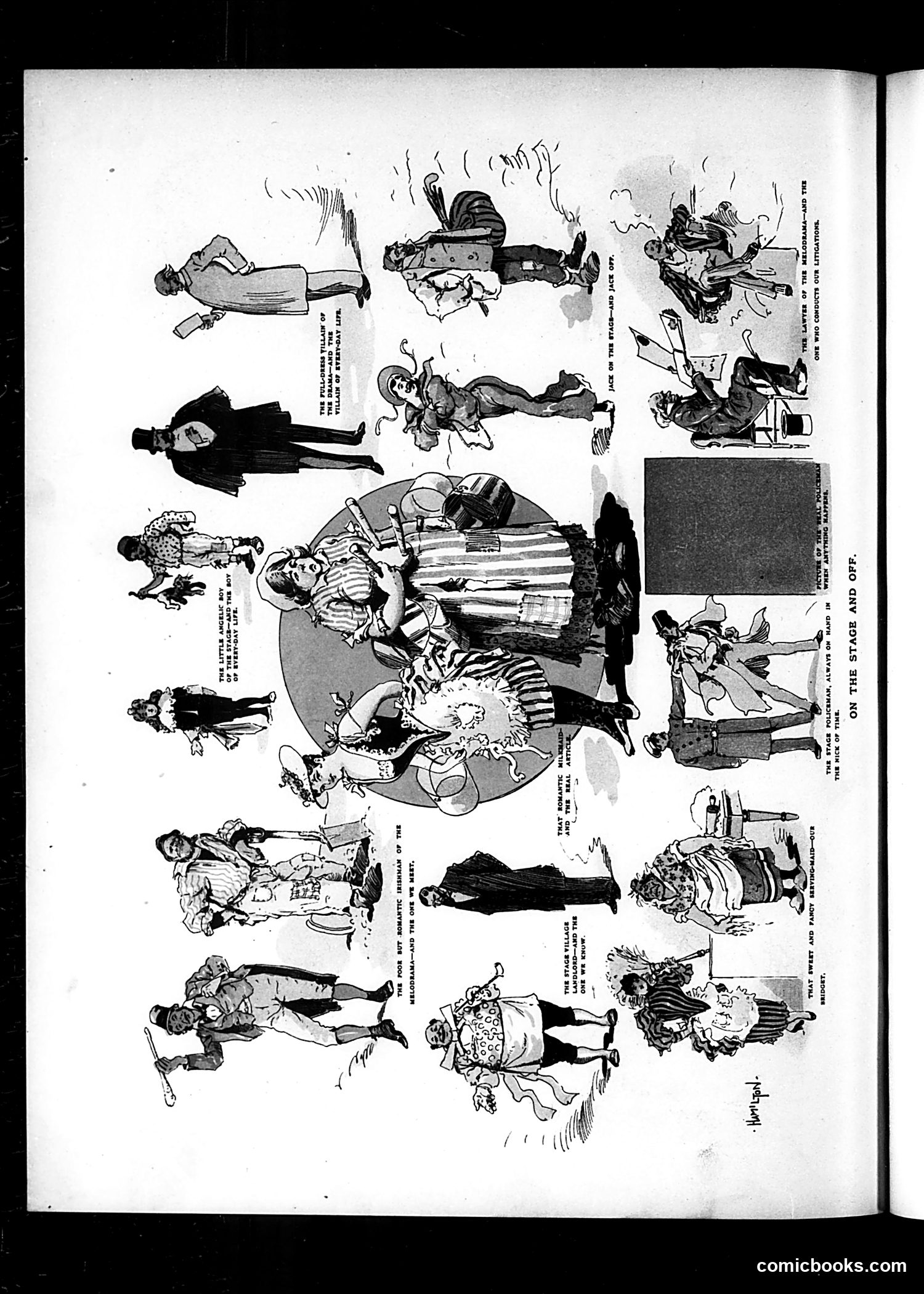
I can see this is a Judge magazine page with multiple satirical character illustrations arranged around a central circular portrait. However, the OCR text appears corrupted and unreadable, making it impossible to identify the specific figures, political references, or satirical points with confidence. The artwork shows various caricatured figures in period dress (appearing to be late 19th or early 20th century), with exaggerated features typical of political satire. The central portrait and surrounding characters suggest commentary on contemporary political or social figures, but without legible text or clear identifying labels, I cannot reliably determine who these figures represent or what specific events or policies are being mocked. To accurately explain this cartoon's meaning, legible caption text would be essential.
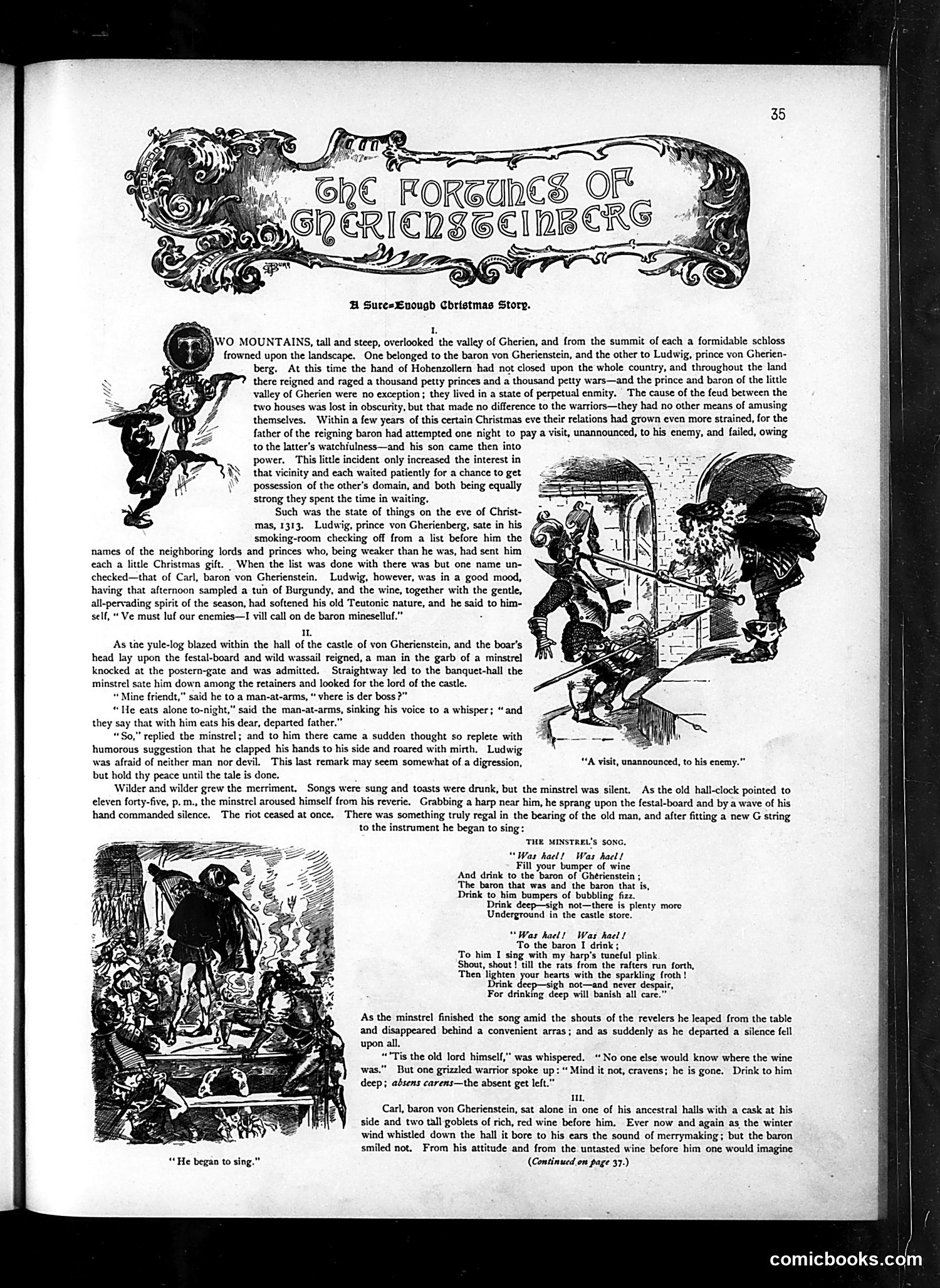
This is a serialized satirical Christmas story rather than a political cartoon. It's a humorous tale set in fictional German territories, poking fun at German feudalism and regional rivalries through exaggerated Teutonic stereotypes. The story depicts two petty German princes—Ludwig von Gherienberg and Carl von Gherienstein—locked in meaningless perpetual enmity over a forgotten cause. The satire targets the absurdity of constant warfare among weak nobility and their comically thick German accents ("vhere is der boss?"). The twist comes when Ludwig, mellowed by wine and Christmas spirit, visits his enemy. A mysterious minstrel arrives and finds humor in the situation, suggesting some ironic resolution is coming. The illustrations show medieval castle scenes and the minstrel performing. This appears to be gentle, festive satire aimed at American readers amused by exaggerated "German" characters and their petty conflicts.
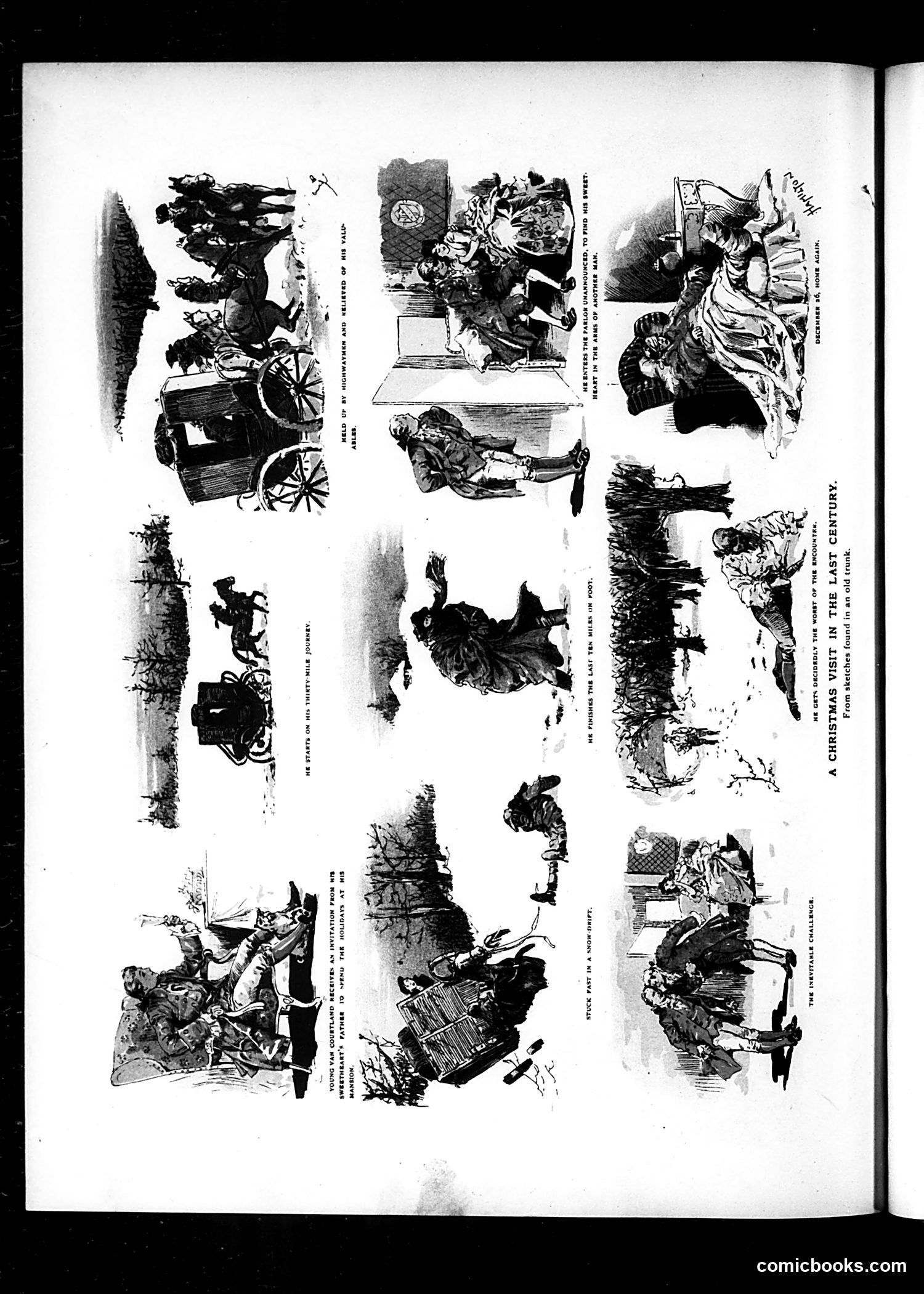
I cannot reliably read the OCR text on this page—it appears heavily corrupted or reversed. While the image shows multiple satirical illustrations in the style of late 19th-century Judge magazine, with various scenes depicting social situations and character interactions, I cannot confidently identify the specific figures, political references, or satirical points without legible captions. The illustrations appear to use caricature and exaggeration typical of period satire, but without clear text connecting them to specific contemporary events or figures, I cannot accurately explain what social commentary or jokes they contain to a modern reader. To properly analyze this page would require either clearer source material or additional historical context about Judge's publication date and content.
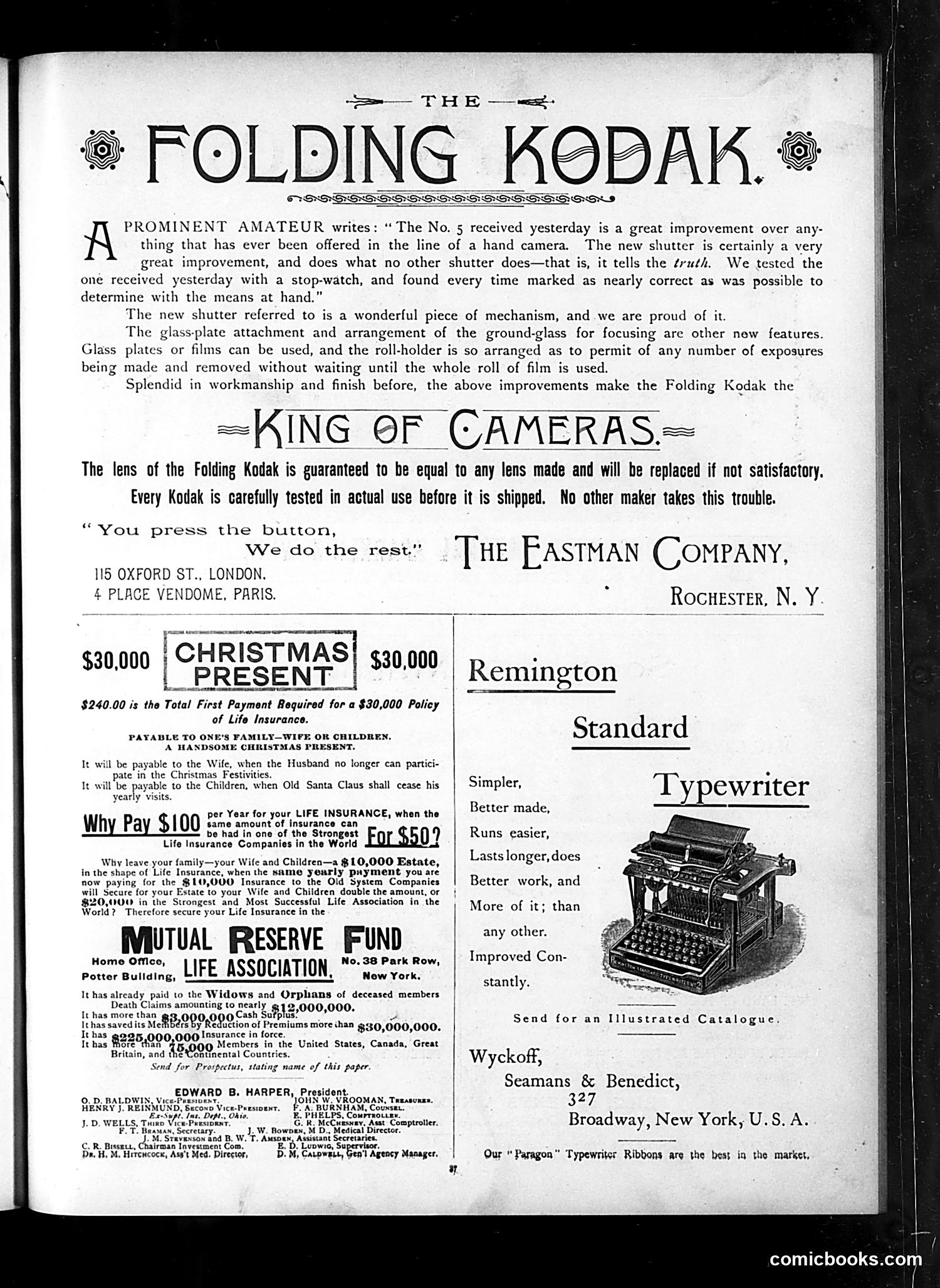
This is primarily an **advertising page** rather than a satirical cartoon page. It contains several product advertisements from the early 1900s: The main featured ad promotes the **Folding Kodak camera**, emphasizing its accuracy and reliability—notably that its shutter "tells the truth." This reflects Kodak's famous marketing slogan "You press the button, We do the rest." Below that is a **life insurance advertisement** for the Mutual Reserve Fund Life Association, using the holiday season as a sales hook. It frames life insurance as a "Christmas Present" to one's family, comparing its cost favorably to competitors. The right side advertises the **Remington Standard Typewriter**, listing its superiority over competitors. **No political satire or social commentary is evident** on this page. Rather, it demonstrates how Judge magazine—while known for satirical content—also relied heavily on paid advertising to fund publication. The ads reveal period concerns: photography technology, mortality/family protection, and business equipment.
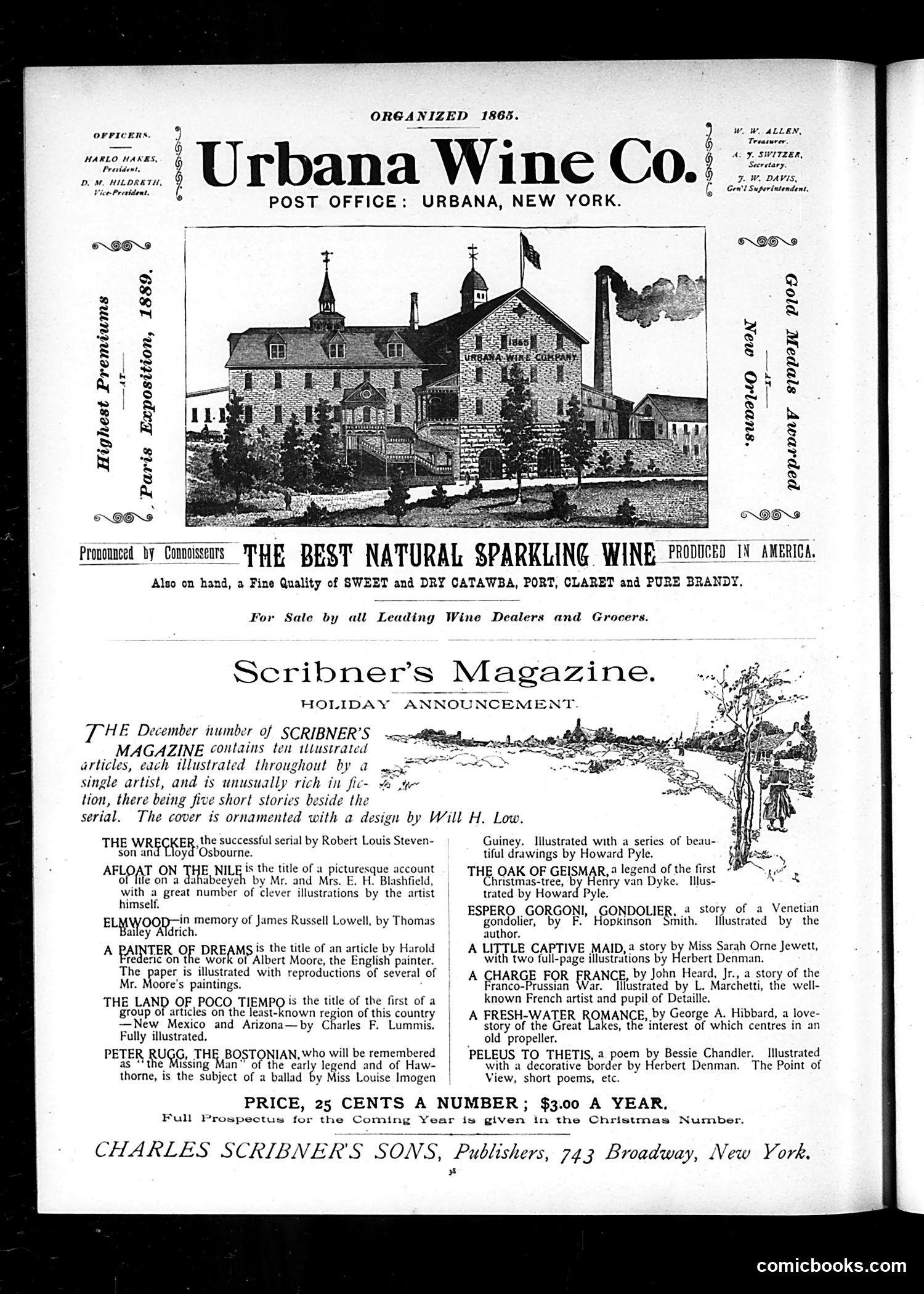
This is not a political cartoon or satirical content page. It's a hybrid advertising/announcement page featuring: **Top half:** An advertisement for the **Urbana Wine Company** (organized 1865, based in Urbana, New York), promoting their "natural sparkling wine" and other beverages. The engraving shows their brick facility with crosses and an American flag. They claim to have won "Highest Premiums" at the Paris Exposition of 1889. **Bottom half:** A holiday announcement for **Scribner's Magazine**, listing December issue contents—illustrated articles, short stories, and serials by notable authors like Robert Louis Stevenson and Thomas Bailey Aldrich, with illustrations by Howard Pyle and others. This appears to be a page from a magazine or newspaper designed to attract both advertisers and readers through upcoming publication previews. There is no satire or political commentary present.
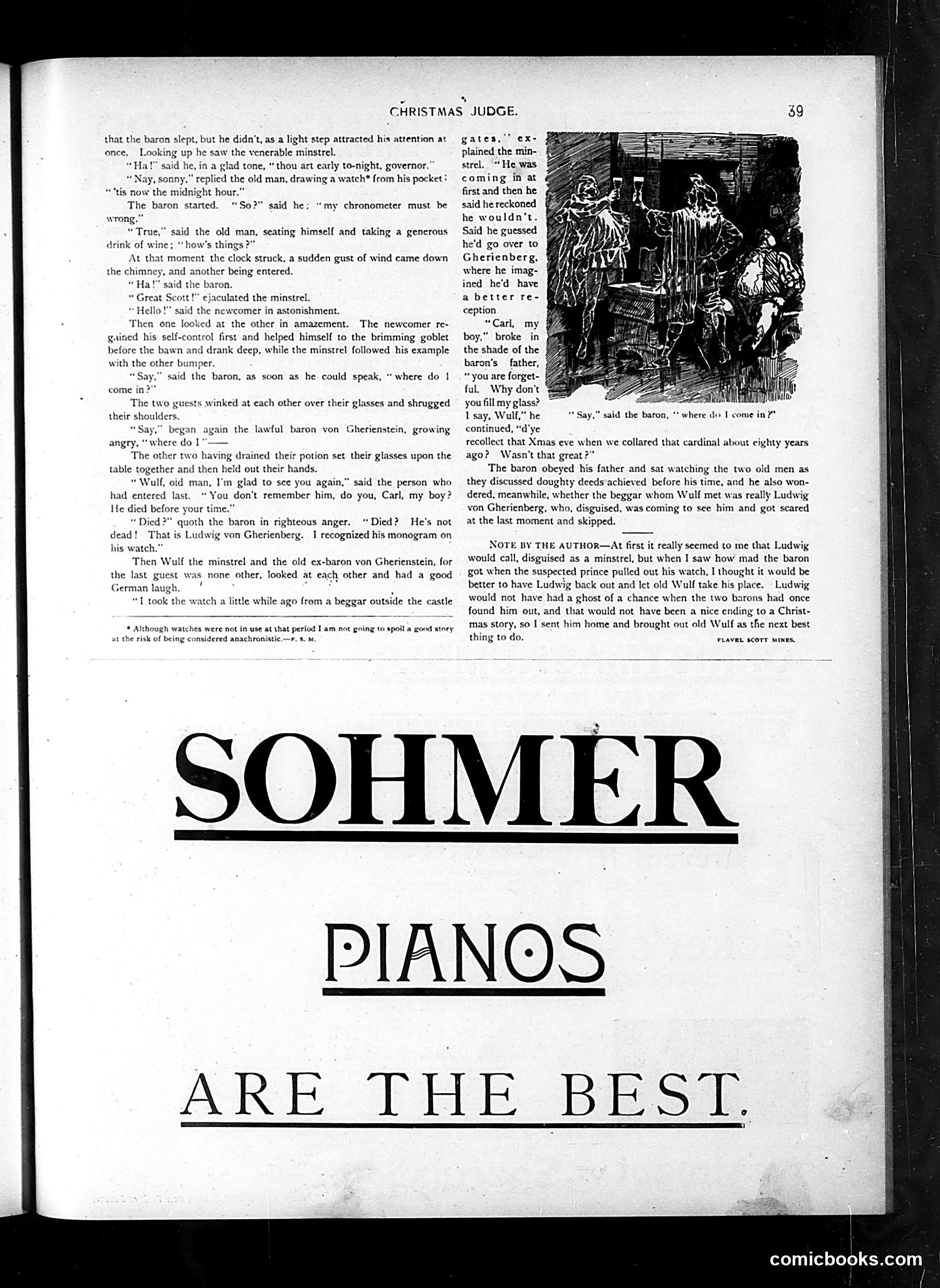
This page contains a Christmas ghost story rather than political satire. The narrative concerns a German baron (von Gherienstein) visited by supernatural guests on Christmas Eve—a minstrel and his own deceased father—who reminisce about past exploits while the living baron grows increasingly exasperated, asking "where do I come in?" The humor derives from the generational clash: the ghost and elderly minstrel monopolize conversation with old war stories, leaving the current baron feeling excluded and irrelevant in his own home. The author's note at bottom reveals meta-textual trickery—Ludwig, another character, was originally supposed to appear disguised but was replaced because the author thought old Wulf would create a better story. The page concludes with an advertisement: "SOHMER PIANOS ARE THE BEST." This is primarily entertainment content, not political commentary.
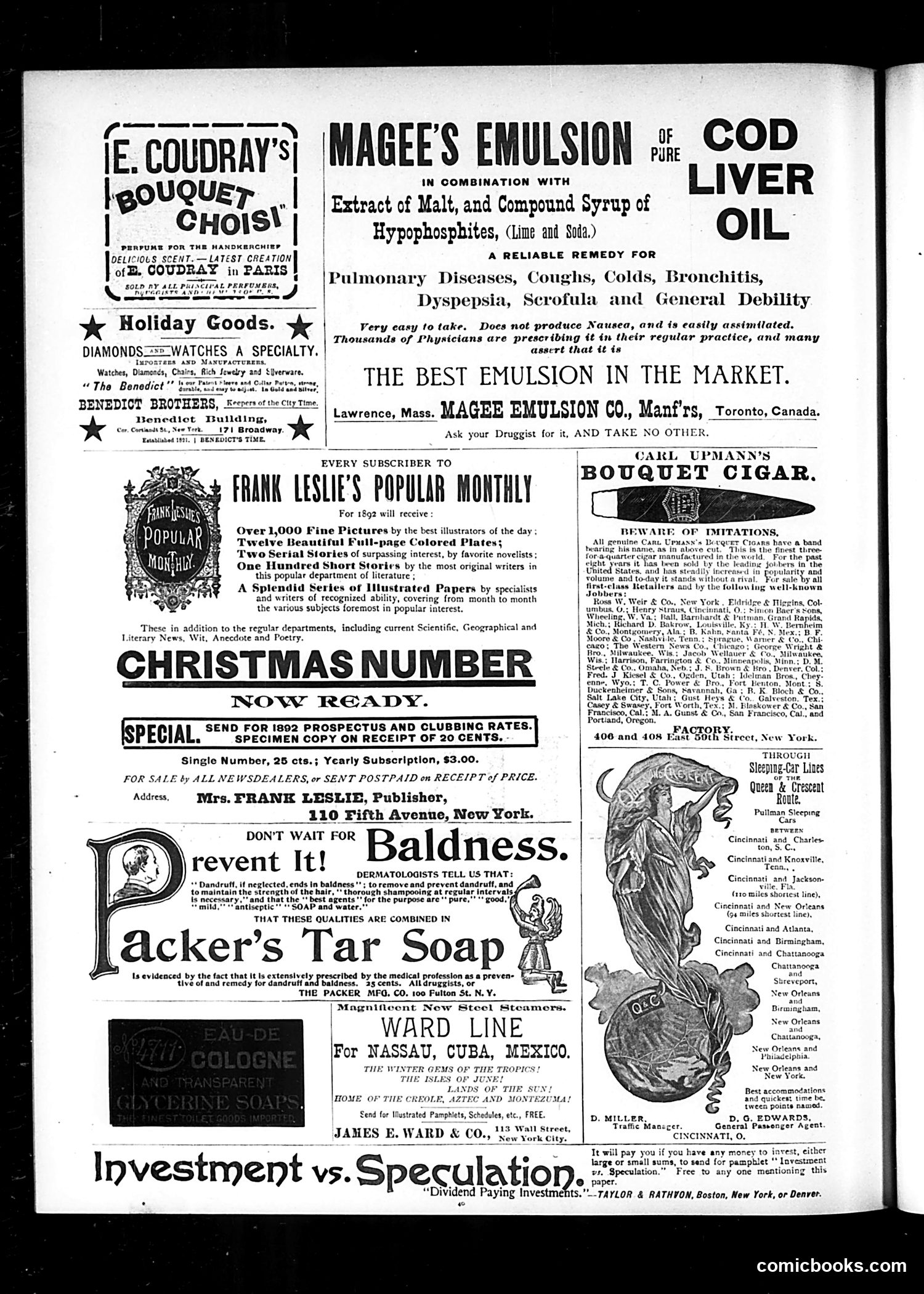
This page is primarily **advertisements** rather than satirical editorial content. It showcases typical 1890s patent medicine and consumer goods marketing. Key advertisements include: - **Magee's Emulsion** (cod liver oil remedy) claiming to treat respiratory and digestive ailments - **Packer's Tar Soap** advertising a baldness cure, with dubious dermatological claims about preventing hair loss - **Frank Leslie's Popular Monthly** promoting a magazine subscription with illustrations and fiction - **Carl Upmann's Cigar** warning against counterfeits - **Railway services** offering sleeping-car lines to various Southern destinations The "Investment vs. Speculation" heading at bottom appears unrelated to visible content. The satire typical of *Judge* magazine is **absent here**—this is a straight commercial page, which was common for late-19th-century publications. The humor lies mainly in the **extravagant medical claims** that modern readers recognize as fraudulent: tar soap curing baldness, emulsions treating serious diseases, etc.
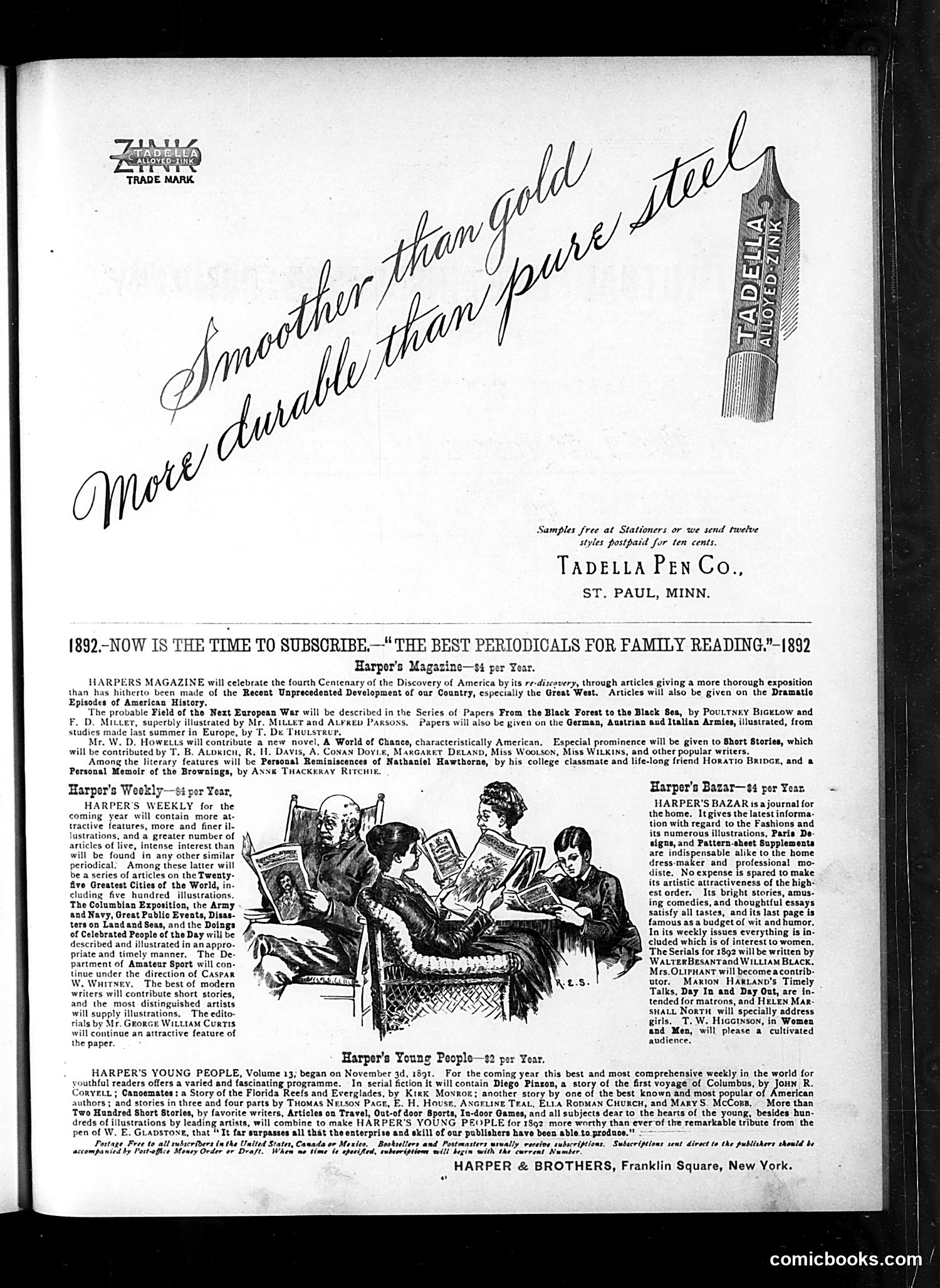
This is primarily an **advertising page** for Harper & Brothers' periodical subscriptions, not a political cartoon. The central illustration shows a family reading together—a common domestic scene used to promote "family reading" publications. The page advertises four Harper magazines for 1892, emphasizing their coverage of: - **The Columbian Exposition** (the Chicago World's Fair, celebrating the 400th anniversary of Columbus) - **The "Great West"** and American development - **European military affairs** (anticipating future conflicts) - Fashion, fiction, and home interest The small illustration depicts middle-class Americans engaged in wholesome reading—the ideal audience these publications targeted. The **Tadella Pen advertisement** at top reinforces the literacy/writing theme. There is **no political satire** on this page. It's a straightforward subscription solicitation aimed at affluent families interested in quality literature, current events, and domestic magazines during the Gilded Age.
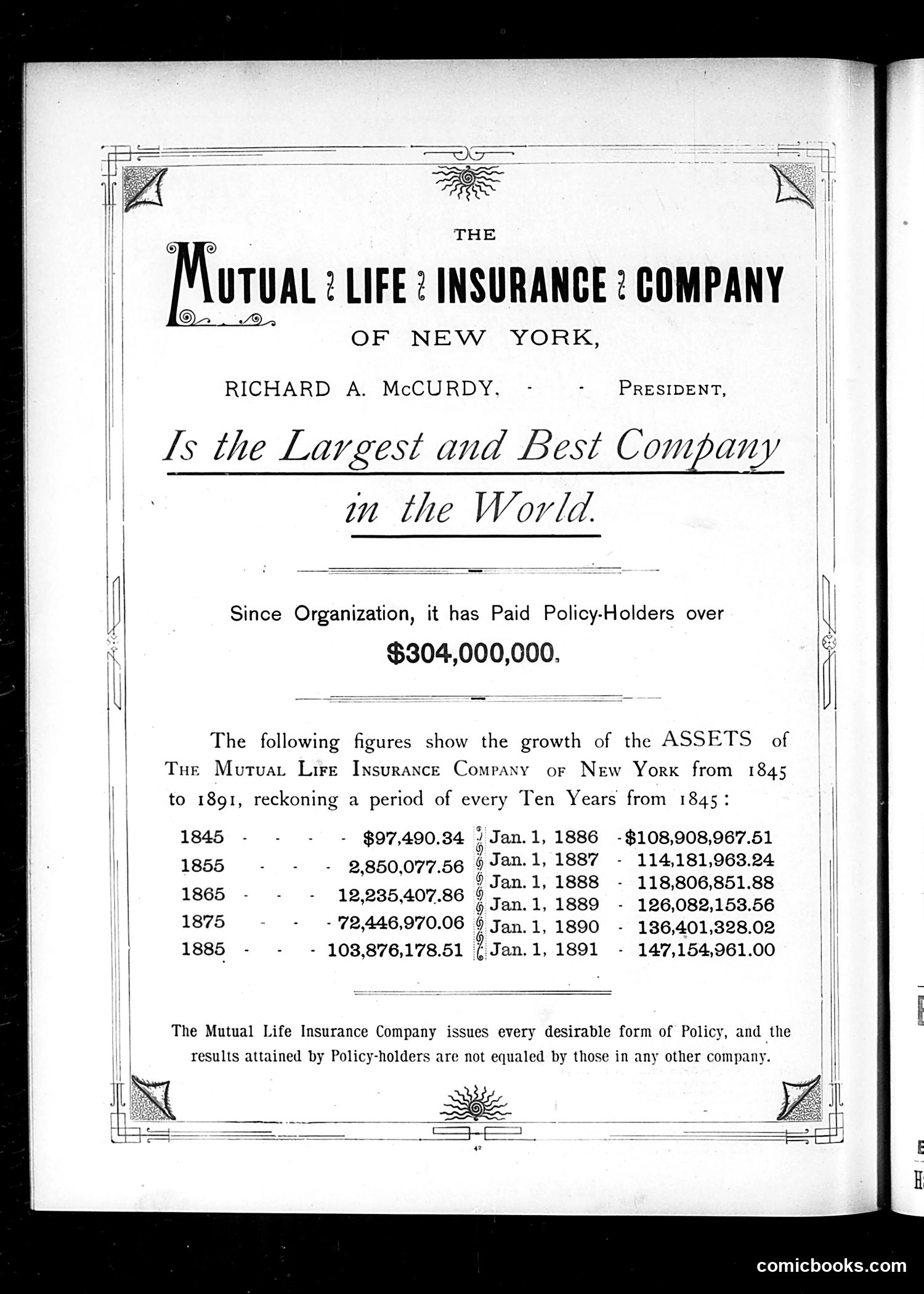
This page is a **straightforward corporate advertisement** for The Mutual Life Insurance Company of New York, not a satirical cartoon. It appears in *Judge* magazine but contains no humor or political commentary. The ad promotes the company's president Richard A. McCurdy and boasts of the firm's dominance: it claims to be "the Largest and Best Company in the World" and highlights $304 million paid to policyholders since founding. A table documents asset growth from 1845–1891, showing dramatic expansion from roughly $97,000 to $147 million. The final claim—that their policyholders' results "are not equaled by those in any other company"—is pure marketing assertion. Without additional context about *Judge*'s editorial stance toward insurance companies or McCurdy specifically, we cannot determine if *Judge*'s publication of this ad was endorsement, irony, or simply paid placement.
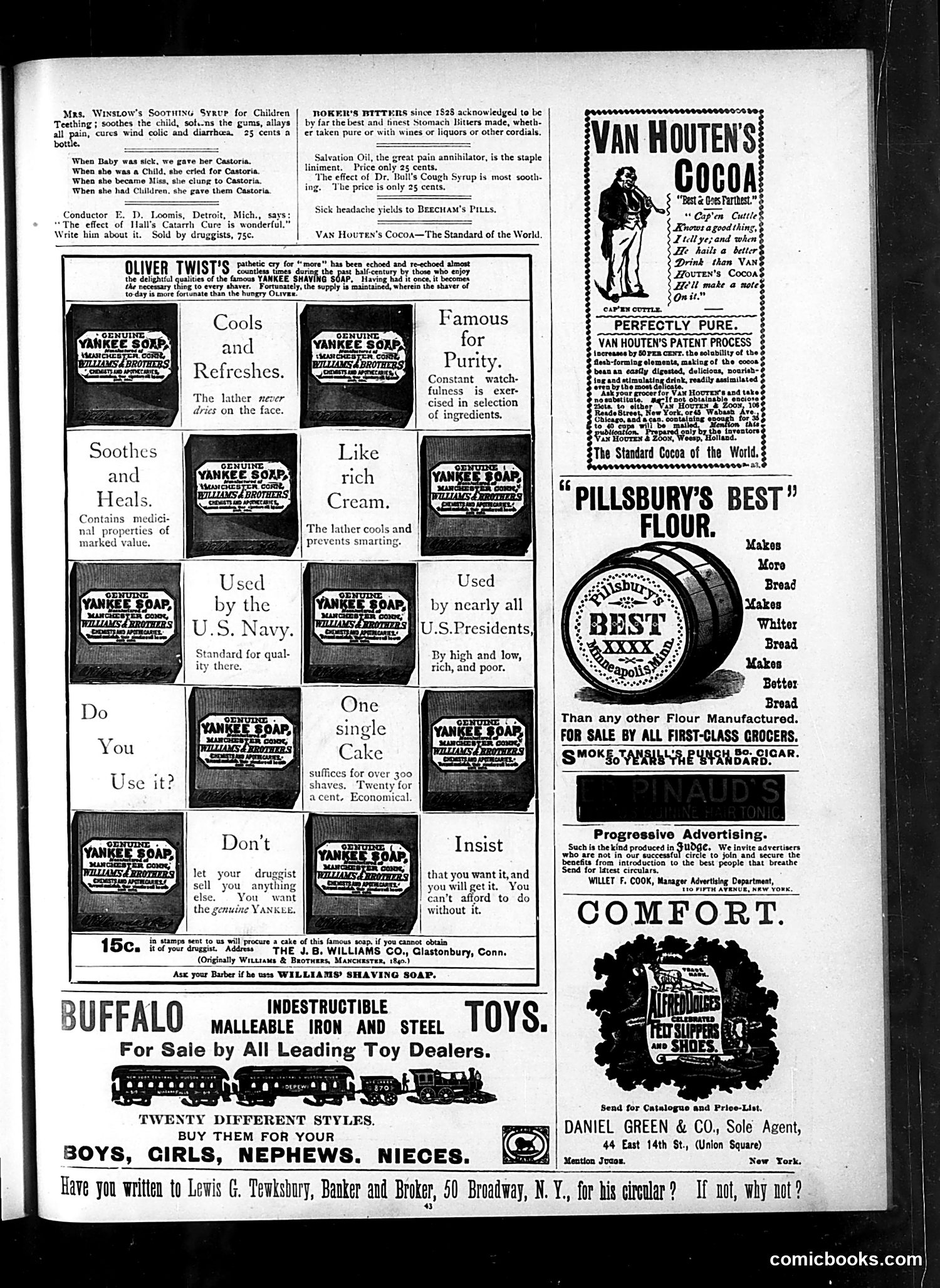
This is **not a cartoon page** but rather a commercial advertising section from *Judge* magazine. The page consists entirely of product advertisements from the late 19th century, with no political satire or editorial content. The ads promote patent medicines and consumer goods typical of the era: Castoria (children's syrup), Yankee Soap, various tonics and pills, Van Houten's Cocoa, and Pillsbury flour. These reflect the period's unregulated medicine industry—products made exaggerated health claims without FDA oversight. One small editorial note appears: *Judge* notes it accepts advertisements from successful products and invites others to join "our successful circle," essentially promoting its own advertising rates. The page is primarily commercial filler, demonstrating how 19th-century magazines subsidized content through extensive paid advertising, often featuring dubious medicinal products that would later be regulated or banned.
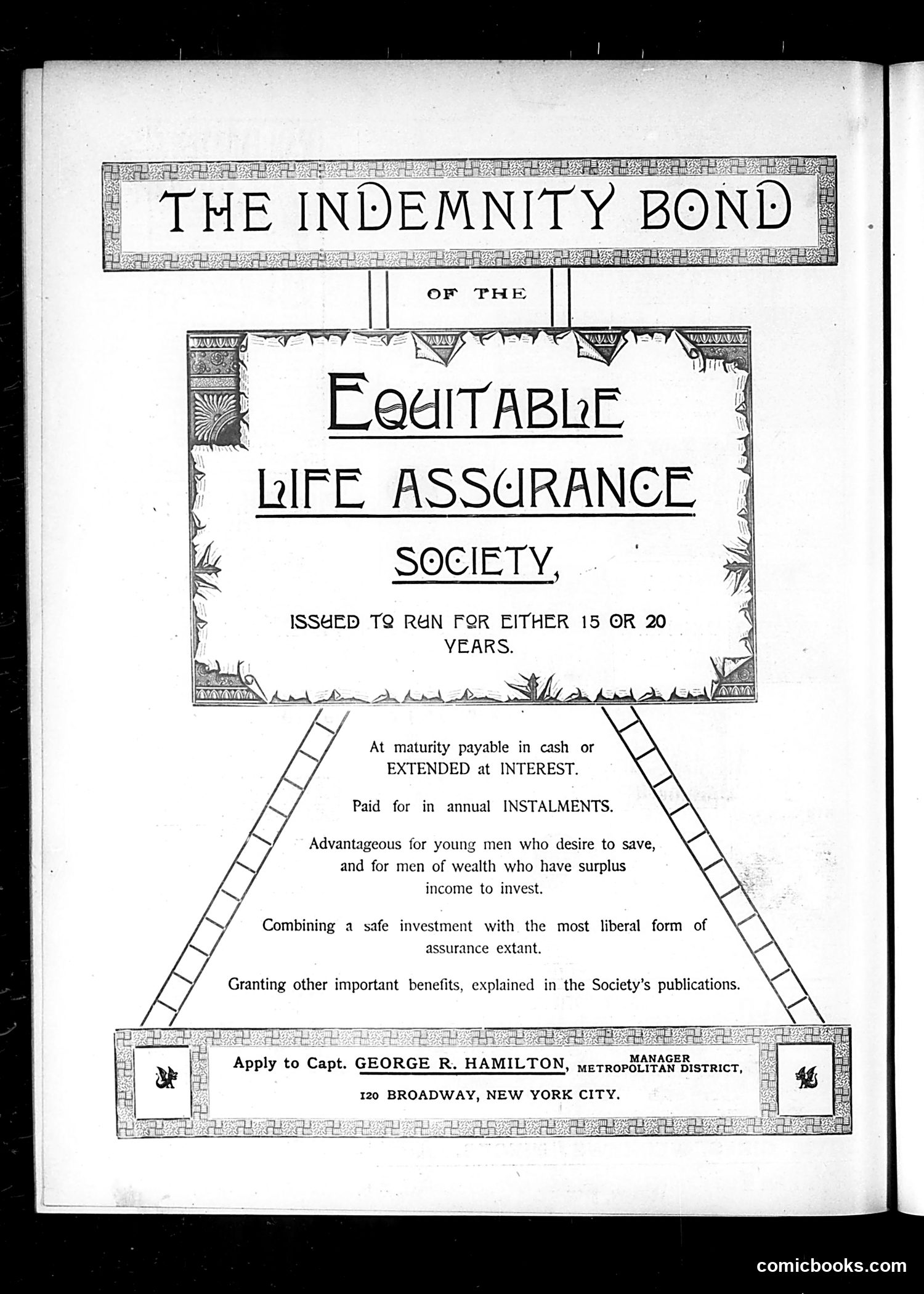
This is a **full-page advertisement**, not a satirical cartoon. It promotes an investment product from the Equitable Life Assurance Society—a life insurance bond issued for 15 or 20-year terms. The ad targets two audiences: young men seeking to save money and wealthy men with surplus income to invest. It emphasizes that payments are made in annual installments and promises maturity payable in cash with extended interest. The language ("safe investment," "liberal form of assurance") reflects late 19th/early 20th-century financial marketing. Interested parties are directed to contact **Capt. George R. Hamilton**, the Metropolitan District Manager, at 120 Broadway, New York City. This appears in *Judge* magazine likely because the publication accepted paid advertisements alongside satirical content to fund operations.
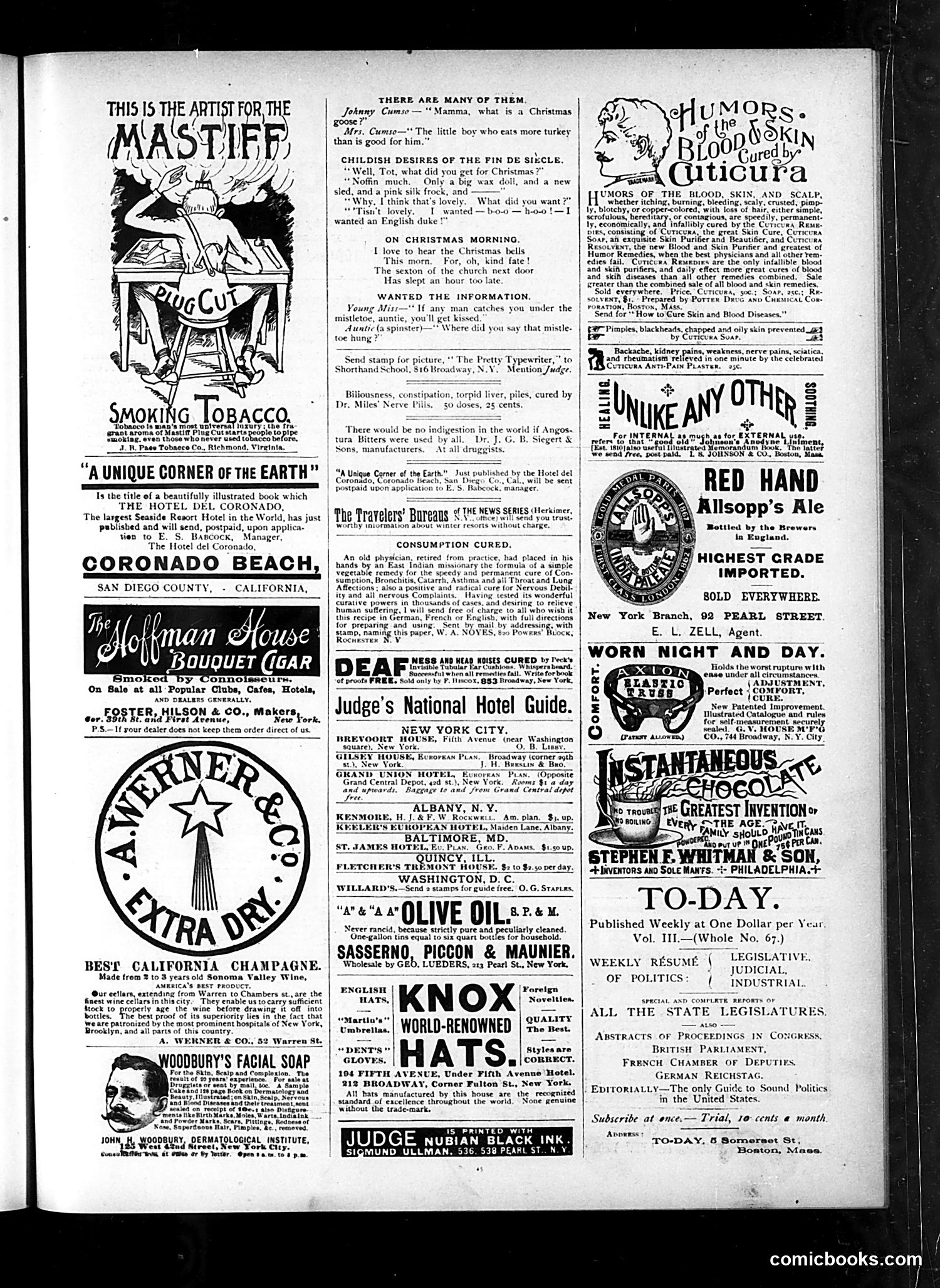
This page is primarily **advertising**, with several brief satirical jokes typical of Judge magazine's style. The main cartoon ("This is the Artist for the Maastiff") shows a caricatured figure at a drafting table, appearing to mock either an artist or tobacco advertiser—the reference is unclear without additional context. The satirical text pieces mock: 1. **"Childish Desires of the Fin de Siècle"**: A joke about a child's Christmas expectations versus desires, satirizing turn-of-the-century materialism and children's growing entitlement. 2. **"Wanted the Information"**: A spinster-aunt joke about mistletoe, mocking unmarried women's romantic desperation—a common Victorian stereotype. 3. **"On Christmas Morning"**: A brief joke about the church sexton sleeping late, minor holiday humor. The remainder of the page consists almost entirely of hotel guides, patent medicines, champagne advertisements, and product endorsements—typical Judge magazine advertising content from this era. Modern readers would recognize the prevalence of unregulated medical claims ("consumption cured") as historically significant quackery.
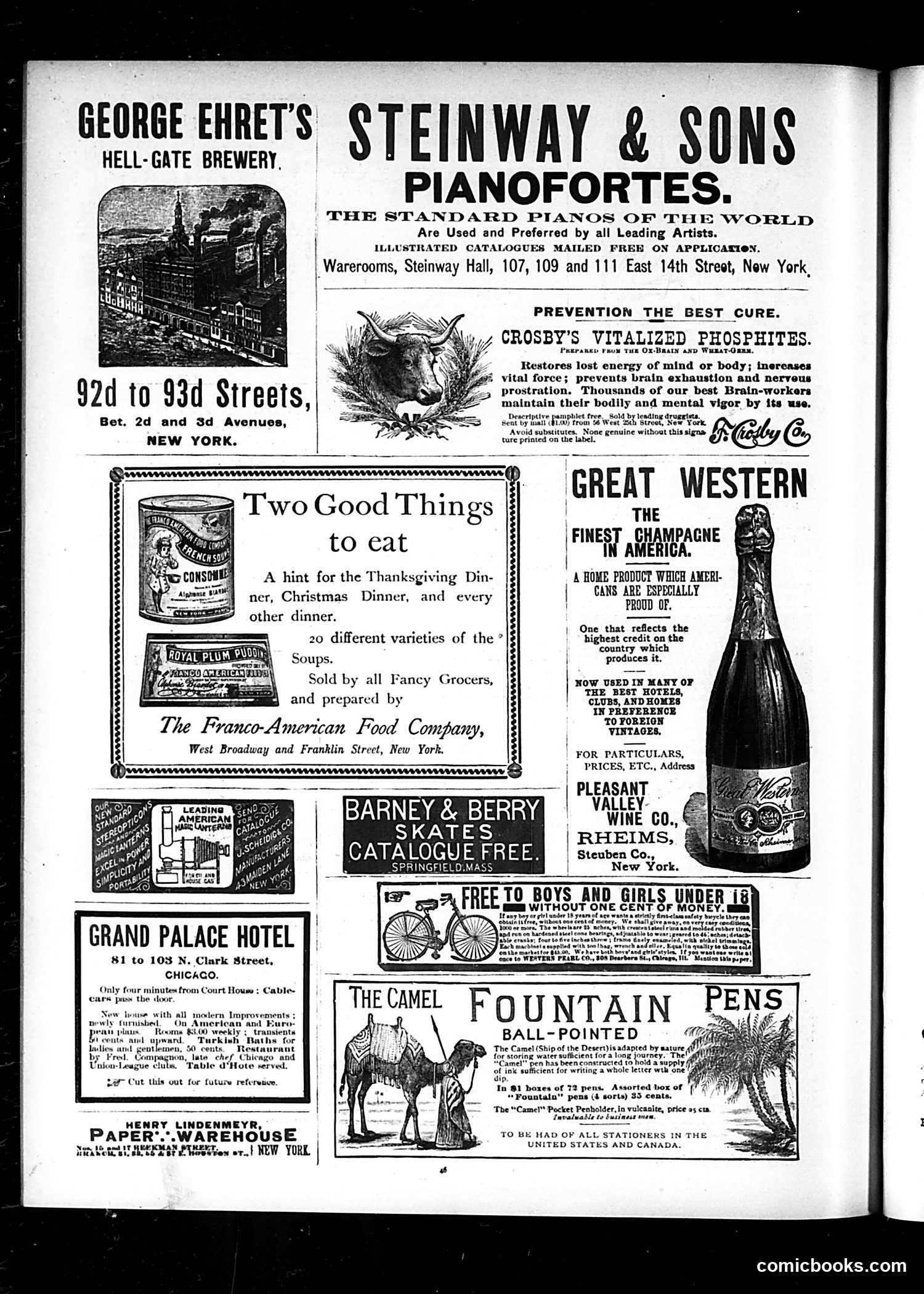
This is primarily an **advertisement page** rather than satirical editorial content. It contains various commercial ads typical of late 19th/early 20th-century American magazines. Notable ads include: - **Steinway & Sons pianos** — positioning themselves as instruments of the elite ("preferred by all Leading Artists") - **Crosby's Vitalized Phosphites** — a patent medicine promising to restore "energy of mind or body" and prevent "brain exhaustion," targeting "Brain-workers" (reflects era's widespread faith in dubious health tonics) - **Franco-American Food Company soups** — marketed for holiday dinners - **Great Western champagne** — positioned as "finest champagne in America" and a patriotic American product - **Camel Fountain Pens** — using the camel metaphor to suggest ink capacity ("holds supply like a camel holds water") - **Grand Palace Hotel, Chicago** — budget accommodation The page reflects Gilded Age consumer culture and the period's optimism about commercial products solving health and lifestyle problems. No apparent satire or political commentary is present.
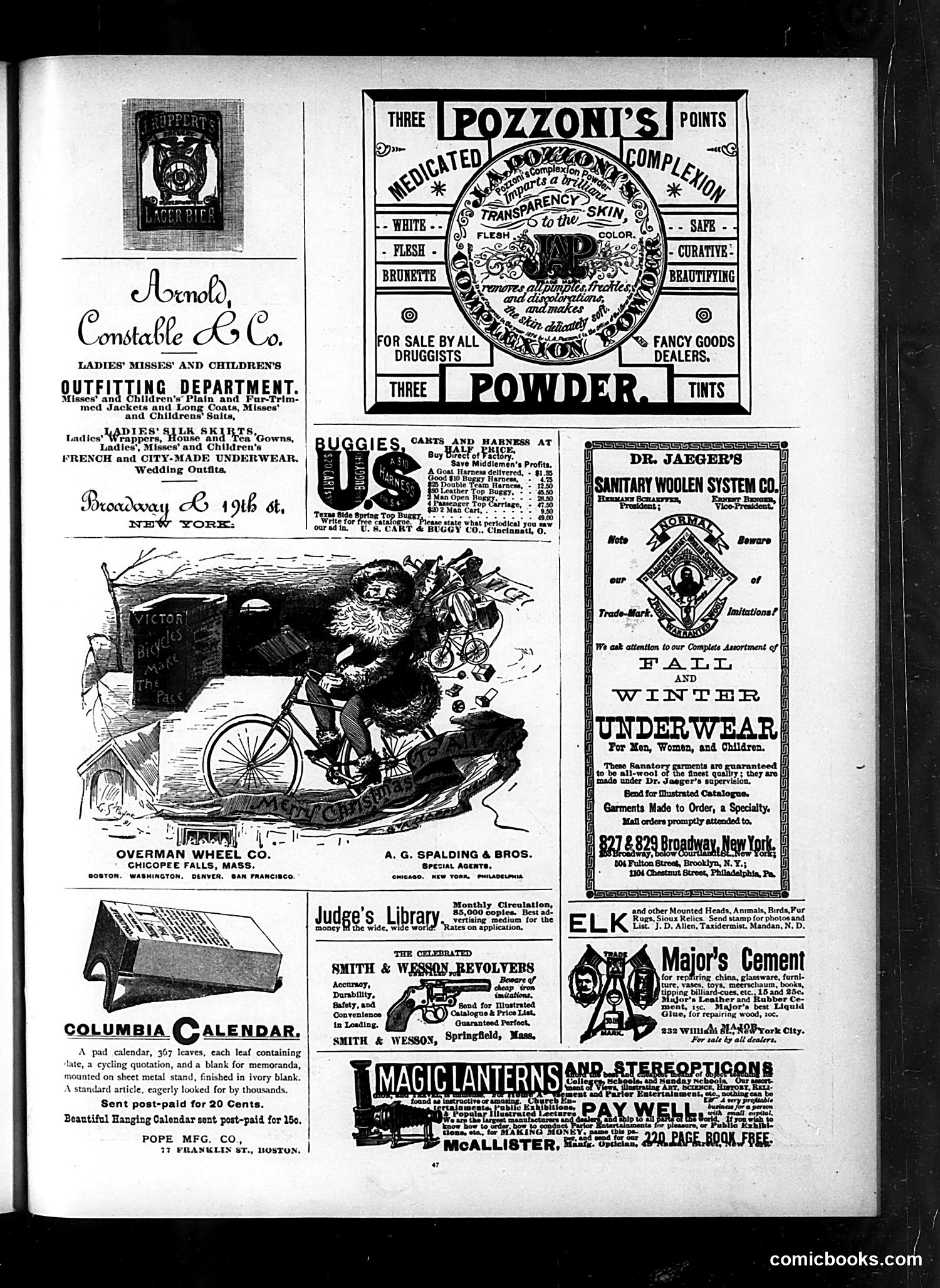
This page is primarily **advertising**, not editorial or satirical content. It displays commercial advertisements from the late 19th/early 20th century for various products and services: **Notable ads include:** - **Pozzoni's Medicated Powder** (top center): a cosmetic/skin product promising to improve complexion - **Arnold, Constable & Co.**: department store for women's and children's clothing on Broadway - **Overman Wheel Co.**: bicycles and harnesses (cycling was hugely popular then) - **A.G. Spalding & Bros.**: sporting goods - **Dr. Jaeger's Sanitary Woolen System**: underwear with health claims - **Smith & Wesson Revolvers**, **Columbia Calendar**, **Major's Cement**: various consumer products The page reflects **consumer culture and industrial capitalism** of the Gilded Age. Products emphasize quality, safety, and health benefits—typical marketing rhetoric for the era. The bicycle ads suggest the cycling craze's cultural prominence. There is **no evident political satire** on this particular page; it functions as a commercial vehicle for Judge magazine's revenue.
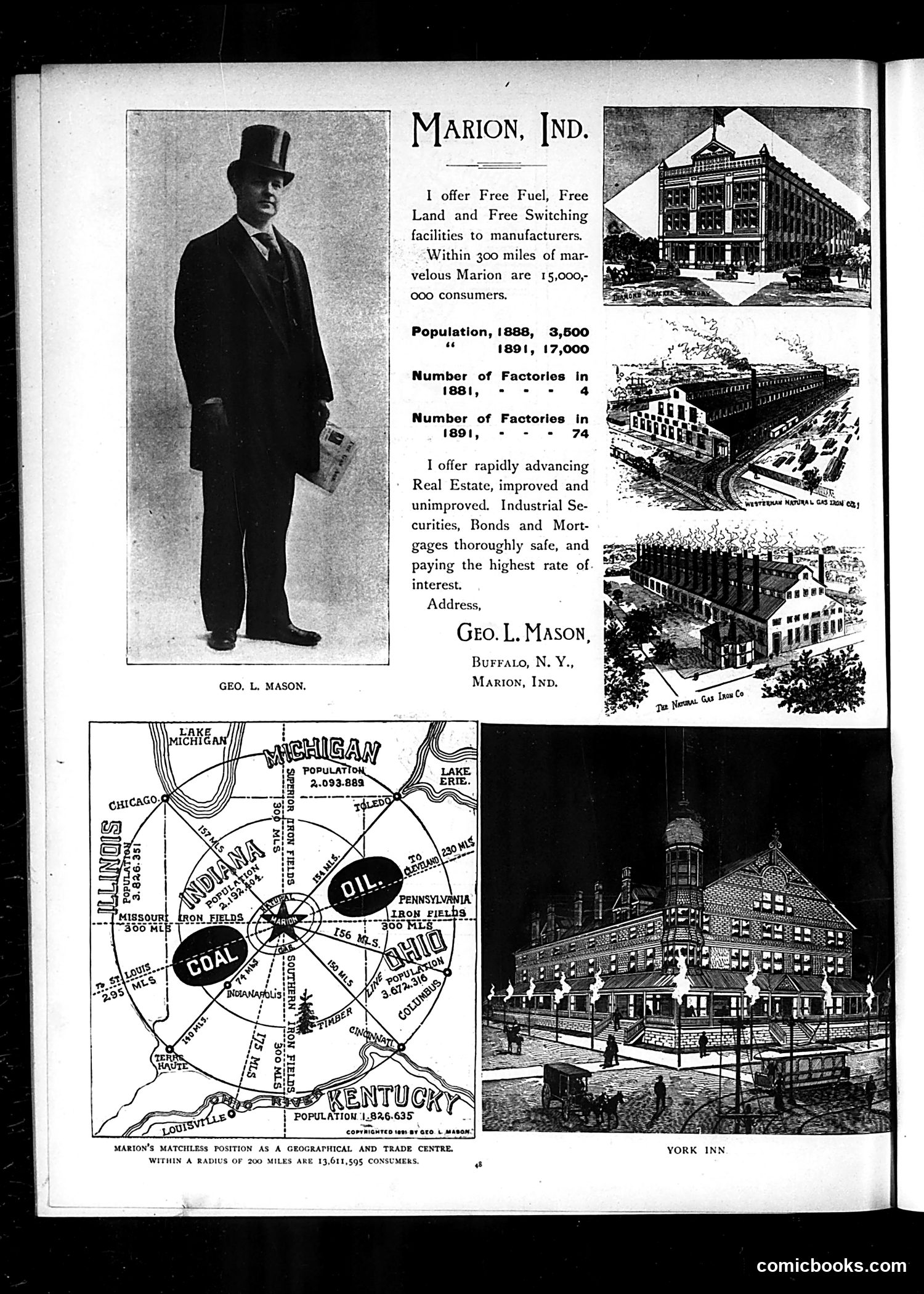
This is primarily **booster advertising** rather than satire or political cartoon. It promotes Marion, Indiana as an industrial hub through Geo. L. Mason, a real-estate and investment promoter based in Buffalo, NY. The page highlights Marion's rapid growth: population jumped from 3,500 (1888) to 17,000 (1891), and factories increased from 4 to 74 in the same decade. Mason advertises free fuel, land, and rail-switching facilities to attract manufacturers, emphasizing access to 15 million consumers within 300 miles. The map shows Marion's central location relative to major cities and natural resources (coal and oil fields). The York Inn photograph promotes local infrastructure. This represents the **Gilded Age boom mentality**, when American towns aggressively competed to attract industry through incentives and promotional literature placed in national magazines like *Judge*.
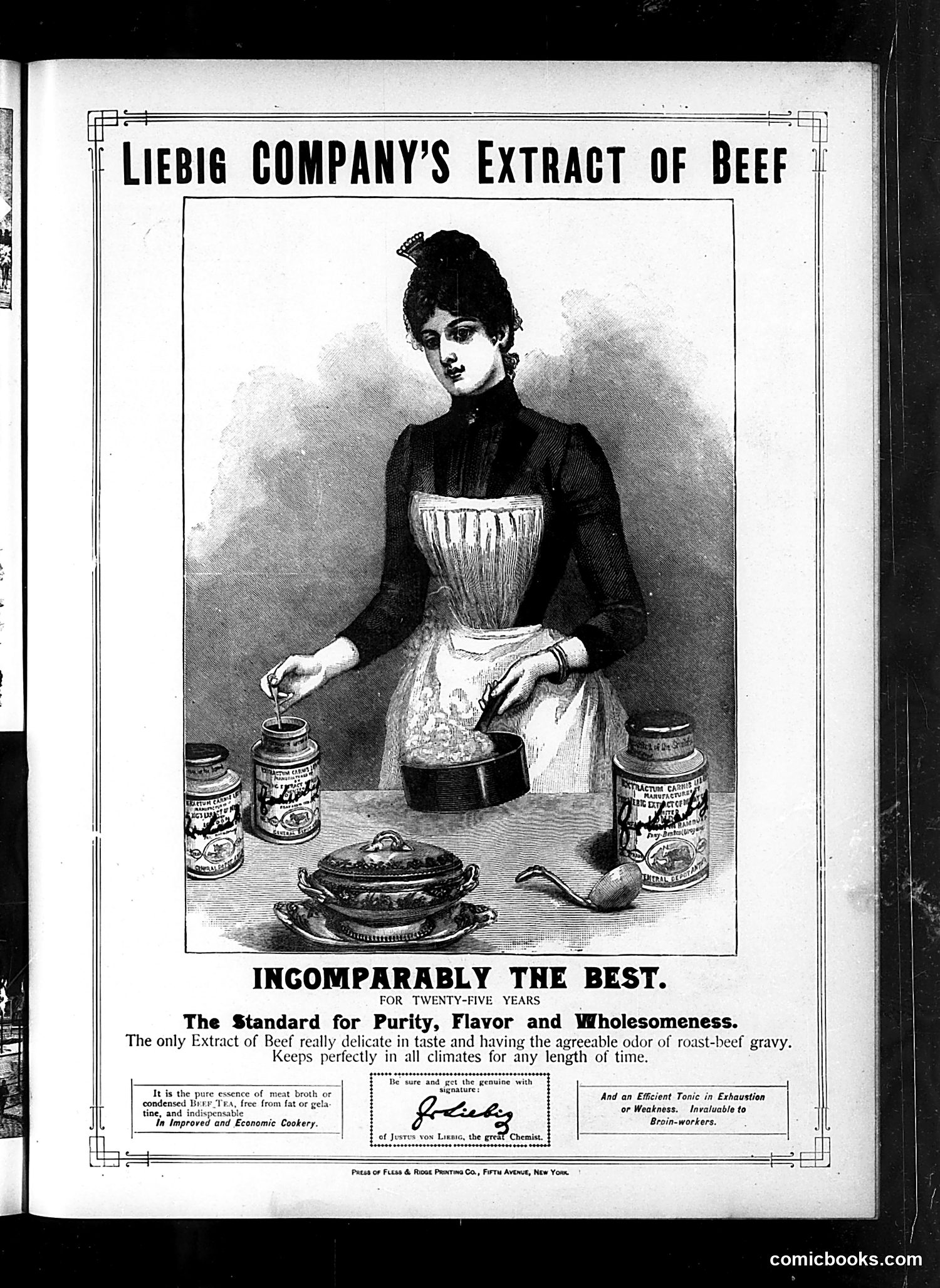
This is a **product advertisement**, not political satire. It promotes Liebig Company's beef extract, a popular Victorian-era concentrated meat product used for cooking and as a nutritional supplement. The image shows a well-dressed woman preparing the extract in a kitchen, surrounded by labeled jars and cooking vessels. The advertisement emphasizes the product's purported benefits: it's claimed to be the finest beef extract for twenty-five years, pure, flavorful, and shelf-stable in any climate. The marketing copy highlights dual uses—as a cooking ingredient and as a medicinal "tonic" for exhaustion and weakness, particularly beneficial for "brain-workers" (office laborers). The invocation of "Justus von Liebig, the great Chemist" lends scientific credibility. This represents typical late 19th-century advertising that blended culinary and health claims, often with exaggerated health benefits by modern standards.
I can see this is a page from *Judge* magazine with an ornate decorative border typical of the publication. However, the OCR text provided is severely corrupted and illegible—it appears to be mostly garbled characters and fragments rather than readable content. While the page contains what appears to be a black and white illustration showing figures in a scene (rotated 90 degrees in the current view), I cannot reliably identify the specific political figures, historical references, or satirical point without legible text or caption information. To properly analyze this cartoon's meaning for modern readers, I would need either: a clearer image, readable captions, or the correct OCR text. I cannot responsibly speculate about its content without these elements.