
Judge, 1891-12-05 · page 37 of 52
Judge — December 5, 1891 — page 37: what you’re looking at
What you’re looking at
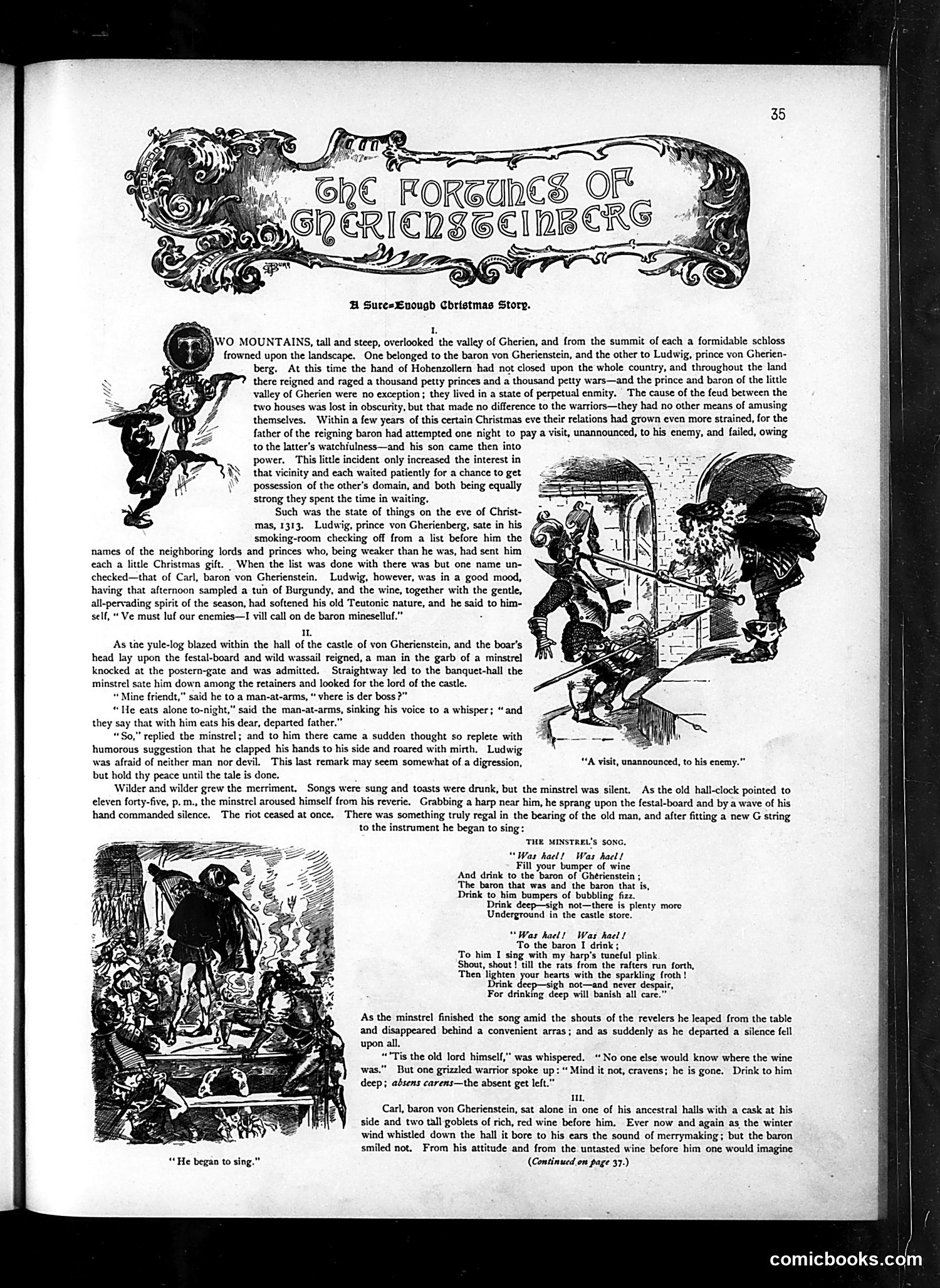
This is a serialized satirical Christmas story rather than a political cartoon. It's a humorous tale set in fictional German territories, poking fun at German feudalism and regional rivalries through exaggerated Teutonic stereotypes. The story depicts two petty German princes—Ludwig von Gherienberg and Carl von Gherienstein—locked in meaningless perpetual enmity over a forgotten cause. The satire targets the absurdity of constant warfare among weak nobility and their comically thick German accents ("vhere is der boss?"). The twist comes when Ludwig, mellowed by wine and Christmas spirit, visits his enemy. A mysterious minstrel arrives and finds humor in the situation, suggesting some ironic resolution is coming. The illustrations show medieval castle scenes and the minstrel performing. This appears to be gentle, festive satire aimed at American readers amused by exaggerated "German" characters and their petty conflicts.
📄 Transcribed text from this page (OCR, searchable)
Machine-transcribed from the original scan — historical spelling and the odd misread are preserved.
Ghe FoRGUNeS OF perl C1MBERG aS ‘BH SucesEvougb Christmas Story. L \WO MOUNTAINS, tall and steep, overlooked the valley of Gherien, and from the summit of each a formidable schloss H frowned upon the landscape. One belonged to the baron von Gherienstein, and the other to Ludwig, prince von Gherien- berg. At this time the hand of Hohenzollern had not closed upon the whole country, and throughout the land there reigned and raged a thousand petty princes and a thousand petty wars—and the prince and baron of the little valley of Gherien were no exception ; they lived in a state of perpetual enmity. ‘The cause of the feud between the two houses was lost in obscurity, but that made no difference to the warriors—they had no other means of amusing themselves. Within a few years of this certain Christmas eve their relations had grown even more strained, for the father of the reigning baron had attempted one night to pay a visit, unannounced, to his enemy, and failed, owing to the latter's watchfulness—and his son came then into power. This little incident only increased the interest in that vicinity and each waited patiently for a chance to get possession of the other's domain, and both being equally strong they spent the time in waiting. Such was the state of things on the eve of Christ- mas, 1313. Ludwig, prince von Gherienberg, sate in his smoking-room checking off from a list before him the names of the neighboring lords and princes who, being weaker than he was, had sent him each a little Christmas gift. When the list was done with there was but one name un- checked—that of Carl, baron von Gherienstein. Ludwig, however, was in a good mood, having that afternoon sampled a tun of Burgundy, and the wine, together with the gentle, all-pervading spirit of the season, had softened his old Teutonic nature, and he said to him- self, “ Ve must luf our enemies—I vill call on de baron mineselluf.” : IL As the yule-log blazed within the hall of the castle of von Gherienstein, and the boar’s head lay upon the festal-board and wild wassail reigned, a man in the garb of a minstrel knocked at the postern-gate and was admitted. Straightway led to the banquet-hall the minstrel sate him down among the retainers and looked for the lord of the castle. “ Mine friendt,” said he to a man-at-arms, “ vhere is der boss ?” “He eats alone to-night,” said the man-at-arms, sinking his voice to a whisper; “and they say that with him eats his dear, departed father.” “So,” replied the minstrel; and to him there came a sudden thought so replete with humorous suggestion that he clapped his hands to his side and roared with mirth. Ludwig was afraid of neither man nor devil. This last remark may seem somewhat of a digression, “A visit, unannounced, to his enemy.” but hold thy peace until the tale is done. ; Wilder and wilder grew the merriment. Songs were sung and toasts were drunk, but the minstrel was silent. As the old hall-clock pointed to eleven forty-five, p.m., the minstrel aroused himself from his reverie. Grabbing a harp near him, he sprang upon the festal-board and by a wave of his hand commanded silence. The riot ceased at once. There was something truly regal in the bearing of the old man, and after fitting a new G string to the instrument he began to sing: THE MINSTREL’S SONG. “Was hael! Was hael! Fill your bumper of wine And drink to the baron of Ghérienstein ; ‘The baron that was and the baron that ‘is, Drink to him bumpers of bubbling fizz. Drink deep—sigh not—there is plenty more Underground in the castle store. “Was hal! Was hal! To the baron I drink; To him I sing with my harp’s tuneful plink Shout, shout! till the rats from the rafters run forth, Then lighten your hearts with the sparkling {roth ! Drink deep—sigh not—and never despair, For drinking deep will banish all care.” As the minstrel finished the song amid the shouts of the revelers he leaped from the table and disappeared behind a convenient arras; and as suddenly as he departed a silence fell upon all. “Tis the old lord himself,” was whispered. “No one else would know where the wine was.” But one grizzled warrior spoke up: “ Mind it not, cravens; he is gone. Drink to him deep; adsens carens—the absent get left.” HL Carl, baron von Gherienstein, sat alone in one of his ancestral halls with a cask at his side and two tall-goblets of rich, red wine before him. Ever now and again as the winter wind whistled down the hall it bore to his ears the sound of merrymaking; but the baron smiled not. From his attitude and from the. untasted wine before him one would imagine “He began to sing.” (Continued.on page 37.) comicbooks.com