
Judge, 1891-12-05 · page 9 of 52
Judge — December 5, 1891 — page 9: what you’re looking at
What you’re looking at
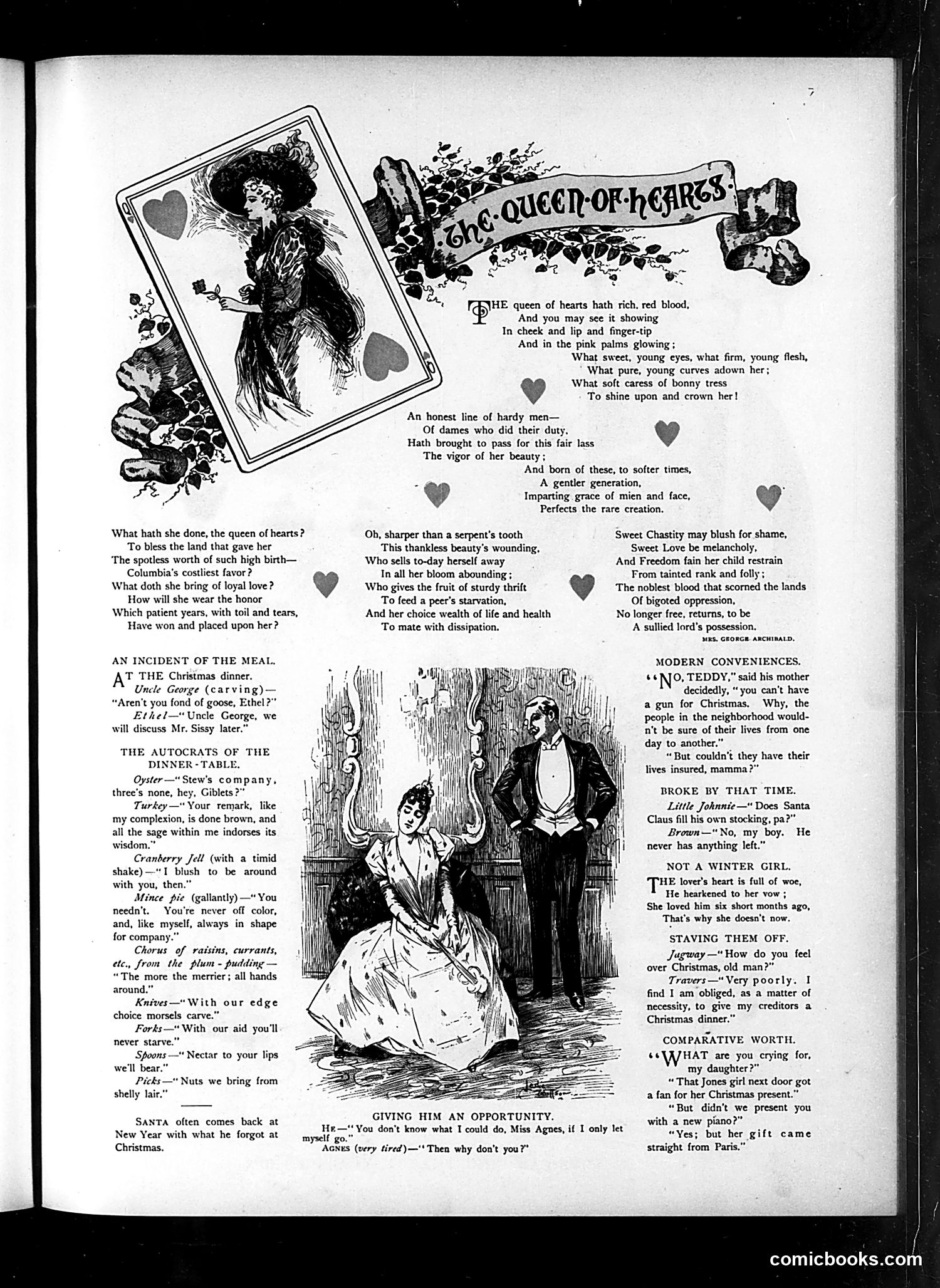
The upper portion features a poem accompanying an illustration of the "Queen of Hearts"—likely referencing American heiresses of the Gilded Age who married European nobility. The satire condemns women of noble American lineage who "sell themselves away" to foreign aristocrats, particularly impoverished European peers seeking wealthy brides. The poem praises American women's "vigorous beauty" inherited from "honest lines of hardy men" and "dames who did their duty," then bitterly questions what these women contribute to America in return. It sarcastically suggests they betray "Sweet Chastity," "Sweet Love," and "Freedom" by marrying for status rather than principle—particularly by joining "bigoted" European establishments that previously "scorned" American independence. This reflects genuine contemporary anxieties about wealthy American daughters marrying foreign titles, viewed as both a betrayal of American values and an embarrassing economic reversal where American gold purchased European prestige. The page's other humor pieces offer lighter holiday satire unrelated to this theme.
📄 Transcribed text from this page (OCR, searchable)
Machine-transcribed from the original scan — historical spelling and the odd misread are preserved.
JHE queen of hearts hath rich, red blood, ‘And you may sce it showing In cheek and lip and finger-tip And in the pink palms glowing ; ‘What sweet, young eyes, what firm, young flesh, What pure, young curves adown her; What soft caress of bonny tress To shine upon and crown her! An honest line of hardy men— Of dames who did their duty, Ww Hath brought to pass for this fair lass The vigor of her beauty ; And born of these, to softer times, ‘A gentler generation, : Imparting. grace of mien and face, yy Ob, sharper than a serpent’s tooth ‘This thankless beauty's wounding, Perfects the rare creation. Who sells to-day herself away In all her bloom abounding ; @ What hath she done, the queen of hearts ? To bless the land that gave her The spotless worth of such high birth— Columbia's costliest favor ? What doth she bring of loyal love? How will she wear the honor Which patient years, with toil and tears, Sweet Chastity may blush for shame, Sweet Love be melancholy, And Freedom fain her child restrain From tainted rank and folly ; The noblest blood that scorned the lands Of bigoted oppression, Who gives the fruit of sturdy thrift To feed a peer's starvation, And her choice wealth of life and health Have won and placed upon her? AN INCIDENT OF THE MEAL. T THE Christmas dinner. Uncle George (carving) — “Aren't you fond of goose, Ethel ?” Ethel—" Uncle George, we will discuss Mr. Sissy later.” THE AUTOCRATS OF THE DINNER - TABLE, Oyster —" Stew's company, three’s none, hey, Giblets?” Turkey —"Your remark, like my complexion, is done brown, and all the sage within me indorses its wisdom.” Cranberry Jell (with a timid shake)—"I blush to be around with you, then, Mince pie (gallantly) —" You needn't. You're never off color, and, like myself, always in shape for company.” Chorus of raisins, currants, etc, from the plum - pudding — “The more the merrier; all hands around.” Knives—"With our edge choice morsels carve.” Forks—"With our aid you'll never starve. Spoons —" Nectar to your lips we'll bear.” Picks —" Nuts we bring from shelly lair.” SANTA often comes back at New Year with what he forgot at Christmas. He—'' You don't know what I could do, Miss Agnes, if I only let myself go.” To mate with dissipation. pana a 1 al K i an 4 ie i il i |) GIVING HIM AN OPPORTUNITY. AGNES (very tired)—'* Then why don’t you?" No longer free, returns, to be A sullied lord's possession. xs. GHORCE. ARCHINALD. MODERN CONVENIENCES. 660, TEDDY,” said his mother decidedly, “you can’t have a gun for Christmas. Why, the people in the neighborhood would- n't be sure of their lives from one day to another.” — “But couldn't they have their lives insured, mamma?” BROKE BY THAT TIME. Little Johnnie —" Does Santa Claus fill his own stocking, pa?” Brown—"No, my boy. He never has anything left.” NOT A WINTER GIRL. HE lover's heart is full of woe, He hearkened to her vow ; She loved him six short months ago, ‘That's why she doesn't now. STAVING THEM OFF. Jugway —"How do you feel over Christmas, old man?” Travers—"Very poorly. I find I am obliged, as a matter of necessity, to give my creditors a Christmas dinner.” COMPARATIVE WORTH. SOYVHAT are you crying for, my daughter?” “ That Jones girl next door got a fan for her Christmas present.” “But didn’t we present you with a new piano?” “Yes; but her gift came straight from Paris.” comicbooks.com