
A complete issue · 16 pages · 1891
Judge — September 12, 1891
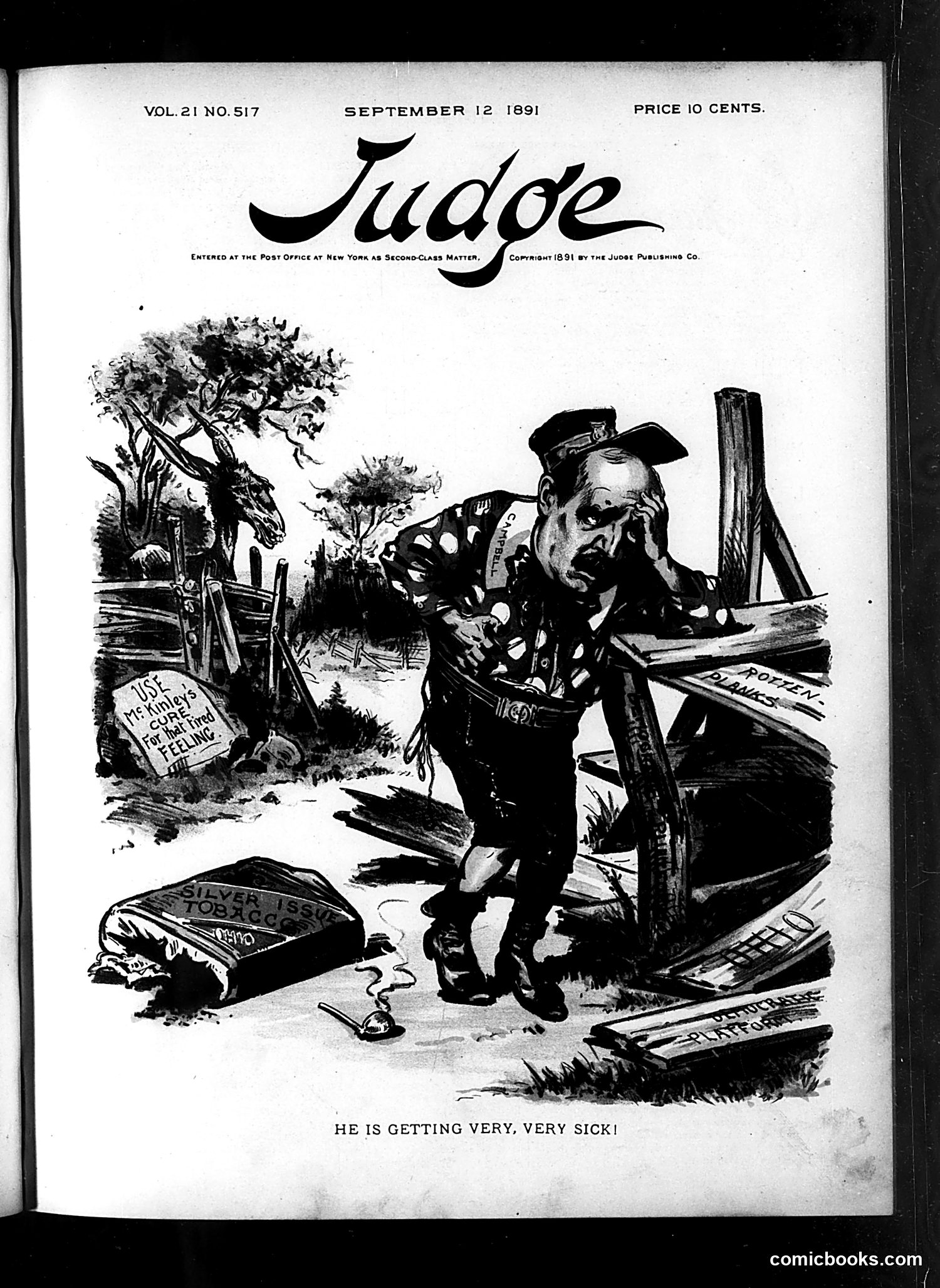
This cartoon satirizes someone suffering from illness, likely political or social in nature. The disheveled figure, dressed in formal attire with a cap, appears severely afflicted—the caption "HE IS GETTING VERY, VERY SICK!" suggests his condition is worsening. The scattered objects around him (including what appears to be documents or papers labeled with text we can partially make out) suggest moral or political corruption. The rural/desolate setting with a grave marker in the background implies this is a commentary on something dying or in terminal decline. Without being able to definitively identify the specific figure or read all text clearly, this appears to be **attacking a particular political figure or movement** whose deteriorating fortunes Judge's editors found cause for satisfaction in 1891.
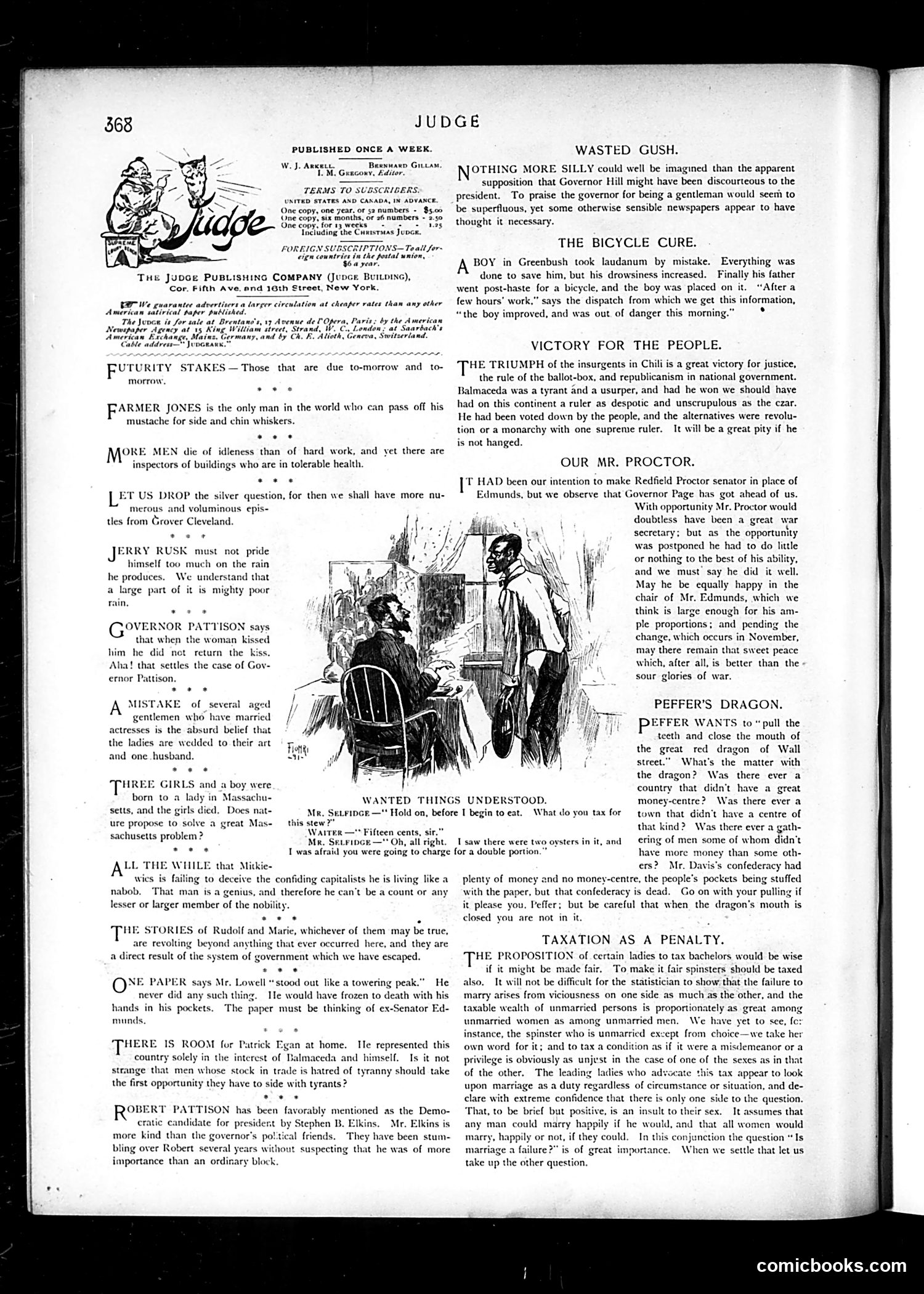
This page from *Judge* contains multiple brief satirical items rather than a single cartoon. The main illustration shows two figures in what appears to be a domestic scene labeled "WANTED THINGS UNDERSTOOD," depicting a conversation about household expenses. The text sections mock various political and social targets: Governor Pattison's kiss-avoidance, Patrick Egan's diplomatic appointment, and Robert Pattison's candidacy. One item jokes about "Farmer Jones" and his mustache; another criticizes the silver question and tariffs—common late-19th-century political debates. The "Taxation as a Penalty" section discusses taxing bachelors, a proposal the author satirizes as absurd. Without specific dates or clearer identification of all figures, the exact historical moment remains uncertain, but the content reflects 1890s American political preoccupations.
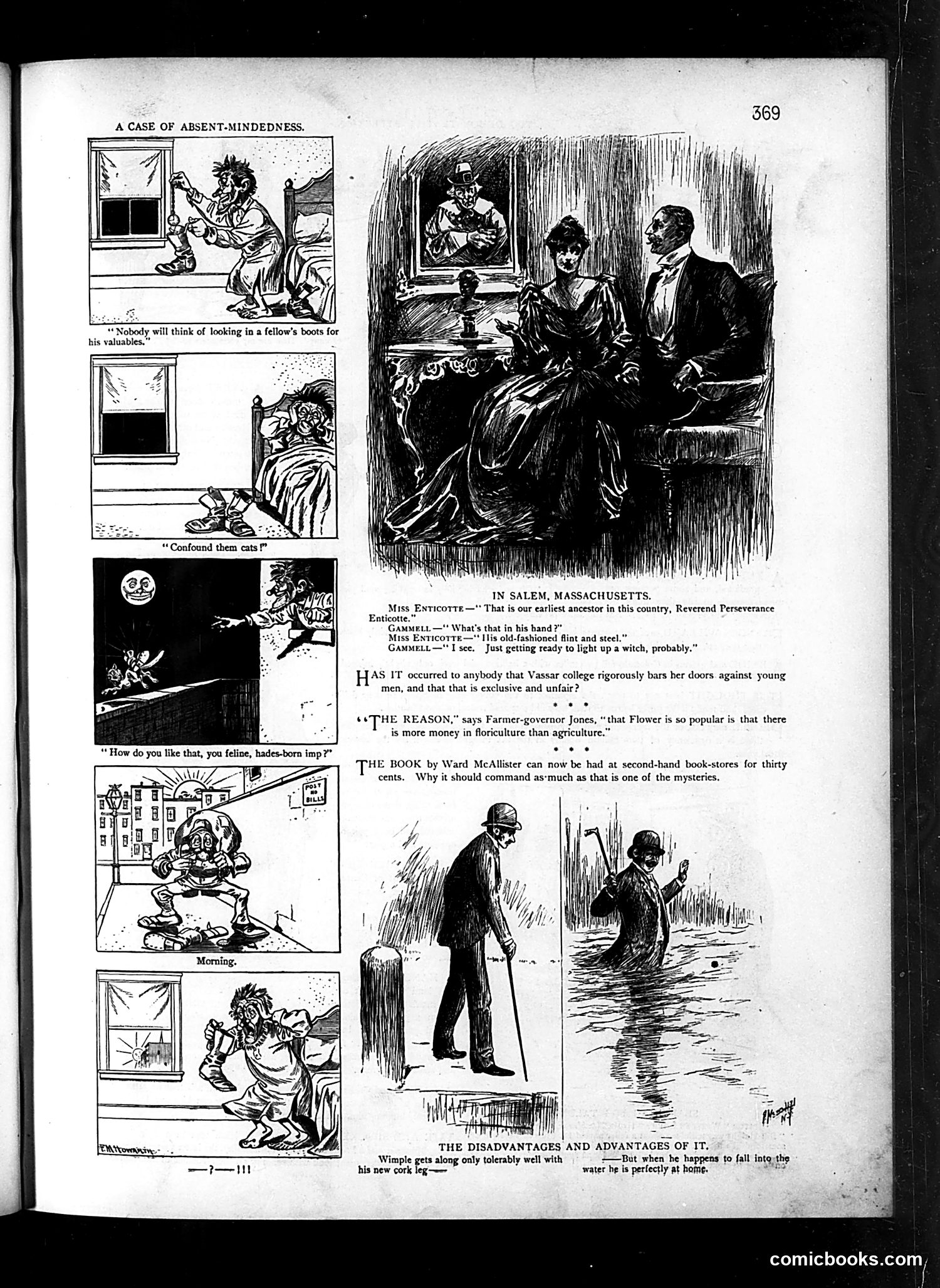
This page contains multiple satirical cartoons and brief commentaries typical of Judge's social humor. **"A Case of Absent-Mindedness"** (left panels): Shows a distracted man forgetting to look in a fellow's boots for valuables, then being told to "Confound them cats!" The joke involves petty theft and household chaos. **"In Salem, Massachusetts"** (center): A dialogue among characters discussing ancestors and witchcraft, playing on Salem's historical witch trial notoriety for comedic effect. **"The Disadvantages and Advantages of It"** (bottom right): Two sketches of a man with a cork leg—one awkwardly positioned on land, one advantageous in water. This pun-based humor mocks disability through physical comedy, typical of period attitudes. The page reflects late 19th/early 20th-century humor conventions: slapstick, wordplay, and casual mockery of misfortune.
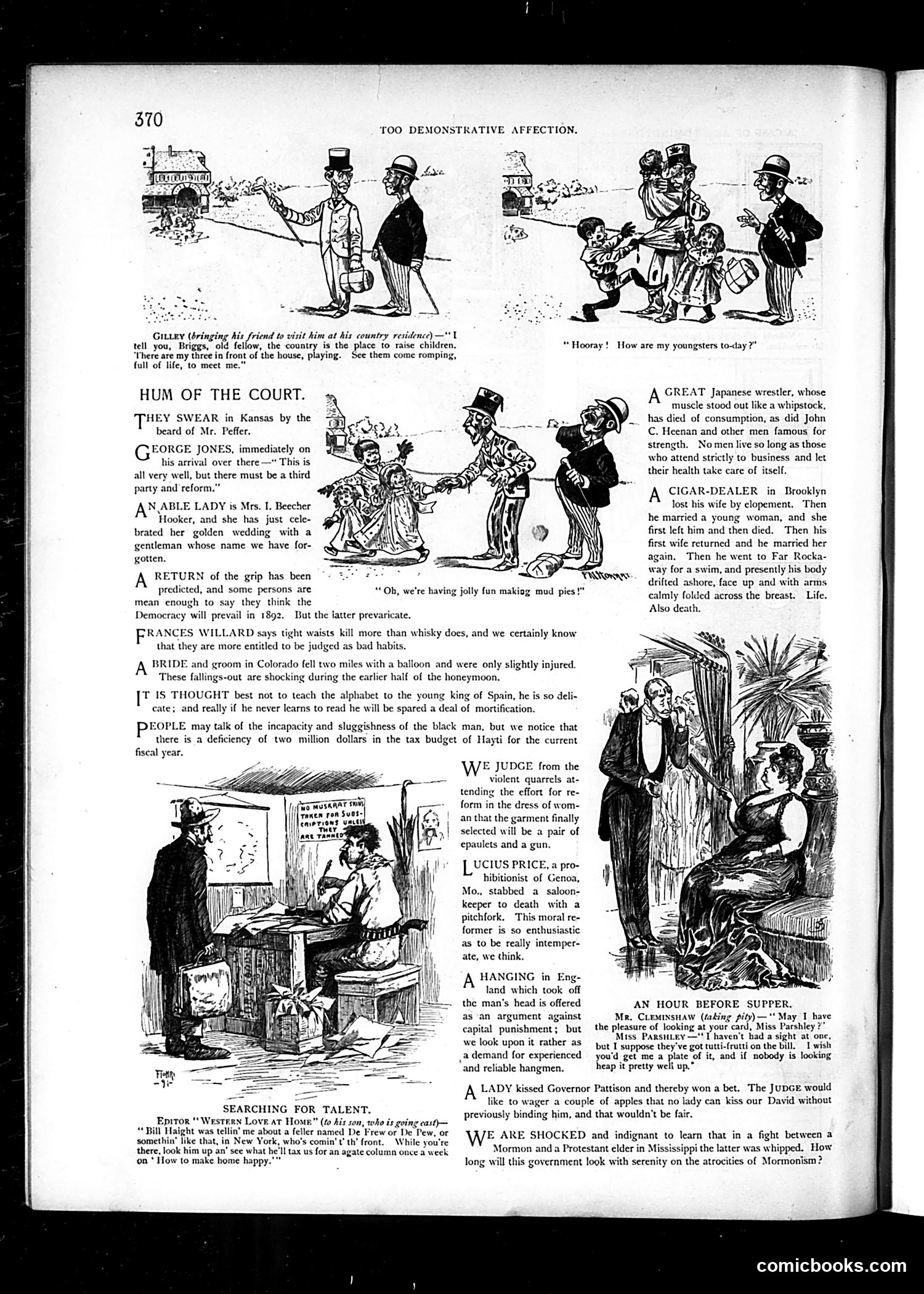
This page from Judge magazine contains brief satirical commentary and jokes on contemporary figures and events, circa 1890s. The main cartoon depicts a father proudly showing a visitor his children playing outside—muddy and wild. The satire mocks excessive sentimentality about rural child-rearing; the father's affected enthusiasm contrasts with the children's chaotic, messy reality. Other items mock specific public figures: Kansas politician Mr. Peffer (known for his beard), reformer Frances Willard (on women's dress reform), and various politicians of the era. The humor relies on readers recognizing these names. Several items satirize moral hypocrisy—particularly a "prohibitionist" who commits murder with a pitchfork, and debates about capital punishment. The page employs Judge's characteristic approach: brief, cutting observations targeting politicians, reform movements, and social pretensions of the 1890s, assuming readers knew contemporary news and personalities.
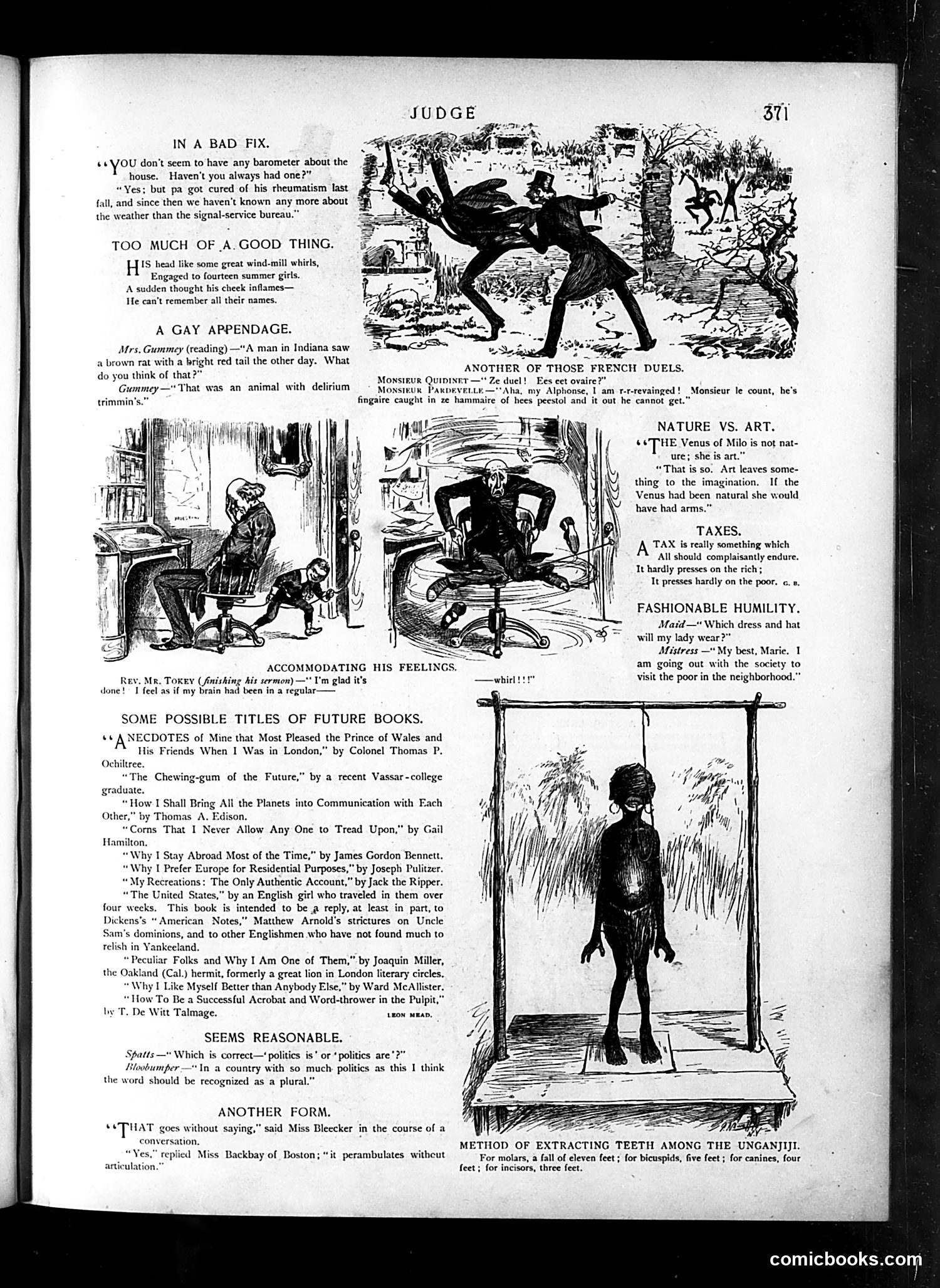
This satirical page from Judge mixes social commentary with light humor typical of late 19th-century American magazines. **Key satirical pieces:** - **"In a Bad Fix"**: Jokes that a father's rheumatism cure has removed the household's barometer—a humorous jab at hypochondria and weather obsession. - **"Too Much of a Good Thing"**: Mocks a man engaged to fourteen women who can't remember their names—commentary on the frivolous romantic entanglements of wealthy society. - **"A Gay Appendage"**: Plays on "delirium tremens" (alcohol withdrawal symptoms) as "delirium trimmin's" when describing a rat's red tail. - **"Future Books"**: Satirizes contemporary celebrities (Edison, James Gordon Bennett, Jack the Ripper as author) and English travelers' criticisms of America (referencing Dickens's "American Notes"). - **French Duel cartoon**: Mocks dueling culture, showing a man's pistol stuck in a hammer. - **Taxes verse**: Cynically notes taxes burden the poor while barely affecting the rich. The page reflects Gilded Age preoccupations: class pretension, romantic excess, and European cultural smugness toward America.
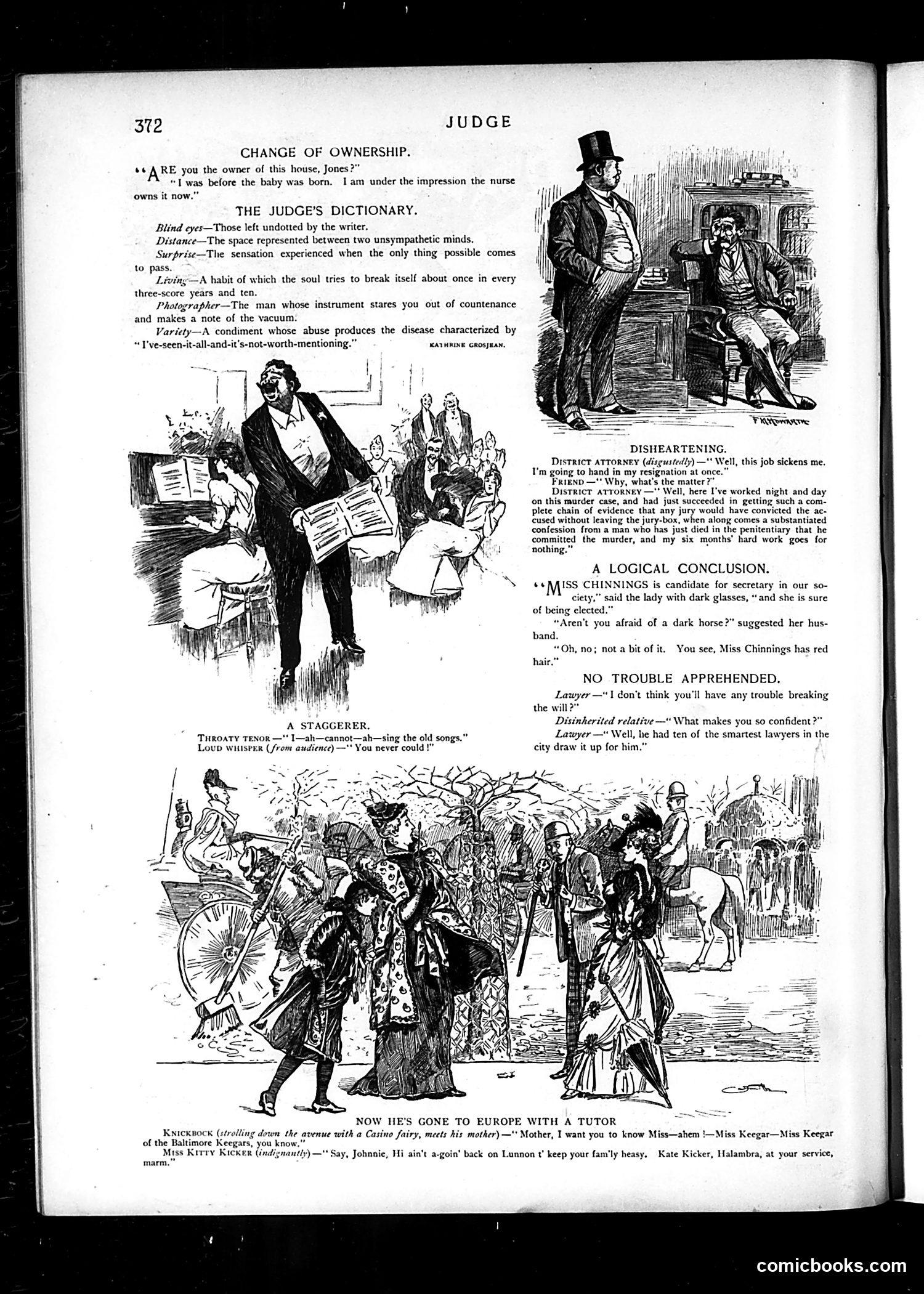
This page contains several short satirical pieces typical of Judge magazine's social commentary: **"Change of Ownership"** jokes that after a baby is born, the nurse effectively controls the household—a dig at domestic power dynamics. **"The Judge's Dictionary"** offers sardonic definitions of common concepts (distance, variety, loving), mocking human nature and pretension. **"A Staggerer"** and **"Disheartening"** lampoon incompetence: a tone-deaf opera singer and a district attorney whose painstaking murder case becomes pointless when someone else confesses. **"A Logical Conclusion"** satirizes superficial reasoning about female candidates. **"No Trouble Apprehended"** ironically suggests that hiring expensive lawyers to write a will ensures it will be successfully challenged. **"Now He's Gone to Europe with a Tutor"** appears to mock class-conscious social climbing and pretentious affectation among the wealthy. The cartoons emphasize domestic absurdities, professional frustrations, and social hypocrisy typical of Gilded Age satire.
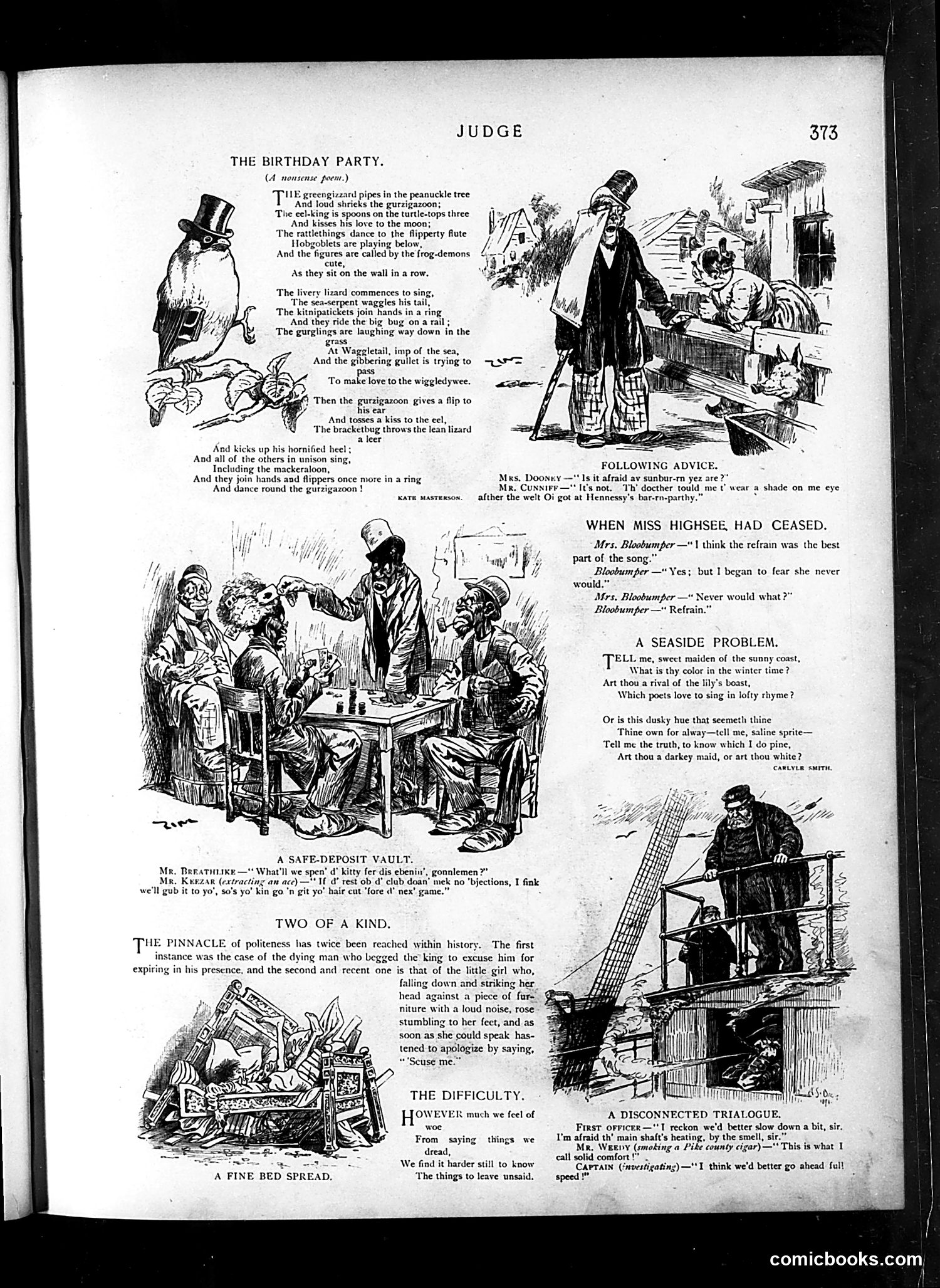
This page contains several unrelated humorous pieces typical of Judge's satirical format: **"The Birthday Party"** is absurdist nonsense verse—deliberately meaningless rhyming gibberish with invented words ("gurzigazoon," "peanuckle tree"). It parodies pretentious poetry and appears to mock either specific contemporary poets or the genre itself. **"Following Advice"** depicts Irish immigrants with heavy dialect humor, common in turn-of-century American magazines. The joke relies on ethnic stereotyping—a man explaining a bar injury using exaggerated Irish accent. **"A Seaside Problem"** uses racial humor asking whether a darkly-tanned woman is naturally dark-skinned or sunburned. This reflects the period's casual racist comedy. **"Two of a Kind"** presents a polite anecdote comparing historical courtesy to a child apologizing after an accident—gentle humor about social propriety. The remaining pieces ("Safe-Deposit Vault," "The Difficulty," "Disconnected Trialogue") are brief jokes about everyday situations with minimal social commentary. The page emphasizes wordplay, ethnic humor, and absurdist comedy rather than political satire.
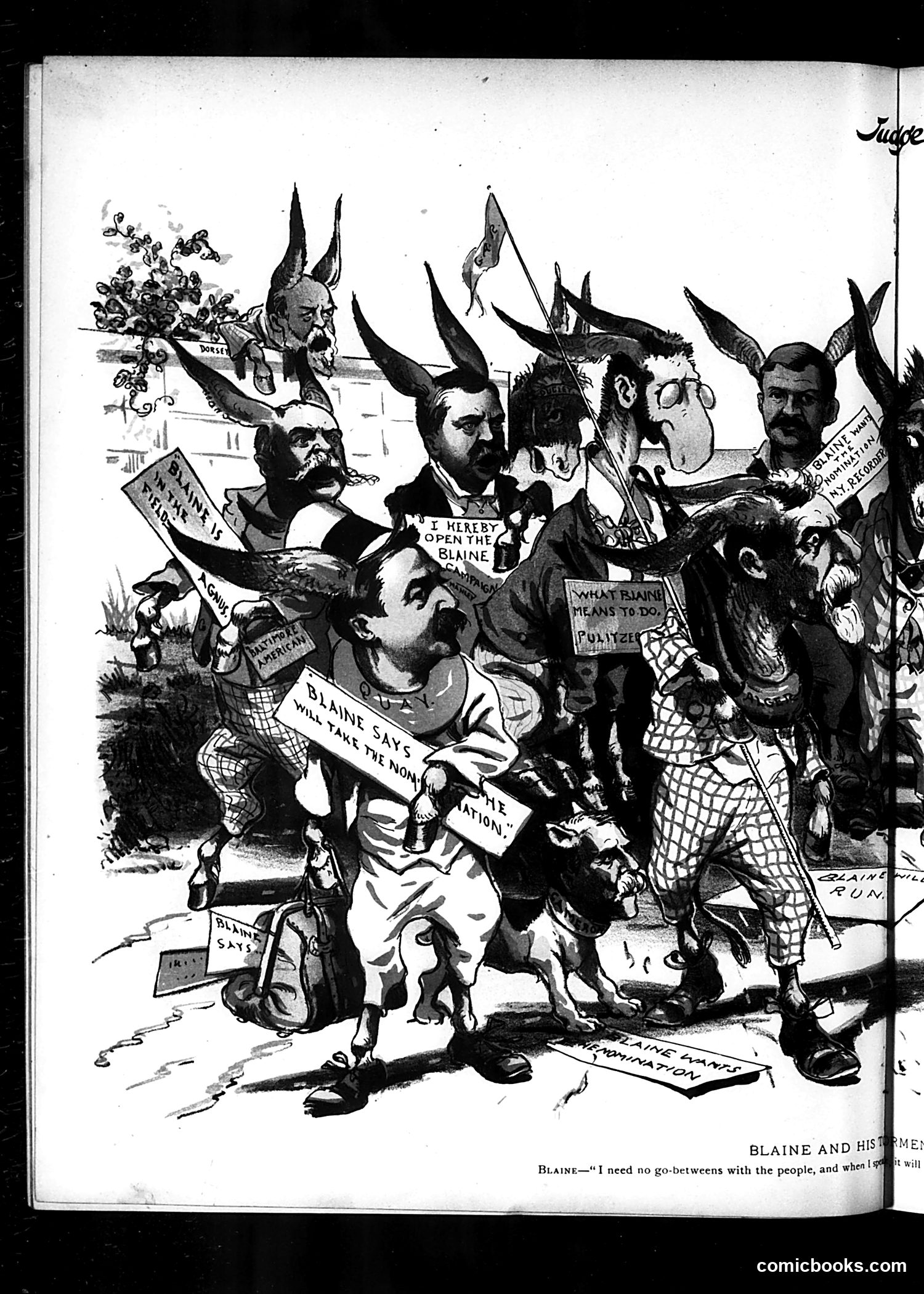
This political cartoon satirizes James G. Blaine (likely from the 1884 presidential campaign), depicting him surrounded by demonic or devilish figures wearing horns. The figures hold signs reading "I HEREBY OPEN THE GAME" and similar phrases, suggesting corrupt political operatives or "go-betweens." The satire mocks Blaine's stated claim that he needs "no go-betweens with the people"—the cartoon implies the opposite, showing him surrounded by questionable intermediaries and political machinery. The devilish imagery suggests these associates represent corruption or moral compromise. This appears to be attacking Blaine's credibility regarding his political independence and integrity, a common strategy in Gilded Age political satire from *Judge* magazine.
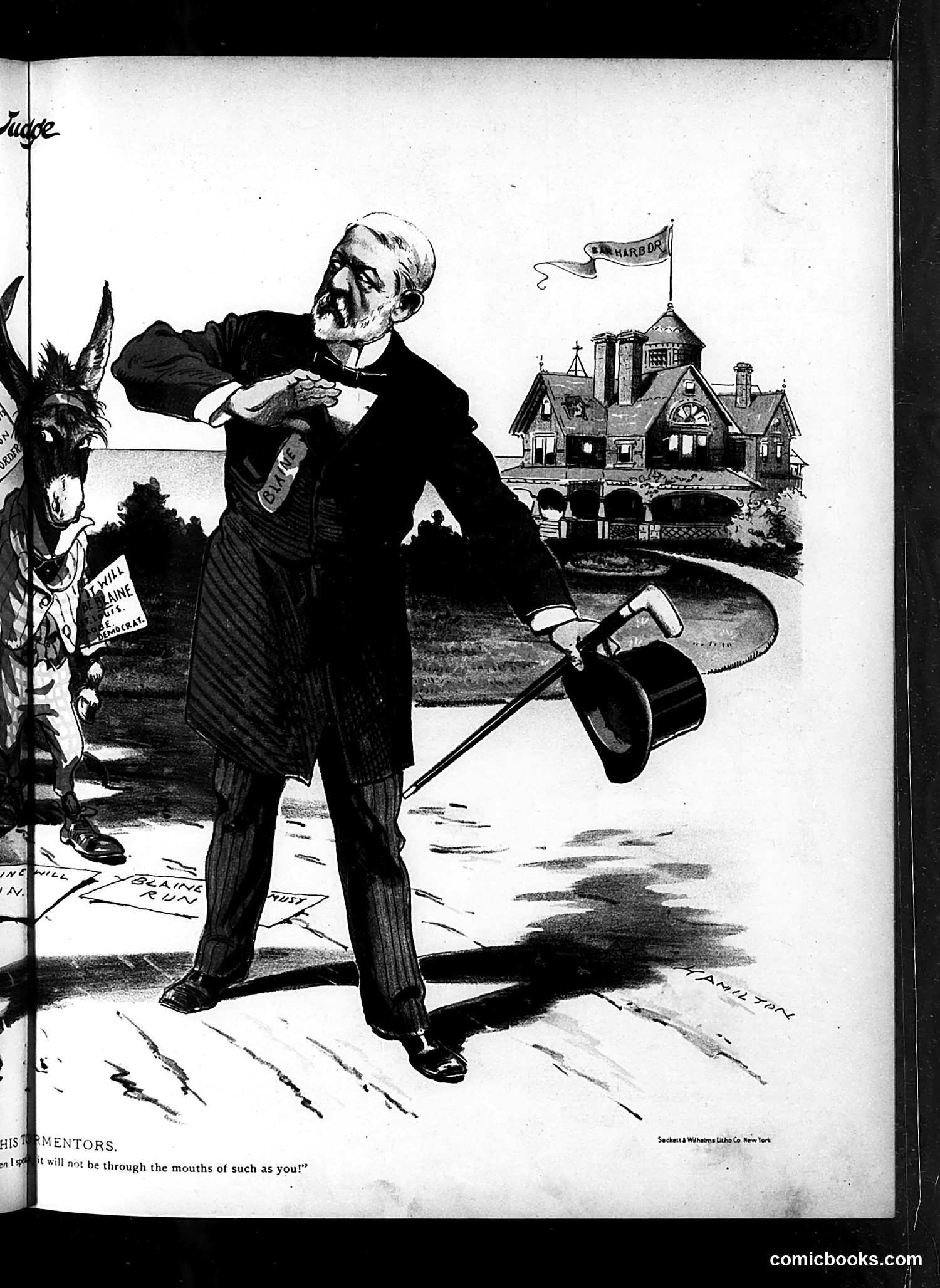
This appears to be a Judge magazine satirical cartoon featuring a bearded gentleman in formal dress wielding a large shovel or spade near a harbor structure flying a flag. To his left is a demonic or monstrous figure (likely representing an opposing political force or social evil). The caption reads: "It will not be through the mouths of such as you!" The cartoon seems to depict a political figure or reformer rejecting interference from corrupt or malevolent forces in his work. The harbor setting and militant posture suggest themes of American political reform, possibly relating to port authority, labor issues, or anti-corruption efforts. The "mentors" reference in the OCR text remains unclear, but the overall message appears to champion honest governance against shadowy opposition. Without seeing the issue's date and context, the specific political controversy referenced cannot be definitively identified.
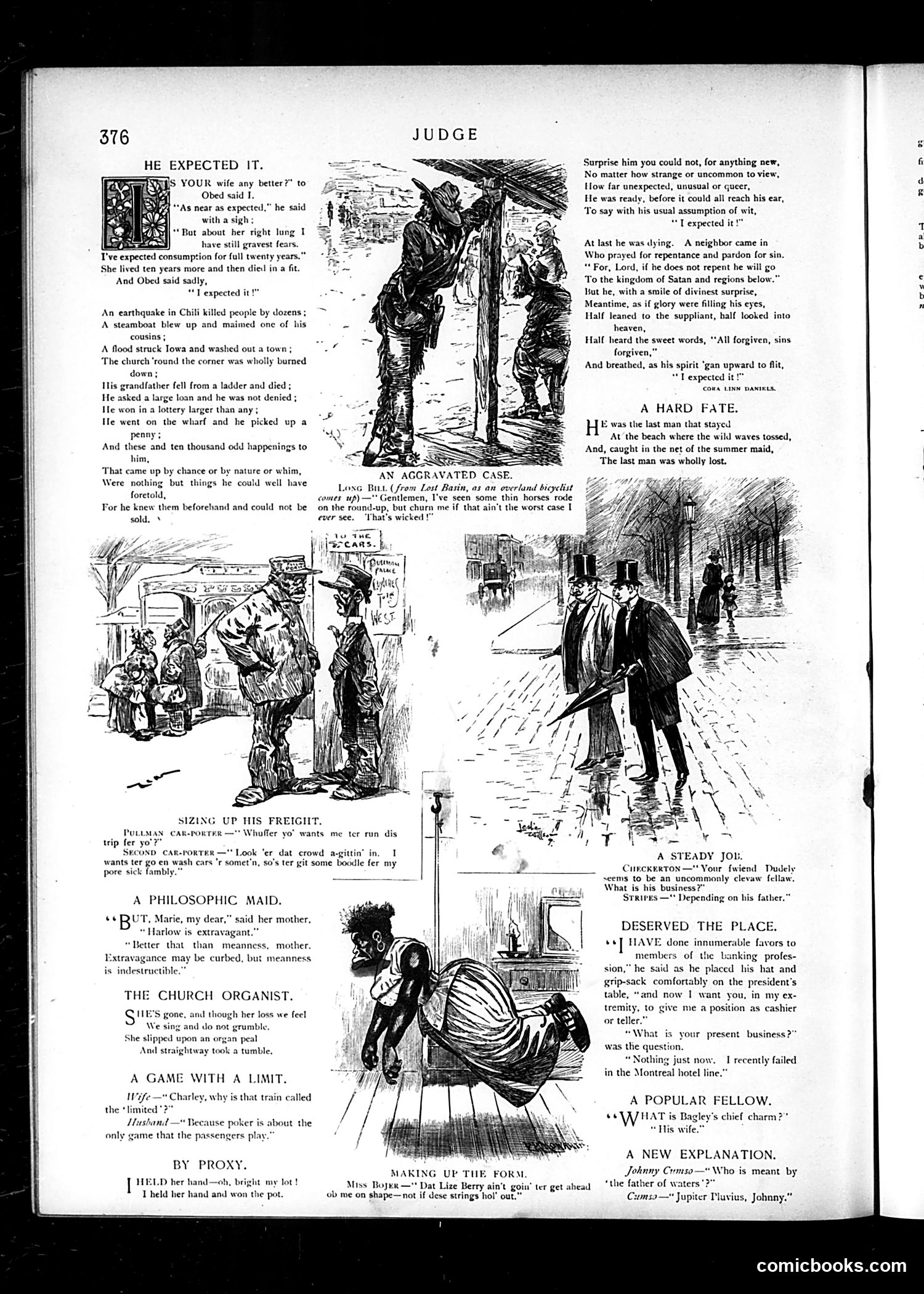
This page contains multiple short humorous pieces typical of late-19th-century American satirical magazines. The dominant feature is "He Expected It!"—a narrative poem about an irritatingly smug man who claims to have foreseen every event in his life, from his wife's death to lottery winnings. The satire mocks fatalistic pessimism and self-satisfied pretension; the joke culminates when even his deathbed vision confirms his unbearable predictability. Surrounding this are brief comic sketches with social commentary: "Sizing Up His Freight" depicts working-class dialect humor about a porter's observations; "A Philosophic Maid" jokes about choosing an extravagant suitor over a miserly one; "The Church Organist" makes dark humor from an organist's accidental death; "A Hard Fate" presents romantic entanglement as masculine doom. The remaining items are one-liners exploiting ethnic dialects ("Crickerton" affecting an affected accent) and period humor about banking, railroads, and courtship. The illustrations—wood engravings—accompany these pieces with Victorian-era character depictions. Overall, the page reflects Judge's formula: mixing literary satire with working-class caricature and social observation.
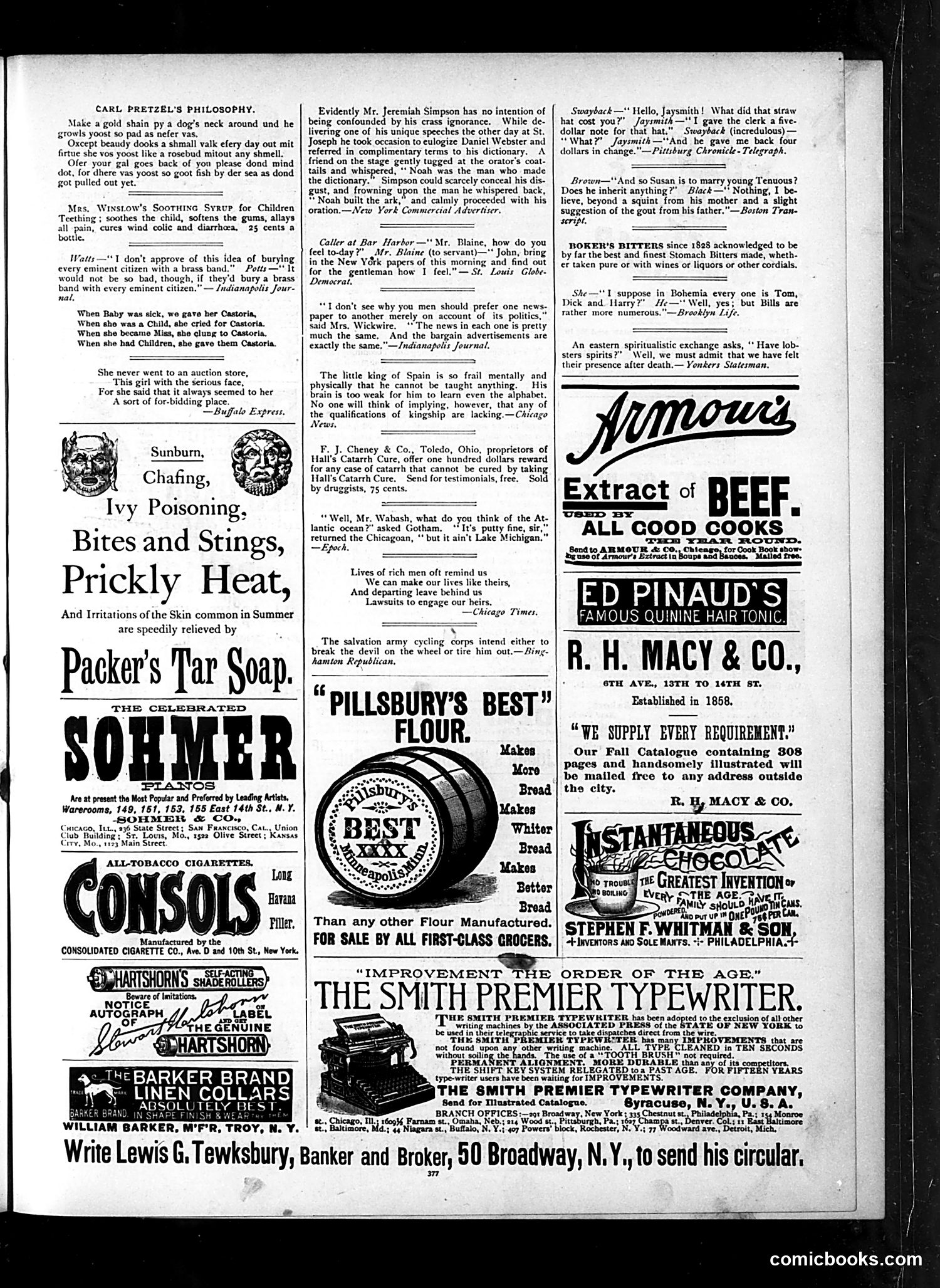
This page is **primarily advertisements** with brief satirical snippets interspersed. The main satirical content concerns **Jeremiah Simpson**, a Populist congressman. The joke ridicules his ignorance: Simpson publicly praised "Daniel Webster's dictionary," not realizing Daniel Webster didn't write a dictionary—Noah Webster did. When corrected backstage, Simpson defensively retorted that "Noah built the ark," missing the point entirely. The satire mocks Simpson as an uneducated buffoon unfit for office. A secondary joke about **James G. Blaine** satirizes politicians' dependence on newspapers: when asked how he feels, Blaine must consult the morning papers to know his own opinion—suggesting politicians are mere mouthpieces for media narratives. A third item ridicules the **King of Spain** as mentally deficient, implying royalty requires no actual competence. The rest is commercial advertising for products (Sohmer pianos, Pillsbury flour, Consols cigarettes, etc.) typical of Judge magazine's revenue model.
This is primarily an **advertising page** from Judge magazine, containing multiple commercial advertisements with minimal editorial content. The notable satirical elements are brief anecdotes: 1. A **free-silver political joke**: References a county-fair machine where depositing 80 cents yields one dollar—mocking the Populist/free-silver movement as economically fraudulent. The Rochester Herald quote explicitly compares free-silver to a confidence scheme. 2. **Humorous short stories** about everyday life (a salesman's pitch about coat pockets, an owl's reputation for wisdom, a bootblack's joke about a dented hat in hot weather). The page reflects Judge's dual nature as both satirical commentary and commercial vehicle. The free-silver critique targets 1890s agrarian political movements, positioning them as economically foolish. The remaining content is filler advertising—beef extract, soap, cigars, hotels, and railroads—typical of period magazines. No prominent political figures or cartoons are visible; the satire is conceptual rather than visual.
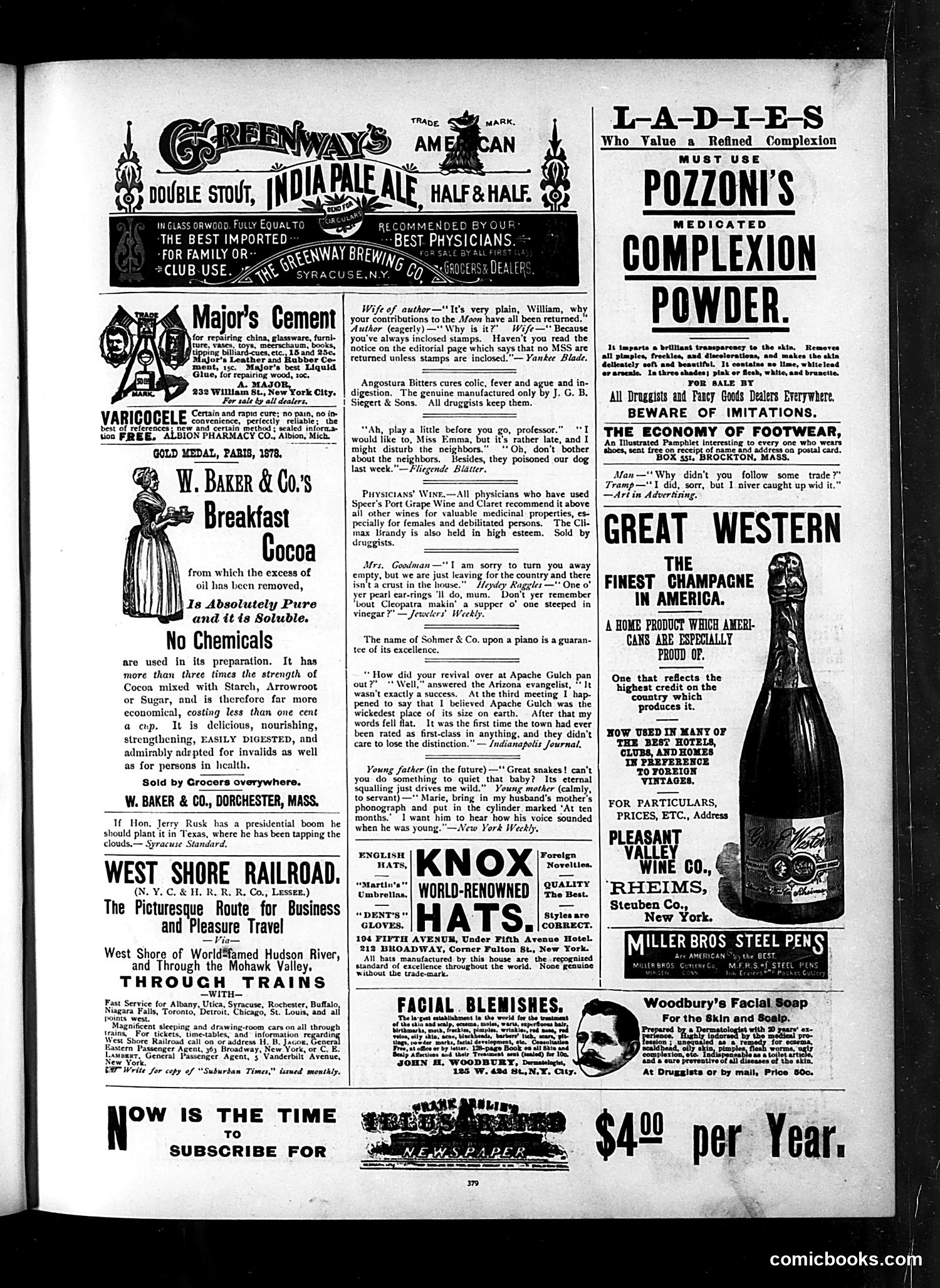
This is overwhelmingly a advertisements page from *Judge* magazine, not a satirical cartoon page. The few joke items present are minor filler between product promotions. **The Limited Satirical Content:** The page contains brief humorous anecdotes rather than political cartoons: - A joke about author "Jerry Rusk" (unclear reference) having a "presidential boom" - Comic dialogue snippets about a wife criticizing her husband's rejected manuscripts, a professor avoiding piano playing, and a revival evangelist's sermon backfiring **The Real Content:** The page is dominated by advertisements for cocoa, cement, medicines, railroads, chocolate, and other Victorian-era products. These ads often include health claims typical of the period (Angostura Bitters curing fevers, facial powders promising "refined complexion"). The satirical snippets appear to be recycled jokes from other publications (credited to *Yankee Blade*, *Jewelers' Weekly*, etc.), serving merely as space-fillers between ads rather than original *Judge* satire. **Conclusion:** This page demonstrates how 19th-century magazines monetized through advertising while padding content with mild humor.
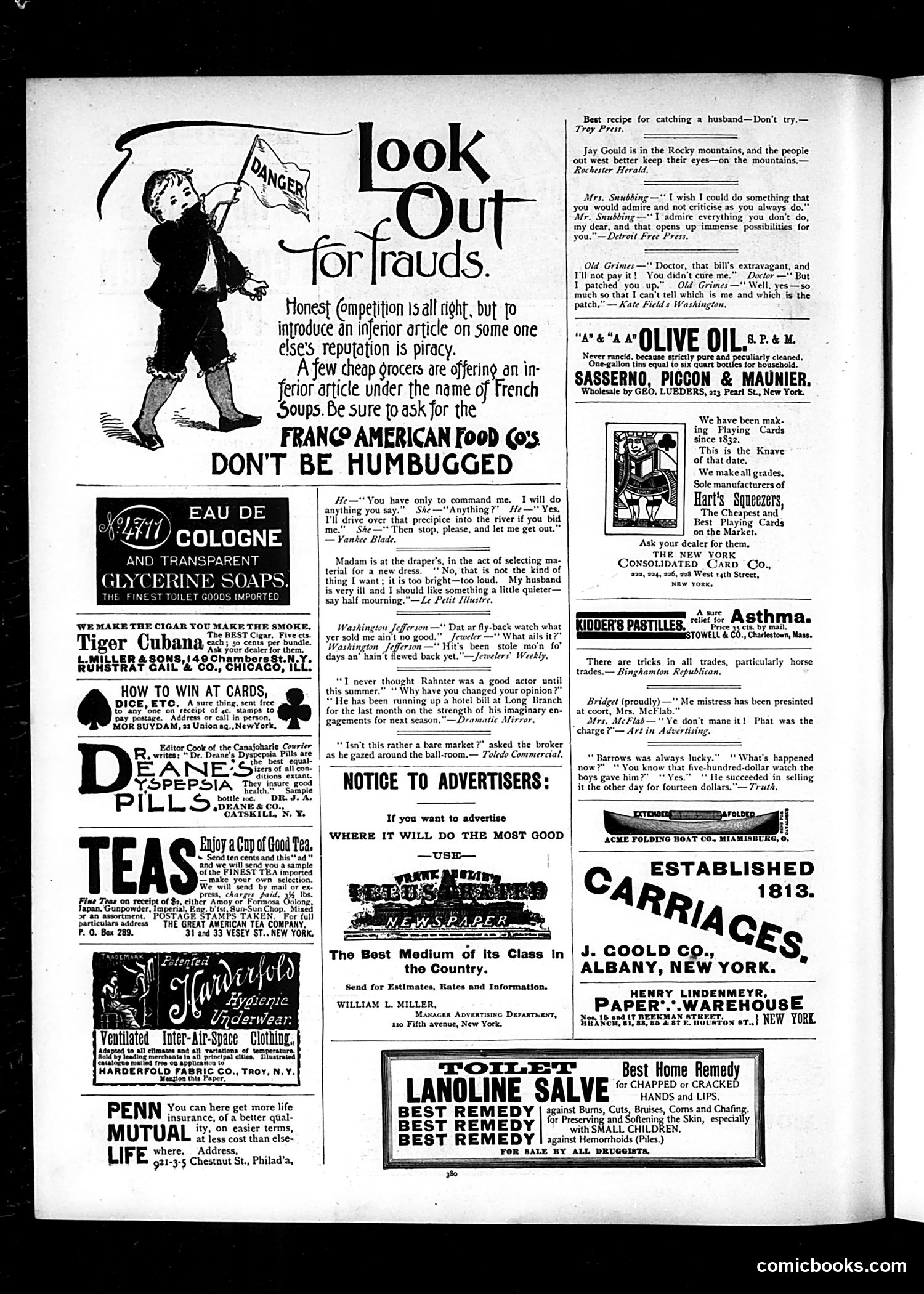
This is primarily an **advertising page** from Judge magazine (likely late 1800s), with several small satirical jokes interspersed. The main cartoon at top shows a boy waving a "DANGER" flag, warning readers: "Look Out for Frauds." The accompanying text warns against cheap grocers selling inferior "French Soups" under the Franco-American Food Company's name—a straightforward consumer protection message against **product counterfeiting and brand piracy**, which was apparently a common problem. The small jokes scattered throughout mock everyday social situations: a woman rejecting a suitor's extreme flattery, a widow shopping for drab fabric rather than bright colors (implying mourning dress), a jeweler dealing with a customer whose watch was stolen, and a broker noting the empty stock market floor. The bulk of the page comprises **advertisements** for various products: patent medicines, tea, cigars, playing cards, soaps, and insurance—typical late-19th-century magazine advertising. The notice to advertisers promotes Judge itself as an effective advertising medium. The content reflects Gilded Age commercial concerns: brand fraud, patent remedies, and the growing importance of advertising in magazines.
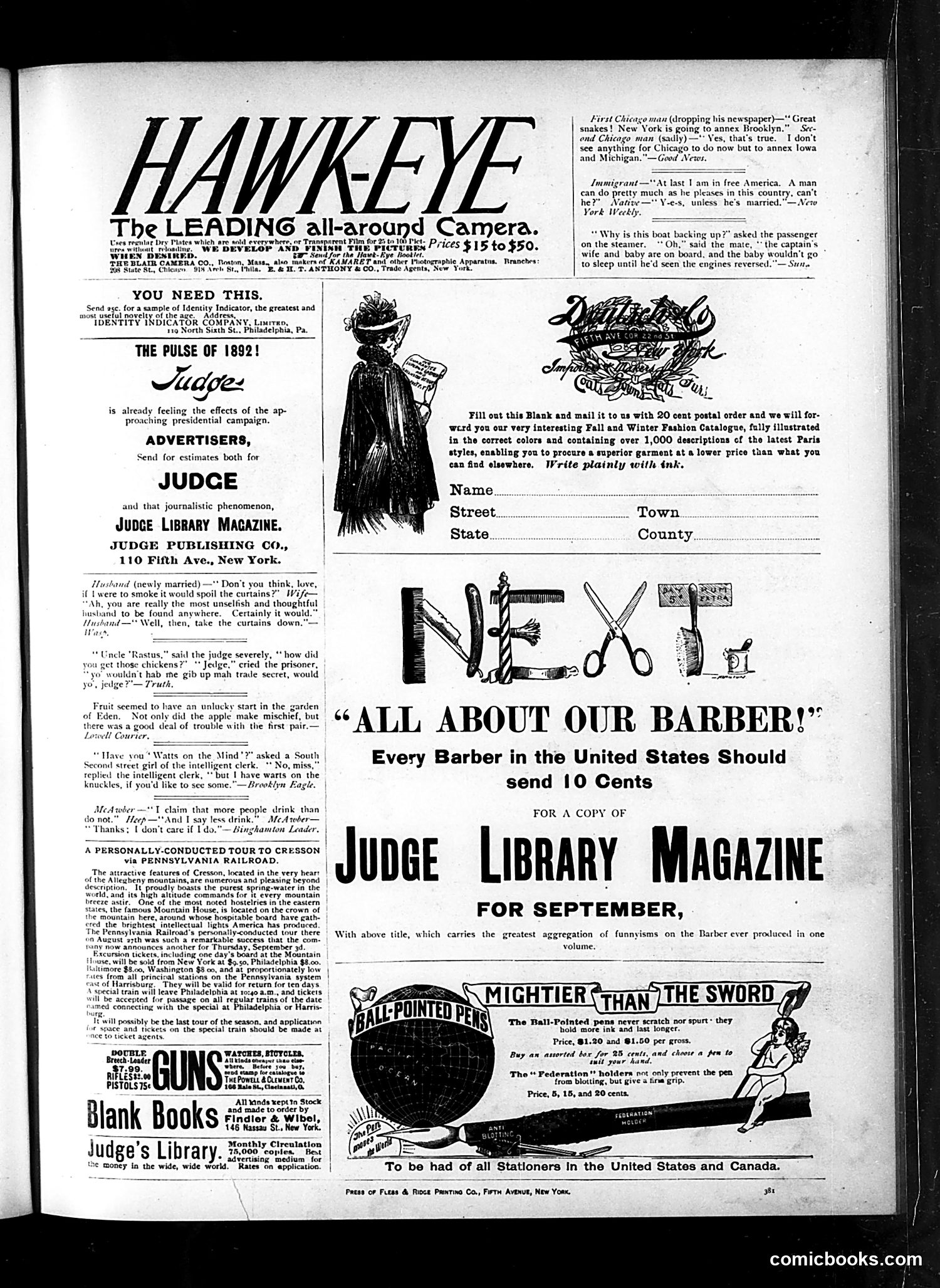
This page is primarily **advertisements and humor** rather than political cartoons. The brief jokes scattered throughout reflect 1892 American anxieties: 1. **Chicago/New York rivalry**: A joke mocking Chicago's inferiority complex—if New York annexes Brooklyn, Chicago should annex Iowa and Michigan. 2. **Immigration and marriage**: An immigrant celebrates American freedom; a native deflates this by noting married men have no freedom. 3. **Gender dynamics**: A husband uses his wife's concern about curtains to justify smoking indoors—satirizing manipulative male logic. 4. **Race humor**: A joke about "Uncle Rastus" stealing chickens relies on racist stereotypes common to 1890s publications. The page is dominated by **product advertisements**: the Hawkeye camera, Judge Library Magazine, pens, barber supplies, and a Pennsylvania Railroad tour. The "barber" headline is simply advertising Judge's September issue. This reflects Judge's business model as a satirical magazine sustained primarily through advertising revenue.
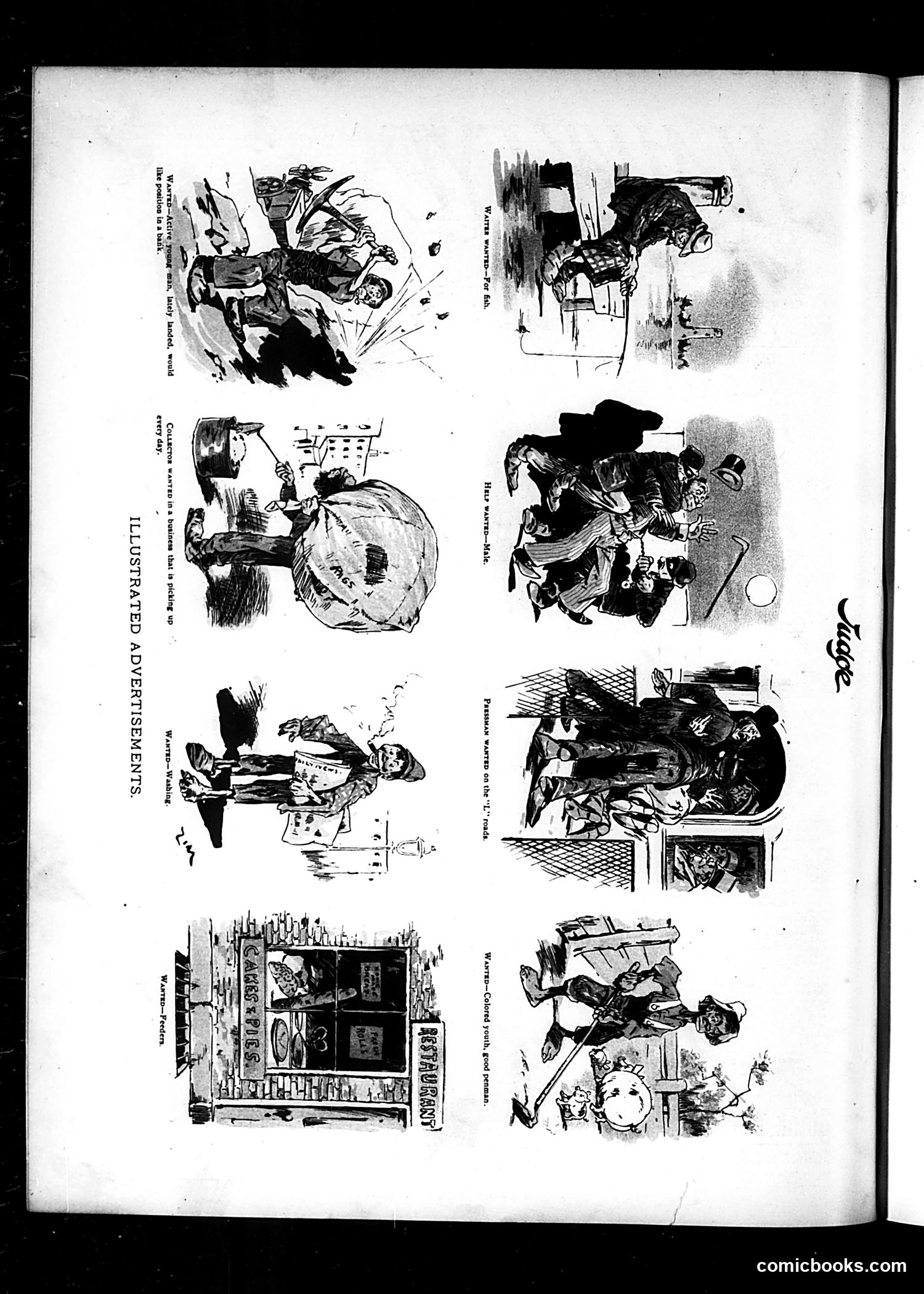
This page from *Judge* magazine contains six cartoon panels labeled "ILLUSTRATED ADVERTISEMENTS" on the left margin. The cartoons appear to depict various domestic or social scenes rendered in satirical style, though the specific text captions are difficult to read clearly in this reproduction. The cartoons likely mock contemporary products, social behaviors, or fashions through exaggerated character depictions typical of *Judge*'s satirical approach. However, without legible captions or clearer image resolution, I cannot definitively identify which products are being advertised, what specific social commentary is intended, or which public figures (if any) are being caricatured. The page's primary function appears to be satirical product advertisement rather than political commentary.