
A complete issue · 16 pages · 1891
Judge — August 15, 1891
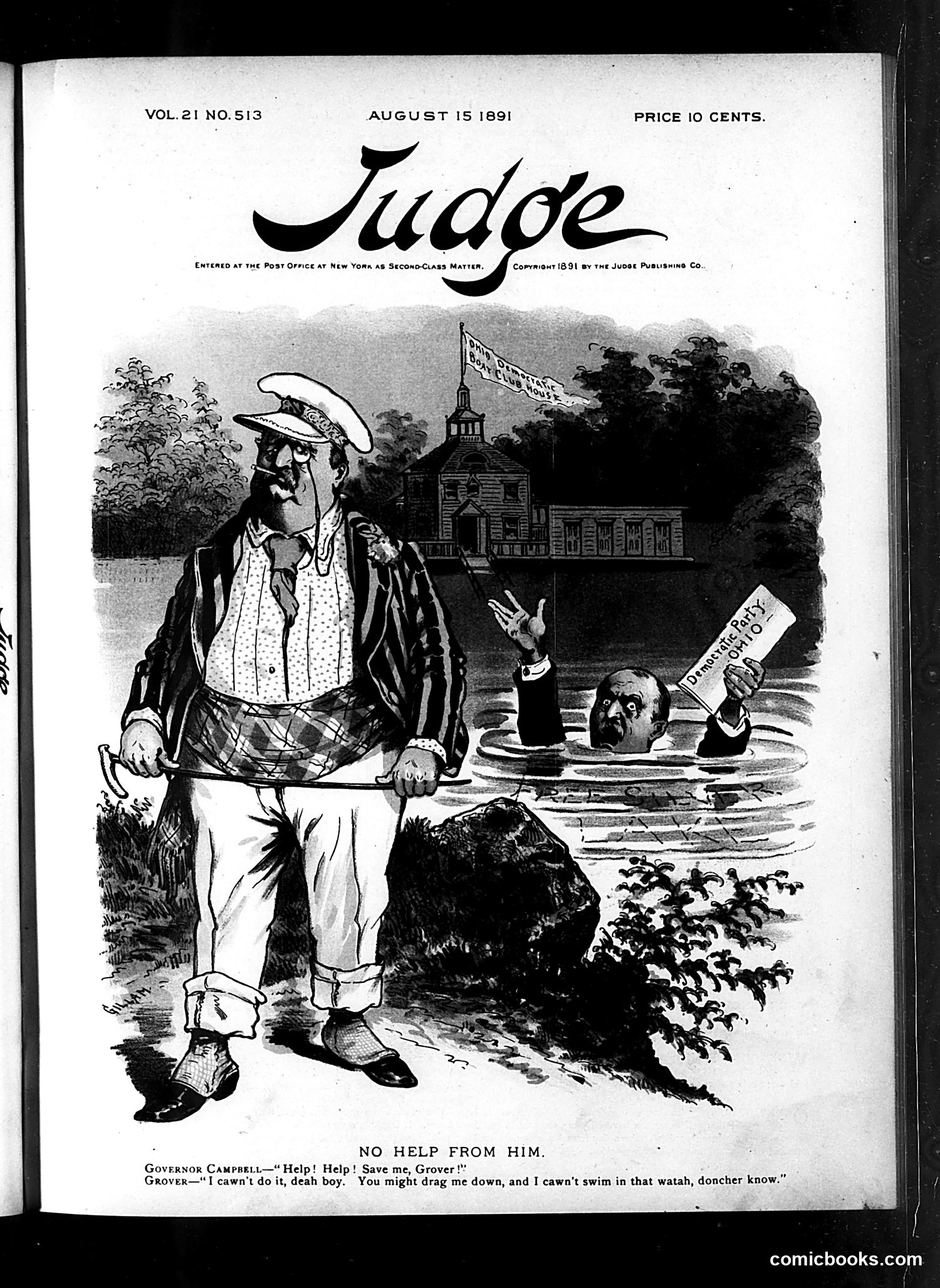
This cartoon depicts Governor Campbell (identified in caption) standing on shore while a drowning man labeled "Grover" struggles in water. The man holds a sign reading "Democratic Policy," and a church with a Democratic banner stands in the background. The drowning "Grover" clearly references President Grover Cleveland. The satire criticizes Campbell's refusal to aid Cleveland politically—the governor claims he "can't swim in that watah, doncher know," suggesting he won't support Democratic policies or the president's agenda. This likely relates to factional tensions within the Democratic Party during Cleveland's presidency (1885-1889, 1893-1897), where state-level politicians sometimes distanced themselves from unpopular federal positions.
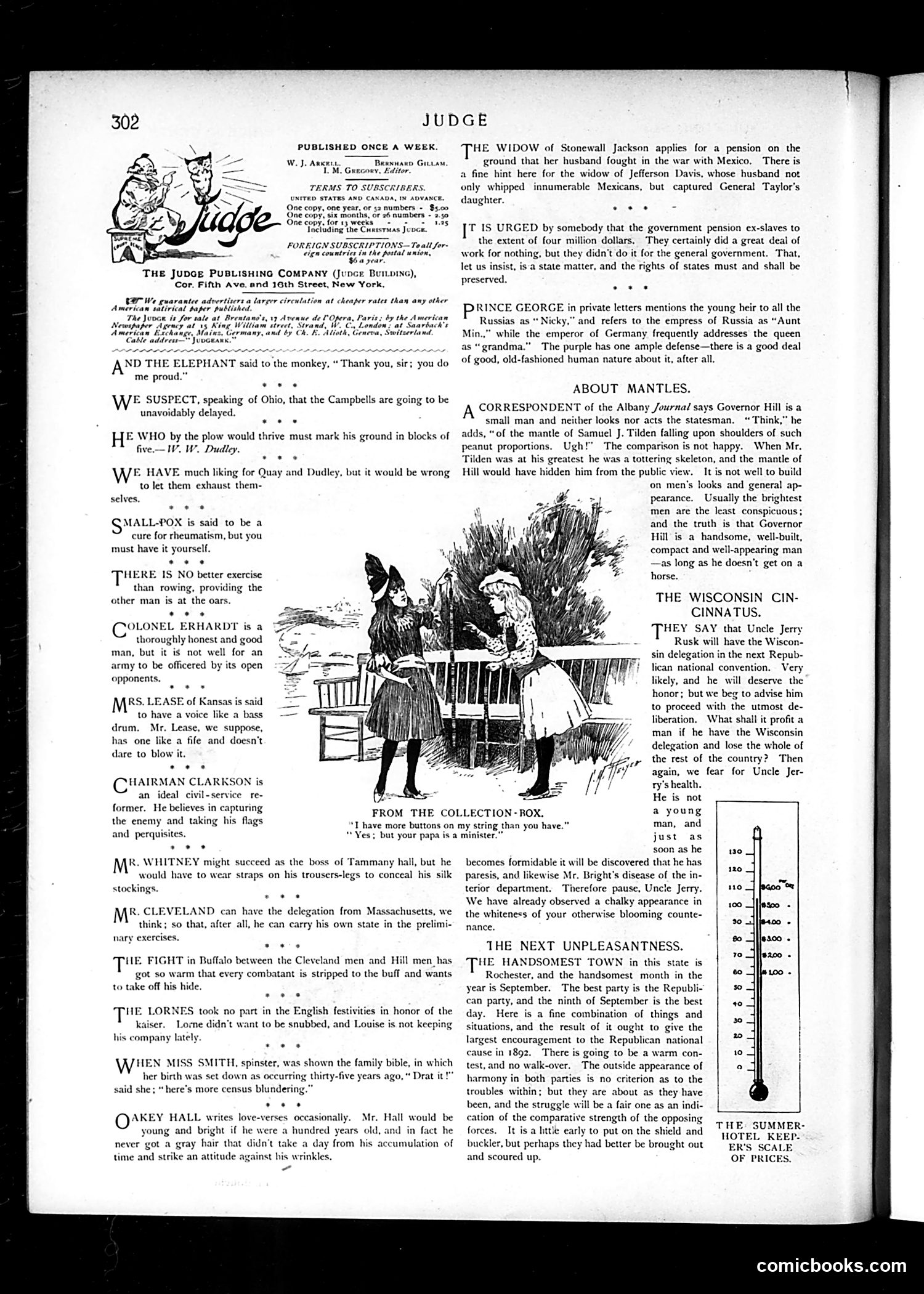
This page contains political commentary and satirical notes rather than a single cartoon. Key items include: **"About Mantles"** — A correspondent criticizes Governor Hill (likely New York's David B. Hill), describing him as small, unstatesman-like, and physically unattractive. The piece suggests his mantle of authority doesn't suit him, comparing his appearance unfavorably to Samuel Tilden. **"The Wisconsin Cincinatus"** — Commentary advising Uncle Jerry Rusk against leading the Wisconsin delegation at the next Republican convention, warning this could damage both him and the party. **"The Next Unpleasantness"** — Notes on Rochester as the "handsomest town" in the state, praising an upcoming Republican gathering while cautiously observing that party harmony masks underlying troubles. The page primarily features political gossip and commentary rather than visual satire.
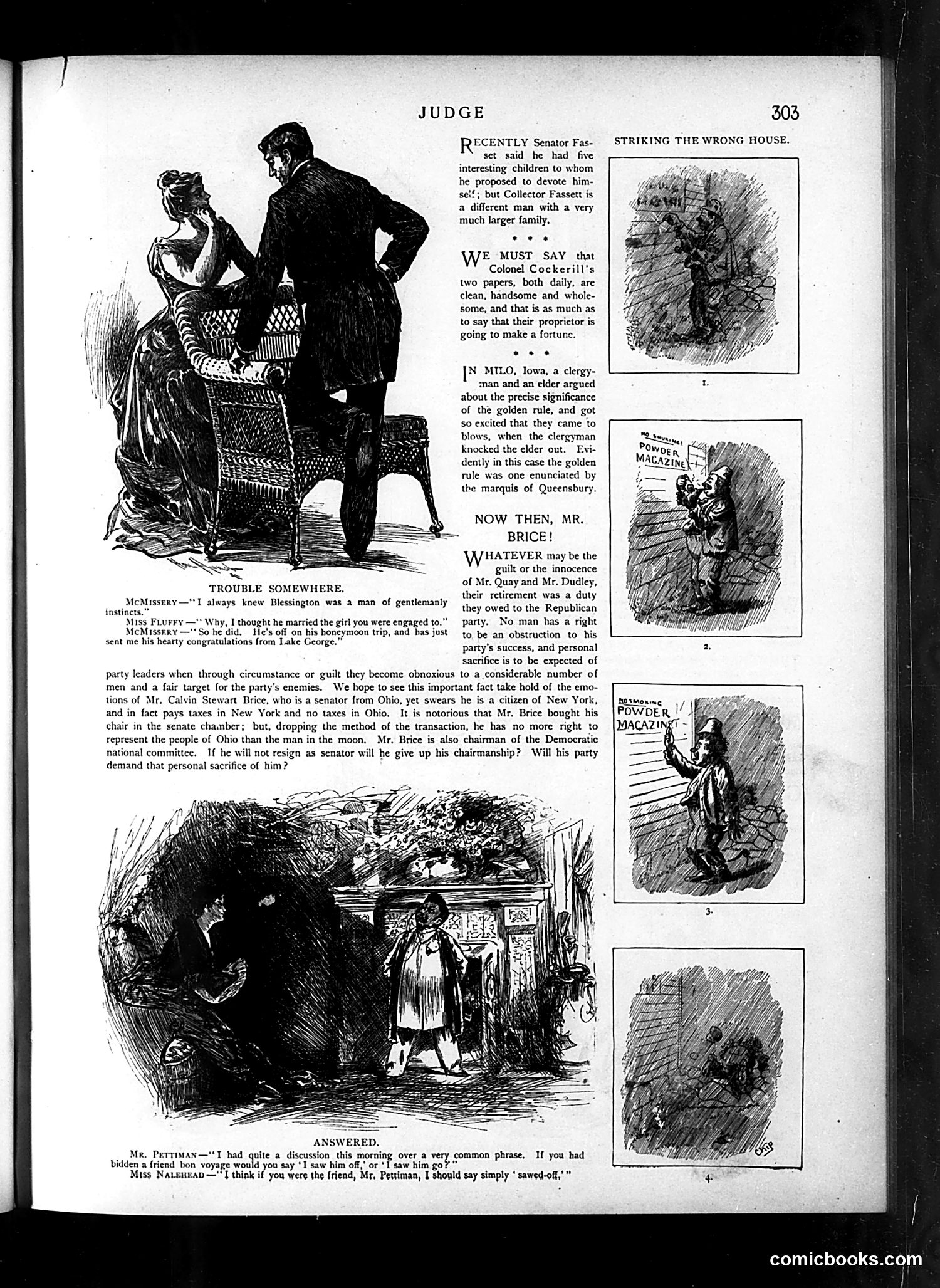
This page satirizes Republican Party politics, likely from the late 19th century. The main text discusses Senator Calvin Stewart Brice of Ohio, criticizing his dual residency and political maneuvering. The cartoon "Trouble Somewhere" depicts a gentleman (possibly Brice) in an awkward domestic situation with a woman, captioned with dialogue about marital infidelity—a visual metaphor for political betrayal. The "Striking the Wrong House" series (illustrations 1-4) on the right appears to show someone repeatedly knocking on incorrect doors seeking something, likely satirizing confused or misdirected political efforts. The "Answered" dialogue at bottom makes a pun about "saved-off" versus "saw off," playing on political jargon about removing party members from power.
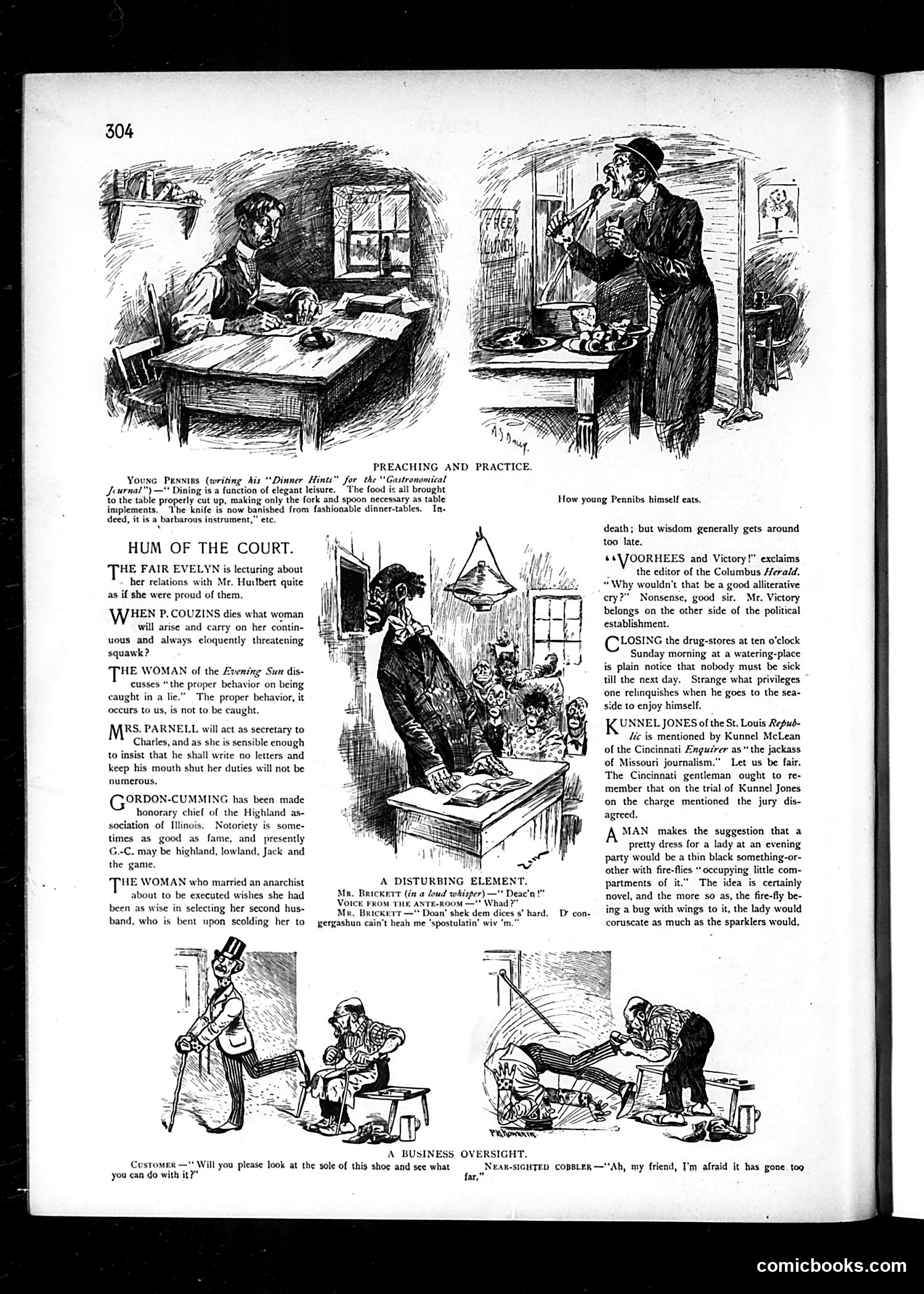
This page from Judge contains multiple brief satirical commentaries on contemporary social figures and behaviors, circa the 1880s-90s. The main cartoon "Preaching and Practice" mocks Young Pennis, who writes pretentious dining advice for a gastronomy journal denouncing knives as "barbarous," yet eats messily with his hands—exposing hypocrisy between his written prescriptions and actual conduct. The "Hum of the Court" section offers short jabs at various public figures: Fair Evelyn (appears to be a society figure); P. Cousins (likely a women's rights activist); Mrs. Parnell (wife of Irish politician Charles); Gordon-Cumming (apparently involved in a scandal); and a woman who married an anarchist. The sketches below illustrate everyday mishaps: a customer with a worn shoe sole, and a near-sighted cobbler admitting the damage is severe. Overall, Judge ridicules social pretension, celebrity gossip, and human folly through brief, disconnected vignettes typical of the magazine's satirical style.
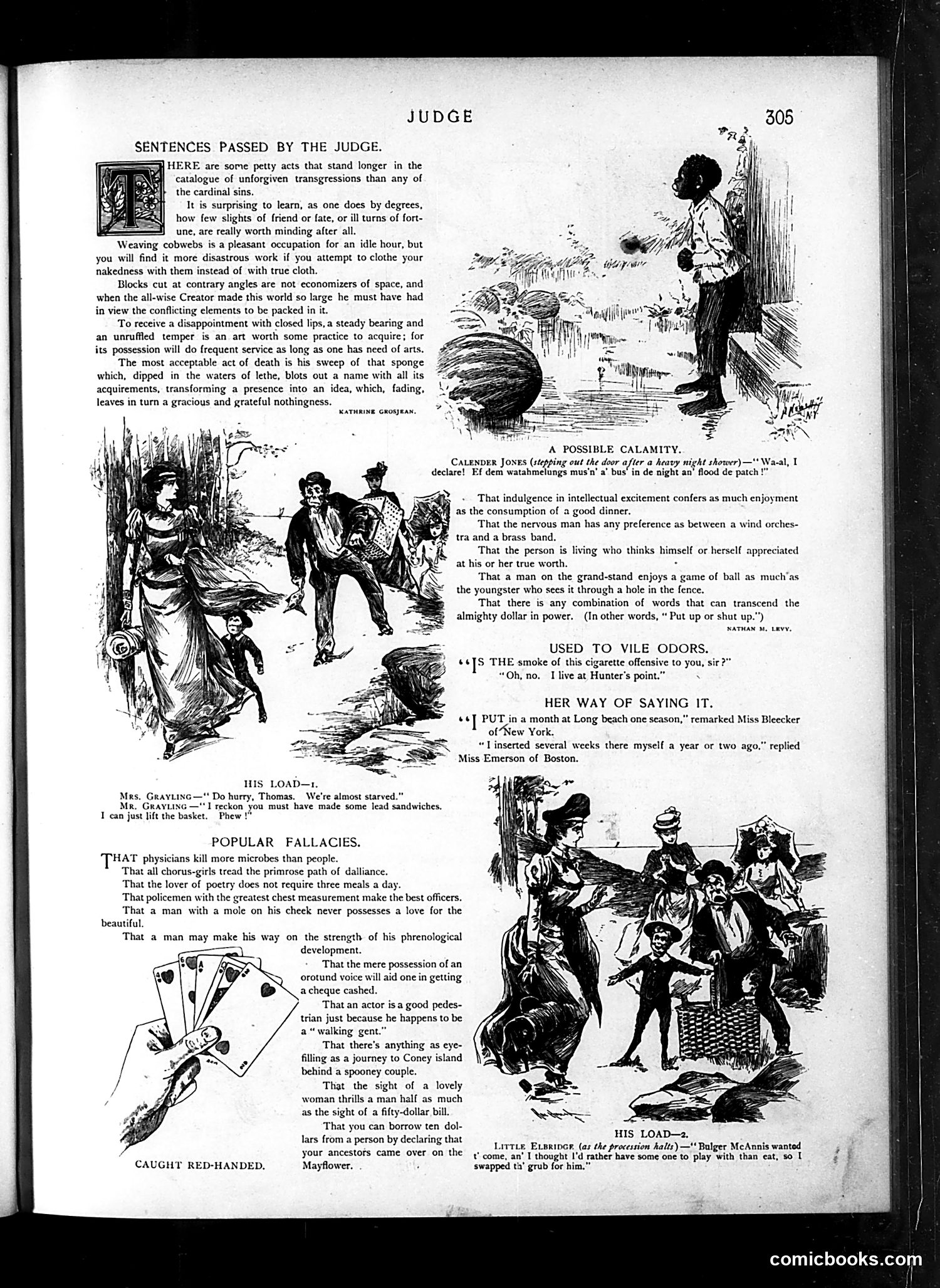
This page from Judge magazine contains several satirical pieces typical of American humor from the late 19th/early 20th century. The main content includes: **"Sentences Passed by the Judge"** — philosophical observations mocking human nature and pretension, including the idea that we overvalue money and hold grudges over trivialities. **"Popular Fallacies"** — a list debunking common assumptions (doctors kill more microbes than people; chorus-girls are immoral; poets don't need food; phrenology determines success). These mock pseudoscientific beliefs and social stereotypes of the era. **Comic vignettes** featuring working-class and rural characters with dialect humor: - A Black farmer ("Calendar Jones") worried about watermelons - References to Hunter's Point (likely a poor NYC neighborhood) - Mrs. Grayling's "lead sandwiches" joke (heavy load) The satire targets Victorian-era superstitions, class pretensions, and ethnic/racial stereotypes common to period humor. The cartoons accompany these pieces with sketches illustrating the jokes.
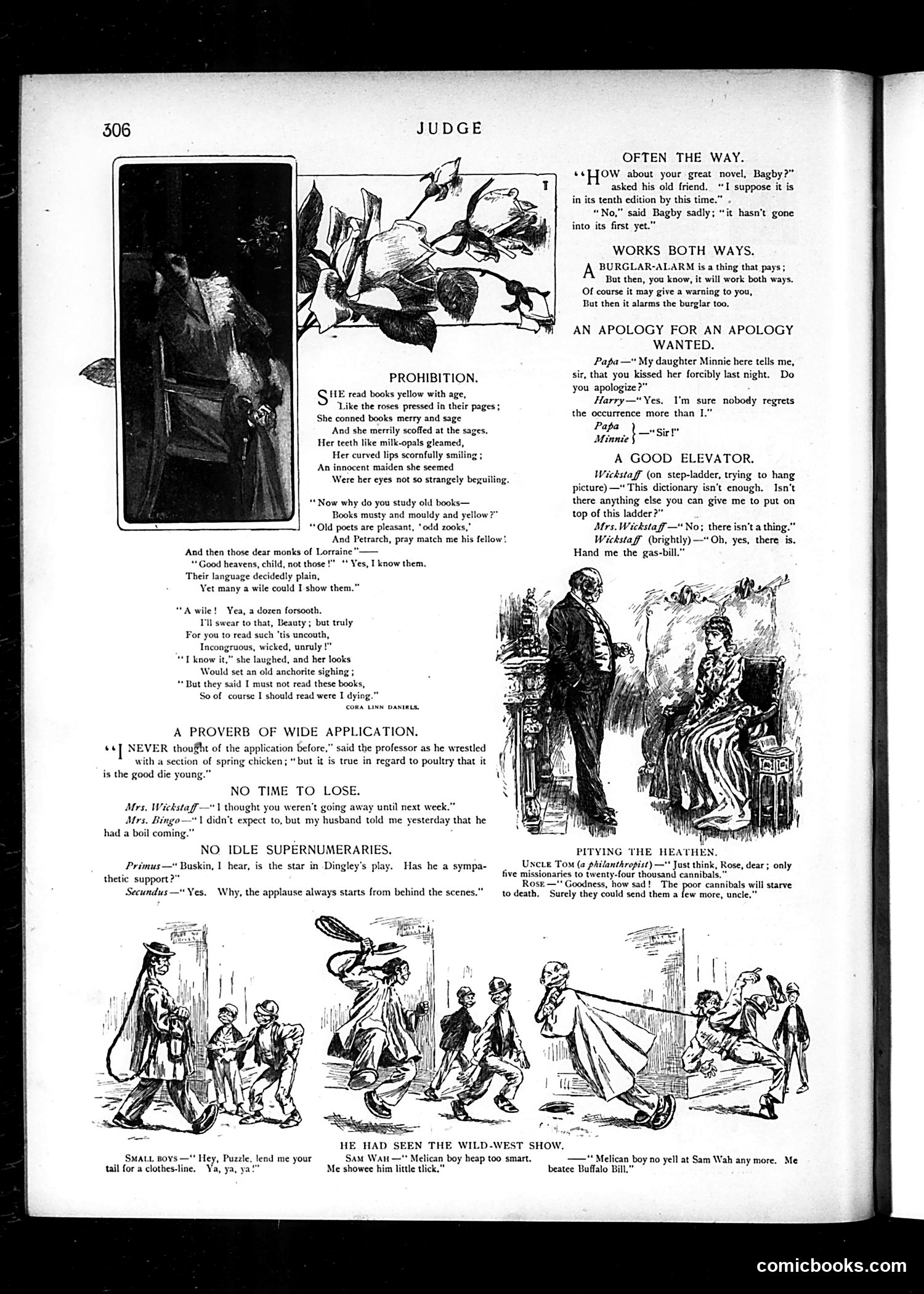
This page contains multiple short humorous pieces typical of early 20th-century satirical magazines: **"Prohibition"** is a poem mocking efforts to censor young women's reading. A girl defends reading "old books" (implying classical literature with adult content), claiming censorship only makes forbidden material more appealing—a satirical jab at prohibition-era moralism and book censorship. **Other brief comedic pieces** include domestic humor ("A Good Elevator" jokes about a gas bill's height), social commentary on burglar alarms working both ways, and commentary on missionary efforts ("Pitying the Heathen" satirizes self-satisfied do-gooders). **The cartoons** depict period stereotypes: exaggerated Asian characters ("Sam Wah") in "The Wild-West Show" section, and various domestic scenes. The humor relies on slapstick, wordplay, and gentle mockery of contemporary customs. The overall tone reflects Judge's satirical approach to American social anxieties around morality, technology, and immigration.
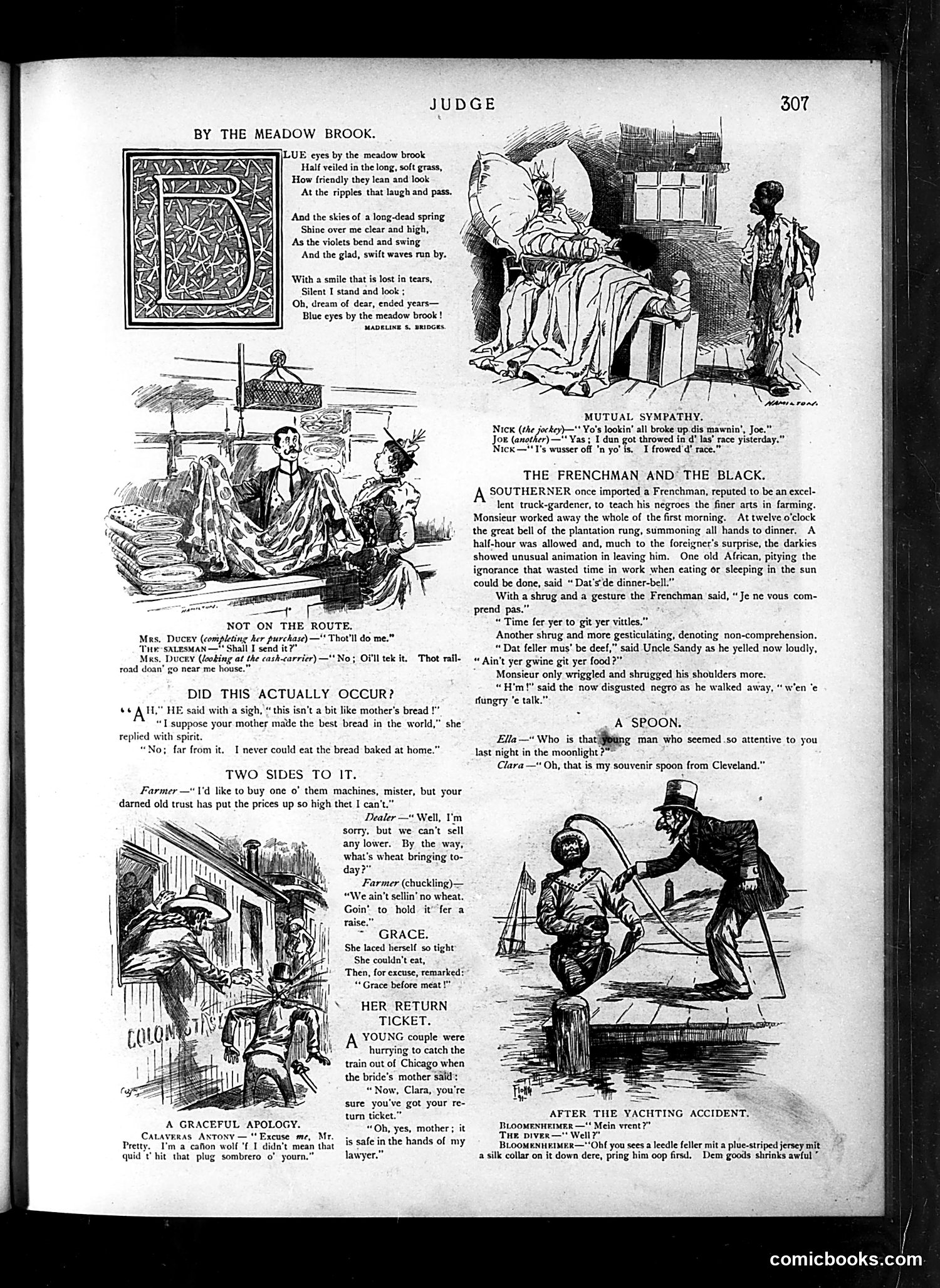
This page contains multiple unrelated satirical humor pieces typical of Judge magazine's format: **"By the Meadow Brook"** is a sentimental poem with illustration—likely mocking the era's overwrought romantic verse. **"Not on the Route"** satirizes rural Irish-American dialect and stubbornness: a woman refuses delivery service, insisting on carrying her purchase herself because the delivery route "don't go near me house." **"Two Sides to It"** criticizes agricultural monopolies: a farmer blames "the trust" for inflated machinery prices, while the dealer notes farmers withhold wheat from market hoping prices rise—exposing farmer hypocrisy about trusts. **"The Frenchman and the Black"** depicts a condescending scenario where an African American plantation worker cannot communicate with an imported French gardener, played for crude humor. **"A Spoon"** makes a pun about a "souvenir spoon"—novelty items hugely popular in the Victorian/Edwardian era—implying the woman's romantic interest is superficial. The cartoons reflect period prejudices while targeting everyday social absurdities and economic frustrations of early 20th-century America.
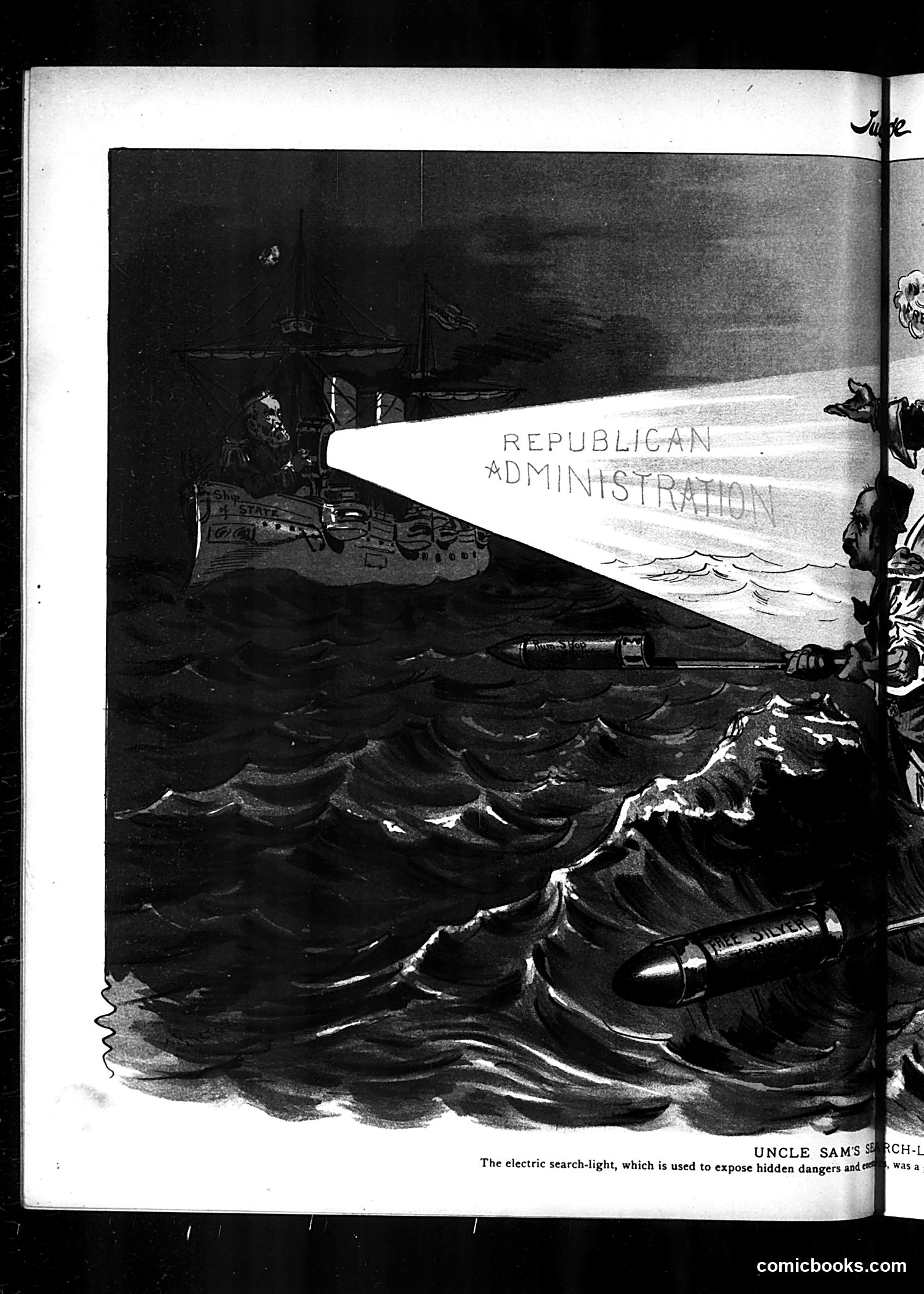
This is a political cartoon titled "Republican Administration" depicting Uncle Sam (personified as America) using a searchlight to illuminate dangers in turbulent seas. The banner labeled "Republican Administration" suggests the cartoon critiques Republican governance's approach to national security or crisis management. The searchlight represents attempts to expose "hidden dangers" — likely referencing threats the Republican administration claimed to address. The dark, churning waters and ominous ship suggest peril or instability. The cartoon appears satirical, questioning whether the Republican administration's methods actually revealed real dangers or merely created theater to justify their policies. The incomplete OCR text prevents full certainty of the specific historical context, but the imagery suggests commentary on Republican crisis management during an uncertain period.
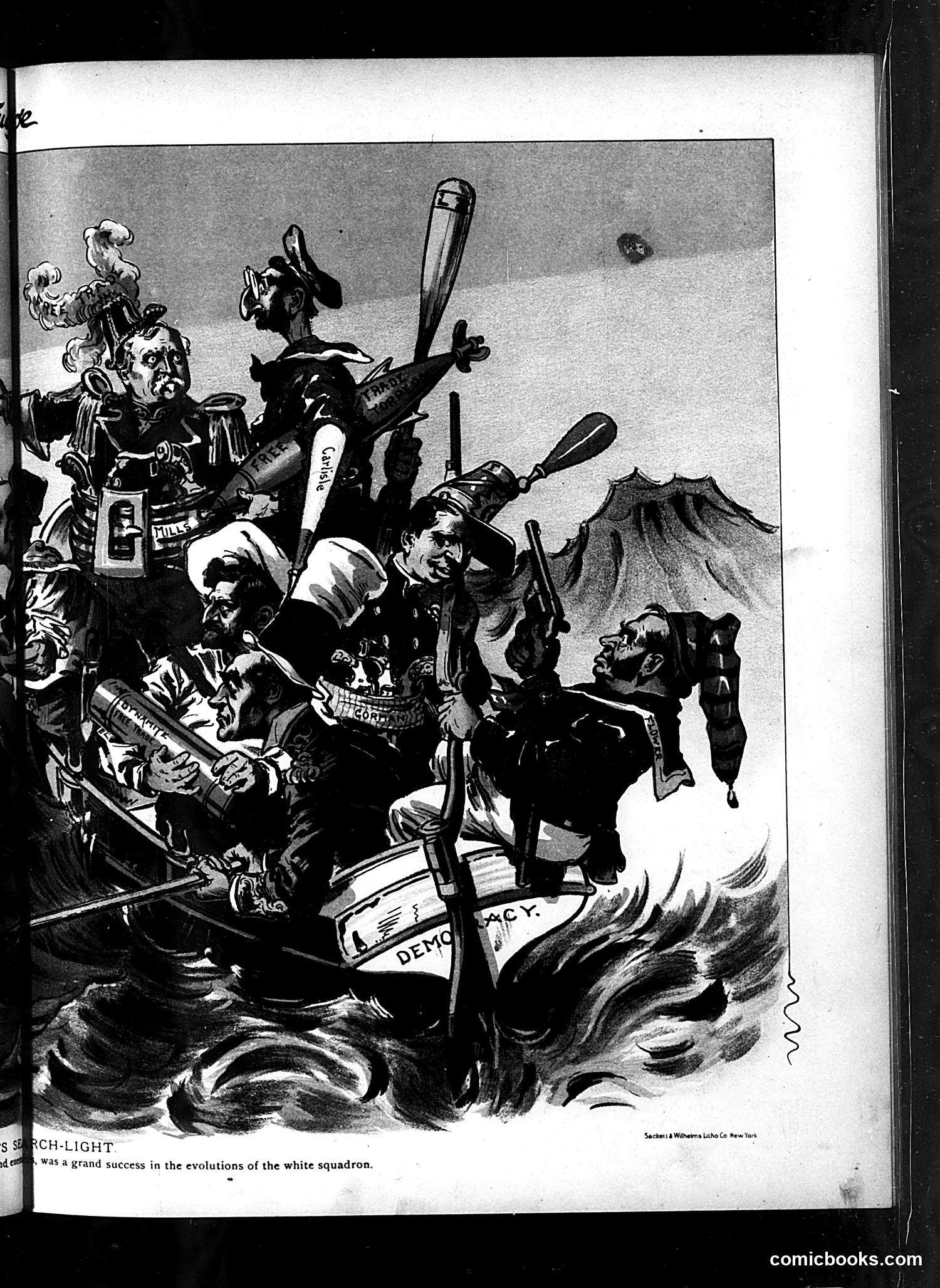
This appears to be a satirical cartoon from *Judge* magazine depicting military or naval conflict. The image shows uniformed figures in a dramatic, violent scene with weapons and what appears to be a sinking vessel labeled "DEMOCRACY." The cartoon seems to critique a naval maneuver or military action ("evolutions of the white squadron"), using the drowning of democracy as its central metaphor. The military figures—rendered with exaggerated features typical of period satire—appear complicit in or celebratory about democracy's demise. Without clearer text or a visible date, I cannot identify the specific historical event referenced. However, the cartoon likely critiques how a military operation was presented as successful while actually undermining democratic principles. The ironic caption suggests public celebration masked a troubling reality.
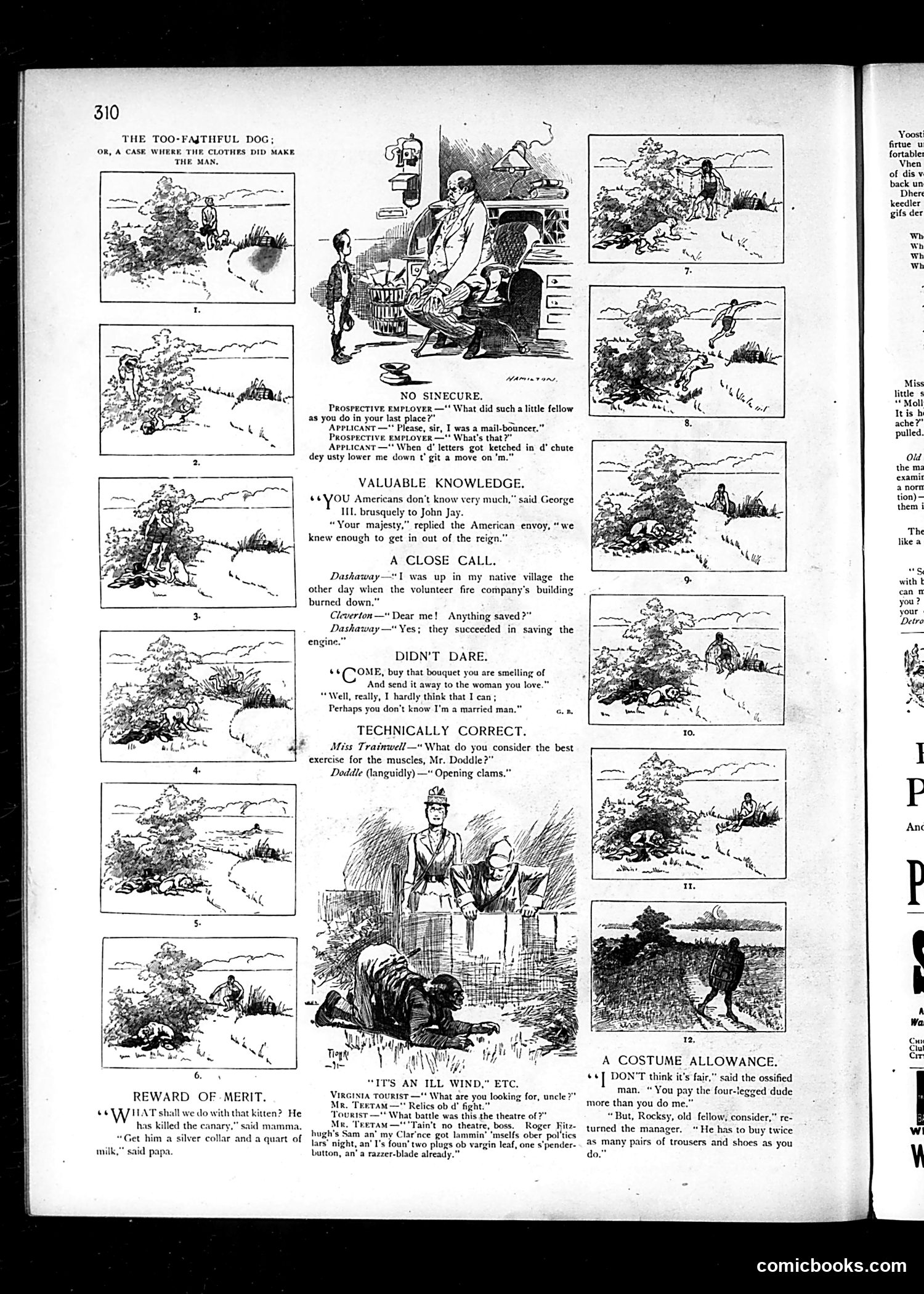
This page from *Judge* magazine contains multiple short humorous pieces typical of early 20th-century American satire: **"NO SINECURE"** mocks job interviews, with an applicant's malapropism ("mail-bouncer") exposing his lower-class status and limited education. **"VALUABLE KNOWLEDGE"** appears to reference George III, likely a historical joke about American independence or diplomatic superiority. **"DIDN'T DARE"** is a marriage joke: a man won't send flowers to a woman because he's married—implying infidelity or marital restrictions. **"TECHNICALLY CORRECT"** puns on "opening clams" as exercise. **"IT'S AN ILL WIND"** depicts a Virginia tourist mishearing "battle" and describing a local fight between "Sam" and "Clarence" over politics. **"A COSTUME ALLOWANCE"** is a vaudeville joke where a four-legged animal performer gets more clothing allowance than a human colleague because he needs more pants and shoes. The cartoons emphasize class differences, regional dialects, and wordplay—humor accessible to *Judge's* educated audience.
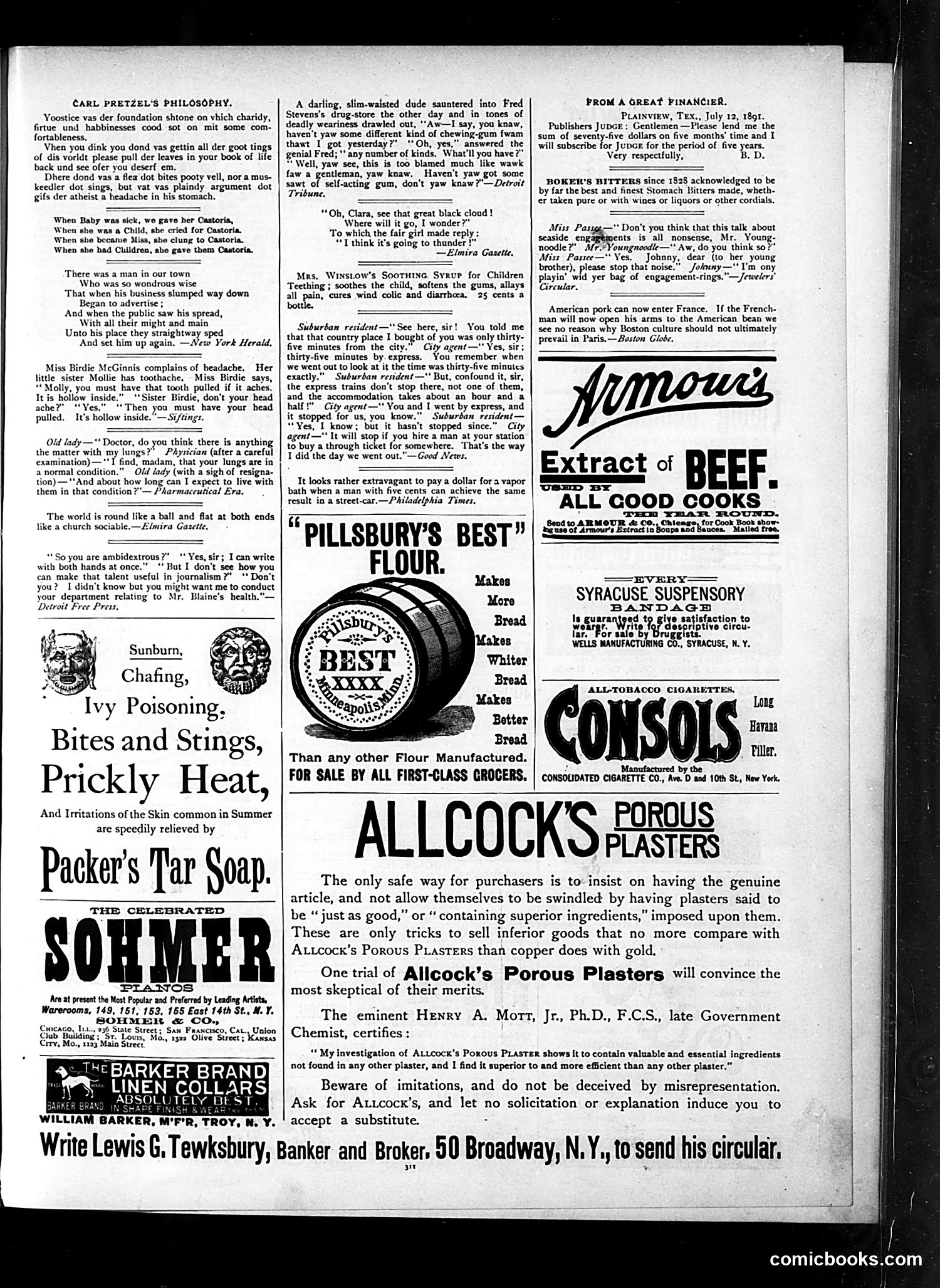
This page is primarily **advertisements and humorous filler pieces** rather than political satire. The content reflects late 19th-century American humor and commercial culture. The cartoons and jokes target: 1. **German immigrants** ("Carl Pretzel's Philosophy")—ethnic humor using deliberate misspellings of German-accented English, common in period satire 2. **Urban sophistication mockery**—the "slim-waisted dude" joke mocks wealthy dandies seeking labor-saving conveniences, reflecting class anxiety about leisure-class excess 3. **General absurdist humor**—puns, logical fallacies, and domestic situations (the hollow-headed girl joke, the self-acting chewing gum bit) The page is dominated by **patent medicine and consumer product advertisements** (Castoria, Sohmer Pianos, Packer's Tar Soap), reflecting Judge's primary revenue source. These ads showcase period commercial culture and medical quackery that would seem absurd to modern readers. No specific political figures or events appear identifiable on this page.
This page is primarily **advertising**, typical of late-19th-century American magazines. The layout includes commercial advertisements for tobacco, beef extract, pianos, cigars, hotels, chocolate, and other consumer goods interspersed with brief humorous anecdotes. The few non-commercial items are small jokes and quips positioned between ads: - A romantic joke about winning affection through kissing rather than reason - A child's wordplay about holes in shoes - A anecdote about an Arizona boy using a harmless snake to frighten tramps - A flirtation tip about testing a suitor's interest through shirt-tying These are lighthearted, domestic humor typical of Judge's satirical tone—poking gentle fun at courtship, parenting, and everyday situations. There are no identifiable political cartoons or caricatures on this page. The content reflects turn-of-the-century American middle-class concerns and consumer culture.
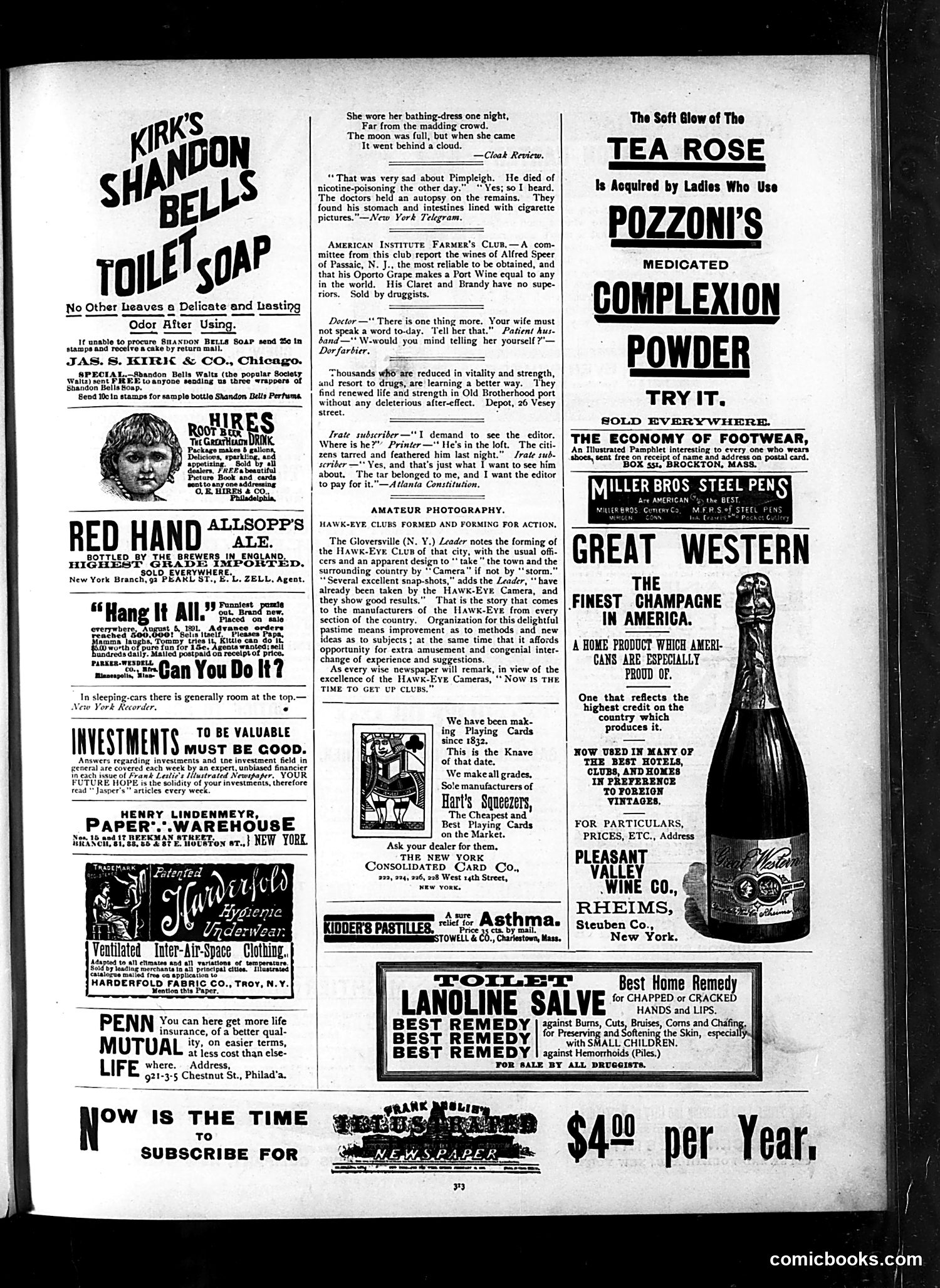
This page is primarily **advertising**, typical of late 19th-century American magazines. The content consists almost entirely of product advertisements interspersed with brief humorous anecdotes rather than editorial cartoons. The few jokes present are mild period humor: one mocks a man's death from "nicotine-poisoning" (cigarette consumption), another plays on marital silence humor ("doctor tells wife not to speak"), and a third concerns a printer tarred and feathered by citizens—a common frontier justice reference. A final quip about sleeping-car space suggests upward mobility aspiration. The advertisements reflect contemporary concerns: patent medicines (asthma cure, lanoline salve), ladies' complexion powder, ale and wine products, insurance, and photography equipment (Hawk-Eye cameras). The page demonstrates how Judge balanced satire with commercial revenue, with advertising dominating over actual satirical content.
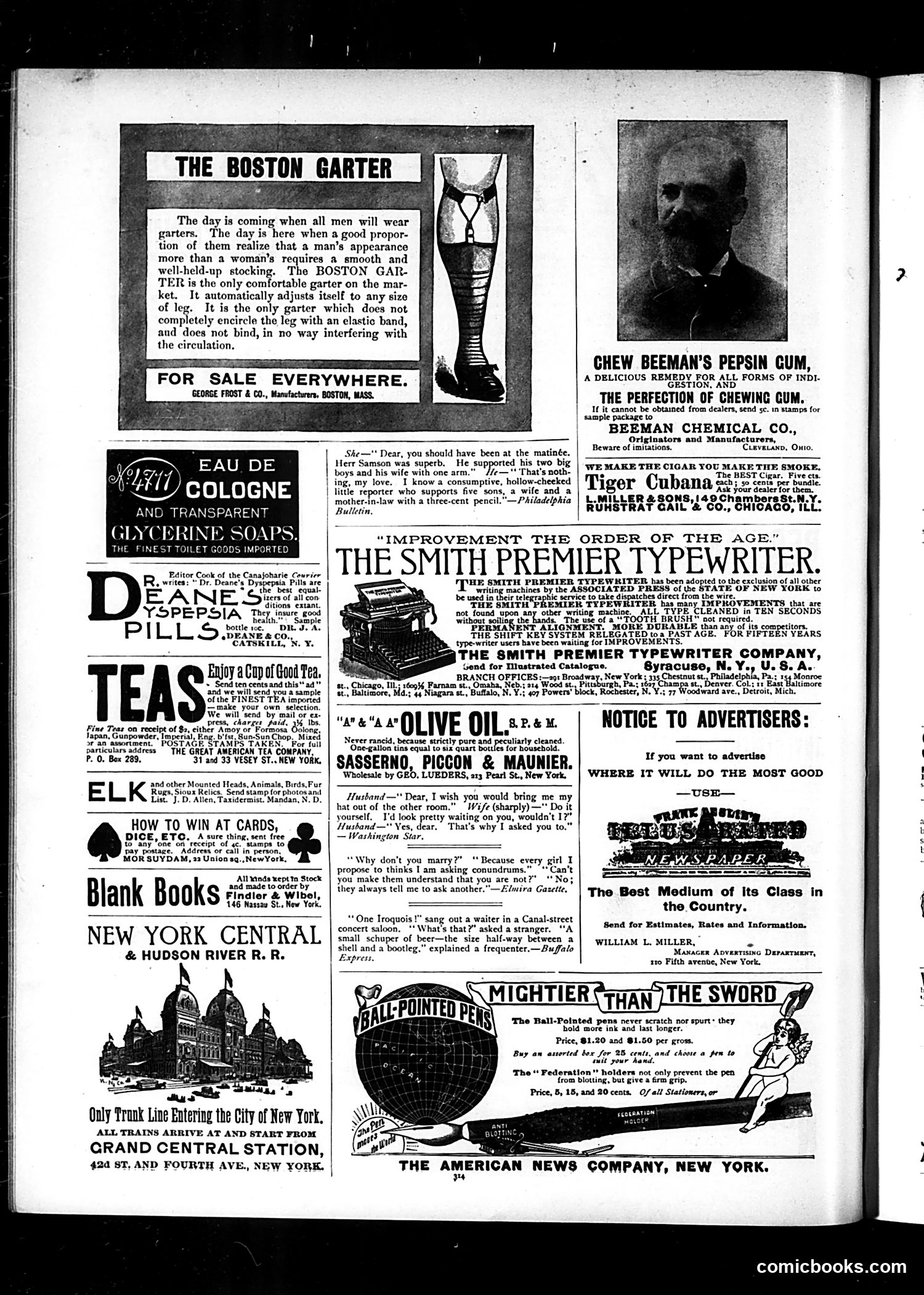
This is primarily an **advertising page** from Judge magazine, featuring product promotions for late-19th/early-20th-century goods rather than political cartoons. The few illustrative elements include: **The Boston Garter ad**: Shows a leg in a garter, promoting this as superior to competitors because it doesn't completely encircle the leg with elastic, allowing better circulation—responding to contemporary concerns about men's grooming and health. **Small comedic snippets** scattered through the text (dialogue about a matinee performer, a husband-wife exchange about hats) are light domestic humor typical of period magazines. **Notable products advertised**: Smith Premier Typewriter (competing with Underwood), Beeman's Pepsin Gum (a digestive remedy), Boston Garter, various teas, olive oil, and pens. The page reflects **Gilded Age consumer culture**—marketed products address gentlemen's fashion, health remedies (pepsin gum for indigestion), and new technology (typewriters). There's minimal political content; instead, it captures commercial messaging and gentle domestic satire characteristic of Judge's lighter editorial matter.
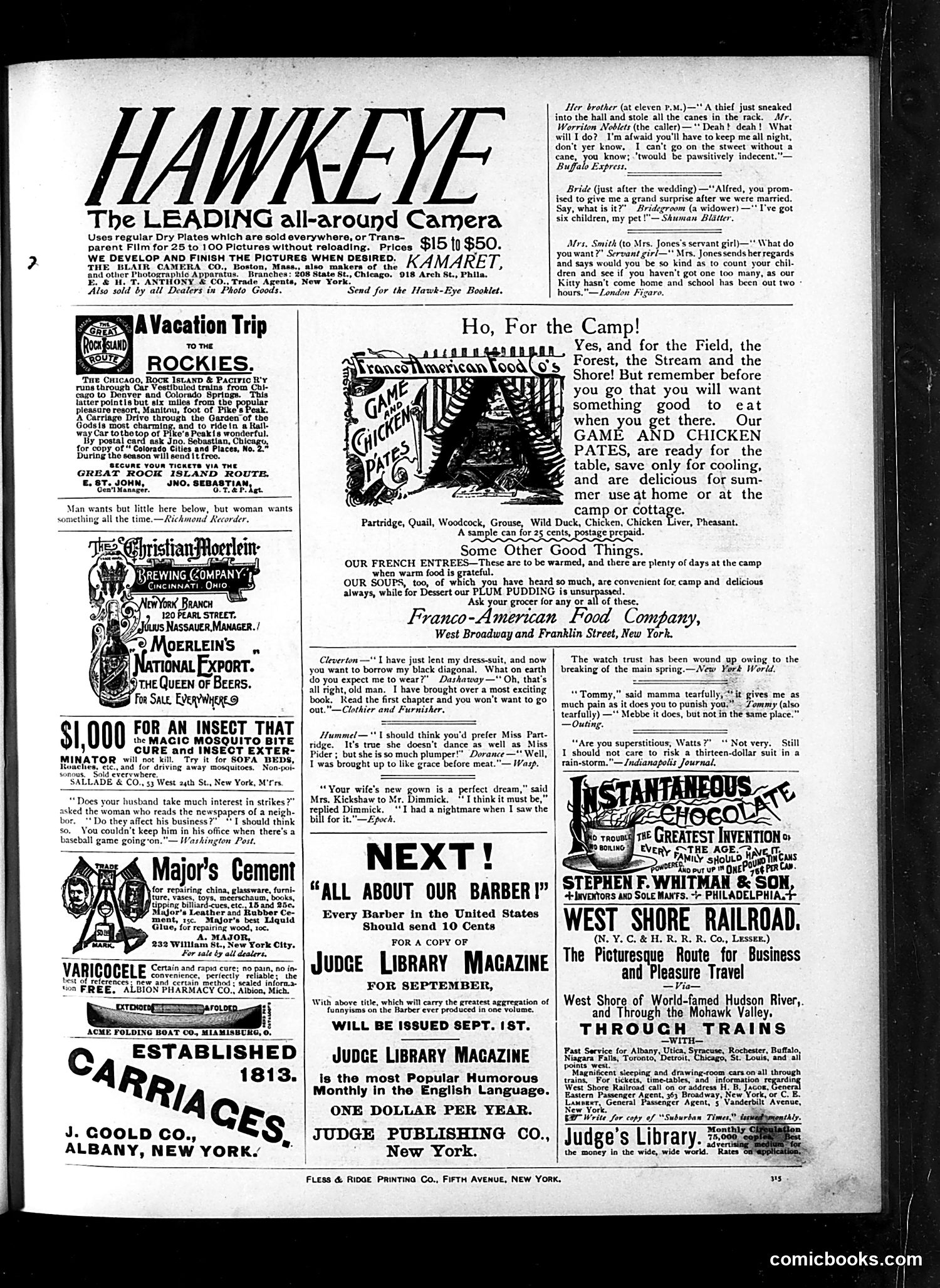
This is primarily an **advertising page** from Judge magazine, not a satirical section. The page contains mostly commercial advertisements for products like cameras, food, cement, and railroad travel. The few **jokes/cartoons** present are brief domestic humor pieces typical of the era: - A caller stuck without his cane after a theft, forced to stay overnight (plays on period etiquette requiring walking sticks) - A newlywed's "surprise" being six stepchildren (remarriage humor) - A servant girl asking if the neighbor has an "extra" child (implying one resembles theirs) These represent **genteel, middle-class humor** about social conventions and domestic life rather than political satire. The **Franco-American Food Company advertisement** prominently features canned game and chicken pâtés marketed for camping—reflecting the era's growing leisure culture. The overall page reflects **early 1900s consumer culture** and advertiser-supported magazine economics rather than Judge's satirical mission.
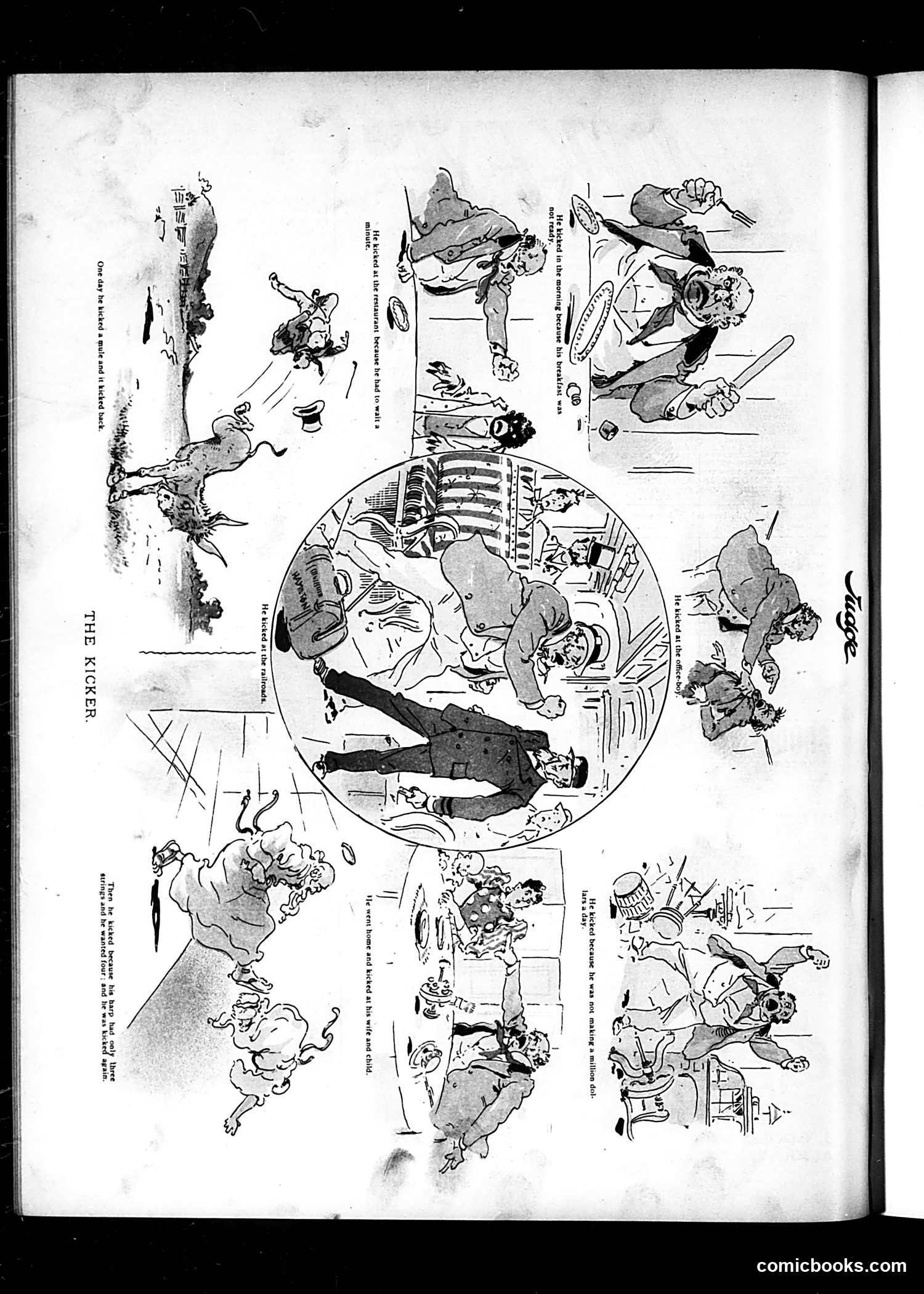
I can see this is a page from *Judge* magazine featuring "The Kicker" as the title. The layout contains a central circular illustration surrounded by smaller comic vignettes showing various characters in different situations. The central image appears to show a formal interior scene with multiple figures, while the surrounding panels depict comedic scenarios. However, the OCR text provided is incomplete and doesn't include the actual caption or article text needed to explain the specific political or social satire. Without readable captions or context text, I cannot reliably identify the specific figures, reference the particular political events being satirized, or explain the satirical point with accuracy. The illustration style and layout suggest early-to-mid 20th century American satire, but more information is needed for proper interpretation.