
A complete issue · 20 pages · 1891
Judge — March 21, 1891
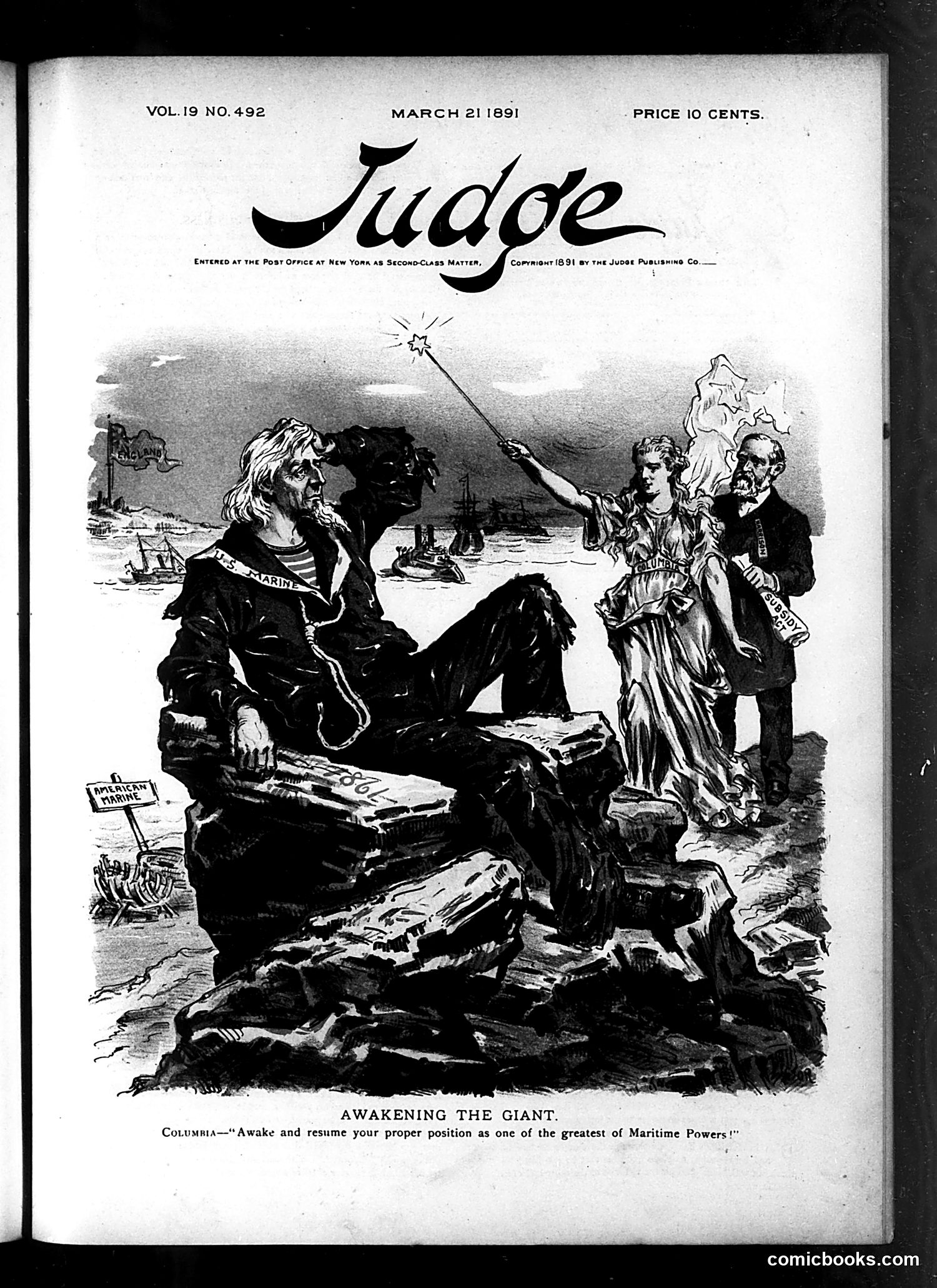
This political cartoon depicts Columbia (female personification of America, center-right) attempting to rouse the United States from slumber. The sleeping figure on the left, labeled with a sailor's cap, represents America's dormant maritime power. Columbia urges him to "awake and resume your proper position as one of the greatest of Maritime Powers!" The satire critiques American naval weakness in the 1890s. The "American interests" sign visible at left references competing imperial powers. The cartoon advocates for American naval expansion and greater maritime influence—a common theme during this era of rising imperialism and navalism. The "giant" metaphor suggests latent American potential waiting to be mobilized on the world stage.
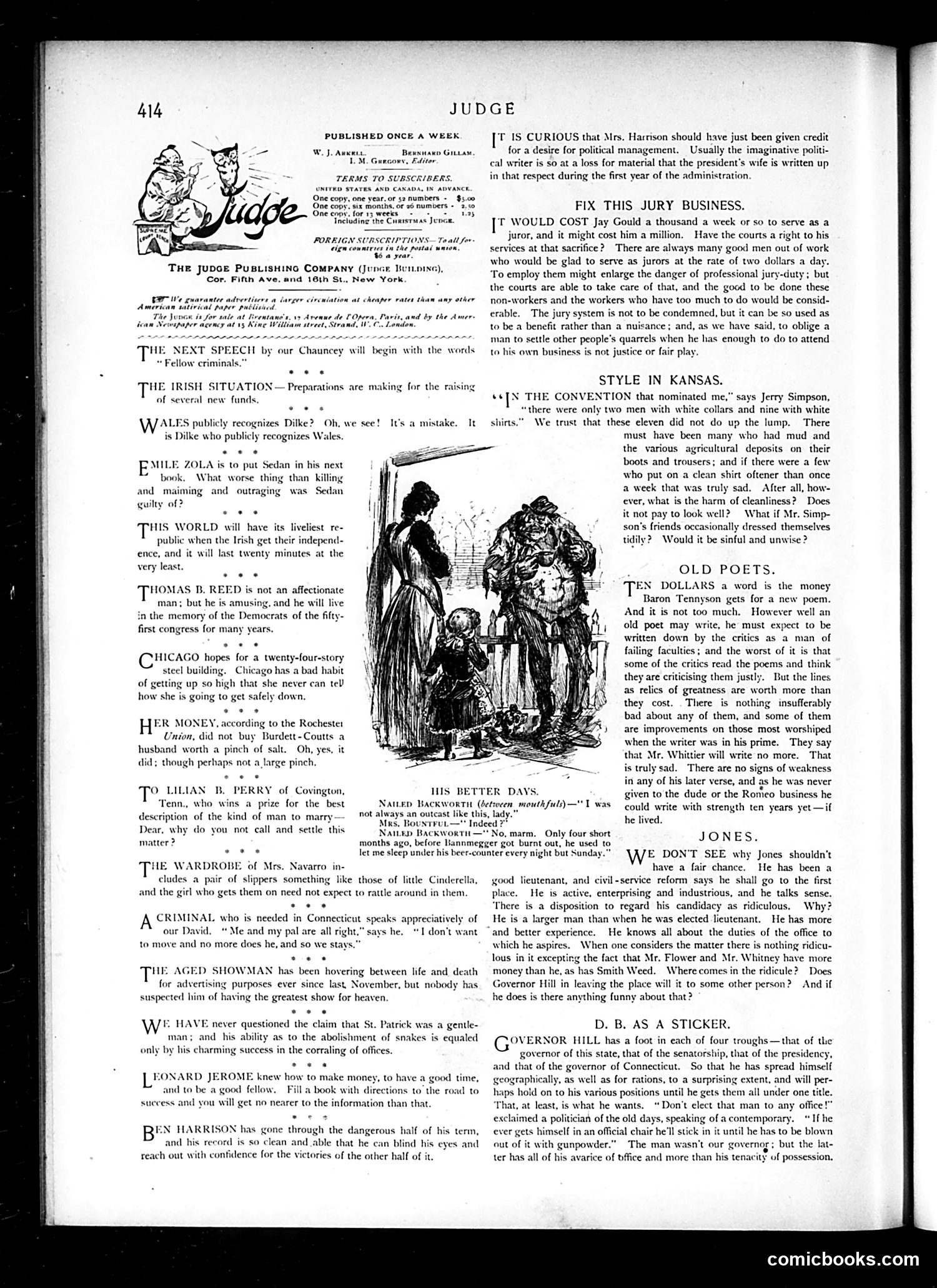
The main illustration titled "His Better Days" depicts a poorly dressed man in tattered clothing speaking to what appears to be a well-dressed woman. The caption references "Nailed Hackworth" and mentions someone who "used to do sleep under his beer-counter every night but Sunday." This cartoon satirizes economic hardship and downward mobility—likely commenting on unemployment or poverty during a period of economic difficulty. The contrast between the man's current destitute state and his implied former respectability ("his better days") suggests social commentary on class decline or economic instability affecting working men. The surrounding text discusses political and social issues typical of Judge's satirical commentary, though specific contemporary references are unclear without additional historical context about the magazine's publication date.
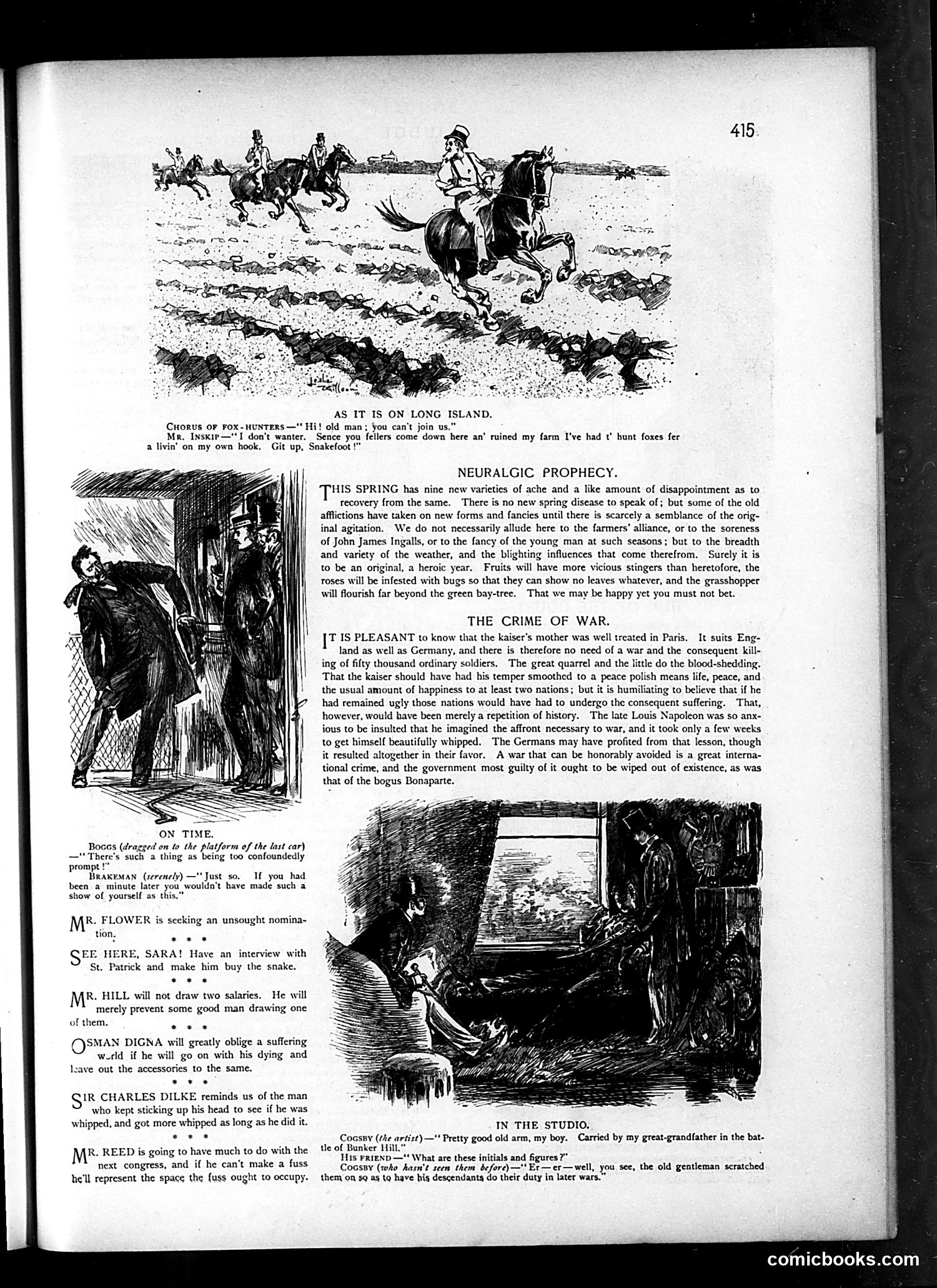
**Top illustration ("As It Is on Long Island"):** A fox-hunting scene depicting riders on horseback chasing foxes. The caption shows a conversation where a hunter claims he "can't join" because "fellas come down here an' ruined my farm I've had" by hunting foxes for sport. This satirizes the conflict between wealthy Long Island sportsmen and local farmers whose property was damaged by recreational fox hunting. **Text sections:** The page contains editorial commentary on topics including spring weather affecting crops ("Neuralgic Prophecy"), and what appears to be war-related commentary. The bottom illustrations show studio scenes and domestic life vignettes with conversational captions typical of Judge's satirical commentary on contemporary social situations. The overall focus appears to be rural/agricultural concerns versus urban leisure activities.
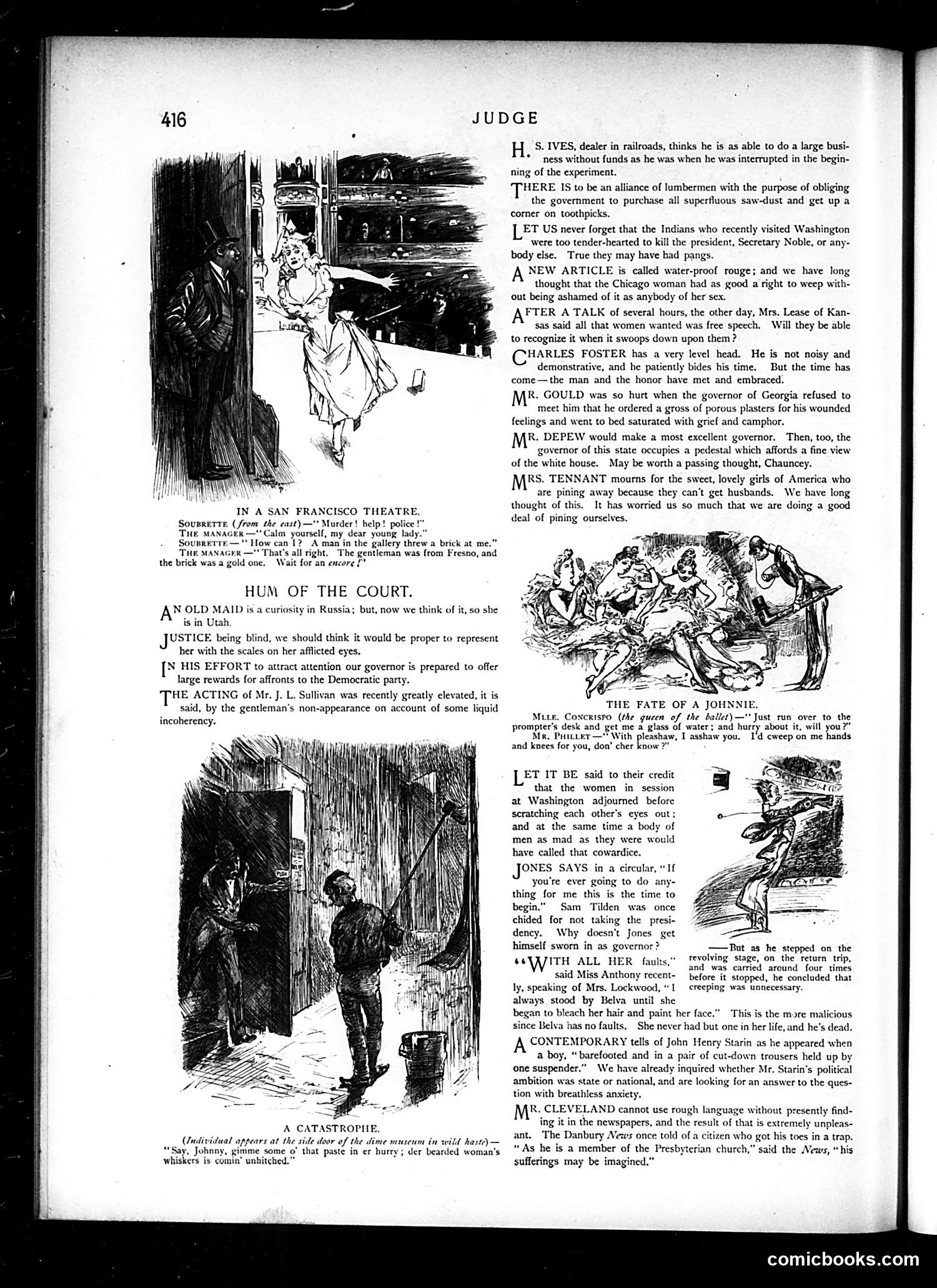
This page collects brief satirical jabs at American political and social figures. Key targets include: **H.S. Ives**: A railroad dealer mocked for doing business without funds—a reference to financial scandal or incompetence. **Mrs. Lease of Kansas**: A women's suffrage advocate (Mary Elizabeth Lease) satirized for demanding "free speech" while apparently unable to recognize actual freedom of expression. **Jay Gould**: The wealthy industrialist ridiculed for being emotionally fragile when a Georgia governor refused to meet him. **Chauncey Depew**: A politician considered for governor, with sarcastic praise for his "level head." **Susan B. Anthony and Belva Lockwood**: Women's rights figures mocked for personal appearance changes (hair bleaching, makeup). The theater sketch jokes about rough California frontier culture. Overall, the page reflects Gilded Age elite anxieties about labor movements, women's suffrage, railroad magnates, and political ambition—using personal ridicule as ammunition against social change.
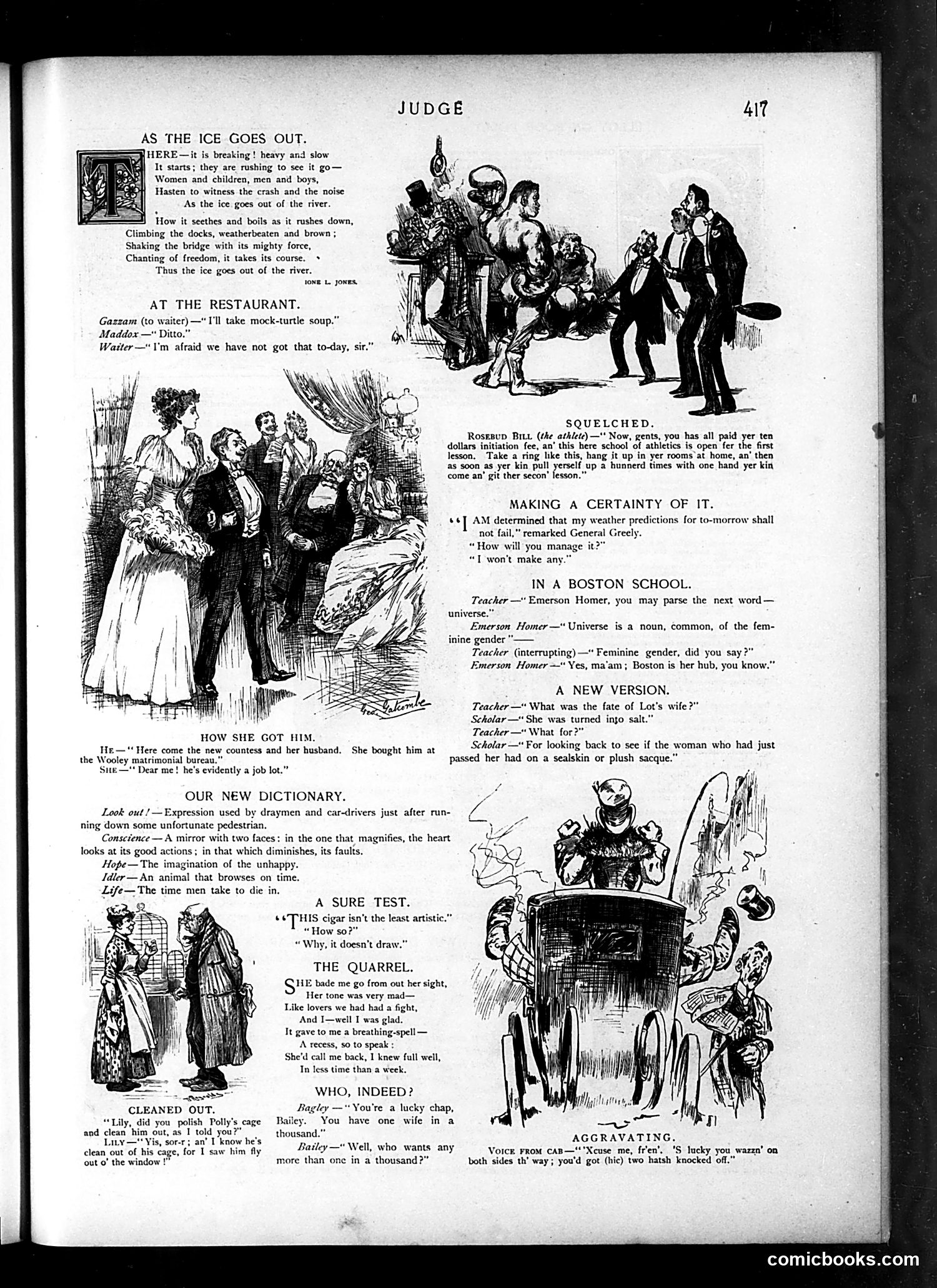
This page contains multiple short humorous pieces typical of late-19th/early-20th-century satirical magazines: **"As the Ice Goes Out"** is a sentimental poem about spring thaw—a seasonal event that drew crowds. The accompanying illustrations show daily life scenes. **Restaurant dialogue** mocks pretentious diners ordering "mock-turtle soup" (an imitation dish), only to be told it's unavailable—ironic deflation of their affected tastes. **"Squelched"** ridicules a charlatan athletic instructor selling fake credentials to gullible initiates. **General Greely joke** plays on the general's weather prediction failures by having him admit he'll make no predictions to ensure success. **Boston School** scene uses local pride humor—a student named "Emerson Homer" defines Boston as feminine because it's "her hub," referencing Oliver Wendell Holmes's famous phrase about Boston. **"Lot's Wife"** adapts the biblical story with contemporary fashion snobbery—the scholar jokes she looked back to check another woman's expensive coat. Other pieces satirize matrimonial agencies, dictionary definitions, and marital quarrels. The humor is gentle, domestic, and class-conscious rather than politically charged.
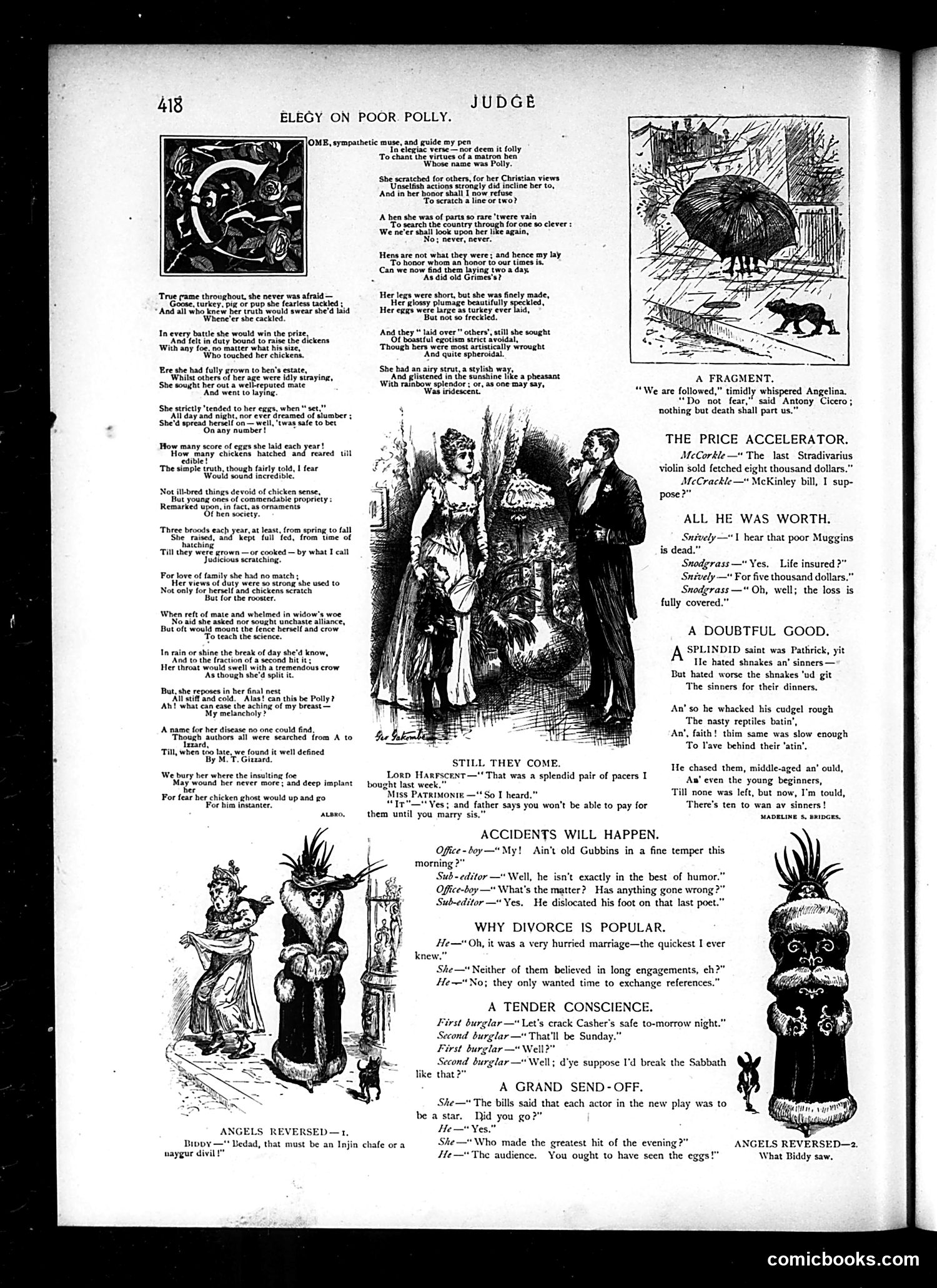
This page is primarily a humorous **elegy—a mock-serious poem mourning a deceased hen named Polly**. The satire lies in treating an ordinary farm bird with the grandiose language and sentimentality reserved for human eulogies. The poem celebrates Polly's domestic virtues: her egg-laying productivity ("three broods each year"), her maternal devotion, her courage defending the henhouse, and her dignified bearing ("glistened in the sunshine like a pheasant"). The joke targets Victorian sentimentality and overwrought commemorative writing by applying it absurdly to poultry. References like "M.T. Gizzard" (a pun on "gizzard") confirm the humorous intent. The page also includes several brief comic dialogues below the poem—typical Judge humor involving social situations and wordplay—though these are disconnected from the main elegy and require less historical context.
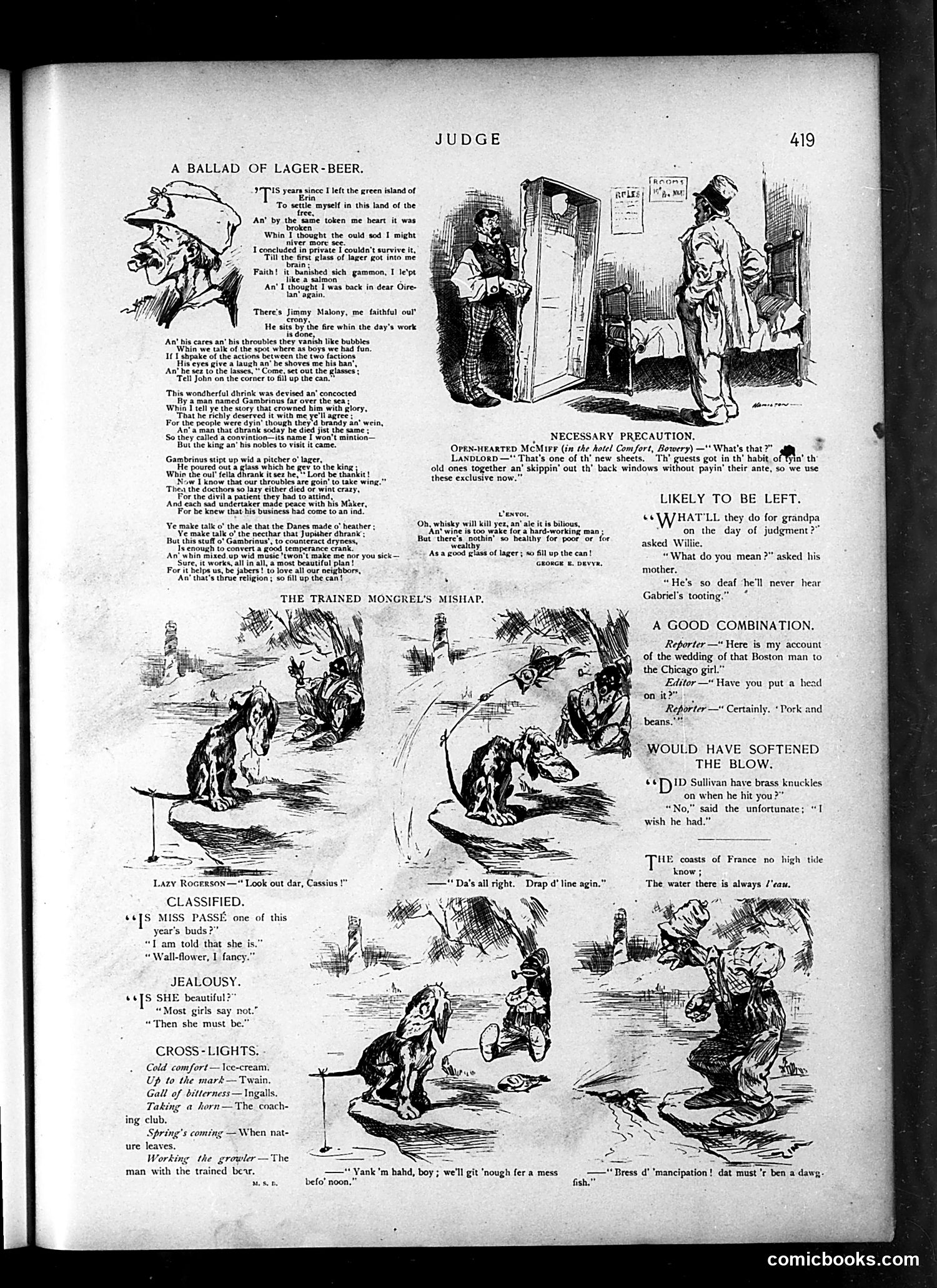
This page contains primarily light humor and social commentary typical of Judge magazine's era. **"A Ballad of Lager-Beer"** is a comic poem celebrating lager beer, written in Irish-immigrant dialect. It presents beer as a cure-all that saved people from despair and replaced ineffective medicines and alcohol. The verse likely reflects both genuine Irish-American immigration experience and period attitudes toward beer as wholesome compared to whiskey. **The cartoon panels** show domestic and working-class scenes with minimal political content—a hotel manager explaining why he uses cheap sheets (guests steal them), a child's naive question about grandfather at judgment day, and workplace mishaps. **"Cross-Lights"** offers puns on contemporary political figures and topics, though specific references are unclear without additional context. The page is primarily entertainment rather than serious satire, reflecting Judge's role as a humor magazine for middle-class readers. The Irish-dialect poem may carry some ethnic stereotyping typical of the era.
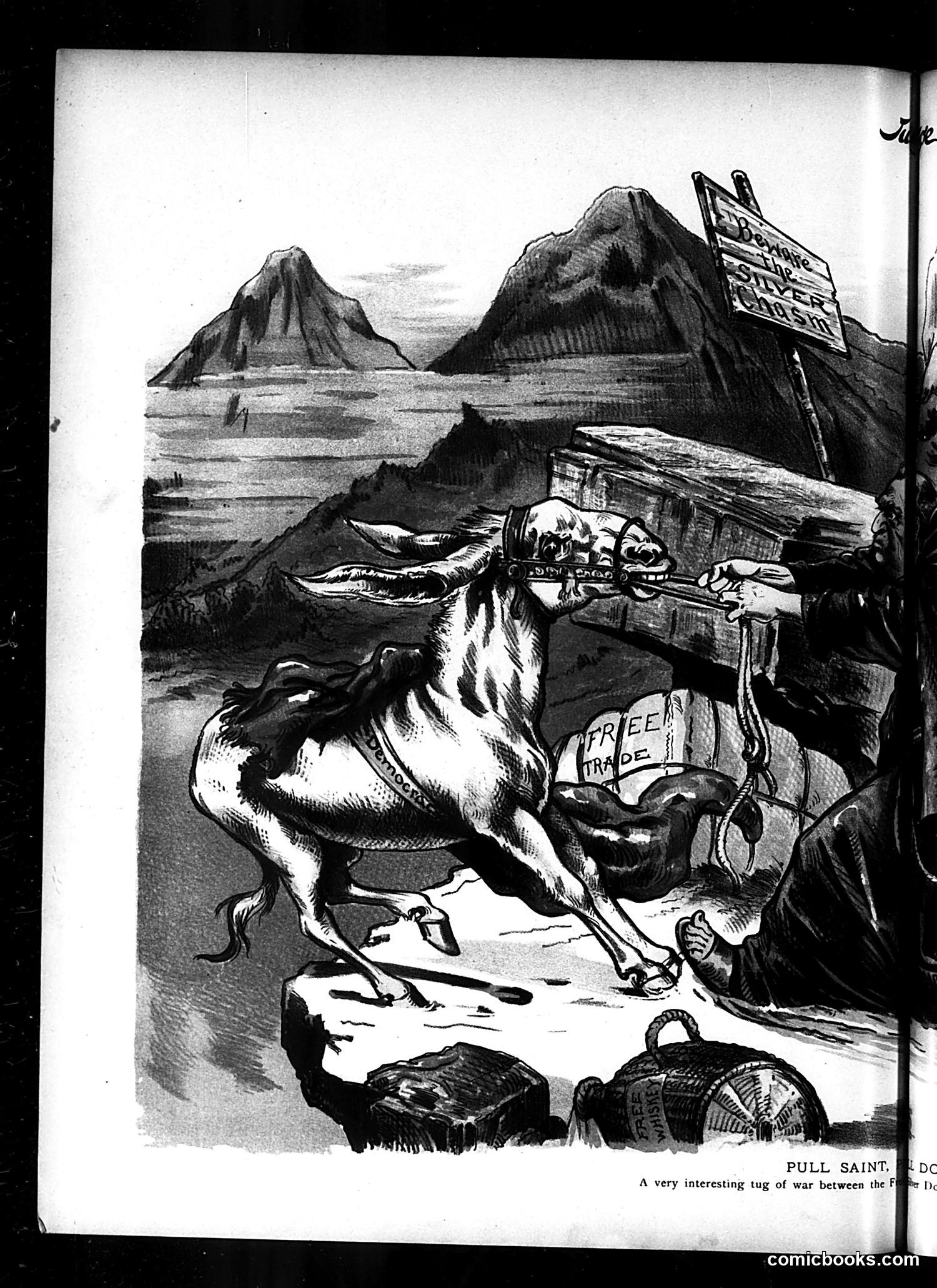
This appears to be a satirical cartoon titled "Pull Saint" depicting a tug-of-war between two figures representing competing economic or political interests. The central figure appears to be labeled with "Free Trade," while opposing forces pull in different directions. The mountainous landscape and shipping/maritime imagery in the background suggest this concerns international commerce or trade policy. The cartoon likely satirizes late 19th or early 20th-century American debates over protectionism versus free trade. The "saint" reference appears ironic, suggesting moral sanctimony in trade arguments. Without the complete caption, the specific antagonists remain unclear, though the visual conflict between labeled economic positions is evident. The work exemplifies *Judge* magazine's use of personification to critique contemporary political disputes.
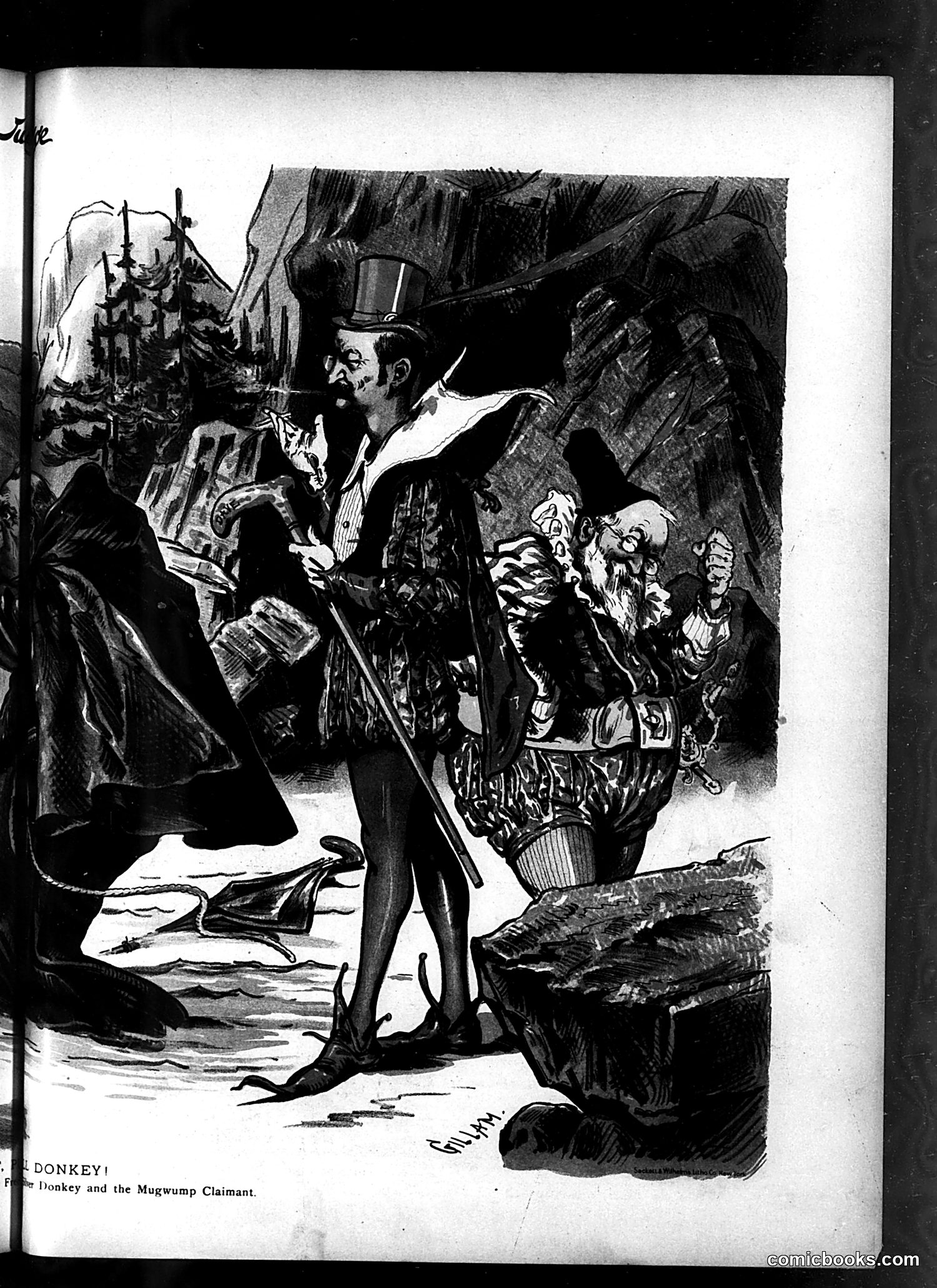
This political cartoon satirizes late 19th-century American politics. The central figure—a well-dressed man in a top hat with exaggerated facial features—represents a "Mugwump," a term for Republicans who broke party ranks (likely during the 1884 presidential election). The "donkey" reference alludes to the Democratic Party symbol. The cartoon suggests the Mugwump is making spurious claims or playing both sides—hence "claimant" to the donkey's identity or loyalty, despite his Republican appearance. The caricatured figures on the right appear to be contemporary political adversaries or supporters. The sketchy, dramatic style emphasizes mockery of the Mugwump's political opportunism or hypocrisy. The precise political moment remains unclear without additional context.
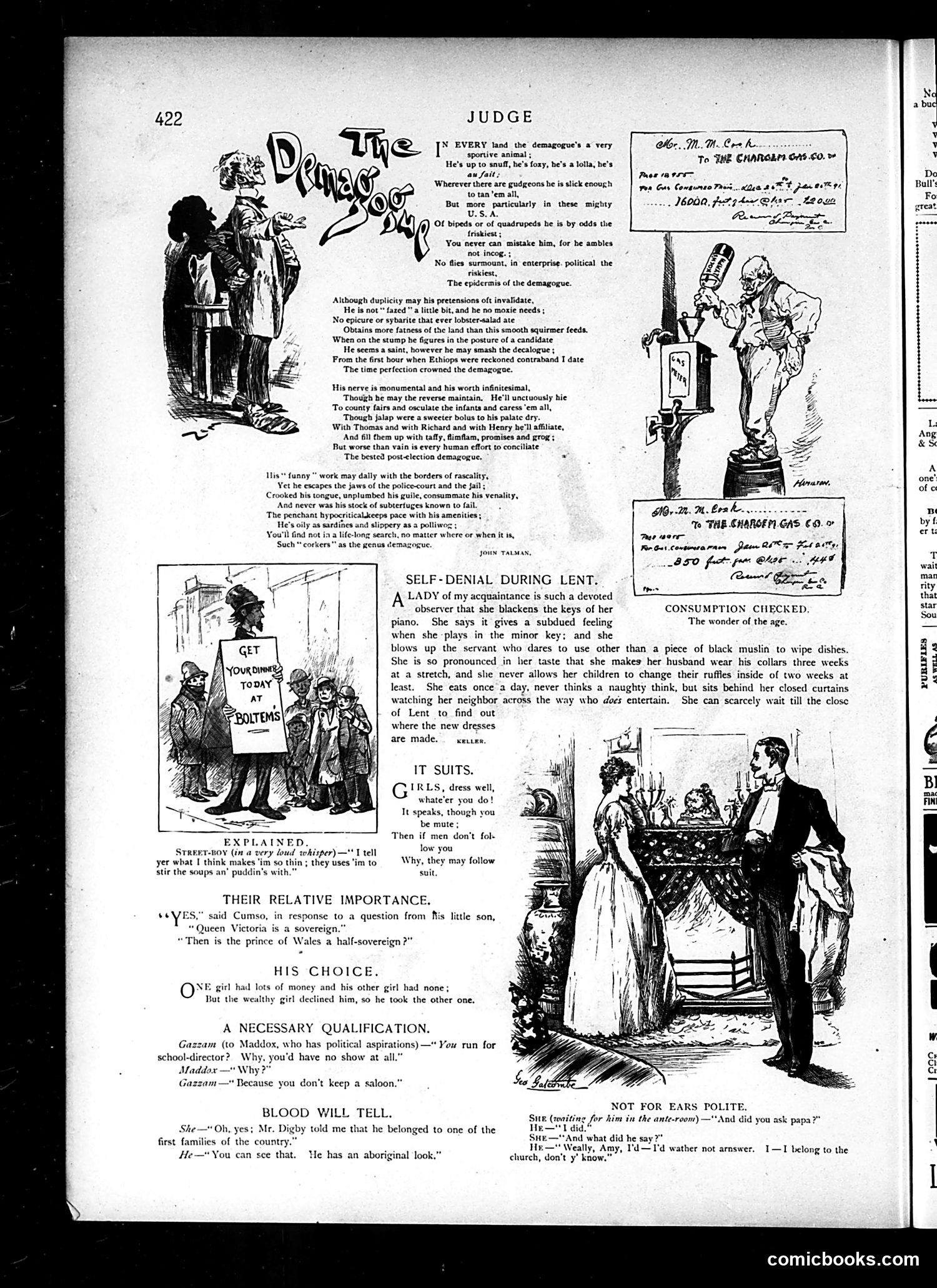
This satirical page from Judge magazine contains multiple pieces attacking political demagogues and social hypocrisy. **"The Demagogue"** (main poem with accompanying caricature): A lengthy verse mocking corrupt politicians who manipulate voters through flattery and false promises ("taffy, flimflam, promises"). The figure appears to represent a generic corrupt politician rather than a specific person—the satire targets the *type* of demagogue common in American politics. **"Self-Denial During Lent"**: Mocks upper-class religious hypocrisy—a wealthy woman performs ostentatious piety (blackening piano keys, wearing rough clothes) while secretly envying her neighbor's entertainment and eagerly awaiting new fashions after Lent ends. **Other brief items**: "It Suits" (girls' fashion advice), "Their Relative Importance" (a mild joke about British monarchy), "His Choice" (romantic humor), and "Blood Will Tell" (class commentary). The page's overall theme: exposing the gap between public virtue and private behavior among politicians and the wealthy.
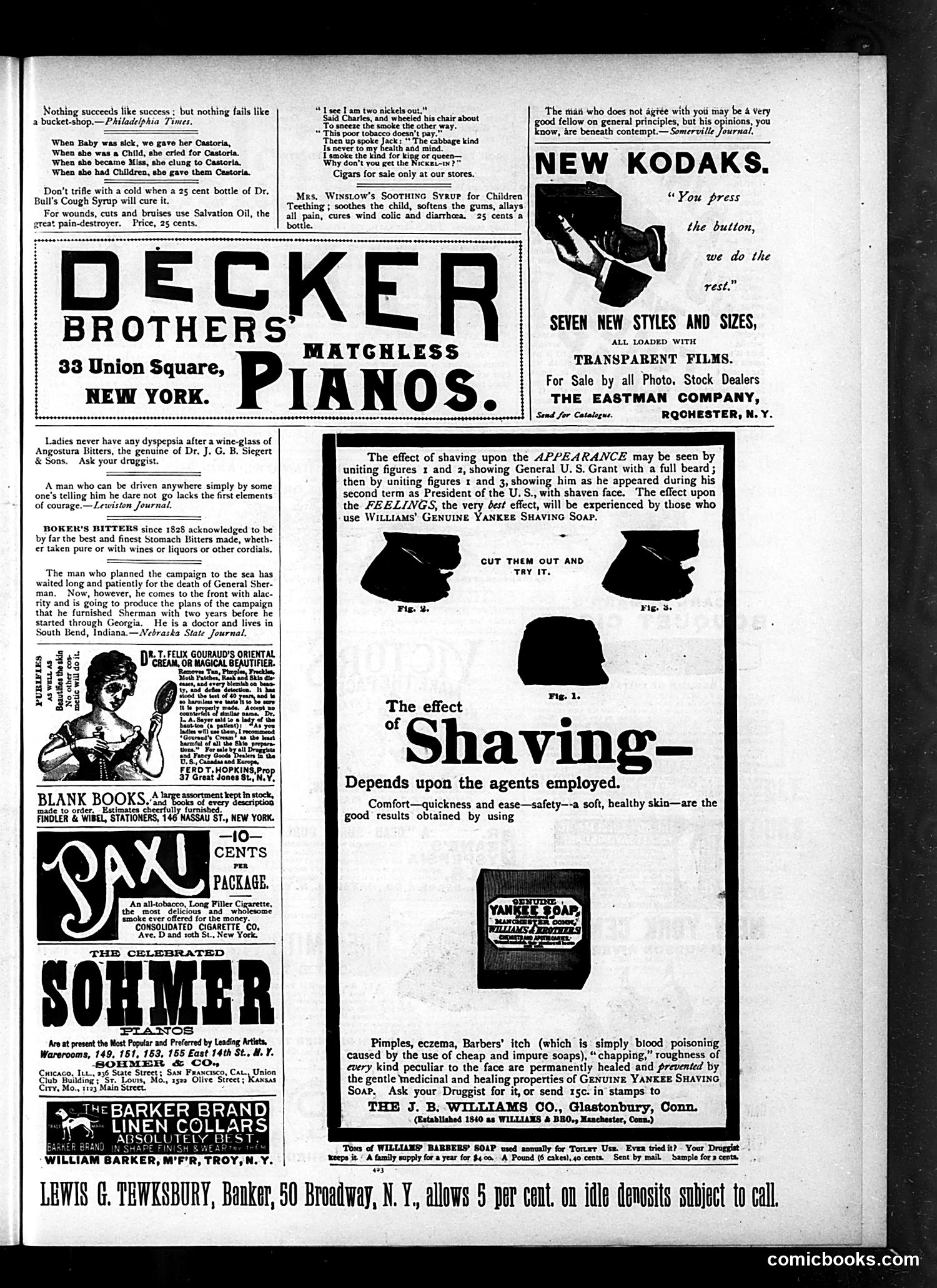
This page is primarily **advertising** with one significant cartoon feature. ## The Main Cartoon: "The Effect of Shaving" The central illustration demonstrates General **Ulysses S. Grant** in three silhouette profiles, showing him with a full beard (figures 1 and 2 combined) versus clean-shaven (figures 1 and 3 combined) as he appeared during his second presidential term. This is an advertisement for **Williams' Genuine Yankee Shaving Soap**. The satire is gentle: the joke suggests that shaving transformed Grant's appearance so dramatically that readers should "cut them out and try it"—implying the soap's efficacy was so remarkable it could achieve presidential-level transformations. ## Supporting Context A brief text snippet mentions "the man who planned the campaign to the sea" (Sherman's March), mocking someone claiming credit for Sherman's Civil War strategy—unrelated satire about military credit-taking. The remainder of the page consists of period advertisements for pianos, cigars, bitters, blank books, and patent medicines—typical Judge magazine filler content.
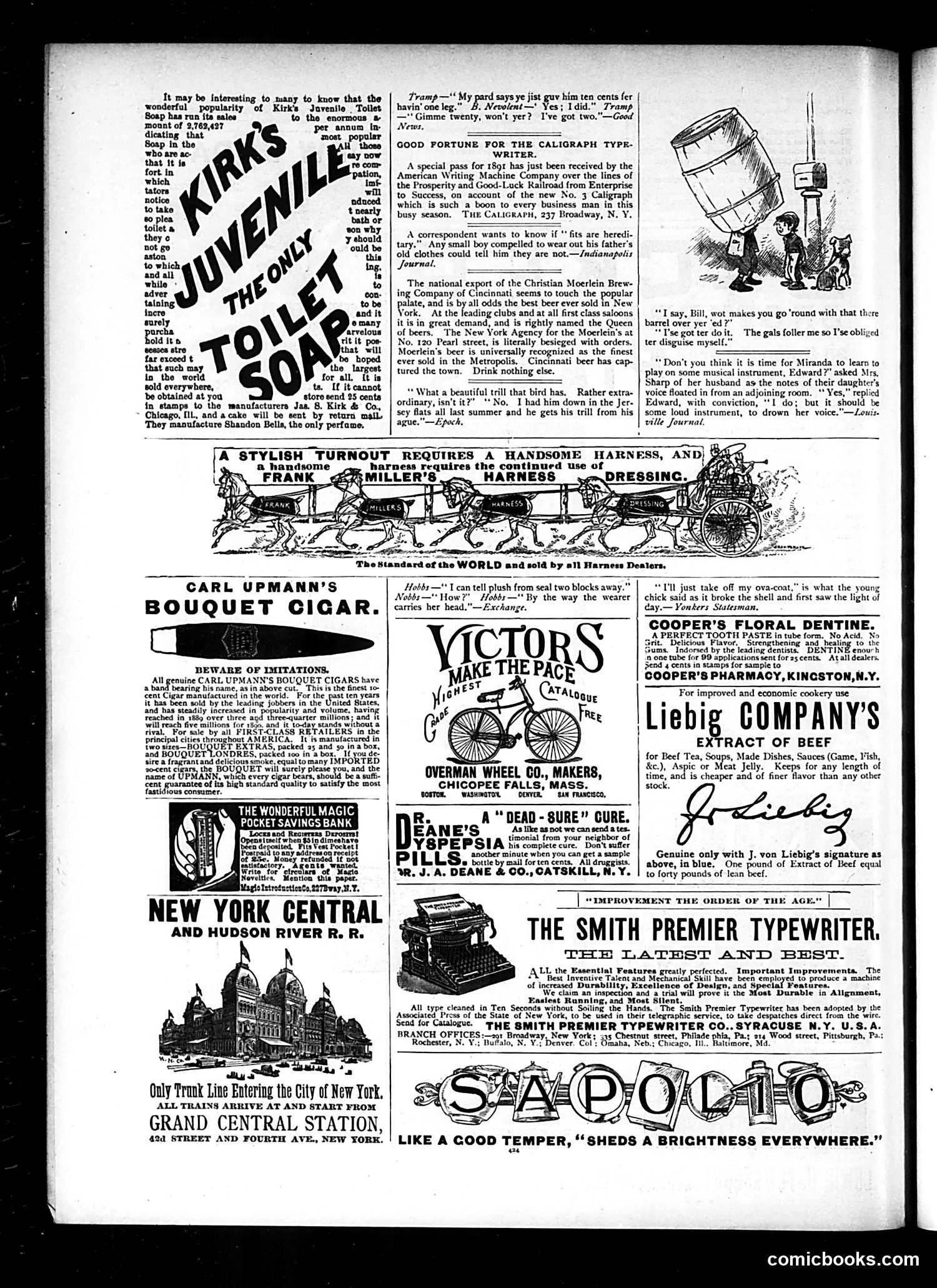
This page consists primarily of **advertisements and brief joke fillers** rather than political cartoons. The substantial satirical content is minimal. The notable humor pieces include: 1. **The "Tramp" joke**: A beggar's logic about compensation—if he received ten cents for one leg, he should get twenty for two. This satirizes absurd reasoning and possibly mocks charitable giving practices. 2. **The "Miranda" domestic joke**: A husband's exasperated comment that his daughter needs a loud instrument to drown out her singing voice—standard Victorian-era domestic satire about women's musical abilities. 3. **The "barrel disguise" joke**: A man hiding under a barrel to avoid women following him—likely satirizing vanity or courtship customs of the era. The page is otherwise dominated by product advertisements for cigars, beer, typewriters, beef extract, and other period goods, suggesting this is a typical issue of *Judge* where commercial sponsorship supported satirical content.
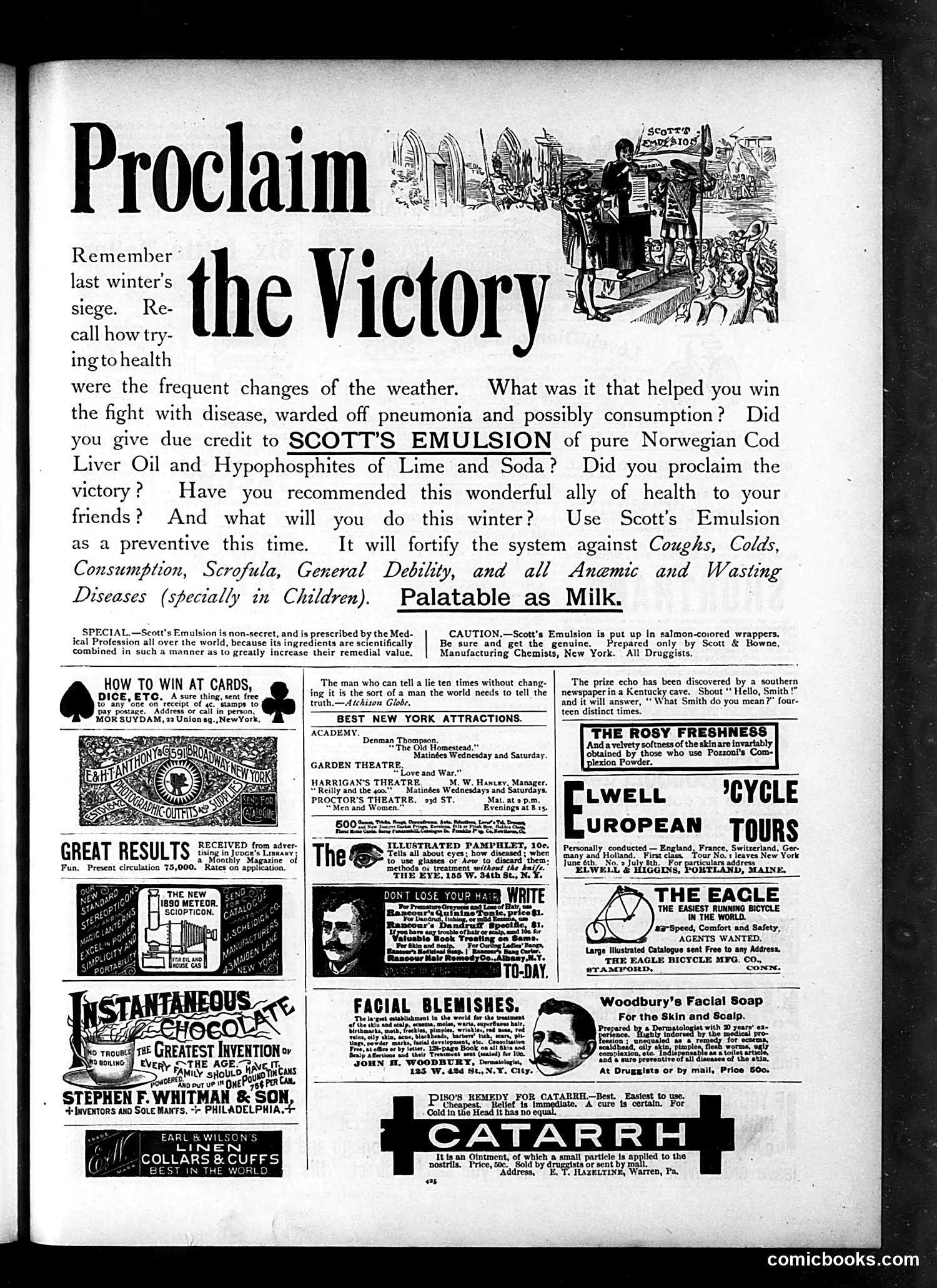
This page is **primarily advertising**, not satire or editorial content. The dominant feature is a large advertisement for **Scott's Emulsion** (cod liver oil supplement), which occupies roughly the top half. The Scott's ad uses a rhetorical strategy common to patent medicine marketing of this era: it appeals to readers who survived the previous winter's illnesses, asking them to attribute their recovery to the product and encourage others to use it preventively. The ad mentions diseases like pneumonia, consumption (tuberculosis), and scrofula—serious health threats of the period. Below this are smaller advertisements for typical turn-of-the-century products and services: theatrical attractions, facial soaps, bicycles, playing card tricks, and remedies for baldness and catarrh. There is **no identifiable political cartoon or satire** on this page. The content reflects early 1900s consumer culture, where magazines like *Judge* generated revenue primarily through patent medicine and consumer goods advertising rather than editorial commentary.
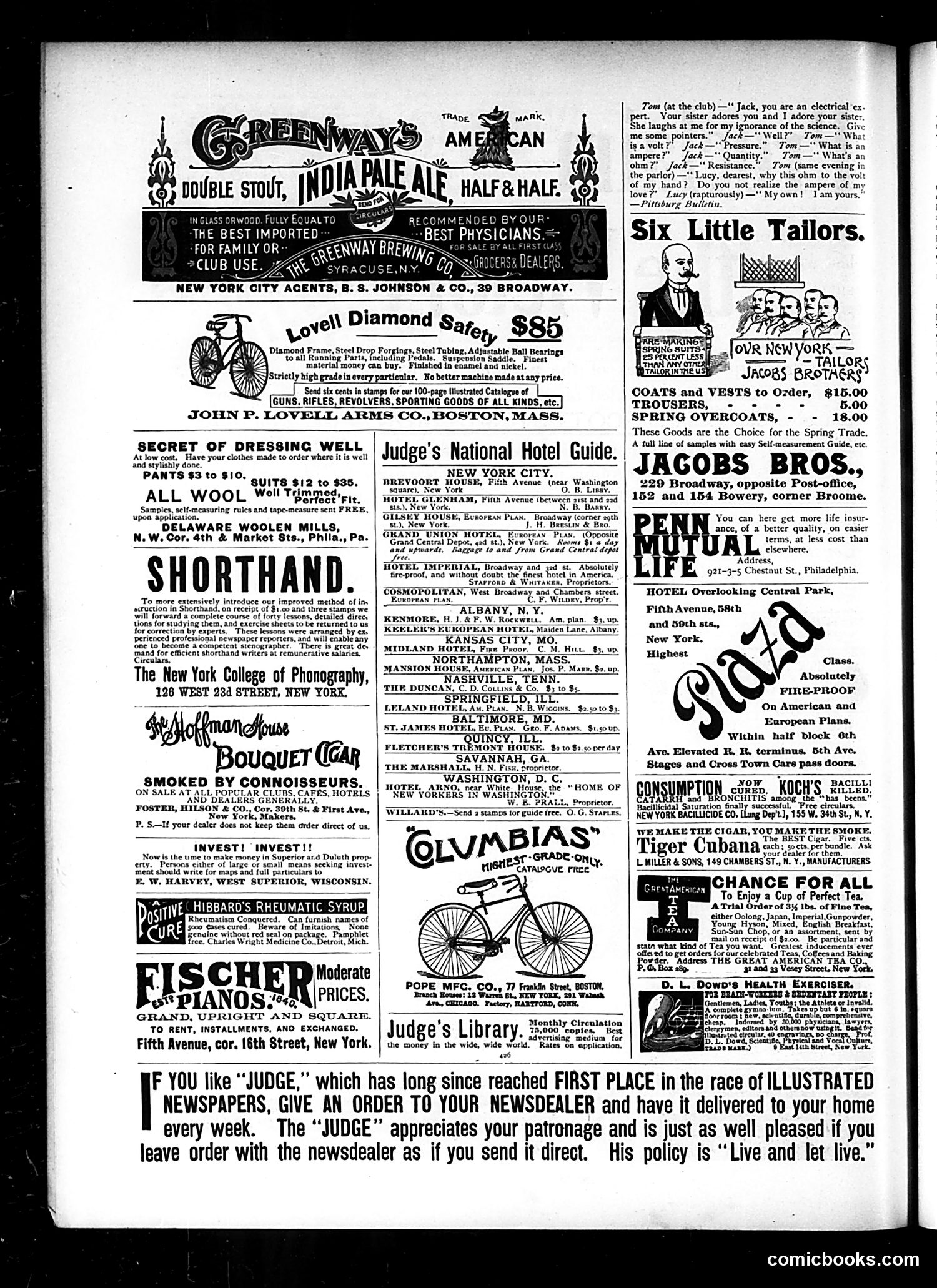
This page is primarily **advertising**, not political satire. It showcases late 19th-century commercial products and services typical of Judge magazine's revenue model. The only narrative content visible is a brief comedic dialogue titled "Tom (at the club)" in the upper right. It depicts a social scene where Tom asks his friend Jack—presented as an "electrical expert"—to explain electrical terminology (volts, amperes, ohms). The humor appears to rely on the contrast between Tom's romantic interest in Jack's sister and his desperate attempt to impress her by seeking technical knowledge he doesn't understand, suggesting the absurdity of trying to master complex science for romantic purposes. The bulk of the page consists of advertisements for diamonds safes, bicycles (Columbias brand), pianos, hotels, cigars, shorthand courses, and patent medicines—reflecting period consumer interests and advertising norms in illustrated magazines.
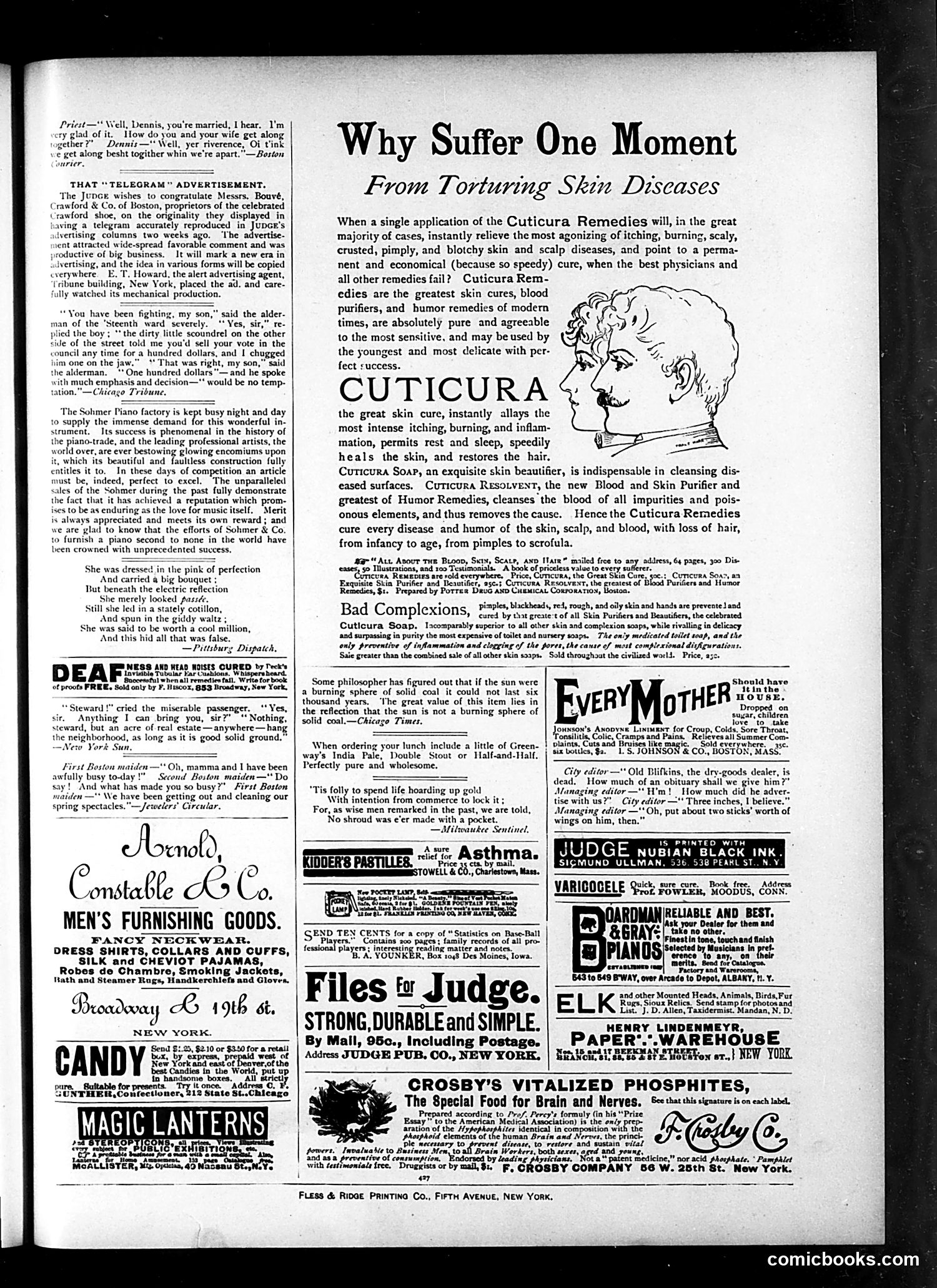
This page is primarily **advertising and humor columns**, not political satire. The main content includes: **The cartoons/jokes** are brief, domestic humor pieces: - A priest and Irishman joke about marriage (the punchline: a couple gets along best when apart) - An alderman anecdote about a boy fighting over an insult to the alderman's reputation (the humor: the alderman is insulted at being valued at only $100, not the fighting itself) - A Boston socialite joke about a wealthy but aging woman whose money compensates for her appearance **The bulk of the page** comprises advertisements for products (Cuticura skin remedies, pianos, candy, furnishings, files, asthma pills, ink, gramophones) typical of late 19th/early 20th-century magazines. **No major political figures or events** are referenced. The humor is mild, social observation—about marriage, Irish-American characters, Boston society, and urban life—rather than satirical commentary on current events or politics.
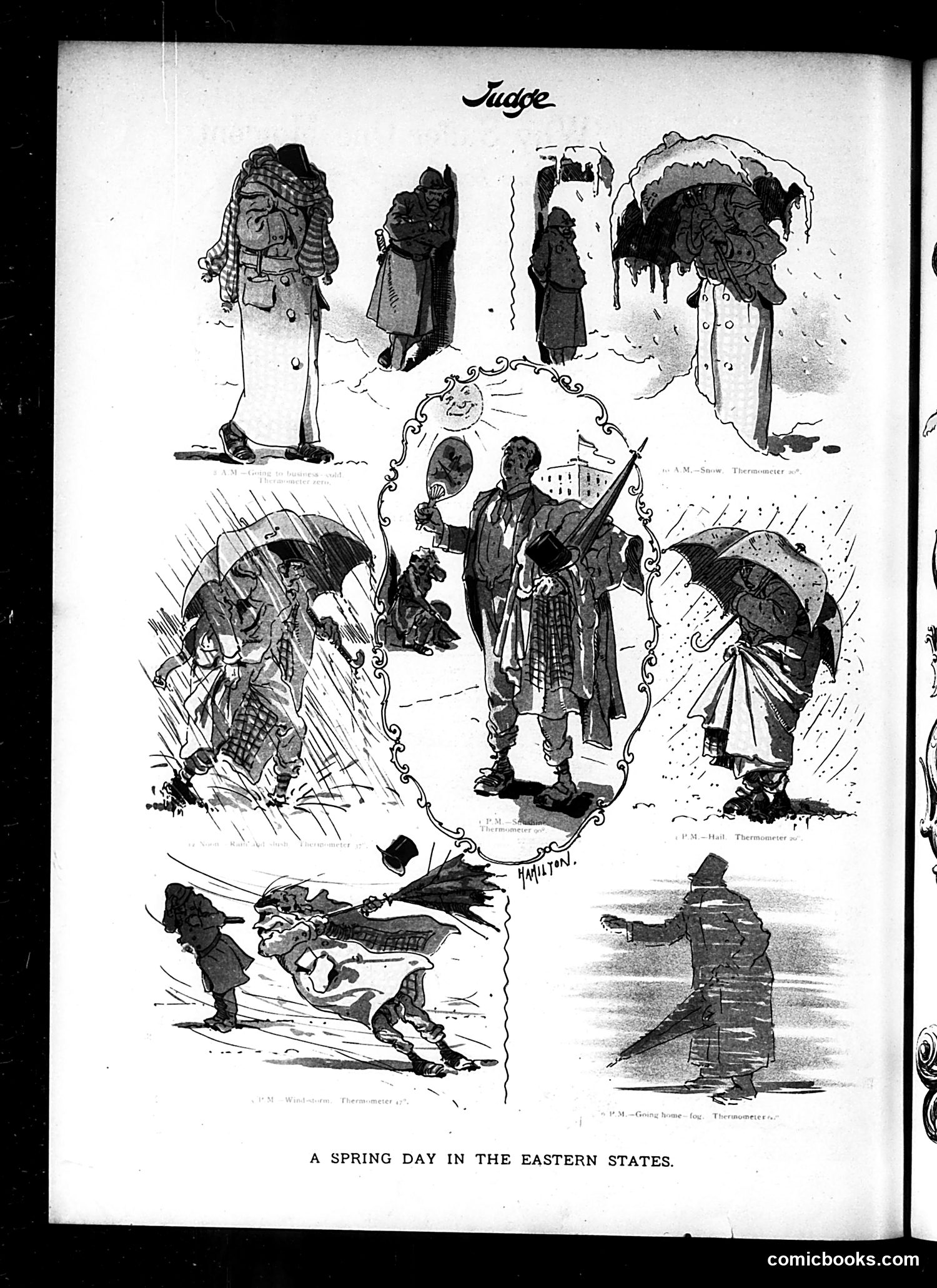
This Judge cartoon satirizes unpredictable spring weather in America's Northeast. The page shows multiple panels depicting the same day's dramatic temperature swings, illustrated through exaggerated character reactions. The repeated "Thermometer" labels suggest each panel represents different hours showing wildly fluctuating conditions—from extreme cold (figures bundled in heavy coats and wraps) to apparent warmth (lighter clothing). References to "P.M." timing indicate progression throughout a single day. The satire mocks how Eastern spring weather confuses residents, forcing them to dress inappropriately as conditions shift rapidly. Characters appear comically distressed by these changes, embodying the frustration of unpredictable seasonal weather. The ornate frame around central figures emphasizes this is a unified joke about regional meteorological chaos rather than separate incidents.
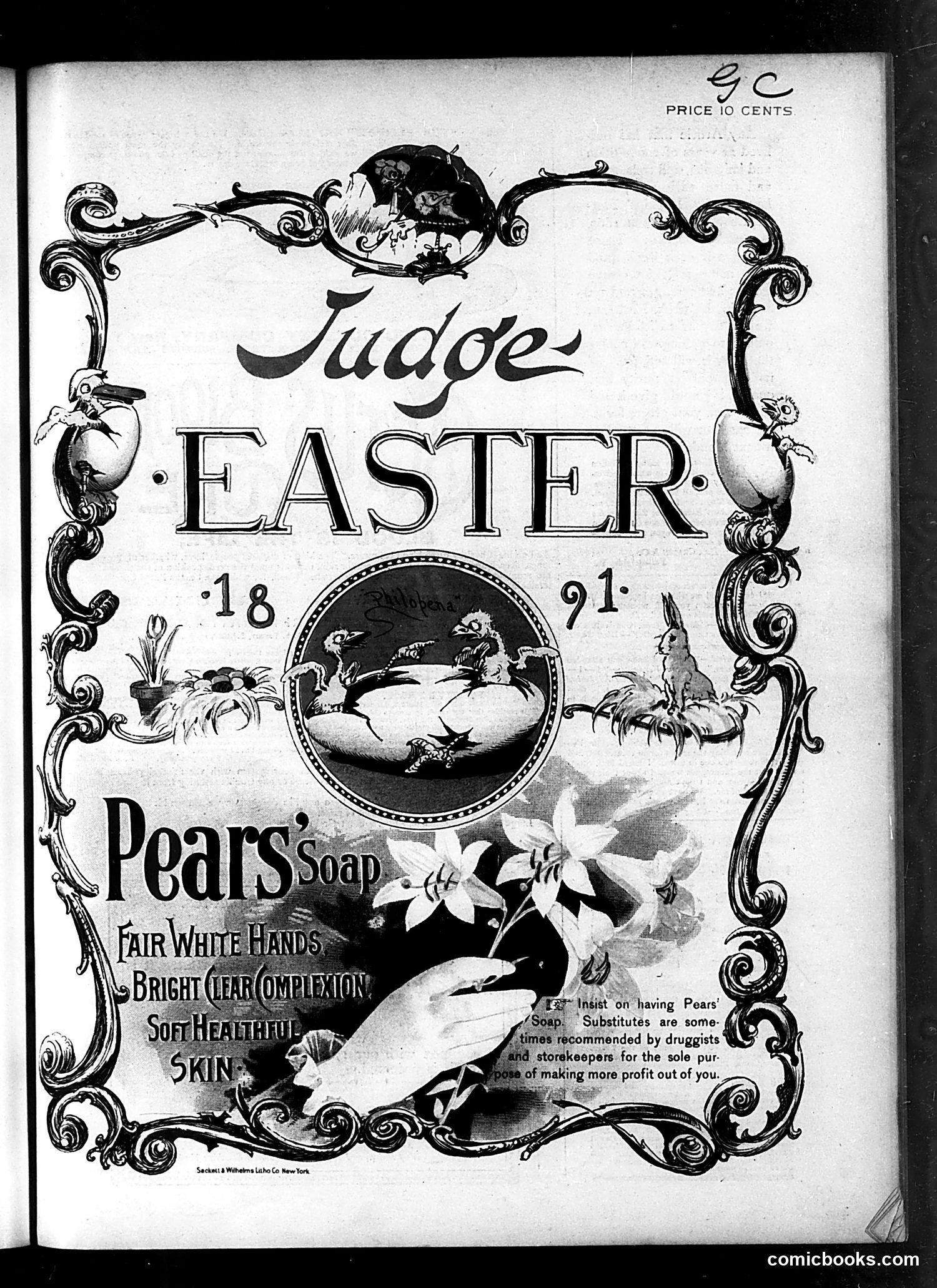
This is primarily a **Pears' Soap advertisement** disguised as editorial content for Judge's Easter 1891 issue. The ornate decorative border frames Easter imagery—eggs, rabbits, flowers—creating a festive presentation. The small text at bottom contains a **satirical jab at substitute products**: it warns consumers that druggists recommend inferior soap alternatives "for the sole purpose of making more profit out of you." This is meta-commentary on advertising itself—Pears' is simultaneously *advertising* while mocking competitors' deceptive marketing tactics. The soap promises "Fair White Hands, Bright Clear Complexion, Soft Healthful Skin"—typical period beauty claims. By framing the message as a consumer warning rather than straightforward promotion, Judge adds humor while promoting the product. The 10-cent price reflects Gilded Age economics.
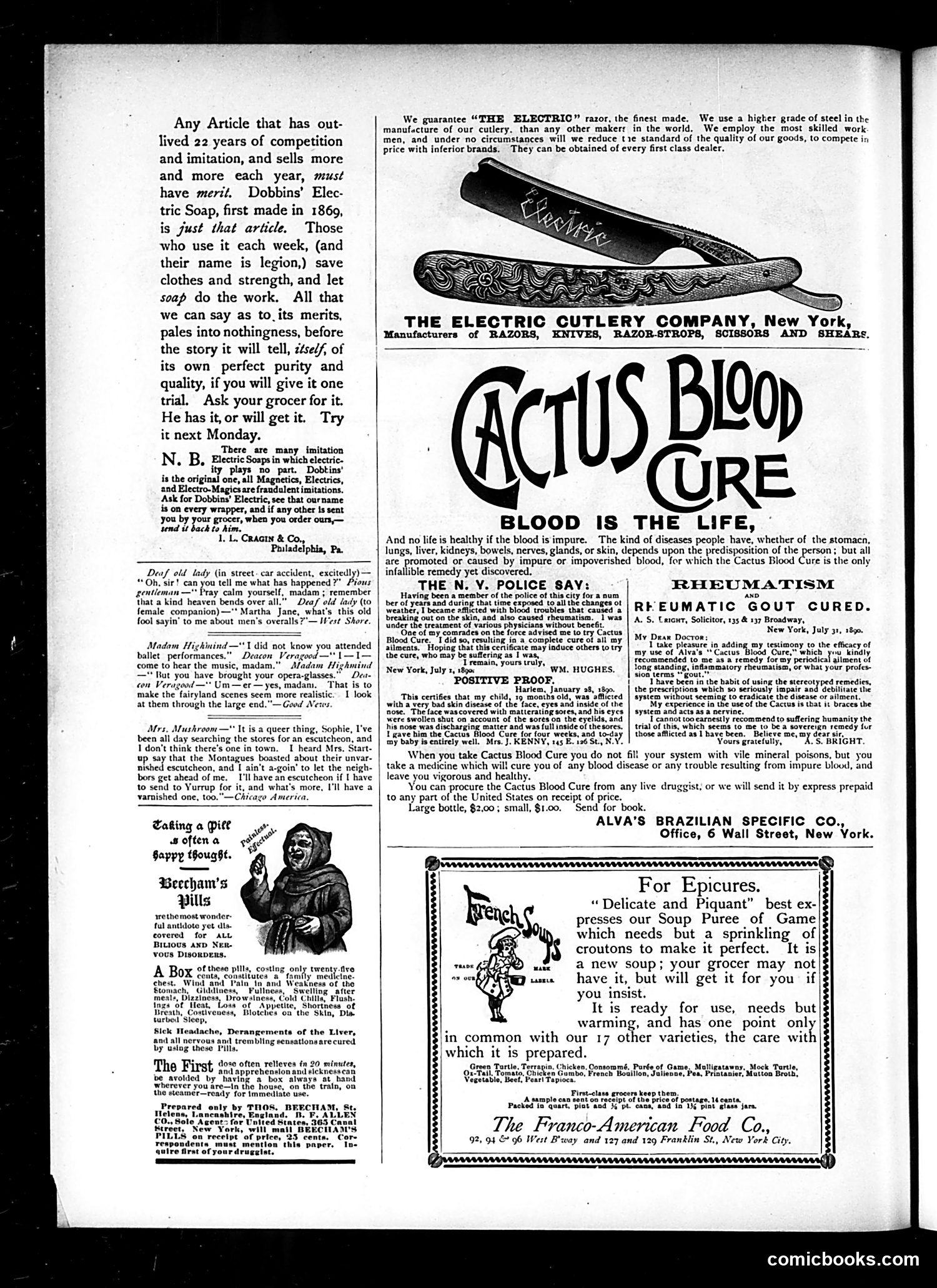
This is primarily an **advertising page** from Judge magazine, featuring patent medicines and consumer products typical of the late 19th century. The main advertisements promote dubious remedies: Dobbins' Electric Soap, Cactus Blood Cure, Beecham's Pills, and Electric razors. The satirical humor appears in the **small anecdotes** scattered between ads. These mock social pretension and misunderstanding: a deaf woman mishears "overalls" as "men's overalls"; a deacon uses opera glasses at ballet to see "fairyland scenes"; a nouveau-riche woman frantically searches for an "escutcheon" (heraldic coat of arms) to compete with neighbors, wanting a "varnished" one. The satire targets the **newly wealthy middle class** attempting to adopt aristocratic markers of status while fundamentally misunderstanding them. The humor relies on class anxiety and the gap between aspiration and knowledge—typical Judge fare mocking American social climbing and the marketing hype surrounding patent medicines.
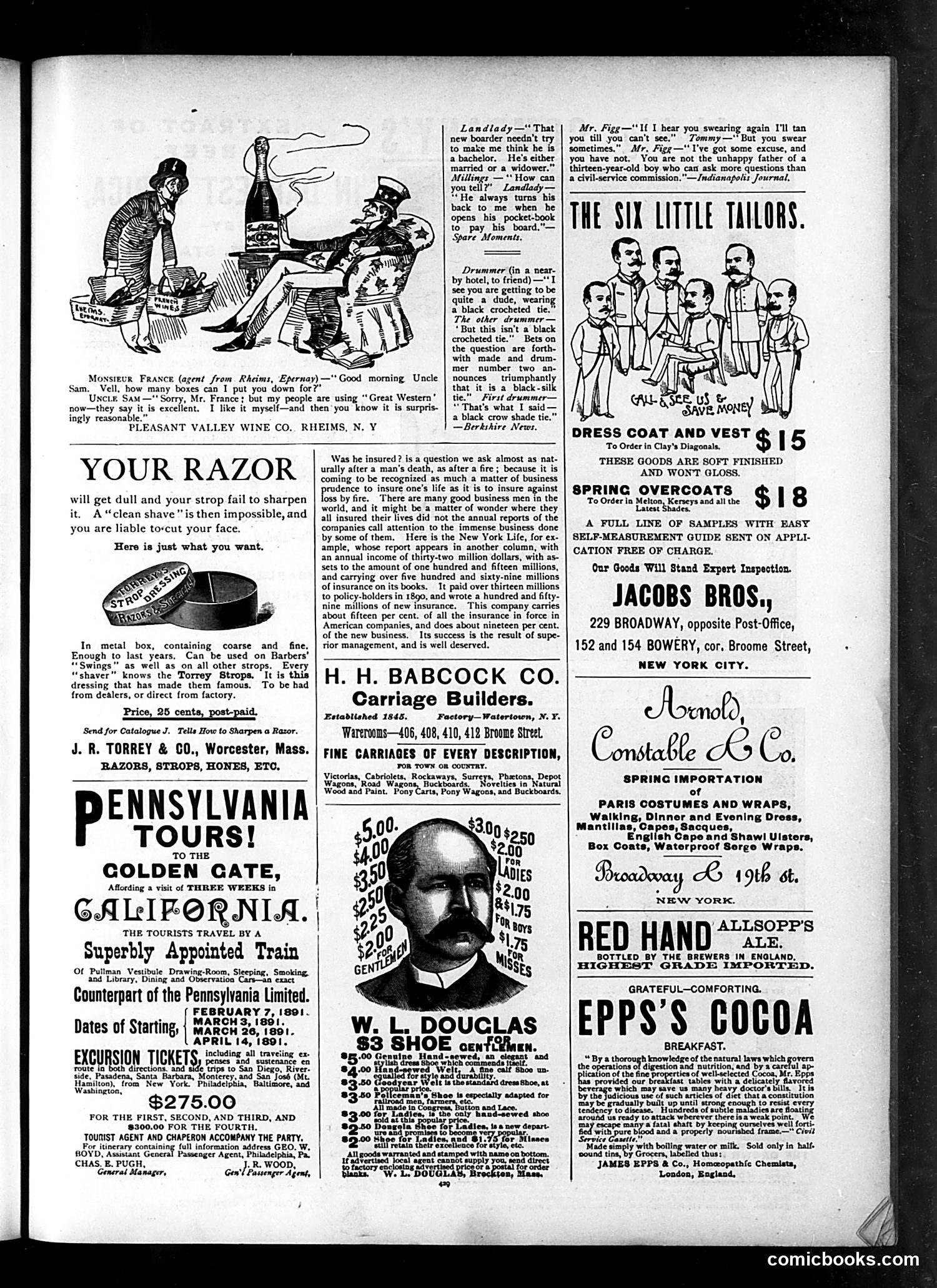
**The Main Cartoon:** The cartoon depicts a Frenchman ("Monsieur France," identified as a champagne agent from Rheims-Epernay) attempting to sell wine to Uncle Sam (the U.S. personified). France is a traveling salesman making a pitch; Uncle Sam, sitting relaxed, declines by saying Americans prefer "Great Western" wine—a domestic American brand. The joke satirizes American protectionism and commercial preference for domestic goods over imports, even when European products (especially French wine) were traditionally more prestigious. It's advertising content (for Pleasant Valley Wine Co.) disguised as humor, essentially joking that even Uncle Sam now prefers American wine. **Supporting Context:** The page is primarily advertisements with scattered short humorous anecdotes about boarding-house life and traveling salesmen. The remaining cartoons address mundane topics: landlady detecting a boarder's marital status, drummers (salesmen) debating whether a tie is crocheted or silk.
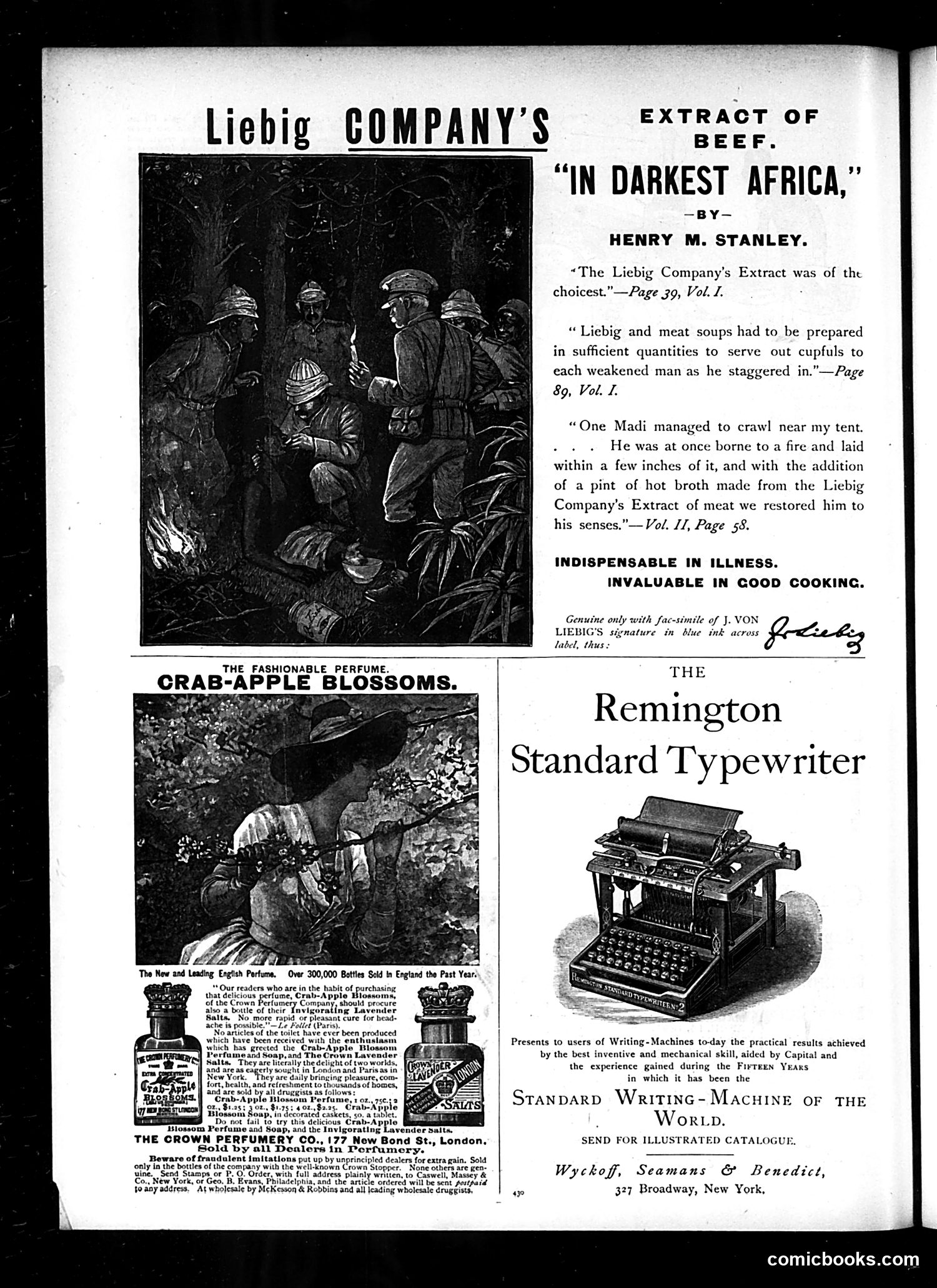
This page is primarily **advertising**, not satire. It contains three product promotions: 1. **Liebig's Beef Extract** (top): Quotes Henry M. Stanley's famous exploration memoir "In Darkest Africa" (1878) to endorse the product's restorative powers. The accompanying engraving depicts Stanley's expedition in Africa. The ads claim Liebig's extract sustained weakened explorers and saved a collapsed man's life—pure testimonial marketing leveraging Stanley's celebrity and the public fascination with African exploration. 2. **Crab-Apple Blossom Perfume** (bottom left): Markets a fashionable fragrance with claims of enthusiasm from English and Parisian society. 3. **Remington Standard Typewriter** (right): Advertises the machine as the "Standard Writing-Machine of the World," emphasizing fifteen years of mechanical refinement. All three are legitimate commercial advertisements using contemporary celebrity endorsement and appeals to modernity/sophistication to sell products.