
Judge, 1891-03-21 · page 6 of 20
Judge — March 21, 1891 — page 6: what you’re looking at
What you’re looking at
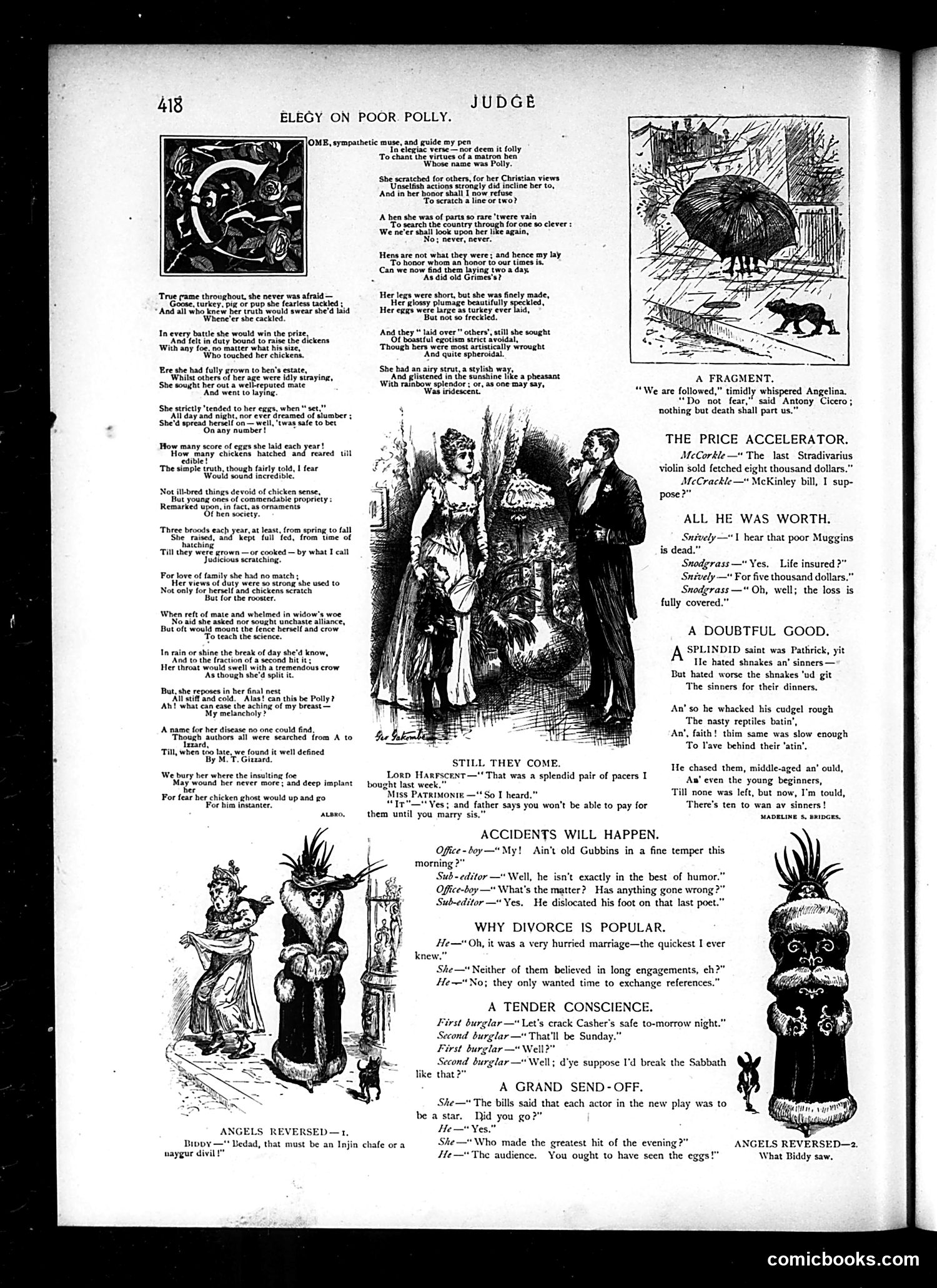
This page is primarily a humorous **elegy—a mock-serious poem mourning a deceased hen named Polly**. The satire lies in treating an ordinary farm bird with the grandiose language and sentimentality reserved for human eulogies. The poem celebrates Polly's domestic virtues: her egg-laying productivity ("three broods each year"), her maternal devotion, her courage defending the henhouse, and her dignified bearing ("glistened in the sunshine like a pheasant"). The joke targets Victorian sentimentality and overwrought commemorative writing by applying it absurdly to poultry. References like "M.T. Gizzard" (a pun on "gizzard") confirm the humorous intent. The page also includes several brief comic dialogues below the poem—typical Judge humor involving social situations and wordplay—though these are disconnected from the main elegy and require less historical context.
📄 Transcribed text from this page (OCR, searchable)
Machine-transcribed from the original scan — historical spelling and the odd misread are preserved.
ELEGY ON POOR. POLLY. JUDGE OME, sympathetic muse, and guide my pen True rame throughout. she never was afraid — Goose, turkey, pig oF pup she fearless tackled ; “And all who knew her truth would swear she'd laid ‘Whene’er she cackled. In every battle she would win the prize, ‘And elt in duty bound to raise the dickens With any foe, no matter what his size, ‘Who touched her chickens. Ere she had fully grown to ben's estate, Whilst others of her age were idly straying, ‘She sought her out a well-reputed mate ‘And went to laying, She strictly "tended to her exes, when“ set.” ‘All day and night, nor ever dreamed of slumber ; She'd spread herself on — well, “twas safe to bet ‘Onany number! rear! reared till How many score of eggs she laid each How many chickens hatched ani edible! The simple truth, though fairly told, I fear Would sound incredible: Not ill-bred things devoid of chicken sense, But young ones of commendable propriety : Remarked upon, in fact, as ornaments ‘Of hen society. “Thgee broods each year, at least, from spring to fall ‘She ‘raised, and kept full fed, from time of hatehing Till they were grown —or cooked — by what I call Judicious scratching For love of family she had no match ; Her views of duty were so strong she used to Not only for herself and chickens scratch But for the rooster. When reft of mate and whelmed in widow's woe No aid she asked nor sought unchaste alliance, But oft would mount the fence herself and crow "To teach the science. In rain or shine the break of day she'd know, ‘And to the fraction of a second hit it; Her throat would swell with a tremendous crow As though she'd split it. But, she reposes in her final nest All stiff and cold. Alas! can this be Polly? Ah! what can ease the aching of my breast — ‘My melancholy ? A name for her disease no one could find, ‘Though authors all were searched from A to Izzard, Till, when too late, we found it well defined By M.T, Gizzard, We bury her where the insulting foe ‘May wound her never more; and deep implant her For fear her chicken ghost would up and go For him instanter. Aunxo, Tn elegiac verse — nor deem it folly To chant the virtues of a matron hen Whose name was Polly. ‘She scratched for others, for her Christian views ‘Unselfish actions strongly did incline her to, And in her honor shall I now refuse ‘To scratch a line or two? A hen she was of parts so rare ‘twere vain ‘To search the country through for one so clever : We ne'er shall look upon her like again, No; never, never. Hens are not what they were; and hence my lay To honor whom an honor to our times is. ‘Can we now find them laying two a day, ‘As did old Grimes's? Her legs were short, but she was finely made, Her glossy plumage beautifully speckled, Her eggs were large as turkey ever laid, But not so freckled, And they “ laid over" others’, still she sought ‘Of boastful egotism strict avoidal, Though hers were most artistically wrought ‘And quite spheroidal She had an airy strut, a stylish way, ‘And glistened in the sunshine like a pheasant With rainbow splendor ; or, as one may say, “We are followed, STILL THEY COME. Lor Harrscent—'"' That was a splendid pair of pacers I bought last week.” Miss PaTRimonte —¢So I heard.” “‘Ir"—"Yes; and father says you won't be able to pay for them until you marry sis.” A FRAGMENT. imidly whispered Angelina. “Do not fear," said Antony Cicero; nothing but death shall part us.” THE PRICE ACCELERATOR. McCorkle—" The last Stradivarius violin sold fetched eight thousand dollars.” McCrackle—* McKinley bill, 1 sup- pose?” ALL HE WAS WORTH. Snively—"1 hear that poor Muggins is dead.” Snodgrass —" Yes, Life insured?” Snively — For five thousand dollars.” Snodgrass —" Oh, well; the loss is fully covered.” A DOUBTFUL GOOD. A SPLINDID saint was Pathrick, yit Me hated shnakes an’ sinners — But hated worse the shnakes ‘ud git The sinners for their dinners, An’ so he whacked his cudgel rough The nasty reptiles batin’, An’, faith! thim same was slow enough To V'ave behind their ‘atin’, He chased them, middle-aged an’ ould, An’ even the young beginners, Till none was left, but now, I'm tould, ‘There's ten to wan av sinners! MADRLINE S, BRIDGES. ACCIDENTS WILL HAPPEN. Office - boy —" My! morning?” Sub -editor —" Well, he isn’t exactly in the best of humor. Office-boy —* What's the matter? Has anything gone wrong?” Sub-editor —"Yes, He dislocated his foot on that last poet.” Ain't old Gubbins in a fine temper this WHY DIVORCE IS POPULAR. He—*Oh, it was a very hurried marriage—the quickest I ever knew She—‘Neither of them believed in long engagements, ch?” He—No; they only wanted time to exchange references.” A TENDER CONSCIENC! First burglar — Let's crack Casher's safe to-morrow night.” Second burglar —"That'll be Sund: st burglar — Well? Second burglar —"Well; d’ye suppose I'd break the Sabbath like that ?” A GRAND SEND - OFF. She—* The bills said that each actor in the new play was to be a star. Did you go?” He—"Yes.” Ske—"Who made the greatest hit of the eveni He—*The audience. You ought to have seen the eggs!” ANGELS RE " Bedad, that must be an Injin chafe or a ANGELS REVERSED—2. naygur divil ! What Biddy saw. comicbooks.com