
Judge, 1891-03-21 · page 2 of 20
Judge — March 21, 1891 — page 2: what you’re looking at
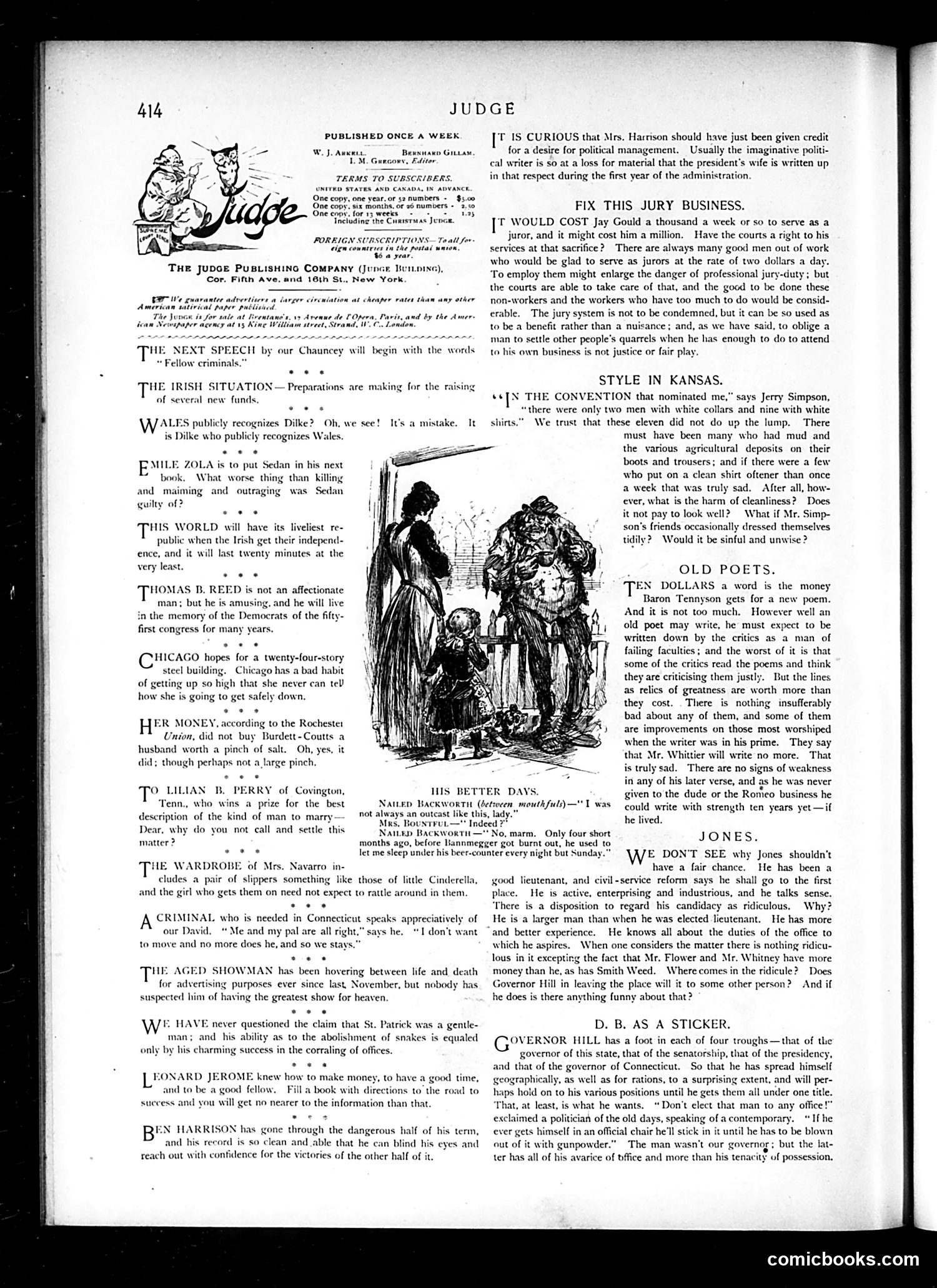
What you’re looking at
The main illustration titled "His Better Days" depicts a poorly dressed man in tattered clothing speaking to what appears to be a well-dressed woman. The caption references "Nailed Hackworth" and mentions someone who "used to do sleep under his beer-counter every night but Sunday." This cartoon satirizes economic hardship and downward mobility—likely commenting on unemployment or poverty during a period of economic difficulty. The contrast between the man's current destitute state and his implied former respectability ("his better days") suggests social commentary on class decline or economic instability affecting working men. The surrounding text discusses political and social issues typical of Judge's satirical commentary, though specific contemporary references are unclear without additional historical context about the magazine's publication date.
📄 Transcribed text from this page (OCR, searchable)
Machine-transcribed from the original scan — historical spelling and the odd misread are preserved.
JUDGE PUBLISHED ONCE A WEEK W. J. Aww TERMS TO SUBSCRIBERS. ‘One copy, one year.or s2 numbers = $3.00 One copy. six months. of 26 numbers - "2.%0 One cope. for 13 w 135 Including the POREIGN SUBSCRIPTIONS— To all for ign counteres in the postal maven $6 @ year, THE JUDGE PUBLISHING Company (Junce, Berpinc), Cor. Fifth Ave. and 16th St., New York reer circulation at cheaper rates t Fellow criminals.” THE IRISH SITUATION — Preparations are makin of several new funds, for the raisi ALES publicly recognizes Dilke? Oh, we see! It's a mistake. is Dilke who publicly recognizes Wales. EMILE ZOL to put Sedan in his next book. What worse thing than killing and maiming and outraging was quilty of? THIS WORLD will have its liveliest re- public when the Irish get their independ- ence, and it will last twenty minutes at the very least. THOMAS B. REED is not an affectionate man; but he is amusing, and he will live in the memory of the Democrats of the fifty- first congress for many ye CHICAGO hopes for a twenty-four-story steel building. Chicago has a bad habit of getting up so high that she never can tel) how she is going to get safely down, H! R MON cording to the Rochestet Union, did not buy Burdett-Coutts a husband worth a pinch of salt. Oh, yes, it did; though perhaps not a large pinch B. PERRY of Covington, who wins a prize for the best description of the kind of man to marry Dear, why do you not call and settle this matter? not always an oute: Mrs. Bou = WARDROBE s. Navarro in- cludes a pair of slippers something like those of little Cinderel and the girl who gets them on need not expect to rattle around in them. A CRIMINAL who is needed in Connecticut speaks appreciatively of our David,“ Me and my pal are all right. “1 don’t want to move and no more does he, and so we stays.” ys he. HE AGED SHOWMAN has been hovering between life and death for advertising purposes ever since last. November, but nobody has suspected him of having the greatest show for heaven F HAVE never questioned the claim that St. Patrick was a gentle- man; and his ability as to the abolishment of snakes is equaled only by his charming success in the corraling of offices. LEONARD JEROME knew how to make money, to have a good time, and to be a good fellow. Fill a book with directions to’ the road to success and you will get no nearer to the information than that. EN HARRISON has gone through the dangerous half of his term, and his record is so cl able that he can blind his eyes and reach out with tories of the other half of it. n_and fidence for the v HIS BETTER Nattep Backwortit (betrcen mouthfuls) —" 1 was t like this, lady.” —"* Indeed ? Natty Backwortit — months ago, before Bannmegger got burnt out, he used let me sleep under his beer-counter every night but Sun [TIS CURIOUS that Mrs. Harrison should have just been given credit for a desire for political management. Usually the imaginative politi- cal writer is so at a loss for material that the president's wife is written up in that respect during the first year of the administration FIX THIS JURY BUSINESS. T WOULD COST Jay Gould a thousand a week or so to serve as. a juror, and it might cost him a million, Have the courts a right to his services at that sacrifice? There are always many good men out of work who would be glad to serve as jurors at the rate of two dollars a day. To employ them might enlarge the danger of professional jury-duty; but the courts are able to take care of that, and the good to be done these non-workers and the workers who have too much to do would be consid- erable. The jury system is not to be condemned, but it can be so used as to be a benefit rather than a nuisance; and, as we have said, to oblige a man to settle other people’s quarrels when he has enough to do to attend to his own business is not justice or fair play. STYLE IN KANSAS. 6¢[N THE CONVENTION that nominated me,” “there were only two men with w shirts.” ys Jerry Simpson, te collars and nine with white We trust that these eleven did not do up the lump. There must have been many who had mud and the various agricultural deposits on their boots and trousers; and if there were a few who put on a clean shirt oftener than once a week that was truly sad. After all, how- ever, what is the harm of cleanliness? Does it not pay to look well? What if Mr. Simp- son's friends occasionally dressed themselves idily? Would it be sinful and unwise ? OLD POETS. N DOLLARS a word is the money Baron Tennyson gets for a new poem. And it is not too much, However well an old poet may write, he must expect to be written down by the critics as a man of ing faculties ; and the worst of it is that some of the critics read the poems and think they are criticising them justly. But the lines as relics of greatness are worth more than they cost. There is nothing insufferably bad about any of them, and some of them are improvements on those most worshiped when the writer was in his prime. They say that Mr. Whittier will write no more. That is truly sad. ‘There are no signs of weakness in any of his later verse, and as he was never given to the dude or the Romeo business he could write with strength ten years yet —if he lived. DAYS. No, marm. Only four short JONES. E DON'T SEE why Jones shouldn't have a fair chance. He has been a ood lieutenant, and civil-service reform says he shall go to the first place. He is active, enterprising and industrious, and he talks sense. ‘There is a disposition to regard his candidacy as ridiculous, Wh: He is a larger man than when he was elected lieutenant. He has more and better experience. He knows all about the duties of the office to which he aspires. When one considers the matter there is nothing ridicu- lous in it excepting the fact that Mr. Flower and Mr. Whitney have mot money than he, as has Smith Weed. Where comes in the ridicule? Does Governor Hill in leaving the place will it to some other person? And if he does is there anything funny about that ? B. AS A STICKER. GOVERNOR HILL has a foot in each of four troughs—that of the governor of this state, that of the senatorship, that of the preside! and that of the governor of Connecticut. So that he has spread himself ographically, as well as for rations, to a surprising extent, and will per- haps hold on to his various positions until he gets them all under one title. ‘That, at least, is what he wants. “Don't elect that man to any office!” exclaimed a politician of the old days, speaking of a contemporary. “If he ever gets himself in an official chair he'll stick in it until he has to be blown out of it with gunpowder.” ‘The man wasn’t our governor; but the lat- ter has all of his avarice of bffice and more than his tenacity of possession, comicbooks.com