
A complete issue · 16 pages · 1891
Judge — January 24, 1891
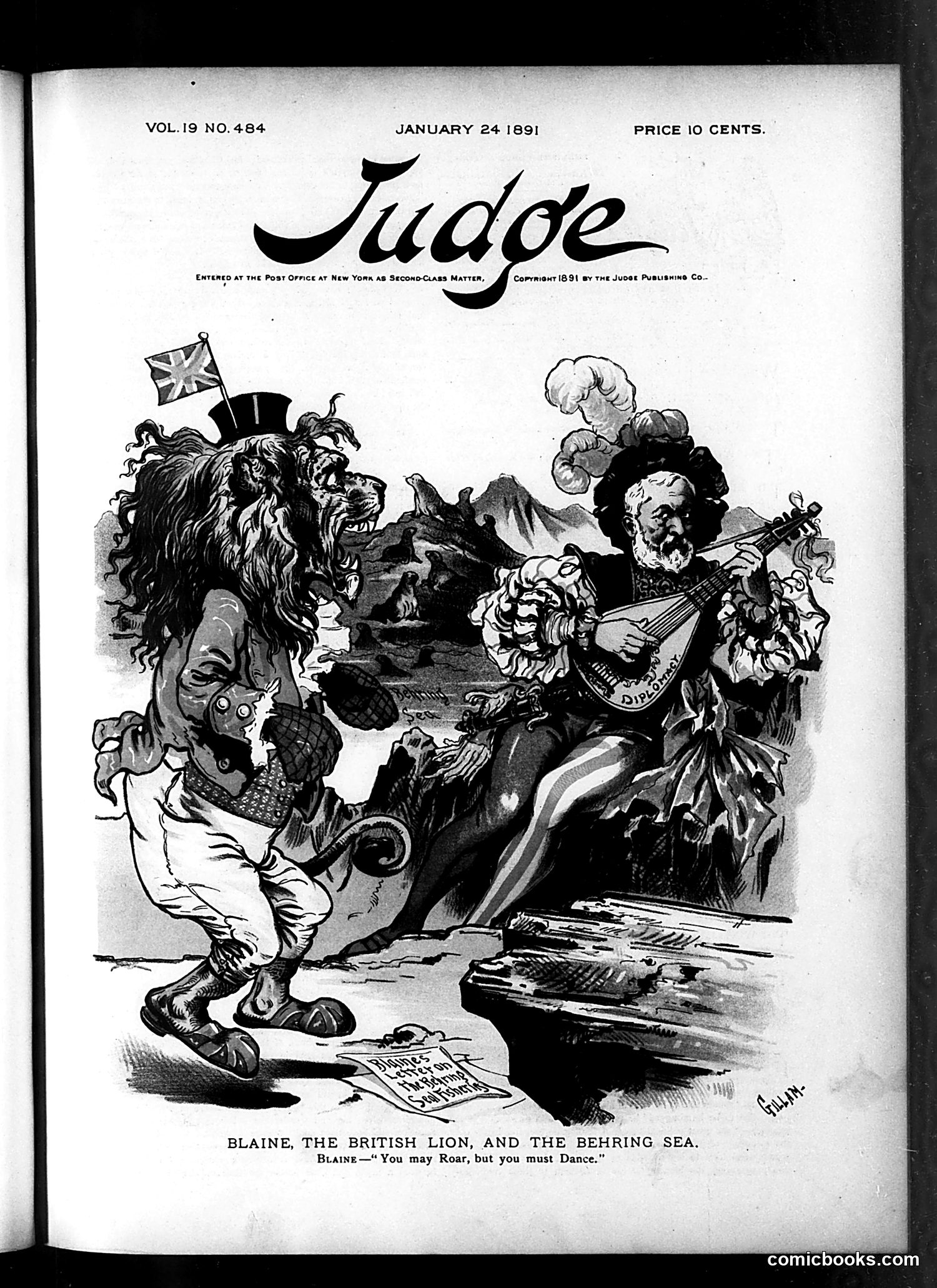
This 1891 *Judge* cartoon depicts a diplomatic dispute over the Bering Sea. The figure on the left, identified as Blaine (James G. Blaine, U.S. Secretary of State), confronts a British Lion playing a stringed instrument. The caption reads: "You may Roar, but you must Dance." The cartoon satirizes American pressure on Britain regarding seal hunting rights in the Bering Sea—a contested territorial issue. Blaine is portrayed as forcing British compliance through aggressive diplomacy ("must Dance"), while the Lion, though powerful ("may Roar"), is depicted as subordinate to American demands. The British flag visible above emphasizes the international nature of the conflict. The satire celebrates American assertiveness in foreign policy.
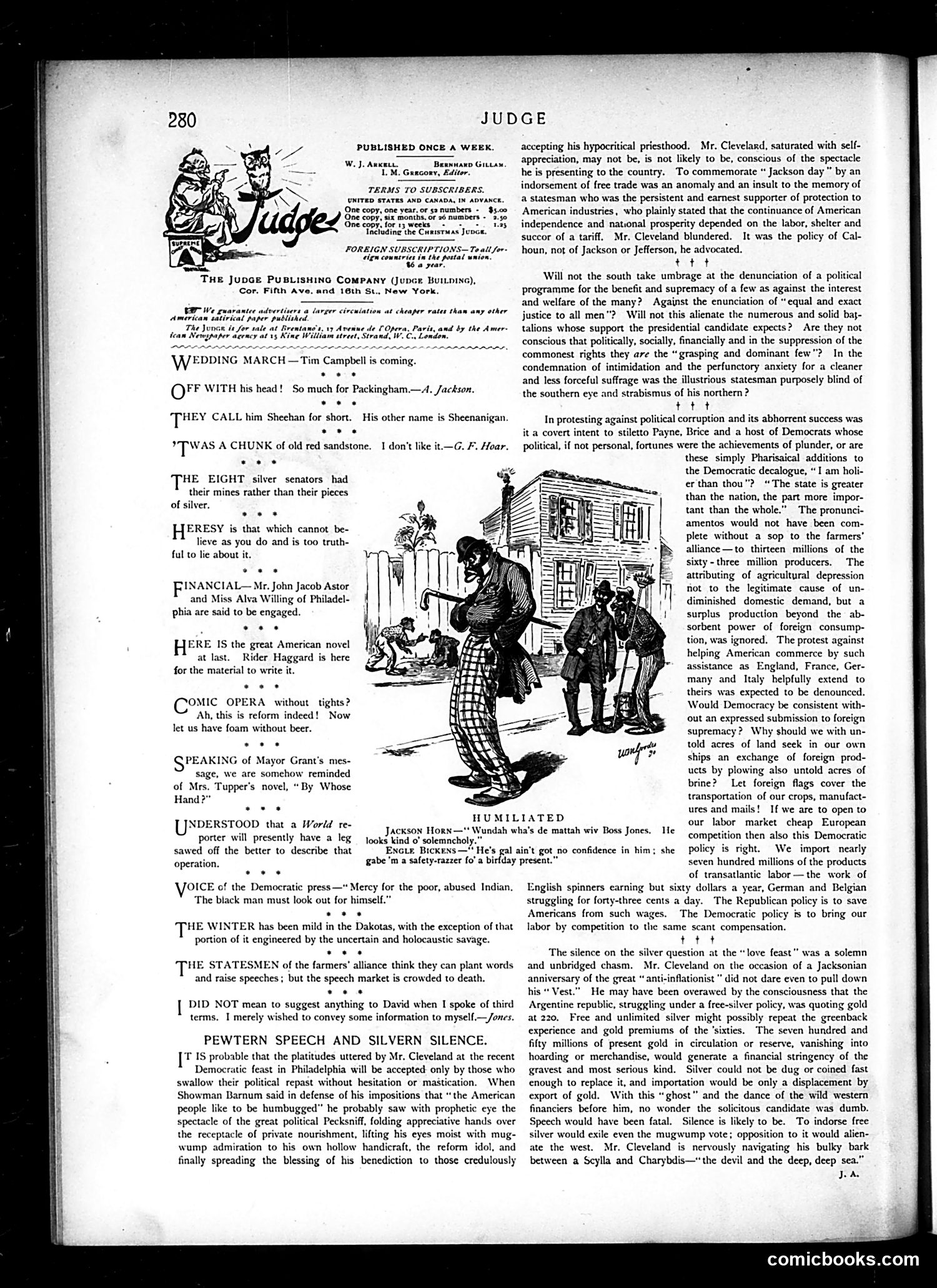
This cartoon depicts a scene titled "Humiliated" showing what appears to be a working-class family (a woman and children) at their home's doorway, with a man in formal dress (likely representing a politician or authority figure) departing. The accompanying text discusses Jackson Horne being "Wundah what's de matter wid boss Jones" and references issues of confidence and birthday presents, suggesting themes of economic hardship or employer-worker relations during this period. The broader article addresses Democratic political policy regarding silver coinage, tariffs, and international labor competition—issues central to late 19th-century American politics. The satire critiques Democratic economic policies as harming American workers through cheap foreign labor competition and currency instability, positioning Republican protectionist policies as the alternative.
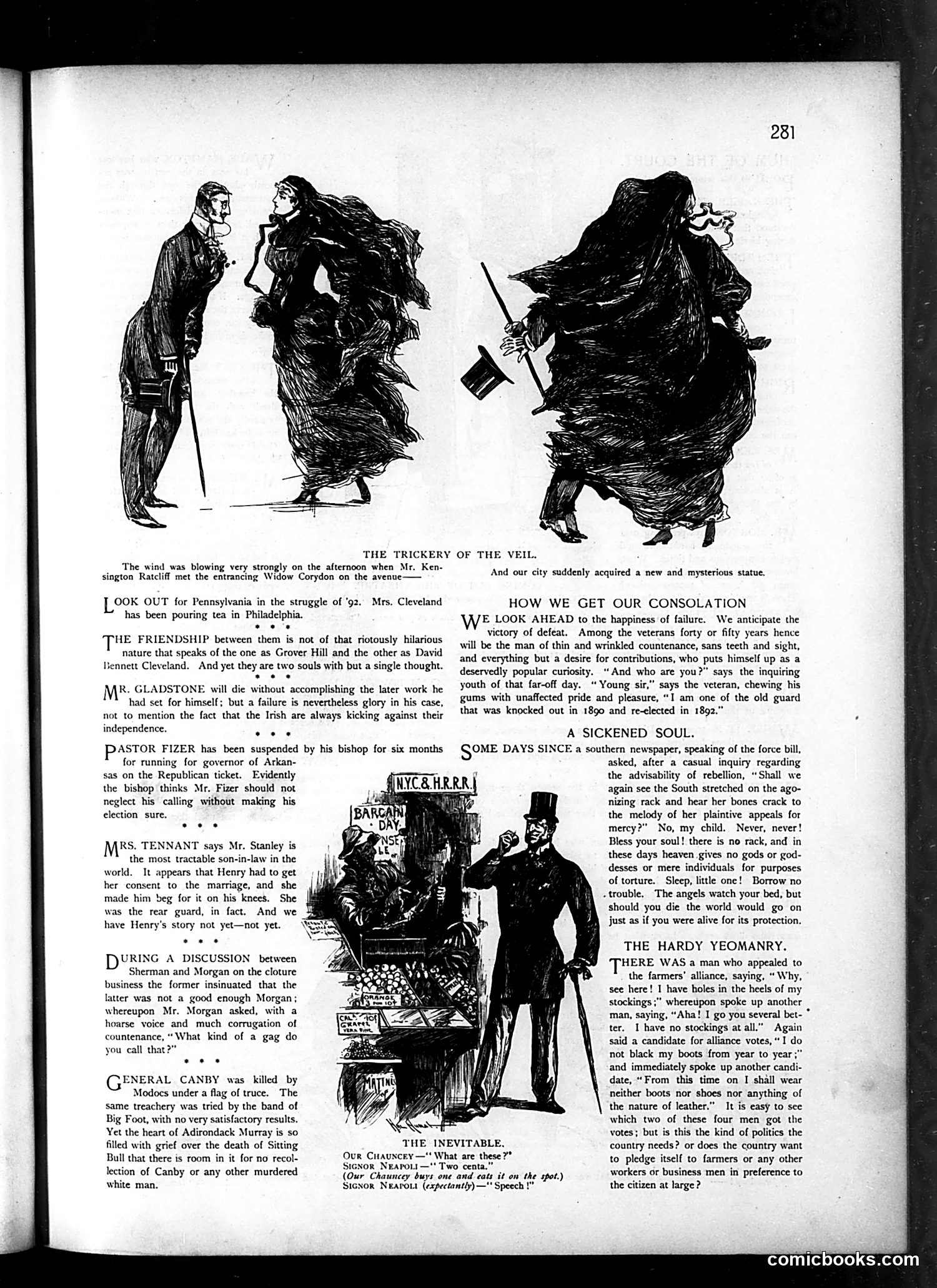
This page from *Judge* magazine contains multiple satirical pieces mocking late 19th-century American politics and politicians. **"The Trickery of the Veil"** (top) depicts a woman in elaborate disguise confronting a well-dressed man, likely satirizing deceptive political maneuvering or fraud. **Lower sections** reference specific political figures: Mrs. Cleveland (wife of President Grover Cleveland), Mr. Gladstone (British PM), and General Canby. The brief items mock their political failures and controversies. **"A Sickened Soul"** presents dialogue between political operatives discussing electoral manipulation and vote-buying—common corruptions of the Gilded Age era. The overall thrust criticizes dishonesty, patronage, and backroom dealing in American politics circa 1892, using caustic humor typical of *Judge*'s partisan satirical approach.
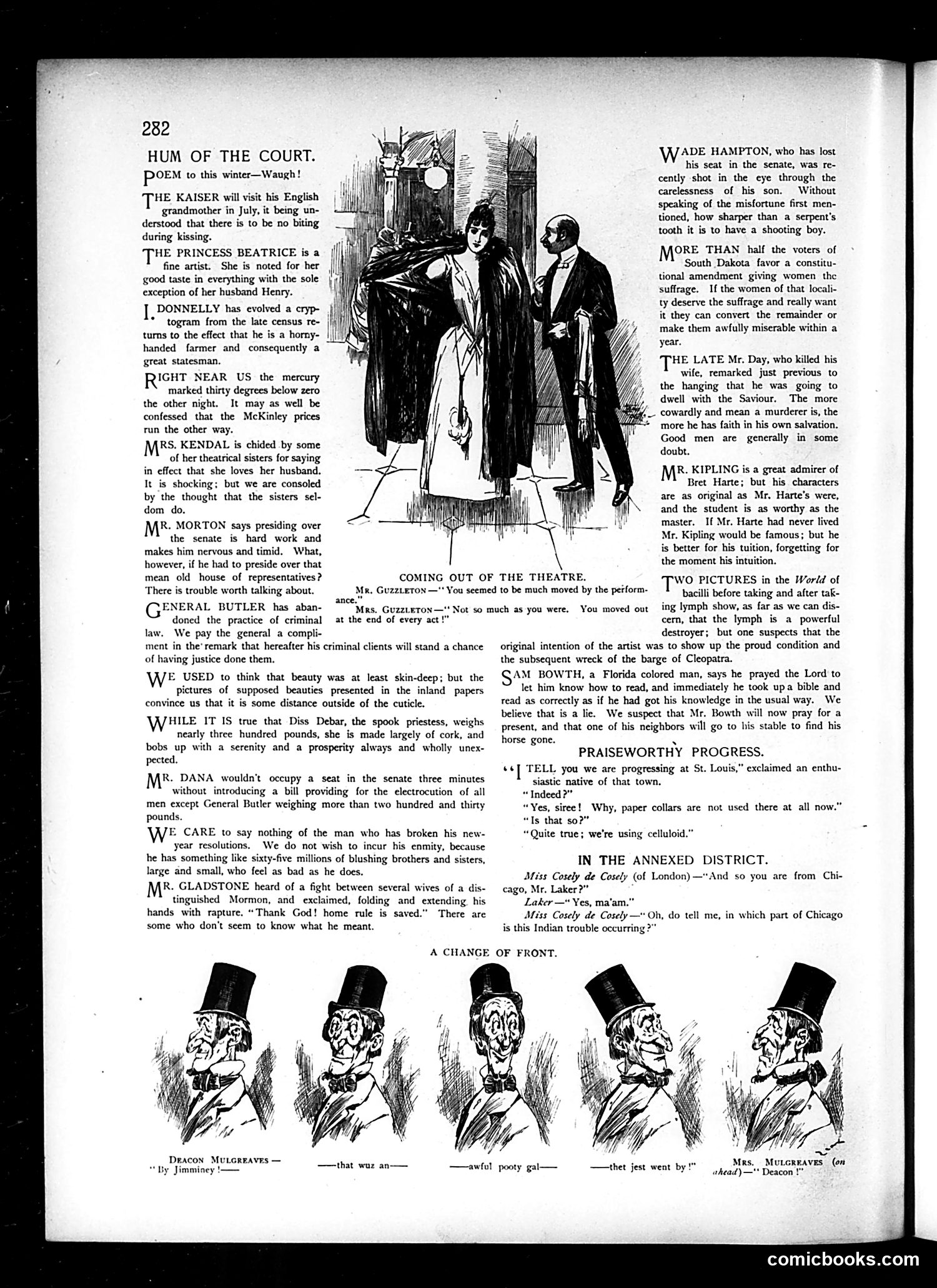
This page from Judge magazine contains brief satirical commentaries on contemporary American political and social figures. The main cartoon depicts "Coming Out of the Theatre"—showing a couple leaving a performance, with Mrs. Guzzleton noting her companion seemed moved by the drama. The text below contains sharp one-liners mocking prominent figures: Kaiser Wilhelm's planned visit to England, Princess Beatrice's choice of husband, Senator Morton's anxiety about leadership, and General Butler's criminal practice. There's political commentary on McKinley's economic policies ("prices run the other way"), critiques of women's suffrage in South Dakota, and mockery of Mormon polygamy via Gladstone's reaction. The bottom illustration, "A Change of Front," depicts five caricatured faces in top hats with accompanying text about "Dragon Mulgreaves" and "an awful pooty gal"—likely satirizing social pretension or romantic intrigue among the wealthy. The satire is broadly domestic and political, targeting politicians, celebrities, and social trends of the era.
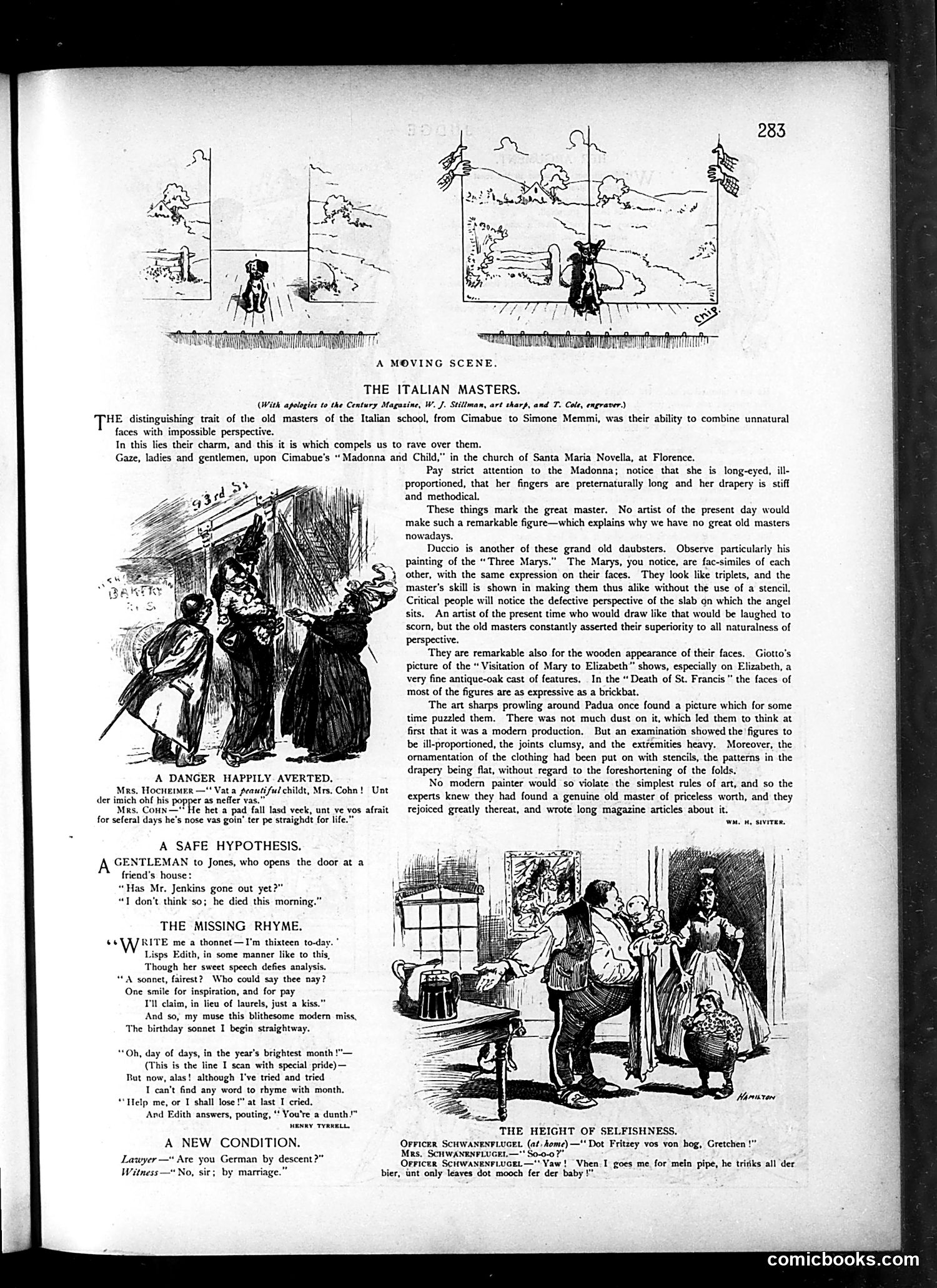
This page satirizes the uncritical admiration of Italian Renaissance masters. The main article mocks art critics and collectors who venerate old masters *despite* their obvious flaws—distorted proportions, awkward perspectives, wooden expressions, and stiff drapery—attributing these defects to genius rather than recognizing them as technical limitations. The satire argues that modern artists who paint with anatomical accuracy and proper perspective are dismissed as inferior precisely *because* they lack these "charming" flaws. The piece suggests that expertise has become inverted: art critics use technical incompetence as proof of authenticity and value. This reflects Gilded Age skepticism about whether wealthy collectors truly understood art or simply followed fashionable pretense. The remaining items are unrelated humor sketches typical of Judge magazine's variety format.
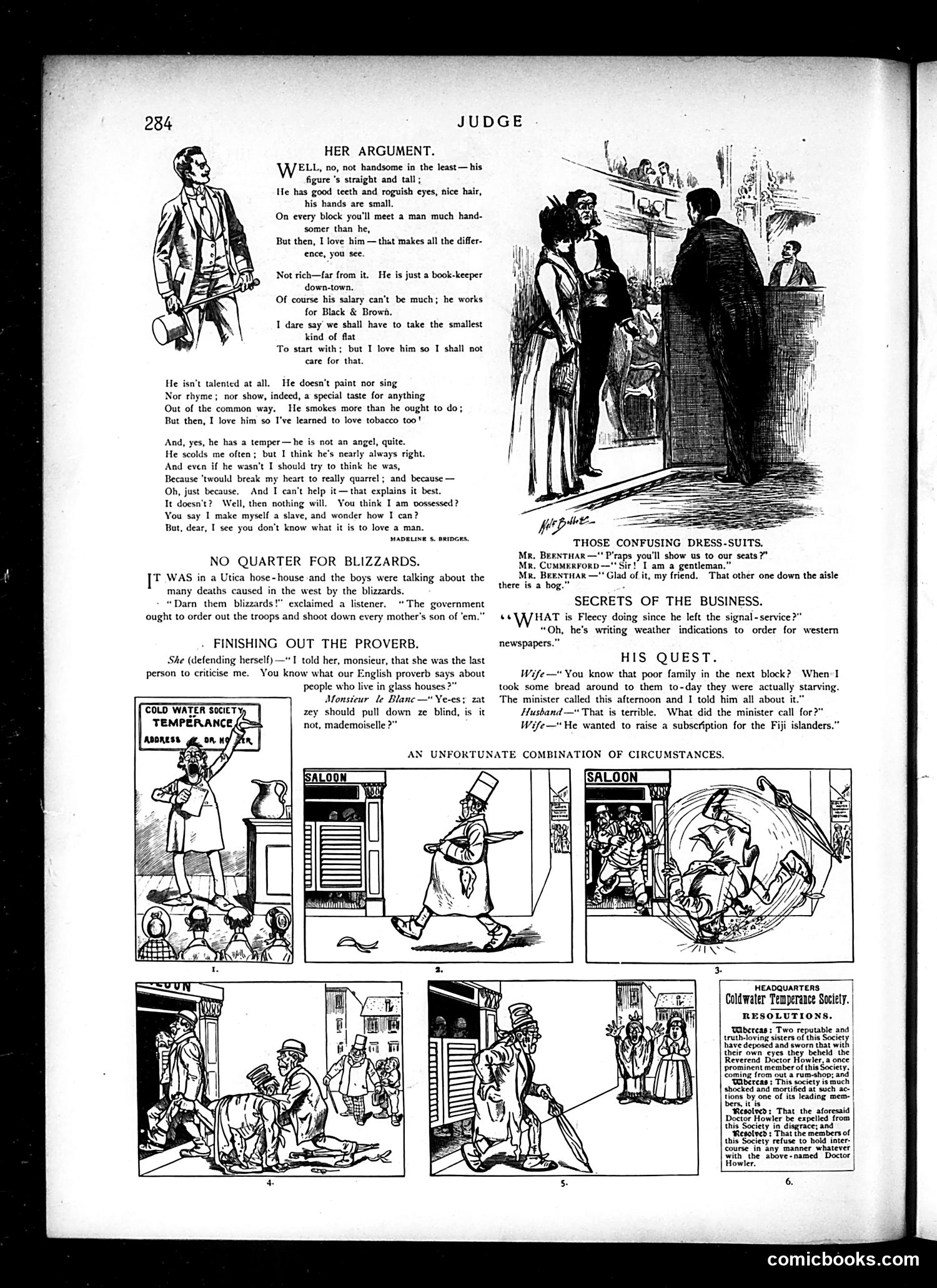
This page contains several satirical pieces typical of late-19th-century American humor: **"Her Argument"** mocks romantic rationalization—a woman defends loving an ordinary, poor, temperamental man by claiming love transcends logic. The satire targets sentimental idealization in courtship. **"No Quarter for Blizzards"** jokes about frontier harshness, with a speaker advocating shooting blizzard victims rather than enduring their deaths. **"Those Confusing Dress-Suits"** appears to mock formal dress-code confusion, with characters mistaking gentlemen for servants. **"Secrets of the Business"** satirizes weather forecasting opportunism—someone leaves legitimate meteorology to write fake weather predictions for newspapers. **"His Quest"** mocks charitable priorities: a minister visits about starving neighbors but only to solicit donations for distant Fiji islanders. **"An Unfortunate Combination"** presents the Coldwater Temperance Society expelling Reverend Howler after witnesses see him leaving a saloon—satirizing temperance hypocrisy and rigid moral enforcement.
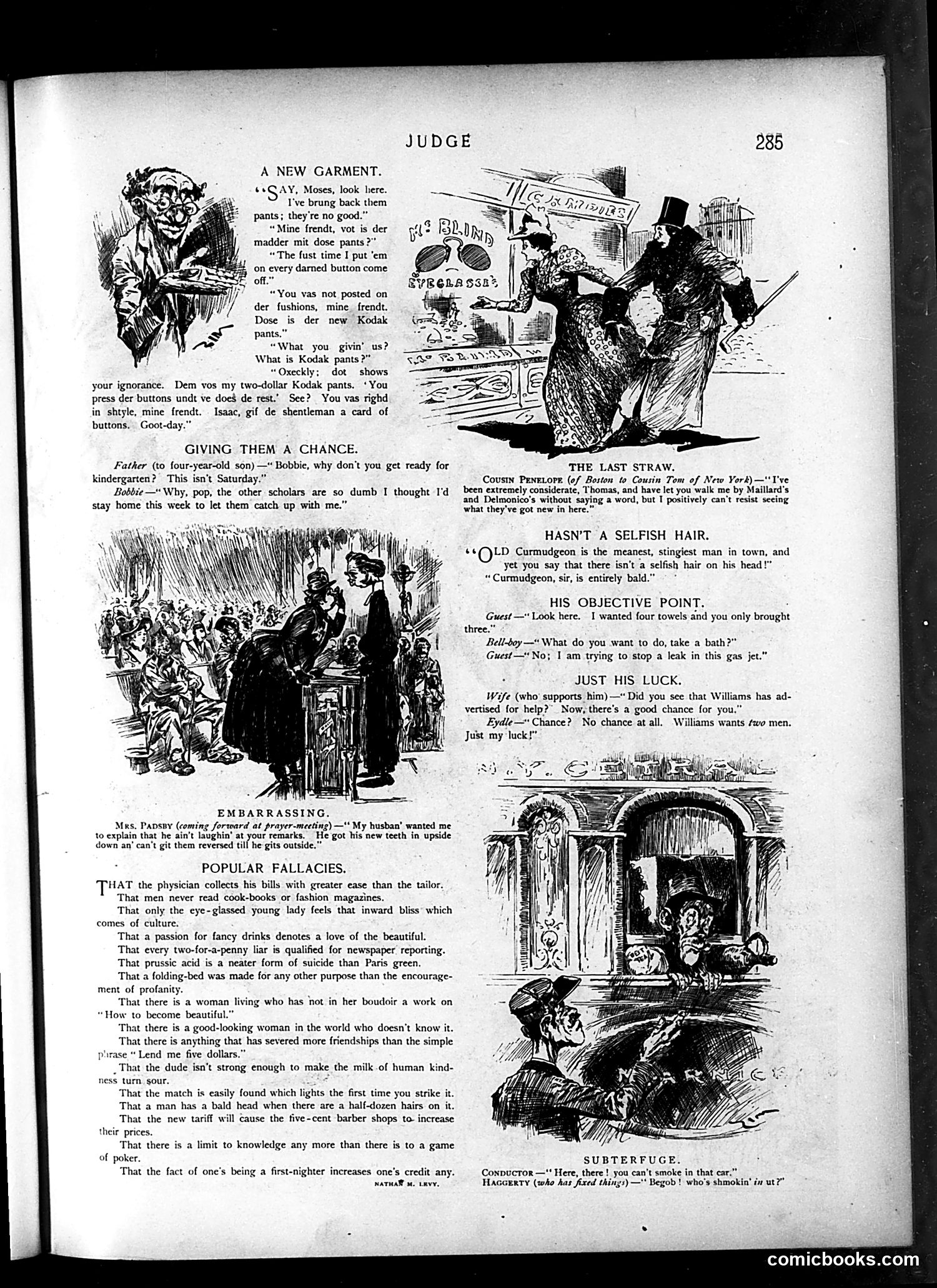
This page contains multiple short humor pieces typical of early 20th-century American satirical magazines. **"A New Garment"** depicts Jewish immigrants (indicated by dialect) discussing "Kodak pants"—a joke about buttons that pop off, playing on Kodak cameras' reliability ("You press the button, we do the rest"). **"Giving Them a Chance"** is a straightforward joke about a precocious child. **"Popular Fallacies"** is a list of humorous observations about human nature and society—essentially editorial commentary disguised as jokes. Notable is the swipe at newspaper reporters as liars. **"The Last Straw"** jokes about wealthy women's shopping habits. **"Hasn't a Selfish Hair"** uses a pun—the miser is literally bald. **"Just His Luck"** depicts working-class economic anxiety. **"Subterfuge"** shows an Irishman (indicated by "Begob") evading transit rules through wordplay. The page reflects period attitudes: ethnic stereotyping, class humor, and commentary on contemporary consumer culture and social manners.
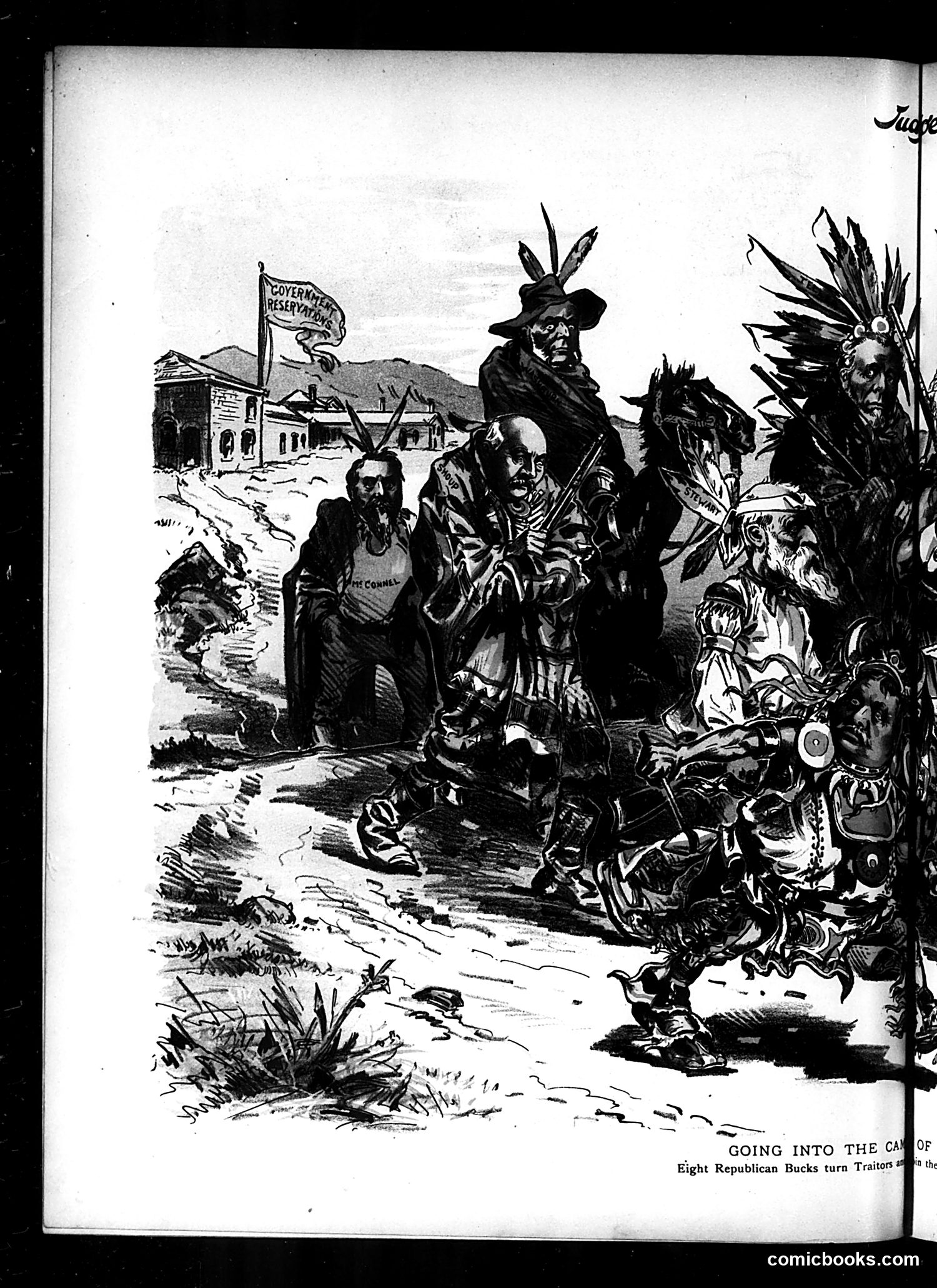
The caption reads "GOING INTO THE CA[MP OF] Eight Republican Bucks turn Traitor [?]" This is a satirical cartoon depicting Native Americans meeting with what appear to be Republican politicians or businessmen at a frontier settlement (visible building with "GOVERNMENT RESERVATION" flag in background). The satire appears to target Republican political figures who the cartoonist characterizes as "traitors"—likely referring to a specific historical incident where eight Republican politicians switched sides or betrayed party positions. The cartoon uses Native American imagery (the feathered headdresses, traditional appearance of figures on the right) as a visual metaphor, though the exact political context remains unclear without additional context about the issue and date of this Judge magazine publication. The juxtaposition suggests comparing the Republicans' alleged betrayal to negotiating with Native Americans at a reservation.
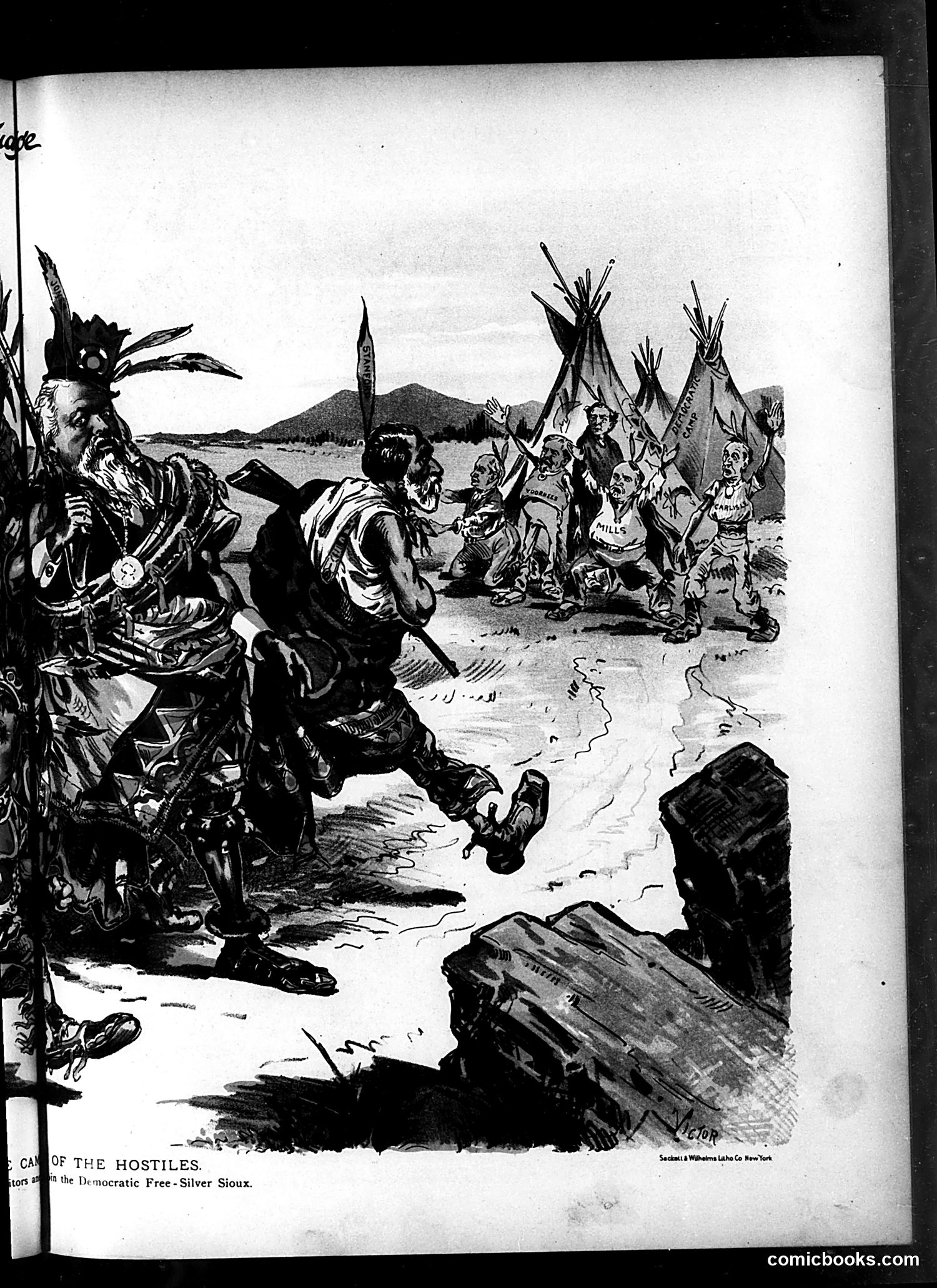
This satirical illustration from *Judge* magazine depicts Native Americans (labeled "the Hostiles") in a derogatory caricature style typical of late 19th-century American journalism. The caption references "the Democratic Free-Silver Sioux," connecting the imagery to contemporary political debate. The cartoon appears to mock the Democratic Party's free-silver monetary policy by associating it with Native American "hostility." The exaggerated facial features and stereotypical depiction reflect the era's racist attitudes toward Indigenous peoples. The camp scene with teepees establishes a "primitive" setting meant to ridicule Democratic economic positions as uncivilized or dangerous. This represents how *Judge*—a Republican-leaning publication—used dehumanizing imagery of Native Americans as a rhetorical weapon against political opponents, conflating Democratic policies with perceived threats to American society.
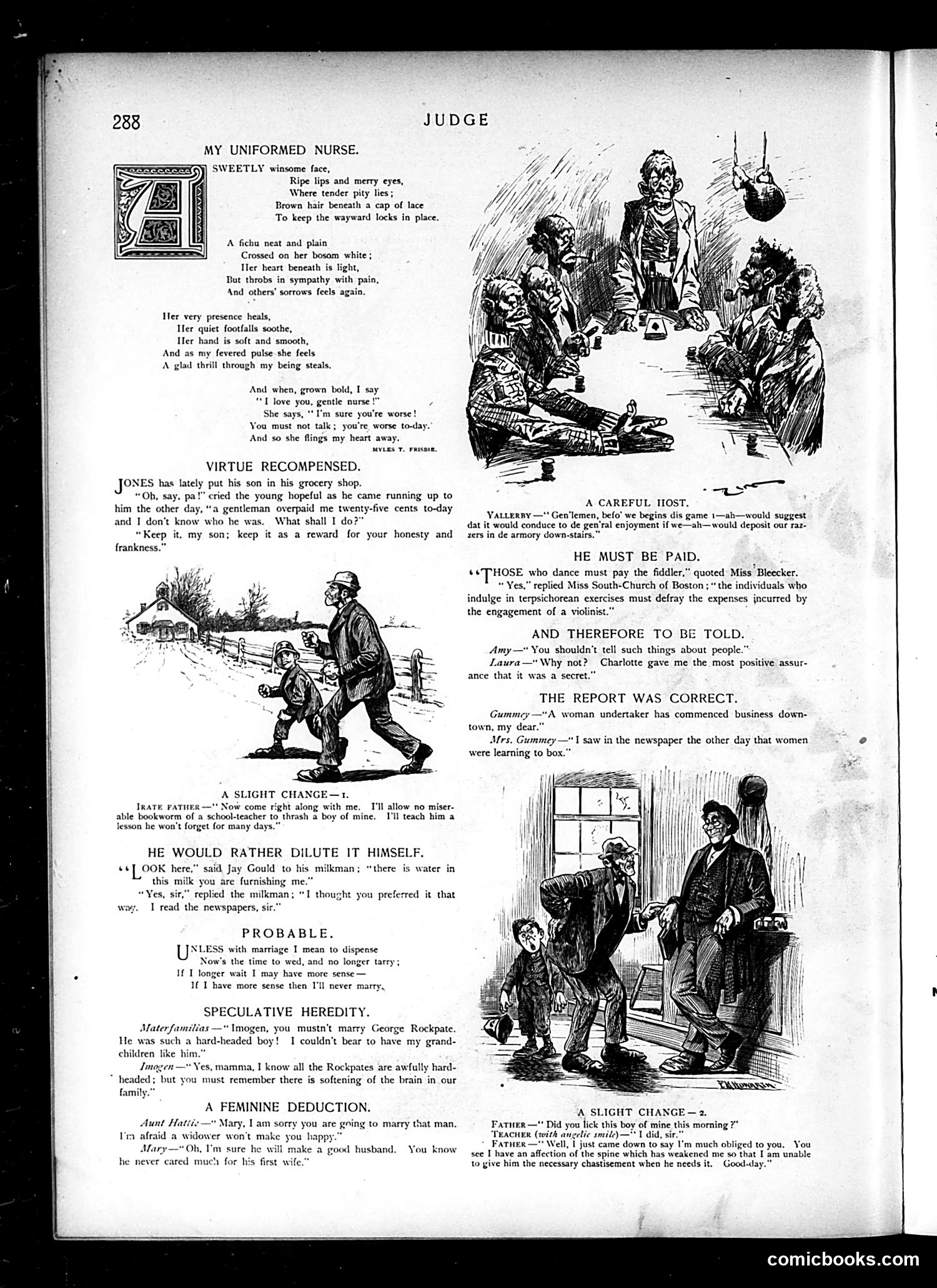
This page contains multiple short humorous pieces typical of Judge's satirical style: **"My Uniformed Nurse"** is a romantic poem about a male patient's attraction to his nurse, ending with her rejecting his advances by telling him he's "worse"—a joke on the common phrase "you're making yourself worse." **"Virtue Recompensed"** mocks middle-class morality: a grocer's son honestly reports overpayment, and his father rewards him—praising honesty while the son keeps money that isn't his. **"He Must Be Paid"** satirizes pretentious speech: two women use overly formal language ("terpsichorean exercises") to discuss paying a violinist for a dance. **"The Report Was Correct"** jokes about women entering previously male-dominated professions (here, undertaking and boxing). **"Jay Gould and the Milkman"** references the famous robber baron Jay Gould, who complains about water in his milk; the milkman defensively notes he reads newspapers—implying Gould's own reputation for cutting corners. The remaining pieces joke about hasty marriages, heredity, and parental discipline—all targeting Victorian social conventions and class pretensions.
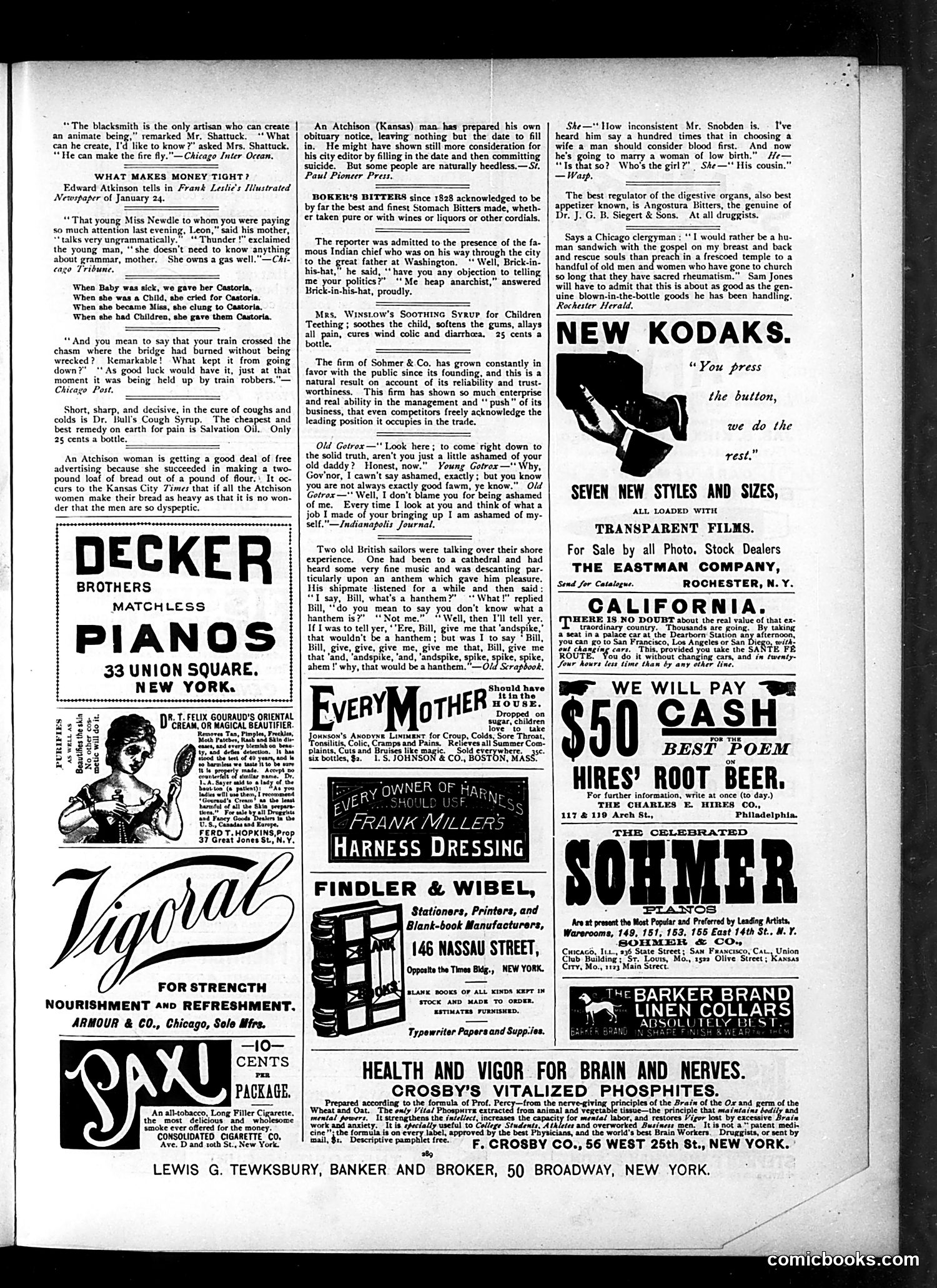
This page is primarily **advertisements and short humorous anecdotes** rather than political cartoons. The humor pieces are gentle social satire: **Key content:** 1. **"What Makes Money Tight?"** — A young man ignores his girlfriend's poor grammar because she owns a gas well, satirizing how wealth trumps refinement. 2. **Atchison woman joke** — Mocks an Atchison, Kansas woman who made a two-pound loaf from one pound of flour; the *Kansas City Times* quips this explains why Atchison men are dyspeptic (digestively troubled). 3. **Train robber anecdote** — Dark humor about a train being held up by robbers, preventing it from falling into a chasm. 4. **Anarchist Indian chief** — A reporter asks a Native American chief about his politics; he proudly declares himself an "anarchist" — likely satirizing contemporary anarchist concerns and stereotyping Indigenous peoples as primitive. The page reflects **Gilded Age American attitudes**: materialism, anti-anarchism sentiment, and casual ethnic stereotyping. Most content serves as filler between large product advertisements (pianos, bitters, patent medicines).
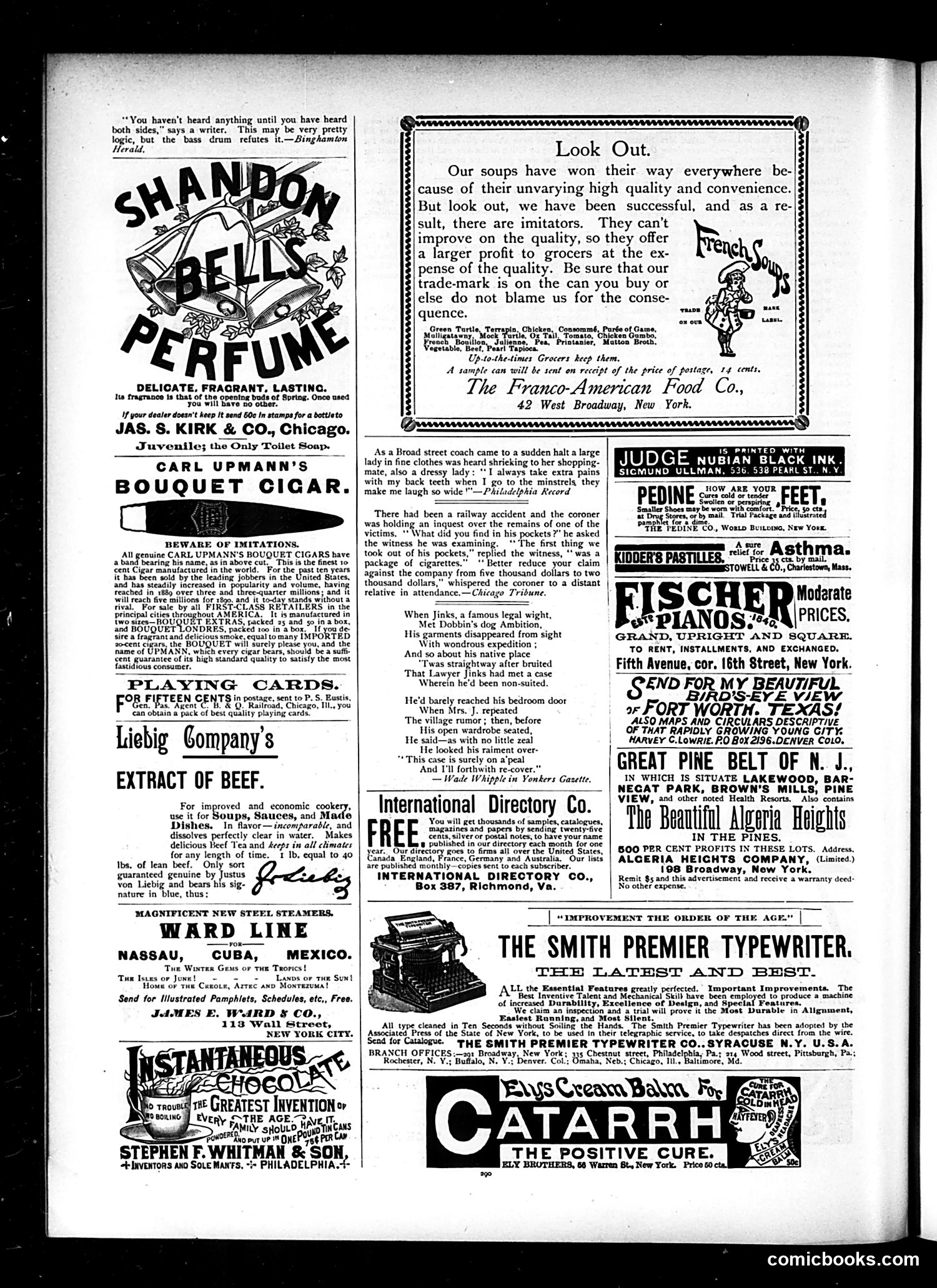
This page is primarily **advertisements** with minimal editorial content. The main satirical element is a brief quoted joke about a woman at minstrel shows (line performance entertainment featuring racial caricature and blackface), noting she laughs with her mouth wide open—a mild social observation about theatrical behavior rather than pointed political satire. The page features typical late-19th-century product ads: Shandon Bells perfume, cigars, beef extract, steamship lines, typewriters, and patent medicines. One ad warns against counterfeit "Franco-American" soups, claiming imitators sacrifice quality for profit margins—an early consumer protection message. A small coroner's inquest joke involves finding cigarettes in a dead man's pockets, used to reduce liability claims. These are light, disconnected humor pieces rather than cohesive editorial cartooning. **The overall page reflects Judge magazine's mixed format**: advertisements subsidizing satirical content, with humor items scattered between commercial notices.
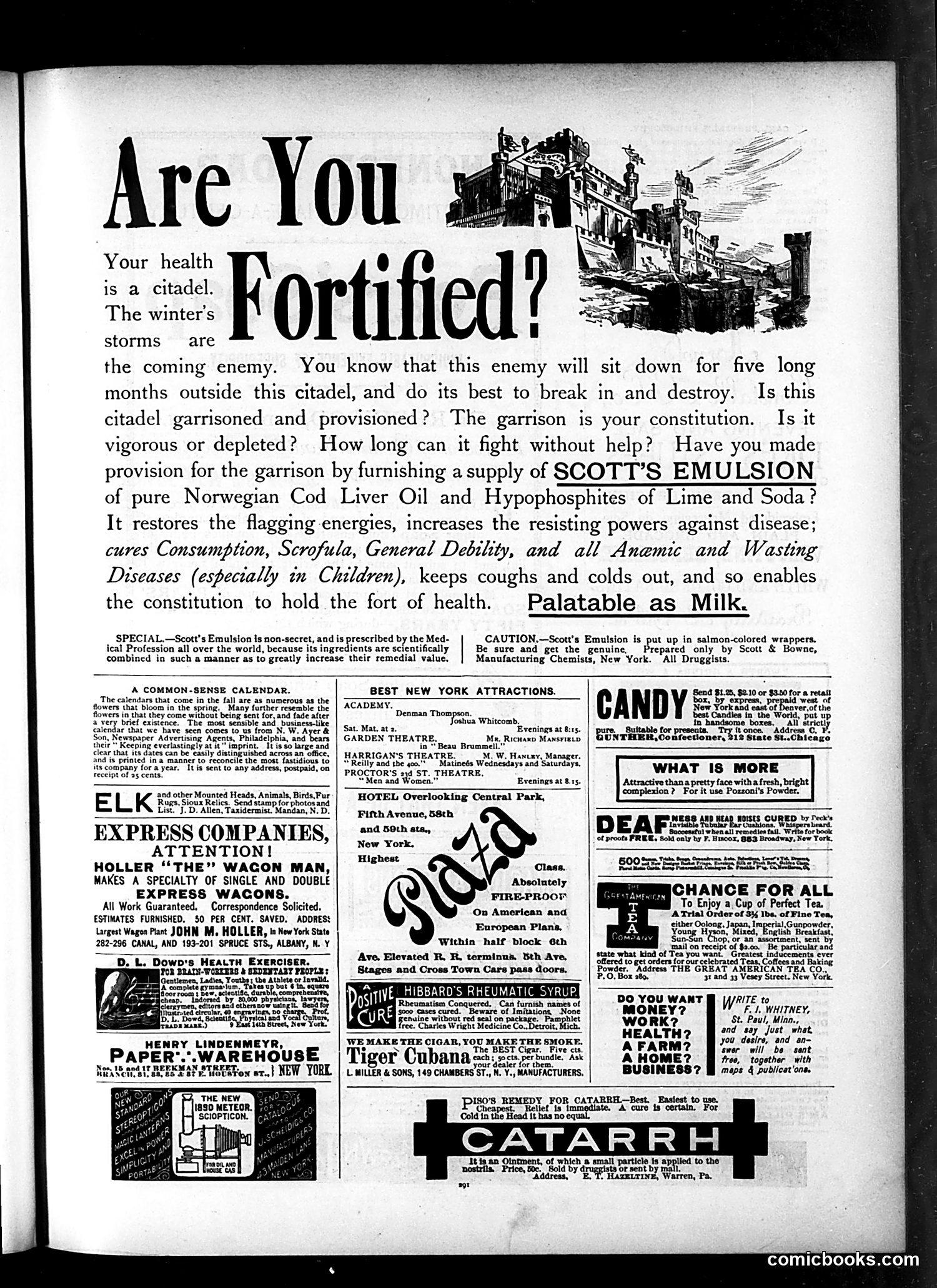
This is primarily an **advertising page** from Judge magazine, not a political cartoon. The dominant feature is a large advertisement for Scott's Emulsion (cod liver oil), using a militaristic metaphor: your body is a "citadel," winter storms are an "enemy," and your constitution is a "garrison" needing provisions to survive. The page contains typical late-19th-century advertisements for various products: patent medicines (Hibbard's Rheumatic Syrup, Piso's Remedy for Catarrh), theatrical announcements for New York venues, hotels, and commercial services. **Social context for modern readers:** These ads reflect genuine public anxieties about winter illness and disease (consumption/tuberculosis was common). Products like cod liver oil were genuinely prescribed; the metaphorical "fortification" language tapped into real health concerns before antibiotics existed. The dense, cluttered ad layout was standard for era publications; the militaristic health language, now quaint, represented contemporary thinking about combating disease through bodily "strength."
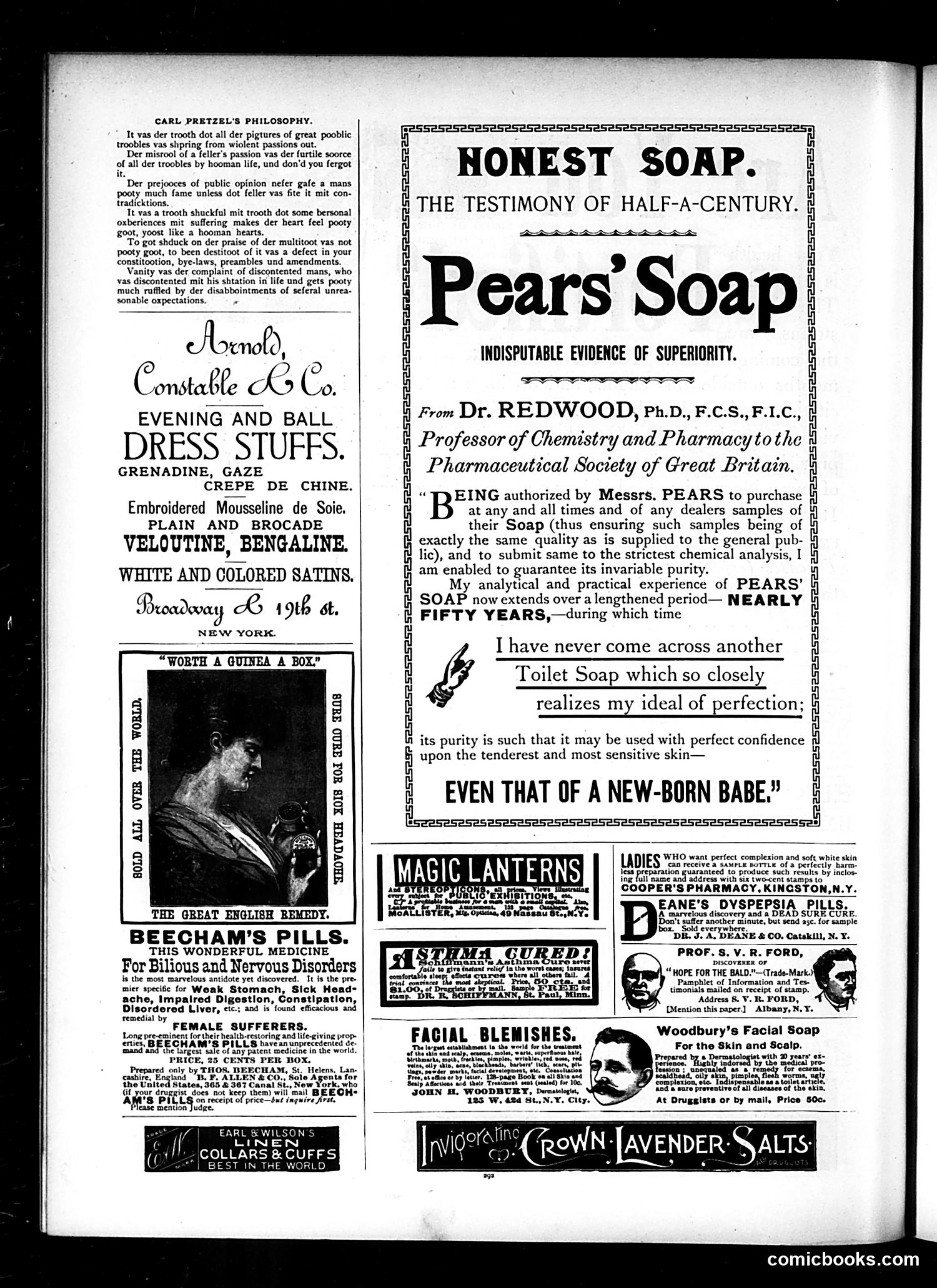
This page is primarily **advertising**, not political satire or comic content. The left column contains "Carl Pretzel's Philosophy"—a fictional German-accented character offering banal wisdom about human nature (passions, opinions, vanity, etc.). This appears to be filler content rather than satire with specific political targets. The remainder of the page showcases period patent medicines and commercial products: Pears' Soap (with a testimonial from a chemistry professor), Beecham's Pills, Eane's Dyspepsia Pills, hair-loss remedies, and facial soaps. These ads tout miraculous cures for digestion, constipation, baldness, and complexion—typical of early-20th-century **snake-oil marketing**. The German-accented "Pretzel" character may be a mild ethnic stereotype common to the era, but the page lacks coherent political commentary. It's essentially a magazine advertisement page masquerading as content through Pretzel's philosophy column.
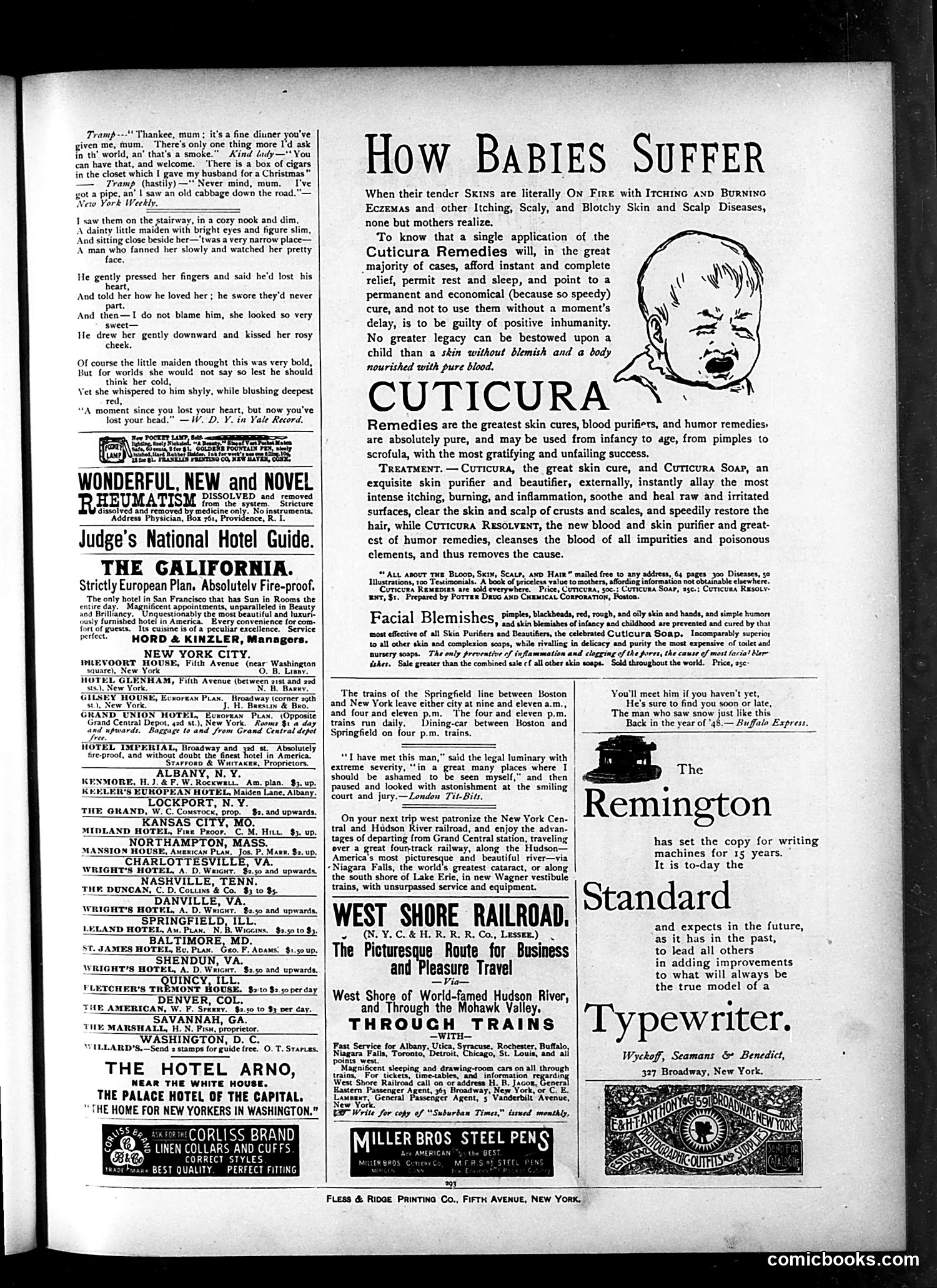
This page contains **primarily advertisements** rather than political cartoons. The main visual content is a large Cuticura Remedies ad featuring an illustrated crying baby, promoting skin treatments for infant eczema and other conditions. The page includes two **brief humorous anecdotes** (not cartoons): 1. A "tramp" joke where a vagrant refuses expensive cigars offered by a lady after accepting dinner, preferring a pipe and cabbage—satirizing working-class pride and the awkwardness of charity. 2. A romantic scene where a young man kisses a woman on a stairwell; she deflects by saying he's "lost his head" after claiming to have lost his heart—a mild Victorian-era sexual propriety joke about impulsive male behavior. The bulk of the page features hotel advertisements and product promotions typical of Judge magazine's era. The Cuticura ad's emphasis on preventing infant suffering reflects late 19th/early 20th-century anxieties about children's health and emerging consumer medicine marketing.
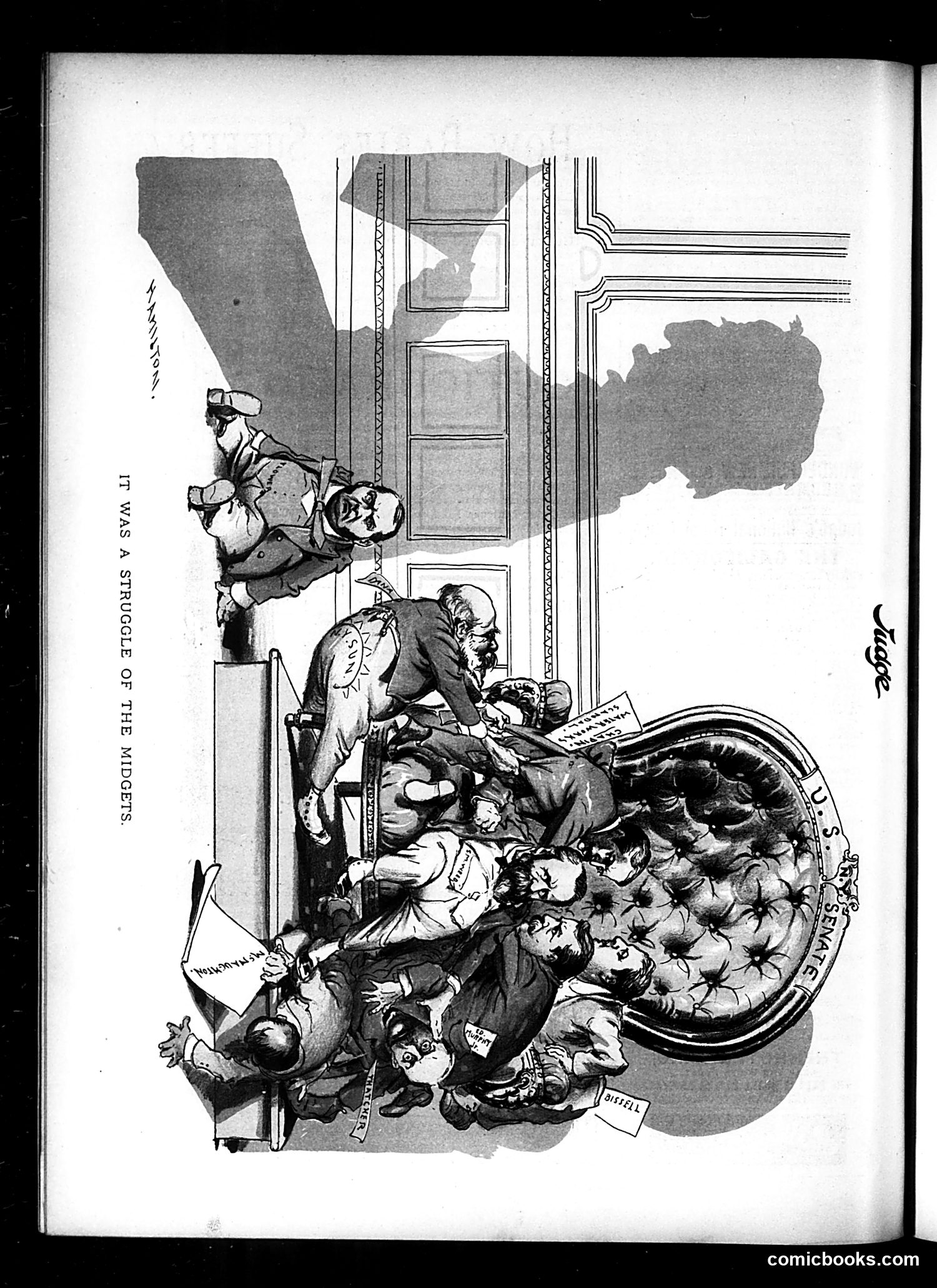
This satirical cartoon depicts a chaotic indoor scene with multiple small figures engaged in a physical struggle or fight. The title's reference to "midgets" suggests the cartoon is mocking political figures or groups as diminutive or insignificant, reducing them to absurdity through exaggeration. The scene shows figures labeled "SISSIES" grappling near a doorway, with what appears to be furniture and household items. The composition satirizes petty political conflict—likely referencing a specific contemporary political dispute that Judge magazine deemed trivial or undignified. Without clear identification of the specific figures or historical context visible in the image, the general point appears to be mockery of politicians engaged in undignified, pointless struggle over minor matters.