
Judge, 1891-01-24 · page 2 of 16
Judge — January 24, 1891 — page 2: what you’re looking at
What you’re looking at
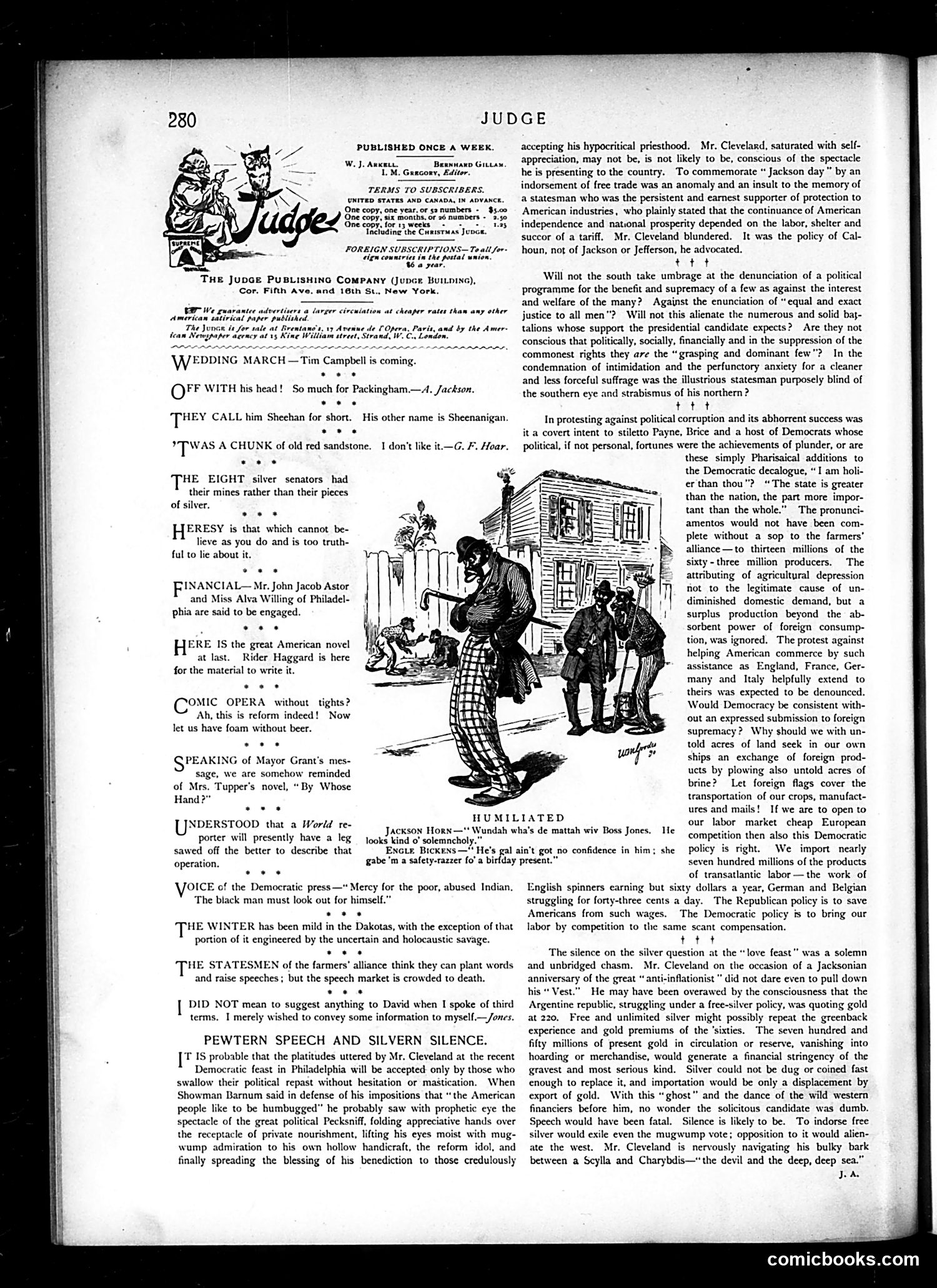
This cartoon depicts a scene titled "Humiliated" showing what appears to be a working-class family (a woman and children) at their home's doorway, with a man in formal dress (likely representing a politician or authority figure) departing. The accompanying text discusses Jackson Horne being "Wundah what's de matter wid boss Jones" and references issues of confidence and birthday presents, suggesting themes of economic hardship or employer-worker relations during this period. The broader article addresses Democratic political policy regarding silver coinage, tariffs, and international labor competition—issues central to late 19th-century American politics. The satire critiques Democratic economic policies as harming American workers through cheap foreign labor competition and currency instability, positioning Republican protectionist policies as the alternative.
📄 Transcribed text from this page (OCR, searchable)
Machine-transcribed from the original scan — historical spelling and the odd misread are preserved.
JUDGE PUBLISHED ONCE A WEEK. W. J. Awwes. Beannano Giicam. 1. M. Gancony, Editor. TERMS TO SUBSCRIBERS. UNITED STATES AND CANADA, IN ADVANCE. One copy, one year. or s2 numbers - Qne copy, six months. or 26 numbers - copy, for ty weeks et Including the Cunistuas Juoce, One THE JuDGe PUBLISHING ComPANy (Jupce BUILDING), Cor. Fifth Ave. and 16th St.. New York. EW We guarantee advertivers a larger circulation at cheaper rates than any other American satirical paper published. The Jona it for sale at Aretine de COpera, Pa team i entane's. 17 ine William street, Strand, is, and by the Amer- london WEDDING MARCH —Tim Campbell is coming. OFF WITH his head! So ae fee Packingham.—A. Jackson. THEY CALL him Sheehan igi His other name is Sheenanigan. eee *T WAS A CHUNK of old red sandstone. 1 don’t like it.—G. F. Hoar. THE EIGHT silver senators had their mines rather than their pieces of silver. ERESY is that which cannot be- lieve as you do and is too truth- ful to lie about it. FINANCIAL—Mr. John Jacob Astor and Miss Alva Willing of Philadel- phia are said to be engaged. HERE IS the great American novel at last. Rider Haggard is here for the material to write it. eee OMIC OPERA without tights? Ah, this is reform indeed! Now let us have foam without beer. SPEAKING of Mayor Grant's mes- sage, we are somehow reminded of Mrs. Tupper's novel, “By Whose Hand?" ere [UNDERSTOOD that a World re- porter will presently have a leg sawed off the better to describe that operation. Act looks kind Encie. Bick N Horn 0’ solemnchol: vs —"* He's Wi VOICE of the Democratic press—" Mercy for the poor, abused Indian. The black man must look out for himself.” eee ‘THE WINTER has been mild in the Dakotas, with the exception of that portion of it engineered by the uncertain and holocaustic savage. THE STATESMEN of the farmers’ alliance think they can plant words and raise speeches; but the speech market is crowded to death. eee [ DID NOT mean to suggest anything to David when I spoke of third terms. I merely wished to convey some information to myself,—/ones. PEWTERN SPEECH AND SILVERN SILENCE. [TIS probable that the platitudes uttered by Mr. Cleveland at the recent Democratic feast in Philadelphia will be accepted only by those who swallow their political repast without hesitation or mastication. When Showman Barnum said in defense of his impositions that “the American people like to be humbugged” he probably saw with prophetic eye the spectacle of the great political Pecksniff, folding appreciative hands over the receptacle of private nourishment, lifting his eyes moist with mug- wump admiration to his own hollow handicraft, the reform idol, and finally spreading the blessing of his benediction to those credulously HUMILIATED ndah wha’s de mattah wiv Boss Jones. 1 gabe'm a safety-razzer fo! a birfday present.” accepting his hypocritical priesthood. Mr. Cleveland, saturated with self- appreciation, may not be, is not likely to be, conscious of the spectacle he is presenting to the country. To commemorate “ Jackson day” by an indorsement of free trade was an anomaly and an insult to the memory of a statesman who was the persistent and earnest supporter of protection to American industries, who plainly stated that the continuance of American independence and national prosperity depended on the labor, shelter and succor of a tariff. Mr. Cleveland blundered. It was the policy of Cal- houn, not of Jackson or Jefferson, he advocated. tats t Will not the south take umbrage at the denunciation of a political programme for the benefit and supremacy of a few as against the interest and welfare of the many? Against the enunciation of “equal and exact justice to all men"? Will not this alienate the numerous and solid bas- talions whose support the presidential candidate expects? Are they not conscious that politically, socially, financially and in the suppression of the commonest rights they ave the “grasping and dominant few"? In the condemnation of intimidation and the perfunctory anxiety for a cleaner and less forceful suffrage was the illustrious statesman purposely blind of the southern eye and strabismus of his northern ? ts tat, In protesting against political corruption and its abhorrent success was it a covert intent to stiletto Payne, Brice and a host of Democrats whose political, if not personal, fortunes were the achievements of plunder, or are these simply Pharisaical additions to the Democratic decalogue, “I am holi- erthan thou"? “The state is greater than the nation, the part more impor- tant than the whole.” The pronunci- amentos would not have been com- plete without a sop to the farmers’ alliance —to thirteen millions of the sixty three million producers. The attributing of agricultural depression fot to the legitimate cause of un- diminished domestic demand, but a surplus production beyond the ab- sorbent power of foreign consump- tion, was ignored. The protest against helping American commerce by such assistance as England, France, Ger- many and Italy helpfully extend to theirs was expected to be denounced. Would Democracy be consistent with- out an expressed submission to foreign supremacy? Why should we with un- told acres of land seek in our own ships an exchange of foreign prod- ucts by plowing also untold acres of brine? Let foreign flags cover the transportation of our crops, manufact- ures and mails! If we are to open to our labor market cheap European competition then also this Democratic policy is right. We import nearly seven hundred millions of the products of transatlantic labor —the work of English spinners earning but sixty dollars a year, German and Belgian struggling for forty-three cents a day. The Republican policy is to save Americans from such wages. The Democratic policy is to bring our labor by competition to the same scant compensation. t t t The silence on the silver question at the “love feast" was a solemn and unbridged chasm. Mr. Cleveland on the occasion of a Jacksonian anniversary of the great “ anti-inflationist " did not dare even to pull down his “ Vest.” He may have been overawed by the consciousness that the Argentine republic, struggling under a free-silver policy, was quoting gold at 220, Free and unlimited silver might possibly repeat the greenback experience and gold premiums of the ‘sixties. The seven hundred and fifty millions of present gold in circulation or reserve, vanishing into hoarding or merchandise, would generate a financial stringency of the gravest and most serious kind. Silver could not be dug or coined fast enough to replace it, and importation would be only a displacement by export of gold. With this “ghost” and the dance of the wild western financiers before him, no wonder the solicitous candidate was dumb. Speech would have been fatal. Silence is likely to be. To indorse free silver would exile even the mugwump vote; opposition to it would alien- ate the west. Mr. Cleveland is nervously navigating his bulky bark between a Scylla and Charybdis—“ the devil and the deep, deep sea.” Ja He ain't got no confidence in him; she comicbooks.com