
Judge, 1891-01-24 · page 5 of 16
Judge — January 24, 1891 — page 5: what you’re looking at
What you’re looking at
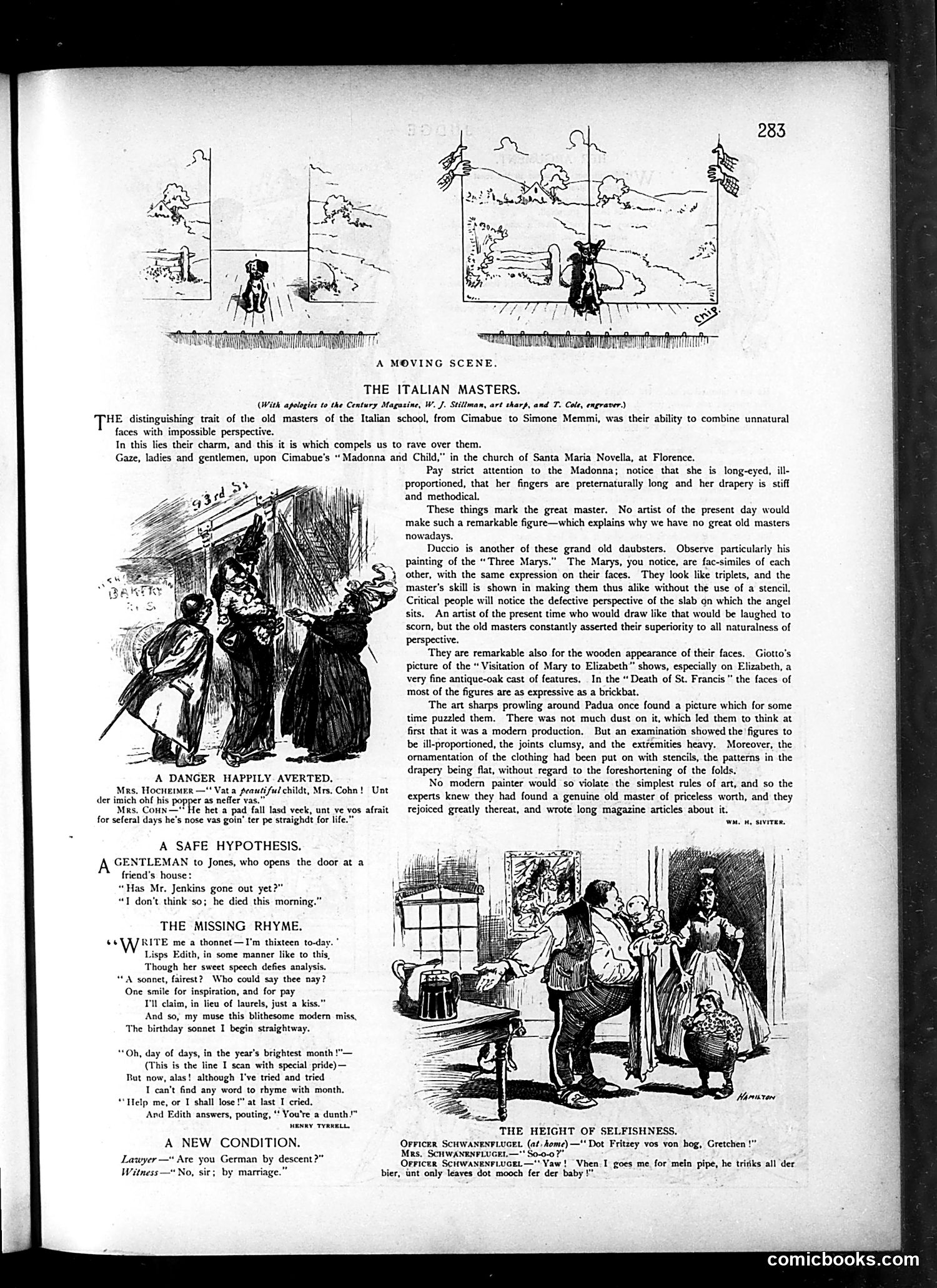
This page satirizes the uncritical admiration of Italian Renaissance masters. The main article mocks art critics and collectors who venerate old masters *despite* their obvious flaws—distorted proportions, awkward perspectives, wooden expressions, and stiff drapery—attributing these defects to genius rather than recognizing them as technical limitations. The satire argues that modern artists who paint with anatomical accuracy and proper perspective are dismissed as inferior precisely *because* they lack these "charming" flaws. The piece suggests that expertise has become inverted: art critics use technical incompetence as proof of authenticity and value. This reflects Gilded Age skepticism about whether wealthy collectors truly understood art or simply followed fashionable pretense. The remaining items are unrelated humor sketches typical of Judge magazine's variety format.
📄 Transcribed text from this page (OCR, searchable)
Machine-transcribed from the original scan — historical spelling and the odd misread are preserved.
A MOVING SCENE. THE ITALIAN MASTERS. (With apologies to the Century Magazine, W. J. Stillman, art sharp, and T. Cole, engraver.) THE distinguishing trait of the old masters of the Italian school, from Cimabue to Simone Memmi, was their ability to combine unnatural faces with impossible perspective. In this lies their charm, and this it is which compels us to rave over them. Gaze, ladies and gentlemen, upon Cimabue’s “Madonna and Child,” in the church of Santa Maria Novella, at Florence. Pay strict attention to the Madonna; notice that she is long-eyed, ill- proportioned, that her fingers are preternaturally long and her drapery is stiff and methodical. These things mark the great master. No artist of the present day would make such a remarkable figure—which explains why we have no great old masters nowadays. Duccio is another of these grand old daubsters. Observe particularly his painting of the “Three Marys.” The Marys, you notice, are fac-similes of each } other, with the same expression on their faces. They look like triplets, and the master’s skill is shown in making them thus alike without the use of a stencil, Critical people will notice the defective perspective of the slab on which the angel sits. An artist of the present time who would draw like that would be laughed to scorn, but the old masters constantly asserted their superiority to all naturalness of perspective. ‘They are remarkable also for the wooden appearance of their faces. Giotto’s picture of the “Visitation of Mary to Elizabeth” shows, especially on Elizabeth, a very fine antique-oak cast of features, In the “Death of St. Francis" the faces of most of the figures are as expressive as a brickbat. The art sharps prowling around Padua once found a picture which for some time puzzled them. There was not much dust on it, which led them to think at first that it was a modern production. But an examination showed the ‘figures to be ill-proportioned, the joints clumsy, and the extremities heavy. Moreover, the ornamentation of the clothing had been put on with stencils, the patterns in the dray being flat, without regard to the foreshortening of the folds. A DANGER HAPPILY: AVERTED. ges ae painter Saal so violate the Rael rules of art, and so the Mrs, Hocnemmer —"' Vata peautiful childt, Mrs. Cohn! Unt z 5 der imich obf his popper as neffer vas."” experts knew they had found a genuine old master of priceless worth, and they Mrs. Coun—" He het a pad fall lasd veek, unt ve vos afrait rejoiced greatly thereat, and wrote long magazine articles about it. for seferal days he’s nose vas goin’ ter pe straighdt for life.” wa. H, siviTeR, A SAFE HYPOTHESIS. TLEMAN to Jones, who opens the door at a friend’s house: “Has Mr, Jenkins gone out yet?” “I don’t think so; he died this morning.” THE MISSING RHYME. S¢\VRITE me a thonnet—I'm thixteen to-d Lisps , in some manner like to this, Though her sweet speech defies analysis. “A sonnet, fairest? Who could say thee nay? One smile for inspiration, and for pay T'll claim, in lieu of laurels, just a kiss.” And so, my muse this blithesome modern miss, The birthday sonnet I begin straightway. “Oh, day of days, in the year’s brightest month !"— (This is the line I scan with special pride)— Tut now, alas! although I've tried and tried I can't find any word to rhyme with month. p g - pds “Help me, or I shall lose!" at last I cried. ‘ q Mirsrert And Edith answers, pouting,“ You're a dunth!* So eens THE HEIGHT OF SELFISHNESS. A NEW CONDITION. OFFiceR SCHWANENPLUGEL (af, 4ome)—'*' Dot Fritzey vos von hog, Gretchen !” Lawyer —" Are you German by descent?” Mas Scr winanr ocala 45°C 50 pyice Orricer ScHWANENFLUGEL—"* Yaw! Vhen.I. goes me. for’ mein pipe, he tritiks all der Witness —" No, sit; by marriage. bier, int only leaves dot mooch fer der baby !" comicbooks.com