
A complete issue · 16 pages · 1891
Judge — January 10, 1891
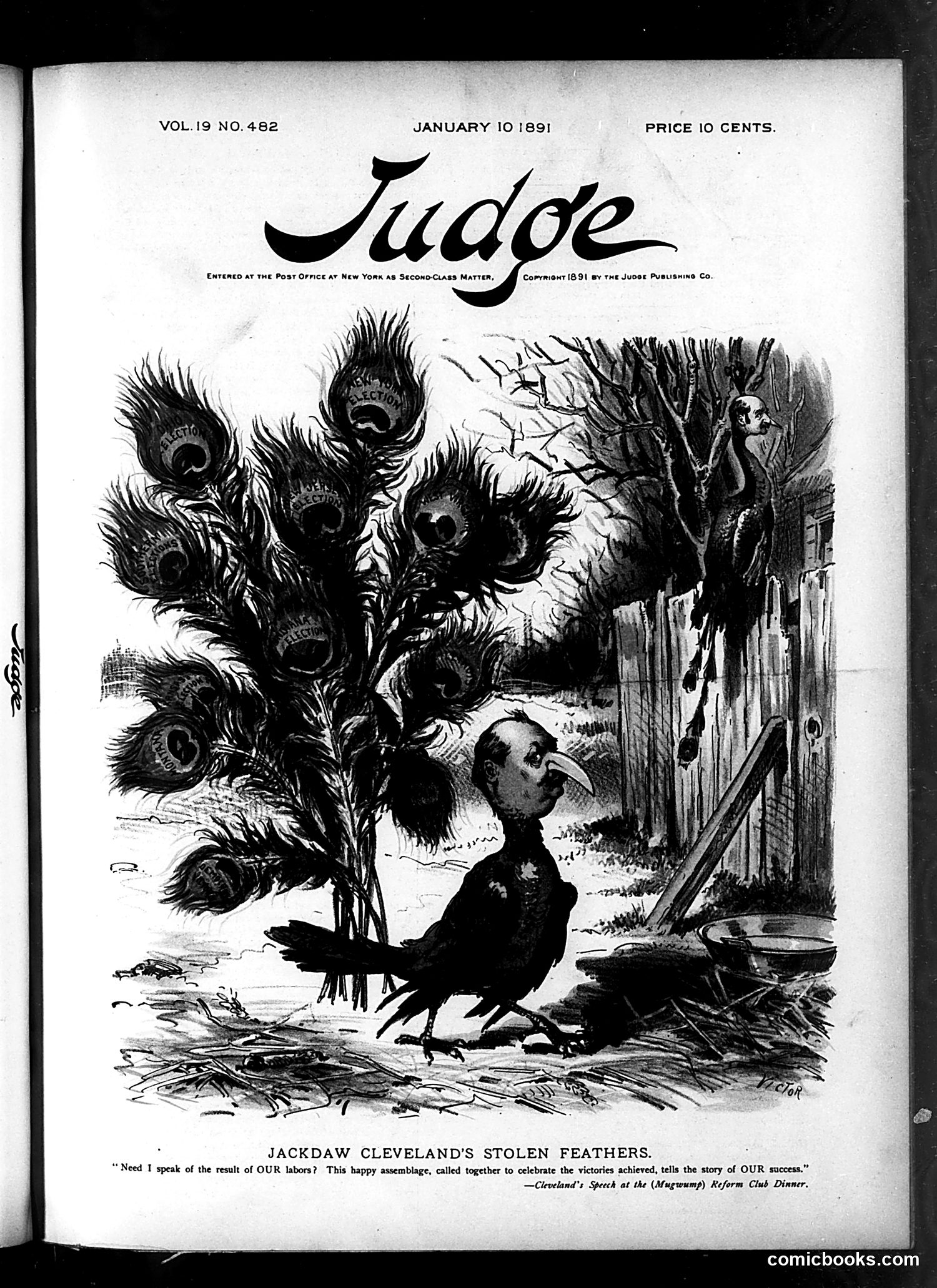
This January 1891 *Judge* cartoon satirizes President Grover Cleveland. The image depicts a man (Cleveland, identifiable by the caption) gazing at a peacock with elaborate feathers marked with eyes. The peacock represents Cleveland's accomplishments and political victories. The caption quotes Cleveland's speech at a Mugwump Reform Club dinner, where he claimed to need recognition for labor's results and "OUR success." The satire suggests Cleveland is admiring achievements that aren't truly his own—the "stolen feathers" metaphor implies he's appropriating credit for collective efforts or previous administrations' work. A jackdaw is a bird known for stealing shiny objects, making the title's pun work: Cleveland, like the thieving bird, claims plumage (credit) that belongs elsewhere.
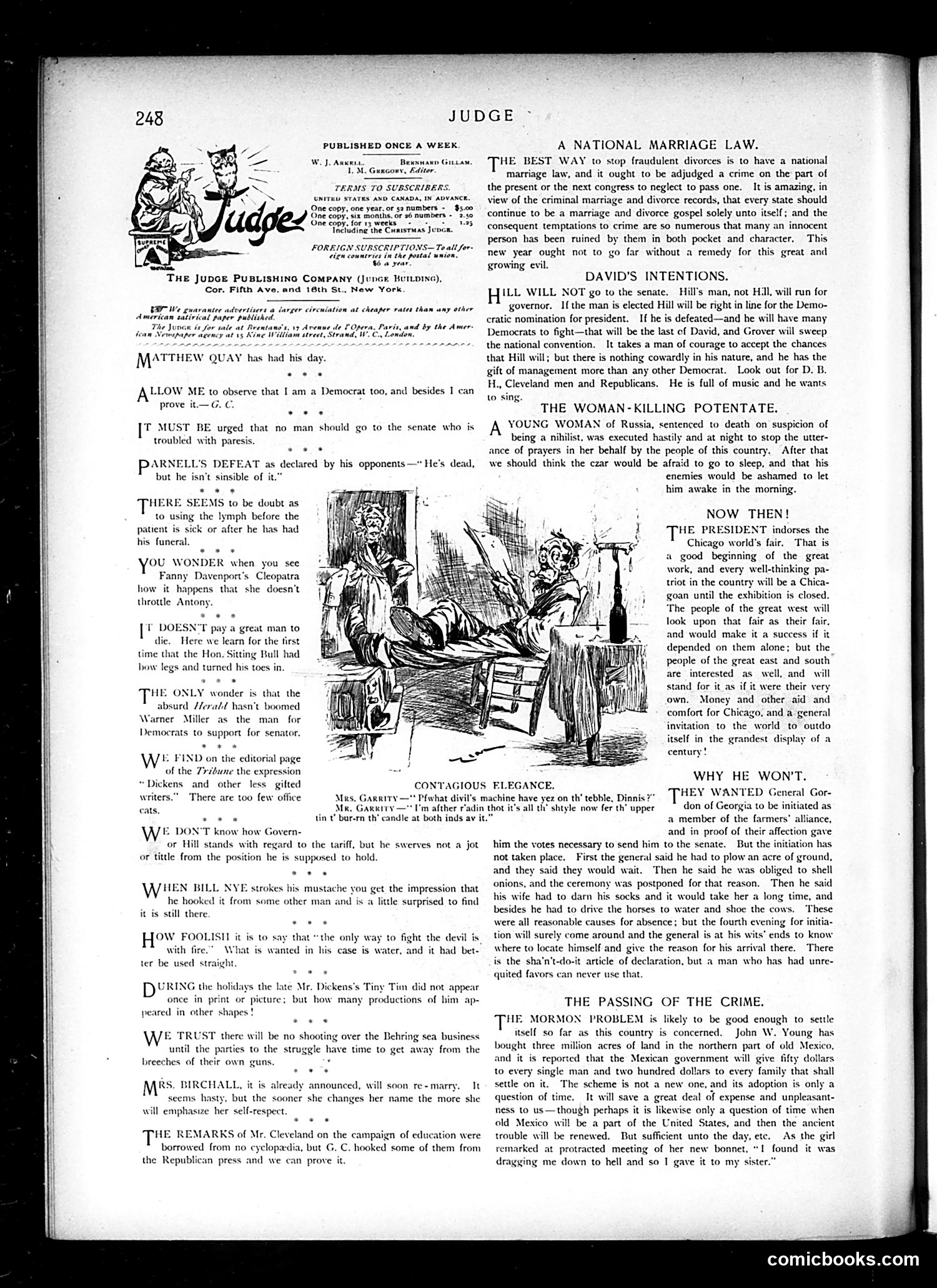
This page contains political commentary rather than a single unified cartoon. The main illustrated piece, labeled "CONTAGIOUS ELEGANCE," appears to depict a woman in elaborate dress affecting fashionable mannerisms—likely satirizing upper-class affectation and conspicuous consumption. The text columns reference several political figures including Hill (likely Senator David B. Hill), Cleveland (President Grover Cleveland), and General Gould. The commentary mocks Democratic political maneuvering, particularly regarding Senate nominations and the upcoming presidential convention. "THE WOMAN-KILLING POTENTATE" references a Russian execution case, while "THE PASSING OF THE CRIME" discusses Mexican land settlement in the American Southwest. The overall page satirizes contemporary political corruption, class pretension, and international affairs typical of 1890s Judge content.
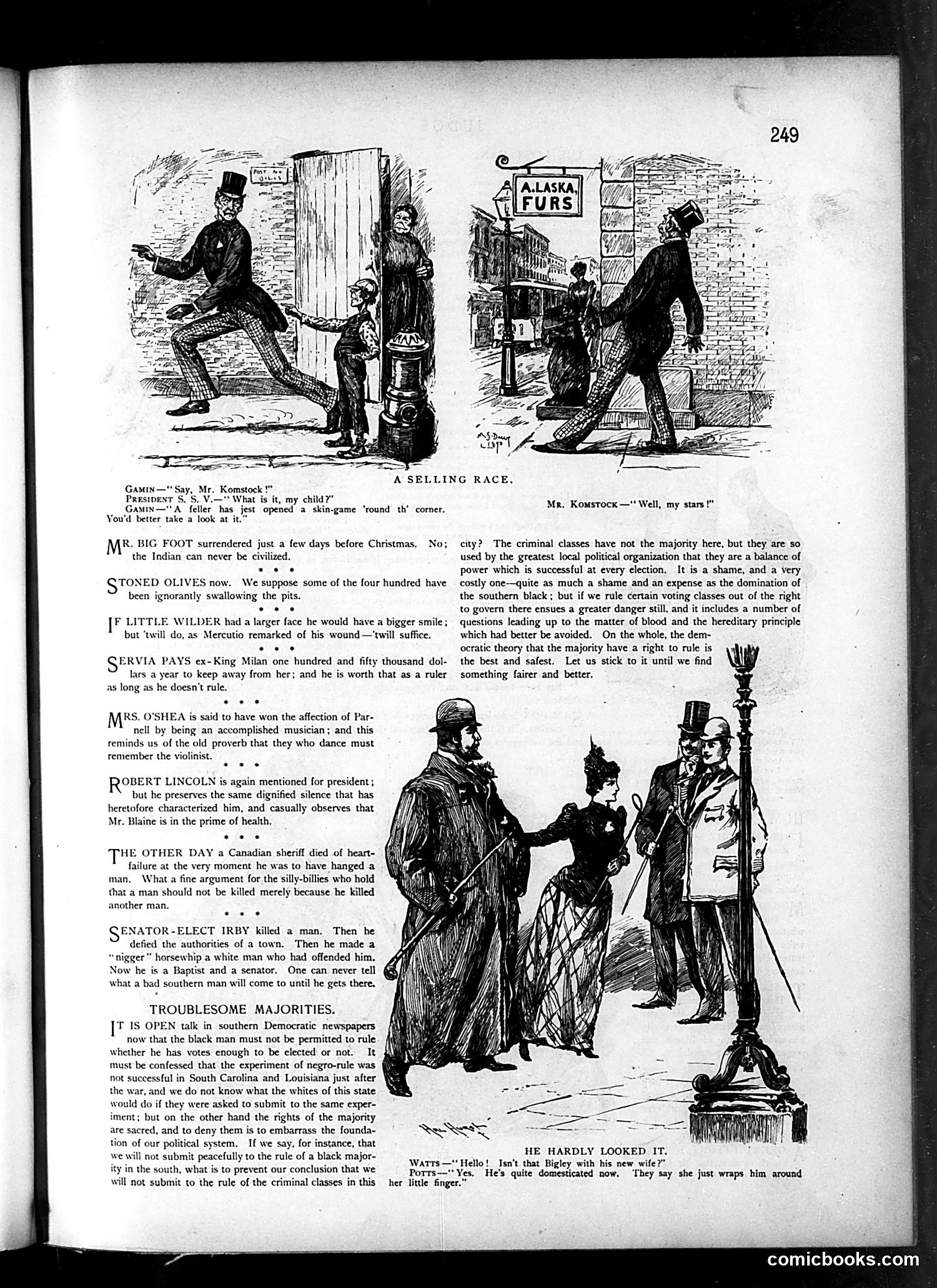
**Top Cartoons:** The left cartoon depicts a man in formal dress playfully kicking at a pole while a child watches—captioned as commentary on someone opening a "skin-game" (gambling operation). The right cartoon shows men outside an "Alaska Furs" shop, labeled "A Selling Race," suggesting competition over fur trading or sales. **Main Article: "Troublesome Majorities"** This political commentary addresses post-Reconstruction Southern politics. It argues against Black political participation, claiming "negro-rule" failed in South Carolina and Louisiana after the Civil War. The piece advocates restricting Black voting rights, presenting this as protecting "foundation of our political system." **Bottom Illustration:** Shows well-dressed men (appears to be political/social figures) in winter dress, though context is unclear from visible text. The page reflects late 19th-century racist political discourse opposing Reconstruction-era voting rights.
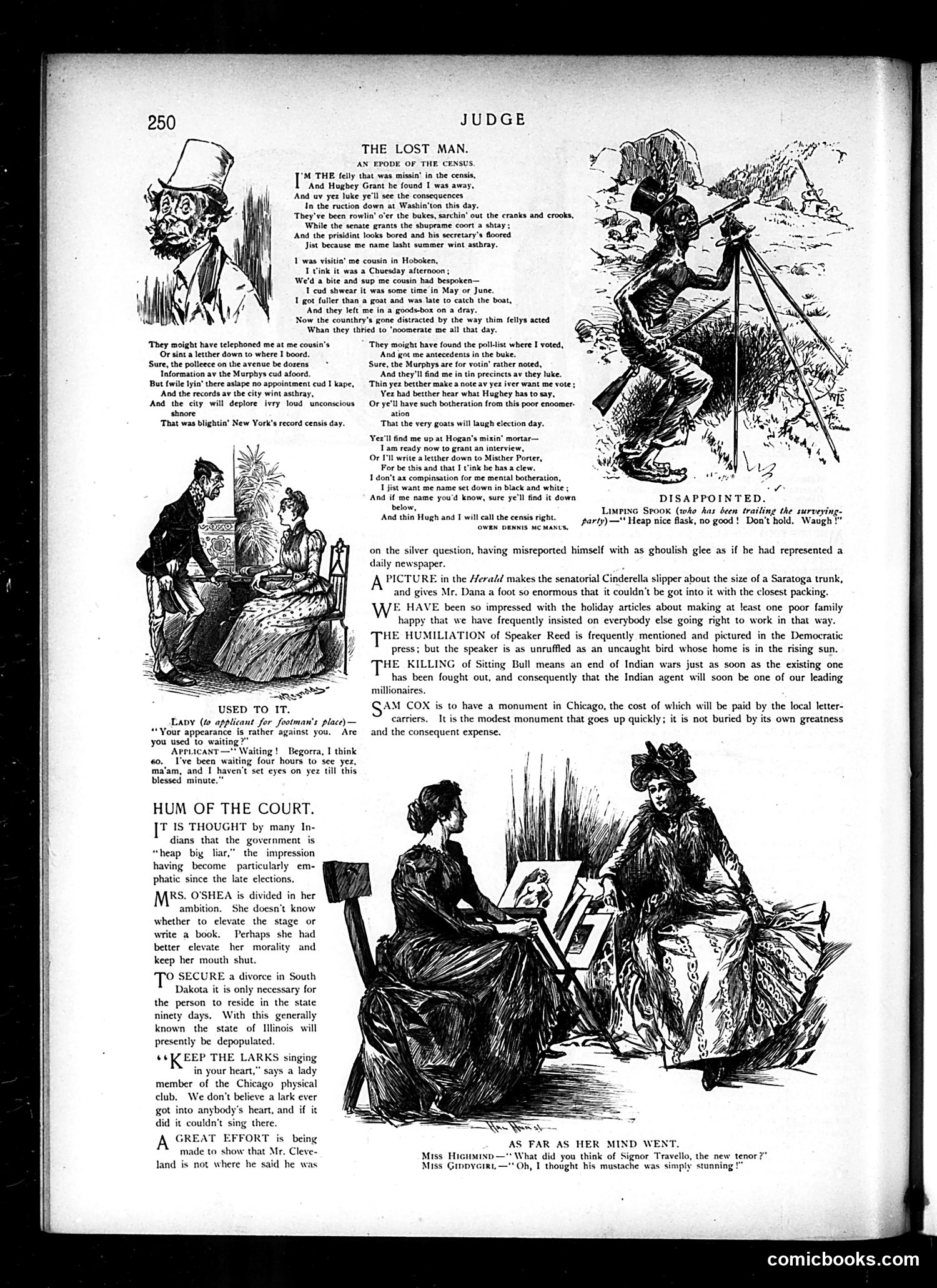
This page satirizes the 1890 U.S. Census through an Irish-immigrant character's complaint poem. A census enumerator missed an Irish laborer (Dennis McManus) who was drunk in a goods-box, causing bureaucratic chaos in Washington. The satire mocks: **The targets:** Census incompetence, political dysfunction (President appears bored, Secretary overwhelmed), and the absurdity that one missing person disrupts government. **The joke:** An ordinary working-class immigrant's absence becomes a national crisis, while politicians scramble uselessly. The character demands his name be recorded—not for dignity, but because he votes and politicians need his support. **Context:** The 1890 Census faced significant accuracy problems. Judge uses this Irish-American character (with exaggerated dialect) to ridicule both government inefficiency and the political importance of immigrant voters, particularly in Democratic strongholds like New York. The accompanying cartoons mock other contemporary issues: Sitting Bull's death, Speaker Reed's composure, and newspaper sensationalism.
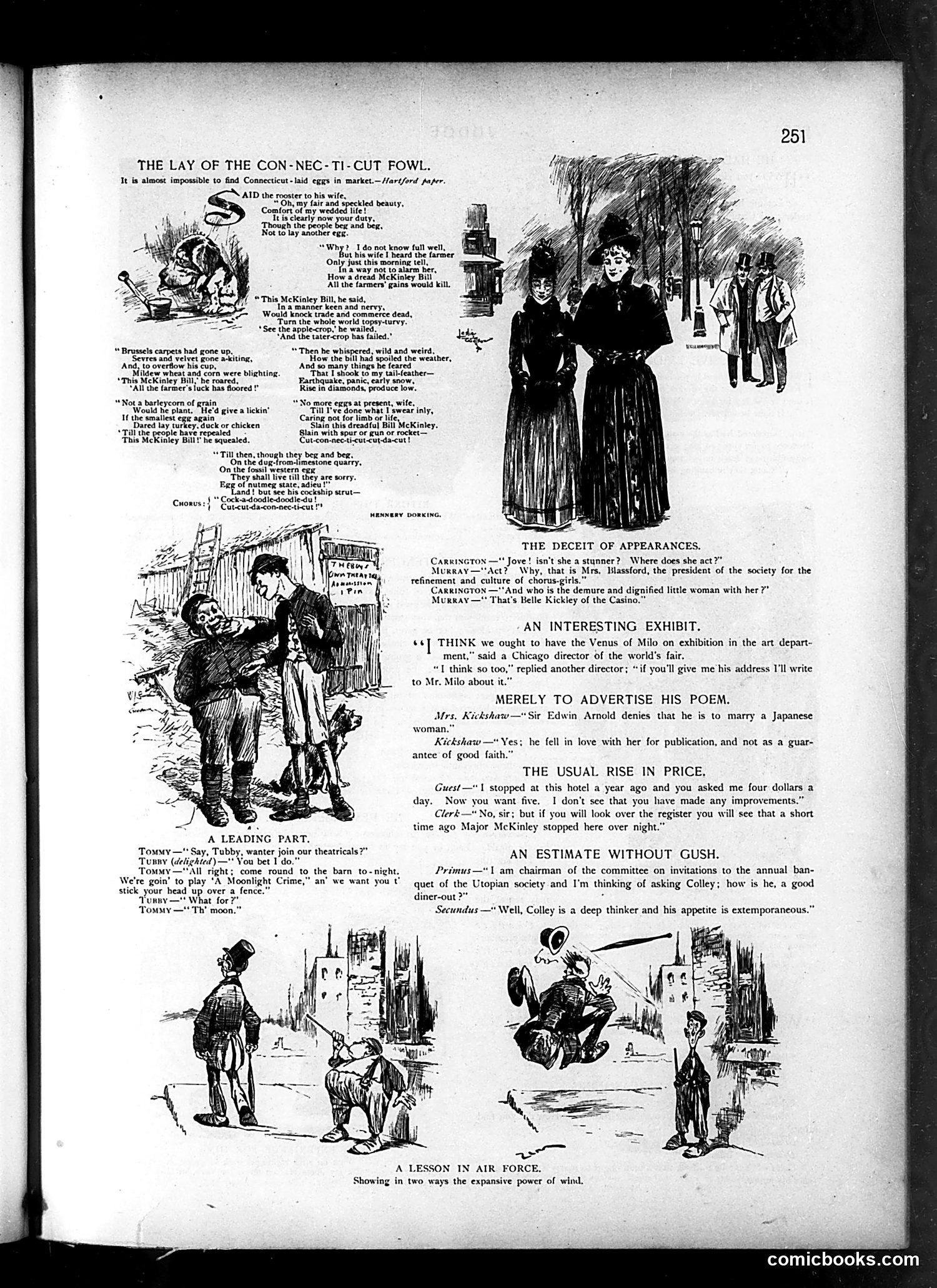
**Main Cartoon: "The Lay of the Connecticut Fowl"** This satirizes the **McKinley Tariff** (likely 1890), using a Connecticut farmer's hen as metaphor. The farmer blames the tariff for economic disasters—rising prices on imports (Brussels carpets, Sèvres pottery), crop failures, and general hardship—so he refuses to let his hens lay eggs until the tariff is repealed. The "Con-nec-ti-cut" wordplay references Connecticut's agricultural interests. The satire attacks protectionist tariffs as economically damaging rather than helpful. **Minor Items:** - "The Deceit of Appearances": Social commentary on theater and chorus girls - "Merely to Advertise His Poem": Jokes about poet Edwin Arnold - "A Lesson in Air Force": Visual gag showing wind's power - Several short humorous dialogues (hotel prices rising, theatrical participation, committee dining) The page represents typical Judge content: political-economic satire mixed with light social humor and visual jokes.
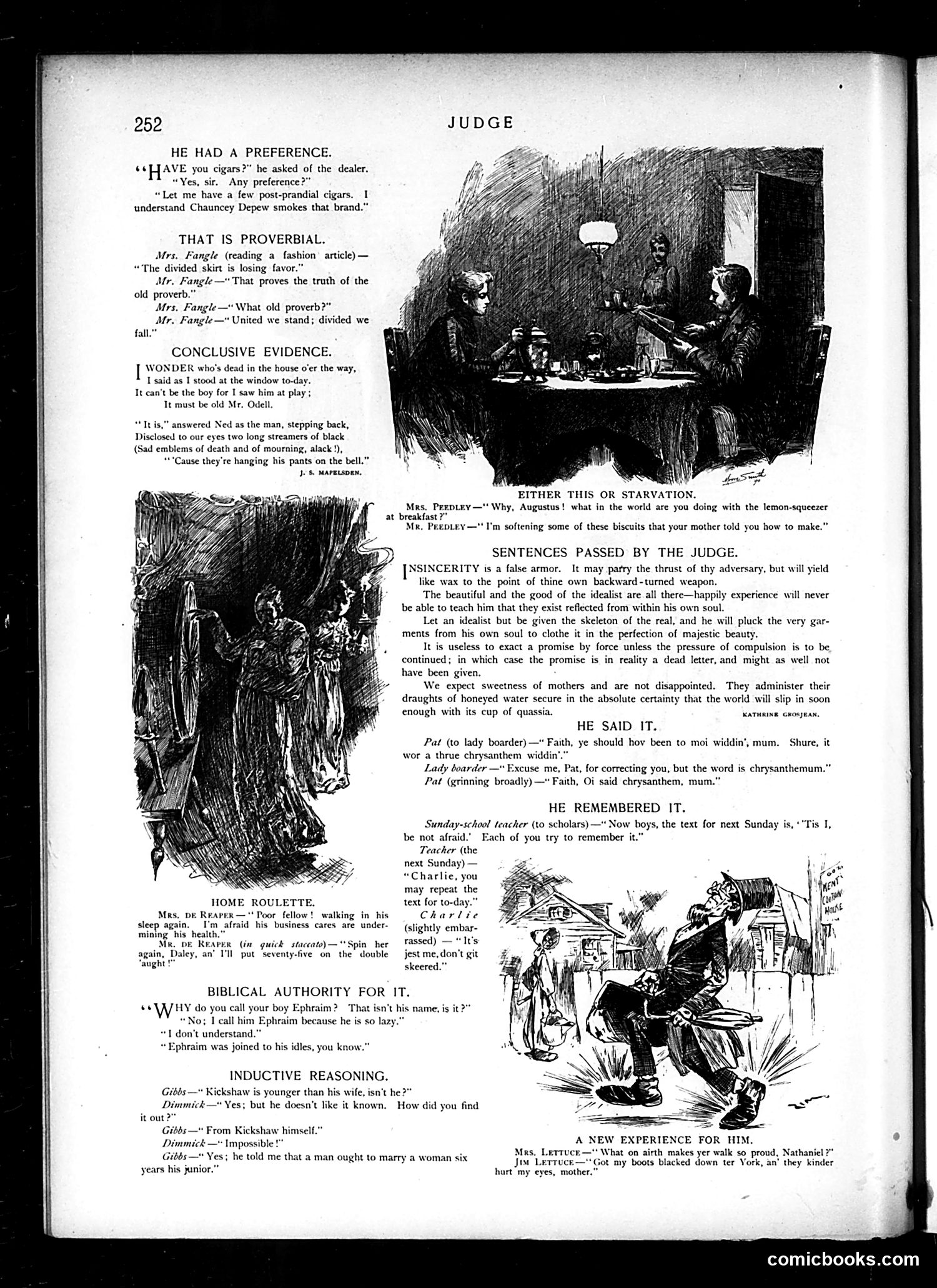
This page from *Judge* contains multiple brief satirical pieces targeting American social pretensions and domestic absurdities circa early 1900s. **Key humor:** - **"He Had a Preference"**: Mocks status-seeking by name-dropping—a cigar smoker wants the brand supposedly favored by Chauncey Depew, a prominent railroad executive and public figure known for wealth and influence. - **"That Is Proverbial"**: Plays on the divided skirt fashion trend with a pun on "United we stand; divided we fall." - **"Conclusive Evidence"**: Dark humor about death—mourning crepe on clothesline is mistaken for evidence of death, but it's actually laundry. - **Dialect humor**: Multiple pieces use exaggerated Irish and working-class dialects ("Faith," "Oi") for comic effect, common in period humor. - **Domestic satire**: Pieces mock marriage dynamics, boarding-house life, and parental advice, reflecting middle-class anxieties. The illustrations support these themes with sketched scenes of ordinary life rendered comically.
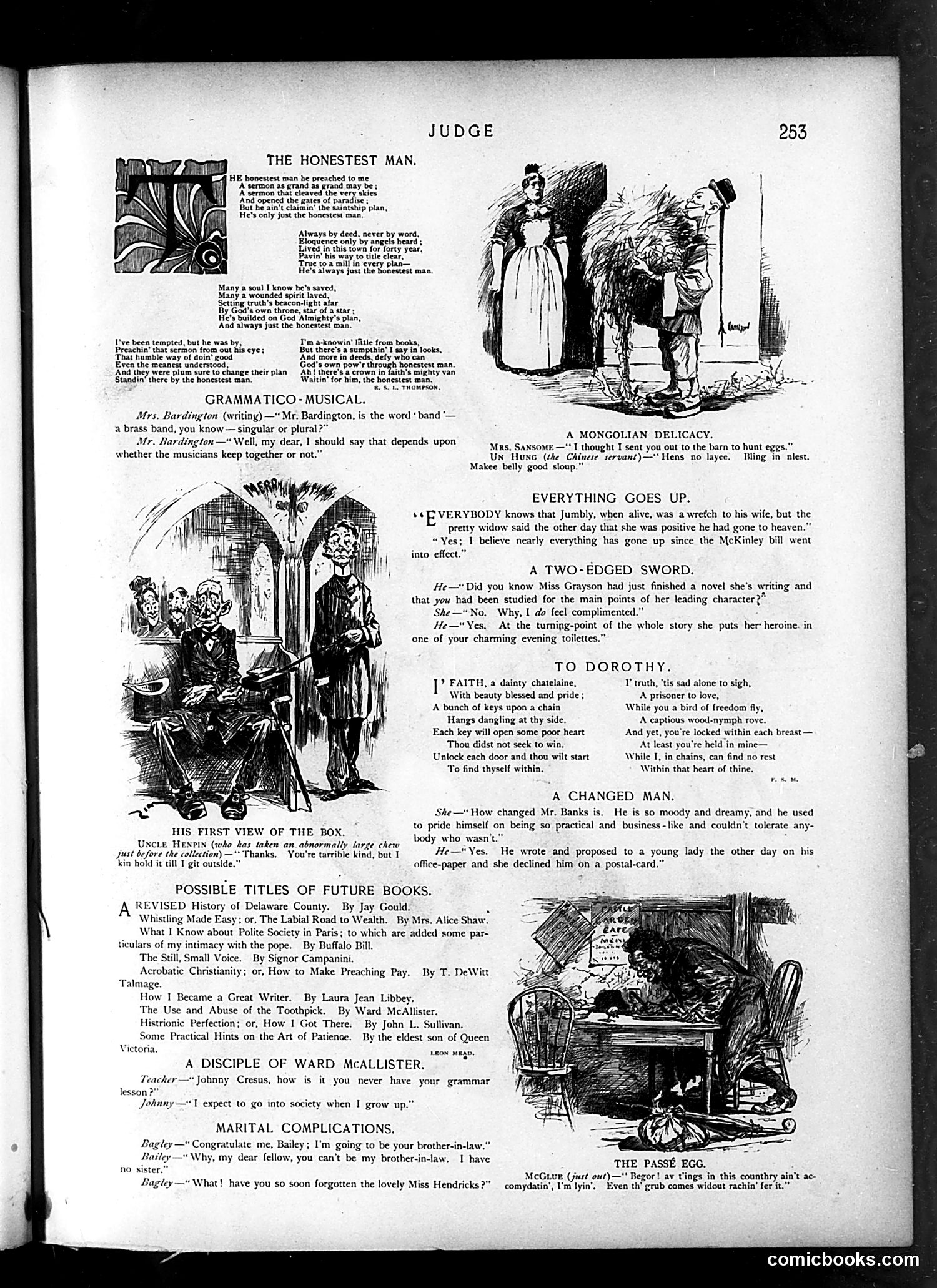
This page from *Judge* (a Gilded Age satirical weekly) contains several distinct pieces satirizing American society circa 1890s: **"The Honestest Man"** celebrates humble, quiet virtue—a man whose integrity speaks through deeds rather than words, contrasting with flashy religiosity. This likely critiques the era's ostentatious piety among the wealthy. **"Grammatico-Musical"** is a simple domestic joke about whether a band is singular or plural, turning on the pun that musicians must "keep together." **"Everything Goes Up"** references the McKinley Tariff (likely 1890), joking that inflation has risen so dramatically that even a widow imagines her deceased husband ascended to heaven. This mocks the tariff's unpopular economic effects. **"A Two-Edged Sword"** plays on a woman discovering she's the model for a novelist's unflattering character—she's flattered until learning the truth. The remaining items are brief satirical sketches and a humorous list of fictional future books spoofing contemporary public figures (Jay Gould, Buffalo Bill, etc.). The overall tone criticizes materialism, affectation, and political economics.
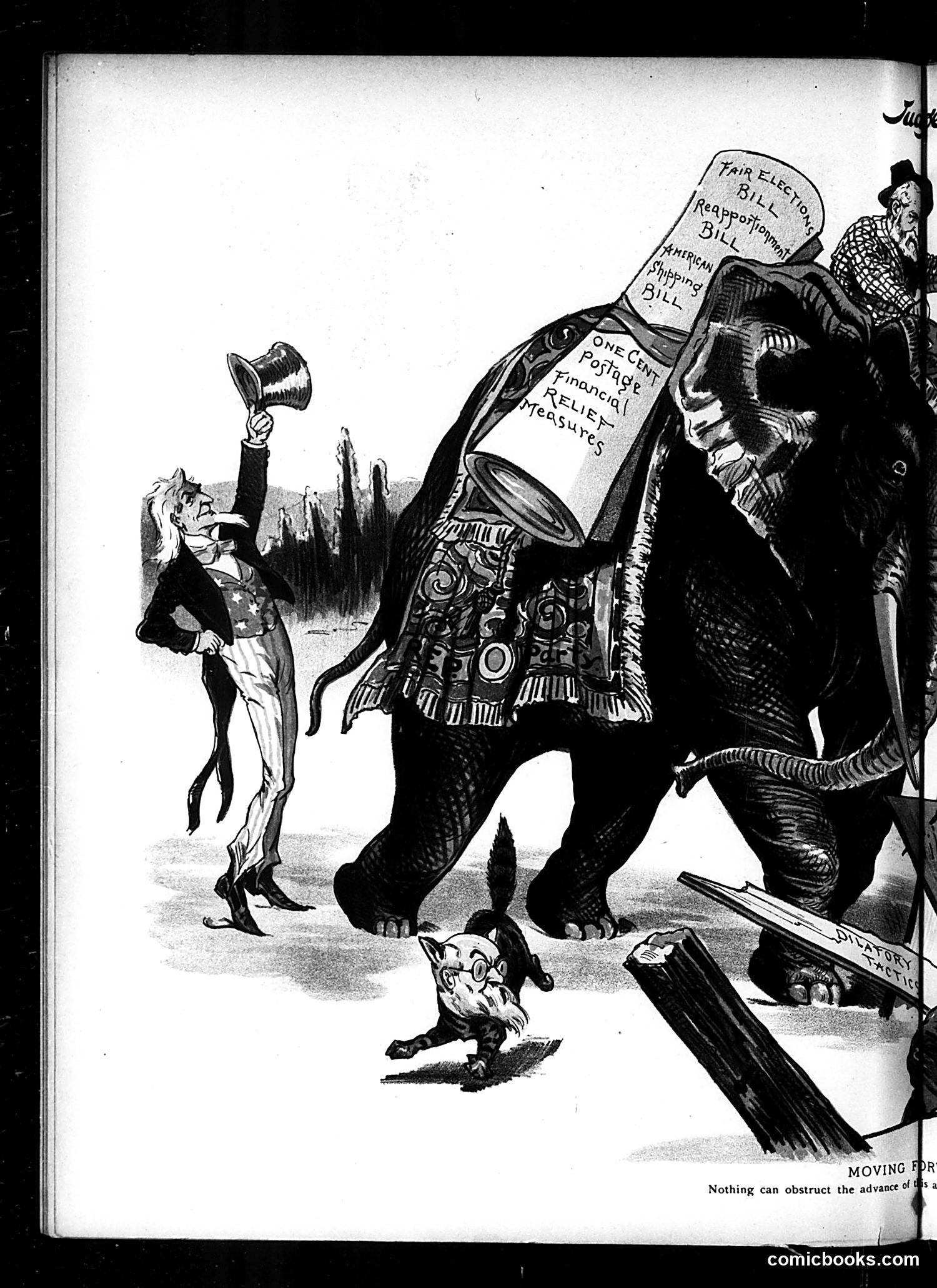
This appears to be a satirical cartoon from *Judge* magazine depicting an enormous elephant laden with legislative bills advancing forward, seemingly unstoppable. A small Uncle Sam figure stands before it, raising his hat in apparent futility or greeting. The elephant likely represents the Republican Party (the GOP's traditional symbol), while the bills labeled on its back—including "Fair Election Bill," "Reapportionment Bill," "American Shipping Bill," and "One Cent Postage"—suggest major legislative initiatives. The caption "Nothing can obstruct the advance of [the party]" expresses either celebration of Republican legislative power or sardonic commentary on their dominance. Small figures aboard and around the elephant suggest political figures or interests riding this wave of legislation. The overall tone appears to critique or mock overwhelming political momentum.
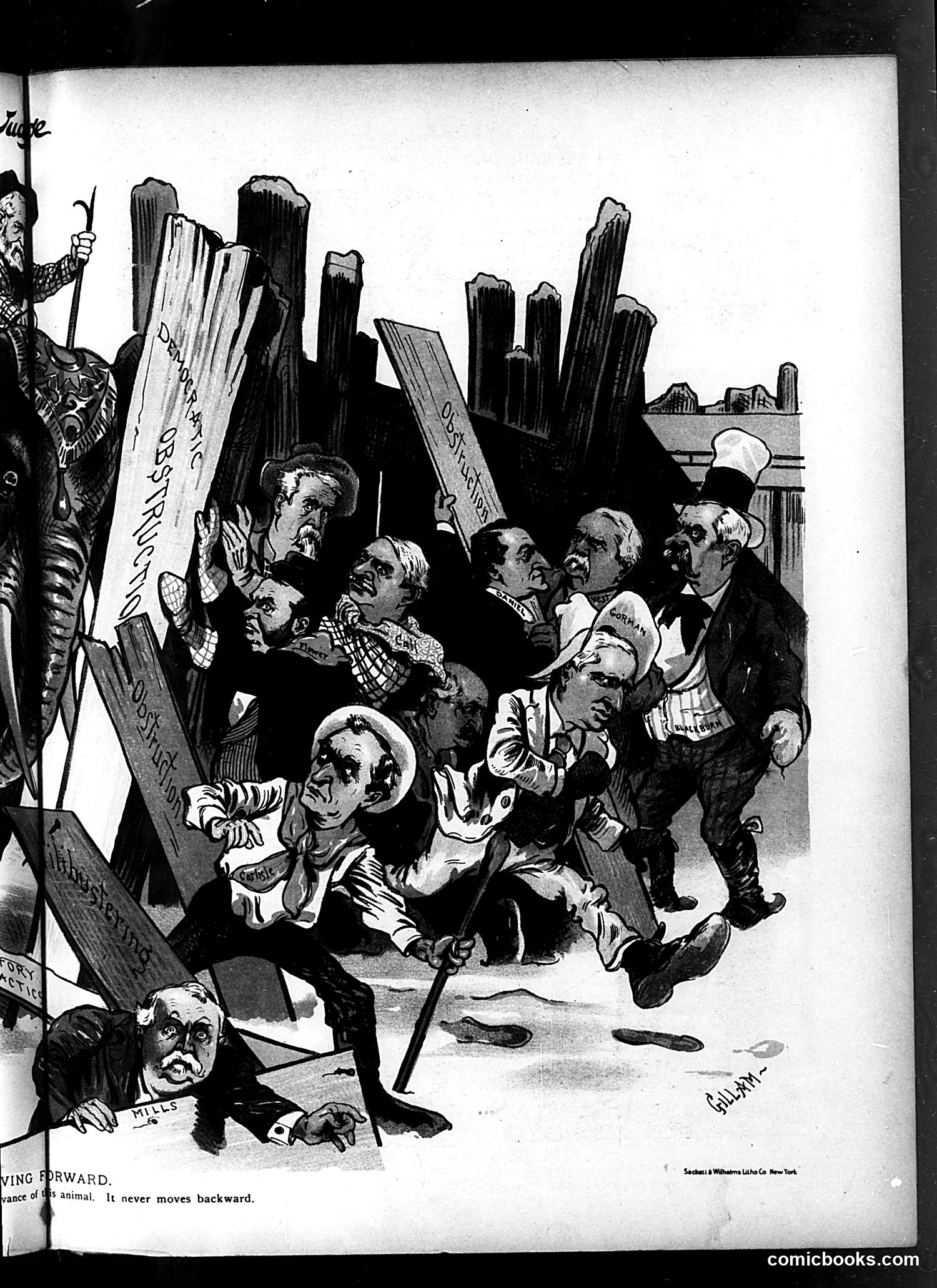
This appears to be a satirical cartoon from *Judge* magazine depicting a group of politicians or public figures clustered around what seems to be a construction or demolition site with tall wooden structures (possibly representing obstacles or resistance). The figures are caricatured in exaggerated style typical of early 20th-century political satire. The caption references an animal that "never moves backward," suggesting forward progress or momentum. The scattered figures and their apparent distress suggest satirical commentary on political movement or policy implementation, though the specific historical context—the particular figures, event, or legislative issue referenced—is unclear from the image alone without additional dating or identification markers visible in the reproduction.
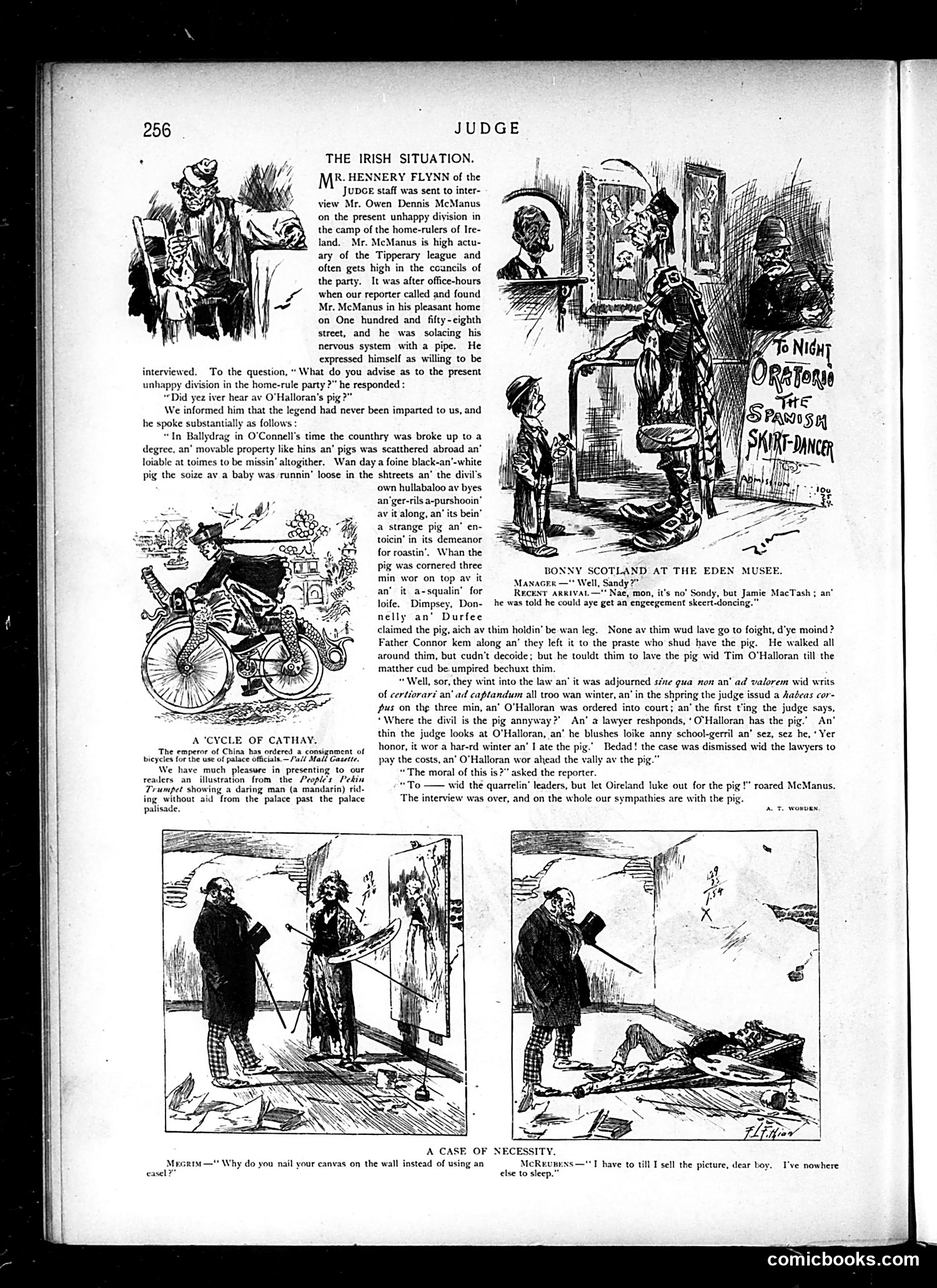
This page satirizes Irish Home Rule politics through an interview with Owen Dennis McManus, a Tipperary League figure. The central joke is an extended allegory: McManus tells a story about O'Halloran's pig—three men fighting over it, taking the dispute to court, where lawyers drag out proceedings with legal Latin terms (habeas corpus, certiorari) throughout winter. The judge finally orders the pig returned, but O'Halloran keeps it anyway. **The satire:** The pig represents Ireland itself. McManus's point—directed at squabbling Irish Home Rule leaders—is that while they litigate endlessly over who controls Ireland, someone (implicitly England or practical politicians) simply keeps it. The cartoon mocks both Irish factional fighting and the absurdity of legal processes that enrich lawyers while resolving nothing. The moral: stop quarreling or Ireland will be lost to those actually holding power.
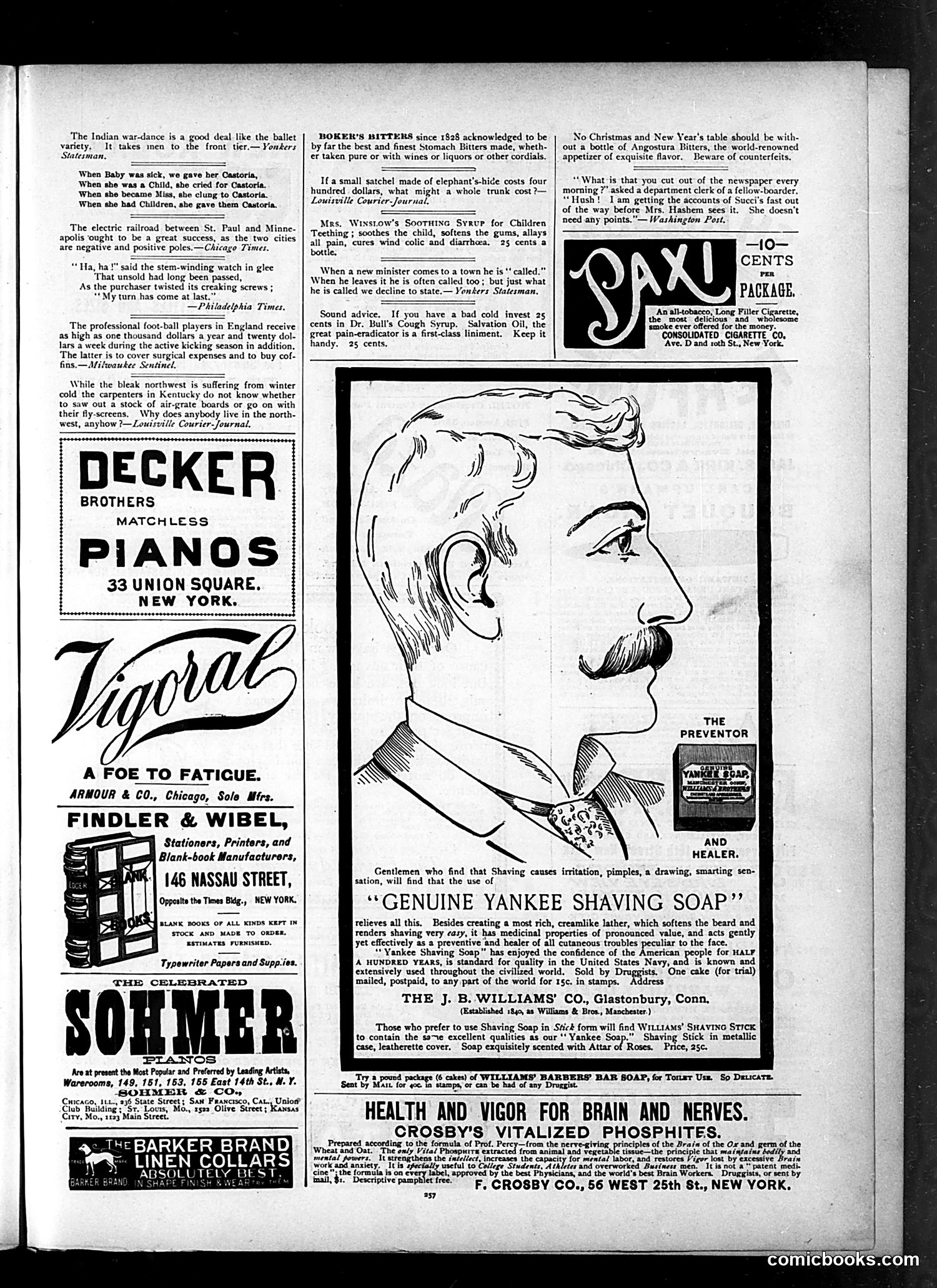
This page is primarily **advertising with brief satirical snippets**, typical of Judge magazine's format. The main visual element is a **portrait of a man with distinctive facial hair**, accompanying an advertisement for "Genuine Yankee Shaving Soap" that claims to prevent shaving irritation and is marketed as a 50-year-old product used by the U.S. Navy. The page contains scattered **one-liner jokes** from various newspapers, including: - A joke about ministers being "called" to towns but "called" out when they leave (wordplay on religious terminology) - Observations about regional weather affecting carpenter work - A quip about a man cutting newspaper clippings about a fasting performer to hide from his wife **Context for modern readers**: The advertisements and jokes reflect late 19th-century concerns (industrial labor, childrearing products, piano sales) and the magazine's practice of mixing editorial humor with commercial endorsements. The shaving soap ad's emphasis on preventing facial irritation was likely relevant to gentlemen's grooming standards of that era.
This page is primarily **advertisements with minimal editorial content**. The visible text snippets at top are brief satirical quotes about pronunciation of African names, weather prediction, piano endorsements, and Native American labor—typical of Judge's light social commentary. The main cartoons or satirical images are **not clearly visible or identifiable** in this reproduction. The page is dominated by period product advertisements: Shandoh Perfume, Kodak cameras, Vaseline products, pianos, cigars, hotels, and the Smith Premier Typewriter. The only substantive editorial content appears to be short, unattributed joke items—common filler material in satirical magazines. Without clearer images of any political cartoons or more substantial editorial pieces, this appears to be a **standard advertising-heavy page** from Judge rather than an issue highlighting significant political or social satire. The quality/legibility of illustrations makes definitive interpretation impossible.
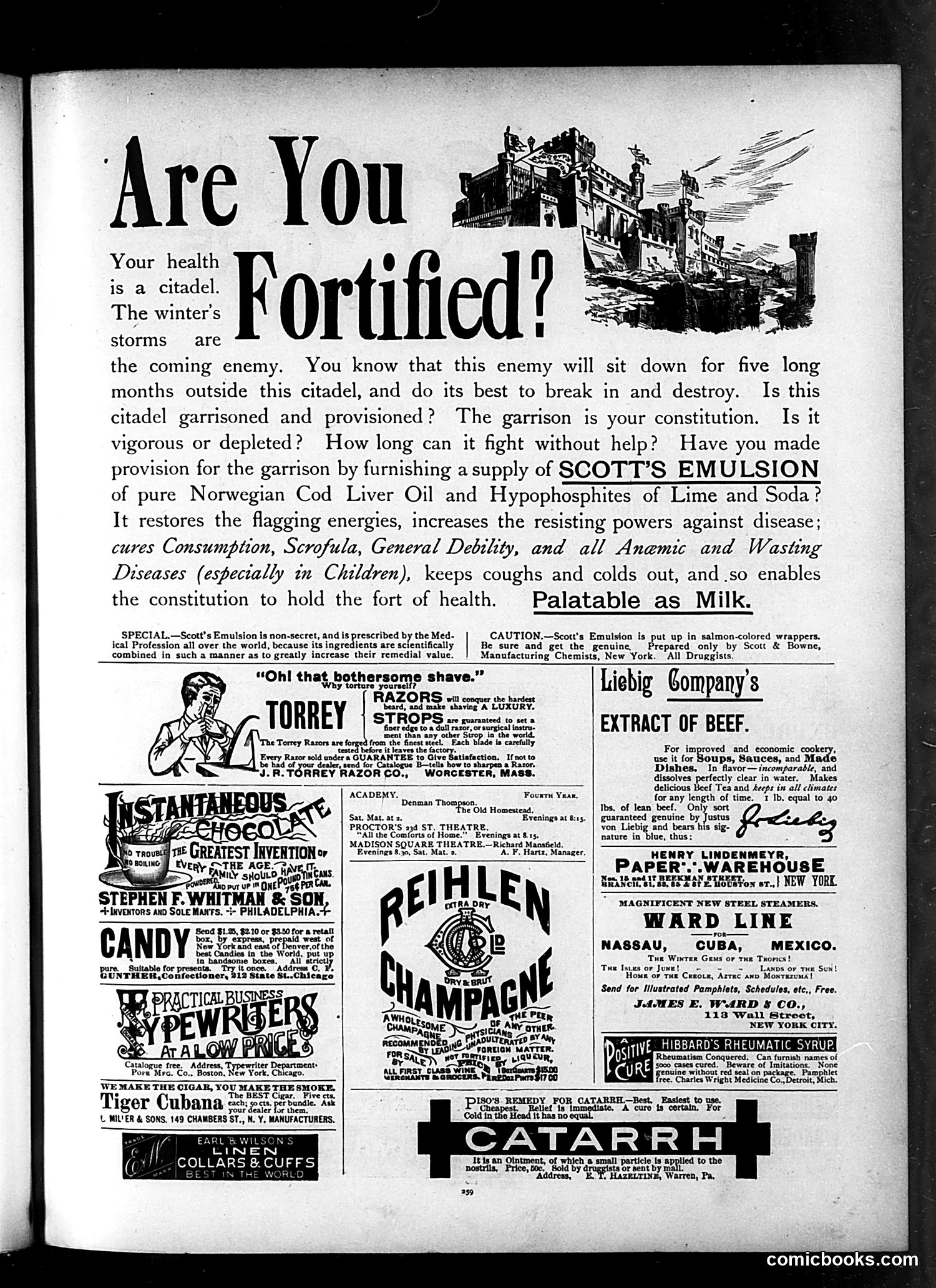
This is primarily an **advertising page** rather than satirical content. The main headline "Are You Fortified?" uses military metaphor—comparing health to a fortress under winter siege—to market **Scott's Emulsion** (cod liver oil supplement) as nutritional defense against cold-season illness. The advertisement employs period-typical medical marketing language, claiming the product cures consumption, scrofula, and "wasting diseases" (likely tuberculosis and malnutrition). It emphasizes medical endorsement and "scientific" formulation—common persuasion tactics for patent medicines of this era. The surrounding ads promote other consumer products: razors, chocolate, candy, champagne, beef extract, paper goods, and steamship travel. One ad includes a racial caricature ("Tiger Cubana" cigars), reflecting the casual racism of early 20th-century advertising. **No political satire is evident**—this is commercial content typical of Judge's revenue model, mixing entertainment with paid advertising.
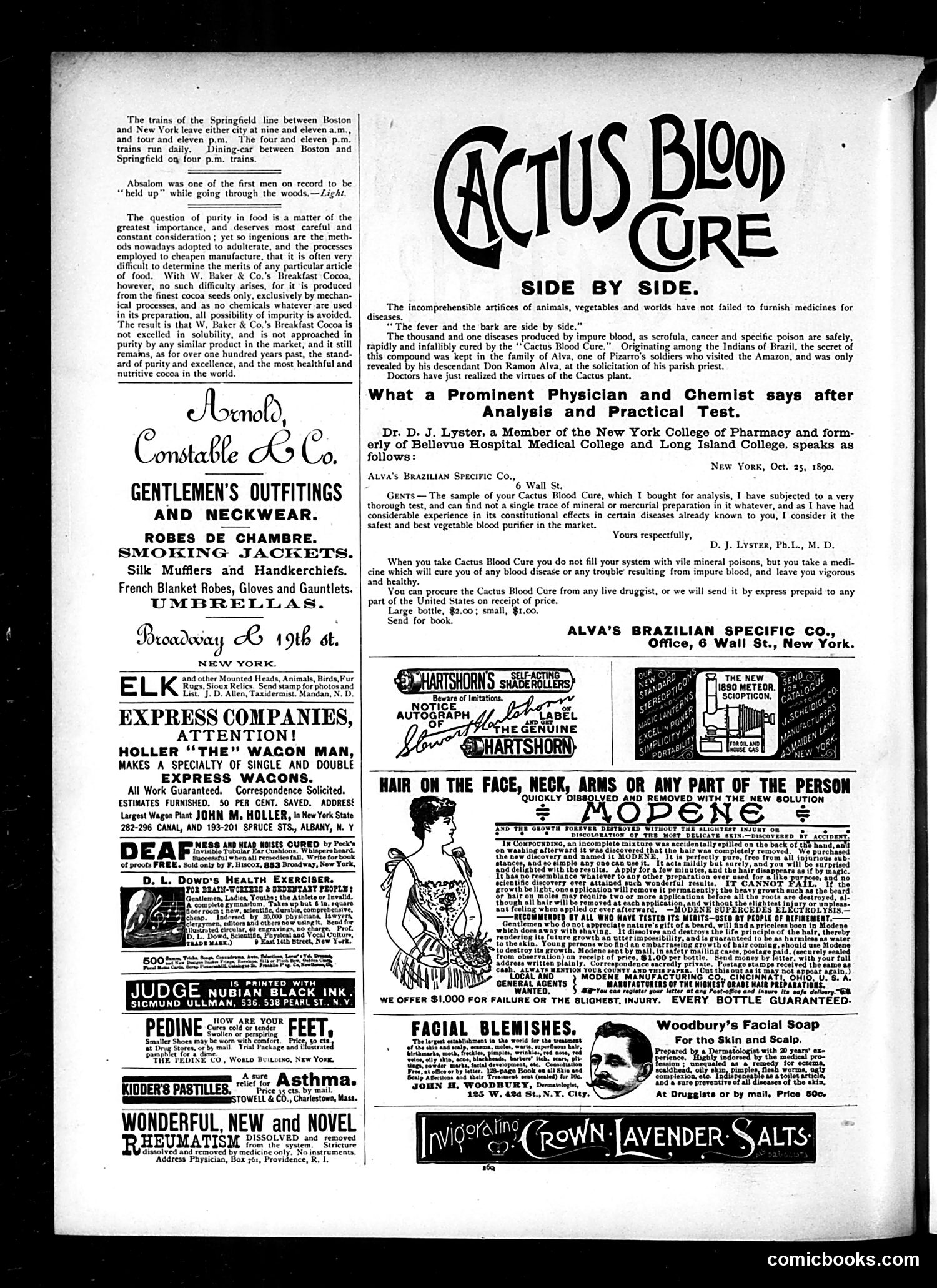
This page is **primarily advertising**, not satirical content. It showcases various patent medicines and commercial products typical of 1890s America. The dominant advertisement is for "Cactus Blood Cure," claiming to treat diseases from impure blood including scrofula and cancer. It includes a testimonial from "Dr. D. J. Lyster" of the New York College of Pharmacy, lending false medical authority. The product supposedly originated from Brazilian indigenous knowledge, a common marketing trope of the era. Other ads include remedies for deafness, asthma, rheumatism, and facial blemishes—conditions that generated substantial patent medicine markets. The page also features clothing retailers and commercial services. **For modern readers:** This reflects the era's rampant medical fraud. Without FDA regulation (established 1906), companies made unsubstantiated cure claims with fabricated doctor endorsements. The "natural ingredient" angle and invocation of indigenous knowledge were standard marketing manipulations targeting desperate patients.
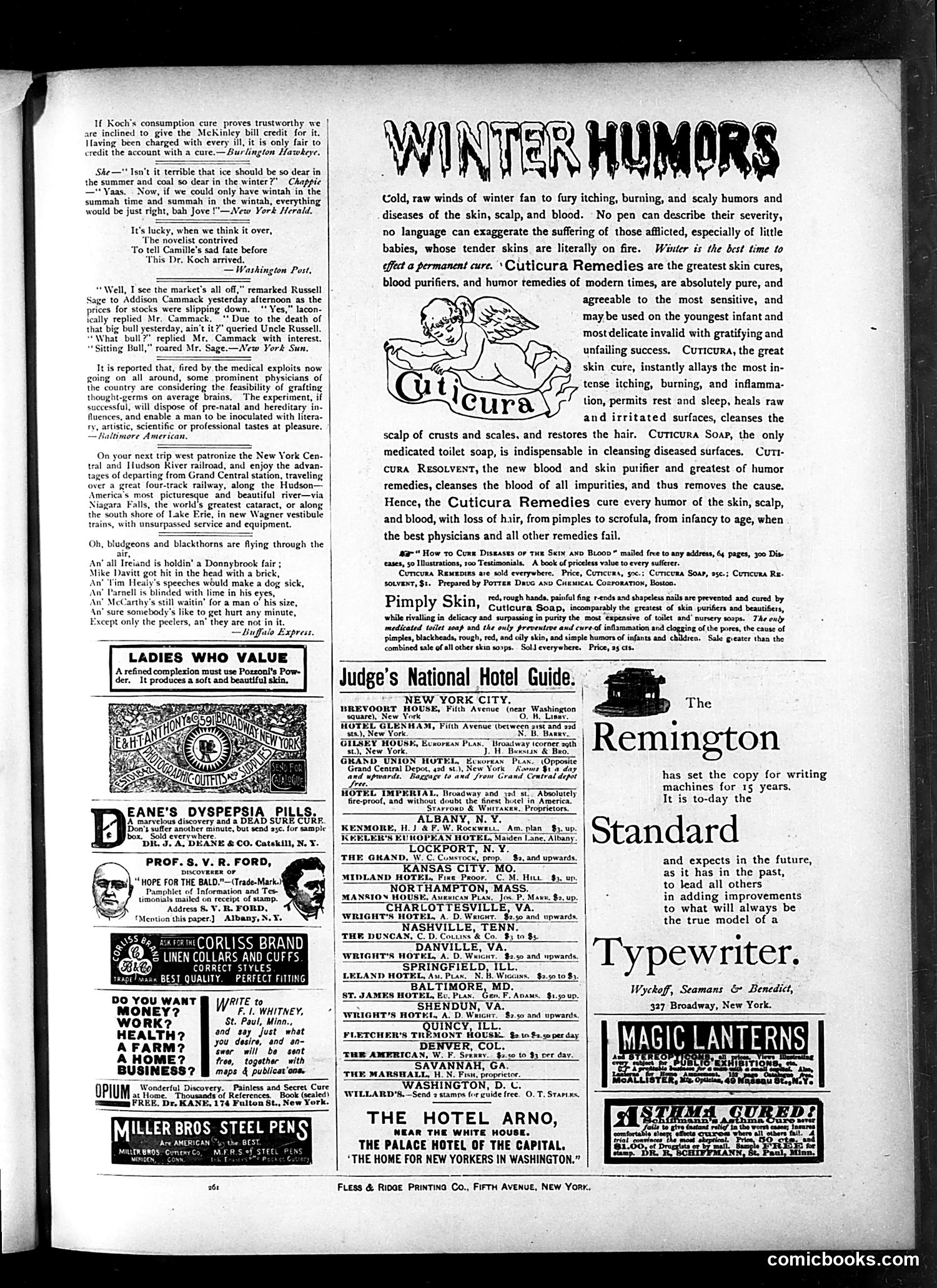
This page is primarily **advertising and light humor**, not political satire. The main content is "Winter Humors," a lengthy advertisement for Cuticura Remedies (skin treatments), with a cherub illustration. The scattered jokes are non-political anecdotes: - A quip about ice prices in summer and coal in winter - Russell Sage and Addison Cammack discussing stock market decline - A comment on Dr. Koch's medical experiments (the tuberculosis researcher) - An Irish-themed verse about "Donnybrook fair" (a reference to Irish riots/chaos), mentioning figures like Mike Davitt and Tim Healy (Irish politicians) The rest consists of period advertisements: hotels (Judge's National Hotel Guide), writing machines (Remington Standard Typewriter), steel pens, hair treatments, and various patent medicines. **There is no coherent political cartoon or sustained satirical argument.** The page reflects typical magazine layout of the era—mixed editorial humor fragments and heavy advertising. The Irish verse may contain political reference, but identifications are unclear without additional historical context.
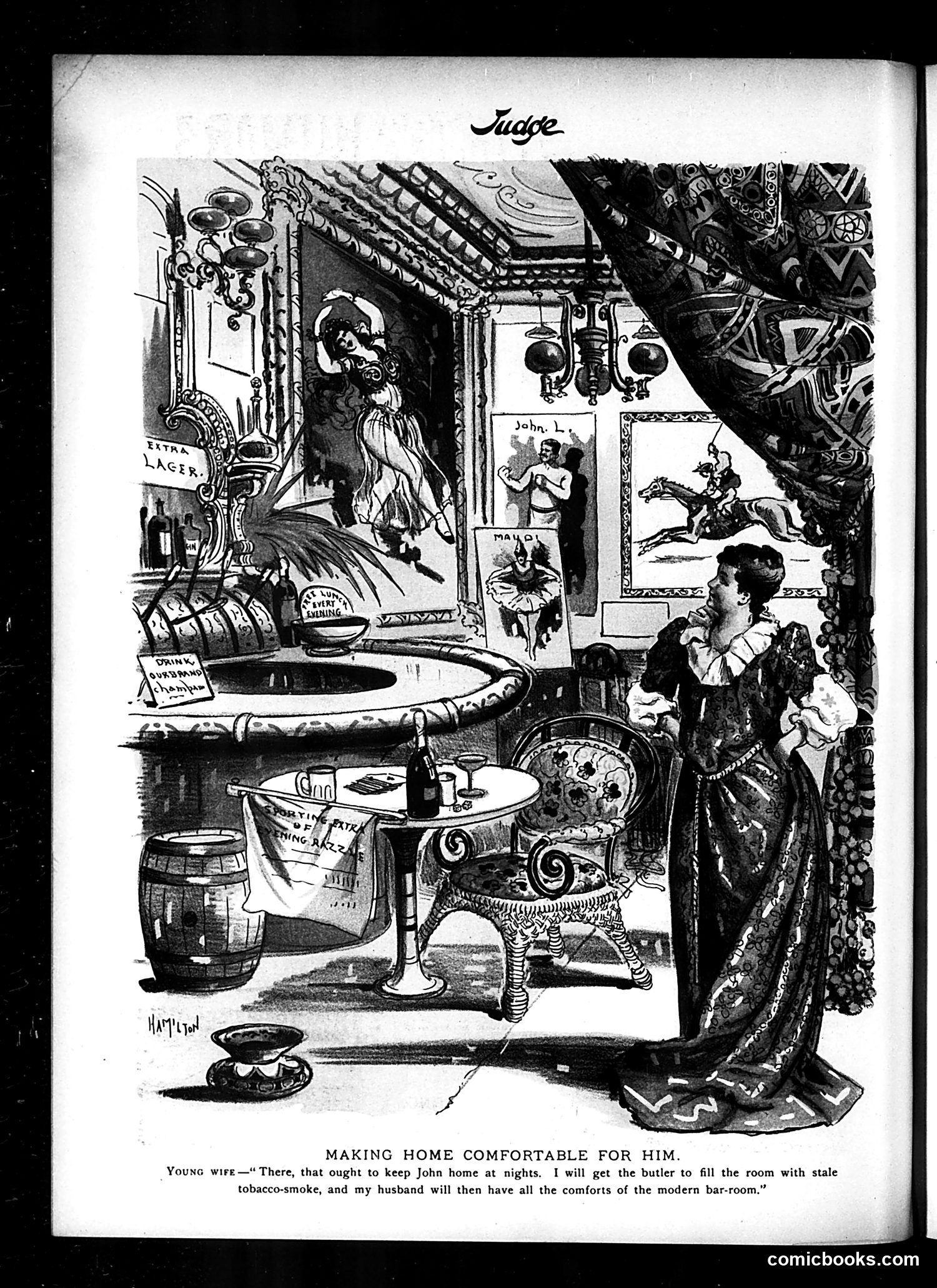
This *Judge* cartoon satirizes early 20th-century domestic life and gender dynamics. A young wife attempts to recreate a bar-room atmosphere at home—complete with stale tobacco smoke, alcohol, and decorative paintings of entertainers—to keep her husband from frequenting actual bars at night. The satire targets both spouses: the wife's willingness to compromise her home's comfort, and husbands' perceived preference for bar culture over domestic life. The elaborate, ornate interior filled with liquor barrels and smoke suggests the absurdity of this solution. The joke reflects contemporary anxieties about prohibition debates, drinking culture, and wives' domestic responsibilities. It's satirizing the lengths women felt obligated to go to maintain marriages while their husbands pursued leisure activities outside the home—a common social criticism of the era.