
A complete issue · 16 pages · 1890
Judge — September 20, 1890
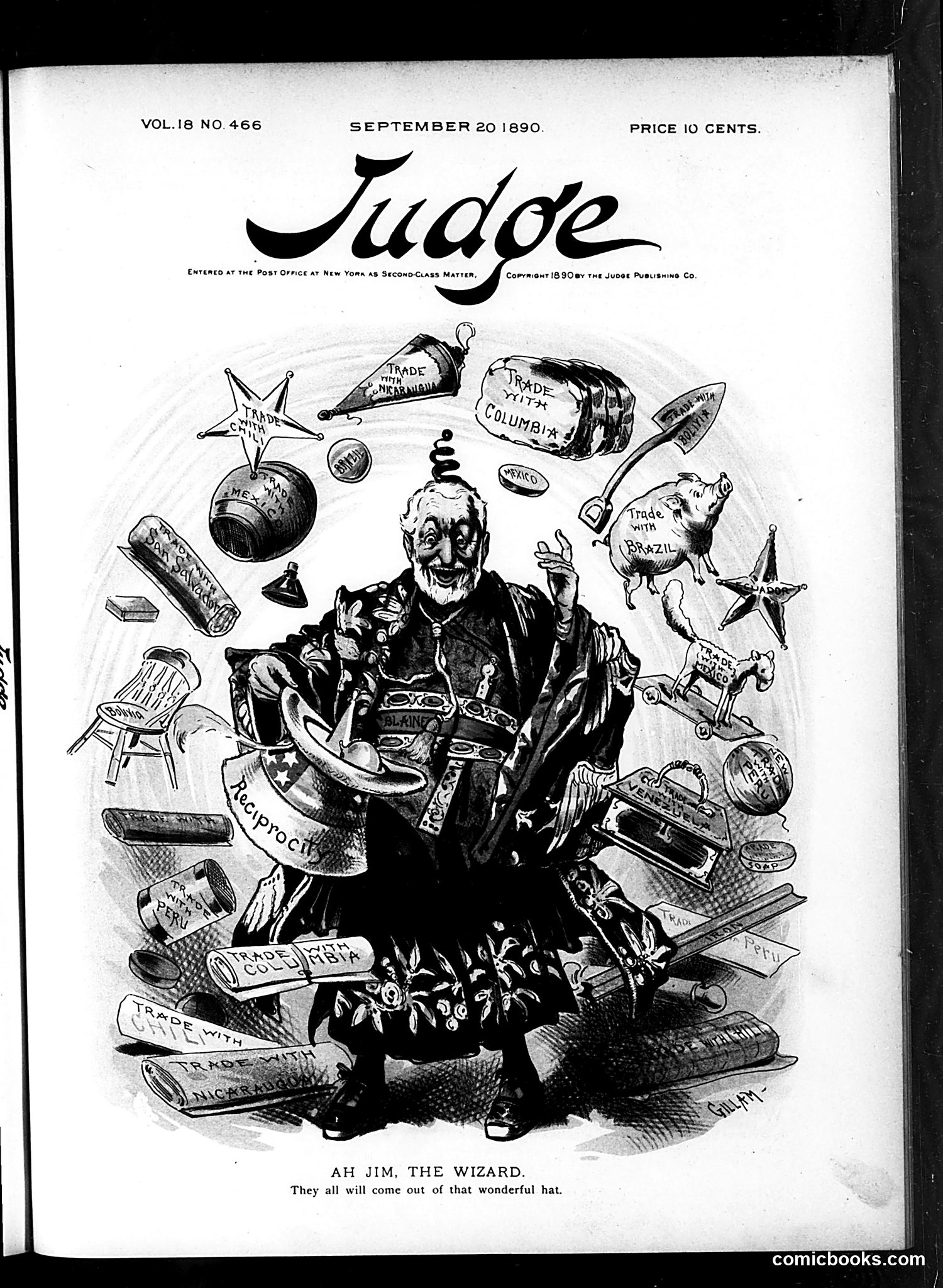
This political cartoon from September 1890 satirizes what appears to be a political figure nicknamed "the Wizard" (likely Jim Blaine or similar contemporary politician) depicted as a conjurer producing various trade goods and commodities from a magical hat. The items emerging—labeled with destinations like "Columbia," "Brazil," "Mexico," and various trade agreements—represent international commerce and tariff negotiations. The caption "They all will come out of that wonderful hat" suggests skepticism about the politician's claims to magically solve economic or trade problems through policy. This reflects 1890s debates over American tariff policy and free trade versus protectionism, mocking a political figure's promised economic solutions as mere sleight-of-hand magic rather than substantive policy.
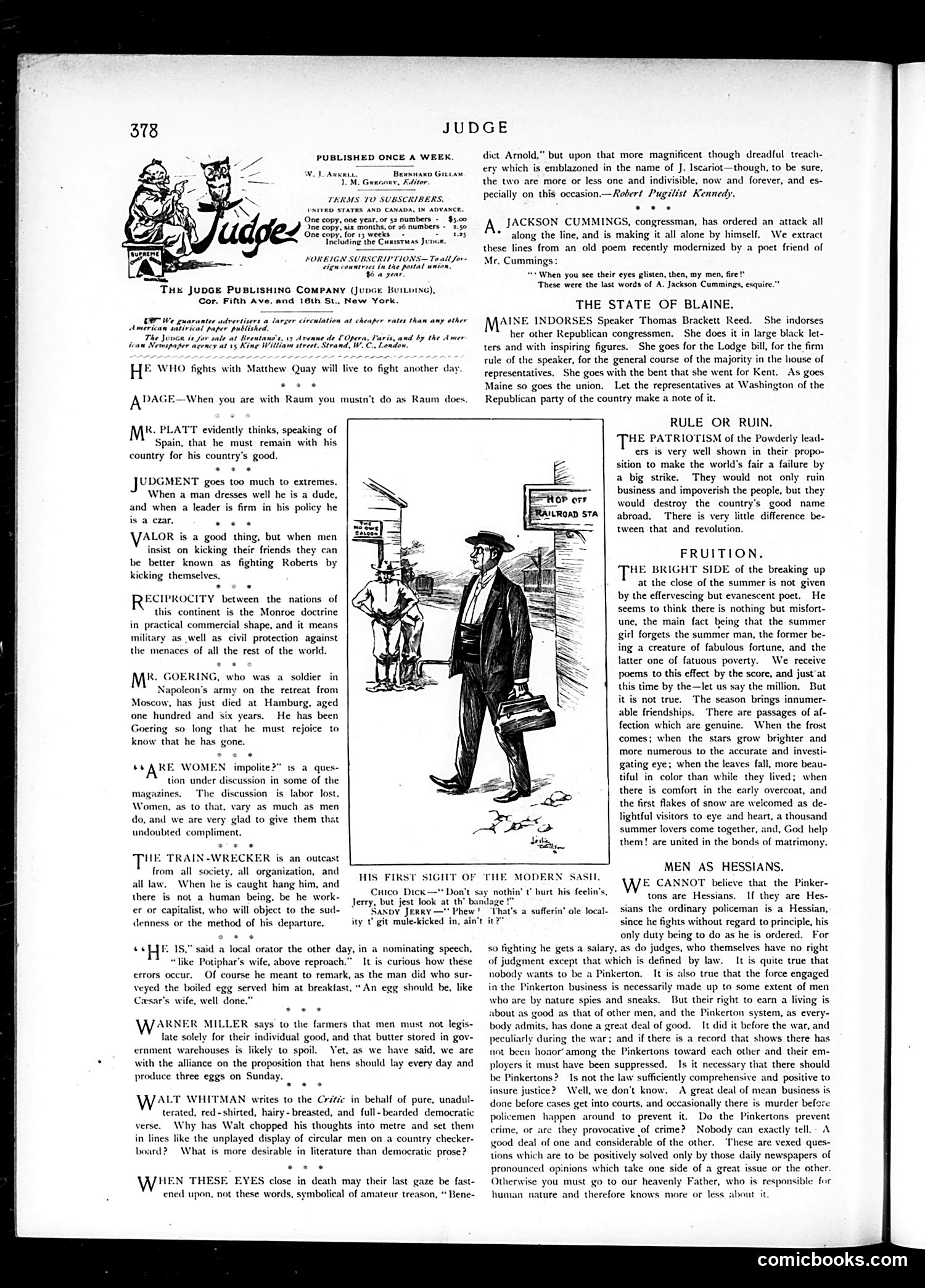
The cartoon depicts a man in old-fashioned clothing examining a window sash with surprise or confusion. The caption suggests this is someone encountering modern window technology for the first time—likely satirizing either rural/backward Americans or immigrants unfamiliar with contemporary conveniences. The accompanying text discusses various social and political topics including women's rights, international commerce, and Pinkerton detectives. A section titled "Men as Hessians" critiques Pinkerton operatives as mercenary agents lacking moral judgment, comparing them unfavorably to independent men of principle. The page reflects early 20th-century debates about labor rights, industrial practices, and American social values. The overall tone is reformist, questioning whether hired agents of capital serve justice or merely profit.
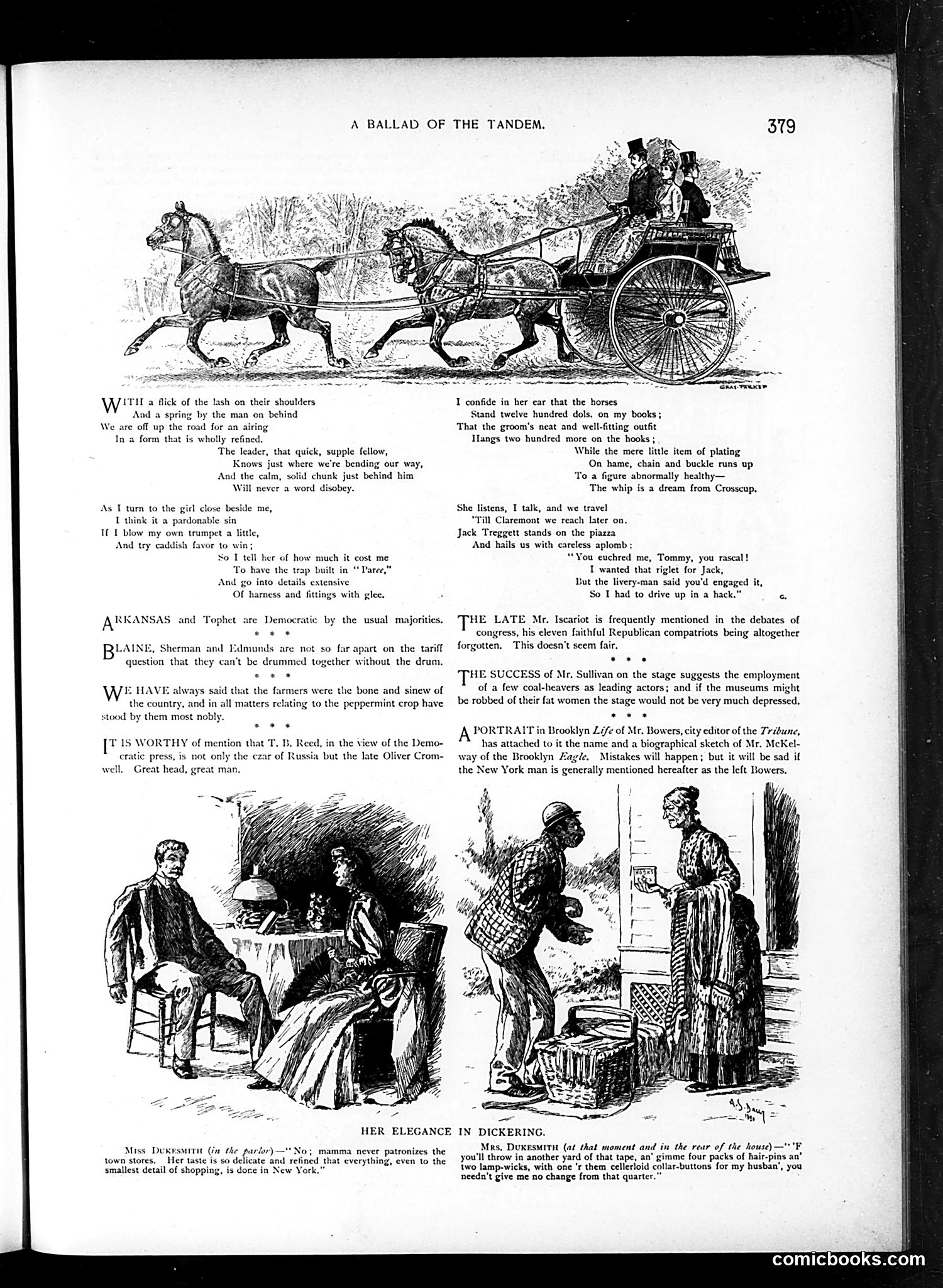
This page presents a humorous poem about a tandem bicycle ride, illustrated with period sketches. The main cartoon at top shows an elaborate horse-drawn carriage with multiple passengers. The poem mocks the social awkwardness and logistics of tandem cycling—two people sharing one bicycle. The narrator expresses anxiety about riding with a woman, worrying about proper etiquette ("If I blow my own trumpet a little, / And try caddish love to win?"). The bottom illustrations labeled "Her Elegance in Dickering" show what appears to be domestic scenes of negotiation, likely satirizing social pretension or class-conscious behavior among the middle classes. The scattered brief commentary items mock contemporary political figures (Arkansas, Blaine, Sherman) and mention press figures, typical of Judge's satirical commentary style. The overall page targets Victorian-era social conventions and bicycle-culture humor.
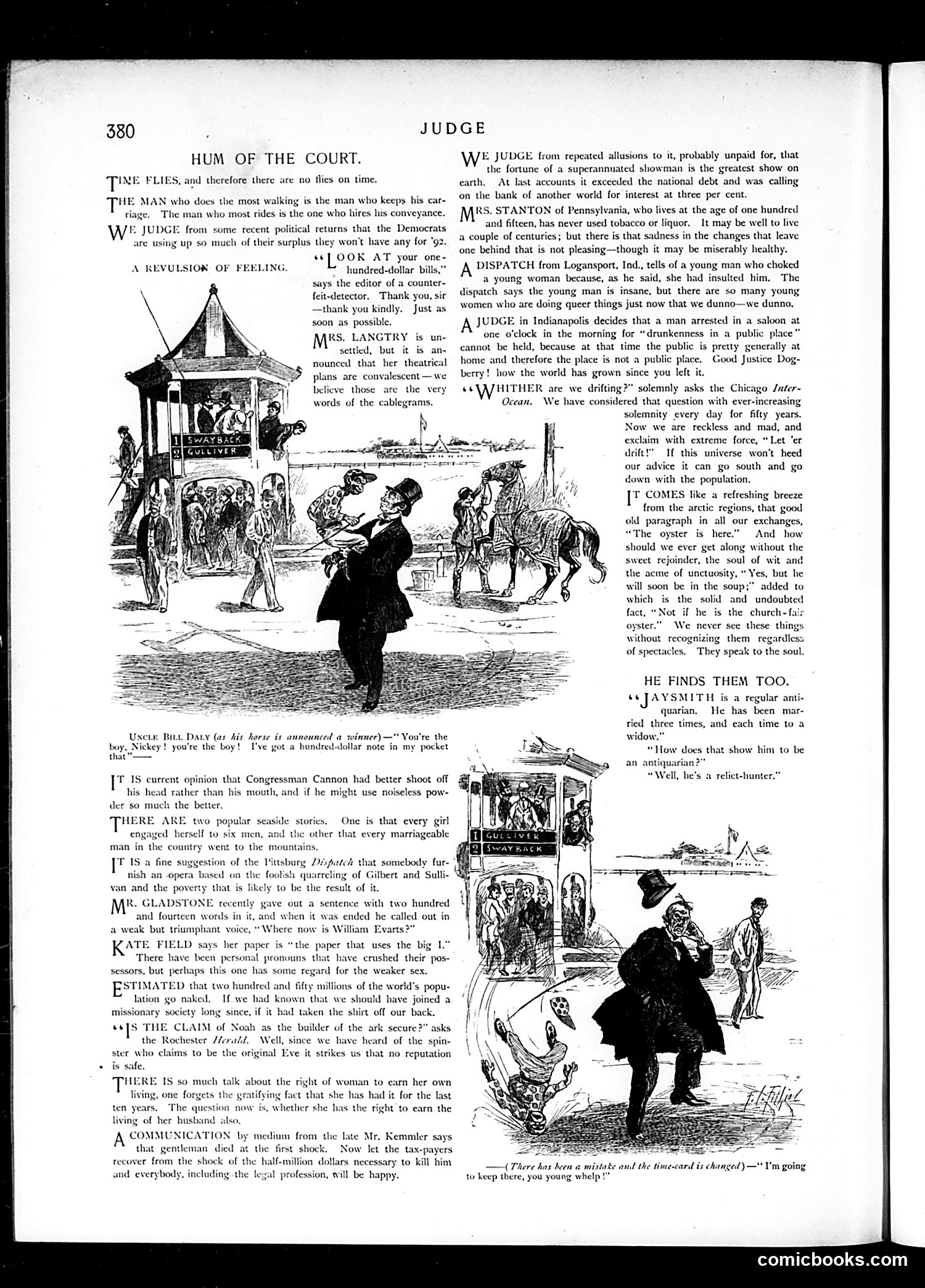
This page from Judge (a late 19th-century American satirical weekly) contains miscellaneous short jokes and commentary rather than a single coherent cartoon narrative. **Key references:** - **Democrats' surplus (1892 election)**: A political jab suggesting Democrats are wastefully spending money ahead of the 1892 presidential election - **Congressman Cannon**: Likely Speaker Joseph G. Cannon, criticized for being too vocal - **Lillie Langtry**: The famous actress, whose theatrical plans and personal life were fodder for gossip columns - **Gilbert and Sullivan**: The operetta composers, apparently feuding - **William Evarts**: A prominent lawyer/politician referenced in a courtroom anecdote - **Kate Field**: A women's rights advocate and journalist - **Mr. Kemmler**: Appears to reference the first electric chair execution (1890), sardonically suggesting taxpayers' shock at the $500,000 cost The page targets politicians, celebrities, women's rights debates, and legal absurdities through brief satirical quips rather than sustained visual satire.
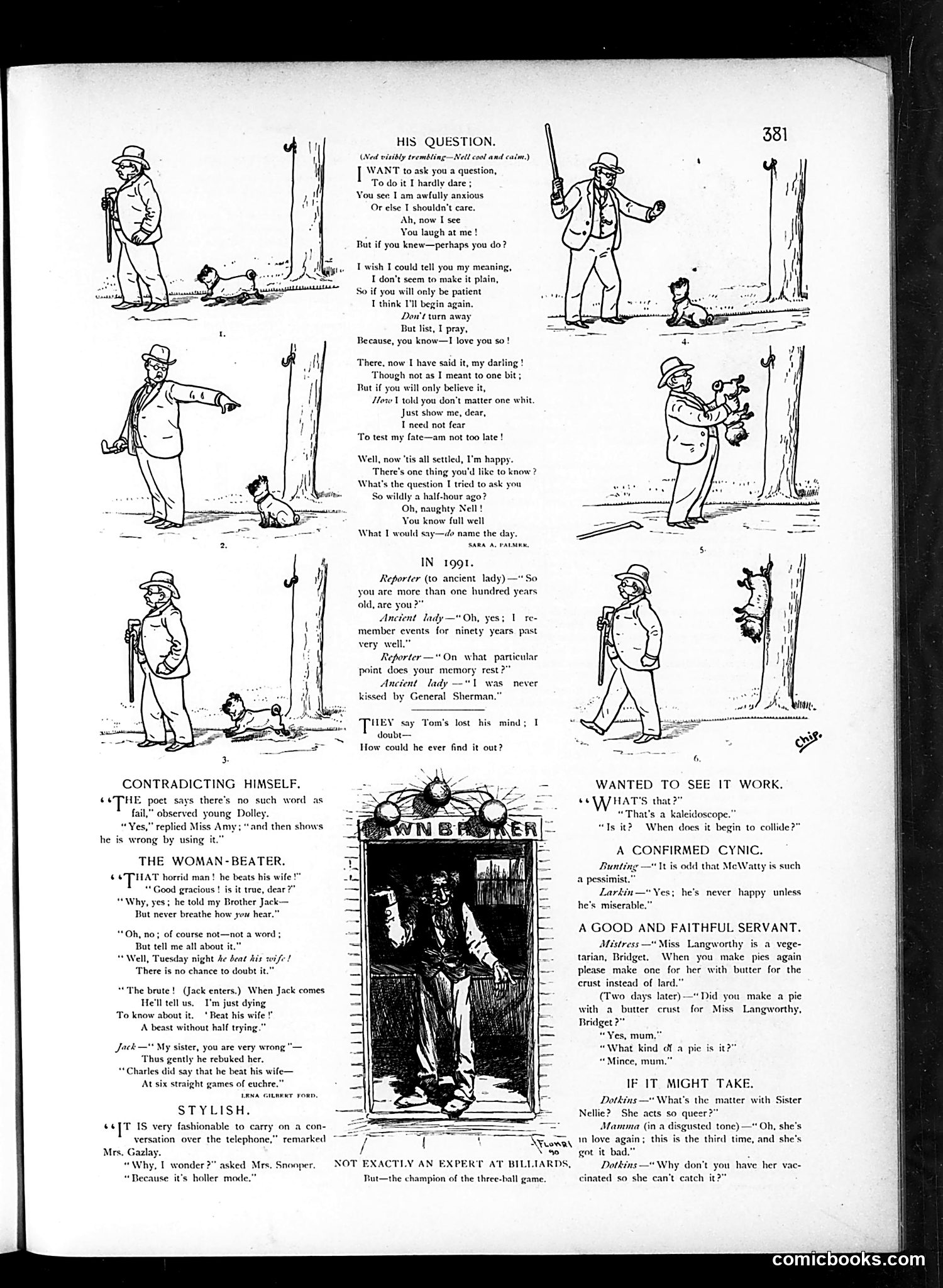
This page contains six short satirical pieces typical of late-19th-century American humor: **"His Question"** depicts a man nervously proposing to a woman named Nell, with illustrations showing his anxious gestures contrasted with her composure. The joke plays on romantic uncertainty and the expected proposal question. **"The Woman-Beater"** exploits a double meaning: gossip about a man who "beats" his wife turns out to mean he defeats her at the card game euchre—satirizing both rumor-mongering and domestic assumptions. **"In 1891"** jokes about an elderly woman's sole memorable event being that General Sherman never kissed her—possibly alluding to Sherman's Civil War infamy, making her avoidance of him darkly humorous. The remaining brief jokes mock telephone etiquette ("holler mode"), misunderstanding a kaleidoscope, pessimism, a vegetarian servant's confusion about butter versus lard, and a mother's sarcastic solution to her daughter's repeated love affairs. The satire targets gossip, domestic life, social pretension, and human folly through mild wordplay and situational comedy.
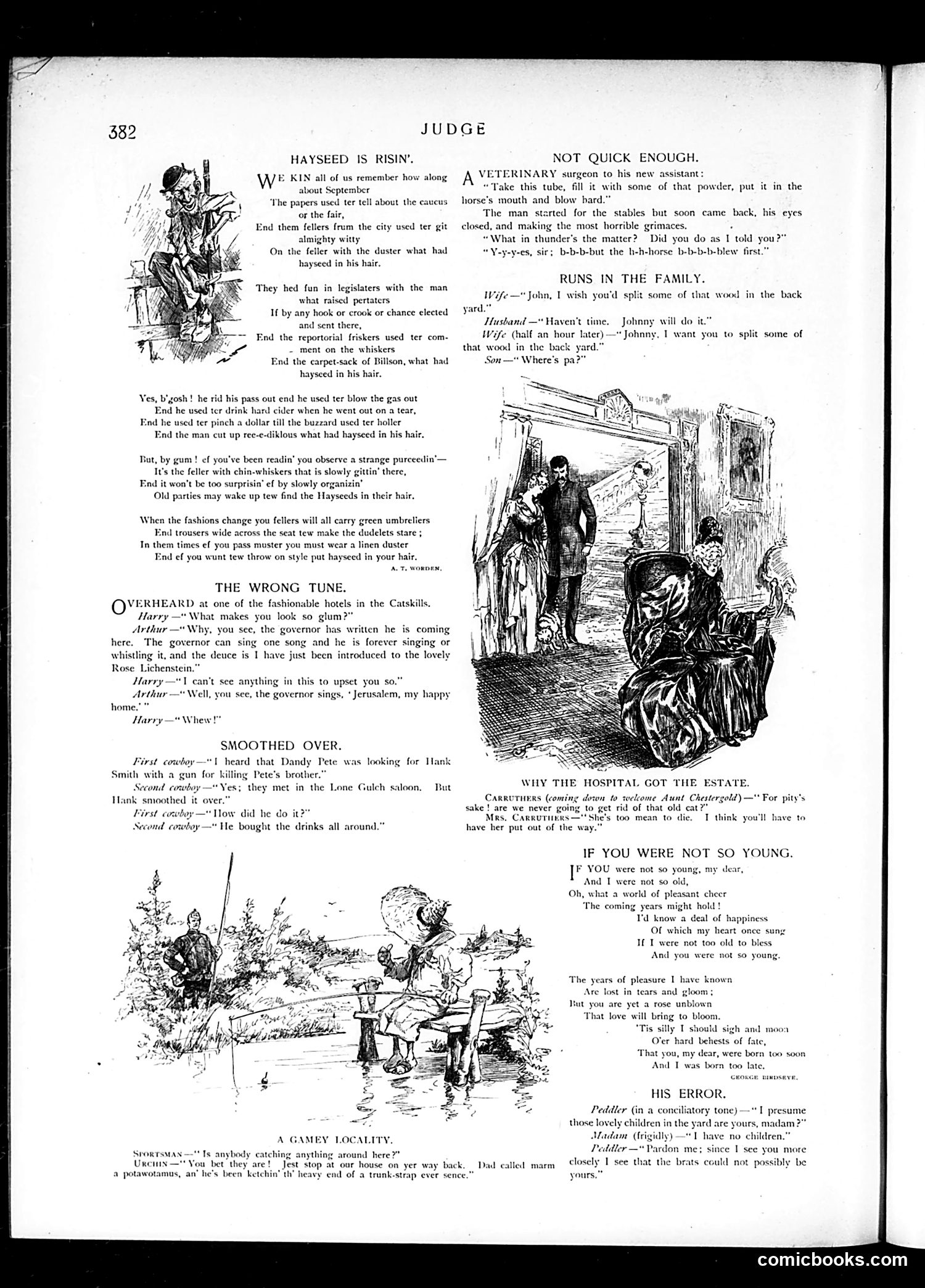
This page from Judge magazine contains multiple humorous sketches satirizing rural American life and social pretension, likely from the late 19th century. The main piece, "HAYSEED IS RISIN'," celebrates the growing political power of rural voters. It mocks the urban elite's previous contempt for rural politicians—depicted as unsophisticated hayseeds with poor manners and appearance. The satire's point inverts: those mocked rustics are gaining influence, and the fashionable classes may soon find themselves following rural customs (wearing duster coats and putting "hayseed in your hair"). Other sketches include romantic and domestic humor: "THE WRONG TUNE" jokes about a governor's repetitive singing, while "RUNS IN THE FAMILY" depicts procrastination passed between husband and son. "NOT QUICK ENOUGH" presents physical comedy about a veterinarian's assistant blown backward by a horse. The verse "IF YOU WERE NOT SO YOUNG" addresses age-gap romance sentimentally rather than satirically. The cartoons use exaggerated illustration styles typical of Judge's satirical approach.
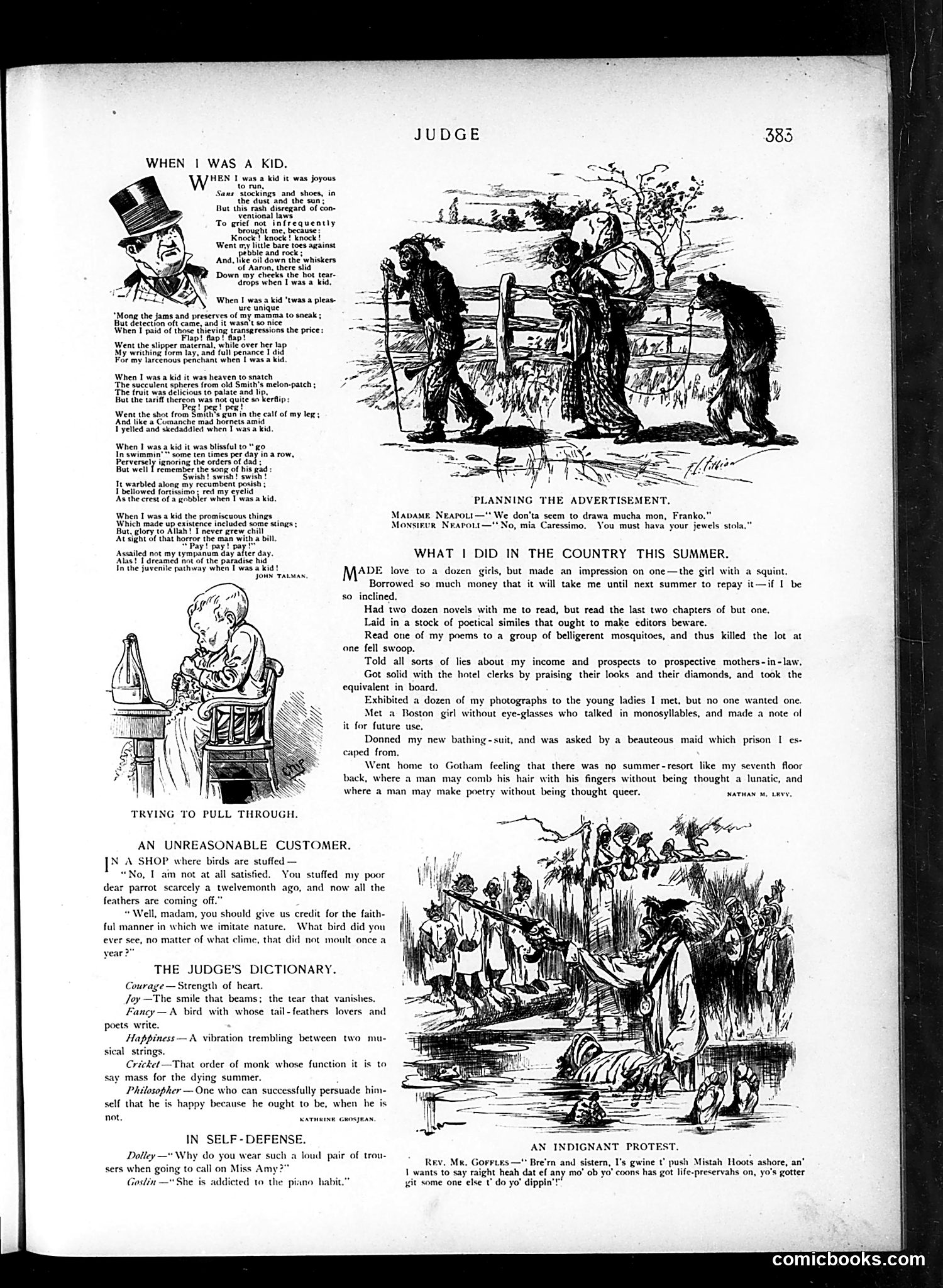
This *Judge* magazine page contains humorous nostalgic and satirical pieces typical of American humor circa early 1900s. **"When I Was a Kid"** (left): A sentimental poem with illustrations depicting childhood misadventures—barefoot play, stealing preserves, raiding melon patches, swimming against parental orders. The humor contrasts innocent childhood transgressions with the physical punishments received (whippings, buckshot). It's gentle nostalgia rather than social commentary. **"Planning the Advertisement"** (center): Two French characters discuss drawing for an advertisement. Madame Neapoli suggests they lack subjects; Monsieur replies they need "jewels stolen"—implying staged or artificial advertising content. This satirizes deceptive advertising practices. **"What I Did in the Country This Summer"** (right): A satirical first-person account where the narrator boasts of summer accomplishments—seducing girls, lying about finances, freeloading from hotels, reading barely, attempting poetry. The humor mocks pretentious urbanites seeking rustic summers while remaining fundamentally dishonest and shallow. **Supporting pieces** include mockery of taxidermy and dictionary definitions offering poetic rather than practical meanings—all gentle social satire typical of *Judge*'s sensibility.
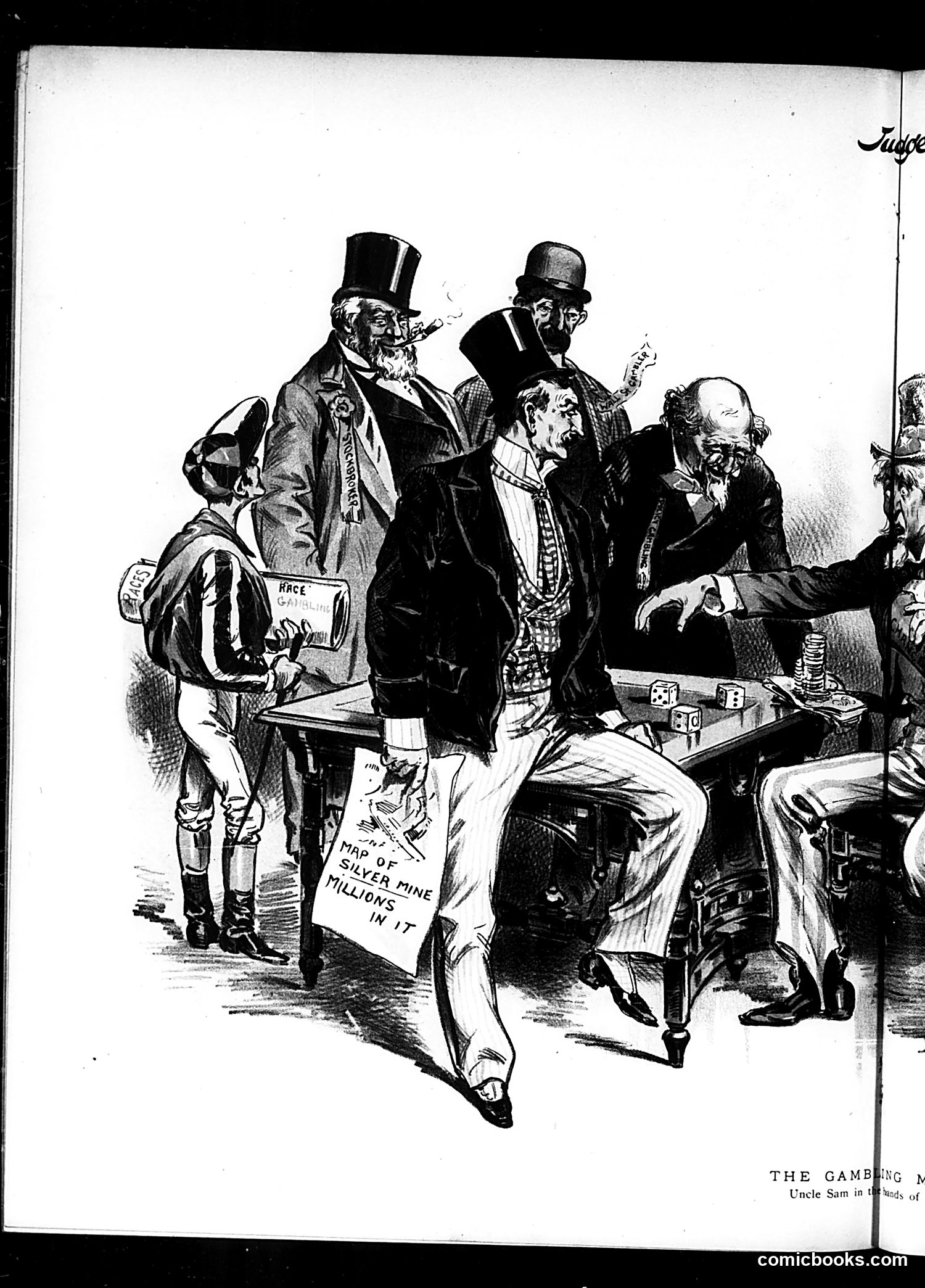
This Judge magazine cartoon satirizes American mining speculation, likely from the Gilded Age or early 1900s. Uncle Sam (identifiable by his characteristic outfit) appears to be gambling at a table with well-dressed speculators and financiers. Documents visible reference "RACE" and "MAP OF SILVER MINE" with "MILLIONS IN IT," suggesting fraudulent or speculative mining schemes. The satire critiques wealthy businessmen luring Americans into risky investment ventures by making exaggerated claims about mineral wealth. Uncle Sam's participation represents the nation being duped by get-rich-quick schemes. The gamblers' top hats and formal dress emphasize their elite status, while the documents hint at deceptive prospectuses used to bilk investors. The cartoon warns against the dangers of unregulated financial speculation disguised as legitimate enterprise.
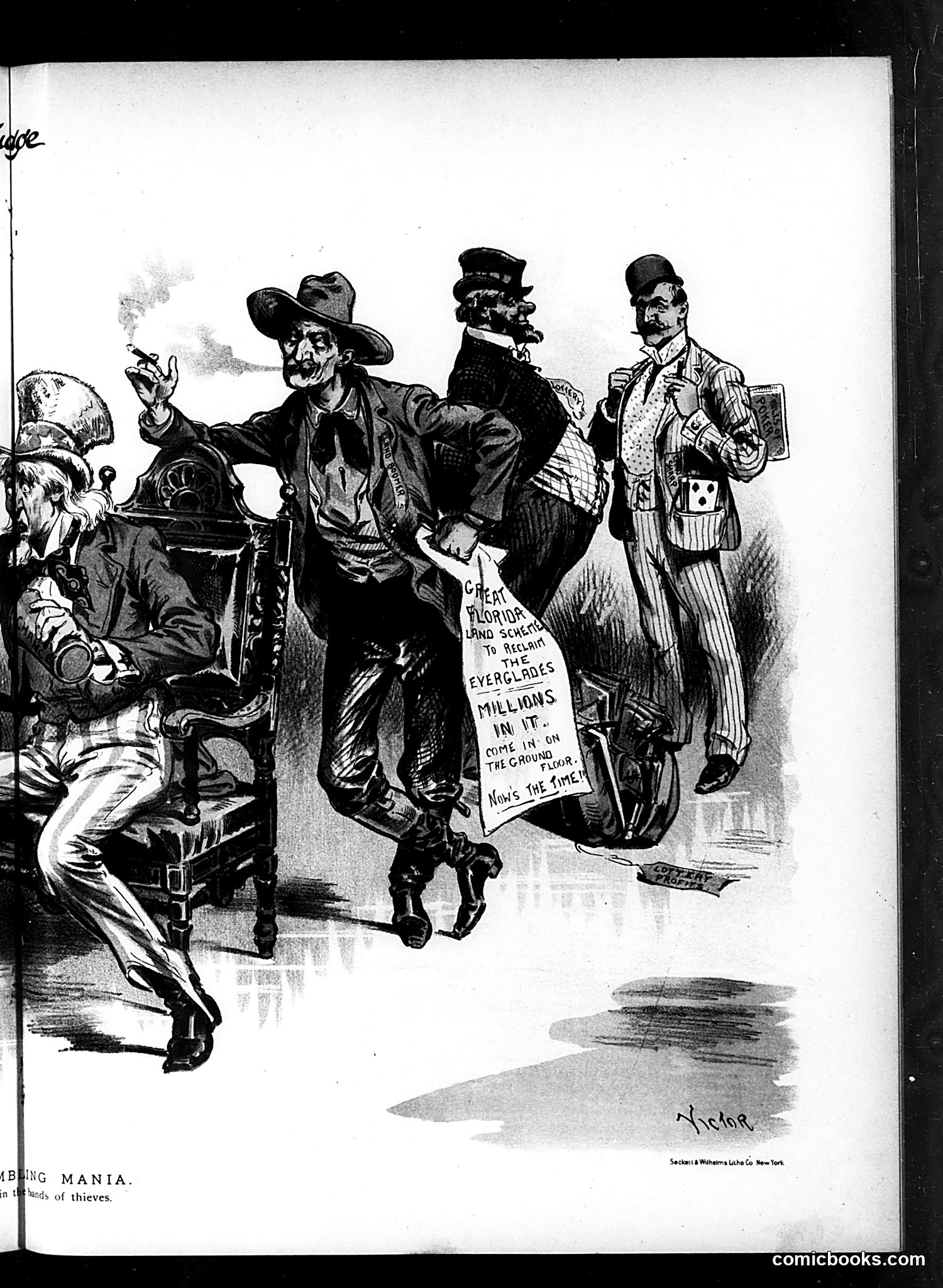
This satirical cartoon depicts what appears to be four politicians or speculators engaged in a scheme regarding Florida land development. The central figure holds a sign advertising "GREAT FLORIDA LAND SCHEME TO RECLAIM THE EVERGLADES" with "MILLIONS IN IT" and "NOW'S THE TIME!" — classic language of financial promotion. The cartoon critiques a land speculation mania, likely referencing early 20th-century Florida development schemes. The exaggerated caricatures and theatrical poses suggest these figures are portrayed as con artists or opportunists exploiting public interest in Everglades reclamation projects. The title "BEING MANIA" (possibly "LAND MANIA") emphasizes the fever-pitch speculation surrounding such ventures. The image satirizes how promoters used grand promises of development and profit to manipulate investors, with the subtitle suggesting such schemes placed wealth "in the hands of thieves."
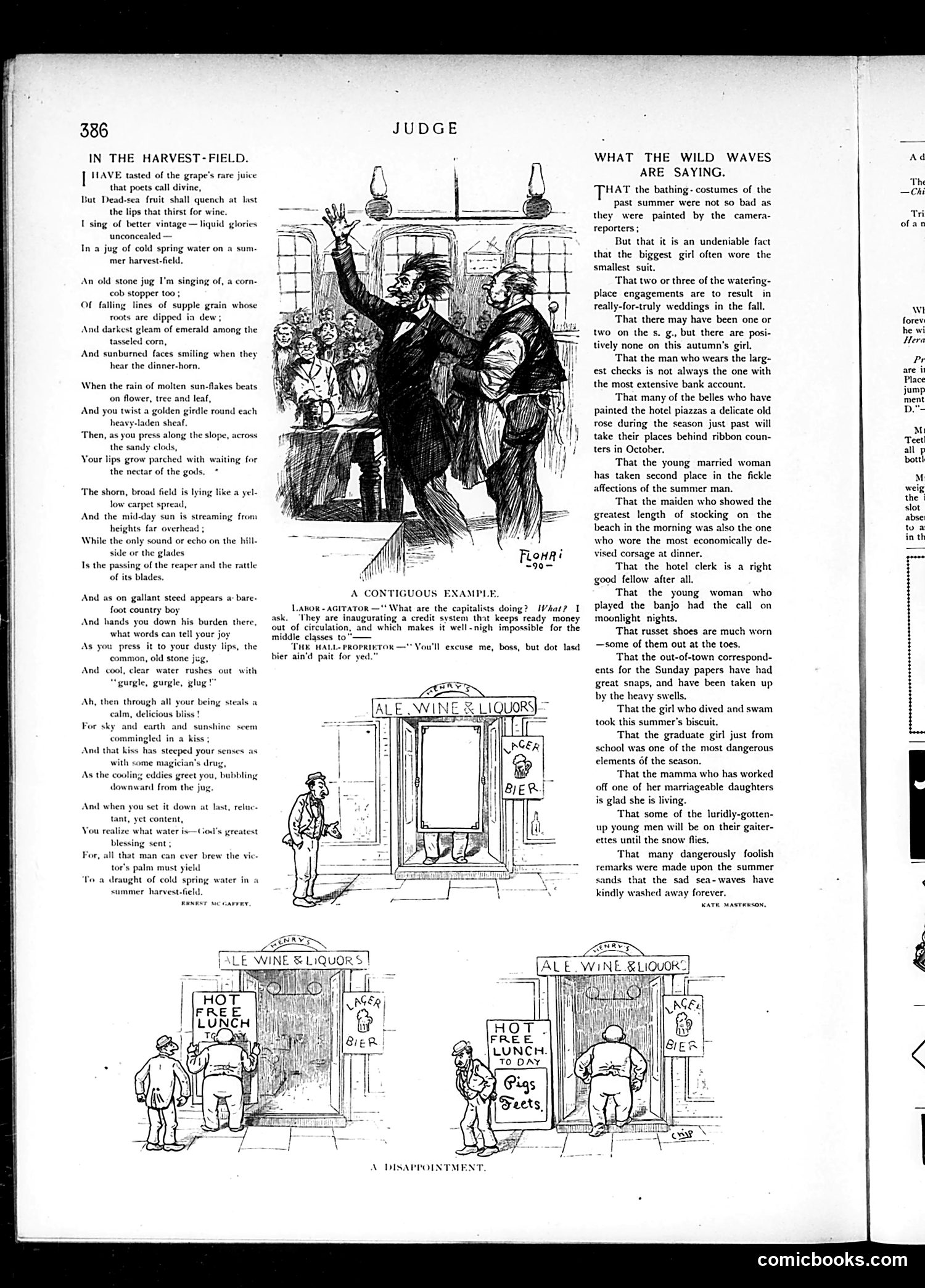
This page contains three satirical pieces: **"In the Harvest-Field"** is a sentimental poem praising cold spring water over wine—ironic praise for the cheapest, most basic refreshment, elevated to poetic glory. **"A Contiguous Example"** shows a labor agitator complaining to a bar owner about capitalist credit systems keeping money from circulation. The owner dismissively responds that the agitator hasn't paid for his beer—satirizing how radical economic critiques sound hollow when the speaker himself owes money. It mocks both extremes: activist rhetoric and working-class hypocrisy. **"What the Wild Waves Are Saying"** is a gossipy column listing beach-resort observations: girls' bathing suits, engagements, economic disparities (those showing wealth aren't always wealthy), and seasonal employment patterns (summer beauties become store clerks in fall). It satirizes class pretension and transient summer romance culture. The page ridicules populist economic arguments, celebrates humble contentment, and mocks upper-class resort society's superficiality and class performance.
This page is primarily **advertisements and humorous short quotations**, not political cartoons. The "Judge" magazine content here consists of brief satirical quips rather than visual cartoons. The humor targets include: **Teething remedies** (Castoria's ubiquity), **labor organizers** (the walking delegate and paid agitator who never strike), **newspaper prize schemes** (the Chicago Tribune's gimmick), **Spanish royalty** (the young King of Spain eating informally), and **women's fashion** (Mabel's bonnet being a recycled old style). The page is dominated by **period advertisements** for pianos, cigarettes, photography supplies, linen collars, stomach bitters, cocoa, and other consumer goods typical of 1880s-90s American magazines. The short jokes reflect contemporary anxieties about labor, commercialism, and social pretension rather than specific political events.
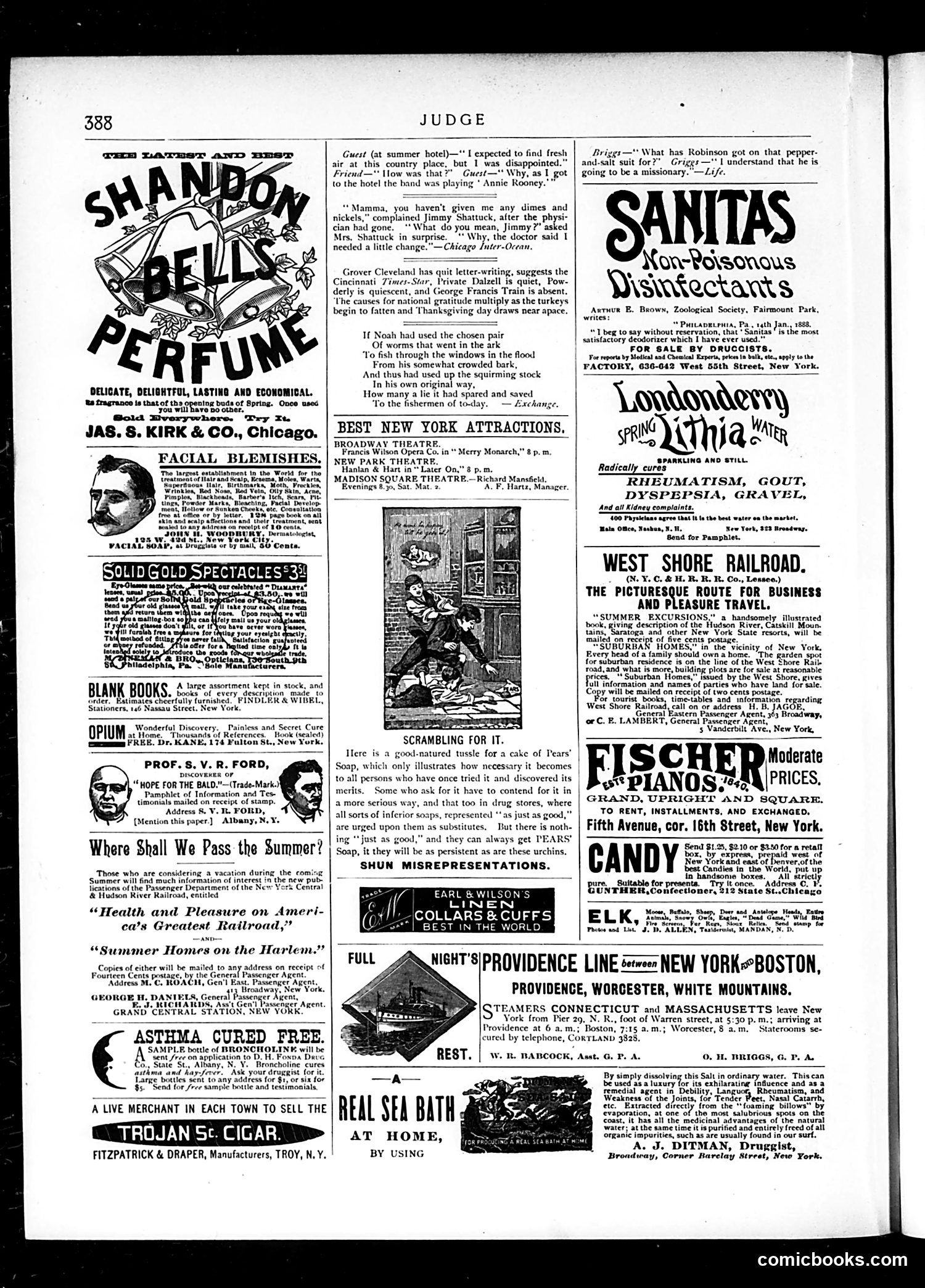
This is primarily a **page of advertisements and brief humorous snippets**, not a political cartoon. The **jokes** include: - A guest disappointed that a country hotel's band plays "Annie Rooney" instead of offering fresh air - A child asking his mother for "change" after the doctor recommends it - A piece praising Grover Cleveland and others for their silence/absence as causes for Thanksgiving gratitude The **main cartoon** ("Scrambling for It") shows people fighting over **Pears' Soap**, illustrating a commercial point: once people try this product, they eagerly compete to buy it again. The page is dominated by **period advertisements** for patent medicines (baldness cures, asthma remedies, opium treatments), spectacles, railroad vacation guides, and facial blemish treatments—typical late 19th-century Judge content mixing light satire with commercial promotion.
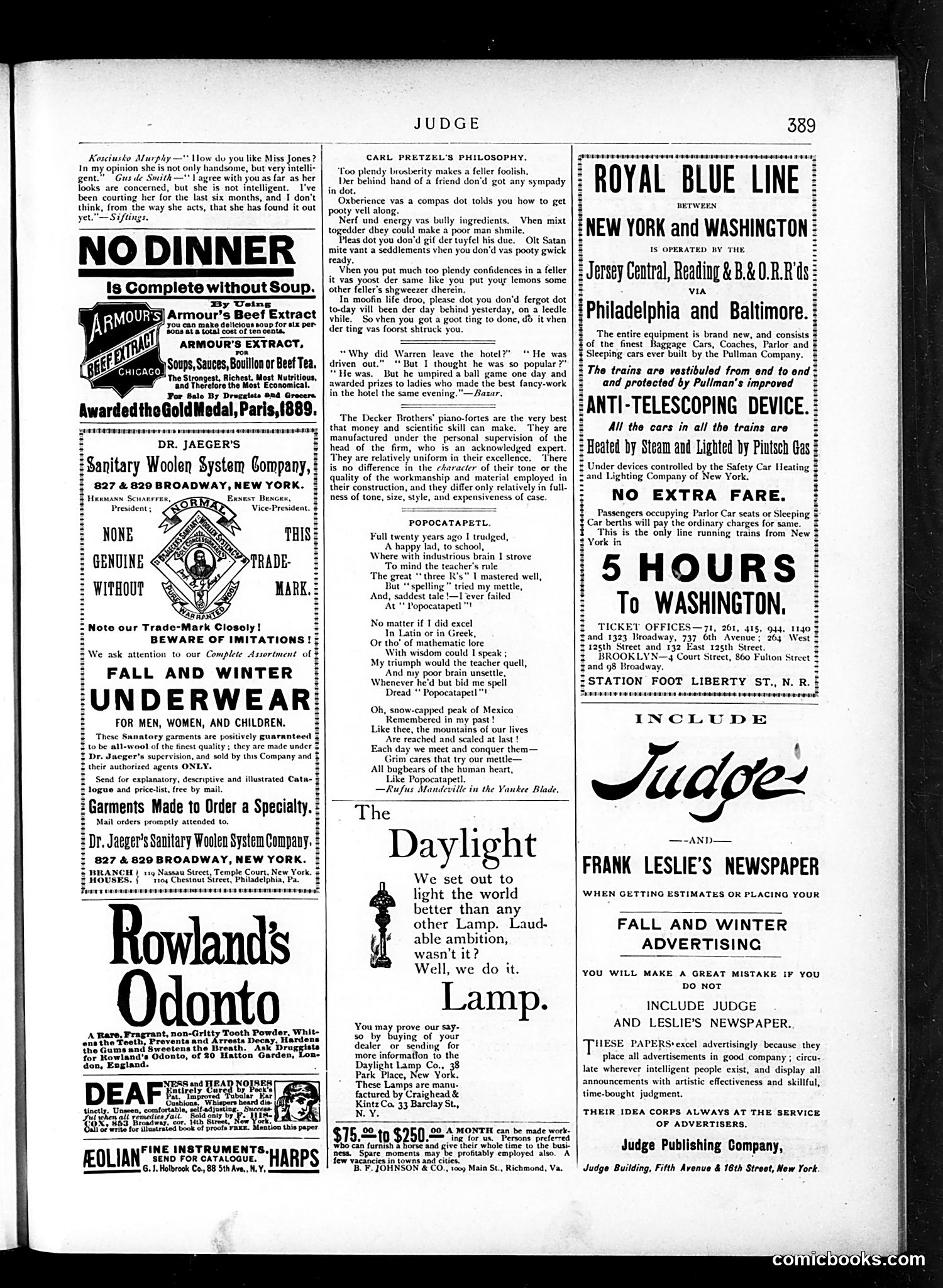
This is primarily an **advertising page** from Judge magazine (page 389), with modest editorial content. The page features: **Main Editorial Content:** - A brief joke about a woman's intelligence, attributed to "Siftings" - **"Carl Pretzel's Philosophy"**: dialect verse offering homespun wisdom (prosperity makes fools, experience guides you, don't trust others with your valuables, seize opportunities). Pretzel appears to be a German-immigrant character speaking in broken English—a common ethnic stereotype in period humor. - A hotel anecdote about an umpire - **"Popocatapetl"**: Opening lines of a nostalgic poem about schooling **Advertisements dominate**, promoting: - Armour's Beef Extract (soup base) - Dr. Jaeger's Sanitary Woolen System (underwear) - Rowland's Odonto (tooth powder) - Various other products The German-dialect "philosophy" reflects late-19th-century American attitudes toward immigrant groups through comedic stereotyping.
This page is primarily **advertising and filler content** with minimal political satire. The few brief jokes scattered throughout are standard period humor: The "Parent" joke mocks circus ticket pricing—a father tries negotiating reduced admission for his teenage son, revealing the boy's disability as a bargaining chip. It's mild social commentary on economic desperation. The "Larkin/Snodgrass" exchange is a temperance joke: when Larkin mentions a waterspout's damage in Iowa, Snodgrass conflates it with prohibition advocates' "harm," suggesting anti-alcohol crusaders cause more damage than natural disasters. This reflects **1890s tensions over Prohibition**. The remaining items—"Mrs. Youngthing," Willie Withington's observation—are innocuous domestic humor with no political content. **The page's real content is commercial**: advertisements for Liebig's Extract of Beef, Armour's beef products, silk merchants, tea companies, and Frank Leslie's Illustrated Newspaper. The famous Millet painting offer is a subscription incentive. This reflects how Judge funded itself through advertising, which often occupied more space than actual editorial content.
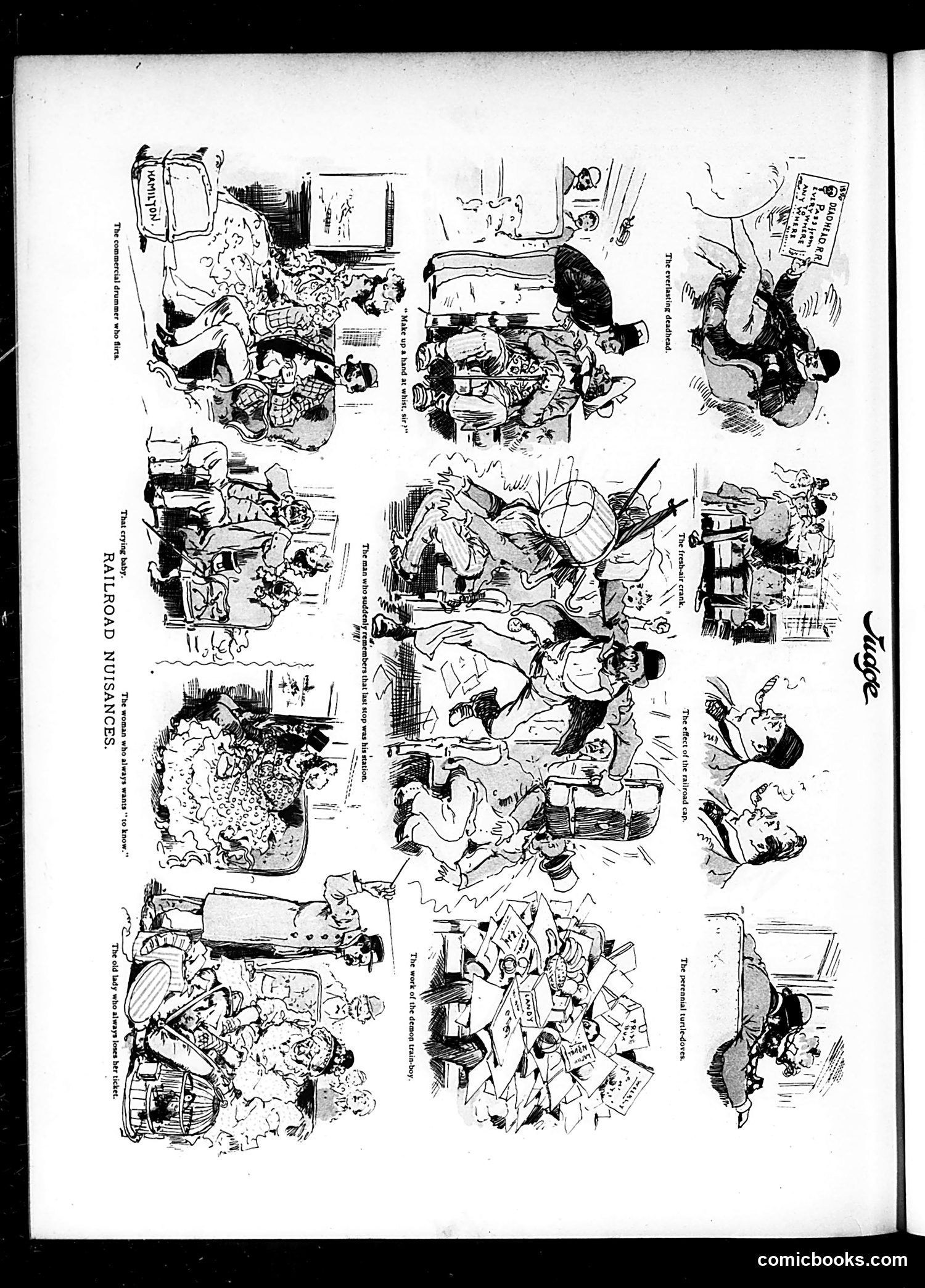
This page presents a series of comic vignettes satirizing annoying passenger behaviors on trains—a common complaint in late 19th/early 20th-century America when rail travel was standard. The sketches appear to depict various "nuisances": a crying baby disturbing other passengers, a woman asking intrusive questions, and other disruptive travelers. The humor targets both the inconsiderate passengers and the helplessness of fellow travelers stuck in close quarters. The title "RAILROAD NUISANCES" frames these as social problems specific to railway transit, when enclosed cars forced strangers into prolonged proximity. Judge uses exaggerated caricature to mock both the offenders and their victims' frustrated reactions—reflecting contemporary anxieties about urban transit and shared public spaces during the railroad era.