
Judge, 1890-09-20 · page 2 of 16
Judge — September 20, 1890 — page 2: what you’re looking at
What you’re looking at
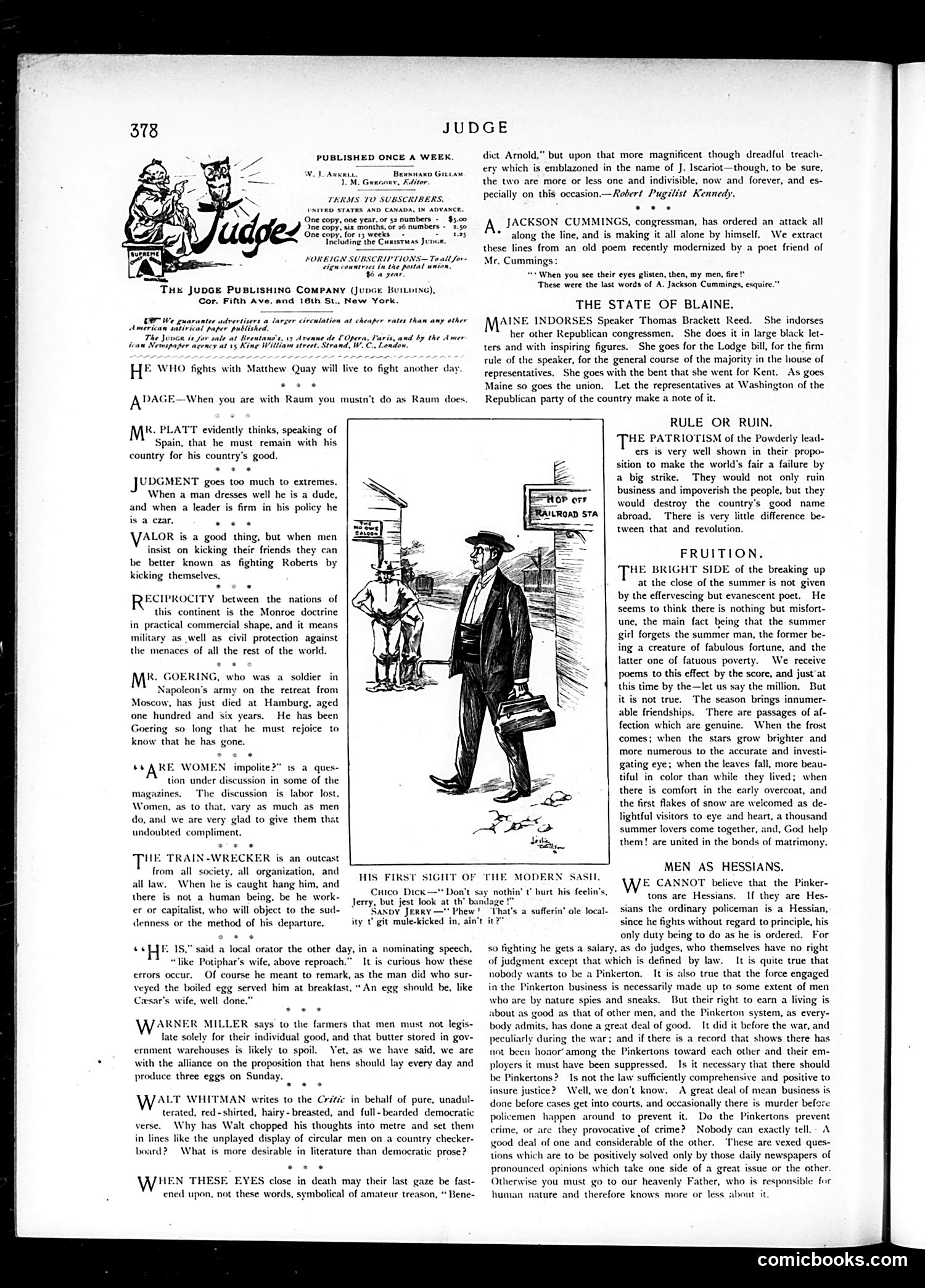
The cartoon depicts a man in old-fashioned clothing examining a window sash with surprise or confusion. The caption suggests this is someone encountering modern window technology for the first time—likely satirizing either rural/backward Americans or immigrants unfamiliar with contemporary conveniences. The accompanying text discusses various social and political topics including women's rights, international commerce, and Pinkerton detectives. A section titled "Men as Hessians" critiques Pinkerton operatives as mercenary agents lacking moral judgment, comparing them unfavorably to independent men of principle. The page reflects early 20th-century debates about labor rights, industrial practices, and American social values. The overall tone is reformist, questioning whether hired agents of capital serve justice or merely profit.
📄 Transcribed text from this page (OCR, searchable)
Machine-transcribed from the original scan — historical spelling and the odd misread are preserved.
JUDGE PUBLISHED ONCE A WEEK. S10 SUBSCRIBERS. UNFTRD STATHS AND CANADA, IN ADVANCE. One copy, one year,or 2 numbers - $5.00 ne copy. six months, or 26 numbers - "2.50 One copy. for 13 weeks = + nay Including the Cwaistuas Jencr. FOREIGN SUBS dign countries in the por $6 a year THe JUDGE PUBLISHING ComPANY (Jupce buiLvinc), Cor. Fifth Ave, and 16th St., New York. 97 We cuarantes advertisers a larger circulation at cheaper rates than any ether American satirical paper published. The Joven is for sale at Brentane's, 17 Avenue de COpera. 1 is, and by the Amer scan Newspaper agency at 15 Kine William street. Strand, W.C., ‘ondon. H® WHO fights with Matthew Quay will live to fight another day. ADPAGE—When you are with Raum you mustn't do as Raum does dict Arnold,” but upon that more magnificent though dreadful treach- ery which is emblazoned in the name of J. Iscariot—though, to be sure, the two are more or less one and indivisible, now and forever, and es- pecially on this occasion—Robert Pugilist Kennedy. A, JACKSON CUMMINGS, congressman, has ordered an attack all * “along the line, and is making it all alone by himself. We extract these lines from an old poem recently modernized by a poet friend of Mr. Cummings: “When you see their eyes glisten, then, my men, fire!" ‘These were the last words of A. Jackson Cummings, esquire.”” THE STATE OF BLAINE. AINE INDORSES Speaker Thomas Brackett Reed. her other Republican congressmen, She does it in large black let- ters and with inspiring figures. She goes for the Lodge bill, for the firm rule of the speaker, for the general course of the majority in the house of representatives. She goes with the bent that she went for Kent. As goes Maine so goes the union, Let the representatives at Washington of the Republican party of the country make a note of it. She indorses ME. PLATT evidently thinks, speaking of Spain, that he must remain with his country for his country’s good. JUDGMENT goes too much to extremes. When a man dresses well he is a dude, and when a leader is firm in his policy he is a czar. cae ‘ALOR is a good thing, but when men insist on kicking their friends they can be better known as fighting Roberts by kicking themselves RECIPROCITY between the nations of this continent is the Monroe doctrine in practical commercial shape, and it means military as well as civil protection against the menaces of all the rest of the world. M*- GOERING, who was a soldier in Napoleon's army on the retreat from Moscow, has just died at Hamburg, aged one hundred and six years. He has been Goering so long that he must rejoice to know that he has gone. SCARE WOMEN impolite?” 1s a ques- tion under discussion in some of the magazines. The discussion is labor lost. Women, as to that, vary as much as men do, and we are very glad to give them that undoubted compliment. WRECKER is an outcast HE TRAIN RULE OR RUIN. HE PATRIOTISM of the Powderly lead- ers is very well shown in their propo- sition to make the world’s fair a failure by a big strike. They would not only ruin business and impoverish the people, but they would destroy the country’s good name abroad, There is very little difference be- tween that and revolution. FRUITION. THE BRIGHT SIDE of the breaking up at the close of the summer is not given by the effervescing but evanescent poet. He seems to think there is nothing but misfort- une, the main fact being that the summer girl forgets the summer man, the former be- ing a creature of fabulous fortune, and the latter one of fatuous poverty. We receive poems to this effect by the score, and just’at this time by the—let us say the million. But it is not true. The season brings innumer- able friendships. There are passages of af- fection which are genuine. When the frost comes; when the stars grow brighter and more numerous to the accurate and investi- gating eye; when the leaves fall, more beau- tiful in color than while they lived; when there is comfort in the early overcoat, and the first flakes of snow are welcomed as de- lightful visitors to eye and heart, a thousand summer lovers come together, and, God help them! are united in the bonds of matrimony. from all society, all organization, and all law, When he is caught hang him, and there is not a human being, be he work- er of capitalist, who will object to the sud- denness or the method of his departure. HIS FIRST SIGHT OF = 1S," said a local orator the other day, in a nominating speech, “like Potiphar’s wife, above reproach.” It is curious how thése errors occur. Of course he meant to remark, as the man did who sur- veyed the boiled egg served him at breakfast, “An egg should be, like Casar's wife, well done.” W28NER MILLER says to the farmers that men must not legis- late solely for their individual good, and that butter stored in go ernment warchouses is likely to spoil. Yet, as we have said, we are with the alliance on the proposition that hens should lay every day and produce three eggs on Sunday. WALT WHITMAN writes to the Critic in behalf of pure, unadul- terated, red-shirted, hairy- breasted, and full-bearded democratic Why has Walt chopped his thoughts into metre and set them in lines like the unplayed display of circular men on a country checker- board? What is more desirable in literature than democratic prose? verse. HEN THESE EYES close in death may their last gaze be fast- ened upon, not these words, symbolical of amateur treason, “ Bene- Cutco Dick" Don't say nothin’ t hurt his feelin’s, Jerry, but jest look at th’ bandage !" Sanpy Jerry —" Phew ! ity git mule-kicked in, ain't it?” MEN AS HESSIANS. E CANNOT believe that tons are Hessians. THE MODERN SASH. the Pinker- If they are Hes- That's a sufferin' ole local. Sians the ordinary policeman is a Hessian, since he fights without regard to principle, his only duty being to do as he is ordered. For so fighting he gets a salary, as do judges, who themselves have no right of judgment except that which is defined by law. It is quite true that nobody wants to be a Pinkerton, It is also true that the force engaged in the Pinkerton business is necessarily made up to some extent of men who are by nature spies and sneaks, But their right to earn a living is about as good as that of other men, and the Pinkerton system, as every- body admits, has done a great deal of good. It did it before the war, and peculiarly during the war; and if there is a record that shows there has not been honor’ among the Pinkertons toward each other and their em- ployers it must have been suppressed. Is it necessary that there should be Pinkertons? Is not the law sufficiently comprehensive and positive to insure justice? Well, we don't know, A great deal of mean business is done before cases get into courts, and occasionally there is murder before policemen happen around to prevent it. Do the Pinkertons prevent crime, or are they provocative of crime? Nobody can exactly tell. A good deal of one and considerable of the other. ‘These are vexed ques- tions which are to be positively solved only by those daily newspapers of pronounced opinions which take one side of a great issue or the other. Otherwise you must go to our heavenly Father, who is responsible for human nature and therefore knows more or less about it comicbooks.com