
A complete issue · 16 pages · 1890
Judge — June 14, 1890
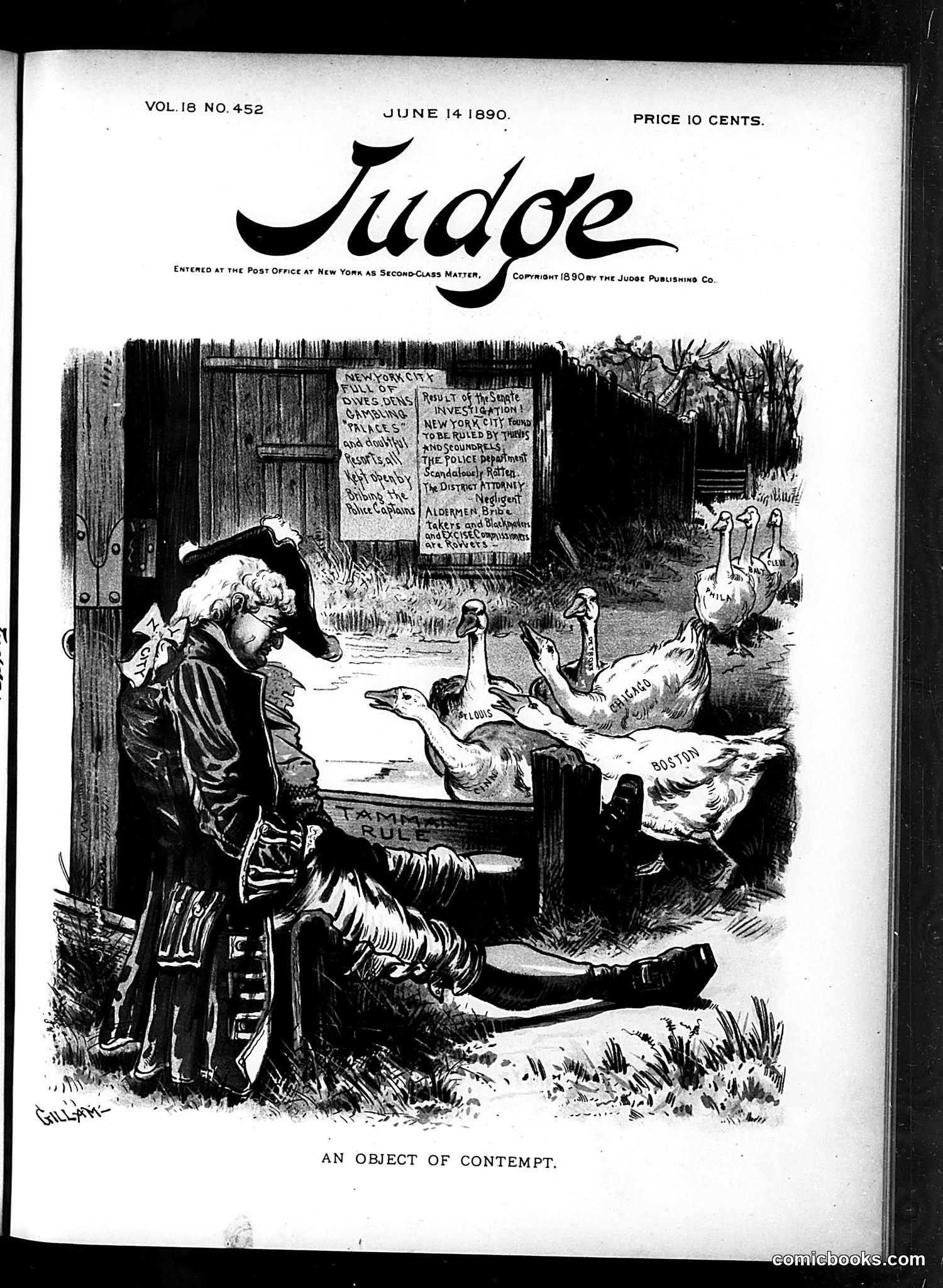
This political cartoon satirizes New York City corruption and negligence. A vagrant sleeps on the ground while geese waddle nearby, apparently thriving in neglected conditions. The visible sign lists multiple city failures: police corruption, palace scandals, missing funds, and negligent departments including the District Attorney. The satire works through contrast—the geese (symbols of contentment or thoughtlessness) flourish while the homeless man deteriorates, suggesting city leadership prioritizes nothing worthwhile. The cartoon critiques how New York's corrupt officials and incompetent bureaucracy leave the city in such poor condition that even vagrants become "objects of contempt" rather than receiving aid. This reflects Gilded Age anxieties about urban governance and poverty.
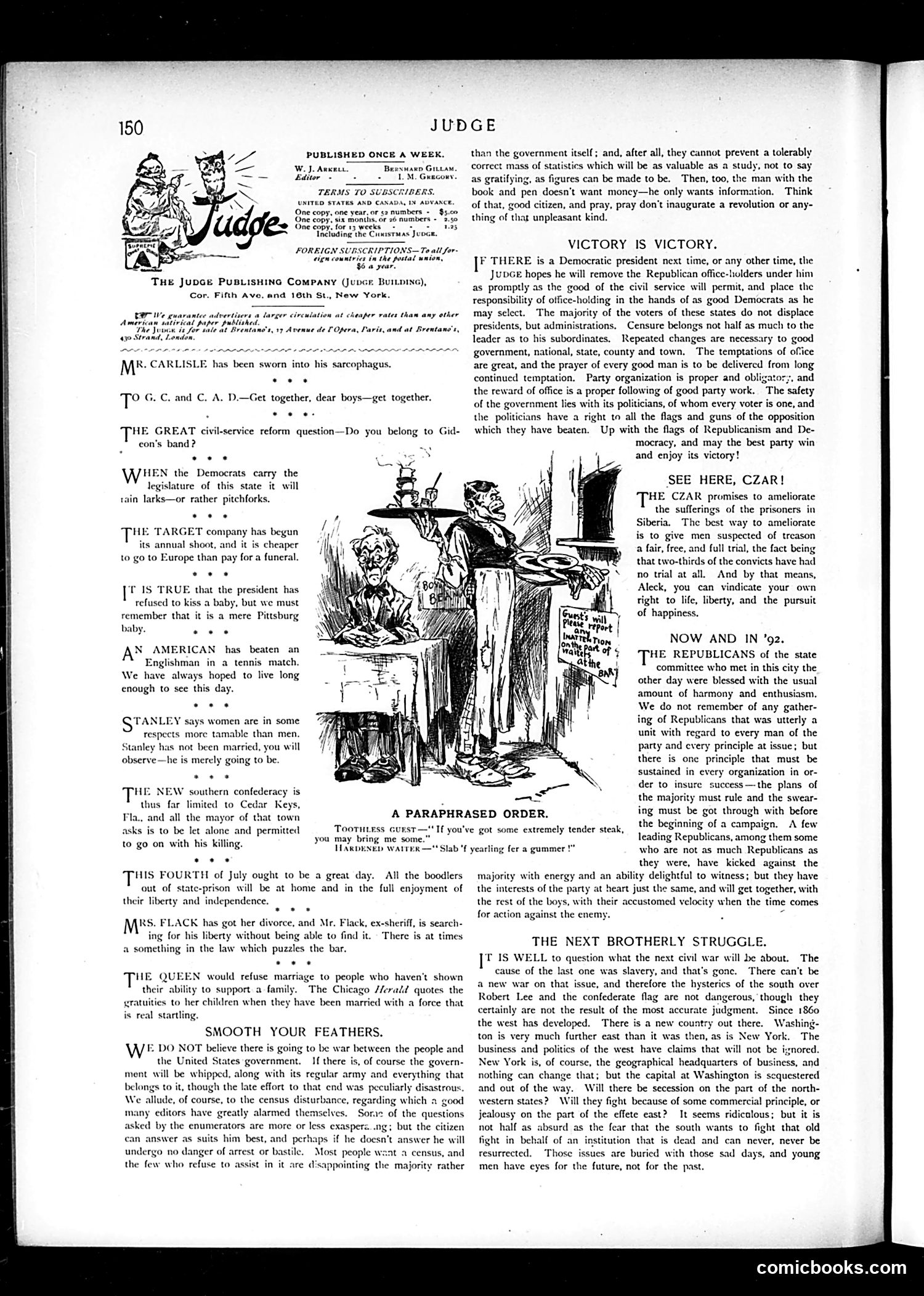
This page contains political commentary rather than a single cartoon. The main illustration, titled "A Paraphrased Order," appears to satirize government bureaucracy or military command structure—showing figures in what seems to be an official setting with papers and proclamations. The text sections address post-Civil War Republican politics, discussing: - Democratic hopes to remove Republican leadership - Civil service reform debates - Republican unity and party organization - References to the "next civil war" (likely metaphorical, regarding political struggle over Reconstruction issues) - Southern "confederacy" and tension over states' rights The overall tone suggests Judge is defending Republican governance while mocking Democratic challenges to it, typical of the magazine's post-1870s political advocacy. Without clearer identification of specific figures or dates in the image, precise attribution remains unclear.
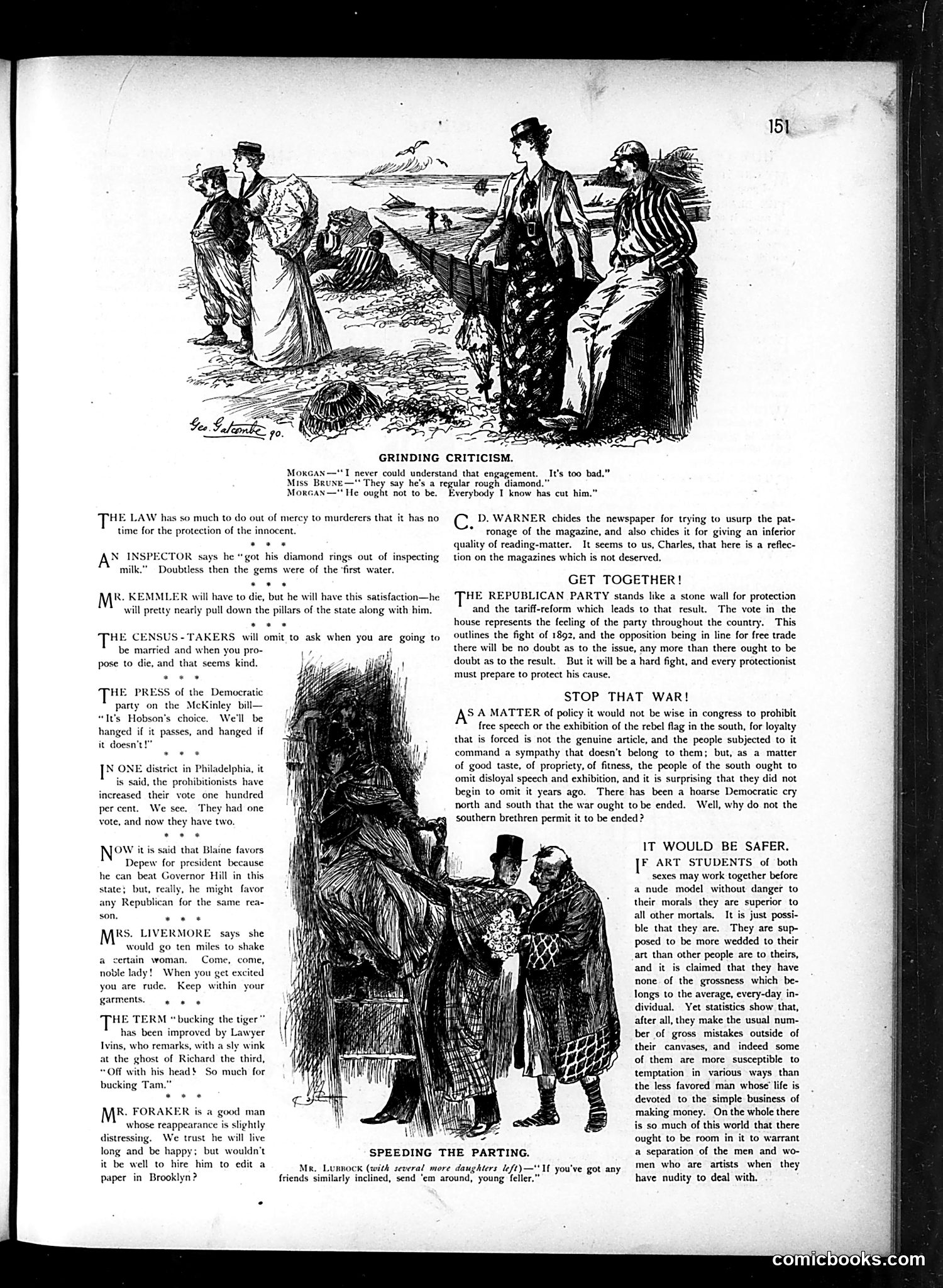
This page contains two satirical illustrations with accompanying brief political commentary typical of 1890s Judge magazine. **Top illustration ("Grinding Criticism")**: Shows a beach scene where characters discuss a man's engagement. The satire criticizes newspaper and magazine critics—particularly C.D. Warner—for unfair attacks on reading materials and editorial decisions. **Bottom illustration ("Speeding the Parting")**: Depicts a large bear with two men, captioned with dialogue about sending friends to someone. This appears to reference American politics circa 1892, with commentary on the Republican Party's tariff positions and Democratic Party responses regarding trade policy and war. The surrounding text discusses various political and social topics: census data, press coverage of McKinley, Philadelphia voting, Blaine and Hill's political activities, and debates about art education propriety. The page reflects Judge's Republican-leaning satirical stance on 1890s American politics.
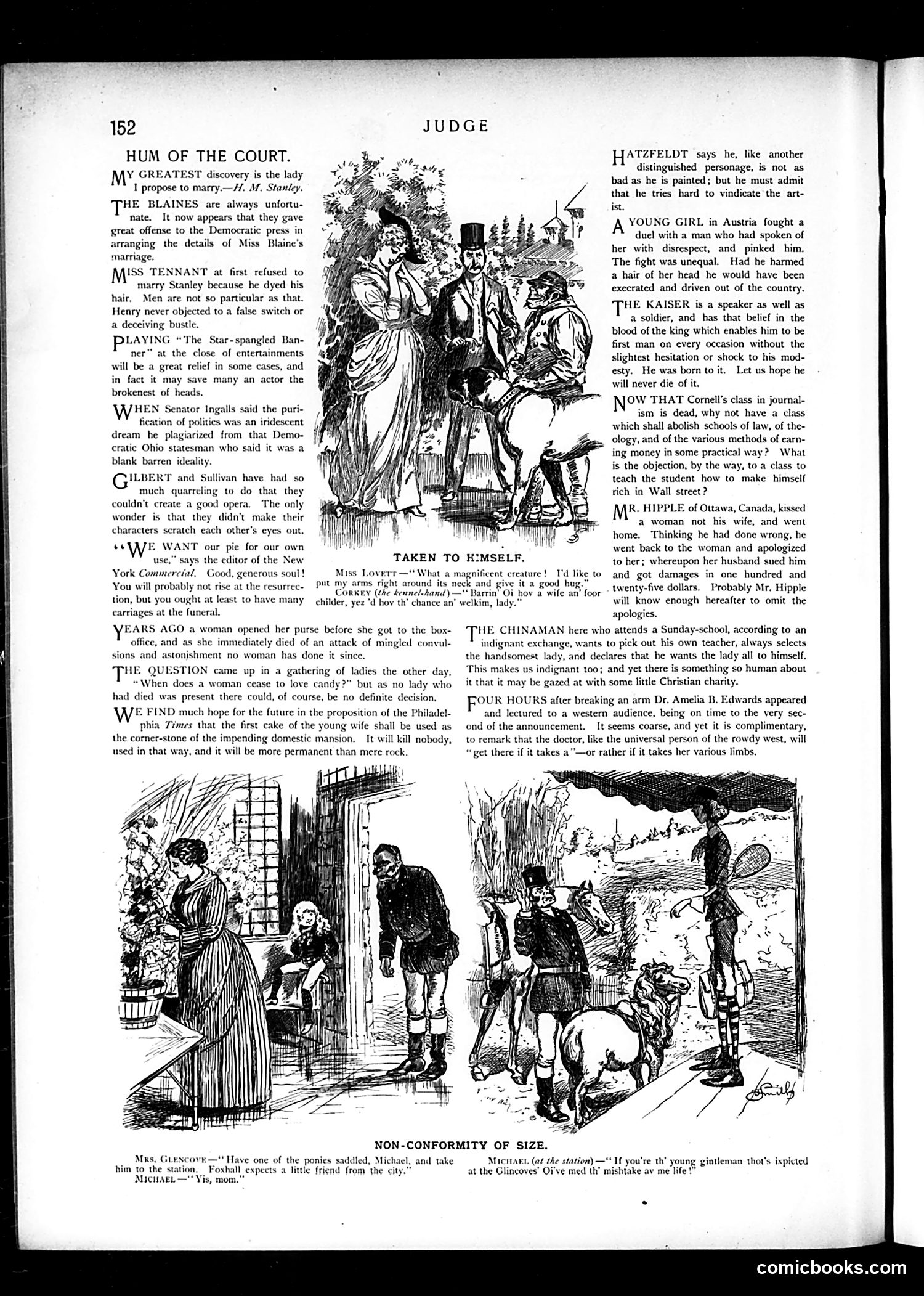
This page from *Judge* contains brief satirical commentary on contemporary social and political figures rather than integrated political cartoons. Key items include mockery of: - **The Blaines**: A Democratic family whose involvement in Miss Blaine's marriage arrangements apparently caused offense - **Senator Ingalls**: Criticized for claiming politics could be "purified"—accused of plagiarizing an Ohio statesman's similar rhetoric - **Gilbert and Sullivan**: The famous theatrical collaborators, mocked for quarreling so much they couldn't create good opera - **Hatzfeldt**: Appears to be a political figure defending his reputation against unflattering portrayals - **The Kaiser**: Praised sardonically for his aristocratic confidence and assumption of superiority The cartoons illustrate specific anecdotes (a woman with a pony, children by the shore) that accompany jokes about human nature and social absurdities rather than addressing major political events. The humor targets personalities, hypocrisy, and Victorian social conventions.
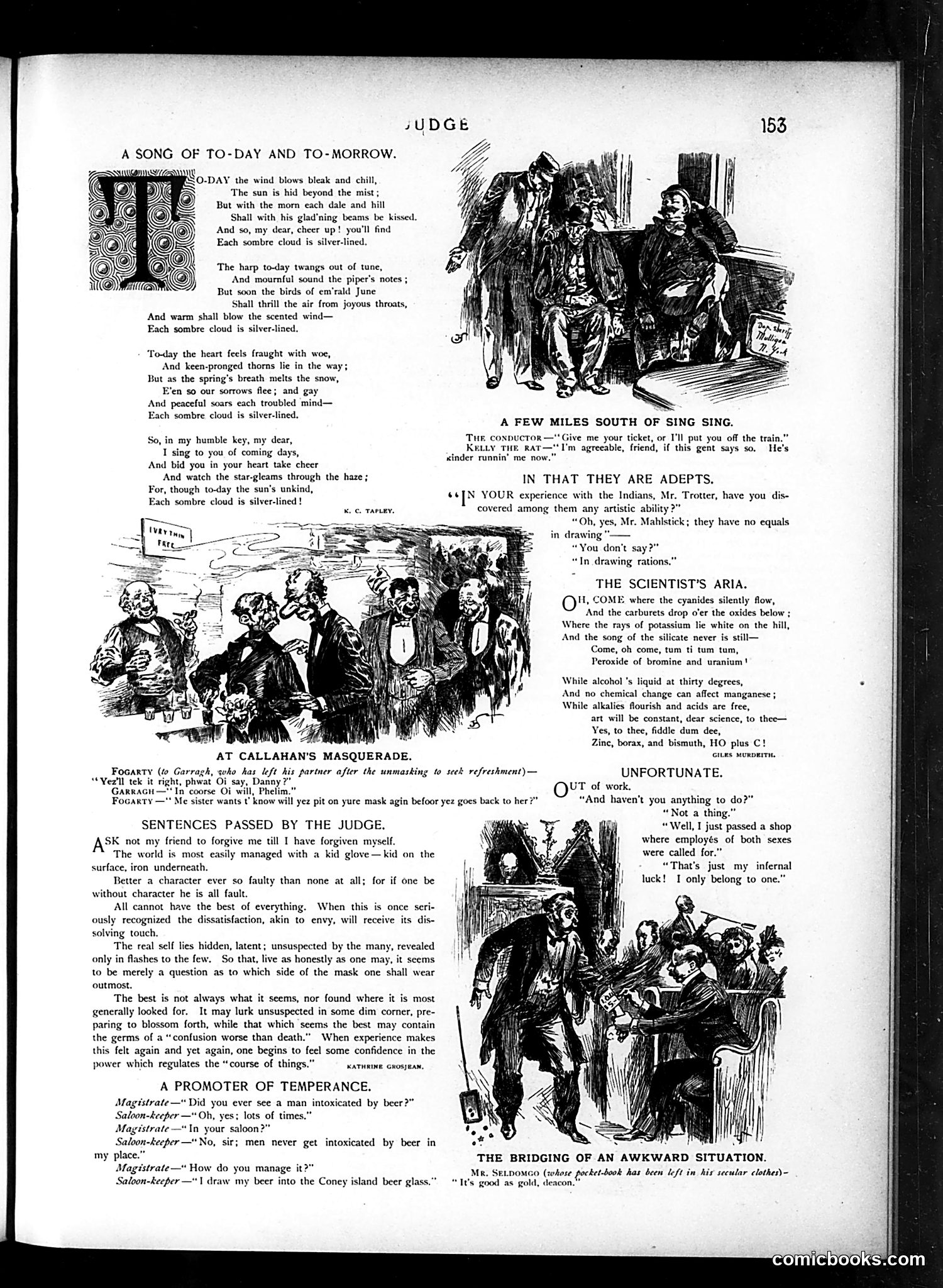
This page contains several satirical pieces typical of late 19th-century American humor: **"A Song of To-Day and To-Morrow"** is sentimental verse about finding hope amid present hardship—the "silver lining" theme common to period literature. **"At Callahan's Masquerade"** satirizes Irish immigrants through dialect humor, depicting working-class Irish characters (Fogarty, Garragh) at a social event. The joke relies on ethnic caricature typical of the era. **"A Promoter of Temperance"** mocks a saloon-keeper who claims his customers never get drunk—he supposedly uses specially shaped "Coney Island beer glasses." The satire targets alcohol industry hypocrisy regarding temperance debates. **"In That They Are Adepts"** appears to reference Native Americans' supposed skill at "drawing rations" (receiving government provisions), playing on period stereotypes. **"The Scientist's Aria"** is whimsical verse mocking overly technical scientific language through a mock-operatic song about chemistry. The page reflects Judge's characteristic blend of sentimental poetry, ethnic humor, and social commentary aimed at middle-class readers.
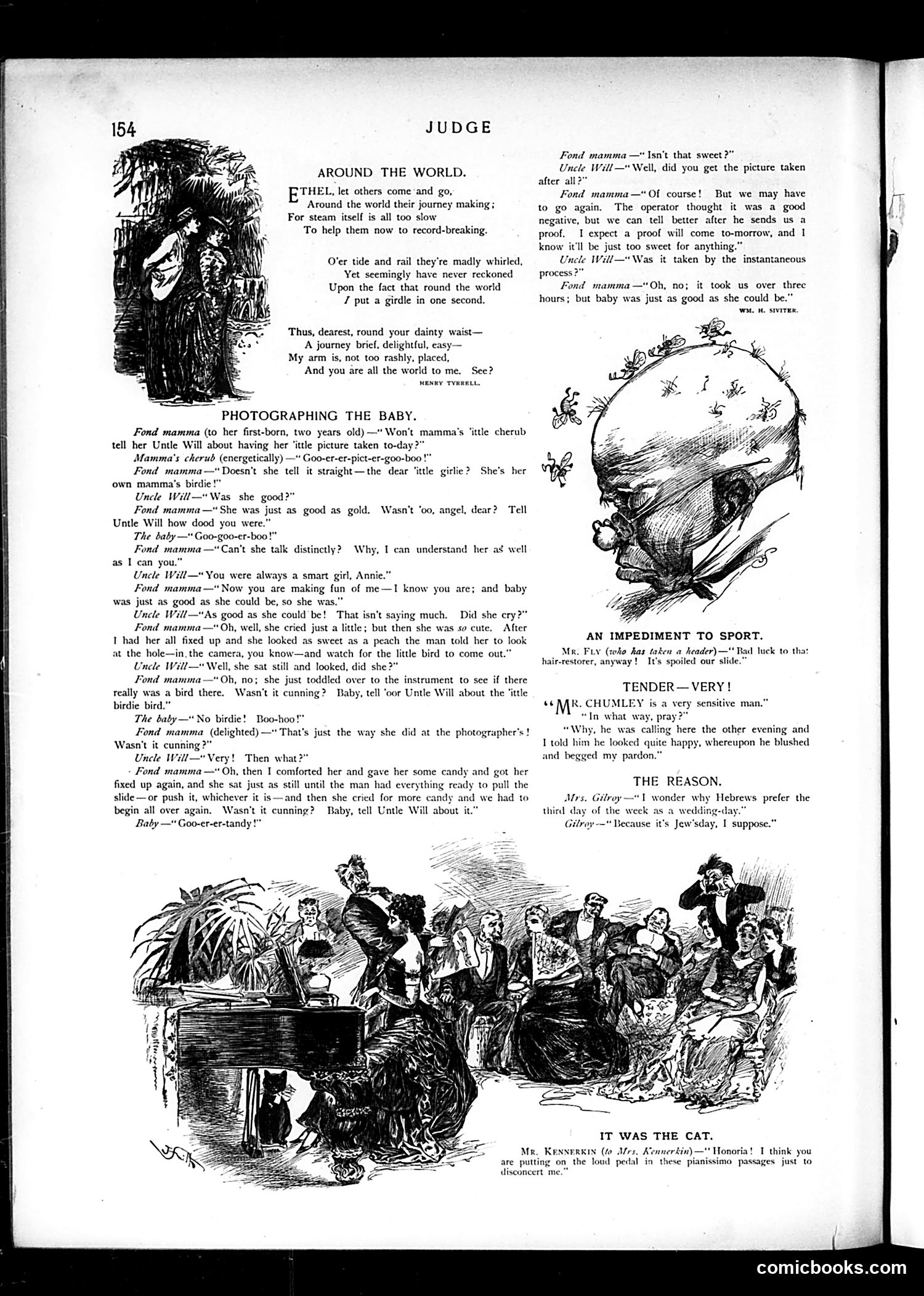
This page contains several unrelated satirical humor pieces typical of Judge magazine: **"Around the World"** plays on contemporary obsession with record-breaking journeys (likely referencing around-the-world travel races popular in the 1880s-90s). The poem humorously suggests a man's embrace around his sweetheart equals circling the globe. **"Photographing the Baby"** satirizes overly sentimental Victorian mothers who dote excessively on their children. The joke mocks both the mother's inability to recognize her toddler's unintelligible babbling as actual speech and the tedious, multi-hour photography process requiring children to sit still. **"An Impediment to Sport"** uses a brief visual gag: a man complains that hair-restorer ruined his cricket slide (disrupted play), not addressing the actual injury. **"The Reason"** and **"It Was the Cat"** are brief one-liners about social sensitivity and musical performance. The page reflects upper-middle-class Victorian concerns: new technology (photography, travel), sentimental parenting, and genteel social embarrassment.
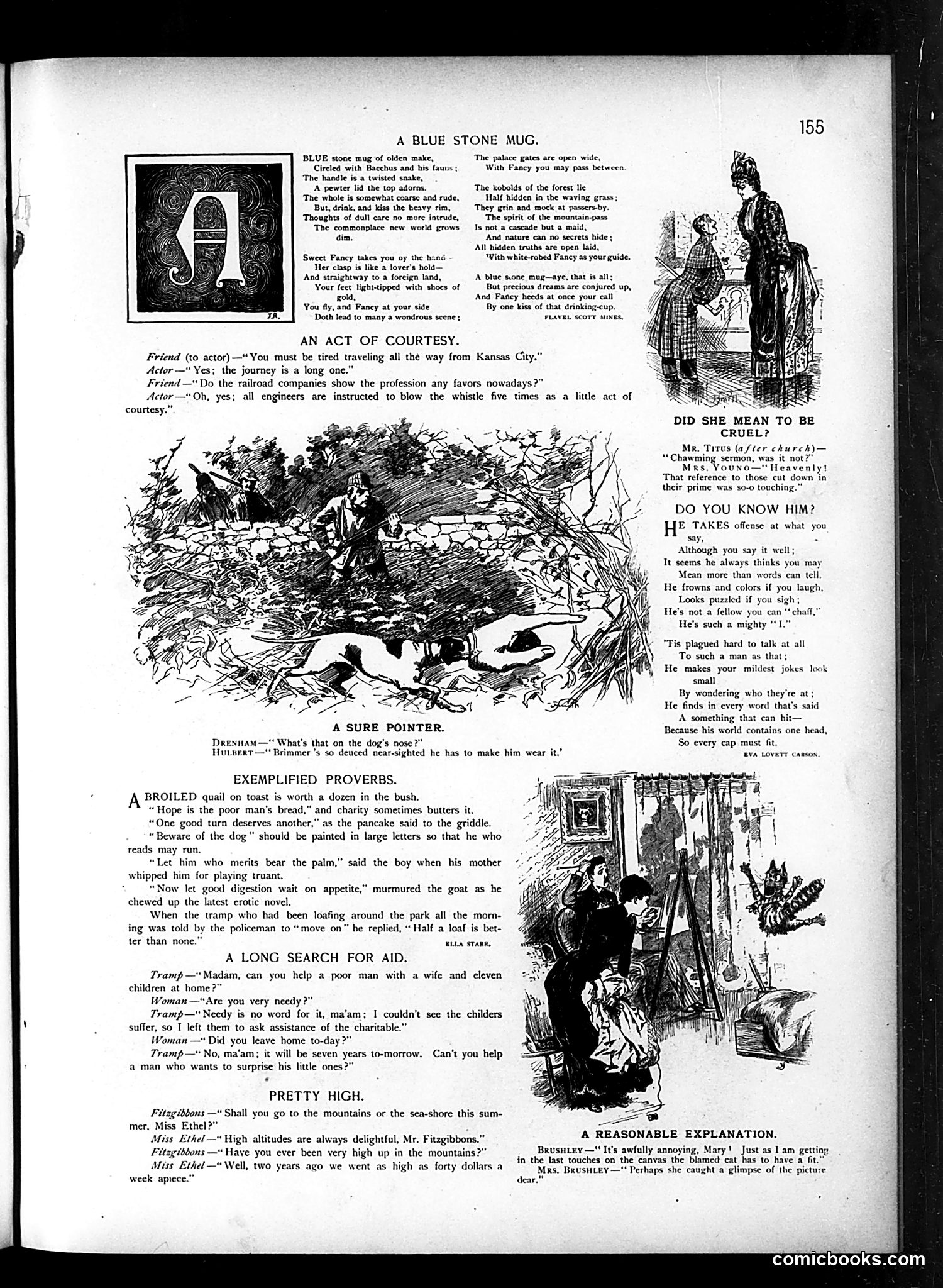
This page contains primarily **humorous short dialogues and light verse** rather than political cartoons—reflecting Judge's satirical humor style of the period. **Key content:** 1. **"A Blue Stone Mug"** — Romantic poetry about imagination and nostalgia, using an antique drinking vessel as a metaphor for escape into fantasy. 2. **"An Act of Courtesy"** — A brief joke about railroad engineers blowing whistles as professional courtesy to actors—gentle mockery of both rail companies and theatrical vanity. 3. **"Exemplified Proverbs"** — Comic reinterpretations of common sayings (e.g., "broiled quail on toast is worth a dozen in the bush"), poking fun at practical materialism. 4. **"Do You Know Him?"** — Social satire about an overly sensitive man who takes offense at trivial remarks, viewing all comments as personal attacks—commentary on ego and social anxiety. 5. **Brief dialogue sketches** involving tramps, servants, and social climbers—typical Judge fare satirizing class differences and human folly. The page emphasizes **character-based humor** over specific political events, targeting universal human quirks rather than newsworthy figures.
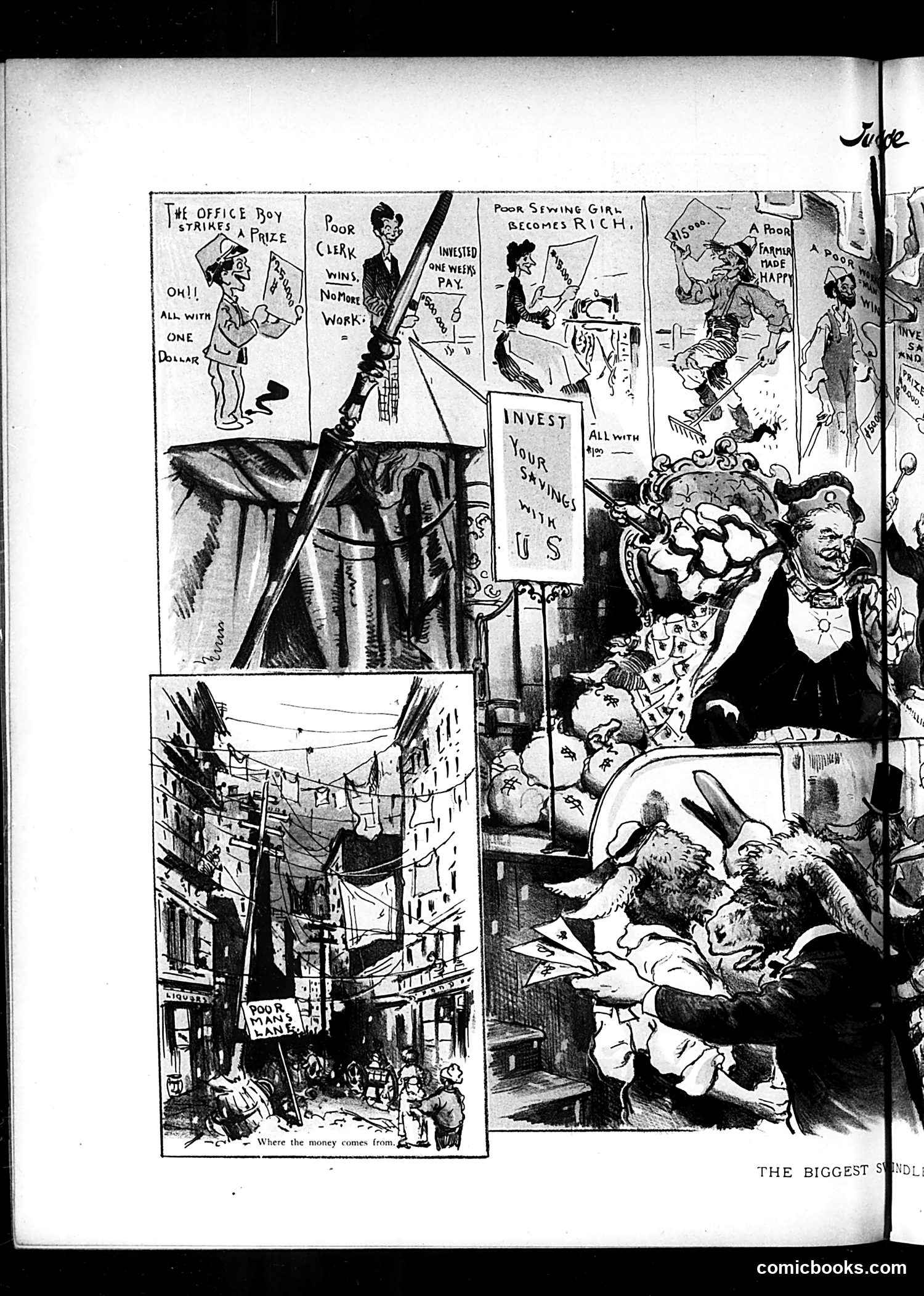
This Judge magazine page satirizes financial schemes and economic inequality in early 20th-century America. The top panels show get-rich-quick narratives: an office boy winning a prize, a poor clerk, and a sewing girl becoming wealthy through investment—unrealistic fantasies. The lower panels reveal the satire's point: a crowded tenement street labeled "Where the money comes from" and wealthy men profiting from poor residents' meager savings. The cartoon contrasts the promised riches with the exploitative reality—the wealthy literally extract money from impoverished neighborhoods. The message critiques investment schemes that prey on desperate workers, promising wealth while actually enriching only those already powerful. The contrast between upper and lower panels exposes how "investment opportunities" marketed to the poor actually funnel their money upward to the rich.
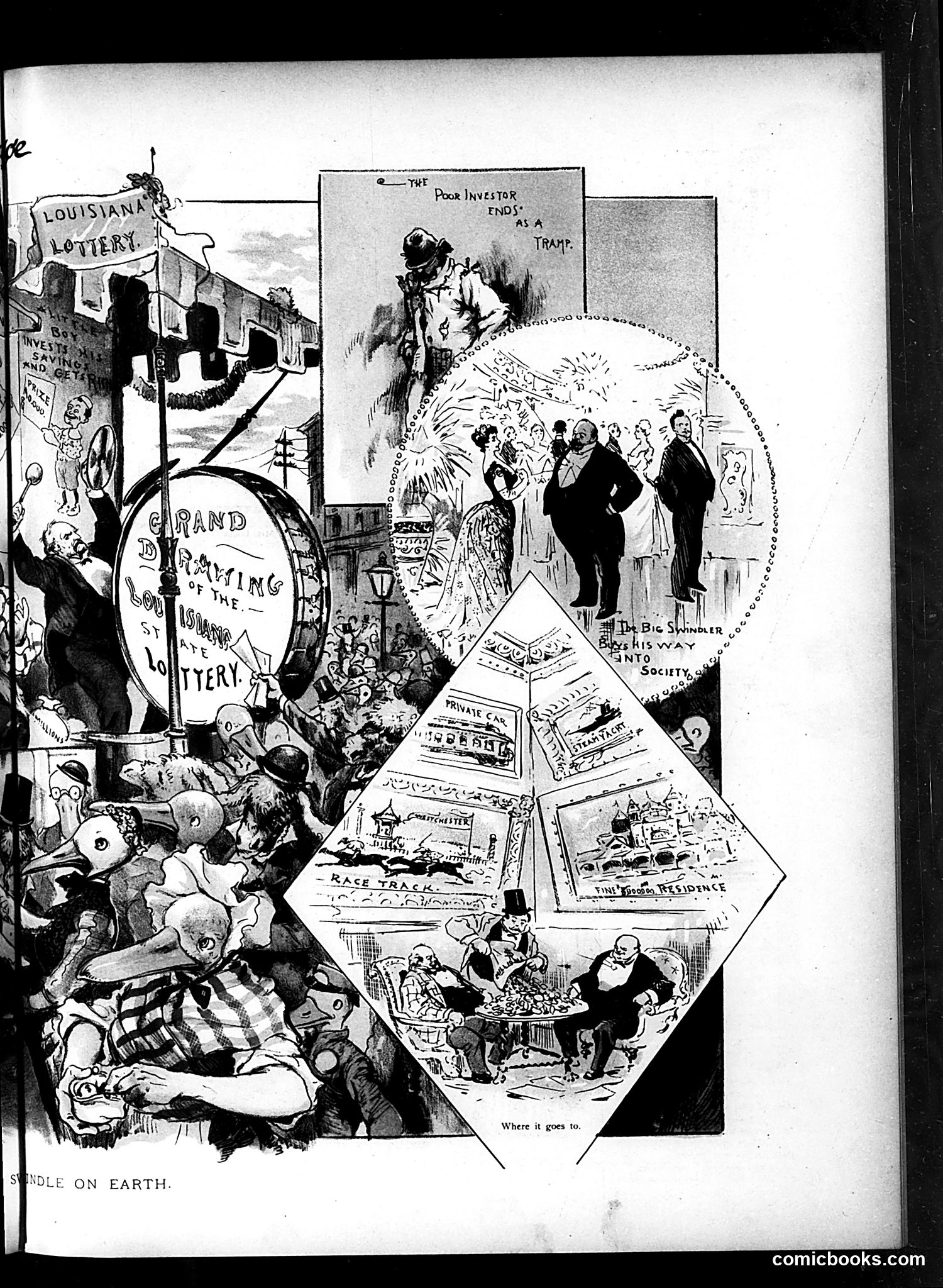
This satirical cartoon criticizes the Louisiana Lottery, a notorious gambling scheme. The left side shows a "Grand Drawing of the Louisiana Lottery" attracting crowds of hopeful participants. The central image traces the "poor investor's" fate through various gambling venues (race track, private cars, fine residences), ultimately depicting him as a tramp in the upper right—"The Big Swindler Eases His Way Into Society." The cartoon satirizes how lottery schemes promise wealth but actually transfer money from desperate poor people to wealthy operators who gain social respectability. It exposes the lottery as a swindle that impoverishes ordinary citizens while enriching corrupt promoters. The vertical flow demonstrates the systematic extraction of funds upward through society.
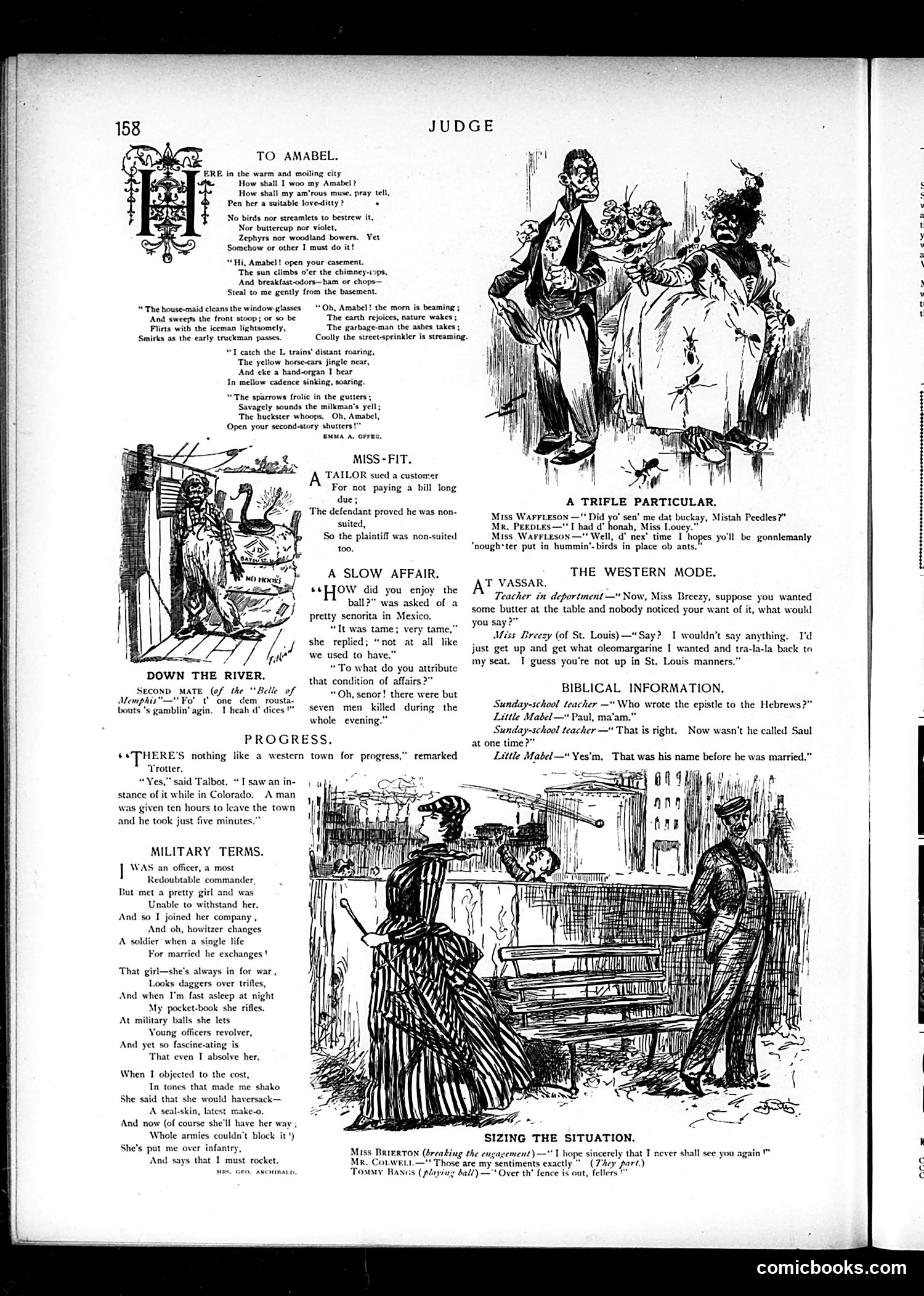
This page collects humorous sketches satirizing American social life. The main illustrated piece, "To Amabel," mocks romantic poetry by depicting a man attempting to woo a woman in a grimy industrial city—replacing traditional pastoral imagery (birds, streams, violets) with urban realities (garbage men, hand organs, the "L" train). The satire contrasts genteel romantic conventions with unglamorous city life. Additional brief jokes mock legal absurdities ("Miss-Fit"), Mexican social customs ("A Slow Affair"), and class pretensions. "Military Terms" uses weaponry metaphors to satirize marriage, while "The Western Mode" ridicules Midwestern directness and informality. "Biblical Information" jokes about a child's innocent misunderstanding of scripture. The illustrations use exaggerated caricature typical of period satirical magazines. Overall, the page reflects Judge's focus on urban American manners, regional differences, and the gap between social pretense and reality.
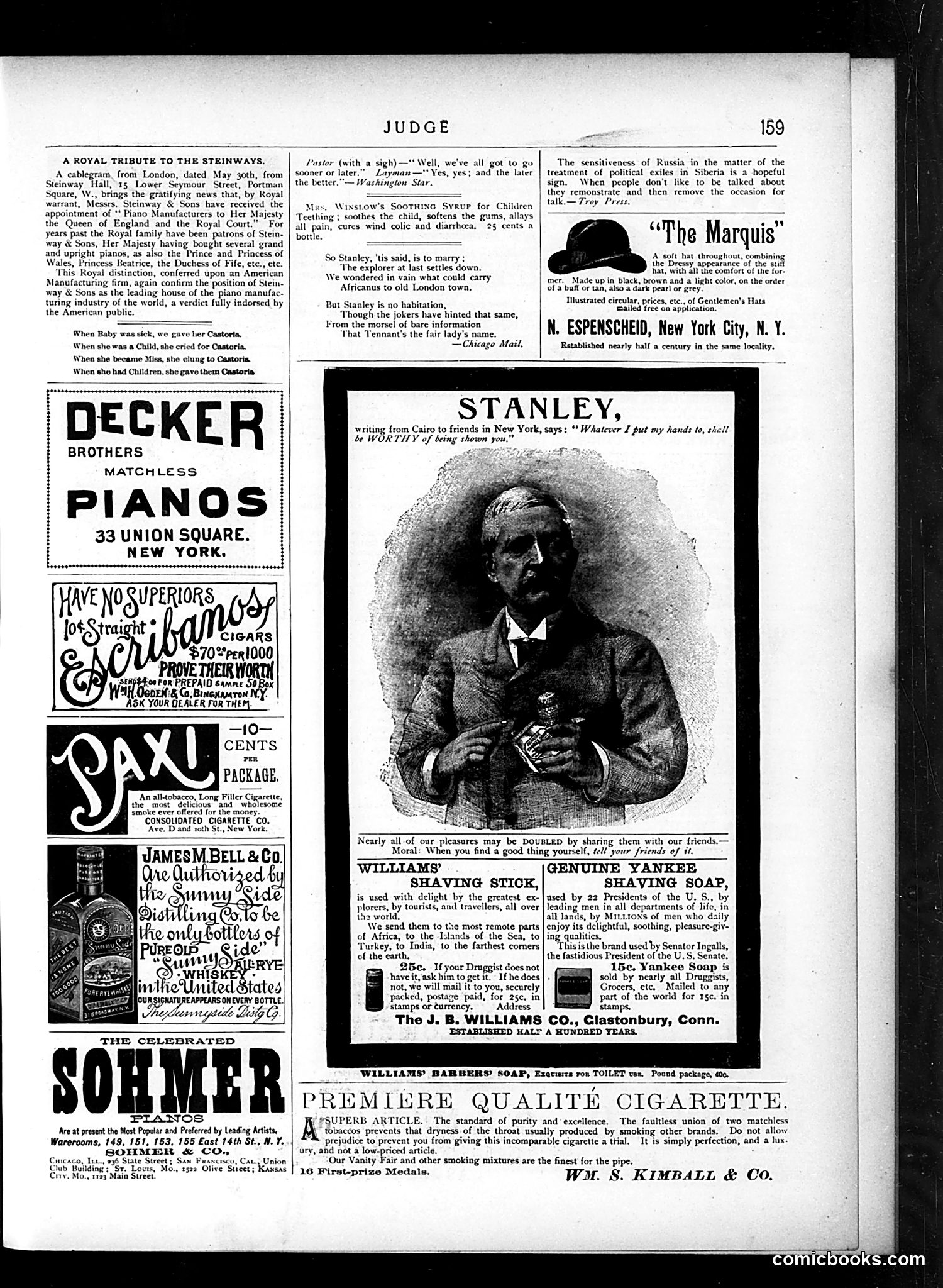
This page contains **primarily advertisements** with minimal editorial content. The main items are: **"Stanley" Section:** A portrait of explorer Henry Morton Stanley with a quote about his accomplishments. The accompanying text humorously notes Stanley—famous for African exploration—is "to marry" and will finally "settle down," playing on the pun that "Stanley is no habitation" (can't be a place to settle). **Editorial Snippets:** Brief jokes about clergy/religion and Russian sensitivity to criticism about Siberian exiles—typical of Judge's satirical commentary. **Advertisements:** The bulk of the page promotes pianos (Decker Brothers, Sohmer), cigars, and grooming products (Williams' Shaving Stick, which cleverly advertises by noting explorers use it globally). A Royal Warrant notice celebrates Steinway pianos receiving British royal patronage. **Historical Context:** This appears to be from around the 1890s, when Stanley's 1889 African expedition was recent news. The magazine uses his fame to sell products while making light satirical jabs at his personal life.
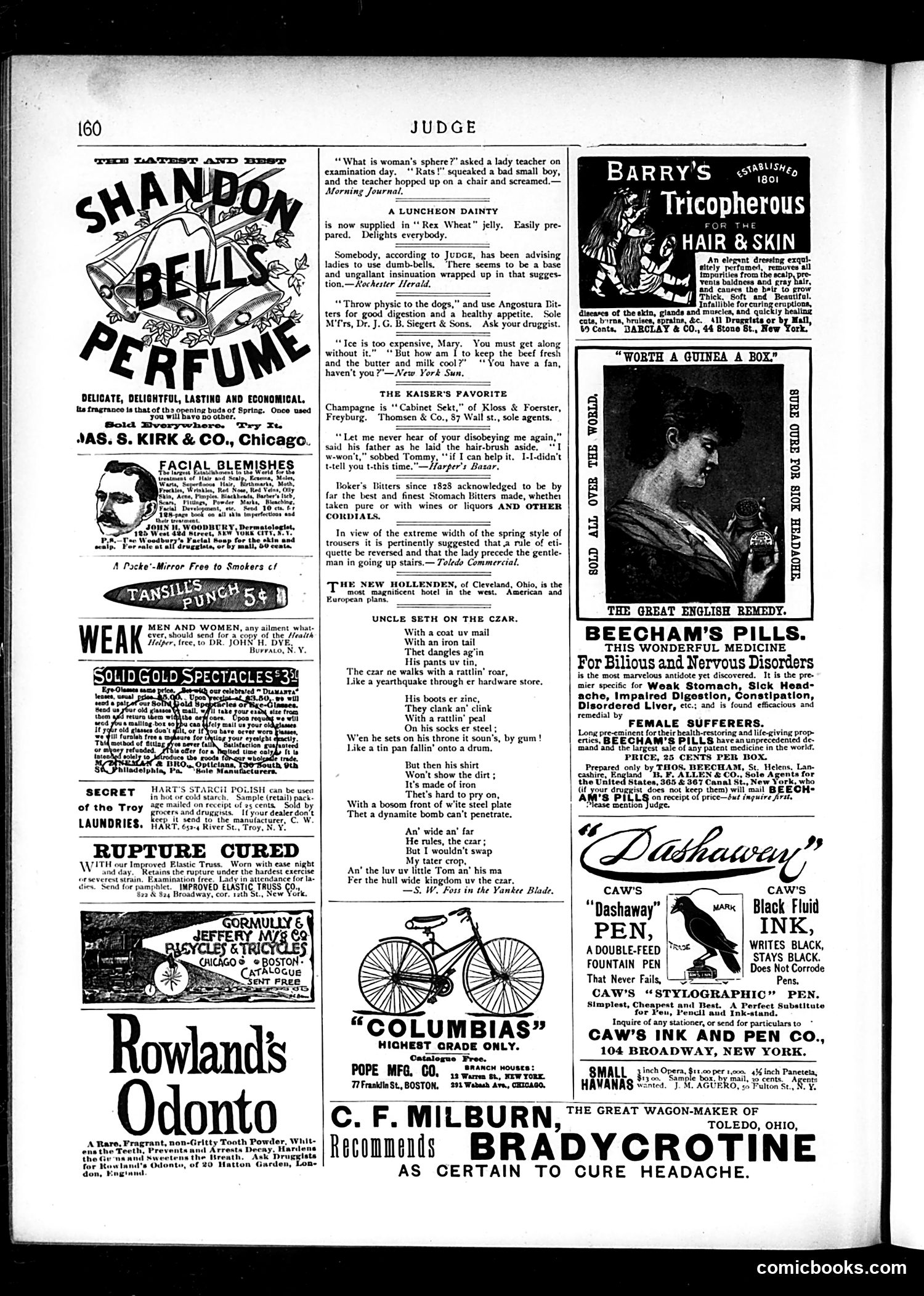
This page is primarily composed of period advertisements and humorous short anecdotal items rather than political cartoons. The "Judge" content includes jokes about contemporary life—such as a lady teacher being spooked by a boy's crude answer about woman's sphere, or a poem by "Uncle Seth" mocking the Russian Czar as an absurdly metal-clad figure, impervious yet inferior to simple rural American life. The satire is gentle and domestic rather than sharply political. The page is dominated by product advertisements for items like perfume, starch, bicycles, champagne, and patent medicines typical of the 1890s-era advertising landscape. There is no major political cartoon or commentary visible.
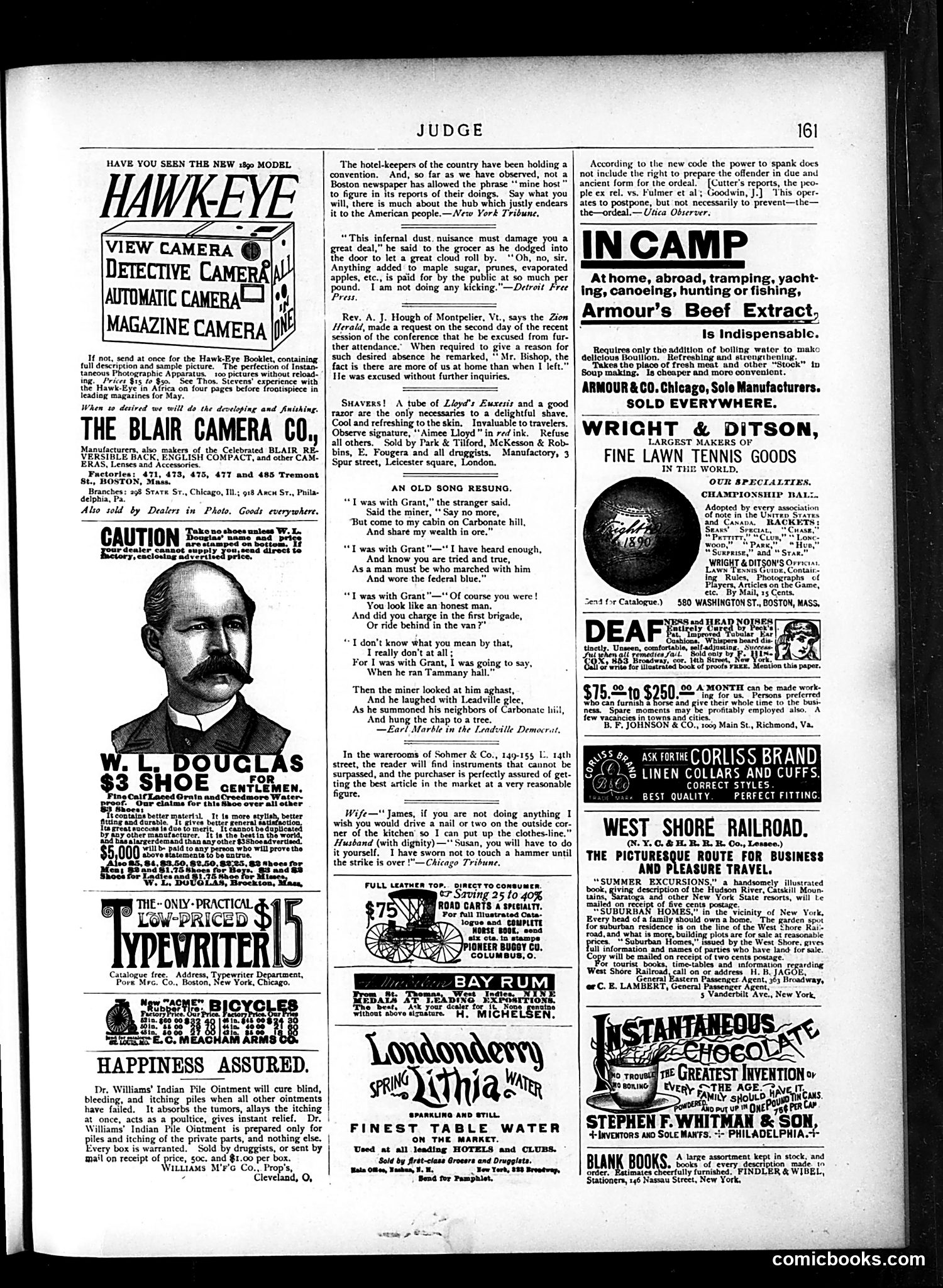
This page is primarily **advertising**, not political satire. It contains product advertisements typical of a late 19th-century magazine: cameras (Hawk-Eye, Blair Camera), typewriters, shoes, bicycles, and patent medicines (pile ointment, lithia water). The only substantive editorial content includes brief humorous observations: a Boston newspaper quip about "mine host" language among hotelkeepers; a grocer's pragmatic acceptance of dust contamination (customers pay for added weight); and a Methodist minister's candid admission that his church has fewer members present than at home. The page includes a poem titled "An Old Song Resung" romanticizing Civil War veterans—likely appealing to Judge's readership in the post-war era by celebrating Union Army service as a mark of character and trustworthiness. The overall page reflects commercial publishing priorities rather than editorial commentary.
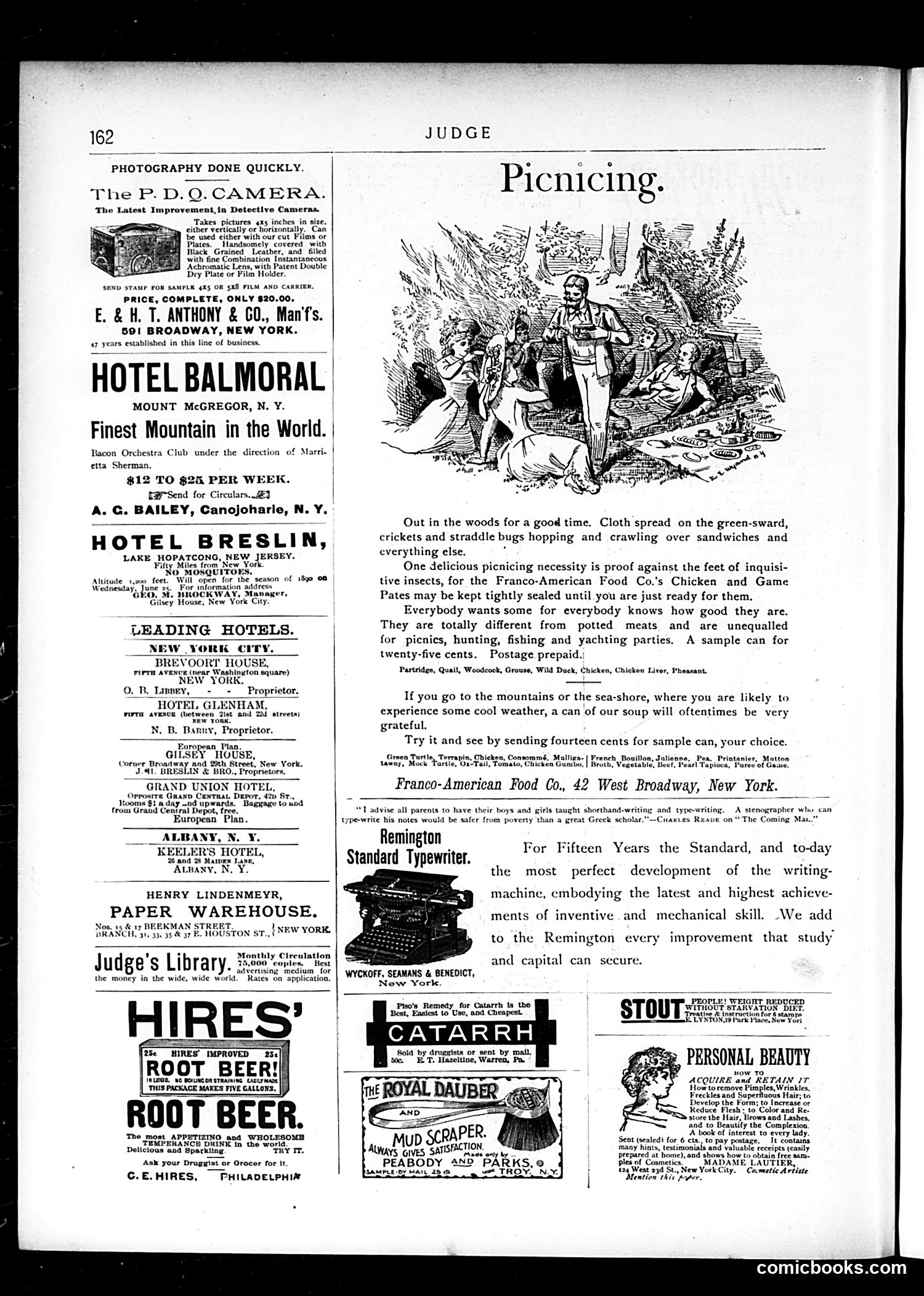
This page's main content is a genteel Victorian-era illustration of a picnic scene, accompanied by text promoting Franco-American Food Co.'s canned goods—specifically sealed pâtés and soups marketed as picnic essentials. The cartoon satirizes upper-class picnicking by depicting an idealized outdoor scene while the text humorously emphasizes the *practical* problem: insects. The joke is that despite romantic notions of outdoor dining, real picnics suffer from "crickets and straddle bugs hopping and crawling over sandwiches." The solution? Sealed canned foods—a modern convenience that protects food from "inquisitive insects." This is essentially advertorial content masquerading as editorial commentary, a common Judge practice. The satire gently mocks both the sentimental vision of picnicking and the real messiness of outdoor meals, while positioning canned goods as the civilized answer. The surrounding ads (hotels, cameras, typewriters) represent typical late-19th-century product placement in magazines.
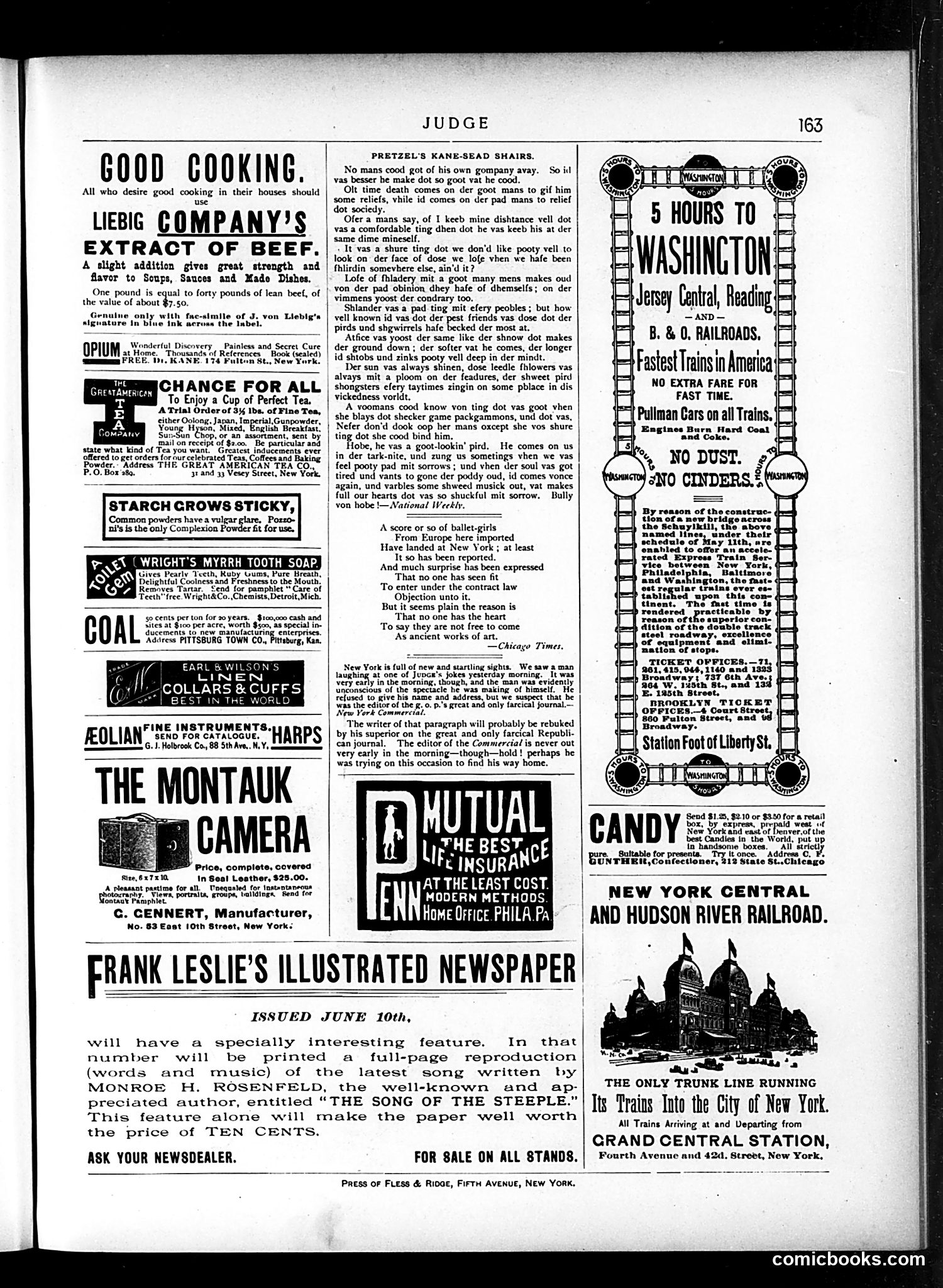
This page is **primarily advertising** with one satirical text feature. The main content is "Pretzel's Kane-sead Shairs" — a humorous column written in exaggerated German-American dialect, poking fun at German immigrant speech patterns and philosophy. The piece offers folksy observations on human nature (love, slander, advice, fidelity) in deliberately mangled English ("dot vas," "vhile," "yoost der condrary"). The satirical target appears to be **German immigrants themselves** — their accent, worldview, and comedic misuse of English. This reflects late-19th-century American humor that mocked ethnic minorities through dialect comedy, which modern readers would recognize as stereotyping. The remaining content is period advertisements for products like Liebig's Extract of Beef, tea, cameras, and railroads — typical magazine filler of the era.
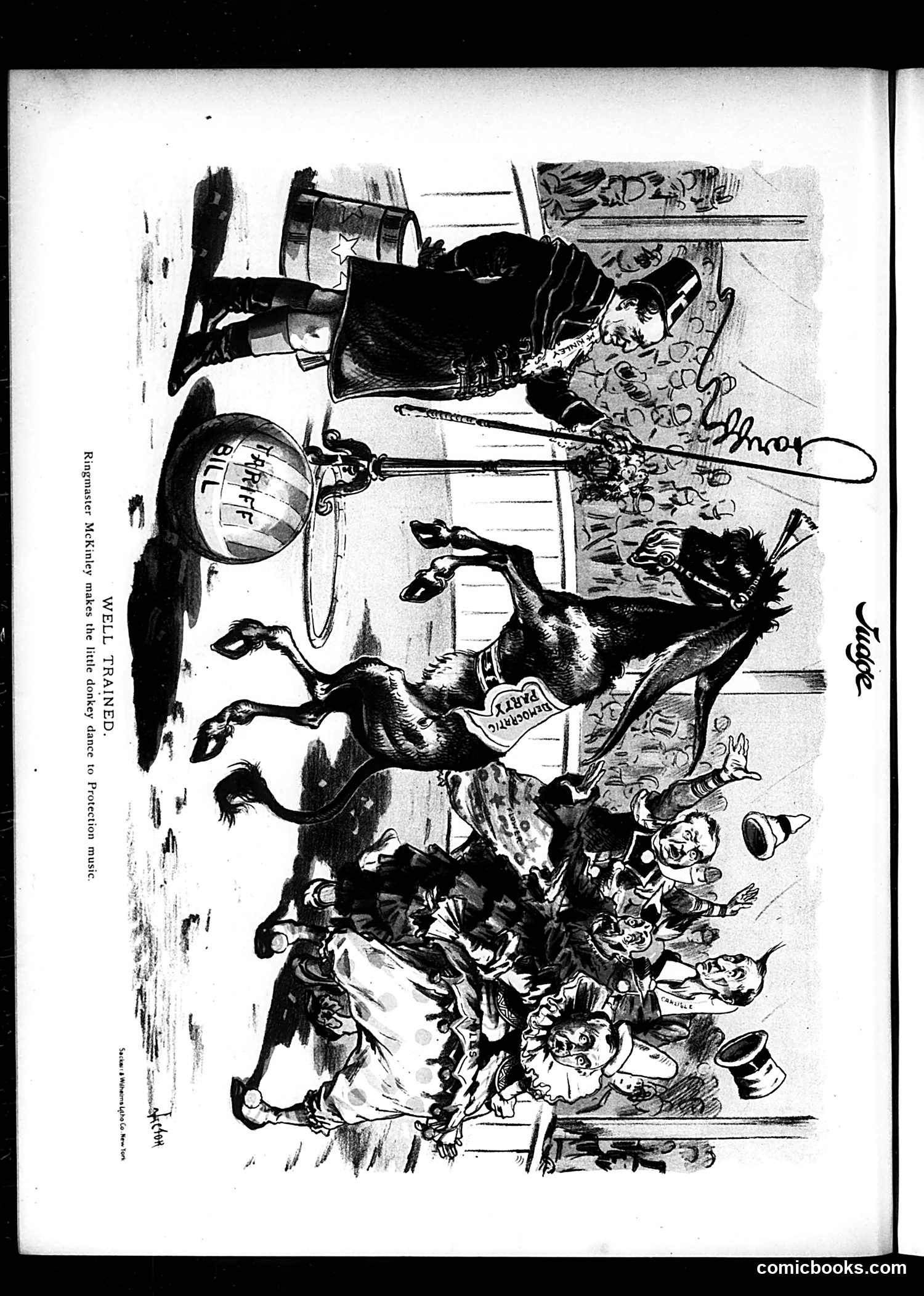
This appears to be a satirical cartoon from *Judge* magazine, though the OCR text is largely corrupted and illegible. The image shows a chaotic indoor scene with multiple figures in period dress (appearing late 19th or early 20th century). A woman in the center appears to be conducting or orchestrating the scene, while various characters—including what appears to be caricatured figures and possibly animals—engage in commotion around her. A large spherical object (possibly a globe or lamp) is visible on the left. Without legible text identifying the figures and their roles, the specific political or social satire remains unclear. The composition suggests commentary on domestic chaos, possibly related to women's suffrage, political management, or social disorder—common *Judge* magazine themes—but confirming the exact target requires readable captions or clearer historical context.