
Judge, 1890-06-14 · page 5 of 16
Judge — June 14, 1890 — page 5: what you’re looking at
What you’re looking at
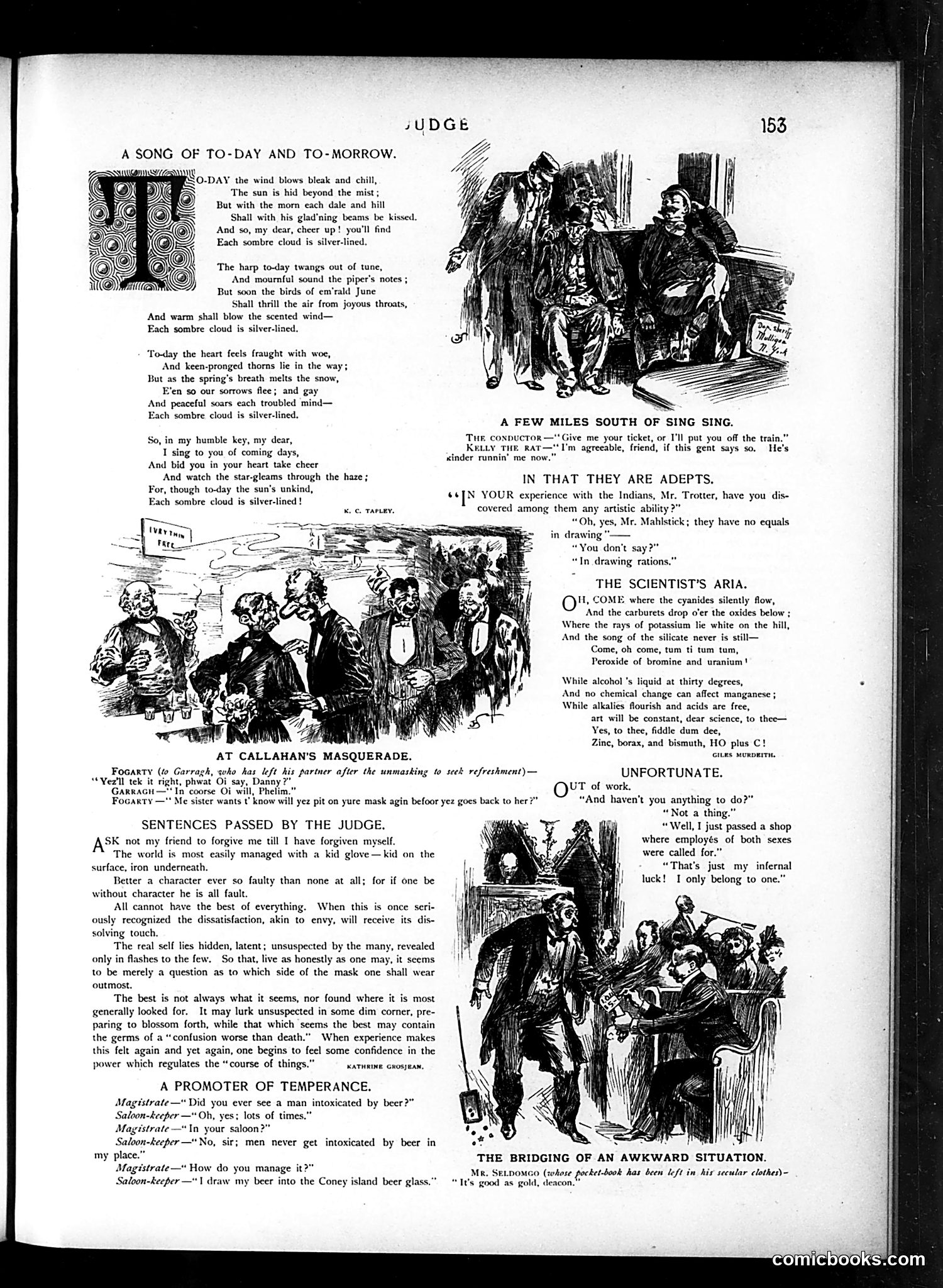
This page contains several satirical pieces typical of late 19th-century American humor: **"A Song of To-Day and To-Morrow"** is sentimental verse about finding hope amid present hardship—the "silver lining" theme common to period literature. **"At Callahan's Masquerade"** satirizes Irish immigrants through dialect humor, depicting working-class Irish characters (Fogarty, Garragh) at a social event. The joke relies on ethnic caricature typical of the era. **"A Promoter of Temperance"** mocks a saloon-keeper who claims his customers never get drunk—he supposedly uses specially shaped "Coney Island beer glasses." The satire targets alcohol industry hypocrisy regarding temperance debates. **"In That They Are Adepts"** appears to reference Native Americans' supposed skill at "drawing rations" (receiving government provisions), playing on period stereotypes. **"The Scientist's Aria"** is whimsical verse mocking overly technical scientific language through a mock-operatic song about chemistry. The page reflects Judge's characteristic blend of sentimental poetry, ethnic humor, and social commentary aimed at middle-class readers.
📄 Transcribed text from this page (OCR, searchable)
Machine-transcribed from the original scan — historical spelling and the odd misread are preserved.
A SONG OF TO-DAY AND TO-MORROW. mY , ji . 0-DAY the wind blows bleak and chill, ‘The sun is hid beyond the mist ; But with the morn each dale and hill Shall with his glad’ning beams be kissed. And so, my dear, cheer uj Each sombre cloud is silv ‘The harp to-day twangs out of tune, And mournful sound the piper's notes ; But soon the birds of em’rald June Shall thrill the air from joyous throats, And warm shall blow the scented wind— Each sombre cloud is silver-lined, ‘To-day the heart feels fraught with woe, And keen-pronged thorns lie in the way; But as the spring’s breath melts the snow, E’en so our sorrows flee; and gay And peaceful soars each troubled mind— Each sombre cloud is silver-lined. So, in my humble key, my dear, I sing to you of coming days, And bid you in your heart take cheer And watch the star-gleams through the haze; For, though to-day the sun's unkind, Each sombre cloud is silv AT CALLAHAN’S MASQUERADE. Focarty (lo Garragh, swho has left “Yez'll tek it right, phwat Oi GarraGu—"'In coorse Oi Focarty —"* Me sister wants t' know will yez pit on yure mask agin befoor yez goes back to her?” SENTENCES PASSED BY THE JUDGE, ASK not my friend to forgive me till 1 have forgiven myself. The world is most easily managed with a kid glove—kid on the surface, iron underneath. Better a character ever so faulty than none at all; for if one be without character he is all fault. All cannot have the best of everything. When this is once sei ously recognized the dissatisfaction, akin to envy, will receive its dis- solving touch. The real self lies hidden, latent; unsuspected by the many, revealed only in flashes to the few. So that, it seems to be merely a question as to which side of the mask one shall wear outmost. The best is not always what it seems, nor found where it is most generally looked for. It may lurk unsuspected in some dim corner, pre- paring to blossom forth, while that which seems the best may contain the germs of a “confusion worse than death.” When experience makes this felt again and yet again, one begins to feel some confidence in the power which regulates the “course of things.” KATHRIN GROSjEAM, A PROMOTER OF TEMPERANCE. Magistrate—* Did you ever see a man intoxicated by beer?” Saloon-keeper —“Oh, yes; lots of times.” Magistrate—*In your saloon?" Saloon-keeper —"No, sit; men never get intoxicated by beer in place.” Magistrate—* How do you manage it?” Saloon-keeper —"\ draw my beer into the Coney island beer glas: is partner after the unmasking to seek refreshment) — A FEW MILES SOUTH OF SING SING. Tur conpuctor—"'Give me your ticket, or I'll put you off the train.” KrLLy THE RaAT—"'I'm agreeable, friend, if this gent says so. He's xinder runnin’ me now. IN THAT THEY ARE ADEPTS. 44] YOUR experience with the Indians, M covered among them any artistic ability “Oh, yes, Mr. Mahlsticl Trotter, have you dis- hey have no equals in drawing "—— “You don't say?” “In drawing rations.” THE SCIENTIST’S ARIA. Oo". COME where the cyanides silently flow, And the carburets drop o'er the oxides below ; Where the rays of potassium lie white on the hill, And the song of the silicate never is still— Come, oh come, tum ti tum tum, Peroxide of bromine and uranium! While alcohol ‘s liquid at thirty degrees, And no chemical change can affect manganese ; While alkalies flourish and acids are free, art will be constant, dear science, to thee— Yes, to thee, fiddle dum dee, Zine, borax, and bismuth, HO plus C! cies MURDRITH. UNFORTUNATE. ovt of work. “And haven't you anything to do?” “Not a thing.” “Well, I just passed a shop where employés of both sexes were called for.” “That's just my infernal luck! I only belong to one.” THE BRIDGING OF AN AWKWARD SITUATION. DOMGO (whose pocket-book has been left in his secular clothes)- as gold, deacon."