
A complete issue · 16 pages · 1890
Judge — June 7, 1890
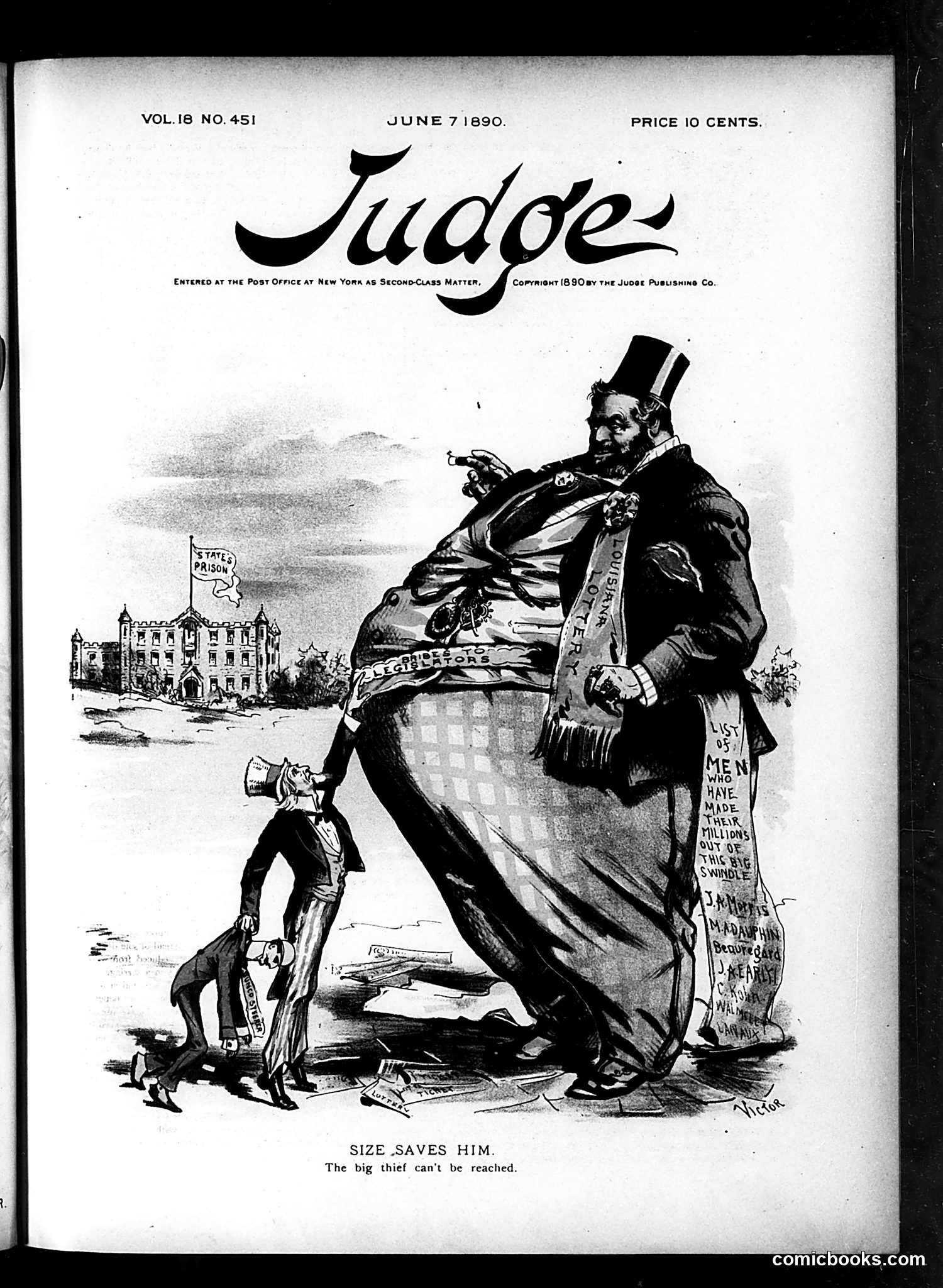
This political cartoon satirizes a powerful political figure (likely a state governor or official) whose size/influence protects him from accountability. A tiny figure at lower left—representing either a prisoner, citizen, or reformer—cannot reach the towering "big chief" to hold him accountable. The State Prison building visible in the background suggests corruption or abuse of the justice system. The scroll listing names on the right appears to catalog individuals allegedly wronged or swindled by this figure. The caption "The big chief can't be reached" emphasizes the cartoon's point: wealth, political power, and status create immunity from consequences that ordinary citizens face. This reflects late-19th-century American concerns about political corruption and unequal justice.
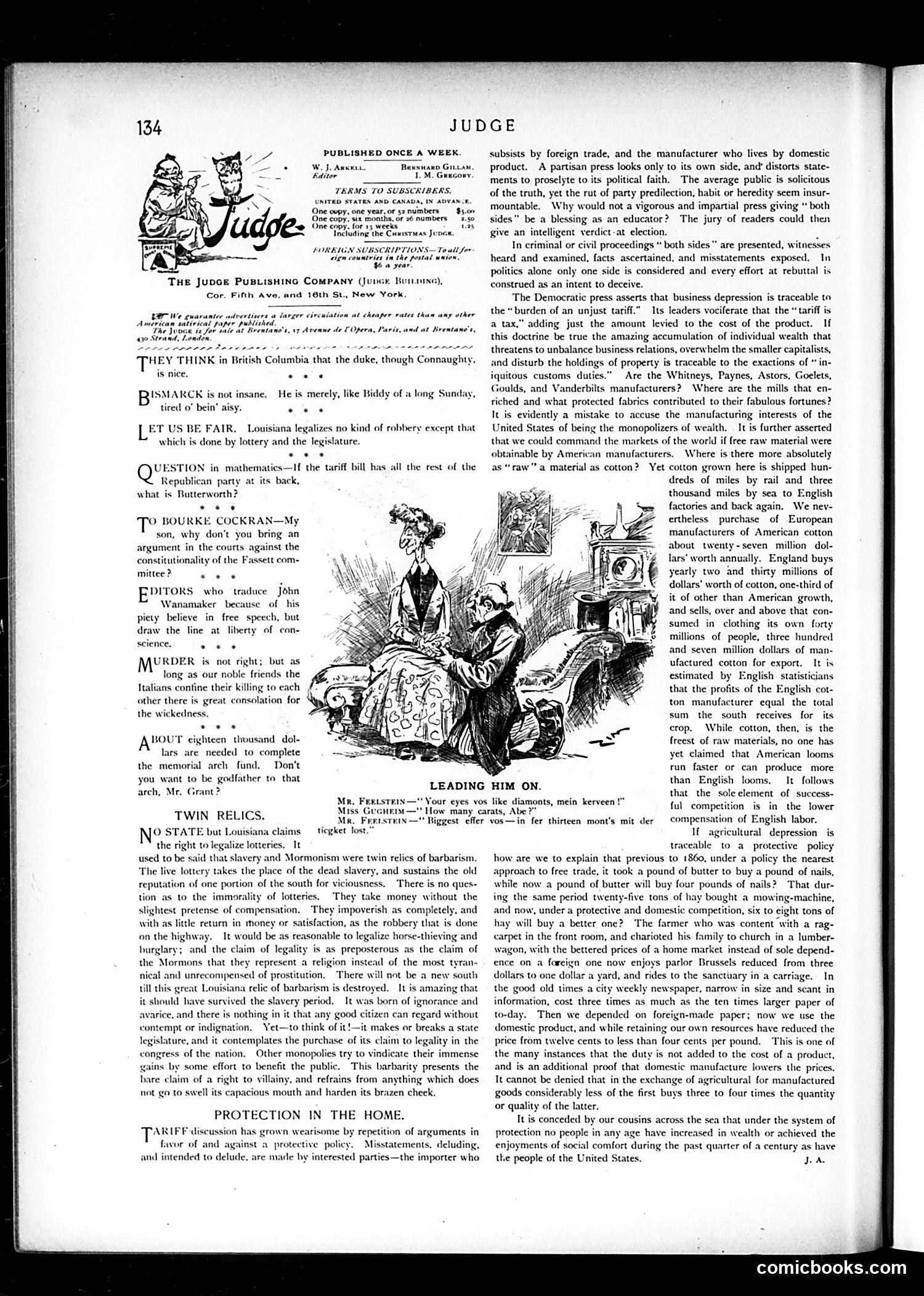
The main cartoon titled "LEADING HIM ON" depicts a woman showing a man fabric swatches or samples, likely representing domestic American textiles. This satirizes debates over **protective tariffs on manufactured goods**. The surrounding editorial text discusses the "tariff question," arguing that American manufacturers—particularly cotton producers—deserve protection from cheaper foreign imports. The piece critiques the Democratic Party's "free trade" stance as naive, asserting that tariffs safeguard American labor and industry. The cartoon's "leading him on" suggests the woman (representing American industry) is manipulating the man (likely a politician or consumer) through appeals to buy domestic products. This reflects 1890s-era tensions between protectionist and free-trade economic philosophies that dominated American politics.
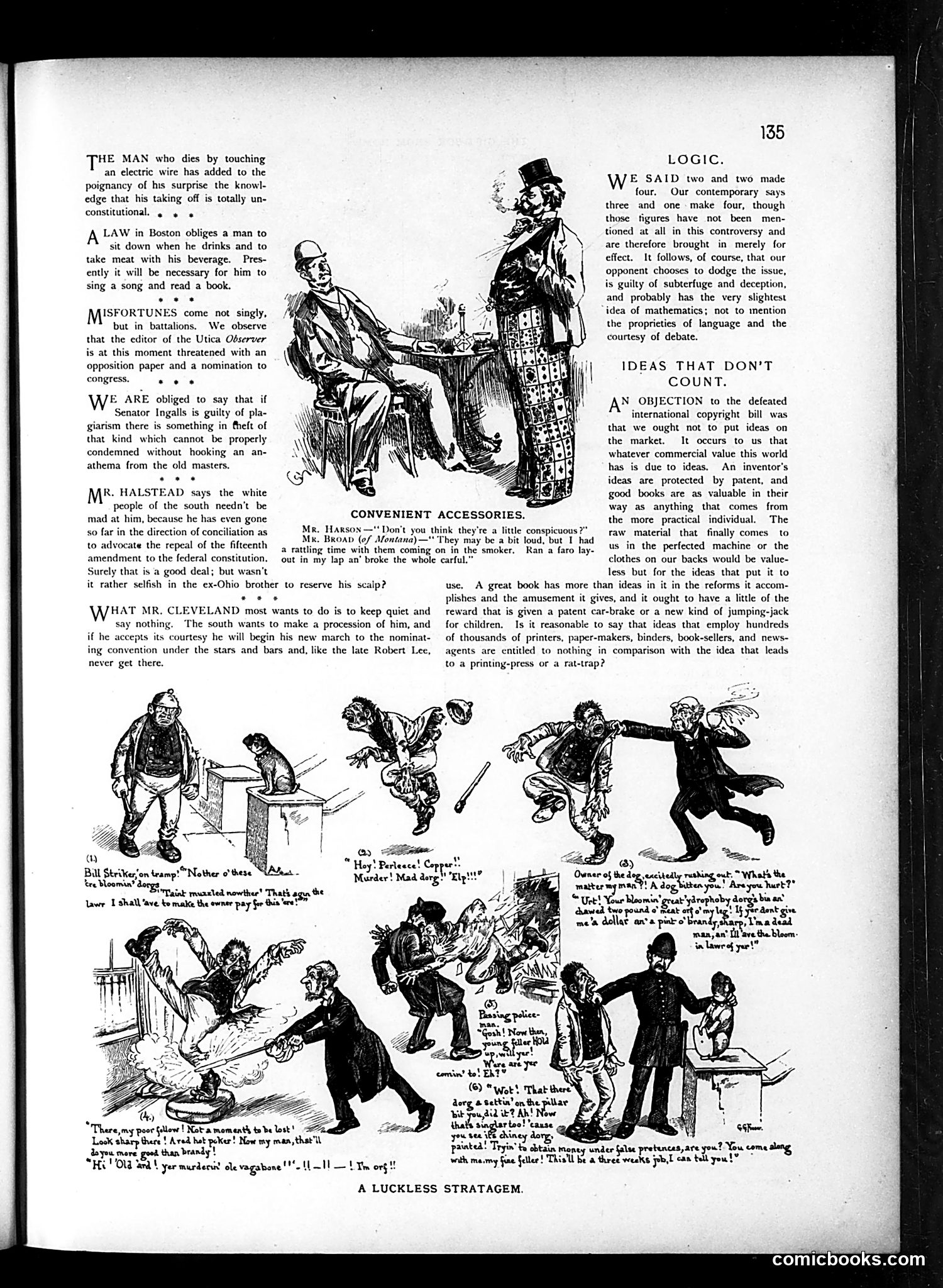
This page contains several satirical pieces targeting political and social issues of the era: **"Logic"** mocks an opponent's argument about two-plus-two equaling four, accusing them of "subterfuge and deception" by dodging the issue—apparently referencing a real contemporary debate. **"Ideas That Don't Count"** criticizes copyright law, arguing that ideas lack commercial value compared to physical inventions. The author suggests book publishers unfairly profit from intellectual property while inventors of practical devices (printing-presses, jumping-jacks) receive minimal compensation. **"A Luckless Stratagem"** (lower cartoon series) depicts slapstick scenes of social mishaps—though specific contemporary references remain unclear from the image alone. The overall tone suggests commentary on class interactions or labor disputes. The page's humor relies on wordplay and visual gags typical of Judge's satirical approach.
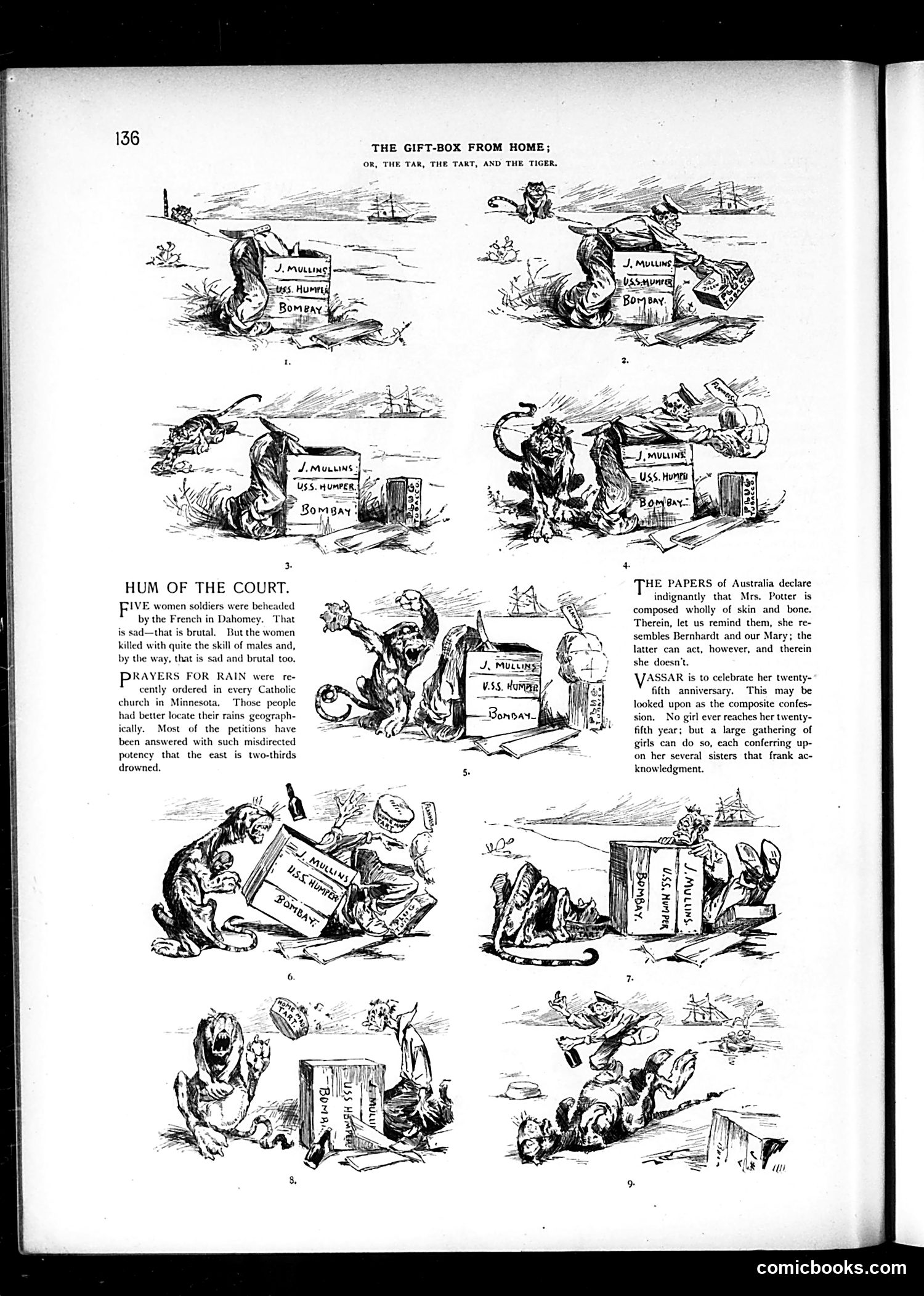
This page presents a nine-panel satirical comic sequence depicting animals (appearing to be monkeys or apes) discovering and mishandling packages labeled "J. Mullins," "USS Humper," and "Bombay." The sequence shows progressive destruction of the contents through each panel. The accompanying text snippets mock various contemporary topics: French colonial violence in Dahomey, misdirected rain prayers in Minnesota, actress Mrs. Potter's thin appearance (compared unfavorably to Sarah Bernhardt), and Vassar College's twenty-fifth anniversary. The main cartoon's humor likely satirizes careless handling of gifts or goods shipped overseas (the "gift-box from home" reference), using animal characters to suggest incompetence or barbarism—a crude visual metaphor common to 1890s-era satirical publications. The specific package labels and progressive deterioration suggest commentary on colonial trade, military supplies, or emigrant parcels, though the exact reference remains unclear without additional context about the "tar, tart, and tiger" in the subtitle.
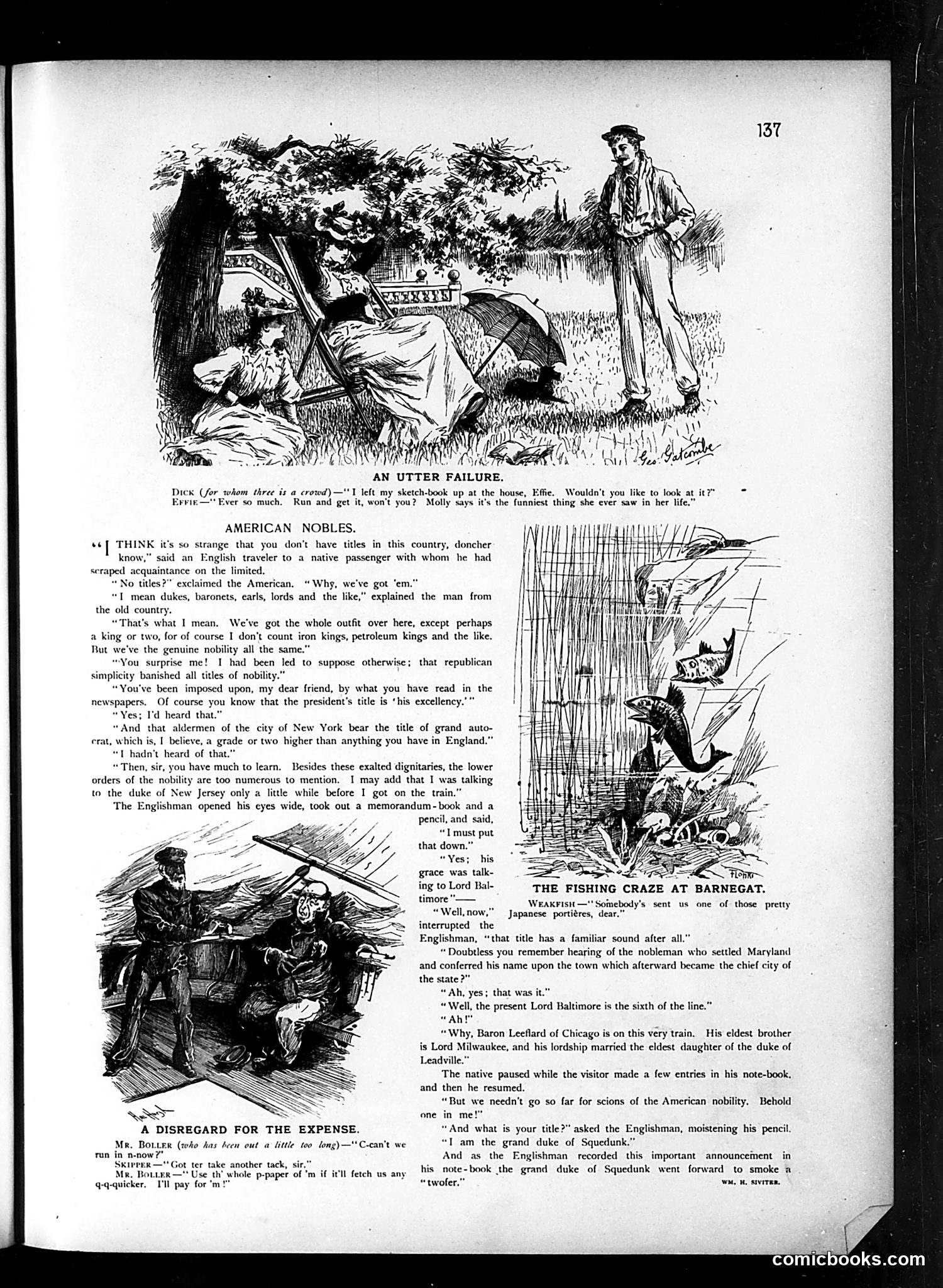
This page satirizes American pretension and the supposed classlessness of American society. An English traveler is amazed that America lacks titles—until a native passenger gleefully catalogs America's "nobility": the President's "excellency," New York aldermen as "grand autocrats," and invented aristocrats like the "Duke of New Jersey," "Lord Milwaukee," and "Baron Leeflard of Chicago." The joke hinges on Americans' contradiction: while rejecting monarchy, they've created their own informal nobility based on wealth (petroleum kings, iron kings, the duke of Leadville) and political office. The satire mocks both Americans' vanity (inventing grandiose titles) and the English visitor's gullibility in earnestly recording these fabrications. The "Grand Duke of Squedunk" caps the absurdity—a completely fictional title accepted as legitimate. The other cartoons appear unrelated humorous vignettes about romantic miscommunication and fishing.
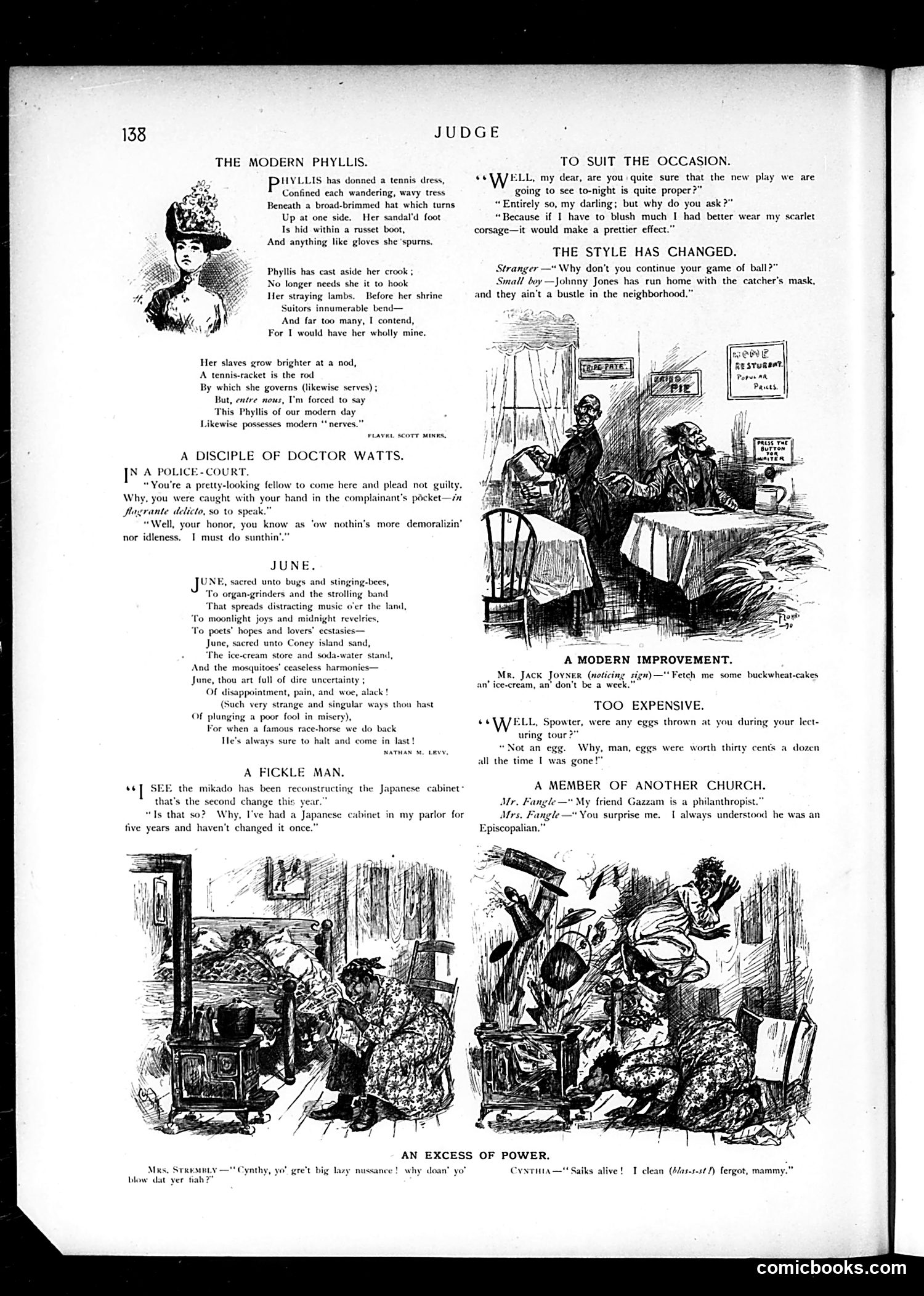
This page contains multiple satirical pieces typical of late-19th/early-20th century American humor: **"The Modern Phyllis"** mocks the "New Woman"—specifically the athletic, independent woman adopting tennis and abandoning traditional feminine restraint. The poem humorously complains that modern women possess "nerves" (boldness/audacity) alongside their athletic prowess. **"A Disciple of Doctor Watts"** shows a police-court scene where a man caught pickpocketing claims idleness is "demoralizing"—implying theft is preferable to unemployment, a darkly ironic commentary on Victorian morality. **The remaining brief jokes** satirize various social topics: changing fashions ("scarlet corsage"), modern improvements, inflation (eggs costing more), church membership, and domestic dynamics. The cartoons use exaggerated character types and situations common to Judge's satirical approach—mocking social pretension, gender role changes, economic anxiety, and domestic situations. The page reflects Gilded Age anxieties about modernization and shifting social norms.
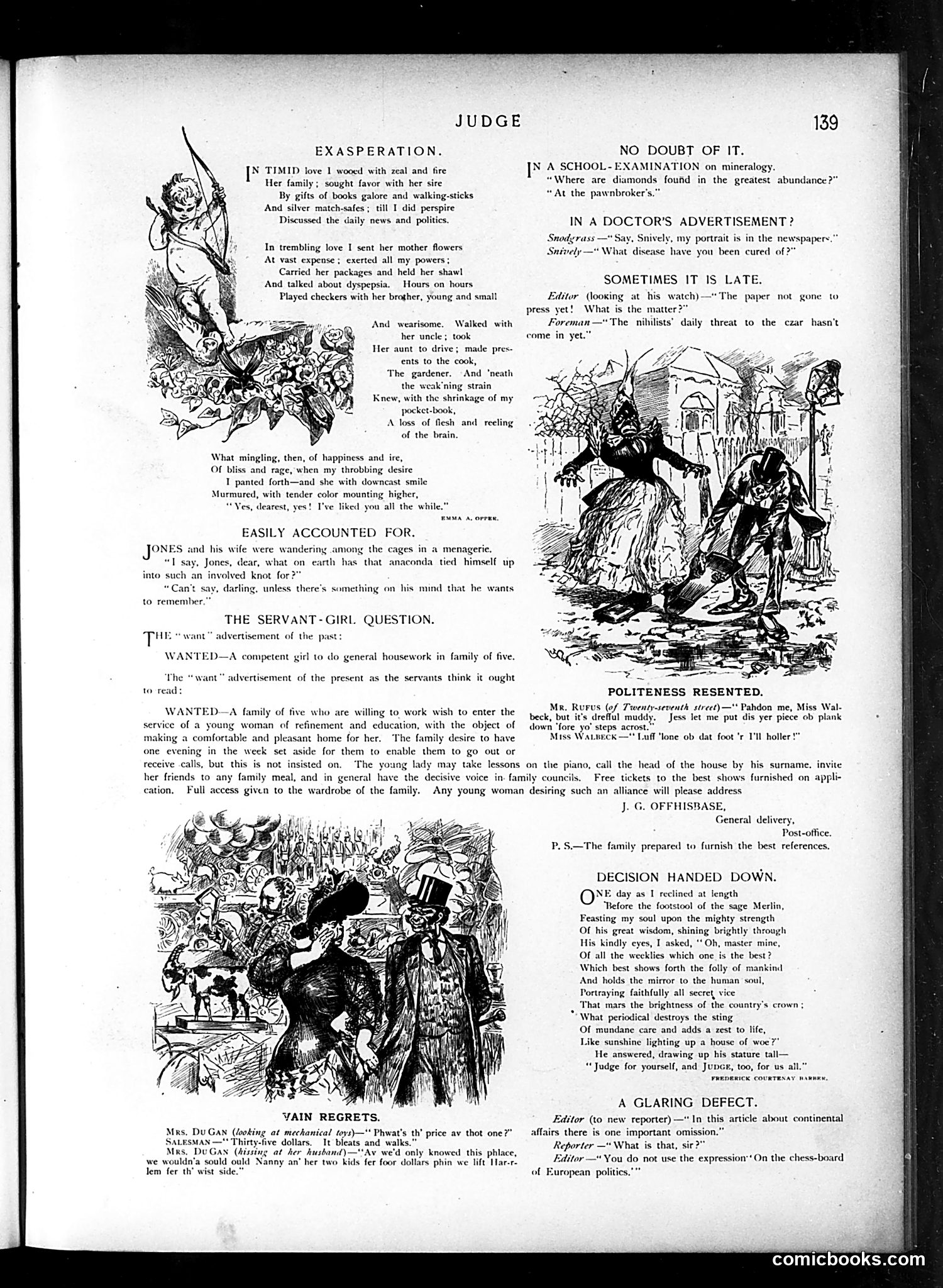
This page contains multiple satirical sketches typical of Judge's social commentary: **"Exasperation"** mocks an overeager suitor who lavishes attention on his beloved's entire family—buying gifts, attending to chores, enduring tedious activities—only to receive a lukewarm acceptance ("I've liked you all the while"). The satire targets masculine desperation and family obligation in courtship. **"The Servant-Girl Question"** reverses the traditional job advertisement format. Where employers once dictated terms to servants, the sketch suggests servants now demand employers become their staff, with rights to evenings off and wardrobe access. This reflects real labor tensions of the era—servants were increasingly asserting bargaining power. **Minor sketches** satirize contemporary life: a school exam joke about diamonds at pawnbrokers (mocking poverty), a Russian nihilist threat as newspaper filler, and Irish-dialect humor about class difference. The page reflects Judge's focus on class anxiety, courtship conventions, and shifting labor dynamics in Gilded Age America.
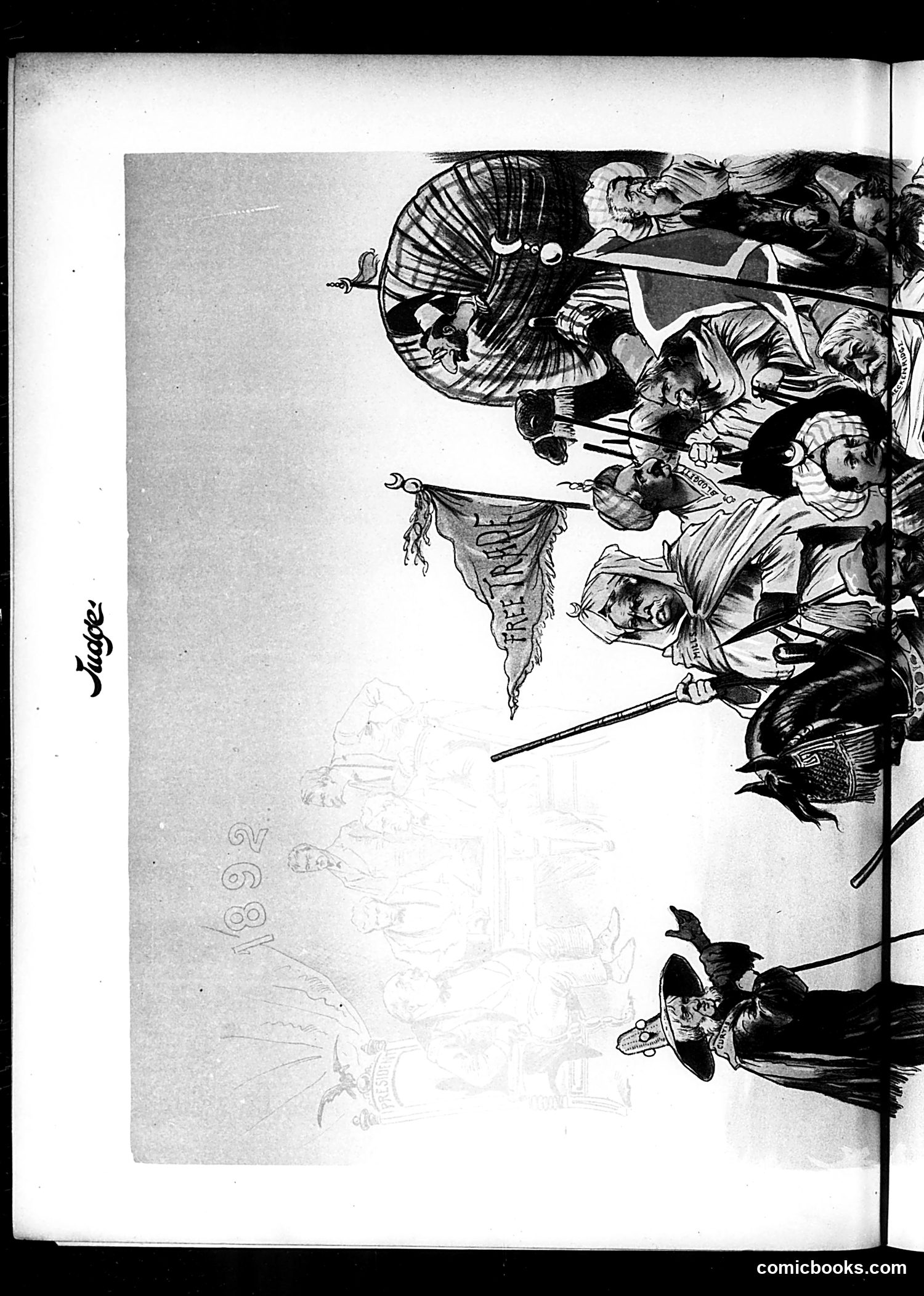
The OCR text appears to be corrupted or consists only of characters/numbers that don't form readable words, making it impossible to extract meaningful context from that source. Looking at the **image itself**, this appears to be a political cartoon printed upside-down or sideways (rotated 90 degrees). The illustration shows multiple figures in period dress with exaggerated features typical of 19th-century satirical caricature. There's an elaborate parasol or umbrella visible, and what appears to be a banner or flag with text that's difficult to read in this reproduction. Without legible text or a clear date visible on the page, I cannot reliably identify the specific political figures, events, or satirical points being made. The artistic style suggests **late 19th-century American political satire**, but determining the exact subject and meaning requires either clearer text or additional contextual information.
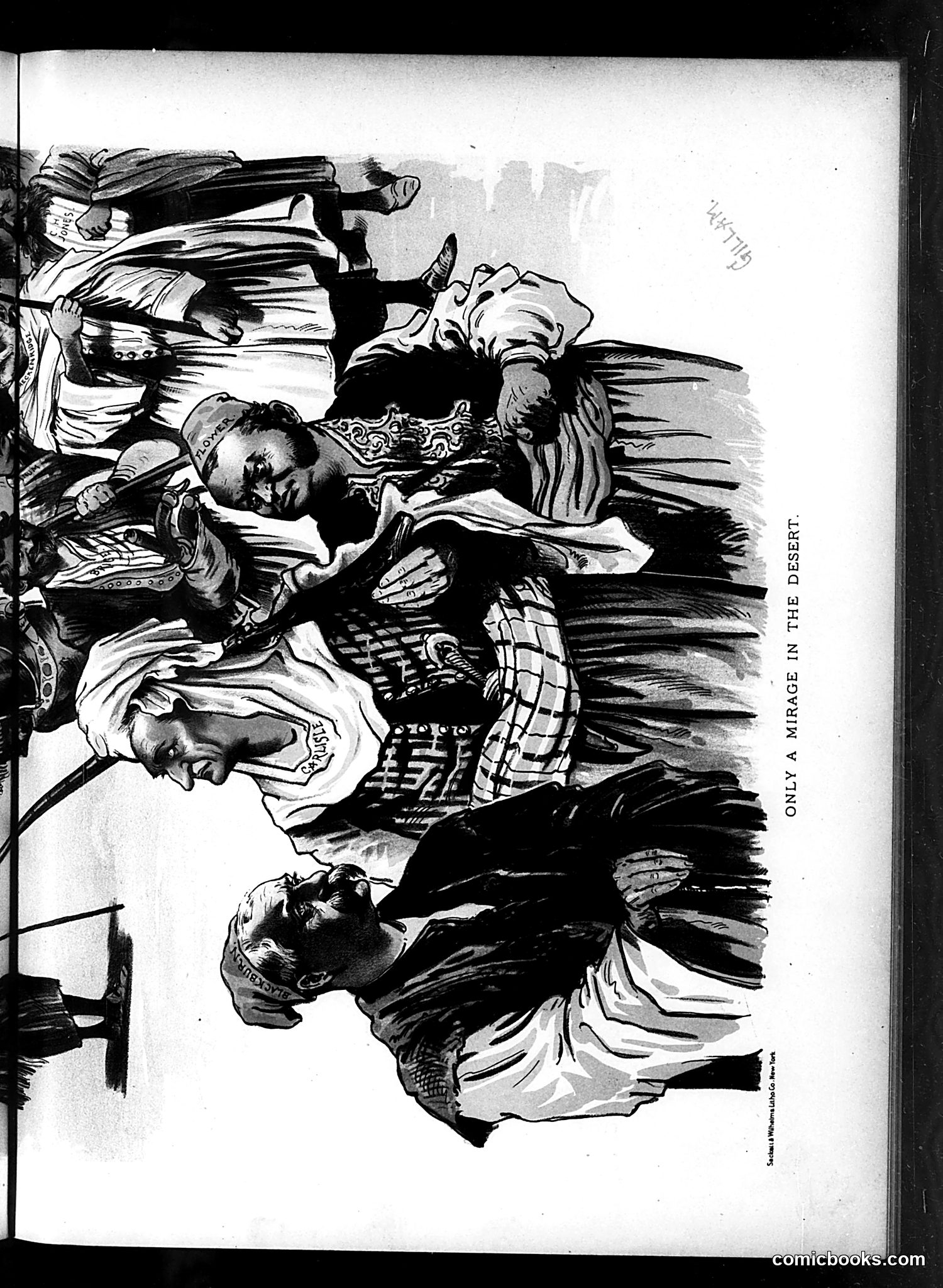
The caption reads "ONLY A MIRAGE IN THE DESERT," suggesting this is a political cartoon about false hopes or illusions in a desert setting. The image shows multiple figures in period dress (appearing to be 19th century), with some appearing to be wealthy or official individuals observing what seem to be mirages or illusions. However, the OCR text is heavily corrupted and unreadable, providing no clear political or historical context. Without legible text identifying the specific figures, political figures being caricatured, or the historical event referenced, I cannot reliably explain what particular political situation or social commentary this cartoon addresses. The artistic style and "Judge" magazine context suggest American political satire, likely concerning wealth, politics, or social pretense, but the specific meaning remains unclear without better source material.
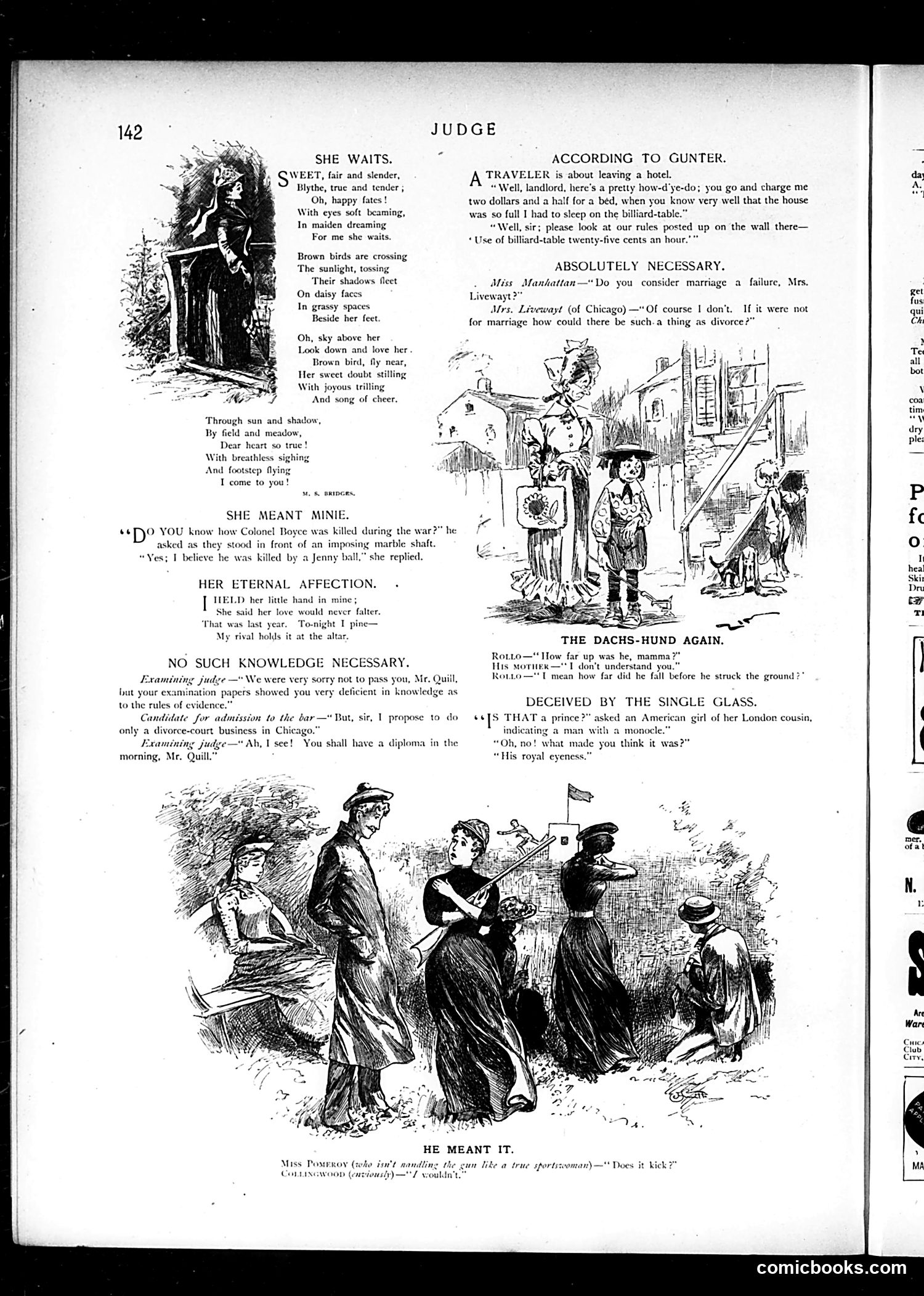
This page contains several short humorous pieces typical of Judge's satirical style: **"She Waits"** is a sentimental poem with romantic illustration—likely satirizing Victorian romantic poetry's melodramatic tone. **"She Meant Minie"** jokes about a woman misunderstanding Civil War terminology, confusing "Jenny ball" (Enfield bullet) with a person's name—poking fun at feminine ignorance of military matters. **"Her Eternal Affection"** presents ironic commentary on women's faithfulness: a man's beloved swears eternal love, then marries another man the following year. **"No Such Knowledge Necessary"** satirizes lawyer credentials, showing an examining judge concerned a candidate lacks proper legal knowledge, but the candidate dismisses this—he only needs divorce-court experience, implying divorce cases require minimal competence. **"According to Gunter"** mocks hotel pricing: a traveler charged extra for sleeping on a billiard table, the landlord justified by posted rules. **Other pieces** include mild jabs at marriage, parenting, and social pretension. The humor relies on wordplay, situational irony, and gentle mockery of contemporary American society and institutions.
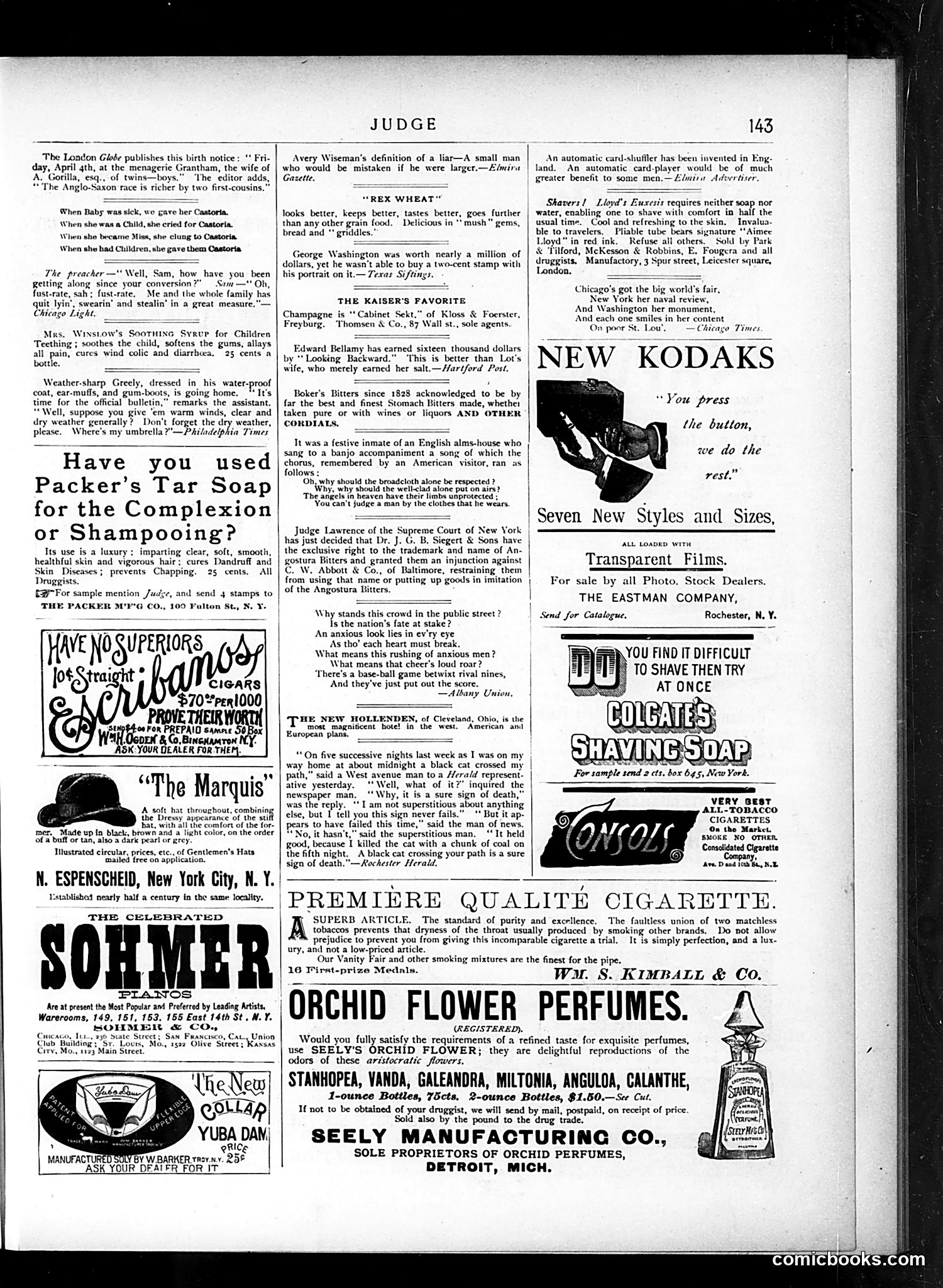
This page is primarily **advertisements and filler content** rather than political cartoons. The actual humor pieces are brief, lightweight items typical of Judge magazine's satirical format: 1. **The "Birth Notice" joke** mocks Anglo-Saxon racial superiority by sarcastically likening births of gorillas to human "cousins"—targeting contemporary pseudo-scientific racism. 2. **The Preacher/Sam dialogue** uses stereotypical dialect humor about a converted Black man's moral improvement—reflecting period racial attitudes. 3. **The Weather Greely cartoon** appears to reference an explorer (likely Adolphus Greely) jokingly requesting good weather conditions, with implied bureaucratic absurdity. The page is dominated by product advertisements (soaps, cigars, pianos, perfumes), which generated Judge's revenue. The satirical content is minimal and reflects 1880s-90s attitudes: casual racism, gender stereotypes, and gentle social observation rather than hard-hitting political commentary.
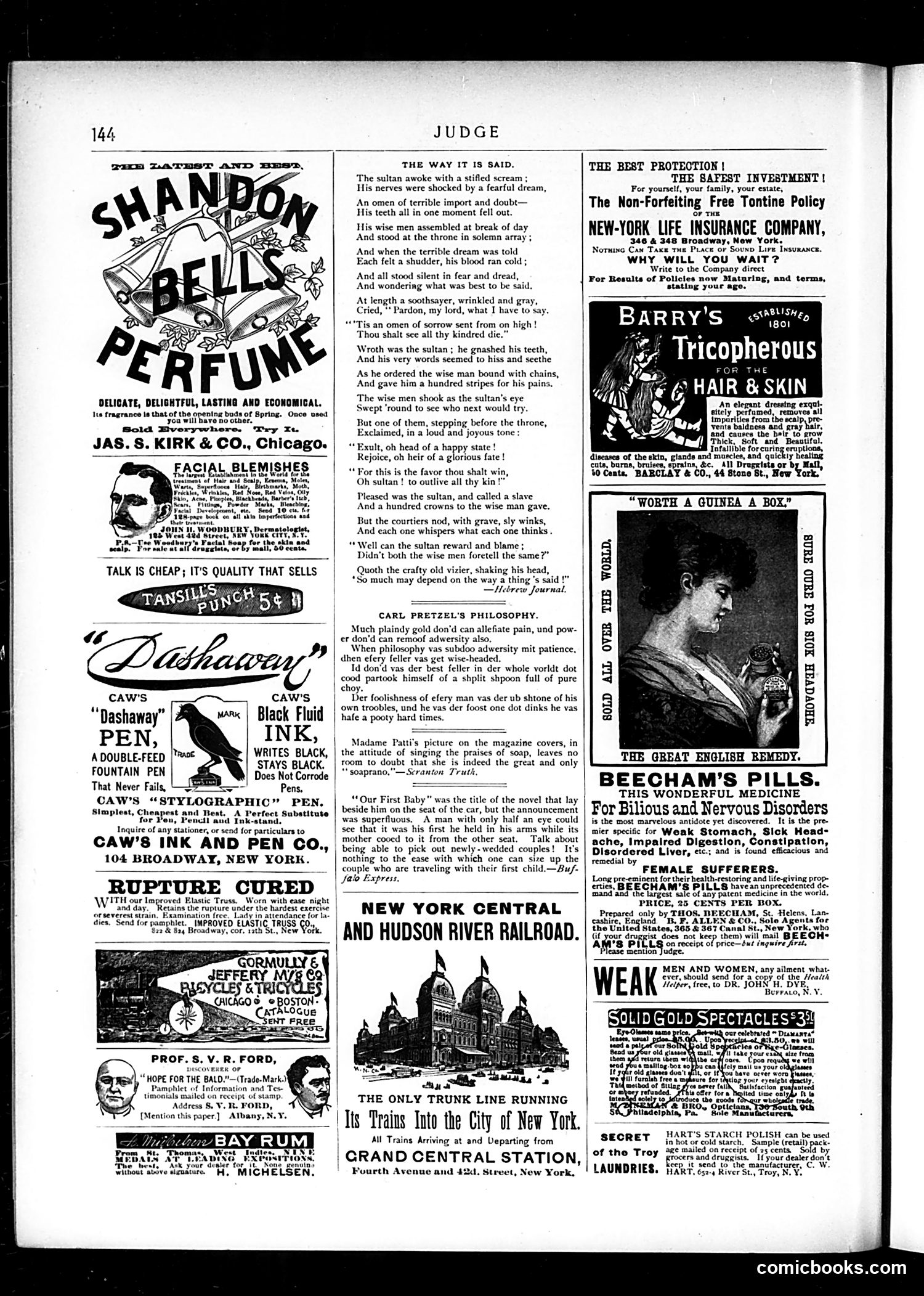
This page is primarily **advertising**, typical of Judge magazine's revenue model. The visible content includes: **Main Cartoon/Content:** "The Way It Is Said" — a humorous parable about a Turkish sultan whose wise men interpret his tooth-loss dream identically but with opposite conclusions. One warns of family deaths (punished); another predicts he'll outlive his relatives (rewarded). The satire critiques how **identical facts receive opposite interpretations based on presentation and audience preference**—a commentary on rhetoric, spin, and how people hear what they want to hear. **Supporting Content:** - "Carl Pretzel's Philosophy" — a comedic ethnic character offering folksy wisdom in exaggerated German-American dialect - Literary quips about Madame Patti and novel titles **Advertisements:** Perfumes, pens, ink, rupture trusses, hair treatments, and railroad promotions dominate the page—representative of late 19th-century Judge content. The "sultan" parable reflects period satirical concerns about truth, persuasion, and human gullibility—timeless themes Judge exploited for humor.
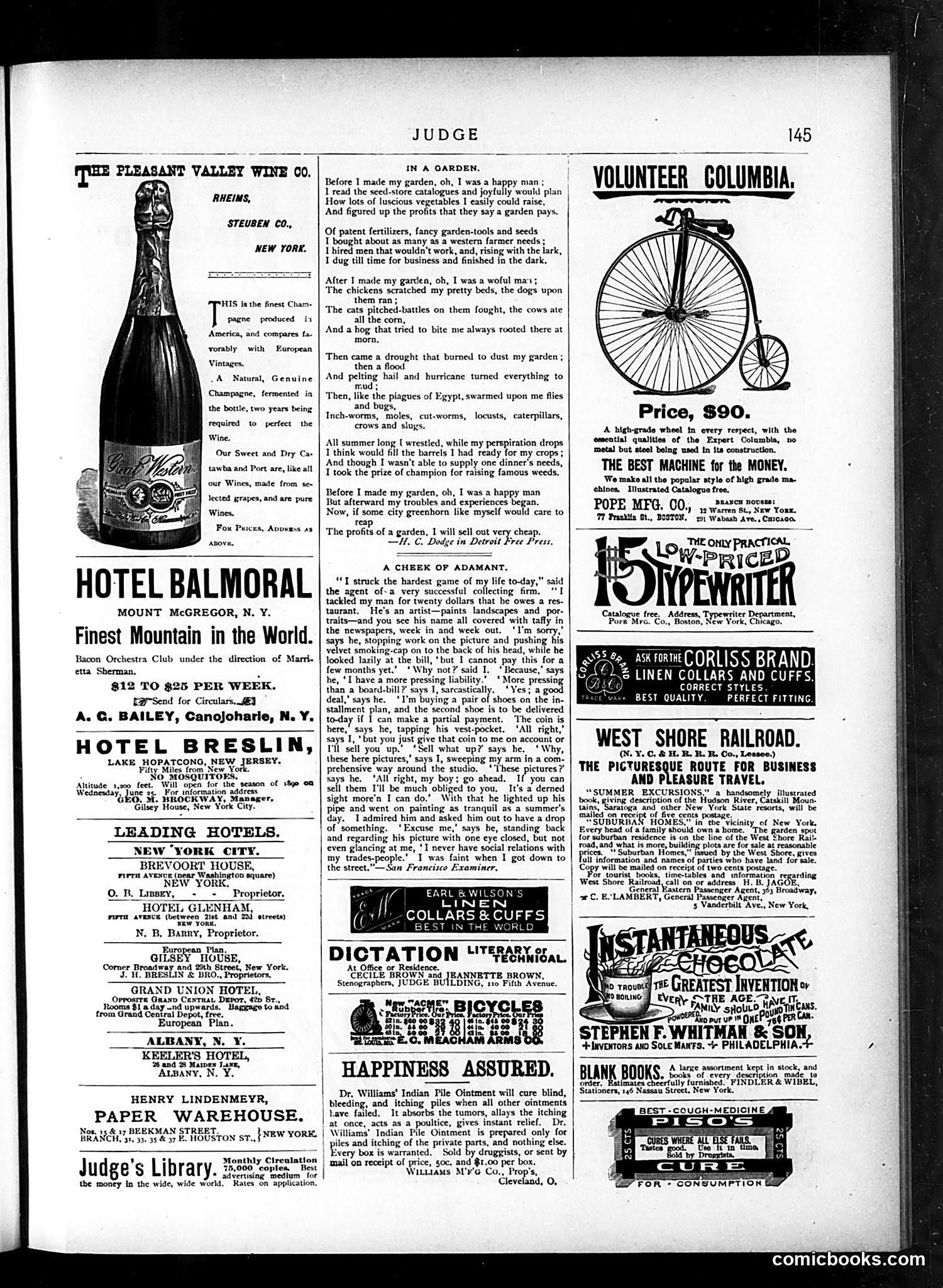
This page is **primarily advertising** with two brief humorous pieces. The main content includes: - **"In a Garden"**: A comedic poem about a city dweller who enthusiastically plants a garden expecting profits, only to encounter every agricultural disaster—drought, flood, pests, animals destroying crops—while ironically winning a prize for raising weeds. The satire mocks urban romanticism about farming and get-rich-quick schemes. - **"A Cheek of Adamant"**: A brief anecdote about a debt collector attempting to recover twenty dollars from a painter. The artist deflects by claiming he must prioritize paying for shoes on an installment plan rather than settling restaurant debts. The joke satirizes both artistic poverty and the absurdity of installment-plan consumer culture priorities. The remainder consists of hotel advertisements (Balmoral, Breslin, Glenham), wine promotions, and various commercial products—typical of Judge's advertising-heavy format from this era.
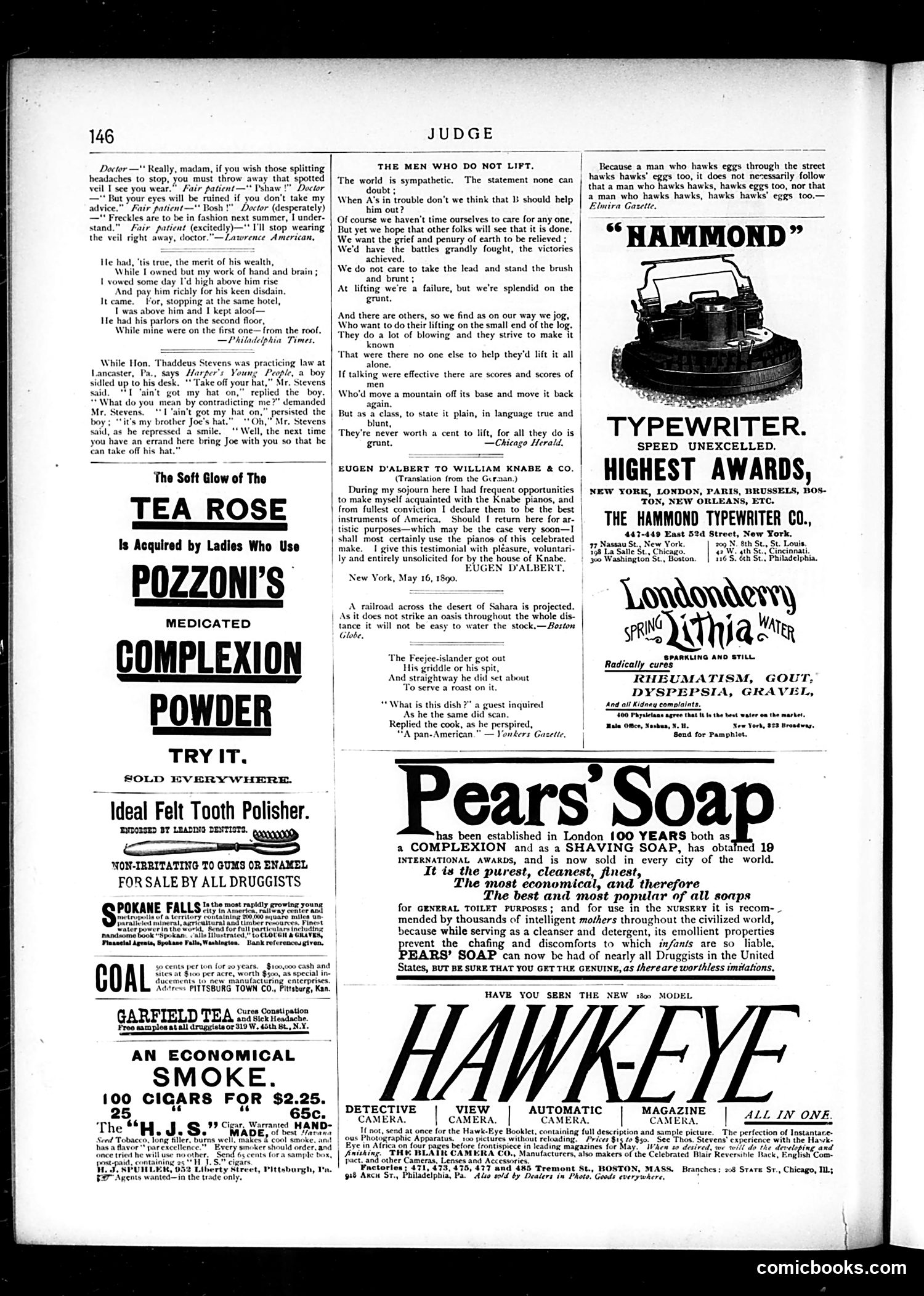
This page is primarily **advertising** with several brief humorous vignettes interspersed. The main cartoon depicts a doctor advising a woman to stop wearing her spotted veil because it causes headaches and eye strain. She dismisses his medical concerns—until he suggests freckles will be fashionable next summer, whereupon she immediately agrees to abandon the veil. The satire mocks women's vanity: fashion dictates their choices more powerfully than health or practical reasoning. Other brief jokes include a story about lawyer Thaddeus Stevens correcting a boy's claim about whose hat he's wearing (a wordplay joke about literal truth), and a verse about people who volunteer opinions and sympathy but refuse actual work—they "grunt" but never "lift." The remainder of the page consists of period advertisements for cosmetics (Pozzoni's Complexion Powder, Pears' Soap), tobacco, coal, real estate, typewriters, and patent medicines—typical of Judge's revenue model. **Overall**: This is a standard advertising-heavy issue page with light social satire about vanity and hypocrisy.
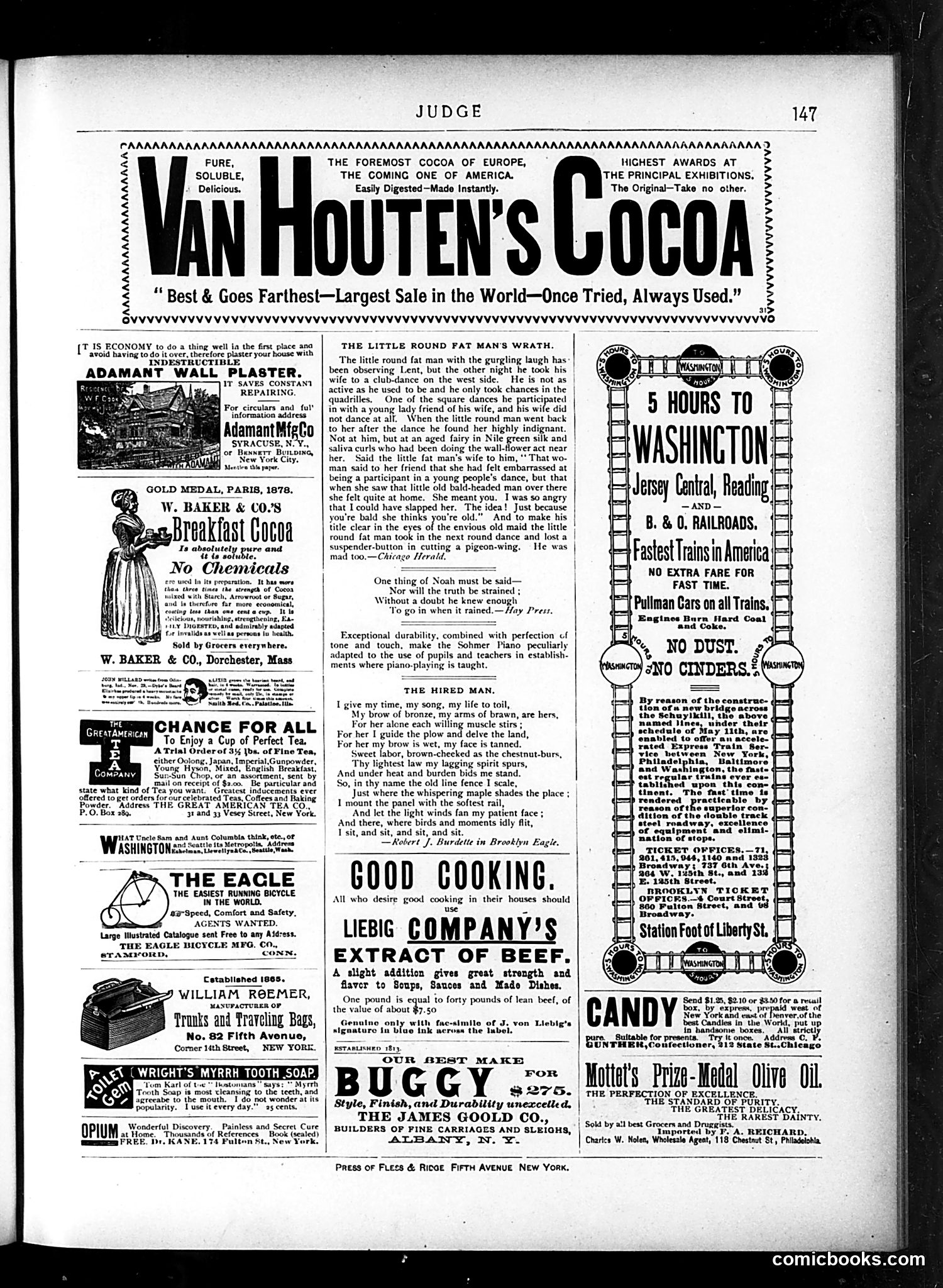
This is primarily a **classified advertising page** from Judge magazine, with one brief satirical story embedded among the ads. ## The Main Content: "The Little Round Fat Man's Wrath" This is a social satire about a middle-aged, bald, overweight man attending a dance with his wife. An elderly woman (described as an "aged fairy" in outdated fashion) insults him by telling her friend that seeing this older man made *her* feel young by comparison. His wife is furious at the insult. The man's revenge is to dance energetically in the next round, deliberately losing a suspender button—a petty, undignified response that mocks his own vanity and wounded pride. **The joke**: It satirizes male ego and the absurdity of taking social slights seriously at a dance. The punchline emphasizes his pathetic attempt at retaliation. The page is otherwise filled with period **product advertisements**—cocoa, tea, bicycles, carriages, tooth soap, and medical nostrums—typical of Judge's revenue model. These ads reveal what consumers of the 1870s-80s considered desirable.
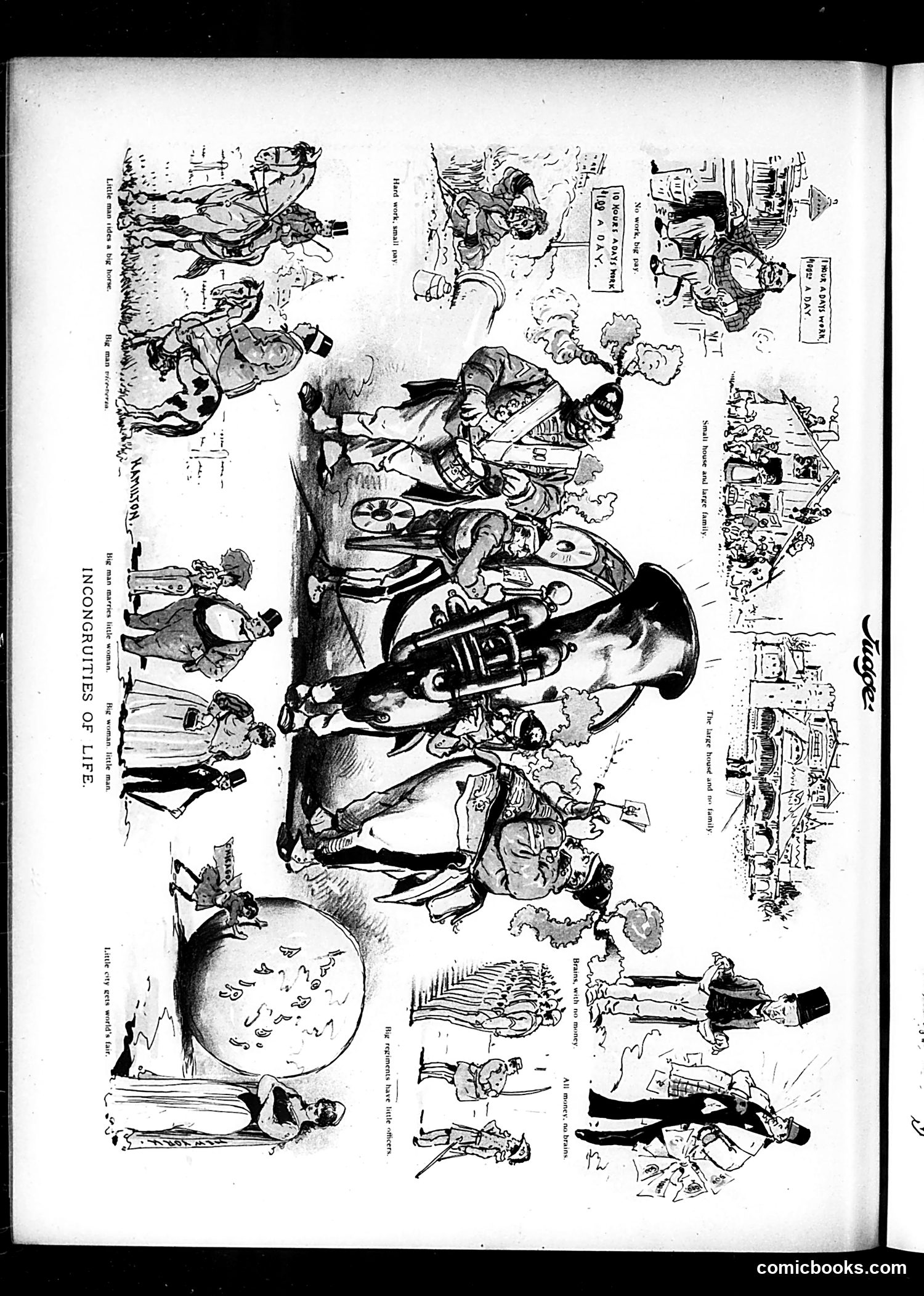
The OCR text is too corrupted to read reliably. However, examining the image itself: this appears to be a multi-panel satirical cartoon page, likely from the early 20th century based on the illustration style and printing quality. The page contains several scenes with caricatured figures in various situations—some appear to involve social commentary on contemporary life, possibly relating to wealth, class, or urban society. One panel features what seems to be a large spherical object, suggesting an absurdist or exaggerated scenario typical of Judge's humor. Without legible text identifying the specific figures, events, or political references, I cannot reliably explain the satire's particular targets or meaning to a modern reader. The artistic quality suggests these were prominent social or political figures of the era, but identification requires clearer source material.